




Inside the class 11 maths notes chapter 11 introduction to three dimensional geometry, you will find the three coordinate axes, the coordinates of a point in space, the eight octants, and both the distance and section formulas that the CBSE Boards, JEE Main, JEE Advanced, and CUET test in 2026-27. These revision notes explain each idea in plain language, with a full formula table for quick recall.
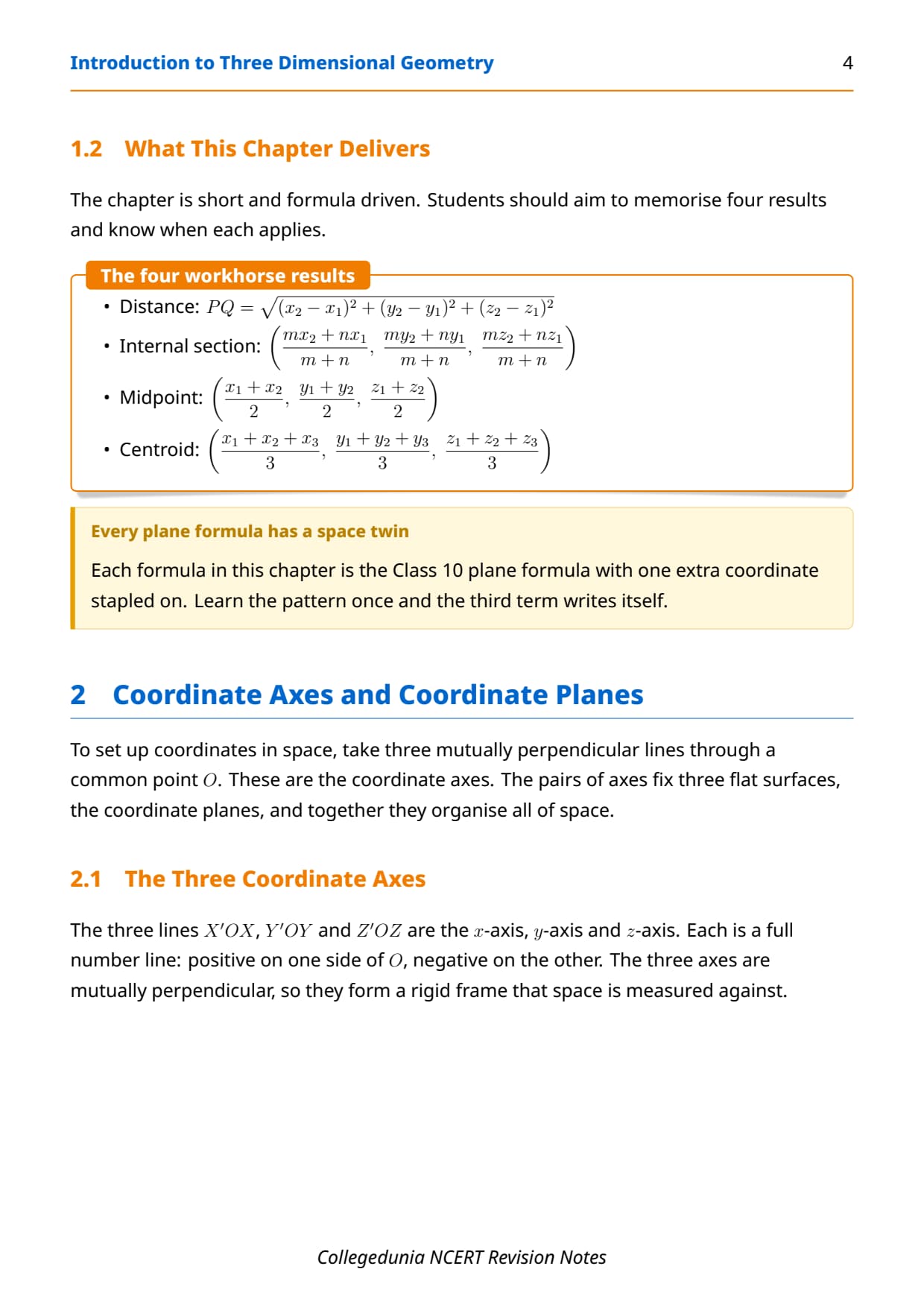
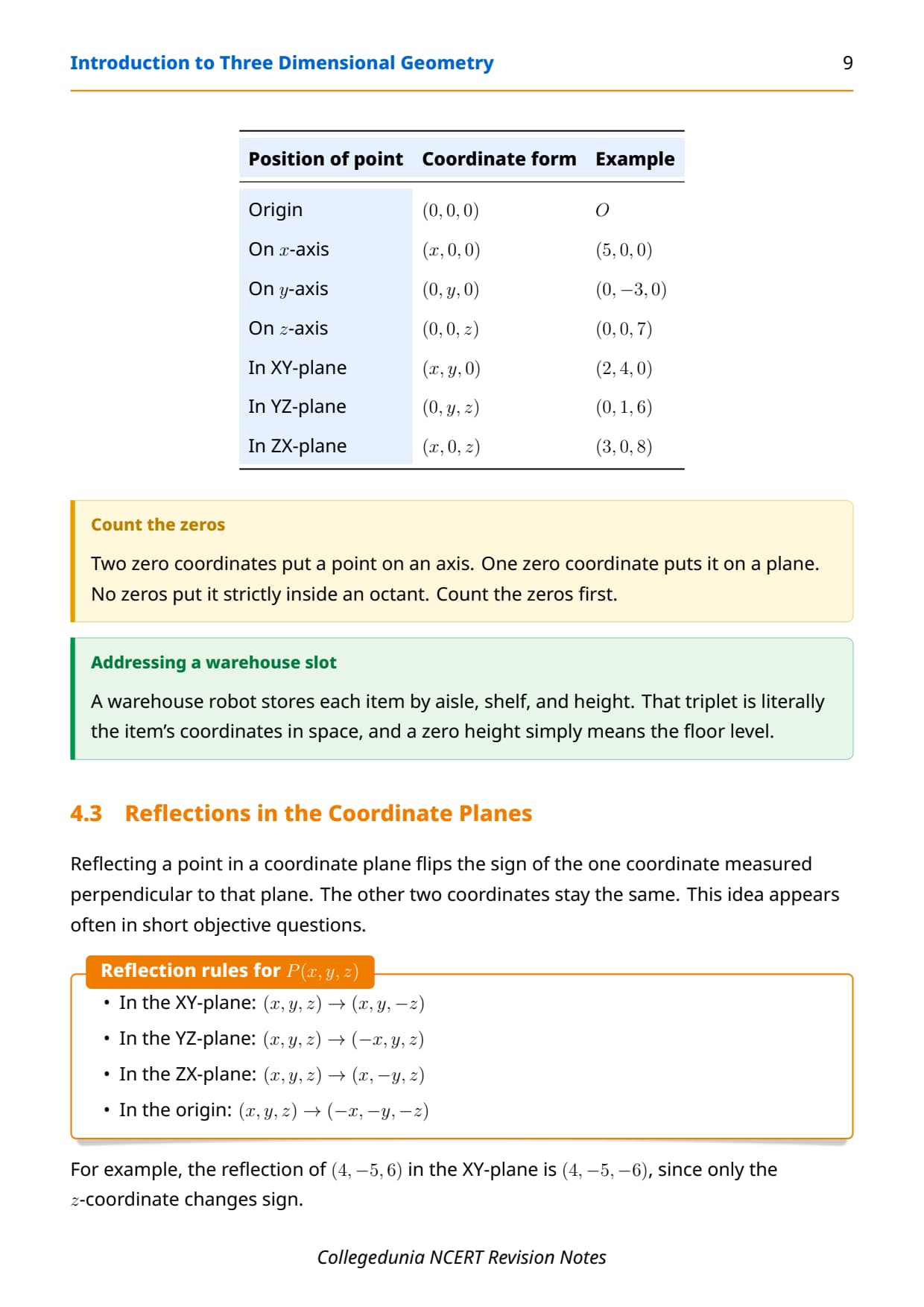
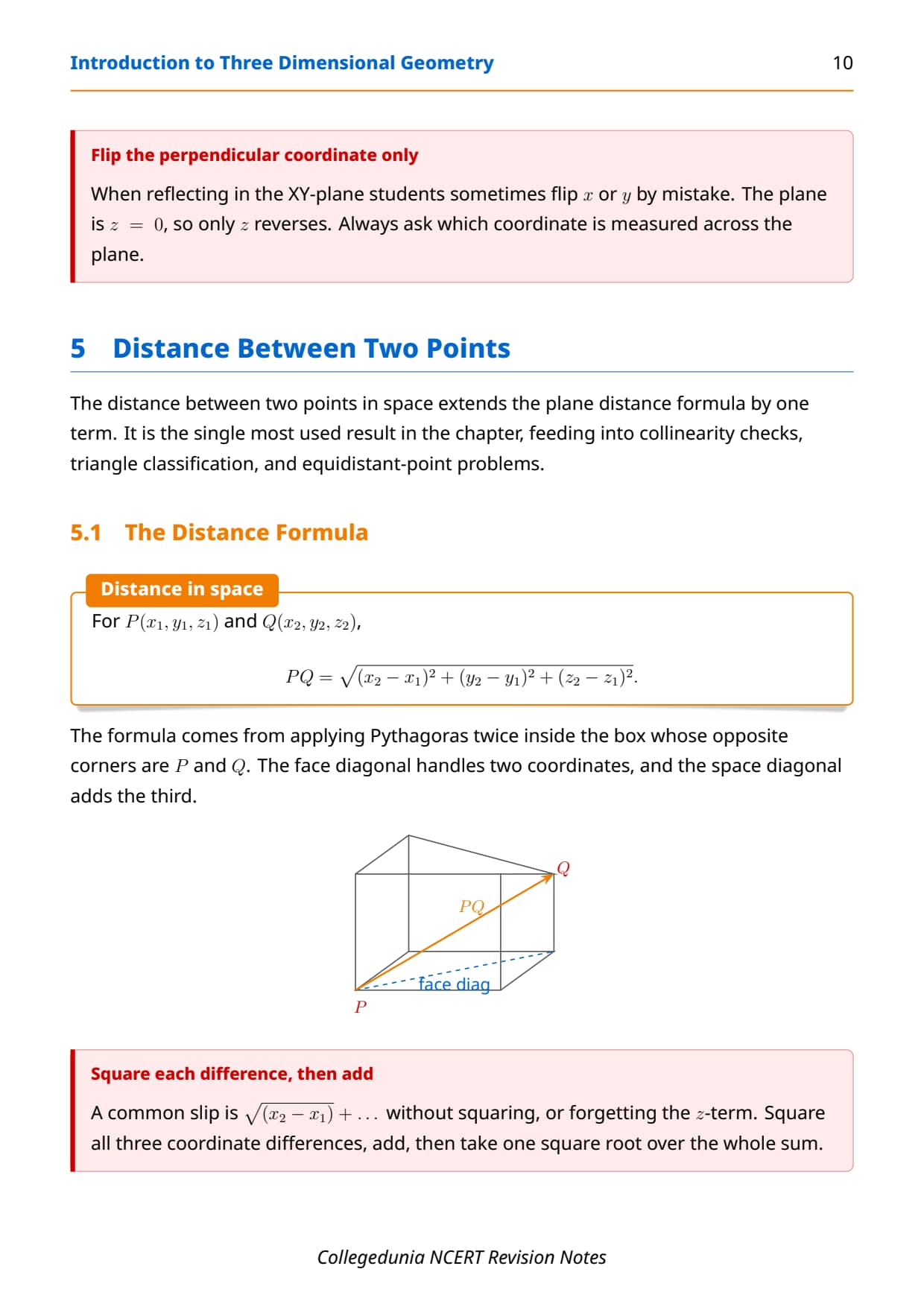
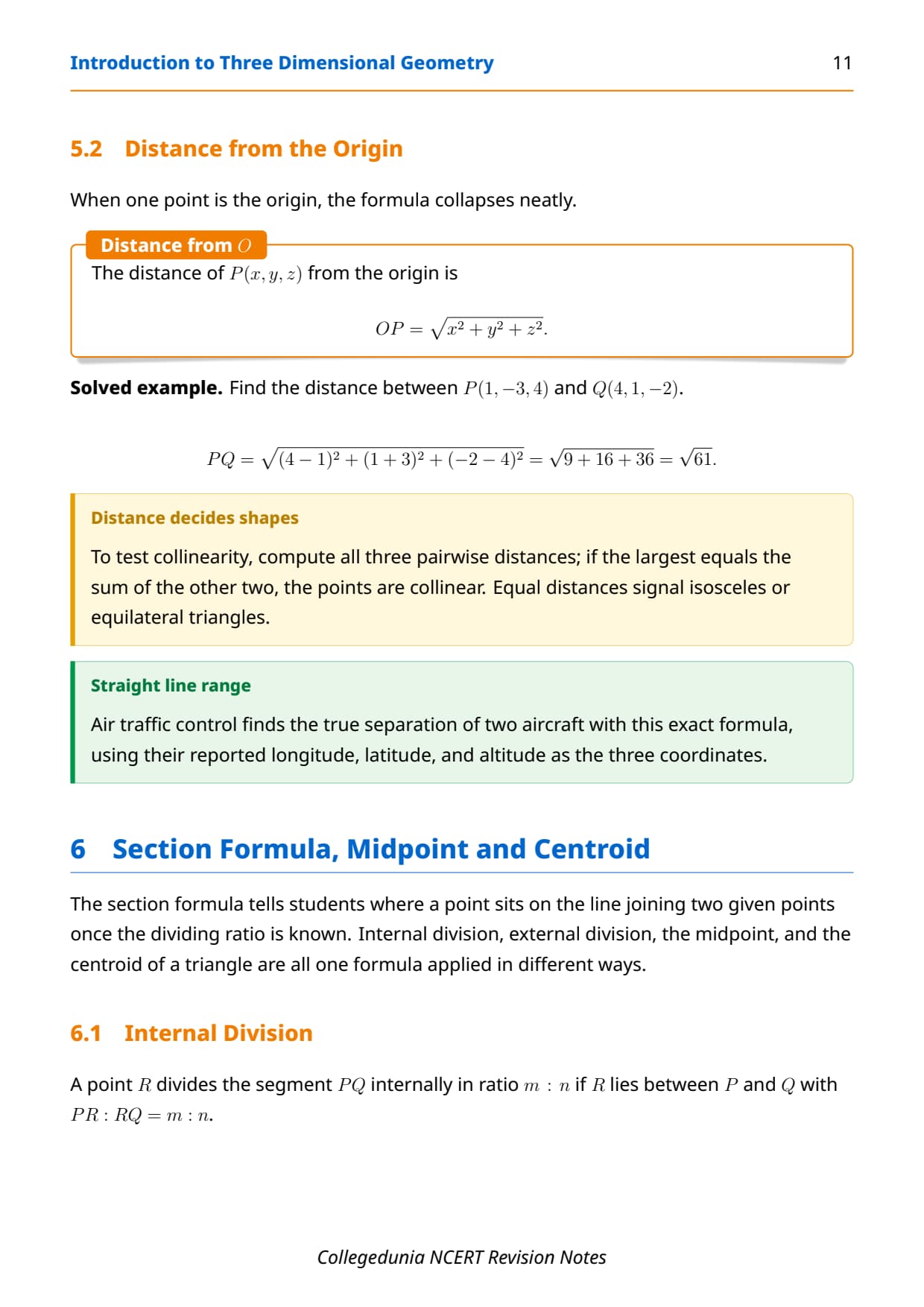
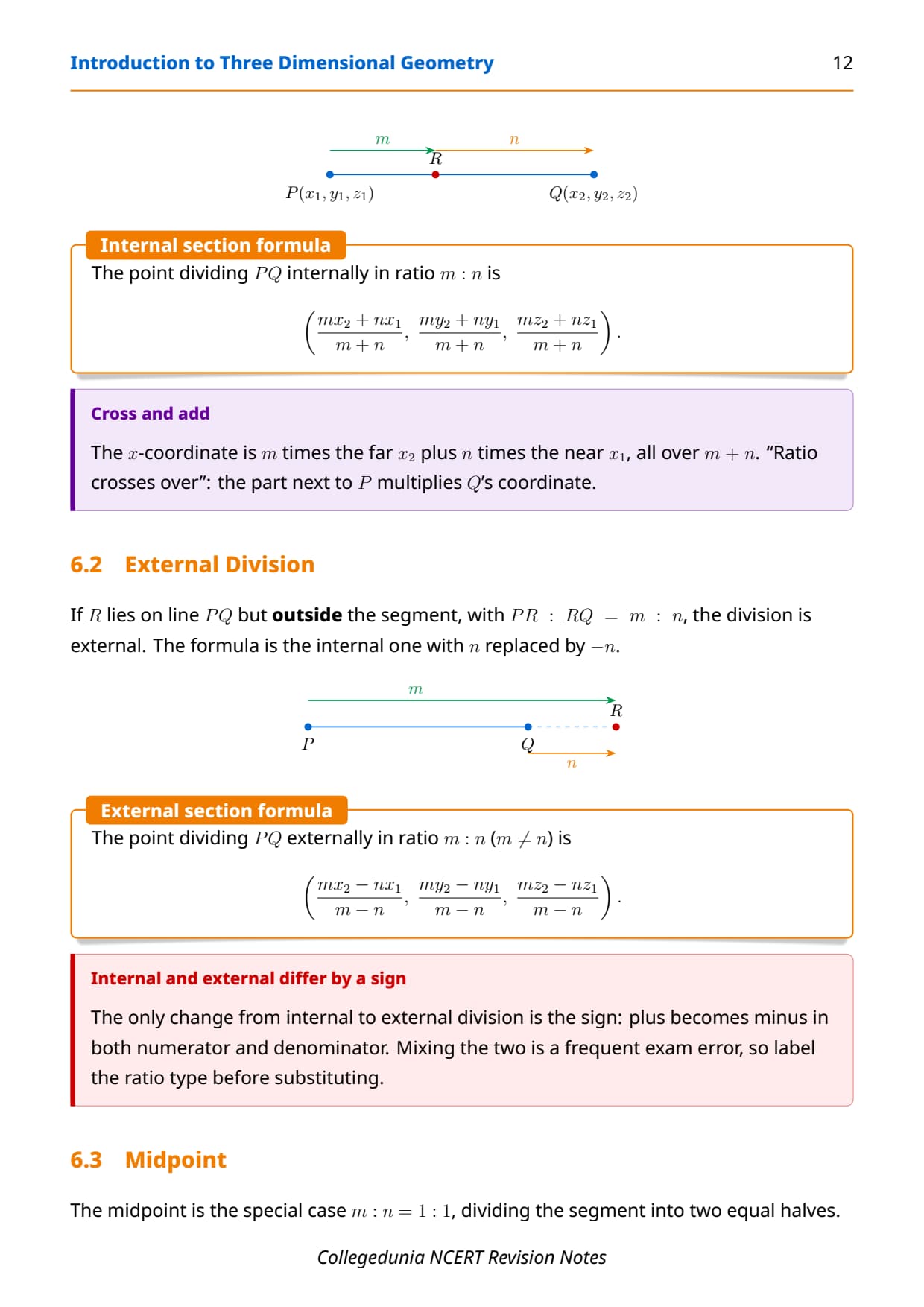
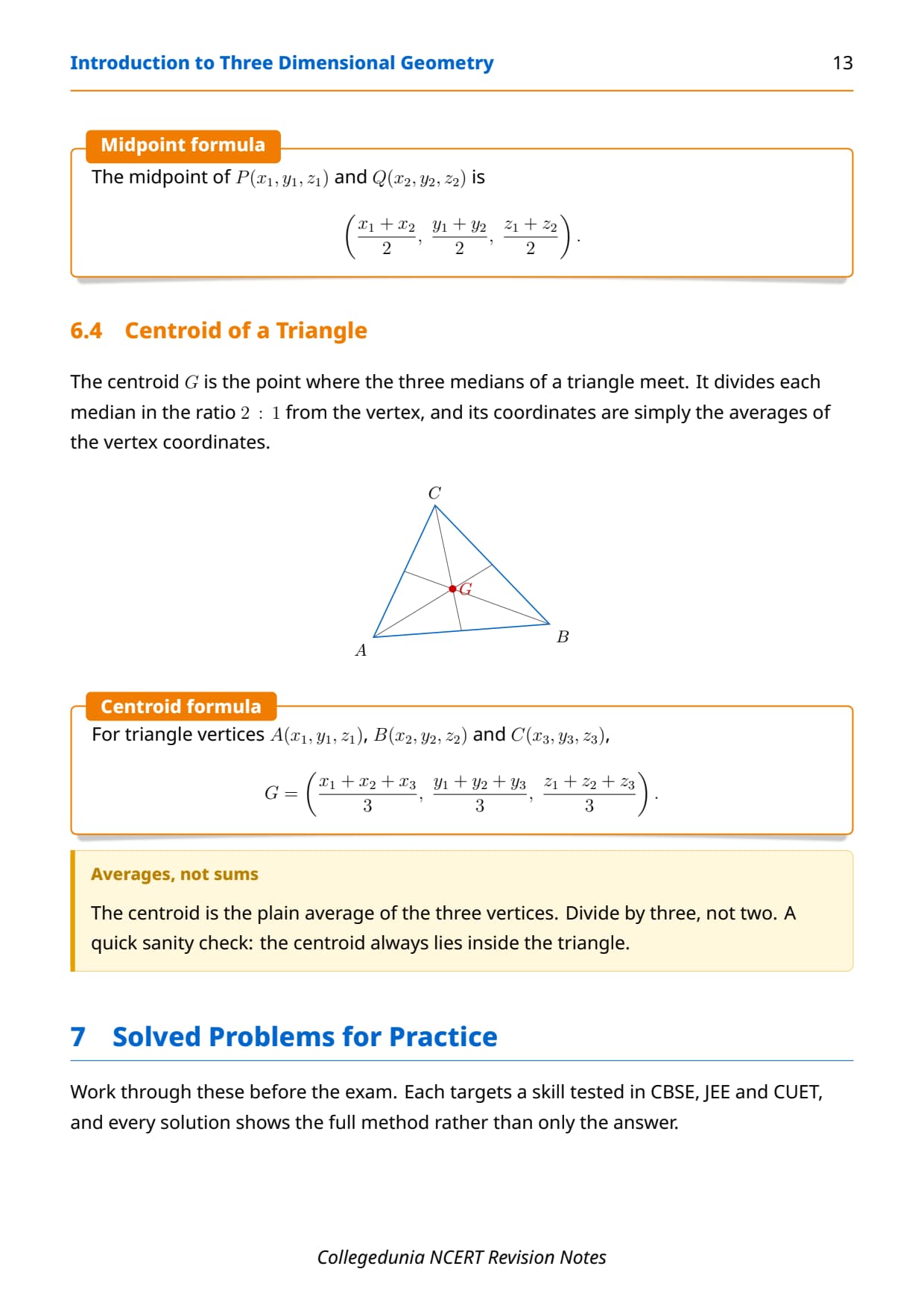
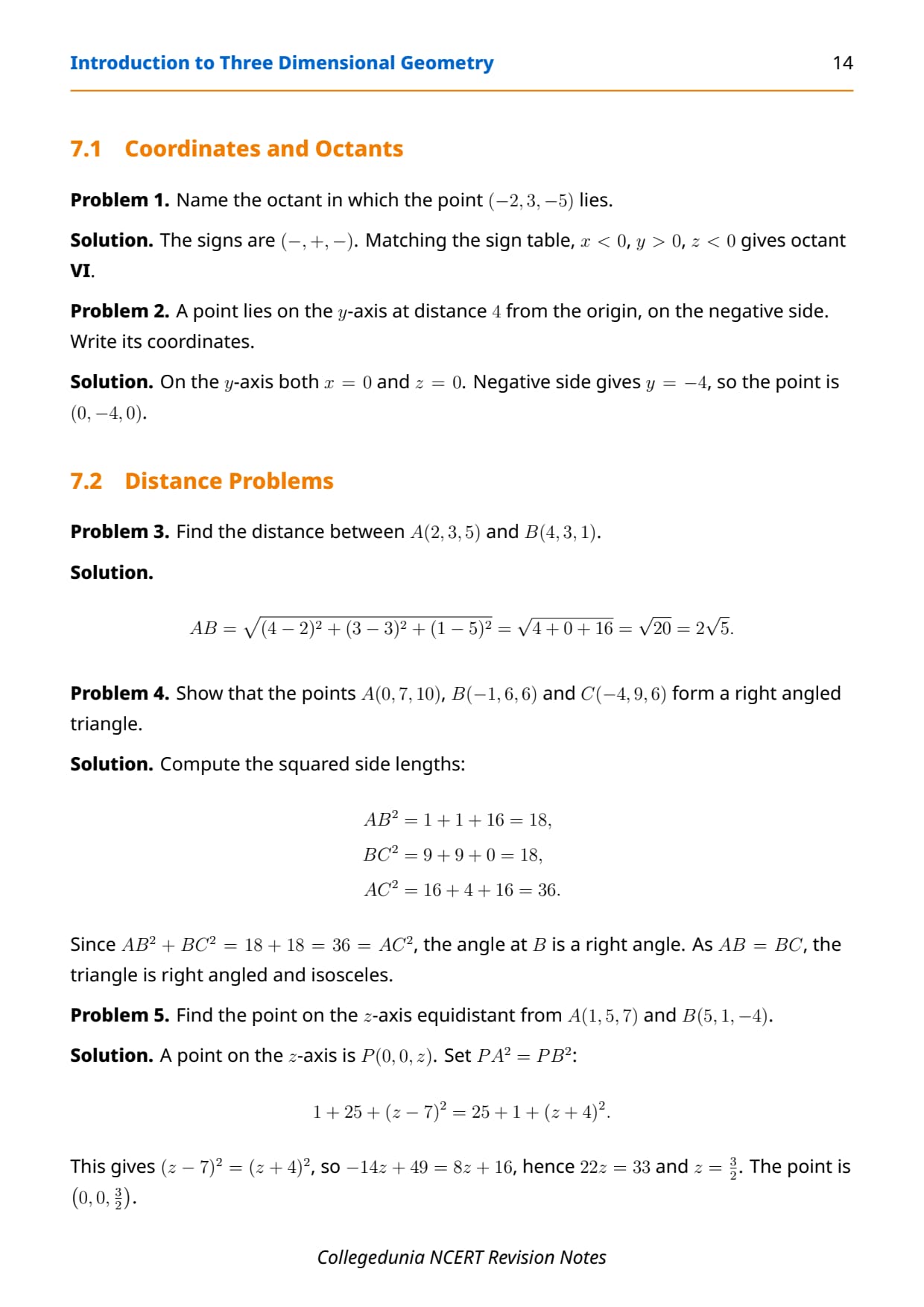
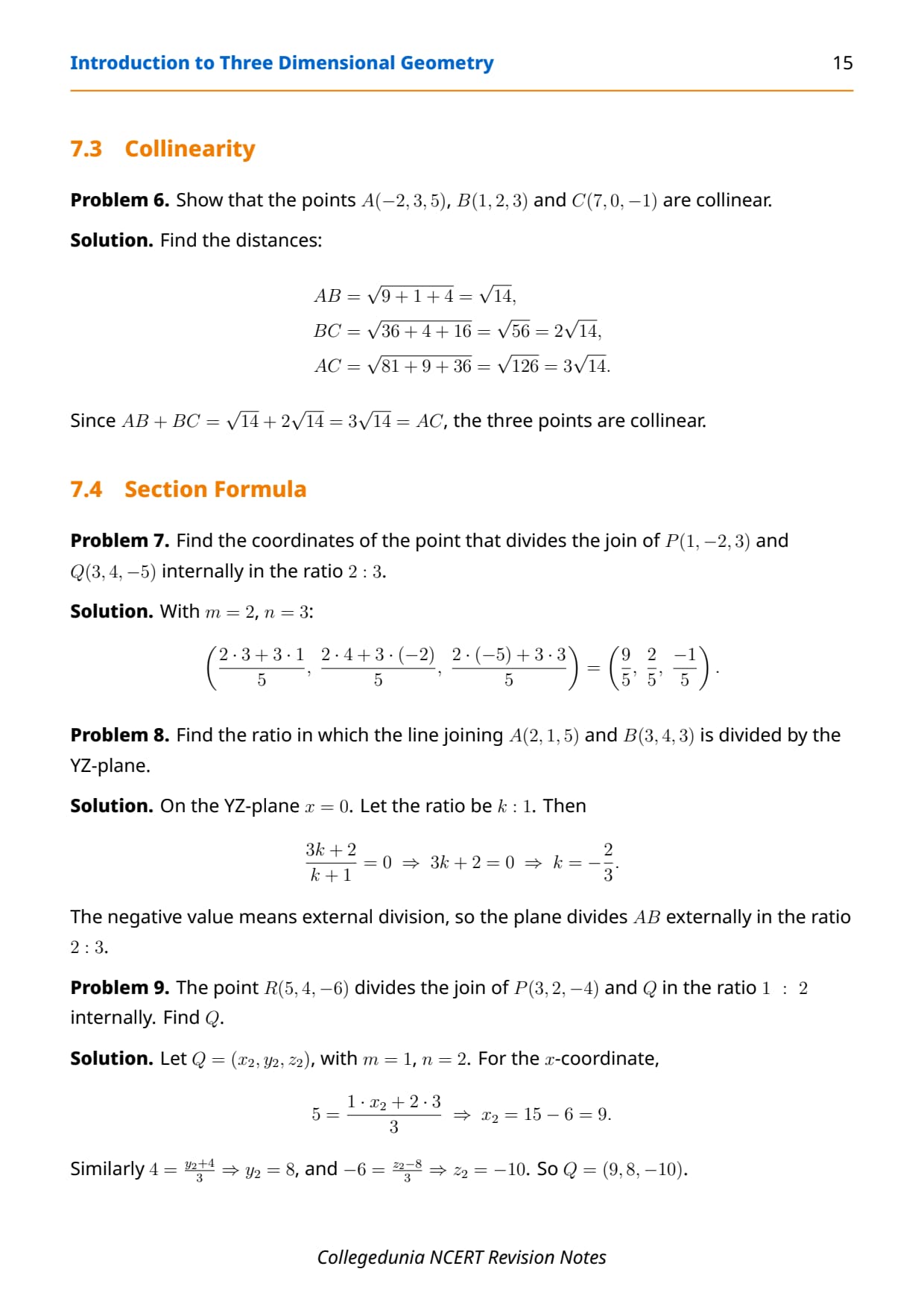
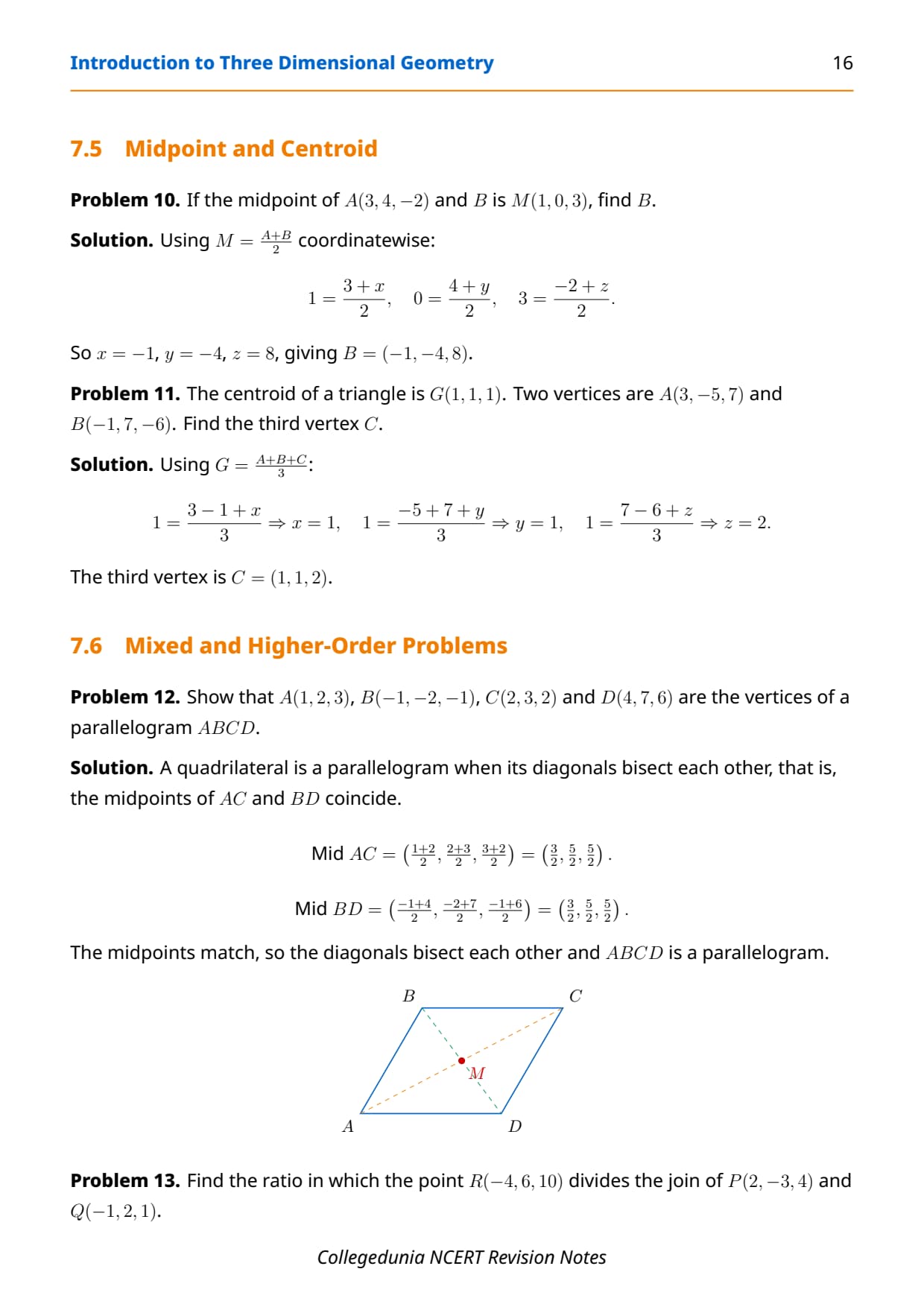
Download the complete Three Dimensional Geometry notes PDF above, then use the topic-by-topic summary and the formula table on this page for a fast last-minute revision.
- CBSE Boards: Three Dimensional Geometry sits in the Coordinate Geometry unit and carries roughly 4 to 6 marks across short-answer questions.
- JEE Main and CUET: expect 1 to 2 direct questions on the distance formula, section formula, and coordinates in space every year.
- What is covered: coordinate axes and planes, coordinates of a point, octants, distance between two points, and the section formula with midpoint.
Every entry in these Three Dimensional Geometry notes is curated by Collegedunia subject experts, based on the 2026-27 NCERT textbook, and checked against the last five years of CBSE Board and JEE Main papers.
Also Check:
- NCERT Solutions for Class 11 Maths Three Dimensional Geometry
- Class 11 Maths Three Dimensional Geometry Handwritten Notes
Topic-by-Topic Summary of Three Dimensional Geometry for Class 11 Maths
The Three Dimensional Geometry chapter splits into four short sub-topic blocks. The class 11 maths notes chapter 11 introduction to three dimensional geometry map each block to what the exam asks, so students know where the marks sit before they revise.
- Coordinate axes and planes: the three axes, the three coordinate planes, and how they divide space. A common 1-mark theory question.
- Coordinates of a point and octants: writing a point as (x, y, z) and naming its octant. A frequent 1 to 2-mark MCQ.
- Distance between two points: the 3D distance formula and its use in proving shapes. The 2 to 3-mark core of the chapter.
- Section formula: internal and external division of a line segment, plus the midpoint. A common 3-mark question.
The rest of these notes take each block in order, so a first read from top to bottom mirrors the NCERT chapter flow.
Coordinate Axes and Coordinate Planes in Three Dimensions
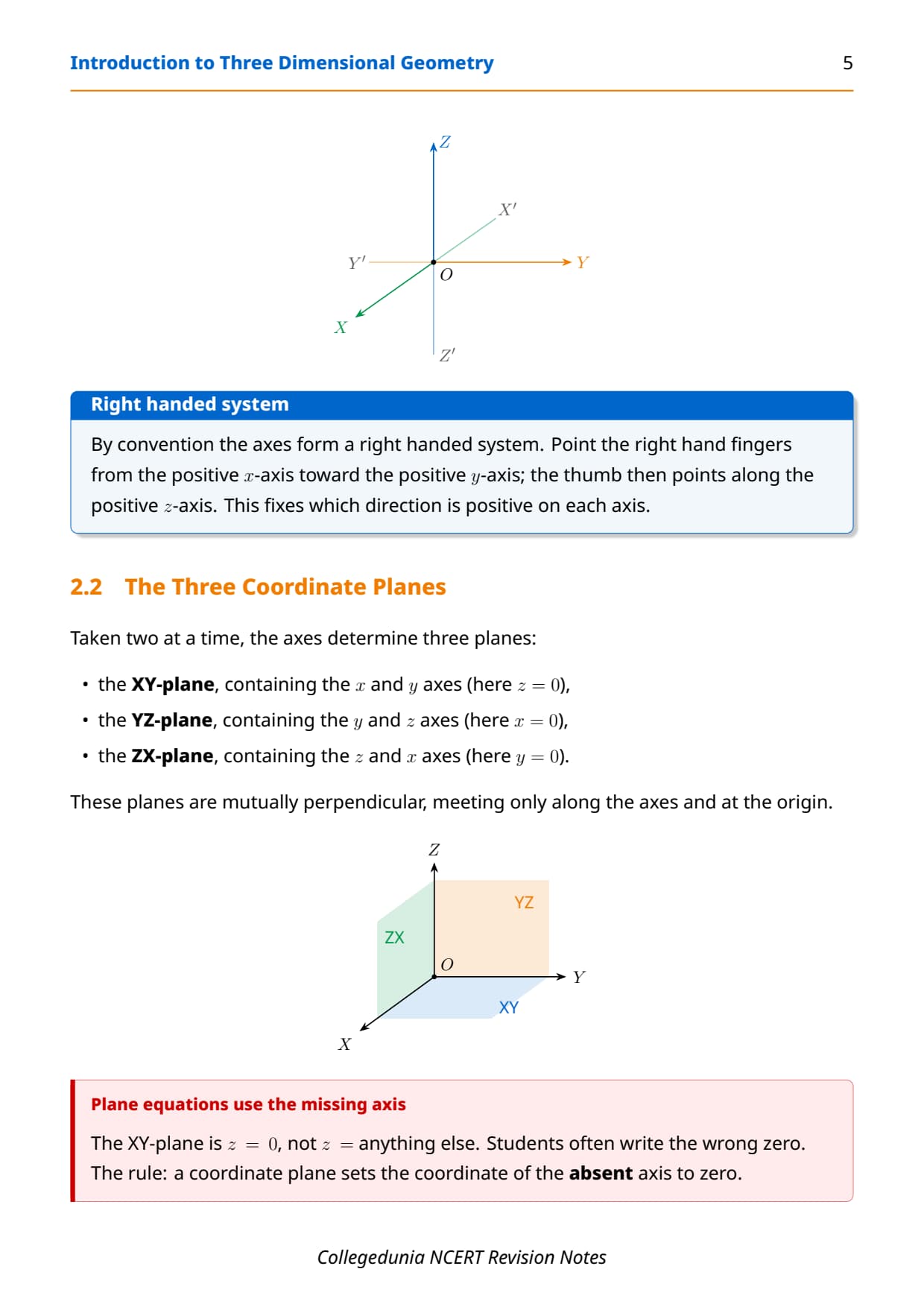
To fix a point in space we need three mutually perpendicular lines that meet at a point O called the origin. These lines are the x-axis, y-axis, and z-axis, and together they form the three-dimensional coordinate system. Each axis is a number line, positive on one side of O and negative on the other.
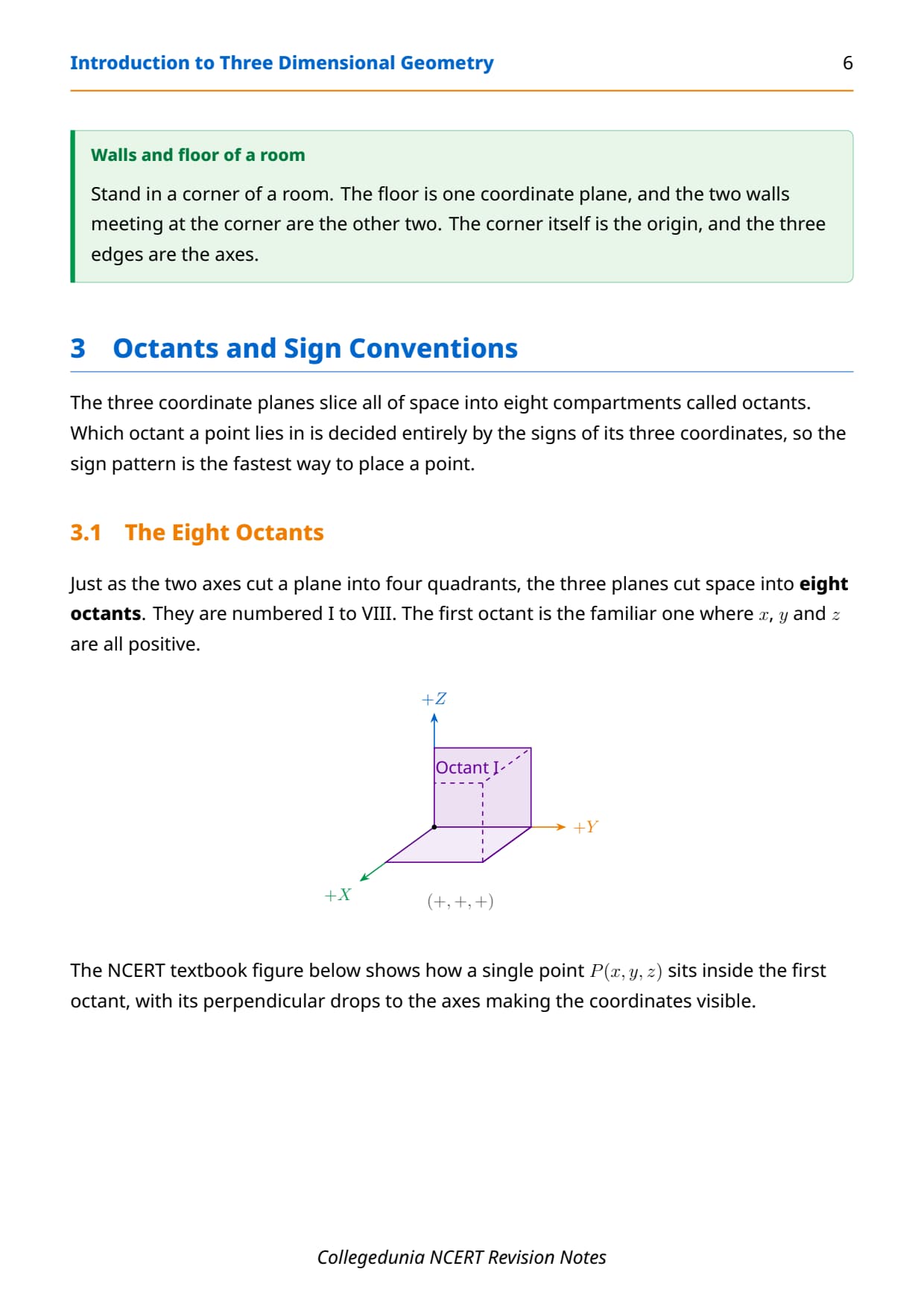
Taken two at a time, the axes fix three flat surfaces called the coordinate planes:
- XY-plane: contains the x-axis and y-axis. Every point on it has z = 0.
- YZ-plane: contains the y-axis and z-axis. Every point on it has x = 0.
- ZX-plane: contains the z-axis and x-axis. Every point on it has y = 0.
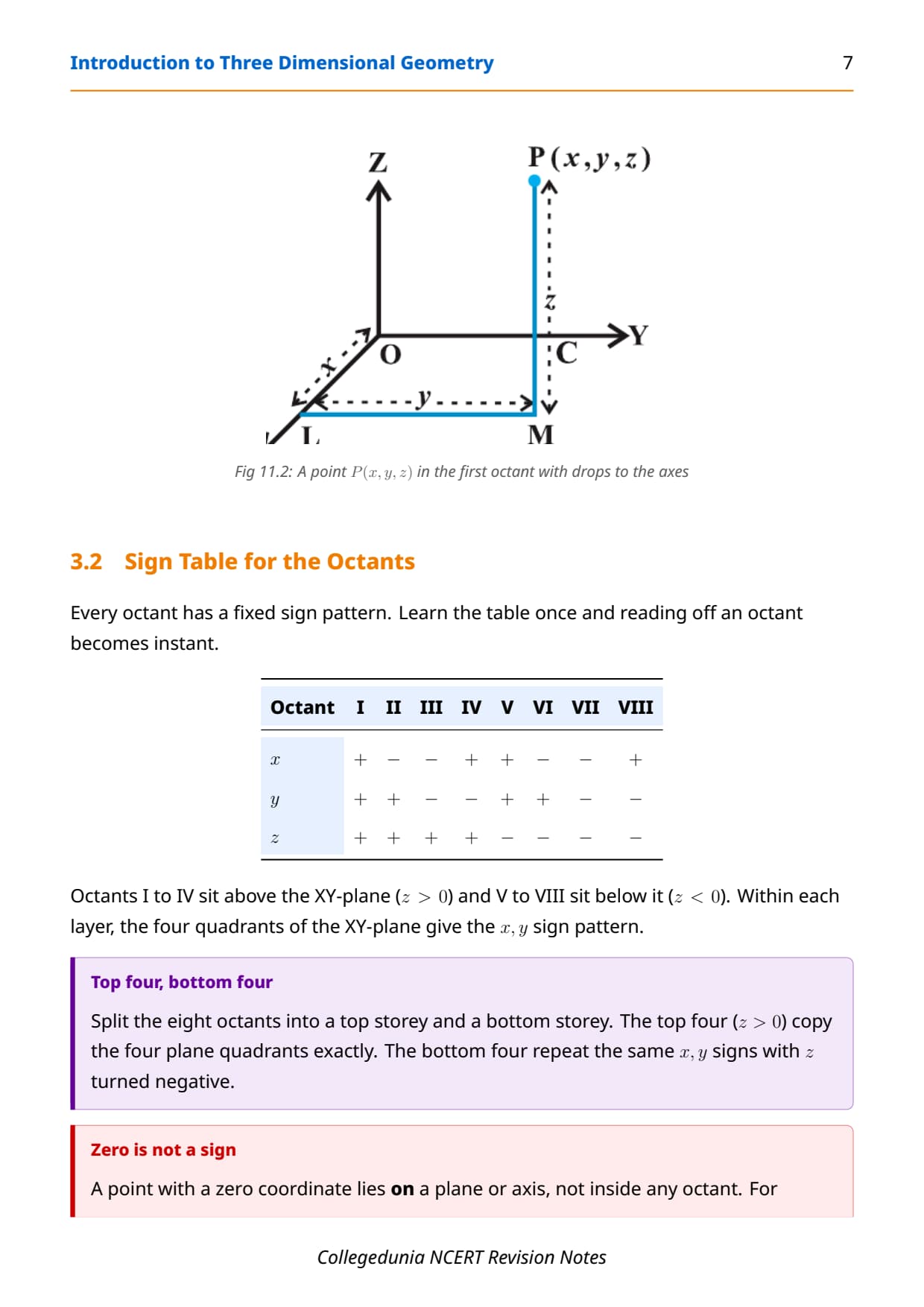
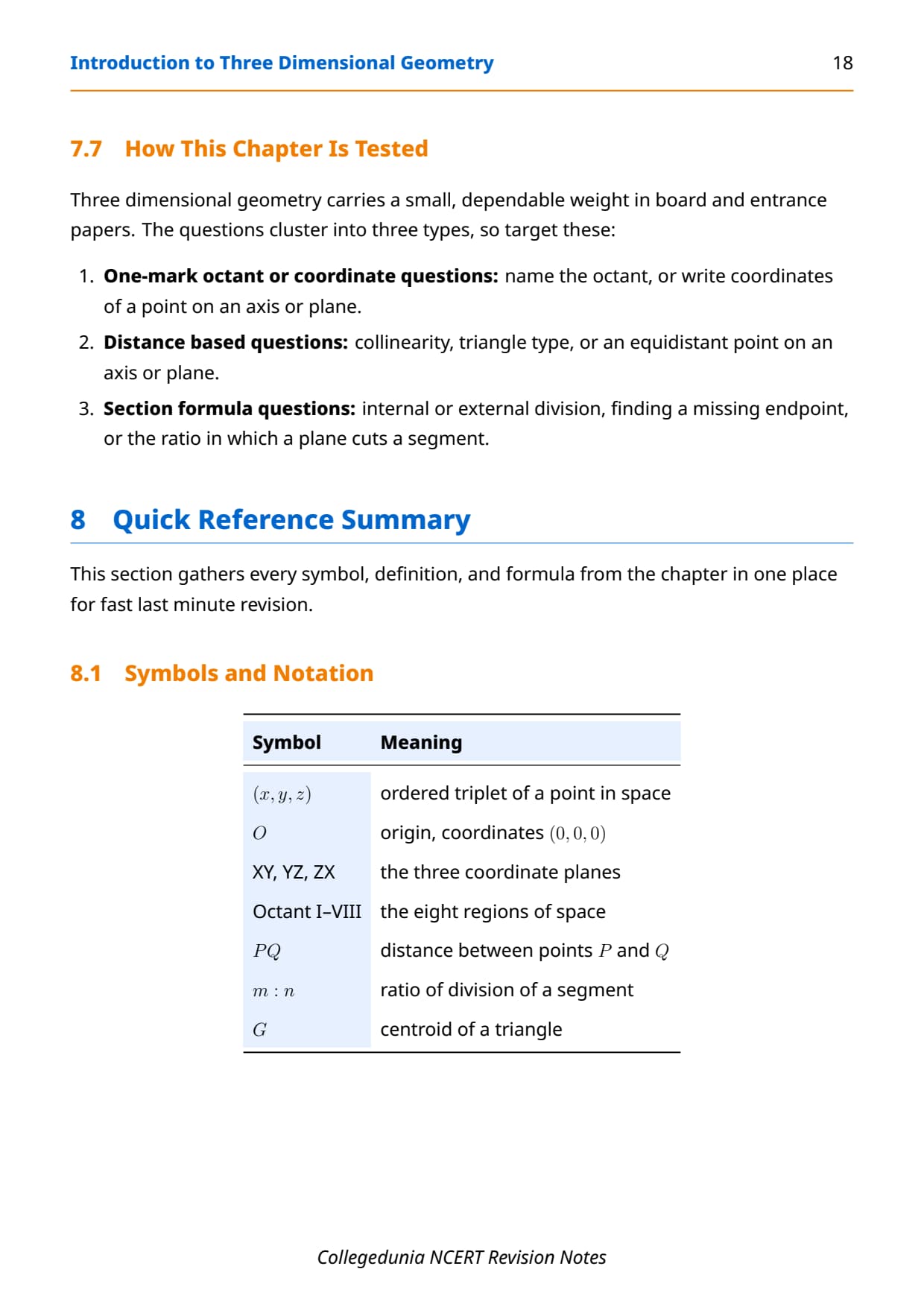
The three coordinate planes divide space into eight parts called octants. A point on any axis has its other two coordinates zero, for example a point on the x-axis is written (x, 0, 0).
Coordinates of a Point in Space and the Eight Octants
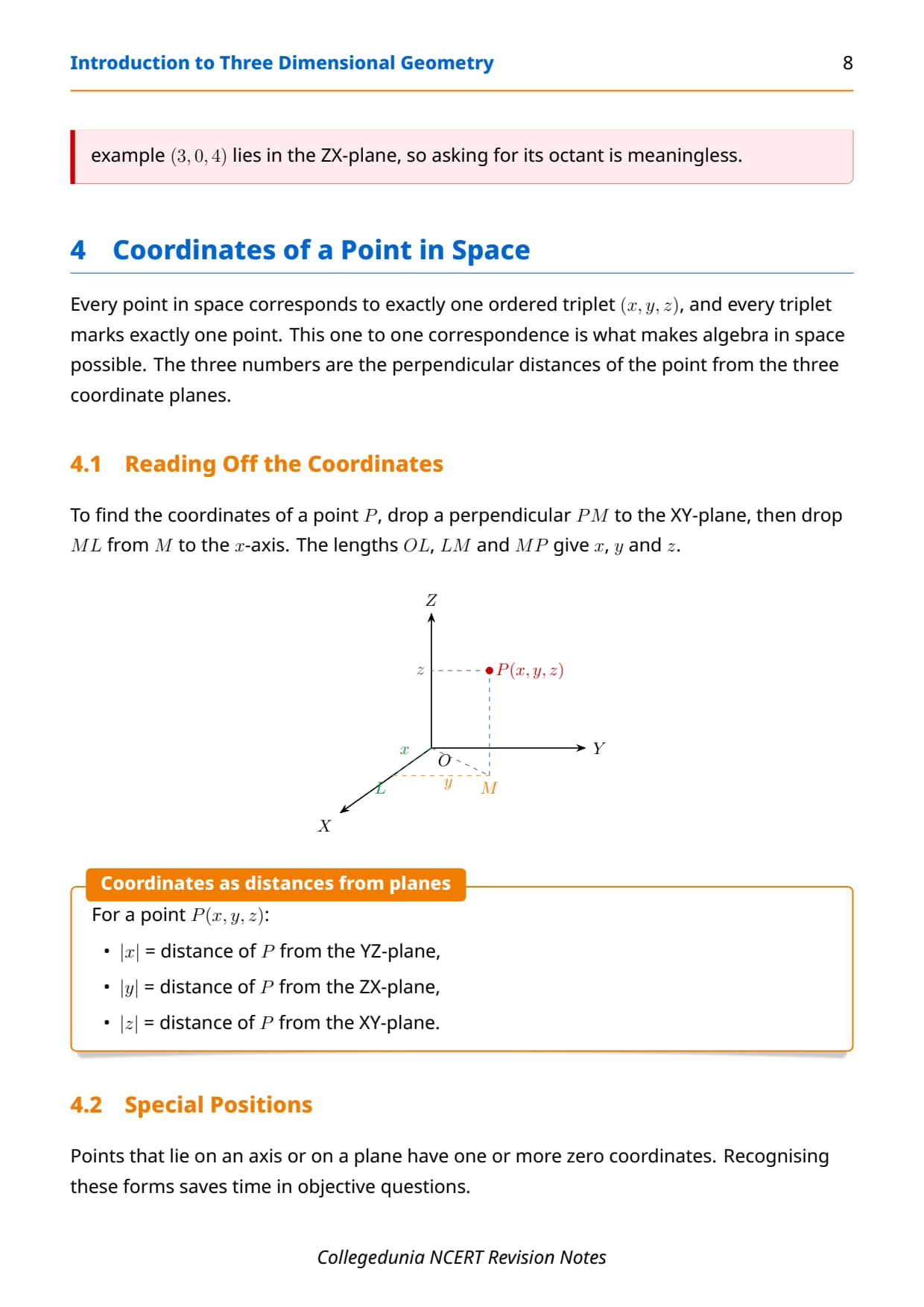
The position of any point P in space is given by an ordered triple (x, y, z). Here x is the perpendicular distance of P from the YZ-plane, y is its distance from the ZX-plane, and z is its distance from the XY-plane. The order matters, so (2, 3, 5) and (5, 3, 2) are different points.
The sign of each coordinate decides which octant the point falls in. The table below lists the sign pattern for the eight octants, so students can place a point at a glance.
| Octant | x | y | z |
|---|---|---|---|
| I | + | + | + |
| II | − | + | + |
| III | − | − | + |
| IV | + | − | + |
| V | + | + | − |
| VI | − | + | − |
| VII | − | − | − |
| VIII | + | − | − |
One fact examiners love: the origin is (0, 0, 0), and any point on a coordinate plane has exactly one coordinate equal to zero. This is a direct 1-mark question.
Distance Between Two Points in Three Dimensional Geometry
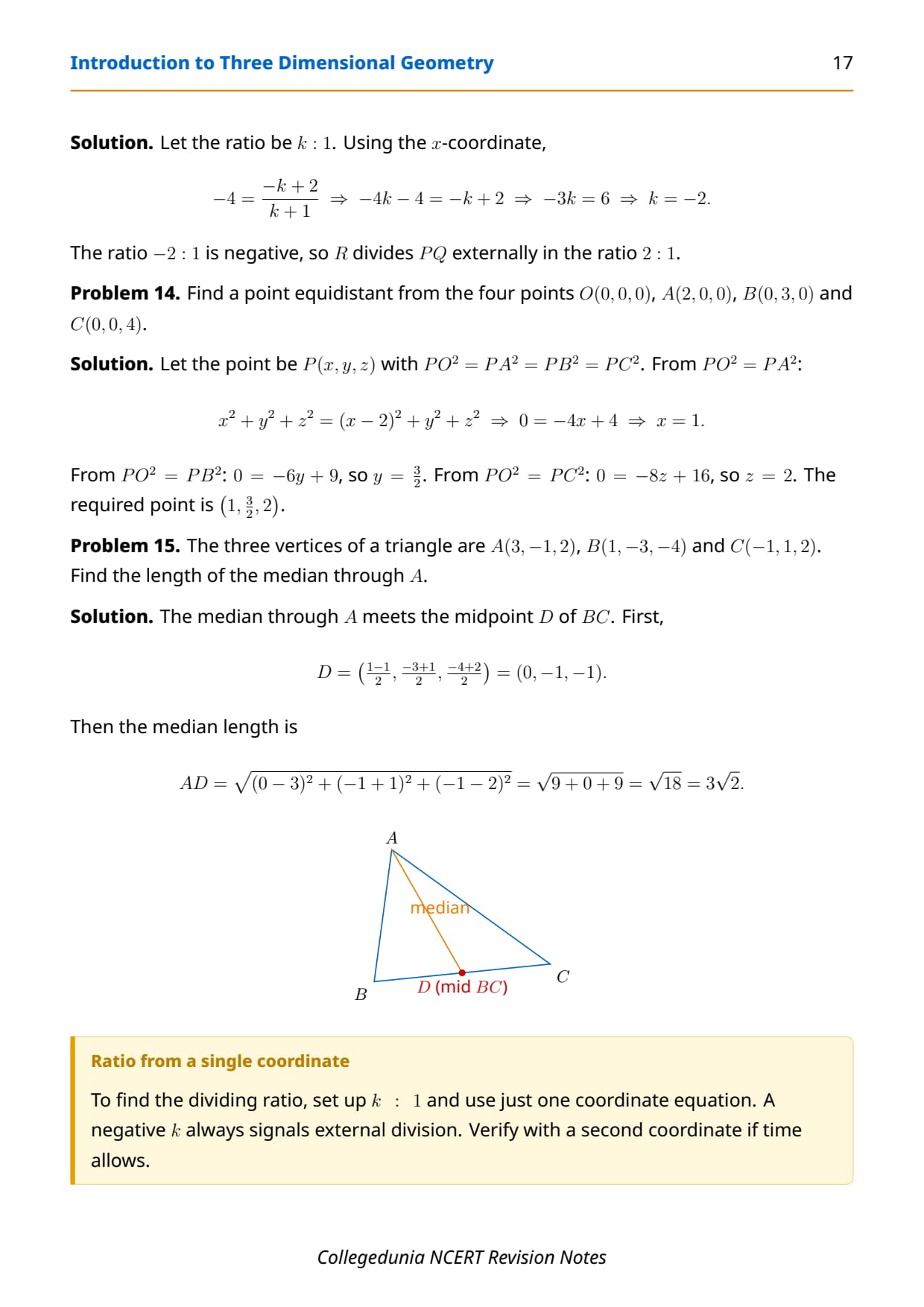
The distance formula is the most-used rule in this chapter. For two points P(x₁, y₁, z₁) and Q(x₂, y₂, z₂), the distance between them is the straight-line length PQ. It extends the familiar 2D formula by adding the z-term.
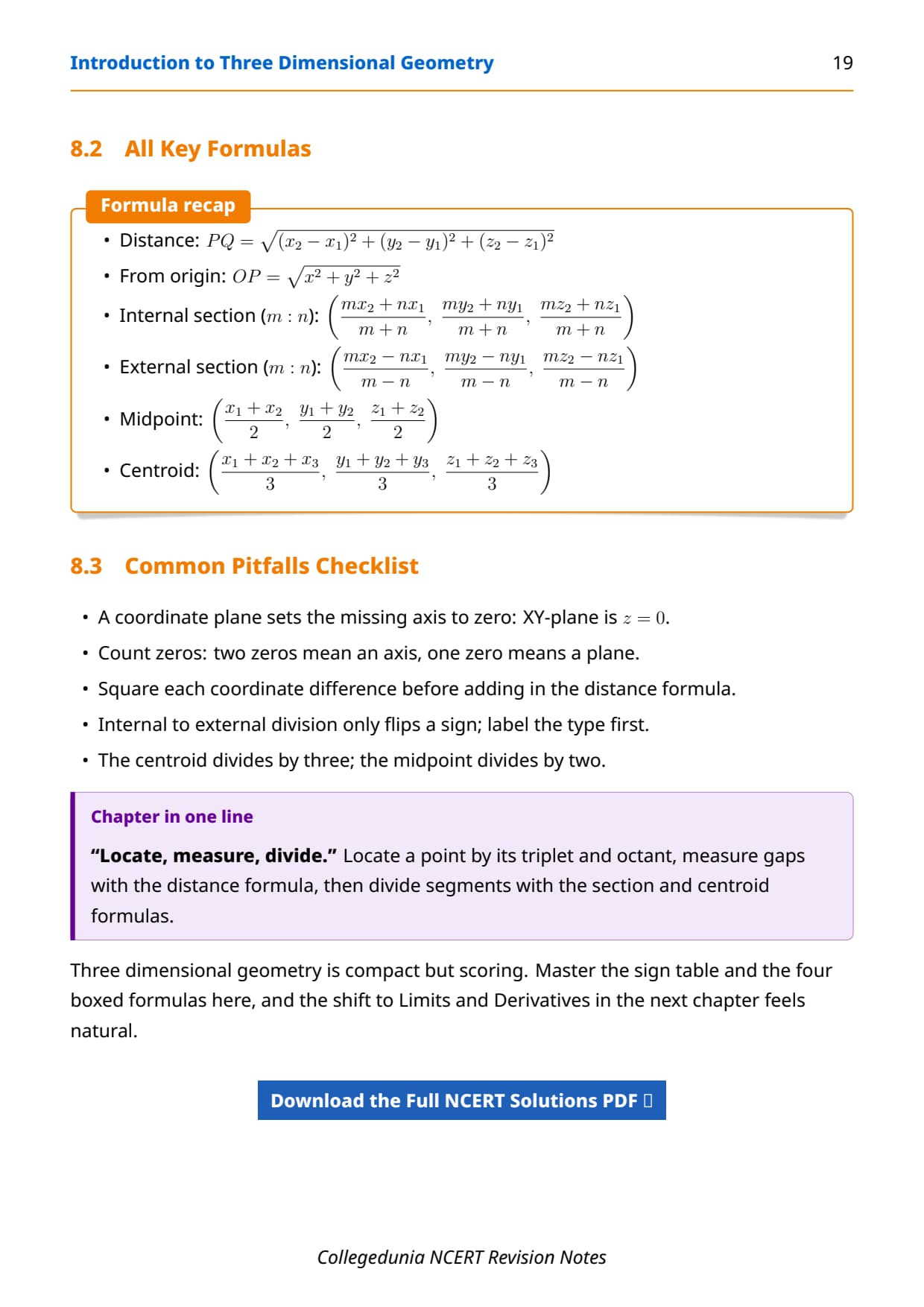
- Distance formula: PQ = √[(x₂ − x₁)² + (y₂ − y₁)² + (z₂ − z₁)²].
- Distance from the origin: for a point P(x, y, z), OP = √(x² + y² + z²).
- Use it to classify shapes: equal sides mean an isosceles or equilateral figure, and the Pythagoras check confirms a right angle.
To prove three points are collinear, find all three pairwise distances and check that the two shorter ones add up to the longest. The distance formula also proves whether four points form a square, rectangle, or parallelogram.
Section Formula: Internal and External Division
The section formula gives the coordinates of a point R that divides the line segment joining P(x₁, y₁, z₁) and Q(x₂, y₂, z₂) in the ratio m : n. There are two cases, internal and external division, and the midpoint is a special case of the first.
- Internal division: R = ((mx₂ + nx₁)/(m + n), (my₂ + ny₁)/(m + n), (mz₂ + nz₁)/(m + n)).
- External division: R = ((mx₂ − nx₁)/(m − n), (my₂ − ny₁)/(m − n), (mz₂ − nz₁)/(m − n)).
- Midpoint: put m = n = 1 to get M = ((x₁ + x₂)/2, (y₁ + y₂)/2, (z₁ + z₂)/2).
External division uses a minus sign in place of the plus sign of internal division. The centroid of a triangle with vertices A, B, and C is the average of the three coordinates, G = ((x₁ + x₂ + x₃)/3, (y₁ + y₂ + y₃)/3, (z₁ + z₂ + z₃)/3).
All Formulas for Three Dimensional Geometry: Quick-Reference Table
The formula table below covers every rule the Three Dimensional Geometry chapter can generate. These formulas are the ones students should copy onto a flashcard before the exam.
| Formula | What It Means | When to Use |
|---|---|---|
| PQ = √[(x₂ − x₁)² + (y₂ − y₁)² + (z₂ − z₁)²] | Distance between two points | Length of a segment; classify shapes |
| OP = √(x² + y² + z²) | Distance of a point from the origin | When one point is the origin |
| R = ((mx₂ + nx₁)/(m + n), …) | Internal section formula | Point divides PQ inside the segment |
| R = ((mx₂ − nx₁)/(m − n), …) | External section formula | Point divides PQ outside the segment |
| M = ((x₁ + x₂)/2, (y₁ + y₂)/2, (z₁ + z₂)/2) | Midpoint of a segment | Ratio 1 : 1 division |
| G = ((x₁ + x₂ + x₃)/3, …) | Centroid of a triangle | Average of three vertices |
Important: the distance formula PQ = √[(x₂ − x₁)² + (y₂ − y₁)² + (z₂ − z₁)²] is the single most-tested rule from this chapter in both CBSE Boards and CUET.
Key Definitions and Theorems in the Three Dimensional Geometry Chapter
Beyond the formulas, a few named terms carry marks in the theory-style questions. These are the results the class 11 maths notes chapter 11 introduction to three dimensional geometry expect students to state precisely.
- Origin: the point O where the three axes meet, with coordinates (0, 0, 0).
- Ordered triple: the three numbers (x, y, z) that fix a point, written in a fixed order.
- Coordinate plane: a flat surface fixed by two axes; the XY, YZ, and ZX planes.
- Octant: one of the eight regions of space cut out by the three coordinate planes.
- Collinear points: three points on one straight line; the two shorter distances add to the longest.
Remember that a point in the XY-plane has z = 0, a point on the x-axis has y = 0 and z = 0, and only the origin has all three coordinates zero. These are the quick-recall facts examiners set for 1 mark.
Common Mistakes Students Make in the Three Dimensional Geometry Chapter
Mistake 1: Dropping the z-term. The 3D distance formula has three squared differences, not two, so never reuse the 2D version.
Mistake 2: Mixing up which plane a coordinate is zero on. A point in the XY-plane has z = 0, not x = 0.
Mistake 3: Using a plus sign for external division. External division needs a minus sign in the denominator and numerator.
Mistake 4: Swapping the order of the ratio m : n so the point is measured from the wrong end of the segment.
Each slip costs 1 to 2 marks in the board exam.
Three Dimensional Geometry Weightage in CBSE Boards, JEE Main and CUET
Three Dimensional Geometry is a scoring chapter because the questions are short and formula-based. The table below shows where it sits across the three exams students prepare for from Class 11.
| Exam | Typical Weightage | Most-Tested Topic |
|---|---|---|
| CBSE Class 11 Boards | 4 to 6 marks (Coordinate Geometry unit) | Distance formula and section formula |
| JEE Main | 1 to 2 questions per year | Coordinates in space and section formula |
| CUET (UG) Mathematics | 1 to 2 MCQs per paper | Octants and distance between two points |
Tip: because this chapter is the base for Class 12 Three Dimensional Geometry with vectors, direction cosines, and planes, a strong grip here pays off across the whole Class 12 syllabus.
How to Revise the Three Dimensional Geometry Chapter Quickly
Three Dimensional Geometry can be revised in about 75 minutes because the content is compact. Use the class 11 maths notes chapter 11 introduction to three dimensional geometry in the three-block plan below for a last-minute recap.
- 0 to 25 min: coordinate axes, the three planes, coordinates of a point, and the eight octants.
- 25 to 50 min: the distance formula, distance from the origin, and one collinearity check by hand.
- 50 to 75 min: the section formula, both internal and external, plus midpoint and centroid.
Finish by writing out the six-row formula table from memory until every rule can be recalled without looking.
Student Feedback on the Three Dimensional Geometry Notes
In a Collegedunia poll of 10,980 Class 11 Maths students conducted before the 2026 boards, 59% of students rated external division in the section formula as the trickiest part of the chapter, ahead of naming octants.
What 10,980 students told us about the Three Dimensional Geometry revision journey:
- 59% of students surveyed found the external section formula the hardest sub-topic.
- 52% said they had once dropped the z-term while using the distance formula.
- 4 out of 5 students revised the formula table the night before the exam.
- Out of 10,980 students, 63% said a rough 3D sketch made octant questions easier.
Source: 2026-27 Class 11 Maths student poll. Sample of 10,980 students from CBSE schools across 14 states.
Other Three Dimensional Geometry Class 11 Maths Resources
Use these notes together with the linked resources below for the full Three Dimensional Geometry study set. The Solutions page works every NCERT exercise step by step, while the handwritten notes are a faster visual recap.
| Resource | What It Gives You |
|---|---|
| NCERT Solutions for Class 11 Maths Three Dimensional Geometry | Step-by-step answers to every exercise question |
| Class 11 Maths Three Dimensional Geometry Handwritten Notes | Neat handwritten revision notes with formula boxes |
| Class 11 Maths Three Dimensional Geometry NCERT Book PDF | The official NCERT chapter PDF to read alongside |
NCERT Notes for Class 11 Maths: All Chapters
| Chapter | Revision Notes |
|---|---|
| Chapter 1 | Sets Notes |
| Chapter 2 | Relations and Functions Notes |
| Chapter 3 | Trigonometric Functions Notes |
| Chapter 4 | Complex Numbers and Quadratic Equations Notes |
| Chapter 5 | Linear Inequalities Notes |
| Chapter 6 | Permutations and Combinations Notes |
| Chapter 7 | Binomial Theorem Notes |
| Chapter 8 | Sequences and Series Notes |
| Chapter 9 | Straight Lines Notes |
| Chapter 10 | Conic Sections Notes |
| Chapter 11 | Introduction to Three Dimensional Geometry Notes (this page) |
| Chapter 12 | Limits and Derivatives Notes |
| Chapter 13 | Statistics Notes |
| Chapter 14 | Probability Notes |
FAQs on Three Dimensional Geometry Class 11 Maths Notes
Introduction to Three Dimensional Geometry Notes - Frequently Asked Questions
Ques. What are the main topics in the class 11 maths notes chapter 11 introduction to three dimensional geometry?
Ans. These Three Dimensional Geometry notes cover the three coordinate axes and coordinate planes, the coordinates of a point in space as an ordered triple, the eight octants, the distance between two points, and the section formula for internal and external division, including the midpoint and centroid.
Ques. What are the coordinate planes in three dimensional geometry?
Ans. The three coordinate planes are the XY-plane, the YZ-plane, and the ZX-plane, each fixed by two of the axes. A point in the XY-plane has z = 0, a point in the YZ-plane has x = 0, and a point in the ZX-plane has y = 0. Together the planes divide space into eight octants.
Ques. How many octants are there in 3D geometry?
Ans. There are eight octants. The three coordinate planes cut space into eight regions, and the sign pattern of the coordinates (x, y, z) decides which octant a point lies in. The first octant has all three coordinates positive.
Ques. What is the distance formula in three dimensions?
Ans. For two points P(x₁, y₁, z₁) and Q(x₂, y₂, z₂), the distance is PQ = √[(x₂ − x₁)² + (y₂ − y₁)² + (z₂ − z₁)²]. The distance of a point from the origin is OP = √(x² + y² + z²). It is the most-tested formula in the chapter.
Ques. What is the section formula in three dimensional geometry?
Ans. For a point R dividing PQ in the ratio m : n, internal division gives R = ((mx₂ + nx₁)/(m + n), (my₂ + ny₁)/(m + n), (mz₂ + nz₁)/(m + n)). External division uses minus signs in place of the plus signs. Putting m = n = 1 gives the midpoint.
Ques. What is the midpoint formula in three dimensions?
Ans. The midpoint of the segment joining P(x₁, y₁, z₁) and Q(x₂, y₂, z₂) is M = ((x₁ + x₂)/2, (y₁ + y₂)/2, (z₁ + z₂)/2). It is the section formula with the ratio 1 : 1, so each coordinate is the average of the two end coordinates.
Ques. Is the Three Dimensional Geometry chapter important for JEE Main and CUET?
Ans. Yes. Three Dimensional Geometry usually gives 1 to 2 questions in JEE Main and CUET (UG) Mathematics every year, mostly on coordinates in space, the distance formula, and the section formula. It is a short, scoring chapter and also the base for Class 12 Three Dimensional Geometry.
Ques. Where can I download the Class 11 Maths Three Dimensional Geometry notes PDF?
Ans. The Three Dimensional Geometry notes PDF is available on this page through the download card above. It covers all definitions, the octant table, the distance formula, and the section formula, and matches the 2026-27 NCERT chapter.



Comments