




NCERT Class 11 English (Woven Words) Chapter 7 Glory at Twilight Notes explain Bhabani Bhattacharya's story through plot, Satyajit's character, irony, social honour, village expectations and answer-writing frames for the 2026-27 syllabus.
- Download the Chapter 7 Notes PDF for quick offline revision.
- Revise Satyajit's fall from wealth, the Shantipur wedding, the Rs 2001 demand and the repeated question "What now?"
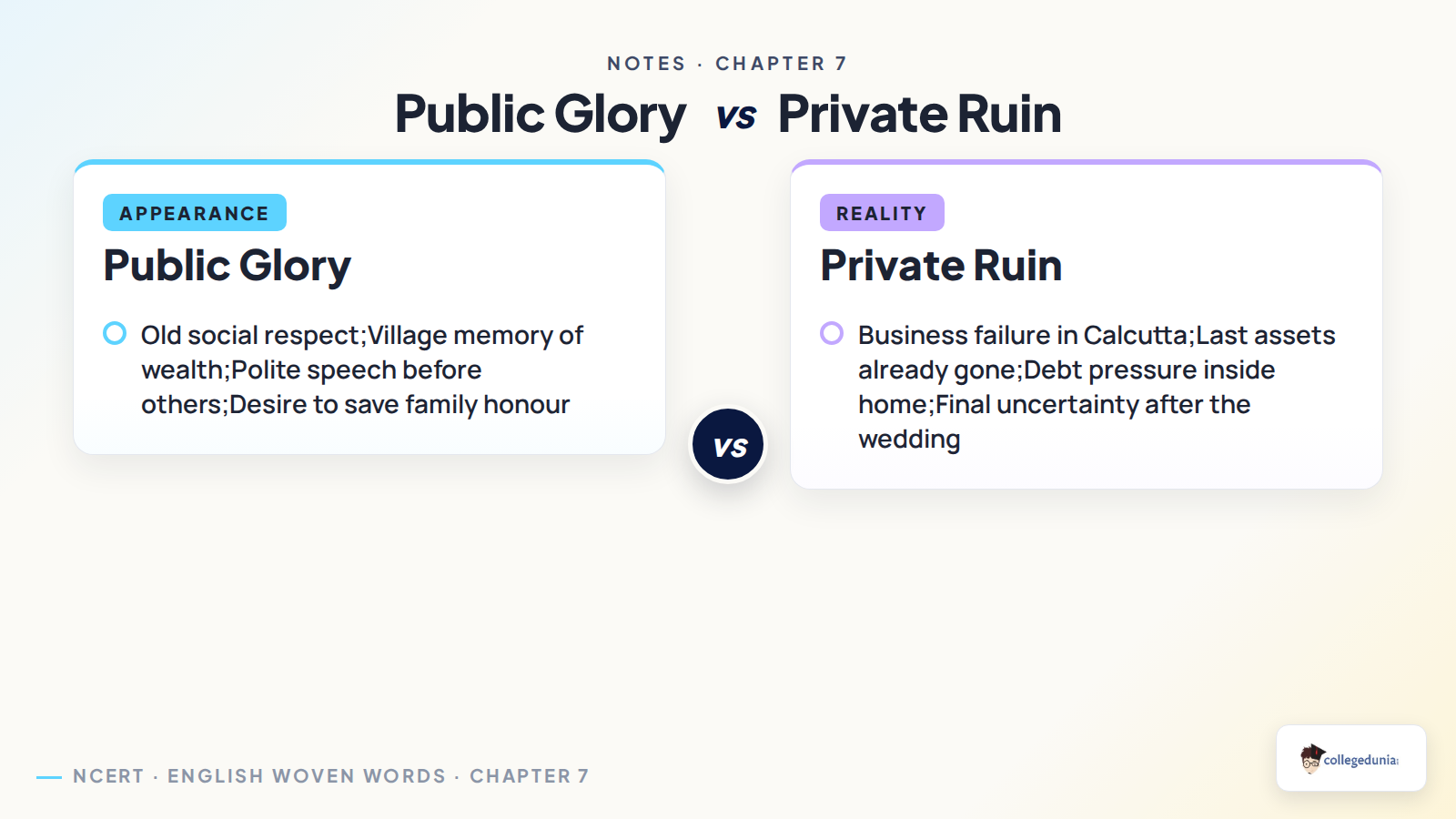
- Student focus: connect the title with the contrast between public respect and private ruin.
Chapter7GloryatTwilightNotes.pdf?page=1&dpi=150)
Chapter7GloryatTwilightNotes.pdf?page=2&dpi=150)
Chapter7GloryatTwilightNotes.pdf?page=3&dpi=150)
Chapter7GloryatTwilightNotes.pdf?page=4&dpi=150)
Chapter7GloryatTwilightNotes.pdf?page=5&dpi=150)
Chapter7GloryatTwilightNotes.pdf?page=6&dpi=150)
Chapter7GloryatTwilightNotes.pdf?page=7&dpi=150)
Chapter7GloryatTwilightNotes.pdf?page=8&dpi=150)
Chapter7GloryatTwilightNotes.pdf?page=9&dpi=150)
Chapter7GloryatTwilightNotes.pdf?page=10&dpi=150)
Chapter7GloryatTwilightNotes.pdf?page=11&dpi=150)
Chapter7GloryatTwilightNotes.pdf?page=12&dpi=150)
Chapter7GloryatTwilightNotes.pdf?page=13&dpi=150)
Chapter7GloryatTwilightNotes.pdf?page=14&dpi=150)
Chapter7GloryatTwilightNotes.pdf?page=15&dpi=150)
Chapter7GloryatTwilightNotes.pdf?page=16&dpi=150)
Chapter7GloryatTwilightNotes.pdf?page=17&dpi=150)
Chapter7GloryatTwilightNotes.pdf?page=18&dpi=150)
Chapter7GloryatTwilightNotes.pdf?page=19&dpi=150)
Chapter7GloryatTwilightNotes.pdf?page=20&dpi=150)
Chapter7GloryatTwilightNotes.pdf?page=21&dpi=150)
Chapter7GloryatTwilightNotes.pdf?page=22&dpi=150)
Chapter7GloryatTwilightNotes_flat_MobileCard.pdf?page=1&dpi=150)
Chapter7GloryatTwilightNotes_flat_MobileCard.pdf?page=2&dpi=150)
Chapter7GloryatTwilightNotes_flat_MobileCard.pdf?page=3&dpi=150)
Chapter7GloryatTwilightNotes_flat_MobileCard.pdf?page=4&dpi=150)
Chapter7GloryatTwilightNotes_flat_MobileCard.pdf?page=5&dpi=150)
Chapter7GloryatTwilightNotes_flat_MobileCard.pdf?page=6&dpi=150)
Chapter7GloryatTwilightNotes_flat_MobileCard.pdf?page=7&dpi=150)
Chapter7GloryatTwilightNotes_flat_MobileCard.pdf?page=8&dpi=150)
Chapter7GloryatTwilightNotes_flat_MobileCard.pdf?page=9&dpi=150)
Chapter7GloryatTwilightNotes_flat_MobileCard.pdf?page=10&dpi=150)
Chapter7GloryatTwilightNotes_flat_MobileCard.pdf?page=11&dpi=150)
Chapter7GloryatTwilightNotes_flat_MobileCard.pdf?page=12&dpi=150)
Chapter7GloryatTwilightNotes_flat_MobileCard.pdf?page=13&dpi=150)
Chapter7GloryatTwilightNotes_flat_MobileCard.pdf?page=14&dpi=150)
Chapter7GloryatTwilightNotes_flat_MobileCard.pdf?page=15&dpi=150)
Chapter7GloryatTwilightNotes_flat_MobileCard.pdf?page=16&dpi=150)
Chapter7GloryatTwilightNotes_flat_MobileCard.pdf?page=17&dpi=150)
Chapter7GloryatTwilightNotes_flat_MobileCard.pdf?page=18&dpi=150)
Chapter7GloryatTwilightNotes_flat_MobileCard.pdf?page=19&dpi=150)
Chapter7GloryatTwilightNotes_flat_MobileCard.pdf?page=20&dpi=150)
Chapter7GloryatTwilightNotes_flat_MobileCard.pdf?page=21&dpi=150)
Chapter7GloryatTwilightNotes_flat_MobileCard.pdf?page=22&dpi=150)
Chapter7GloryatTwilightNotes_flat_MobileCard.pdf?page=23&dpi=150)
Chapter7GloryatTwilightNotes_flat_MobileCard.pdf?page=24&dpi=150)
Chapter7GloryatTwilightNotes_flat_MobileCard.pdf?page=25&dpi=150)
Chapter7GloryatTwilightNotes_flat_MobileCard.pdf?page=26&dpi=150)
Chapter7GloryatTwilightNotes_flat_MobileCard.pdf?page=27&dpi=150)
Chapter7GloryatTwilightNotes_flat_MobileCard.pdf?page=28&dpi=150)
Chapter7GloryatTwilightNotes_flat_MobileCard.pdf?page=29&dpi=150)
Chapter7GloryatTwilightNotes_flat_MobileCard.pdf?page=30&dpi=150)
Chapter7GloryatTwilightNotes_flat_MobileCard.pdf?page=31&dpi=150)
Chapter7GloryatTwilightNotes_flat_MobileCard.pdf?page=32&dpi=150)
Chapter7GloryatTwilightNotes_flat_MobileCard.pdf?page=33&dpi=150)
Chapter7GloryatTwilightNotes_flat_MobileCard.pdf?page=34&dpi=150)
Chapter7GloryatTwilightNotes_flat_MobileCard.pdf?page=35&dpi=150)
Student Feedback on Glory at Twilight
In a Collegedunia revision poll of 10,420 Class 11 English students, most students said the story became clearer when they tracked Satyajit's public welcome beside his hidden financial collapse.
Glory at Twilight Class 11 Notes PDF Overview
Glory at Twilight is a short story by Bhabani Bhattacharya. It presents Satyajit, a former bank Managing Director, at the moment when his fortune has collapsed but his village still worships him as a symbol of success. The title points to the last glow of honour after the real light of prosperity has faded.
| Point | Revision note | Exam use |
|---|---|---|
| Central conflict | Satyajit has lost his wealth but cannot admit it before people who trust his old image. | Use for theme and character questions. |
| Repeated motif | The question "What now?" returns at moments of fear and decision. | Use for title and narration answers. |
| Setting | The slow train and Shantipur village create a world of memory and social expectation. | Use for atmosphere questions. |
| Ending | Satyajit mortgages his last house and fish pond to save Beena's wedding honour. | Use for irony and moral dilemma answers. |
Glory at Twilight Class 11 Story Explanation
Source: Magnet Brains on YouTube
Plot Summary of Glory at Twilight
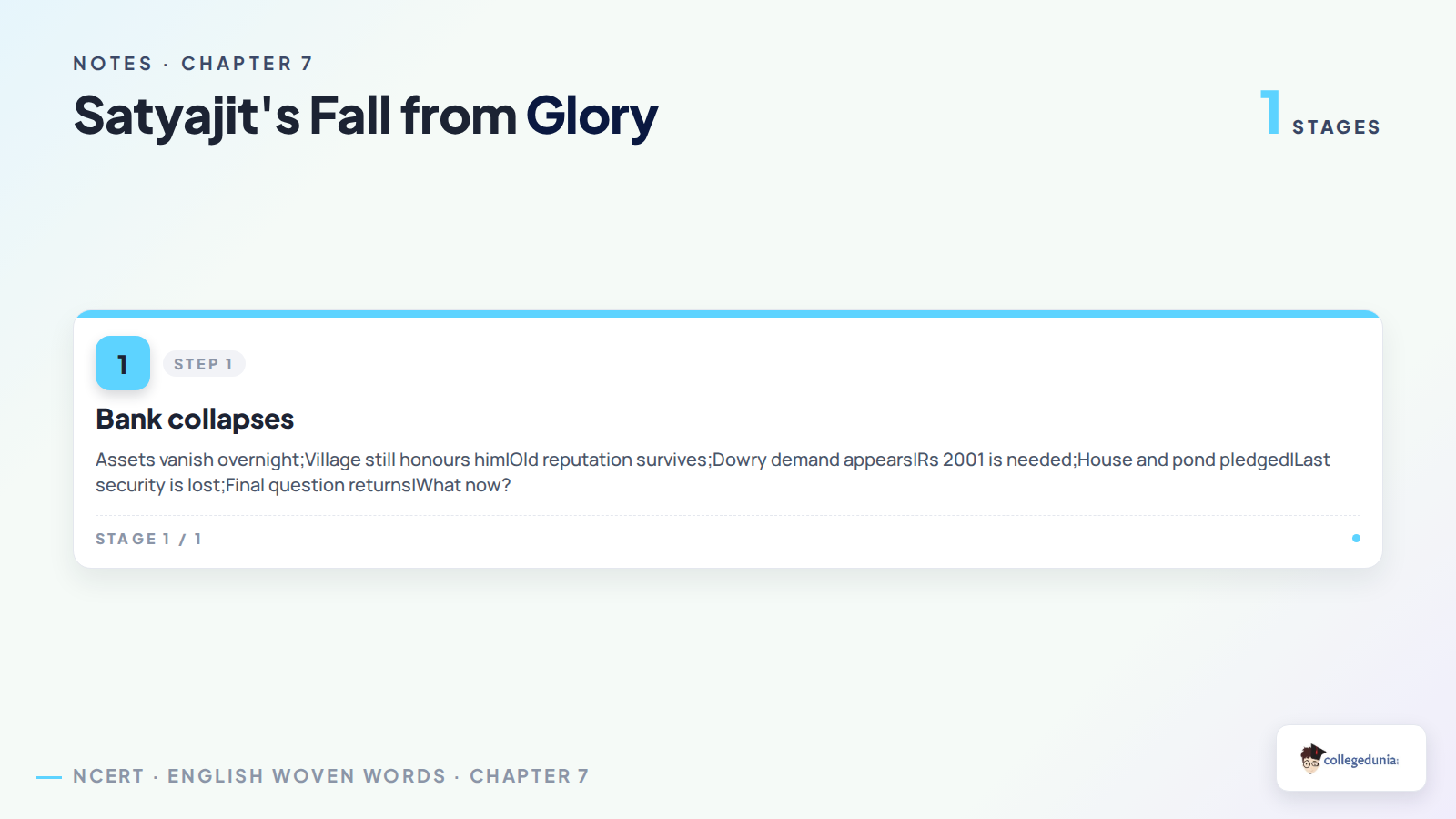
Satyajit travels by a slow village train while thinking about the collapse of his bank and the loss of his private assets. He remembers how he once rose from clerk to Managing Director after catching a forger. That old incident now troubles him because the forger's desperation looks different after Satyajit's own downfall.
He reaches Shantipur for Beena's wedding, expecting only to give a modest sum. Instead, the village welcomes him like a great benefactor. Srinath, his old neighbour, praises him as the pride of the village. Satyajit feels like an impostor because everyone sees the millionaire he used to be, not the ruined man he has become.
Near the wedding hour, Srinath asks for Rs 2001 as cash dowry. Satyajit cannot pay, but he also cannot confess his ruin. When the moneylender Harish agrees to lend only against Satyajit's ancestral house and fish pond, Satyajit signs them away. The marriage music begins, and Satyajit sits alone under the fig tree with the same question: "What now?"
Character Sketches in Glory at Twilight
Satyajit is proud, intelligent, self-made and deeply trapped by reputation. His rise shows energy and ambition, but his fall exposes his dependence on public honour. He is not heartless: he feels disturbed by the forger's story and sacrifices his last security for Beena's marriage.
Uncle Srinath is affectionate, theatrical and dependent. He calls money "benediction" because he wraps financial demand in emotional and religious language. His devotion to Satyajit is real, but it is also tied to the belief that Satyajit can solve every daughter crisis.
Beena is the quiet centre of the crisis. She washes Satyajit's feet in reverence, but her marriage depends on a cash demand she cannot control. Through her, the story shows how social customs can place young women inside negotiations of honour and money.
| Character | Key quality | Supporting detail |
|---|---|---|
| Satyajit | Fallen pride | He enjoys village respect while knowing that his glory is already dead. |
| Srinath | Dependence | He believes Satyajit's blessing can save every wedding difficulty. |
| Harish | Practical suspicion | He trusts property more than the signature of a supposed millionaire. |
| Beena | Innocent stake | Her wedding honour becomes the reason for Satyajit's final sacrifice. |
Main Themes in Glory at Twilight
The story studies the difficulty of adjusting to a fall from glory. Success gives Satyajit identity, respect and power, but failure arrives faster than he can publicly accept. The village still lives inside yesterday's image of him, while Satyajit is already facing tomorrow's struggle for survival.
| Theme | Story evidence | Answer line |
|---|---|---|
| Fall from glory | The bank collapses and all city assets disappear. | Bhattacharya shows that reputation can outlive reality for a short, painful time. |
| Social honour | The village welcomes Satyajit as a hero and treats his presence as auspicious. | Honour becomes both comfort and burden. |
| Money and morality | The forger episode returns when Satyajit himself faces desperation. | The story complicates easy judgments about crime, shame and need. |
| Dowry pressure | Beena's wedding may break unless Rs 2001 is paid. | The marriage system turns family dignity into a financial test. |
Narrative Technique and Language in Glory at Twilight
The narration stays close to Satyajit's thoughts. Short fragments such as the memory of the banking establishment and the tempo of success show the broken rhythm of his mind. This technique helps students see that the story is not only about events, but also about the pressure of memory, shame and self-deception.
- The train journey gives time for flashback and self-questioning.
- The phrase "What now?" works as a refrain that marks Satyajit's mental crisis.
- Village speeches use an Indian idiom of blessing, honour, devotion and social prestige.
- The title uses twilight as an image of fading splendour, not complete darkness.
How to Write Answers on Glory at Twilight
For NCERT answers, begin with the direct reason, then add one story detail and one interpretive line. For example, if the question asks why Satyajit feels like an impostor, state that the village honours him as a millionaire while he knows he is ruined. Then connect this to the story's larger theme of false public glory.
| Question type | Best answer frame | What to avoid |
|---|---|---|
| Reason questions | Reason plus scene plus effect on Satyajit. | Do not give only a plot line. |
| Theme discussion | Theme plus two examples from train, village or wedding. | Do not ignore the ending. |
| Appreciation answers | Mention perspective, flashback, refrain and irony. | Do not turn it into a moral summary only. |
| Language work | Quote a phrase and explain how it reveals character. | Do not list adjectives without interpretation. |
Related Resources for Glory at Twilight
| Resource | Use it for | Link |
|---|---|---|
| NCERT Solutions | Practise textbook questions and answers | Open Solutions |
| NCERT Book PDF | Read the source chapter | Open Book PDF |
| Handwritten Notes | Revise with visual notes | Open Handwritten Notes |
All Class 11 English Woven Words Notes Chapters
| Chapter | Notes Link |
|---|---|
| Chapter 1 The Lament | Open Notes |
| Chapter 2 A Pair of Mustachios | Open Notes |
| Chapter 3 The Rocking-horse Winner | Open Notes |
| Chapter 4 The Adventure of the Three Garridebs | Open Notes |
| Chapter 5 Pappachi's Moth | Open Notes |
| Chapter 6 The Third and Final Continent | Open Notes |
| Chapter 7 Glory at Twilight | Current chapter notes |
Glory at Twilight Class 11 Notes FAQs
Ques. What is the central idea of Glory at Twilight?
Ans. The central idea is the painful gap between Satyajit's old public glory and his present financial ruin.
Ques. Why does Satyajit feel like an impostor?
Ans. He feels like an impostor because Shantipur honours him as a rich success while he knows that his wealth has collapsed.
Ques. What does Rs 2001 represent in the story?
Ans. Rs 2001 represents the social and financial pressure of dowry, which forces Satyajit to risk his last security.
Ques. How does the title Glory at Twilight suit the chapter?
Ans. The title suits the chapter because Satyajit's honour still glows briefly even after the real light of his prosperity has faded.



Comments