




Around 25% of the weightage in the CBSE Class 11 Accountancy board paper comes from Unit 3: Financial Statements, and Financial Statements-II carries the heaviest numerical load in that unit. Collegedunia's NCERT Notes Class 11 Accountancy Chapter 9 Financial Statements-II are free to download as a 25-page PDF and walk through all eleven adjustments, from closing stock to interest on capital, exactly as the 2026-27 CBSE paper tests them.
- CBSE Weightage: A full Trading, Profit and Loss Account and Balance Sheet question with 5 to 6 adjustments is one of the most repeated 8-mark questions from this chapter.
- CUET Weightage: Identifying the correct dual effect of an adjustment (Trading/P&L Account plus Balance Sheet) is a recurring MCQ pattern in CUET Commerce.
- Covers: All eleven adjustments, the grouped Balance Sheet format, and two fully worked illustrations, according to the 2026-27 NCERT.
You can find the complete Notes for Financial Statements-II, including every adjustment, the grouped Balance Sheet format, and both solved illustrations, in the article below.
This NCERT Notes Class 11 Accountancy Chapter 9 Financial Statements-II page is curated by subject experts, mapped to the 2026-27 NCERT, and checked against the last five years of CBSE board question papers.
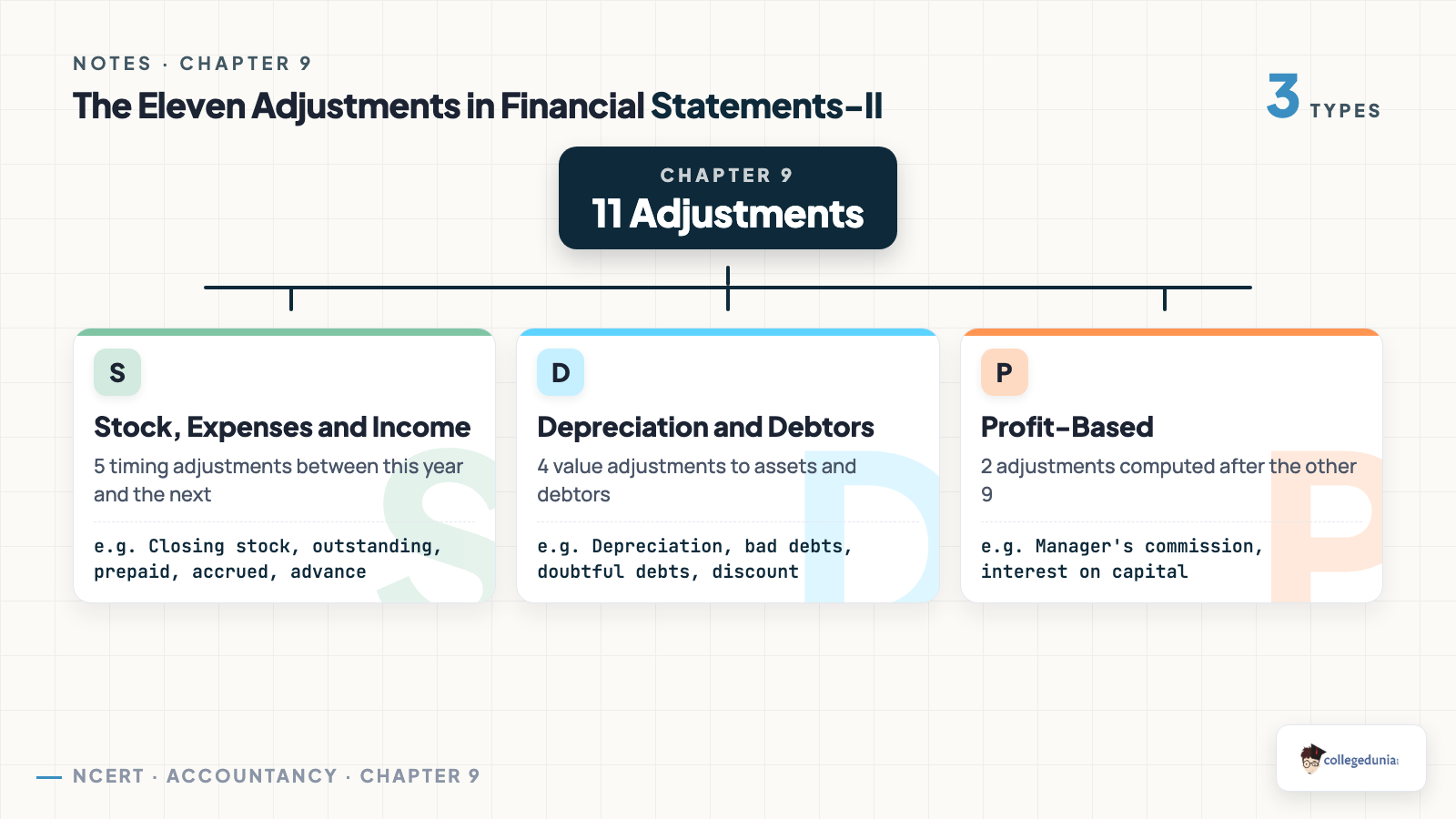
What Financial Statements-II Covers: The Eleven Adjustments at a Glance
Financial Statements-II picks up where the plain trial balance stops. Every item below needs an adjusting entry before the Trading Account, Profit and Loss Account and Balance Sheet can show a true and fair result.
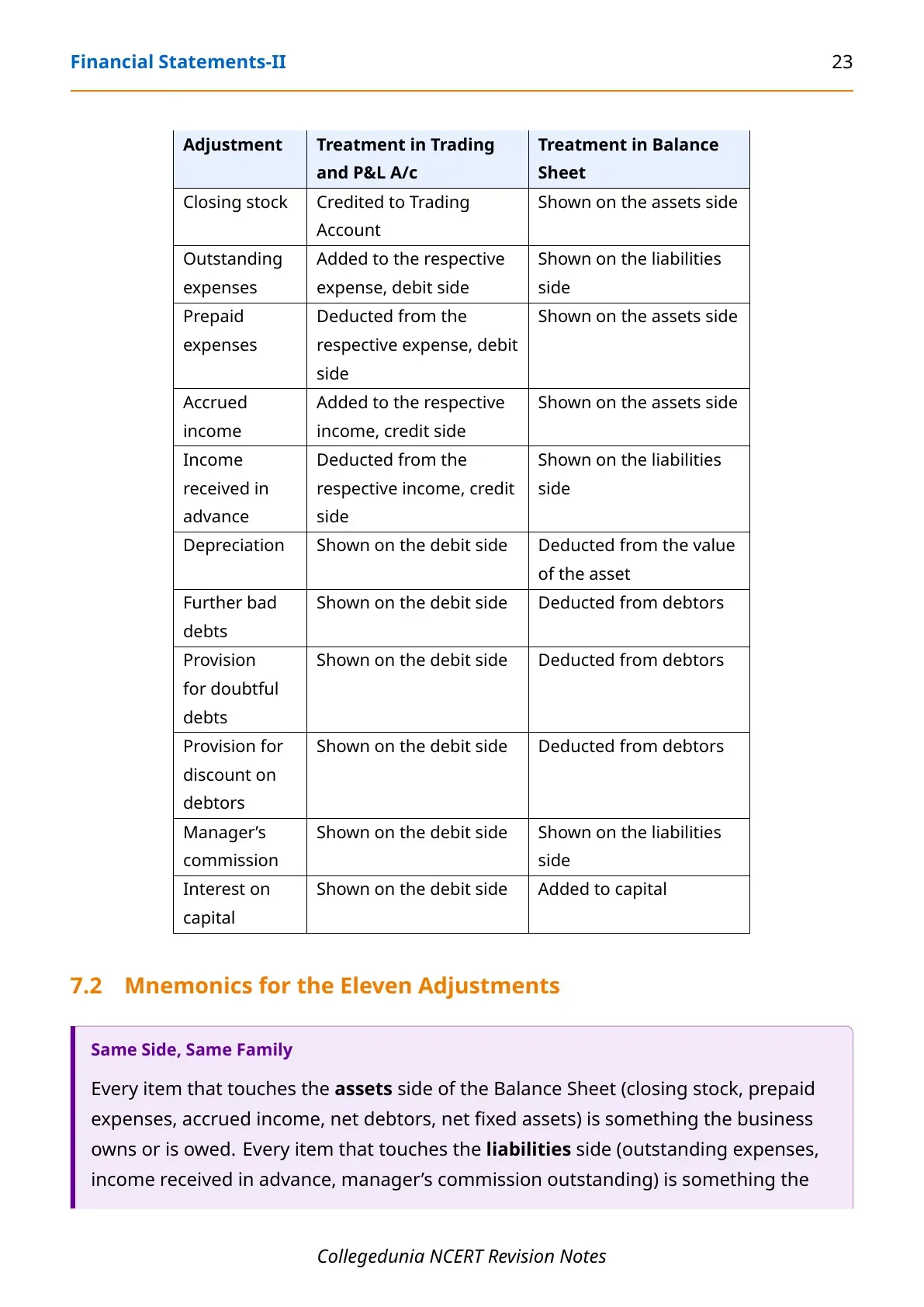
| Adjustment | Effect on Trading/P&L Account | Effect on Balance Sheet |
|---|---|---|
| Closing stock | Credited to Trading Account | Shown on the assets side |
| Outstanding expenses | Added to the expense, debit side | Shown on the liabilities side |
| Prepaid expenses | Deducted from the expense, debit side | Shown on the assets side |
| Accrued income | Added to the income, credit side | Shown on the assets side |
| Income received in advance | Deducted from the income, credit side | Shown on the liabilities side |
| Depreciation | Shown on the debit side | Deducted from the asset's value |
| Further bad debts | Shown on the debit side | Deducted from debtors |
| Provision for doubtful debts | Shown on the debit side | Deducted from debtors |
| Provision for discount on debtors | Shown on the debit side | Deducted from debtors |
| Manager's commission | Shown on the debit side | Shown on the liabilities side |
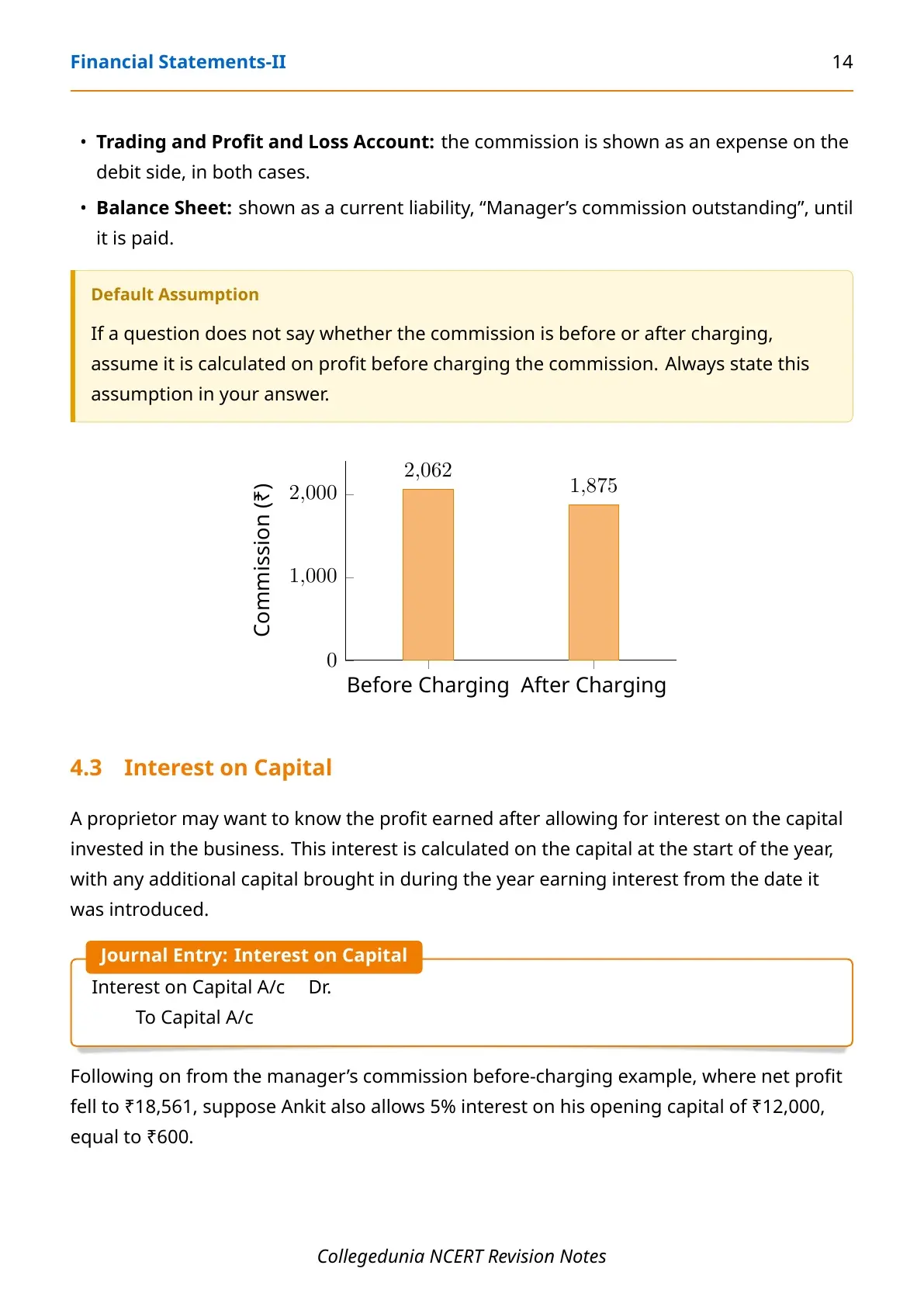
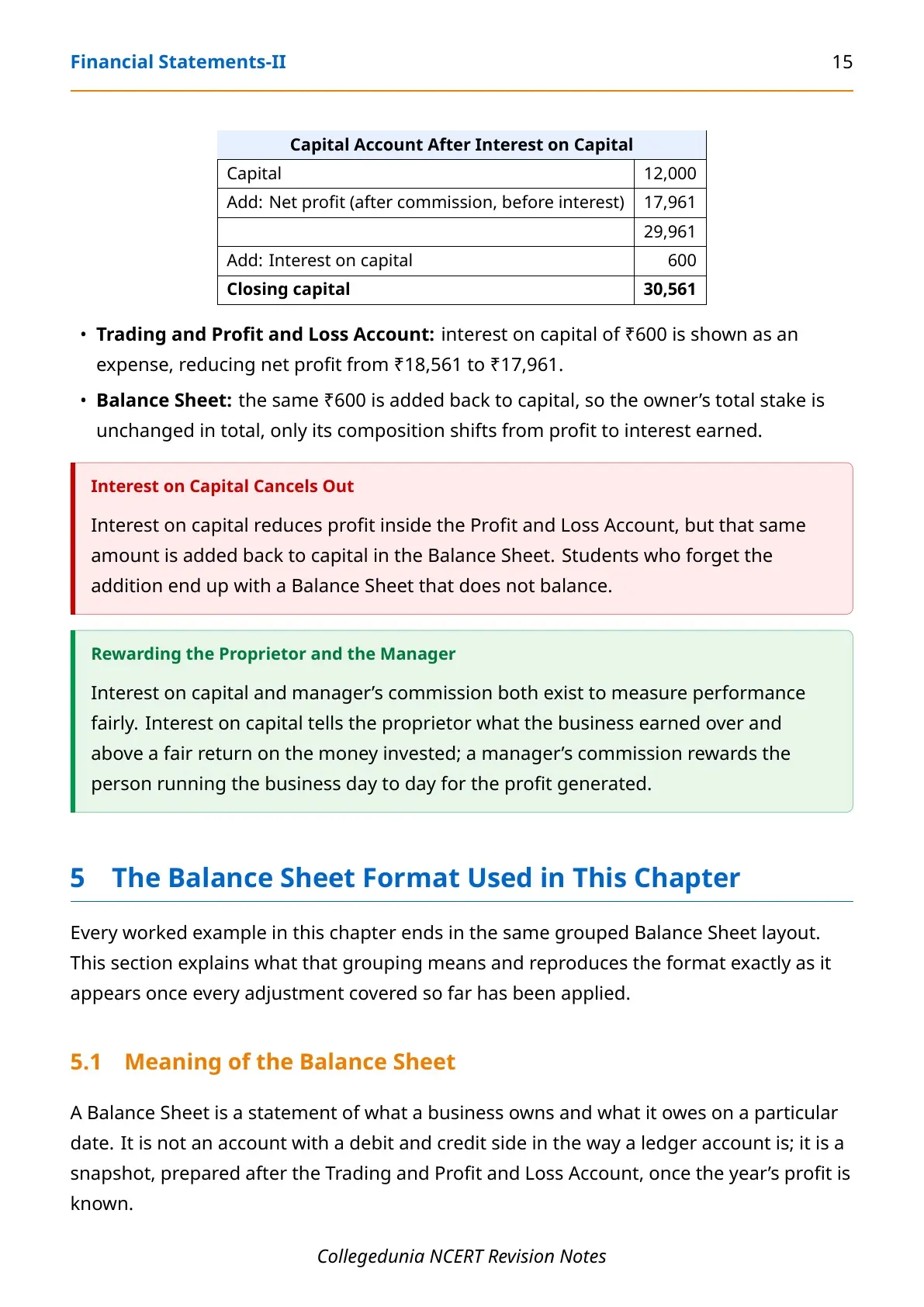
| Interest on capital | Shown on the debit side | Added to capital |
The Class 11 Accountancy Chapter 9 Financial Statements-II Notes PDF explains each row with the exact journal entry and a solved figure, so the table above is a quick-recall map, not the full explanation.
Financial Statements-II Explained for Class 11 Boards
Source: Magnet Brains on YouTube
How Every Adjustment Reaches Both the Trading/P&L Account and the Balance Sheet
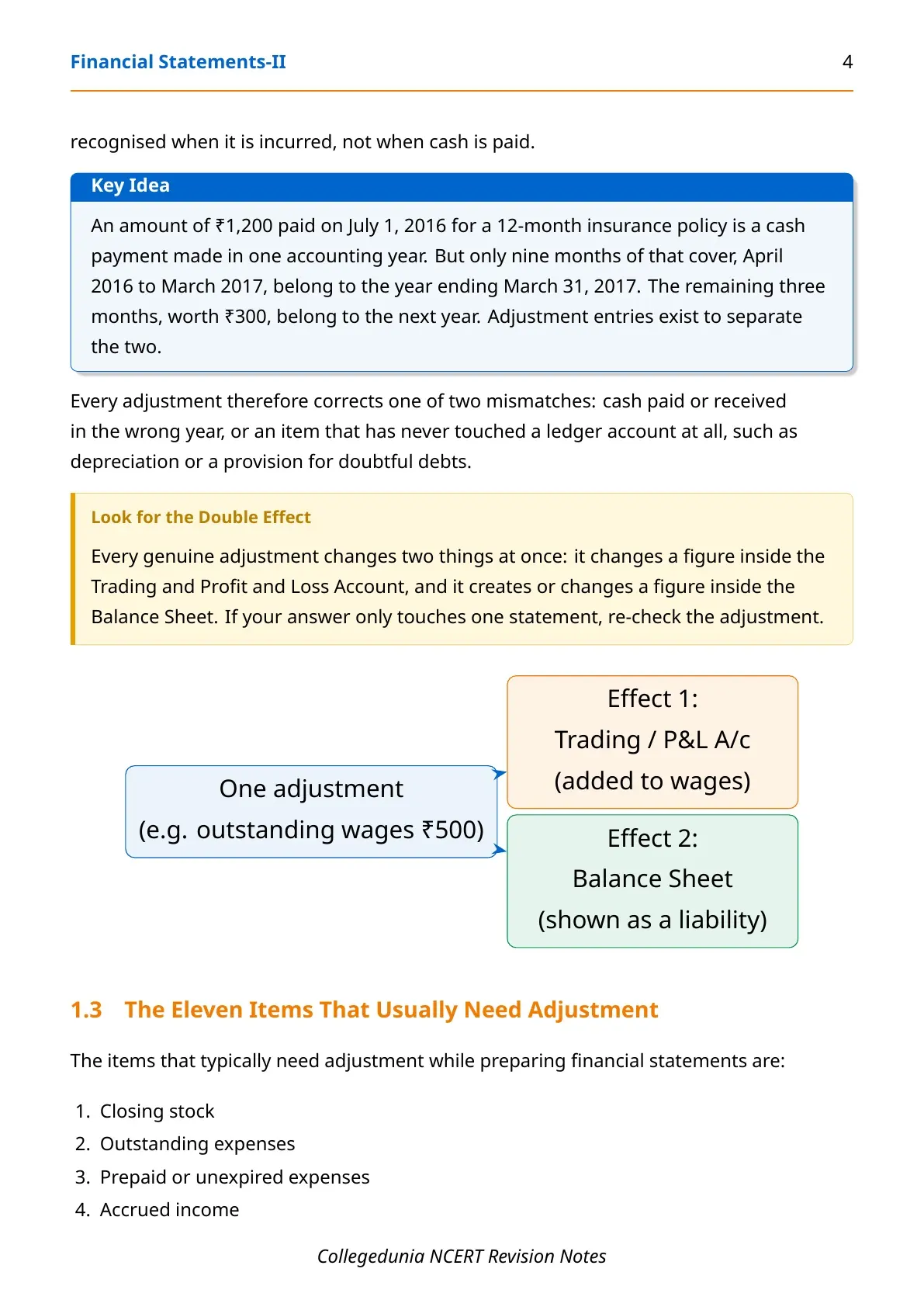
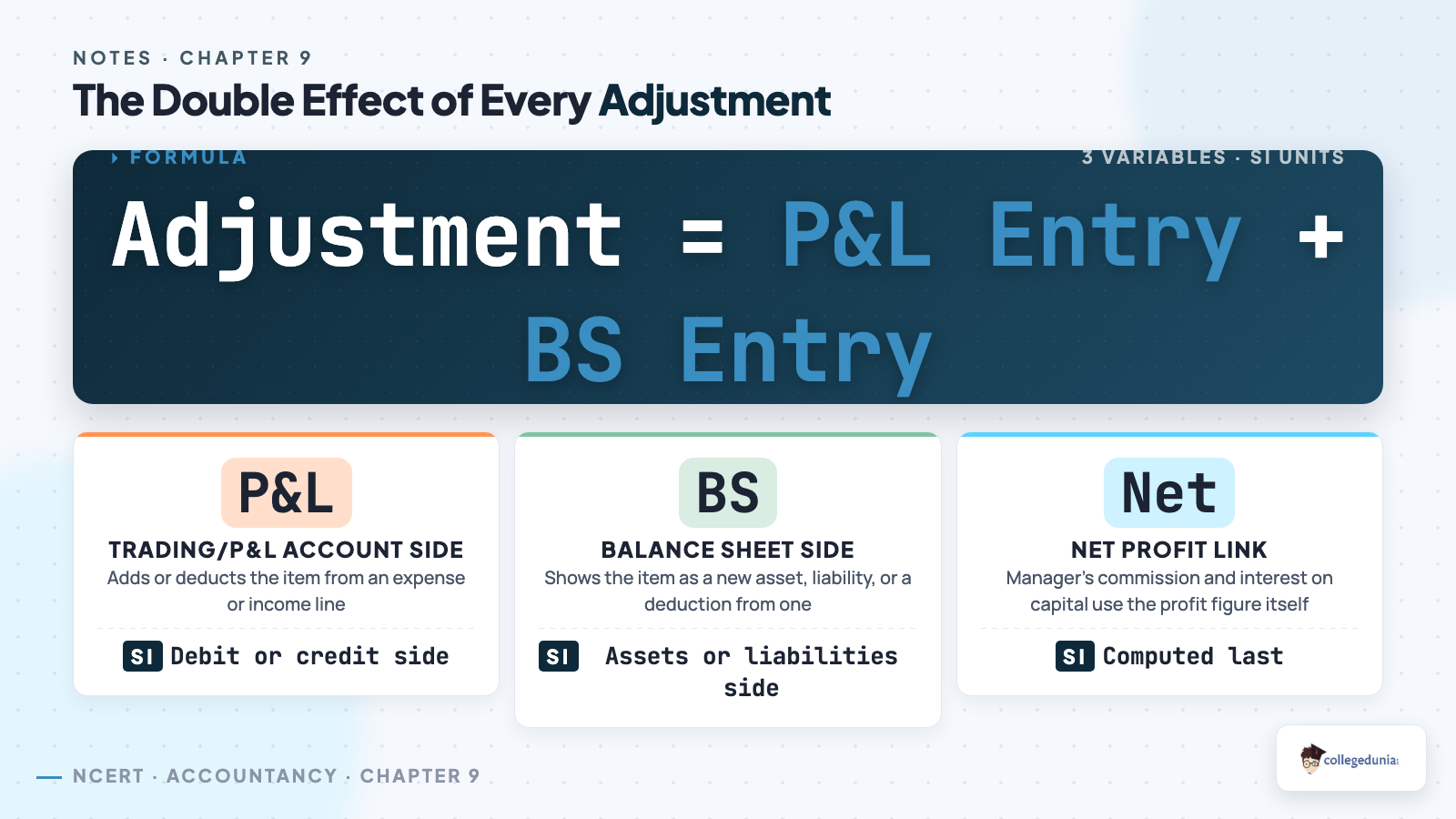
The chapter's central idea is the double effect. An adjustment that is given as additional information (outside the trial balance) must be entered twice, once in the Trading and Profit and Loss Account and once in the Balance Sheet, or the two sides will not tally.
- Timing adjustments (outstanding, prepaid, accrued, advance) shift an amount between this year and the next, so one side of the entry is always a current asset or current liability.
- Value adjustments (depreciation, bad debts, both provisions) reduce an asset's book value, so one side of the entry always lands on the assets side of the Balance Sheet.
- Profit-based adjustments (manager's commission, interest on capital) depend on the profit figure itself, so they must be worked out after the other ten adjustments are already in place.
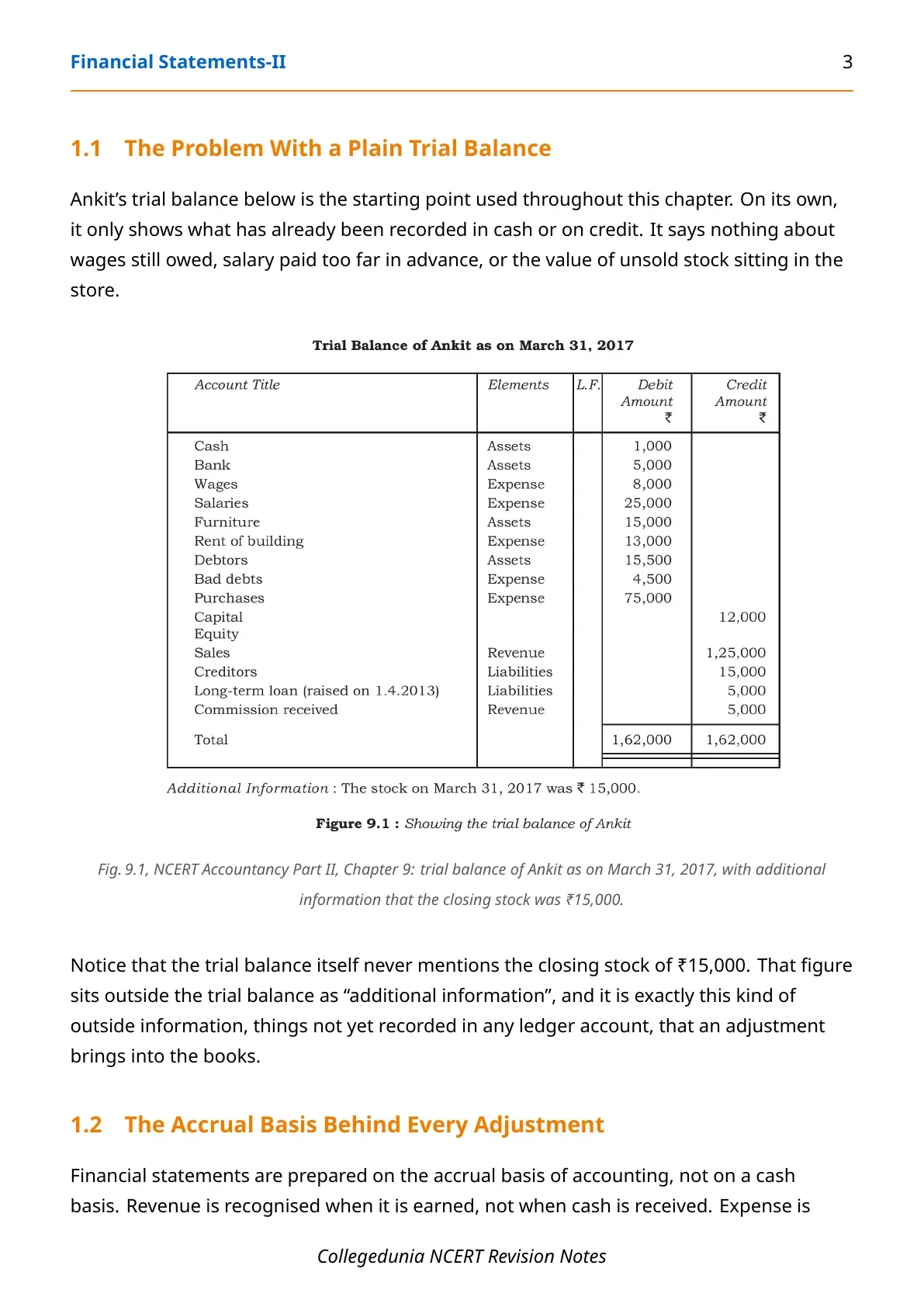
Ankit's running trial balance in the NCERT textbook is used as the solved example for every single adjustment. The Notes PDF keeps that same running example so a student can see the Trading Account, Profit and Loss Account and Balance Sheet change, one adjustment at a time, all the way to the final answer.
The Grouped Balance Sheet Format Used After Every Adjustment
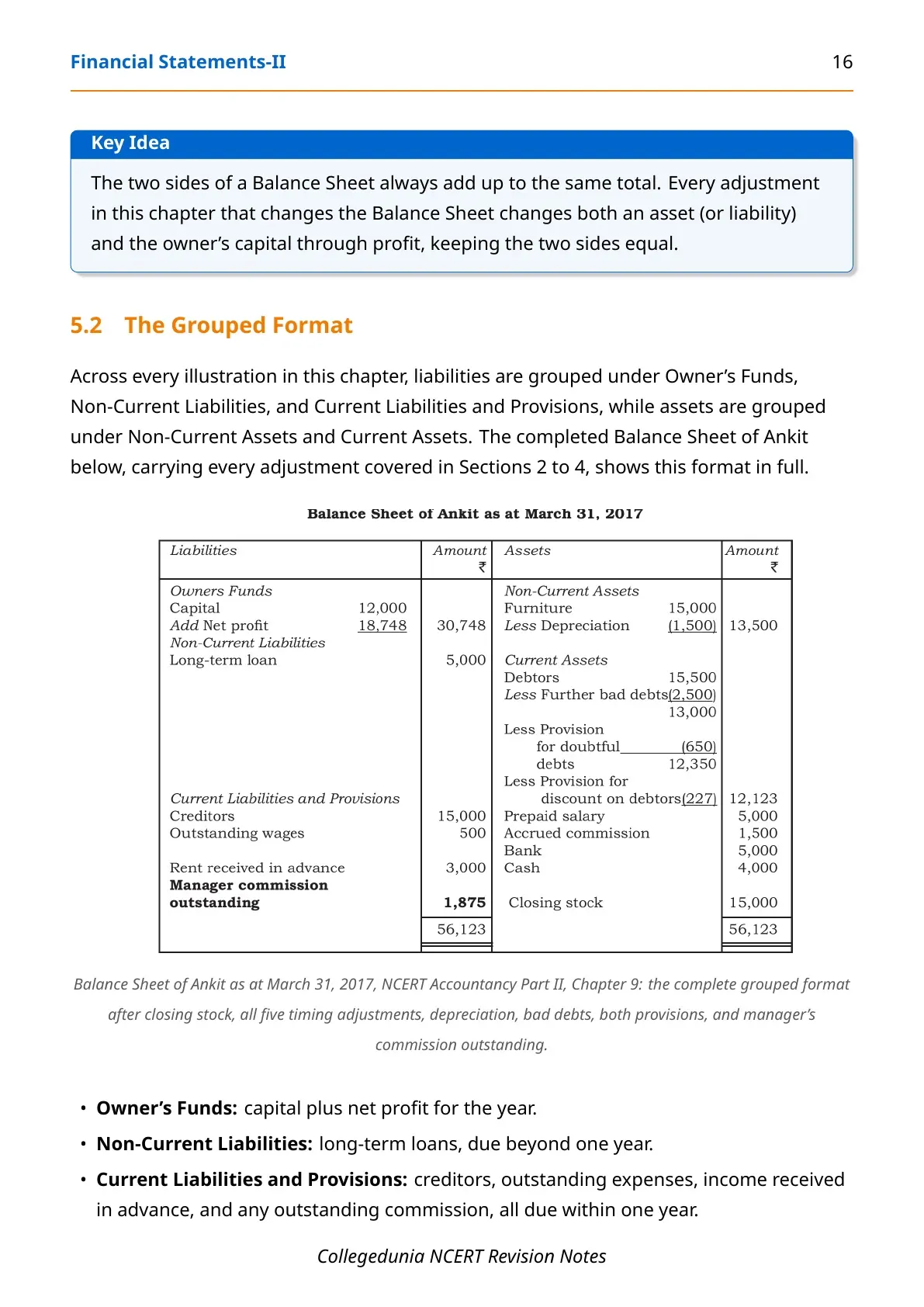
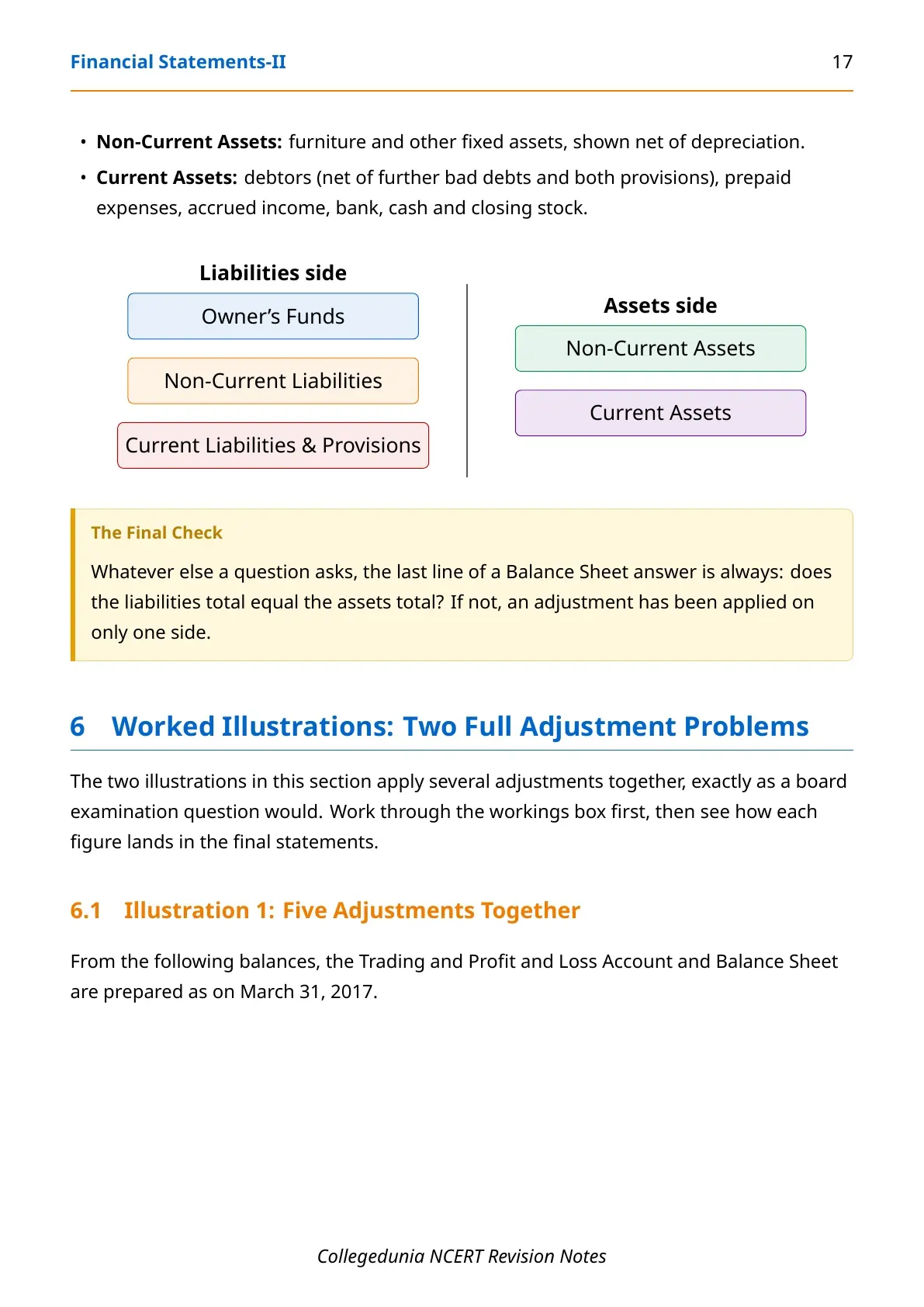
Once all eleven adjustments are applied, the final Balance Sheet in this chapter always uses the same grouped layout. Getting this grouping right is worth marks on its own in a CBSE answer.
| Liabilities Side | Assets Side |
|---|---|
| Owner's Funds: capital plus net profit for the year | Non-Current Assets: fixed assets, shown net of depreciation |
| Non-Current Liabilities: long-term loans due beyond one year | Current Assets: debtors net of bad debts and both provisions, prepaid expenses, accrued income, bank, cash and closing stock |
| Current Liabilities and Provisions: creditors, outstanding expenses, income received in advance, outstanding commission |
The Notes PDF reproduces this exact format straight from the NCERT textbook, so a student can check their own answer's layout, line by line, against the official one.
Manager's Commission: Before Charging vs After Charging
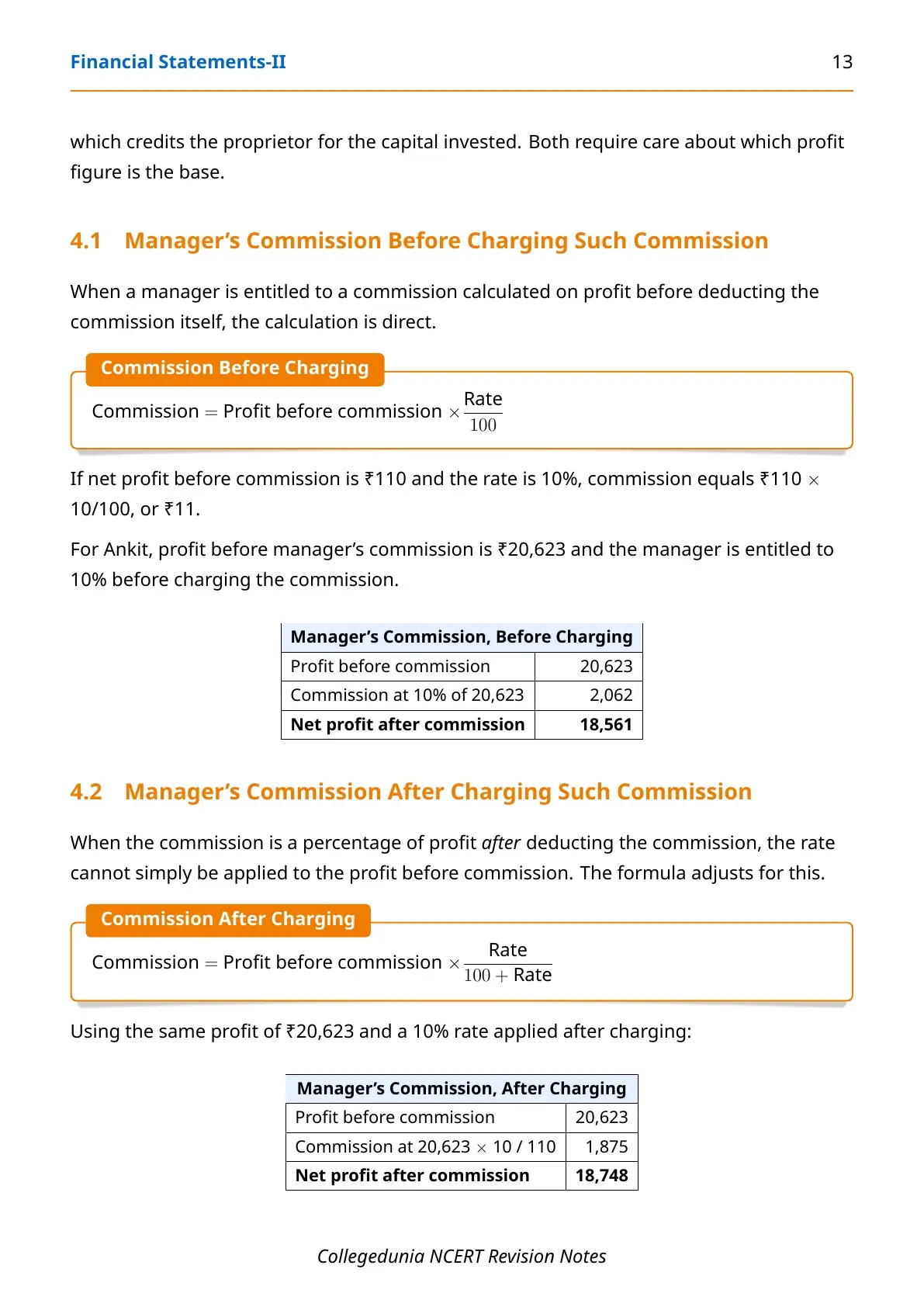
Manager's commission is the one adjustment in this chapter that has two formulas, and picking the wrong one is a common exam mistake. When a question does not say which one applies, the CBSE default is before charging.
| Basis | Formula | When to Use |
|---|---|---|
| Before charging commission | Profit before commission × Rate / 100 | Default assumption when the question is silent |
| After charging commission | Profit before commission × Rate / (100 + Rate) | Only when the question explicitly says "after charging" |
Both formulas use the same starting figure, the net profit before any commission is deducted. Only the denominator changes.
Worked Illustrations: Every Adjustment Flowing Through the Full Statements
Reading the rule for an adjustment is not the same as applying five or six of them together under exam pressure. The Notes PDF carries two fully worked illustrations that combine multiple adjustments in one problem.
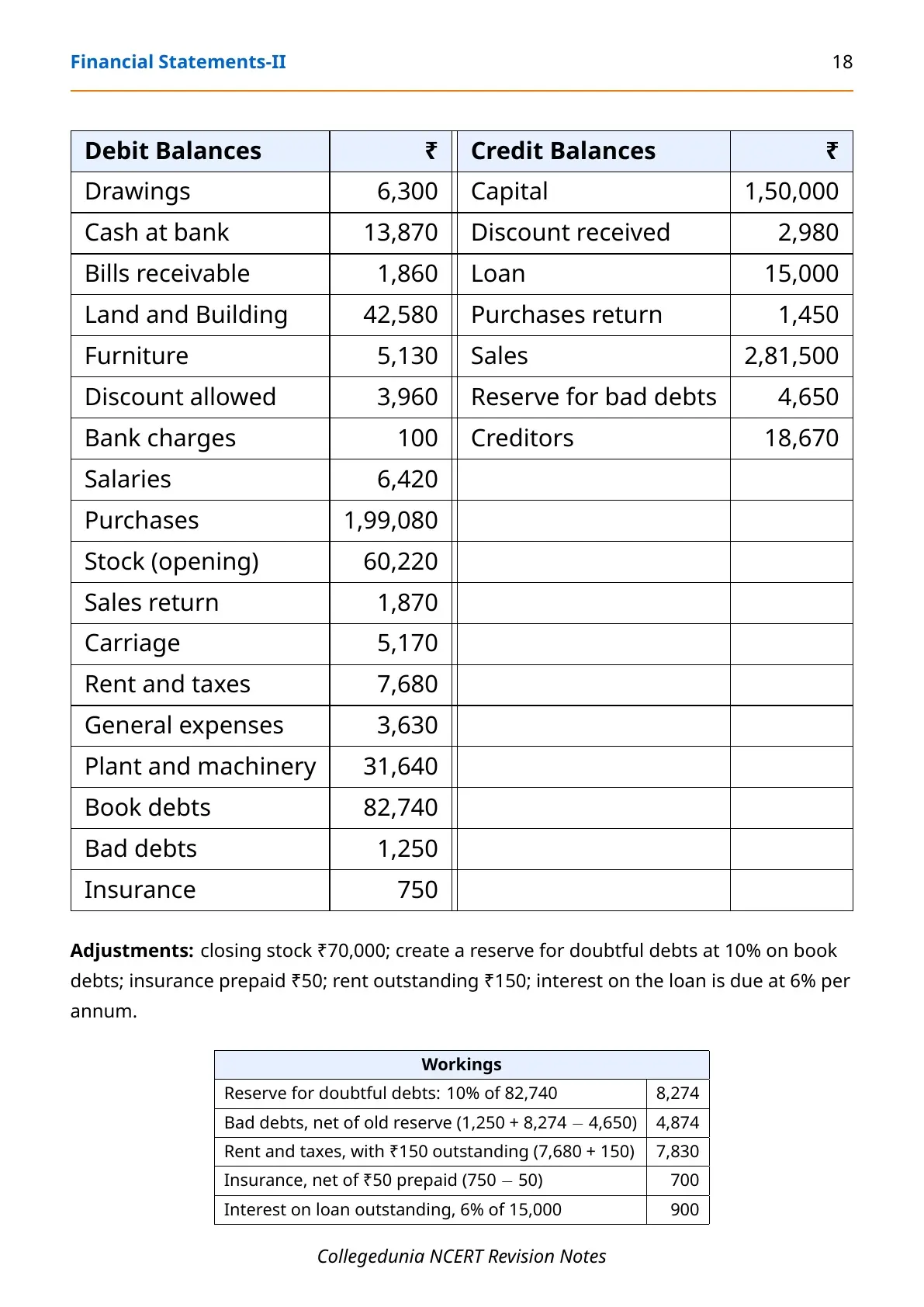
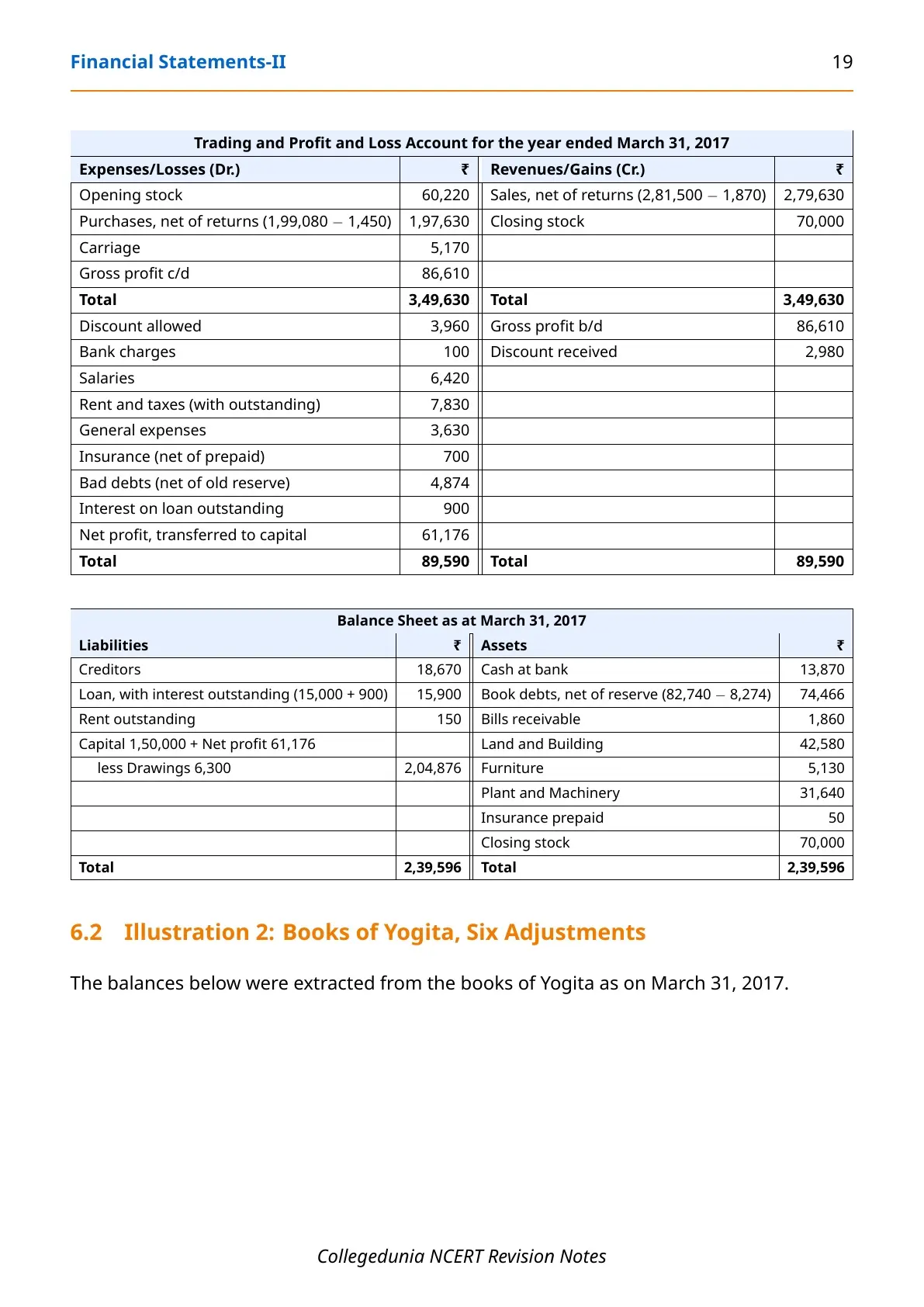
- Illustration 1 (five adjustments): closing stock, a reserve for doubtful debts, prepaid insurance, outstanding rent and interest on a loan, worked through to a Balance Sheet that totals ₹2,39,596 on both sides.
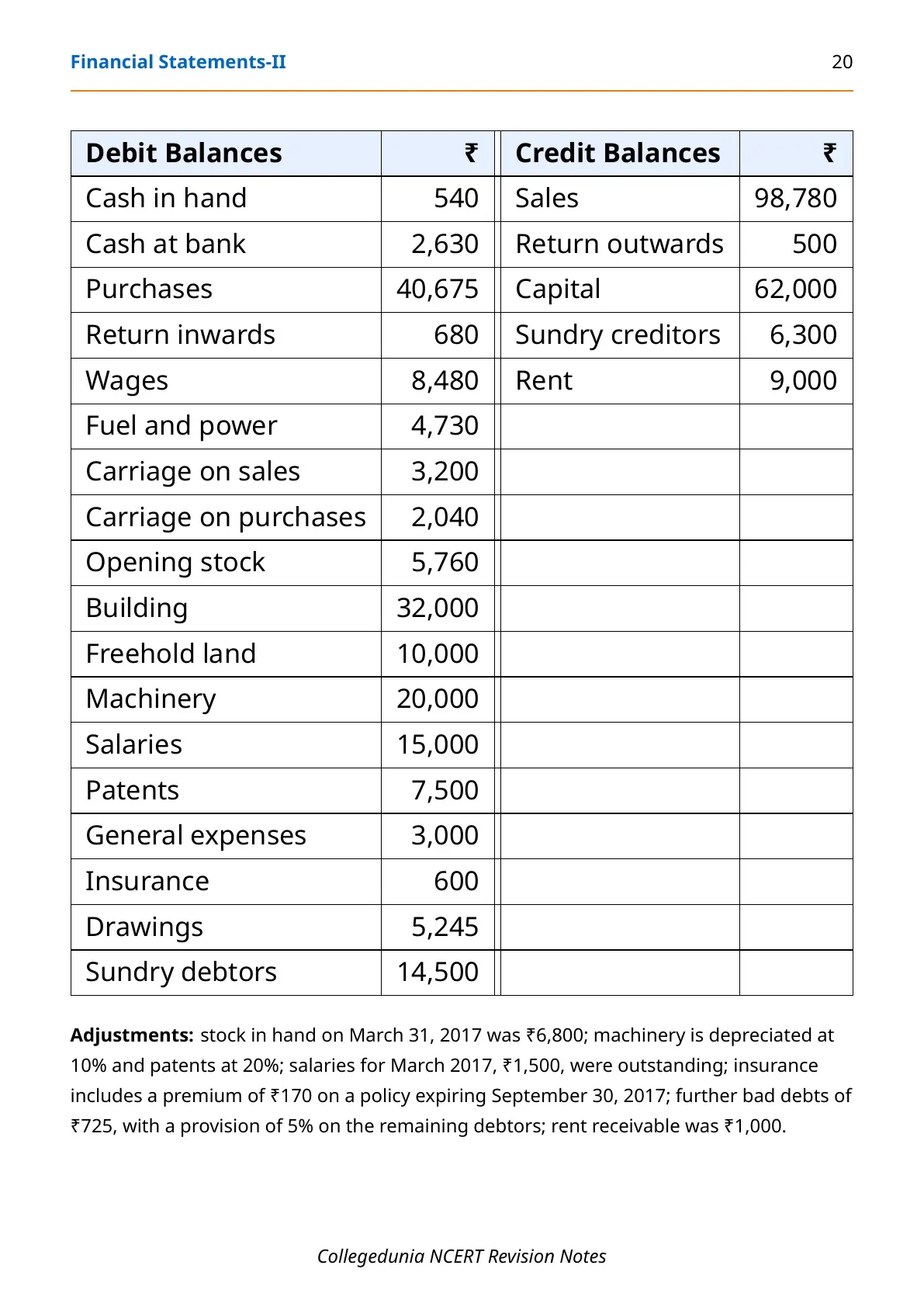
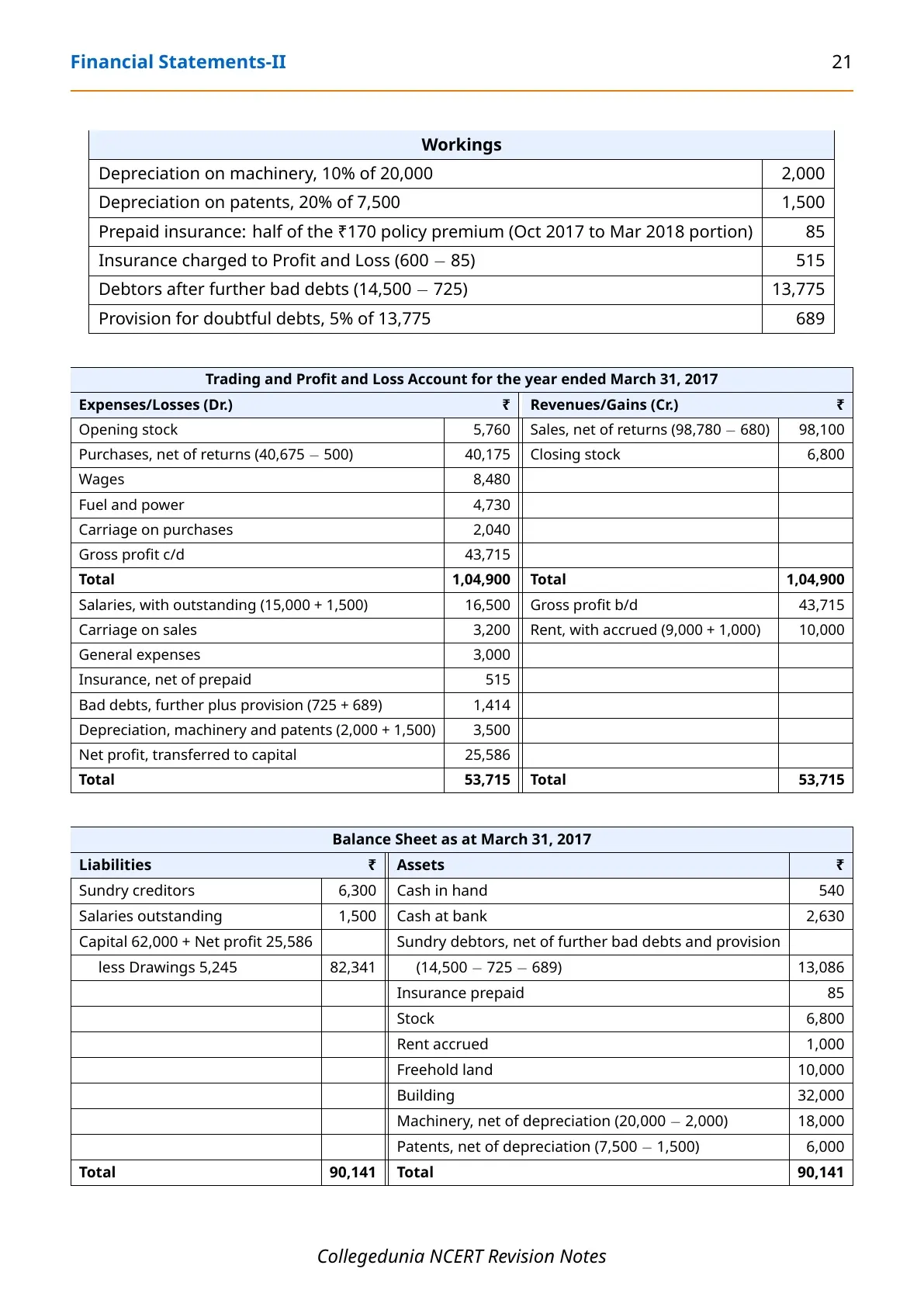
- Illustration 2 (six adjustments): closing stock, depreciation on two separate assets, an outstanding salary, a part-prepaid insurance premium, bad debts with a fresh provision, and accrued rent, closing at a Balance Sheet total of ₹90,141.
Both illustrations show every working, not just the final figure, so a student can see exactly where each number in the final Trading Account, Profit and Loss Account and Balance Sheet comes from.
Common Mistakes Students Make in the Financial Statements-II Chapter
| Mistake | Fix |
|---|---|
| Crediting closing stock to the Trading Account twice when purchases were already adjusted for it | Check whether the trial balance shows "adjusted purchases" first; if it does, closing stock goes only to the Balance Sheet |
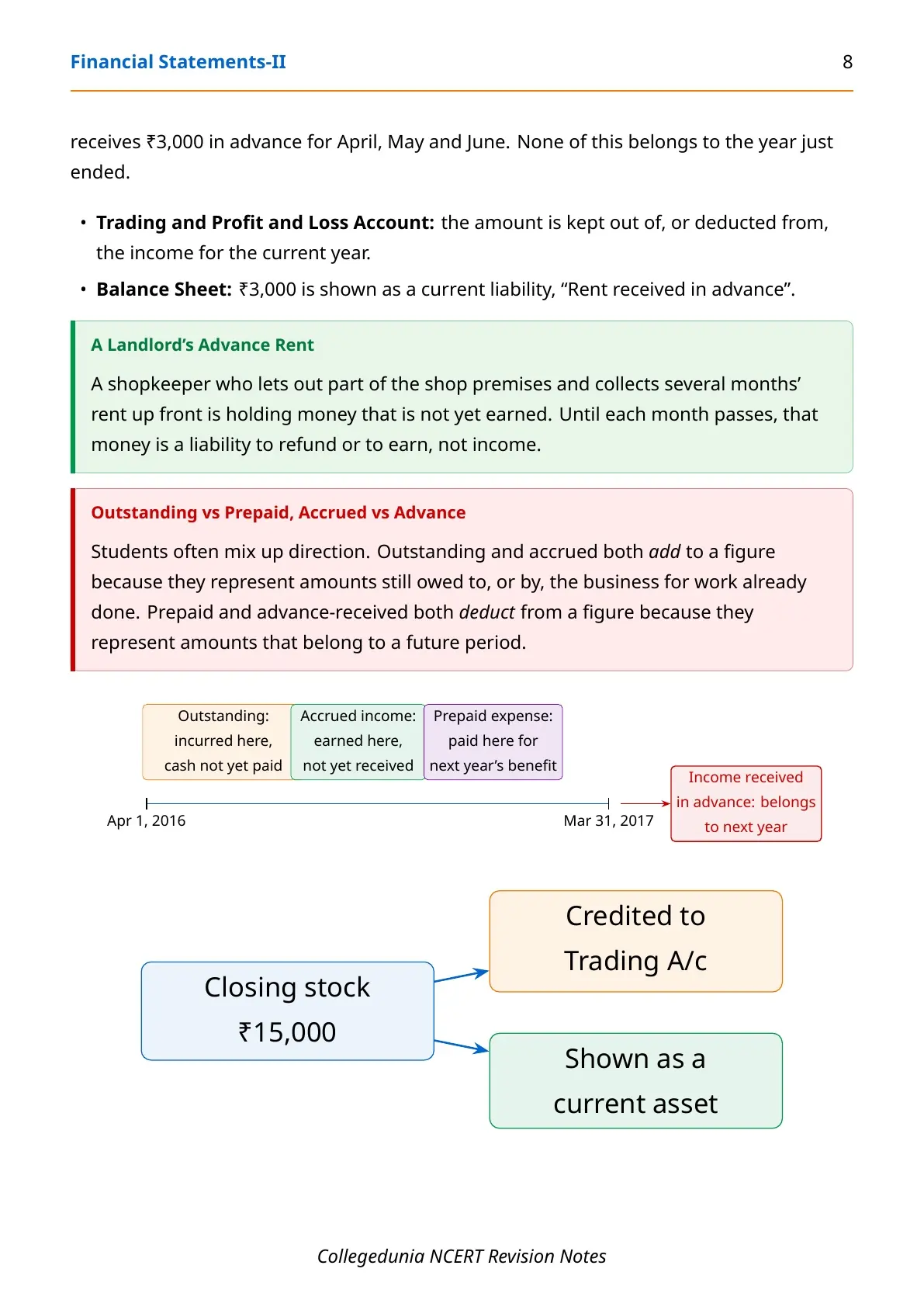
| Adding an outstanding item instead of deducting a prepaid one, or the reverse | Outstanding and accrued always add; prepaid and income received in advance always deduct |
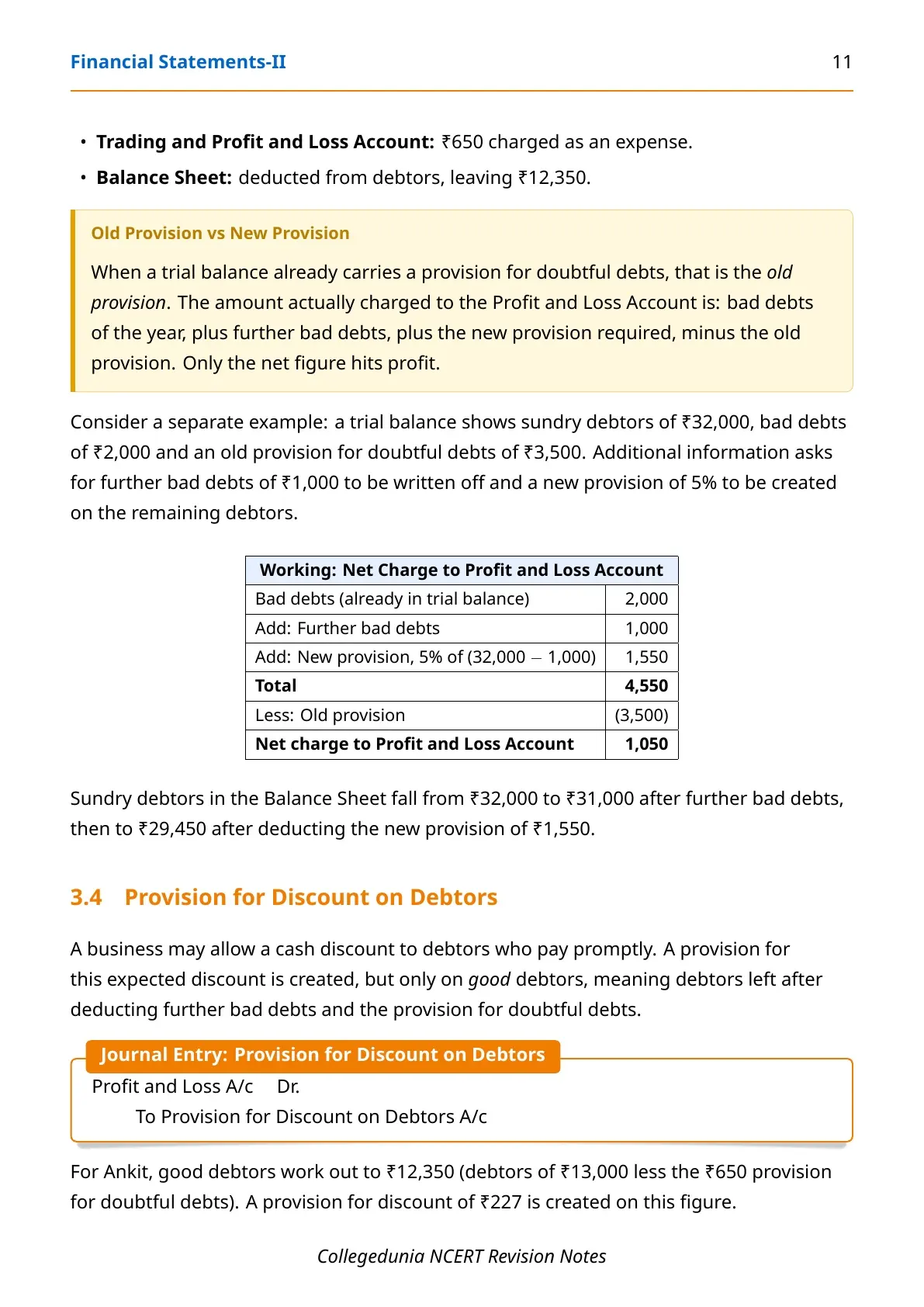
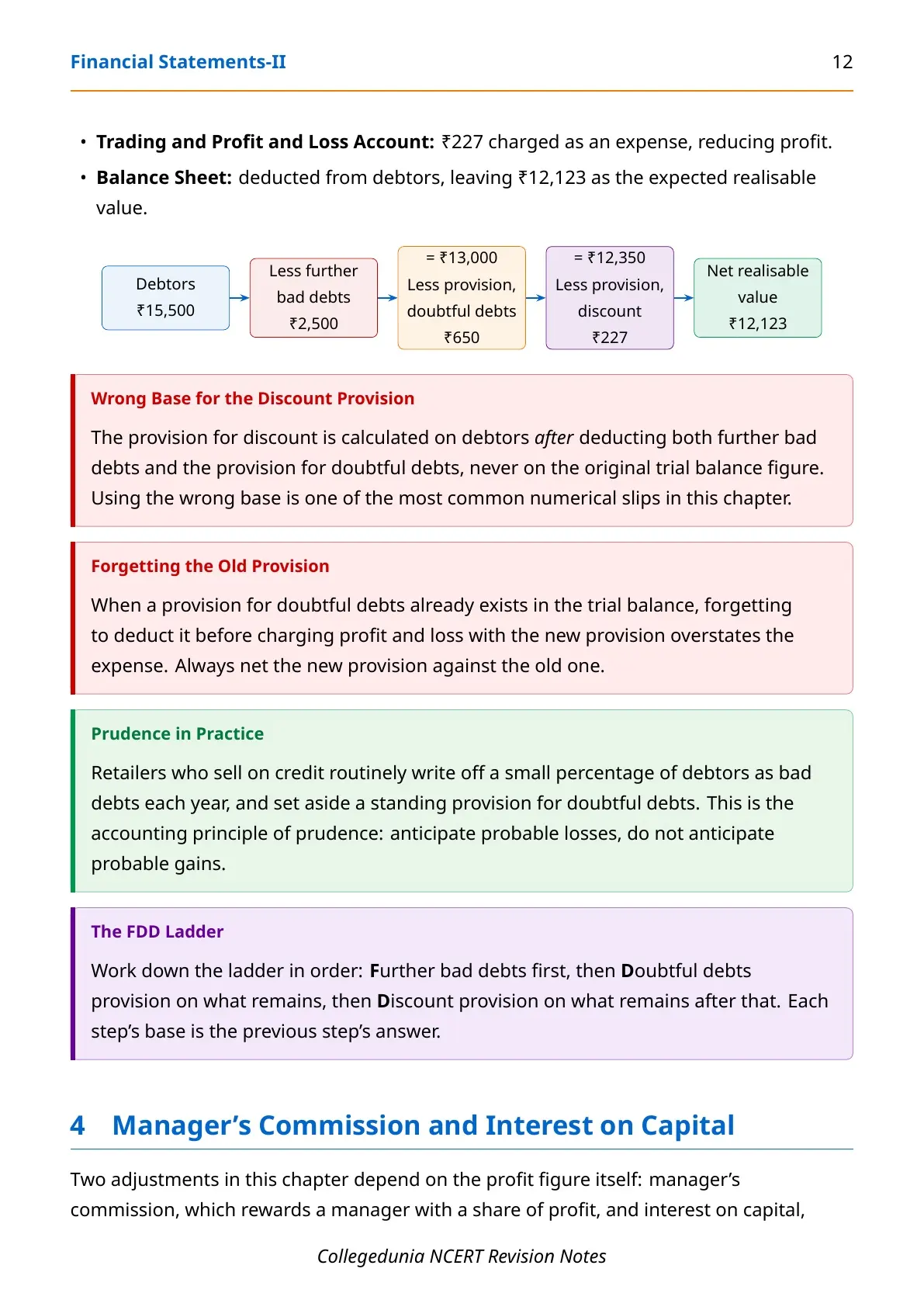
| Calculating the provision for doubtful debts on the original debtors figure | Always deduct further bad debts from debtors first, then apply the provision rate on what remains |
| Calculating the provision for discount before the provision for doubtful debts | Work the ladder in order: further bad debts, then doubtful debts, then discount |
| Forgetting to add interest on capital back to capital in the Balance Sheet | Interest on capital reduces profit in the P&L Account but is always added back to capital |
| Using the plain percentage rate for "after charging" manager's commission | Use Rate over (100 plus Rate) whenever the question says the commission is charged after itself |
Key Terms Glossary for Financial Statements-II
| Term | Meaning |
|---|---|
| Outstanding expense | An expense that belongs to the current year but is still unpaid at the year end |
| Prepaid expense | An expense already paid, part of which belongs to the next accounting year |
| Accrued income | Income earned during the year but not yet received in cash |
| Income received in advance | Cash already collected for a benefit that belongs partly or wholly to the next year |
| Further bad debts | Additional bad debts discovered after the trial balance is drawn up, still to be written off |
| Provision for doubtful debts | An estimated reserve set aside against debtors who may not pay |
| Marshalling | The order in which assets and liabilities are arranged in the Balance Sheet |
Financial Statements-II Topic-wise Weightage for CBSE Class 11 Accountancy
Not every adjustment in this chapter carries equal exam weight. The table below shows which sub-topics come up most often in the CBSE board pattern.
| Sub-topic | Weightage | CBSE Frequency |
|---|---|---|
| Full Trading, P&L Account and Balance Sheet with 5-6 adjustments | High | Almost every year |
| Provision for doubtful debts and discount on debtors | High | Almost every year |
| Depreciation and further bad debts | Medium | 3 out of last 5 years |
| Manager's commission, before and after charging | Medium | 3 out of last 5 years |
| Interest on capital | Low | 1 out of last 5 years |
How Collegedunia's Notes Help You With Financial Statements-II
The NCERT Notes Class 11 Accountancy Chapter 9 Financial Statements-II on this page are built to match how Class 11 board papers actually test this chapter.
- 2026-27 NCERT Alignment: Every format and rule matches the current NCERT print.
- All Eleven Adjustments Side by Side: Each one with its journal entry and its dual effect, explained separately.
- Two Complete Worked Illustrations: Full Trading Account, Profit and Loss Account and Balance Sheet, five and six adjustments respectively.
- The Official Balance Sheet Format: Reproduced from the NCERT textbook so students can check their own layout against it.
Financial Statements-II Class 11 Accountancy Resources
Besides the NCERT Notes Class 11 Accountancy Chapter 9 Financial Statements-II on this page, every other resource type for this chapter sits in one place below.
| Resource | Status |
|---|---|
| Financial Statements-II Class 11 Notes | You are reading this page |
| Financial Statements-II Class 11 Handwritten Notes | Available now |
| Financial Statements-II Class 11 NCERT Solutions | (coming soon) |
| Financial Statements-II Class 11 NCERT Book PDF | (coming soon) |
NCERT Notes for Class 11 Accountancy: All Chapters
Jump to the notes for any other Class 11 Accountancy chapter.
| Chapter | Notes |
|---|---|
| Chapter 1 | Introduction to Accounting |
| Chapter 2 | Theory Base of Accounting |
| Chapter 3 | Recording of Transactions-I |
| Chapter 4 | Recording of Transactions-II |
| Chapter 5 | Bank Reconciliation Statement |
| Chapter 6 | Trial Balance and Rectification of Errors |
| Chapter 7 | Depreciation, Provisions and Reserves (coming soon) |
| Chapter 8 | Financial Statements-I (coming soon) |
| Chapter 9 | Financial Statements-II (this page) |
Financial Statements-II Class 11 Accountancy Notes FAQs
Ques. Where can I download Financial Statements-II Class 11 Accountancy Notes PDF?
Ans. You can download the Financial Statements-II Class 11 Accountancy Notes PDF directly from this page. Both the Normal and HD versions are available, and both are free.
Ques. Is this Notes PDF aligned with the 2026-27 NCERT?
Ans. Yes. This page reflects the current 2026-27 syllabus for Class 11 Accountancy. All eleven adjustments and the Balance Sheet format match the latest NCERT print of Accountancy Part II.
Ques. How many pages is the Class 11th Accountancy Financial Statements-II Notes PDF?
Ans. The Notes PDF runs approximately 25 pages and covers all eleven adjustments, the grouped Balance Sheet format, and two fully worked illustrations.
Ques. What are the eleven adjustments covered in Financial Statements-II?
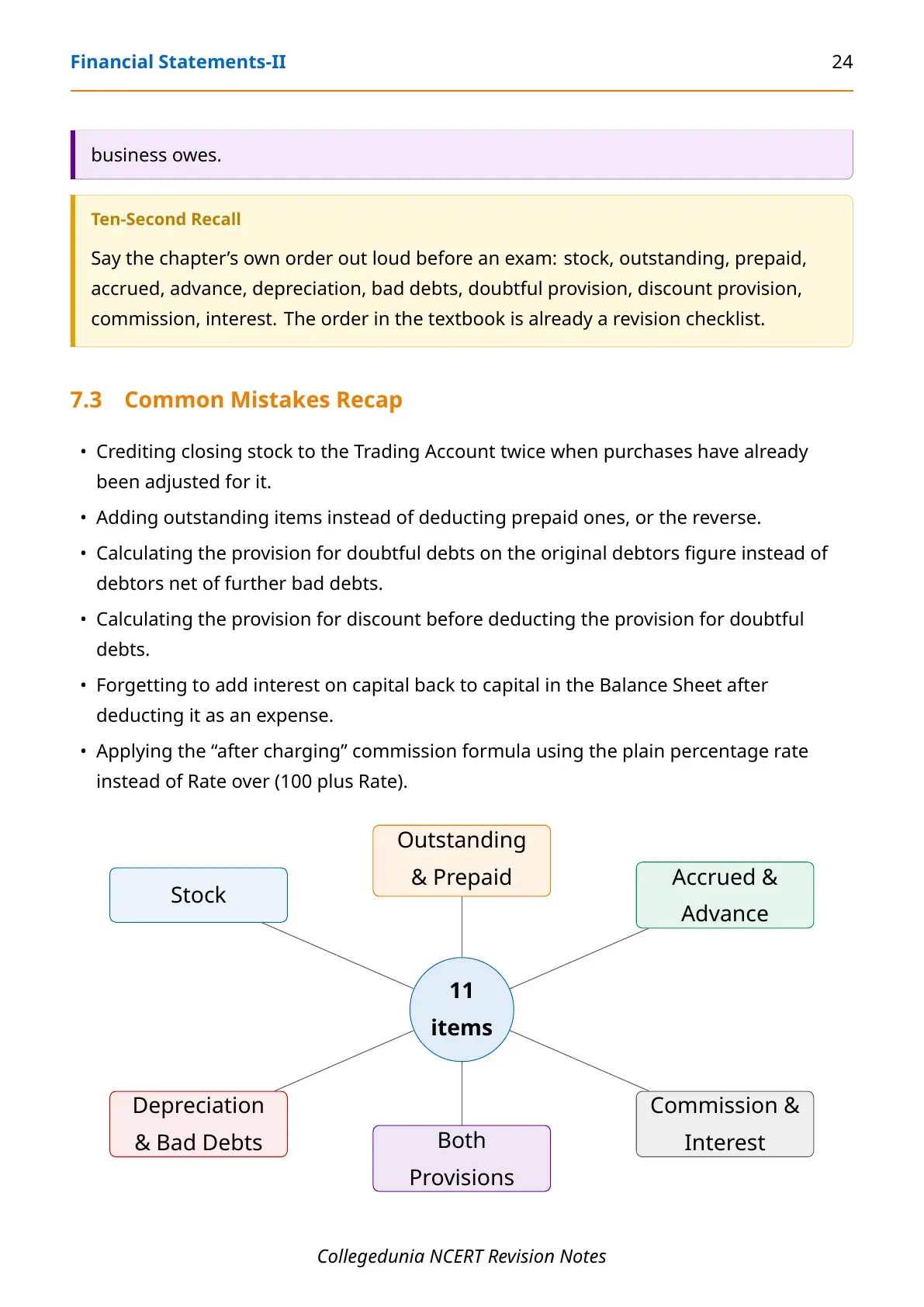
Ans. Closing stock, outstanding expenses, prepaid expenses, accrued income, income received in advance, depreciation, bad debts, provision for doubtful debts, provision for discount on debtors, manager's commission, and interest on capital.
Ques. Which formula is used for manager's commission if the question does not specify before or after charging?
Ans. Assume the commission is calculated on profit before charging the commission, and state this assumption clearly in the answer.
Ques. In what order should provision for doubtful debts and provision for discount on debtors be calculated?
Ans. First deduct further bad debts from debtors, then apply the provision for doubtful debts on the remaining balance, then apply the provision for discount on the balance left after that.
Ques. Does Financial Statements-II follow directly from Financial Statements-I?
Ans. Yes. Financial Statements-I (Chapter 8) covers the basic Trading Account, Profit and Loss Account and Balance Sheet without adjustments. Financial Statements-II (Chapter 9) adds the eleven adjustments on top of that same format.
Ques. What is an adjustment in accounting?
Ans. An adjustment is an entry made at the end of the accounting year to bring an item, not yet fully recorded in the trial balance, into the final accounts on the accrual basis.
Ques. How is a provision for doubtful debts defined?
Ans. A provision for doubtful debts is a reasonable estimate, charged to the Profit and Loss Account, that is set aside against debtors who may not pay in the next accounting year.
Ques. What are current liabilities and provisions in a Balance Sheet?
Ans. Current liabilities and provisions are amounts a business must pay within one year, such as creditors, outstanding expenses, income received in advance, and any outstanding manager's commission.



Comments