




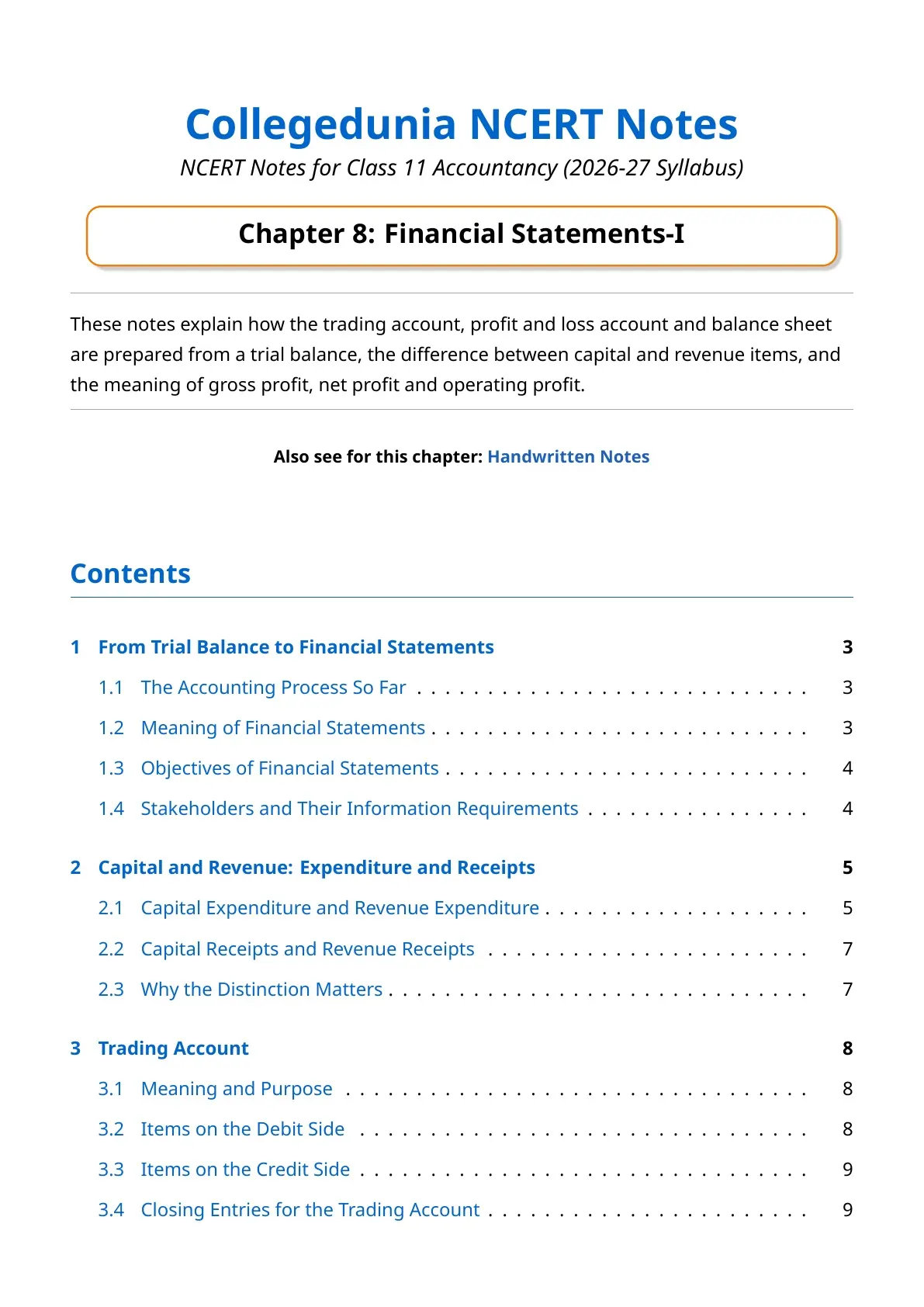
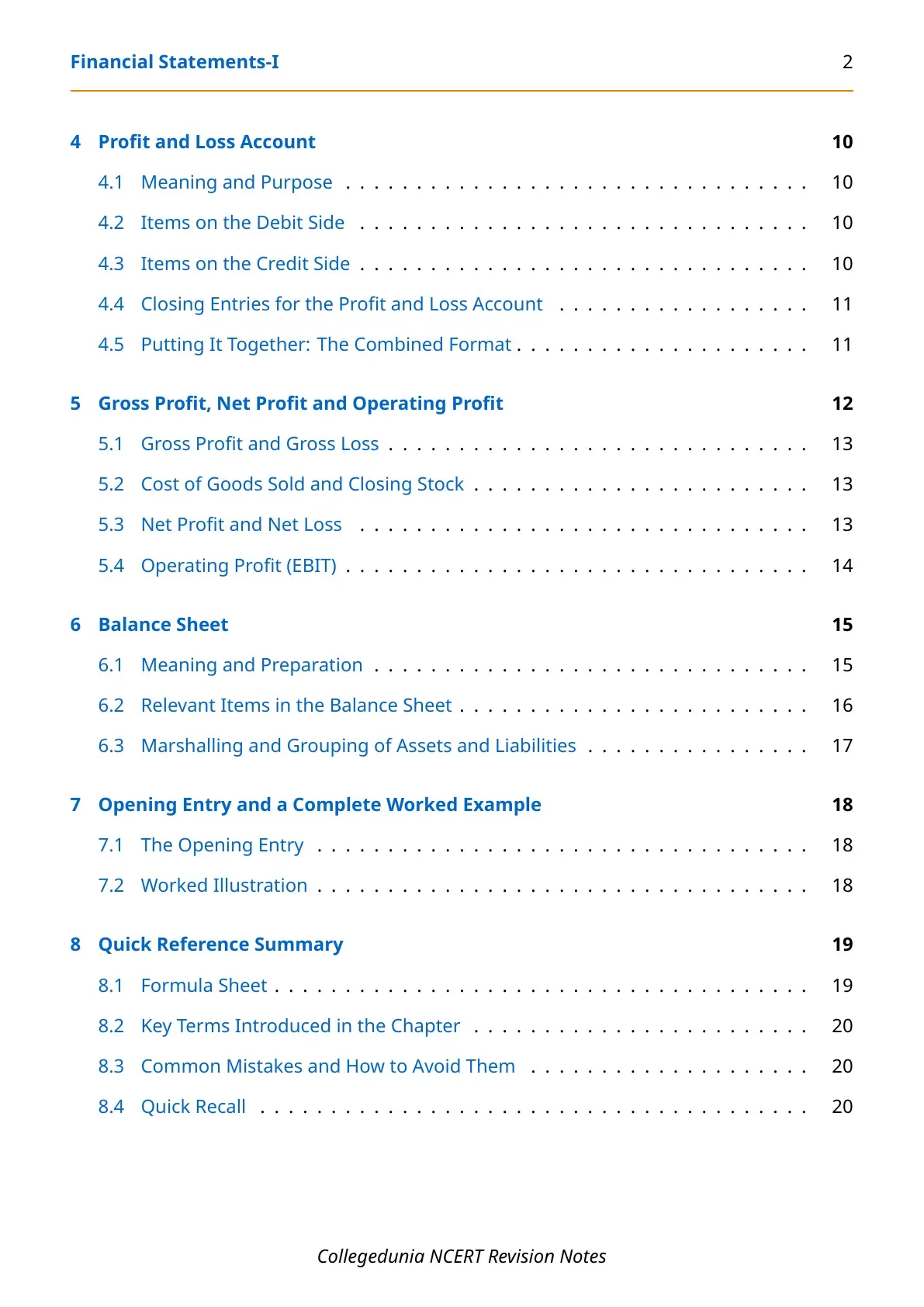
Financial statements are the final output of the accounting process, the two reports that turn a trial balance into a clear picture of profit and financial position. Collegedunia's NCERT Notes Class 11 Accountancy Chapter 8 Financial Statements-I are free to download as a 21-page PDF, covering the Trading Account, Profit and Loss Account and Balance Sheet. It follows the latest 2026-27 CBSE syllabus.
- CBSE Weightage: The Trading Account, Profit and Loss Account and Balance Sheet together carry 6 to 8 marks most years.
- Covers: Capital vs revenue items, both financial statement formats, gross profit, net profit, operating profit and balance sheet grouping.
- CUET Weightage: Classifying capital and revenue expenditure is a recurring MCQ pattern in CUET Commerce.
This NCERT Notes Class 11 Accountancy Chapter 8 Financial Statements-I page is curated by subject experts, mapped to the 2026-27 NCERT, and checked against the last five years of CBSE board question papers.
Meaning, Objectives and Users of Financial Statements
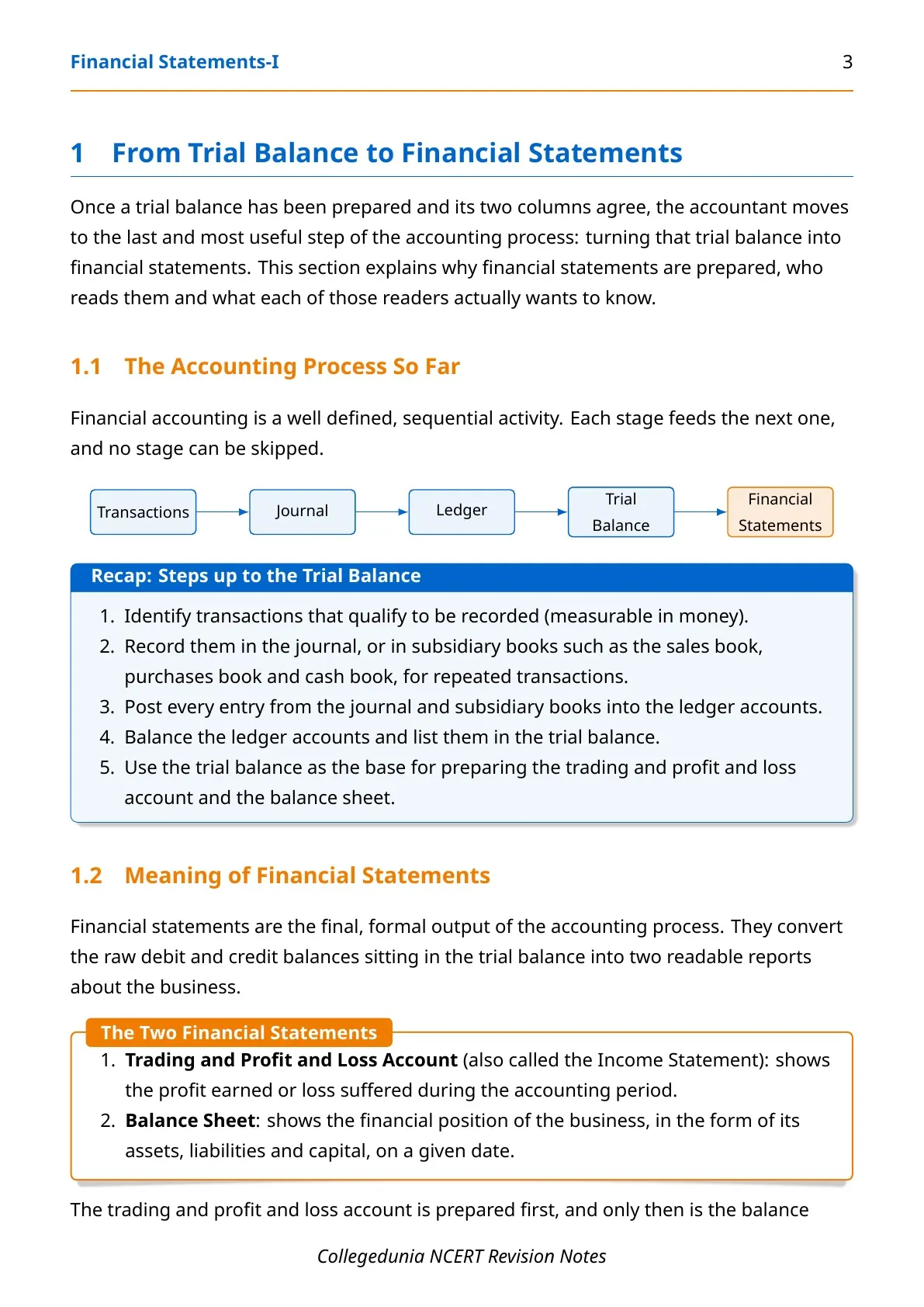
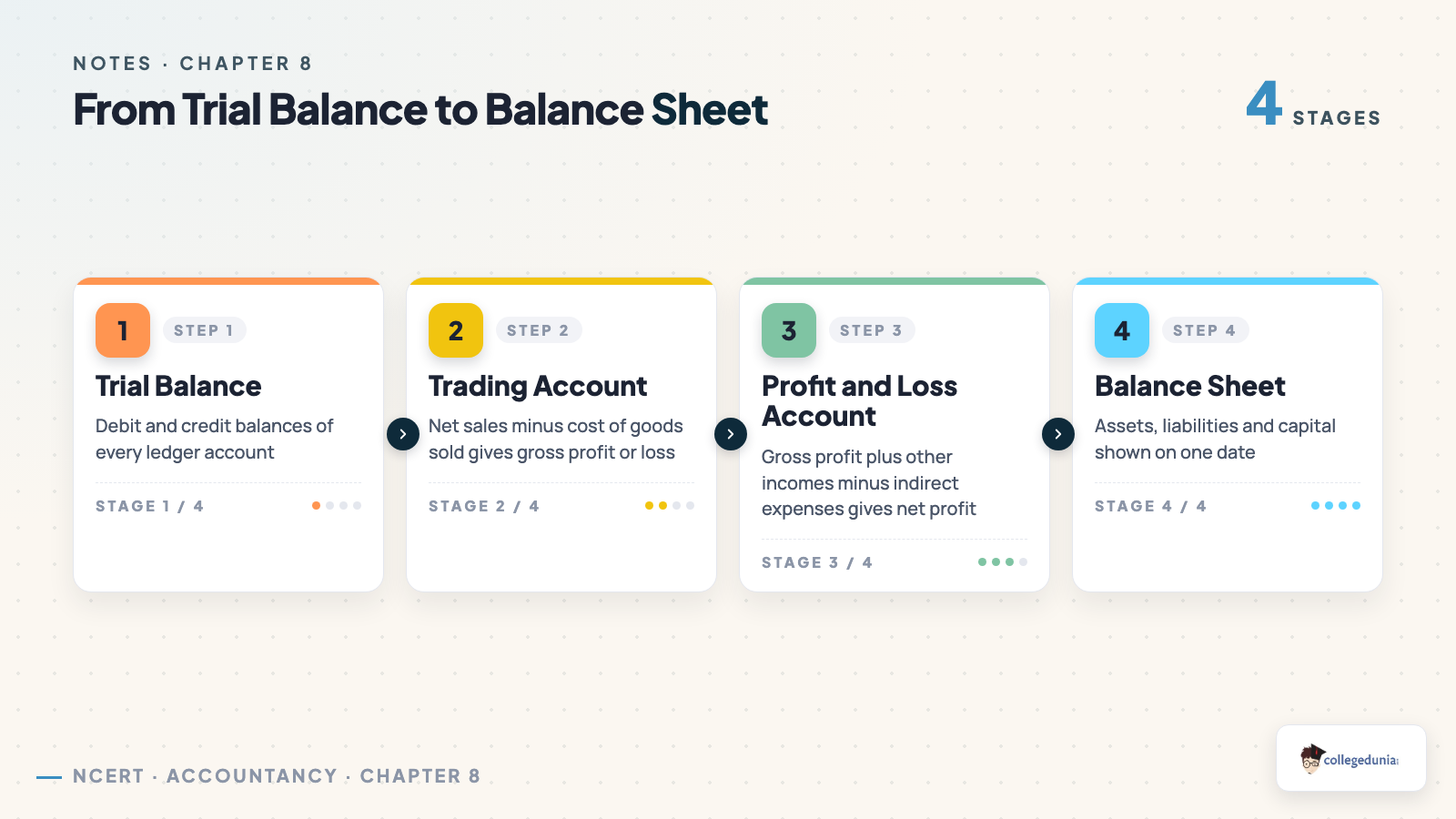
A trial balance is only a checklist of balances. Financial statements turn that checklist into two readable reports: the Trading and Profit and Loss Account, which shows profit or loss, and the Balance Sheet, which shows assets, liabilities and capital on a date.
- Objective one: present a true and fair view of the business's financial performance.
- Objective two: present a true and fair view of its financial position.
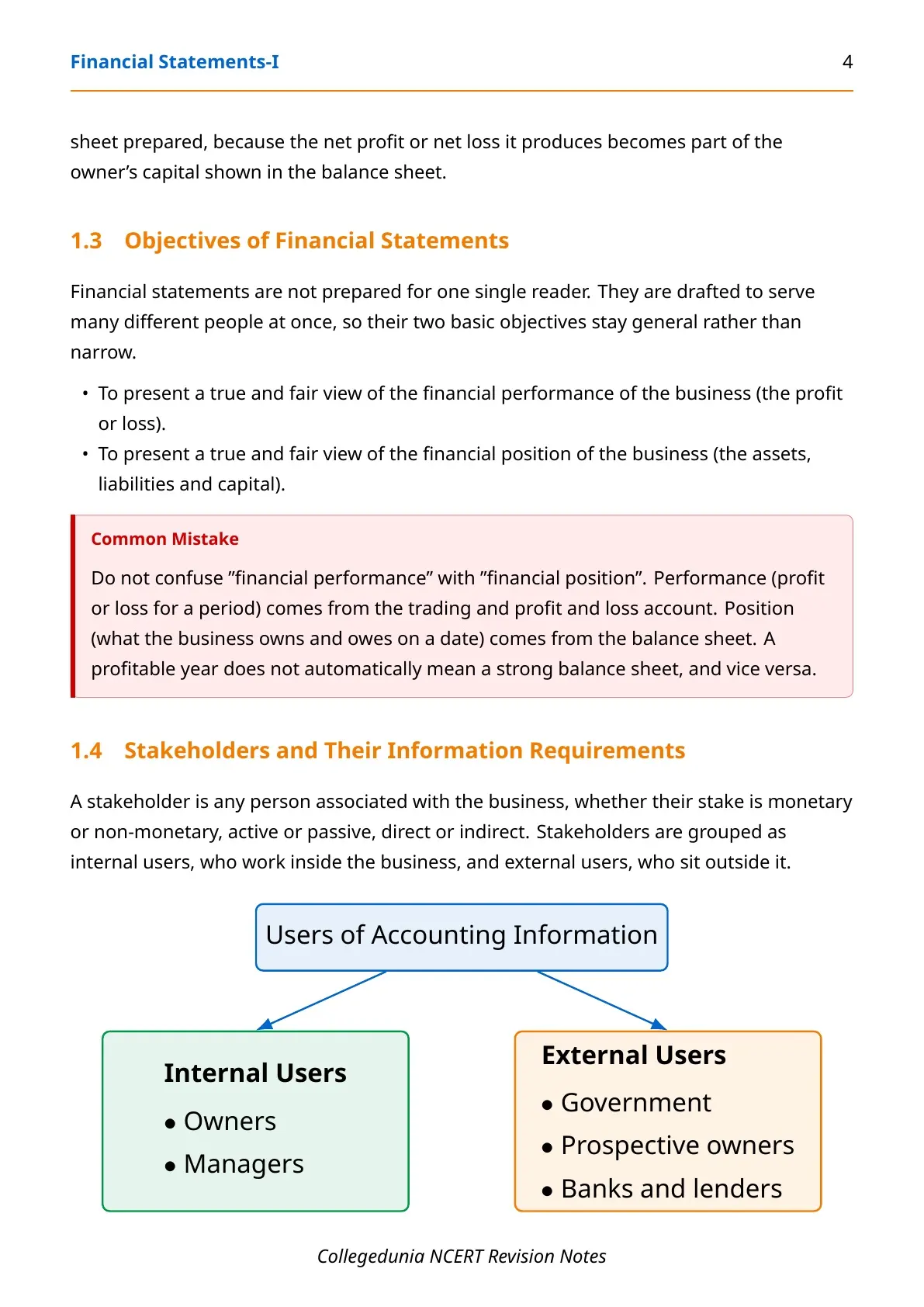
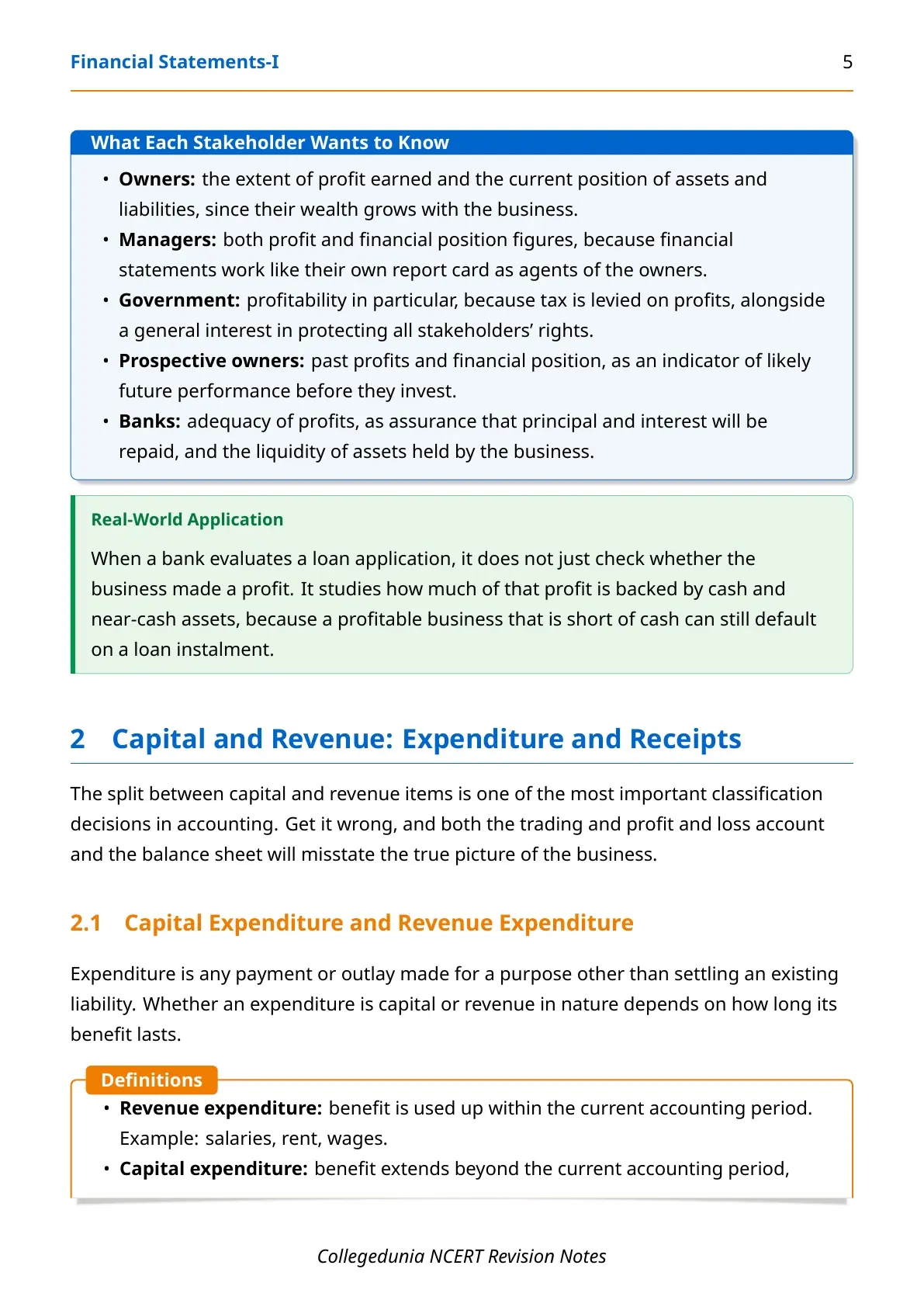
Different people read the same financial statements for different reasons. Owners check profit and asset growth, managers treat the statements as their own report card, and banks check whether profits are backed by cash.
| User | Internal or External | What They Look For |
|---|---|---|
| Owners | Internal | Extent of profit and the current position of assets and liabilities |
| Managers | Internal | Both profit and financial position, as their own report card |
| Government | External | Profitability, since tax is levied on profits |
| Prospective owners | External | Past profits and position, as a sign of future performance |
| Banks | External | Adequacy of profits and how liquid the assets are |
Trading and Profit and Loss Account Explained
Source: Rajat Arora on YouTube
Capital and Revenue: Expenditure and Receipts Explained
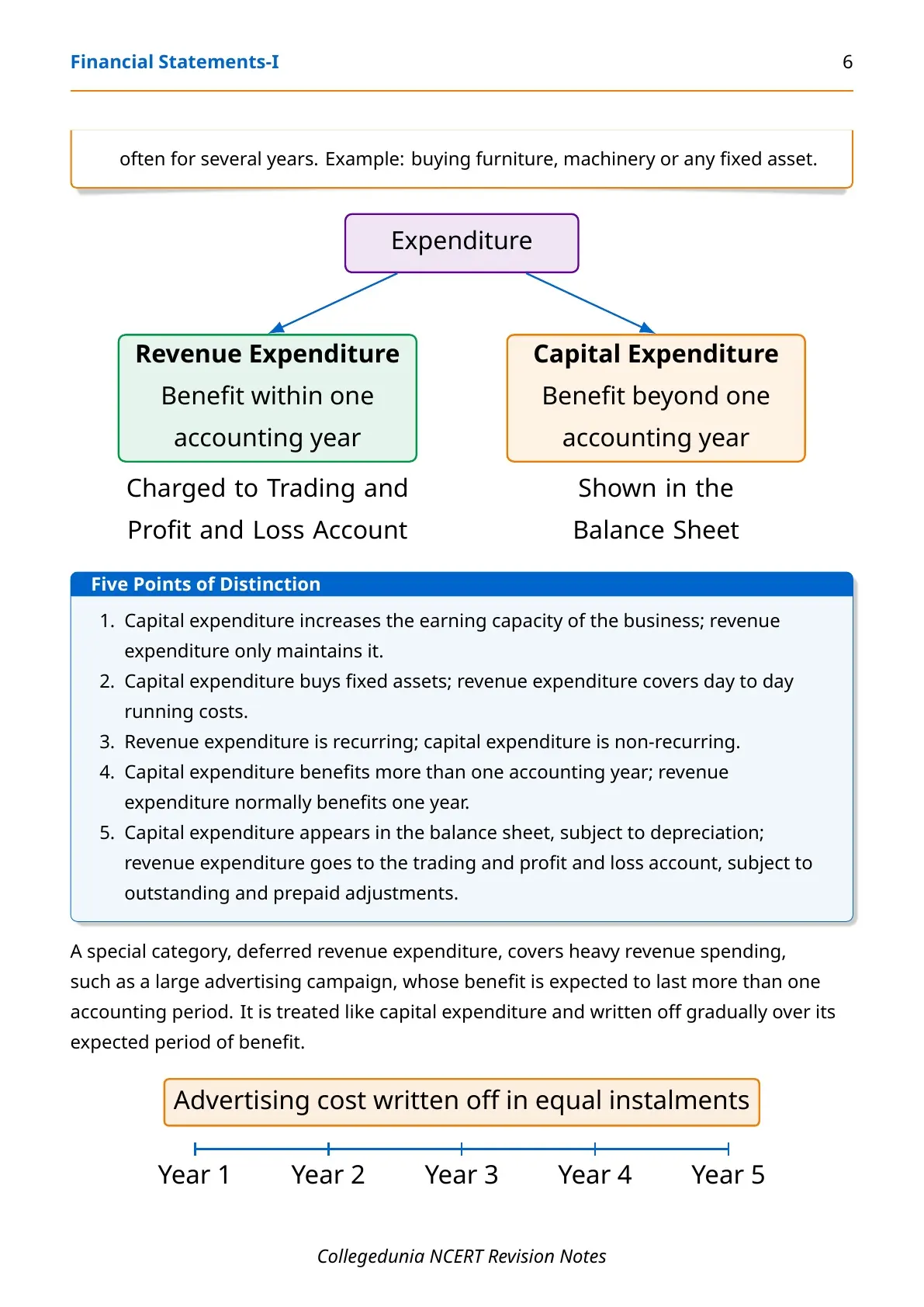
Every rupee spent or received by a business is either a capital item or a revenue item. Getting this classification wrong changes both the profit figure and the balance sheet total.
| Type | Capital | Revenue |
|---|---|---|
| Expenditure | Benefit lasts beyond one year; buys a fixed asset; goes to the Balance Sheet | Benefit used up within the year; runs the business; goes to the Trading and Profit and Loss Account |
| Receipts | Creates an obligation to repay, or is a sale of a fixed asset | No obligation created; day-to-day income such as sales or interest received |
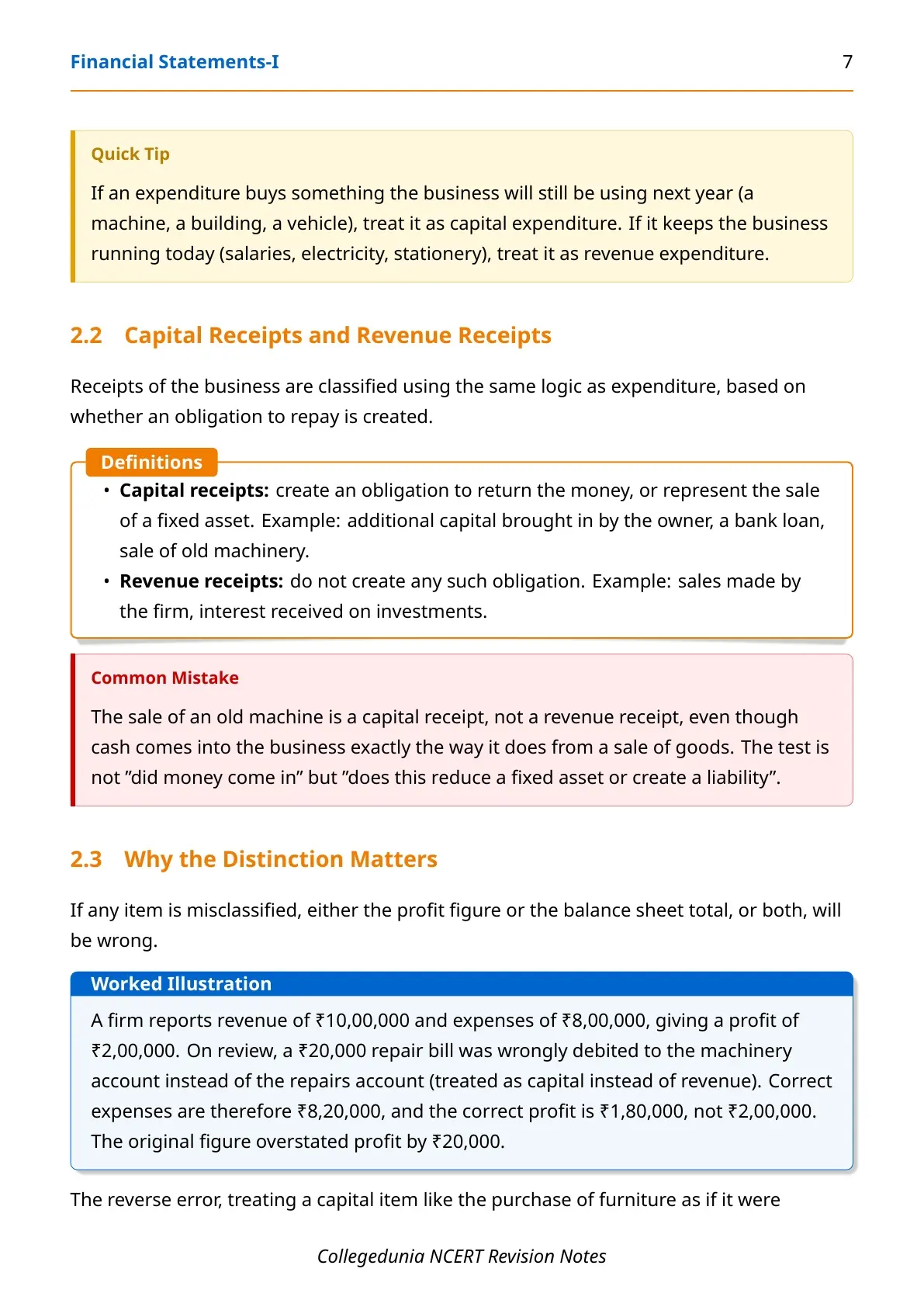
A repair bill wrongly debited to a machinery account instead of the repairs account overstates both profit and the asset value in the same year. This is why the classification is checked before any account is closed into the final statements.
Trading Account: Items and the NCERT Format
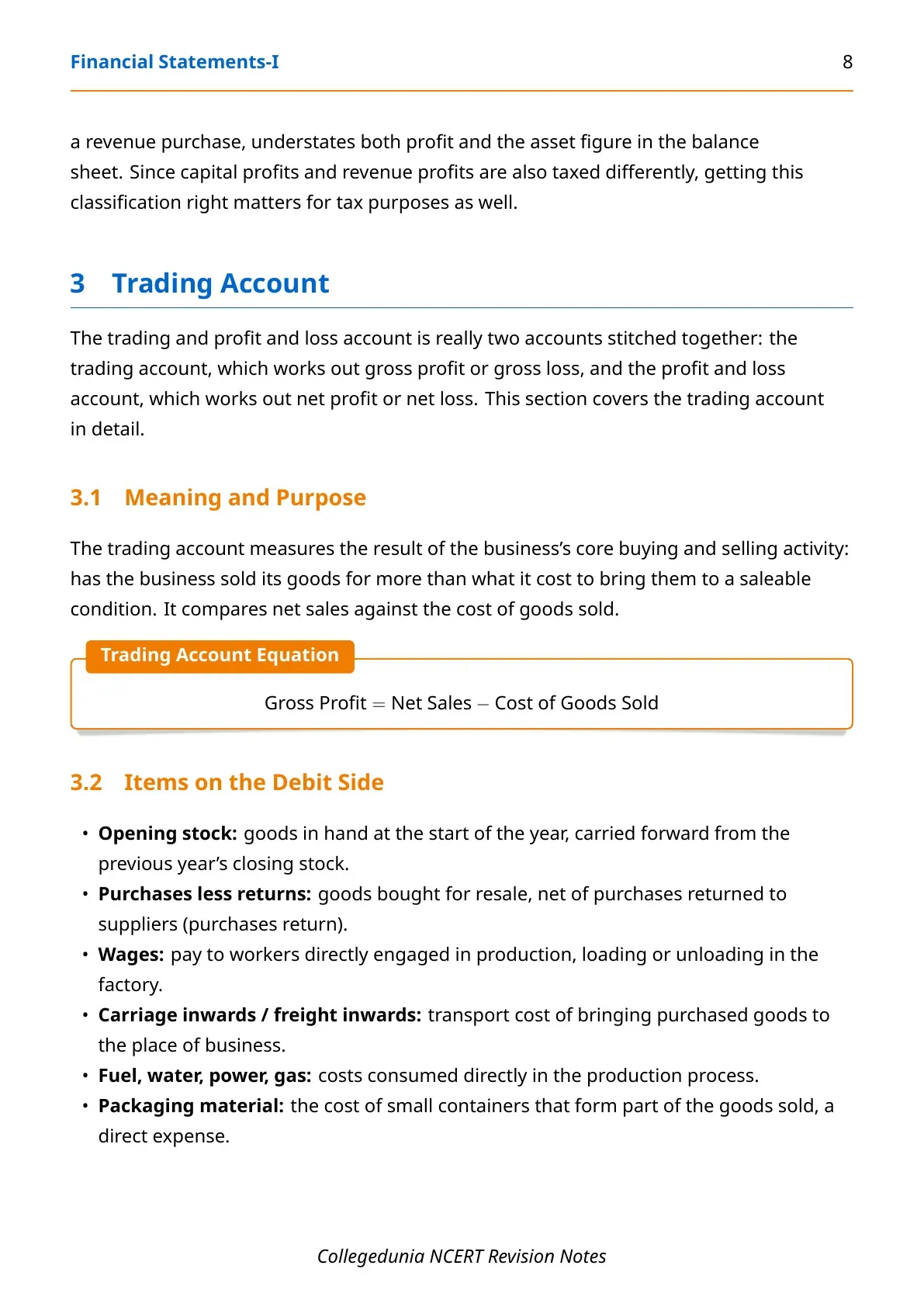
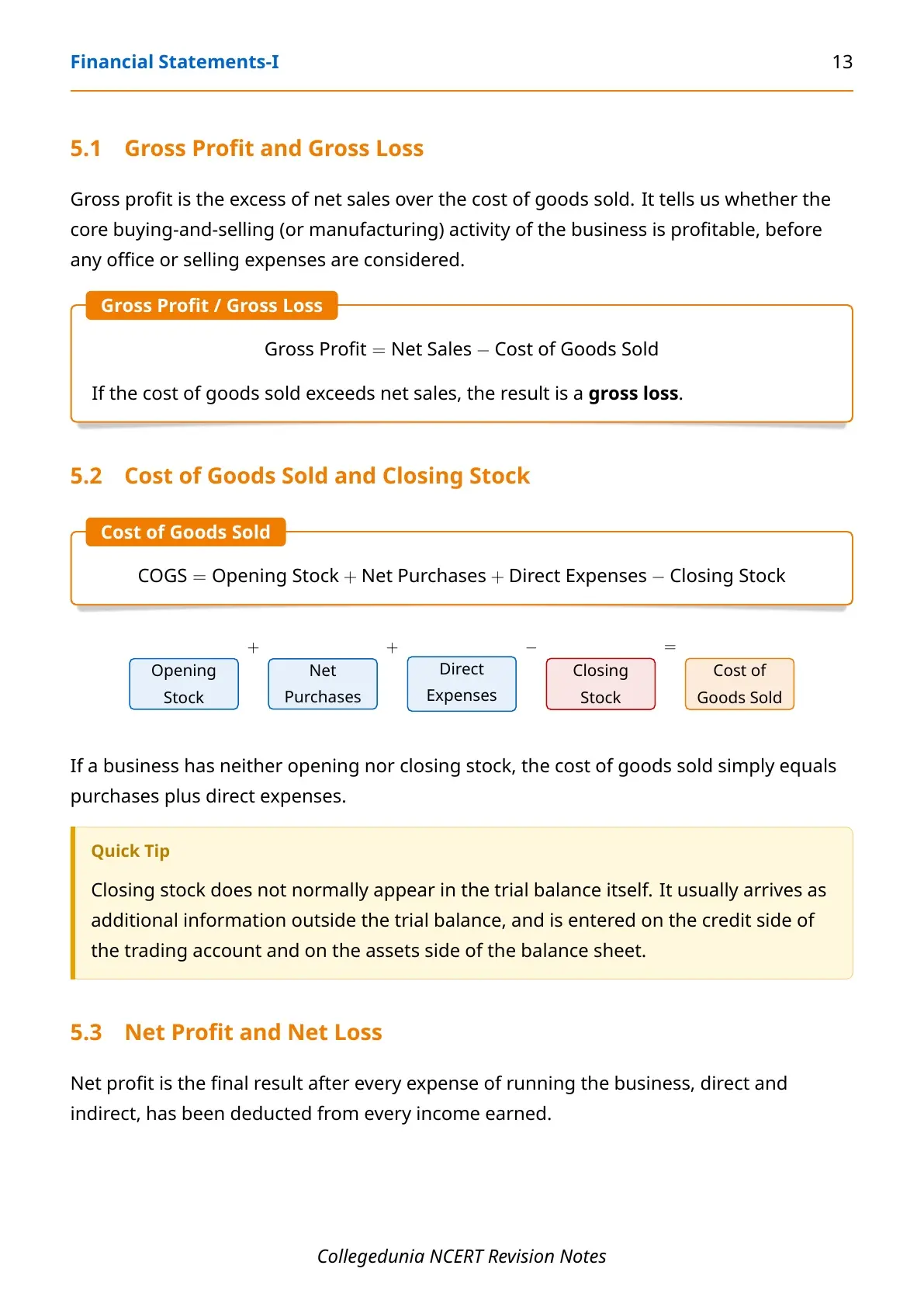
The Trading Account is the first half of the final account. It compares net sales against the cost of goods sold to work out gross profit or gross loss.
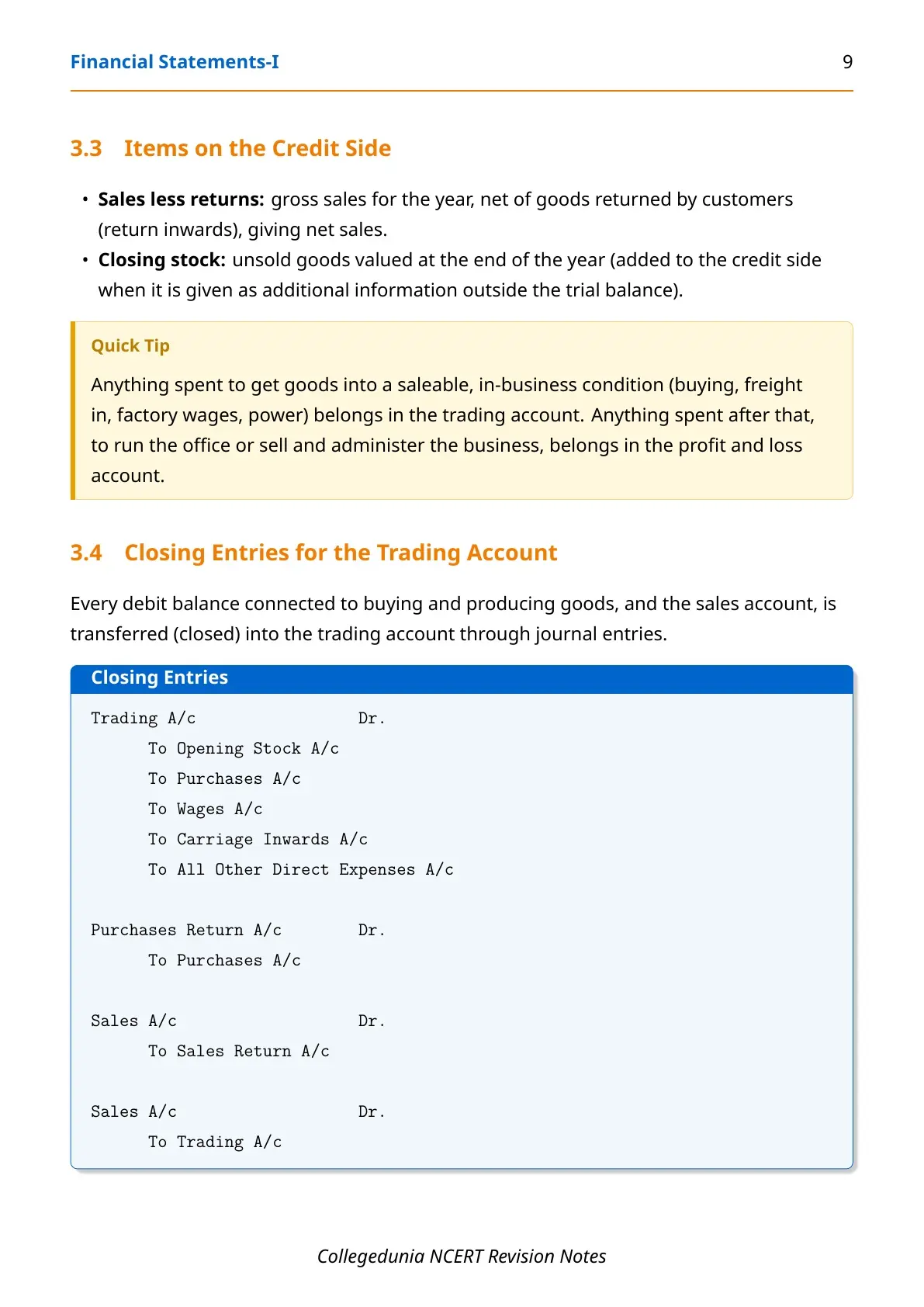
- Debit side: opening stock, purchases less returns, wages, carriage inwards, and other direct expenses.
- Credit side: sales less returns, and closing stock when given as additional information.
| Formula | Meaning |
|---|---|
| Gross Profit = Net Sales – Cost of Goods Sold | Result of the core buying-and-selling activity |
| Cost of Goods Sold = Opening Stock + Net Purchases + Direct Expenses – Closing Stock | What it actually cost to bring the goods to sale |
Closing stock rarely appears inside the trial balance. It is normally given as additional information outside it, and is entered on the credit side of the Trading Account and again on the assets side of the Balance Sheet.
Profit and Loss Account: Items and the Combined Format
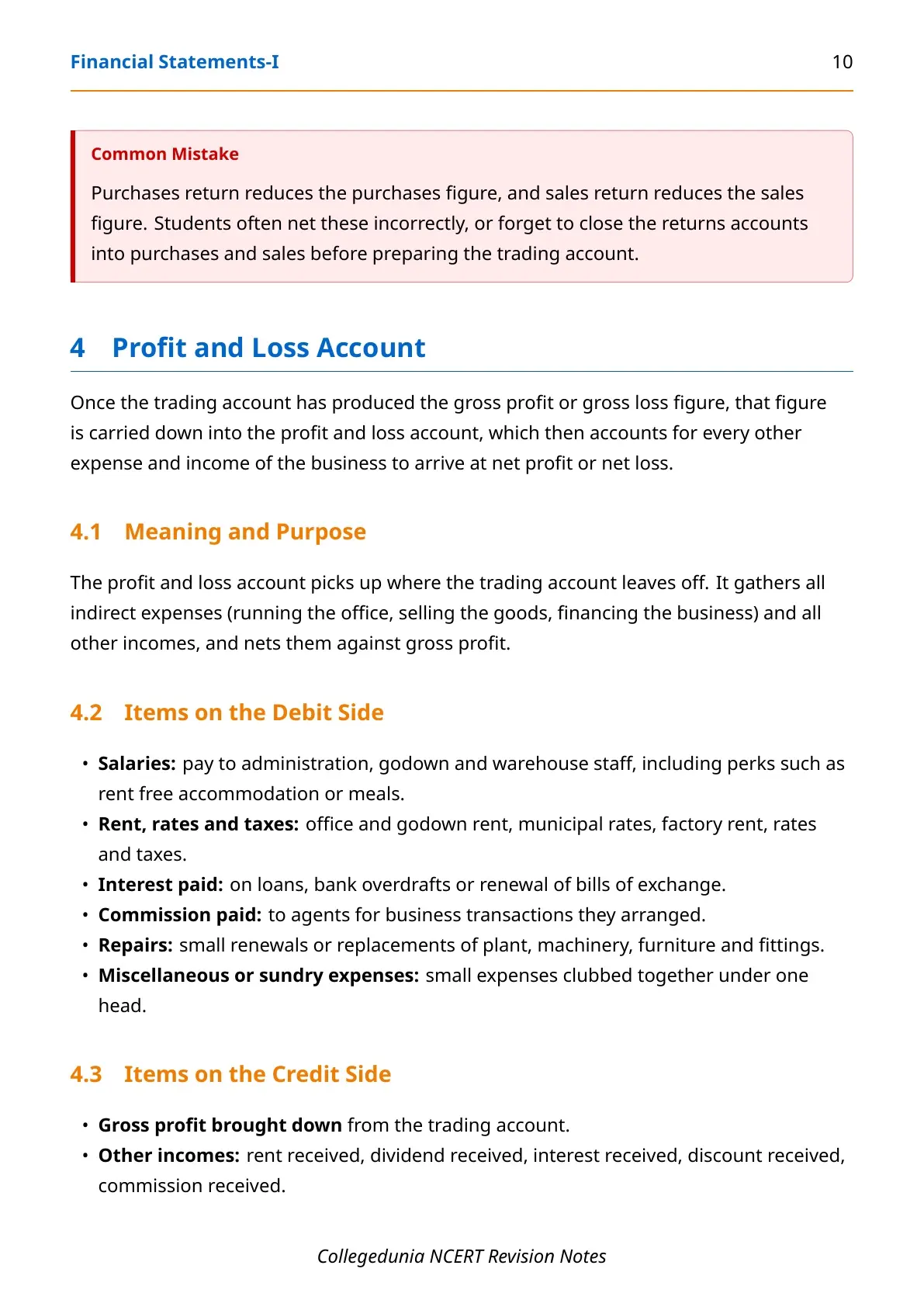
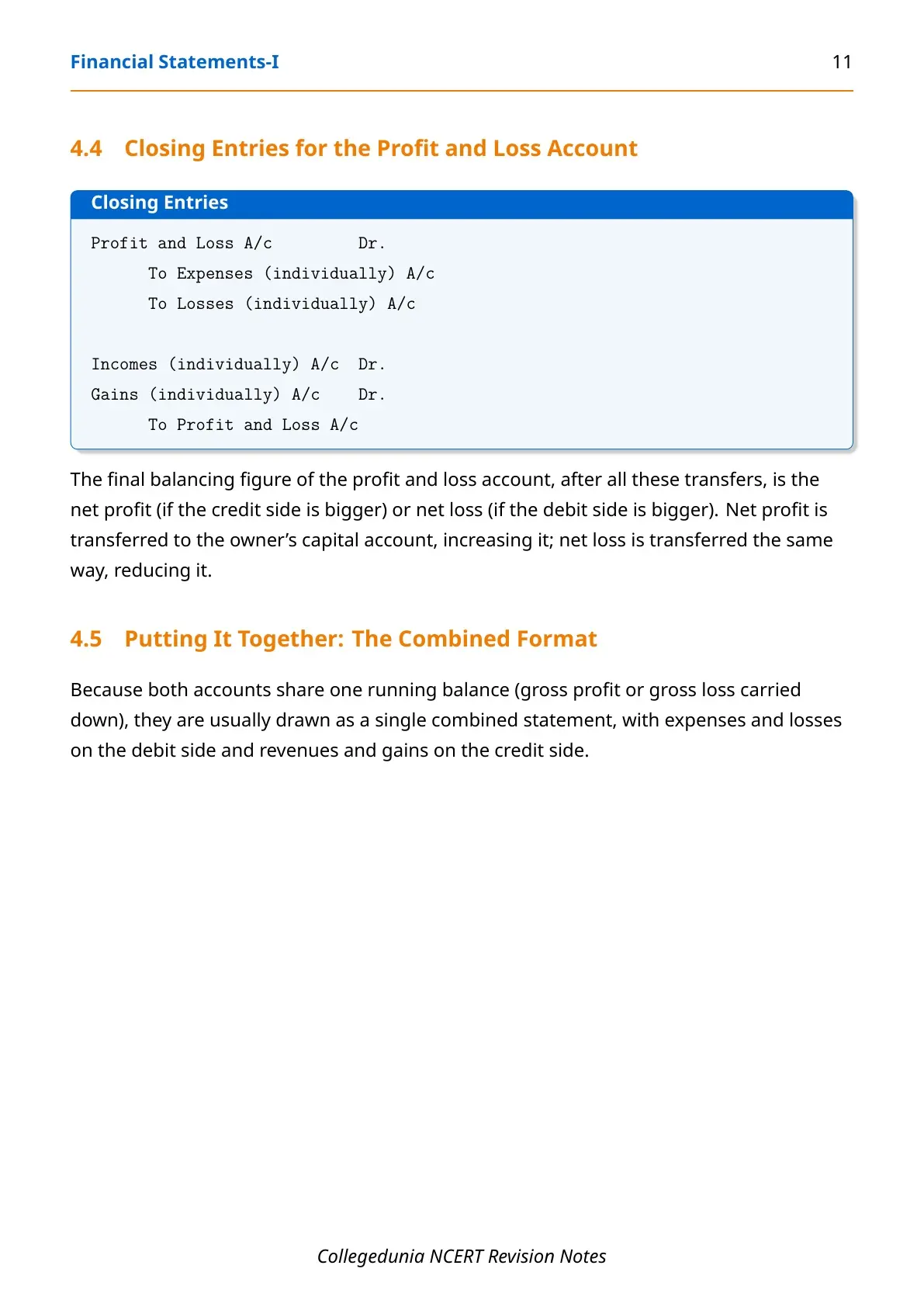
The Profit and Loss Account picks up the gross profit or gross loss and nets it against every other expense and income to reach net profit or net loss.
- Debit side: salaries, rent, interest paid, commission paid, repairs and sundry expenses.
- Credit side: gross profit brought down, plus other incomes such as rent received or discount received.
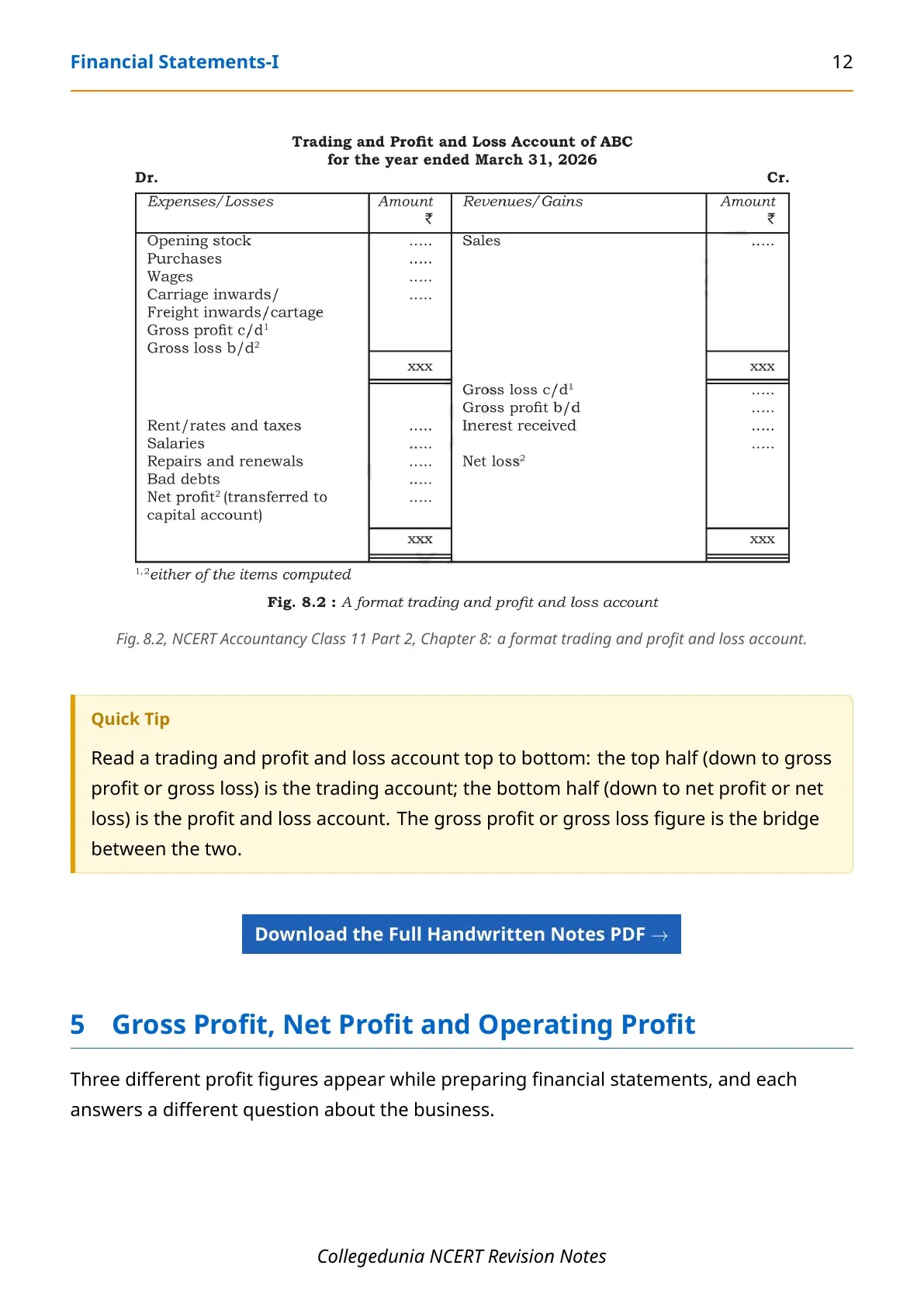
Because both accounts share the gross profit or gross loss figure, the NCERT draws them as one combined statement.
| Trading and Profit and Loss Account (combined format) |
|---|
| Dr. side: Opening stock, Purchases, Wages, Carriage inwards → Gross profit c/d. Then: Rent, Salaries, Repairs, Bad debts → Net profit (transferred to capital) |
| Cr. side: Sales → Gross loss c/d. Then: Gross profit b/d, Interest received, other incomes → Net loss |
Gross Profit, Net Profit and Operating Profit Compared
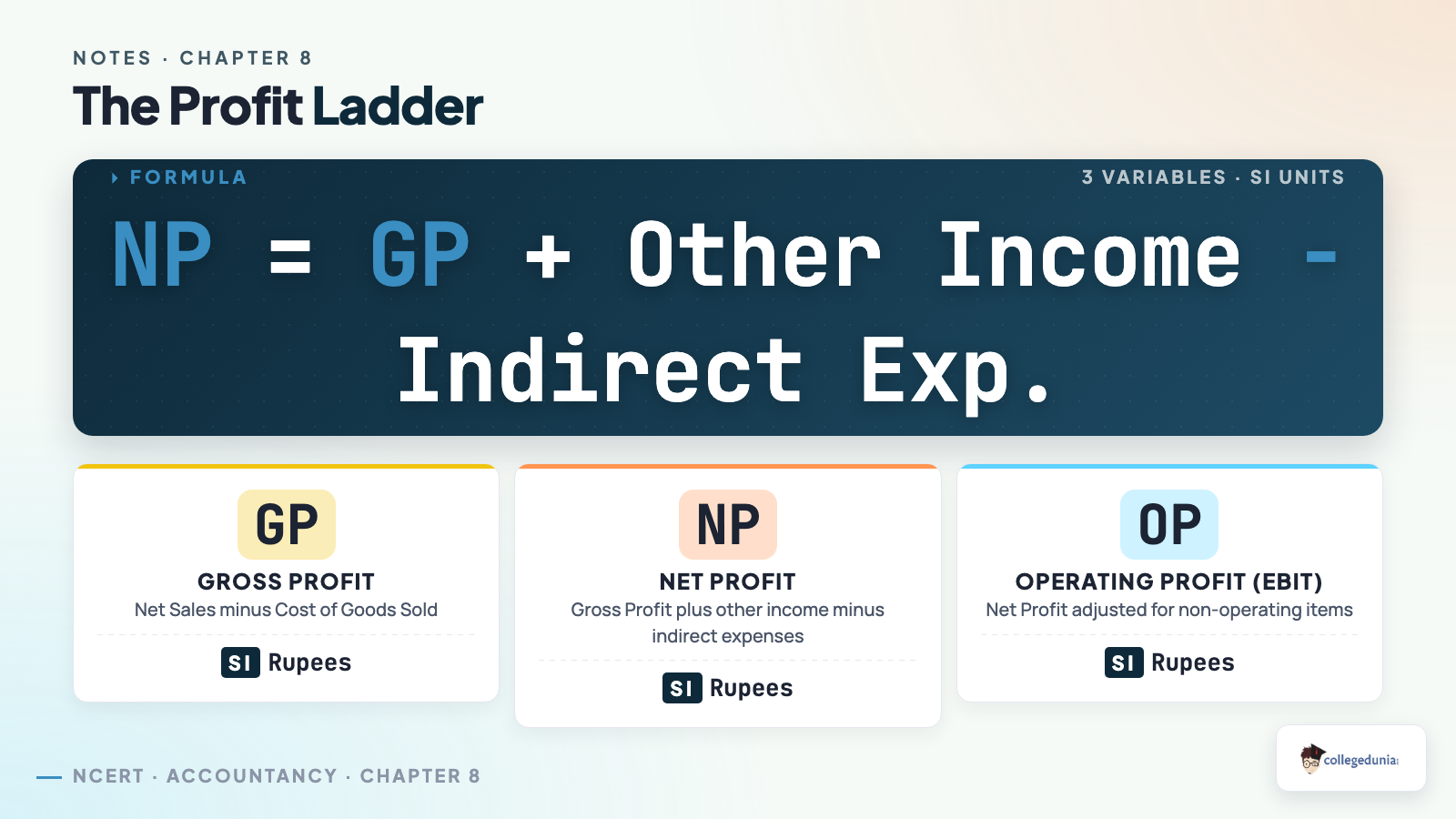
Three profit figures appear while preparing the final accounts, and each answers a different question about the business.
| Profit Level | Formula | What It Shows |
|---|---|---|
| Gross Profit | Net Sales – Cost of Goods Sold | Profit from core buying and selling, before office costs |
| Net Profit | Gross Profit + Other Incomes – Indirect Expenses | Final profit after every expense and income |
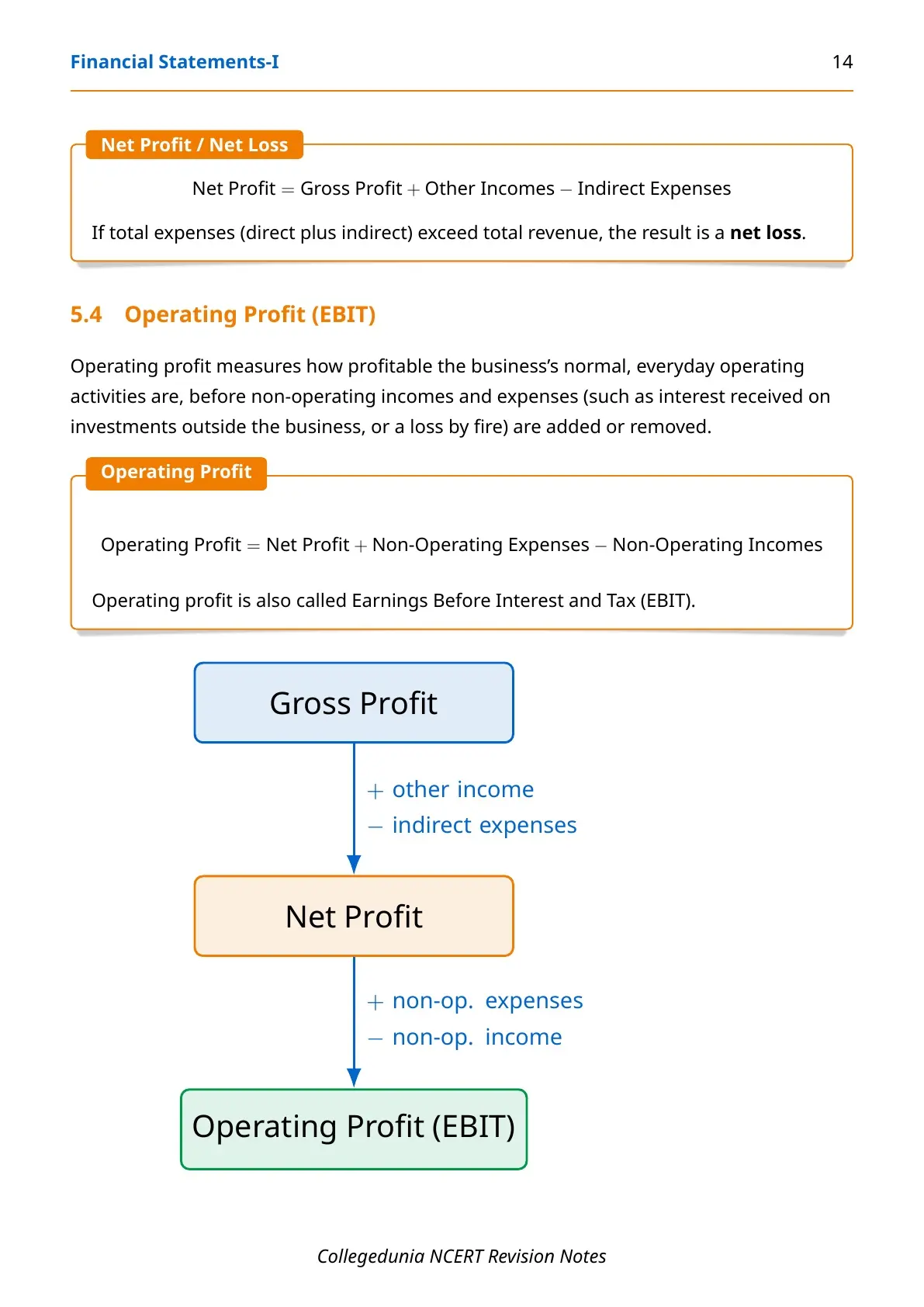
| Operating Profit (EBIT) | Net Profit + Non-Operating Expenses – Non-Operating Incomes | Profit from normal operations only, stripped of one-time items |
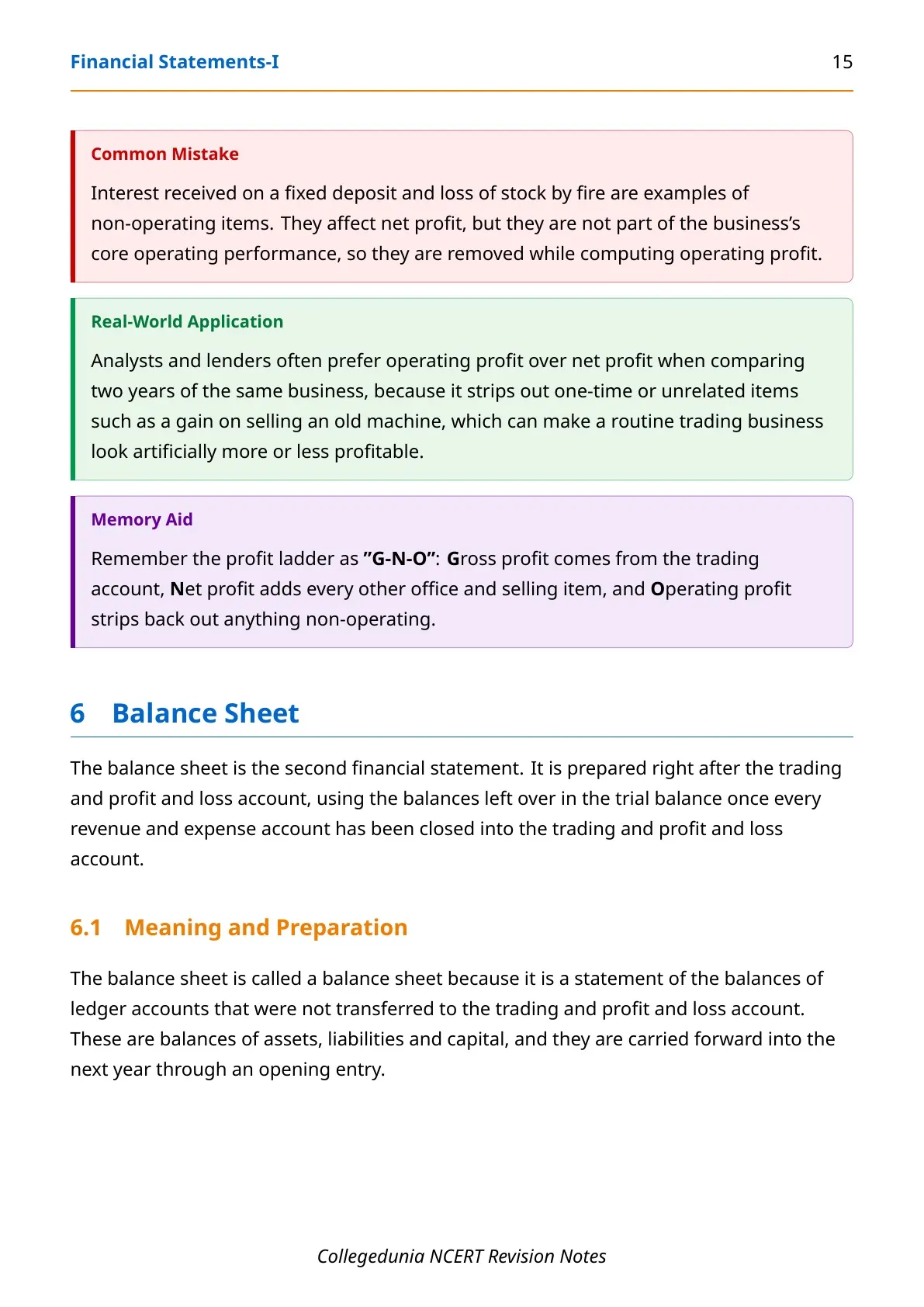
Interest received on a fixed deposit and a loss of stock by fire are non-operating items. They change net profit but are removed while working out operating profit, since they say nothing about how the core business is doing.
Balance Sheet: Format, Items, Grouping and Marshalling
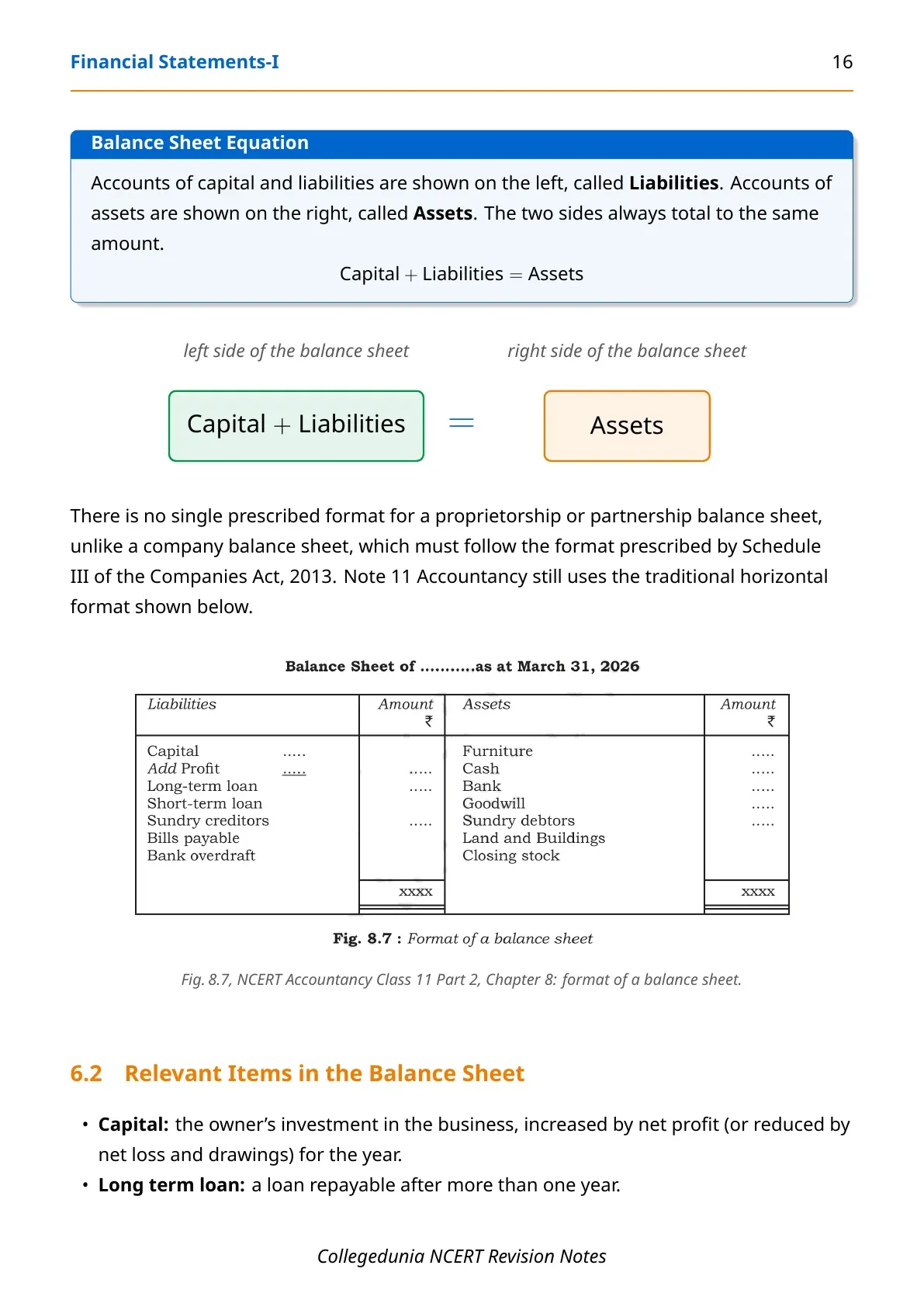
The Balance Sheet lists every balance left over once revenue and expense accounts are closed into the Trading and Profit and Loss Account. It is a statement of assets, liabilities and capital on one date.
| Side | Contains |
|---|---|
| Liabilities (left) | Capital plus net profit, long-term loan, sundry creditors, bills payable, bank overdraft |
| Assets (right) | Fixed assets such as land and furniture, plus current assets such as debtors, bank, cash and closing stock |
There is no single prescribed format for a proprietorship Balance Sheet, unlike a company, which must follow Schedule III of the Companies Act, 2013. Class 11 Accountancy sticks to the traditional horizontal format.
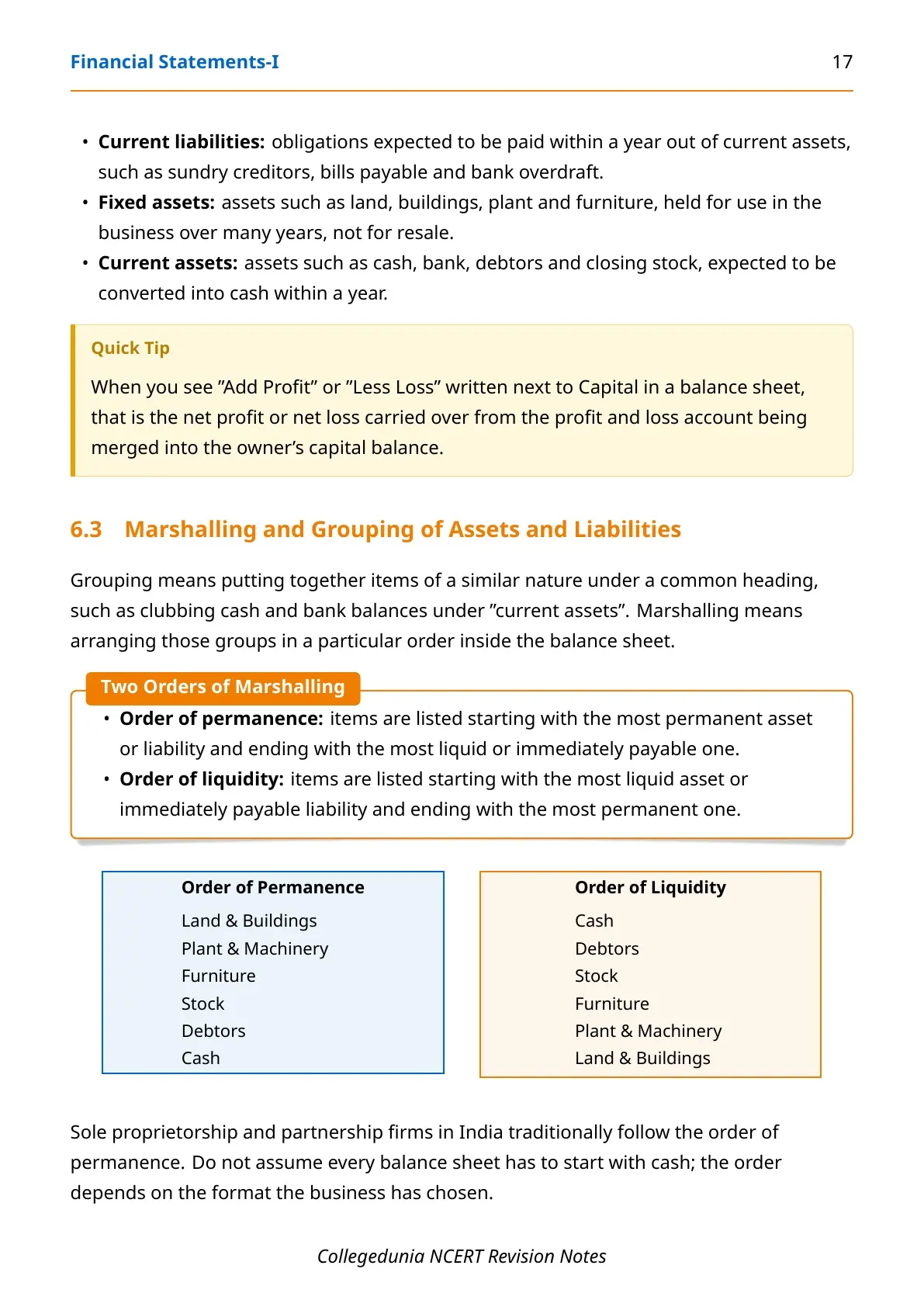
Grouping means clubbing similar items, such as cash and bank, under one heading. Marshalling means arranging those groups in order.
| Order of Permanence | Order of Liquidity |
|---|---|
| Land and buildings first, cash last | Cash first, land and buildings last |
| Used by most Indian sole proprietors and partnerships | Used when liquidity is the reader's main concern, such as by a bank |
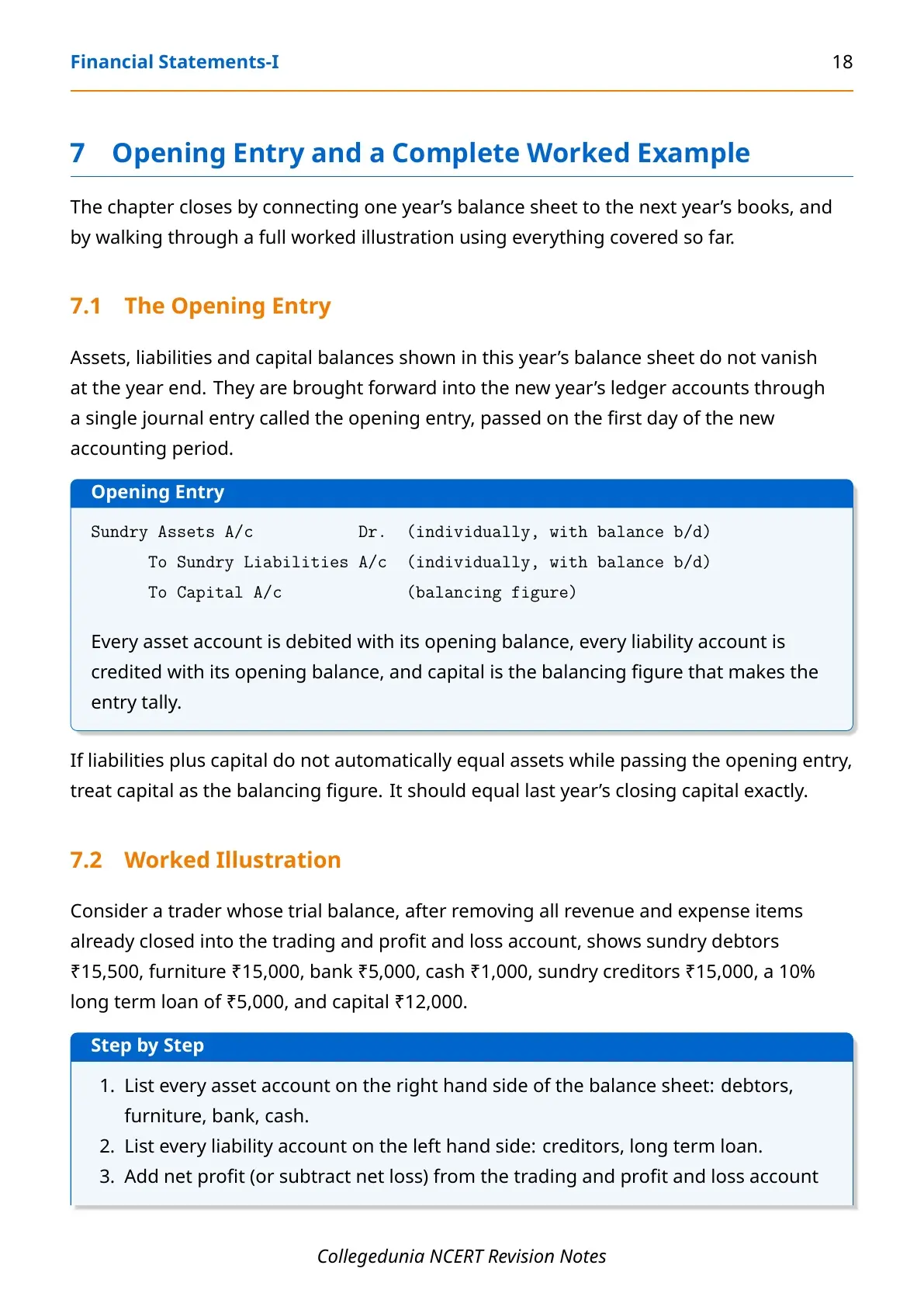
The chapter closes with the opening entry, the single journal entry that carries every asset, liability and capital balance forward into the new year's books, with capital as the balancing figure.
Financial Statements-I Topic-wise Weightage for CBSE Class 11
The Trading and Profit and Loss Account numerical is the most predictable question this chapter sends into the board paper.
| Sub-topic | Weightage | CBSE Frequency |
|---|---|---|
| Trading and Profit and Loss Account numerical | High | Almost every year |
| Balance Sheet preparation with adjustments | High | Almost every year |
| Capital vs revenue classification (theory or MCQ) | Medium | 3 out of last 5 years |
| Gross profit vs net profit vs operating profit (theory) | Low | 1-2 out of last 5 years |
Important Formulas and Formats to Remember
These are the exact formulas this chapter is built on. Keep this box open while practising numericals.
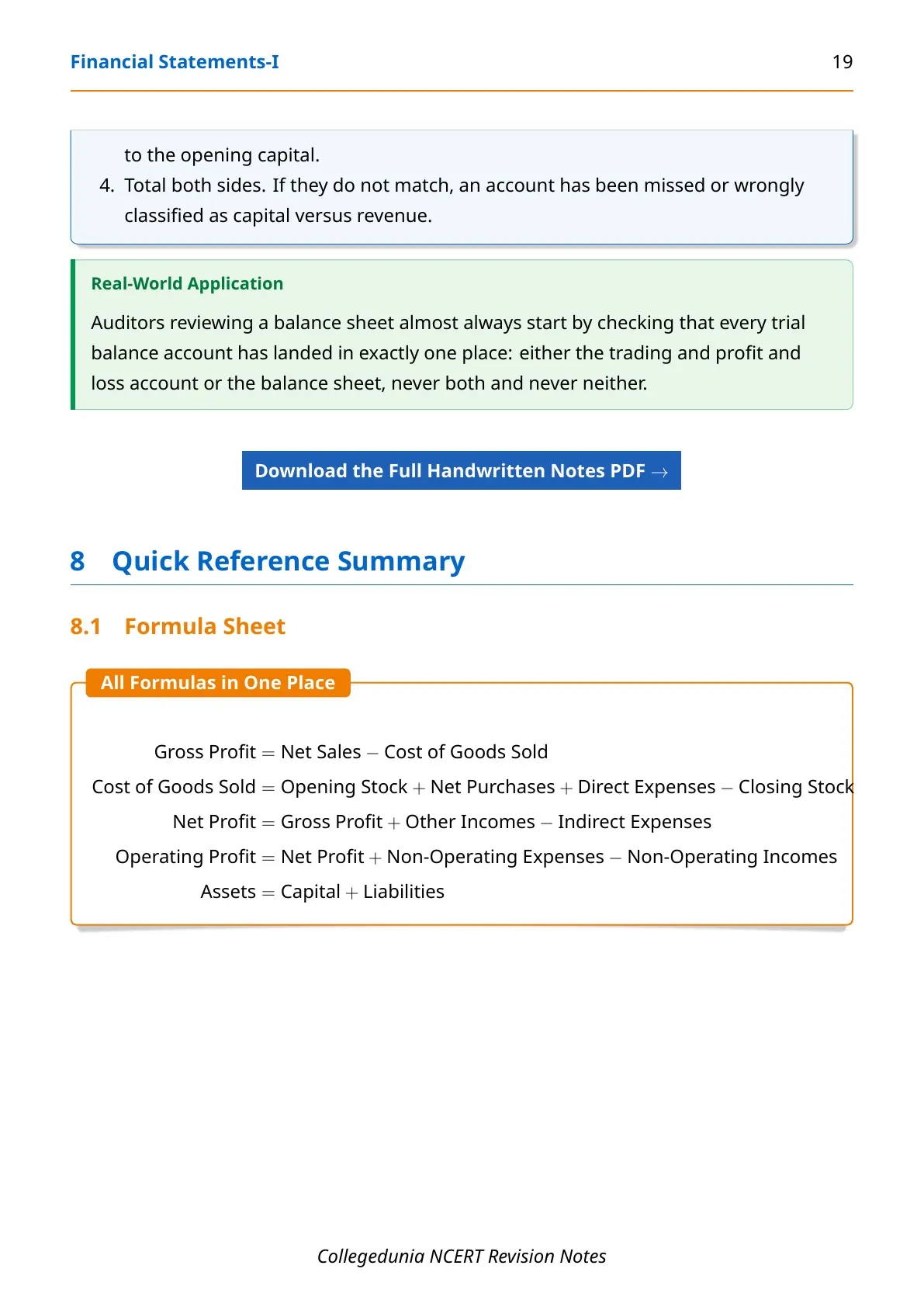
- Gross Profit = Net Sales – Cost of Goods Sold
- Cost of Goods Sold = Opening Stock + Net Purchases + Direct Expenses – Closing Stock
- Net Profit = Gross Profit + Other Incomes – Indirect Expenses
- Operating Profit = Net Profit + Non-Operating Expenses – Non-Operating Incomes
- Balance Sheet Equation: Capital + Liabilities = Assets
Common Mistakes Students Make in the Financial Statements Chapter
| Mistake | Fix |
|---|---|
| Treating a repair expense as a capital item | Check whether the benefit lasts one year or several before classifying it |
| Forgetting to close purchases return into purchases before the Trading Account | Always net off returns against purchases and sales first |
| Entering closing stock twice, once in the trial balance and once as additional information | Closing stock appears in the trial balance only if it is already adjusted |
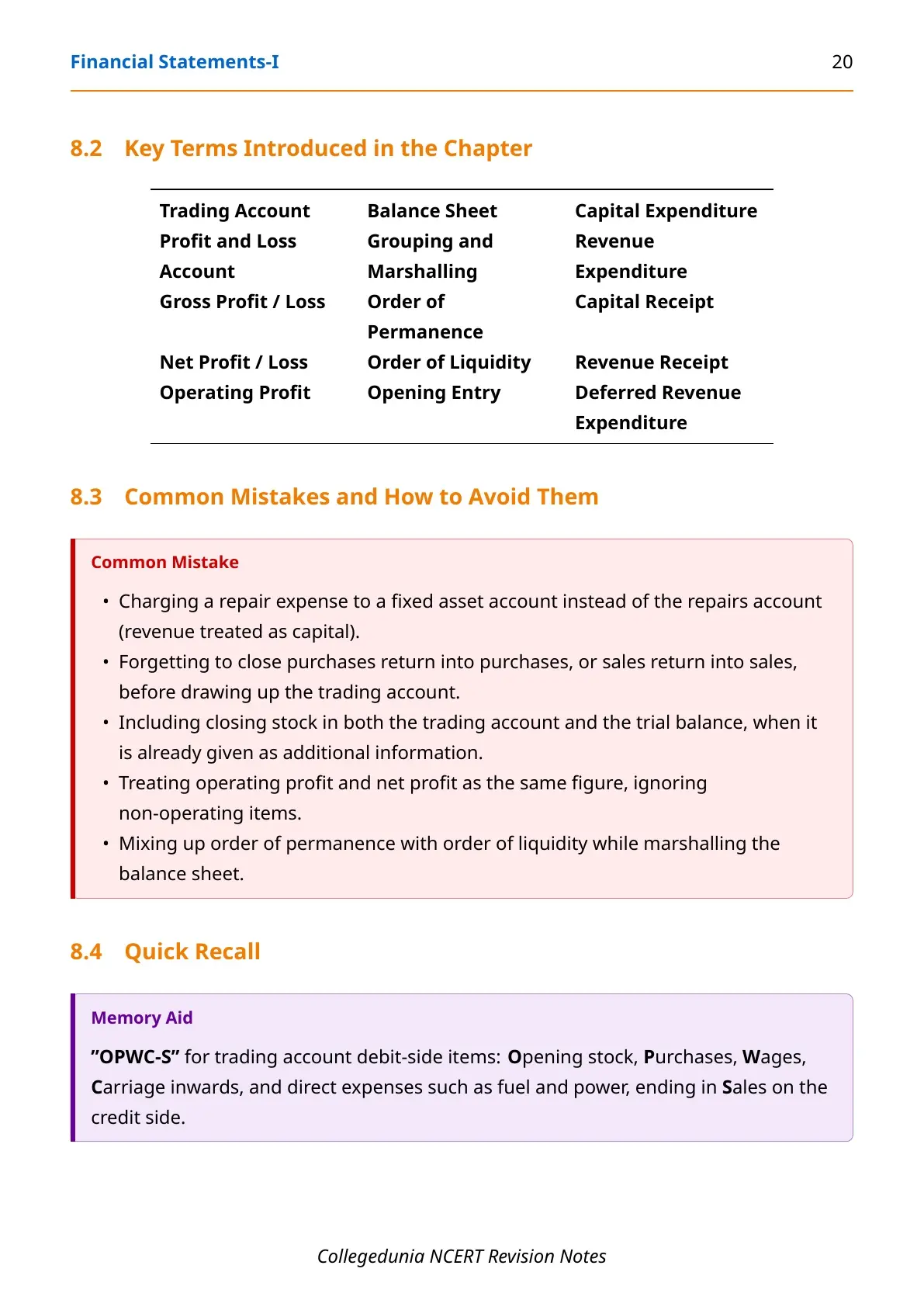
| Treating operating profit and net profit as the same number | Remove non-operating items such as interest received or a fire loss from net profit first |
Key Accounting Terms Glossary for Financial Statements-I
| Term | Meaning |
|---|---|
| Trading Account | Account that works out gross profit or gross loss |
| Profit and Loss Account | Account that works out net profit or net loss |
| Balance Sheet | Statement of assets, liabilities and capital on a date |
| Operating Profit (EBIT) | Profit from core operations, before non-operating items |
| Marshalling | Arranging asset and liability groups in a set order |
| Opening entry | The journal entry that carries balances into the new year |
How Collegedunia's Notes Help You With Financial Statements-I
The NCERT Notes Class 11 Accountancy Chapter 8 Financial Statements-I on this page are built to match how Class 11 board papers actually test this chapter.
- 2026-27 NCERT Alignment: Every format matches the current NCERT print, including both final-account formats.
- Both Formats Reproduced Tightly: The Trading and Profit and Loss Account format and the Balance Sheet format, exactly as printed.
- The Full Profit Ladder: Gross profit, net profit and operating profit worked out side by side, with one worked numerical.
- Quick Recall Boxes: Formula sheet, common mistakes and a mnemonic for last-day revision.
Financial Statements-I Class 11 Accountancy Resources
Besides the NCERT Notes Class 11 Accountancy Chapter 8 Financial Statements-I on this page, every other resource type for this chapter sits in one place below.
| Resource | Status |
|---|---|
| Financial Statements-I Class 11 Notes | You are reading this page |
| Financial Statements-I Class 11 Handwritten Notes | Available now |
| Financial Statements-I Class 11 NCERT Solutions | (coming soon) |
| Financial Statements-I Class 11 NCERT Book PDF | (coming soon) |
NCERT Notes for Class 11 Accountancy: All Chapters
Jump to the notes for any other Class 11 Accountancy chapter.
| Chapter | Notes |
|---|---|
| Chapter 1 | Introduction to Accounting |
| Chapter 2 | Theory Base of Accounting |
| Chapter 3 | Recording of Transactions-I |
| Chapter 4 | Recording of Transactions-II |
| Chapter 5 | Bank Reconciliation Statement |
| Chapter 6 | Trial Balance and Rectification of Errors |
| Chapter 7 | Depreciation, Provisions and Reserves (coming soon) |
| Chapter 8 | Financial Statements-I (this page) |
| Chapter 9 | Financial Statements-II (coming soon) |
Financial Statements-I Class 11 Accountancy Notes FAQs
Ques. What are financial statements in Class 11 Accountancy Chapter 8?
Ans. Financial statements are the Trading and Profit and Loss Account and the Balance Sheet, prepared from a trial balance to show the business's profit or loss and its financial position on a date.
Ques. What is the difference between capital expenditure and revenue expenditure?
Ans. Capital expenditure buys a fixed asset and benefits the business for more than one year, so it goes to the Balance Sheet. Revenue expenditure is used up within the year and goes to the Trading and Profit and Loss Account.
Ques. What is a Trading Account and what does it show?
Ans. A Trading Account compares net sales against the cost of goods sold for an accounting period to work out gross profit or gross loss.
Ques. What is a Profit and Loss Account and what does it show?
Ans. A Profit and Loss Account takes the gross profit or gross loss from the Trading Account, adds other incomes, subtracts indirect expenses, and arrives at net profit or net loss.
Ques. What is the difference between gross profit, net profit and operating profit?
Ans. Gross profit is net sales minus the cost of goods sold. Net profit adds other incomes and subtracts indirect expenses from gross profit. Operating profit further removes non-operating items such as interest received or a fire loss from net profit.
Ques. How is a Balance Sheet defined?
Ans. A Balance Sheet is a statement listing the balances of asset, liability and capital accounts that were not transferred to the Trading and Profit and Loss Account, on a specific date.
Ques. What are grouping and marshalling of assets and liabilities?
Ans. Grouping means clubbing similar items, such as cash and bank, under one heading in the Balance Sheet. Marshalling means arranging those groups in a set order, either order of permanence or order of liquidity.
Ques. What is the opening entry in accounting?
Ans. The opening entry is the journal entry passed on the first day of a new accounting year that brings forward every asset, liability and capital balance from the previous year's Balance Sheet.
Ques. Are these Class 11 Accountancy notes aligned with the 2026-27 NCERT?
Ans. Yes. These notes follow the current 2026-27 NCERT print for Class 11 Accountancy Chapter 8, Financial Statements-I, including both final-account formats and the Balance Sheet format.
Ques. How many pages is the Class 11 Accountancy Chapter 8 Notes PDF?
Ans. The Notes PDF runs to 21 pages and covers stakeholders, capital and revenue items, the Trading and Profit and Loss Account, the profit ladder, the Balance Sheet, and a quick-recall summary.
Ques. What is the difference between a capital receipt and a revenue receipt?
Ans. A capital receipt creates an obligation to repay, such as a loan, or comes from selling a fixed asset. A revenue receipt, such as sales income or interest received, creates no such obligation.
Ques. What is deferred revenue expenditure?
Ans. Deferred revenue expenditure is a heavy revenue expense, such as a large advertising campaign, whose benefit is expected to last more than one accounting period, so it is written off gradually like a capital item.



Comments