



These Notes for Class 10 Science Chapter 9 Light - Reflection and Refraction give you a fast, concept-first revision of the whole chapter, built on the latest 2026-27 CBSE syllabus. They cover the laws of reflection, image formation by concave and convex mirrors, the mirror formula and lens formula with the New Cartesian Sign Convention, refraction and Snell's law, refractive index, magnification, and the power of a lens.
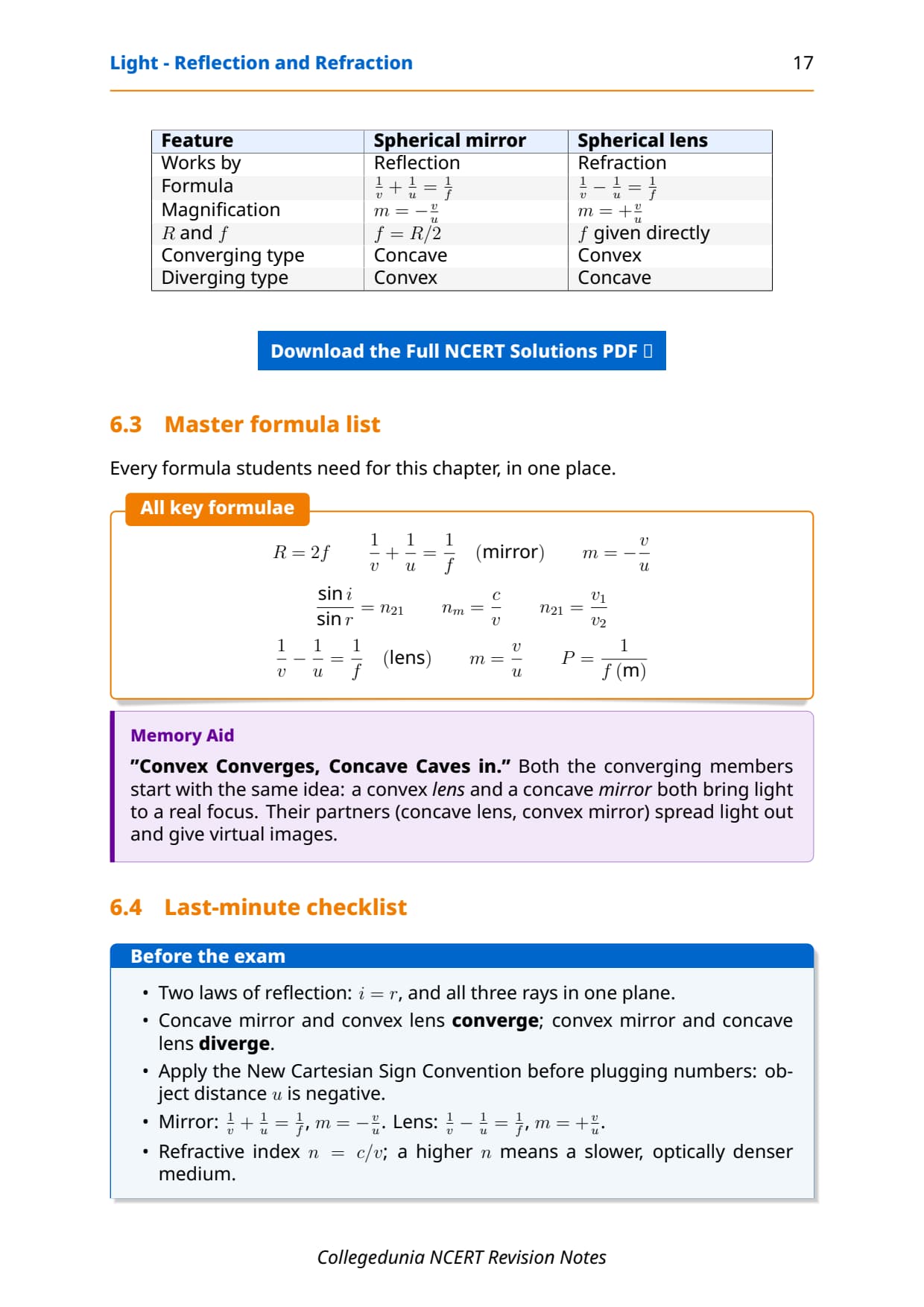
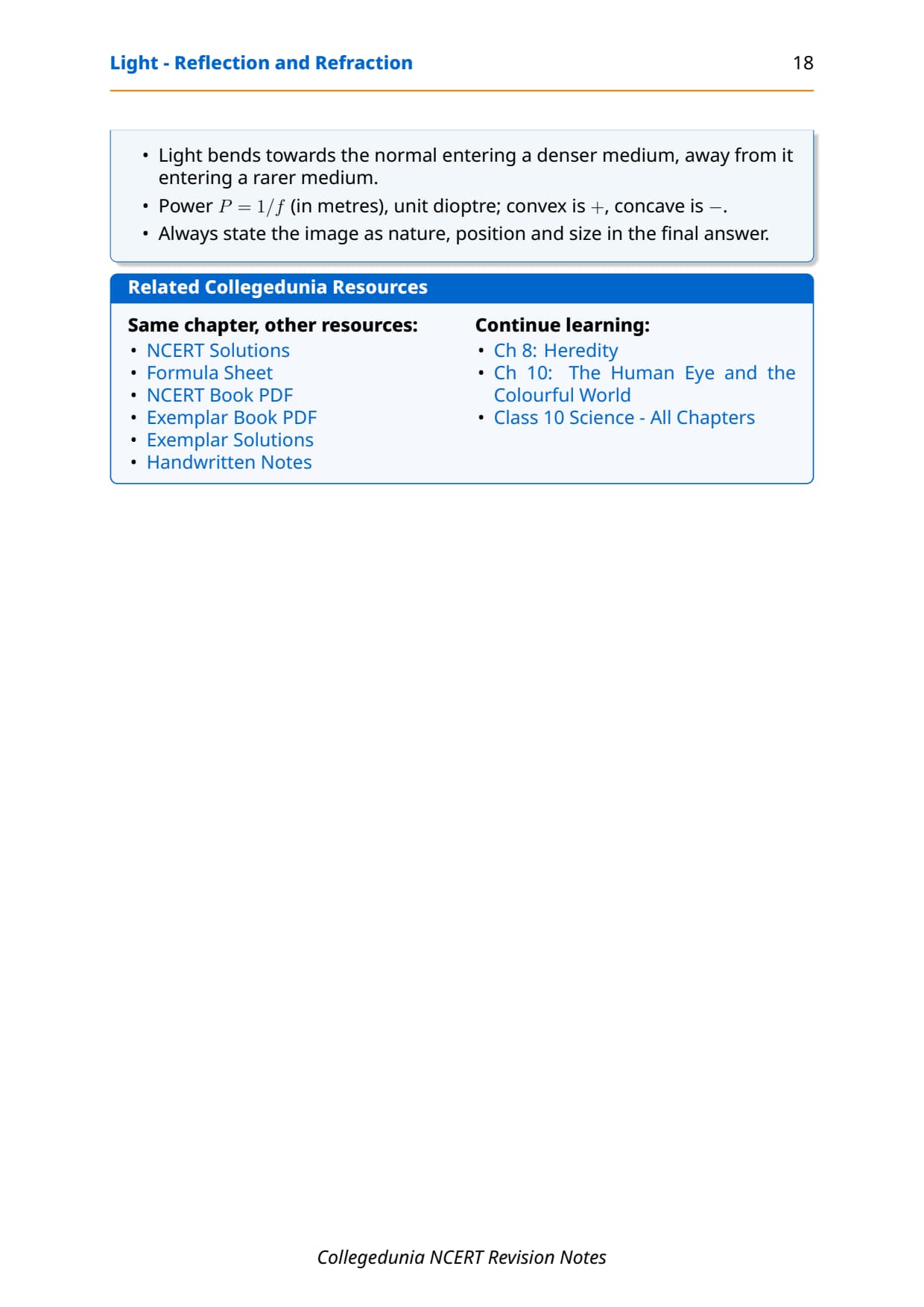
- Every formula explained with its meaning, the correct signs, and a fully worked solved example so you can attempt board numericals with confidence.
- Full coverage of reflection, spherical mirrors, mirror formula, refraction, refractive index, lenses, lens formula and power of a lens with labelled diagrams.
- Notes aligned with the 2026-27 CBSE Class 10 Science syllabus and written for the board exam; no NEET or JEE references because this is a Class 10 board chapter.
These Collegedunia revision notes are curated by Science subject experts, mapped to the 2026-27 NCERT textbook, and refined against the last five years of CBSE Class 10 Science board papers.
Student Feedback: What 13,200 students told us about this chapter
79% of Class 10 students said the sign convention was where they lost the most marks, mixing up the signs of u, v and f in numericals. 3 out of 5 students told us that learning the mirror formula and the lens formula side by side, and writing down the signs before substituting, fixed most of their numerical errors before the board exam.
Toppers found that memorising the two converging rules, "concave mirror and convex lens converge," and always stating the image as nature, position and size in the final line, saved 10 to 15 minutes in the exam, and the average student spent 3 to 4 hours on these notes across the first read and the final revision.
Source: 2026-27 Class 10 Science student poll. Sample of 13,200 students from CBSE schools across 14 states, conducted before the 2026 boards.
What the Notes for Class 10 Science Chapter 9 Light - Reflection and Refraction Cover
This chapter studies how light bounces back from a surface (reflection) and bends entering a new material (refraction), in exam-ready blocks.
- Reflection and mirrors: the two laws, concave and convex mirrors, ray diagrams, image types.
- Mirror numericals: the mirror formula, sign convention, magnification.
- Refraction: Snell's law, refractive index, the glass slab.
- Lenses and power: the lens formula, magnification, power in dioptres.
Source: Magnet Brains on YouTube
Reflection of Light and the Laws of Reflection in Class 10 Science
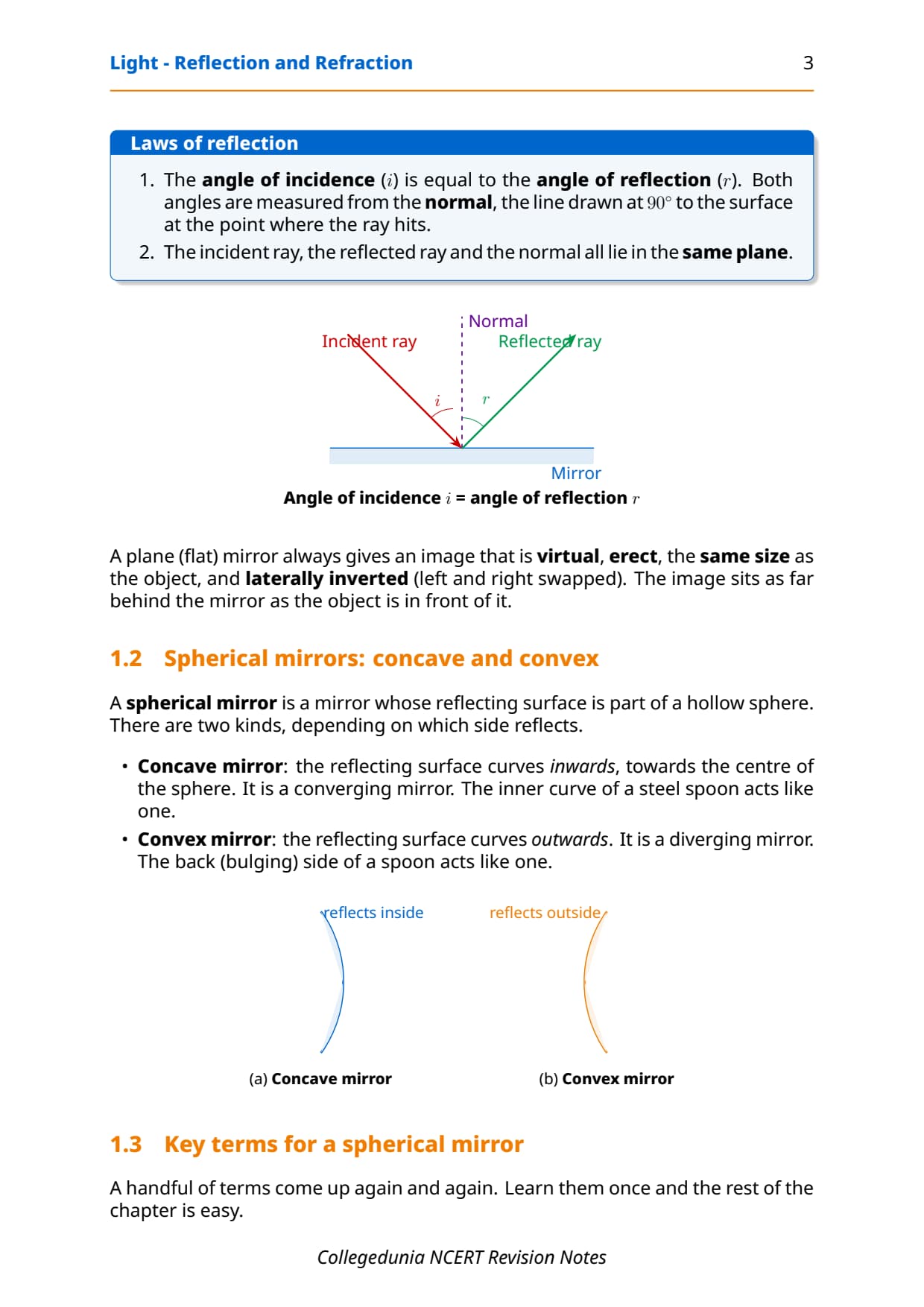
A mirror sends back most of the light that falls on it: reflection. The normal is the line at 90° to the surface where the ray hits; the angle of incidence (i) and angle of reflection (r) are measured from it.
The two laws of reflection:
- First law: angle of incidence = angle of reflection, both from the normal.
- Second law: the incident ray, reflected ray and normal lie in the same plane.
A plane mirror always gives a virtual, erect, same-size, laterally inverted image, as far behind the mirror as the object is in front.
Spherical Mirrors: Concave and Convex in Class 10 Science
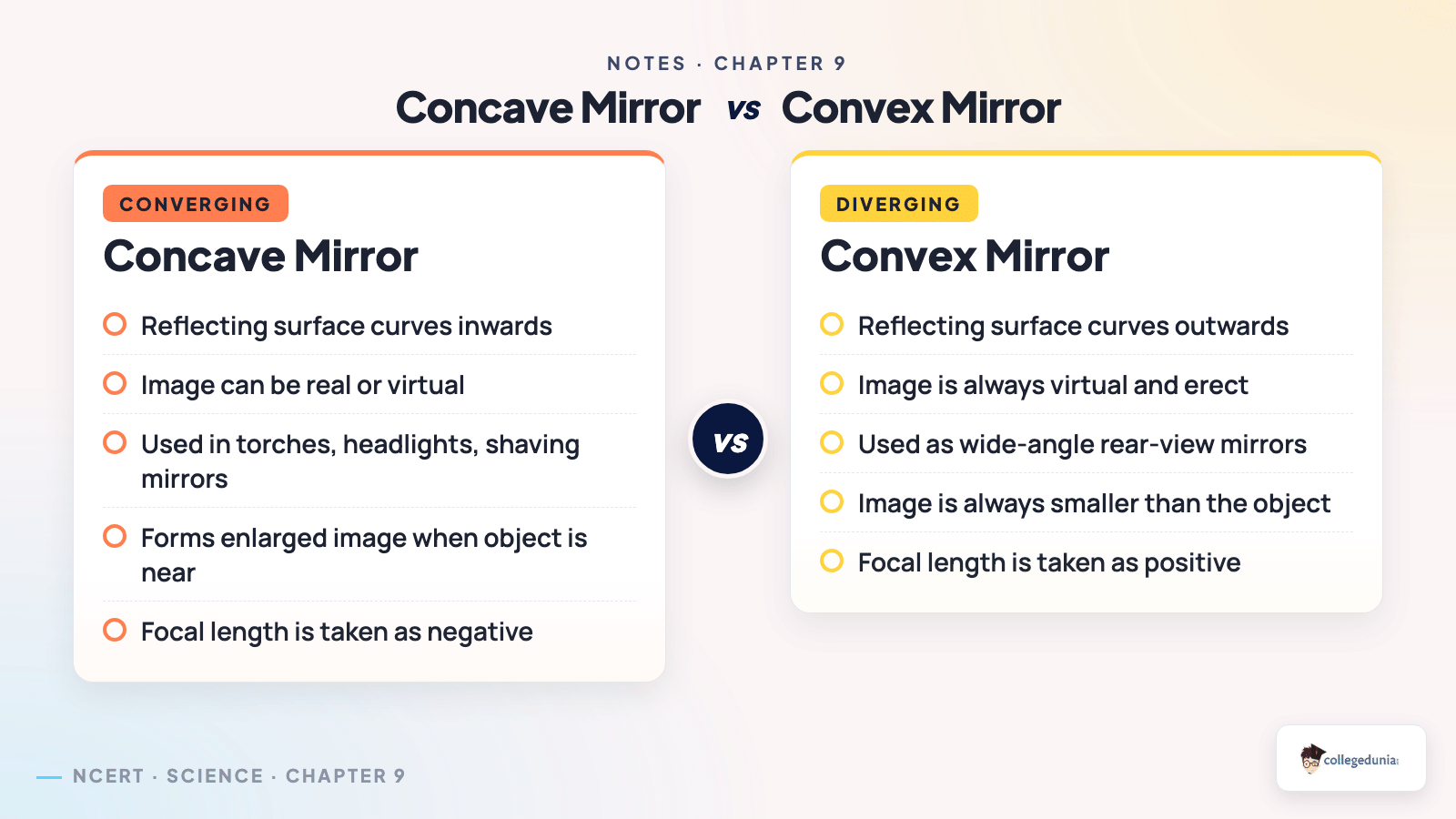
A spherical mirror is part of a hollow sphere. A concave mirror curves inwards and converges light; a convex mirror curves outwards and diverges it.
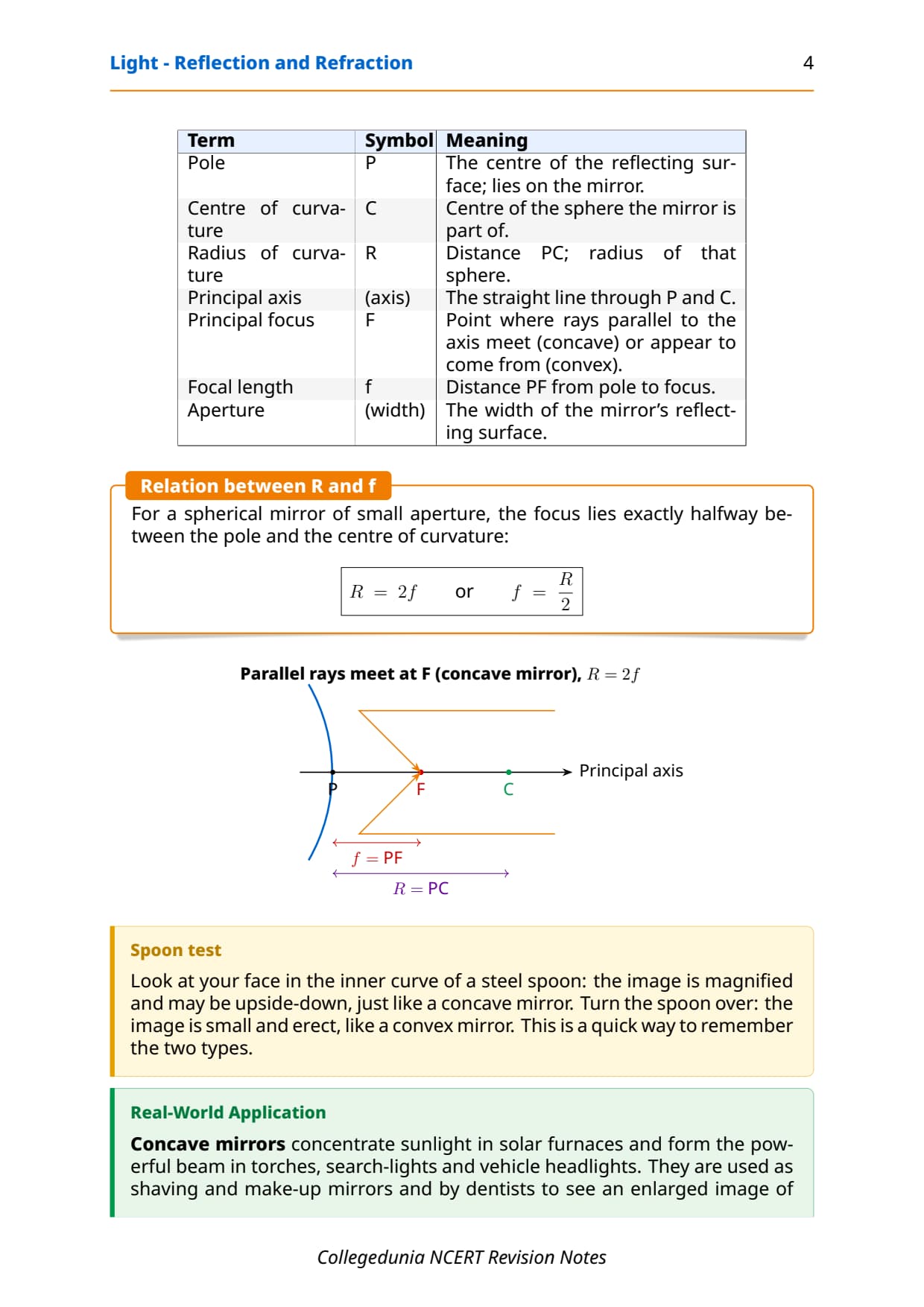
Learn these key terms first:
| Term | Symbol | Meaning |
|---|---|---|
| Pole | P | Centre of the reflecting surface |
| Centre of curvature | C | Centre of the sphere the mirror is part of |
| Radius of curvature | R | Distance PC |
| Principal focus | F | Where rays parallel to the axis meet (concave) or seem to come from (convex) |
| Focal length | f | Distance PF |
For a small-aperture mirror, the focus lies halfway between P and C:
Image Formation by Spherical Mirrors in Class 10 Science
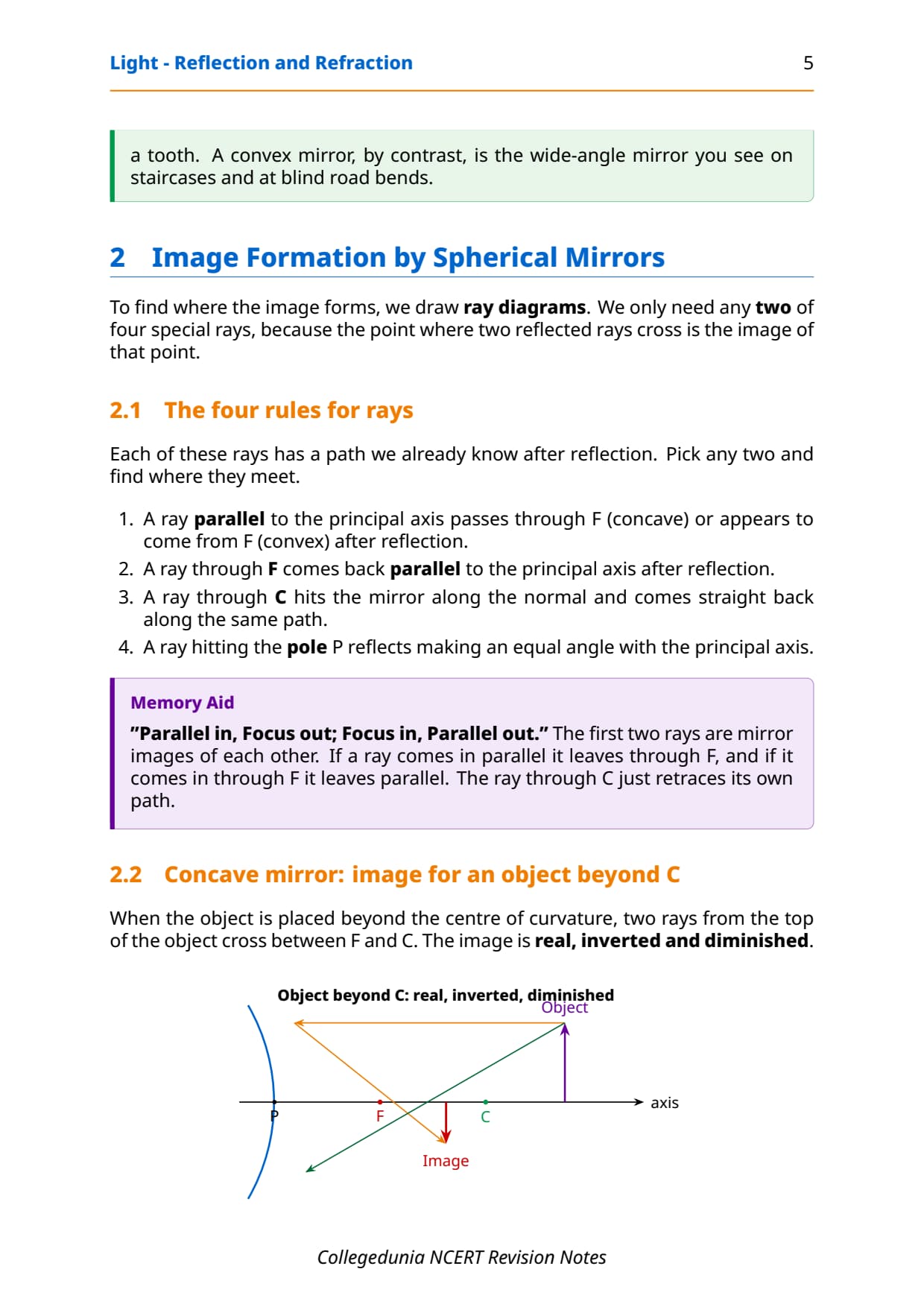
To find an image, draw a ray diagram using any two of these special rays; where they cross is the image:
- A ray parallel to the axis passes through F (concave) or appears to come from F (convex).
- A ray through F comes back parallel to the axis.
- A ray through C returns along the same path.
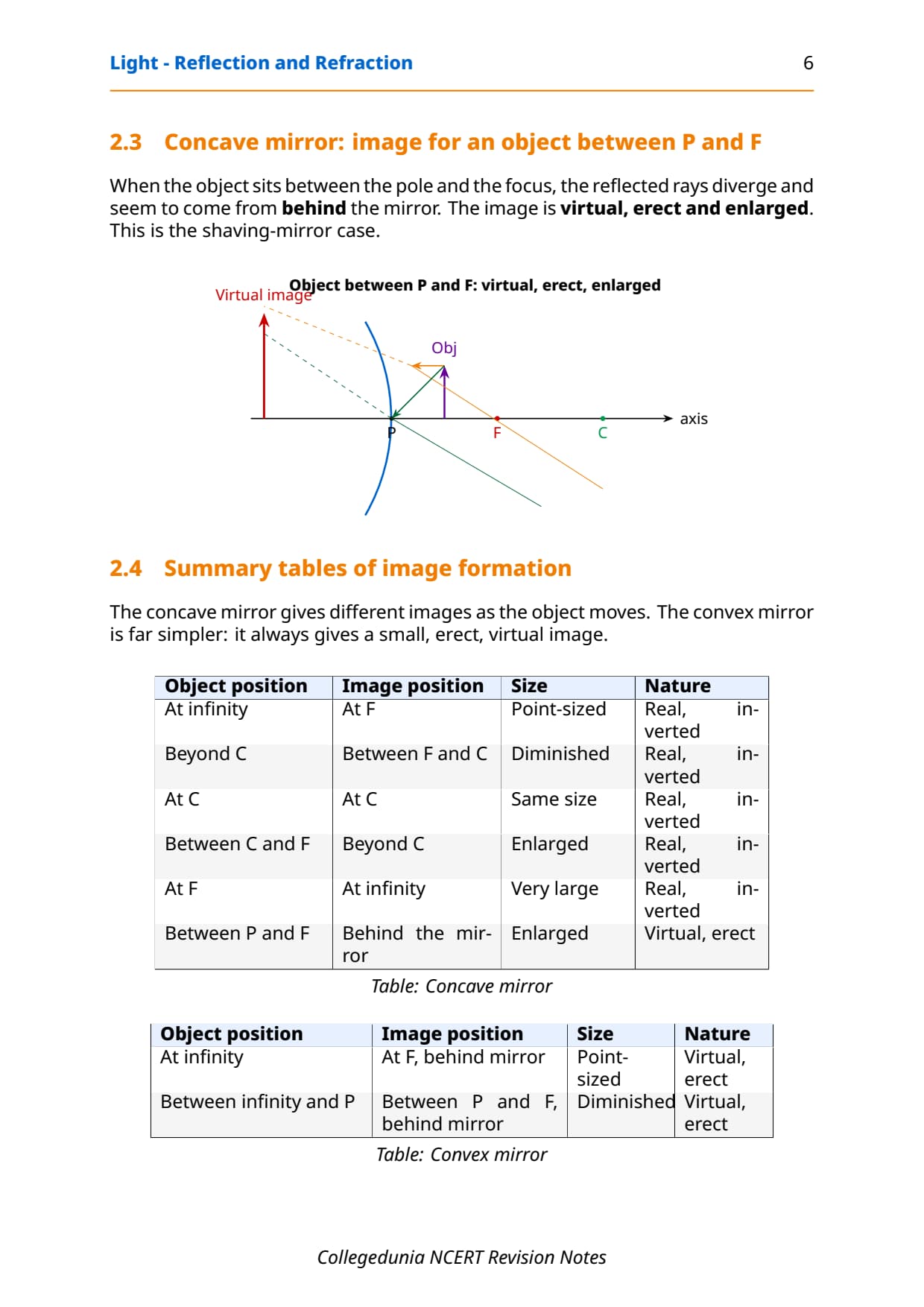
For a concave mirror the image changes with object position; a convex mirror always gives a small, erect, virtual image. This table is among the most-asked in the exam.
| Object position (concave) | Image position | Size and nature |
|---|---|---|
| At infinity | At F | Point-sized, real, inverted |
| Beyond C | Between F and C | Diminished, real, inverted |
| At C | At C | Same size, real, inverted |
| Between C and F | Beyond C | Enlarged, real, inverted |
| At F | At infinity | Very large, real, inverted |
| Between P and F | Behind the mirror | Enlarged, virtual, erect |
Concave mirrors are used in headlights, torches and shaving mirrors. Convex mirrors are rear-view and safety mirrors and can never form a real image.
Mirror Formula, Sign Convention and Magnification in Class 10 Science
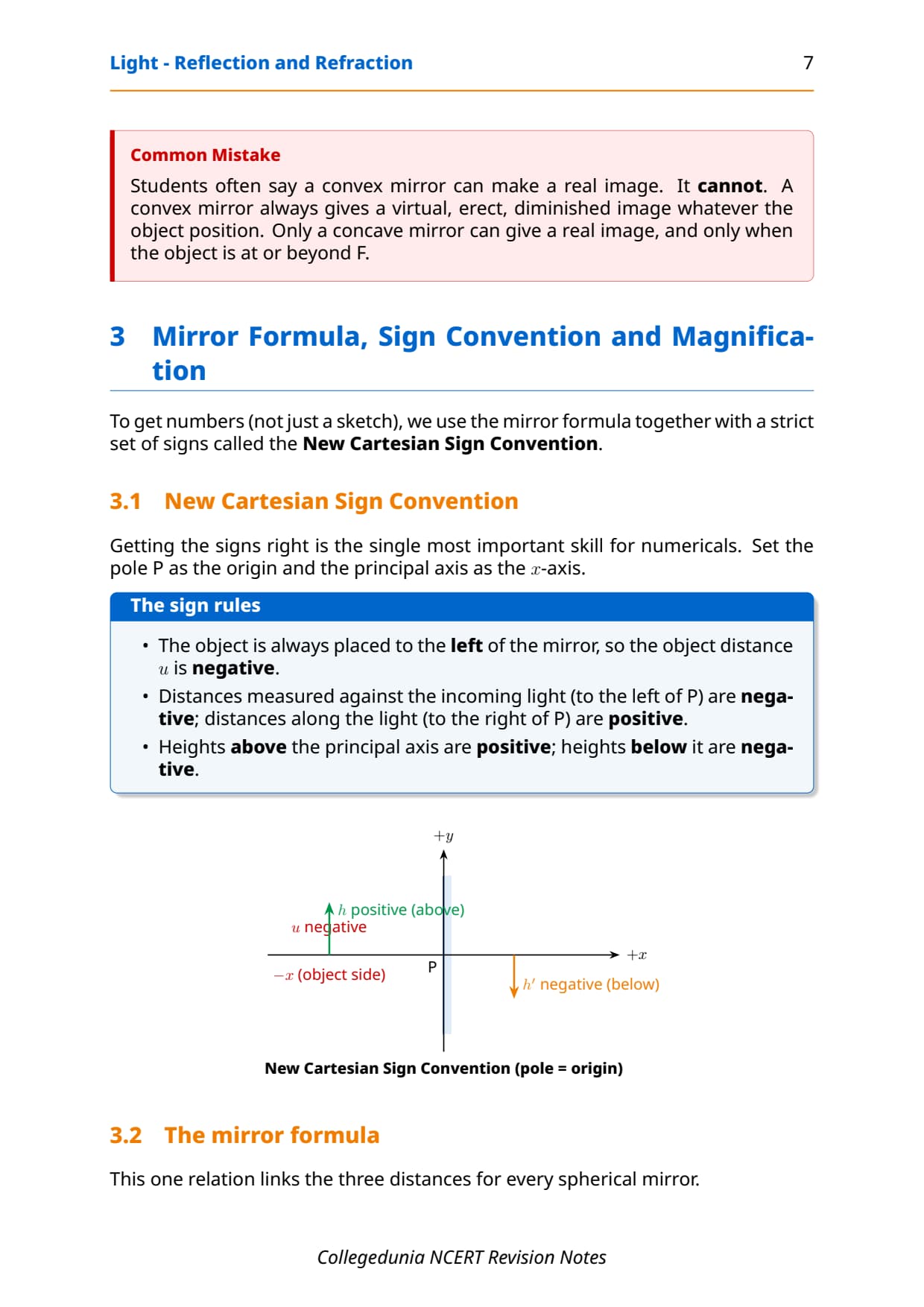
Numericals use the mirror formula with the New Cartesian Sign Convention. Set the pole P as origin, then:
- Object is to the left, so u is negative.
- Distances along the light (right of P) are positive; against it, negative.
- Heights above the axis are positive; below it, negative.
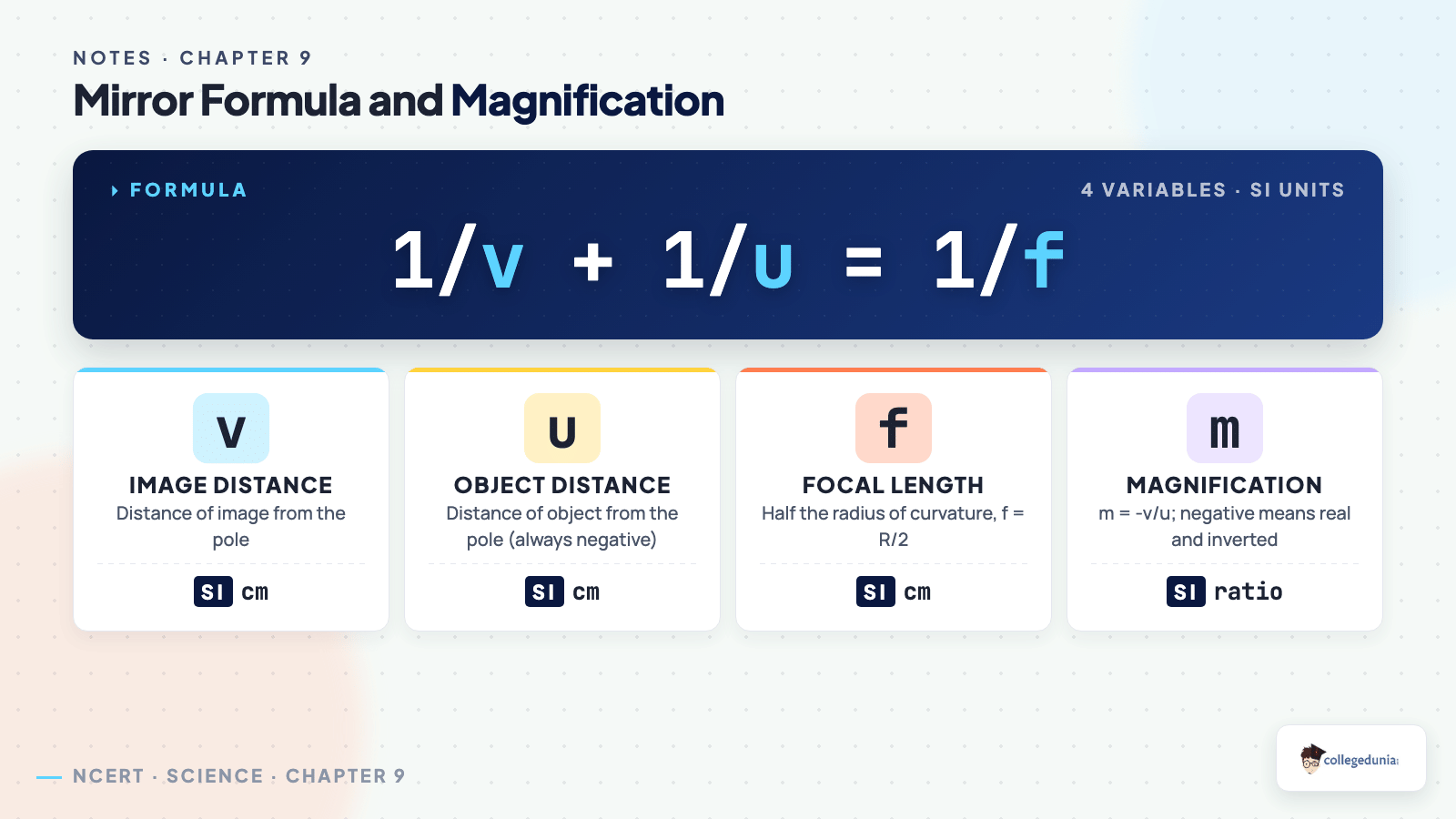
Magnification: m = h′/h = − v/u
A negative m means the image is real and inverted; a positive m means virtual and erect.
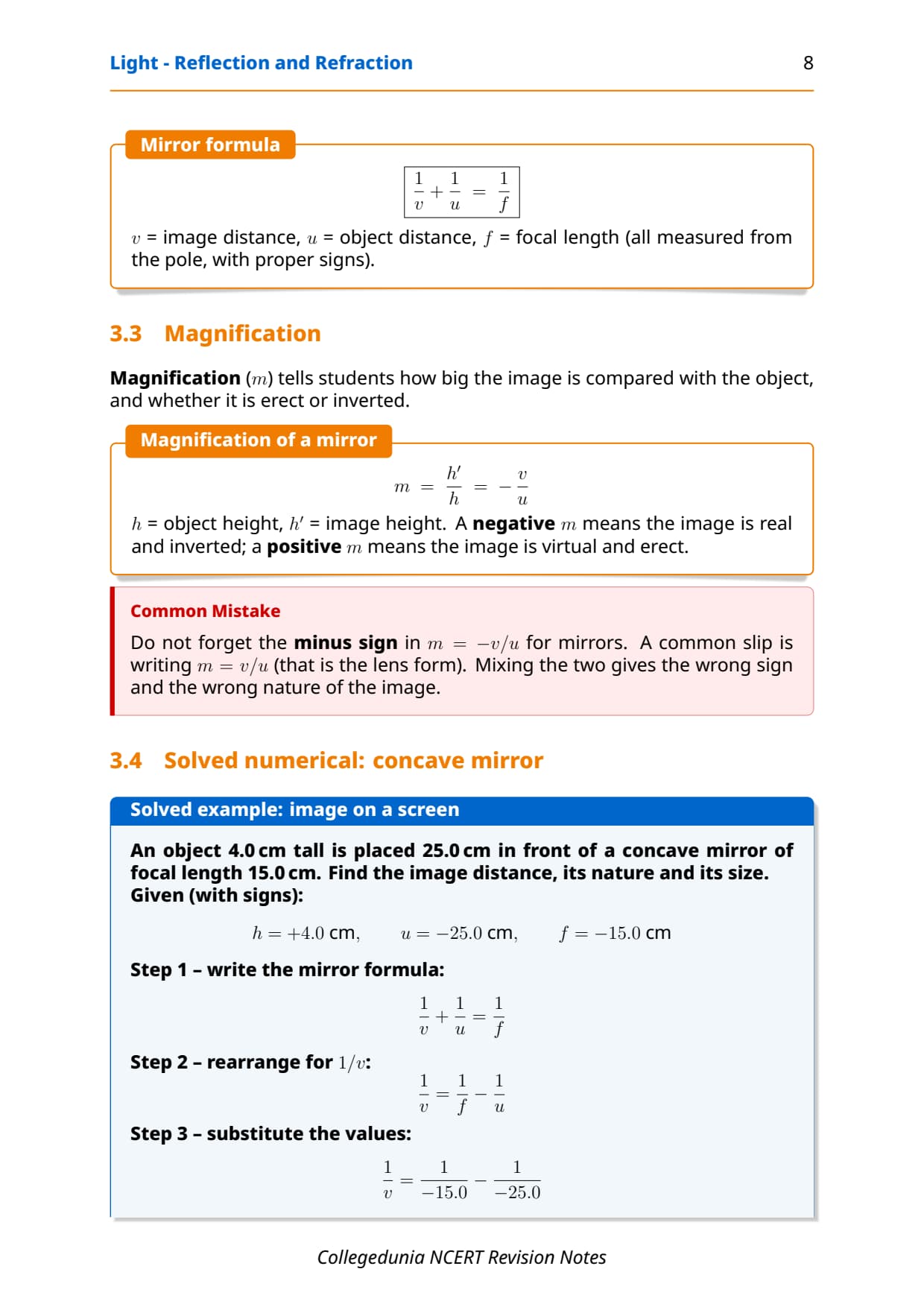
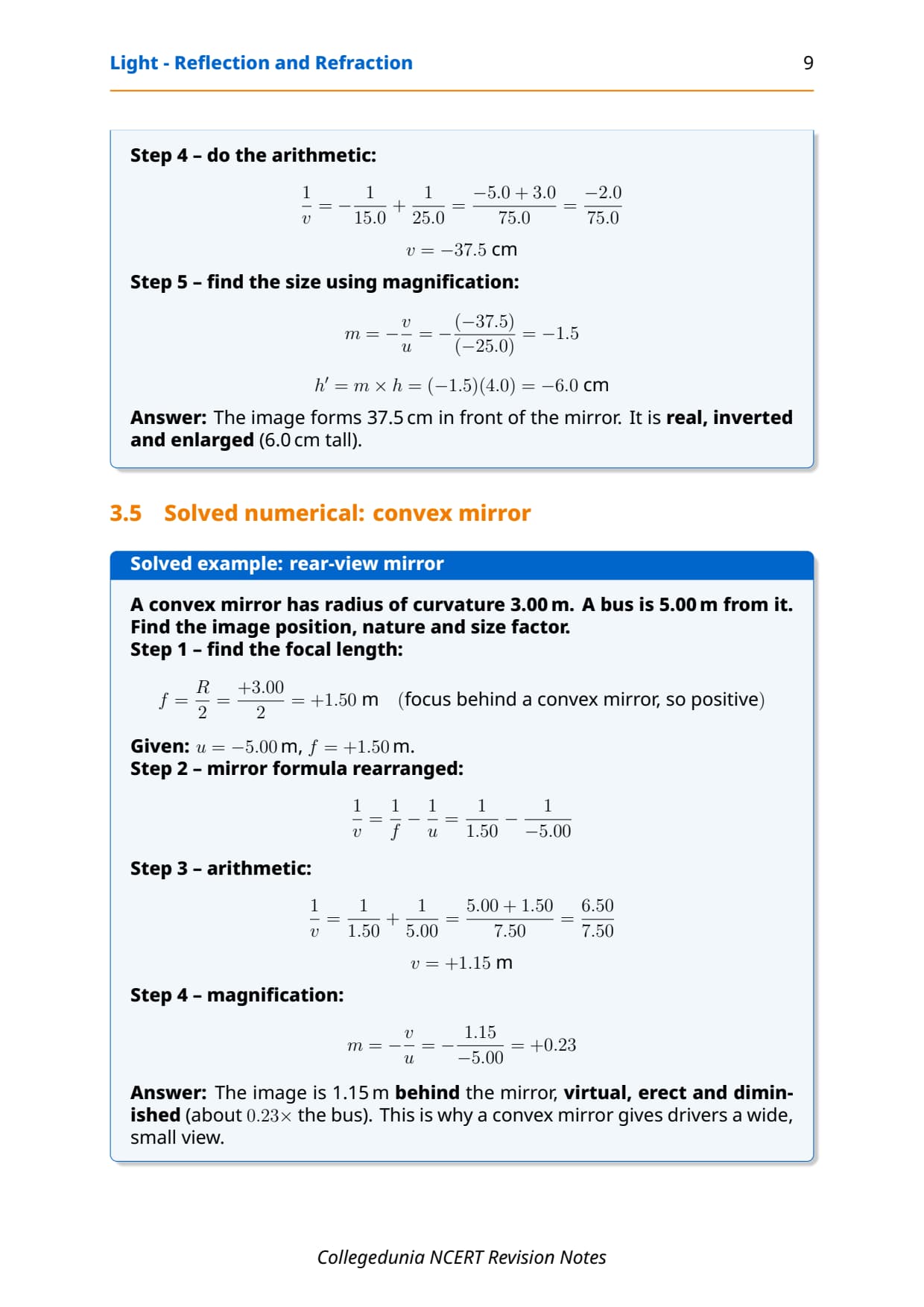
1/v = 1/f − 1/u = 1/(−15.0) − 1/(−25.0) = −2.0/75.0, so v = −37.5 cm
m = − v/u = −1.5
Answer: image 37.5 cm in front, real, inverted, enlarged.
Refraction of Light and Refractive Index in Class 10 Science
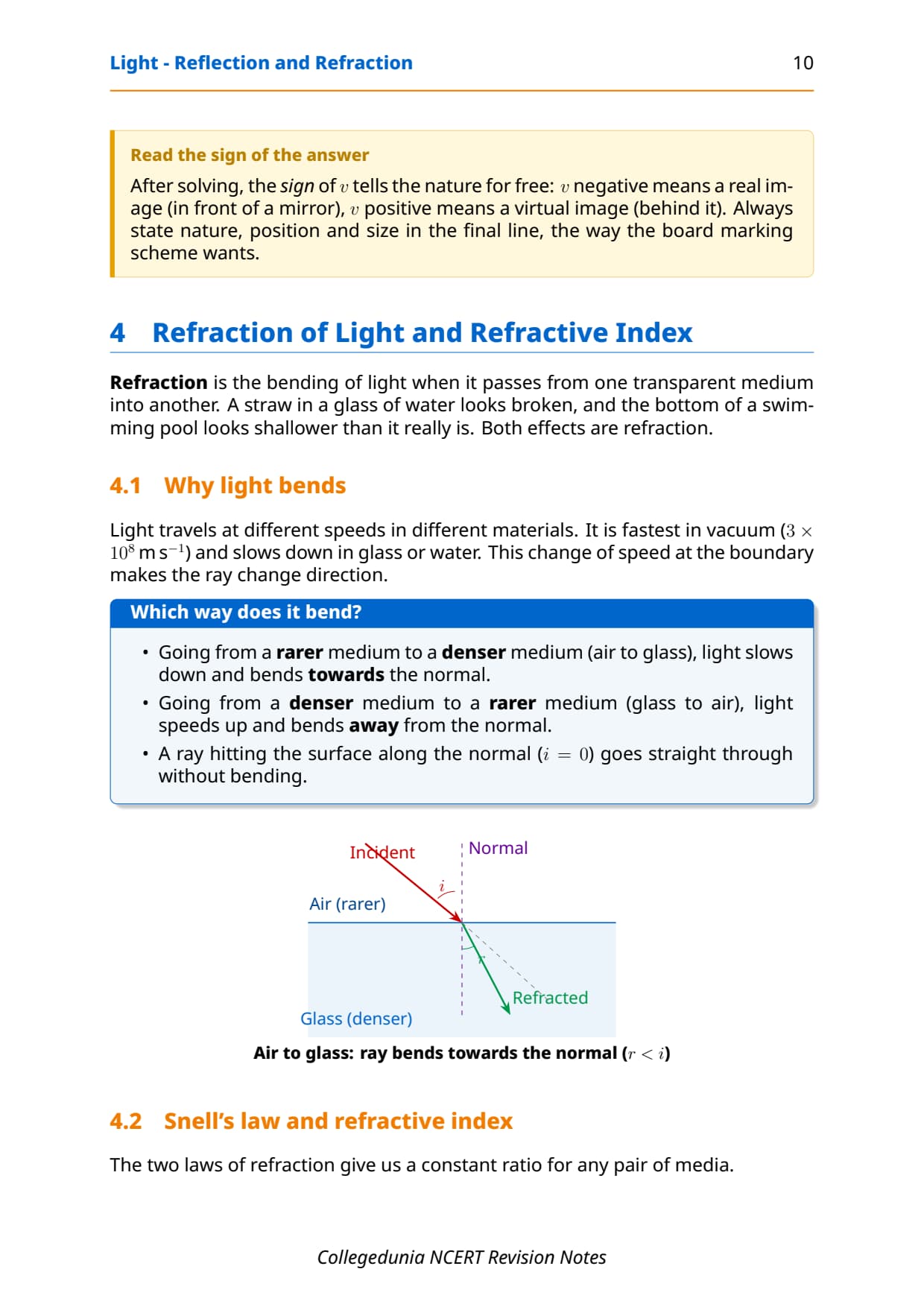
Refraction is the bending of light passing from one transparent medium into another. It bends because light travels at different speeds in different materials: fastest in vacuum (3 × 10⁸ m/s), slower in glass or water, and this change of speed at the boundary bends the ray.
- Rarer to denser (air to glass): bends towards the normal.
- Denser to rarer (glass to air): bends away from the normal.
- A ray along the normal (i = 0) goes straight through.
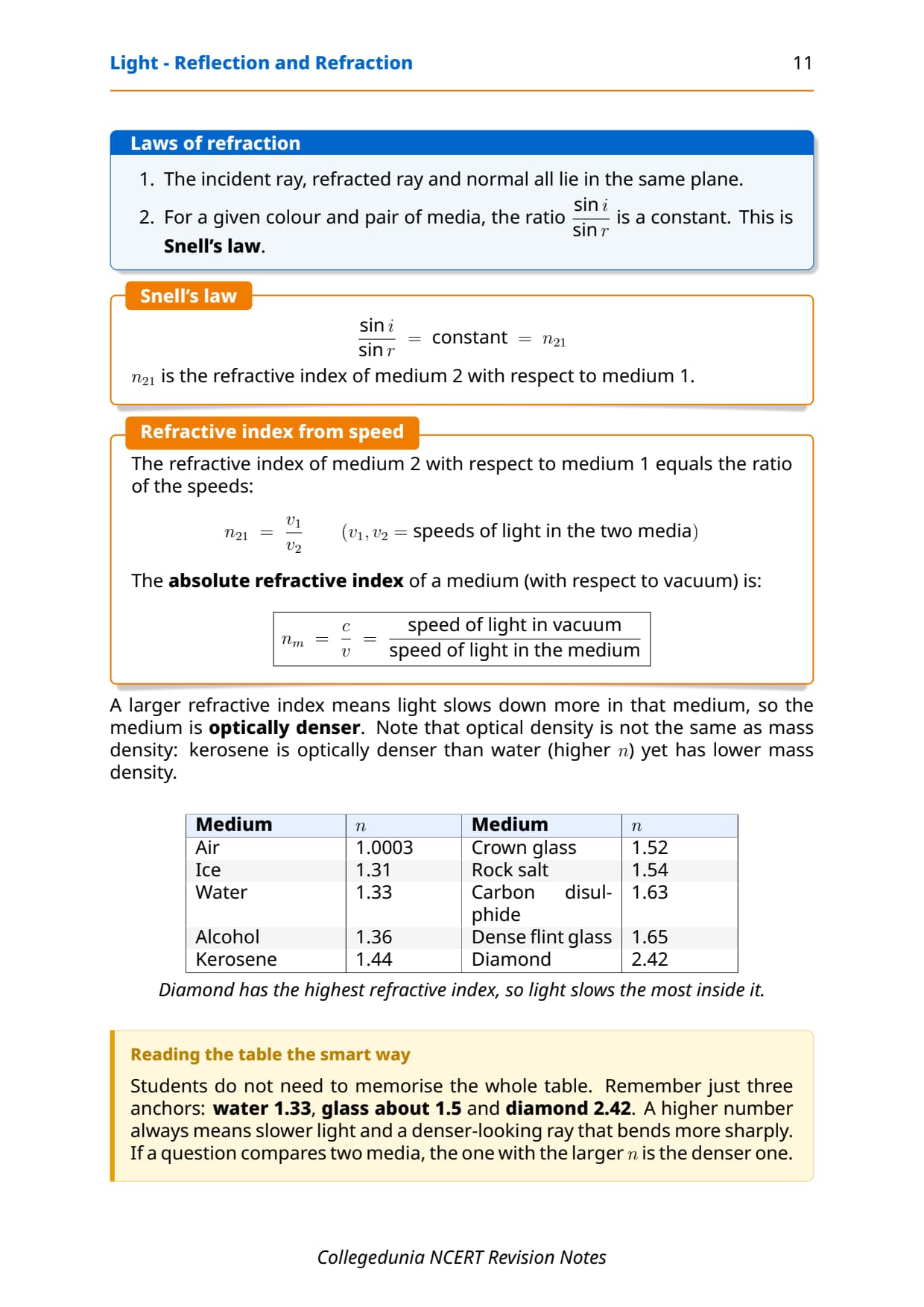
Snell's law is the second law; its constant is the refractive index.
Refractive index from speed: nm = c / v = (speed of light in vacuum) / (speed of light in the medium)
A larger refractive index means light slows more, so the medium is optically denser. Three anchors:
| Medium | Refractive index (n) | Note |
|---|---|---|
| Water | 1.33 | Anchor for liquids |
| Crown glass | 1.52 | Glass is about 1.5 |
| Diamond | 2.42 | Highest; light slows the most |
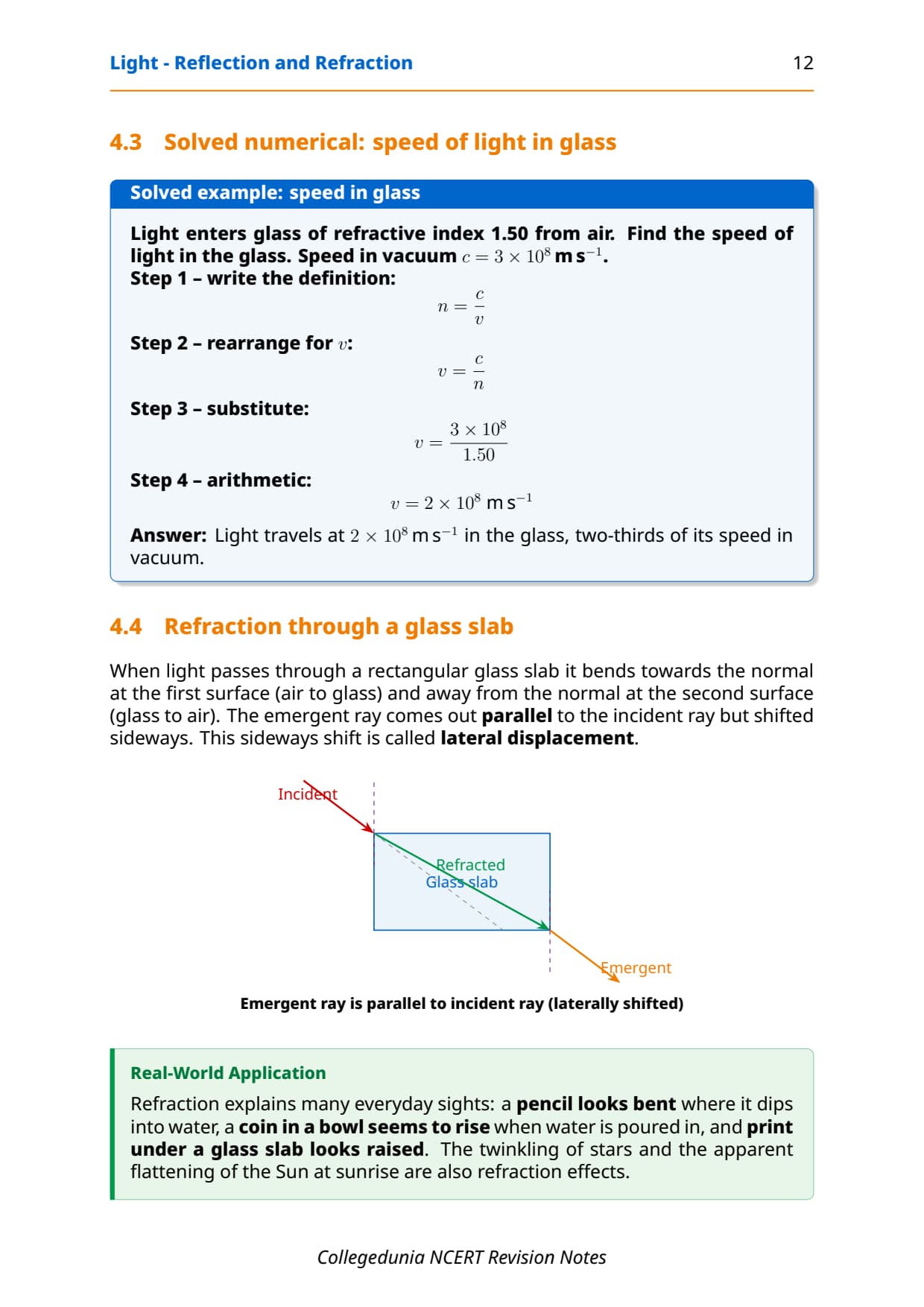
Through a rectangular glass slab, the emergent ray is parallel to the incident ray but shifted sideways (lateral displacement). Glass of n = 1.50 slows light to v = c/n = 2 × 10⁸ m/s. Denser means slower, and slower means bending towards the normal.
Spherical Lenses and the Lens Formula in Class 10 Science
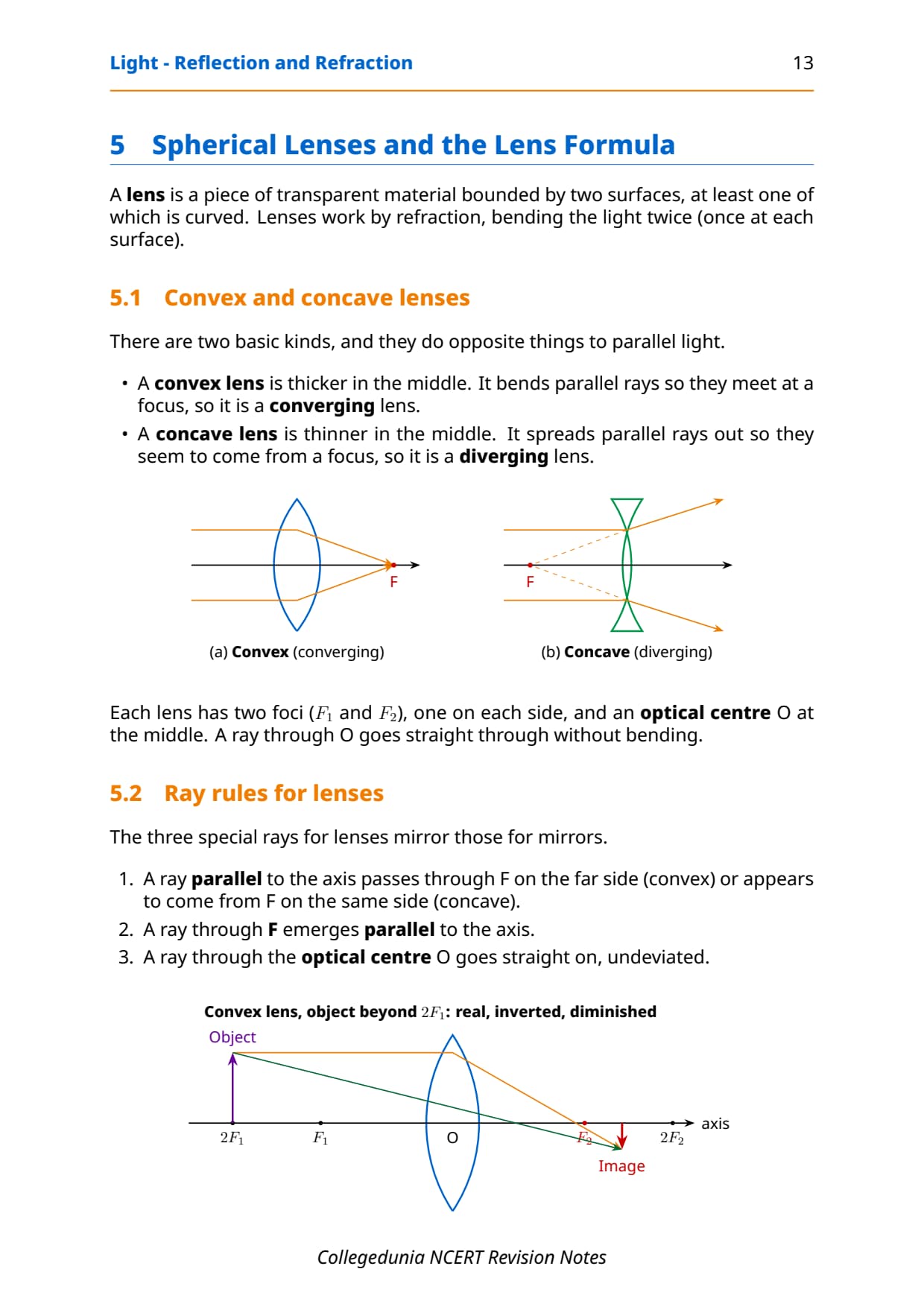
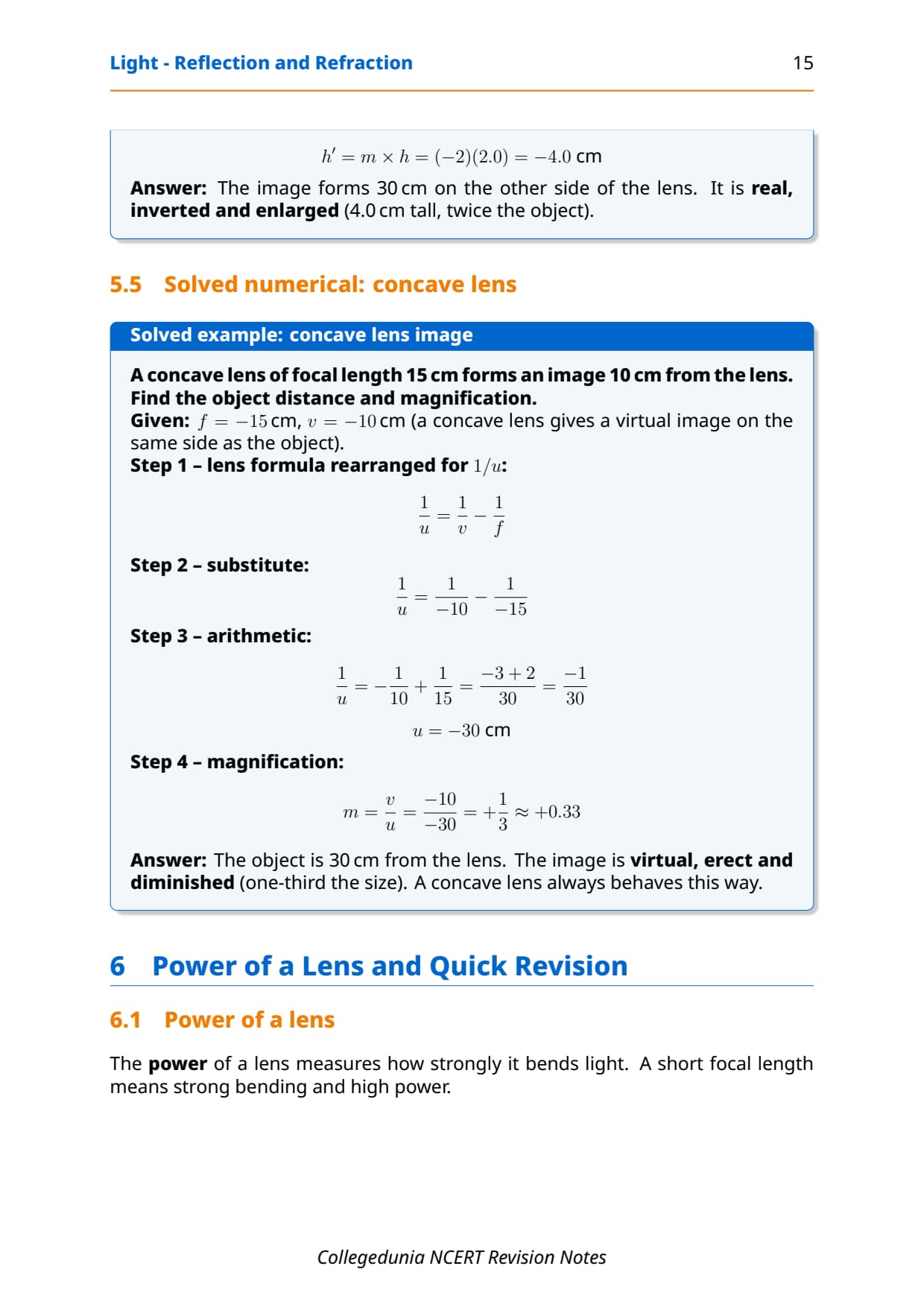
A lens works by refraction. A convex lens is thicker in the middle and converges parallel rays; a concave lens is thinner and diverges them. Each lens has an optical centre O; a ray through O is undeviated. The lens formula has a minus where the mirror had a plus.
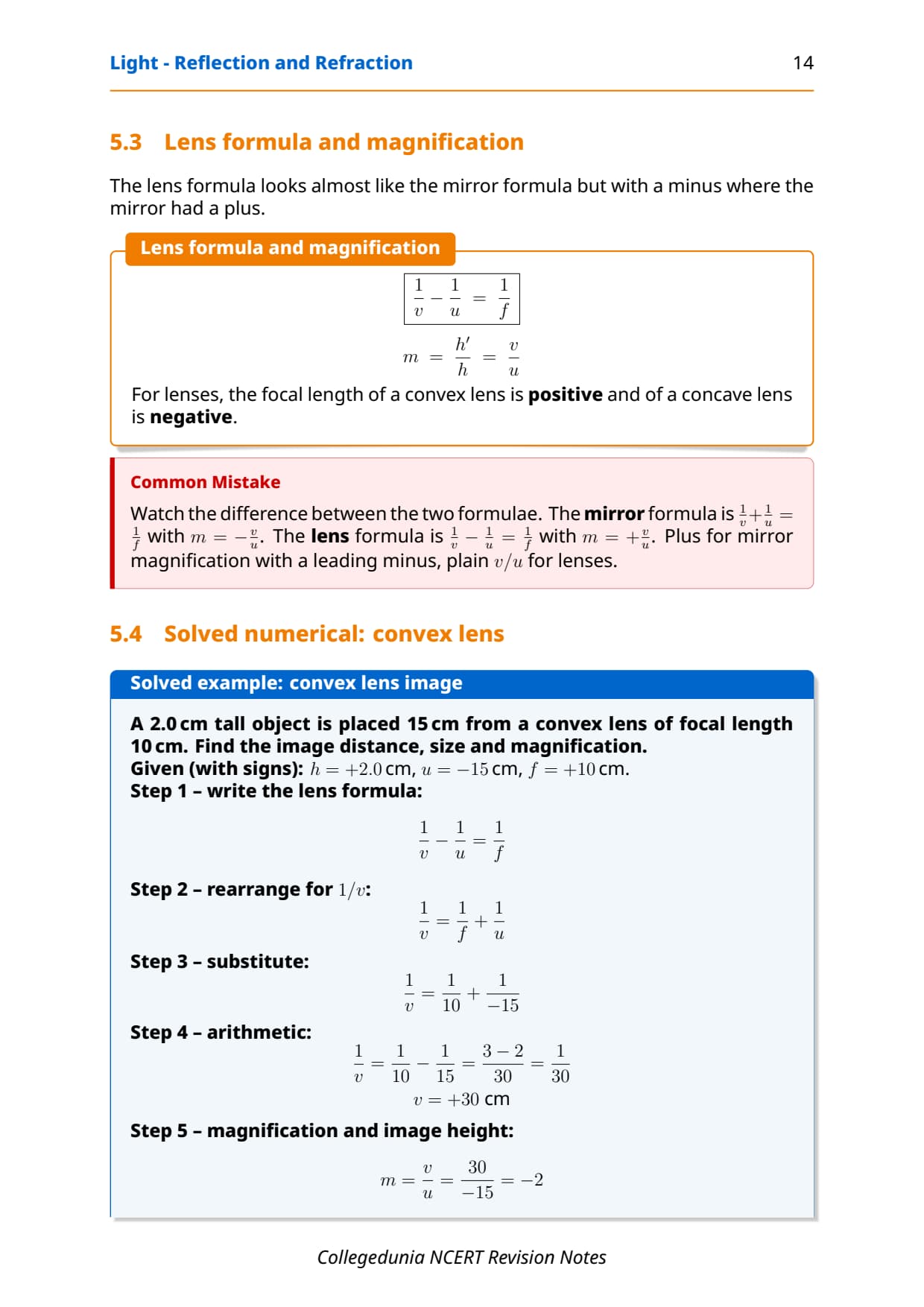
Magnification (lens): m = h′/h = v/u
A convex lens has positive focal length, a concave lens negative. The example below shows a convex lens forming a real, magnified image.
1/v = 1/f + 1/u = 1/10 + 1/(−15) = 1/30, so v = +30 cm
m = v/u = 30/(−15) = −2
Answer: image 30 cm on the other side, real, inverted, enlarged (twice the object).
Power of a Lens and the Dioptre in Class 10 Science
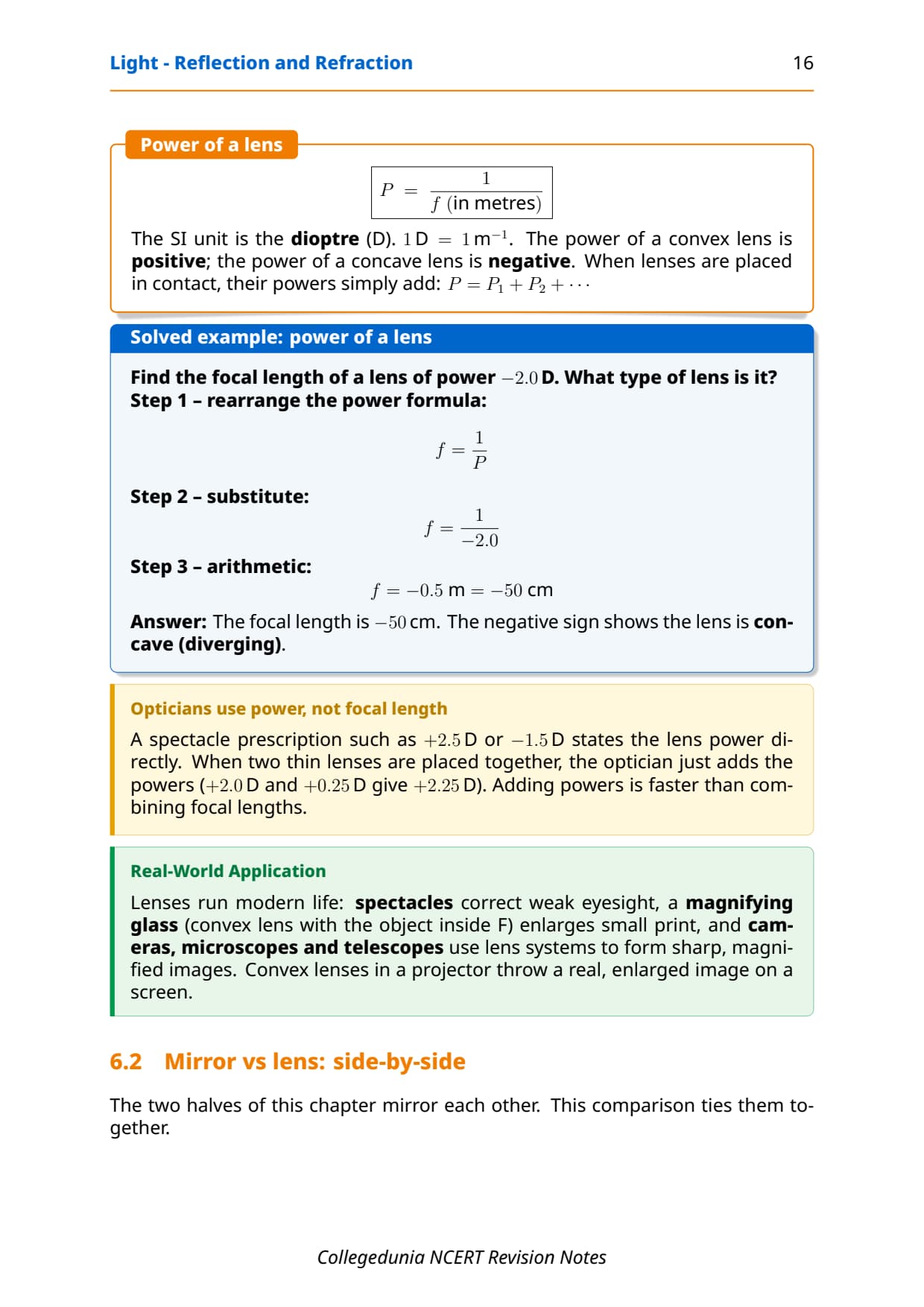
The power of a lens measures how strongly it bends light: short focal length means high power. It is the reciprocal of the focal length in metres.
A convex lens has positive power, a concave lens negative. Thin lenses in contact have powers that add (P = P1 + P2 + ...). A prescription like +2.5 D states the power directly.
- Lens type from power: −2.0 D gives f = −50 cm, a concave (diverging) lens.
- Lenses in contact: +2.0 D and +0.25 D act as a single +2.25 D lens.
Common Exam Traps and How to Revise This Chapter
Revise in two passes: the laws and ray rules, then the mirror and lens numericals, writing signs down before substituting. The repeat-offender mistakes:
- Angles from the surface: i and r are measured from the normal, not the mirror.
- Wrong signs: u is always negative; apply the sign convention before substituting.
- Swapping formulae: mirror is 1/v + 1/u = 1/f, lens is 1/v − 1/u = 1/f; magnification signs differ too.
- Convex mirror never gives a real image; always virtual, erect, diminished.
- Power unit: dioptres (D), with f in metres.
Also Check: The full set of CBSE board paper questions for this chapter, with step-by-step answers, is included in the downloadable PDF above, updated for the 2026-27 cycle.
Other Resources for Class 10 Science Chapter 9 Light - Reflection and Refraction
Pair these revision notes with the matching NCERT Solutions, the formula sheet, handwritten notes and the official NCERT book chapter. All resources for Class 10 Science Chapter 9 Light - Reflection and Refraction are linked below.
| Resource | What it covers | Open |
|---|---|---|
| Notes | Concept-first revision notes on reflection, spherical mirrors, the mirror and lens formulae, refraction, refractive index and the power of a lens. | You are here |
| NCERT Solutions | Step-by-step answers to all in-text and exercise questions, with an Expert Solution for each. | Class 10 Science Chapter 9 NCERT Solutions |
| Formula Sheet | Quick reference of the must-know formulae, sign rules and ray diagrams of the chapter. | Class 10 Science Chapter 9 Formula Sheet |
| Handwritten Notes | Scanned-style handwritten pages for last-minute board revision. | Class 10 Science Chapter 9 Handwritten Notes |
| NCERT Book PDF | Official NCERT Science Chapter 9 Light - Reflection and Refraction textbook in PDF form. | Class 10 Science Chapter 9 NCERT Book PDF |
Notes for Class 10 Science: All Chapters
Related Links: Use the table below to open the revision notes for the other chapters of Class 10 Science. Every chapter ships with the same concept-first notes style, full PDF download, and revision FAQ.
| Chapter | Notes link |
|---|---|
| Chapter 1 | Chemical Reactions and Equations Notes |
| Chapter 2 | Acids, Bases and Salts Notes |
| Chapter 3 | Metals and Non-metals Notes |
| Chapter 4 | Carbon and its Compounds Notes |
| Chapter 5 | Life Processes Notes |
| Chapter 6 | Control and Coordination Notes |
| Chapter 7 | How do Organisms Reproduce? Notes |
| Chapter 8 | Heredity Notes |
| Chapter 9 | Light - Reflection and Refraction Notes (You are here) |
| Chapter 10 | The Human Eye and the Colourful World Notes |
| Chapter 11 | Electricity Notes |
| Chapter 12 | Magnetic Effects of Electric Current Notes |
| Chapter 13 | Our Environment Notes |
Notes Class 10 Science Chapter 9 Light - Reflection and Refraction FAQs
Ques. What does Chapter 9 Light - Reflection and Refraction cover in Class 10 Science?
Ans. Chapter 9 covers what light does at a surface and at the boundary of a new material. The notes explain the two laws of reflection, image formation by concave and convex mirrors, the mirror formula with the New Cartesian Sign Convention, and magnification. They then move to refraction: why light bends, Snell's law, refractive index from the speed of light, and refraction through a glass slab. The chapter ends with spherical lenses, the lens formula, lens magnification, and the power of a lens measured in dioptres, all aligned with the 2026-27 CBSE syllabus and with solved numericals.
Ques. What are the two laws of reflection of light?
Ans. The first law of reflection says the angle of incidence is equal to the angle of reflection, with both angles measured from the normal, the line drawn at 90 degrees to the surface where the ray hits. The second law says the incident ray, the reflected ray and the normal all lie in the same plane. These two laws hold for every reflecting surface, flat or curved, which is why they work for plane mirrors as well as concave and convex spherical mirrors. A common exam slip is to measure the angles from the mirror surface instead of from the normal.
Ques. What is the mirror formula and the sign convention used with it?
Ans. The mirror formula is 1/v + 1/u = 1/f, where v is the image distance, u is the object distance and f is the focal length, all measured from the pole. It is used with the New Cartesian Sign Convention: the pole is the origin, the object is placed to the left so u is negative, distances measured along the light (to the right of the pole) are positive while distances against the light are negative, and heights above the principal axis are positive while heights below are negative. Applying these signs before substituting the numbers is the key to getting mirror numericals right.
Ques. What is the difference between the mirror formula and the lens formula?
Ans. The mirror formula is 1/v + 1/u = 1/f with magnification m = minus v/u, while the lens formula is 1/v minus 1/u = 1/f with magnification m = plus v/u. So the mirror equation has a plus between the two reciprocal terms and a leading minus in its magnification, whereas the lens equation has a minus between the terms and a plain v/u for its magnification. For a mirror f = R/2, while a lens has its focal length given directly. Keeping the two formulae and their magnification signs apart prevents one of the most common mistakes in this chapter.
Ques. What is refractive index and how is it related to the speed of light?
Ans. The refractive index of a medium tells you how much light slows down inside it. The absolute refractive index is n = c/v, where c is the speed of light in vacuum (3 multiplied by 10 to the power 8 metres per second) and v is the speed of light in the medium. A larger refractive index means light travels more slowly in that medium, so the medium is said to be optically denser and the ray bends more sharply. For example, glass of refractive index 1.50 slows light to 2 multiplied by 10 to the power 8 metres per second, which is two-thirds of its speed in vacuum.
Ques. What is the power of a lens and in what unit is it measured?
Ans. The power of a lens measures how strongly the lens bends light, and it is the reciprocal of the focal length in metres: P = 1/f. The SI unit is the dioptre, written D, where 1 D equals 1 per metre. The power of a convex (converging) lens is positive and the power of a concave (diverging) lens is negative. A short focal length means a high power, so a strongly bending lens such as a plus 10 D lens (focal length 10 centimetres) is far more powerful than a plus 2 D lens (focal length 50 centimetres). When thin lenses are placed in contact, their powers simply add.
Ques. How many pages is the Class 10 Science Light - Reflection and Refraction Notes PDF?
Ans. The Light - Reflection and Refraction Notes PDF runs about 20 to 22 pages and covers the full chapter in concept-first revision blocks, with labelled ray diagrams for concave and convex mirrors and lenses, the sign-convention diagram, the mirror and lens formulae with solved numericals, the refraction and glass-slab diagrams, a refractive index table, comparison tables, common-mistake boxes, memory aids and a one-glance revision strip. The PDF is free to download for the 2026-27 session, and a green Handwritten Notes button on this page opens the scanned-style version for last-minute revision.
Ques. Are these Notes for Class 10 Science Chapter 9 aligned with the 2026-27 syllabus?
Ans. Yes. This page reflects the current 2026-27 CBSE syllabus for Class 10 Science. The Light - Reflection and Refraction chapter is part of the current cycle, and these notes follow the NCERT textbook, covering the laws of reflection, spherical mirrors and their images, the mirror formula and sign convention, magnification, refraction and Snell's law, refractive index, spherical lenses and the lens formula, and the power of a lens. The notes are written for the CBSE board exam, with the high-frequency question types, the key formulae and the sign rules highlighted throughout.



Comments