




These Notes for Class 10 Science Chapter 8 Heredity give you a fast, concept-first revision of the whole chapter, built on the latest 2026-27 CBSE syllabus. They cover how variation builds up across generations, the famous pea-plant experiments of Gregor Mendel, the meaning of dominant and recessive traits, the monohybrid (3:1) and dihybrid (9:3:3:1) crosses, how genes on chromosomes control a feature through proteins, and how the sex of a baby is decided by the X and Y chromosomes.
- Every idea explained with a one-line meaning, a simple Punnett-square diagram, and the standard NCERT example the board keeps repeating.
- Full coverage of variation, Mendel's pea experiments, dominant and recessive traits, genotype and phenotype, the 3:1 and 9:3:3:1 ratios, genes, chromosomes and sex determination.
- Notes aligned with the 2026-27 CBSE Class 10 Science syllabus and written for the board exam; no NEET or JEE references because this is a Class 10 board chapter.
These Collegedunia revision notes are curated by Science subject experts, mapped to the 2026-27 NCERT textbook, and refined against the last five years of CBSE Class 10 Science board papers.
Student Feedback: What 12,600 students told us about this chapter
76% of Class 10 students said they kept confusing the genotype ratio (1:2:1) with the phenotype ratio (3:1) when they first revised this chapter. 3 out of 5 students told us that drawing one Punnett square by hand and memorising the 9:3:3:1 dihybrid result locked the cross questions before the board exam.
Toppers found that learning sex determination as a single line, "the father's sperm decides the sex," and the gene to protein to trait chain as one flow, saved 8 to 12 minutes in the exam, and the average student spent 2 to 3 hours on these notes across the first read and the final revision.
Source: 2026-27 Class 10 Science student poll. Sample of 12,600 students from CBSE schools across 13 states, conducted before the 2026 boards.
What the Notes for Class 10 Science Chapter 8 Heredity Cover
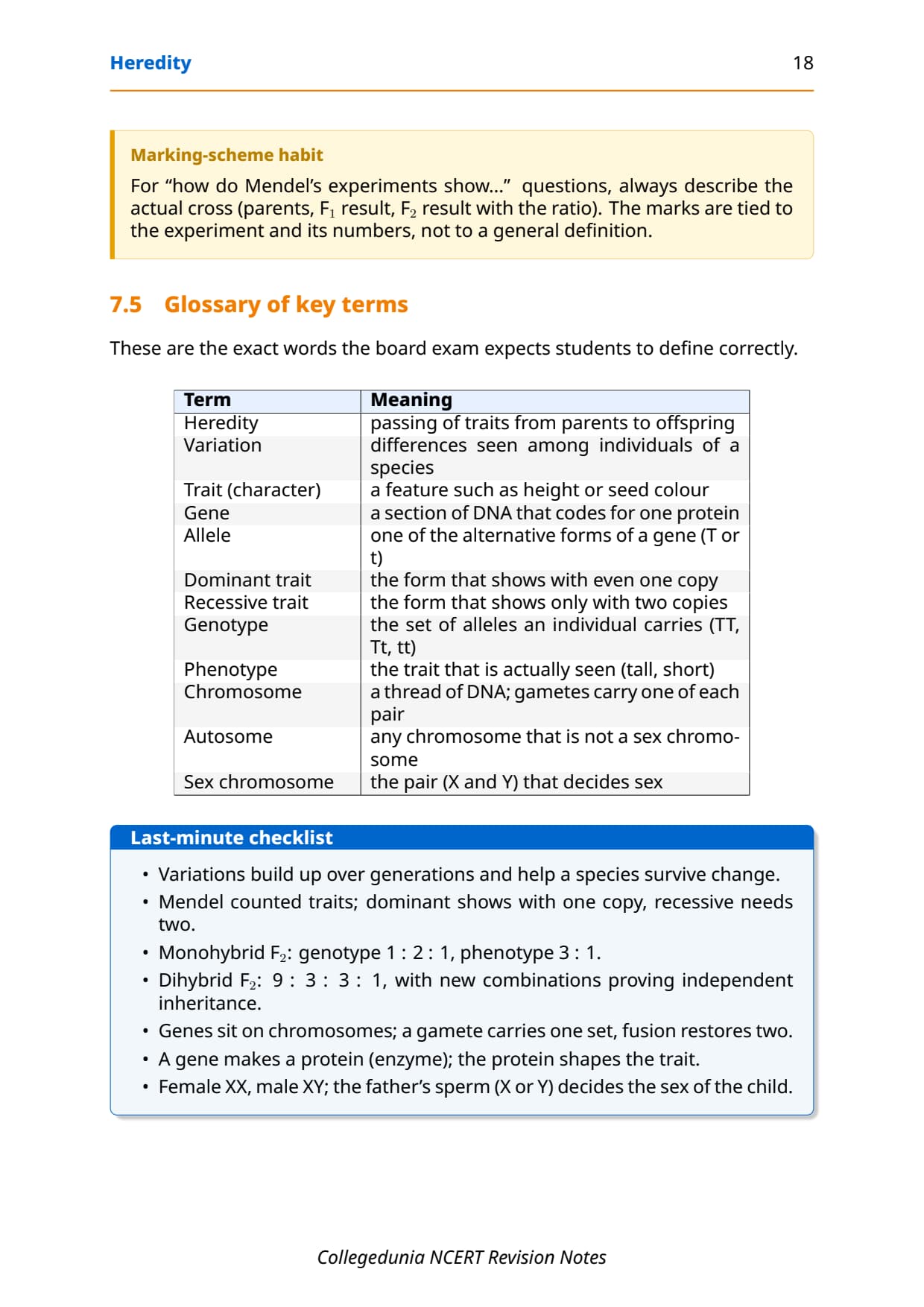
Heredity is the study of how features pass from one generation to the next, and how small variations creep in. The chapter moves from how variation builds up, to Gregor Mendel's pea-plant experiments, to how genes on chromosomes control traits and decide the sex of a baby.
- Variation and heredity: why offspring resemble parents and why variation helps survival.
- Mendel's experiments: dominant and recessive traits, the monohybrid 3:1 and dihybrid 9:3:3:1 ratios.
- Genes and sex determination: how a gene makes a protein that shapes a trait, and why the father decides the child's sex.
Source: Magnet Brains on YouTube
Variation and the Build-up of Heredity in Class 10 Science
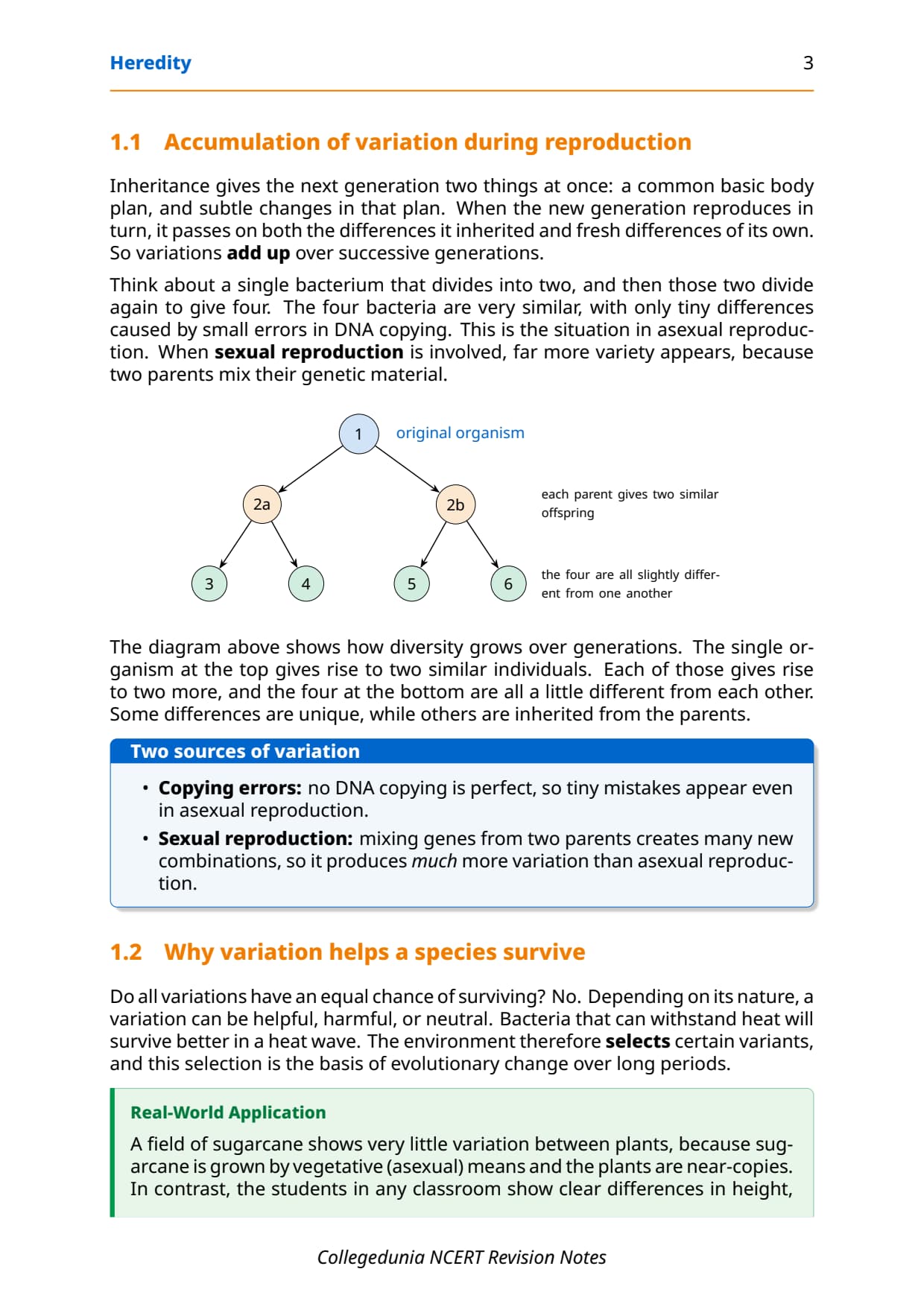
Every time a living thing reproduces, it passes on a copy of its body design, which is why offspring resemble their parents. But the copying of DNA is never perfect, so each new individual carries small differences called variations. As each generation reproduces, variations add up over time.
1 organism → 2 similar offspring → 4 slightly different offspring → more and more variety
A variation can be helpful, harmful or neutral. Bacteria that withstand heat survive better in a heat wave, so the environment selects certain variants, the basis of evolution.
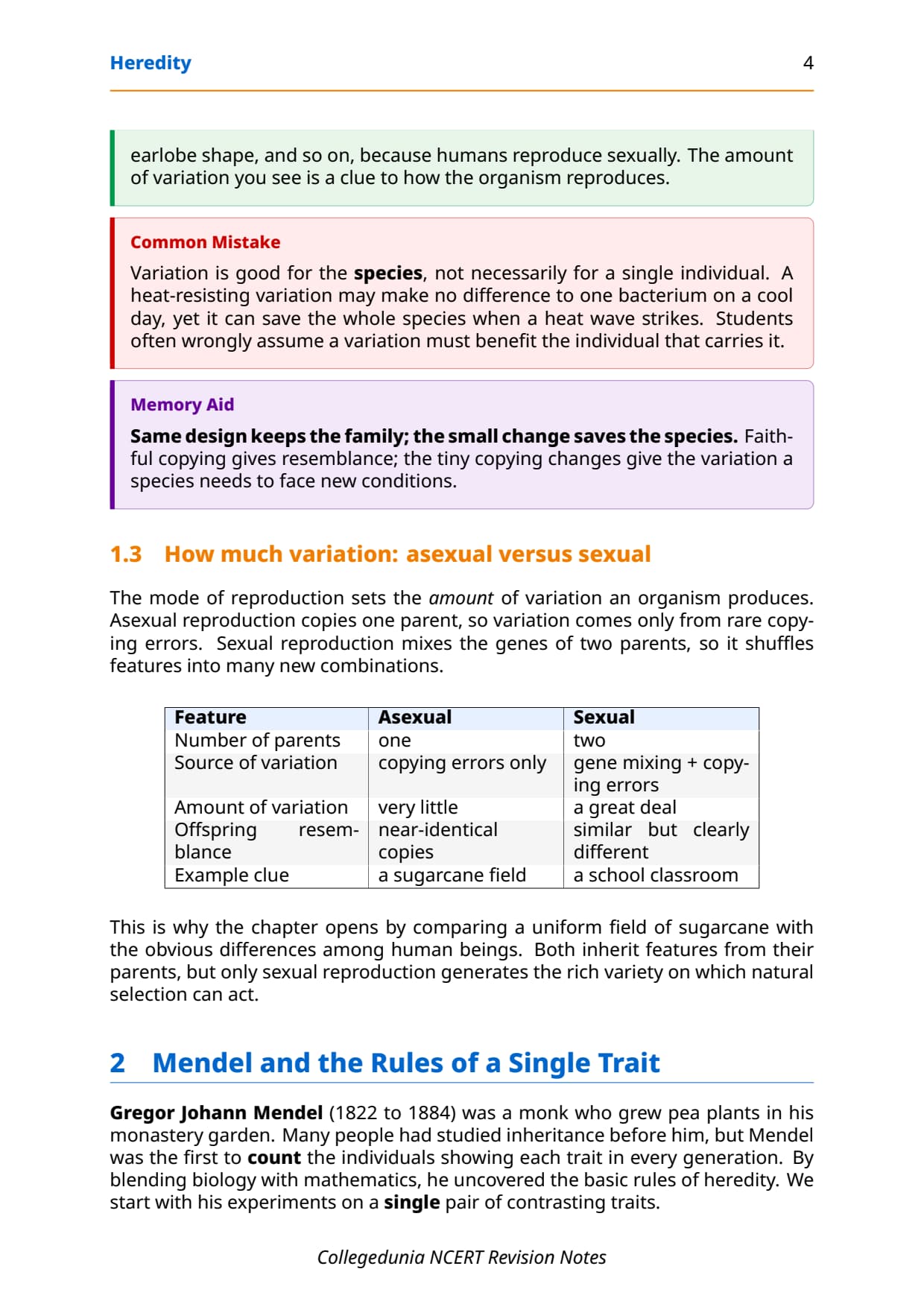
| Feature | Asexual reproduction | Sexual reproduction |
|---|---|---|
| Number of parents | One | Two |
| Source of variation | Copying errors only | Gene mixing + copying errors |
| Amount of variation | Very little | A great deal |
| Offspring resemblance | Near-identical copies | Similar but clearly different |
| Example clue | A uniform sugarcane field | A school classroom |
Mendel and the Rules of a Single Trait in Class 10 Science
Gregor Johann Mendel was a monk who grew pea plants in his monastery garden. He was the first to count the individuals showing each trait in every generation, blending biology with mathematics. The garden pea was a clever choice: it has several pairs of clearly contrasting characters and is easy to self- or cross-pollinate.
| Character | Dominant form | Recessive form |
|---|---|---|
| Plant height | Tall | Short (dwarf) |
| Seed shape | Round | Wrinkled |
| Seed colour | Yellow | Green |
| Flower colour | Violet | White |
A few terms must be exactly right:
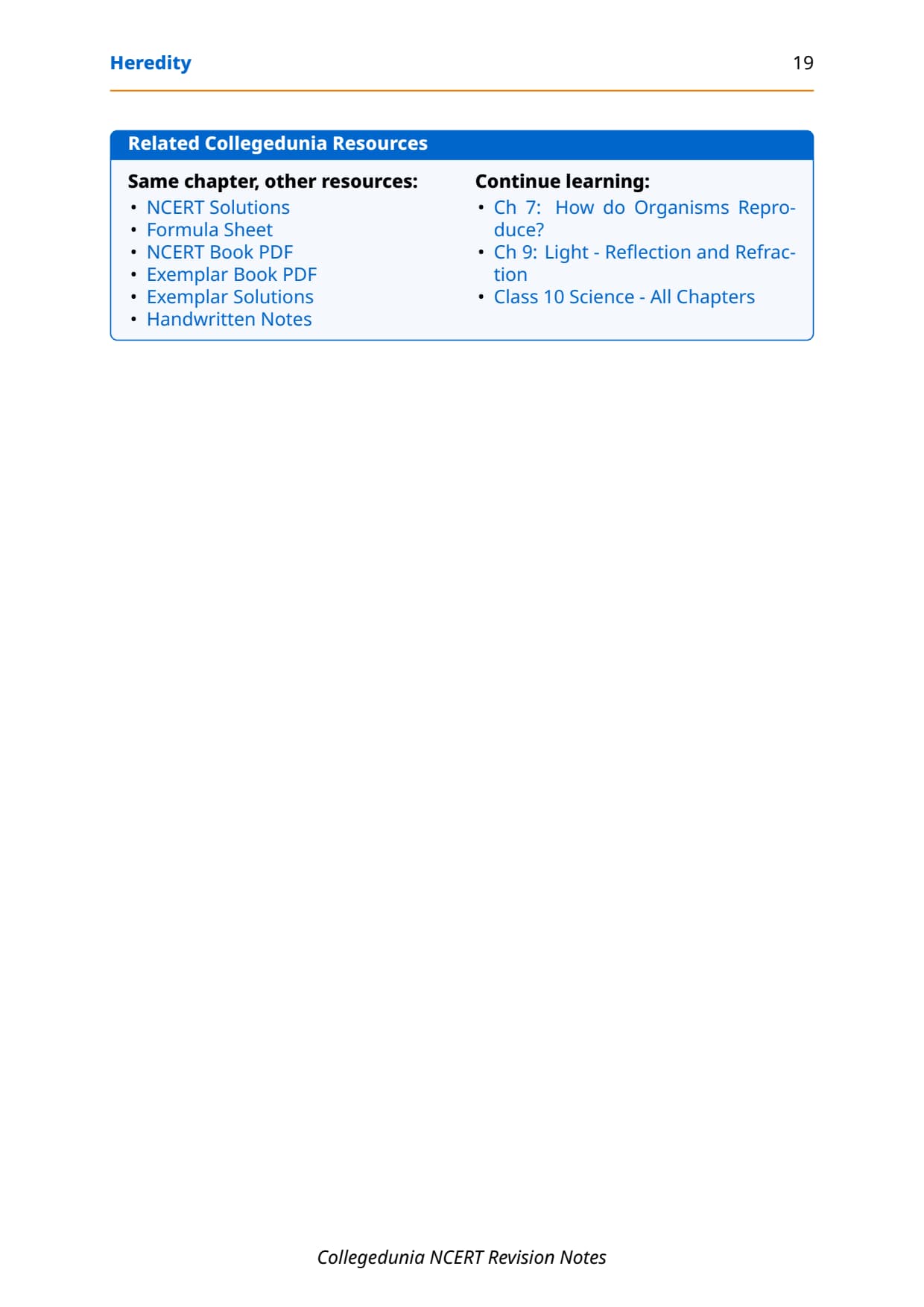
- Trait: a feature such as plant height. Gene: a unit of inheritance. Allele: one form of a gene (T for tall, t for short).
- Dominant trait: shows with only one copy (T). Recessive trait: shows only when both copies are that type (tt).
Keep genotype (the alleles carried, such as TT, Tt or tt) separate from phenotype (the trait you see). Tt and TT differ in genotype but share the same phenotype, both tall, because one T is enough.
The Monohybrid Cross and the 3:1 Ratio in Class 10 Science
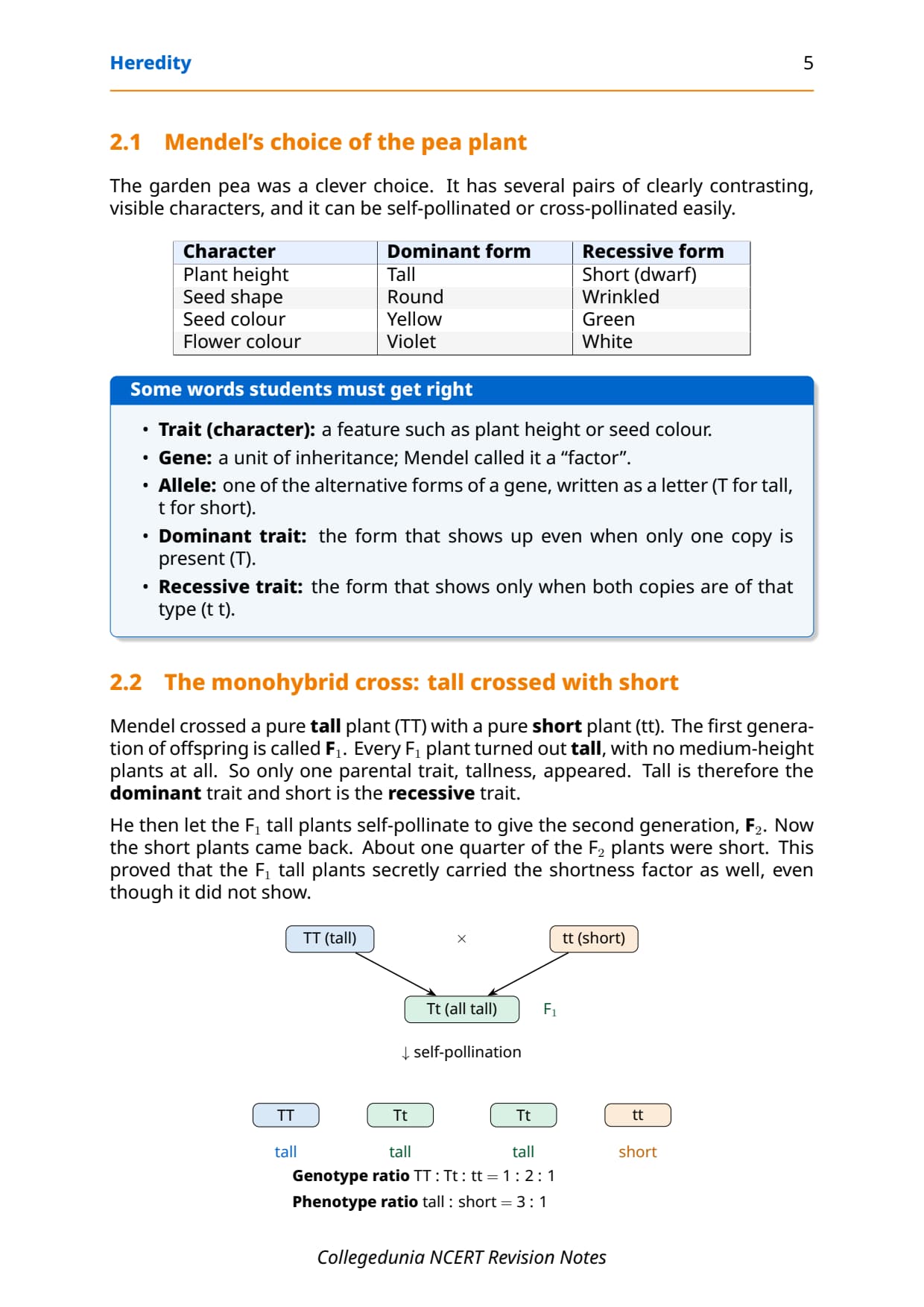
Mendel crossed a pure tall plant (TT) with a pure short plant (tt). Every F1 plant turned out tall, so tall is dominant and short is recessive. He then self-pollinated the F1 to give the F2 generation, where short plants came back in about one quarter, proving the F1 secretly carried the shortness factor.
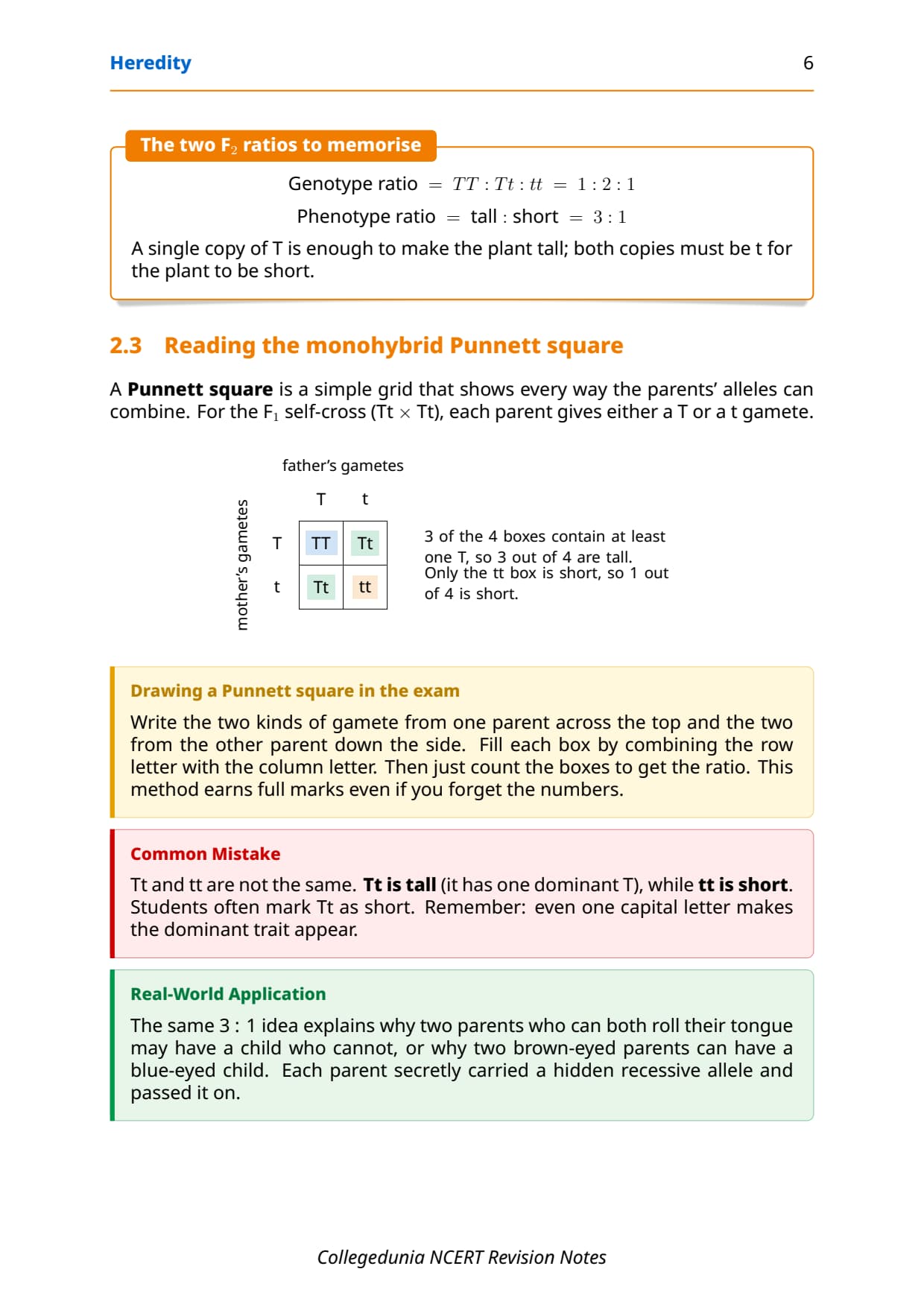
A Punnett square shows every way the parents' alleles can combine. For the F1 self-cross (Tt × Tt), the four boxes are TT, Tt, Tt, tt. Three hold at least one T, so three out of four are tall and one is short. Tt is tall (one dominant T is enough); only tt is short.
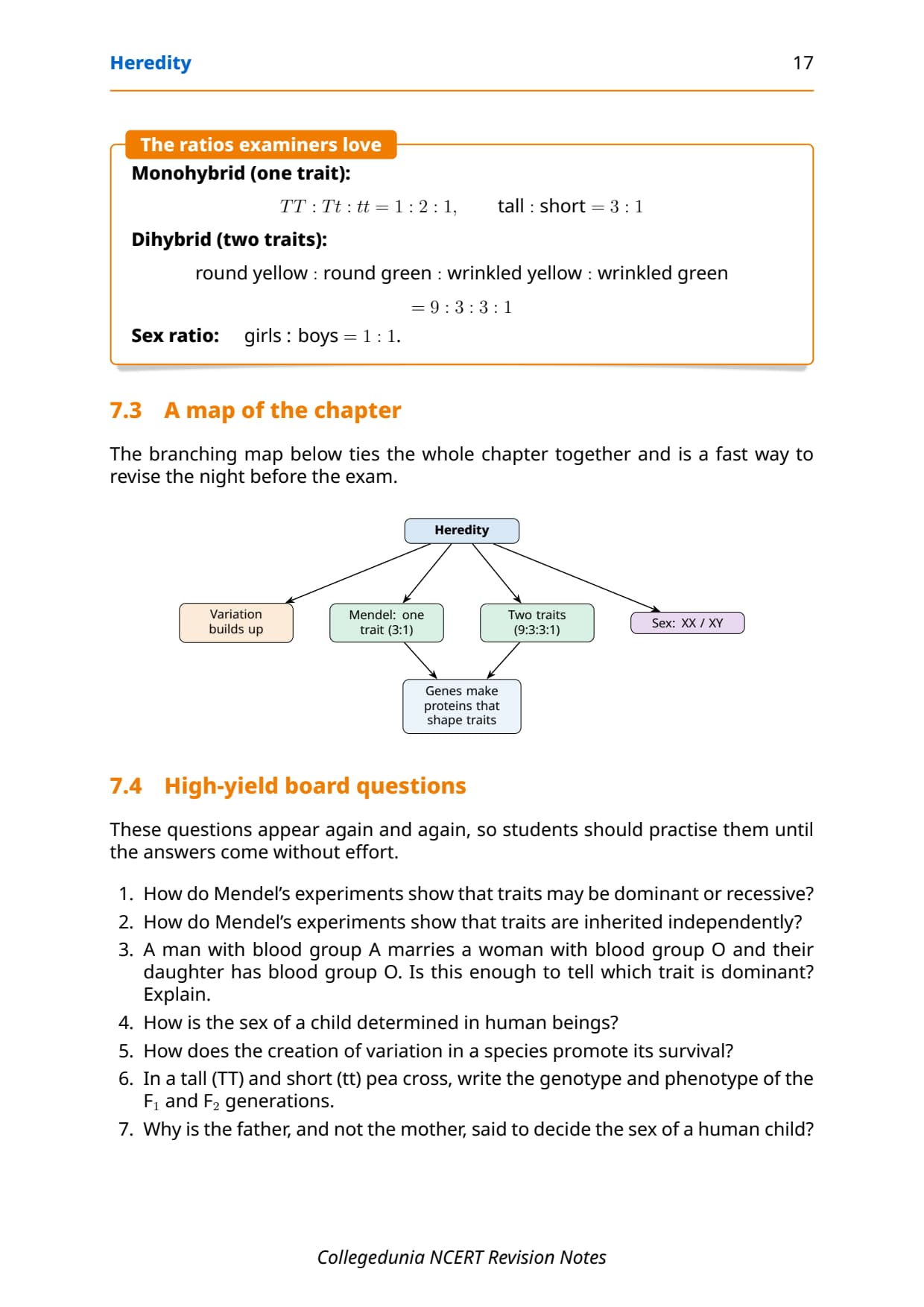
Phenotype ratio tall : short = 3 : 1
A test cross exposes a hidden recessive allele. A tall plant might be TT or Tt; cross it with a short plant (tt): if all offspring are tall, it was TT; if any short plants appear, it was Tt. This is the same 3:1 idea that lets two brown-eyed parents have a blue-eyed child.
The Dihybrid Cross and the 9:3:3:1 Ratio in Class 10 Science
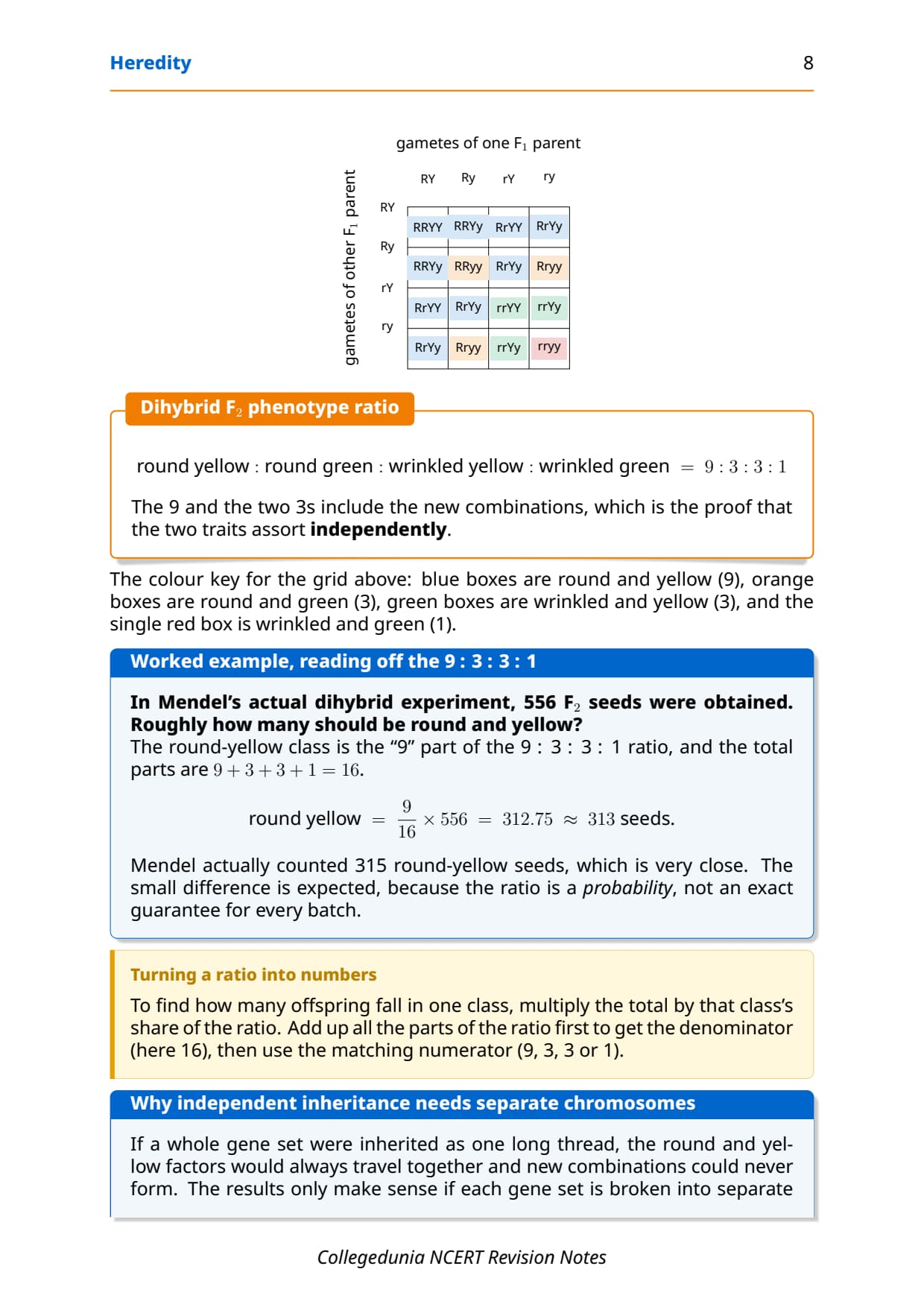
A dihybrid cross follows two characters at once. Mendel bred a tall, round-seeded plant against a short, wrinkled-seeded plant. All F1 were tall with round seeds, so tall and round are dominant. Self-pollinating them, the F2 showed the parental types plus new combinations such as tall plants with wrinkled seeds, proving the traits are inherited independently. Crossing two F1 plants (RrYy × RrYy) gives sixteen combinations.
round yellow : round green : wrinkled yellow : wrinkled green = 9 : 3 : 3 : 1
The two "3" classes are the new combinations, proof that seed shape and colour assort independently. To turn a ratio into numbers, add the parts (9 + 3 + 3 + 1 = 16) and use the matching share. The ratio is a probability, not a guarantee.
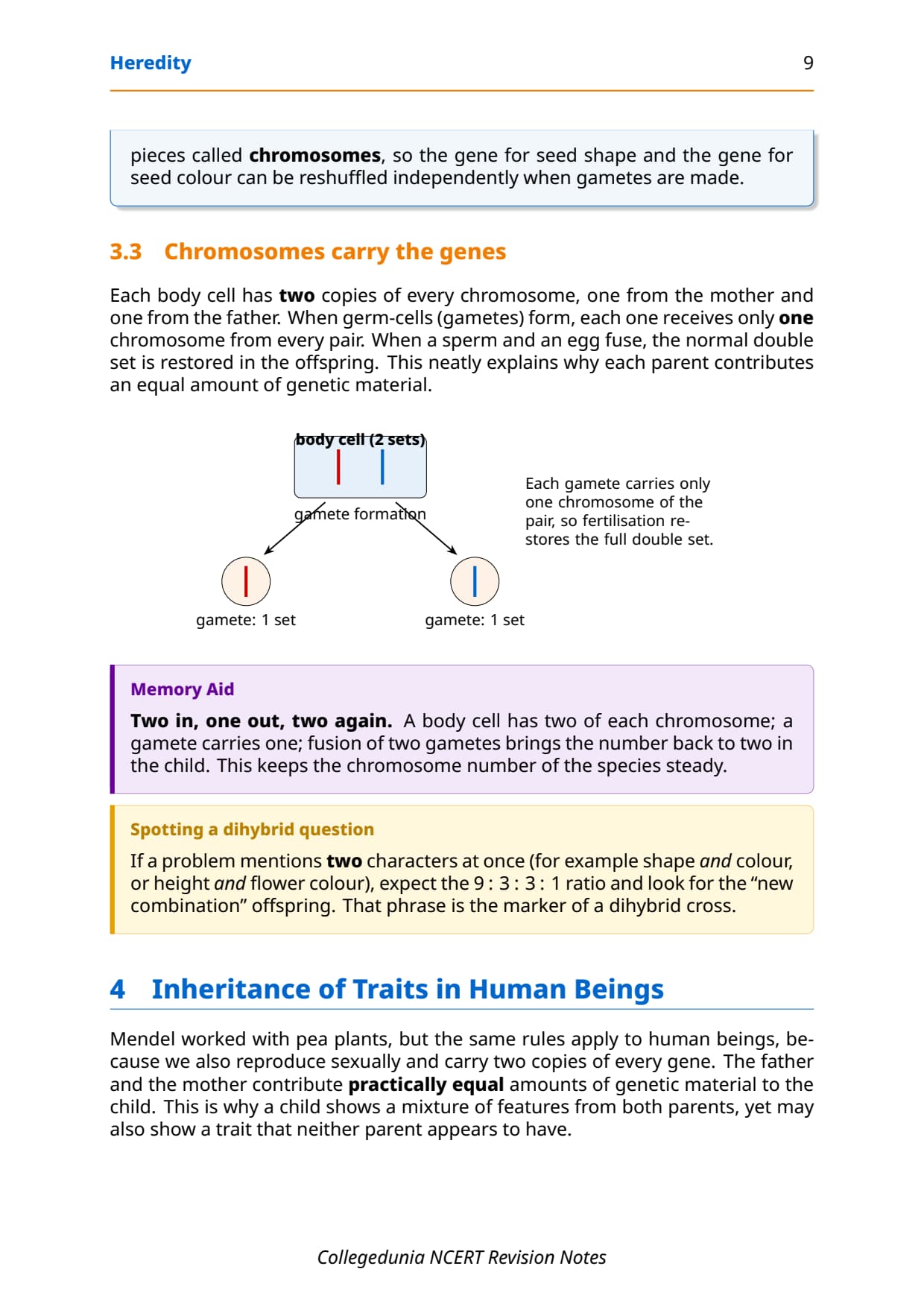
The results only make sense if each gene sits on a separate chromosome: a body cell carries two copies of every chromosome and each gamete carries only one, with fertilisation restoring the double set. If a question mentions two characters at once, expect 9:3:3:1.
Inheritance of Traits in Human Beings in Class 10 Science
The same rules apply to human beings, since we reproduce sexually and carry two copies of every gene. The father and mother contribute practically equal genetic material, so a child shows a mixture of features from both parents, yet may show a trait neither parent appears to have.
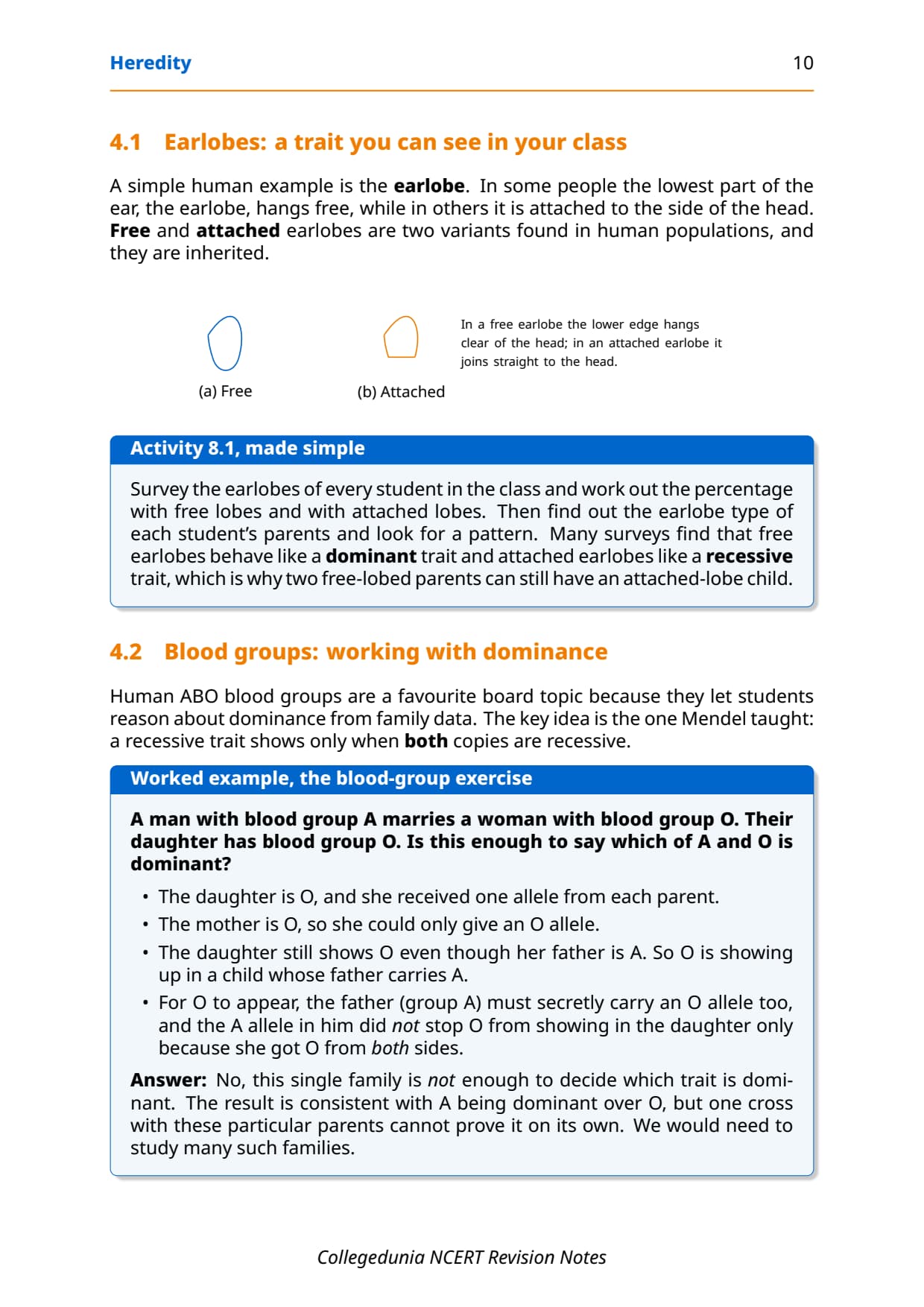
A simple example is the earlobe: free earlobes behave like a dominant trait and attached like a recessive one, so two free-lobed parents can have an attached-lobe child.
| Point | Inherited trait | Acquired trait |
|---|---|---|
| Stored in | DNA / genes | Body cells only |
| Passed to children | Yes | No |
| Example | Free earlobes, eye colour | A scar, a learned language, muscles built by exercise |
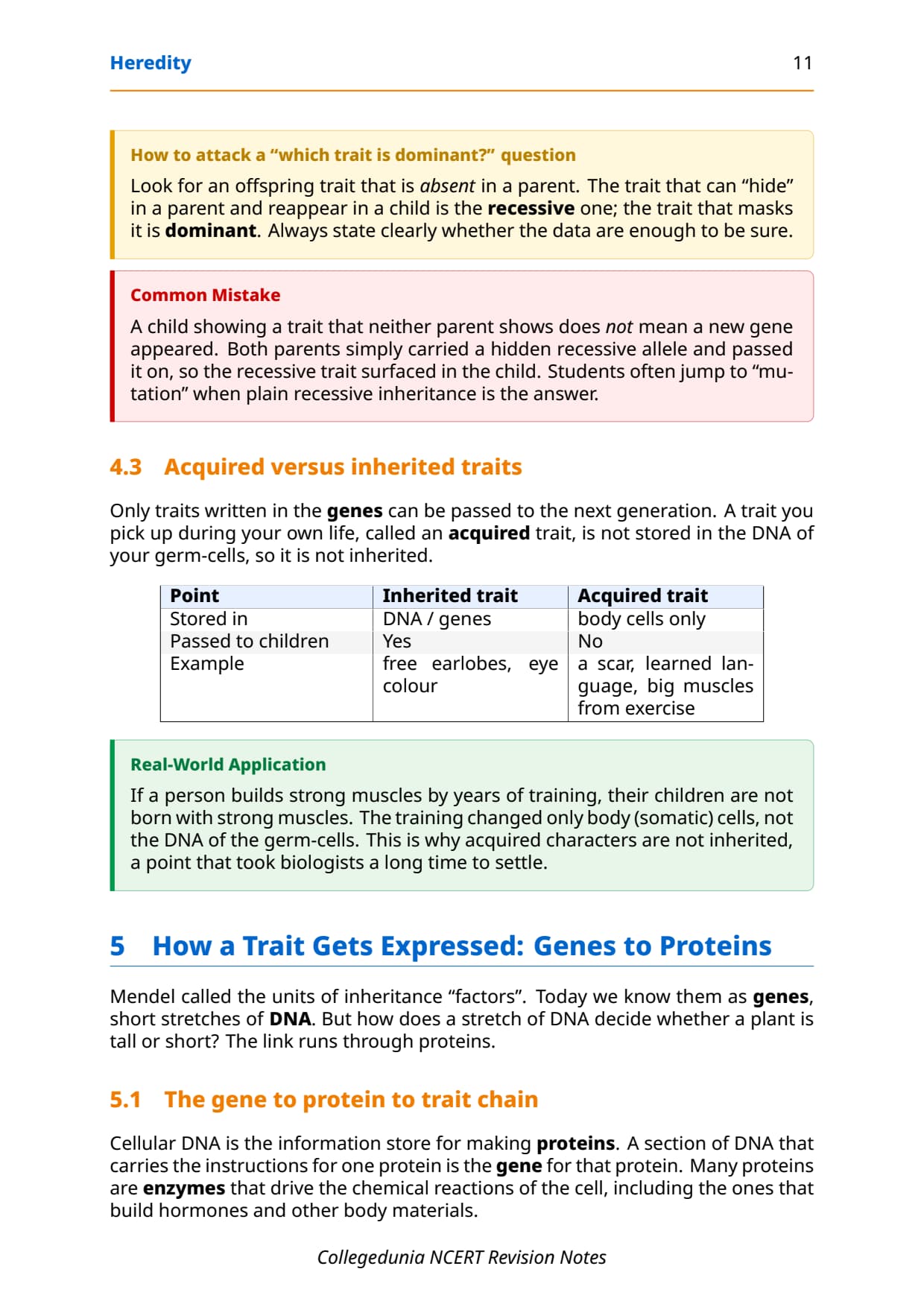
Only traits written in the genes can be passed on. An acquired trait, picked up during life, is not stored in germ-cell DNA, so it is not inherited: muscles built by training are not passed to children. A trait absent in both parents usually means a hidden recessive allele, not a new mutation.
How a Trait Gets Expressed: Genes to Proteins
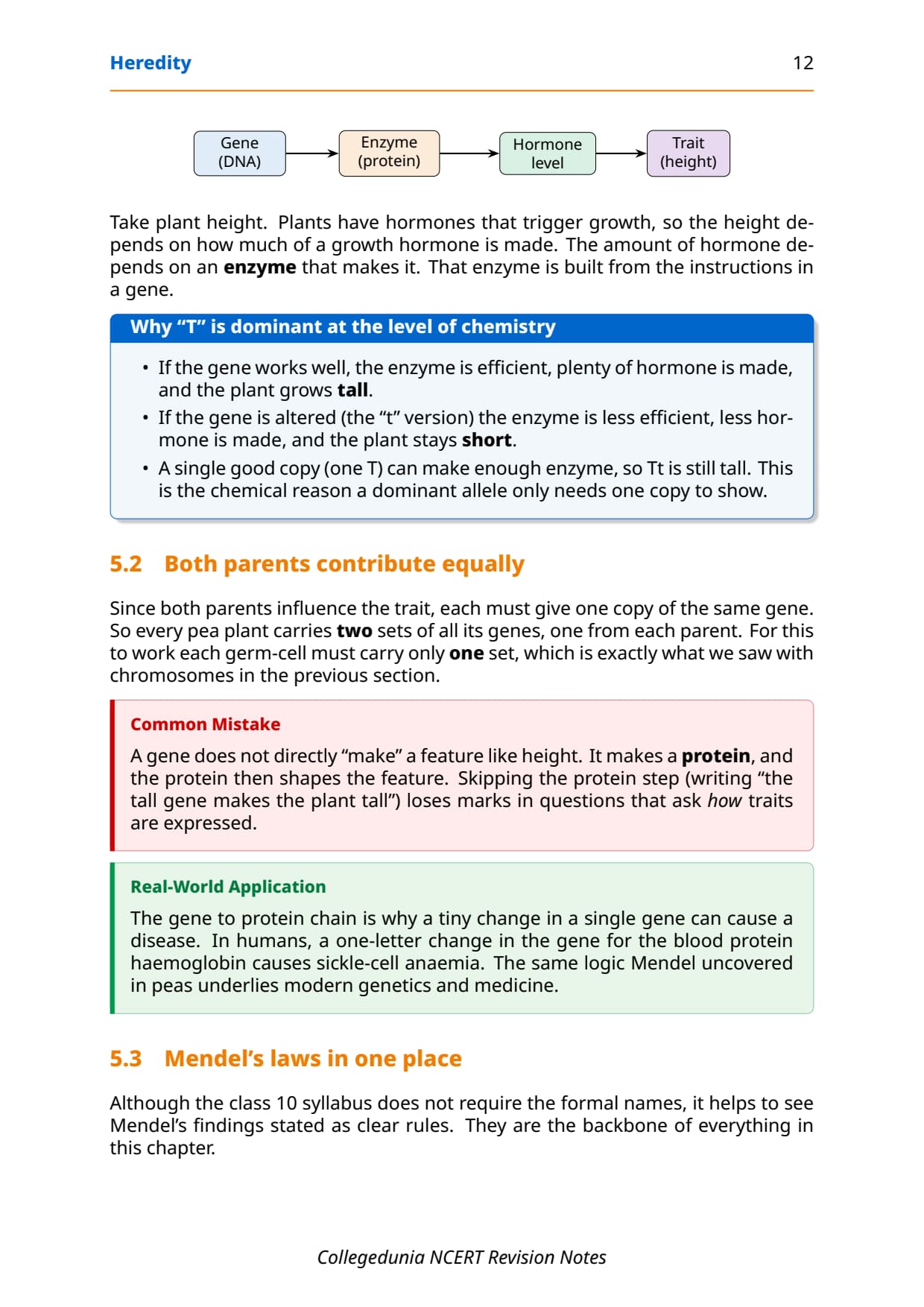
Mendel called the units of inheritance "factors". Today we call them genes, short stretches of DNA. A gene decides a trait through proteins: a section of DNA carries the instructions for one protein, and many of these proteins are enzymes.
gene (DNA) → enzyme (protein) → hormone level → trait (e.g. height)
Take plant height. Height depends on a growth hormone; the hormone depends on an enzyme; the enzyme is built from a gene's instructions. This explains why "T" is dominant at the level of chemistry:
- If the gene works well, the enzyme is efficient, plenty of hormone is made, and the plant grows tall.
- If the gene is altered (the "t" version), the enzyme is less efficient, less hormone is made, and the plant stays short.
- A single good copy (one T) makes enough enzyme, so Tt is still tall. Remember the protein step: "the tall gene makes the plant tall" loses marks when a question asks how a trait is expressed.
Sex Determination in Human Beings in Class 10 Science
Species decide sex in different ways: in some reptiles the egg temperature decides it. In human beings, sex is decided genetically by the sex chromosomes. Humans have 23 pairs of chromosomes: twenty-two pairs are autosomes, and the twenty-third pair is the sex chromosomes.
- Females have two matched X chromosomes, so a female is XX.
- Males have one X and one shorter Y chromosome, so a male is XY.
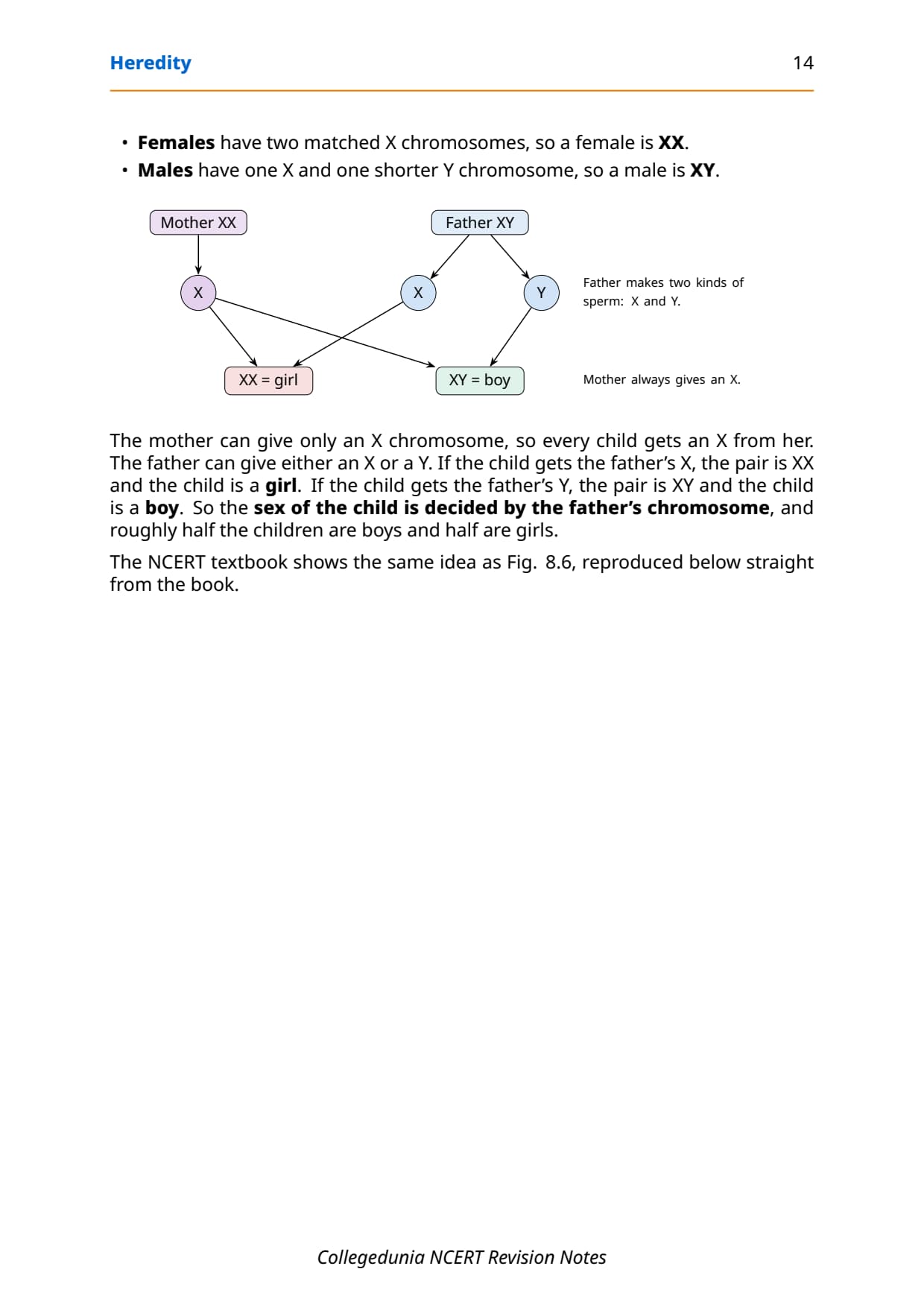
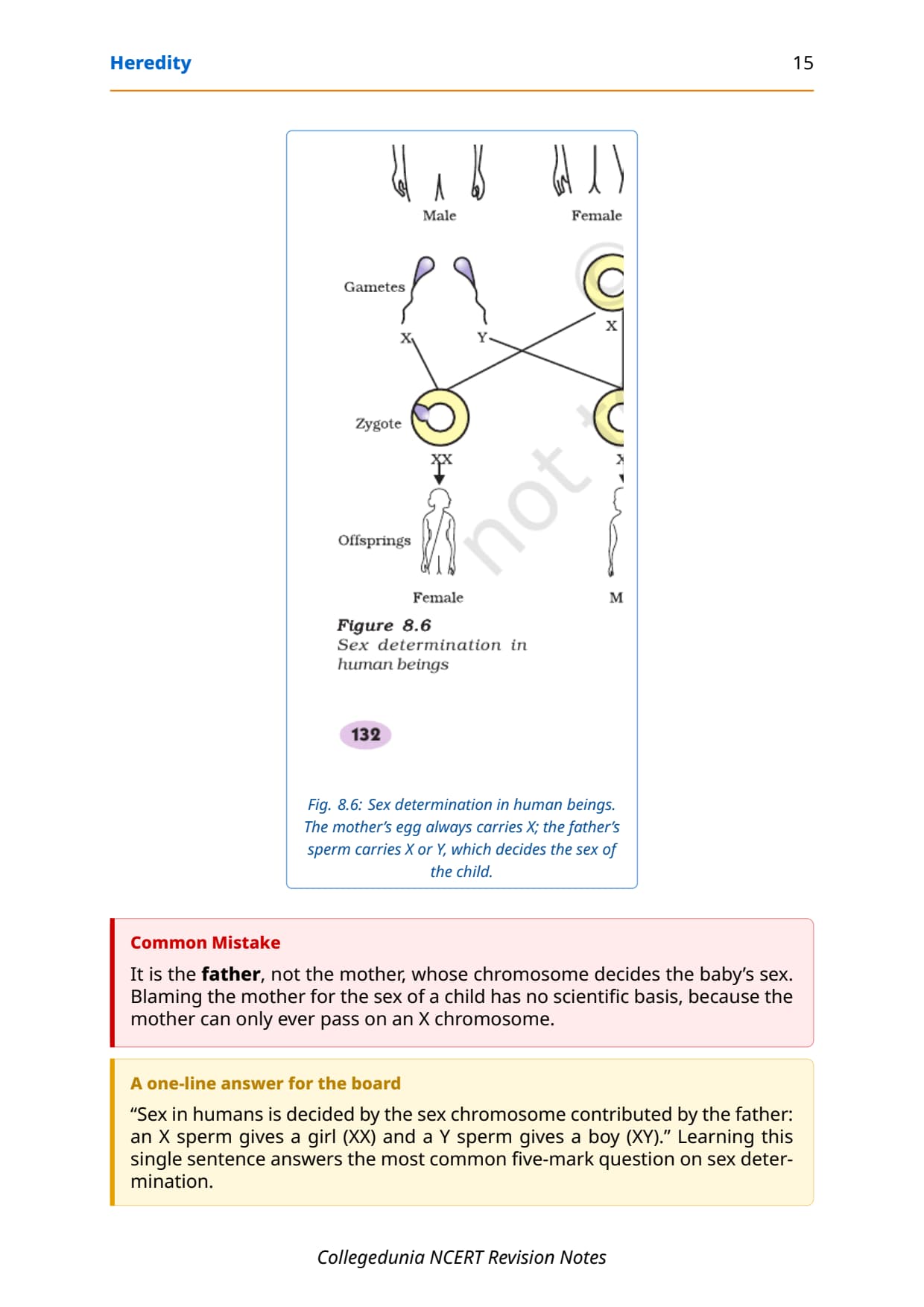
The mother gives only an X, so every child gets an X from her. The father gives either an X (an XX girl) or a Y (an XY boy). So the sex of the child is decided by the chromosome the father contributes. Blaming the mother has no scientific basis, since she can only ever pass on an X.
Quick Revision Strip and Common Exam Traps for Heredity
Read this in the last minutes before the exam. The traps below cost marks every year.
The repeat-offender mistakes in Heredity board answers:
- Confusing the ratios: genotype is 1:2:1, phenotype is 3:1; do not swap them.
- Marking Tt as short: Tt is tall (one dominant T is enough); only tt is short.
- Saying the mother decides the sex: she gives only X, so the father's sperm decides.
- Skipping the protein step or calling a hidden recessive a "mutation".
Previous Year Question Trends from the Heredity Chapter
This chapter is tested mainly through Punnett-square crosses, dominant vs recessive traits, the monohybrid and dihybrid ratios, sex determination, and the gene to protein link.
| Year | Question type asked | Marks |
|---|---|---|
| 2025 | Cross a tall (TT) with a short (tt) pea plant; give the F1 and F2 genotype and phenotype ratios | 3 |
| 2024 | How is the sex of a child determined in human beings; why is the father said to decide it | 3 |
| 2023 | How do Mendel's experiments show that traits are inherited independently | 3 |
| 2022 | Difference between dominant and recessive traits with one example each | 2 + 1 |
| 2021 | How does a gene control a trait; difference between inherited and acquired traits | 2 + 2 |
Also Check: The full set of CBSE board paper questions for this chapter, with step-by-step answers, is included in the downloadable PDF above, updated for the 2026-27 cycle.
Other Resources for Class 10 Science Chapter 8 Heredity
Pair these revision notes with the matching NCERT Solutions, the formula sheet, handwritten notes and the official NCERT book chapter. All resources for Class 10 Science Chapter 8 Heredity are linked below.
| Resource | What it covers | Open |
|---|---|---|
| Notes | Concept-first revision notes on variation, Mendel's experiments, the 3:1 and 9:3:3:1 ratios, genes and chromosomes, and sex determination. | You are here |
| NCERT Solutions | Step-by-step answers to all in-text and exercise questions, with an Expert Solution for each. | Class 10 Science Chapter 8 NCERT Solutions |
| Formula Sheet | Quick reference of the must-know terms, ratios and crosses of the chapter. | Class 10 Science Chapter 8 Formula Sheet |
| Handwritten Notes | Scanned-style handwritten pages for last-minute board revision. | Class 10 Science Chapter 8 Handwritten Notes |
| NCERT Book PDF | Official NCERT Science Chapter 8 Heredity textbook in PDF form. | Class 10 Science Chapter 8 NCERT Book PDF |
Notes for Class 10 Science: All Chapters
Related Links: Use the table below to open the revision notes for the other chapters of Class 10 Science. Every chapter ships with the same concept-first notes style, full PDF download, and revision FAQ.
| Chapter | Notes link |
|---|---|
| Chapter 1 | Chemical Reactions and Equations Notes |
| Chapter 2 | Acids, Bases and Salts Notes |
| Chapter 3 | Metals and Non-metals Notes |
| Chapter 4 | Carbon and its Compounds Notes |
| Chapter 5 | Life Processes Notes |
| Chapter 6 | Control and Coordination Notes |
| Chapter 7 | How do Organisms Reproduce? Notes |
| Chapter 8 | Heredity Notes (You are here) |
| Chapter 9 | Light - Reflection and Refraction Notes |
| Chapter 10 | The Human Eye and the Colourful World Notes |
| Chapter 11 | Electricity Notes |
| Chapter 12 | Magnetic Effects of Electric Current Notes |
| Chapter 13 | Our Environment Notes |
Notes Class 10 Science Chapter 8 Heredity FAQs
Ques. What does Chapter 8 Heredity cover in Class 10 Science?
Ans. Chapter 8 Heredity covers how features pass from parents to offspring and how variation builds up across generations. The notes explain why offspring resemble their parents, how copying errors and sexual reproduction add variation, and why variation helps a species survive. They then cover Gregor Mendel's pea-plant experiments, dominant and recessive traits, the monohybrid cross with its 1:2:1 genotype and 3:1 phenotype ratios, the dihybrid cross with its 9:3:3:1 ratio, how a gene makes a protein that shapes a trait, and how the sex of a human baby is decided by the X and Y chromosomes. Everything is aligned with the 2026-27 CBSE syllabus.
Ques. What is the difference between dominant and recessive traits?
Ans. A dominant trait is the form of a character that shows up even when only one copy of its allele is present, written with a capital letter such as T for tall. A recessive trait is the form that shows only when both copies are of that type, written with two small letters such as tt for short. In Mendel's pea cross, the F1 plants from a TT and tt cross were all tall, so tall is dominant and short is recessive. The recessive trait can hide in a parent and reappear in a later generation, which is why two tall parents can produce a short plant if both secretly carry the t allele.
Ques. What are the genotype and phenotype ratios of a monohybrid cross?
Ans. In a monohybrid cross between two F1 plants (Tt and Tt), the genotype ratio is TT : Tt : tt = 1 : 2 : 1, and the phenotype ratio is tall : short = 3 : 1. The Punnett square gives four boxes, TT, Tt, Tt and tt; three of the four hold at least one dominant T, so three out of four plants are tall and one is short. The key point for the board exam is to keep the two ratios separate: the 1:2:1 describes the combination of alleles (genotype), while the 3:1 describes the trait you actually see (phenotype). Mixing them up is one of the most common mistakes in this chapter.
Ques. What is the 9:3:3:1 ratio in a dihybrid cross?
Ans. The 9:3:3:1 ratio is the F2 phenotype ratio of a dihybrid cross, where two characters are followed at the same time. When Mendel crossed pea plants differing in seed shape and seed colour and self-pollinated the F1 plants, the F2 generation came in four types in the ratio round-yellow : round-green : wrinkled-yellow : wrinkled-green = 9 : 3 : 3 : 1. The two "3" classes are new combinations that were not present in either original parent, and their appearance proves that the two traits are inherited independently of each other. To turn the ratio into numbers, add the parts (9 + 3 + 3 + 1 = 16) and use the matching share of the total.
Ques. How is the sex of a child determined in human beings?
Ans. The sex of a human child is decided genetically by the sex chromosomes. Females have two X chromosomes (XX) and males have one X and one Y chromosome (XY). The mother can pass on only an X chromosome, so every child receives an X from her. The father can pass on either an X or a Y. If the child gets the father's X, the pair is XX and the child is a girl; if the child gets the father's Y, the pair is XY and the child is a boy. So the chromosome contributed by the father decides the sex, which is why it is scientifically wrong to blame the mother for the sex of a child.
Ques. How does a gene control a trait in Class 10 Science?
Ans. A gene is a section of DNA that carries the instructions for making one protein. Many of these proteins are enzymes that drive the chemical reactions of the cell, including the ones that make hormones. A gene controls a trait through this chain: the gene makes an enzyme, the enzyme controls how much of a hormone is made, and the hormone level shapes the trait, such as plant height. If a gene works well, plenty of efficient enzyme and hormone are made and the plant grows tall; if the gene is the altered "t" version, less is made and the plant stays short. A single good copy makes enough enzyme, which is why one dominant allele is enough to show the dominant trait.
Ques. How many pages is the Class 10 Science Heredity Notes PDF?
Ans. The Heredity Notes PDF runs about 18 to 20 pages and covers the full chapter in concept-first revision blocks, with labelled Punnett squares for the monohybrid and dihybrid crosses, the gene to protein to trait chain, the sex-determination cross, comparison tables, common-mistake boxes, memory aids, a glossary of key terms and a one-glance revision strip. The PDF is free to download for the 2026-27 session, and a green Handwritten Notes button on this page opens the scanned-style version for last-minute revision.
Ques. Are these Notes for Class 10 Science Chapter 8 aligned with the 2026-27 syllabus?
Ans. Yes. This page reflects the current 2026-27 CBSE syllabus for Class 10 Science. The Heredity chapter is part of the current cycle, and these notes follow the NCERT textbook, covering variation and the build-up of heredity, Mendel's pea-plant experiments, dominant and recessive traits, the monohybrid 3:1 and dihybrid 9:3:3:1 ratios, inheritance of traits in human beings, how genes make proteins that shape traits, and sex determination by the X and Y chromosomes. The notes are written for the CBSE board exam, with the high-frequency question types and the key ratios highlighted throughout.



Comments