



These Notes for Class 10 Science Chapter 4 Carbon and its Compounds give you a fast, concept-first revision of the whole chapter, built on the latest 2026-27 CBSE syllabus. They cover the covalent bond, why carbon is tetravalent and shows catenation, saturated and unsaturated compounds, functional groups and the homologous series, the four key reactions, and the chemistry of ethanol, ethanoic acid, soaps and detergents.
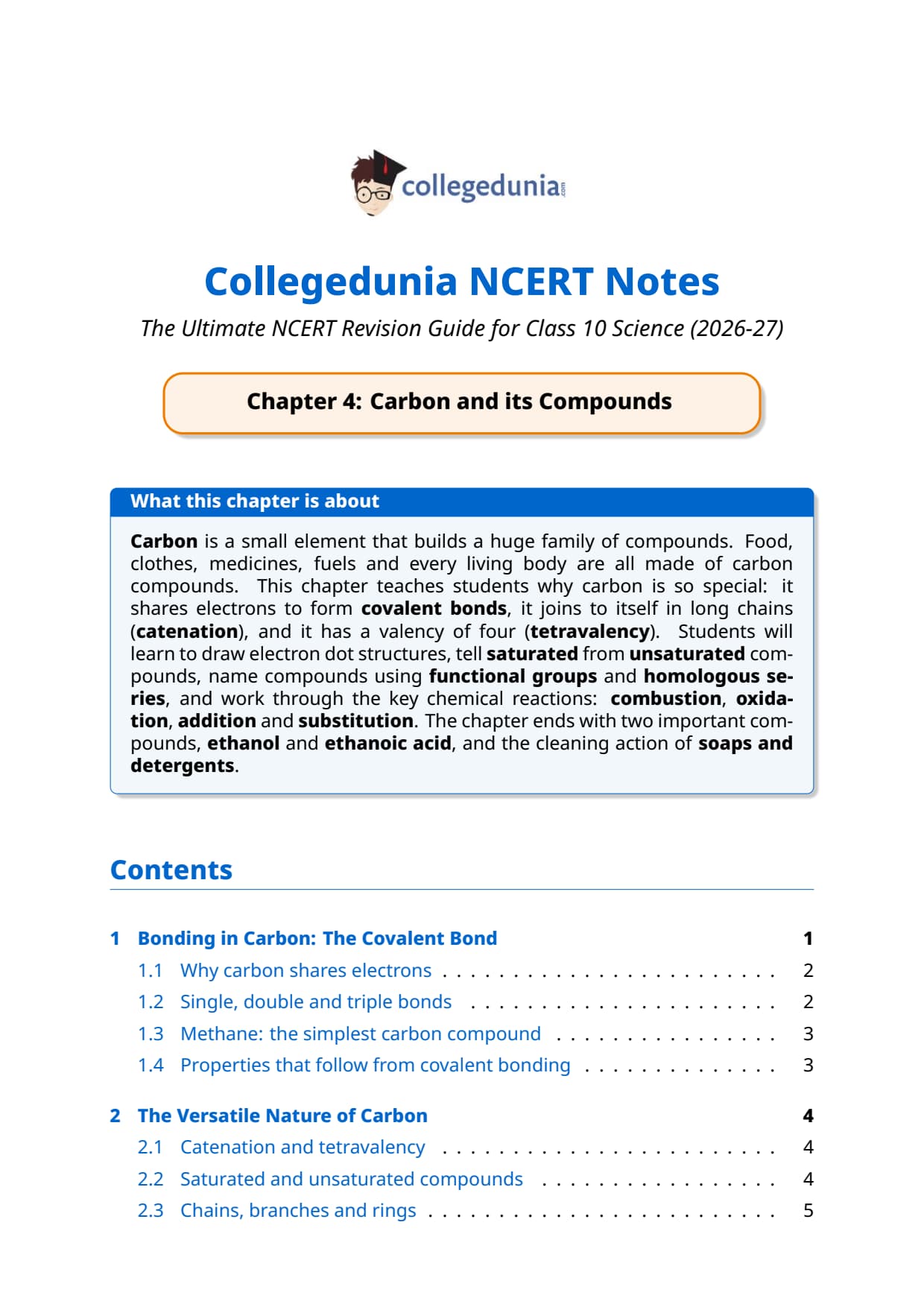
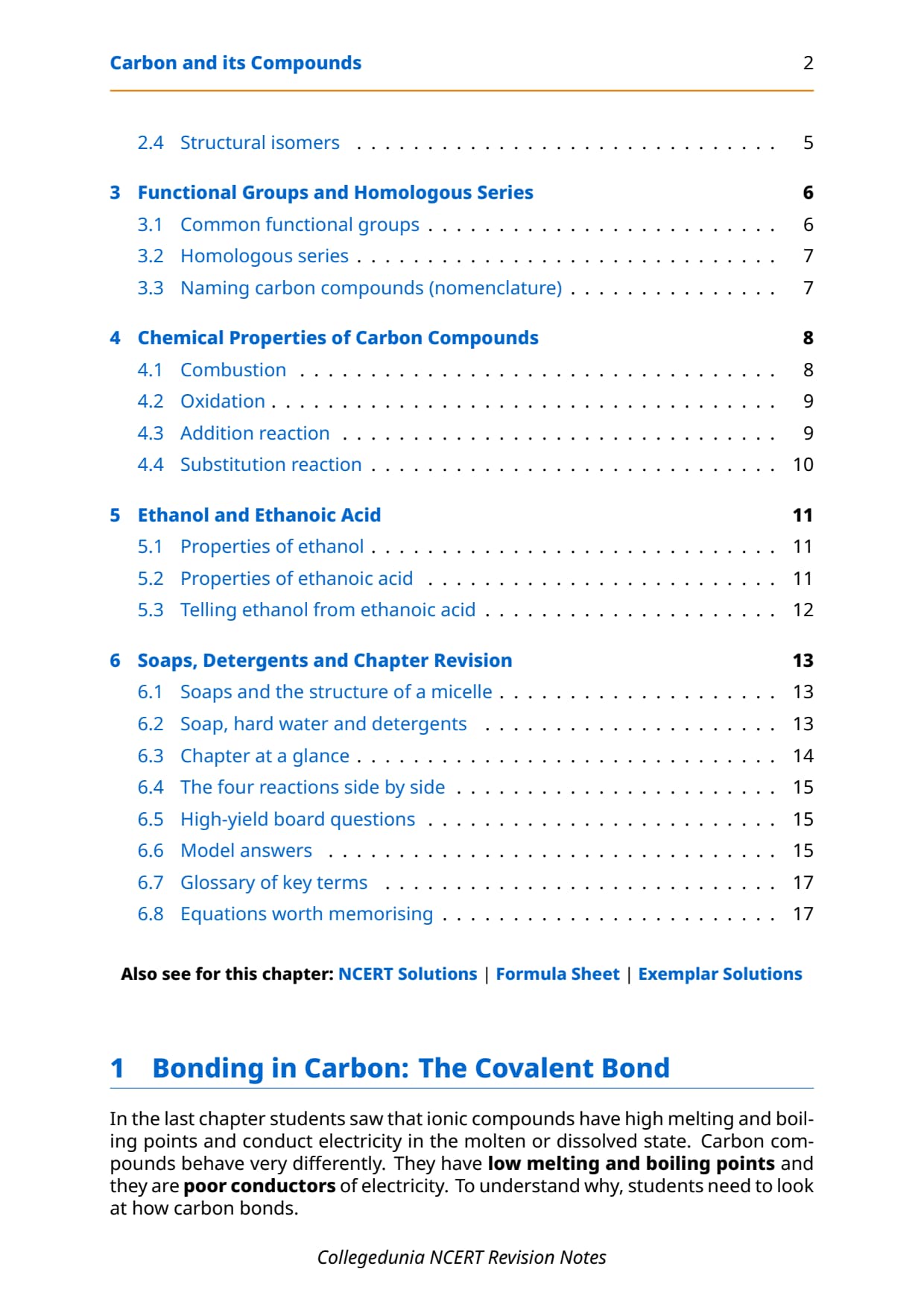
- Every reaction explained with a one-line rule, a balanced equation, and the everyday example the CBSE board paper likes to ask.
- Full coverage of covalent bonding, catenation and tetravalency, naming compounds, combustion, oxidation, addition and substitution, ethanol, ethanoic acid and how soap cleans.
- Notes aligned with the 2026-27 CBSE Class 10 Science syllabus and written for the board exam; no NEET or JEE references because this is a Class 10 board chapter.
These Collegedunia revision notes are curated by Science subject experts, mapped to the 2026-27 NCERT textbook, and refined against the last five years of CBSE Class 10 Science board papers.
Student Feedback: What 10,300 students told us about this chapter
72% of Class 10 students said naming carbon compounds and remembering the functional groups was the part they kept slipping on when they first revised. 3 out of 5 students told us a one-page table of functional groups with their suffixes helped them get the nomenclature question right in the board exam.
Toppers found that learning the four reactions (combustion, oxidation, addition, substitution) with one equation each saved 8 to 10 minutes in the exam, and the average student spent 1.5 to 2 hours on these notes across the first read and the final revision.
Source: 2026-27 Class 10 Science student poll. Sample of 10,300 students from CBSE schools across 13 states, conducted before the 2026 boards.
What the Notes for Class 10 Science Chapter 4 Carbon and its Compounds Cover
Carbon builds a huge family of compounds: food, clothes, medicines, fuels and every living body. These notes keep the NCERT order:
- Covalent bonding: why carbon shares electrons, and why covalent compounds melt low and conduct poorly.
- Catenation, tetravalency and nomenclature: chains and rings, saturated vs unsaturated, isomers, functional groups, homologous series.
- Reactions and key compounds: combustion, oxidation, addition, substitution; ethanol, ethanoic acid, soaps, detergents.
Source: Magnet Brains on YouTube
Bonding in Carbon: The Covalent Bond in Class 10 Science
Carbon compounds have low melting and boiling points and are poor conductors. The reason lies in how carbon bonds.
Why carbon shares electrons
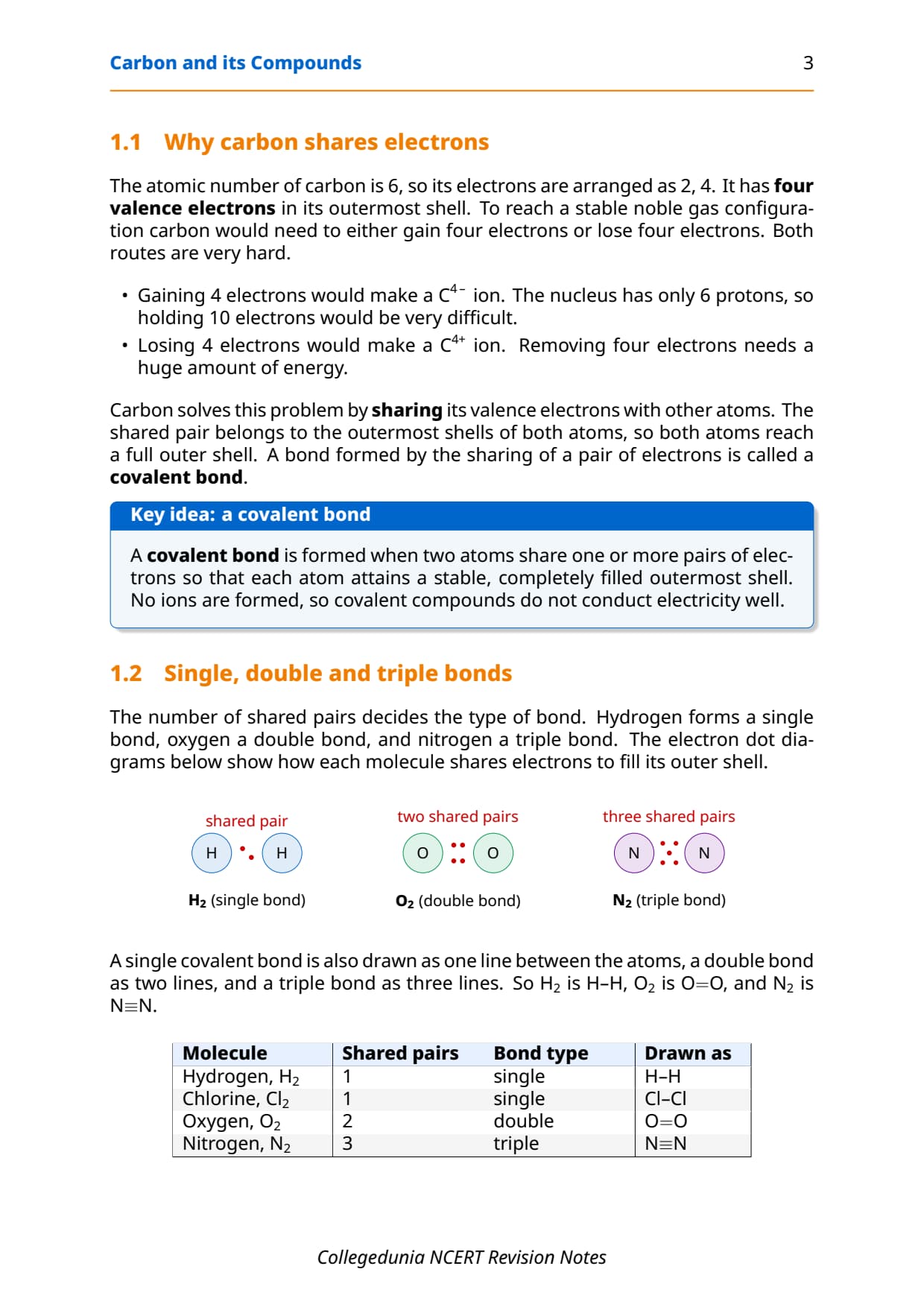
Carbon has the arrangement 2, 4, so it has four valence electrons. Gaining or losing four electrons is too hard, so carbon shares them. A bond formed by sharing a pair of electrons is a covalent bond: the shared pair belongs to both atoms, both reach a full outer shell, and no ions form.
Single, double and triple bonds
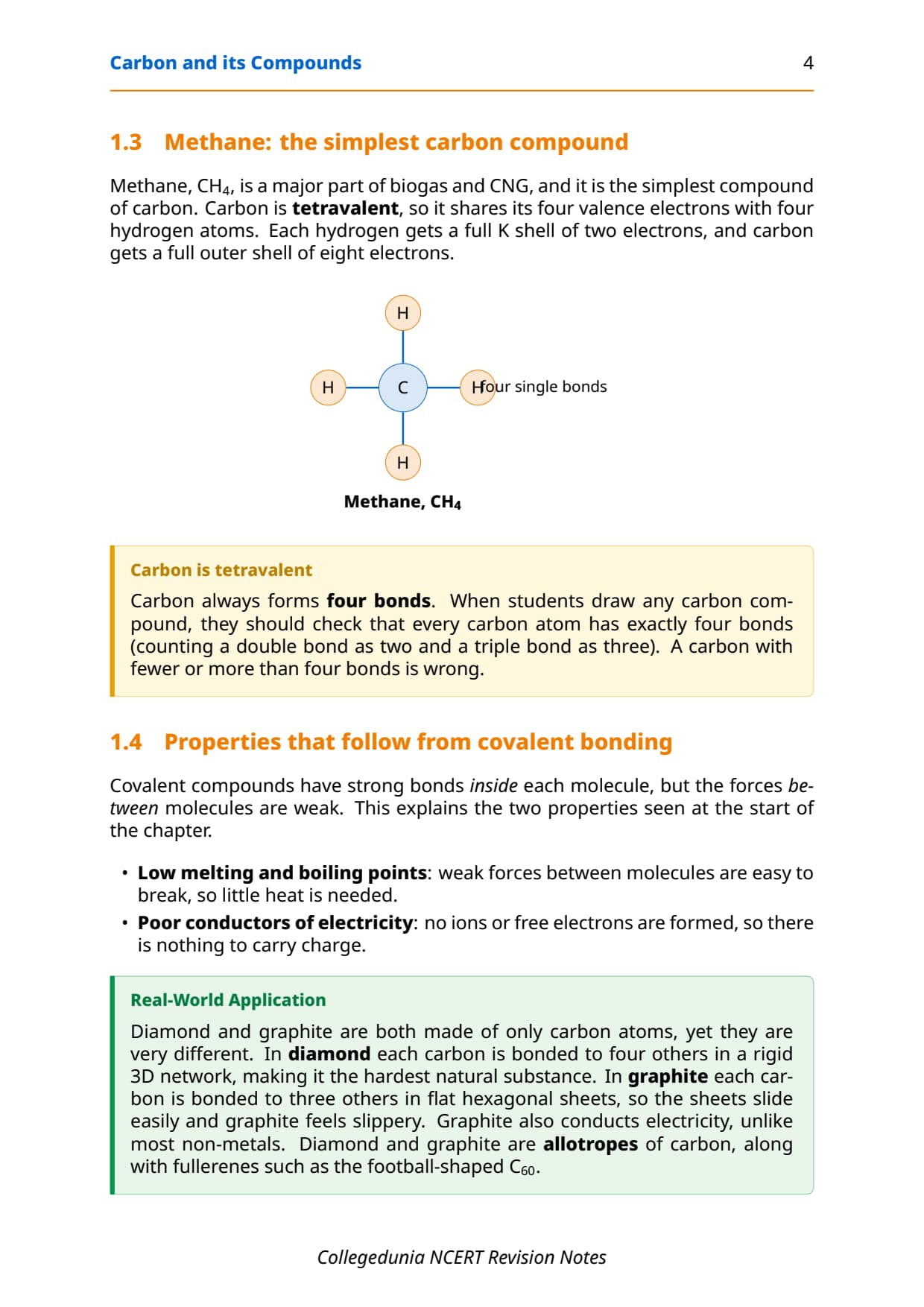
The number of shared pairs decides the bond: H2 single (H–H), O2 double (O=O), N2 triple (N≡N). In methane CH4, tetravalent carbon shares its four electrons with four hydrogens. Covalent compounds have strong bonds inside molecules but weak forces between them, hence the low melting and boiling points and poor conductivity (no ions or free electrons).
The Versatile Nature of Carbon: Catenation and Tetravalency
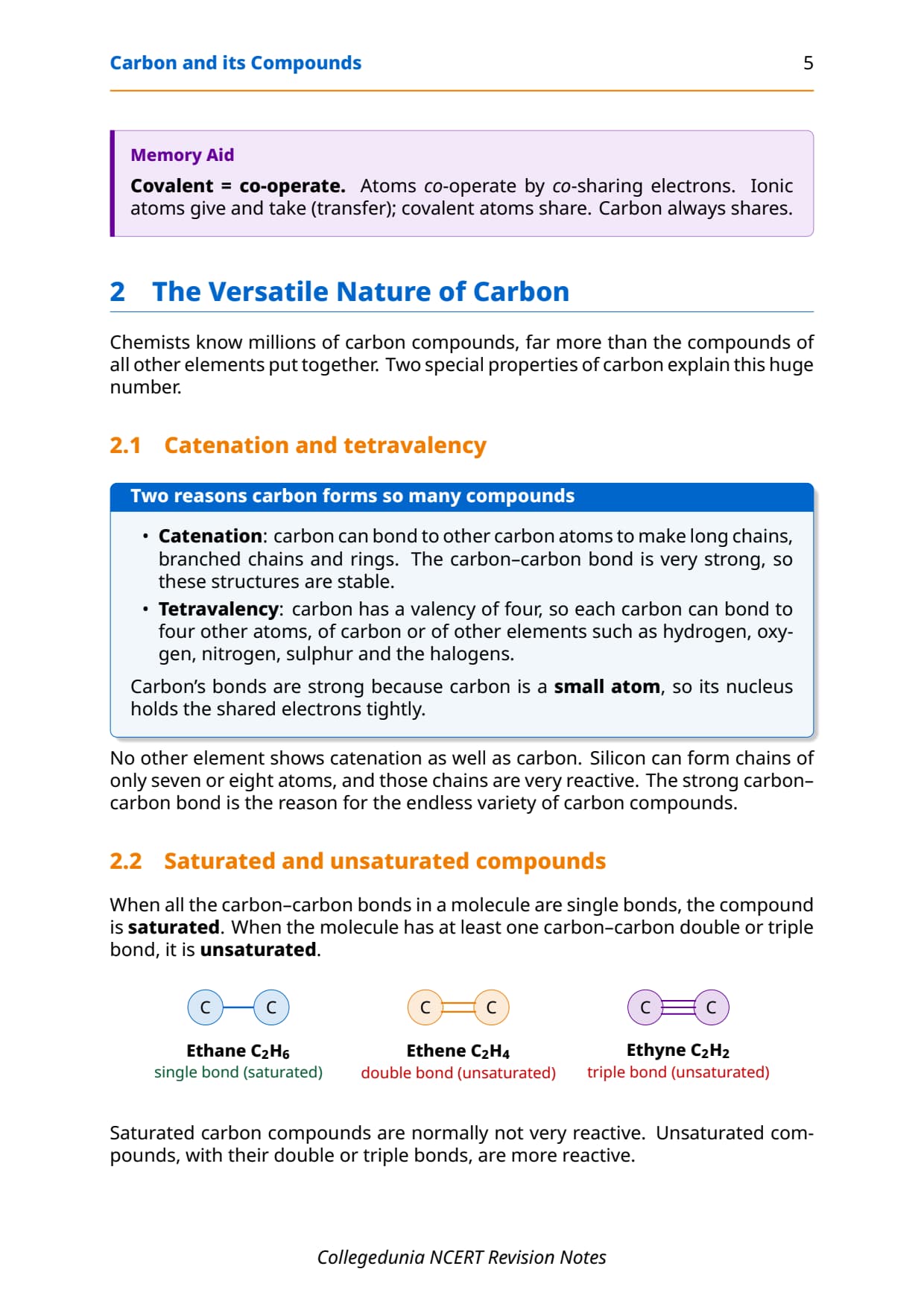
Carbon forms more compounds than all other elements together. Two properties explain this, and naming both wins the marks:
- Catenation: carbon bonds to other carbon atoms to make chains, branches and rings; the C-C bond is very strong.
- Tetravalency: with a valency of four, each carbon bonds to four other atoms, of carbon or of elements like hydrogen, oxygen, nitrogen and the halogens.
Carbon's bonds are strong because it is a small atom.
Saturated and unsaturated compounds
All single C-C bonds make a saturated compound (less reactive); a double or triple bond makes it unsaturated (more reactive): ethane, ethene (C=C), ethyne (C≡C).
Chains, branches, rings and isomers
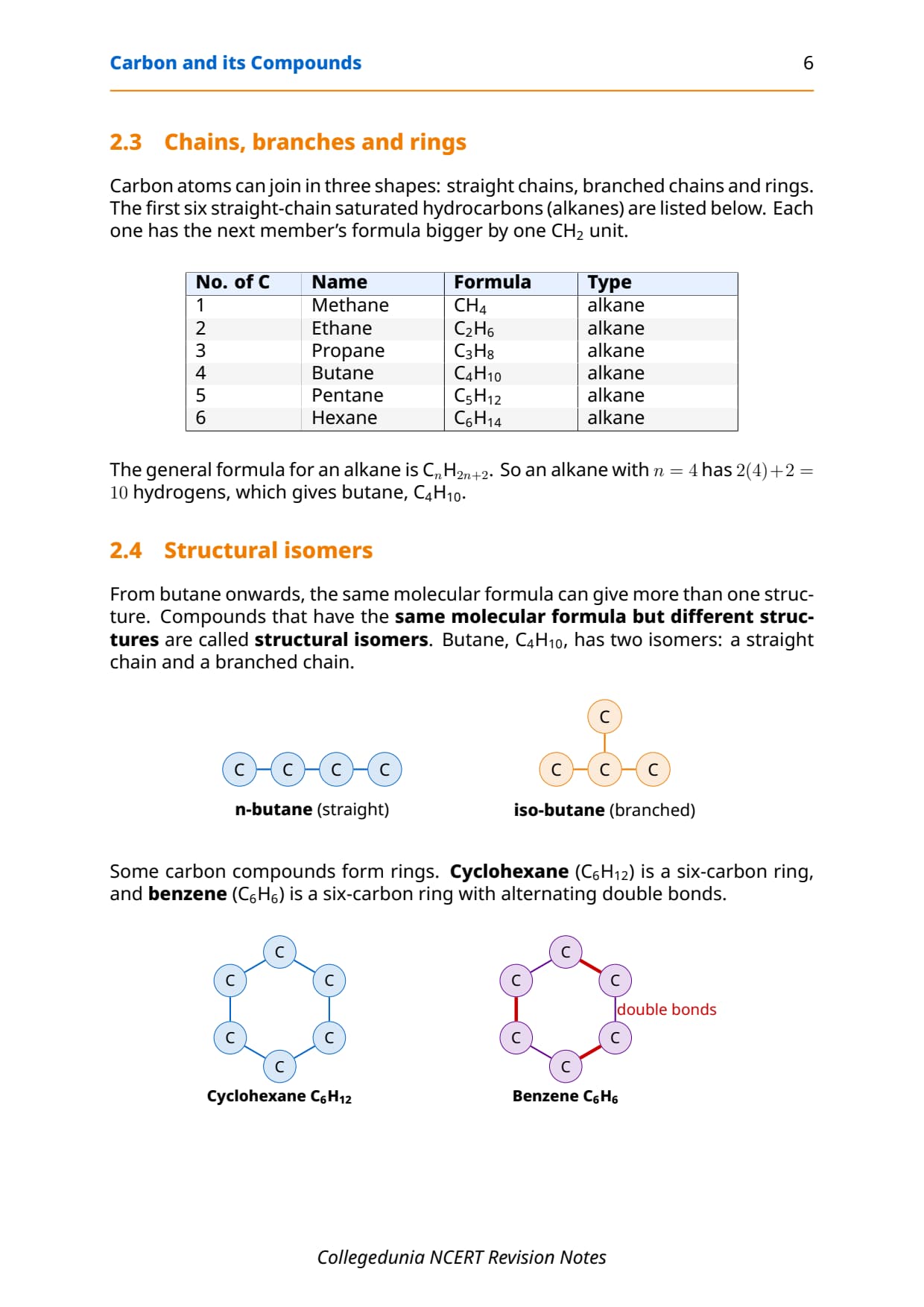
The first six alkanes (CnH2n+2, each bigger by CH2) are methane, ethane, propane, butane, pentane, hexane. From butane onwards, one formula can give more than one structure. Compounds with the same formula but different structures are structural isomers: butane has n-butane (straight) and iso-butane (branched). Carbon also forms rings such as cyclohexane and benzene.
Memory aid: alkane = single, alkene = double, alkyne = triple; formulae CnH2n+2, CnH2n, CnH2n-2.
Functional Groups and the Homologous Series in Class 10 Science
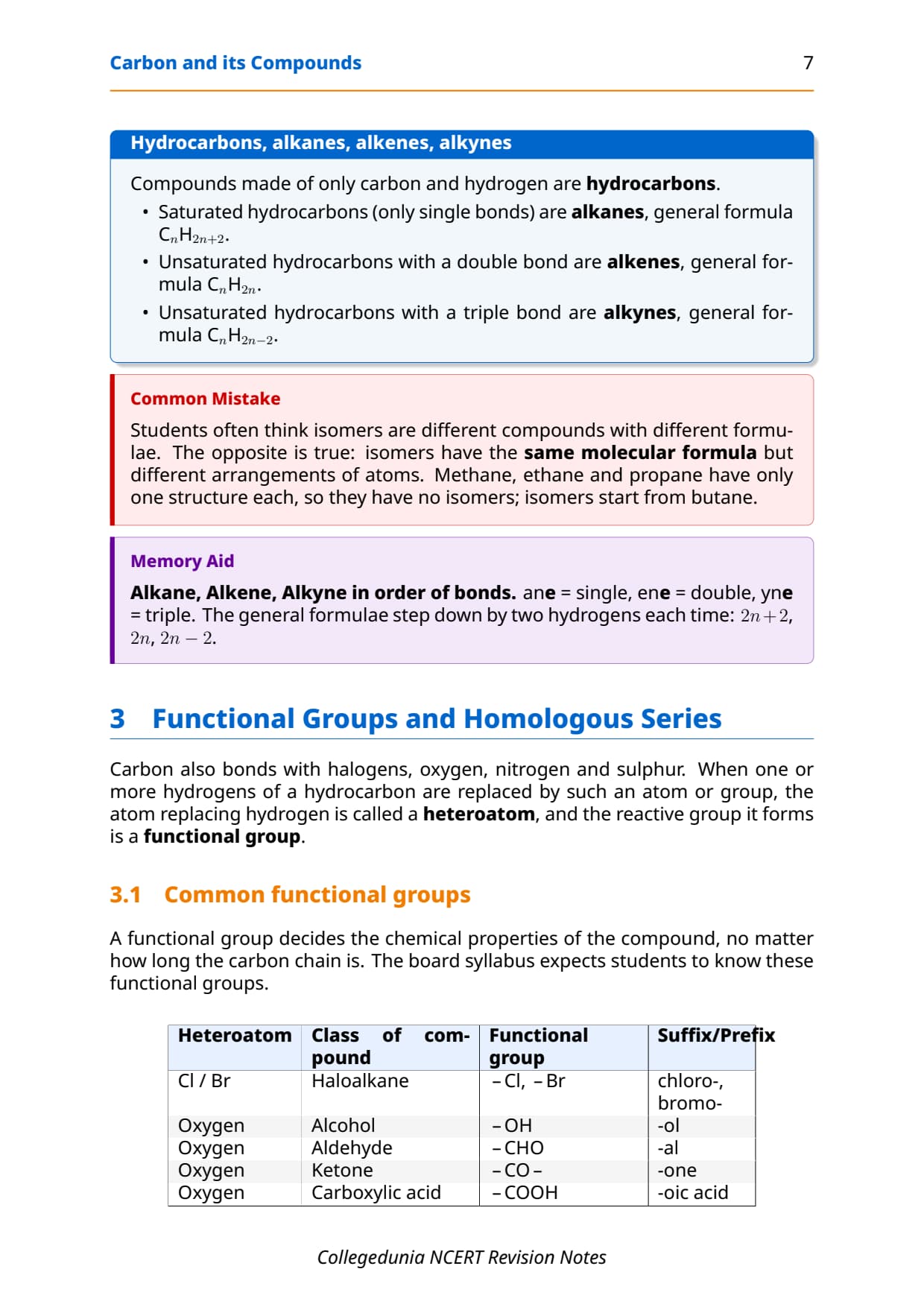
When a hydrogen is replaced by an atom or group, that replacing atom is a heteroatom and the reactive group it forms is a functional group, which decides the compound's chemistry.
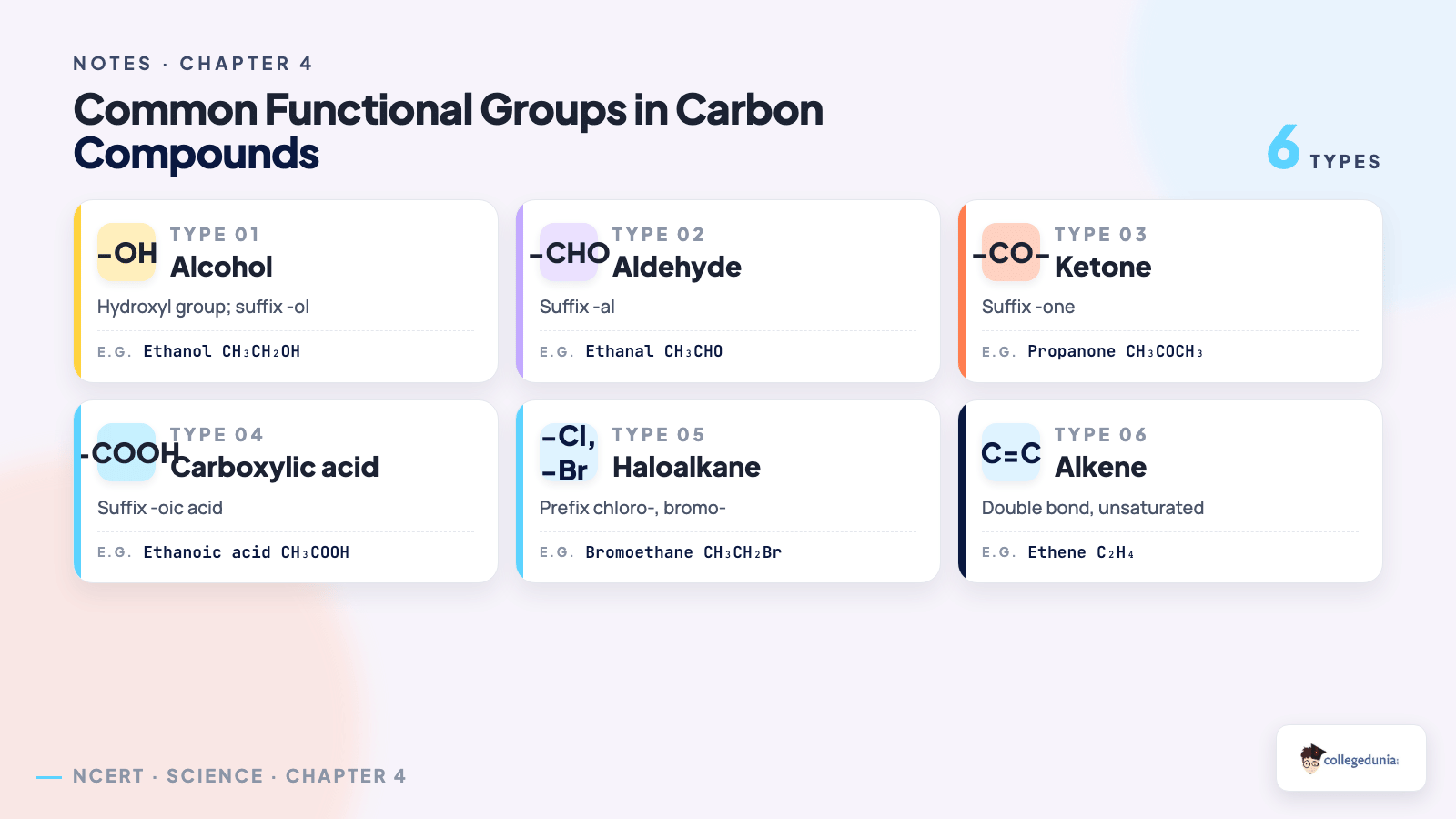
| Heteroatom | Class of compound | Functional group | Suffix / Prefix |
|---|---|---|---|
| Cl / Br | Haloalkane | –Cl, –Br | chloro-, bromo- |
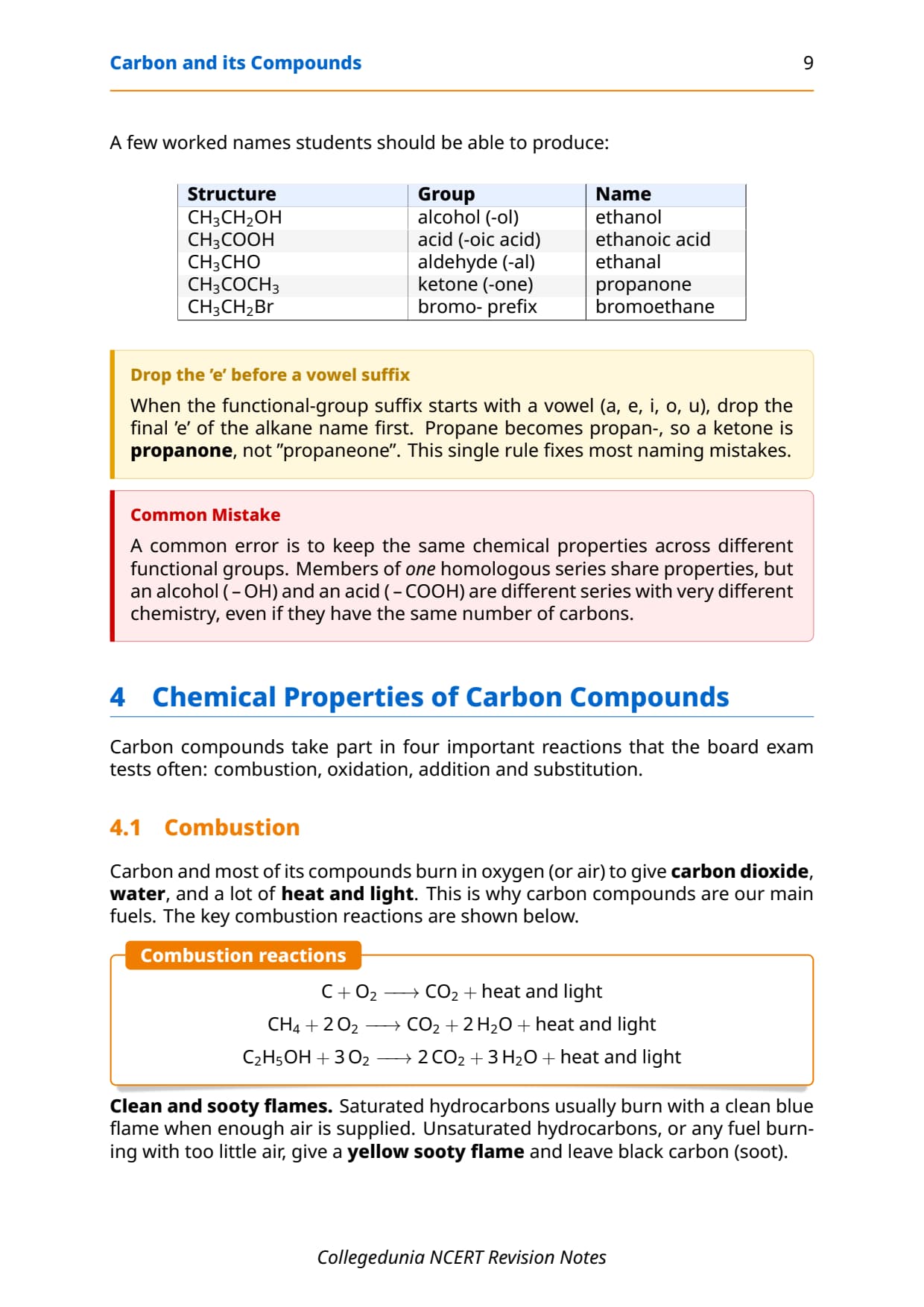
| Oxygen | Alcohol | –OH | -ol |
| Oxygen | Aldehyde | –CHO | -al |
| Oxygen | Ketone | –CO– | -one |
| Oxygen | Carboxylic acid | –COOH | -oic acid |
The homologous series
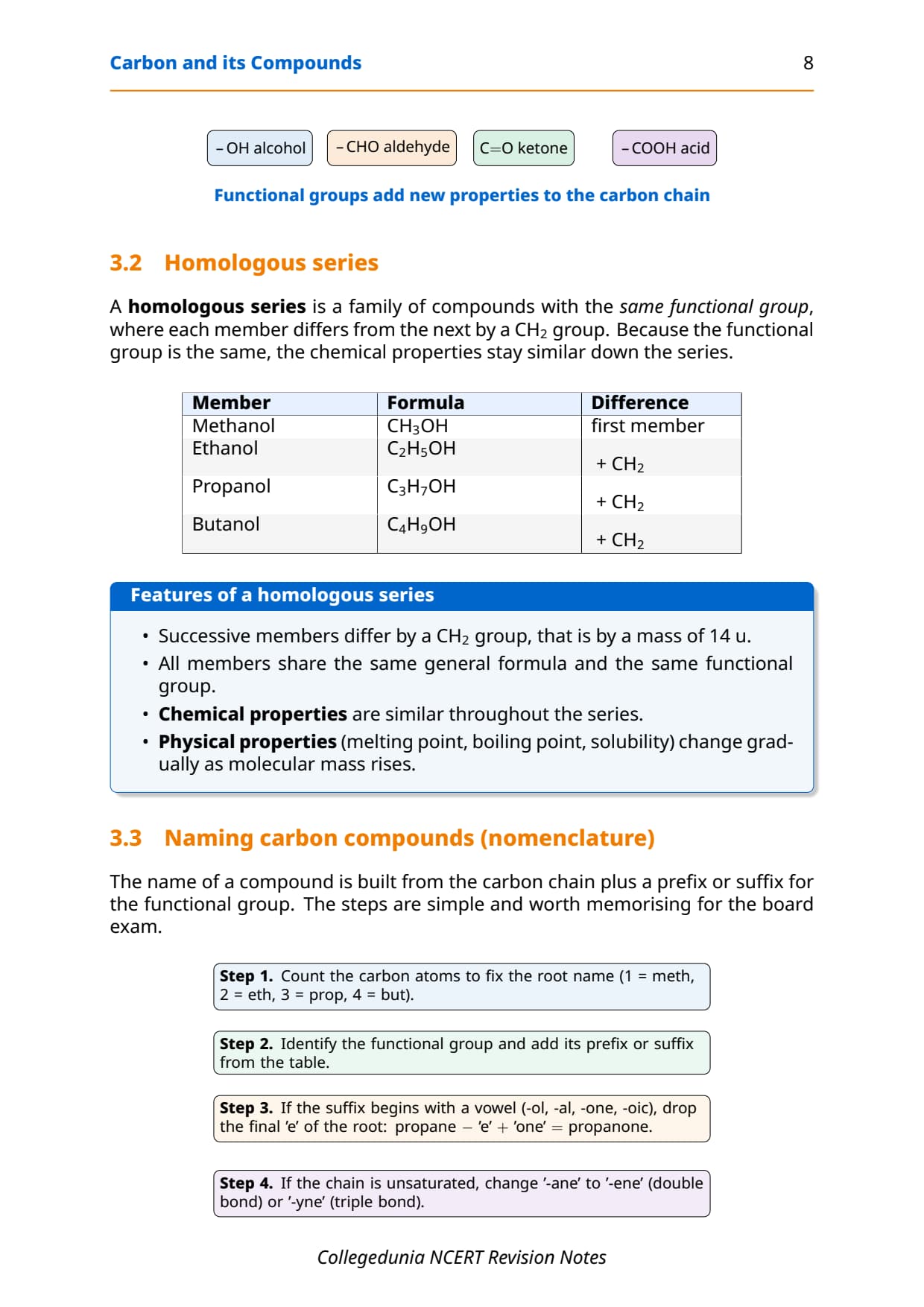
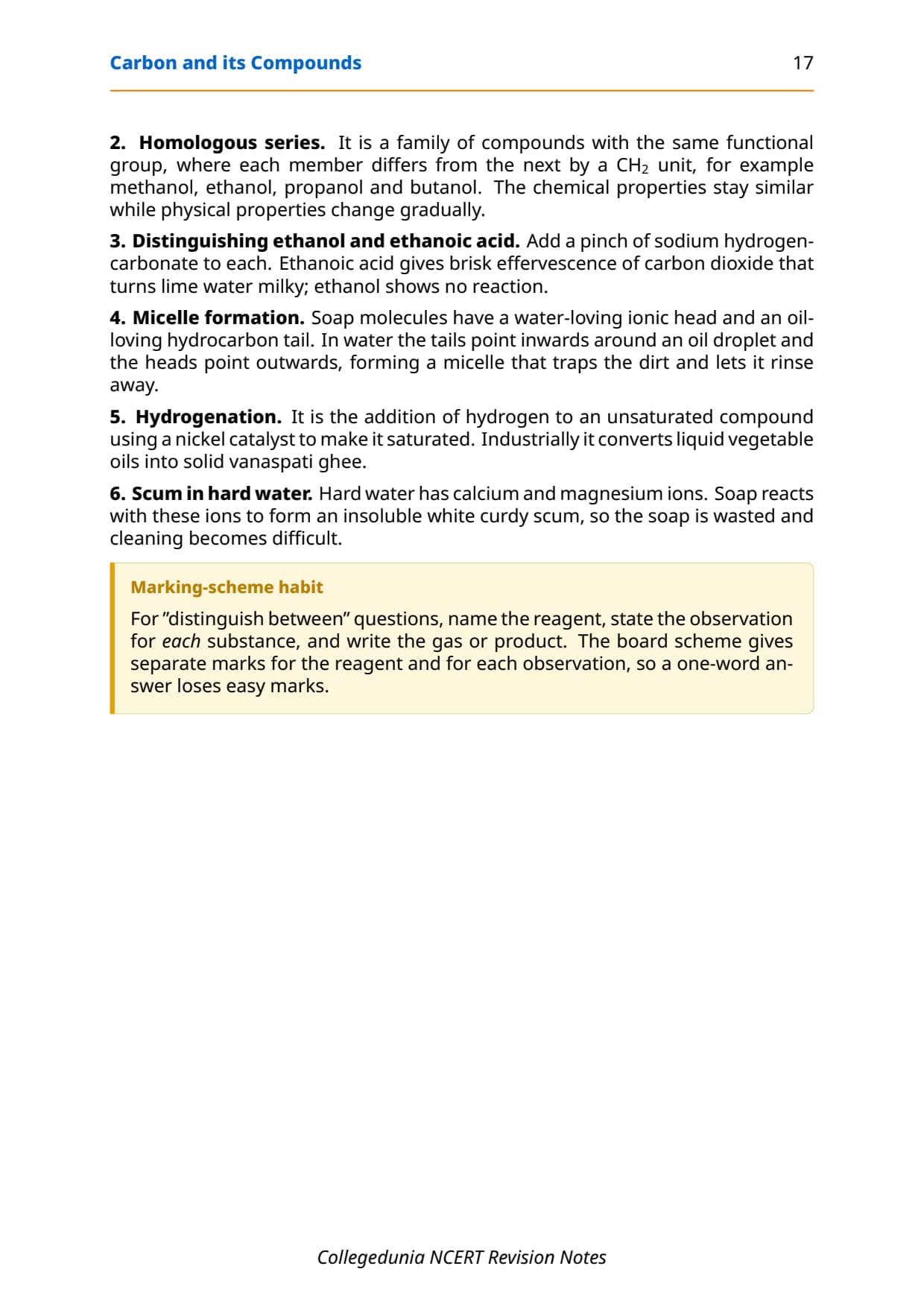
A homologous series is a family of compounds with the same functional group, each differing from the next by CH2 (14 u). Chemical properties stay similar; physical properties change gradually with mass. Example: methanol, ethanol, propanol, butanol.
Naming carbon compounds (nomenclature)
- Count the carbons for the root name (1 = meth, 2 = eth, 3 = prop, 4 = but).
- Add the functional group's prefix or suffix from the table; if the suffix begins with a vowel (-ol, -al, -one, -oic), drop the final 'e' (propane + 'one' = propanone).
- If unsaturated, change '-ane' to '-ene' (double) or '-yne' (triple).
Chemical Properties of Carbon Compounds in Class 10 Science
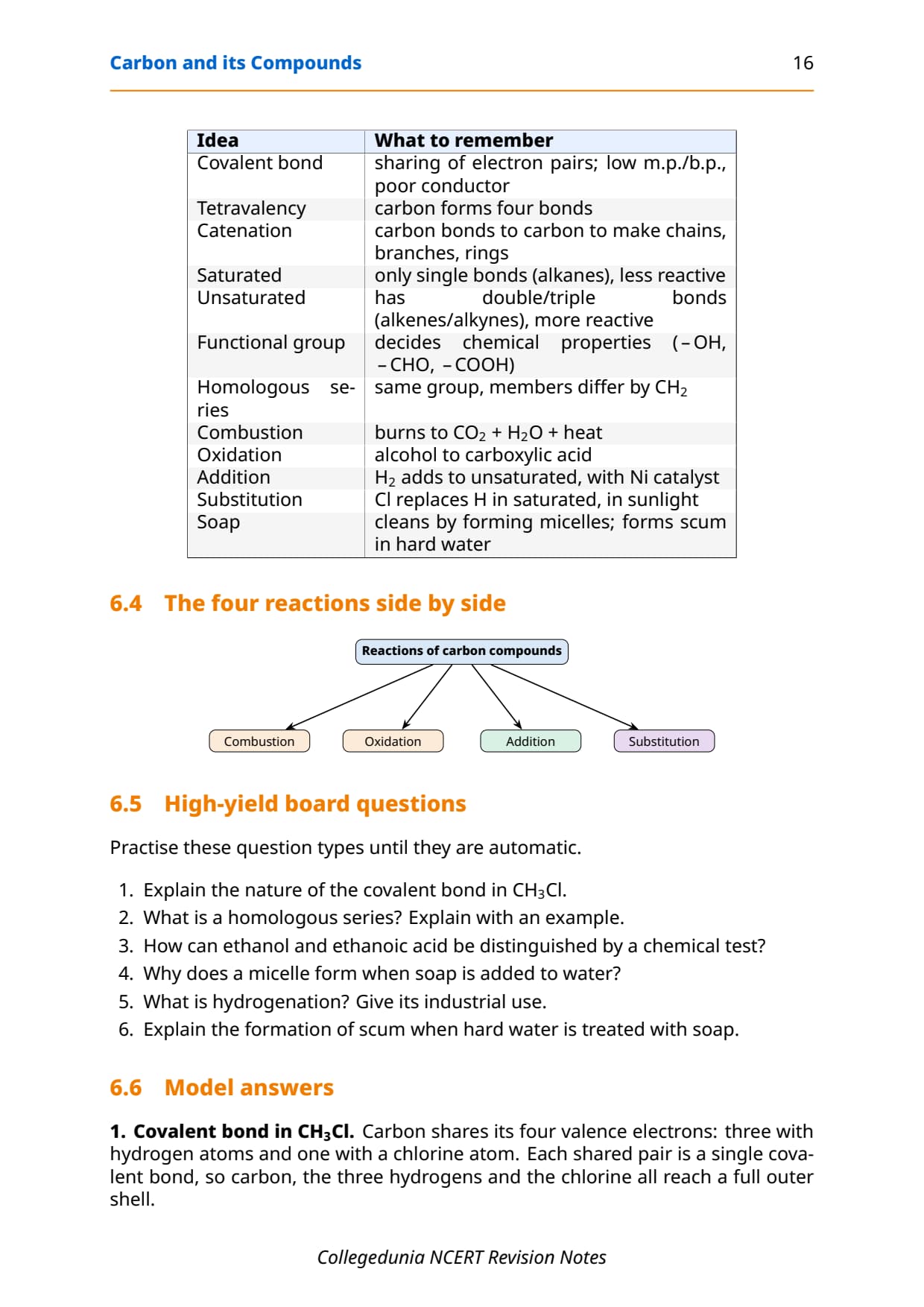
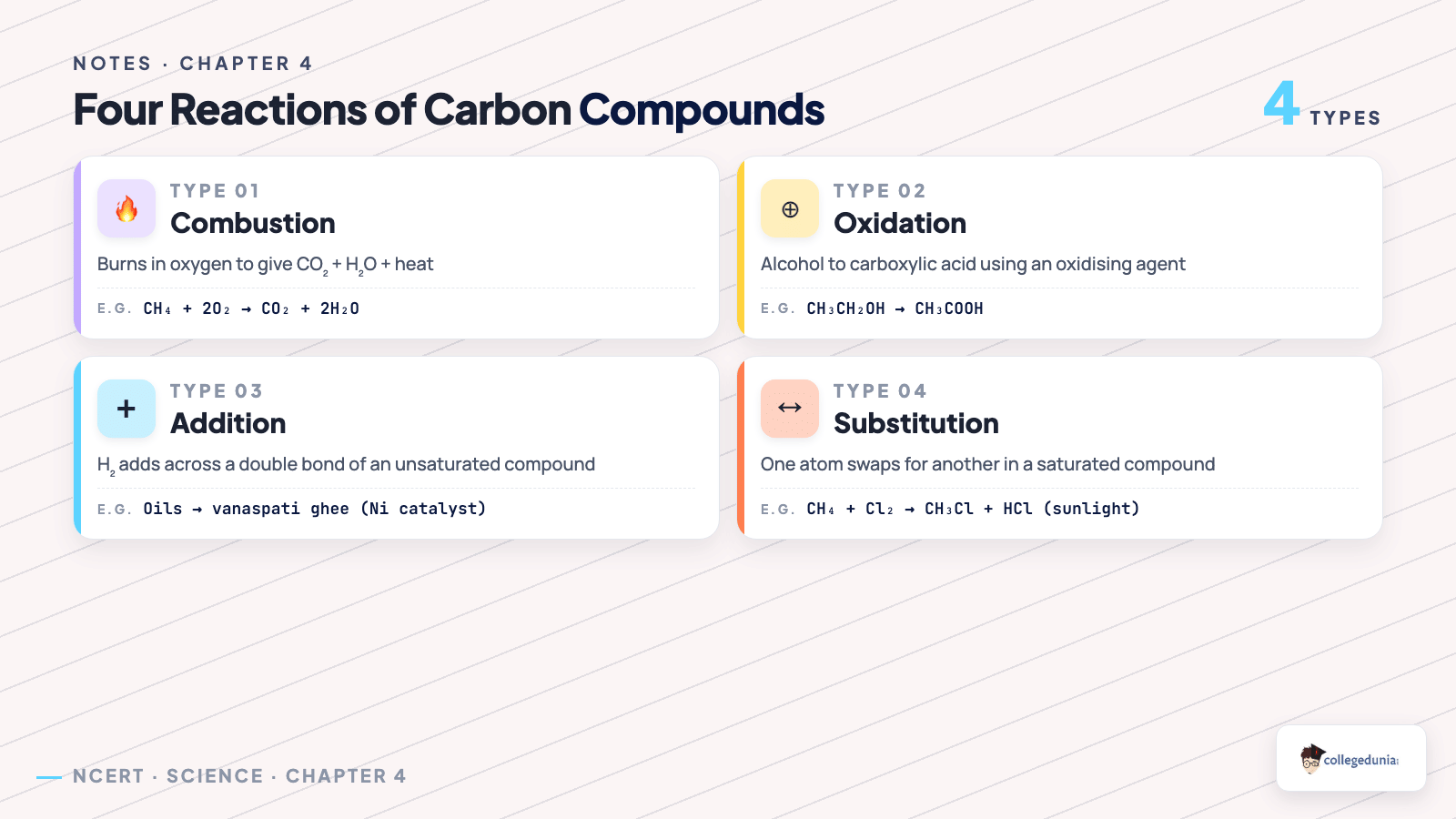
Carbon compounds take part in four reactions the board tests often: combustion, oxidation, addition and substitution.
Combustion and oxidation
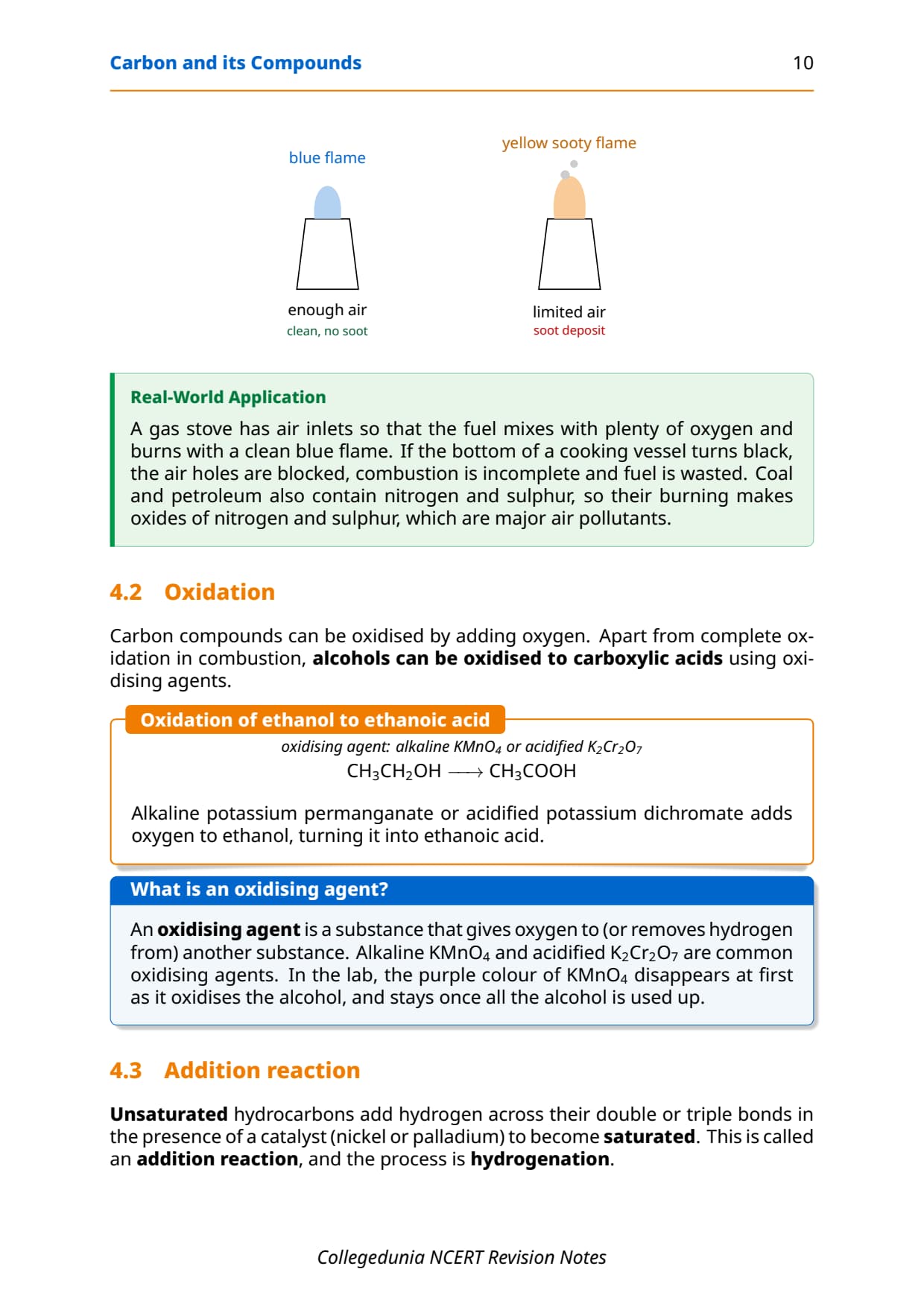
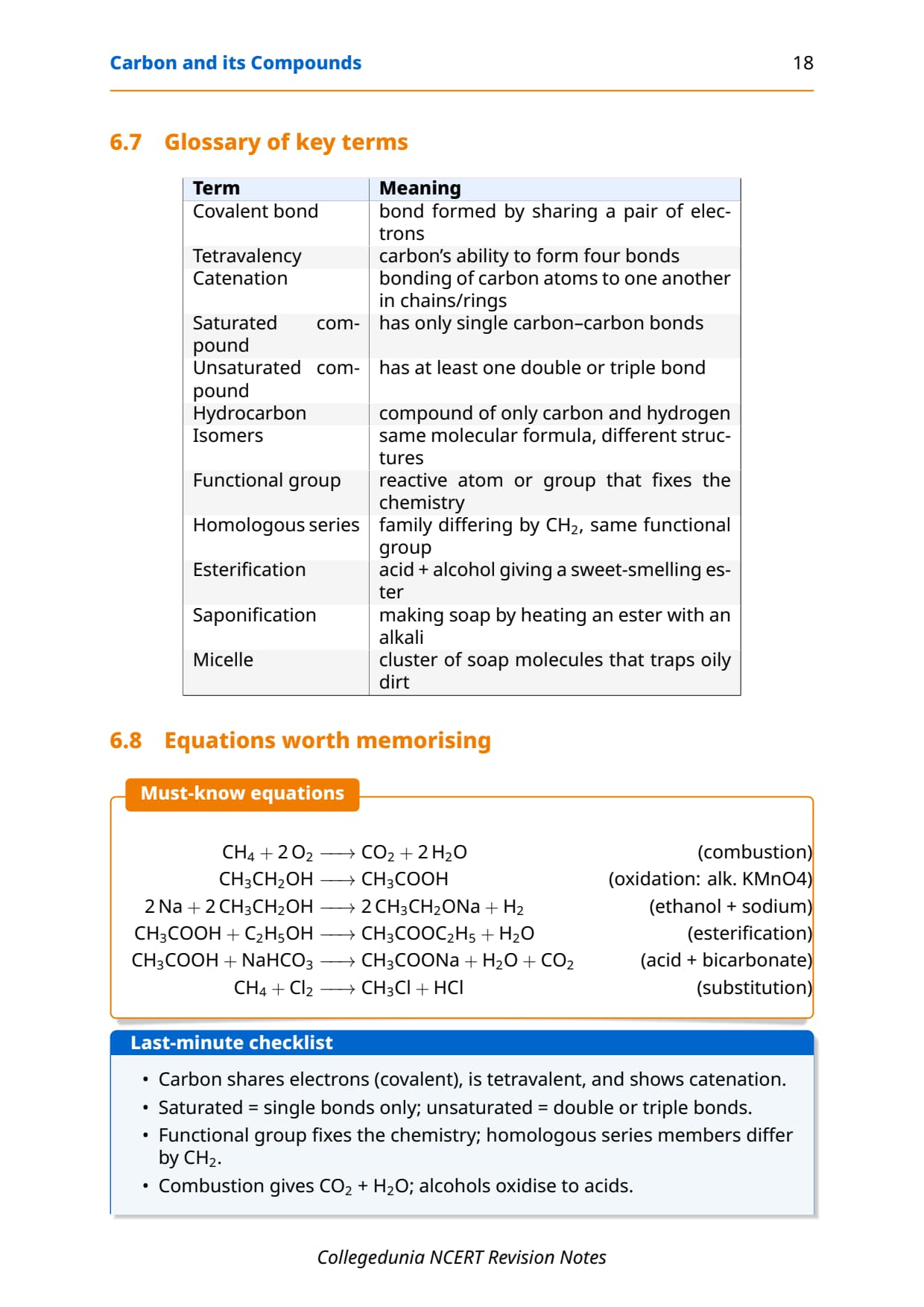
Carbon compounds burn in oxygen to give CO2, water and heat. With enough air, saturated hydrocarbons give a clean blue flame; with too little air a yellow sooty flame. Alcohols are oxidised to carboxylic acids by oxidising agents (KMnO4 or K2Cr2O7).
Oxidation: CH3CH2OH → CH3COOH (alkaline KMnO4)
Addition and substitution
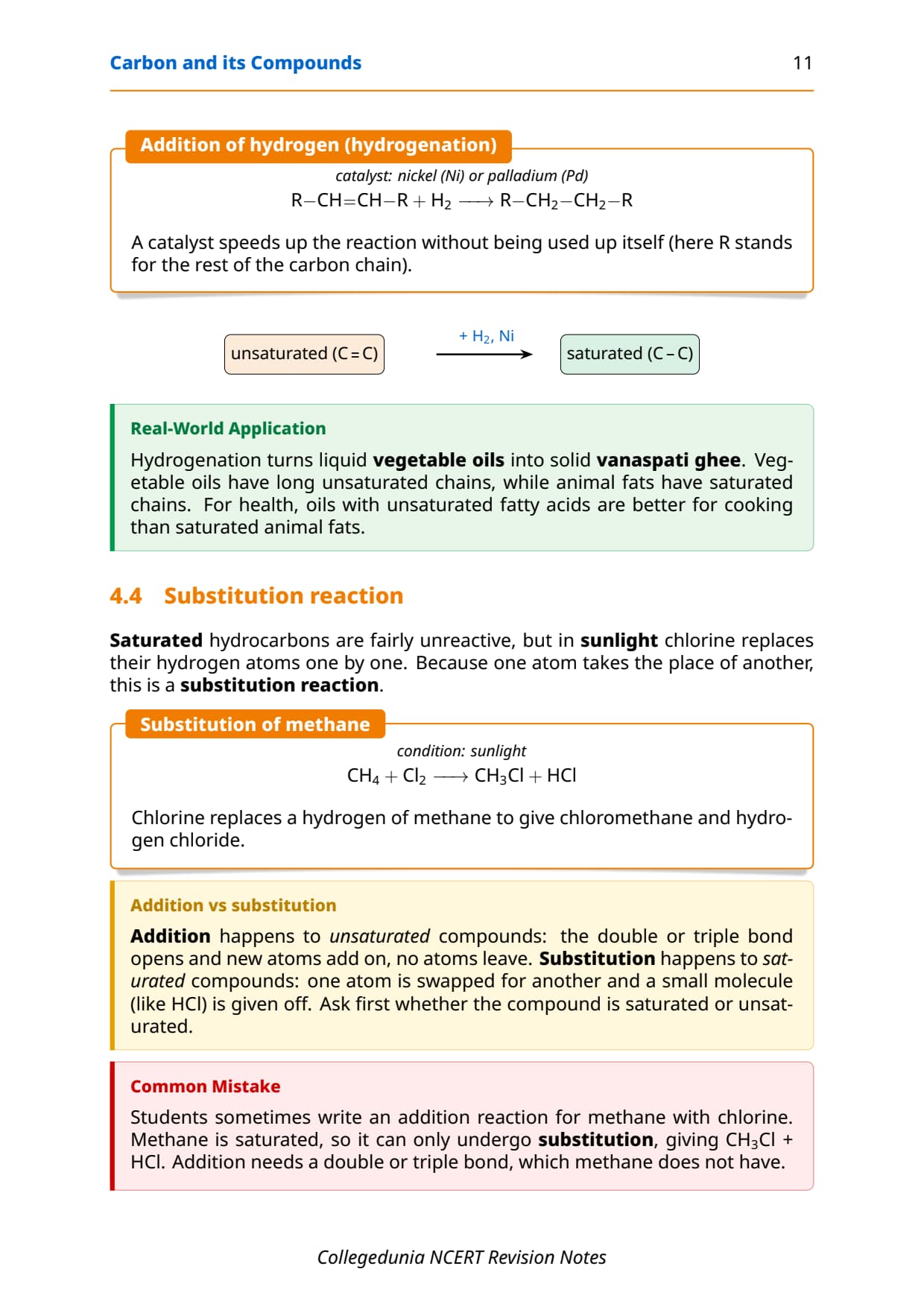
Addition: unsaturated compounds add hydrogen over a nickel catalyst to become saturated (hydrogenation turns vegetable oils into vanaspati ghee). Substitution: saturated hydrocarbons are unreactive, but in sunlight chlorine replaces hydrogen atoms.
Substitution: CH4 + Cl2 → CH3Cl + HCl (sunlight)
Check first whether the compound is saturated (substitution only) or unsaturated (can add).
Ethanol and Ethanoic Acid in Class 10 Science
Two carbon compounds appear every year: ethanol (common alcohol) and ethanoic acid (acetic acid).
Properties of ethanol
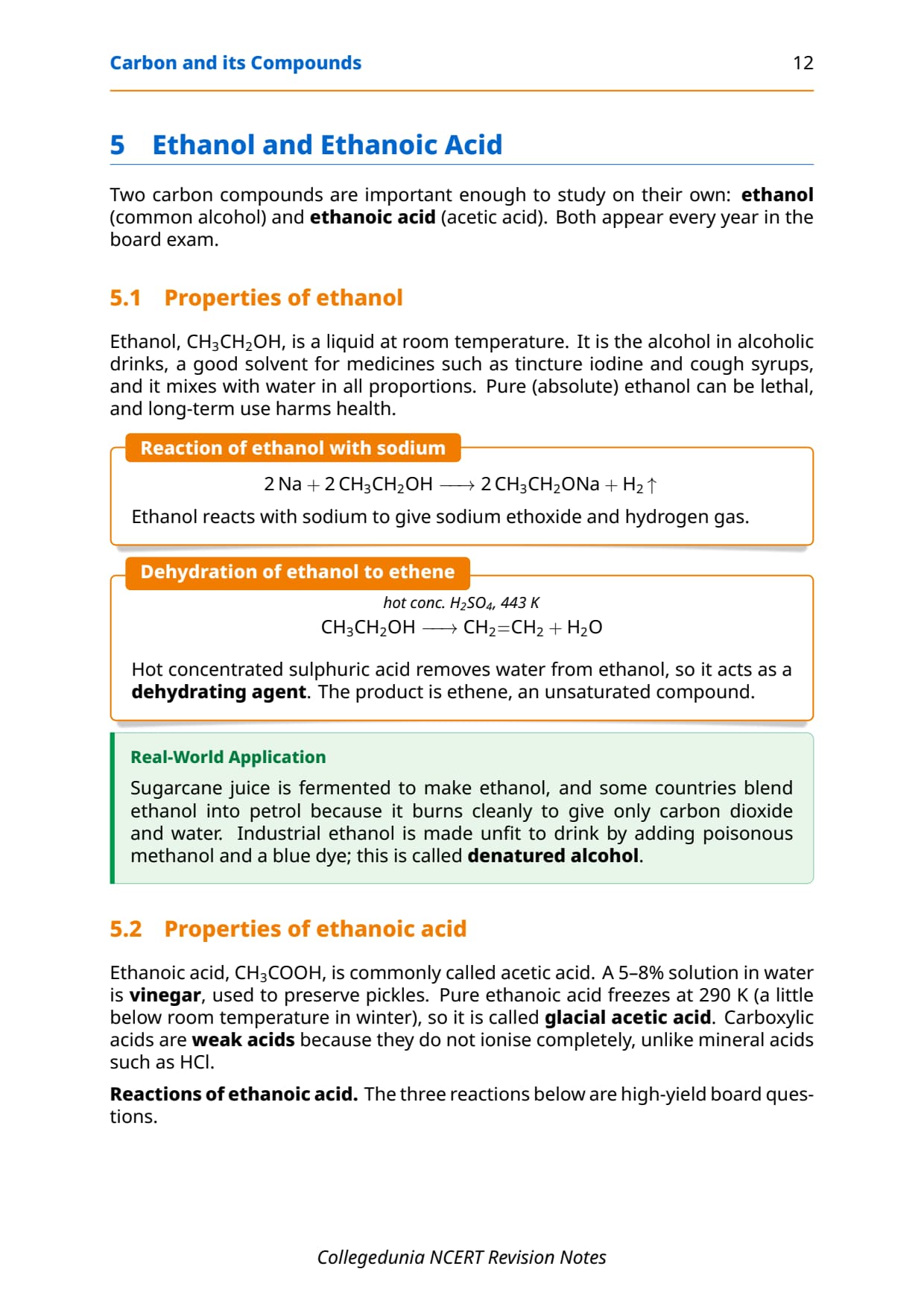
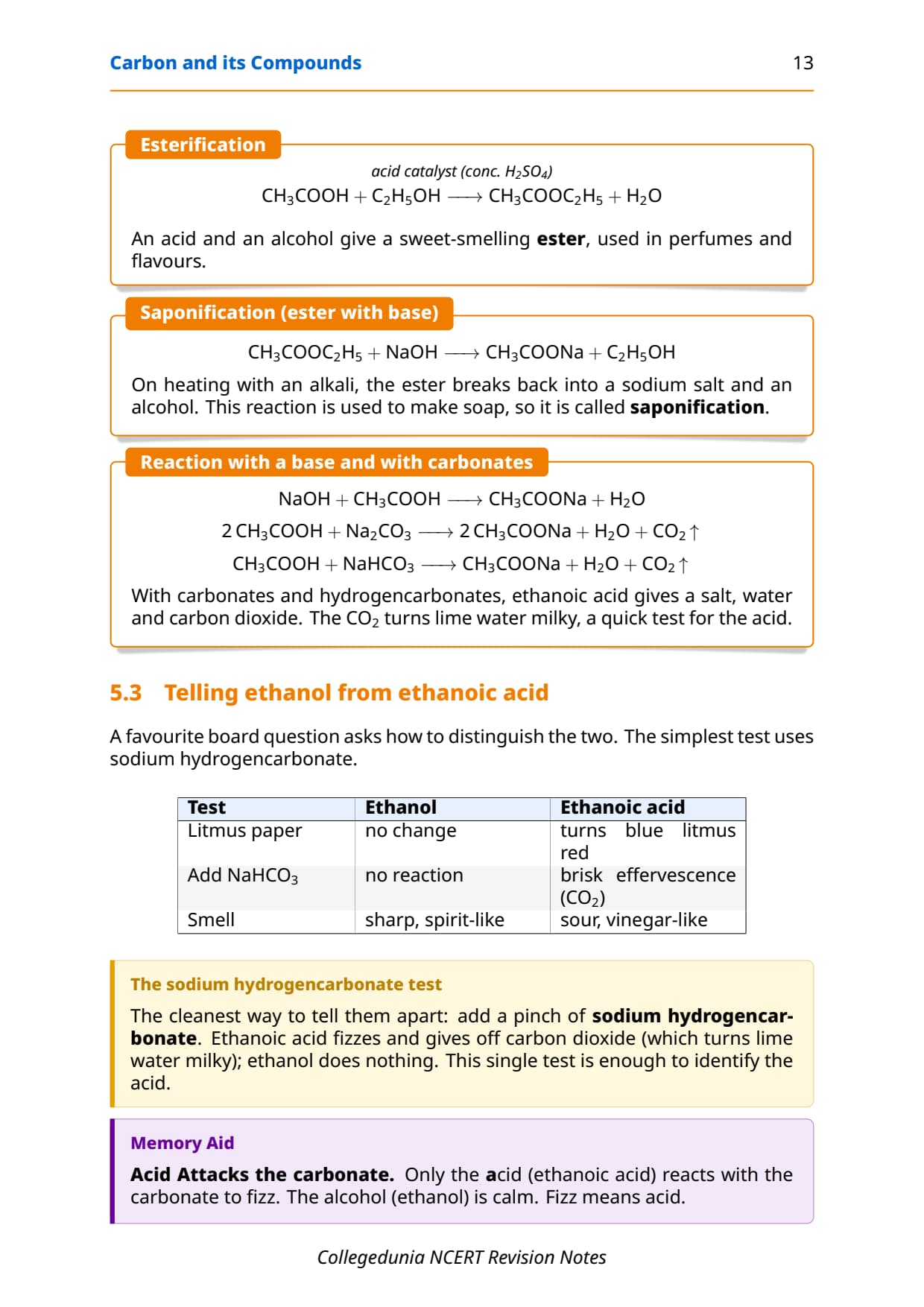
Ethanol, CH3CH2OH, is a liquid, the alcohol in drinks, a good solvent (e.g. tincture iodine), and mixes with water in all proportions.
Dehydration (hot conc. H2SO4, 443 K): C2H5OH → CH2=CH2 + H2O
Hot conc. H2SO4 is a dehydrating agent. Industrial ethanol made unfit to drink is denatured alcohol.
Properties of ethanoic acid
Ethanoic acid, CH3COOH, at 5 to 8 percent in water is vinegar. Pure acid freezes at 290 K (glacial acetic acid). Carboxylic acids are weak acids as they do not ionise completely.
With carbonate: CH3COOH + NaHCO3 → CH3COONa + H2O + CO2↑
An acid plus an alcohol gives a sweet-smelling ester; heating an ester with an alkali (saponification) makes soap. With carbonates, ethanoic acid gives a salt, water and CO2, which turns lime water milky.
Telling ethanol from ethanoic acid
| Test | Ethanol | Ethanoic acid |
|---|---|---|
| Litmus paper | No change | Turns blue litmus red |
| Add NaHCO3 | No reaction | Brisk effervescence (CO2) |
| Smell | Sharp, spirit-like | Sour, vinegar-like |
Soaps and Detergents in Class 10 Science
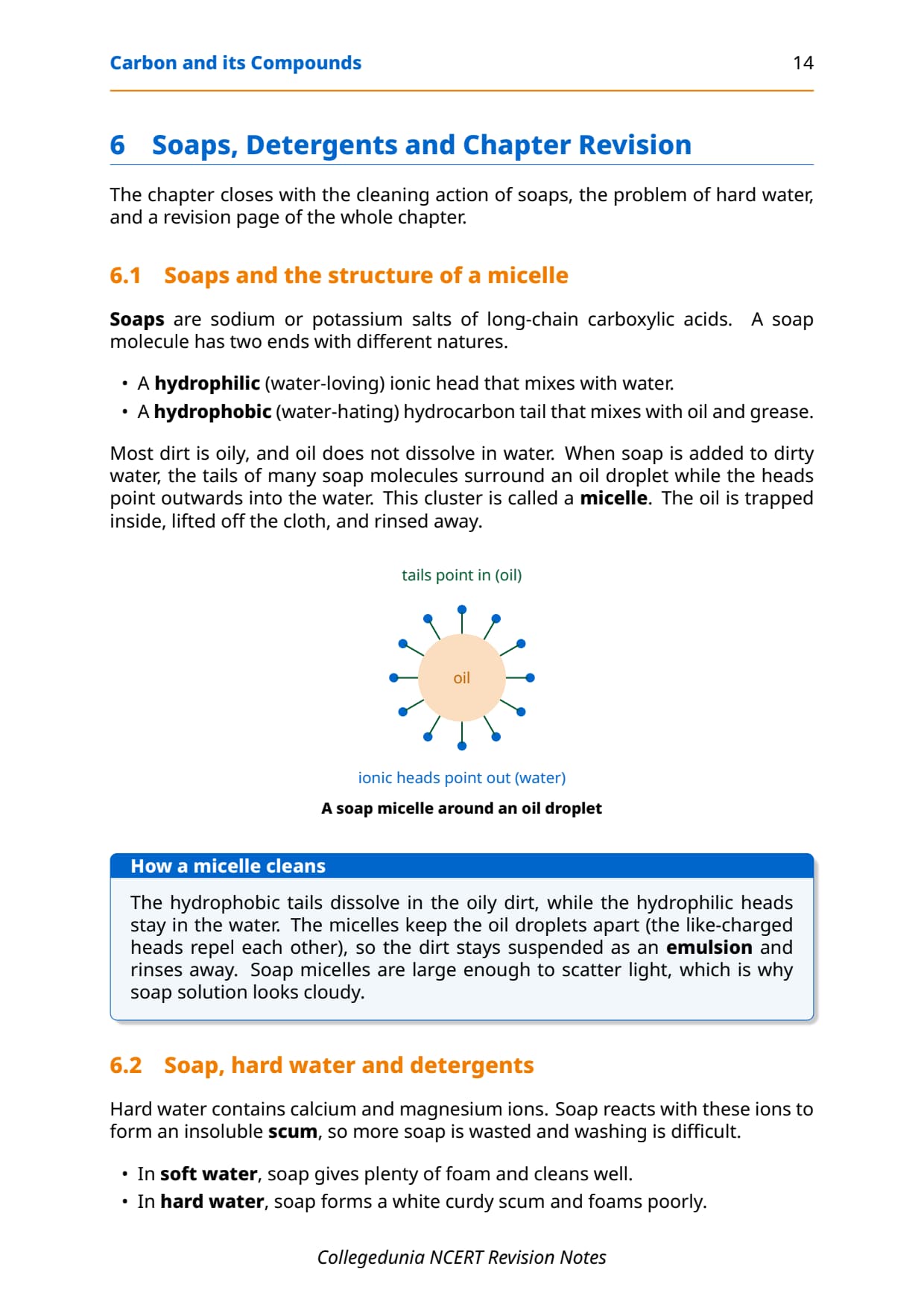
Soaps are sodium or potassium salts of long-chain carboxylic acids. A soap molecule has two ends of different natures:
- A hydrophilic (water-loving) ionic head that mixes with water.
- A hydrophobic (water-hating) hydrocarbon tail that mixes with oil and grease.
In dirty water, the tails of many soap molecules surround an oil droplet while the heads point outwards. This cluster is a micelle: the oil is trapped inside, lifted off the cloth and rinsed away.
Soap, hard water and detergents
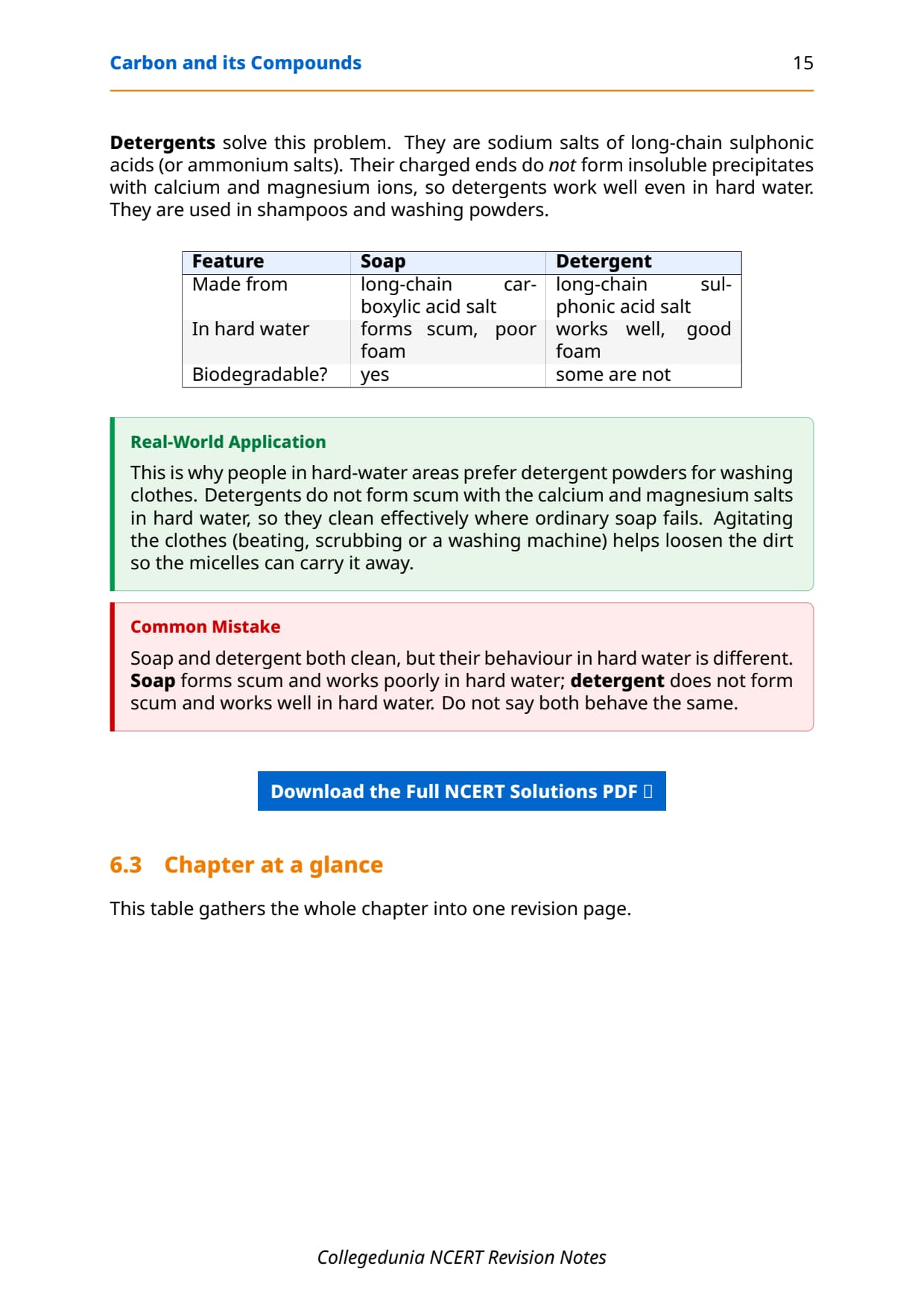
Hard water contains calcium and magnesium ions. Soap reacts with them to form an insoluble scum, wasting soap. Detergents (salts of long-chain sulphonic acids) do not form precipitates with these ions, so they work well even in hard water.
| Feature | Soap | Detergent |
|---|---|---|
| Made from | Long-chain carboxylic acid salt | Long-chain sulphonic acid salt |
| In hard water | Forms scum, poor foam | Works well, good foam |
| Biodegradable? | Yes | Some are not |
Quick Revision Strip and Common Exam Traps
The repeat-offender mistakes in Carbon and its Compounds board answers:
- Wrong number of bonds: every carbon must have exactly four (double = two, triple = three).
- Confusing addition and substitution: addition needs an unsaturated compound; methane is saturated, so only substitution.
- Forgetting to drop the 'e' before a vowel suffix: propane becomes propanone.
- Soap vs detergent in hard water: soap forms scum and fails; detergent works well.
Also Check: The full set of CBSE board paper questions for this chapter, with step-by-step answers, is included in the downloadable PDF above, updated for the 2026-27 cycle.
Other Resources for Class 10 Science Chapter 4 Carbon and its Compounds
Pair these revision notes with the matching NCERT Solutions, the formula sheet, handwritten notes and the official NCERT book chapter. All resources for Class 10 Science Chapter 4 Carbon and its Compounds are linked below.
| Resource | What it covers | Open |
|---|---|---|
| Notes | Concept-first revision notes on covalent bonding, catenation, functional groups, the four reactions, ethanol, ethanoic acid and soaps. | You are here |
| NCERT Solutions | Step-by-step answers to all in-text and exercise questions, with an Expert Solution for each. | Class 10 Science Chapter 4 NCERT Solutions |
| Formula Sheet | Quick reference of the must-know reactions, functional groups and the homologous series. | Class 10 Science Chapter 4 Formula Sheet |
| Handwritten Notes | Scanned-style handwritten pages for last-minute board revision. | Class 10 Science Chapter 4 Handwritten Notes |
| NCERT Book PDF | Official NCERT Science Chapter 4 Carbon and its Compounds textbook in PDF form. | Class 10 Science Chapter 4 NCERT Book PDF |
Notes for Class 10 Science: All Chapters
Related Links: Use the table below to open the revision notes for the other chapters of Class 10 Science. Every chapter ships with the same concept-first notes style, full PDF download, and revision FAQ.
| Chapter | Notes link |
|---|---|
| Chapter 1 | Chemical Reactions and Equations Notes |
| Chapter 2 | Acids, Bases and Salts Notes |
| Chapter 3 | Metals and Non-metals Notes |
| Chapter 4 | Carbon and its Compounds Notes (You are here) |
| Chapter 5 | Life Processes Notes |
| Chapter 6 | Control and Coordination Notes |
| Chapter 7 | How do Organisms Reproduce? Notes |
| Chapter 8 | Heredity Notes |
| Chapter 9 | Light - Reflection and Refraction Notes |
| Chapter 10 | The Human Eye and the Colourful World Notes |
| Chapter 11 | Electricity Notes |
| Chapter 12 | Magnetic Effects of Electric Current Notes |
| Chapter 13 | Our Environment Notes |
Notes Class 10 Science Chapter 4 Carbon and its Compounds FAQs
Ques. What does Chapter 4 Carbon and its Compounds cover in Class 10 Science?
Ans. Chapter 4 covers why carbon is so special and how it forms millions of compounds. The notes explain the covalent bond and why carbon shares electrons, the two key properties of catenation and tetravalency, saturated and unsaturated compounds with structural isomers, the functional groups and the homologous series, and the rules for naming compounds. They then cover the four reactions of carbon compounds (combustion, oxidation, addition and substitution) and the chemistry of ethanol, ethanoic acid, soaps and detergents, all aligned with the 2026-27 CBSE syllabus.
Ques. Why does carbon form a large number of compounds in Class 10 Science?
Ans. Carbon forms millions of compounds because of two properties. The first is catenation, the ability of carbon to bond to other carbon atoms to form long chains, branched chains and rings, made possible by the very strong carbon-carbon bond. The second is tetravalency, since carbon has a valency of four and can bond to four other atoms of carbon or of elements such as hydrogen, oxygen, nitrogen, sulphur and the halogens. Carbon's bonds are strong because it is a small atom, so its nucleus holds the shared electrons tightly. No other element shows catenation as well as carbon.
Ques. What is a covalent bond and why do carbon compounds conduct electricity poorly?
Ans. A covalent bond is formed when two atoms share one or more pairs of electrons so that each atom attains a stable, completely filled outermost shell. Carbon has four valence electrons, and gaining or losing four electrons is very hard, so carbon shares electrons instead, forming covalent bonds with no ions. Because no ions or free electrons are produced, carbon compounds have nothing to carry charge, so they are poor conductors of electricity. The forces between covalent molecules are also weak, which is why carbon compounds have low melting and boiling points.
Ques. What is a homologous series in Class 10 Science?
Ans. A homologous series is a family of compounds with the same functional group, where each member differs from the next by a CH2 group, that is by a mass of 14 u. The alcohols methanol, ethanol, propanol and butanol form one homologous series. The features are that successive members differ by CH2, all members share the same general formula and functional group, the chemical properties stay similar throughout the series, and the physical properties such as melting point, boiling point and solubility change gradually as the molecular mass rises.
Ques. How can ethanol and ethanoic acid be distinguished by a chemical test?
Ans. The simplest test is to add a pinch of sodium hydrogencarbonate (NaHCO3) to each. Ethanoic acid gives brisk effervescence of carbon dioxide, which turns lime water milky, while ethanol shows no reaction. Ethanoic acid also turns blue litmus red because it is an acid, while ethanol leaves litmus unchanged. By smell, ethanoic acid is sour and vinegar-like, while ethanol is sharp and spirit-like. For full board marks, name the reagent, state the observation for each compound, and write the gas given off.
Ques. What is the difference between addition and substitution reactions?
Ans. An addition reaction happens to unsaturated compounds: the double or triple bond opens and new atoms add on, with no atoms leaving. The standard example is hydrogenation, where hydrogen adds across the double bond of an unsaturated oil in the presence of a nickel catalyst to give a saturated fat. A substitution reaction happens to saturated compounds: one atom is swapped for another and a small molecule is given off. The standard example is methane reacting with chlorine in sunlight to give chloromethane and hydrogen chloride. Always check first whether the compound is saturated or unsaturated.
Ques. How many pages is the Class 10 Science Carbon and its Compounds Notes PDF?
Ans. The Carbon and its Compounds Notes PDF runs about 17 to 20 pages and covers the full chapter in concept-first revision blocks, with balanced equations, the functional-group table, the homologous series, comparison tables, common-mistake boxes and a one-glance revision strip. The PDF is free to download for the 2026-27 session, and a green Handwritten Notes button on this page opens the scanned-style version for last-minute revision.
Ques. Are these Notes for Class 10 Science Chapter 4 aligned with the 2026-27 syllabus?
Ans. Yes. This page reflects the current 2026-27 CBSE syllabus for Class 10 Science. The Carbon and its Compounds chapter is unchanged for the current cycle, and these notes follow the NCERT textbook, covering covalent bonding, catenation and tetravalency, functional groups and the homologous series, nomenclature, the four reactions of carbon compounds, and ethanol, ethanoic acid, soaps and detergents. The notes are written for the CBSE board exam, with the high-frequency question types and marking-scheme habits highlighted throughout.



Comments