




These Notes for Class 10 Science Chapter 2 Acids, Bases and Salts give you a fast, concept-first revision of the whole chapter, built on the latest 2026-27 CBSE syllabus. They cover how indicators tell acids from bases, the chemical properties of acids and bases, the pH scale, and the common salts: common salt, baking soda, washing soda, bleaching powder and plaster of Paris.
- Every reaction explained with a one-line rule, a balanced equation, and the everyday example the board likes to ask.
- Full coverage of acids give H+, bases give OH-, the pH scale, the chlor-alkali process, and water of crystallisation.
- Aligned with the 2026-27 CBSE Class 10 Science syllabus and written for the board exam.
These Collegedunia revision notes are curated by Science subject experts, mapped to the 2026-27 NCERT textbook, and refined against the last five years of CBSE Class 10 Science board papers.
Student Feedback: What 9,800 students told us about this chapter
72% of Class 10 students said remembering which salt is made how (baking soda, washing soda, bleaching powder) was the hardest part of this chapter when they first revised it. 3 out of 5 students told us a one-page table of the five acid-base reactions helped them write the equation correctly in the board exam.
Toppers found that learning the pH scale and the common salts cold saved 8 to 10 minutes in the exam, and the average student spent 1.5 to 2 hours on these notes across the first read and the final revision.
Source: 2026-27 Class 10 Science student poll. Sample of 9,800 students from CBSE schools across 13 states, conducted before the 2026 boards.
What the Notes for Class 10 Science Chapter 2 Acids, Bases and Salts Cover
These notes compress the NCERT order into exam-ready blocks: indicators, the five acid-base reactions, the shared ions, the pH scale, pH in daily life, and the family of salts from common salt.
Source: Magnet Brains on YouTube
Indicators: Telling Acids from Bases in Class 10 Science
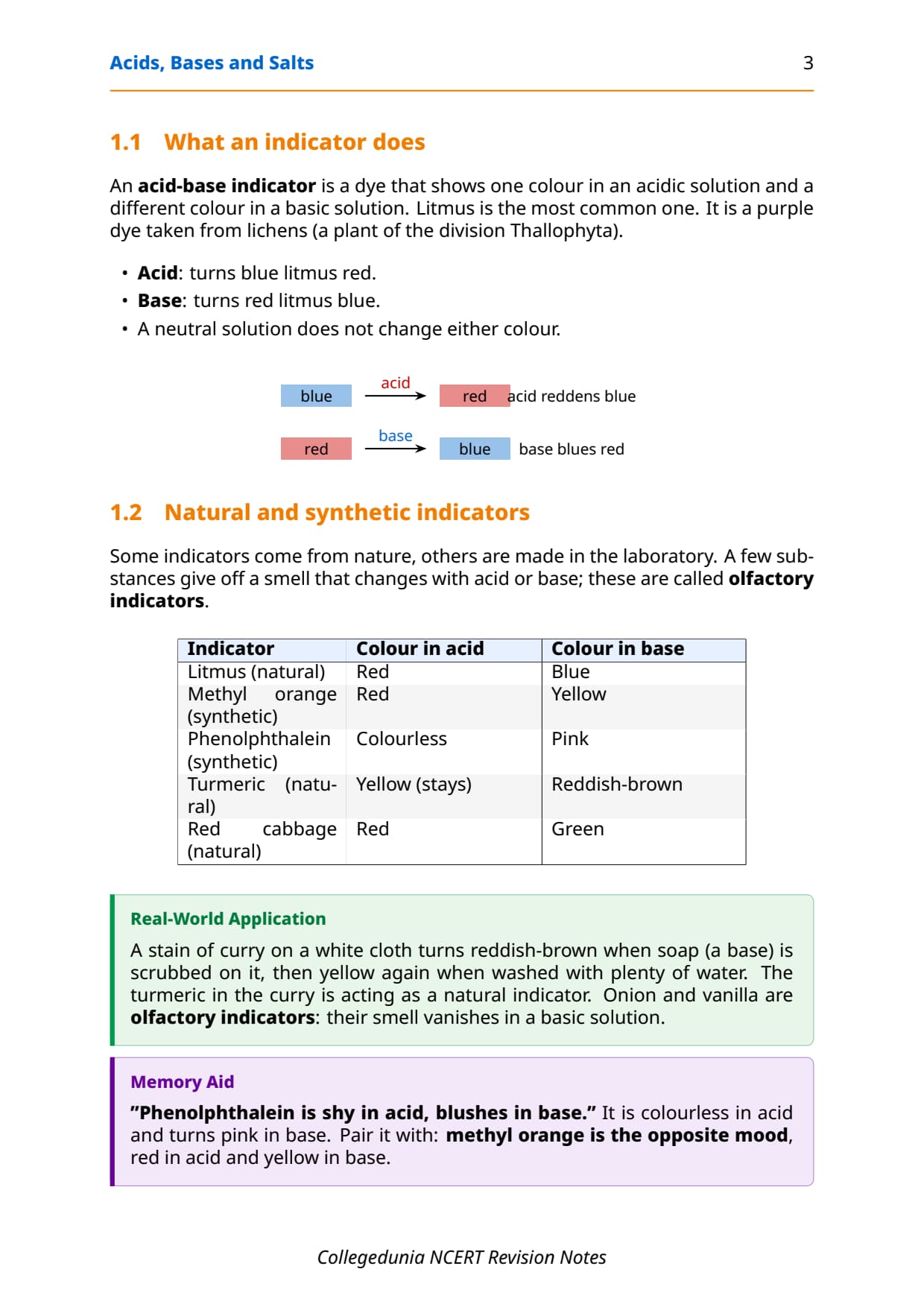
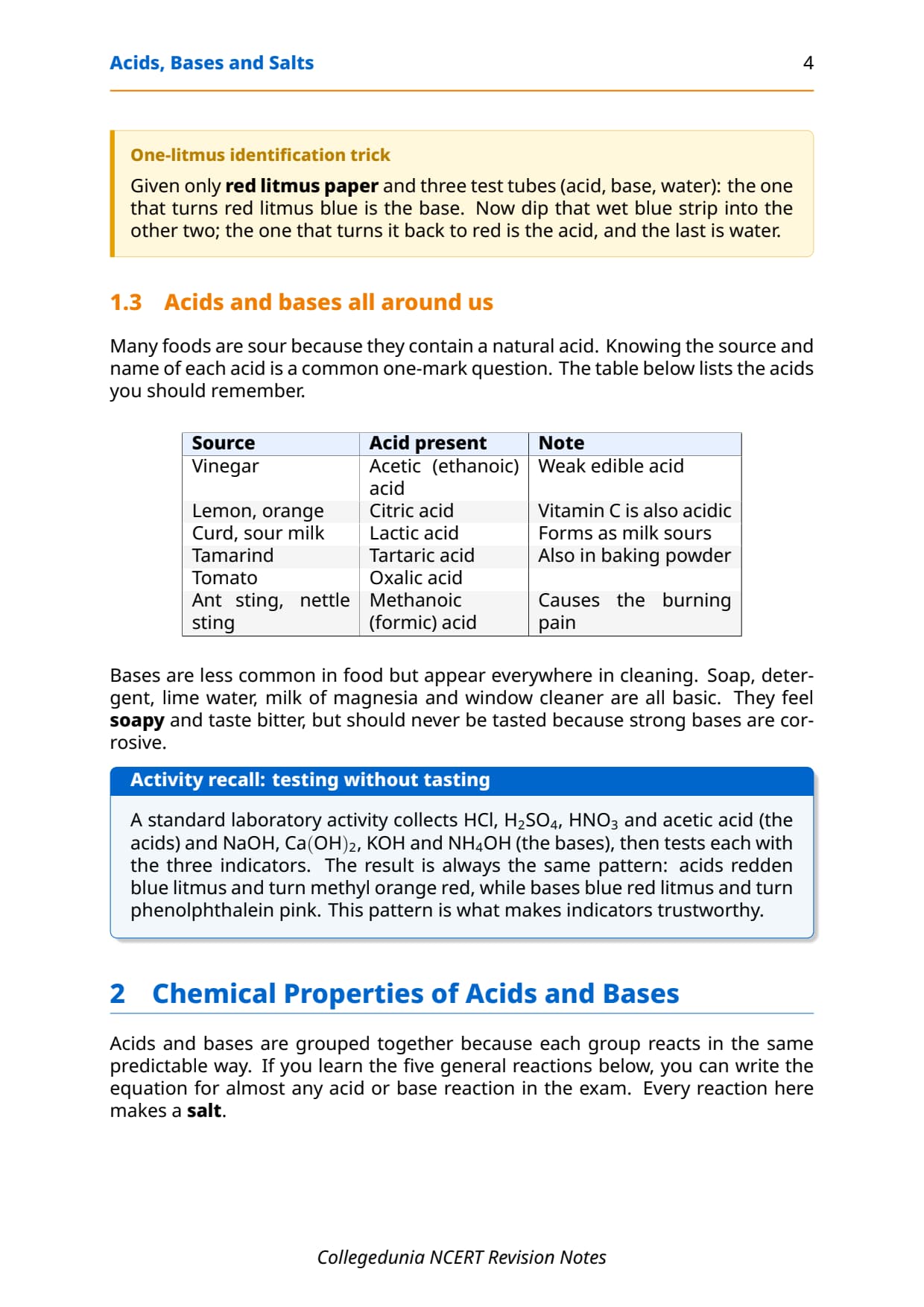
We never taste a chemical; we use an indicator, a substance that changes colour in acid and base. An acid turns blue litmus red; a base feels soapy and turns red litmus blue. Litmus is a purple dye from lichens. A few indicators change their smell instead, called olfactory indicators (onion, vanilla).
| Indicator | Colour in acid | Colour in base |
|---|---|---|
| Litmus (natural) | Red | Blue |
| Methyl orange (synthetic) | Red | Yellow |
| Phenolphthalein (synthetic) | Colourless | Pink |
| Turmeric (natural) | Yellow (stays) | Reddish-brown |
| Red cabbage (natural) | Red | Green |
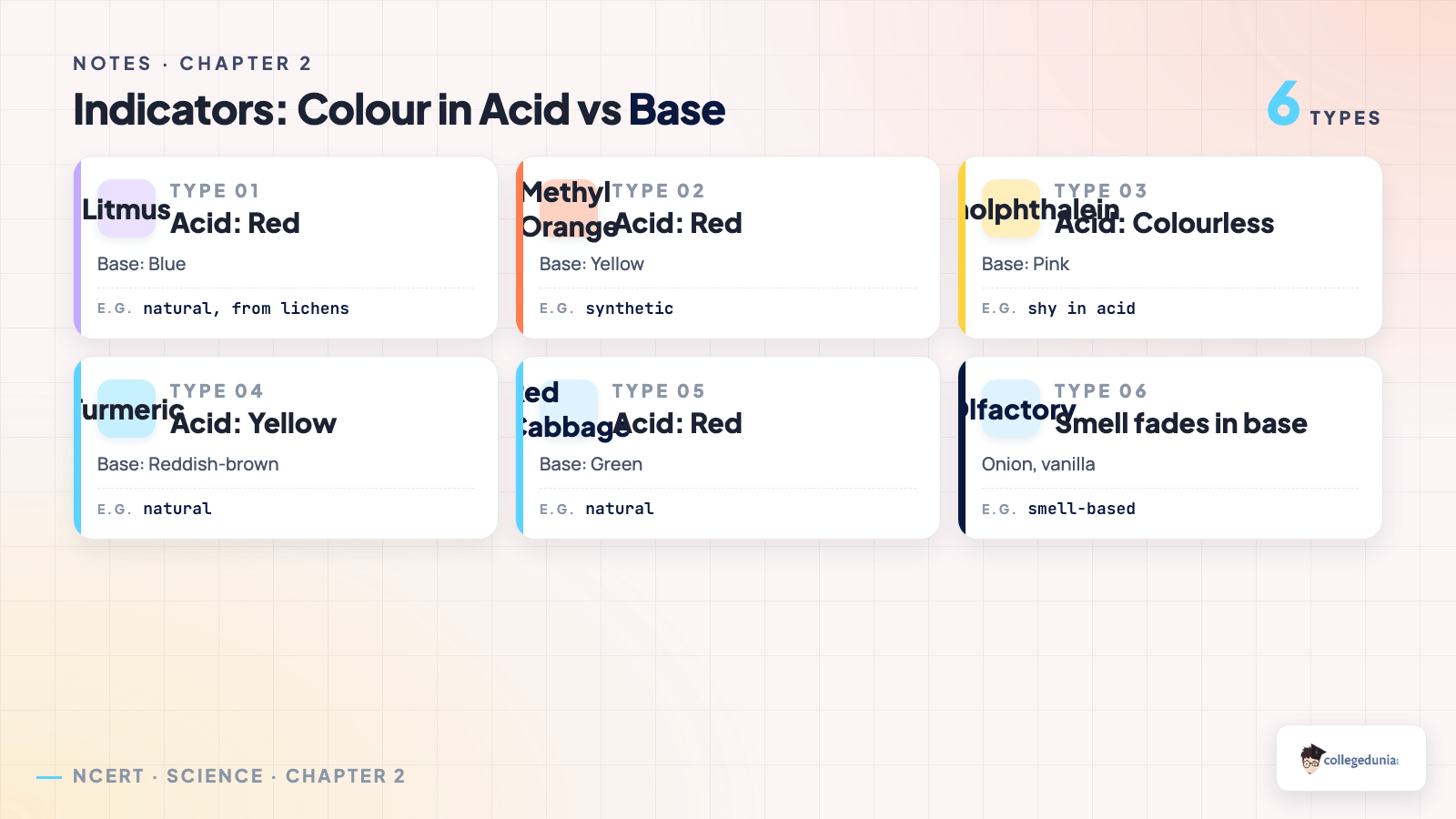
A common trap: phenolphthalein is colourless in acid, pink in base; methyl orange is the opposite, red in acid, yellow in base.
Chemical Properties of Acids and Bases in Class 10 Science
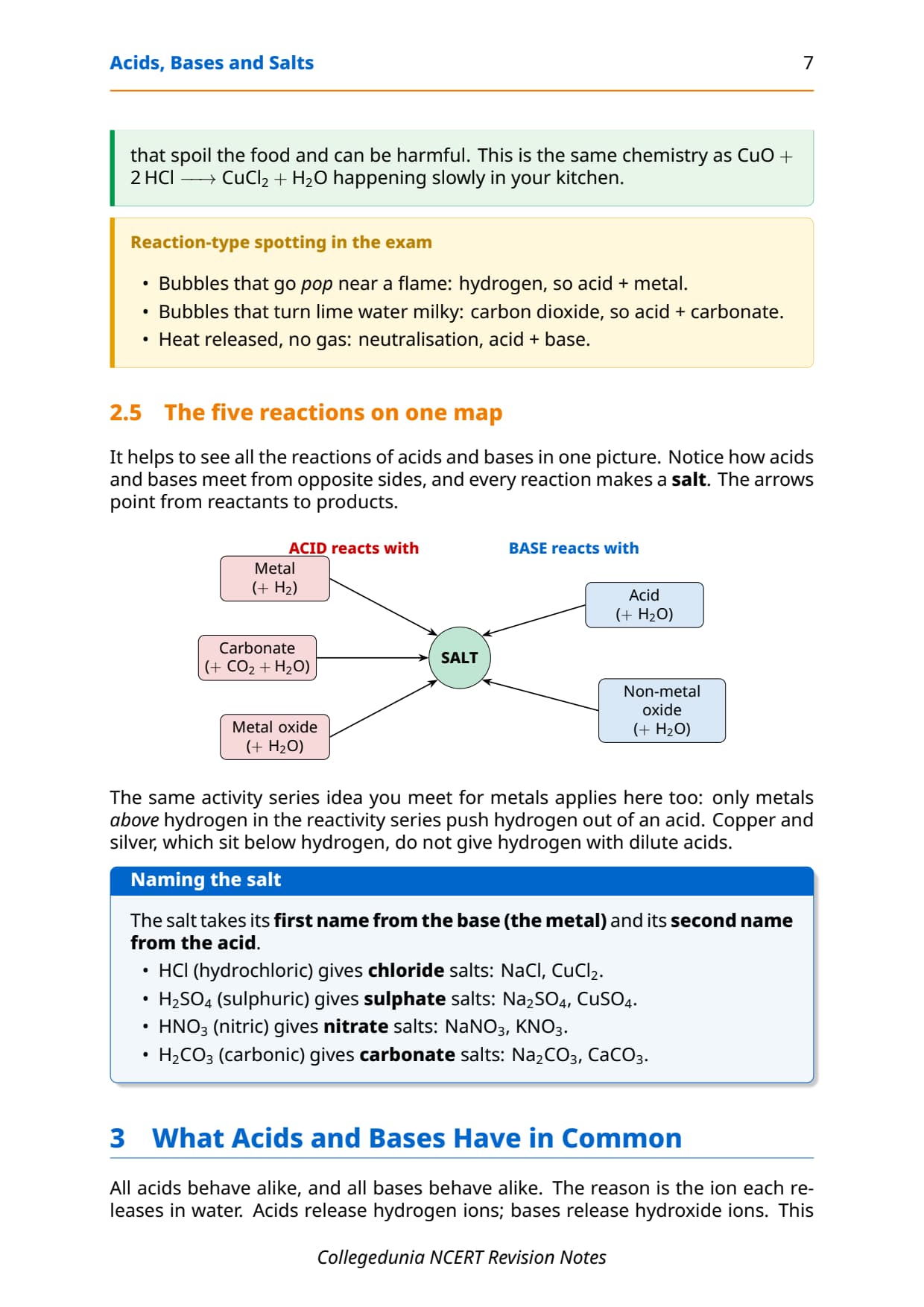
Learn these five general reactions and you can write almost any acid or base equation. Every reaction here makes a salt.
Reaction with metals: hydrogen gas
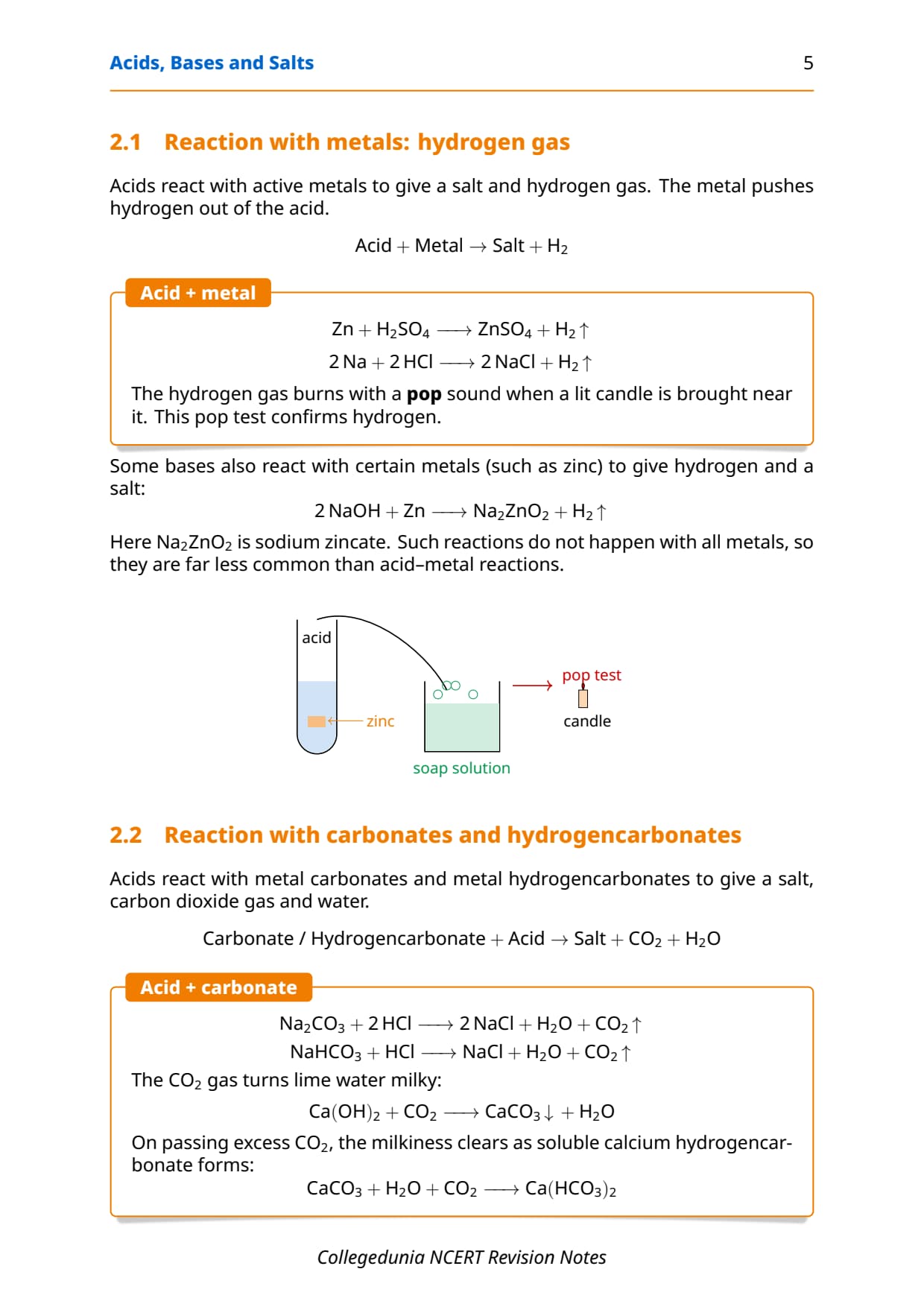
Acids react with active metals: Acid + Metal → Salt + Hydrogen.
Zn + H2SO4 → ZnSO4 + H2↑
2Na + 2HCl → 2NaCl + H2↑
The hydrogen burns with a pop sound near a flame.
Reaction with carbonates and hydrogencarbonates
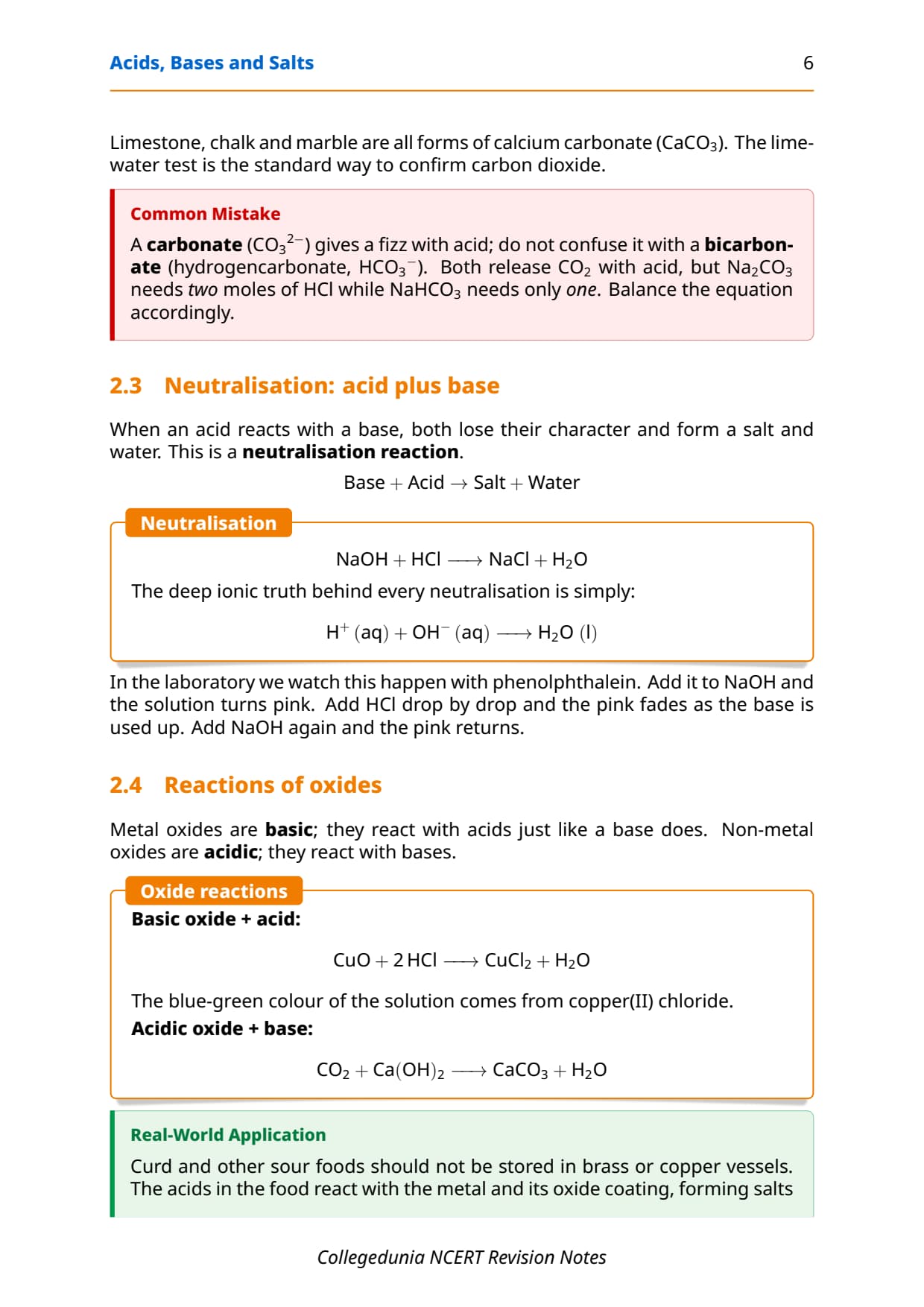
Acids react with carbonates and hydrogencarbonates: + Acid → Salt + CO2 + H2O. The CO2 turns lime water milky.
Na2CO3 + 2HCl → 2NaCl + H2O + CO2↑
NaHCO3 + HCl → NaCl + H2O + CO2↑
Lime water test: Ca(OH)2 + CO2 → CaCO3↓ + H2O
A carbonate (Na2CO3) needs two moles of HCl; a hydrogencarbonate (NaHCO3) needs one.
Neutralisation: acid plus base
An acid and base form a salt and water in a neutralisation reaction: Base + Acid → Salt + Water (NaOH + HCl → NaCl + H2O). The ionic truth is H+ + OH- → H2O.
Reactions of oxides
Metal oxides are basic and react with acids (CuO + 2HCl → CuCl2 + H2O); non-metal oxides are acidic and react with bases (CO2 + Ca(OH)2 → CaCO3 + H2O).
What Acids and Bases Have in Common in Class 10 Science
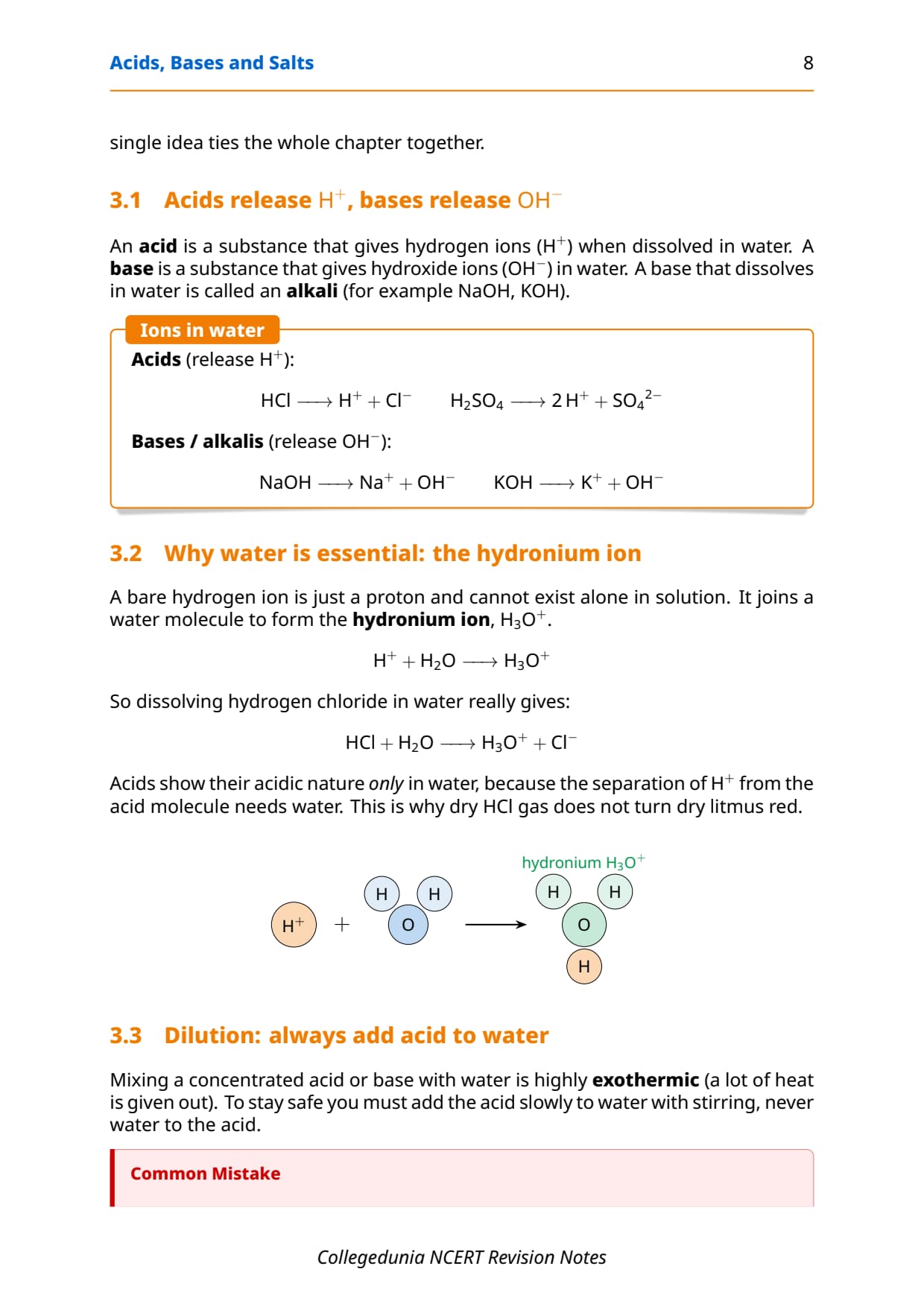
All acids behave alike, and all bases behave alike, because of the ion each releases in water. An acid gives H+; a base gives OH-. A base that dissolves in water is an alkali (NaOH, KOH).
- Water is essential: a bare H+ joins water as the hydronium ion (H3O+), so acids show acidity only in water.
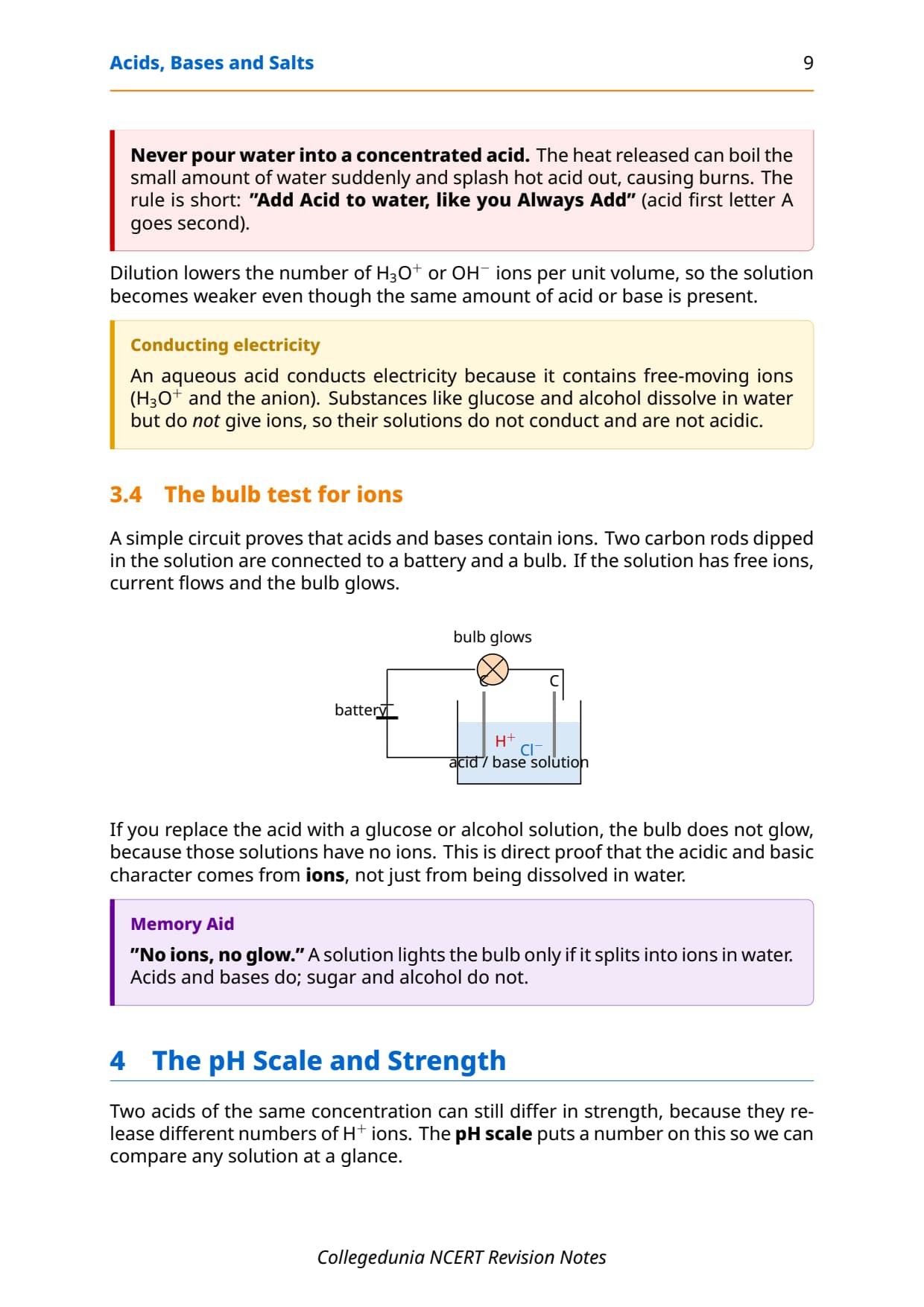
- Ions carry current: acid and base solutions split into ions and conduct electricity (the bulb test).
HCl → H+ + Cl- H2SO4 → 2H+ + SO42-
Bases / alkalis release OH-:
NaOH → Na+ + OH- KOH → K+ + OH-
The hydronium ion and dilution
A bare H+ joins water to form the hydronium ion H3O+. This is why dry HCl gas does not turn dry litmus red. Diluting a concentrated acid is highly exothermic, so always add the acid slowly to water, never water to acid.
The bulb test for ions
Carbon rods joined to a battery and bulb prove acids and bases contain ions: free ions make the bulb glow. Glucose or alcohol solutions have no ions, so the bulb stays dark.
The pH Scale and Strength in Class 10 Science
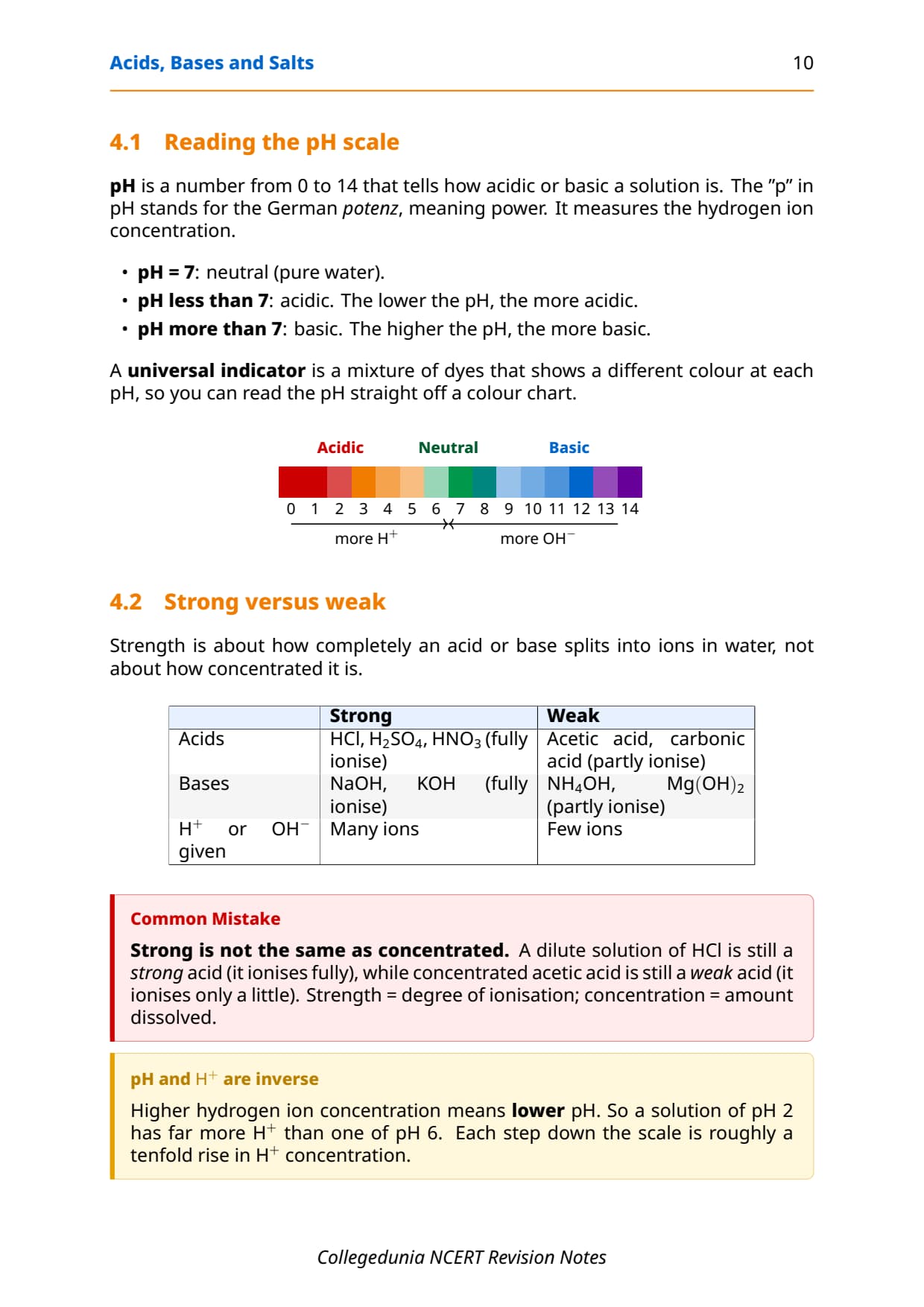
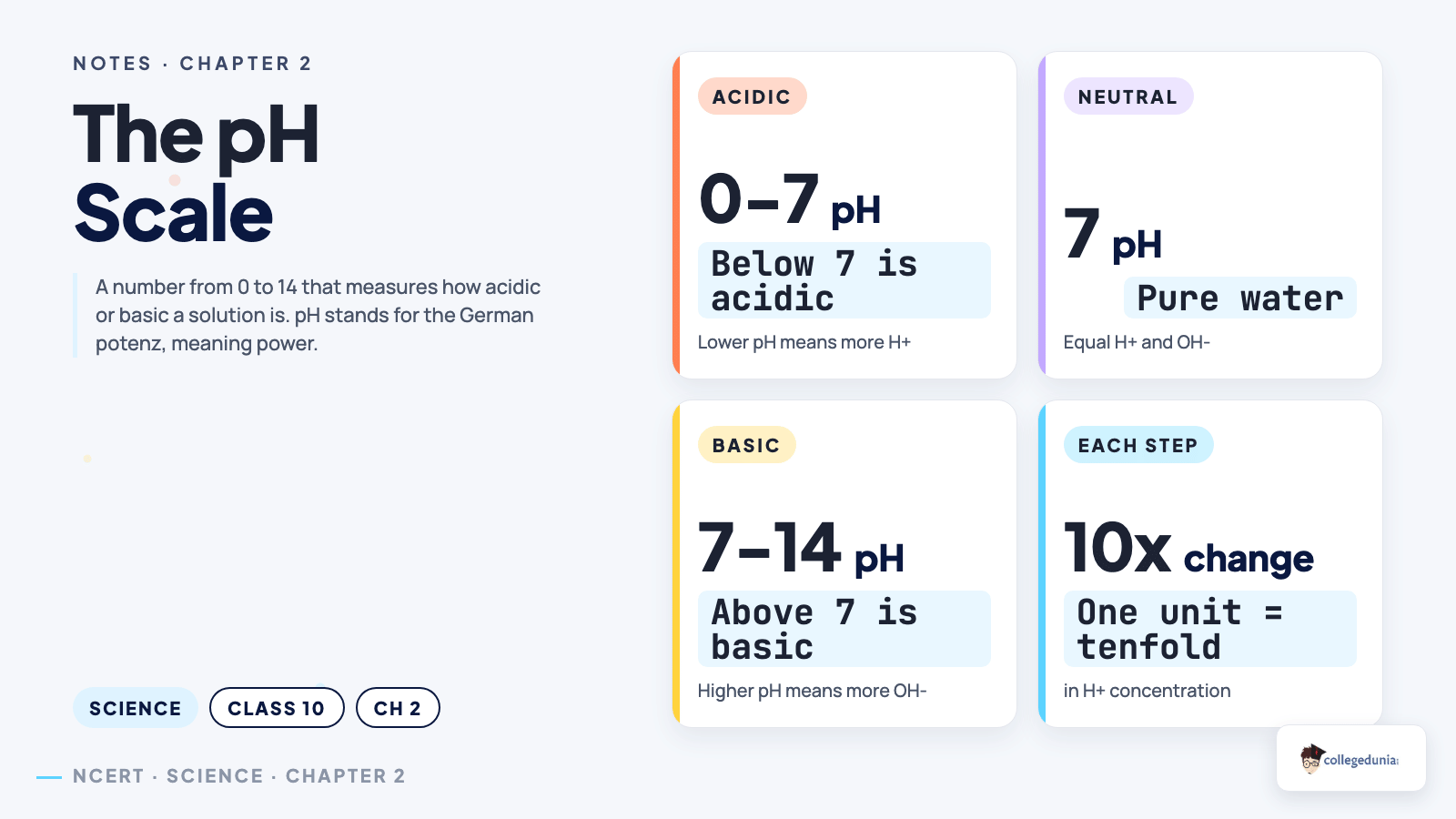
Two acids of the same concentration can differ in strength, because they release different numbers of H+ ions. The pH scale puts a number on this, running from 0 to 14.
- pH = 7: neutral (pure water).
- pH less than 7: acidic. Lower pH means more acidic.
- pH more than 7: basic. Higher pH means more basic.
A universal indicator is a dye mix showing a different colour at each pH.
Strong versus weak
Strength is how completely an acid or base splits into ions, not how concentrated it is. A strong acid (HCl, H2SO4, HNO3) ionises fully; a weak acid (acetic, carbonic) ionises only partly. NaOH and KOH are strong bases; NH4OH is weak.
| Strong (fully ionises) | Weak (partly ionises) | |
|---|---|---|
| Acids | HCl, H2SO4, HNO3 | Acetic acid, carbonic acid |
| Bases | NaOH, KOH | NH4OH, Mg(OH)2 |
| Ions released | Many ions | Few ions |
Importance of pH in Everyday Life
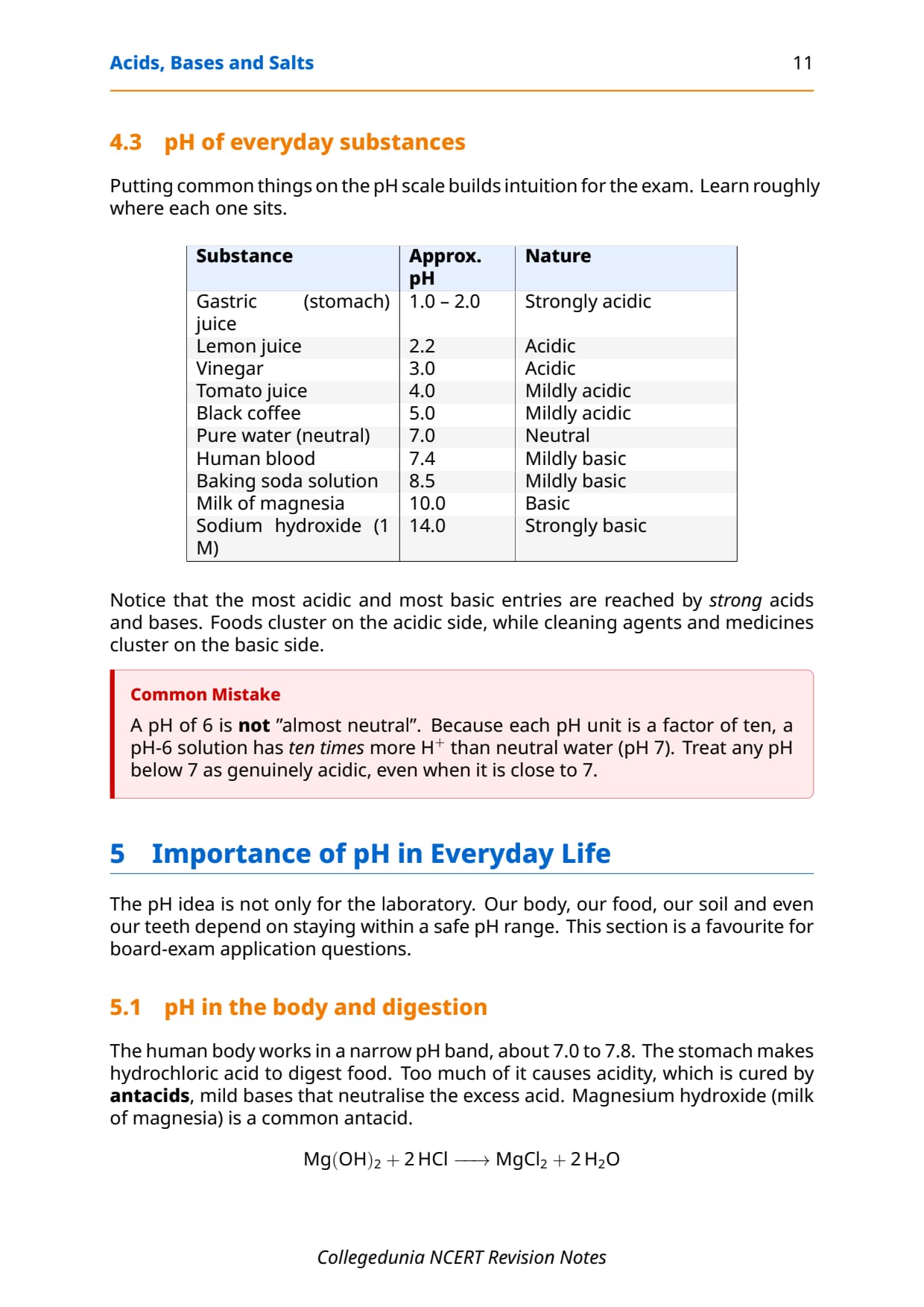
pH matters beyond the lab: body, food, soil and teeth all depend on a safe pH range. This is a favourite for board application questions, so map each situation to its remedy.
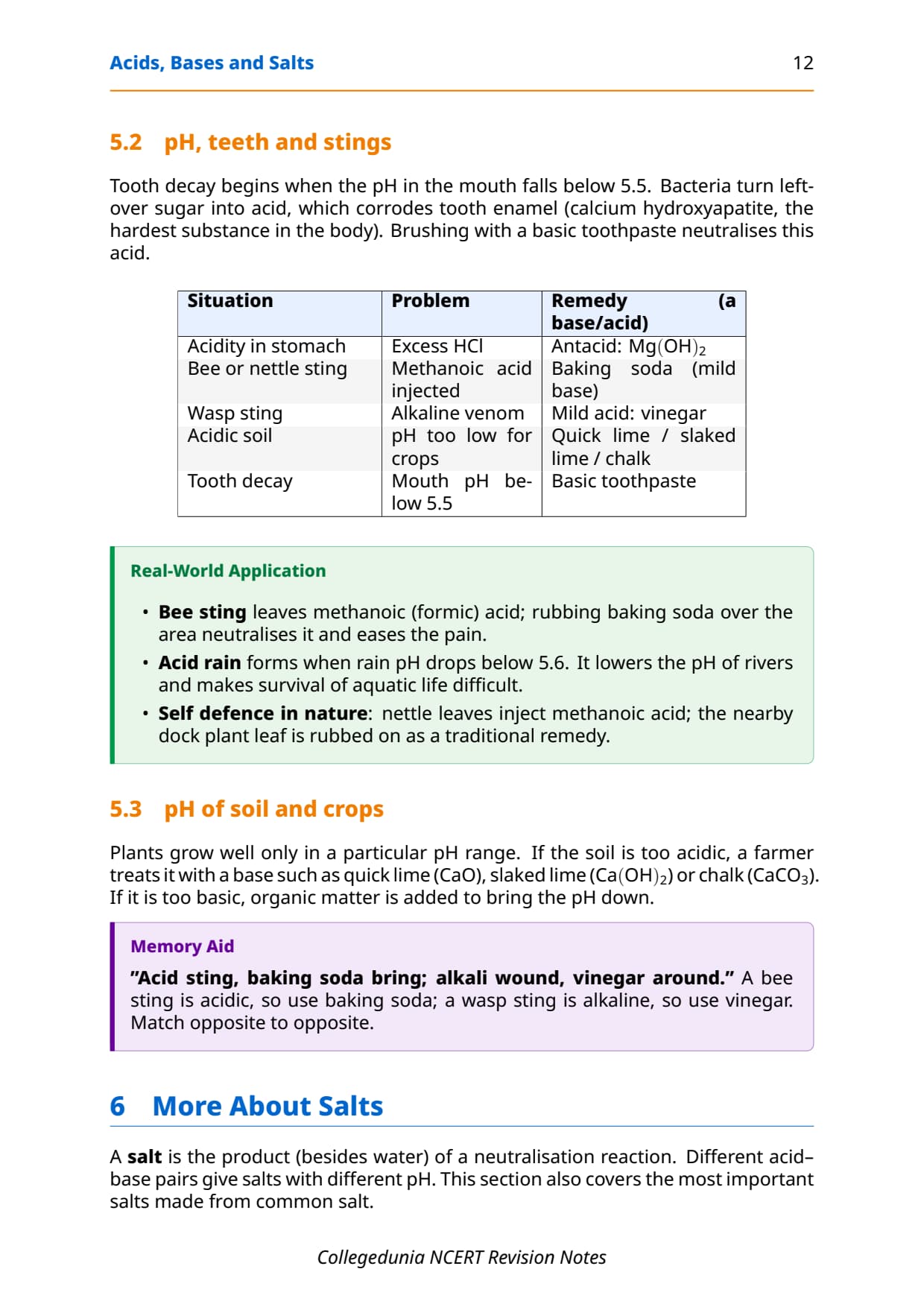
| Situation | Problem | Remedy (a base/acid) |
|---|---|---|
| Acidity in stomach | Excess HCl | Antacid: Mg(OH)2 (milk of magnesia) |
| Bee or nettle sting | Methanoic acid injected | Baking soda (a mild base) |
| Wasp sting | Alkaline venom | Mild acid: vinegar |
| Acidic soil | pH too low for crops | Quick lime / slaked lime / chalk |
| Tooth decay | Mouth pH below 5.5 | Basic toothpaste |
The body works in a narrow pH band (about 7.0 to 7.8). Tooth decay starts below pH 5.5, when bacteria turn sugar into enamel-corroding acid. Acid rain (pH below 5.6) lowers river pH and harms aquatic life.
More About Salts: Common Salt and Its Family
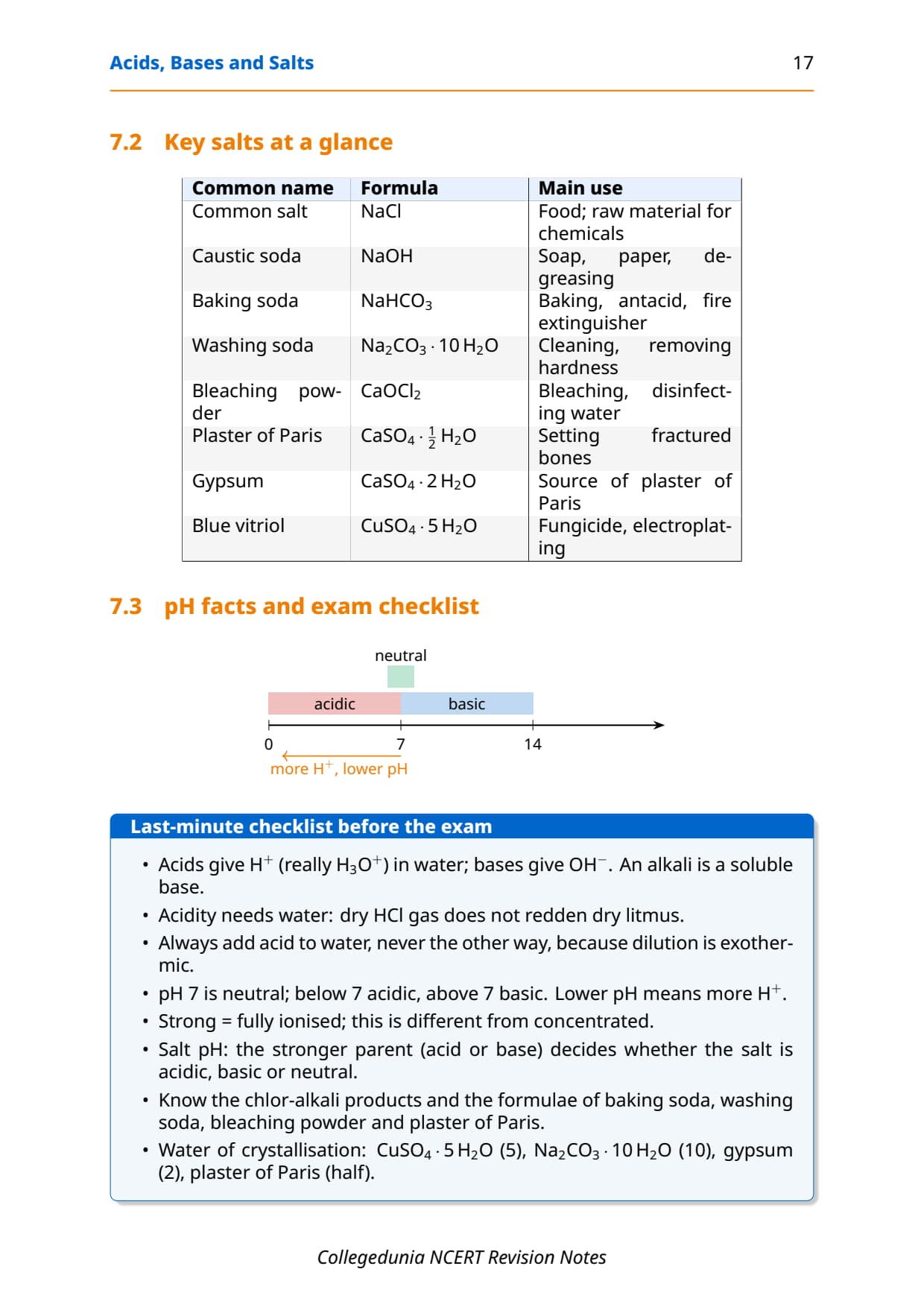
A salt is the product (besides water) of neutralisation. Strong acid + strong base gives a neutral salt (NaCl); strong acid + weak base gives an acidic salt; weak acid + strong base gives a basic salt.
Common salt and the chlor-alkali process
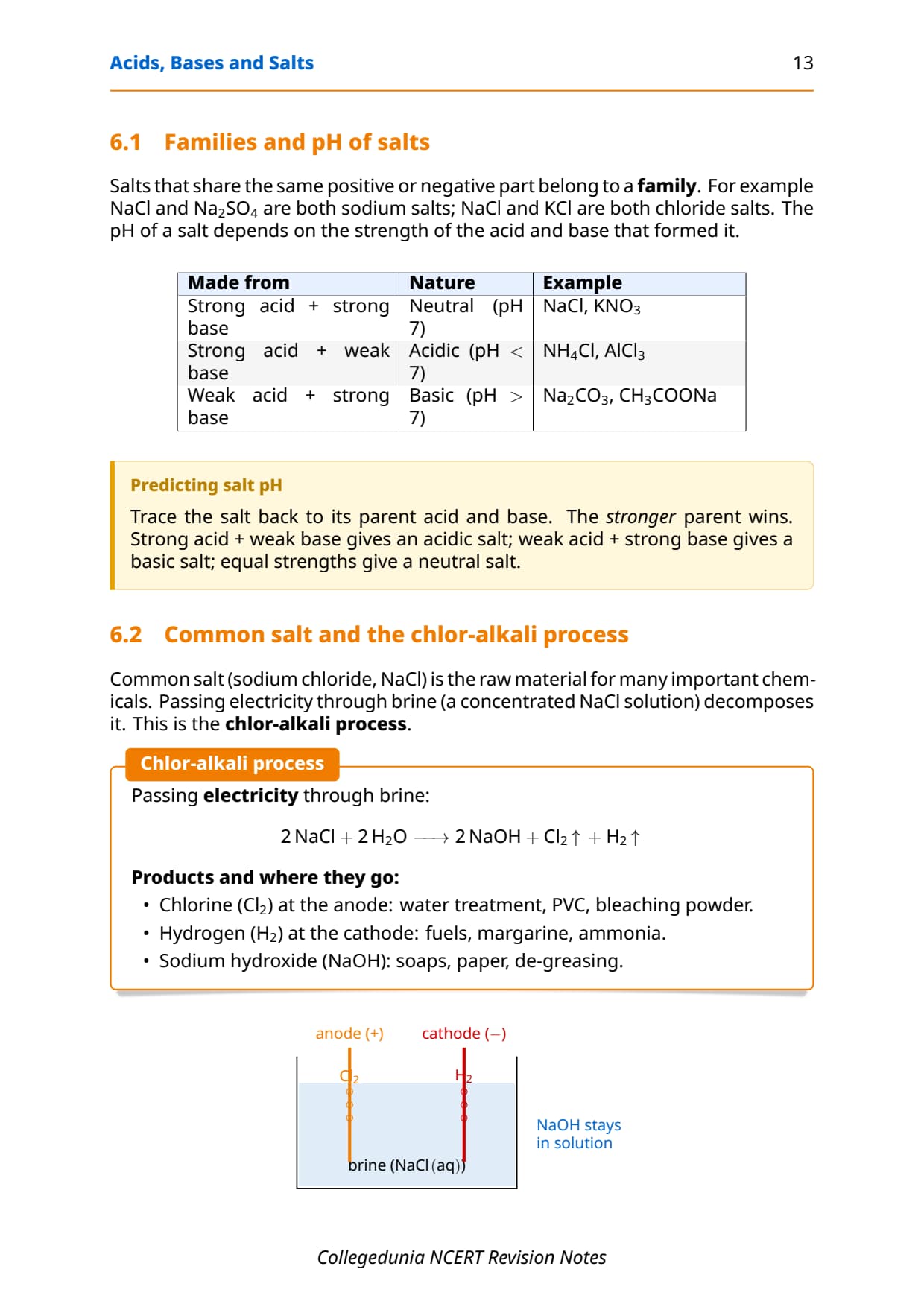
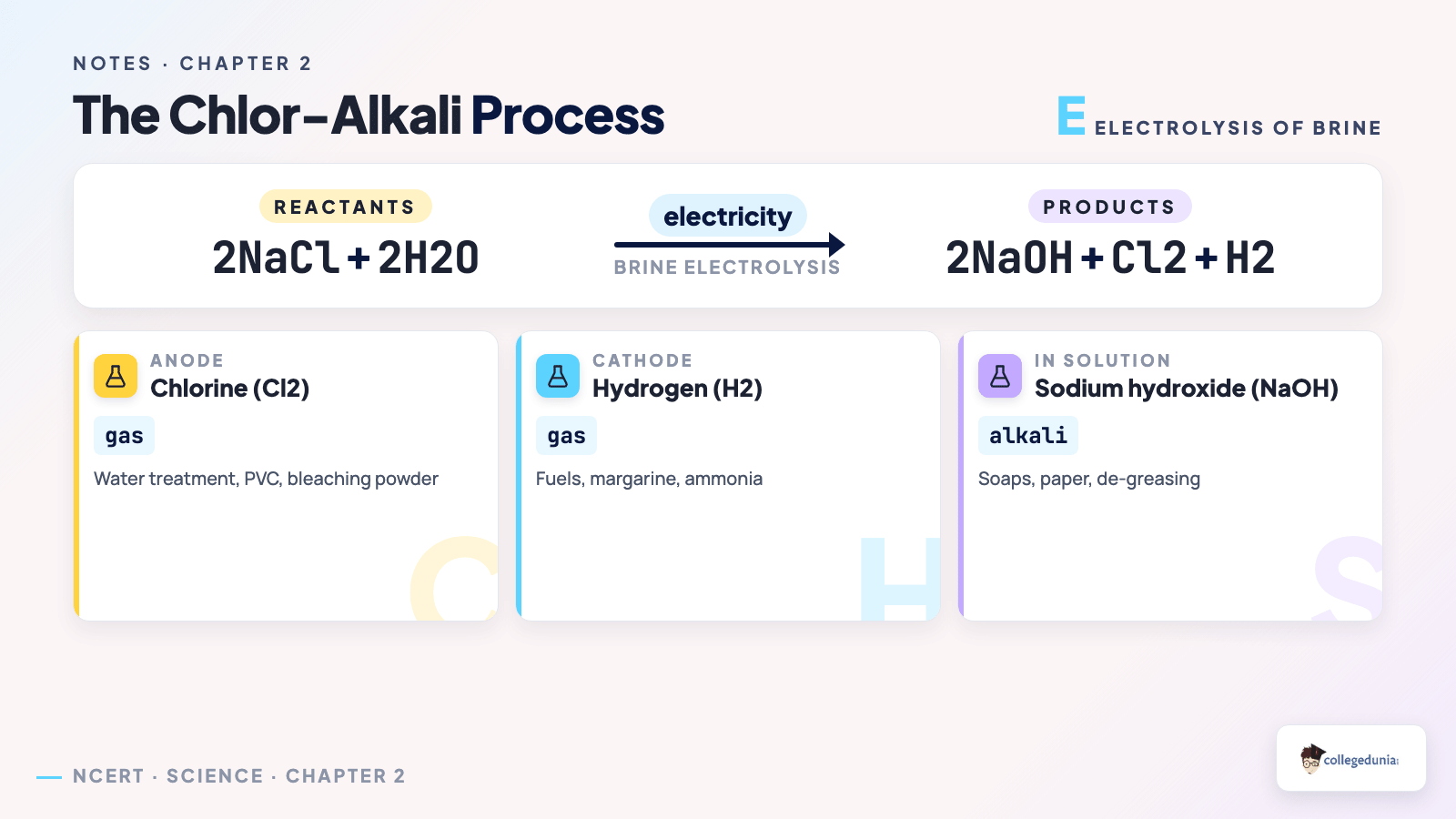
Passing electricity through brine (concentrated NaCl) decomposes it; this is the chlor-alkali process: 2NaCl + 2H2O → 2NaOH + Cl2↑ + H2↑.
- Chlorine (Cl2) at the anode: water treatment, PVC, bleaching powder.
- Hydrogen (H2) at the cathode, and sodium hydroxide (NaOH) in solution: soaps, paper, de-greasing.
Bleaching powder, baking soda and washing soda
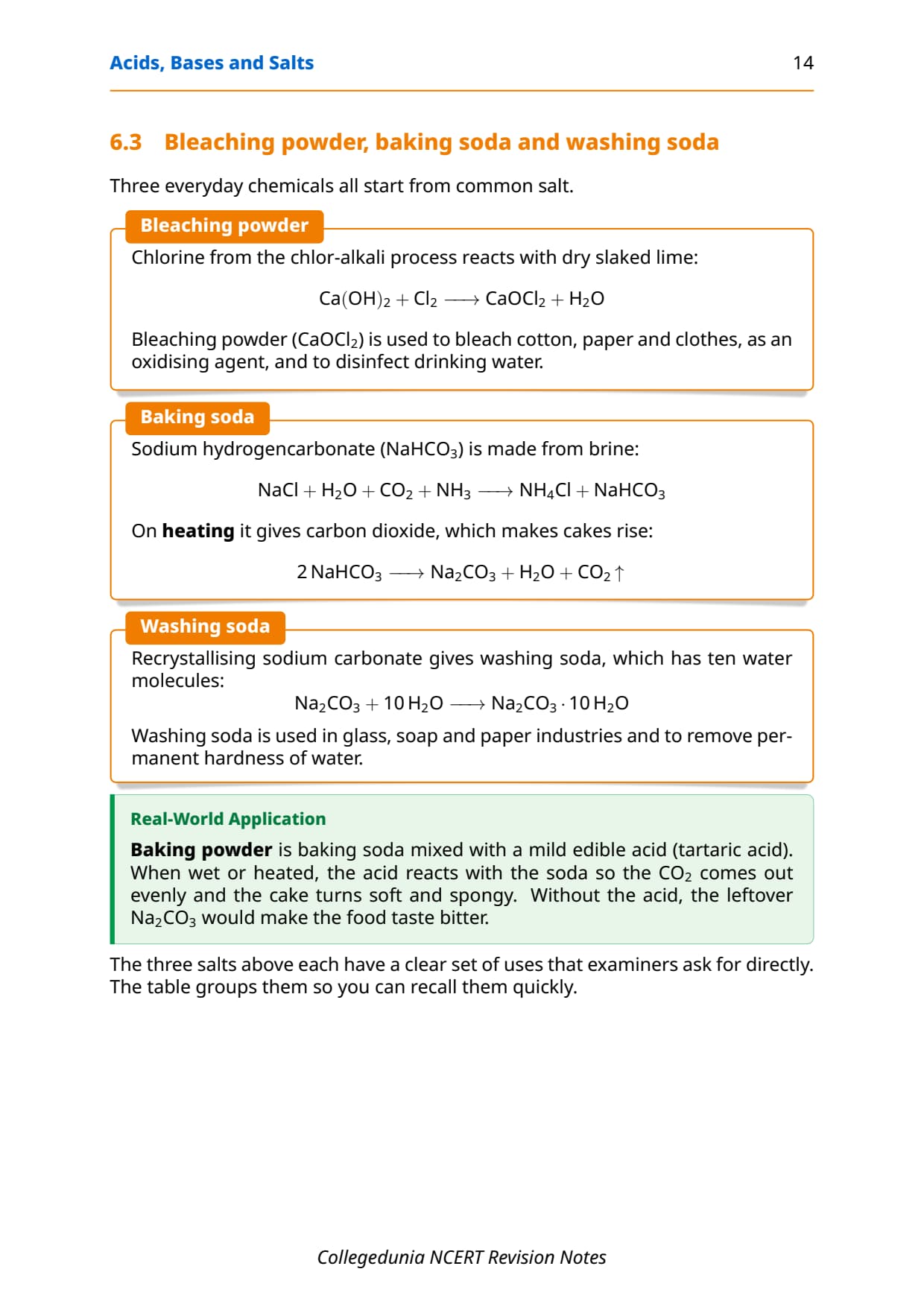
Three everyday chemicals all start from common salt. Learn how each is made and one use each.
Also Check: The full set of CBSE board paper questions for this chapter, with step-by-step answers, is included in the downloadable PDF above, updated for 2026-27.
| Salt | How it is made | Everyday uses |
|---|---|---|
| Bleaching powder (CaOCl2) | Ca(OH)2 + Cl2 → CaOCl2 + H2O | Bleaching cotton and paper, oxidising agent, disinfecting water |
| Baking soda (NaHCO3) | NaCl + H2O + CO2 + NH3 → NH4Cl + NaHCO3 | Baking, antacid, soda-acid fire extinguishers |
| Washing soda (Na2CO3·10H2O) | Recrystallising Na2CO3 with 10 water molecules | Glass, soap and paper industry, removing permanent hardness of water |
On heating, baking soda gives CO2 that makes cakes rise. Baking powder is baking soda plus a mild edible acid (tartaric acid).
Water of crystallisation and plaster of Paris
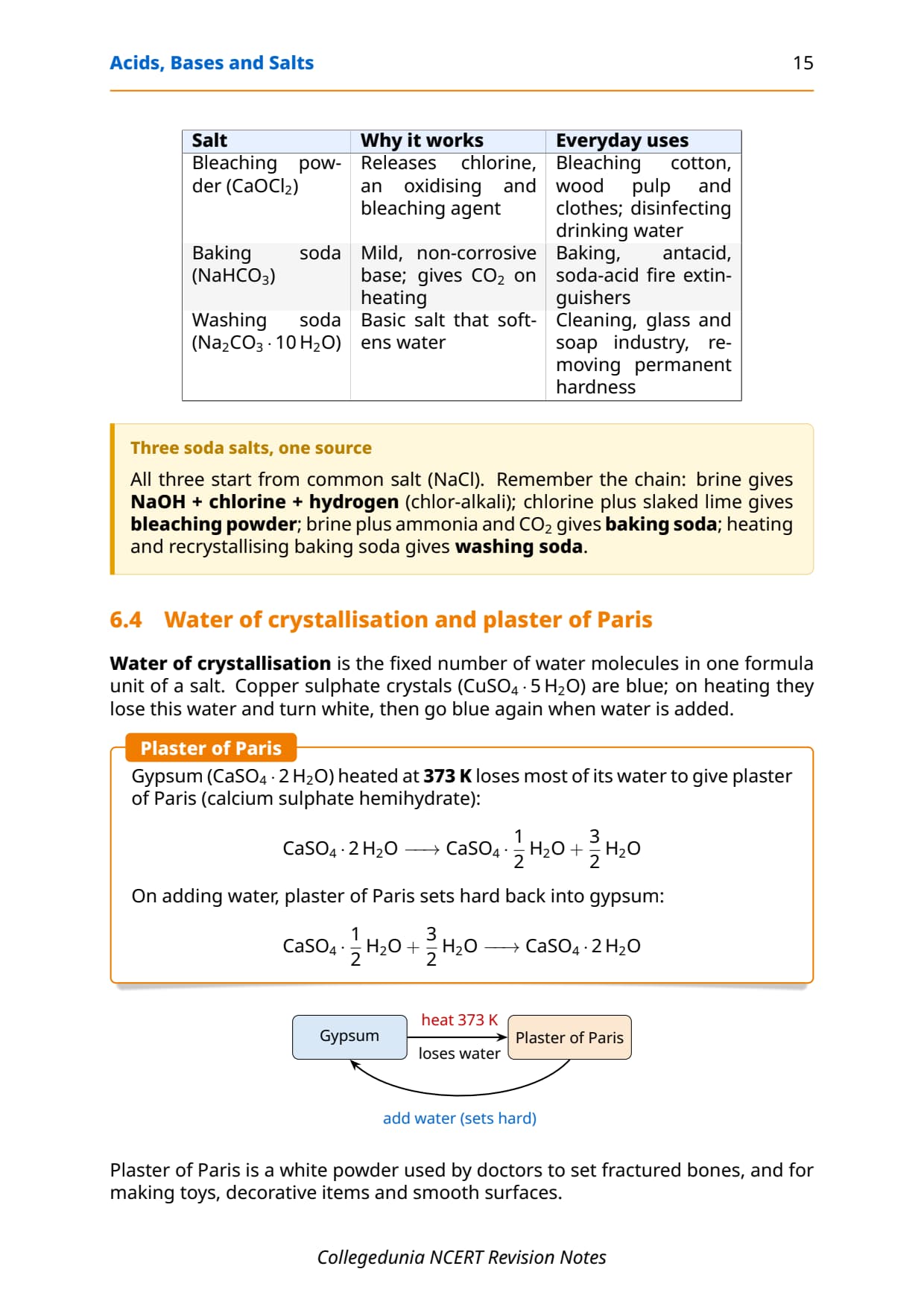
Water of crystallisation is the fixed number of water molecules in one formula unit of a salt. Gypsum (CaSO4·2H2O) heated at 373 K gives plaster of Paris (calcium sulphate hemihydrate), which sets hard back into gypsum with water and is used to set fractured bones.
CaSO4·2H2O → CaSO4·½H2O + 1½H2O
Quick Revision Strip and Common Exam Traps
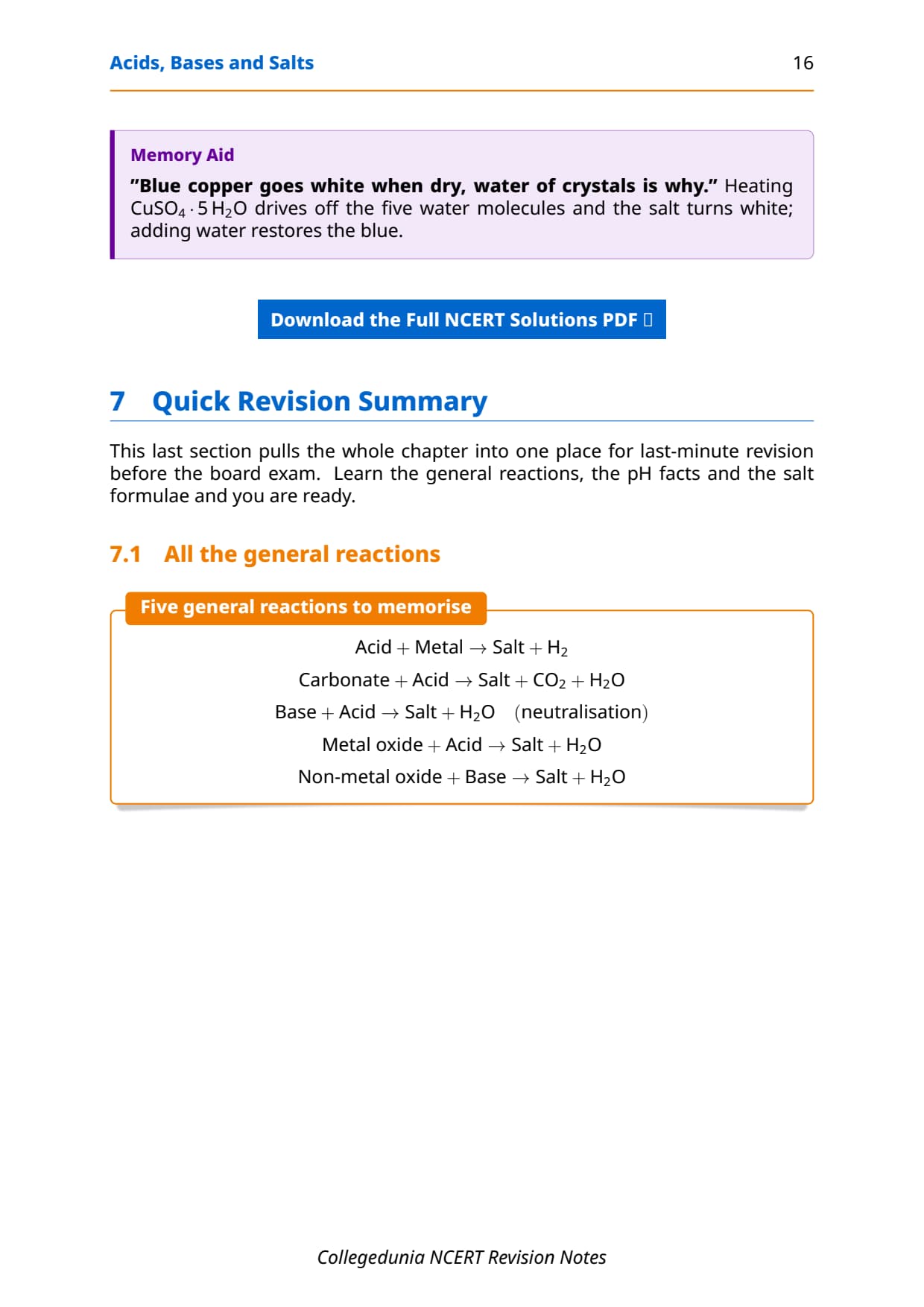
Read this strip in the last minutes before the exam. It lines up the five acid-base reactions with their products.
| Reaction | Products |
|---|---|
| Acid + Metal | Salt + Hydrogen gas (pop test) |
| Acid + Carbonate / Hydrogencarbonate | Salt + CO2 (lime water milky) + Water |
| Acid + Base (neutralisation) | Salt + Water |
| Acid + Metal oxide | Salt + Water |
| Base + Non-metal oxide | Salt + Water |
Other Resources for Class 10 Science Chapter 2 Acids, Bases and Salts
Pair these revision notes with the matching NCERT Solutions, the formula sheet, handwritten notes and the official NCERT book chapter. All resources for Class 10 Science Chapter 2 Acids, Bases and Salts are linked below.
| Resource | What it covers | Open |
|---|---|---|
| Notes | Concept-first revision notes on indicators, the five acid-base reactions, the pH scale, and the family of salts. | You are here |
| NCERT Solutions | Step-by-step answers to all in-text and exercise questions, with an Expert Solution for each. | Class 10 Science Chapter 2 NCERT Solutions |
| Formula Sheet | Quick reference of the must-know reactions, the pH scale and key salt formulae. | Class 10 Science Chapter 2 Formula Sheet |
| Handwritten Notes | Scanned-style handwritten pages for last-minute board revision. | Class 10 Science Chapter 2 Handwritten Notes |
| NCERT Book PDF | Official NCERT Science Chapter 2 Acids, Bases and Salts textbook in PDF form. | Class 10 Science Chapter 2 NCERT Book PDF |
Notes for Class 10 Science: All Chapters
Related Links: Use the table below to open the revision notes for the other chapters of Class 10 Science. Every chapter ships with the same concept-first notes style, full PDF download, and revision FAQ.
| Chapter | Notes link |
|---|---|
| Chapter 1 | Chemical Reactions and Equations Notes |
| Chapter 2 | Acids, Bases and Salts Notes (You are here) |
| Chapter 3 | Metals and Non-metals Notes |
| Chapter 4 | Carbon and its Compounds Notes |
| Chapter 5 | Life Processes Notes |
| Chapter 6 | Control and Coordination Notes |
| Chapter 7 | How do Organisms Reproduce? Notes |
| Chapter 8 | Heredity Notes |
| Chapter 9 | Light - Reflection and Refraction Notes |
| Chapter 10 | The Human Eye and the Colourful World Notes |
| Chapter 11 | Electricity Notes |
| Chapter 12 | Magnetic Effects of Electric Current Notes |
| Chapter 13 | Our Environment Notes |
Notes Class 10 Science Chapter 2 Acids, Bases and Salts FAQs
Ques. What does Chapter 2 Acids, Bases and Salts cover in Class 10 Science?
Ans. Chapter 2 covers how acids and bases behave and how they form salts. The notes explain how indicators such as litmus, methyl orange and phenolphthalein tell acids from bases, the five chemical reactions of acids and bases with metals, carbonates, oxides and each other, and the idea that acids give H+ ions while bases give OH- ions in water. They then cover the pH scale, strong versus weak acids and bases, the importance of pH in everyday life, and the family of salts made from common salt: baking soda, washing soda, bleaching powder and plaster of Paris, all aligned with the 2026-27 CBSE syllabus.
Ques. What is the difference between an acid and a base in Class 10 Science?
Ans. An acid is a substance that gives hydrogen ions (H+) when dissolved in water; it tastes sour and turns blue litmus red. A base is a substance that gives hydroxide ions (OH-) in water; it tastes bitter, feels soapy and turns red litmus blue. A base that dissolves in water, such as NaOH or KOH, is called an alkali. Acids and bases neutralise each other to form a salt and water, and the deep ionic truth behind every neutralisation is H+ plus OH- giving water.
Ques. What is the pH scale and what does it tell us?
Ans. The pH scale is a number line from 0 to 14 that tells how acidic or basic a solution is. A pH of 7 is neutral (pure water), a pH below 7 is acidic, and a pH above 7 is basic. The lower the pH, the more acidic the solution; the higher the pH, the more basic it is. A universal indicator shows a different colour at each pH, so you can read the pH straight off a colour chart. pH measures the hydrogen ion concentration, and each step on the scale is roughly a tenfold change in H+.
Ques. What is the difference between a strong acid and a weak acid?
Ans. A strong acid ionises completely in water and gives many hydrogen ions, for example HCl, H2SO4 and HNO3. A weak acid ionises only partly and gives few hydrogen ions, for example acetic acid and carbonic acid. Strength is about the degree of ionisation, not the concentration: a dilute solution of HCl is still a strong acid because it ionises fully, while concentrated acetic acid is still a weak acid because it ionises only a little. The same idea separates strong bases (NaOH, KOH) from weak bases (NH4OH).
Ques. How are baking soda and washing soda made and used?
Ans. Baking soda is sodium hydrogencarbonate (NaHCO3), made from brine by adding ammonia and carbon dioxide. It is used in cooking, as an antacid, and in soda-acid fire extinguishers; on heating it gives off carbon dioxide that makes cakes rise. Washing soda is sodium carbonate with ten water molecules (Na2CO3·10H2O), made by recrystallising sodium carbonate. It is used in the glass, soap and paper industries and to remove the permanent hardness of water. Both salts trace back to common salt through the chlor-alkali chain.
Ques. What is the chlor-alkali process in Class 10 Science?
Ans. The chlor-alkali process is the decomposition of brine (a concentrated solution of common salt, NaCl) by passing electricity through it. The reaction is 2NaCl + 2H2O giving 2NaOH + Cl2 + H2. It is called chlor-alkali because it produces chlorine and the alkali sodium hydroxide. Chlorine collects at the anode and is used in water treatment, PVC and bleaching powder; hydrogen collects at the cathode and is used in fuels and margarine; sodium hydroxide stays in solution and is used in soaps, paper and de-greasing.
Ques. How many pages is the Class 10 Science Acids, Bases and Salts Notes PDF?
Ans. The Acids, Bases and Salts Notes PDF runs about 20 to 22 pages and covers the full chapter in concept-first revision blocks, with balanced equations, an indicator colour table, the pH scale, comparison tables, common-mistake boxes and a one-glance revision strip of the five acid-base reactions. The PDF is free to download for the 2026-27 session, and a green Handwritten Notes button on this page opens the scanned-style version for last-minute revision.
Ques. Are these Notes for Class 10 Science Chapter 2 aligned with the 2026-27 syllabus?
Ans. Yes. This page reflects the current 2026-27 CBSE syllabus for Class 10 Science. The Acids, Bases and Salts chapter is unchanged for the current cycle, and these notes follow the NCERT textbook, covering indicators, the chemical properties of acids and bases, what acids and bases have in common, the pH scale, the importance of pH in everyday life, and the family of salts. The notes are written for the CBSE board exam, with the high-frequency question types and marking-scheme habits highlighted throughout.



Comments