




These Notes for Class 10 Maths Chapter 9 Some Applications of Trigonometry give you a quick, concept-first revision of the whole chapter. It uses the trigonometric ratios from Chapter 8 to find heights and distances you cannot measure directly: how tall a tower is, how far a ship has sailed, or how high a kite is flying.
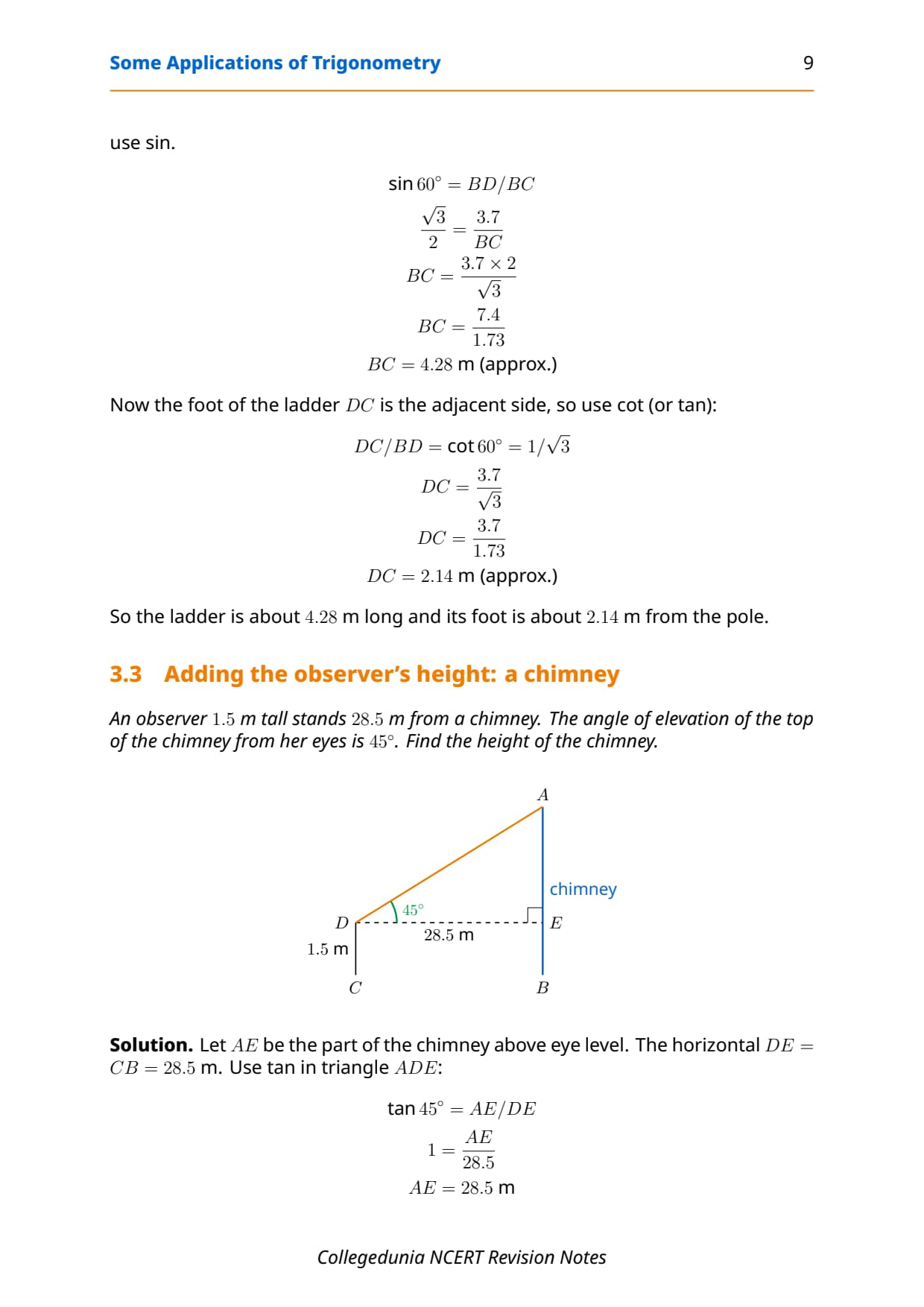
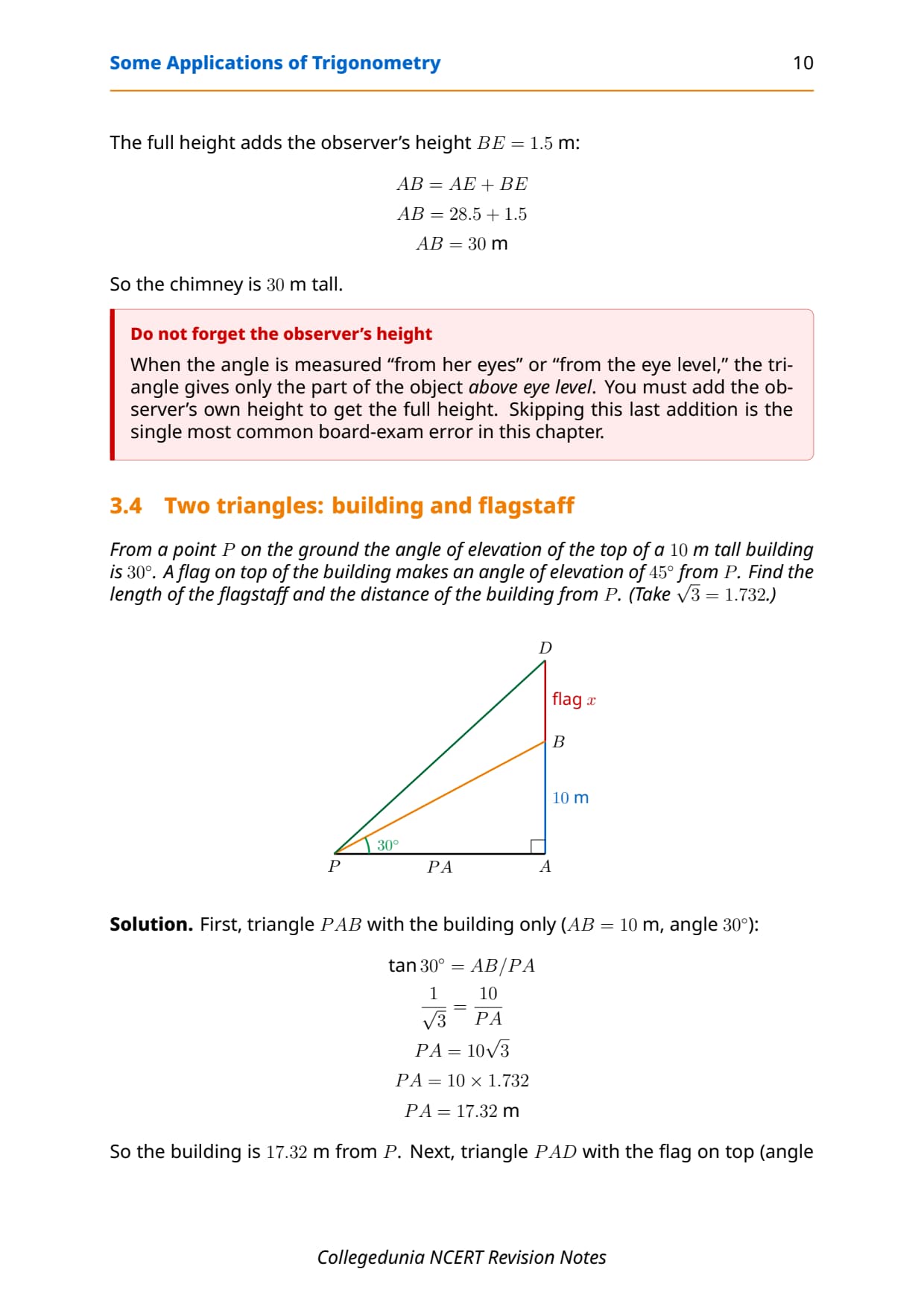
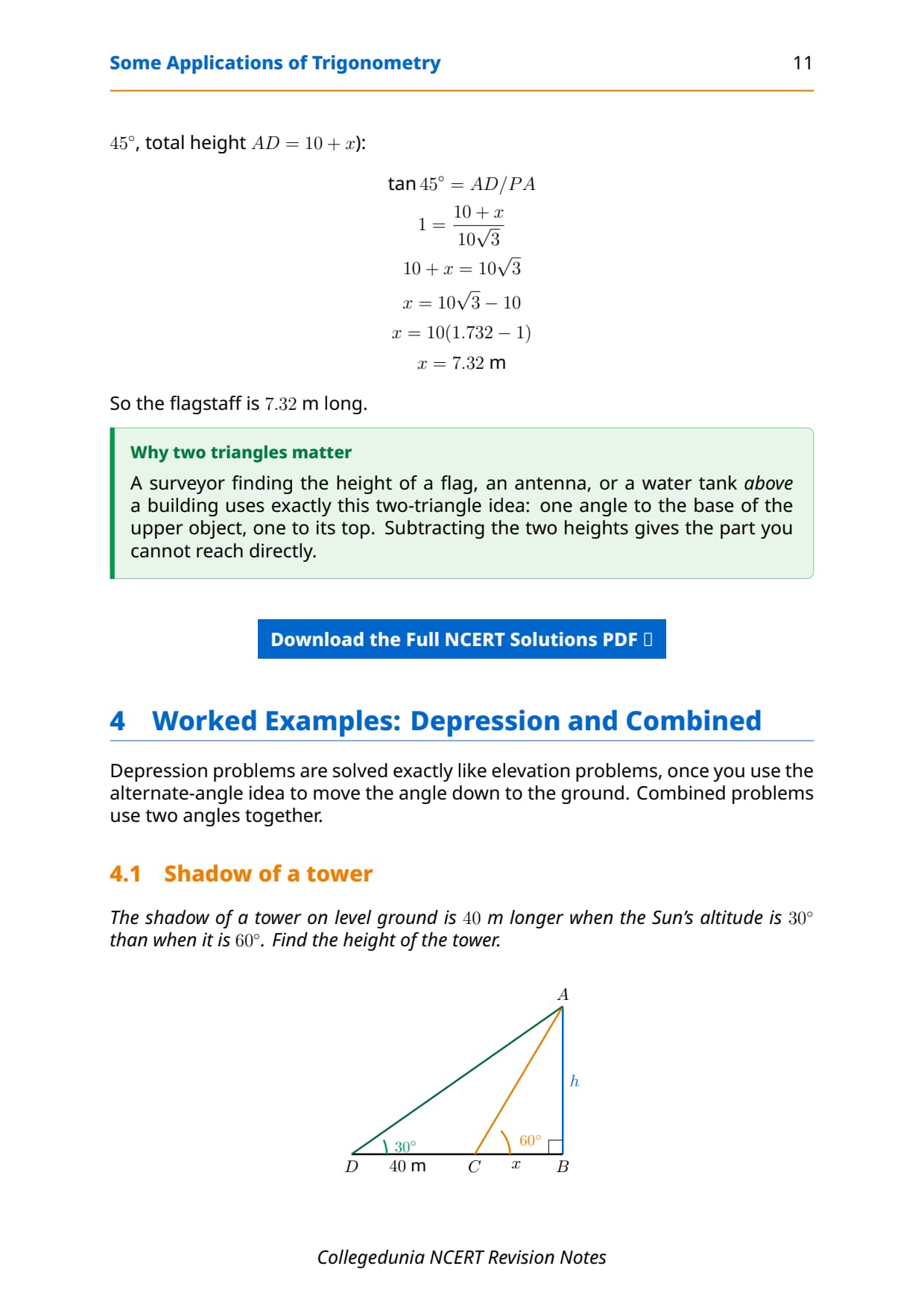
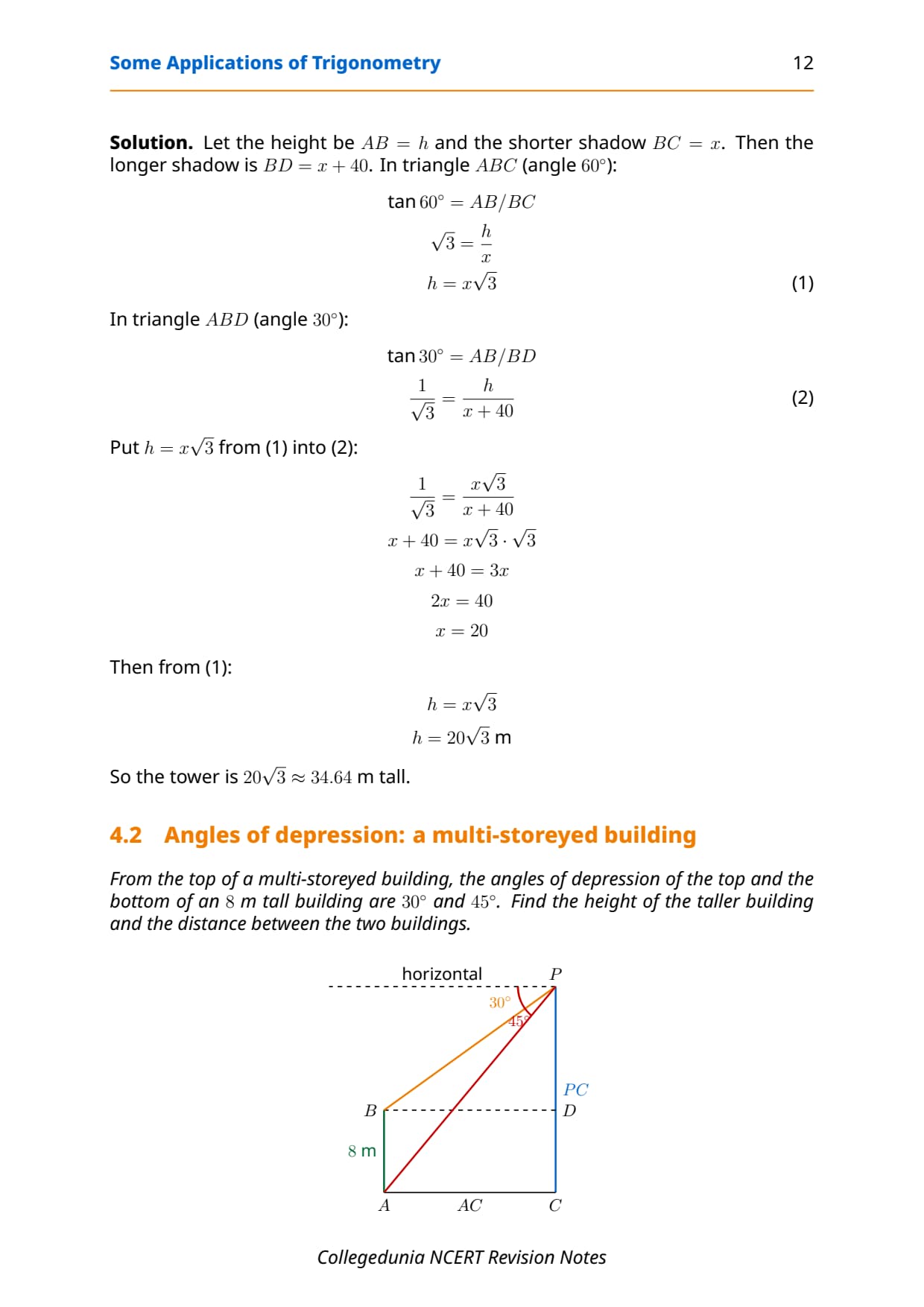
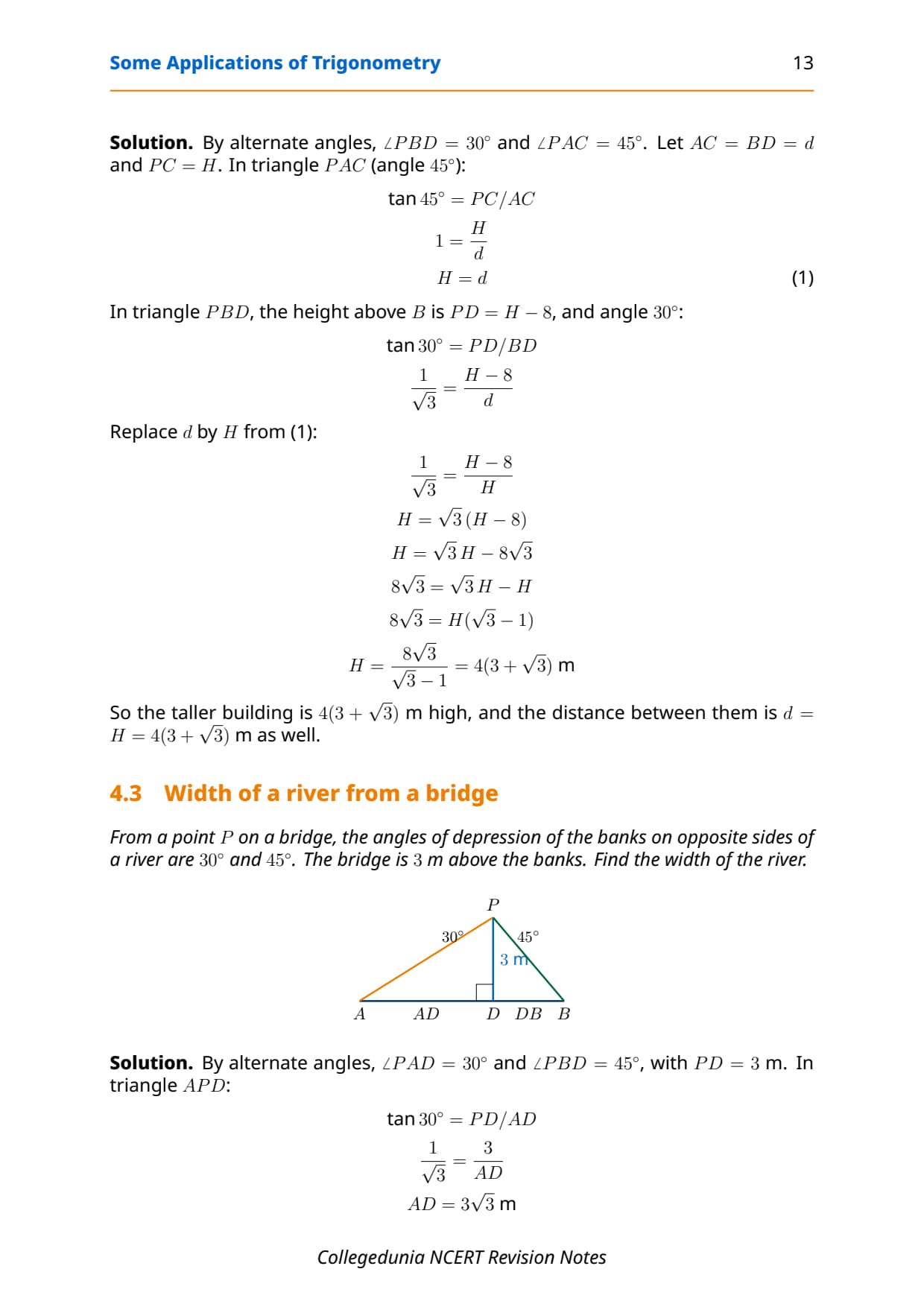
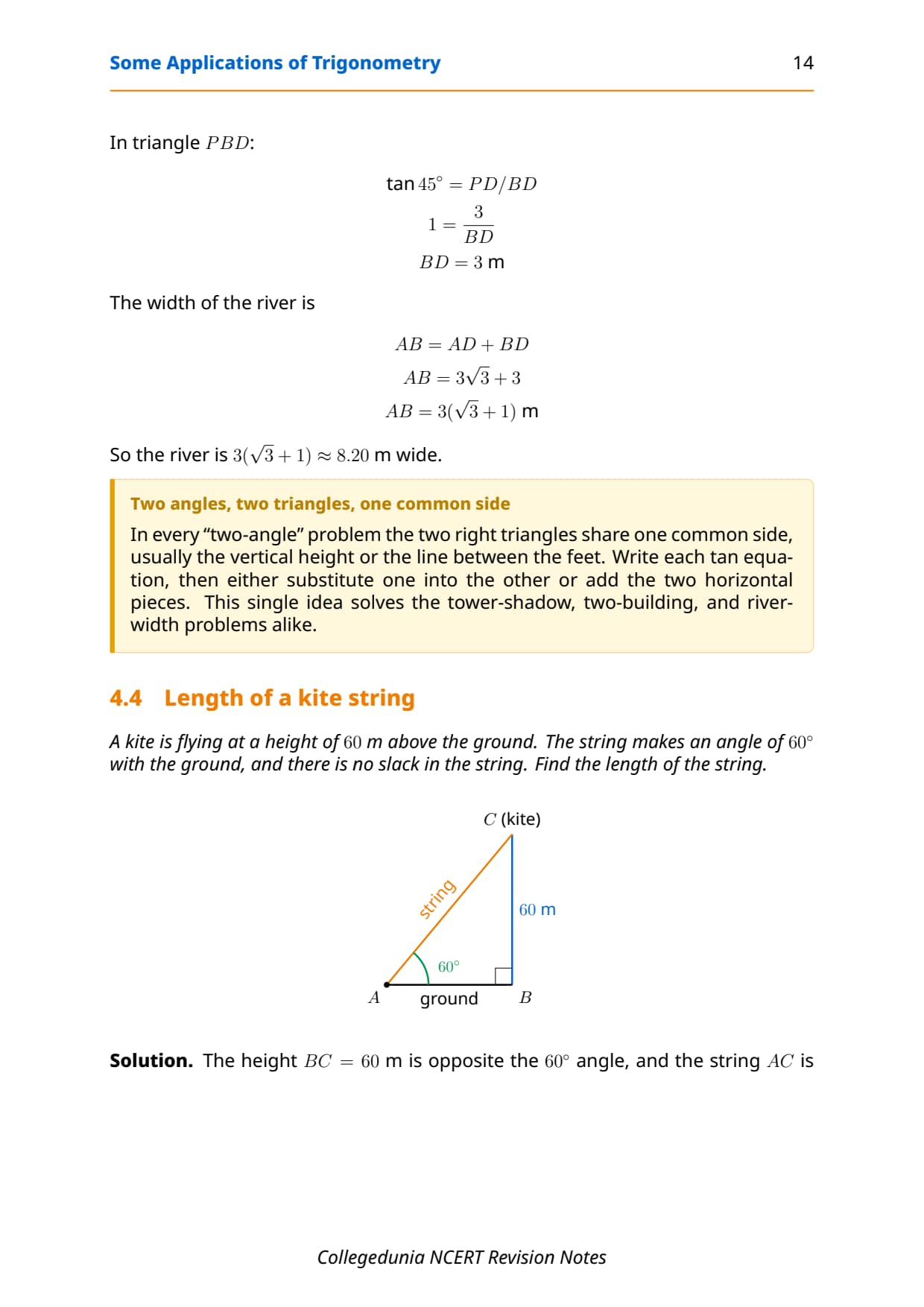
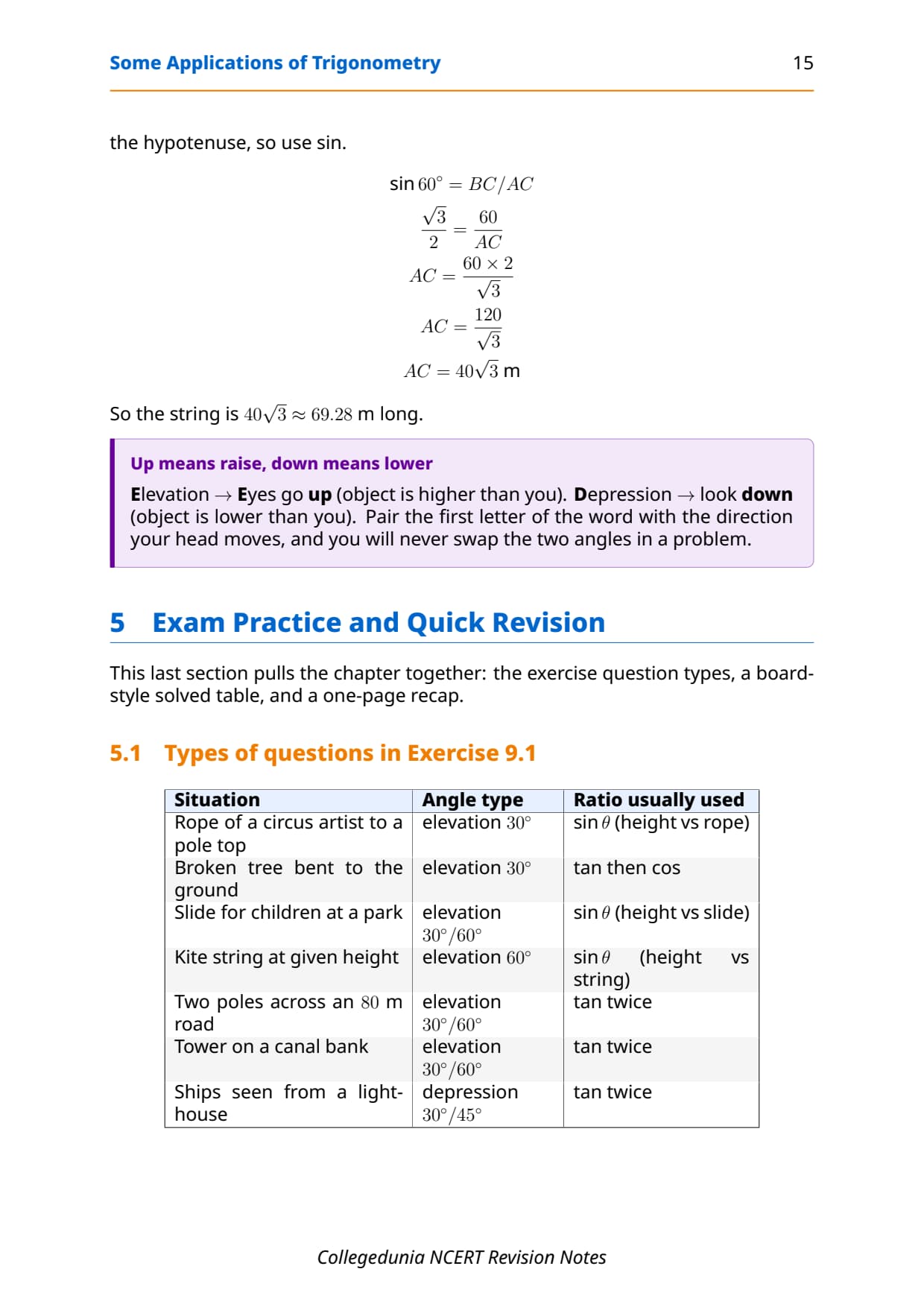
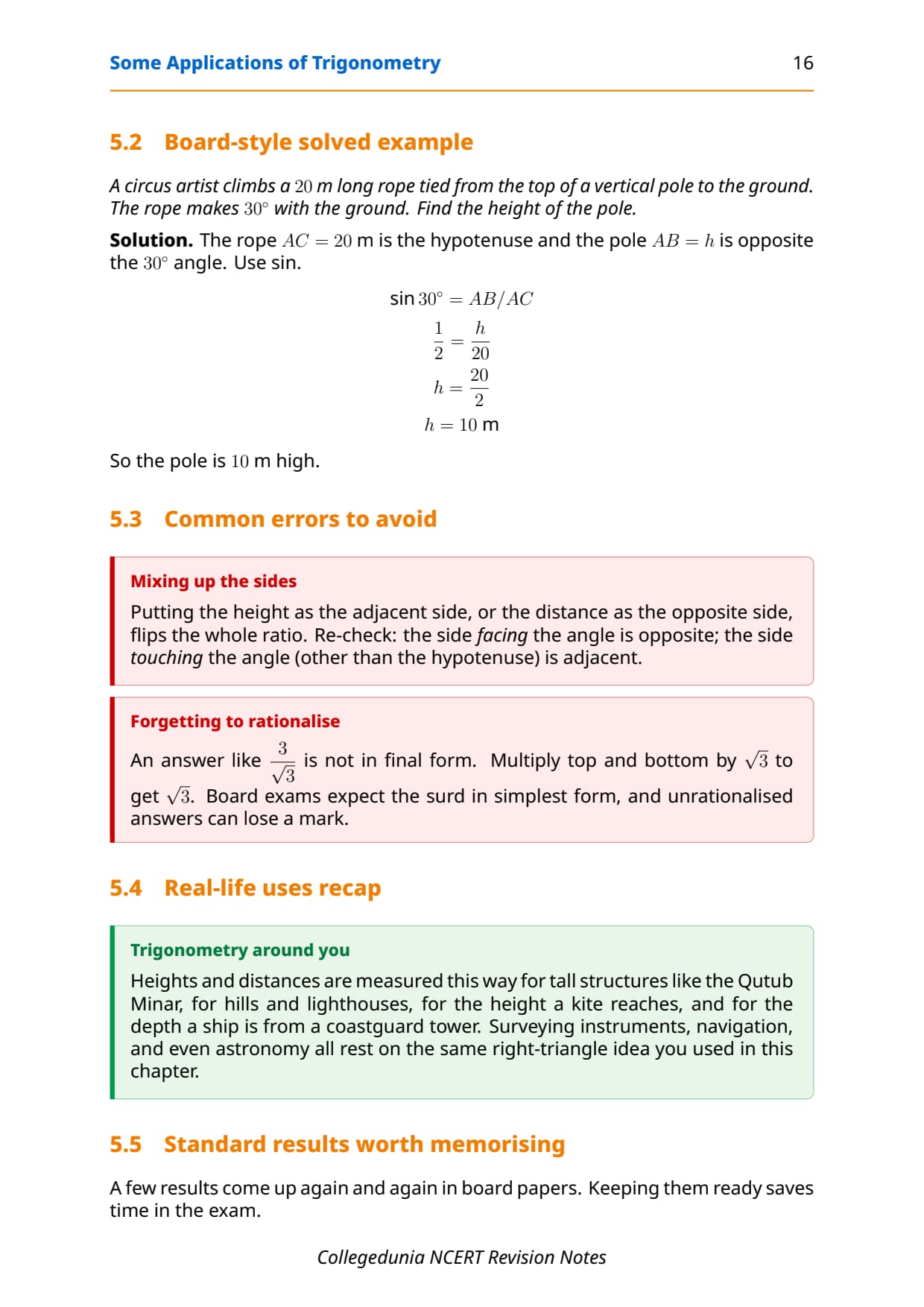
- Angle of elevation and angle of depression made clear, with diagrams, solved examples, and a step-by-step method for every board problem type.
- Full coverage of how to turn a word problem into a right-angled triangle, pick the correct ratio, and solve for the unknown.
- Aligned to the 2026-27 CBSE syllabus and written to help you score full marks in the heights and distances section.
These Collegedunia revision notes are curated by Maths subject experts, according to the 2026-27 NCERT textbook, and refined against the last five years of CBSE Class 10 Maths board papers.
Student Feedback: What 8,400 students told us about this chapter
72% of Class 10 students said drawing a clear diagram and labelling the angle of elevation or depression first was the most useful habit. The correct ratio becomes obvious once the triangle is on paper. 3 out of 4 students who lost marks here picked the wrong ratio, not the wrong arithmetic.
Top scorers said the chapter has only one real skill: turning a word problem into a right-angled triangle, then applying tan, sin, or cos. Students who treated each question as words to diagram to equation finished faster and made fewer mistakes.
Source: 2026-27 Class 10 Maths student poll, 8,400 students from CBSE schools in 12 states, before the 2026 boards.
|
Table of Contents |
Watch Applications of Trigonometry Class 10 Maths Explained
Source: Magnet Brains on YouTube
What These Notes Cover
Chapter 8 taught the trigonometric ratios; Chapter 9 uses them to find heights and distances you cannot measure directly. A lighthouse, a kite, a flagpole, a river's width: all can be measured from afar using a known base and an observed angle.
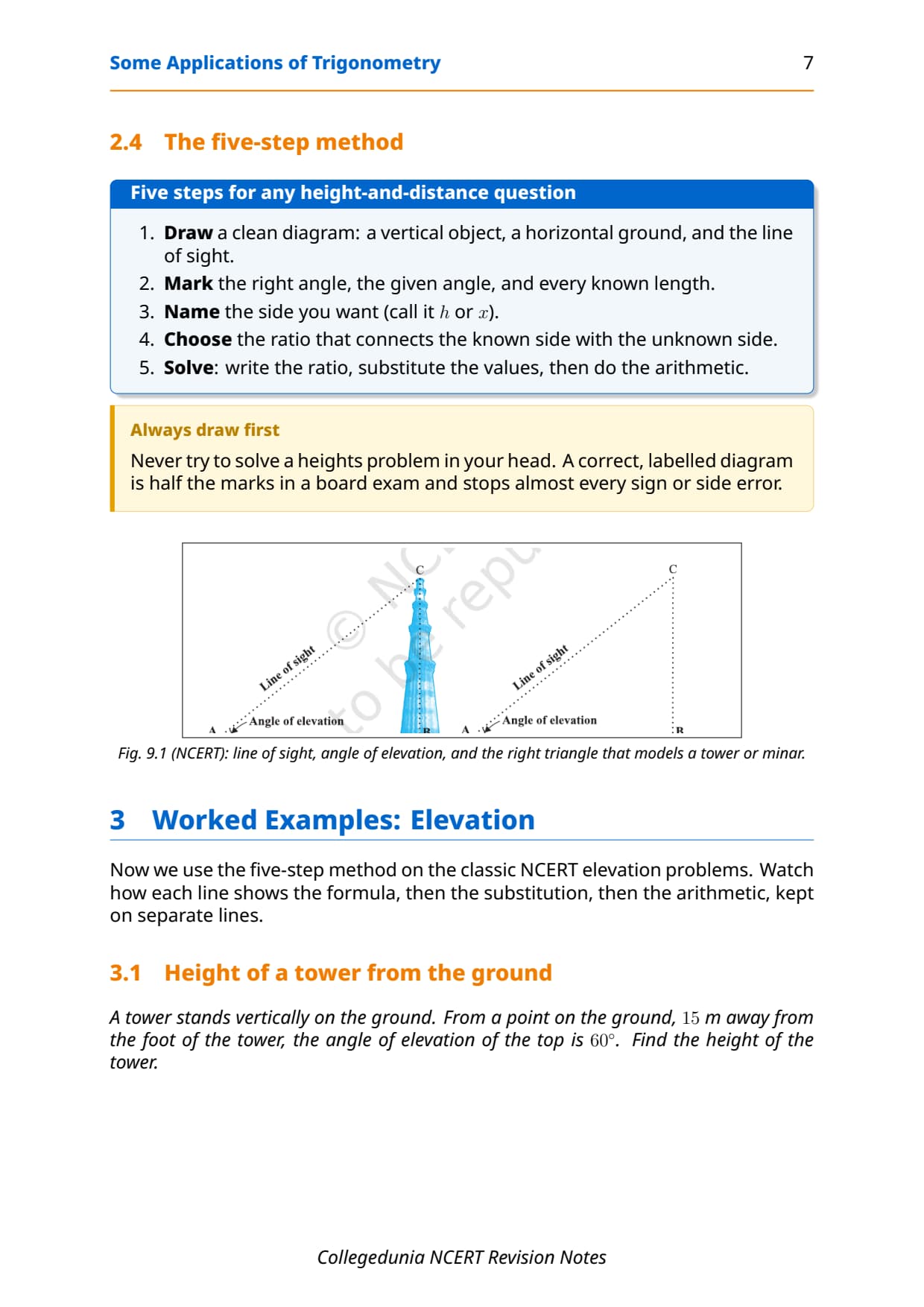
- Angle of elevation: the angle you look up through, from the horizontal to an object above.
- Angle of depression: the angle you look down through to an object below (say, from a cliff).
- Single-triangle problems: one observer, one object. Draw the triangle, mark the sides, apply the right ratio.
- Two-angle problems: two angles from one or two positions. Form two equations and solve together.
The whole chapter rests on one skill: turning a word description into a right-angled triangle, then reading off the right ratio.
Angle of Elevation and Angle of Depression
These two terms set up almost every problem in the chapter.
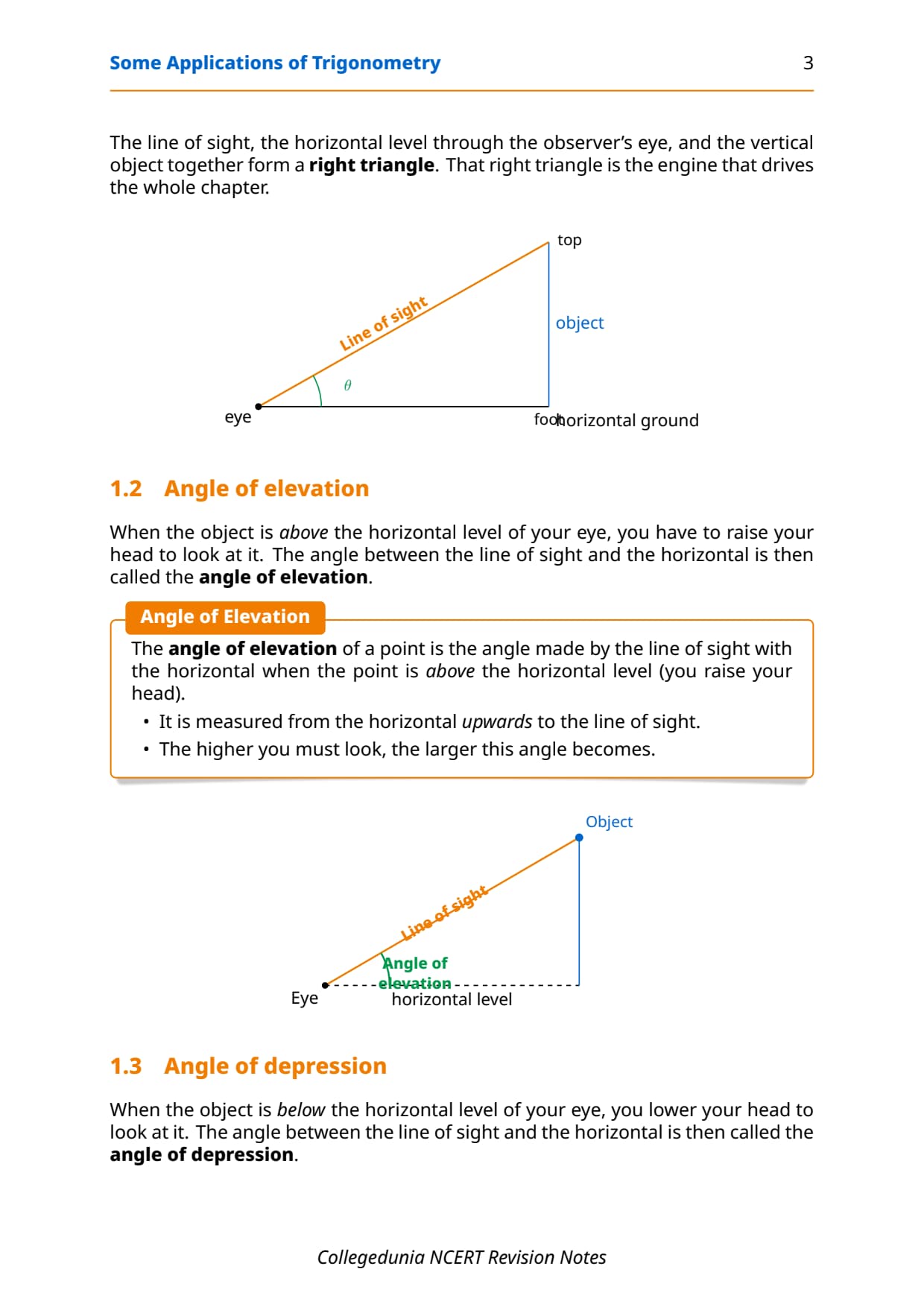
Angle of elevation
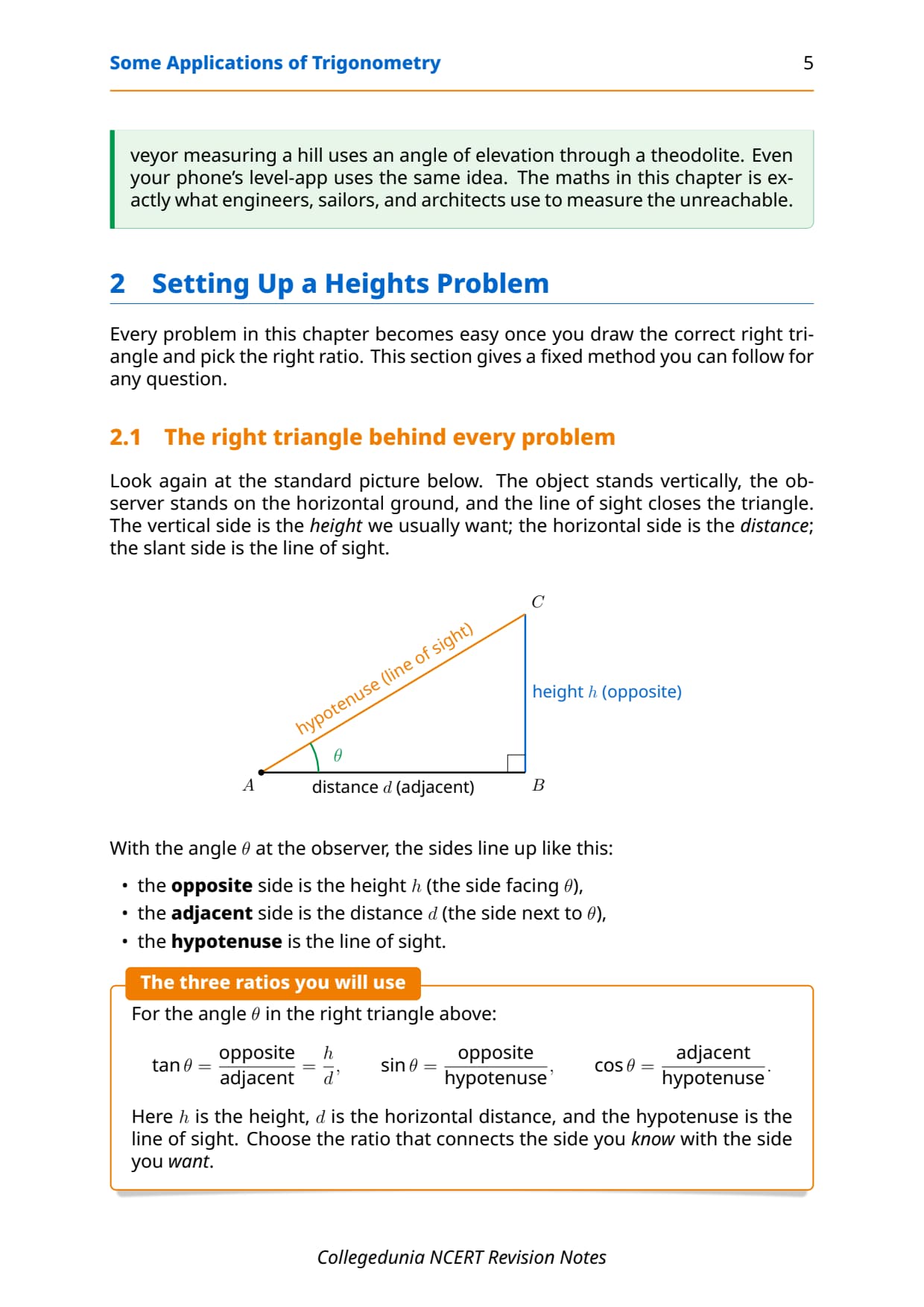
Stand at O and look up at an object P. The angle of elevation is the angle θ between the horizontal at O and the line of sight OP. In the right-angled triangle, the height is the opposite side, the distance is the adjacent side, and the line of sight is the hypotenuse. So tan(angle of elevation) = height / horizontal distance, which fits most problems because height and distance are the usual givens.
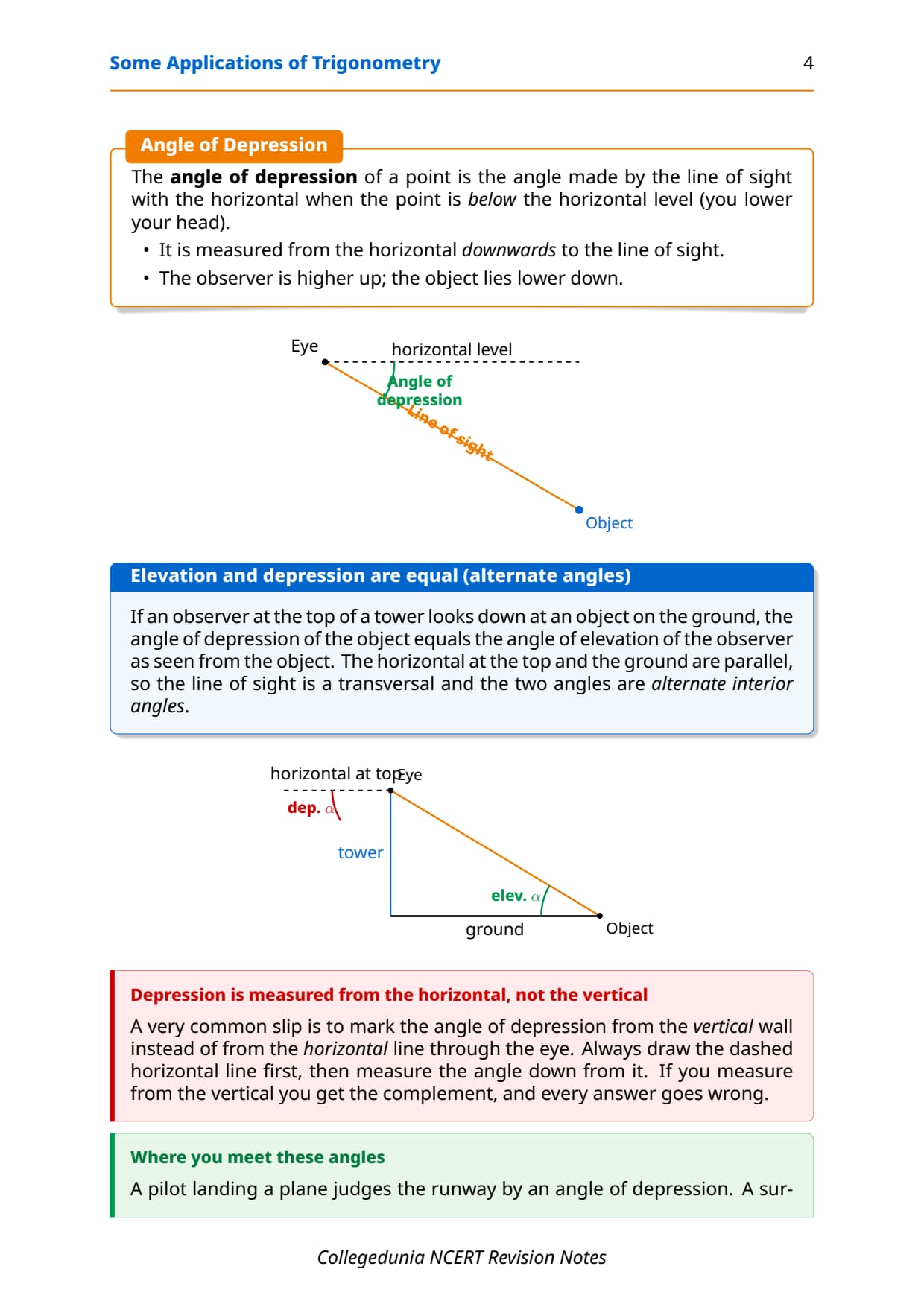
Angle of depression
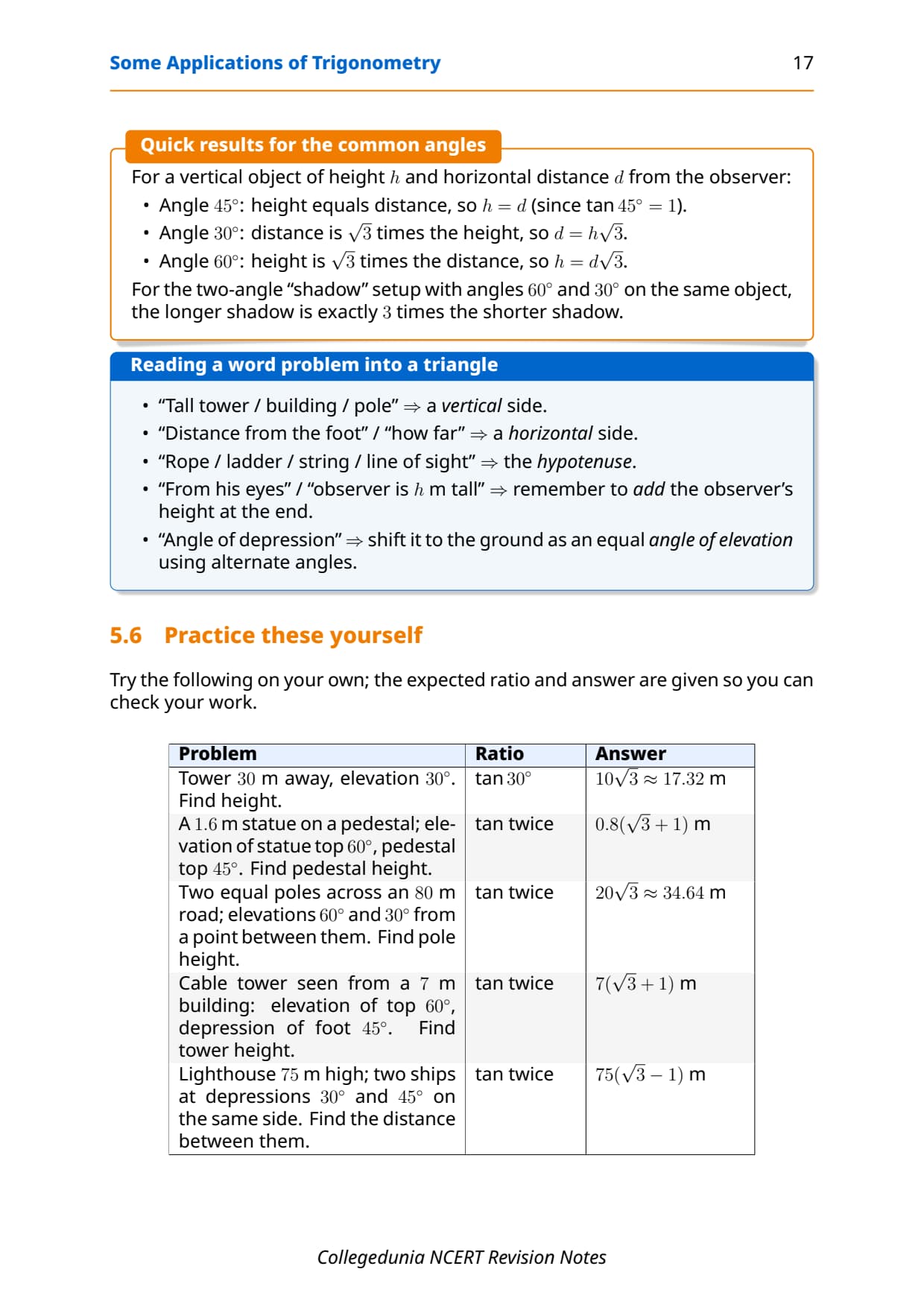
Now stand on a cliff at P and look down at an object O below. The angle of depression is the angle between the horizontal at P and the line of sight PO. Key fact: the angle of depression from P to O equals the angle of elevation from O to P (alternate interior angles), so you can swap between them and use the same triangle and ratio.
Setting Up a Heights and Distances Problem
Every problem follows the same five steps. Practise them until they are automatic.
| Step | What to do |
|---|---|
| Step 1 | Read the problem. Spot the observer, the object, and the angle type (elevation or depression). |
| Step 2 | Draw a diagram: observer at one vertex, object at the top of the vertical, base below. Most marks are saved here. |
| Step 3 | Label the known side (a height or distance) and mark the angle θ at the observer. |
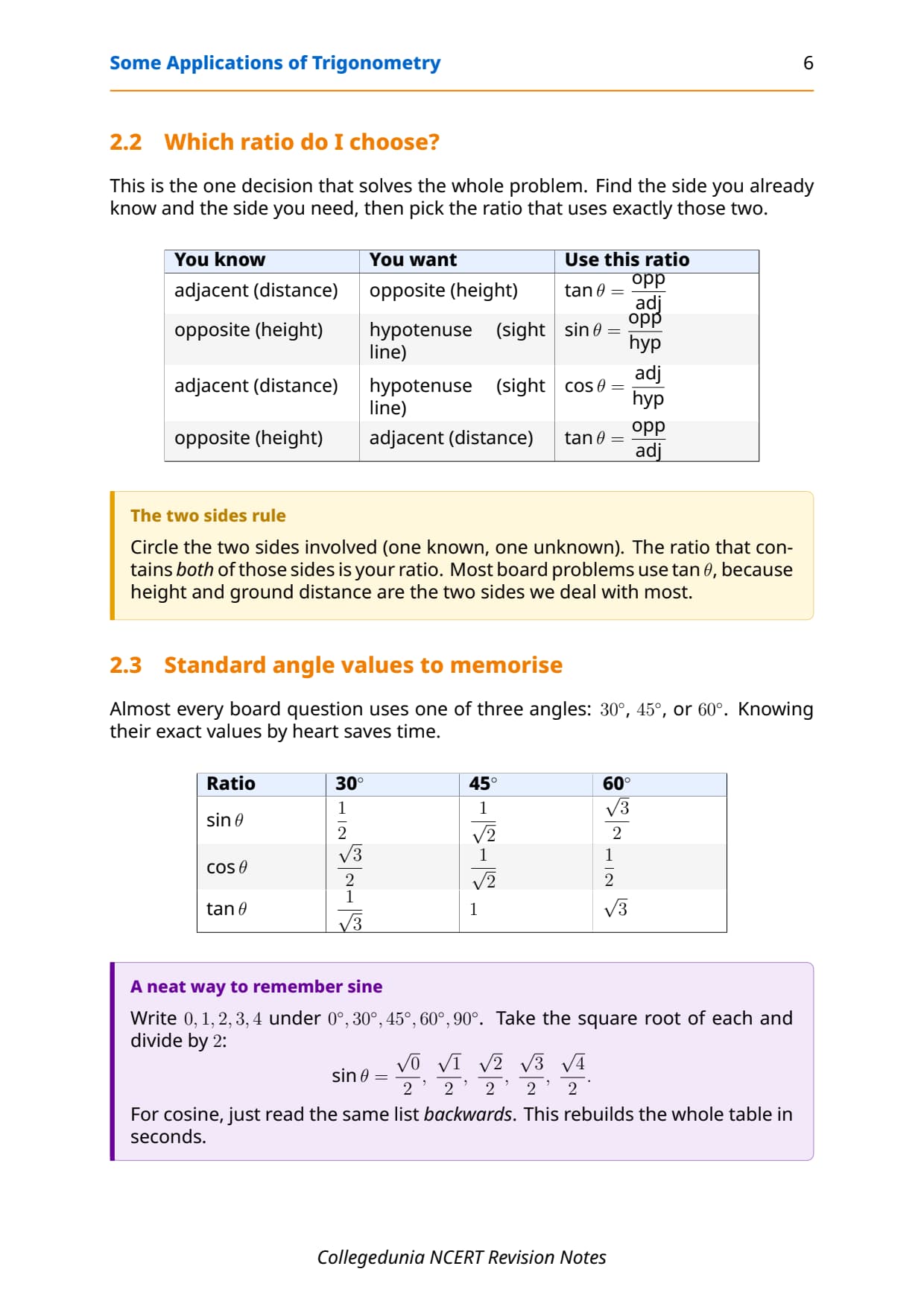
| Step 4 | Find the unknown side and pick the ratio: tan for opposite/adjacent, sin for opposite/hypotenuse, cos for adjacent/hypotenuse. |
| Step 5 | Substitute the standard angle value, solve, simplify, and add units. |
tan θ = opposite / adjacent is used most, because height and distance are exactly the opposite and adjacent sides. When in doubt, use tan first.
Key Trigonometric Ratios
This chapter uses the standard values from Chapter 8. Board problems mostly use 30°, 45°, and 60°, which give clean surds.
| Angle θ | tan θ | sin θ | cos θ | When it shows up |
|---|---|---|---|---|
| 30° | 1 / √3 | 1/2 | √3/2 | Low angles; longer distances |
| 45° | 1 | 1/√2 | 1/√2 | Height equals distance; clean symmetry |
| 60° | √3 | √3/2 | 1/2 | Steep angles; taller objects, shorter distances |
At 45°, tan 45° = 1, so height = distance, the fastest sum with no surds. At 60°, height = d√3. At 30°, height = d/√3 = d√3/3 after rationalising.
Solved Examples: Heights and Distances
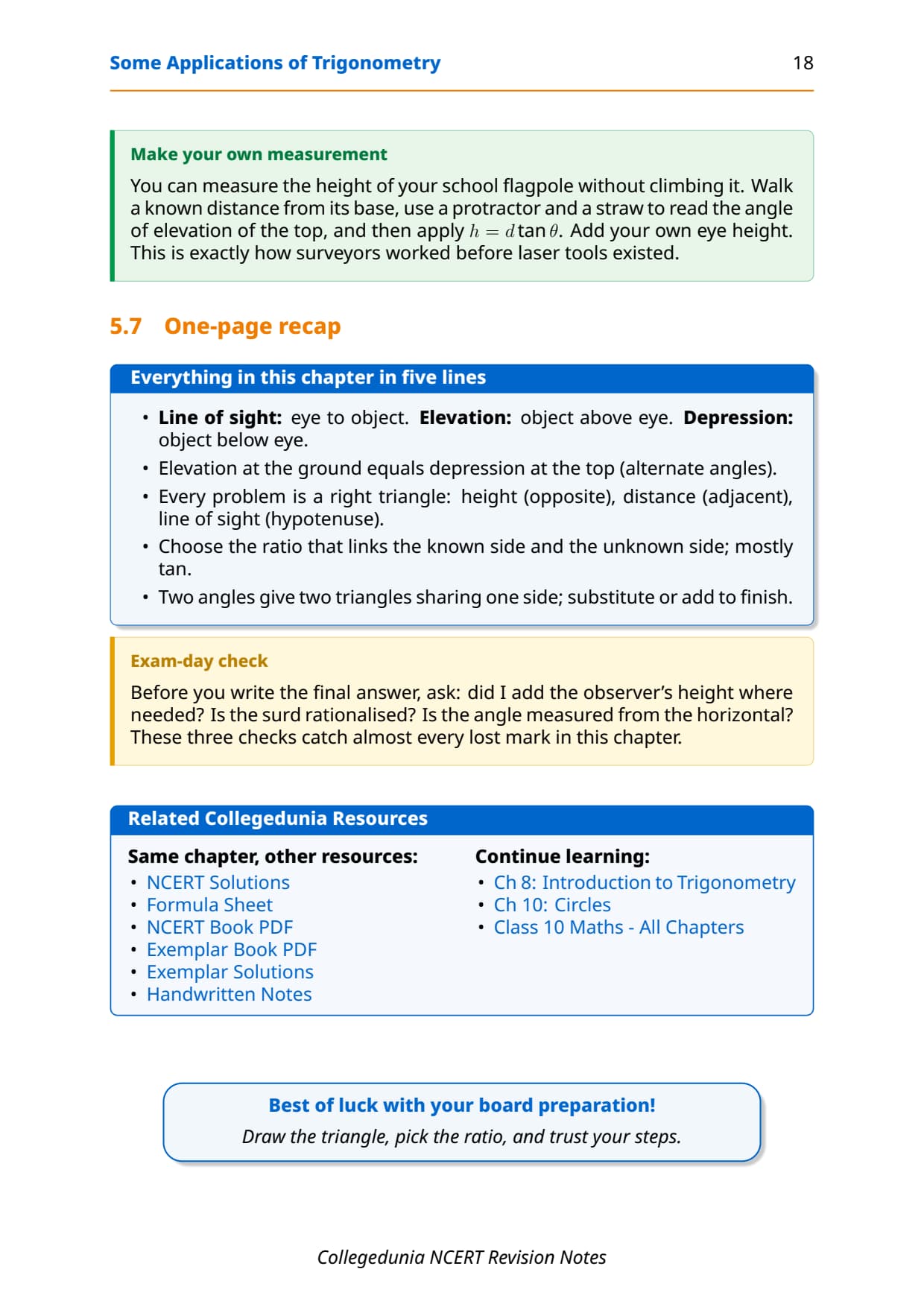
These cover the main board types: single-angle elevation, depression from a height, and the two-angle walking problem. Try each with the five-step setup first.
Example 1: Height of a tower (single angle)
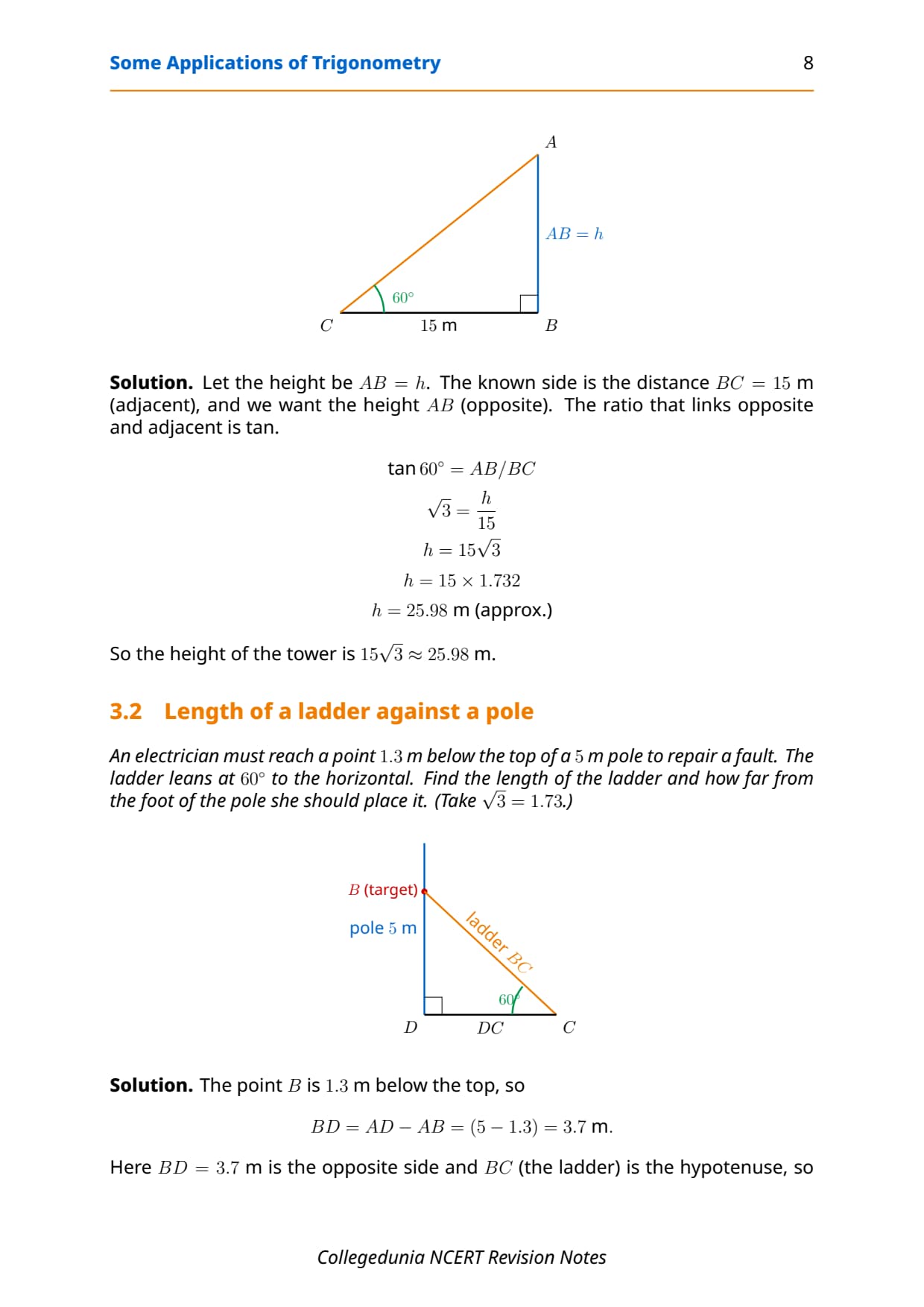
Problem: From a point 50 m from a tower's base, the angle of elevation of the top is 60°. Find the height.
Solution: Let the height be h. tan 60° = h / 50, so √3 = h / 50, giving h = 50√3 m.
Answer: The height of the tower is 50√3 m (about 86.6 m).
Example 2: Distance from the base (angle of depression)
Problem: From the top of a 75 m lighthouse, the angle of depression of a ship is 30°. How far is the ship from the base?
Solution: By alternate angles, the elevation from the ship is also 30°. With d the horizontal distance, tan 30° = 75 / d, so 1/√3 = 75 / d, giving d = 75√3 m.
Answer: The ship is 75√3 m (about 129.9 m) from the base.
Example 3: Two-angle problem (observer walks closer)
Problem: From a point P, the angle of elevation of a building's top is 30°. After walking 20 m toward it, the angle becomes 60°. Find the height.
Solution: Let the height be h and the distance to the nearer point Q be x, so P is (x + 20) away.
From P: tan 30° = h / (x + 20), so h = (x + 20)/√3 ... (i). From Q: tan 60° = h / x, so h = x√3 ... (ii).
Equating: x√3 = (x + 20)/√3, so 3x = x + 20, giving x = 10 m, and h = 10√3 m.
Answer: The height of the building is 10√3 m (about 17.3 m).
Two-Observer and Two-Object Problems
Board papers often add a harder variant: two observers look at one object from opposite sides, or one observer looks at two objects. These make two right-angled triangles sharing a side (usually the tower height) that links the two equations.
- Two observers, same side: like Example 3. Same height h, different distances; equate the two expressions for h.
- Two observers, opposite sides: both look up; the two distances add up to the total between them.
- One observer, two objects: two depression angles, two triangles.
The opposite-side setup is the most common 4-mark question here: label the shared height h, label the two distances, write two tan equations, and solve, never combining the triangles into one equation.
How to Revise for the Board Exam
This is a skills chapter: the idea is narrow, but it needs steady practice. A three-pass plan works well:
- First, master the diagram. Take five problems from Exercise 9.1 and draw the diagram only. Check the right angle is at the foot of the vertical, the angle is at the observer, and the sides are labelled. A correct diagram makes the solution almost automatic.
- Then run the five-step method. Write the equation, substitute the standard value, and solve in two or three clean lines. Examiners reward clear working, so do not skip steps.
- Finally, drill two-angle questions. These carry more marks; do at least three timed, no notes, checking each before the next.
Previous Year Question Trends
This chapter is a reliable source of 3-mark and 4-mark questions, and the types repeat across years.
| Year | Question type asked | Marks |
|---|---|---|
| 2025 | Two observers on opposite sides of a tower; find the height from two angles and the total distance | 4 |
| 2024 | From a building top, angles of depression to two points; find the distance between them | 4 |
| 2023 | Angle of elevation of a kite from two observers apart; find the height of the kite | 3 |
| 2022 | A person walks toward a tower; angle changes from 30° to 60°; find the height | 4 |
| 2021 | Single angle: height of a lighthouse from the angle of depression to a ship | 3 |
Also Check: The full set of board questions for this chapter, with step-by-step solutions, is in the Notes PDF above, updated for 2026-27.
Common Mistakes to Avoid
Most lost marks come from a short list of repeated errors. Knowing them before the exam is the fastest way to protect your score.
- No diagram or a wrong diagram: the right angle goes at the foot of the vertical, not the observer or top. Wrong placement means a wrong equation.
- Using sin or cos instead of tan: most problems give only height and distance, which tan links directly; sin and cos need the rarely-given hypotenuse.
- Not rationalising surds: leaving 75/√3 instead of 25√3 loses a mark.
- One variable for both distances: if the observer walks 20 m closer, use d and (d + 20), not d twice.
- Forgetting units: state every height and distance in metres.
Other Resources for This Chapter
Pair these notes with the matching NCERT Solutions, formula sheet, handwritten notes, and the official NCERT book chapter. All resources for Some Applications of Trigonometry are linked below.
| Resource | What it covers | Open |
|---|---|---|
| Notes | Concept-first revision on elevation and depression, the five-step setup, solved examples, and board question trends. | You are here |
| NCERT Solutions | Step-by-step answers to all Exercise 9.1 questions, with a diagram and full working for each. | Class 10 Maths Chapter 9 NCERT Solutions |
| Formula Sheet | One-page reference with elevation and depression definitions, standard angle values, and the tan/sin/cos guide. | Class 10 Maths Chapter 9 Formula Sheet |
| Handwritten Notes | Scanned-style pages for last-minute revision of heights and distances. | Class 10 Maths Chapter 9 Handwritten Notes |
| NCERT Book PDF | Official NCERT Maths Chapter 9 textbook in PDF form. | Class 10 Maths Chapter 9 NCERT Book PDF |
| Exemplar Solutions | Worked answers to the harder NCERT Exemplar problems for extra practice. | Class 10 Maths Chapter 9 Exemplar Solutions |
Notes for Class 10 Maths: All Chapters
Related Links: Open the revision notes for any other Class 10 Maths chapter below. Each has the same concept-first style, a full PDF, and a revision FAQ.
| Chapter | Notes link |
|---|---|
| Chapter 1 | Real Numbers Notes |
| Chapter 2 | Polynomials Notes |
| Chapter 3 | Pair of Linear Equations in Two Variables Notes |
| Chapter 4 | Quadratic Equations Notes |
| Chapter 5 | Arithmetic Progressions Notes |
| Chapter 6 | Triangles Notes |
| Chapter 7 | Coordinate Geometry Notes |
| Chapter 8 | Introduction to Trigonometry Notes |
| Chapter 9 | Some Applications of Trigonometry Notes (You are here) |
| Chapter 10 | Circles Notes |
| Chapter 11 | Areas Related to Circles Notes |
| Chapter 12 | Surface Areas and Volumes Notes |
| Chapter 13 | Statistics Notes |
| Chapter 14 | Probability Notes |
Notes Class 10 Maths Chapter 9 Some Applications of Trigonometry FAQs
Ques. What does Chapter 9 Some Applications of Trigonometry cover in Class 10 Maths?
Ans. Chapter 9 uses the trigonometric ratios from Chapter 8 to find heights and distances you cannot measure directly. It introduces the angle of elevation (you look up at an object above you) and the angle of depression (you look down at an object below you). The main skill is turning a word problem into a right-angled triangle, finding the two sides involved (usually height and horizontal distance), and applying the right ratio, usually tan. The chapter has one exercise, Exercise 9.1, with 16 problems, from single-angle sums to two-angle or two-observer questions with a shared height.
Ques. What is the angle of elevation in Class 10 Maths Chapter 9?
Ans. The angle of elevation is the angle between the observer's horizontal line and the line of sight to an object above. It is measured upward from the horizontal. In the right-angled triangle (vertical height, horizontal distance, and line of sight), it sits at the observer's vertex. The key relation is tan(angle of elevation) = height / horizontal distance. This ratio drives almost every calculation in the chapter.
Ques. What is the difference between angle of elevation and angle of depression?
Ans. The angle of elevation is measured upward: you look up at something above you. The angle of depression is measured downward: you look down at something below you, say from a cliff toward a ship. The key fact is that the angle of depression from P to O equals the angle of elevation from O to P. The two horizontal lines at P and O are parallel, and the line of sight PO cuts them, so the angles are alternate interior angles and equal. So you can always turn a depression problem into an elevation problem and use the same equation.
Ques. Which trigonometric ratio is used most in Chapter 9 heights and distances?
Ans. The tangent ratio (tan) is used most. The two values you usually get are the vertical height and the horizontal distance, which are exactly the opposite and adjacent sides at the observer's angle. So tan(angle) = opposite / adjacent = height / horizontal distance. Sin and cos appear only when the hypotenuse (slant distance) is given or needed, which is less common. If unsure, check which two sides are involved, and use tan if they are height and distance.
Ques. How do you solve two-angle problems in Chapter 9 Some Applications of Trigonometry?
Ans. A two-angle problem gives two angles from two positions, and asks for a height or a distance. The method is: (1) Draw a diagram with both observer positions, the height h, and the two distances (say x and x + d, where d is the distance walked). (2) Write a tan equation for each: tan(angle 1) = h / (x + d) and tan(angle 2) = h / x. (3) Solve them together: get h from both, equate to find x, then substitute back for h. The shared height h links the two equations. Always write both clearly before combining.
Ques. What are the standard angle values used in Chapter 9 Class 10 Maths?
Ans. Problems almost always use 30, 45, and 60 degrees, because these give exact surd values. The key ones are tan 30 = 1/√3, tan 45 = 1, and tan 60 = √3. At 45 degrees, height equals horizontal distance, the cleanest case. At 60 degrees, height = distance times √3. At 30 degrees, height = distance divided by √3, which rationalises to distance times √3 divided by 3. These three are enough for every problem in Exercise 9.1. The sin and cos values are needed only when the slant distance appears.
Ques. Is Chapter 9 Some Applications of Trigonometry important for the CBSE Class 10 board exam?
Ans. Yes, Chapter 9 is a steady source of marks in the board exam. It usually gives one or two questions of 3 to 4 marks each, so 6 to 8 marks out of 80. The questions follow a few set templates: single-angle elevation, depression from a height, the two-angle walking problem, and two observers on opposite sides. Targeted practice on these works well. If you can draw a correct diagram, write the tan equation, and simplify surds, you can score full marks. The chapter builds on Chapter 8, so a strong Chapter 8 base helps a lot.



Comments