




These Notes for Class 10 Maths Chapter 8 Introduction to Trigonometry give you a clean, concept-first revision of the whole chapter. They cover the four ideas tested year after year: trigonometric ratios, standard angle values (0°, 30°, 45°, 60°, 90°), trigonometric identities, and converting between ratios. Every part follows the 2026-27 CBSE syllabus.
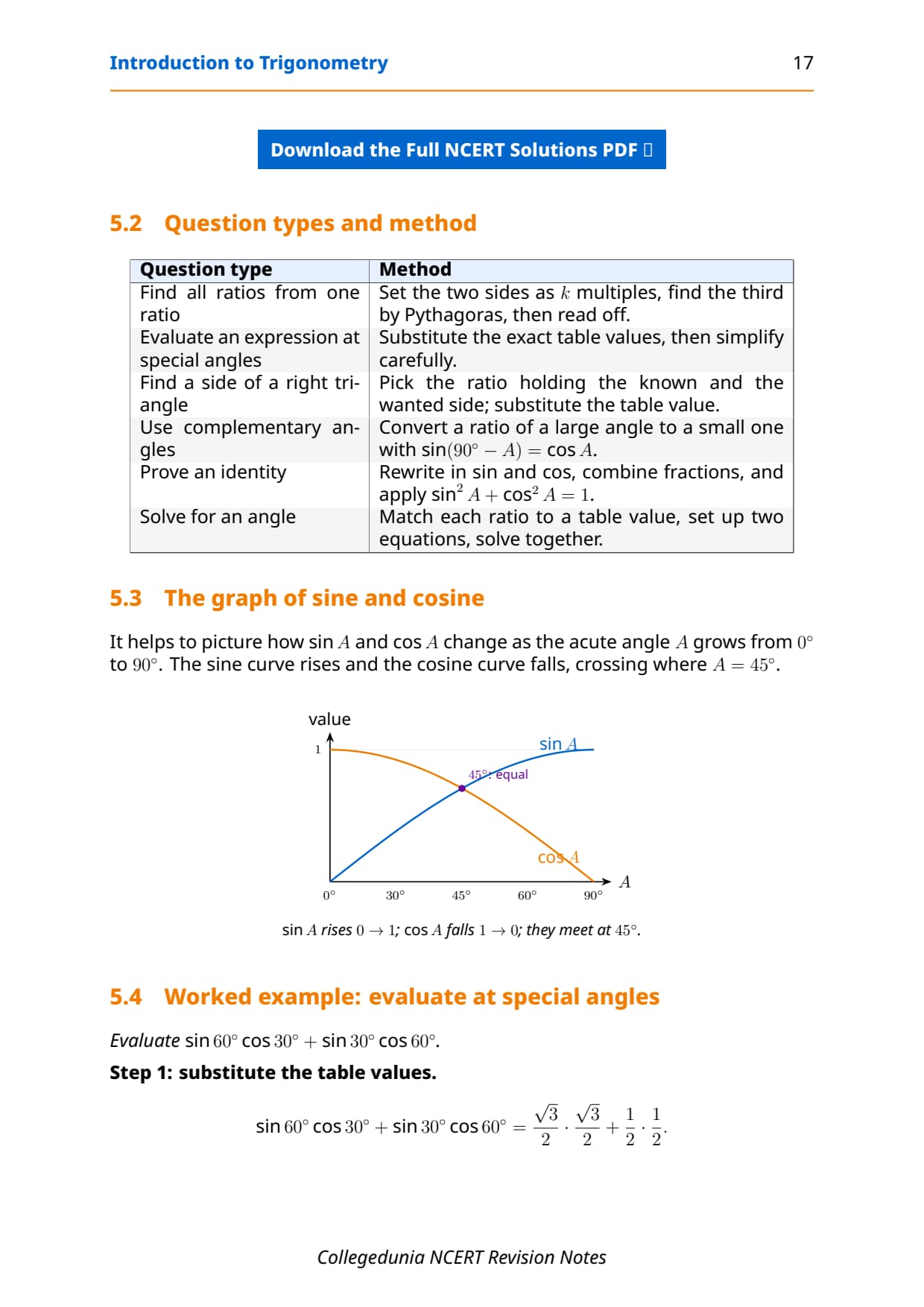
- All key ratios and identities explained step by step, with plain-word derivations, solved examples, and board tips.
- Full coverage of sin, cos, tan, cosec, sec, cot, the standard values table, and the three Pythagorean identities.
- Memory tricks and common-mistake alerts on every concept, aligned with the 2026-27 CBSE syllabus.
These Collegedunia notes are written by Maths experts from the 2026-27 NCERT textbook and checked against the last five years of CBSE Class 10 board papers.
Student Feedback: What 9,200 students told us
68% of Class 10 students said memorising the standard values table (sin, cos, tan for 0°, 30°, 45°, 60°, 90°) was the most useful thing they did for this chapter. Almost every board question uses one of these values. 4 out of 5 students said writing the table at the top of their rough work saved time.
Toppers said the key skill was spotting which Pythagorean identity to apply (sin² + cos² = 1, 1 + tan² = sec², or 1 + cot² = cosec²) from the question's form. That is what separated full marks from partial marks. The average student spent 3 to 4 hours on the first read, ratio practice, and revision.
Source: 2026-27 Class 10 Maths student poll, 9,200 students from CBSE schools in 14 states, before the 2026 boards.
Watch Introduction to Trigonometry Class 10 Maths Explained
Source: Magnet Brains on YouTube
What These Notes Cover
Chapter 8 introduces trigonometry, which means measuring triangles. It is all about right-angled triangles: the ratios between their sides, the values those ratios take at standard angles, and the identities that link them. The 2026-27 syllabus centres on four big ideas.
- Trigonometric ratios: sin, cos, tan, cosec, sec, cot in terms of the opposite, adjacent and hypotenuse sides.
- Standard angle values: exact values of all six ratios at 0°, 30°, 45°, 60°, 90°, the table every student must memorise.
- Trigonometric identities: the three Pythagorean identities used to convert between ratios and simplify expressions.
- Complementary angles: sin and cos, tan and cot, sec and cosec swap when the angle changes to (90° minus the angle).
Trigonometric Ratios: sin, cos, tan, cosec, sec, cot
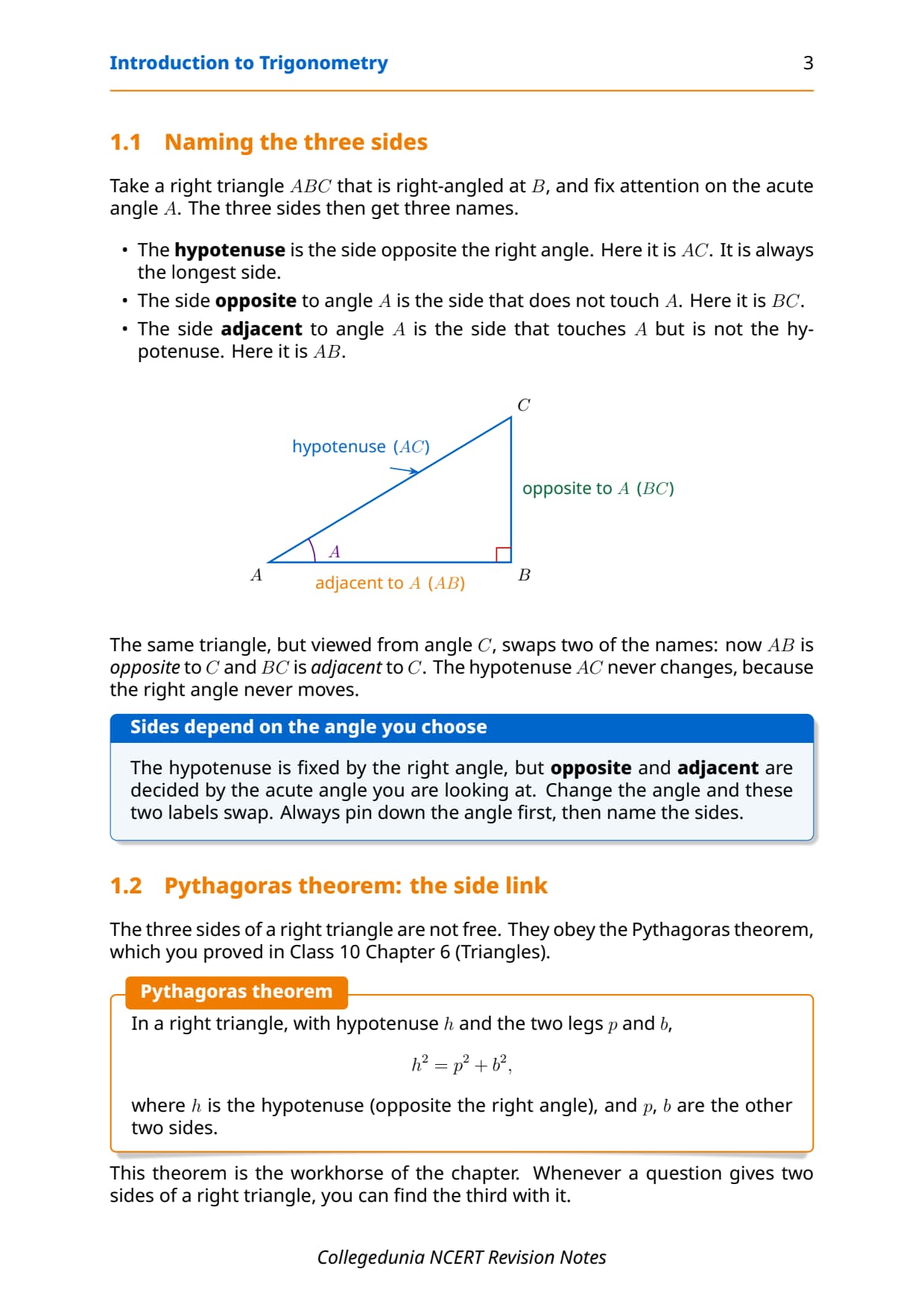
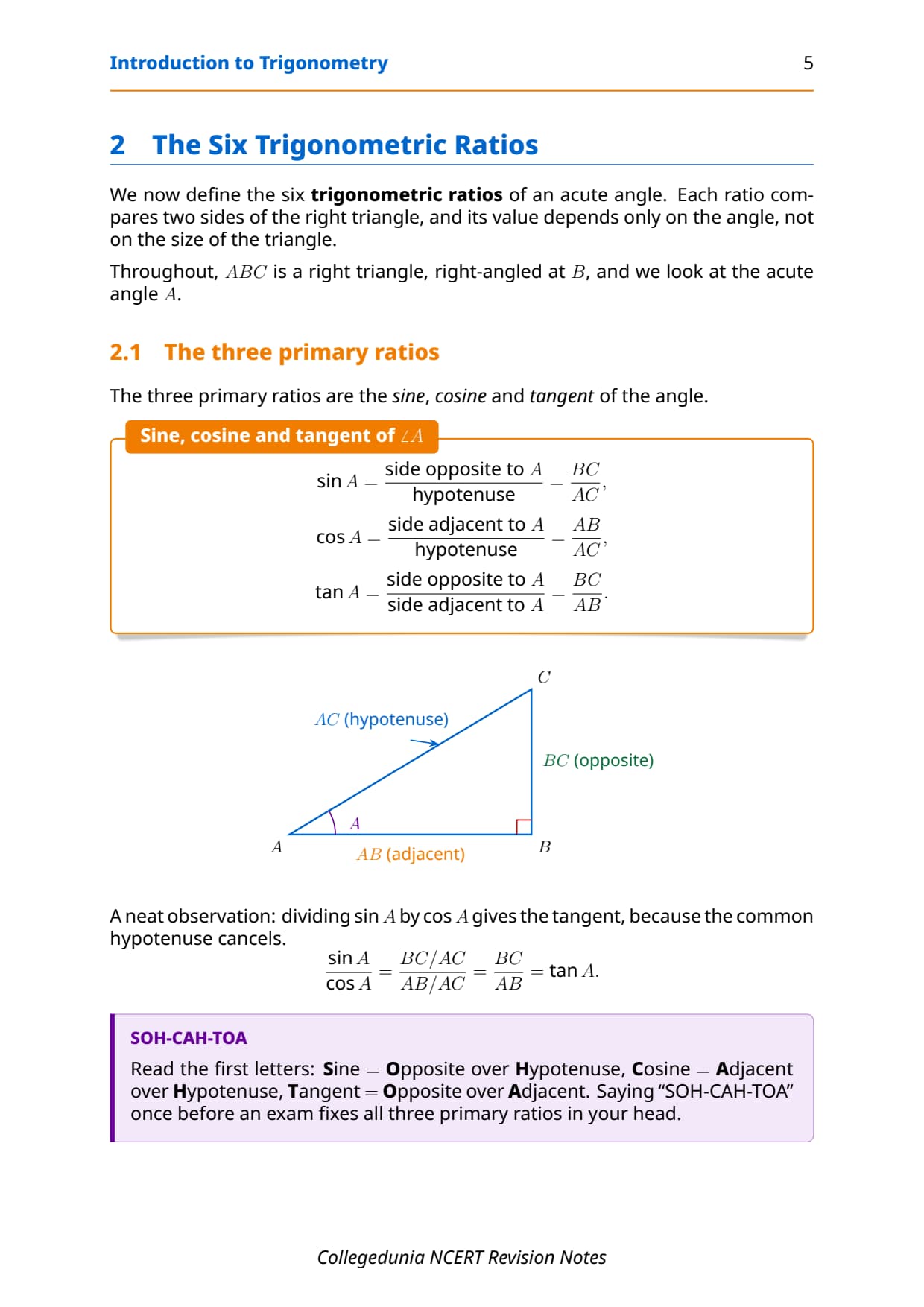
The six trigonometric ratios are defined for an acute angle θ in a right-angled triangle. Label the sides like this: hypotenuse (H, opposite the right angle), opposite (O, opposite angle θ), and adjacent (A, next to angle θ but not the hypotenuse). Then:
| Ratio | Definition | Reciprocal |
|---|---|---|
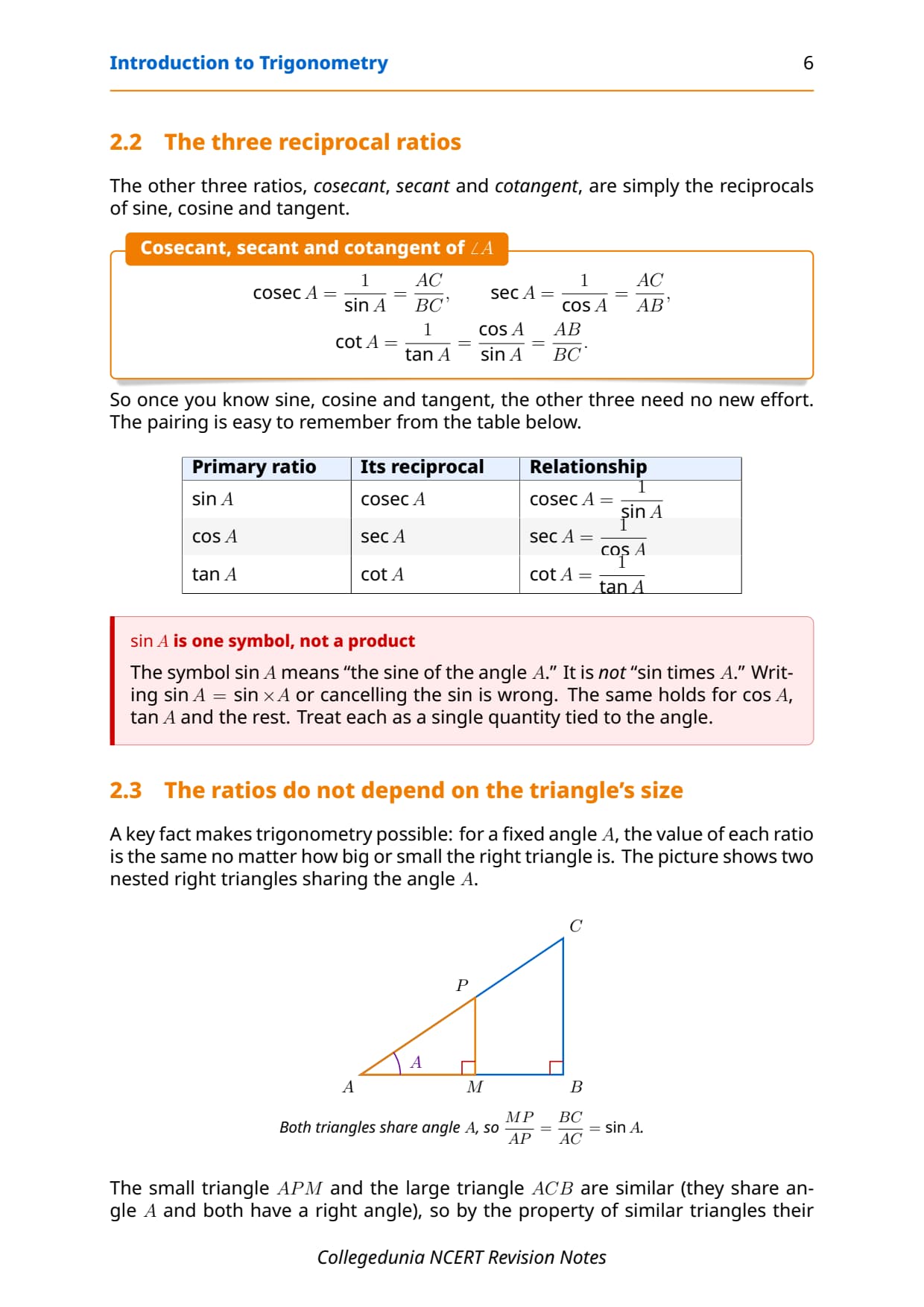
| sin θ | Opposite / Hypotenuse = O / H | cosec θ = H / O |
| cos θ | Adjacent / Hypotenuse = A / H | sec θ = H / A |
| tan θ | Opposite / Adjacent = O / A | cot θ = A / O |
Notice that tan θ = sin θ / cos θ and cot θ = cos θ / sin θ (put O/H for sin and A/H for cos, and the H cancels). Also, the reciprocal pairs are sin and cosec, cos and sec, tan and cot, so sin θ × cosec θ = 1 always. A memory trick for the three main ratios is SOH-CAH-TOA: Sin = Opposite/Hypotenuse, Cos = Adjacent/Hypotenuse, Tan = Opposite/Adjacent.
Standard Angle Values Table (0° to 90°)
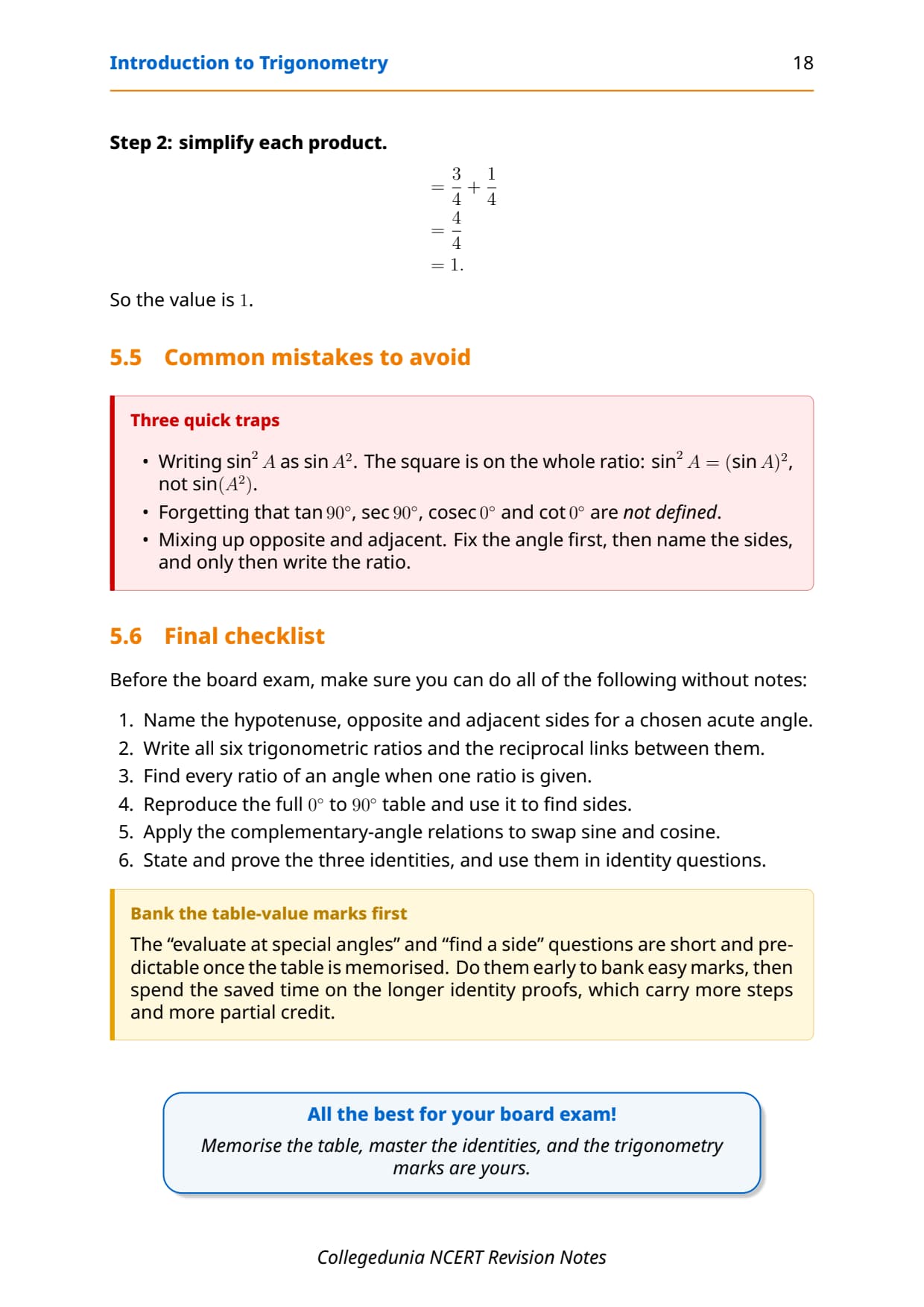
The standard values table lists exact values of all six ratios at five special angles: 0°, 30°, 45°, 60°, and 90°. Every board paper uses at least one of these. Memorising the full table is non-negotiable for this chapter.
| Angle θ | sin θ | cos θ | tan θ | cosec θ | sec θ | cot θ |
|---|---|---|---|---|---|---|
| 0° | 0 | 1 | 0 | Not defined | 1 | Not defined |
| 30° | 1/2 | √3/2 | 1/√3 | 2 | 2/√3 | √3 |
| 45° | 1/√2 | 1/√2 | 1 | √2 | √2 | 1 |
| 60° | √3/2 | 1/2 | √3 | 2/√3 | 2 | 1/√3 |
| 90° | 1 | 0 | Not defined | 1 | Not defined | 0 |
A fast trick for sin values: take √0, √1, √2, √3, √4 and divide each by 2, giving 0, 1/2, 1/√2, √3/2, 1. The cos values are just sin read backwards (cos 0° = sin 90° = 1, and so on). tan is undefined at 90° because tan θ = sin θ / cos θ and cos 90° = 0; likewise cot and cosec are undefined at 0°, and sec at 90°.
Trigonometric Identities
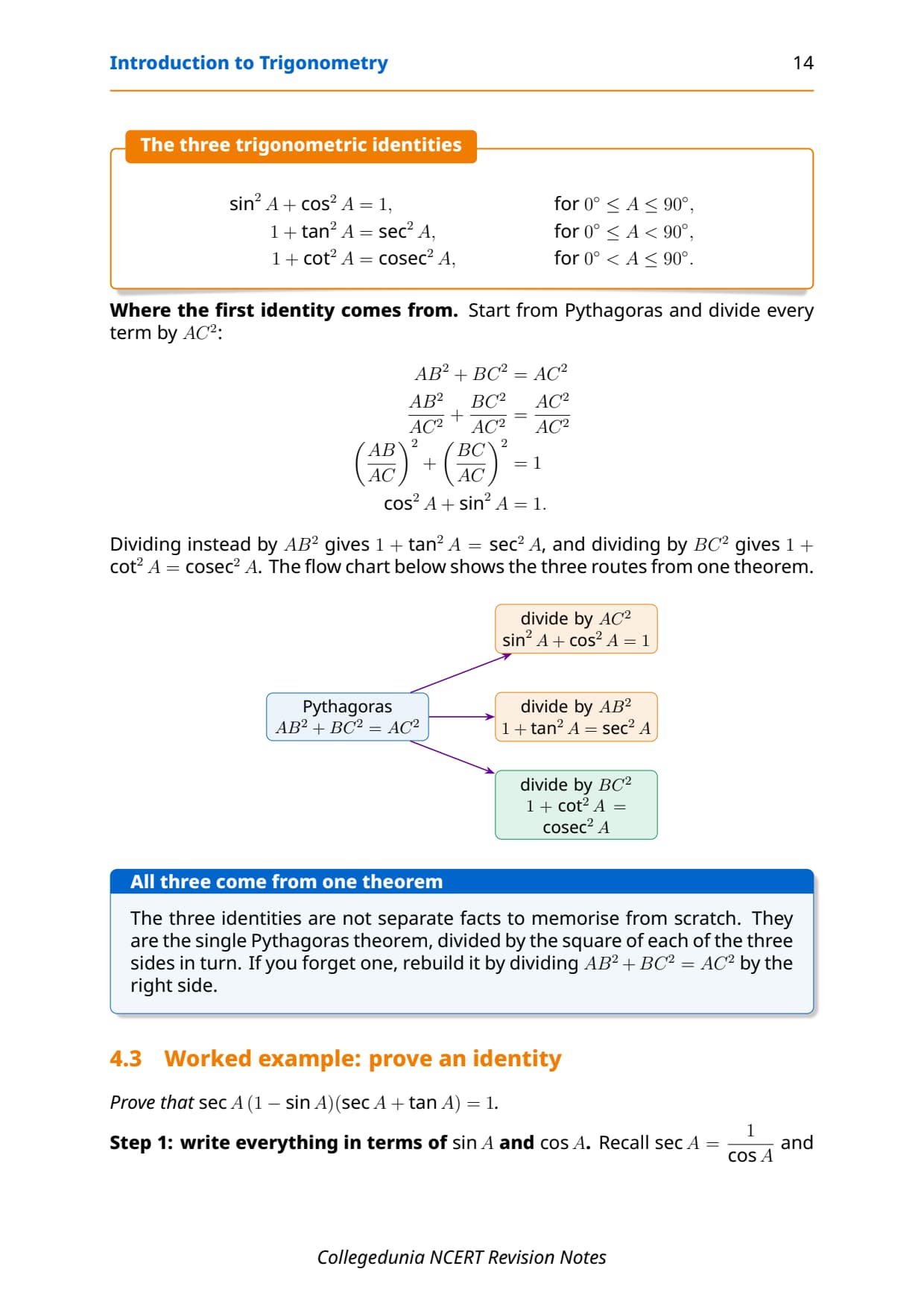
A trigonometric identity holds true for every angle. Chapter 8 covers three Pythagorean identities, each from the Pythagorean Theorem, and they power the board's 3-mark and 4-mark proof questions.
Identity 1: sin² θ + cos² θ = 1
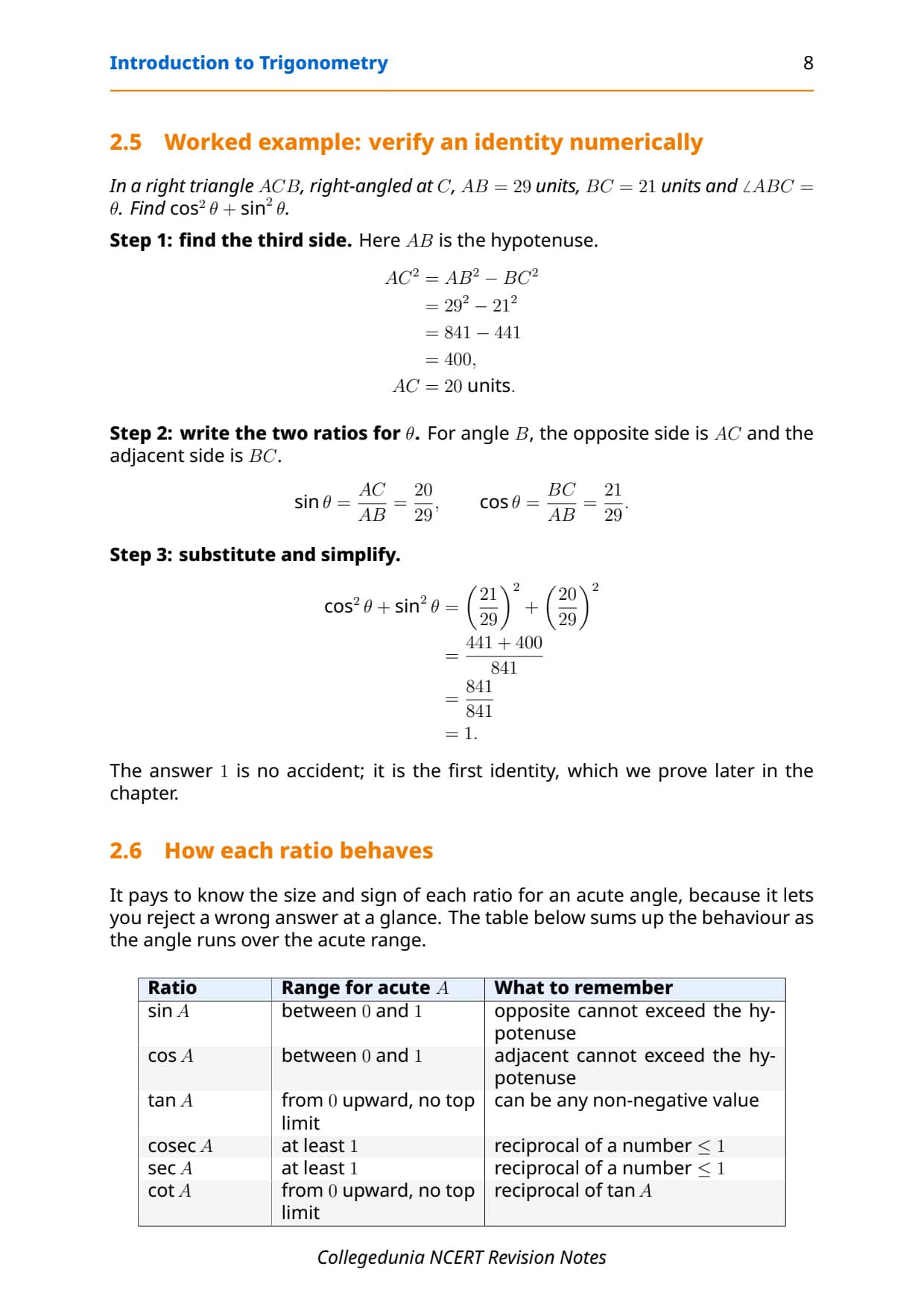
Identity 2: 1 + tan² θ = sec² θ
Identity 3: 1 + cot² θ = cosec² θ
You can derive all three from Identity 1: divide sin² + cos² = 1 by cos² θ to get Identity 2, or by sin² θ to get Identity 3. So you only need to memorise Identity 1.
| Identity | Divide by | Rearrangements you need |
|---|---|---|
| sin² θ + cos² θ = 1 | Base identity | sin² θ = 1 − cos² θ; cos² θ = 1 − sin² θ |
| 1 + tan² θ = sec² θ | cos² θ | sec² θ − tan² θ = 1; tan² θ = sec² θ − 1 |
| 1 + cot² θ = cosec² θ | sin² θ | cosec² θ − cot² θ = 1; cot² θ = cosec² θ − 1 |
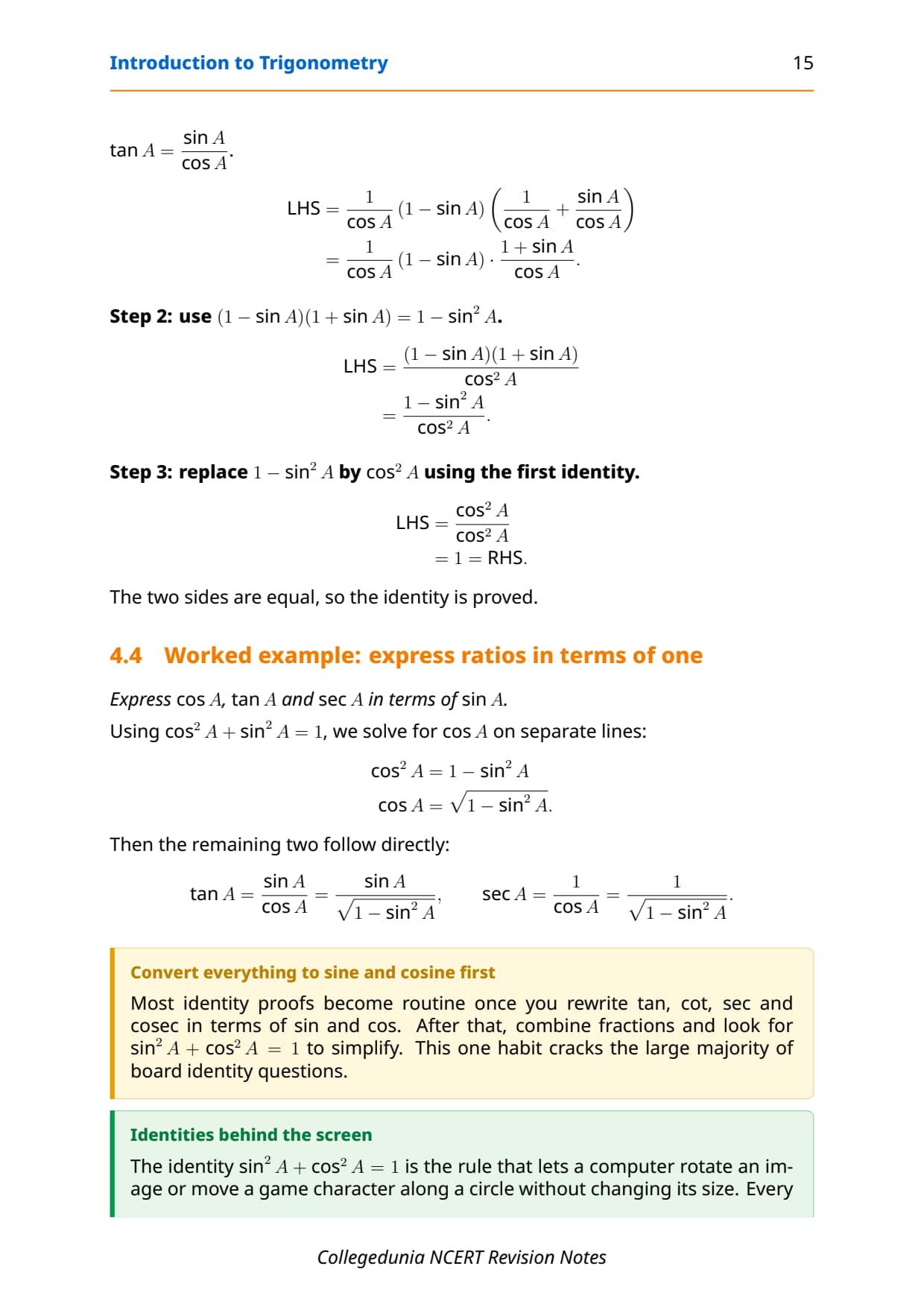
To prove an identity, start from the more complex side, convert everything to sin and cos, simplify, and reach the simpler side. Never move terms across the equals sign in a proof: that assumes what you are proving and loses all marks.
Complementary Angles
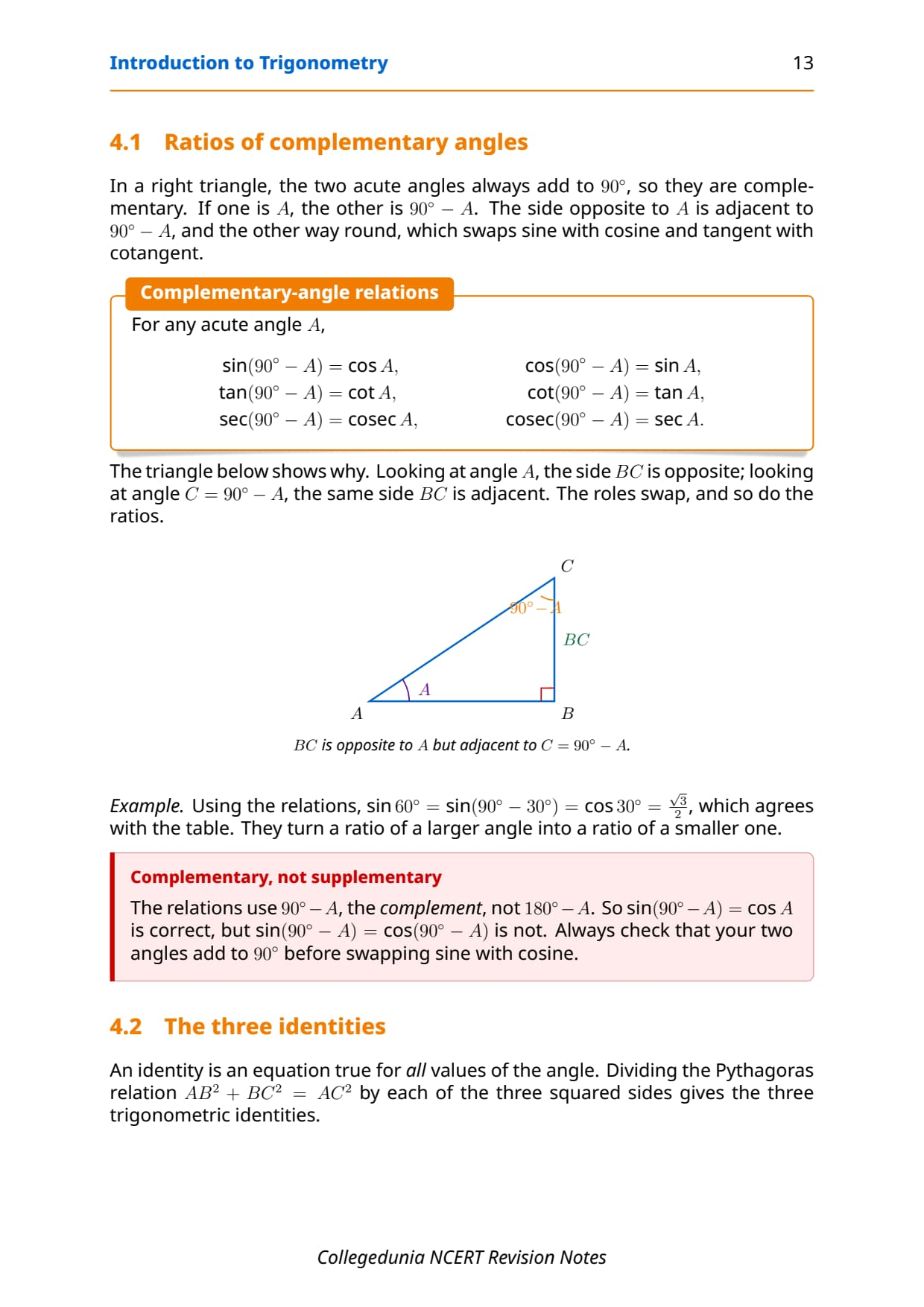
Two angles are complementary if they add up to 90°. In a right-angled triangle, the two acute angles are always complementary. This links the ratios of θ and (90° − θ) directly.
- sin (90° − θ) = cos θ and cos (90° − θ) = sin θ
- tan (90° − θ) = cot θ and cot (90° − θ) = tan θ
- sec (90° − θ) = cosec θ and cosec (90° − θ) = sec θ
These come from the triangle: if one acute angle is θ, the other is (90° − θ), and the opposite and adjacent sides swap. The "co" in cosine, cotangent and cosecant means "complement", so the pairs are built into the names.
Board questions use these to simplify expressions like sin 65° / cos 25°. Since 65° + 25° = 90°, sin 65° = cos 25°, so the value is 1. Whenever two angles in an expression add to 90°, apply the complementary angle rule at once.
How to Use These Notes
Chapter 8 is mostly definitions, a table of values, and three identities, so prep in two passes. First, do not memorise the table by staring at it: derive it once using the 30-60-90 triangle (sides 1, √3, 2) and the 45-45-90 triangle (sides 1, 1, √2), and it is hard to forget. Then practise identity proofs (3 or 4 marks each) from Exercise 8.3, noting which identity you use at each step. For the 2026-27 board, Chapter 8 usually carries 6 to 8 marks: expect a 1 or 2-mark question on standard values, a 3-mark complementary angle sum, and a 3 or 4-mark identity proof.
Previous Year Question Trends
Chapter 8 is a reliable marks-earner in the CBSE board paper. The question types repeat in a steady cycle, so one example of each type prepares you well.
| Year | Question type | Marks |
|---|---|---|
| 2025 | Prove an identity using the Pythagorean identities | 4 |
| 2024 | Evaluate an expression using standard angle values | 2 |
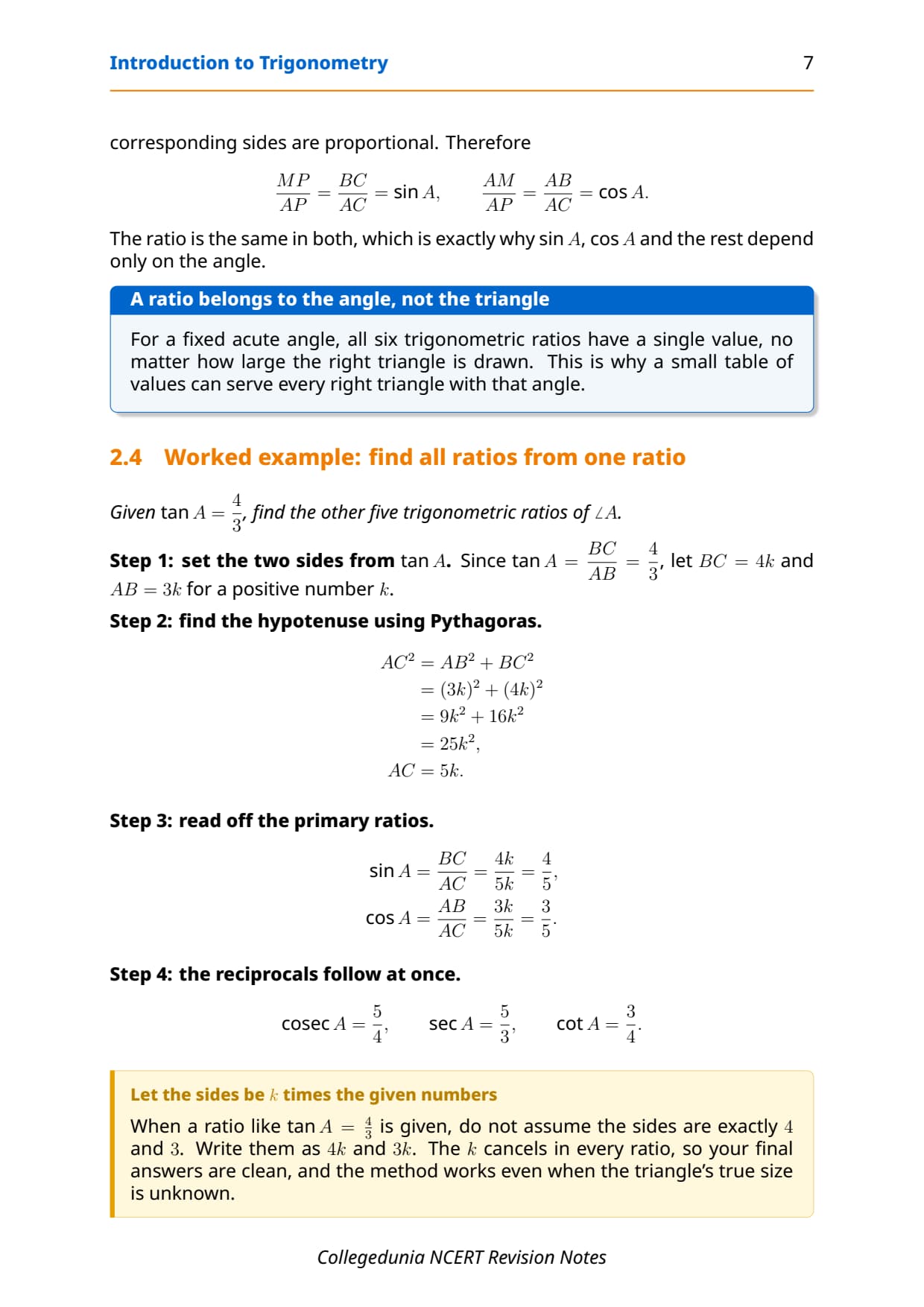
| 2023 | Find all six ratios from one given ratio and a constraint | 3 |
| 2022 | Simplify an expression using complementary angle relations | 3 |
| 2021 | Find the value of an expression with two standard angles | 2 |
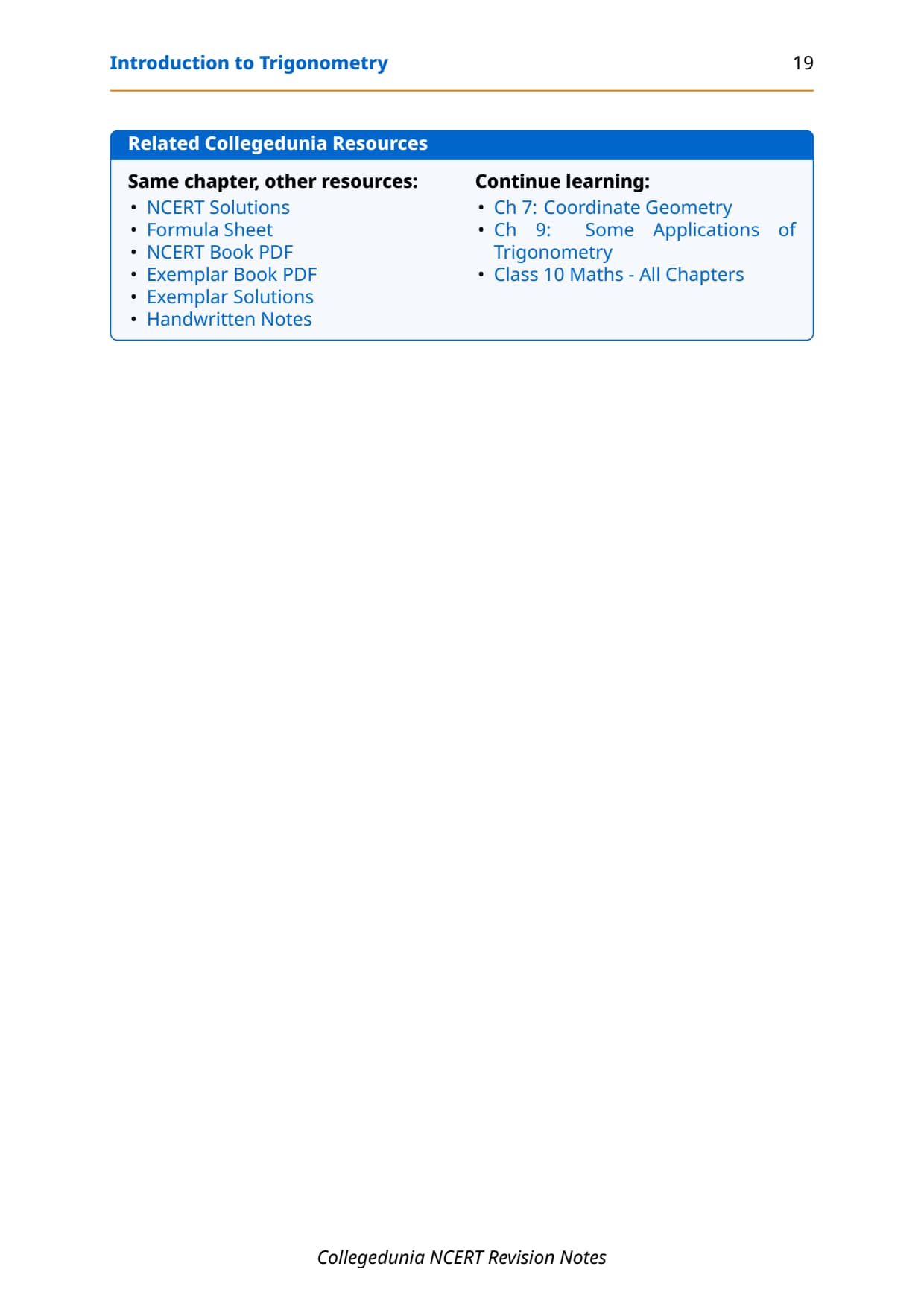
Also Check: The full set of CBSE board questions for this chapter, with step-by-step answers, is in the PDF above, updated for the 2026-27 cycle.
Common Mistakes to Avoid
Most lost marks in Chapter 8 come from the same short list of errors:
- Swapping sin and cos at 30° and 60°: sin 30° = 1/2 and sin 60° = √3/2, not the other way round.
- Forgetting tan 90° is not defined: any finite value for tan 90° is wrong.
- Moving terms across the equals sign in a proof: this is circular reasoning, so work on one side only.
- Reciprocal errors: cosec θ = 1/sin θ (not 1/cos θ) and sec θ = 1/cos θ (not 1/sin θ).
Other Resources for This Chapter
Pair these notes with the matching NCERT Solutions, formula sheet, handwritten notes, and the official NCERT book chapter. All resources for this chapter are linked below.
| Resource | What it covers | Open |
|---|---|---|
| Notes | Concept-first revision on ratios, standard values, identities, and complementary angles. | You are here |
| NCERT Solutions | Step-by-step answers to all Exercise 8.1, 8.2, and 8.3 questions, with an Expert Solution for each. | Class 10 Maths Chapter 8 NCERT Solutions |
| Formula Sheet | One-page list of all ratios, the standard values table, identities, and complementary relations. | Class 10 Maths Chapter 8 Formula Sheet |
| Handwritten Notes | Scanned-style handwritten pages for last-minute revision. | Class 10 Maths Chapter 8 Handwritten Notes |
| NCERT Book PDF | Official NCERT Maths Chapter 8 textbook in PDF form. | Class 10 Maths Chapter 8 NCERT Book PDF |
| Exemplar Solutions | Worked answers to the harder NCERT Exemplar problems for extra practice. | Class 10 Maths Chapter 8 Exemplar Solutions |
All Class 10 Maths Notes
Related Links: Use the table below to open the notes for any other chapter. Each one has the same concept-first style, full PDF download, and revision FAQ.
| Chapter | Notes link |
|---|---|
| Chapter 1 | Real Numbers Notes |
| Chapter 2 | Polynomials Notes |
| Chapter 3 | Pair of Linear Equations in Two Variables Notes |
| Chapter 4 | Quadratic Equations Notes |
| Chapter 5 | Arithmetic Progressions Notes |
| Chapter 6 | Triangles Notes |
| Chapter 7 | Coordinate Geometry Notes |
| Chapter 8 | Introduction to Trigonometry Notes (You are here) |
| Chapter 9 | Some Applications of Trigonometry Notes |
| Chapter 10 | Circles Notes |
| Chapter 11 | Areas Related to Circles Notes |
| Chapter 12 | Surface Areas and Volumes Notes |
| Chapter 13 | Statistics Notes |
| Chapter 14 | Probability Notes |
Class 10 Maths Chapter 8 Introduction to Trigonometry Notes FAQs
Ques. What does Chapter 8 Introduction to Trigonometry cover in Class 10 Maths?
Ans. Chapter 8 covers the basics of trigonometry in right-angled triangles. First, the six ratios (sin, cos, tan, cosec, sec, cot), defined from the opposite side, adjacent side, and hypotenuse for one acute angle. Second, the standard values of all six ratios at 0°, 30°, 45°, 60°, and 90°, which you must memorise. Third, the three Pythagorean identities (sin² θ + cos² θ = 1, 1 + tan² θ = sec² θ, 1 + cot² θ = cosec² θ) and how to use them. Fourth, complementary angles, where sin and cos, tan and cot, sec and cosec swap when the angle changes to 90° minus the angle.
Ques. What are the six trigonometric ratios in Class 10 Maths?
Ans. They are defined for an acute angle θ in a right-angled triangle. Label the sides hypotenuse (H, opposite the right angle), opposite (O, opposite θ), and adjacent (A, next to θ). Then sin θ = O/H, cos θ = A/H, tan θ = O/A. The other three are reciprocals: cosec θ = 1/sin θ, sec θ = 1/cos θ, cot θ = 1/tan θ. Also tan θ = sin θ/cos θ and cot θ = cos θ/sin θ. A handy trick is SOH-CAH-TOA: Sin = Opposite/Hypotenuse, Cos = Adjacent/Hypotenuse, Tan = Opposite/Adjacent.
Ques. What is the standard values table for sin, cos, and tan in Class 10?
Ans. It gives exact values at five angles. For sin: sin 0° = 0, sin 30° = 1/2, sin 45° = 1/√2, sin 60° = √3/2, sin 90° = 1. For cos: cos 0° = 1, cos 30° = √3/2, cos 45° = 1/√2, cos 60° = 1/2, cos 90° = 0 (cos values are sin read backwards). For tan: tan 0° = 0, tan 30° = 1/√3, tan 45° = 1, tan 60° = √3, and tan 90° is not defined (cos 90° = 0). Trick for sin: take √0/2, √1/2, √2/2, √3/2, √4/2, which give 0, 1/2, 1/√2, √3/2, 1. Then cosec and sec are reciprocals of sin and cos, and cot is the reciprocal of tan.
Ques. What are the three trigonometric identities in Class 10?
Ans. The three Pythagorean identities are: Identity 1: sin² θ + cos² θ = 1 (the base one, from the Pythagorean Theorem). Identity 2: 1 + tan² θ = sec² θ (divide Identity 1 by cos² θ). Identity 3: 1 + cot² θ = cosec² θ (divide Identity 1 by sin² θ). You can rearrange each: sin² θ = 1 − cos² θ, sec² θ − tan² θ = 1, cosec² θ − cot² θ = 1. In a proof, start with the more complex side, convert to sin and cos, apply the right identity, and simplify to the other side. Never move terms across the equals sign.
Ques. What are complementary angles in Class 10 Trigonometry?
Ans. Two angles are complementary if they sum to 90°. In a right-angled triangle, the two acute angles always are. Their ratios link up like this: sin(90° − θ) = cos θ, cos(90° − θ) = sin θ, tan(90° − θ) = cot θ, cot(90° − θ) = tan θ, sec(90° − θ) = cosec θ, cosec(90° − θ) = sec θ. These simplify board expressions. For example, sin 65° = sin(90° − 25°) = cos 25°, so sin 65°/cos 25° = 1. The "co" in cosine, cotangent, and cosecant means "of the complement", which is why these pairs swap.
Ques. Which exercises are in Chapter 8 Introduction to Trigonometry in Class 10 Maths?
Ans. The 2026-27 NCERT syllabus has three exercises. Exercise 8.1 covers the six ratios: finding all ratios for a given angle, verifying ratios, and finding unknown sides. Exercise 8.2 covers standard values: evaluating expressions and checking equations with the table for 0°, 30°, 45°, 60°, and 90°. Exercise 8.3 covers identities and complementary angles: proving identities and simplifying expressions. Step-by-step solutions to all three are in the NCERT Solutions PDF linked above.
Ques. Are these Trigonometry Notes aligned with the 2026-27 CBSE syllabus?
Ans. Yes. These notes follow the current 2026-27 CBSE syllabus for Class 10 Maths. Chapter 8 sits in the Trigonometry unit and covers the ratio definitions in a right-angled triangle, the standard values at 0°, 30°, 45°, 60°, and 90°, the three Pythagorean identities, and complementary angles. They follow the NCERT textbook order to help you prepare for the board exam. This chapter leads straight into Chapter 9 on heights and distances, and is also a base for Class 11 and 12 Maths.



Comments