




These Notes for Class 10 Maths Chapter 3 Pair of Linear Equations in Two Variables give you a fast, concept-first revision built on the 2026-27 CBSE syllabus. You will learn how to form a pair of equations from a word problem and solve it three ways: the graphical, substitution and elimination methods. A simple ratio test then tells you if a pair has one solution, no solution, or infinitely many.
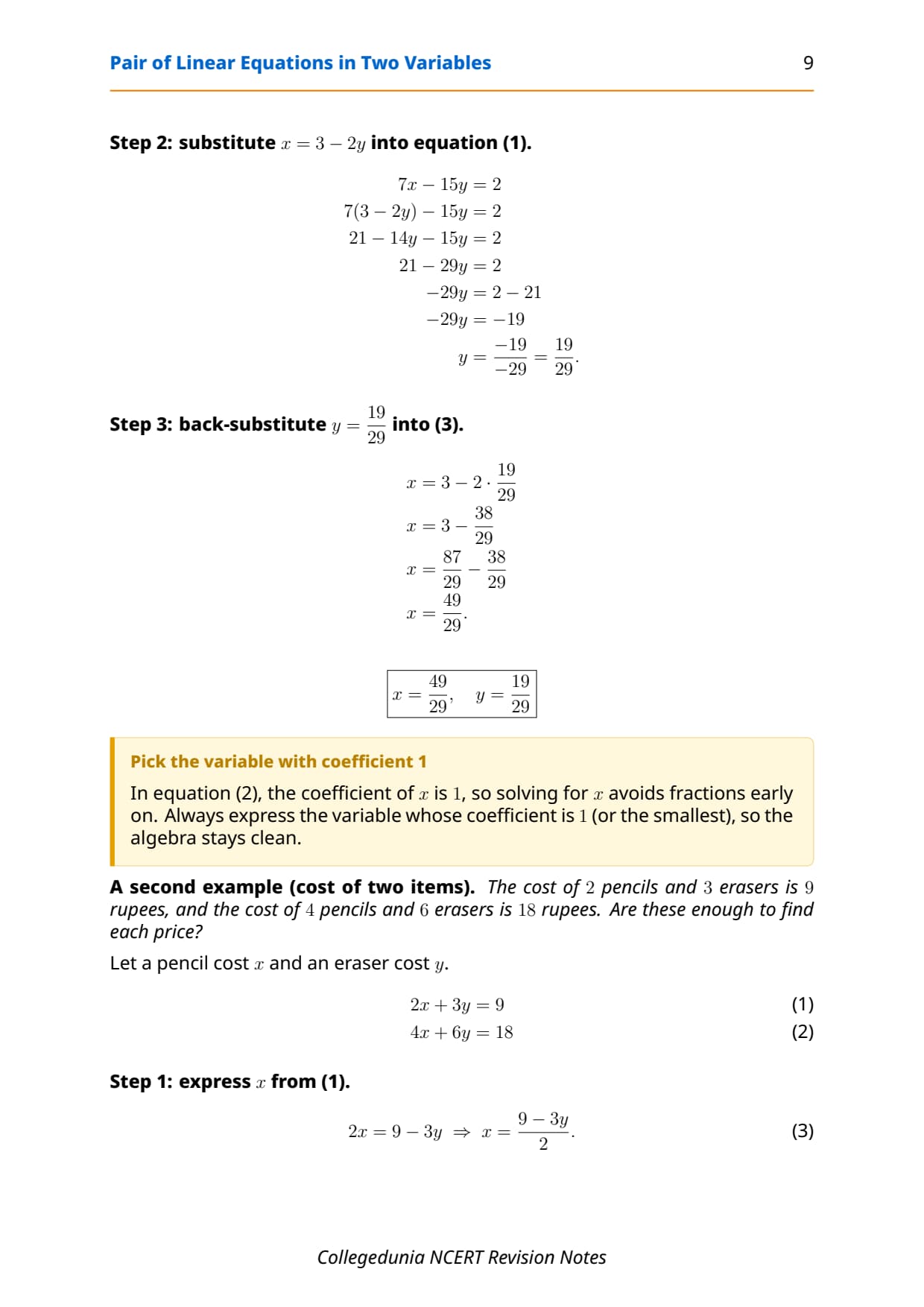
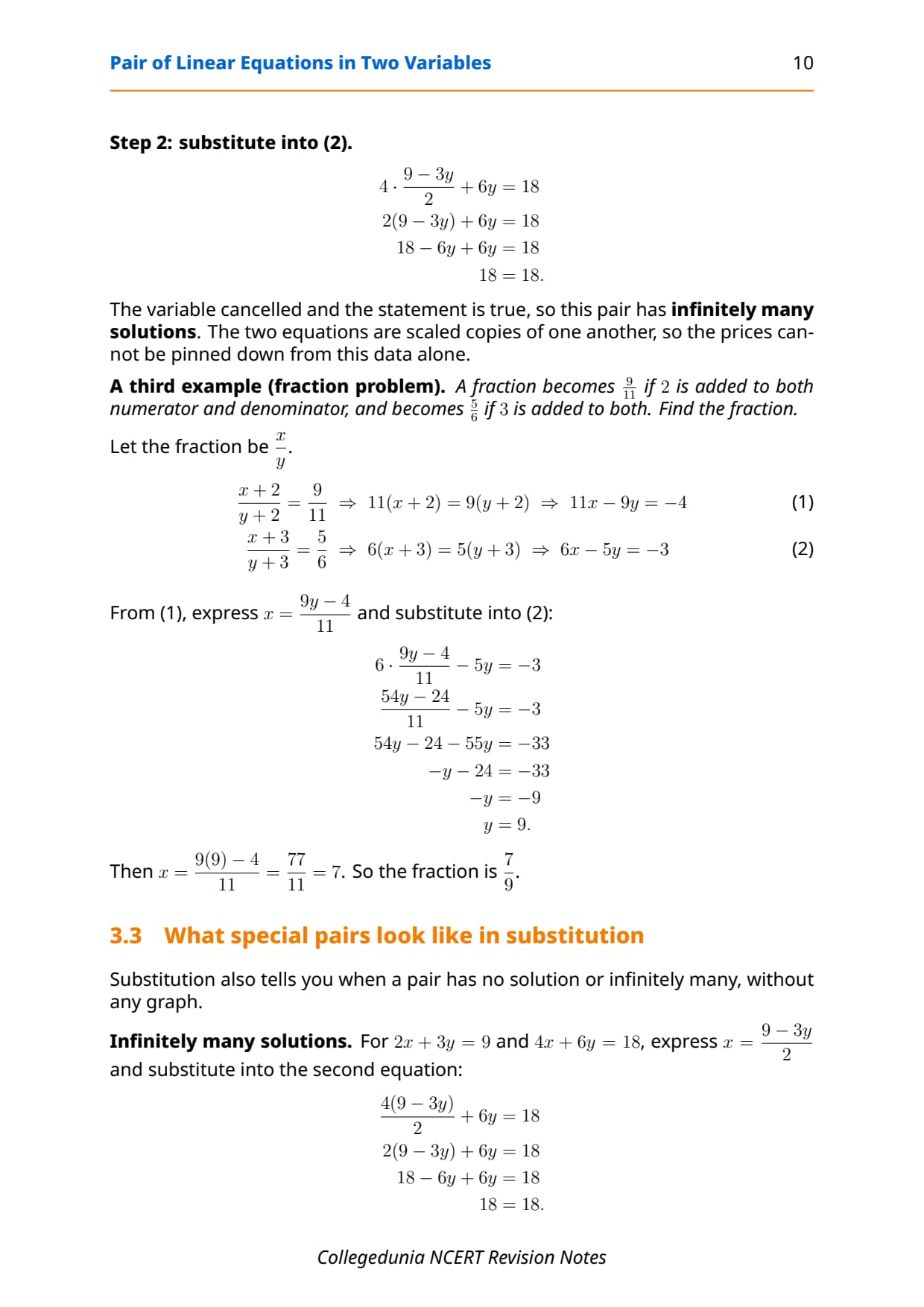
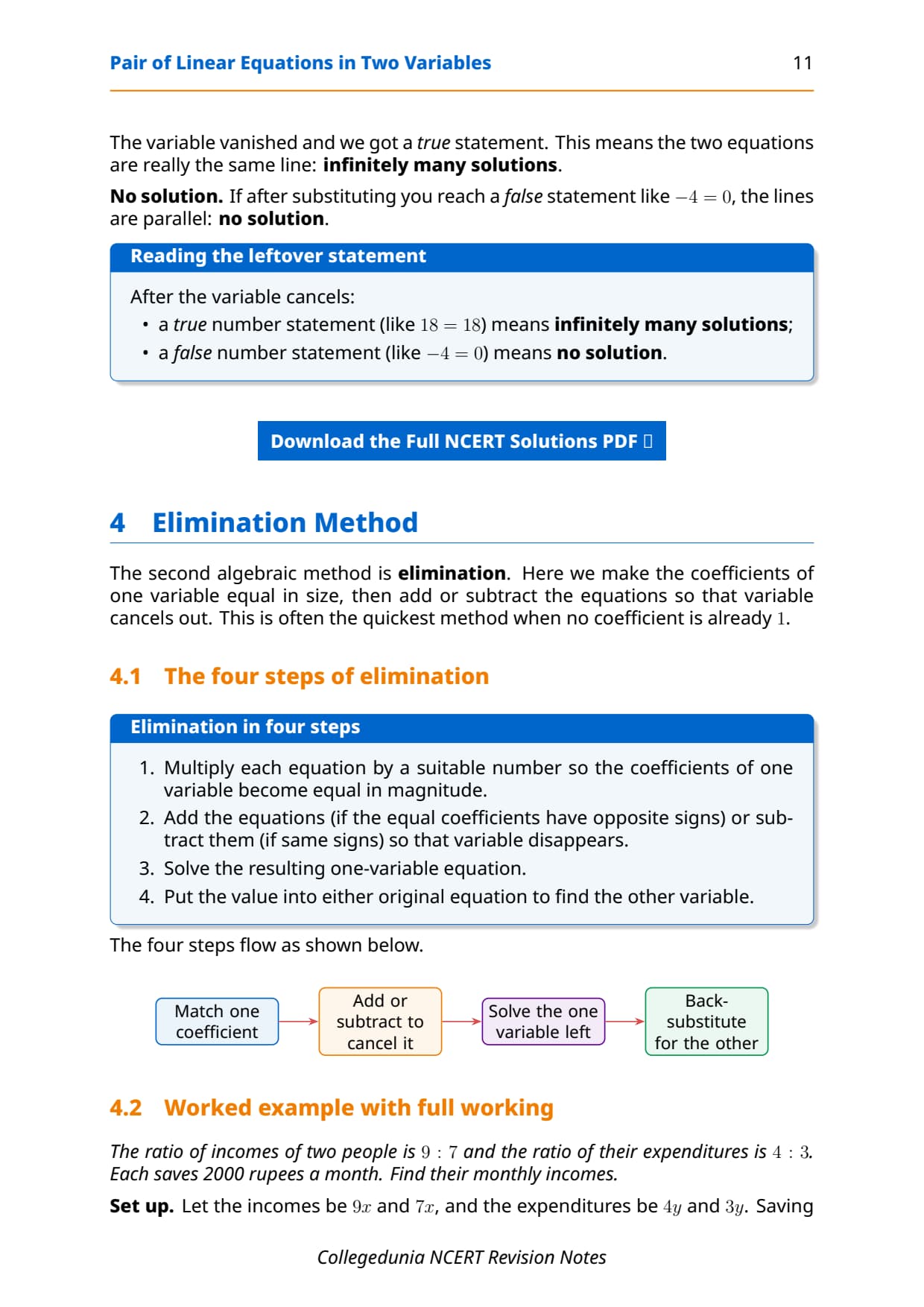
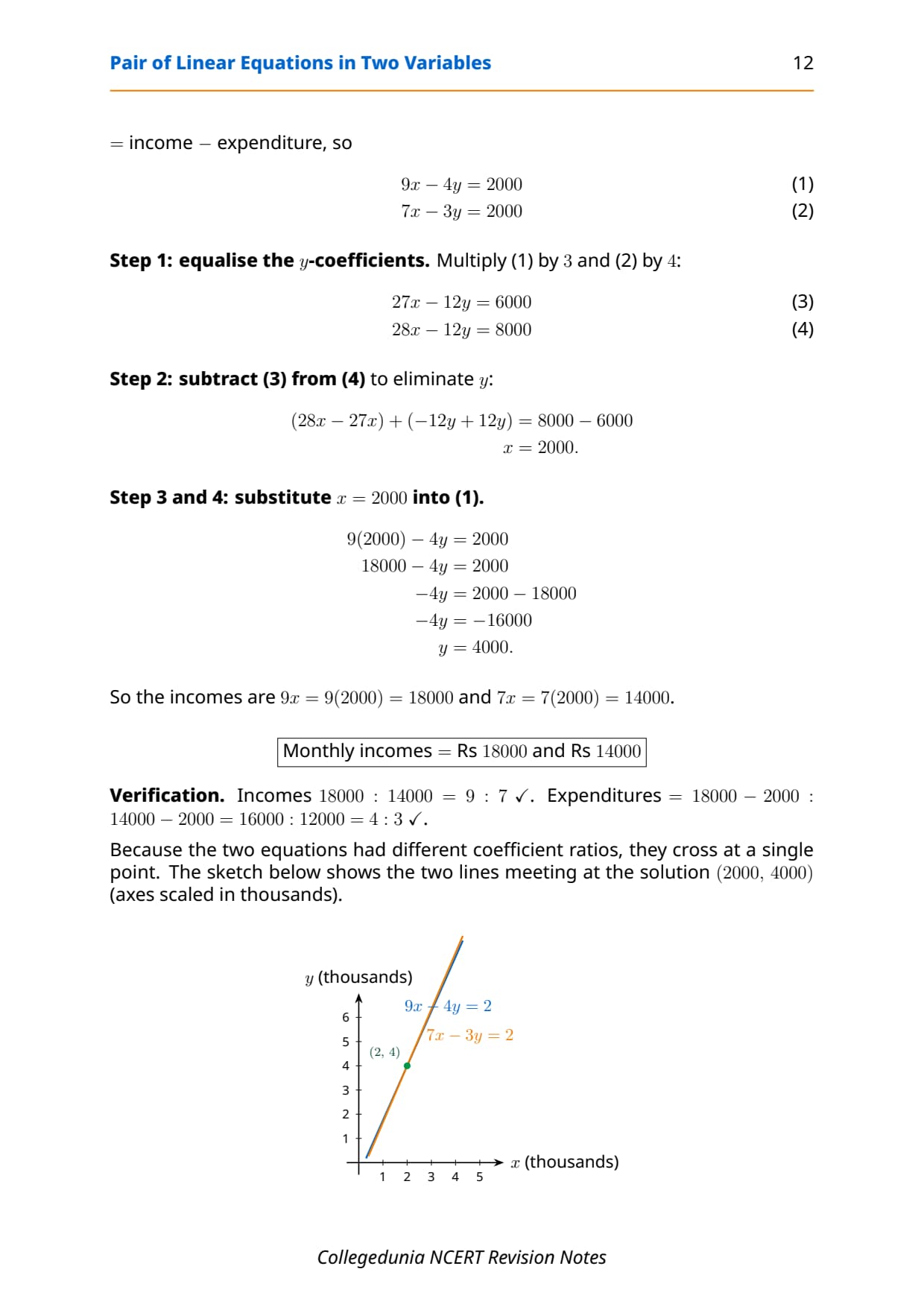
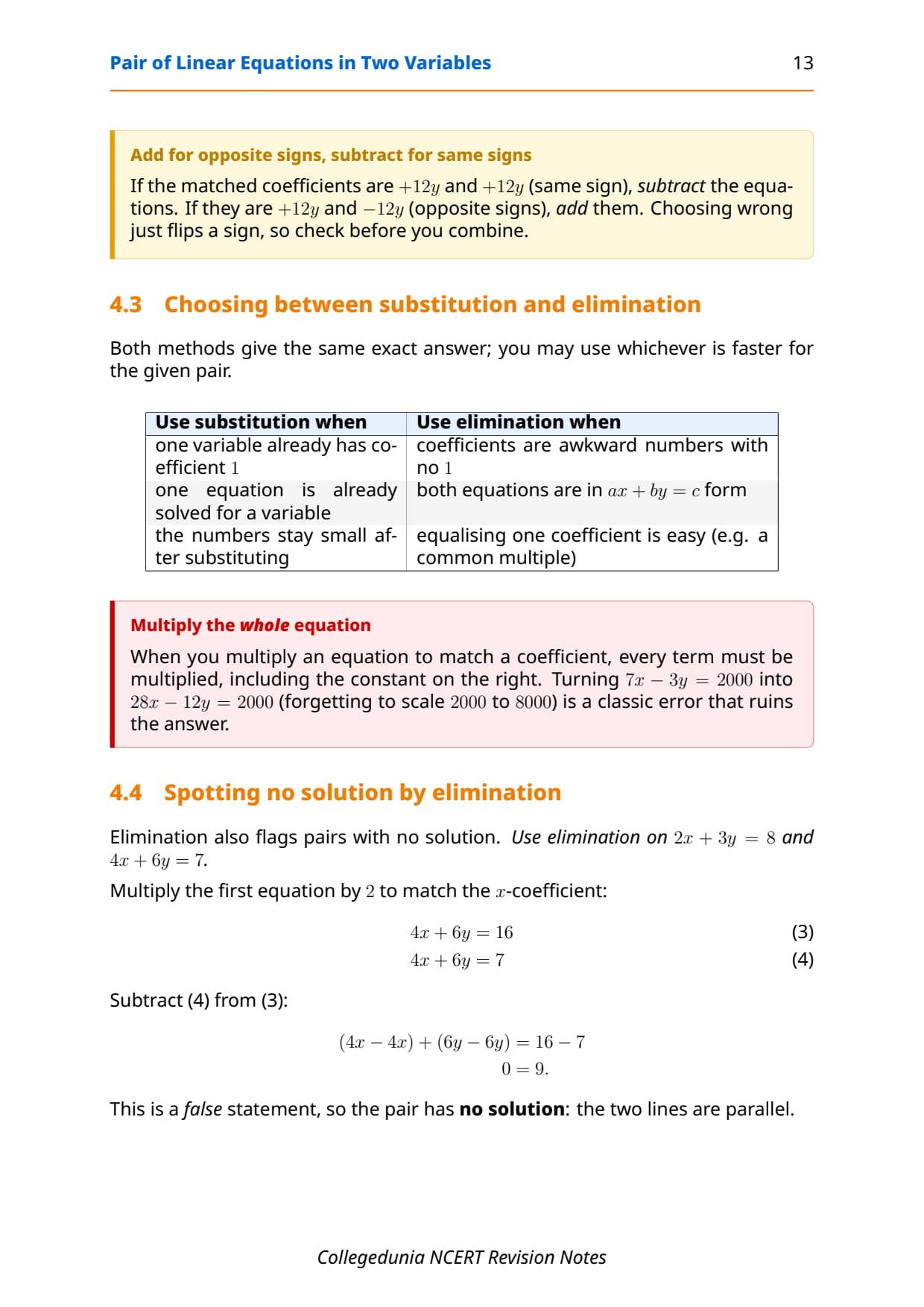
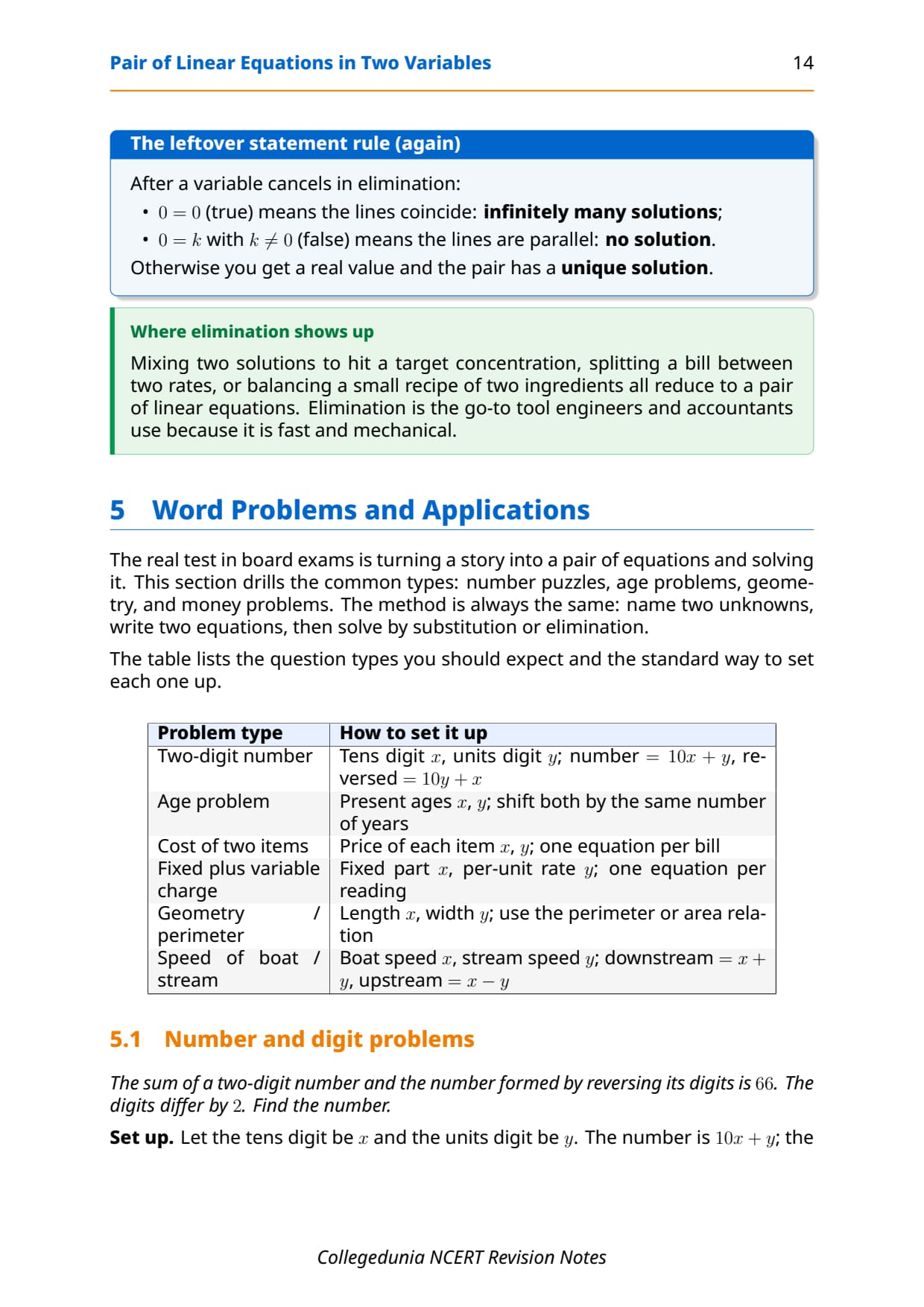
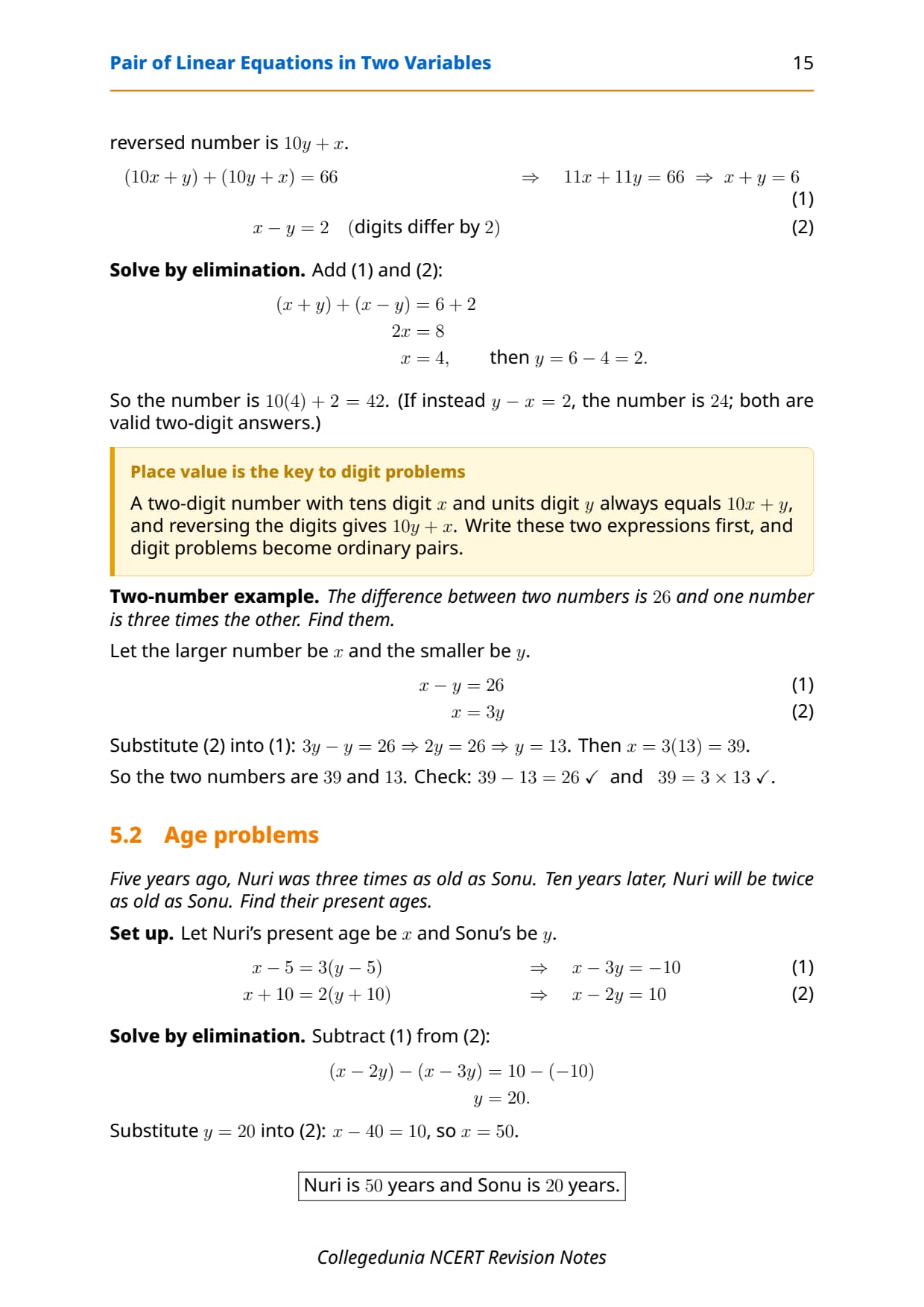
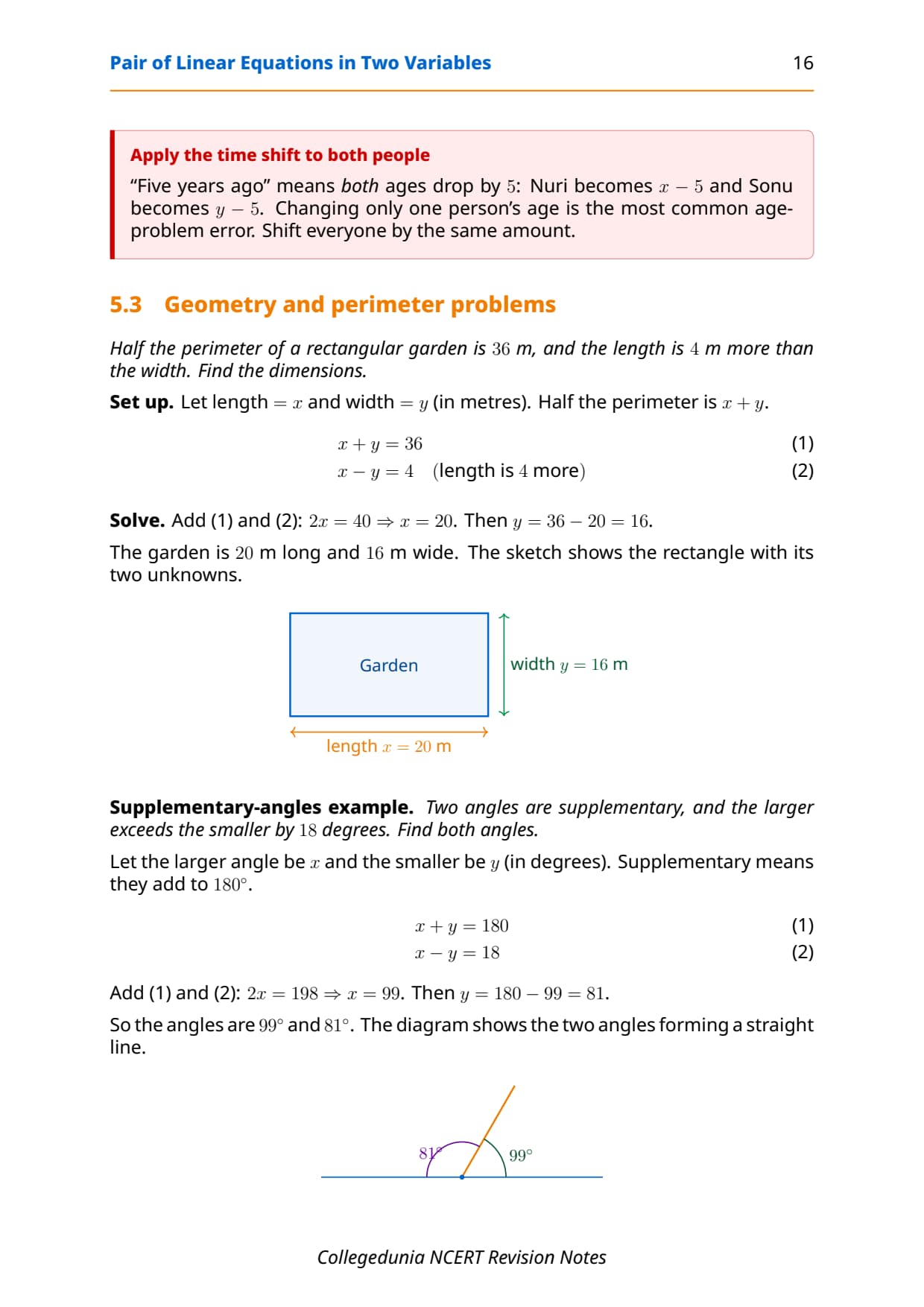
- Every method in plain words, with one short solved example and a board-exam tip.
- Full coverage of the graphical, substitution and elimination methods, the consistency rules, and the word-problem types CBSE asks most.
- Aligned with the rationalised 2026-27 syllabus, and useful for CUET and JEE foundation algebra too.
These notes are written by Maths experts from the 2026-27 NCERT textbook and checked against the last five years of CBSE board papers.
Student Feedback: What 9,800 students told us
71% of Class 10 students found turning a word problem into two equations the hardest part. 3 out of 5 said knowing when to use substitution versus elimination saved them the most time in the paper.
Toppers said the one-line ratio test saved them 2 to 3 minutes per question. The average student spent 2 to 3 hours on these notes across the first read and final revision.
Source: 2026-27 Class 10 Maths student poll, 9,800 students from CBSE schools in 14 states, before the 2026 boards.
|
Table of Contents |
Watch Pair of Linear Equations Class 10 Maths Explained
Source: Magnet Brains on YouTube
What These Notes Cover
Given two linear equations in the same two variables, which pair (x, y) satisfies both at once? These notes follow NCERT order, compressed into revision blocks. The 2026-27 syllabus focuses on three big ideas.
- Forming a pair: turning a word problem into two linear equations.
- Solving a pair: the graphical, substitution and elimination methods, all reaching the same meeting point.
- Nature of solutions: using the ratios a1/a2, b1/b2 and c1/c2 to decide one, none, or infinitely many.
Pair of Linear Equations and Its General Form
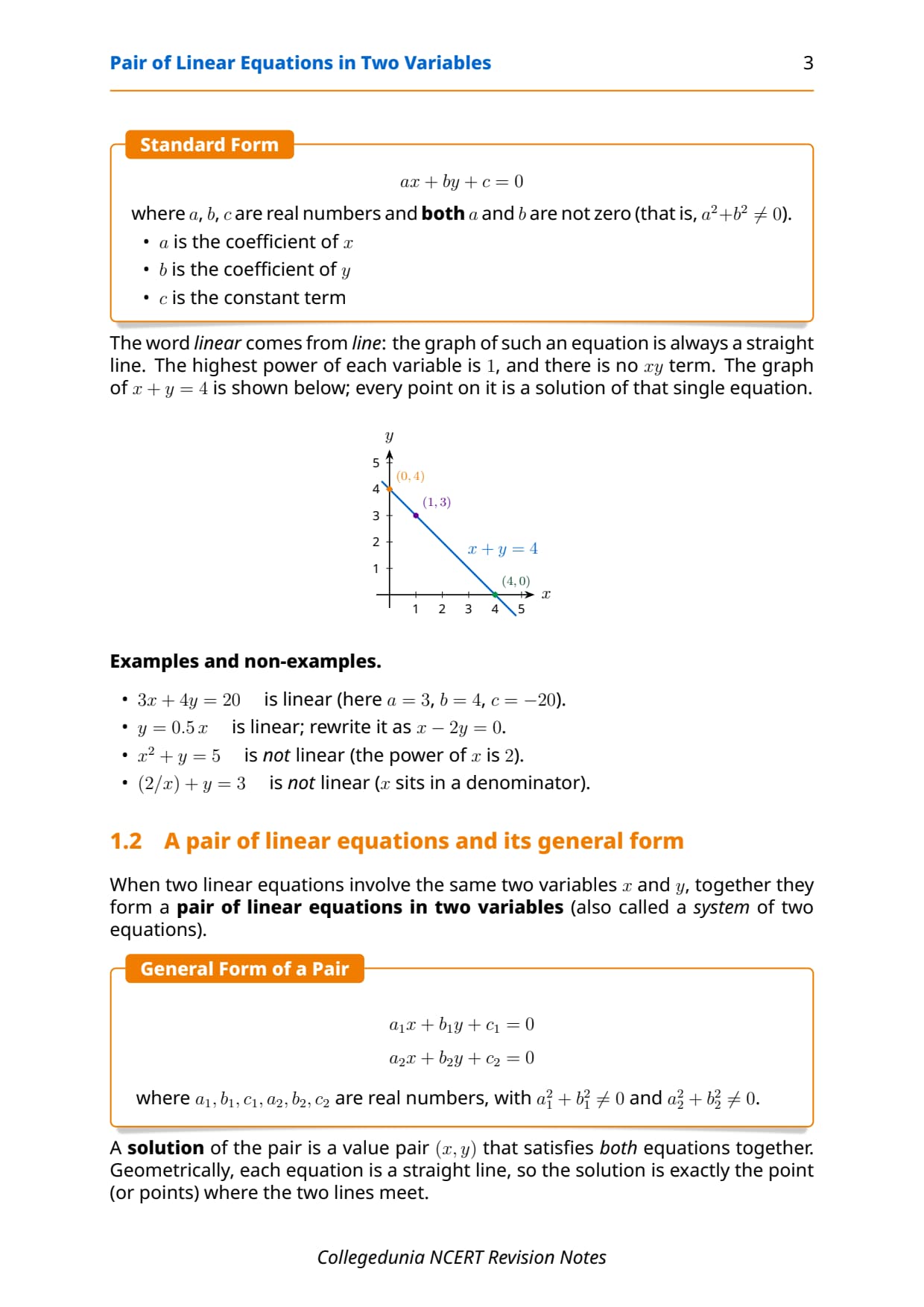
A linear equation in two variables is any equation you can write as ax + by + c = 0, where a, b, c are real and a, b are not both zero. Its graph is always a straight line, the highest power of each variable is 1, and there is no xy term.
When two such equations share the same x and y, they form a pair of linear equations. A solution is a pair (x, y) that satisfies both, so it is the point where the two lines meet.
| Equation | Linear in two variables? | Reason |
|---|---|---|
| 3x + 4y = 20 | Yes | Both powers 1; a = 3, b = 4, c = −20 |
| y = 0.5x | Yes | Rewrite as x − 2y = 0 |
| x squared + y = 5 | No | Power of x is 2, not 1 |
| (2/x) + y = 3 | No | x sits in a denominator |
The general form of a pair is a1 x + b1 y + c1 = 0 and a2 x + b2 y + c2 = 0. Keeping both in this = 0 form makes the ratio test work cleanly later.
Graphical Method and the Three Cases
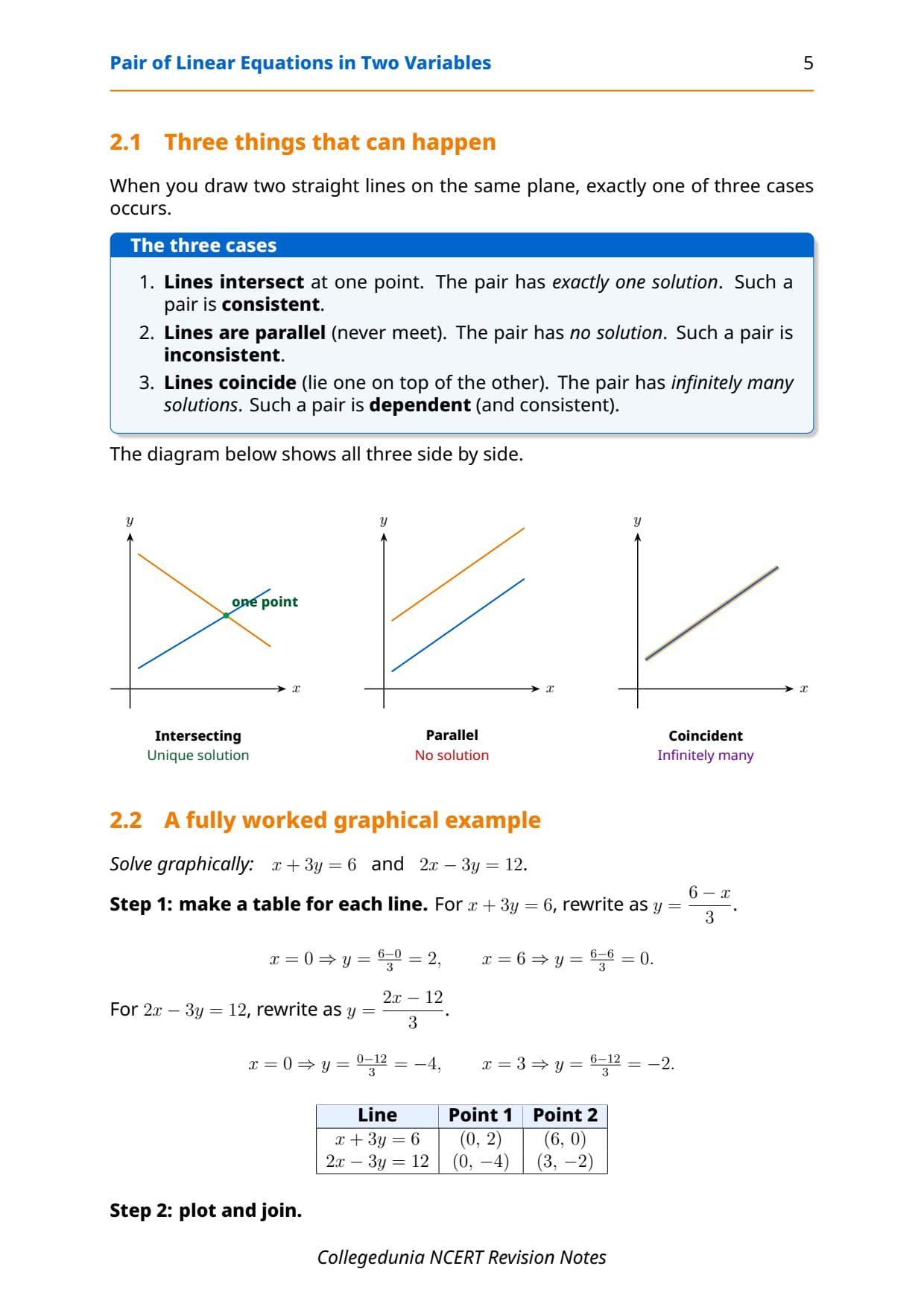
The most visual way is to draw both lines and see where they cross. Each line needs only two points: pick two x-values, find the y-values, plot and join. The meeting point is the solution. When you draw two lines, exactly one of three things happens, a favourite exam topic:
| How the two lines sit | Number of solutions | Pair is called |
|---|---|---|
| Intersect at one point | Exactly one solution | Consistent |
| Parallel (never meet) | No solution | Inconsistent |
| Coincident (one on top of the other) | Infinitely many solutions | Dependent and consistent |
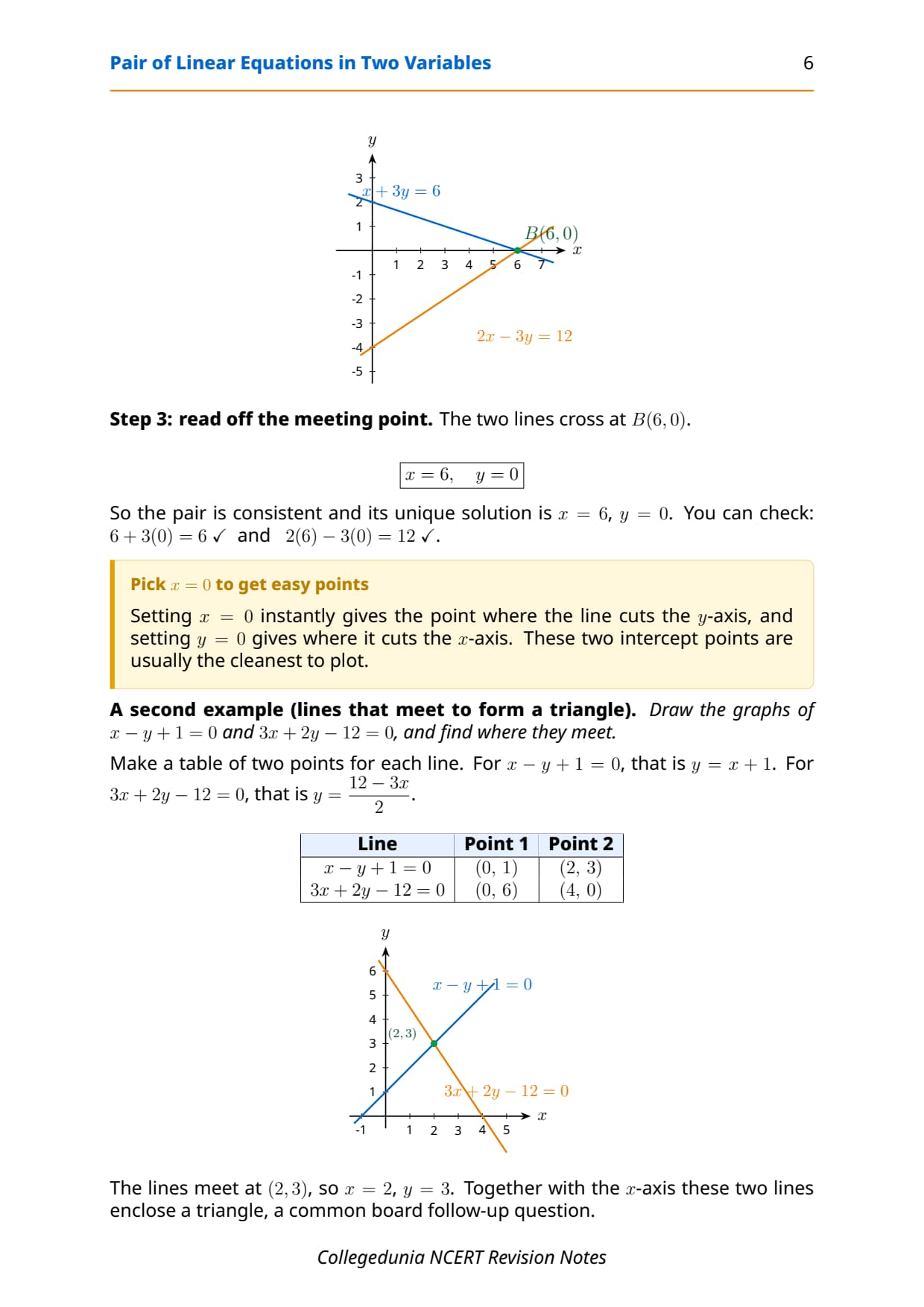
Take x + 3y = 6 and 2x − 3y = 12. The lines cross at (6, 0), so the pair is consistent with x = 6, y = 0. Check: 6 + 3(0) = 6 and 2(6) − 3(0) = 12, both true. Setting x = 0 gives the y-intercept and y = 0 the x-intercept, the cleanest points to plot.
Consistency from the Coefficient Ratios
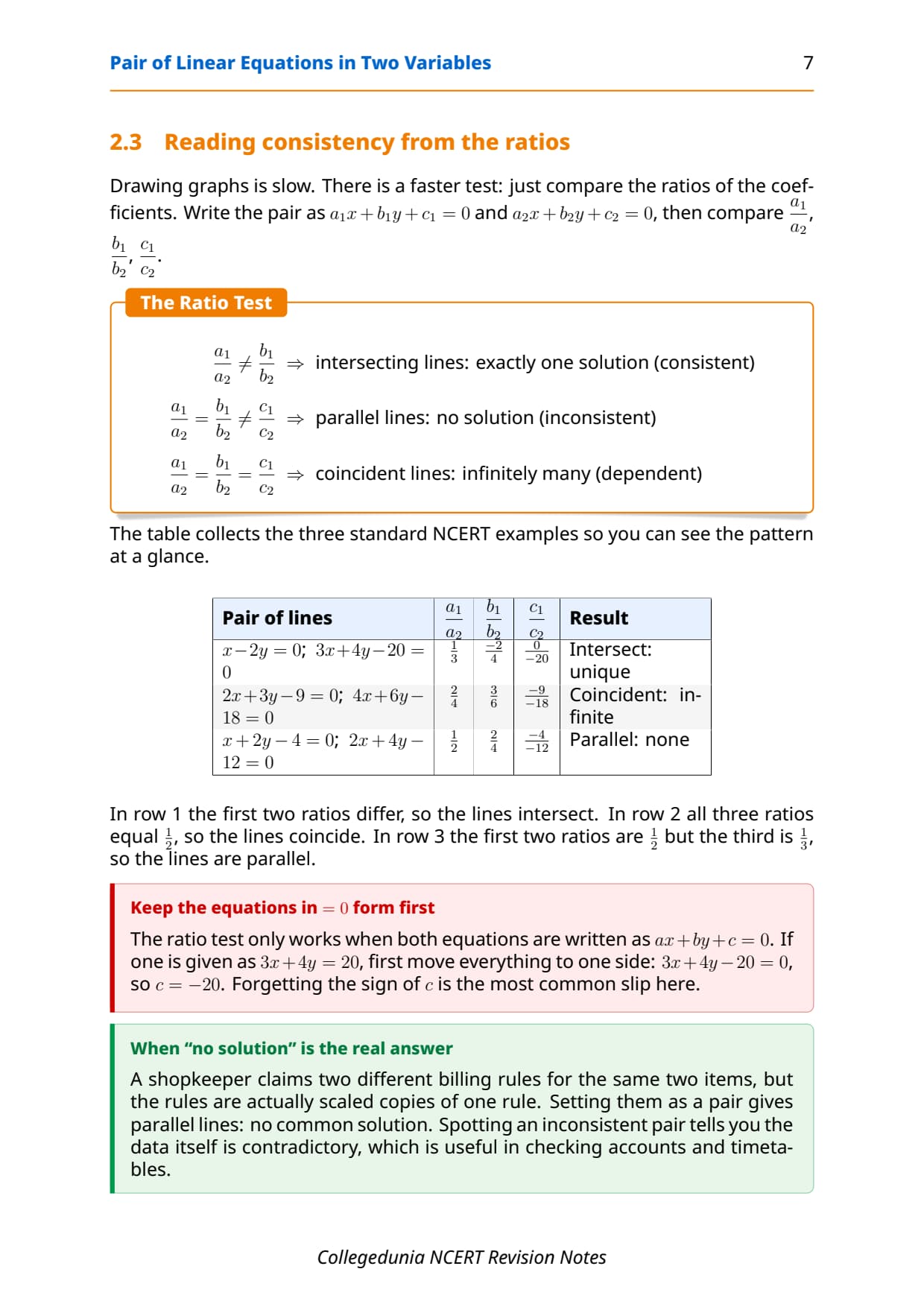
Graphs are slow and not exact for fractions. A faster test compares the coefficient ratios a1/a2, b1/b2 and c1/c2, stating the number of solutions without solving.
- a1/a2 ≠ b1/b2: lines intersect, exactly one solution (consistent).
- a1/a2 = b1/b2 ≠ c1/c2: lines parallel, no solution (inconsistent).
- a1/a2 = b1/b2 = c1/c2: lines coincide, infinitely many solutions (dependent).
For example, in 2x + 3y − 9 = 0 and 4x + 6y − 18 = 0, all three ratios equal 1/2, so the lines coincide (infinitely many solutions). In x + 2y − 4 = 0 and 2x + 4y − 12 = 0, the first two ratios are 1/2 but the third is 1/3, so the lines are parallel with no solution.
Substitution Method Step by Step
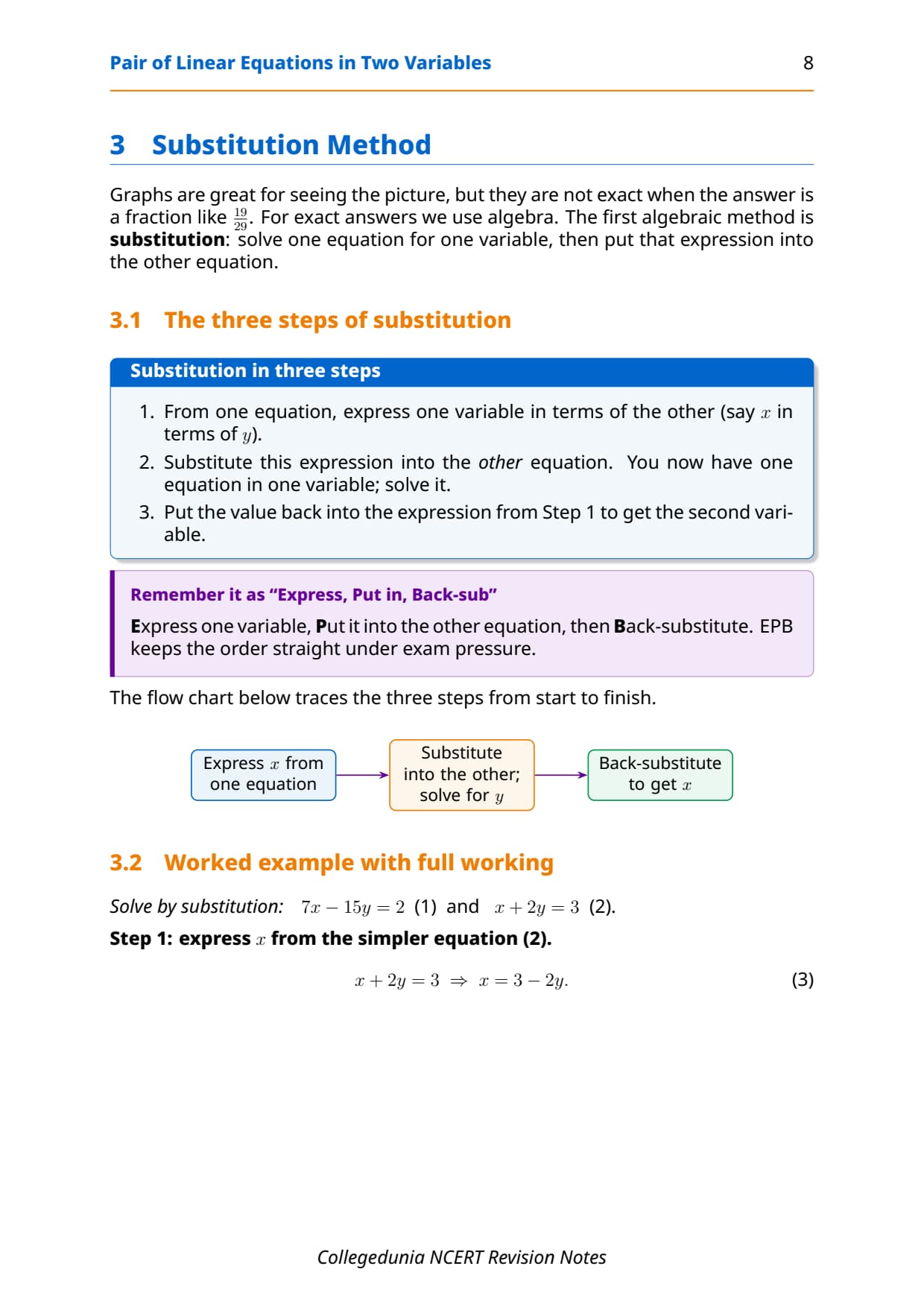
For exact answers we use algebra. The first method is substitution: solve one equation for one variable, then put it into the other. Three steps:
- Express one variable in terms of the other from one equation.
- Substitute into the other equation; you now have one equation in one variable, so solve it.
- Back-substitute into the Step 1 expression to get the second variable.
Take 7x − 15y = 2 and x + 2y = 3. From the second, x = 3 − 2y. Substitute: 7(3 − 2y) − 15y = 2 gives 21 − 29y = 2, so y = 19/29 and x = 49/29. Tip: express the variable whose coefficient is 1 to avoid fractions.
Substitution also flags special pairs: a true leftover like 18 = 18 means infinitely many solutions, a false one like −4 = 0 means no solution.
Elimination Method Step by Step
The second method is elimination: make one variable's coefficients equal, then add or subtract so it cancels. Often quickest when no coefficient is 1.
- Match one coefficient: multiply each equation so one variable's coefficients are equal in magnitude.
- Add or subtract: add if the matched coefficients have opposite signs, subtract if same, so that variable disappears.
- Solve the resulting one-variable equation.
- Back-substitute to find the other variable.
Take 9x − 4y = 2000 and 7x − 3y = 2000. Multiply by 3 and 4 to match the y-coefficients: 27x − 12y = 6000 and 28x − 12y = 8000. Subtract to get x = 2000, then 9(2000) − 4y = 2000 gives y = 4000.
| Use substitution when | Use elimination when |
|---|---|
| One variable has coefficient 1 | Coefficients are awkward with no 1 |
| One equation is already solved for a variable | Both equations in ax + by = c form |
| Numbers stay small after substituting | Equalising a coefficient is easy |
How to Use the Notes PDF for Revision
This is a method-heavy chapter, so take two passes: one for forming pairs and graphs, one for the algebraic methods and word problems. The PDF follows the same order.
First pass: forming pairs and graphs
Lock the standard form ax + by + c = 0, building two equations from a word problem, and the three graphical cases (intersecting, parallel, coincident). Sketch one pair to see the meeting point before the algebra.
Second pass: substitution, elimination and word problems
Work substitution and elimination on one example each, then practise the common word-problem types: two-digit numbers, ages, cost of two items, and boat-and-stream speed. The habit Name, Form, Solve, Check keeps long word problems on track. These same skills appear in the CUET General Test and JEE foundation algebra.
Previous Year Question Trends
CBSE tests this chapter mainly through word problems solved by substitution or elimination, the ratio test, and finding a constant that makes a pair consistent or inconsistent. The table maps the question types across recent papers.
| Year | Question type asked | Marks |
|---|---|---|
| 2025 | Solve a word problem (ages or cost of two items) by elimination | 3 |
| 2024 | Find the value of k for which a pair has no solution or infinitely many | 2 or 3 |
| 2023 | Solve a pair by substitution and verify the answer | 2 |
| 2022 | State whether a given pair is consistent using the ratio test | 1 or 2 |
| 2021 | Solve a pair graphically and read the meeting point | 3 |
Also Check: The full set of CBSE board questions for this chapter, with step-by-step answers, is in the PDF above, updated for 2026-27.
Common Mistakes to Avoid
Most lost marks here come from a few repeat errors. Each is easy to avoid once named.
The repeat-offender mistakes in board answers:
- Skipping the "let" statement: not naming x and y costs setup marks and causes mix-ups.
- Reversing a "more than" sentence: "girls are 4 more than boys" is g = b + 4, not b = g + 4.
- Using the ratio test on = c form: the test needs ax + by + c = 0, so move the constant over and watch the sign of c.
- Forgetting to scale the constant: when multiplying an equation, scale the right-hand number too.
- Misreading the leftover statement: a true statement means infinitely many solutions, a false one means none.
Other Resources for This Chapter
Pair these notes with the matching NCERT Solutions, formula sheet, handwritten notes and the official NCERT book chapter. All resources are linked below.
| Resource | What it covers | Open |
|---|---|---|
| Notes | Concept-first revision notes on forming a pair, the graphical method, the ratio test, and the substitution and elimination methods. | You are here |
| NCERT Solutions | Step-by-step answers to all exercise questions, with an Expert Solution for each. | Class 10 Maths Chapter 3 NCERT Solutions |
| Formula Sheet | One-page list of the key forms, the ratio test, and the substitution and elimination steps for fast revision. | Class 10 Maths Chapter 3 Formula Sheet |
| Handwritten Notes | Scanned-style handwritten pages for last-minute board revision. | Class 10 Maths Chapter 3 Handwritten Notes |
| NCERT Book PDF | Official NCERT Maths Chapter 3 Pair of Linear Equations in Two Variables textbook in PDF form. | Class 10 Maths Chapter 3 NCERT Book PDF |
| Exemplar Solutions | Worked answers to the harder NCERT Exemplar problems for extra practice. | Class 10 Maths Chapter 3 Exemplar Solutions |
Notes for Class 10 Maths: All Chapters
Related Links: Open the revision notes for the other Class 10 Maths chapters below. Each one has the same concept-first style, full PDF download, and revision FAQ.
| Chapter | Notes link |
|---|---|
| Chapter 1 | Real Numbers Notes |
| Chapter 2 | Polynomials Notes |
| Chapter 3 | Pair of Linear Equations in Two Variables Notes (You are here) |
| Chapter 4 | Quadratic Equations Notes |
| Chapter 5 | Arithmetic Progressions Notes |
| Chapter 6 | Triangles Notes |
| Chapter 7 | Coordinate Geometry Notes |
| Chapter 8 | Introduction to Trigonometry Notes |
| Chapter 9 | Some Applications of Trigonometry Notes |
| Chapter 10 | Circles Notes |
| Chapter 11 | Areas Related to Circles Notes |
| Chapter 12 | Surface Areas and Volumes Notes |
| Chapter 13 | Statistics Notes |
| Chapter 14 | Probability Notes |
Notes Class 10 Maths Chapter 3 Pair of Linear Equations in Two Variables FAQs
Ques. What does Chapter 3 Pair of Linear Equations in Two Variables cover in Class 10 Maths?
Ans. Chapter 3 covers three ideas in the 2026-27 CBSE syllabus. First, forming a pair of linear equations from a word problem, each in the standard form ax + by + c = 0. Second, solving the pair three ways: the graphical method (draw both lines and read the meeting point), the substitution method (express one variable and put it into the other equation), and the elimination method (cancel one variable by adding or subtracting). Third, deciding the nature of the solutions from the ratios a1/a2, b1/b2 and c1/c2, which tell you whether the pair has one solution, none, or infinitely many.
Ques. What are the three methods to solve a pair of linear equations?
Ans. They are graphical, substitution and elimination. The graphical method plots both lines, and the point where they cross is the solution; best for seeing if the pair is consistent. Substitution expresses one variable, puts it into the other equation, solves, then back-substitutes; best when one coefficient is already 1. Elimination matches one variable's coefficients, adds or subtracts to cancel it, then solves; best when the coefficients are awkward. All three give the same answer.
Ques. How do you use the ratio test to find the number of solutions?
Ans. Write both equations as a1 x + b1 y + c1 = 0 and a2 x + b2 y + c2 = 0, then compare a1/a2, b1/b2 and c1/c2. If a1/a2 is not equal to b1/b2, the lines intersect and there is exactly one solution (consistent). If a1/a2 = b1/b2 but neither equals c1/c2, the lines are parallel and there is no solution (inconsistent). If a1/a2 = b1/b2 = c1/c2, the lines coincide and there are infinitely many solutions (dependent). The test only works when both equations are in ax + by + c = 0 form.
Ques. What is the difference between the substitution and elimination methods?
Ans. Both give the same solution, but they suit different pairs. Substitution works best when one variable has coefficient 1, or when one equation is already solved for a variable, so you avoid fractions early. Elimination works best when the coefficients are awkward with no 1, since you just multiply to match one variable's coefficient and cancel it. For example, 7x − 15y = 2 with x + 2y = 3 is easy by substitution (x has coefficient 1), while 9x − 4y = 2000 with 7x − 3y = 2000 is faster by elimination.
Ques. What do consistent, inconsistent and dependent pairs mean?
Ans. A consistent pair has at least one solution: its lines either intersect at one point (unique solution) or coincide (infinitely many). An inconsistent pair has no solution; its lines are parallel and never meet. A dependent pair is a special consistent pair whose two equations are the same line, so they coincide. In short: intersecting lines are consistent, parallel lines are inconsistent, and coincident lines are dependent.
Ques. How do you turn a word problem into a pair of linear equations?
Ans. Follow four steps: Name, Form, Solve, Check. First name the unknowns with a clear "let x be... and y be..." line. Then form one equation from each condition, translating each sentence carefully. Next solve by substitution or elimination to find x and y. Finally check both values in the original problem. For a two-digit number, the number is 10x + y (tens digit x, units digit y), and the reversed number is 10y + x.
Ques. How many pages is the Class 10 Maths Pair of Linear Equations Notes PDF?
Ans. The Notes PDF runs about 20 pages and covers the full chapter in concept-first blocks. It includes the standard form ax + by + c = 0, forming a pair from a word problem, the graphical method with the three cases, the ratio test, the substitution method, the elimination method, and common word-problem types with full working. The PDF is free for 2026-27, and a green Handwritten Notes button opens the scanned-style version.
Ques. Are these Notes for Class 10 Maths Chapter 3 aligned with the 2026-27 syllabus?
Ans. Yes. This page follows the rationalised 2026-27 CBSE syllabus. Pair of Linear Equations in Two Variables is the third chapter of the Algebra unit. The focus is forming a pair, solving by the graphical, substitution and elimination methods, and reading the number of solutions from the coefficient ratios. These notes follow the NCERT order and also help with the CUET General Test and JEE foundation questions.



Comments