




These Notes for Class 10 Maths Chapter 14 Probability cover theoretical probability, sample space, complementary events, and impossible versus certain events. All notes follow the 2026-27 CBSE syllabus. Probability is one of the most scoring chapters in the board paper.
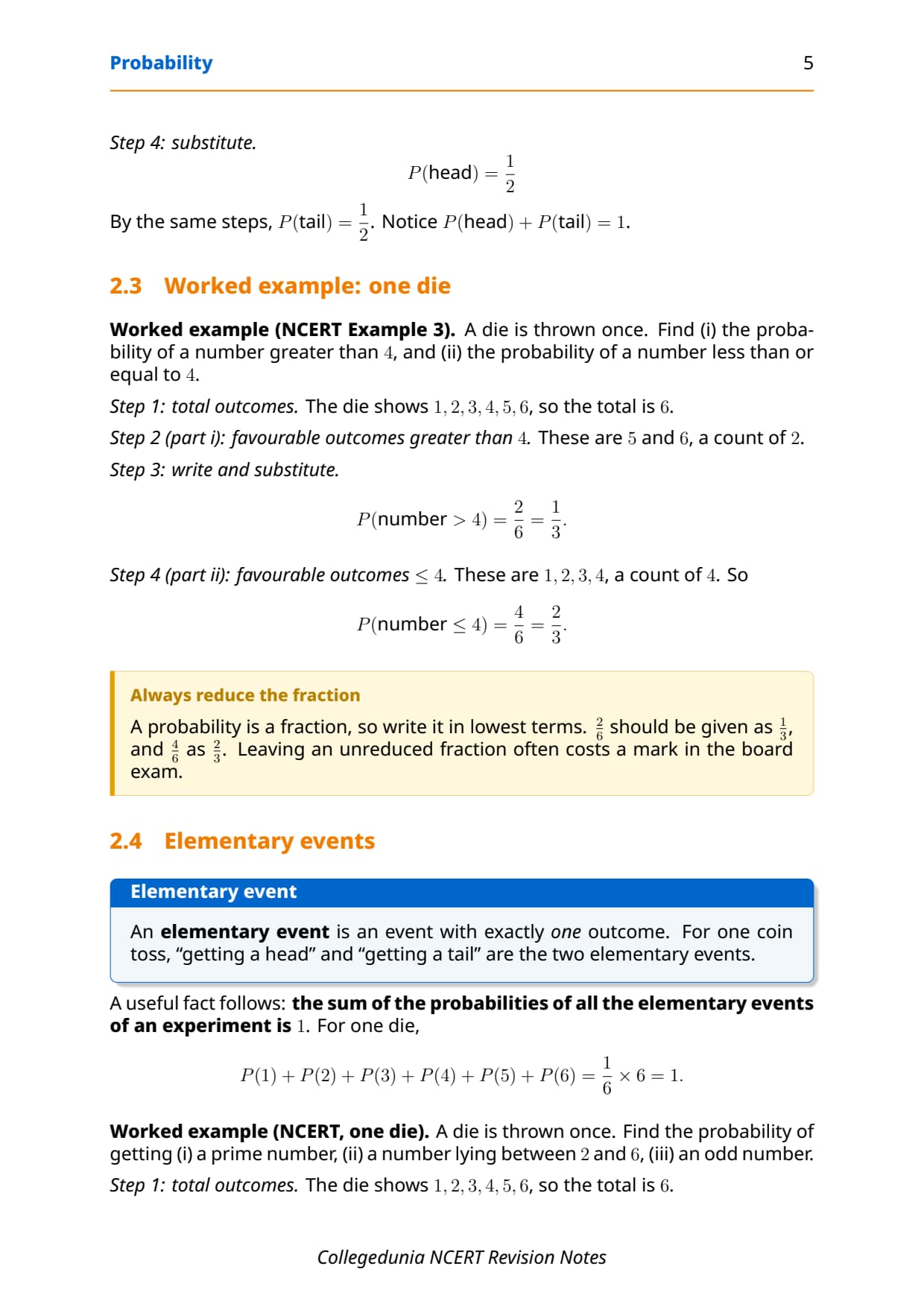
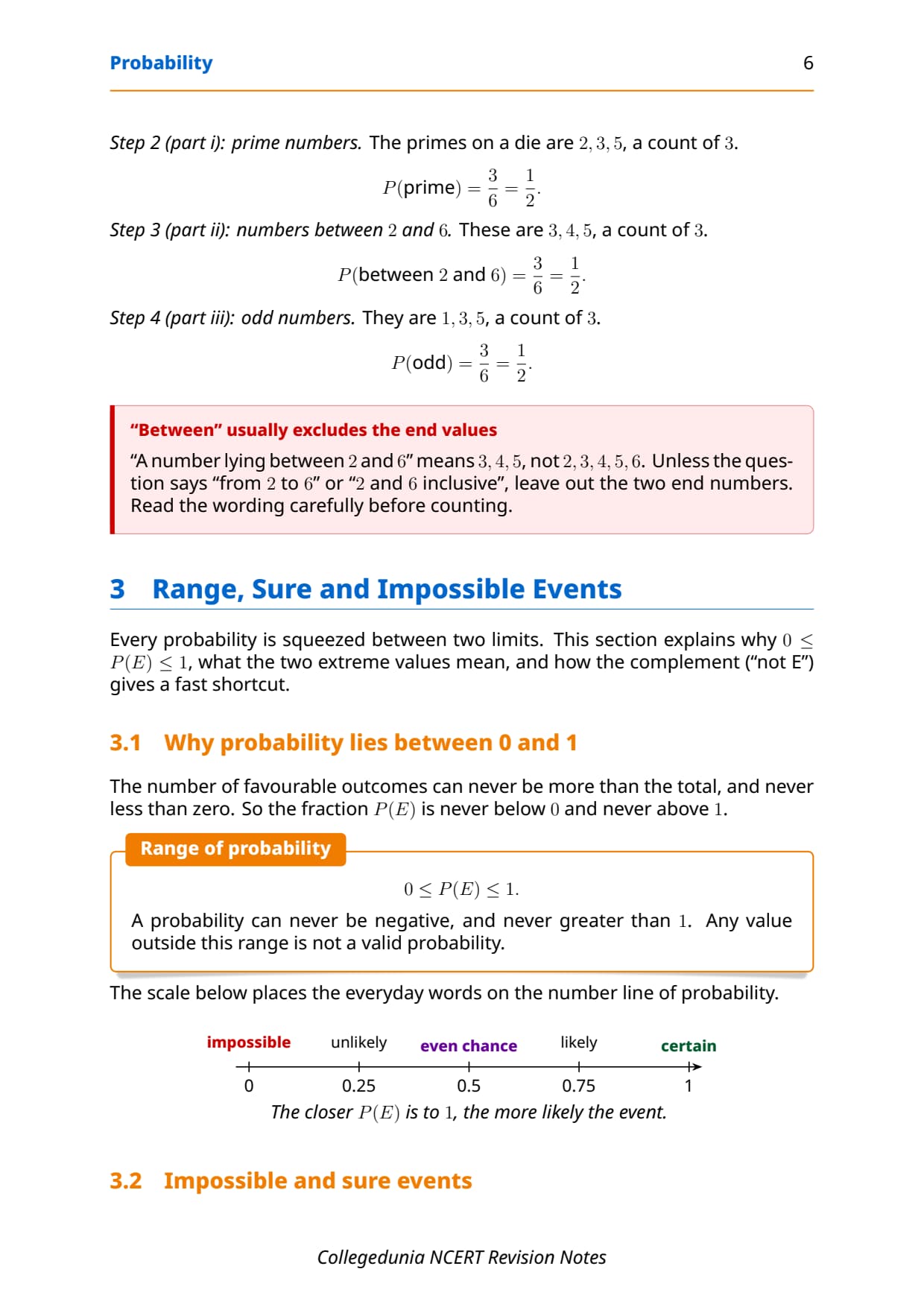
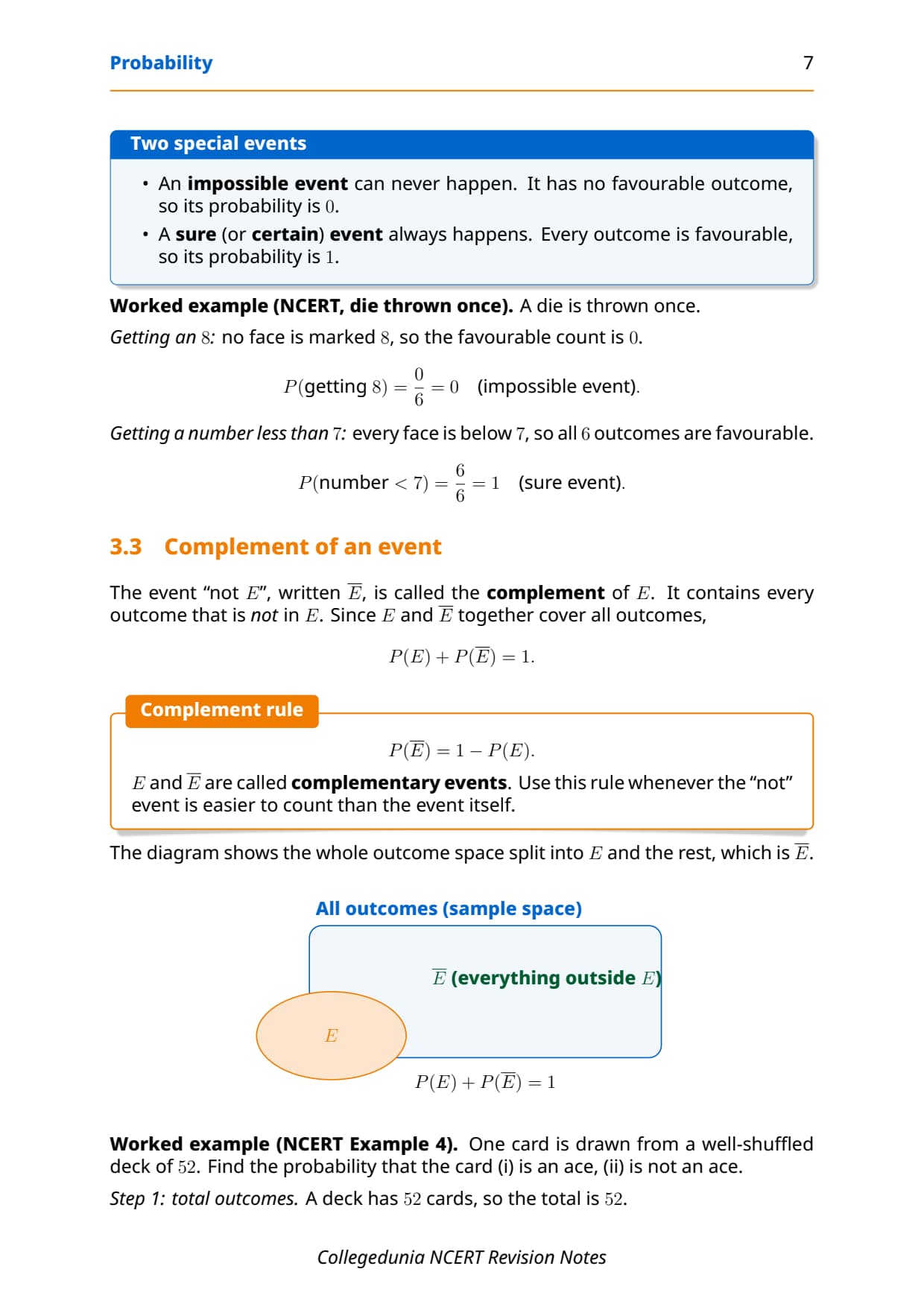
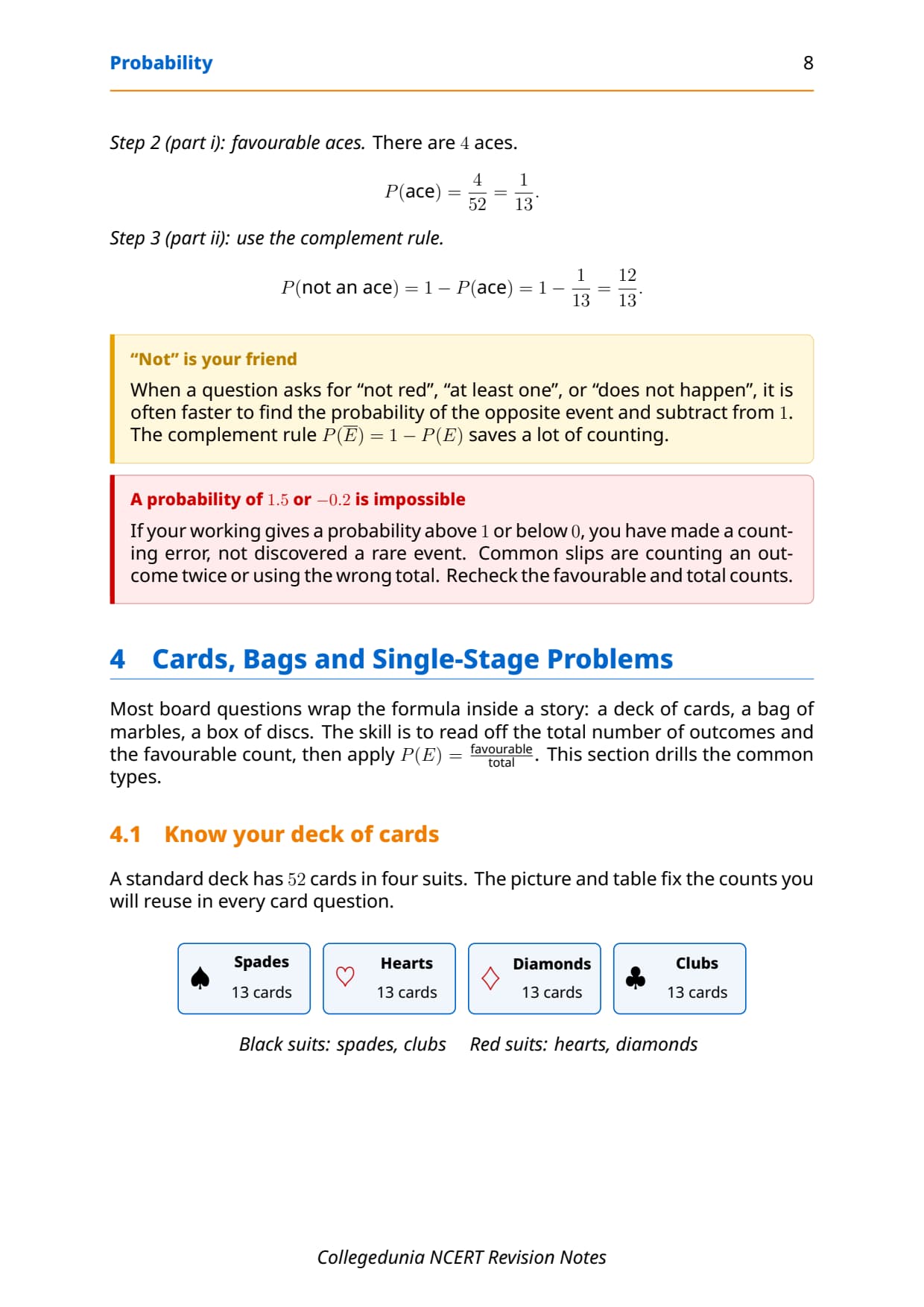
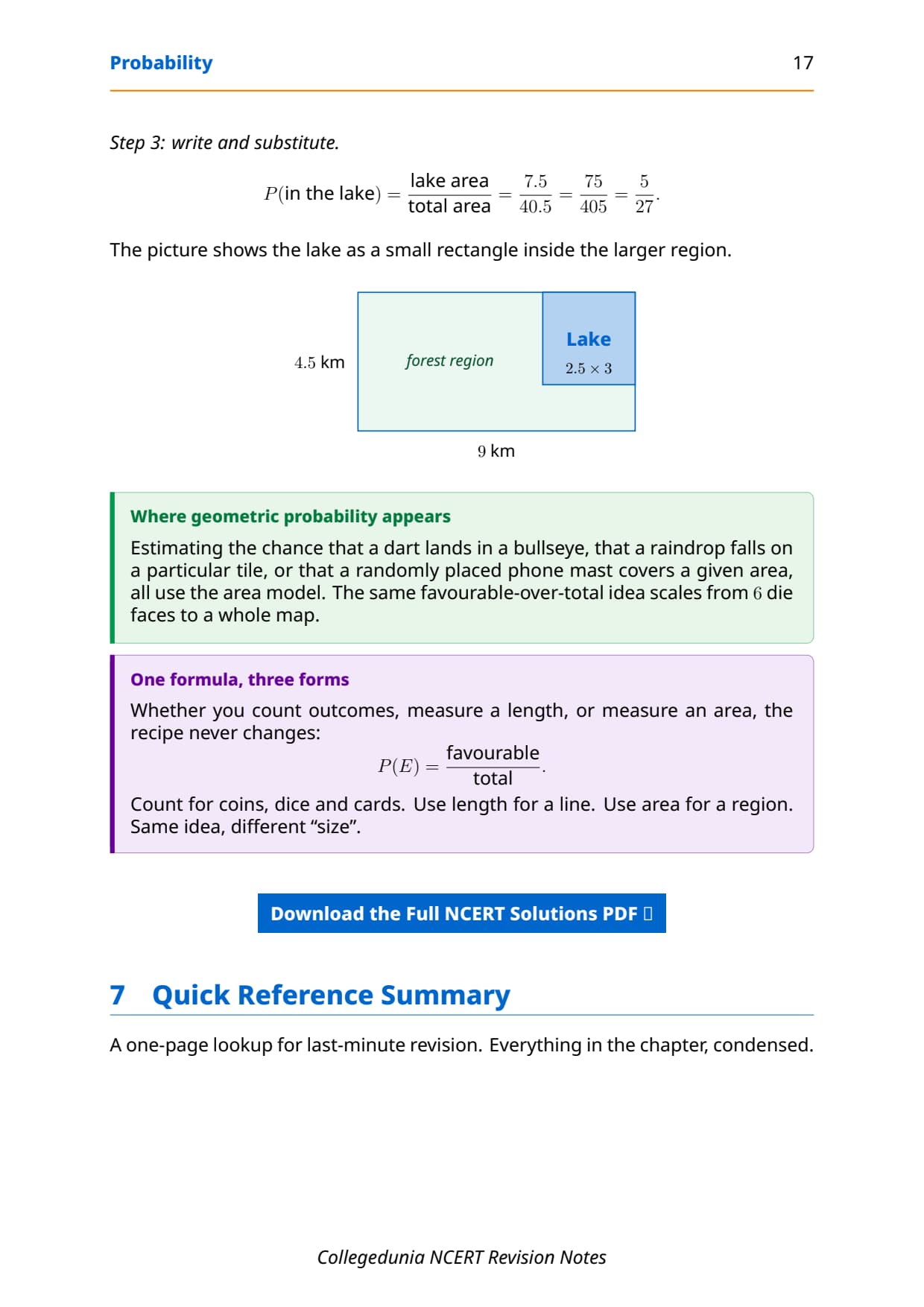
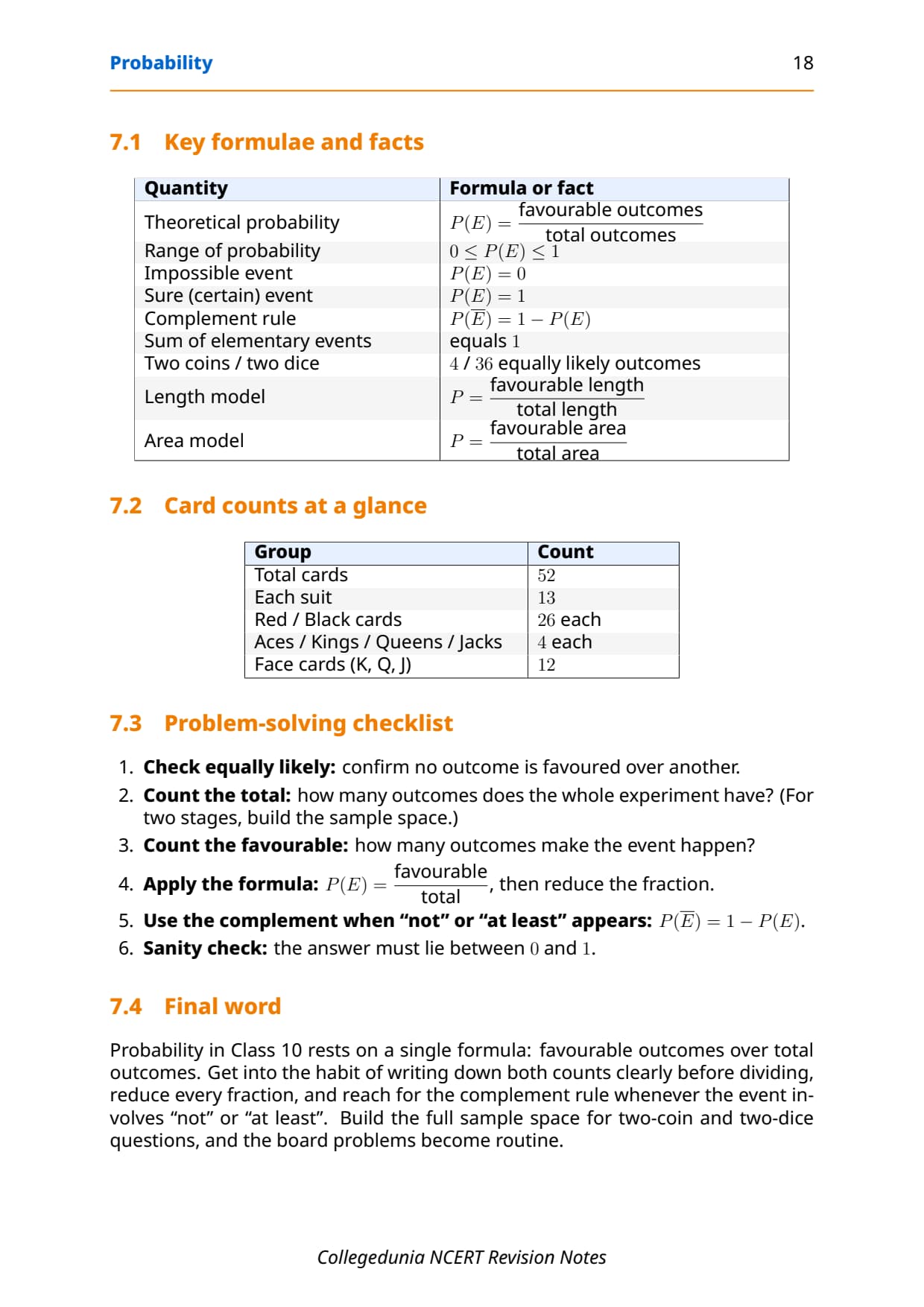
- The theoretical probability formula P(E) = favourable outcomes / total outcomes, with equally likely outcomes, sample space, and event types explained simply.
- Complementary, impossible, and certain events, plus the rule P(E) + P(not E) = 1, each in plain words with CBSE board examples.
- Aligned to the 2026-27 CBSE syllabus, so you can grab the 5 to 7 marks this chapter brings in every board exam.
These notes are written by Maths experts from the 2026-27 NCERT textbook and checked against the last five years of CBSE Class 10 board papers.
Student Feedback: what 7,400 students told us
79% of Class 10 students said writing the sample space first was the habit that helped them avoid the most errors. Students who jumped straight to counting favourable outcomes often missed or double-counted them. That cost marks in the 3-mark and 4-mark questions.
Top scorers called this one of the most predictable chapters in the board paper. The same question types, coins, dice, cards and balls in a bag, repeat every year. Students who solved 15 to 20 standard problems, instead of only reading formulas, scored 2 to 3 marks more.
Source: 2026-27 Class 10 Maths student poll, 7,400 students from CBSE schools in 11 states, before the 2026 boards.
Watch Probability Class 10 Maths Explained
Source: Magnet Brains on YouTube
What These Notes Cover
Probability is the last chapter of Class 10 Maths. It introduces theoretical (classical) probability: you assume all outcomes are equally likely and find the probability by counting, with no experiment.
- Sample space and events: the set of all outcomes is the sample space; any subset is an event. n(S) is the denominator in the formula.
- Formula and complement: P(E) = favourable outcomes / total equally likely outcomes, and P(E) + P(not E) = 1.
- Impossible and certain events: P = 0 and P = 1; all probabilities lie between 0 and 1.
- Standard contexts: tossing coins, rolling dice, drawing cards from a deck of 52, and drawing balls from a bag.
Sample Space, Events & Favourable Outcomes
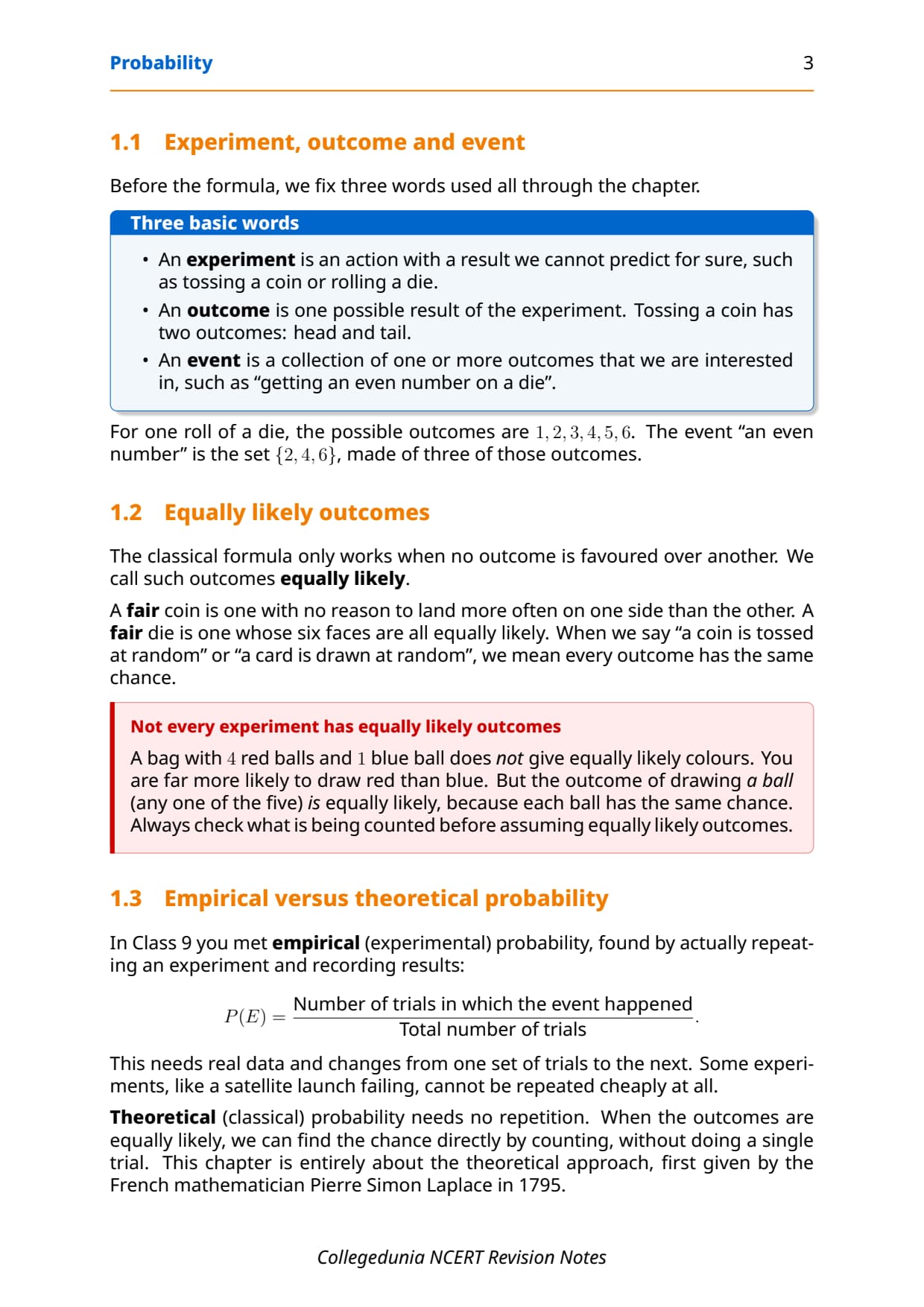
Before any formula, get three ideas clear: a random experiment, the sample space, and an event.
An experiment is random if it has several possible results you cannot predict, like tossing a coin, rolling a die, or drawing a card. The sample space (S) is the set of all possible outcomes. Always write S = { ... } before starting a problem. The count n(S) is the denominator in the formula.
| Experiment | Sample space S | n(S) |
|---|---|---|
| Toss one coin | {H, T} | 2 |
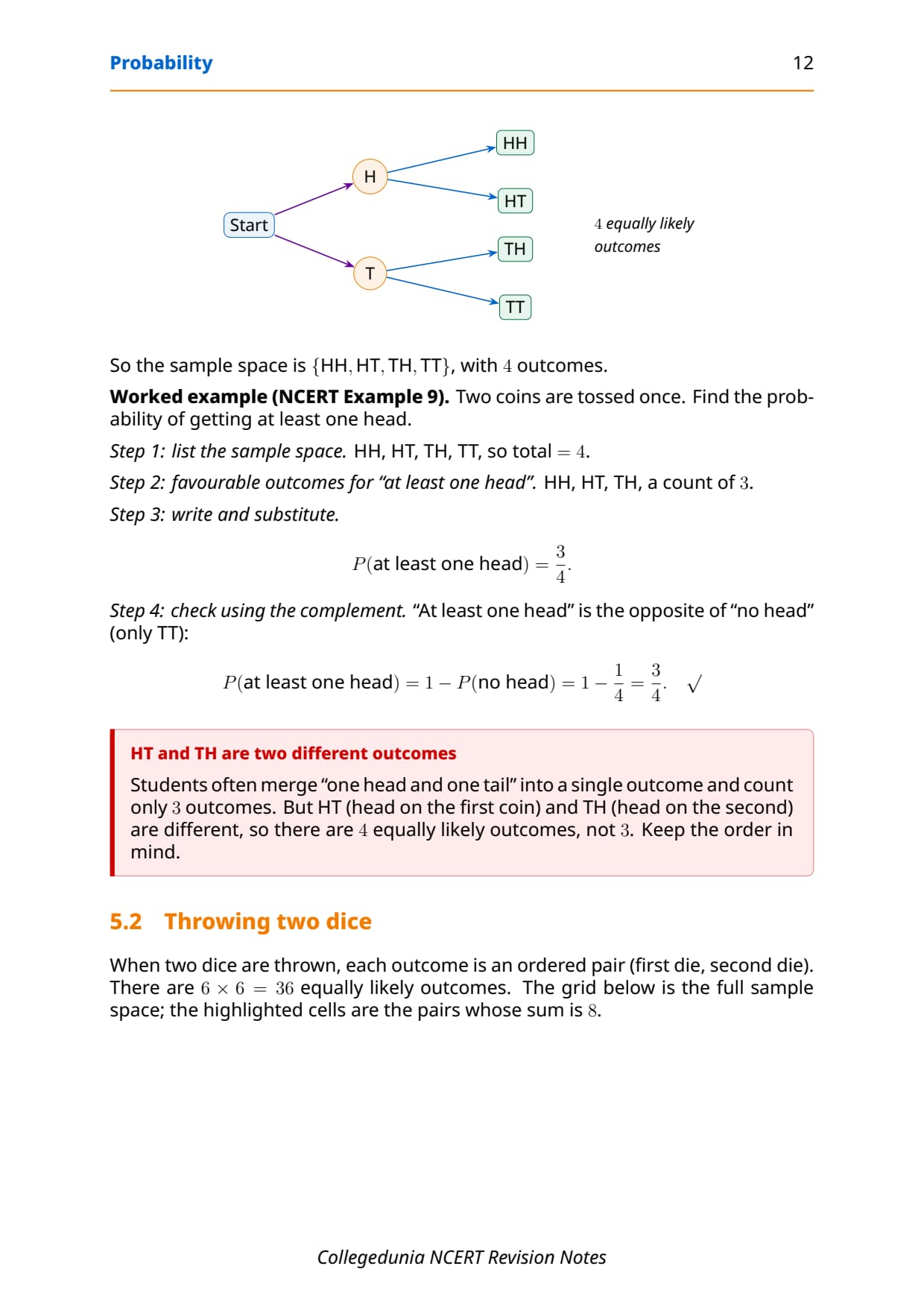
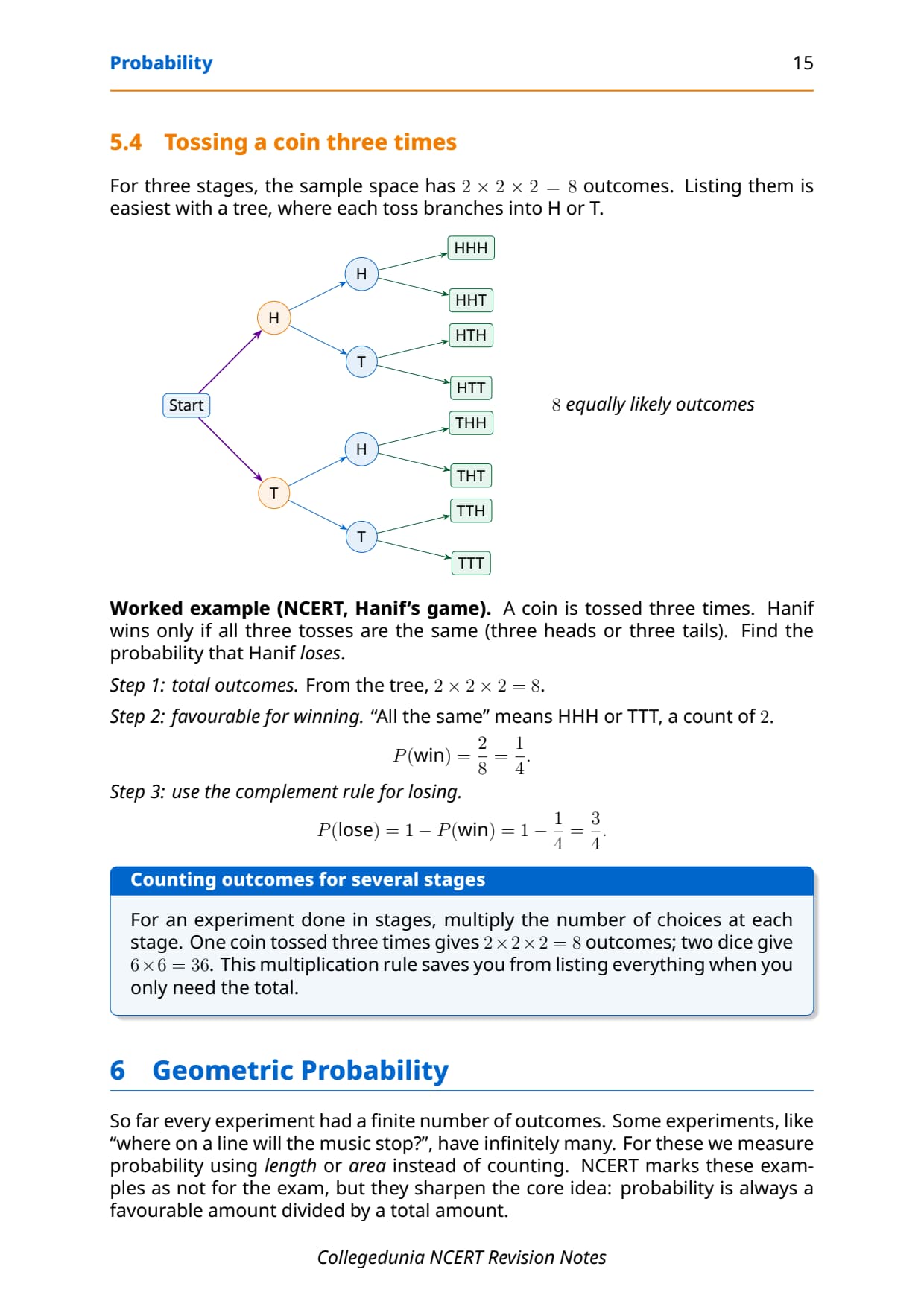
| Toss two coins | {HH, HT, TH, TT} | 4 |
| Roll one die | {1, 2, 3, 4, 5, 6} | 6 |
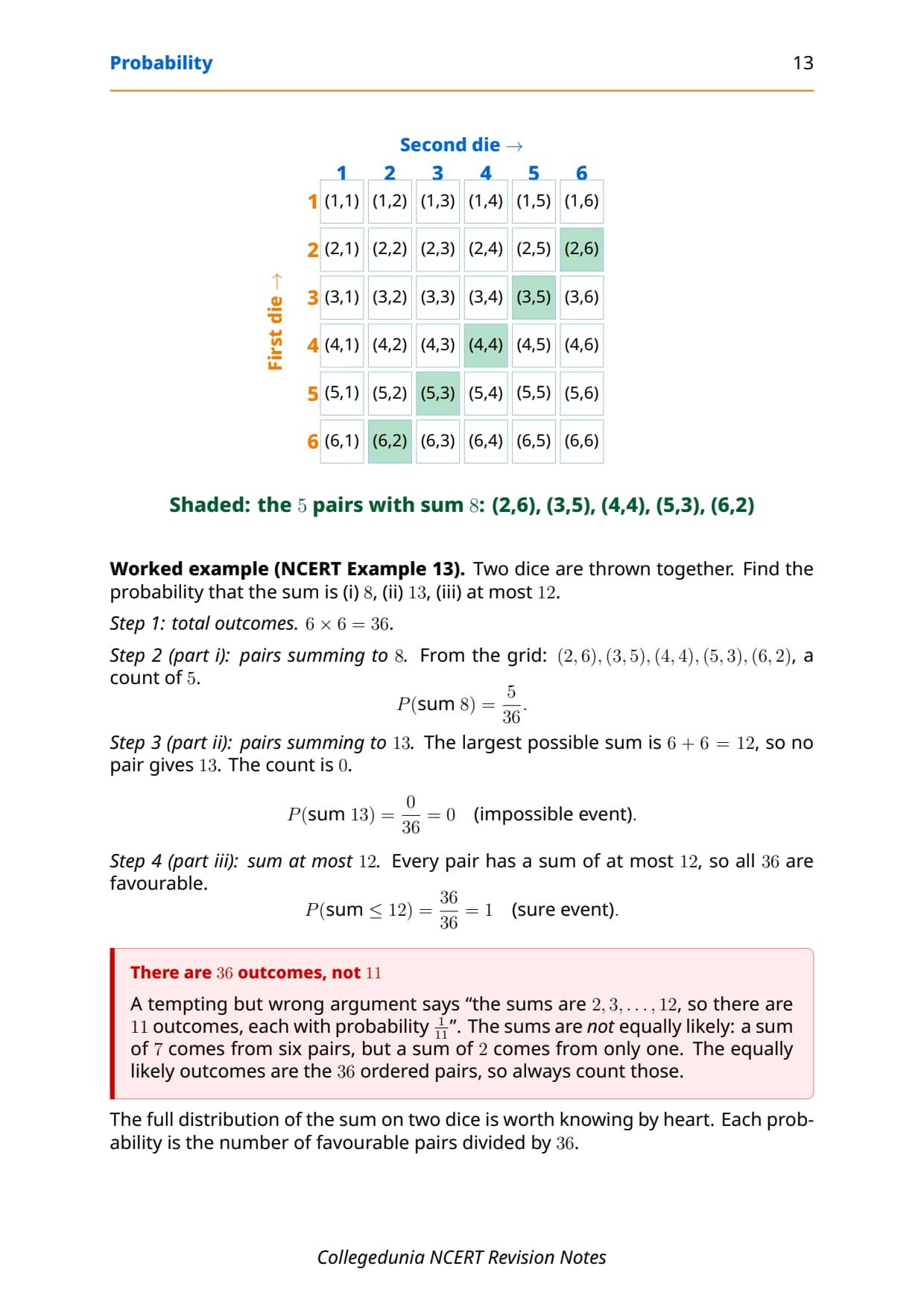
| Roll two dice | All (a, b) pairs where a, b ∈ {1,...,6} | 36 |
| Draw one card from a deck | All 52 cards | 52 |
An event (E) is any subset of the sample space. The favourable outcomes are the outcomes in S that satisfy E; their count is n(E).
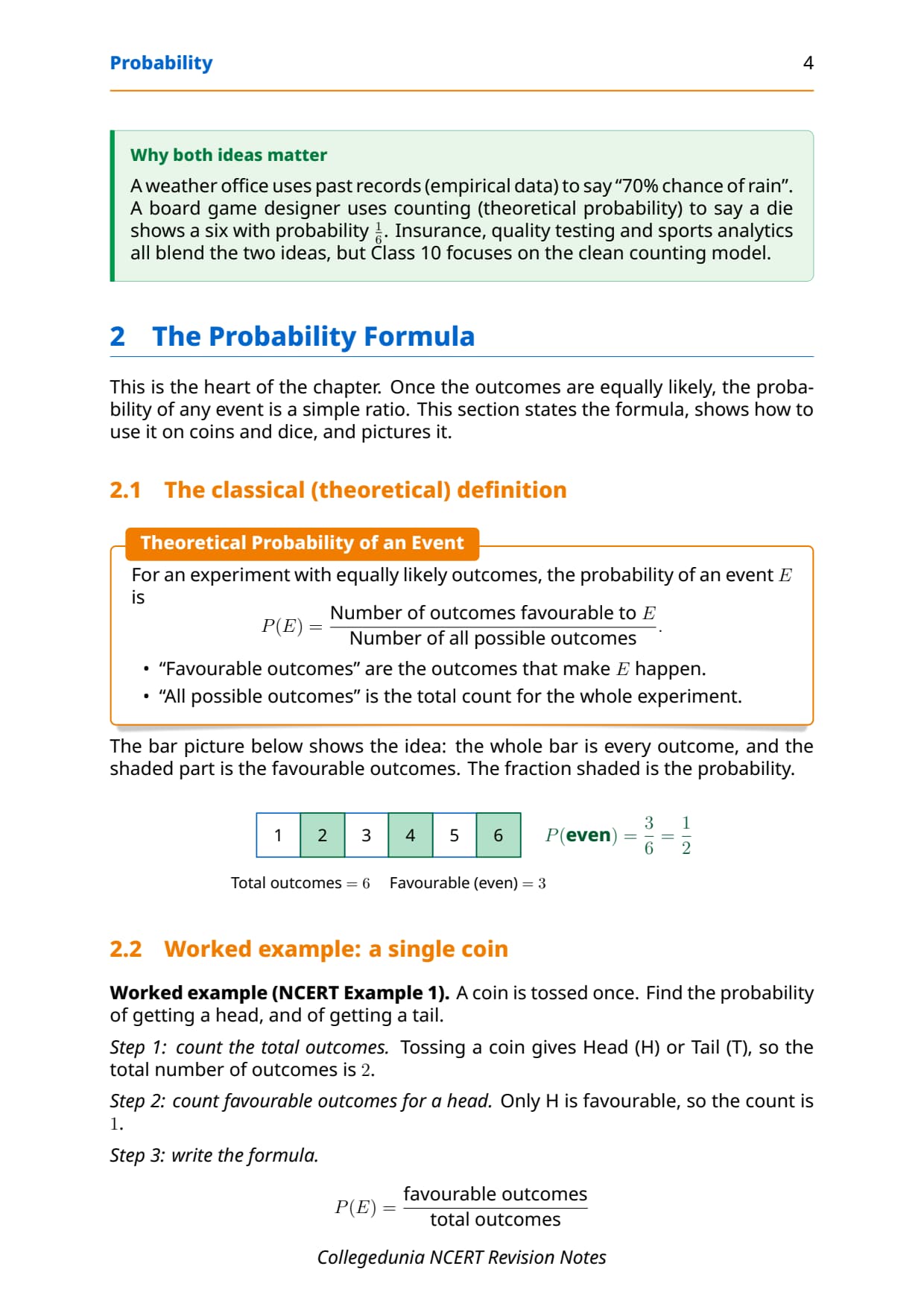
Example: Roll a die. E="an even number" = {2, 4, 6}, so n(E) = 3 and n(S) = 6. P(E) = 3/6 = 1/2. Outcomes are always equally likely (fair coin, fair die, shuffled deck); biased experiments are not in the Class 10 syllabus.
Theoretical Probability Formula: P(E) = Favourable / Total
The theoretical probability of an event E is:
or, using set notation: P(E) = n(E) / n(S)
This works only when all outcomes are equally likely. NCERT calls it theoretical probability to set it apart from experimental probability, which uses frequencies from repeated trials.
Standard sample space sizes to memorise
| Experiment | n(S) | Key sub-counts to know |
|---|---|---|
| One coin | 2 | H = 1, T = 1 |
| Two coins | 4 | 2 heads = 1, exactly 1 head = 2, 0 heads = 1 |
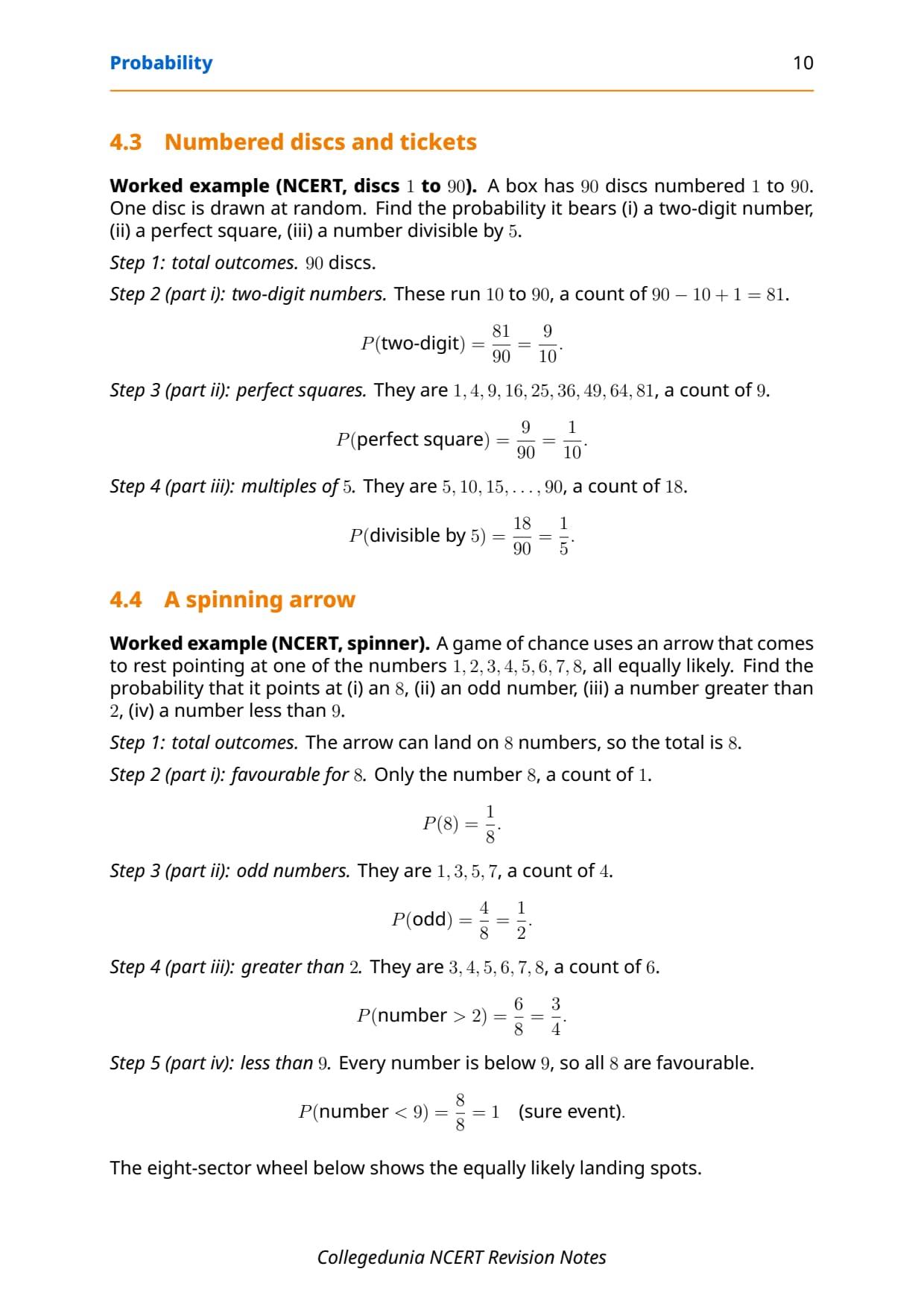
| One die | 6 | Even = 3, odd = 3, prime = 3 (2,3,5), multiples of 3 = 2 |
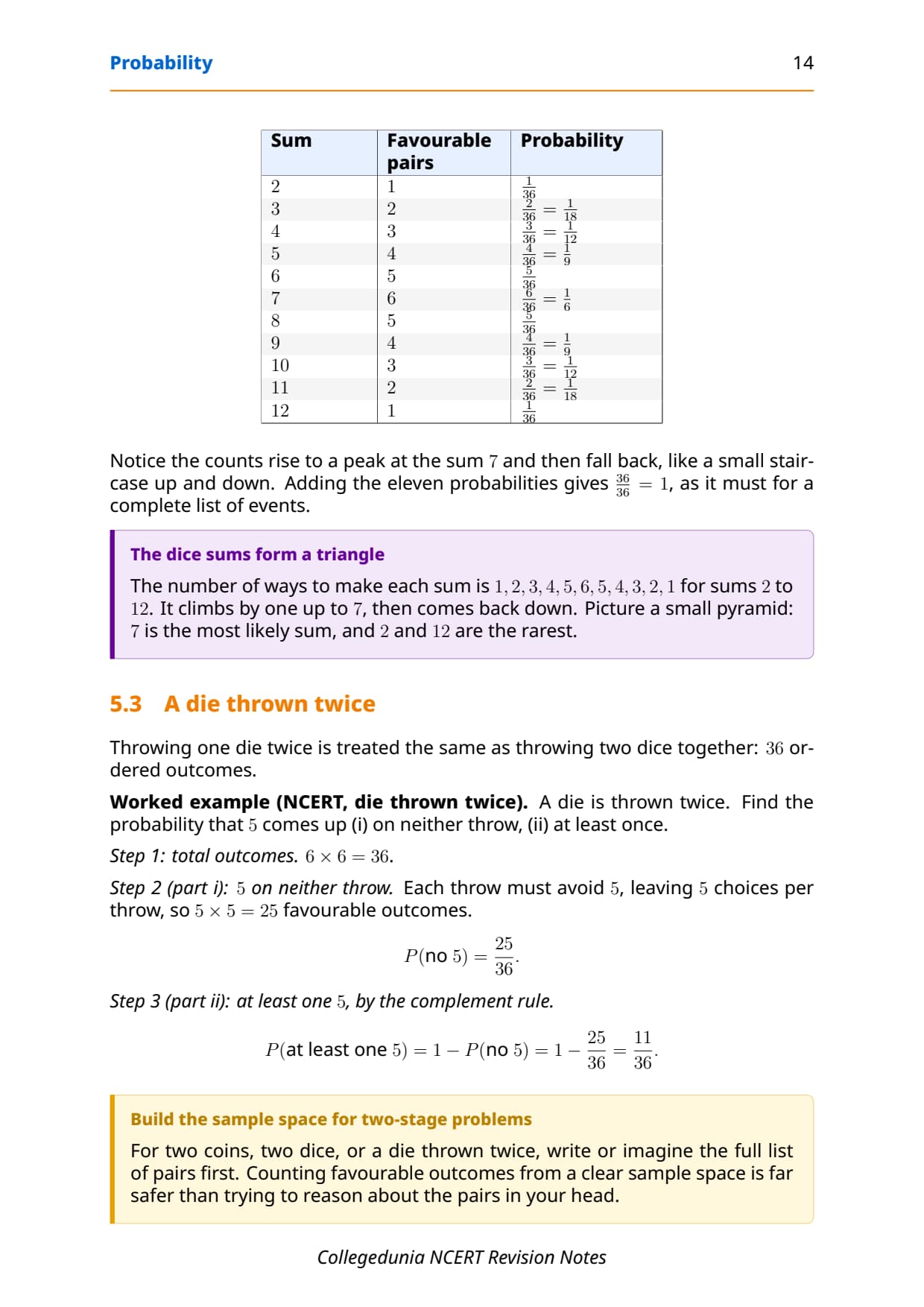
| Two dice | 36 | Sum = 7 has 6 pairs, doublets = 6, sum = 2 has 1 pair |
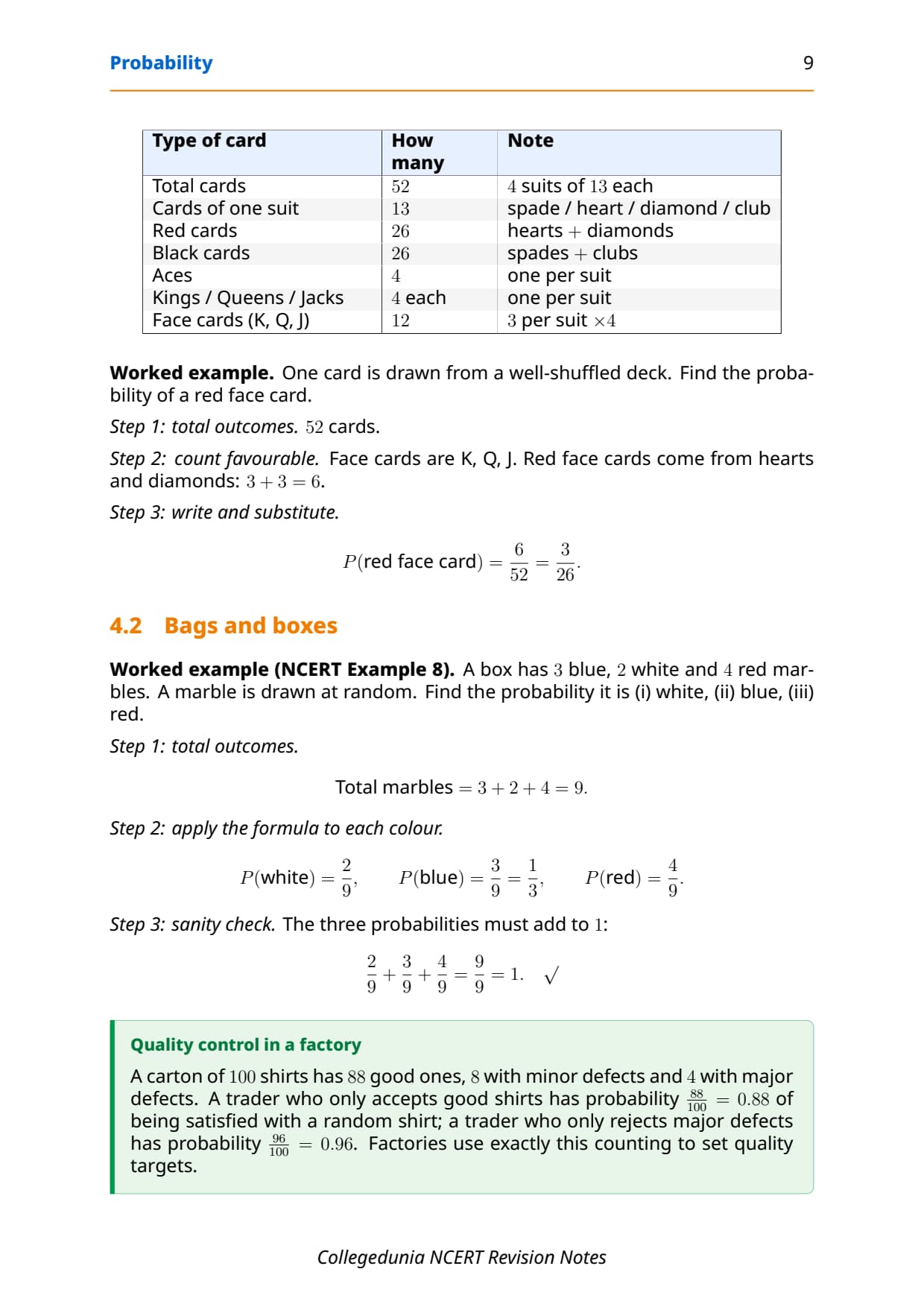
| Deck of cards | 52 | 26 red, 26 black; 4 each of aces, kings, queens, jacks; 12 face cards |
Card deck: 4 suits, 13 cards each. Face cards are Jack, Queen, King only (12 in all); the Ace is NOT a face card.
Complementary Events & P(E) + P(not E) = 1
For any event E, the complementary event (written E' or "not E") is the event that E does not happen. One of the two must occur, and both cannot occur at once. So we get the rule:
This helps when the complement is easier to count. For "at least one head" with two coins, find P(no heads) = P(TT) = 1/4, then P(at least one head) = 1 - 1/4 = 3/4. Useful triggers: "at least one" (count "none"), "not a..." (use 1 - P(E) directly), and any event where the direct count is large. Write the rule in your answer; CBSE gives a step mark for stating it.
Impossible Events, Certain Events & the Range of Probability
An impossible event has no favourable outcomes, so P = 0 (getting a 7 on a die is the empty set). A certain event has every outcome favourable, so P = 1 (a number less than 7 on a die is the whole S). For any event E, 0 ≤ P(E) ≤ 1: a value outside this range means you over- or under-counted, so use it as a built-in answer check.
| Type of event | Probability | Example |
|---|---|---|
| Impossible event | P(E) = 0 | Getting 7 on a single die |
| Very unlikely | P(E) close to 0 | Drawing the ace of spades from a 52-card deck: P = 1/52 |
| Equally likely | P(E) = 0.5 | Getting a head on a fair coin |
| Very likely | P(E) close to 1 | Not getting a 6 on a die: P = 5/6 |
| Certain event | P(E) = 1 | Getting a number between 1 and 6 on a die |
Solved Board Problems: Coins, Dice, Cards & Bags
These problems cover the question types the CBSE board uses. Each lists the full sample space and writes the formula before substituting.
Problem 1: Two coins tossed
Question: Two coins are tossed. Find P of (i) exactly two heads, (ii) at least one head, (iii) no head. S = {HH, HT, TH, TT}, n(S) = 4.
- (i) Two heads: {HH}, P = 1/4.
- (ii) At least one head: {HH, HT, TH}, P = 3/4. Faster: 1 - P(no head) = 1 - 1/4 = 3/4.
- (iii) No head: {TT}, P = 1/4.
Problem 2: Cards from a deck
Question: One card is drawn from 52. Find P of (i) a black king, (ii) neither red nor queen, (iii) an ace or a jack. n(S) = 52.
- (i) Black king: 2 (Spades + Clubs). P = 2/52 = 1/26.
- (ii) Neither red nor queen: red or queen = 26 + 4 - 2 = 28, so neither = 52 - 28 = 24. P = 24/52 = 6/13.
- (iii) Ace or jack: 4 + 4 = 8. P = 8/52 = 2/13.
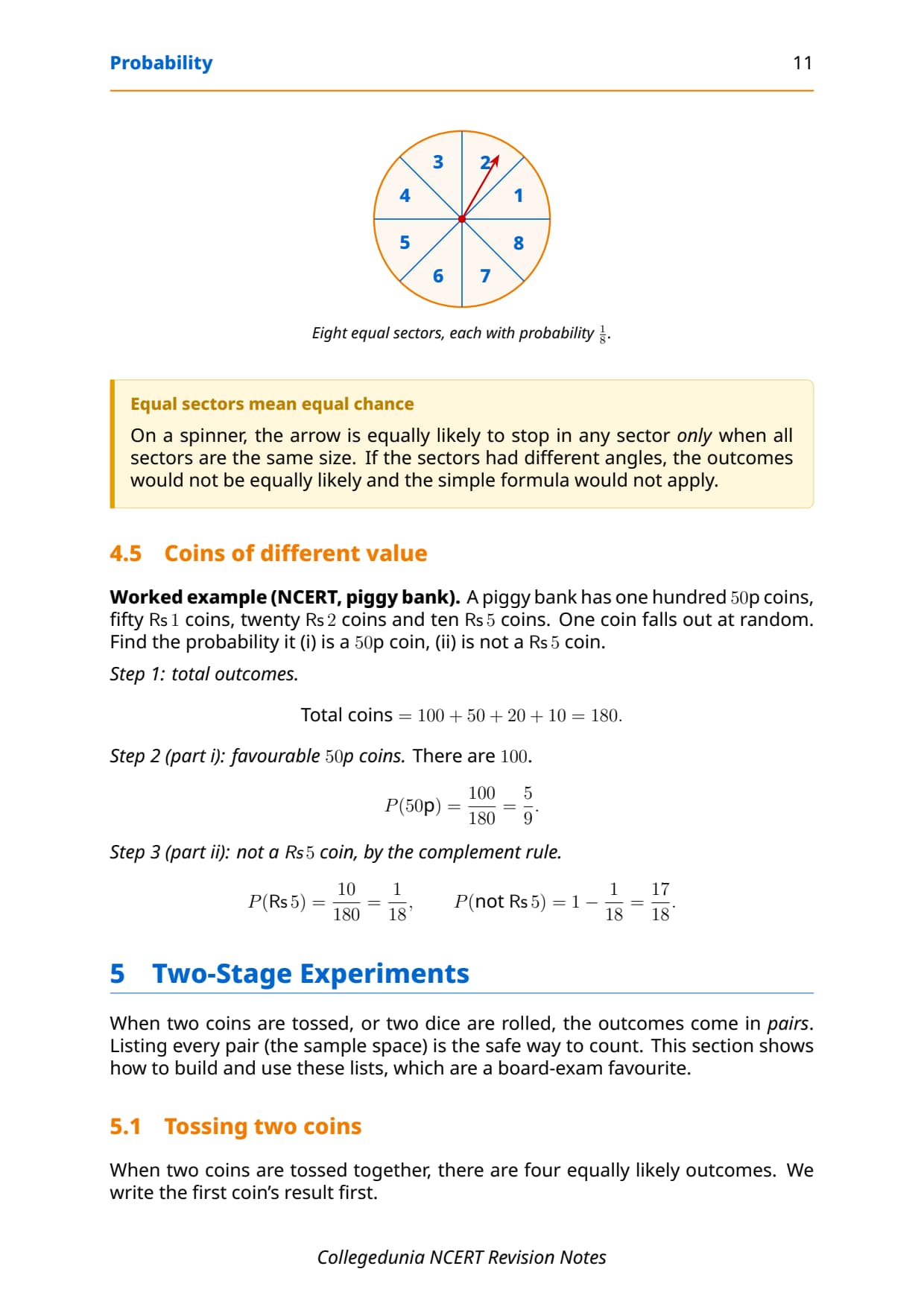
For balls in a bag, the denominator is always the total balls (sum all colours first), and 1 is not prime (primes 1 to 6 are 2, 3, 5).
Common Mistakes to Avoid
Marks slip away to counting errors, wrong sample spaces, and a misused complement rule.
The most common mistakes:
- Incomplete sample space: for two coins, missing TH (HT and TH differ, so list ordered pairs).
- Treating 1 as prime: primes 1 to 6 are {2, 3, 5}.
- Confusing face cards and Ace: face cards are J, Q, K only (12); the Ace is not one.
- Wrong total for two dice: writing n(S) = 12 instead of 6 × 6 = 36.
- Not simplifying: leaving 26/52 instead of 1/2 costs a presentation mark.
- Forgetting P(E) = n(E)/n(S): CBSE gives a step mark for the formula.
- Misusing the complement: the rule is P(not E) = 1 - P(E), not P(not E) = P(E).
Previous Year Question Trends
Probability is one of the most predictable chapters in the board paper. Questions come as 2 or 3-mark problems, and the same experiment types repeat every year at low to moderate difficulty.
| Year | Question type asked | Marks |
|---|---|---|
| 2025 | Cards: probability of drawing a face card or an ace; complement rule | 3 |
| 2024 | Balls in a bag: three types of balls, find P(E) and P(not E) | 2 + 1 |
| 2023 | Two dice: find probability of sum = 8; sum < 4 | 3 |
| 2022 | Cards: find probability of a black card, a queen, or a number < 5 | 4 |
| 2021 | One die and one coin tossed together: find probability of getting head and an odd number | 3 |
Also Check: Find the full step-by-step exercise answers on the Chapter 14 Probability NCERT Solutions page.
Quick Revision Summary
Use this the night before the exam: every formula in one place.
- Theoretical probability: P(E) = n(E) / n(S) = favourable / total equally likely
- Complement rule: P(not E) = 1 - P(E), i.e. P(E) + P(not E) = 1
- Range: 0 ≤ P(E) ≤ 1
- Impossible event: P = 0 | Certain event: P = 1
Method: identify the experiment, write S and n(S), list the favourable outcomes for E and count n(E), apply P(E) = n(E)/n(S), then substitute, simplify, and check 0 ≤ P(E) ≤ 1.
Other Resources for Chapter 14
Pair these notes with the matching NCERT Solutions, formula sheet, handwritten notes, and the official NCERT book. All resources for this chapter are linked below.
| Resource | What it covers | Open |
|---|---|---|
| Notes | Concept-first revision notes on sample space, theoretical probability, complementary events, impossible and certain events, solved board problems, and a full revision summary. | You are here |
| NCERT Solutions | Step-by-step answers to all 25 questions in Exercise 14.1, with complete sample space listed, formula written, and fraction simplified for every answer. | Class 10 Maths Chapter 14 NCERT Solutions |
| Formula Sheet | One-page reference with P(E) = n(E)/n(S), the complement rule P(not E) = 1 - P(E), sample space sizes for standard experiments, and card deck breakdown. | Class 10 Maths Chapter 14 Formula Sheet |
| Handwritten Notes | Scanned-style handwritten pages covering theoretical probability, sample spaces for coins, dice, cards, and bags, worked examples, and the complement rule for Chapter 14. | Class 10 Maths Chapter 14 Handwritten Notes |
| NCERT Book PDF | Official NCERT Maths Chapter 14 Probability textbook in PDF form, with all figures, exercises, and the original worked examples from the 2026-27 edition. | Class 10 Maths Chapter 14 NCERT Book PDF |
| Exemplar Solutions | Worked answers to the harder NCERT Exemplar problems on Probability for deeper board practice and understanding of more complex sample spaces and event types. | Class 10 Maths Chapter 14 Exemplar Solutions |
Notes for Class 10 Maths: All Chapters
Related Links: Open the notes for any other chapter of Class 10 Maths below. Each one has the same concept-first style, a full PDF download, and a revision FAQ.
| Chapter | Notes link |
|---|---|
| Chapter 1 | Real Numbers Notes |
| Chapter 2 | Polynomials Notes |
| Chapter 3 | Pair of Linear Equations in Two Variables Notes |
| Chapter 4 | Quadratic Equations Notes |
| Chapter 5 | Arithmetic Progressions Notes |
| Chapter 6 | Triangles Notes |
| Chapter 7 | Coordinate Geometry Notes |
| Chapter 8 | Introduction to Trigonometry Notes |
| Chapter 9 | Some Applications of Trigonometry Notes |
| Chapter 10 | Circles Notes |
| Chapter 11 | Areas Related to Circles Notes |
| Chapter 12 | Surface Areas and Volumes Notes |
| Chapter 13 | Statistics Notes |
| Chapter 14 | Probability Notes (You are here) |
Notes Class 10 Maths Chapter 14 Probability FAQs
Ques. What does Chapter 14 Probability cover in Class 10 Maths?
Ans. Chapter 14 covers theoretical (classical) probability. The main ideas are random experiments, sample space, events, equally likely outcomes, and the formula P(E) = n(E)/n(S). It also covers complementary events and P(E) + P(not E) = 1, impossible events (P = 0), and certain events (P = 1). The standard experiments are tossing coins, rolling dice, drawing cards from a 52-card deck, and drawing balls from a bag. There is one exercise (Exercise 14.1) with 25 questions, all on the single formula.
Ques. What is the probability formula for Class 10 Chapter 14?
Ans. The formula is P(E) = favourable outcomes / total equally likely outcomes, written as P(E) = n(E) / n(S). Here n(E) is the count of favourable outcomes and n(S) is the total outcomes in the sample space. It works only when all outcomes are equally likely. P(E) always lies between 0 and 1: P(E) = 0 means impossible, P(E) = 1 means certain, and anything in between gives the chance of the event.
Ques. What are complementary events and how is the complement rule used?
Ans. For any event E, the complement (written "not E" or E') is the event that E does NOT happen. E and not-E cover all outcomes, so P(E) + P(not E) = 1, which gives P(not E) = 1 - P(E). The rule helps when "not E" is easier to count than E. For "at least one head" with two coins, find 1 - P(no heads) = 1 - 1/4 = 3/4, instead of counting {HH, HT, TH}. Always write the rule in board answers, as CBSE gives a step mark for it.
Ques. How many cards are in a standard deck and what are face cards?
Ans. A standard deck has 52 cards in 4 suits: Spades and Clubs (black), Hearts and Diamonds (red). Each suit has 13 cards: Ace, 2 to 10, Jack, Queen, King. So there are 26 red and 26 black cards, and 4 of each value (4 Aces, 4 Kings, and so on). Face cards are Jack, Queen and King only, 3 per suit, so 12 in all. The Ace is not a face card. These counts come up in almost every card-based question.
Ques. What is the sample space when two dice are thrown?
Ans. For two dice, the sample space is all ordered pairs (a, b) where a is the first die and b the second, with a, b ∈ {1,...,6}. The total is n(S) = 6 × 6 = 36. Common counts: sum = 7 has 6 pairs; sum = 2 has 1 pair {(1,1)}; doublets (same number on both) = 6 pairs. The key mistake is writing n(S) = 12 (adding 6+6) instead of 36 (multiplying 6×6).
Ques. Where can I download the Chapter 14 Probability Notes PDF?
Ans. Use the Download button at the top of this page. Both the typed and handwritten versions are free. The PDF covers the probability formula, sample spaces for all standard experiments, complementary events, impossible and certain events, solved board problems on coins, dice, cards and bags, a common mistakes section, and a last-day revision summary, all on the 2026-27 CBSE syllabus.
Ques. Is Chapter 14 Probability important for the CBSE Class 10 board exam?
Ans. Yes. Probability is tested every year in the CBSE Class 10 board paper and usually carries 3 to 5 marks across one or two questions. The types are highly predictable: the same experiments, coins, dice, cards and balls, appear each year with small changes. Since there is only one formula, solving 15 to 20 standard problems from the last five board papers is one of the fastest ways to full marks. Students who list the sample space carefully avoid the costly counting errors.
Ques. How many pages is the Class 10 Maths Chapter 14 Probability Notes PDF?
Ans. The Notes PDF runs about 18 to 20 pages. It covers the probability formula, sample spaces for coins, dice, cards and bags, complementary events and the complement rule, impossible and certain events, a worked-problems section on every standard type, a common mistakes section, and a full revision summary with all formulas and key terms, on the 2026-27 CBSE syllabus.



Comments