



These nationalism in india class 10 notes pull together every movement, date, leader, and symbol that the CBSE board paper actually tests for History Chapter 2.
Chapter2NationalisminIndiaNotes.pdf?page=1&dpi=150)
Chapter2NationalisminIndiaNotes.pdf?page=2&dpi=150)
Chapter2NationalisminIndiaNotes.pdf?page=3&dpi=150)
Chapter2NationalisminIndiaNotes.pdf?page=4&dpi=150)
Chapter2NationalisminIndiaNotes.pdf?page=5&dpi=150)
Chapter2NationalisminIndiaNotes.pdf?page=6&dpi=150)
Chapter2NationalisminIndiaNotes.pdf?page=7&dpi=150)
Chapter2NationalisminIndiaNotes.pdf?page=8&dpi=150)
Chapter2NationalisminIndiaNotes.pdf?page=9&dpi=150)
Chapter2NationalisminIndiaNotes.pdf?page=10&dpi=150)
Chapter2NationalisminIndiaNotes.pdf?page=11&dpi=150)
Chapter2NationalisminIndiaNotes.pdf?page=12&dpi=150)
Chapter2NationalisminIndiaNotes.pdf?page=13&dpi=150)
Chapter2NationalisminIndiaNotes.pdf?page=14&dpi=150)
Chapter2NationalisminIndiaNotes.pdf?page=15&dpi=150)
Chapter2NationalisminIndiaNotes.pdf?page=16&dpi=150)
Chapter2NationalisminIndiaNotes.pdf?page=17&dpi=150)
Chapter2NationalisminIndiaNotes.pdf?page=18&dpi=150)
Chapter2NationalisminIndiaNotes.pdf?page=19&dpi=150)
Chapter2NationalisminIndiaNotes.pdf?page=20&dpi=150)
Built on the NCERT textbook India and the Contemporary World II, these revision notes follow the chapter in exact order, from the First World War and the idea of satyagraha to the Salt March, Civil Disobedience, and the making of Bharat Mata.
- This chapter carries about 6 to 8 marks in the CBSE Class 10 board paper, drawn mainly from source-based and 5-mark answer questions.
- The nationalism in india class 10 notes cover all key years in one timeline: 1915, 1917, 1919, 1920, 1922, 1929, 1930 and 1931.
- Pairs with the NCERT Solutions for Nationalism in India for full model answers.
Every fact in these nationalism in india class 10 notes is curated by subject experts, checked against the 2026-27 NCERT textbook, and refined using the last five years of CBSE board papers.
Introduction: How Nationalism Grew in Colonial India
Modern nationalism in India grew with the anti-colonial movement: colonialism became the common enemy pulling scattered communities together, and the Congress under Mahatma Gandhi tried to channel many grievances into one non-violent struggle.
- Colonialism as the common enemy gave farmers, workers and merchants a shared reason to unite.
- Swaraj meant different things to a Patidar farmer, an Assam plantation worker and a Bombay industrialist.
- The Congress was the umbrella organisation turning grievances into a mass movement.
The core idea is that Indian nationalism was a nation with many voices. The unity was real but fragile, with high points of Congress activity followed by phases of disunity.
The First World War, Satyagraha and the Rowlatt Act
The First World War (1914 to 1918) raised defence spending; prices doubled between 1913 and 1918, and forced recruitment from villages caused anger.
Mahatma Gandhi returned from South Africa in January 1915 with satyagraha, which stressed the power of truth: if the cause was true, only non-violence appealing to the oppressor's conscience was needed. His early wins were Champaran (1917), Ahmedabad (1918) and Kheda (1918).
In 1919 Gandhi launched a nationwide satyagraha against the Rowlatt Act, which allowed detention without trial for two years. The Rowlatt hartal began on 6 April 1919, the Jallianwala Bagh massacre on 13 April 1919, separate events a week apart.
Satyagraha to Salt March: Nationalism in India Explained for Class 10
Source: Magnet Brains on YouTube
Jallianwala Bagh and the Khilafat Issue
On 13 April 1919 a crowd gathered in the enclosed ground of Jallianwala Bagh in Amritsar, some to protest, others for the Baisakhi fair. General Dyer blocked the exits and opened fire, killing hundreds, to "produce a moral effect".
As crowds attacked government buildings, Gandhi called off the satyagraha: once a non-violent movement turns violent, it loses its moral force.
To bring Hindus and Muslims closer, Gandhi took up the Khilafat issue. With Ottoman Turkey defeated, there were rumours of a harsh treaty on the Khalifa.
- A Khilafat Committee formed in Bombay (March 1919); the brothers Muhammad Ali and Shaukat Ali discussed united mass action with Gandhi.
- At the Calcutta session of September 1920, the Congress agreed to start Non-Cooperation for Khilafat and swaraj.
The Non-Cooperation Movement (1921 to 1922)
Gandhi's idea, in Hind Swaraj, was that British rule survived because Indians cooperated; if they refused, swaraj would come within a year. The programme proposed surrendering titles and a boycott of courts, councils, schools and foreign goods, adopted at Nagpur in December 1920.
It spread fast in the towns: students left schools, lawyers gave up practice. Foreign cloth import halved between 1921 and 1922 from Rs 102 crore to Rs 57 crore.
It then slowed: khadi was costlier than mill cloth, and alternative Indian institutions were slow to appear, so students and lawyers drifted back.
Differing Strands: Countryside, Tribals and Plantations
Non-Cooperation spread to the countryside, where peasants, tribals and plantation workers joined for their own reasons, a most-asked 5-mark theme:
| Group | Leader | What swaraj meant to them |
|---|---|---|
| Awadh peasants | Baba Ramchandra | End of high rents and begar; Oudh Kisan Sabha (Oct 1920) under Nehru. |
| Gudem Hills tribals | Alluri Sitaram Raju | Freedom to use forests and from forced labour; Raju used guerrilla force, executed 1924. |
| Assam plantation workers | (left in thousands) | Right to move freely out of the tea gardens, believing "Gandhi Raj" was coming. |
Not all groups followed Gandhi's non-violence: Alluri Sitaram Raju praised Gandhi but used guerrilla force, and peasants often took the Mahatma's name to sanction actions the Congress disliked.
In February 1922, after a crowd set fire to a police station at Chauri Chaura, Gandhi withdrew the Non-Cooperation Movement.
Towards Civil Disobedience: Simon Commission and Purna Swaraj
Through the 1920s, C. R. Das and Motilal Nehru formed the Swaraj Party for council politics, while Jawaharlal Nehru and Subhas Chandra Bose pressed for full independence. Two factors then shaped events:
- The economic depression: agricultural prices fell from 1926 and collapsed after 1930, so peasants could not pay revenue.
- The Simon Commission under Sir John Simon had no Indian member, so in 1928 all parties met it with "Go back Simon".
The Simon Commission was rejected because it had not a single Indian member. Lord Irwin's vague "dominion status" offer (October 1929) did not satisfy the Congress, so the Lahore Congress of December 1929 demanded "Purna Swaraj" and declared 26 January 1930 Independence Day.
The Salt March and the Civil Disobedience Movement (1930)
Salt, used by rich and poor alike, became Gandhi's symbol to unite the nation, its British monopoly and tax one of the most oppressive faces of colonial rule. On 31 January 1930 Gandhi sent Irwin eleven demands, chiefly to abolish the salt tax. Irwin refused.
Salt March in five numbers: 78 volunteers, 240 miles, 24 days, reaching Dandi on 6 April 1930. Gandhi broke the salt law by making salt from sea water, launching the Civil Disobedience Movement.
People now actively broke colonial laws: making salt, refusing taxes, violating forest laws. About 100,000 people were arrested. Gandhi then signed the Gandhi-Irwin Pact on 5 March 1931, agreeing to attend the Round Table Conference for the release of prisoners.
How Different Groups Saw Civil Disobedience
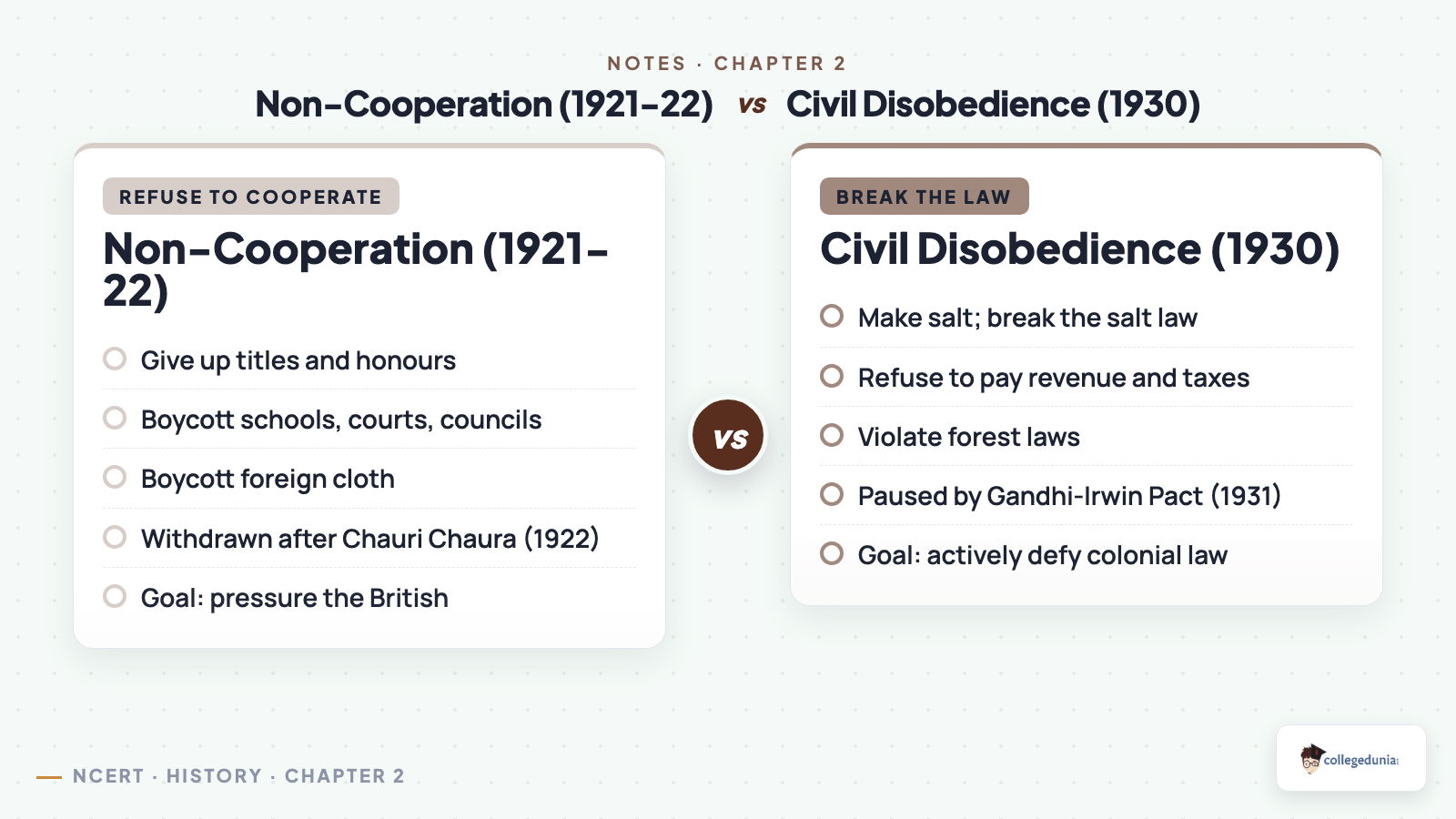
This is the heart of the "nation with many voices" theme. The image below contrasts the two great movements.
- Rich peasants (Patidars, Jats) wanted lower revenue; disappointed by the 1931 settlement, many refused to rejoin in 1932.
- Poor peasants wanted unpaid rent remitted, but the Congress avoided "no rent" campaigns.
- Business classes (G. D. Birla) wanted protection from imports; they formed FICCI (1927) and funded the movement, then grew wary.
- Industrial workers mostly stayed away; women participated on a large scale for the first time.
The movement had limits. Dr B. R. Ambedkar wanted reserved seats and separate electorates, clashing with Gandhi until the Poona Pact of September 1932. Many Muslim organisations, after the Khilafat declined, stayed lukewarm, leaving distrust between communities.
The Sense of Collective Belonging: Bharat Mata, Songs and Flags
Belonging to one nation also grew through cultural processes: images, songs, folklore and symbols, a guaranteed source-based question.
- Bharat Mata: Bankim Chandra Chattopadhyay wrote "Vande Mataram"; Abanindranath Tagore painted Bharat Mata as a calm, ascetic figure.
- Folklore revival: Rabindranath Tagore collected ballads in Bengal; Natesa Sastri compiled Tamil folk tales.
- Flags: a Swadeshi tricolour with eight lotuses appeared in Bengal; by 1921 Gandhi designed the Swaraj flag with a spinning wheel.
- Reinterpreting history to counter the British view that Indians were backward.
Do not merge the two flags: the Swadeshi flag had eight lotuses and a crescent; the Swaraj flag (1921) had a spinning wheel. When the glorified past was mainly Hindu, symbols meant to unite could also divide.
Key Dates Timeline for Nationalism in India
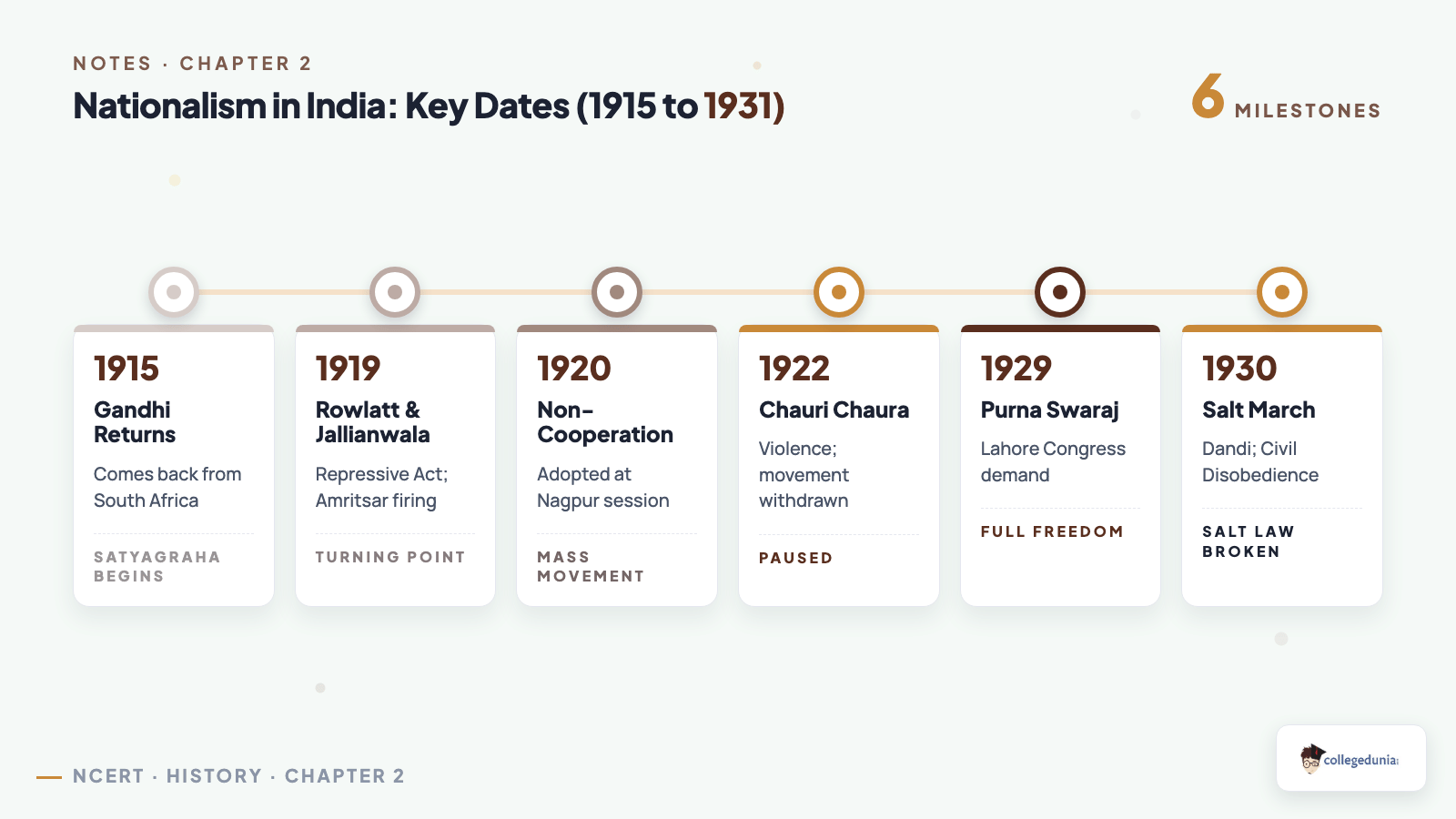
Every must-know year in one place for last-minute revision:
| Year | Event |
|---|---|
| 1915 | Gandhi returns from South Africa. |
| 1917 | Champaran satyagraha. |
| 1919 | Rowlatt Act; Jallianwala Bagh (13 April). |
| 1920 | Non-Cooperation adopted at Nagpur. |
| 1922 | Chauri Chaura; Non-Cooperation withdrawn. |
| 1929 | Lahore Congress; Purna Swaraj. |
| 1930 | Salt March; Dandi (6 April). |
| 1931 | Gandhi-Irwin Pact (5 March). |
Student Feedback on This Chapter
In a Collegedunia poll of 13,210 Class 10 students before the 2026 boards, the "differing strands" section was rated the hardest part, and 69% of students said the "many voices of swaraj" comparison cost them marks.
Source: 2026-27 Class 10 History student poll. Sample of 13,210 students from CBSE schools across 15 states.
PDF Download and Quick Summary of Nationalism in India
One-glance summary, in line with the 2026-27 CBSE syllabus:
- Satyagraha (Champaran, Ahmedabad, Kheda) set the stage.
- The Rowlatt Act and Jallianwala Bagh (1919) triggered Non-Cooperation, withdrawn after Chauri Chaura (1922).
- It revived as Civil Disobedience after the Salt March of 1930; belonging grew through Bharat Mata and the Swaraj flag.
Also See: Other Resources for Nationalism in India
Also Check: the same chapter in other formats:
| Resource | Best Used For |
|---|---|
| NCERT Solutions | Model answers to every textbook question. |
| Handwritten Notes | A quick scanned visual recap for last-minute revision. |
| NCERT Book PDF | The full original textbook chapter to read from source. |
All Class 10 History Notes, Chapter by Chapter
Related Links: Class 10 History notes for every chapter:
| Chapter | Notes Link |
|---|---|
| Chapter 1: The Rise of Nationalism in Europe | The Rise of Nationalism in Europe Notes |
| Chapter 2: Nationalism in India | You are here |
| Chapter 3: The Making of a Global World | The Making of a Global World Notes |
| All chapters | Class 10 History Hub |
Ques. What do the nationalism in india class 10 notes cover?
Ans. These notes cover the First World War distress and the idea of satyagraha, the Rowlatt Act and Jallianwala Bagh, the Khilafat and Non-Cooperation movements, the differing strands among peasants, tribals and plantation workers, the Salt March and Civil Disobedience, how different groups saw the movement, and the sense of collective belonging through Bharat Mata, Vande Mataram and the Swaraj flag, all in NCERT textbook order.
Ques. Why is 1919 important in Nationalism in India?
Ans. In 1919 the British passed the repressive Rowlatt Act, which allowed detention without trial. The protest hartal began on 6 April 1919, and on 13 April 1919 General Dyer ordered firing at Jallianwala Bagh in Amritsar, killing hundreds. These events outraged Indians and pushed Gandhi towards the Non-Cooperation Movement.
Ques. What is satyagraha according to this chapter?
Ans. Satyagraha is a method of mass agitation based on the power of truth and non-violence. Gandhi argued that if the cause was true and the struggle was against injustice, a satyagrahi could win without physical force, by appealing to the conscience of the oppressor. He first used it in India at Champaran, Ahmedabad and Kheda in 1917 and 1918.
Ques. Why was salt chosen as the symbol of the Civil Disobedience Movement?
Ans. Salt was used by every Indian, rich or poor, so it could unite the whole nation. The British monopoly over its production and the tax on it were among the most oppressive faces of colonial rule. Gandhi marched 240 miles to Dandi with 78 volunteers and broke the salt law on 6 April 1930, launching the Civil Disobedience Movement.
Ques. What does "a nation with many voices" mean?
Ans. It means the freedom movement united many groups who each understood swaraj differently. Rich peasants wanted lower revenue, poor peasants wanted rent relief, business classes wanted protection from imports, workers and women joined with their own hopes, and dalits and many Muslims wanted political safeguards. The unity was real but fragile.
Ques. Who created the image of Bharat Mata?
Ans. Bankim Chandra Chattopadhyay wrote "Vande Mataram" as a hymn to the motherland in the 1870s, later including it in his novel Anandamath. Abanindranath Tagore then painted the famous image of Bharat Mata as a calm, composed, ascetic and divine figure, which circulated widely in popular prints and became a symbol of nationalism.
Ques. Why did Gandhi withdraw the Non-Cooperation Movement?
Ans. In February 1922 a crowd at Chauri Chaura set fire to a police station, turning the movement violent. Gandhi believed a non-violent movement loses its moral force the moment it turns violent, so he called it off and decided that satyagrahis needed proper training in discipline before another mass struggle.
Ques. What was the difference between Non-Cooperation and Civil Disobedience?
Ans. In Non-Cooperation (1921 to 1922) people were asked to refuse to cooperate with the British, by giving up titles and boycotting schools, courts, councils and foreign goods. In Civil Disobedience (1930) people went further and actively broke colonial laws, making salt, refusing to pay revenue and chaukidari taxes, and violating forest laws.
Ques. How is the nationalism in india class 10 notes PDF best used?
Ans. Download the notes PDF for quick revision of the timeline, the leaders and the symbols of the chapter. Then move to the NCERT Solutions for model answers, and use the handwritten notes for a final visual recap. This three-step plan covers concepts and practice together for the 2026-27 boards.



Comments