




The handwritten notes on Class 7 Arts (Kriti) Chapter 18 Textiles and Traditions have been carefully prepared for quick revision according to the 2026-27 NCERT book. The PDF covers motifs, patchwork, fabric journals, embroidery traditions, basic stitches, textile artwork ideas and the self-assessment points from the chapter.
- Best for revision: motif meanings, warp and weft, fabric journal steps and embroidery terms.
- PDF length: 22 handwritten pages with diagrams, process charts and quick recall cues.
- Use it with: the NCERT chapter PDF before making your textile artwork.
Chapter18TextilesandTraditionsHandwrittenNotes.pdf?page=1&dpi=150)
Chapter18TextilesandTraditionsHandwrittenNotes.pdf?page=2&dpi=150)
Chapter18TextilesandTraditionsHandwrittenNotes.pdf?page=3&dpi=150)
Chapter18TextilesandTraditionsHandwrittenNotes.pdf?page=4&dpi=150)
Chapter18TextilesandTraditionsHandwrittenNotes.pdf?page=5&dpi=150)
Chapter18TextilesandTraditionsHandwrittenNotes.pdf?page=6&dpi=150)
Chapter18TextilesandTraditionsHandwrittenNotes.pdf?page=7&dpi=150)
Chapter18TextilesandTraditionsHandwrittenNotes.pdf?page=8&dpi=150)
Chapter18TextilesandTraditionsHandwrittenNotes.pdf?page=9&dpi=150)
Chapter18TextilesandTraditionsHandwrittenNotes.pdf?page=10&dpi=150)
Chapter18TextilesandTraditionsHandwrittenNotes.pdf?page=11&dpi=150)
Chapter18TextilesandTraditionsHandwrittenNotes.pdf?page=12&dpi=150)
Chapter18TextilesandTraditionsHandwrittenNotes.pdf?page=13&dpi=150)
Chapter18TextilesandTraditionsHandwrittenNotes.pdf?page=14&dpi=150)
Chapter18TextilesandTraditionsHandwrittenNotes.pdf?page=15&dpi=150)
Chapter18TextilesandTraditionsHandwrittenNotes.pdf?page=16&dpi=150)
Chapter18TextilesandTraditionsHandwrittenNotes.pdf?page=17&dpi=150)
Chapter18TextilesandTraditionsHandwrittenNotes.pdf?page=18&dpi=150)
Chapter18TextilesandTraditionsHandwrittenNotes.pdf?page=19&dpi=150)
Chapter18TextilesandTraditionsHandwrittenNotes.pdf?page=20&dpi=150)
Chapter18TextilesandTraditionsHandwrittenNotes.pdf?page=21&dpi=150)
Chapter18TextilesandTraditionsHandwrittenNotes.pdf?page=22&dpi=150)
Student Feedback: In a Collegedunia study poll of 8,920 Class 7 Arts students, 78% said the chapter became easier after they revised it as motif, fabric story, stitch practice and artwork steps.
What the Textiles and Traditions Handwritten Notes Cover
Class 7 Arts Chapter 18 introduces textile art as art made with cloth, thread, fibre, yarn and simple tools. The handwritten notes start with the main chapter map so students can revise the whole lesson without losing the order. They cover motifs and their meanings, the Dhaaga and Soodi curtain story, patchwork as memory, warp and weft, fabric journals, embroidery traditions, basic stitches and textile artwork planning.
The chapter is practical, so the notes are also practical. Instead of only giving definitions, the PDF shows how a student should observe a fabric sample, write its story, label its texture and connect it with a motif or technique. The main exam-friendly idea is that textiles are art, craft, memory and culture together.
Fabric Journal Process in Chapter 18
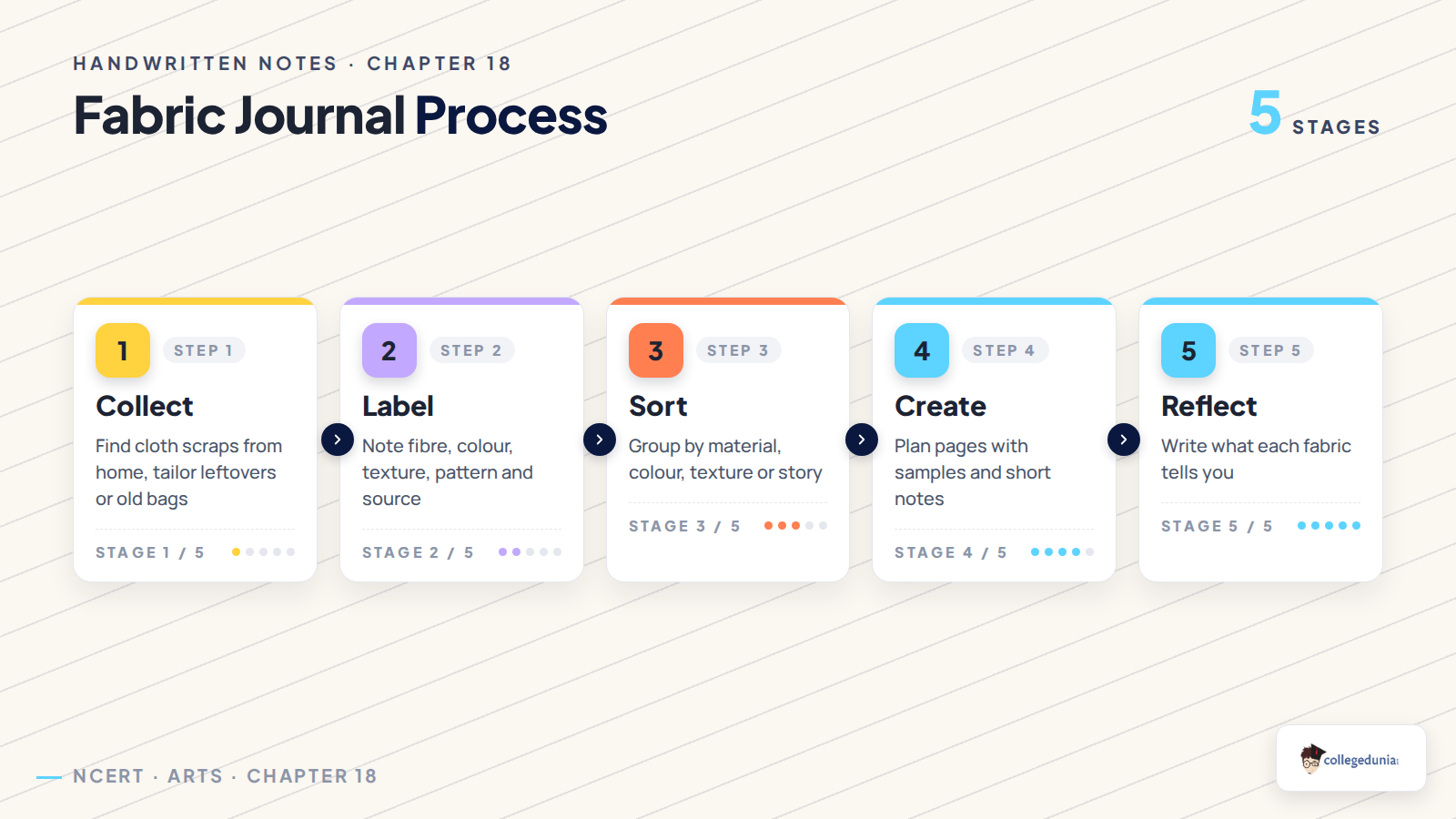
The fabric journal activity asks students to collect fabric pieces from discarded clothes, bags, mats, rags or tailor leftovers. For every sample, students should note where it was found, who may have used it, what fibre it may contain and what pattern or texture is visible. This is why the notes break the activity into collect, label, sort, create and reflect.
Students can sort samples by material, colour, texture or pattern. For example, cotton pieces can go together, printed fabrics can go together, or cloth with family stories can form one section. This step matters because the journal is not just a scrapbook. It is a small art record with observation, memory and arrangement.
Motif and Patchwork Revision
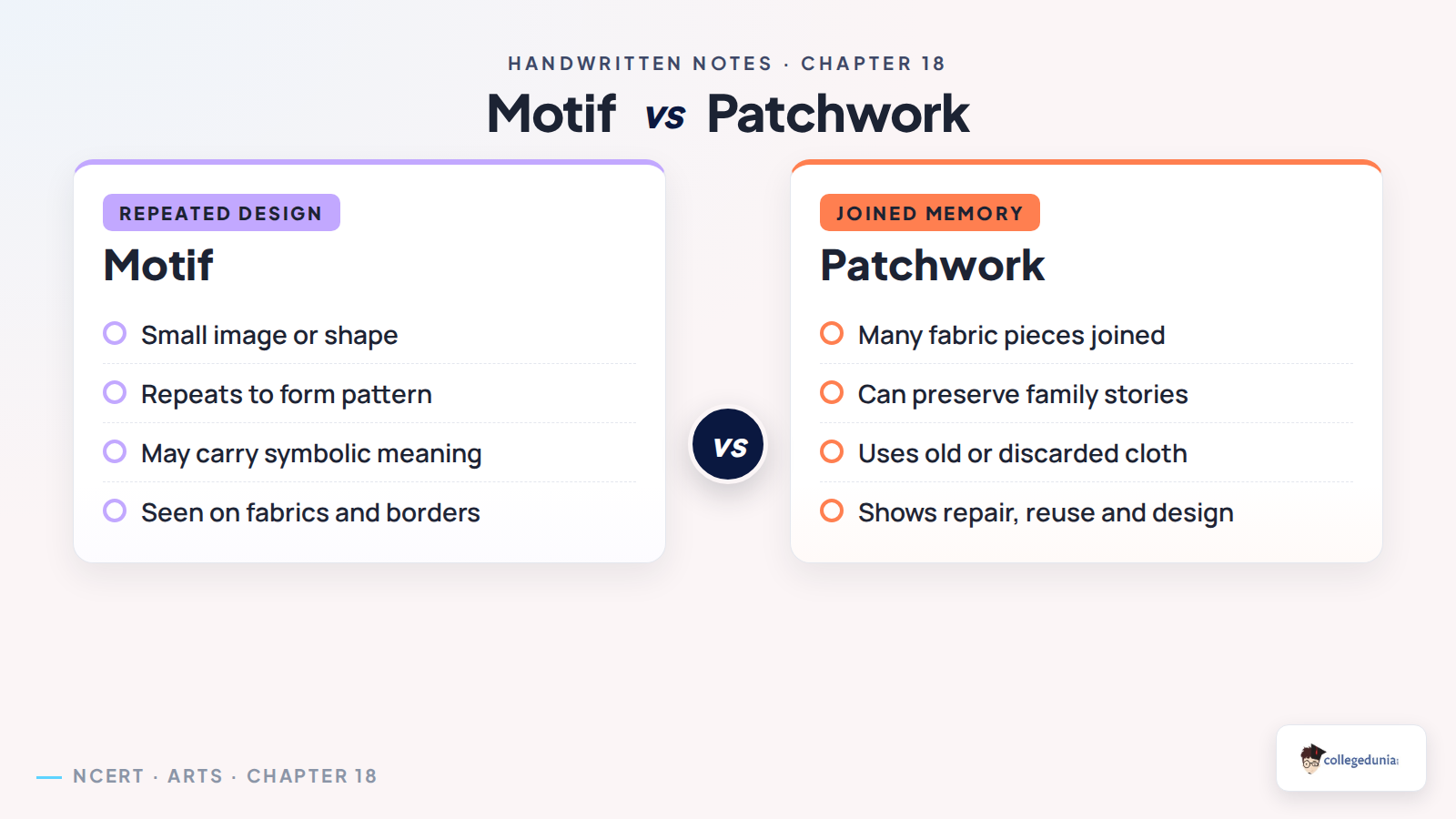
A motif is a small decorative image or shape that repeats to make a pattern. Dots and circles can suggest wholeness and energy. Lines can suggest movement and progress. Mango or paisley shapes can suggest life and continuity. The handwritten notes place these examples together so students can remember the meaning with the drawing.
Patchwork is different. It joins many fabric pieces into one bigger surface. In the chapter story, the curtain is made from Aaji's clothes, including a sweater piece, a stained saree, crochet and tassels. Patchwork turns old cloth into a new story, while motif turns a small design into a repeated pattern.
Embroidery, Stitches and Textile Artwork
Embroidery is the art of making stitches, patterns and designs on fabric. The chapter lists Indian embroidery traditions such as Chikankari, Chamba Rumal, Kasuti, Toda, Ahir, Kantha, Khneng, Gota and Kashida. The notes group them by region so students can revise both the name and the place.
The basic stitch activity is also included. Students need card paper or thick drawing sheet, a medium needle and thread or wool. The process is simple: thread the needle, knot the longer end, mark the line, pierce holes, stitch slowly and knot the reverse side at the end. Even stitch spacing and neat knots are more important than speed.
The chapter ends by asking students to make a textile artwork. It can be weaving, knitting, crochet, macrame, fabric toy making, fabric painting, printing, tie and dye or another local textile idea. The notes help students plan the artwork by choosing a theme, collecting materials, trying small samples, making the final piece and writing a short reflection.
Textile Art Revision Video for Class 7 Arts
Source: NCERT Arts revision channel
Class 7 Arts Chapter 18 Resource Links
| Resource | Use it for | Link |
|---|---|---|
| NCERT Book PDF | Read the full chapter text and activities | Open Class 7 Arts Chapter 18 NCERT Book PDF |
| Notes | Revise chapter facts in typed format | Open Textiles and Traditions Notes |
| Handwritten Notes | Use this page for quick visual revision | Textiles and Traditions Handwritten Notes |
Class 7 Arts (Kriti) Handwritten Notes for All Chapters
| Chapter | Handwritten Notes |
|---|---|
| Chapter 12 | Dance, You and Creativity Handwritten Notes |
| Chapter 15 | Objects in Icons and Symbols Handwritten Notes |
| Chapter 16 | Nature's Palette Handwritten Notes |
| Chapter 17 | How You Feel Handwritten Notes |
| Chapter 18 | Textiles and Traditions Handwritten Notes |
Textiles and Traditions Class 7 Arts Handwritten Notes FAQs
Ques. What is covered in Class 7 Arts Chapter 18 Textiles and Traditions handwritten notes?
Ans. The PDF covers motifs, patchwork, warp and weft, fabric journals, embroidery traditions, basic stitches, textile artwork planning and the chapter assessment points.
Ques. What is a motif in Textiles and Traditions?
Ans. A motif is a small decorative image or shape that repeats to make a pattern. In textiles, motifs may also carry symbolic meanings.
Ques. Why is the fabric journal important in Chapter 18?
Ans. The fabric journal helps students collect textile samples, note their material and texture, and connect every sample with a short story.
Ques. Which embroidery traditions are named in this chapter?
Ans. The chapter names Chikankari, Chamba Rumal, Kasuti, Toda, Ahir, Kantha, Khneng, Gota and Kashida as examples of Indian embroidery traditions.



Comments