



The Tiger King class 12 english handwritten notes from Collegedunia give you an 8-page scanned notebook covering the Pratibandapuram setting and the colonial-era hunting backdrop, the scene-by-scene summary of the prophecy, the seventy-tiger run in the Maharaja's own state and twenty-nine more in his father-in-law's state for a total of ninety-nine, the staged hundredth tiger fetched from the People's Park in Madras and the wooden toy bought for two annas and a quarter that kills the Maharaja, character arcs for the Maharaja (Sir Jilani Jung Jung Bahadur) and the dewan, the four-theme map (conceit of power, animal cruelty, fate vs free will, sycophancy), key quotations, the year-wise PYQ map and a last-week recall strip for the 2026-27 CBSE English Core paper.
- CBSE Weightage: 6 marks per Vistas Long Answer in Section C, drawn from the five Reading with Insight questions
The notebook runs 8 ruled pages with a faded red margin line, blue-black mix ballpoint strokes, and hand-drawn arrows that mirror the way a topper would condense the chapter on the night before the paper.
Every page mirrors a question slot you will actually face: the setting + author on page 1, the scene-by-scene summary in five beats on page 2, the Maharaja character arc on page 3, the dewan and British officer episode on page 4, the four-theme map on page 5, the key quotations on page 6, the PYQ + common-mistakes map on page 7, and the value-points + last-week recall strip on page 8. Read in that order on the morning of the exam and you carry the chapter end-to-end in fifteen minutes.
Also Check:
The Tiger King Class 12 English Handwritten Notes: What the 8 Pages Cover
The Tiger King class 12 english handwritten notes are structured as eight themed pages, each anchored on one question slot. Use the strip below as a contents map before you flip the PDF open.
| Page | Focus | What you copy onto your rough sheet first |
|---|---|---|
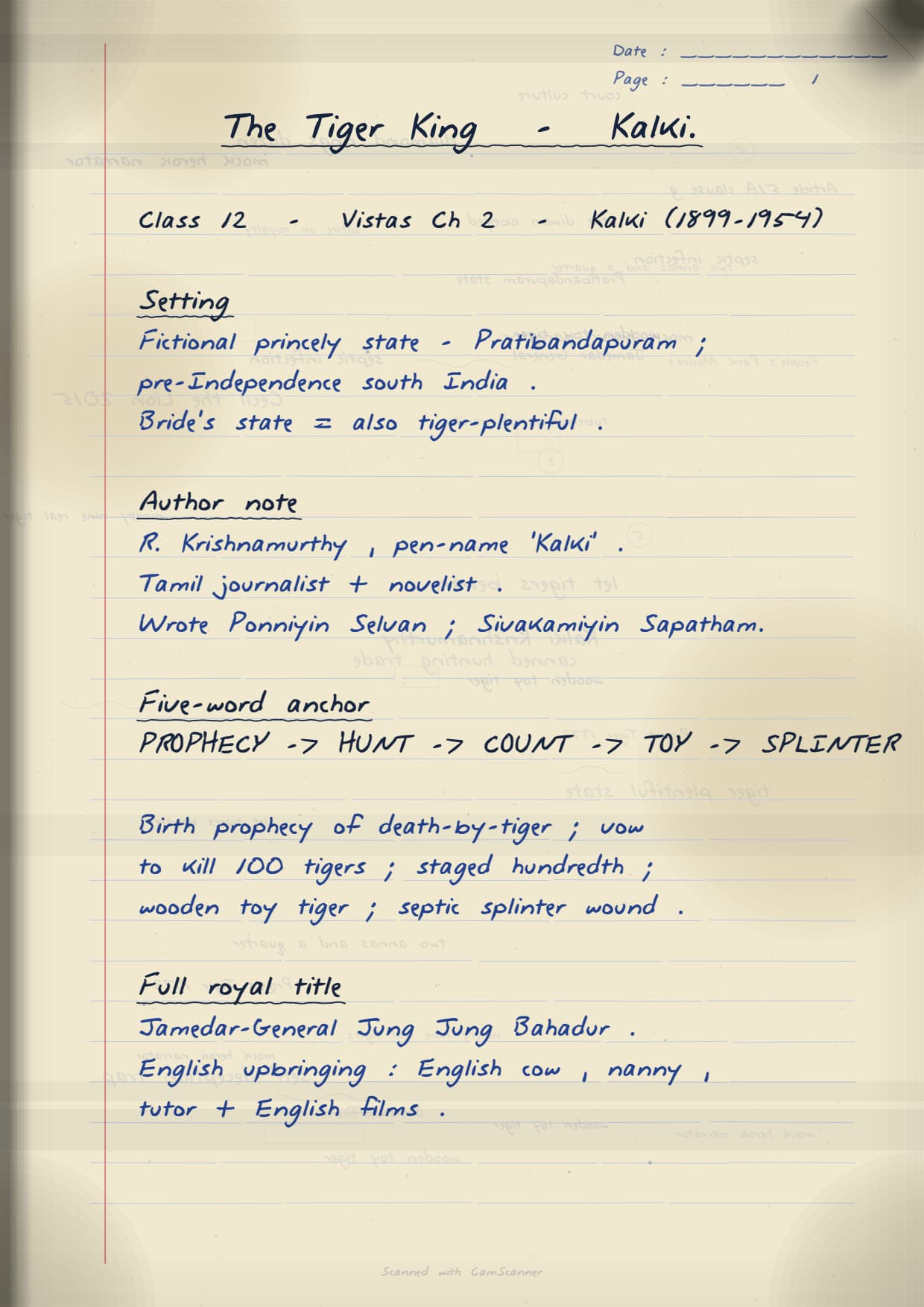
| Page 1 | Setting + author | Pratibandapuram (fictional princely state); Kalki Krishnamurthy (1899-1954); five-word anchor PROPHECY - HUNT - COUNT - TOY - SLIVER. |
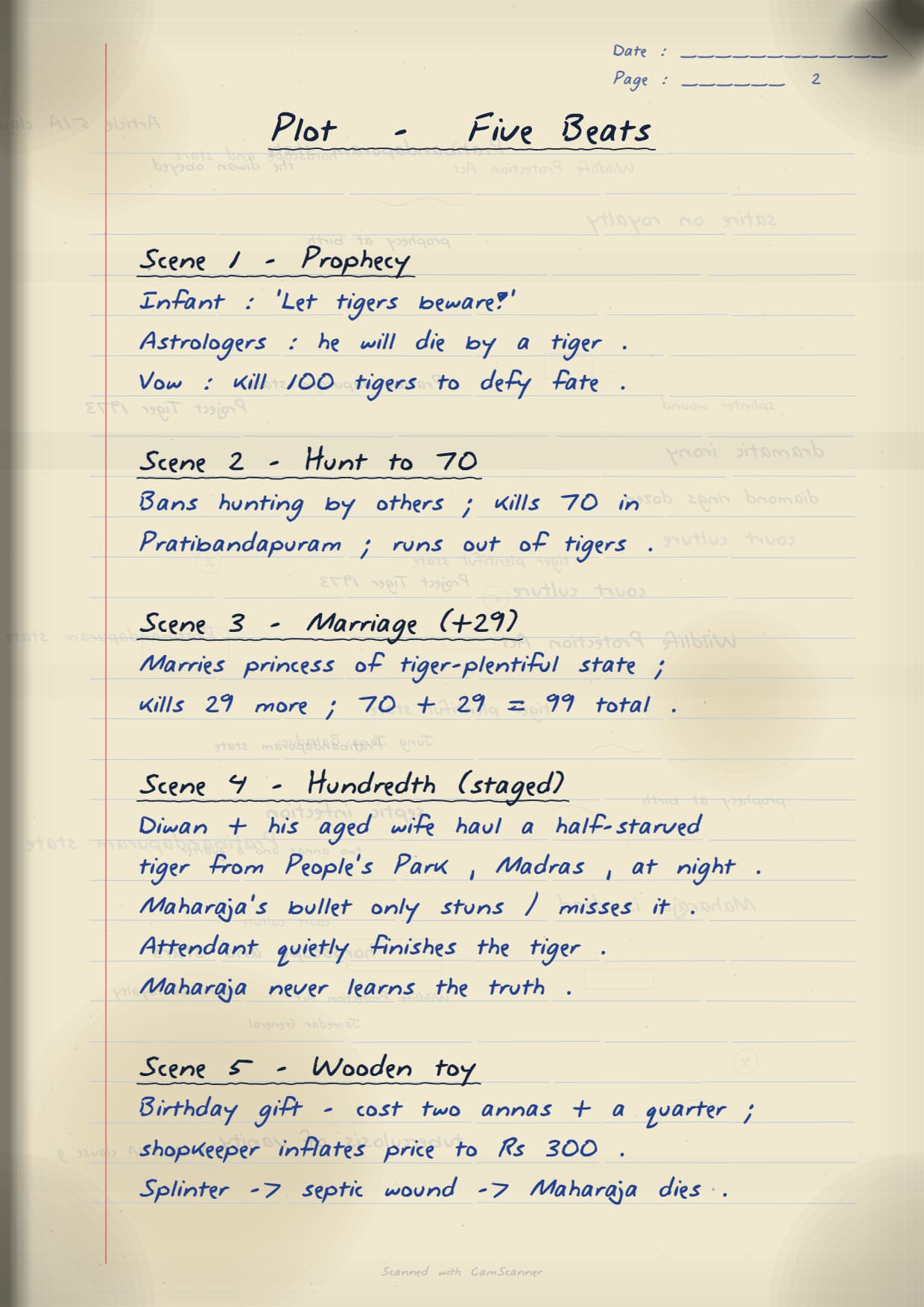
| Page 2 | Scene-by-scene summary in 5 beats | Prophecy at birth, seventy in Pratibandapuram (ten years), diplomatic marriage and twenty-nine more in the bride's state, staged hundredth from the People's Park in Madras, wooden toy at two annas and a quarter. |
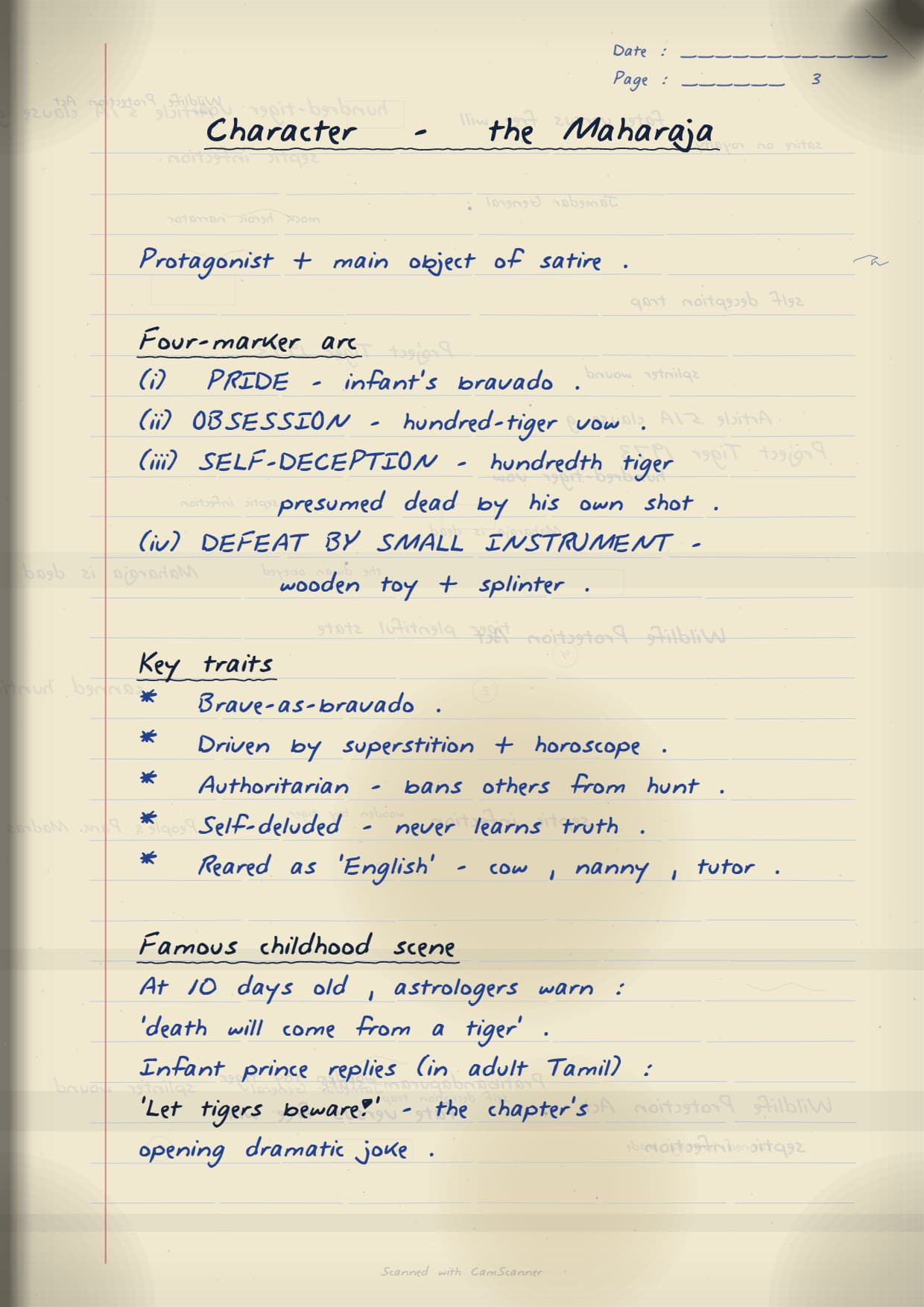
| Page 3 | Maharaja character arc | From the ten-day-old infant's "Let tigers beware!" to "hundred-tiger vow" to "self-deception" to "defeated by a sliver". |
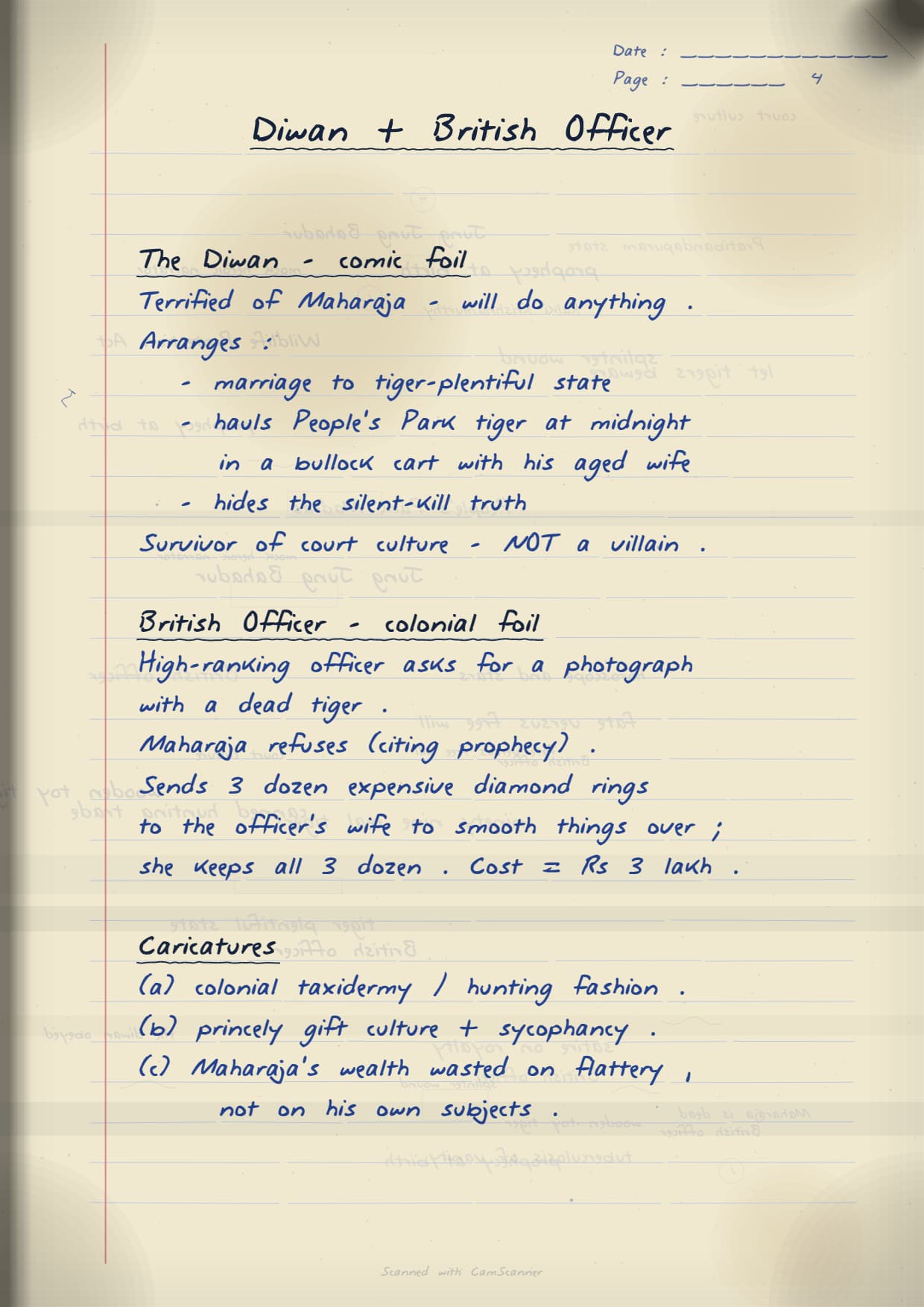
| Page 4 | The dewan + British officer | Dewan as comic foil (midnight drag of the People's Park tiger with his aged wife); British officer episode; duraisani's fifty diamond rings; three lakh rupee bill from Calcutta jewellers. |
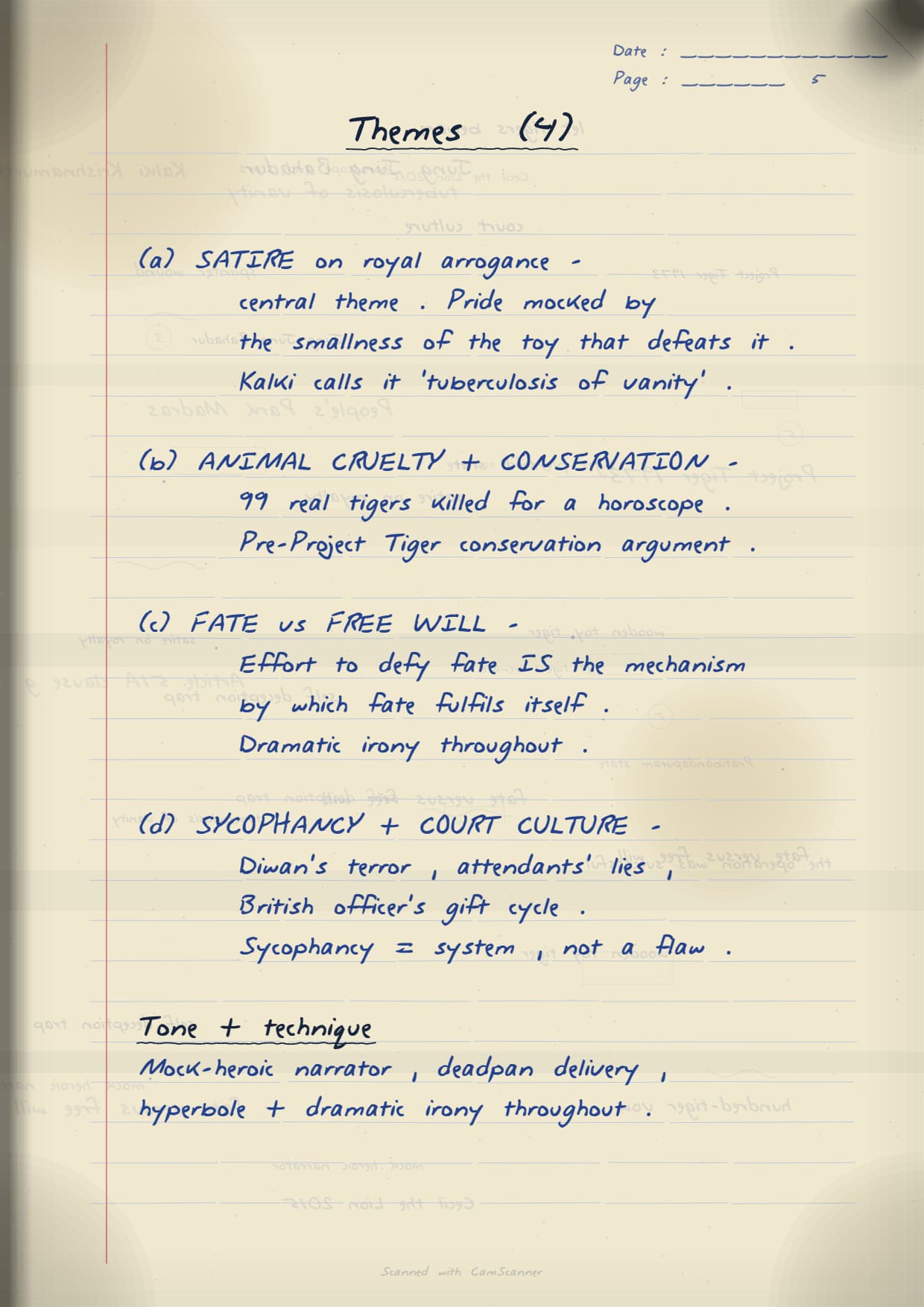
| Page 5 | Four-theme map | Conceit of those in power, animal cruelty, fate vs free will, sycophancy and court culture. |
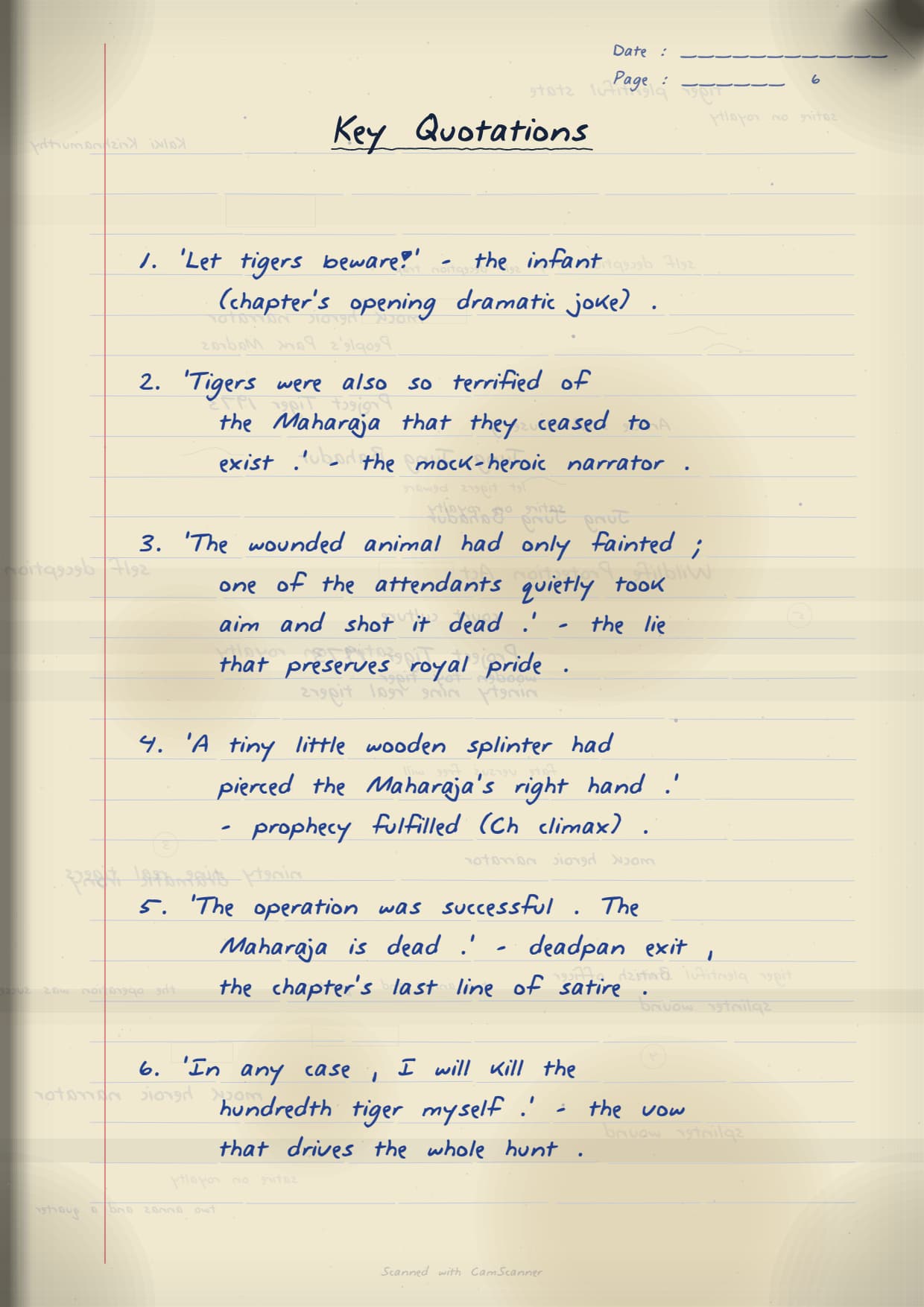
| Page 6 | Key quotations | "Let tigers beware!"; the chief astrologer's "crop my hair short and become an insurance agent"; the silent kill from one foot away; the sliver; "The operation was successful. The Maharaja is dead." |
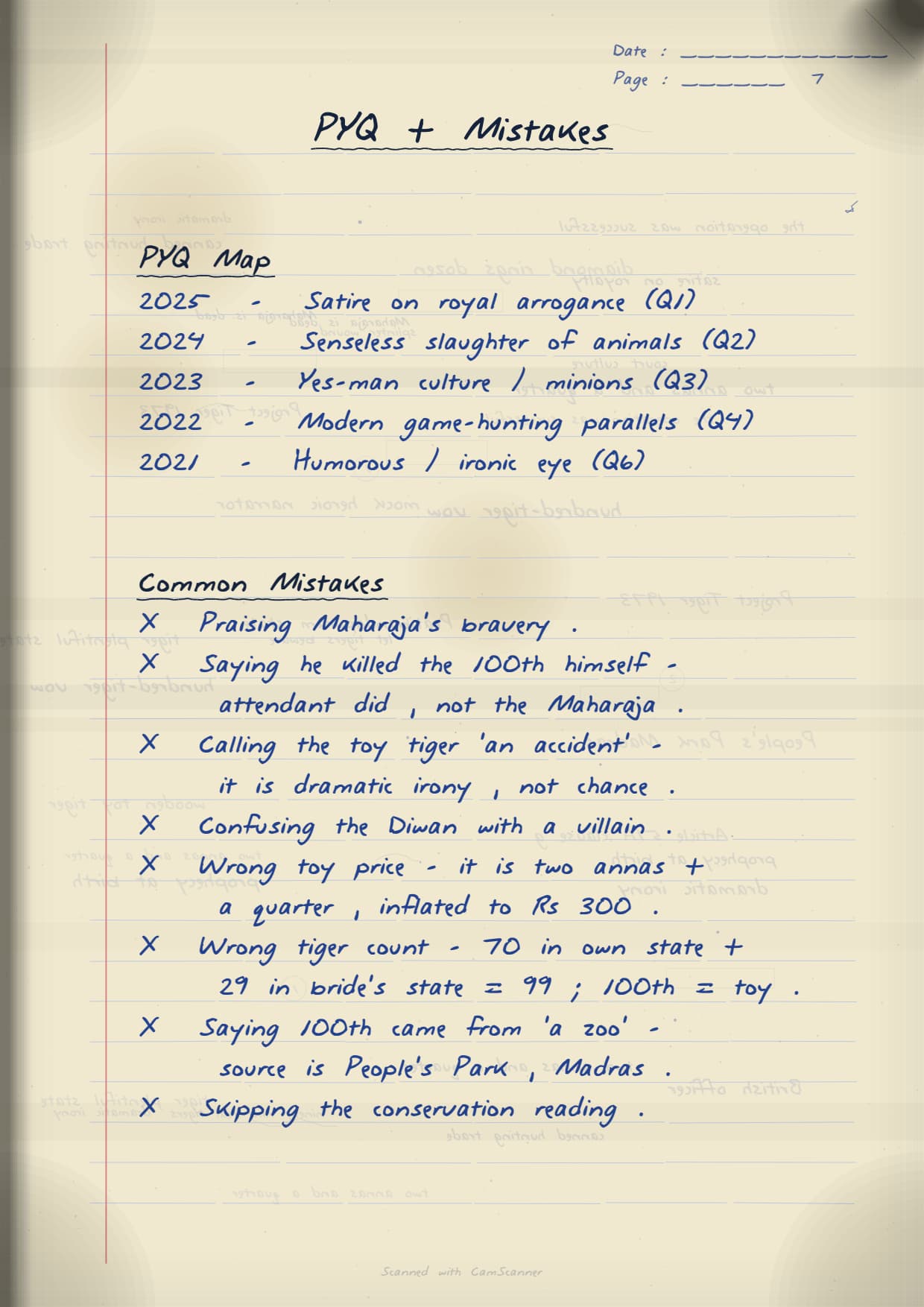
| Page 7 | PYQ + common mistakes | 2021-2025 long-answer rotations; the seven most repeated errors in board scripts (including the toy-cost trap: two annas and a quarter, not two and a half). |
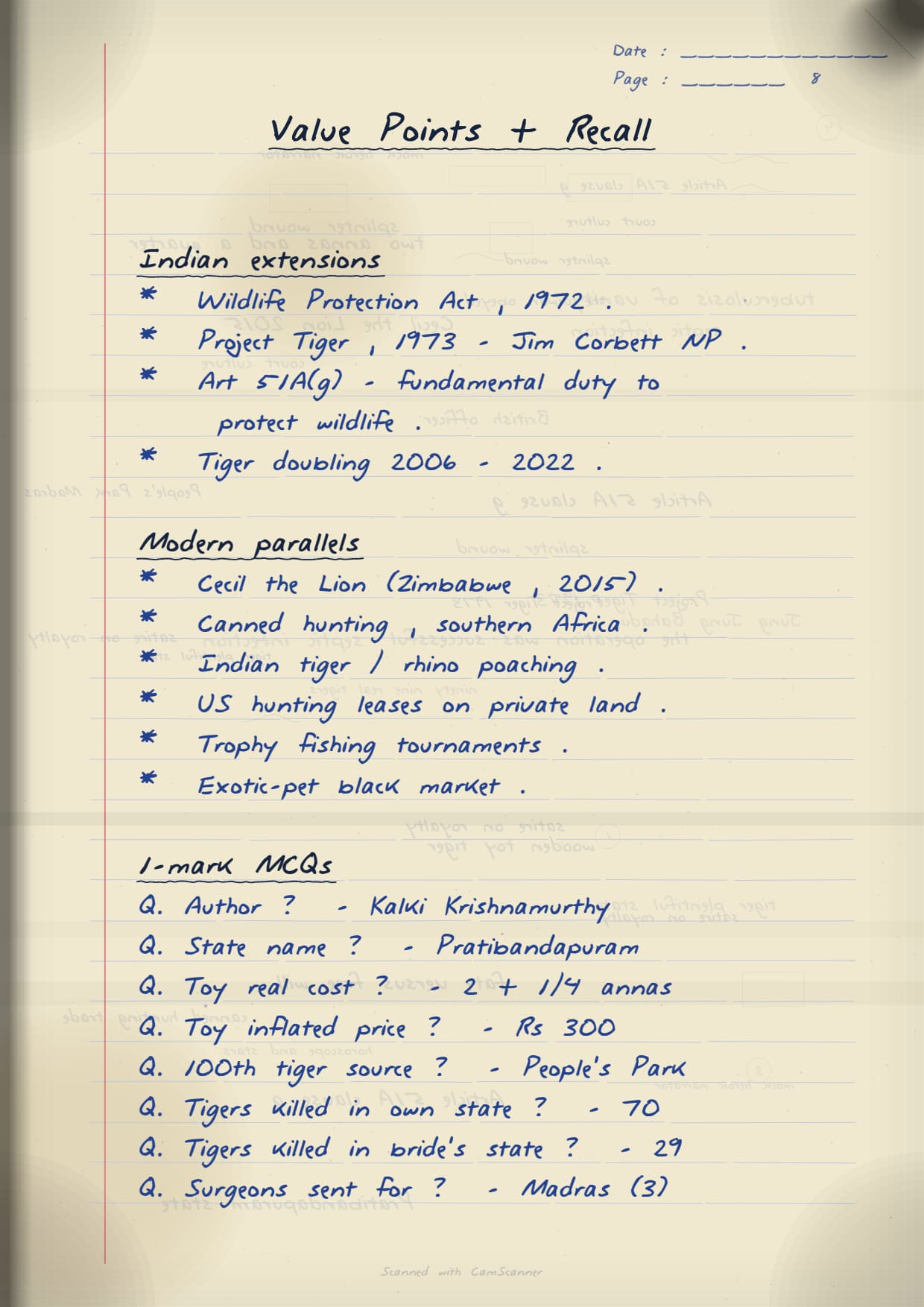
| Page 8 | Value points + last-week recall | Wildlife Protection Act 1972; Project Tiger 1973; Article 51A(g); modern parallels (Cecil the Lion, canned hunting, US hunting leases); 1-mark MCQs. |
The Tiger King Video Walkthrough
Source: Magnet Brains on YouTube
Setting Map: The Page-1 Skeleton
Page 1 of the notebook places the action in a fictional princely state (Pratibandapuram) in pre-Independence south India. The handwritten note summarises the six setting facts that drive the entire chapter and that CBSE tests in 1-mark MCQs.
Scene-by-Scene Summary: The Page-2 Five-Beat Walk
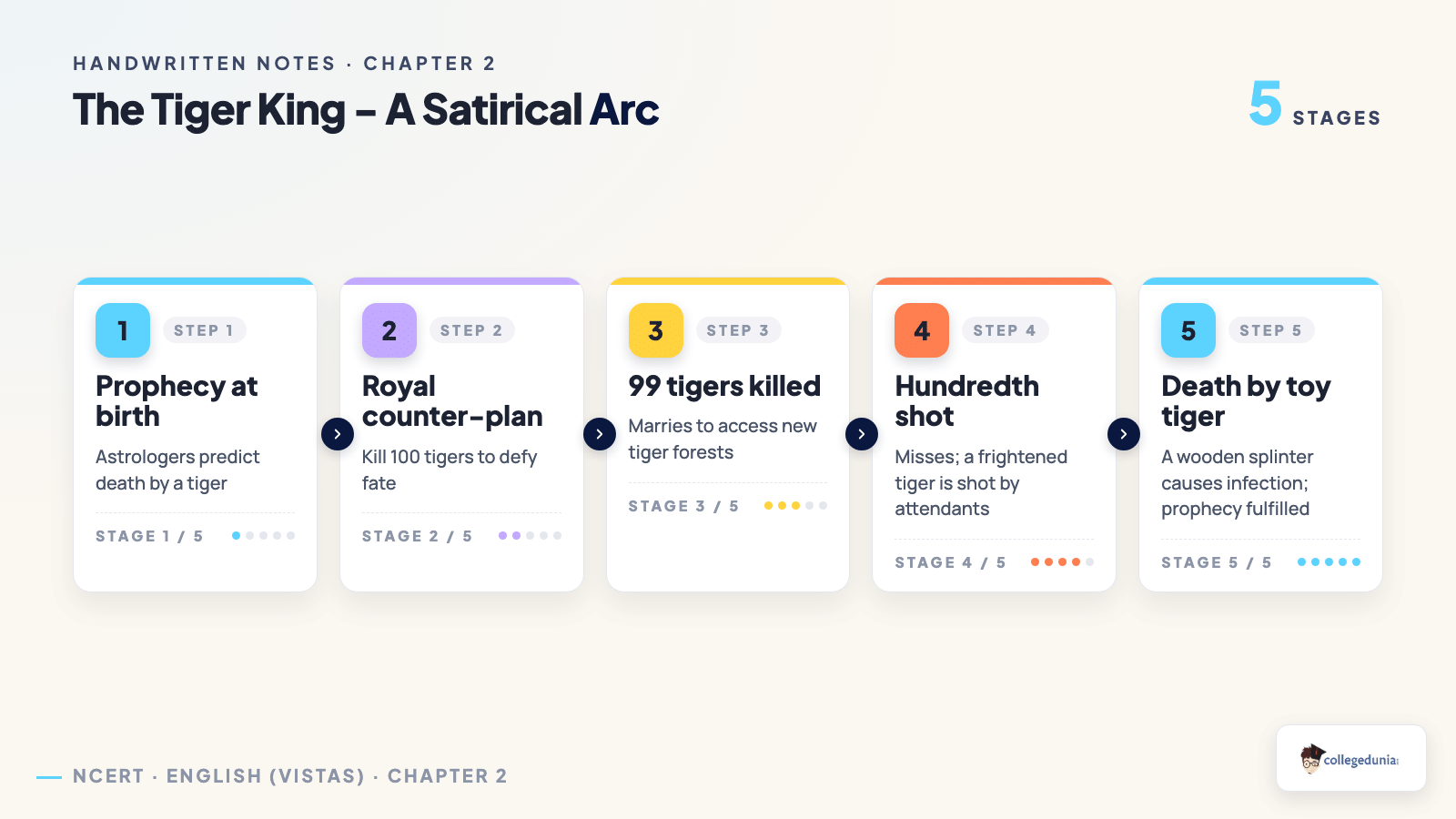
Page 2 is the most reproduced spread in the notebook. It walks the chapter in five beats with hand-drawn arrows linking each beat to the next: the prophecy at birth (the ten-day-old infant growls "Let tigers beware!"), the hunt to seventy tigers in Pratibandapuram (over ten years, until the tigers run extinct), the diplomatic marriage (to a princess from a tiger-plentiful state, where the Maharaja kills twenty-nine more for a total of ninety-nine), the staged hundredth tiger (the dewan and his aged wife haul a tiger from the People's Park in Madras to the forest at midnight; the Maharaja's bullet misses; the tiger faints from the shock; a hunter finishes it from one foot away), and the wooden toy tiger (carved by an unskilled carpenter, real cost two annas and a quarter, inflated by the shopkeeper to three hundred rupees under threat of the Emergency; sliver pierces the Maharaja's right hand; septic wound; death). Memorise the five-beat skeleton and any Long Answer becomes a fill-in-the-blank exercise.
Character Arcs: Pages 3 and 4
Pages 3 and 4 give the four-marker arc for the Maharaja and the comic-foil portrait of the dewan plus the British officer episode. The handwritten notebook deliberately keeps the dewan and the British officer on the same page so the colonial-era court culture comes across as a single system, not as separate episodes - the dewan dragging the People's Park tiger at midnight and the duraisani keeping all fifty diamond rings are two halves of the same sycophancy machine.
Four-Theme Map: The Page-5 Diagram
Page 5 maps the four themes (conceit of those in power, animal cruelty + conservation, fate vs free will, sycophancy and court culture) as a small theme web with arrows linking each theme to the central plot device. The conservation reading is highlighted because CBSE has set value-based questions on this for at least three years running.
Key Quotations: Page 6
Page 6 carries the five top-mark quotations the marker expects to see: the infant's bravado ("Let tigers beware!"), the chief astrologer's comic prophecy ("I shall cut off my tuft, crop my hair short and become an insurance agent"), the silent-kill line where a hunter shoots the tiger from one foot away to preserve royal pride, the sliver line that fulfils the prophecy, and the deadpan autopsy line that closes the satire ("The operation was successful. The Maharaja is dead.").
PYQ Map and Common Mistakes: Page 7
Page 7 of the notebook is the year-wise CBSE PYQ map (2021-2025) paired with the seven most repeated errors in board scripts - including the toy-cost trap (the story says two annas and a quarter, not two and a half) and the People's Park trap (the hundredth tiger comes from the People's Park in Madras, not a generic zoo). The list of mistakes is the difference between a 4-mark and a 6-mark answer.
Value Points and Last-Week Recall: Page 8
Page 8 is the one-page exam-morning recall strip. Indian conservation precedents (Wildlife Protection Act 1972, Project Tiger 1973, Article 51A(g), tiger doubling 2006-2022), modern parallels (Cecil the Lion 2015, canned hunting, Indian poaching, US hunting leases, trophy fishing, exotic-pet trade), and 1-mark MCQs - each with the skeleton of an ideal answer. Carry this page into the exam hall as your final lap revision.
Why Handwritten Notes Work for CBSE Vistas
- Visual memory: handwritten text triggers a different memory pathway than typed text; recall is faster.
- Spaced repetition: the notebook's eight themed pages mirror the chapter's natural exam slots so each glance is a small practice session.
- Margin notes: the red margin line carries a sparse set of one-word triggers (PROPHECY, HUNT, COUNT, TOY, SLIVER) that you can scan in under thirty seconds.
- Hand-drawn arrows: the five-beat plot map and the four-theme web are laid out as connected diagrams, not as paragraphs.
FAQs on The Tiger King Class 12 Handwritten Notes
FAQs on The Tiger King Class 12 Handwritten Notes
How many pages is the The Tiger King Handwritten Notes PDF?
The Collegedunia handwritten notes for The Tiger King run 8 ruled notebook pages, scanned-style, covering the setting, plot, character arcs of the Maharaja and the dewan, the four themes, key quotations, year-wise PYQ map and a last-week recall strip.
Are these handwritten notes different from the typeset notes?
Yes. The handwritten notes are designed as a scanned student notebook with blue-black mix ballpoint strokes, faded red margin line and hand-drawn arrows. The typeset notes are a longer (11-page) revision PDF with detailed prose explanations. Use the handwritten notes for last-week revision and the typeset notes for first-read study.
Are these notes aligned to the 2026-27 NCERT syllabus?
Yes. The notes are line-by-line aligned to the 2026-27 NCERT Vistas reprint of Chapter 2 The Tiger King. All five Reading with Insight questions are mapped to themes on the notebook's page 5 and to the PYQ slot on page 7.
What is the recommended way to use the handwritten notes?
Read the typeset notes (long-form) for first-time study, then use the handwritten notes for revision the week before the exam. The eight pages are designed to be read in fifteen minutes, with page 8's recall strip carried into the exam hall as the final pass.



Comments