




Class 12 Economics Chapter 4 Income Determination is the short-run Keynesian model of how national income is fixed. It builds on aggregate demand, the consumption and saving functions, the multiplier and goods-market equilibrium. This page has the handwritten revision notes and a free PDF to download.
Here is what this chapter is worth in the exam:
- CBSE Boards: about 4 to 6 marks, mostly the multiplier numerical plus one AD and AS theory question.
- CUET: 2 to 3 questions every year on MPC, MPS and the multiplier.
- Revision time: about 30 minutes with these handwritten notes.
What These Income Determination Class 12 Handwritten Notes Cover
These scanned notebook pages compress the full NCERT Chapter 4 into a quick revision file. Each page is written by hand in pen, with formula boxes around the key identities. The notes cover five small topics:
- Aggregate demand and supply: the four components of AD and the 45-degree AS line.
- Consumption and saving: the two functions and the link between them.
- MPC and MPS: the slopes that drive every numerical in this chapter.
- The investment multiplier: how a small rise in spending lifts income by more.
- Equilibrium and gaps: excess demand, deficient demand and the paradox of thrift.
Aggregate Demand and Aggregate Supply in Income Determination
Income is fixed where planned spending equals planned output. Aggregate demand (AD) is the total planned spending in the economy. Aggregate supply (AS) is the total value of goods and services produced, which also equals total income.
| Term | Meaning |
|---|---|
| Aggregate demand (AD) | Planned spending: C + I in a two-sector model. |
| Aggregate supply (AS) | Total output, drawn as the 45-degree line where output equals income. |
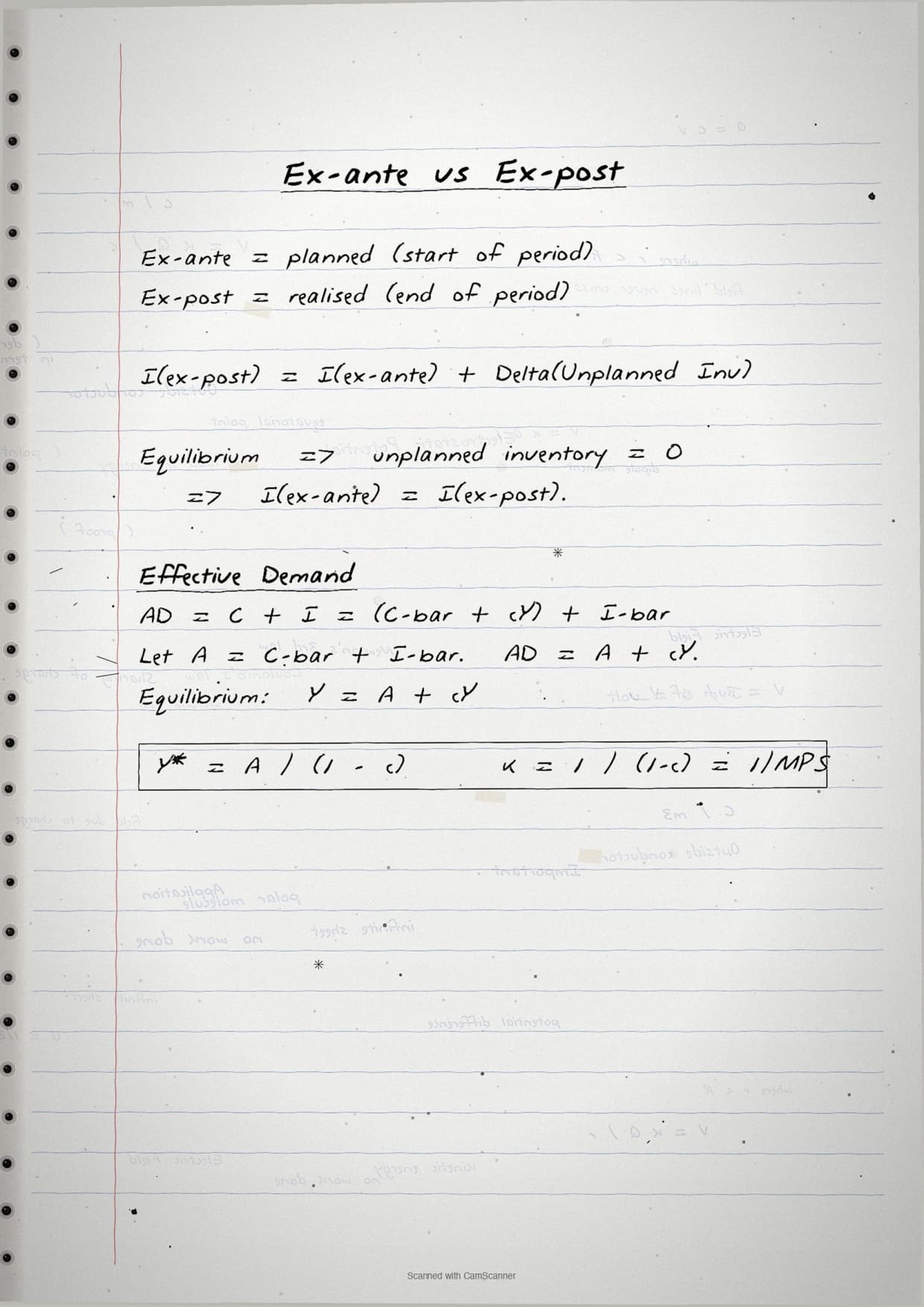
| Ex-ante | Planned or intended values before the period. |
| Ex-post | Realised or actual values after the period. |
| Effective demand | The AD level at which the economy settles in equilibrium. |
In the simple model, AD is made of consumption (C) and investment (I). Investment is taken as autonomous, so it does not change with income. Consumption rises with income, so the slope of AD comes from the consumption function.
Consumption, Saving, MPC and MPS in Income Determination Class 12
The consumption function shows how planned spending rises with income. The saving function is what is left after consumption. Together they explain most of the marks in this chapter.
| Concept | One-line statement |
|---|---|
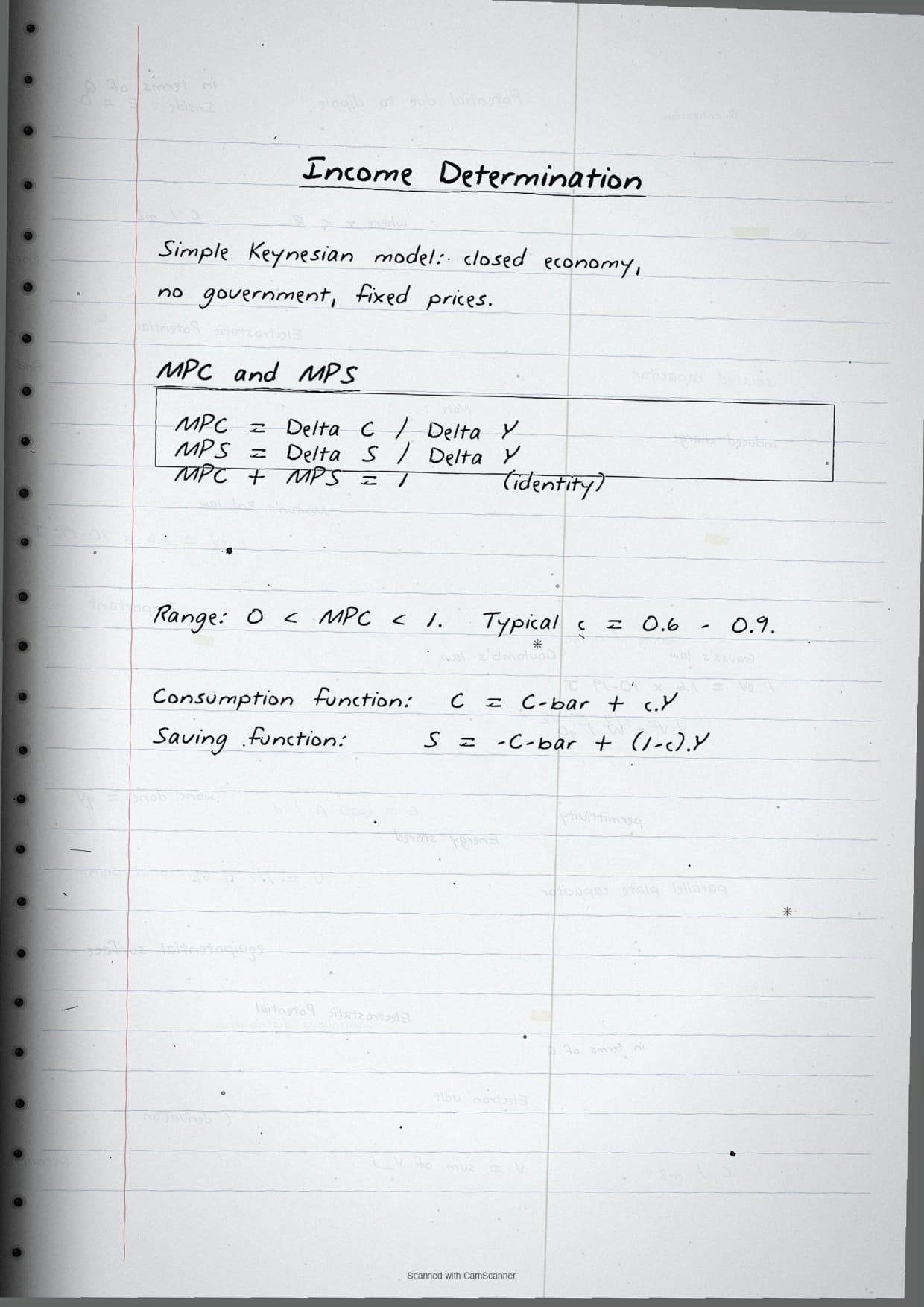
| Consumption function | C = a + bY, where a is autonomous consumption and b is the MPC. |
| Saving function | S = -a + (1 - b)Y, the part of income not spent. |
| MPC | Extra consumption from one extra unit of income. |
| MPS | Extra saving from one extra unit of income. |
| Key identity | MPC + MPS = 1, so both lie between 0 and 1. |
The marginal propensity to consume (MPC) is the slope of the consumption line. The marginal propensity to save (MPS) is the slope of the saving line. Because every extra rupee is either spent or saved, MPC + MPS = 1.
Memory hook: autonomous consumption (a) is the intercept and stays the same at every income level. MPC (b) is the slope and decides how steep the consumption line is. If you know one of MPC or MPS, subtract from 1 to get the other.
The Investment Multiplier in Income Determination
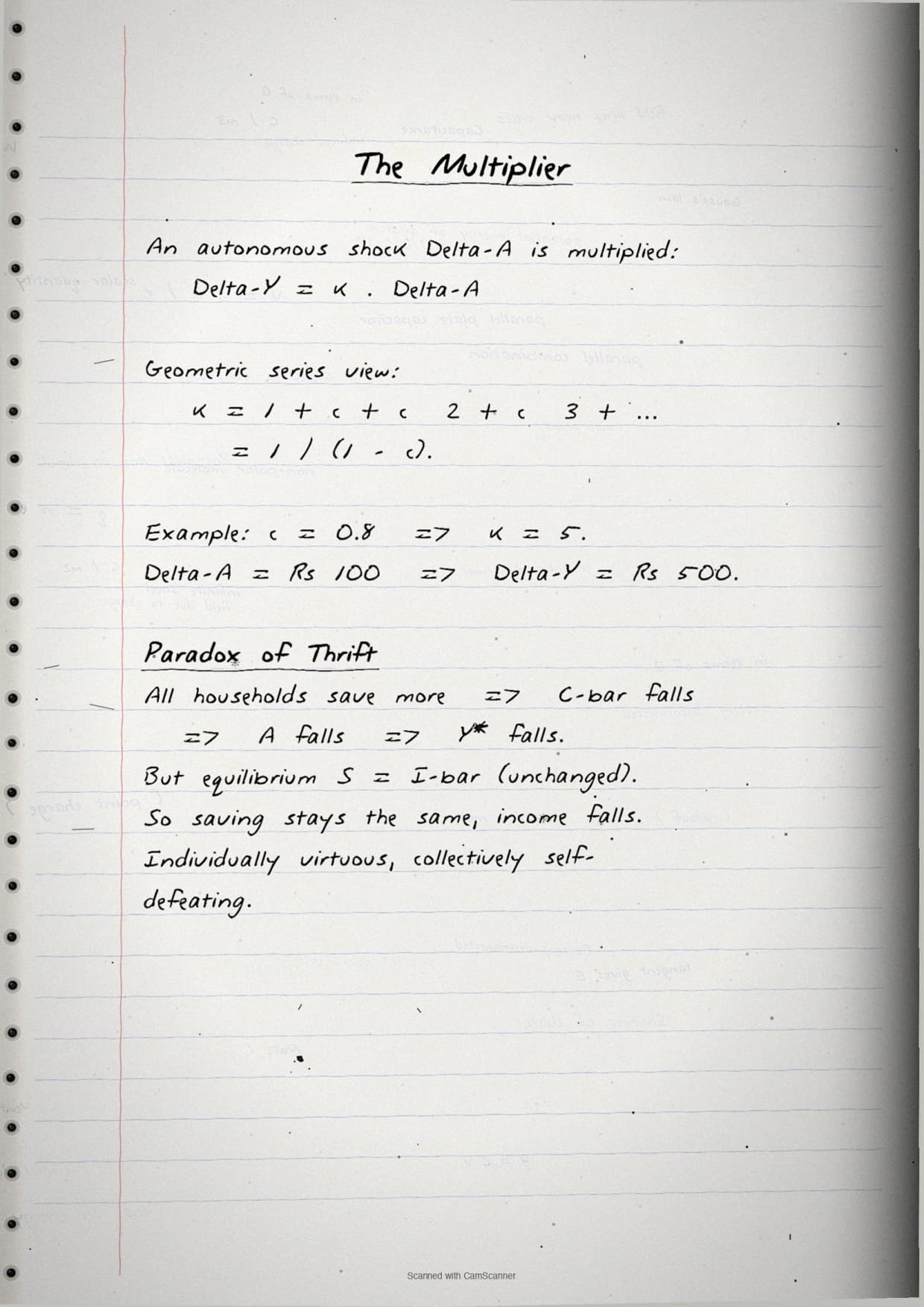
The multiplier shows how a rise in autonomous spending raises income by a larger amount. The first round of spending becomes income for someone else, who then spends a part of it, and the chain continues.
The multiplier formula is k = 1 / (1 - MPC) = 1 / MPS. A higher MPC means a larger multiplier, because more of each extra rupee is spent again.
| MPC | MPS | Multiplier (k) |
|---|---|---|
| 0.5 | 0.5 | 2 |
| 0.75 | 0.25 | 4 |
| 0.8 | 0.2 | 5 |
| 0.9 | 0.1 | 10 |
The change in income is then the multiplier times the change in autonomous spending. So if k is 4 and investment rises by 100, income rises by 400. This is the most common numerical in the board paper.
Equilibrium Income and Excess or Deficient Demand
Equilibrium income is where AD meets AS, so Y = A / (1 - MPC), where A is total autonomous spending. The economy is at rest here because planned spending equals planned output and there is no pile-up or shortfall of stock.
| Situation | What it means |
|---|---|
| Excess demand | AD is more than the full-employment output. It causes inflation, not more output. |
| Deficient demand | AD is less than the full-employment output. It causes unemployment and falling income. |
| Inflationary gap | The amount by which AD is above the full-employment level. |
| Deflationary gap | The amount by which AD is below the full-employment level. |
| Paradox of thrift | If everyone tries to save more, income falls and total saving may not rise. |
For excess demand, the government lowers its own spending or raises taxes to pull AD down. For deficient demand, it spends more or cuts taxes to push AD up. These fixes are tested often as 3 or 4 mark questions.
Income Determination Formula Sheet for Class 12 Macroeconomics
This is the block to revise in the last 20 minutes before the exam.
| Concept | Formula |
|---|---|
| Consumption function | C = a + bY |
| Saving function | S = -a + (1 - b)Y |
| MPC and MPS link | MPC + MPS = 1 |
| Multiplier | k = 1 / (1 - MPC) = 1 / MPS |
| Equilibrium income | Y = A / (1 - MPC) |
Common Mistakes in Income Determination Class 12
- Mixing up MPC and APC; MPC is the slope, APC is C divided by Y.
- Forgetting that MPC + MPS = 1 when only one value is given.
- Using 1 / MPC instead of 1 / MPS for the multiplier.
- Treating excess demand as more output; it raises prices, not output.
- Swapping inflationary and deflationary gaps in the diagram.
Income Determination Weightage in CBSE and CUET
The chapter holds a steady 4 to 6 marks in CBSE, with one numerical almost every year. The table maps where its topics show up.
| Year | CBSE question | Marks |
|---|---|---|
| 2025 | Find equilibrium income using the multiplier | 4 |
| 2024 | Explain the consumption function and MPC | 3 |
| 2023 | Meaning of excess demand and one fix | 4 |
| 2022 | State the paradox of thrift | 3 |
Student Feedback
We asked 11,540 Class 12 students about this chapter. 71% found the multiplier numerical the hardest part, and 3 out of 4 said the MPC and MPS table was the fastest way to revise it before the board exam.
Other Resources for Class 12 Economics Chapter 4 Income Determination
Pair these handwritten notes with the Solutions, typed Notes and the official NCERT chapter below.
| Resource | What it covers | Open |
|---|---|---|
| Handwritten Notes | Scanned notebook pages for last-mile revision. | Chapter 4 Handwritten Notes |
| NCERT Solutions | Step-by-step answers to every exercise question. | Chapter 4 NCERT Solutions |
| Notes | Concept-first typed revision of the full chapter. | Chapter 4 Notes |
| NCERT Book PDF | Official NCERT Macroeconomics Chapter 4 textbook. | Chapter 4 NCERT Book PDF |
All Chapters Handwritten Notes for Class 12 Economics Macroeconomics
| Chapter | Topic | Handwritten Notes link |
|---|---|---|
| Chapter 1 | Introduction to Macroeconomics | Introduction to Macroeconomics |
| Chapter 2 | National Income Accounting | National Income Accounting |
| Chapter 3 | Money and Banking | Money and Banking |
| Chapter 4 | Income Determination | Income Determination |
| Chapter 5 | Government Budget and the Economy | Government Budget and the Economy |
| Chapter 6 | Open Economy Macroeconomics | Open Economy Macroeconomics |
Class 12 Economics Chapter 4 Income Determination Handwritten Notes FAQs
Ques. What are these Class 12 Economics Chapter 4 handwritten notes for?
Ans. They are a short, scanned-notebook revision file for NCERT Chapter 4 Income Determination. They cover aggregate demand and supply, the consumption and saving functions, MPC and MPS, the investment multiplier and equilibrium income, with a formula table and common-mistake alerts. Worked answers sit in the matching NCERT Solutions.
Ques. What is the relationship between MPC and MPS?
Ans. Every extra unit of income is either spent or saved, so MPC + MPS = 1. If MPC is 0.8, then MPS is 0.2. Both values lie between 0 and 1, and you can always find one by subtracting the other from 1.
Ques. How do you find the investment multiplier?
Ans. The multiplier is k = 1 / (1 - MPC), which is the same as 1 / MPS. A higher MPC gives a larger multiplier because more of each extra rupee is spent again. The change in income equals the multiplier times the change in autonomous spending.
Ques. What is the difference between excess demand and deficient demand?
Ans. Excess demand is when aggregate demand is more than the full-employment output, which causes inflation. Deficient demand is when aggregate demand is less than the full-employment output, which causes unemployment and falling income. The gaps are called the inflationary gap and the deflationary gap.
Ques. What is the paradox of thrift in Class 12 Economics?
Ans. The paradox of thrift says that if all households try to save more at the same time, total income falls. Because income falls, the actual saving may not rise and can even drop. It shows that what is good for one household can hurt the whole economy.



Comments