




Inside these handwritten Financial Management notes for Class 12 you get the wealth-maximisation objective, the three financial decisions, capital structure and working capital, hand-written for fast revision of the 2026-27 syllabus.
- CBSE Weightage: 8 to 12 marks (Unit 3, Business Finance and Marketing)
- Format: Compact mnemonic notes + spotter words for last-day revision
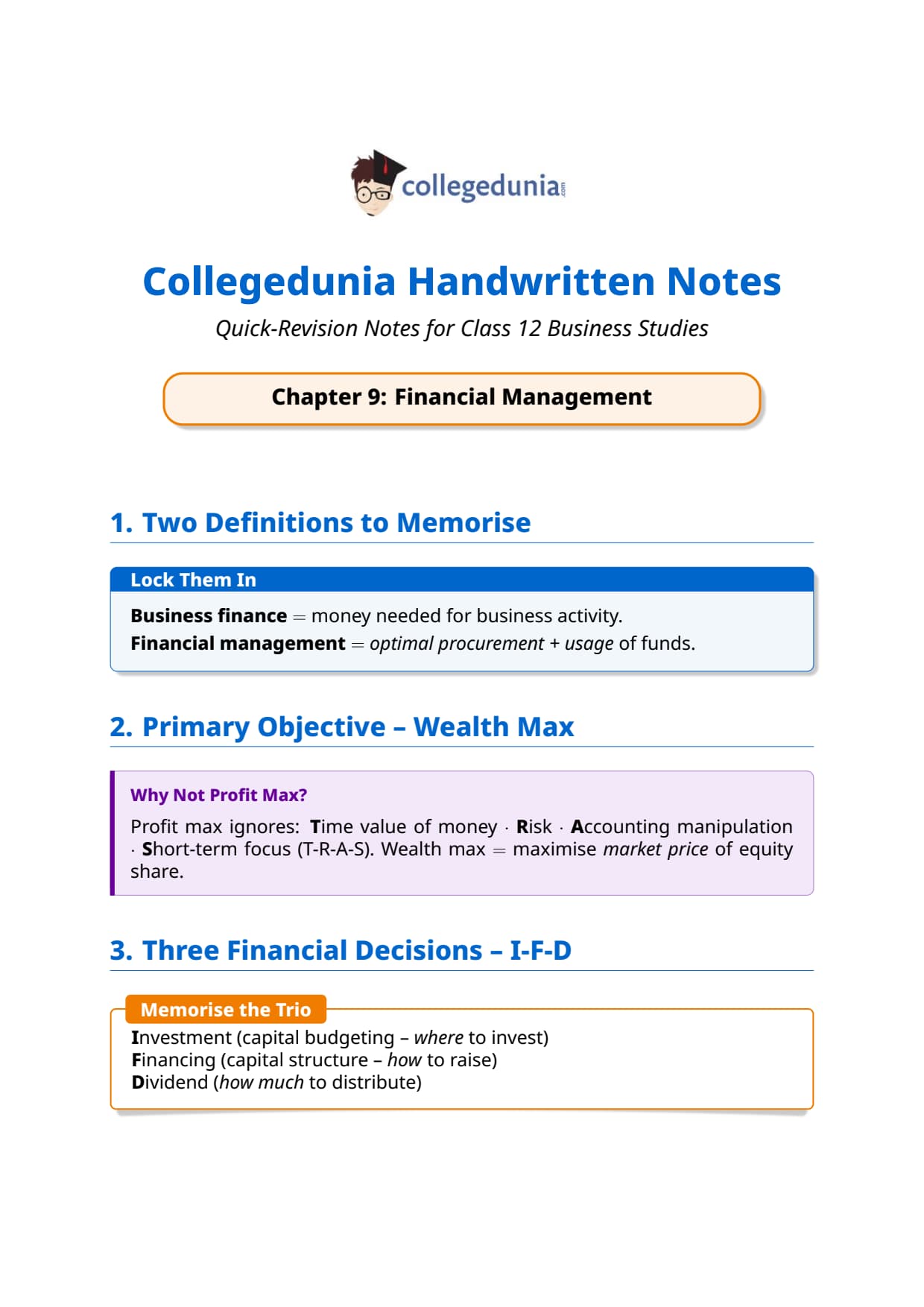
The handwritten notes are designed for board-exam candidates in the final 24-48 hours before the paper. Each section is short, mnemonic-led (I-F-D for the three decisions, T-R-A-S for why profit max fails) and ends with a CBSE spotter that maps case-study trigger words to the right NCERT answer.
Financial Management Class 12 Handwritten Notes: Section Map
| Section | What is Covered | Why It Matters in the Exam |
|---|---|---|
| 1. Two Definitions | Business finance + Financial management | 1-mark VSA |
| 2. Wealth Maximisation | T-R-A-S mnemonic for why profit max fails | 3 to 4-mark contrast |
| 3. Three Decisions (I-F-D) | Investment / Financing / Dividend | 4 to 5-mark name-and-explain |
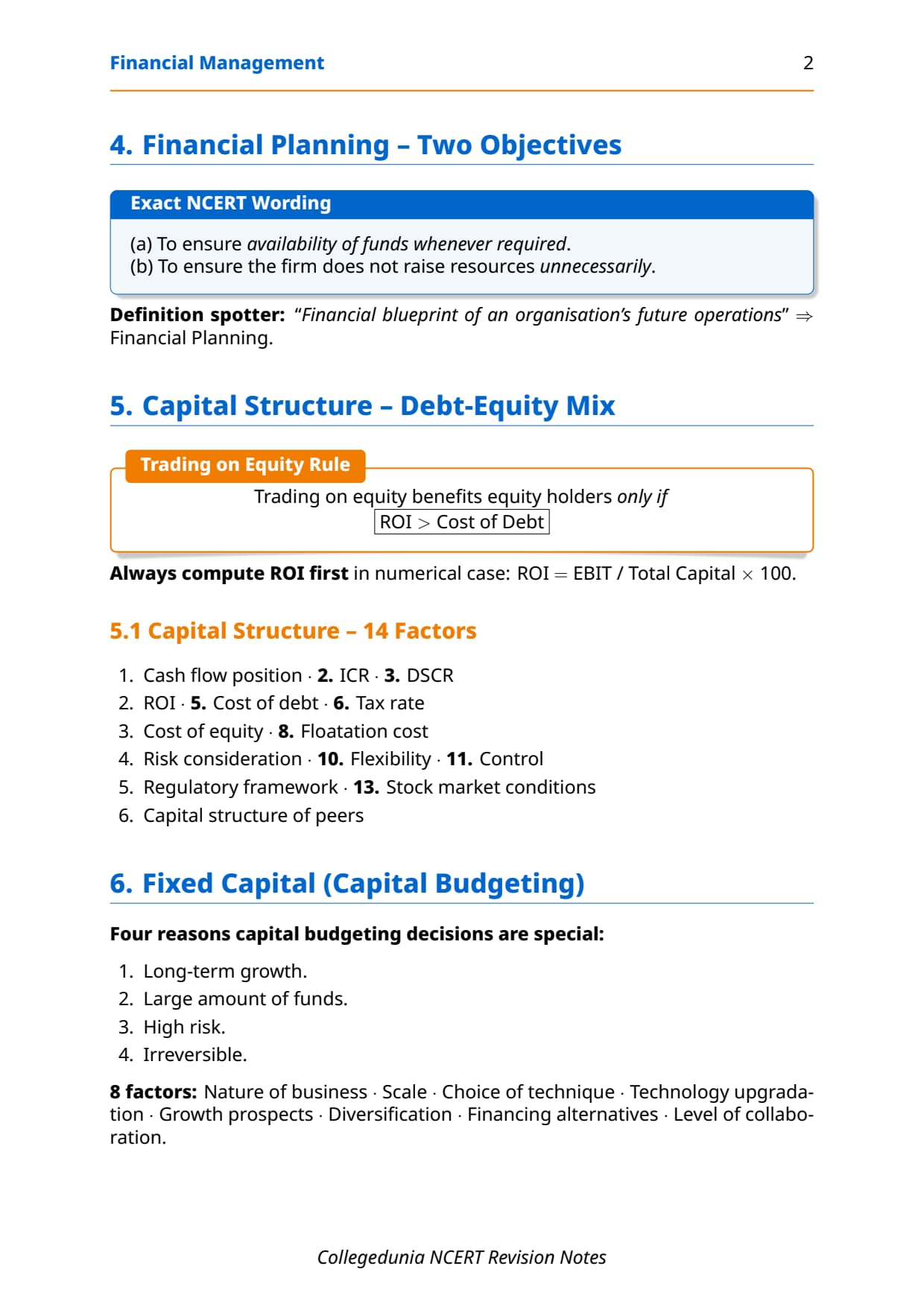
| 4. Financial Planning | Blueprint of future operations; 2 twin objectives | 3 to 5-mark case-study |
| 5. Capital Structure | Trading on Equity rule (ROI > Cost of Debt); 14 factors | 5 to 6-mark long answer |
| 6. Fixed Capital | Capital budgeting; 4 reasons it's special; 8 factors | 4 to 6-mark long answer |
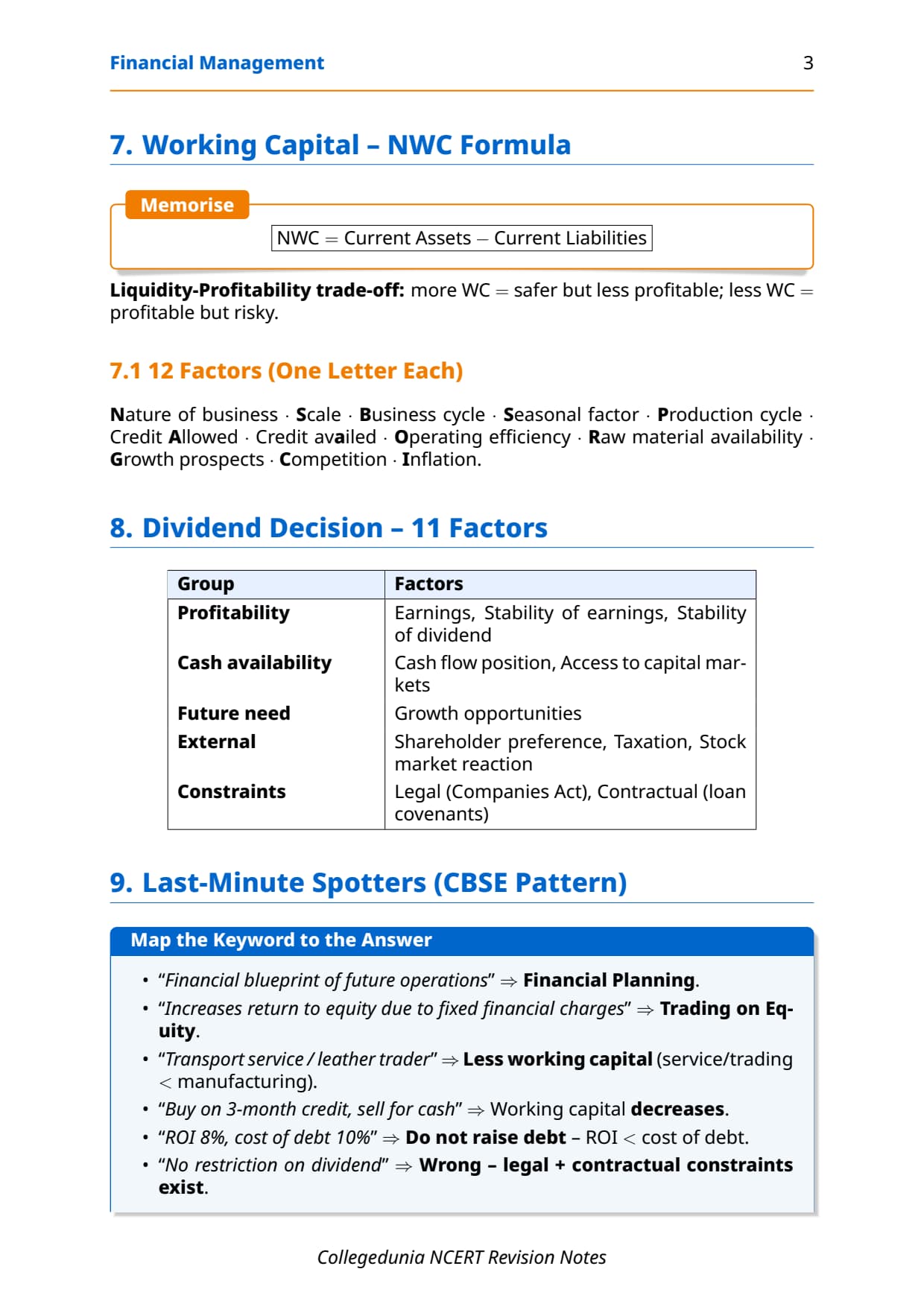
| 7. Working Capital | NWC = CA - CL; 12 factors | 5 to 6-mark "five determinants" |
| 8. Dividend Decision | 11 factors grouped into 5 buckets | 5 to 6-mark "any 8 factors" |
| 9. CBSE Spotters | Trigger-word $\to$ answer map | Case-study mini-Qs |
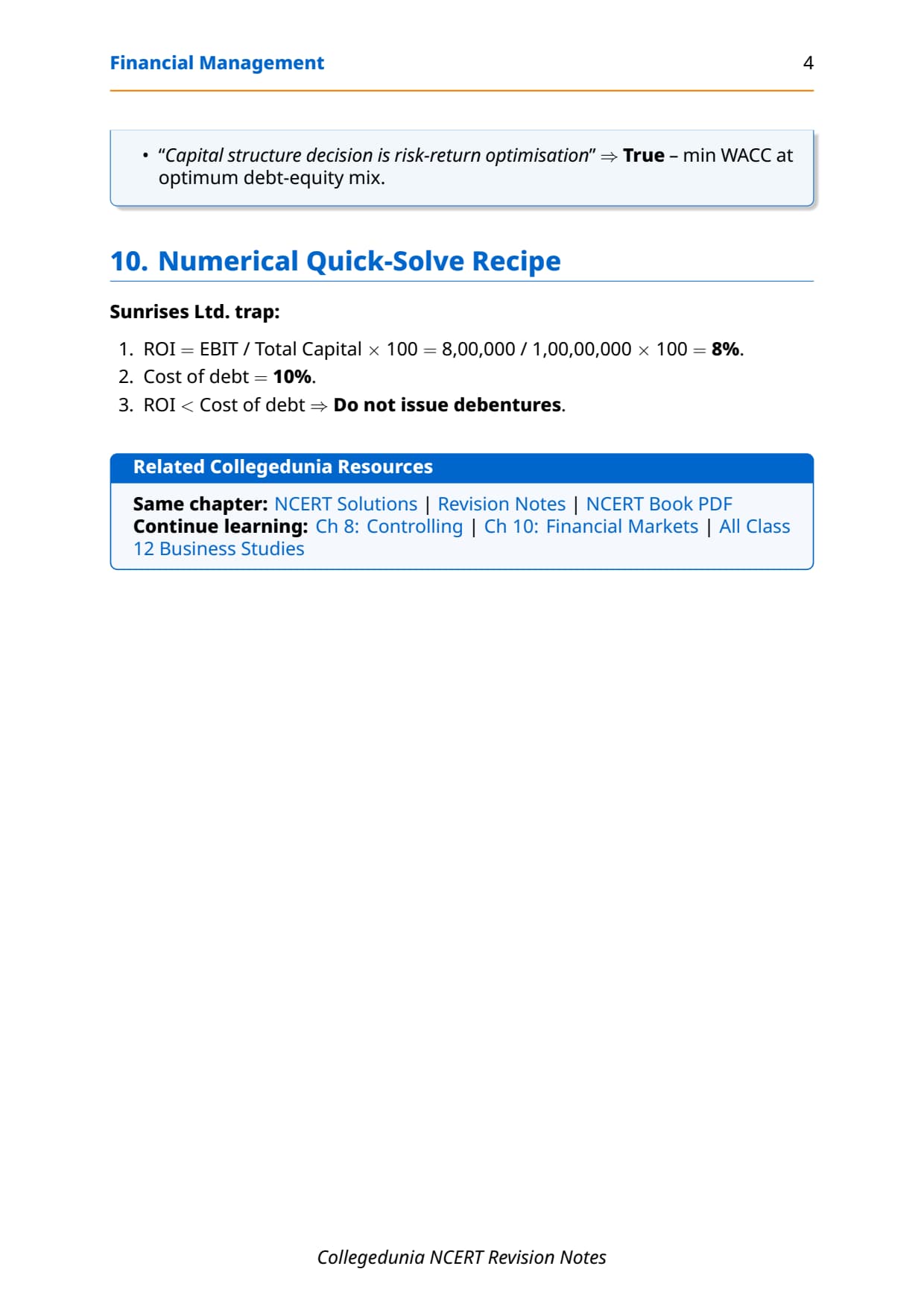
| 10. Sunrises Numerical Recipe | ROI computation + decision rule | 3-mark numerical |
Financial Management Video Walkthrough
Source: Magnet Brains on YouTube
What the Class 12 Business Studies Chapter 9 Handwritten Notes PDF Contains
- Compact handwritten-style notes on 4 pages -- definitions, wealth maximisation, three decisions, financial planning, capital structure (trading on equity), fixed capital, working capital, dividend decision.
- Mnemonics: I-F-D (three decisions), T-R-A-S (why profit max fails), N-S-B-S-P-A-A-O-R-G-C-I (twelve working-capital factors).
- Trading-on-equity rule (ROI > Cost of Debt) and the Sunrises Ltd.\ numerical recipe in one place.
- Working capital NWC formula and the liquidity-profitability trade-off.
- Dividend factors grouped into 5 logical buckets (profitability, cash availability, future need, external, constraints).
- CBSE spotter mapping case-study trigger words (``financial blueprint'', ``fixed financial charges'', ``ROI 8\% / cost 10\%'') to the correct NCERT answer.
- Cross-links to Solutions, Revision Notes and the NCERT Book PDF for the same chapter.
Continue Learning: Class 12 Business Studies Chapter 9 and Nearby Chapters
- Ch 8: Controlling Handwritten Notes
- Ch 10: Financial Markets Handwritten Notes
- All Class 12 Business Studies Chapters
Student Feedback
In a Collegedunia poll of 410 Class 12 Commerce students, 79% said the I-F-D and T-R-A-S mnemonics helped them recall the three financial decisions faster in the exam hall. 3 in 4 said the trading-on-equity spotter cleared up a doubt textbooks left vague.
Other Resources for Class 12 Business Studies Chapter 9 Financial Management
| Resource | Link |
|---|---|
| NCERT Solutions | Financial Management NCERT Solutions |
| Revision Notes | Financial Management Class 12 Notes |
| Handwritten Notes | Financial Management Handwritten Notes |
| NCERT Book PDF | Financial Management NCERT Book PDF |
Financial Management Class 12 - Frequently Asked Questions
Financial Management Class 12 - Frequently Asked Questions
What is the primary objective of financial management?
The primary objective is wealth maximisation of equity shareholders, measured by the market price of the equity share. It is preferred over profit maximisation because profit ignores the time value of money, risk and is open to accounting manipulation.
What does I-F-D stand for?
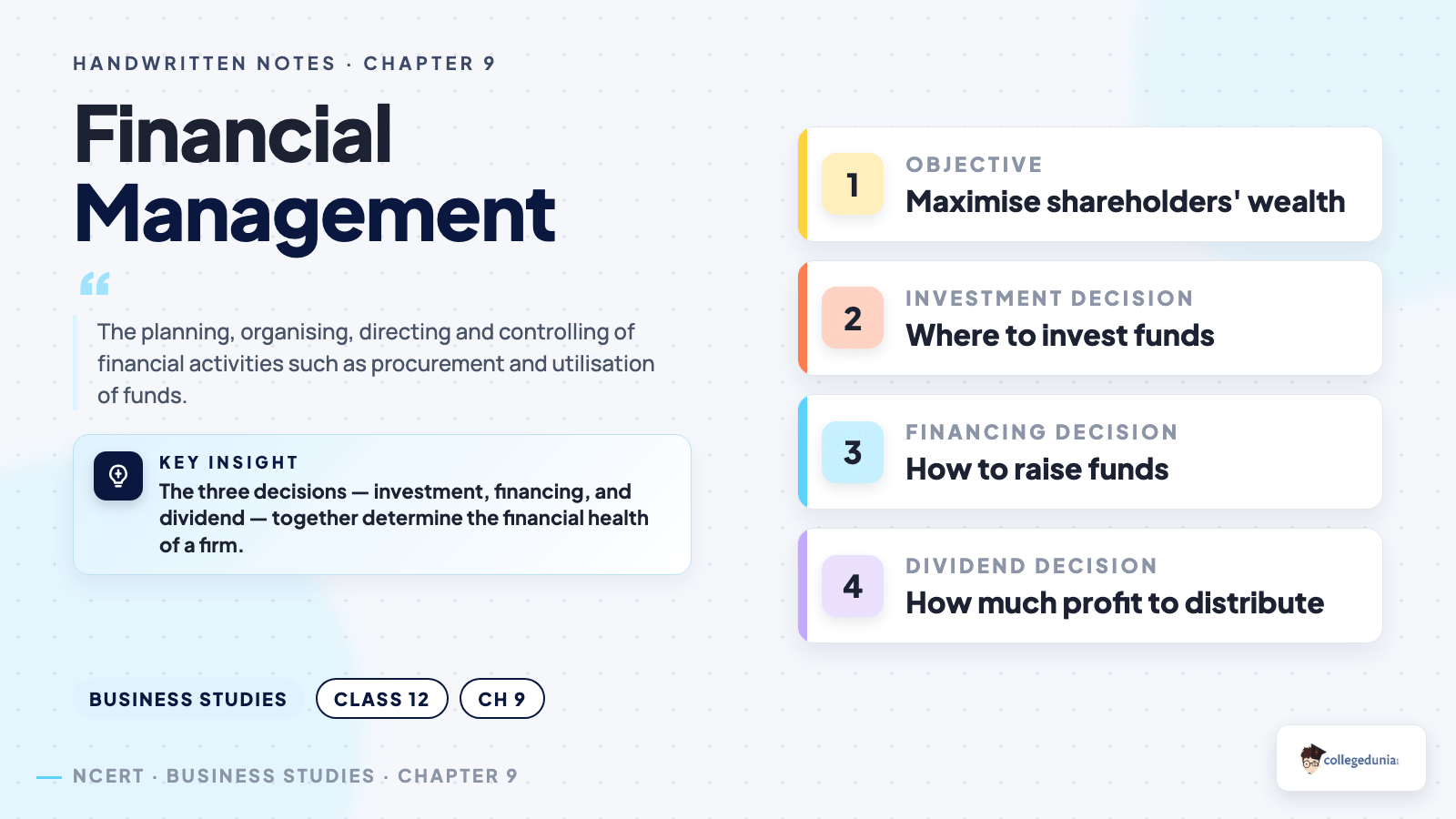
I-F-D is the mnemonic for the three financial decisions: Investment, Financing, Dividend. Together they answer "where to invest", "how to fund" and "how much to distribute".
When is trading on equity beneficial?
Trading on equity is beneficial only when ROI > Cost of Debt. In the Sunrises Ltd. case, ROI = 8% and cost of debt = 10%, so ROI < cost of debt and debt would destroy value. The company should not issue debentures.
What is the net working capital formula?
Net Working Capital (NWC) = Current Assets - Current Liabilities. Higher NWC means higher liquidity but lower profitability; lower NWC means higher profitability but more liquidity risk. The financial manager seeks the optimum WC level.
Where can I download the Class 12 Business Studies Chapter 9 Financial Management Handwritten Notes PDF?
You can download the Collegedunia Class 12 Business Studies Chapter 9 Financial Management Handwritten Notes PDF free of cost from this page. Aligned to NCERT Reprint 2026-27 and built for last-day revision.



Comments