




The class 12 business studies handwritten notes chapter 10 Financial Markets capture every section, formula, and SEBI function as scanned notebook pages, written in dark-blue ballpoint on ruled paper with hand-drawn flowcharts for trading and the classification tree. The format matches what a Class 12 Commerce student would actually carry into the board exam revision room.
- CBSE Weightage: 8 to 10 marks (Unit 3 Business Finance)
- Format: Scanned handwritten PDF with hand-drawn flowcharts and formula boxes
- Style: Notebook-ruled paper, blue ballpoint, side annotations on every formula
Download the PDF from the slot above and pair it with the Collegedunia notes page for line-by-line definitions.
These notes are curated by Commerce subject experts, mapped to the 2026-27 NCERT print, and checked against five years of CBSE board papers.
Why Choose Handwritten Notes for Financial Markets Class 12
Chapter 10 packs 25 named concepts into five money market instruments, two capital market segments, and three SEBI function groups. Re-reading dense NCERT prose rarely fixes these names in memory; a scanned notebook with one section per page does.
- Faster revision pass: Eight NCERT sections across five A4 pages, readable in under fifteen minutes.
- Visual recall: Money market instruments come with hand-drawn arrows and side notes, like a tutor's board scribbles.
- Same look as your own book: Ruled paper, blue ink, red margin, scribble-corrections on common mistakes.
- Built around CBSE answer length: Each block matches the 3-mark or 5-mark answer format, with key terms underlined.
Financial Markets Video Walkthrough
Source: Magnet Brains on YouTube
What's Inside the Class 12 Business Studies Chapter 10 Handwritten Notes PDF
The PDF runs five A4 pages, scanned to print cleanly at home, tracking the eight NCERT sections in book order.
| Page | Topic | What you'll see |
|---|---|---|
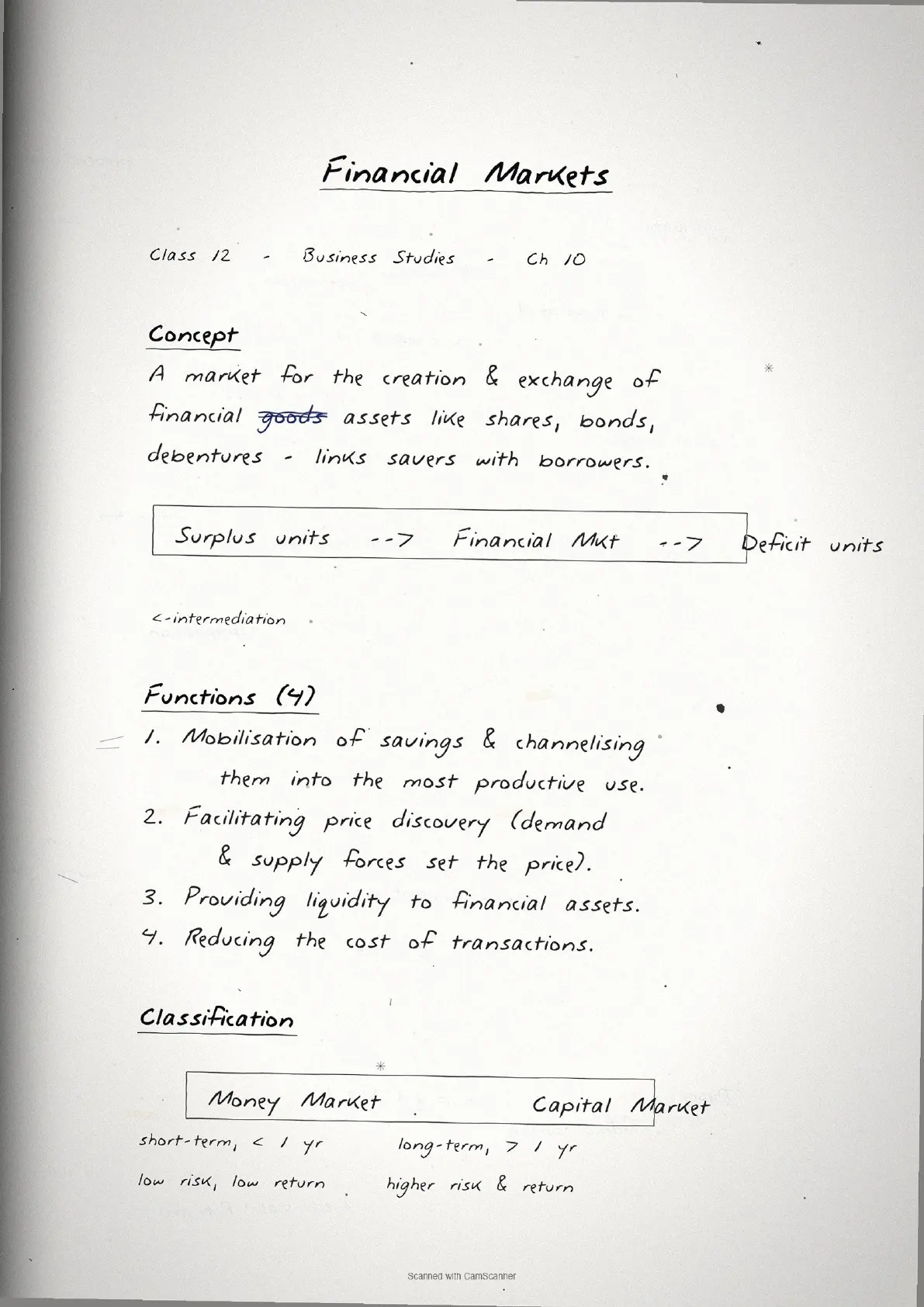
| Page 1 | Concept, Functions (M-P-L-R), Classification | Definition box, four functions (Mobilisation, Price discovery, Liquidity, Reduce cost), Money vs Capital comparison split |
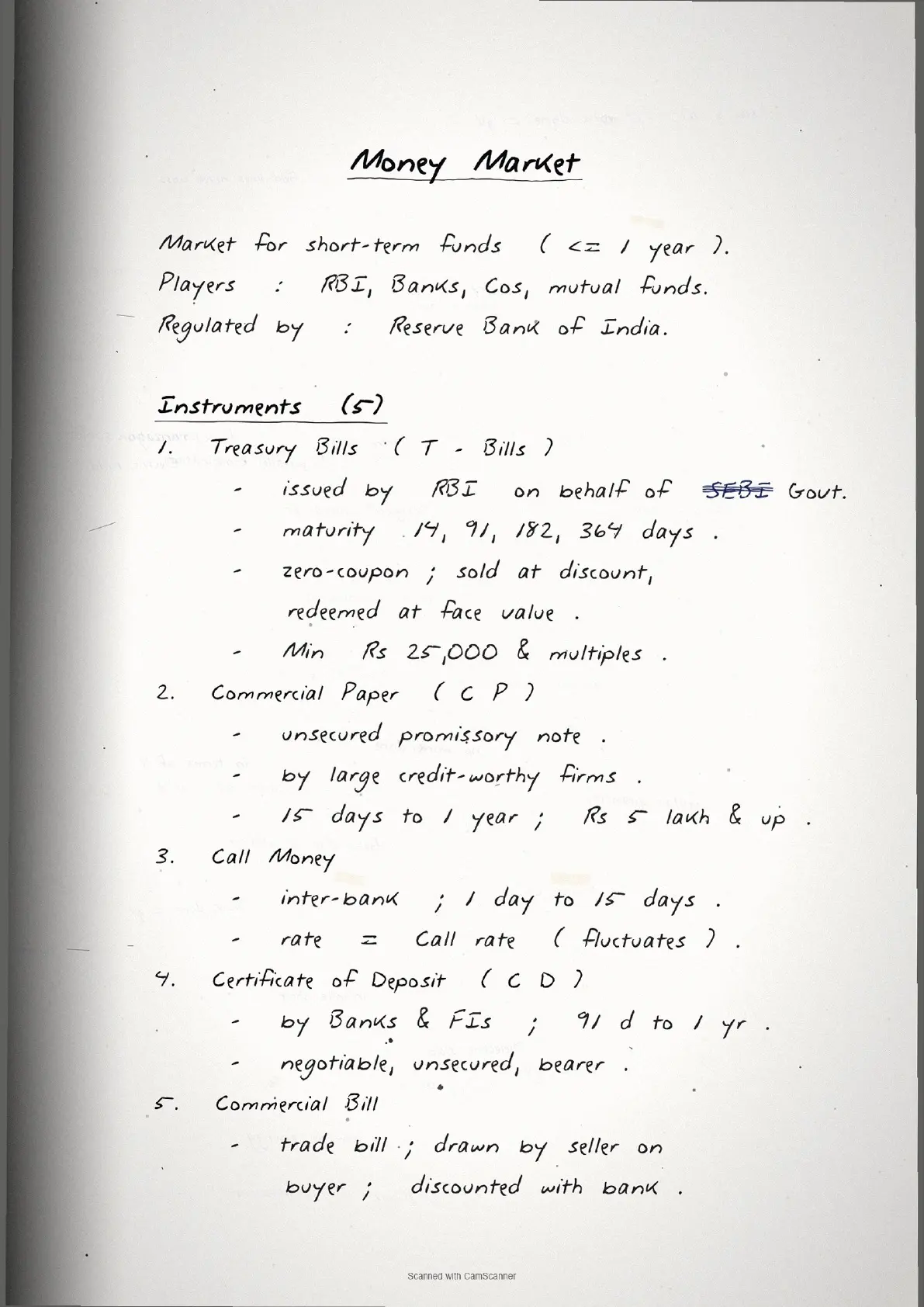
| Page 2 | Money Market and 5 Instruments | T-Bill (RBI, Rs 25K min, 14/91/182/364 days), Commercial Bill, Commercial Paper (15d to 1yr), Call Money (1 to 15d inter-bank), CD (Rs 1L min) with side annotations |
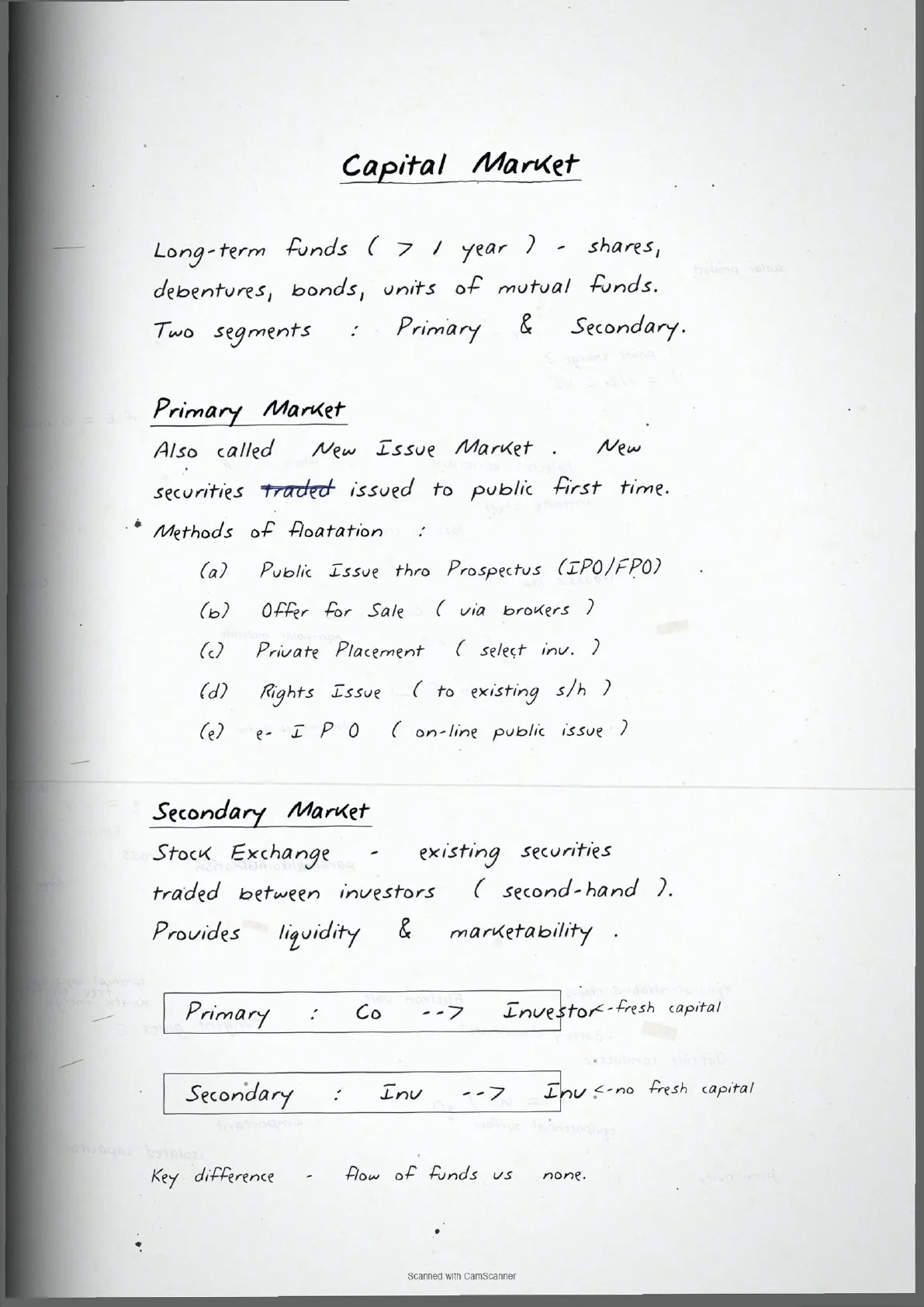
| Page 3 | Capital Market: Primary vs Secondary | PORP-E five methods of floatation (Prospectus, Offer for Sale, Rights, Private Placement, e-IPO) with primary vs secondary flow boxes |
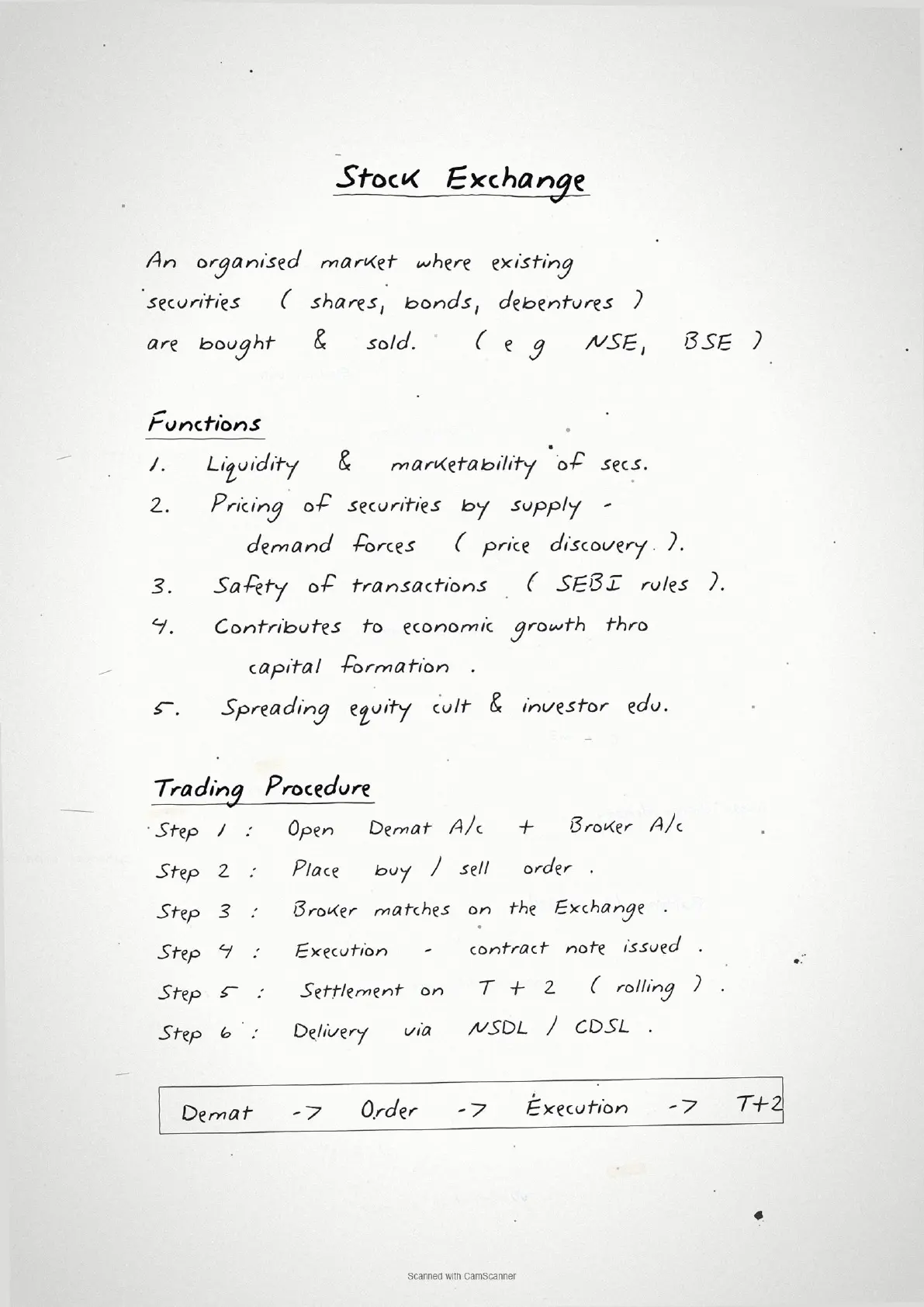
| Page 4 | Stock Exchange and Trading Procedure | BSE (1875), NSE (1992 screen-based); Sensex and Nifty 50; Demat to Order to Execution to T plus 2 rolling settlement |
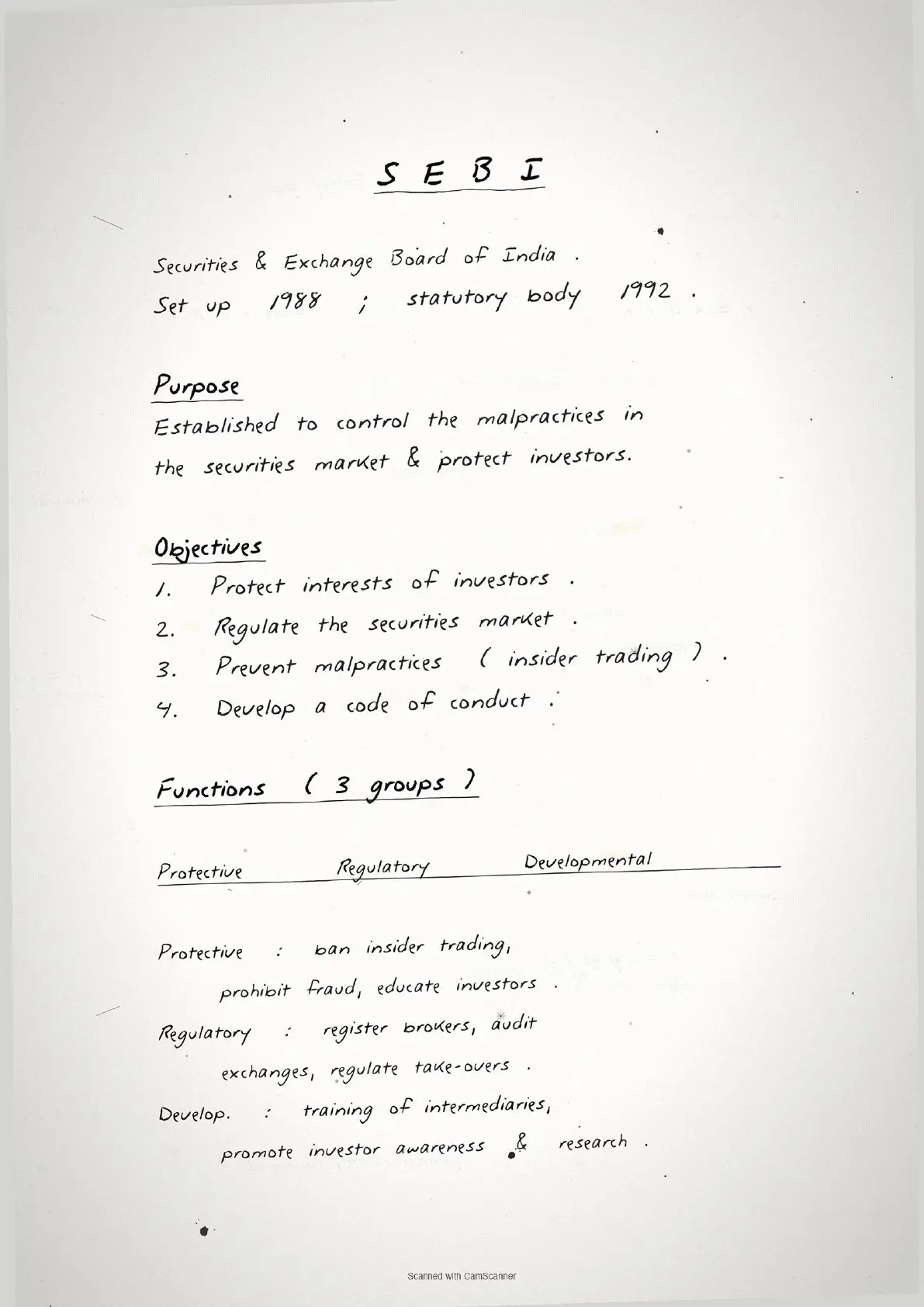
| Page 5 | SEBI | Established 1988, statutory 1992; three function groups (Regulatory, Developmental, Protective) |
Memory Mnemonics for Financial Markets Chapter 10
Students consistently mix up three blocks in the board exam: the five money market instruments, the five floatation methods, and the three SEBI function groups. These mnemonics match the notebook's own annotations.
Diagram Inventory in the Financial Markets Handwritten Notes
Every hand-drawn box and arrow in the PDF is listed here, so a student can jump to the right page during last-day revision.
| Diagram | Page | Use during revision |
|---|---|---|
| Surplus to Deficit intermediation box | Page 1 | Open any 3-mark answer on the concept of financial markets |
| Money vs Capital market split | Page 1 | Locate the maturity, risk, and return cues for a comparison question |
| T-Bill discount cycle annotation | Page 2 | Quick recall for the issued-at-discount feature |
| Primary to Secondary flow boxes | Page 3 | 5-mark long-answer template for fund-flow questions |
| Six-step trading procedure | Page 4 | Skeleton for the stock exchange long-answer question |
| SEBI three function groups bracket | Page 5 | 5-mark answer skeleton for any SEBI question |
Pen-Colour and Symbol Conventions in the PDF
The notes follow a consistent ink and symbol code, so a student can scan the page and pick up cues at a glance.
- Dark blue body ink: Definitions, NCERT-verbatim phrasing, key terms.
- Near-black heading ink: Section names like "Functions" or "Trading Procedure".
- Side annotations: Small arrows next to each formula box show where to use it in answers.
- Wobbly box outlines: Mark CBSE-favourite phrases such as price discovery, liquidity, T plus 2, insider trading.
- Scribble corrections: Three to five strike-throughs show common errors, like "SEBI" instead of "Govt", with the fix written next to it.
Financial Markets Class 12 Self-Assessment Quiz
Five quick MCQs for a post-read test, each with a page reference back to the PDF.
Q1. T-Bills are issued by which body on behalf of the Government?
(a) SEBI (b) RBI (c) NSE (d) BSE
Answer: (b) RBI - SEBI regulates capital market, not money market instruments. Page 2.
Q2. The minimum maturity of a Commercial Paper is
(a) 7 days (b) 15 days (c) 30 days (d) 91 days
Answer: (b) 15 days. Commercial Paper maturity 15 days to 1 year; introduced in India in 1990. Page 2.
Q3. Which is NOT a method of floatation in the primary market?
(a) Offer for Sale (b) Rights Issue (c) Trading on NSE (d) Private Placement
Answer: (c) Trading on NSE - that is secondary market activity. Page 3.
Q4. India shifted to which settlement cycle for equity trades?
(a) T plus 3 (b) T plus 2 (c) T plus 5 (d) Same-day
Answer: (b) T plus 2, as per the NCERT 2026-27 rolling settlement procedure. Page 4.
Q5. Investor education is which type of SEBI function?
(a) Protective (b) Regulatory (c) Developmental (d) Statutory
Answer: (c) Developmental. Protective is anti-fraud and insider-trading ban. Page 5.
Last 24-Hour Revision Card for Financial Markets
The night-before-exam skim list. Each item is a one-glance check, mapped to a page so a student can flip there in seconds.
- Functions of Financial Market (4): mobilisation, price discovery, liquidity, lower transaction cost.
- 5 Money Market Instruments: T-Bill, Commercial Paper, Call Money, CD, Commercial Bill. Maturity ranges memorised.
- 5 Methods of Floatation: Prospectus, Offer for Sale, Private Placement, Rights, e-IPO.
- Primary vs Secondary: Co to Investor vs Investor to Investor. Fresh capital vs no fresh capital.
- Trading Procedure: Demat then Order then Execution then T plus 2 Rolling Settlement then Delivery via NSDL/CDSL. Traded on BSE (1875) or NSE (1992 screen-based); indices Sensex (BSE) and Nifty 50 (NSE).
- SEBI Functions (3 groups): Regulatory, Developmental, Protective, with one example each. SEBI established 1988, statutory under SEBI Act 1992.
How Collegedunia's Handwritten Notes Compare with Self-Notes
Most Class 12 Commerce students start making their own notes and run out of time by January. These handwritten notes fill that gap: same notebook look, but NCERT-verbatim accuracy.
- Time saved: A student spends roughly 90 minutes hand-copying Chapter 10 from the NCERT print. The Collegedunia PDF is ready in one download.
- Coverage gaps: Self-notes often miss two of the five money market instruments. The PDF lists all five with maturity ranges.
- SEBI structure: Self-notes group SEBI functions into two columns or skip Developmental entirely. The PDF keeps all three groups with one-line examples.
Handwritten Notes for Class 12 Business Studies: All Chapters
The table below lists every chapter of the Class 12 Business Studies NCERT Book linked to its handwritten notes page so a student can collect the full set in one sitting.
| Chapter | Resource |
|---|---|
| Chapter 1 | Nature and Significance of Management Handwritten Notes |
| Chapter 2 | Principles of Management Handwritten Notes |
| Chapter 3 | Business Environment Handwritten Notes |
| Chapter 4 | Planning Handwritten Notes |
| Chapter 5 | Organising Handwritten Notes |
| Chapter 6 | Staffing Handwritten Notes |
| Chapter 7 | Directing Handwritten Notes |
| Chapter 8 | Controlling Handwritten Notes |
| Chapter 9 | Financial Management Handwritten Notes |
| Chapter 11 | Marketing Handwritten Notes |
| Chapter 12 | Consumer Protection Handwritten Notes |
Student Feedback
In a Collegedunia poll of 410 Class 12 Commerce students, 79% said the five money market instruments were the hardest part of Chapter 10 to recall in the exam hall. 3 in 4 said a one-page hand-drawn diagram helped them remember the trading procedure faster than re-reading the NCERT text.
Other Resources for Class 12 Business Studies Chapter 10 Financial Markets
| Resource | Link |
|---|---|
| NCERT Solutions | Financial Markets NCERT Solutions |
| Revision Notes | Financial Markets Class 12 Notes |
| Handwritten Notes | Financial Markets Handwritten Notes |
| NCERT Book PDF | Financial Markets NCERT Book PDF |
Financial Markets Class 12 Business Studies Handwritten Notes FAQs
Ques. Where can I download Financial Markets Class 12 Business Studies Handwritten Notes PDF?
Ans. You can download the Financial Markets Class 12 Business Studies Handwritten Notes PDF directly from this page. Both the Normal and HD versions are available, and both are free.
Ques. Are these Class 12 Business Studies Chapter 10 Handwritten Notes aligned with the 2026-27 NCERT?
Ans. Yes. The notes reflect the current 2026-27 syllabus for Class 12 Business Studies. The eight sections, the SEBI functions list (established 1988, statutory 1992), and the T plus 2 rolling settlement cycle all match the latest NCERT print.
Ques. How many pages is the Class 12th Business Studies Financial Markets Handwritten Notes PDF?
Ans. The PDF runs 5 A4 pages, covering all eight NCERT sections, all five money market instruments, both capital market segments, the trading procedure, and the SEBI function groups.
Ques. Are diagrams included in the Class 12 Business Studies Chapter 10 Handwritten Notes?
Ans. Yes. The PDF includes six hand-drawn diagrams: the intermediation flow box, money vs capital split, primary vs secondary flow boxes, the six-step trading procedure, and the SEBI three-group bracket.
Ques. Can I use these handwritten notes for last-day board exam revision?
Ans. Yes. The 5-page format is designed for a 15-minute revision pass. The Last 24-Hour Revision Card on this page lists exactly what to skim from each section before walking into the exam hall.
Ques. Do these handwritten notes cover SEBI functions in detail?
Ans. Yes. Page 5 of the PDF carries the full SEBI section with purpose, objectives, and all three groups of functions (Protective, Regulatory, Developmental) with one example each.
Ques. Where do I get the matching Solutions for Class 12 Business Studies Chapter 10?
Ans. The chapter-end exercise answers are available on the Collegedunia NCERT Solutions page for Financial Markets Class 12, linked at the top and bottom of this article.



Comments