




These Team Games handwritten notes turn the whole chapter into clean, pen-on-paper pages for fast last-minute revision. They follow the 2026-27 NCERT "Health and Physical Education" Class 11 Chapter 5 and cover the eight team games in the book: Basketball, Cricket, Football, Handball, Hockey, Kabaddi, Kho-Kho and Volleyball. Students get the history, ground and court sizes, number of players, basic skills and key terms of each game in a format that is easy to skim before a class test.
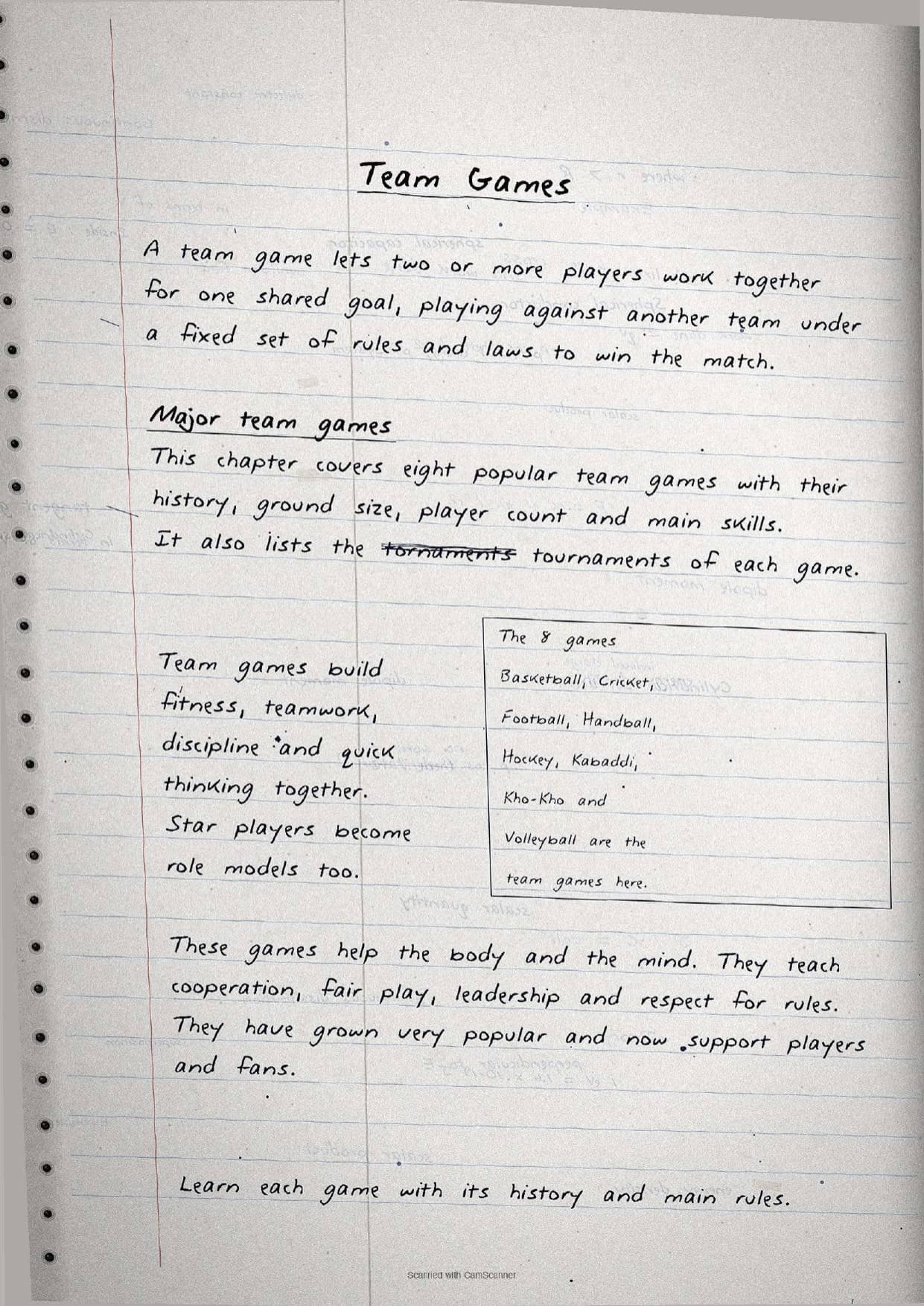
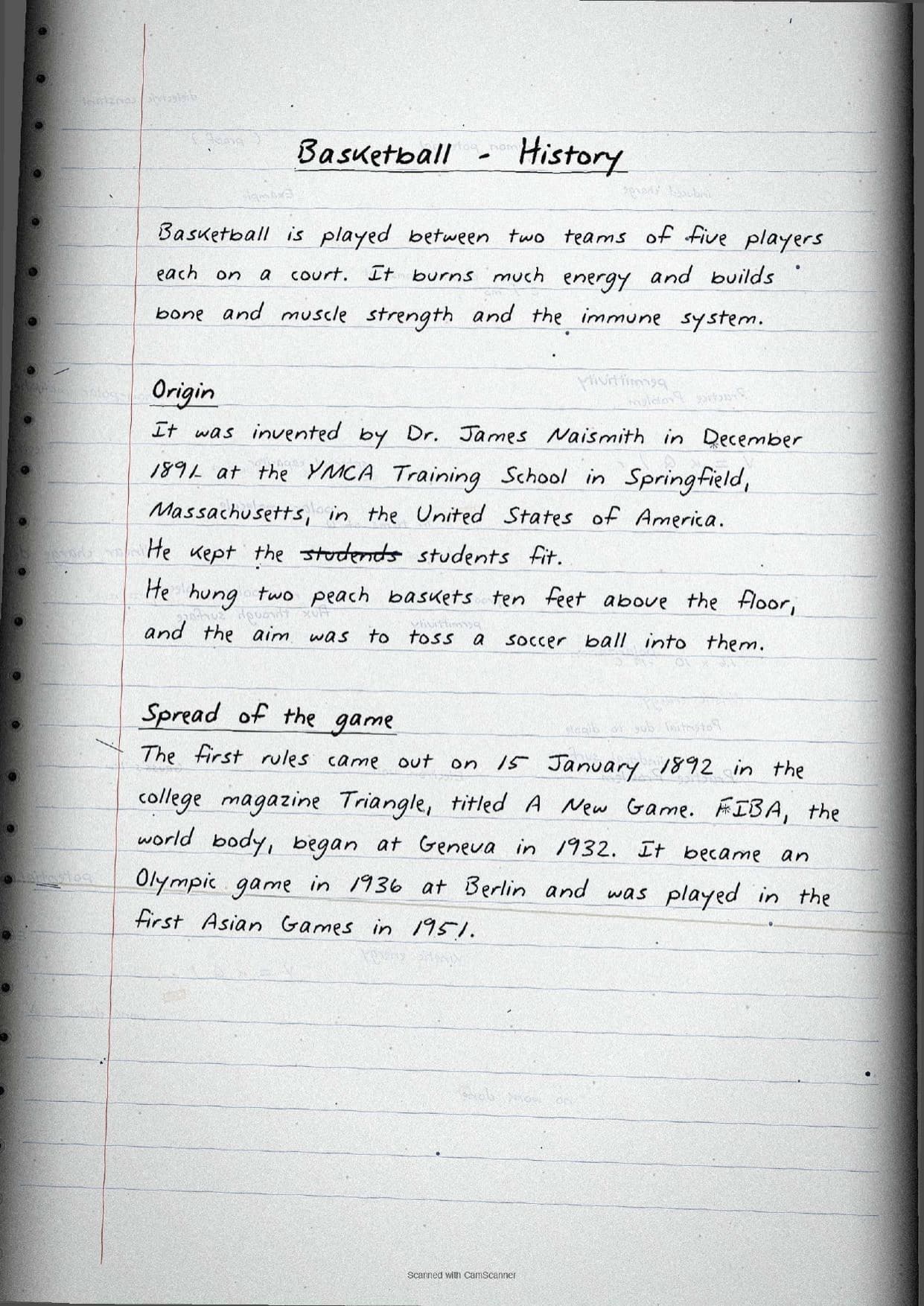
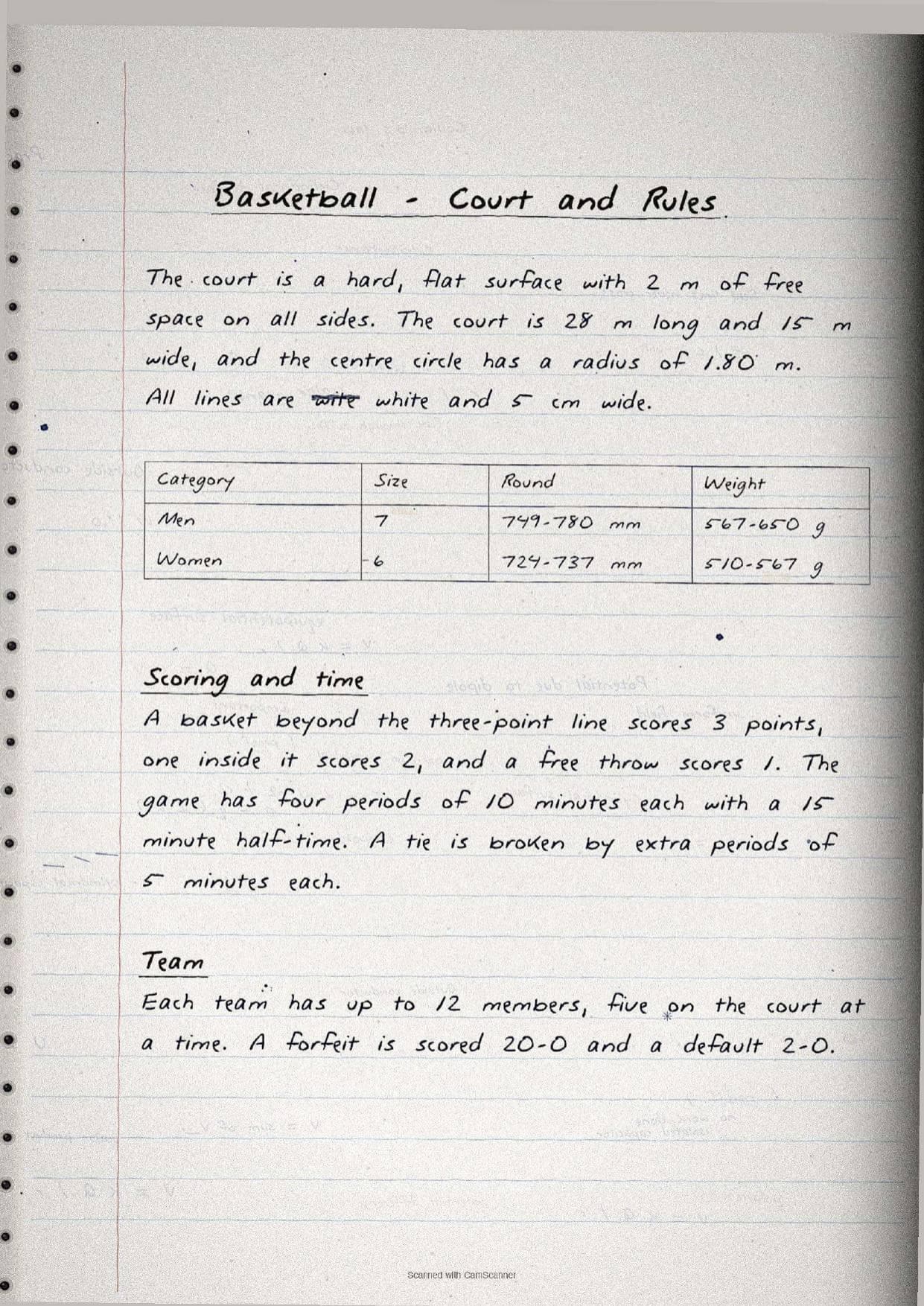
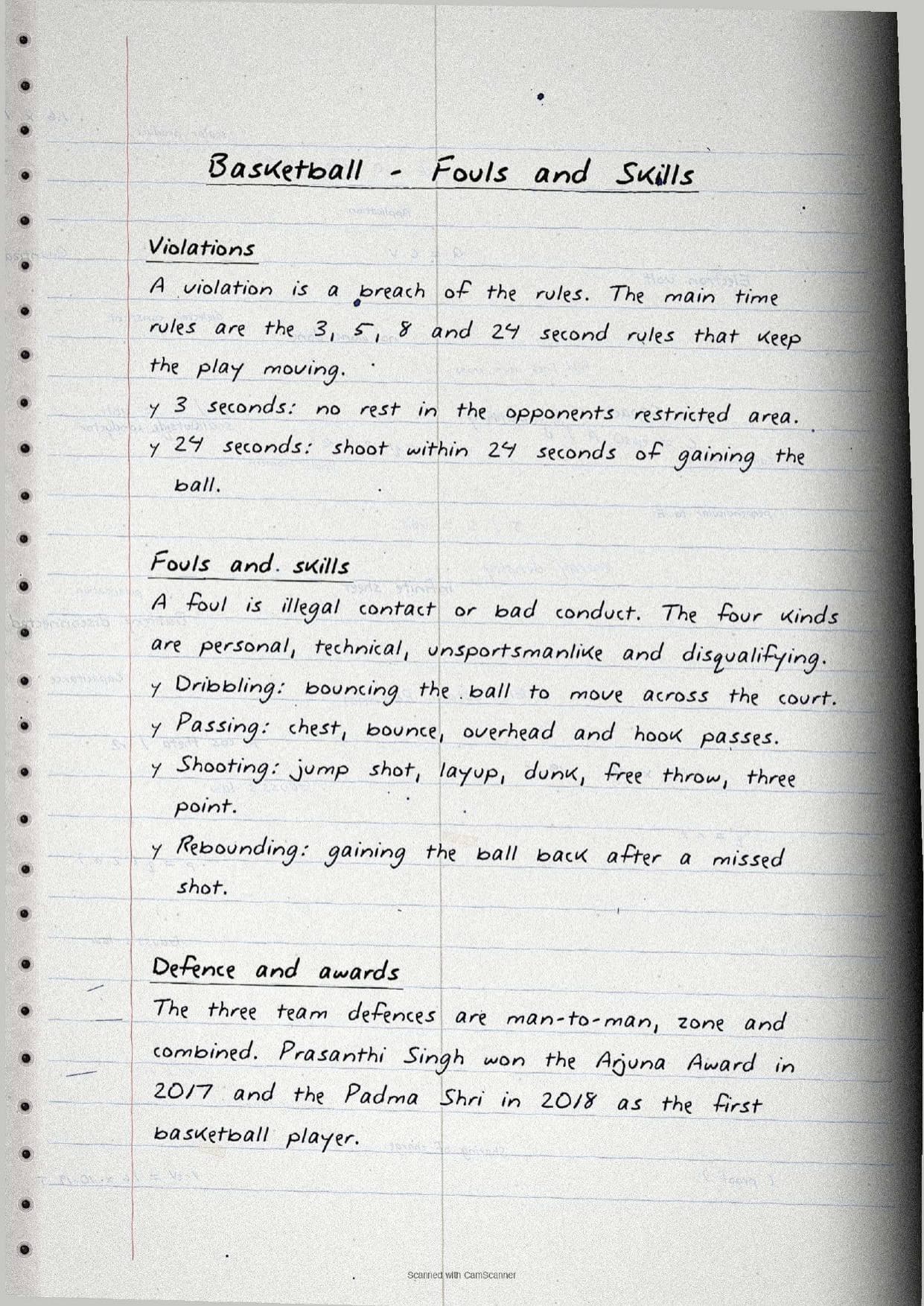
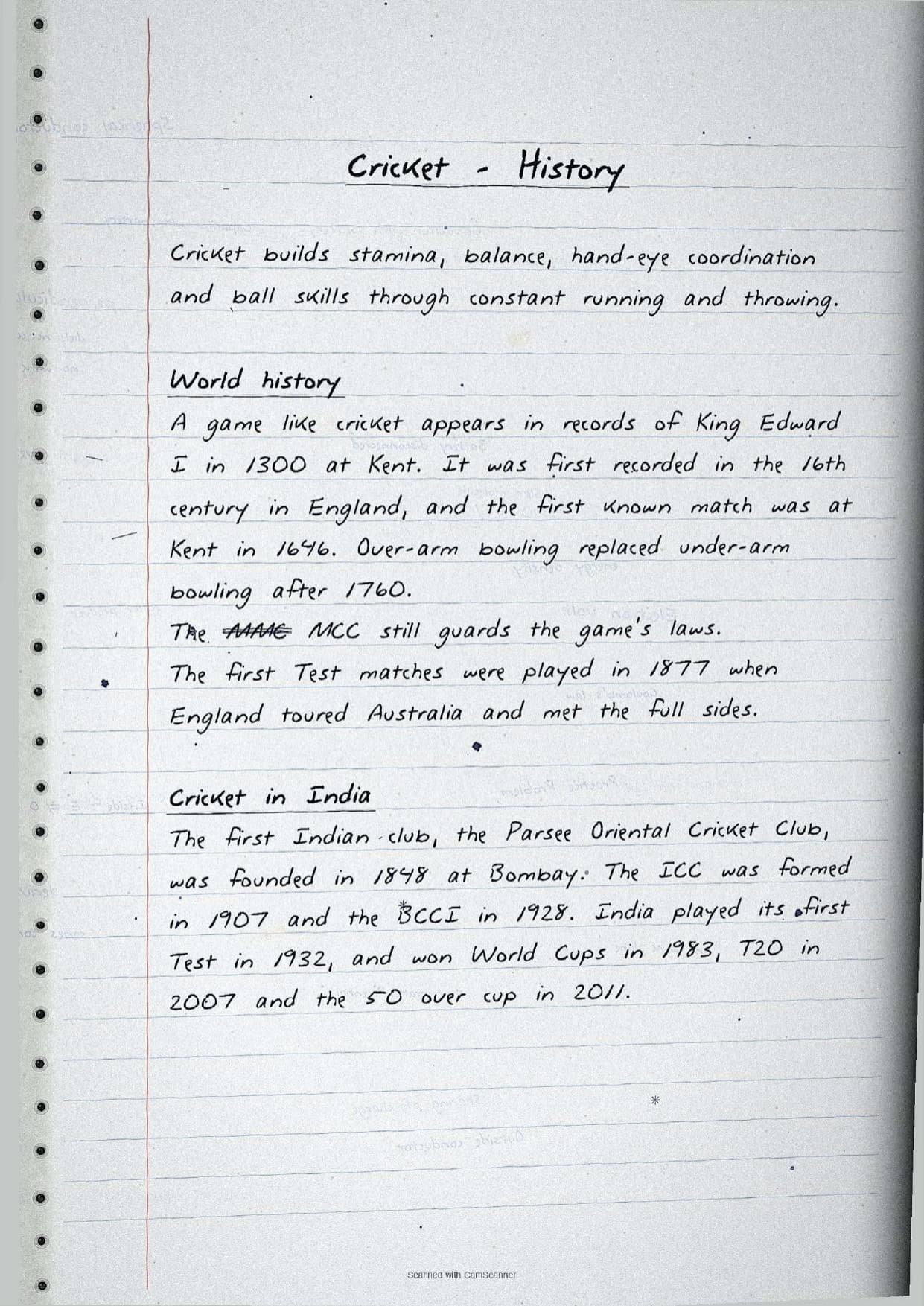
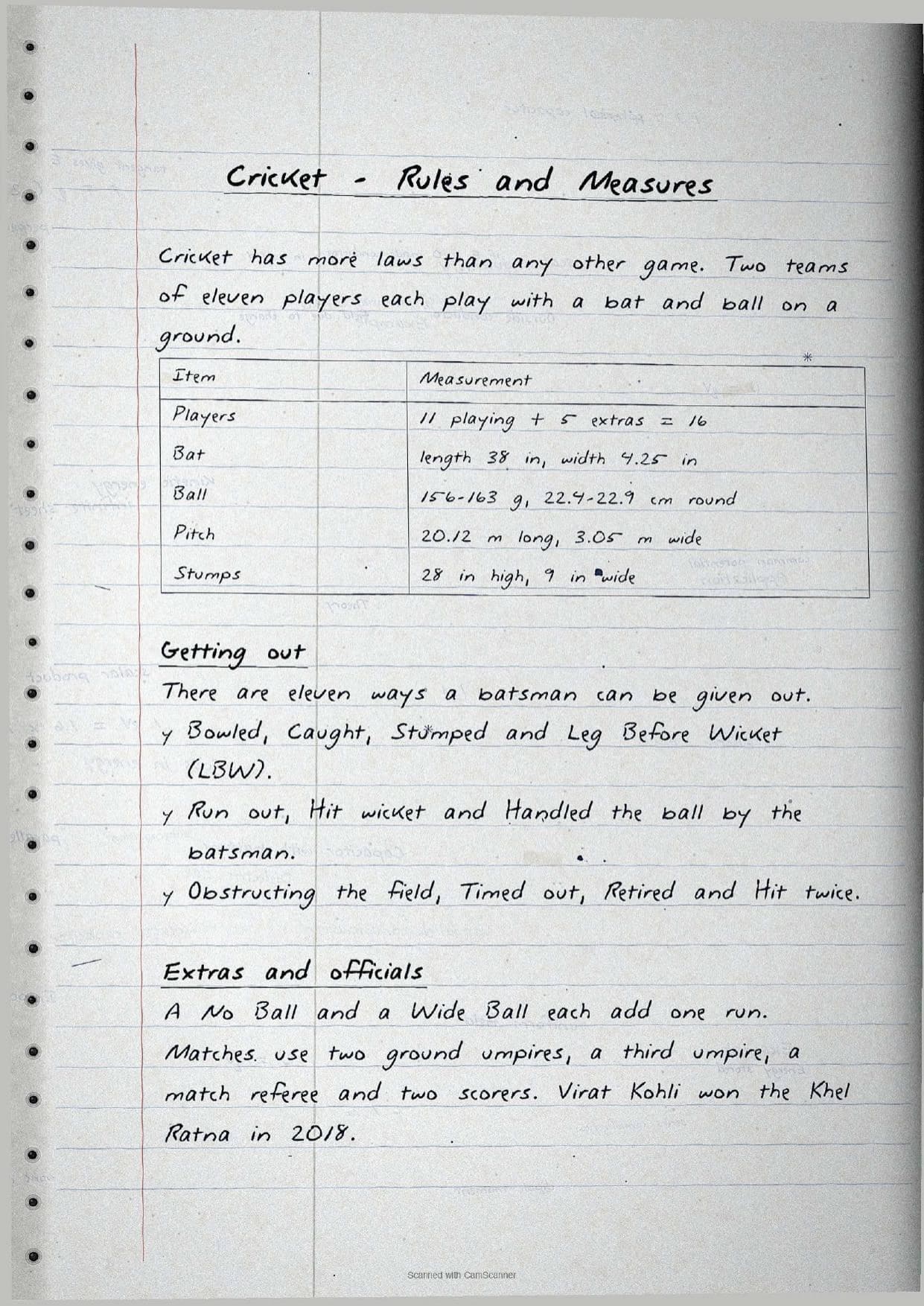
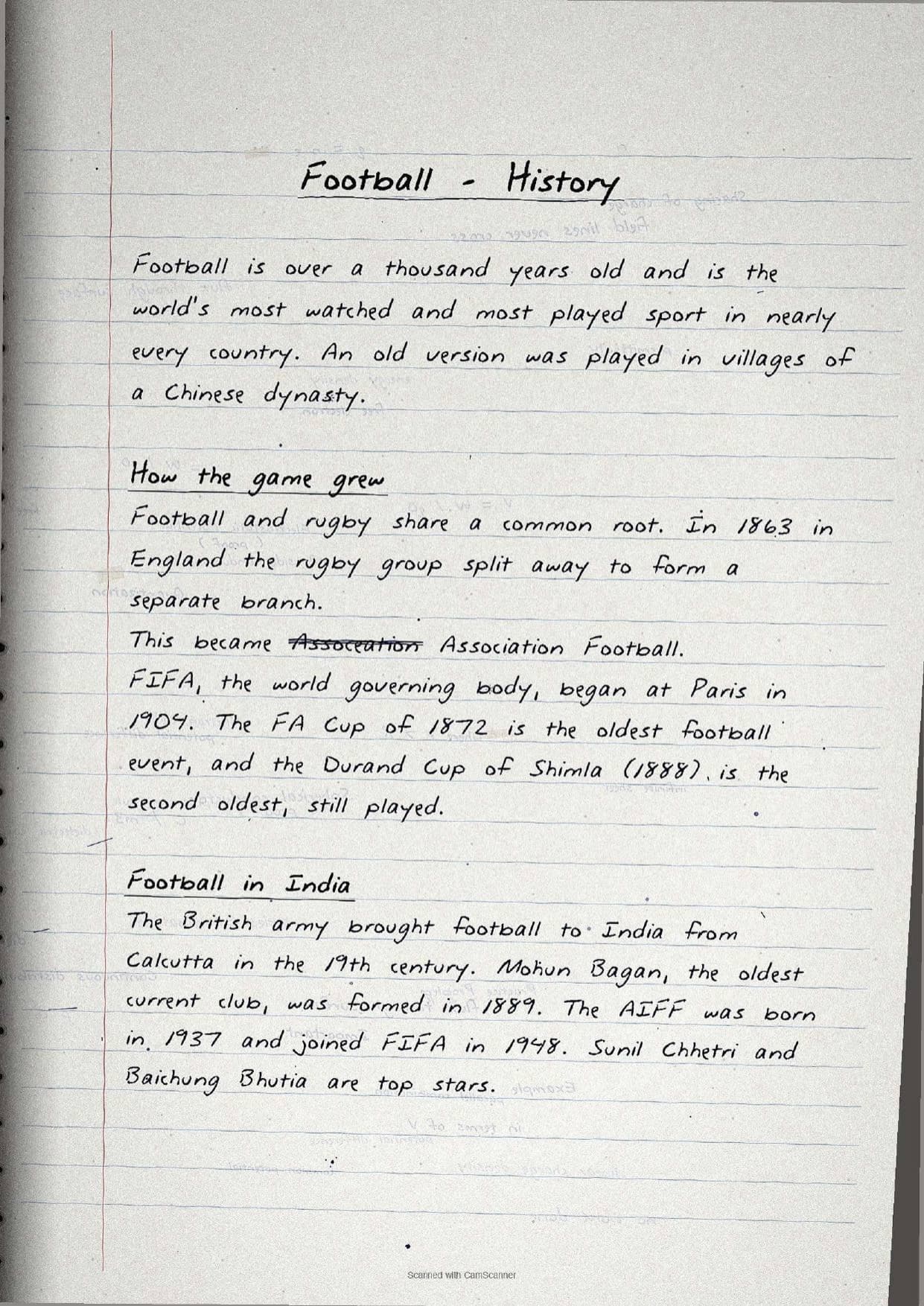
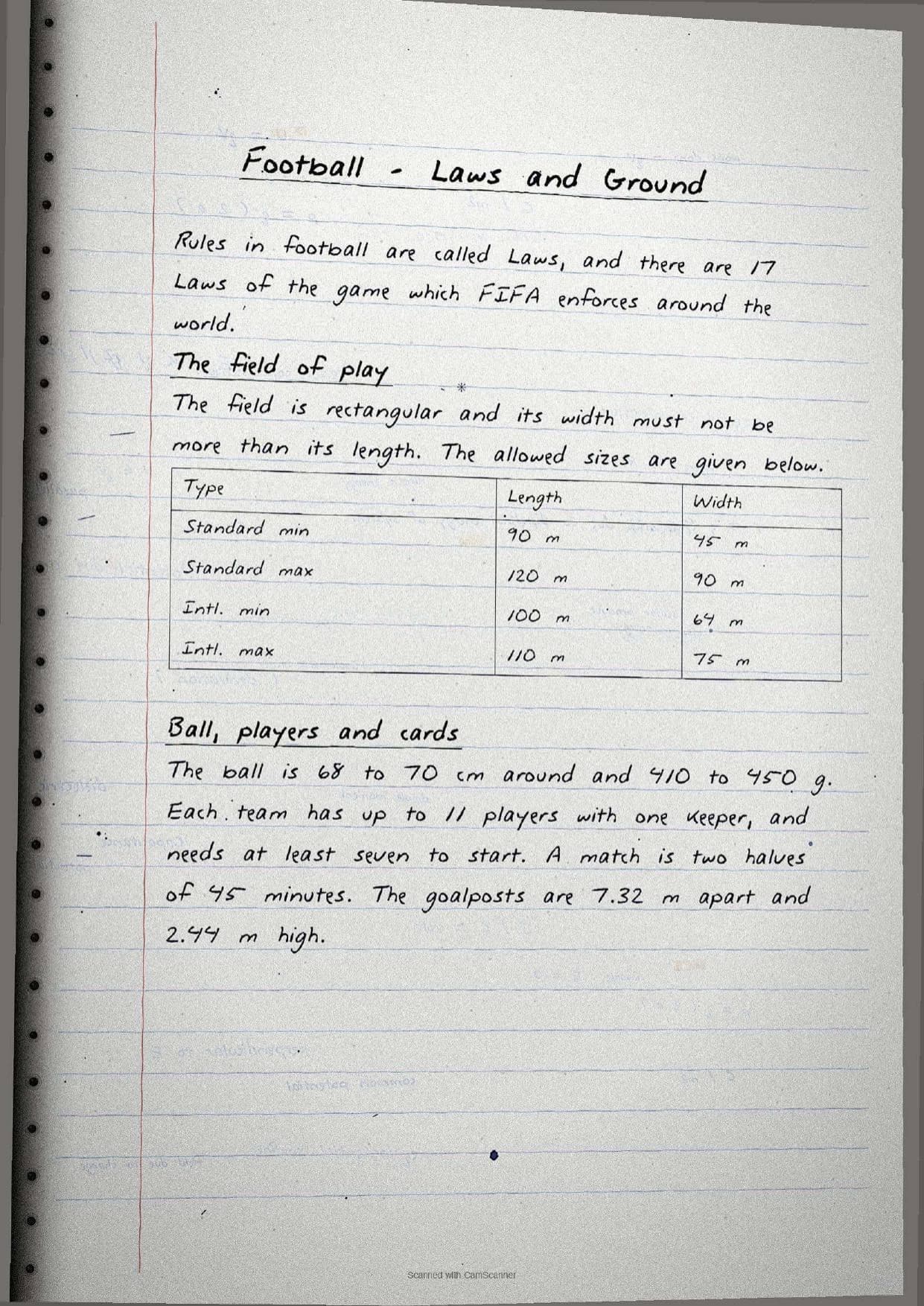
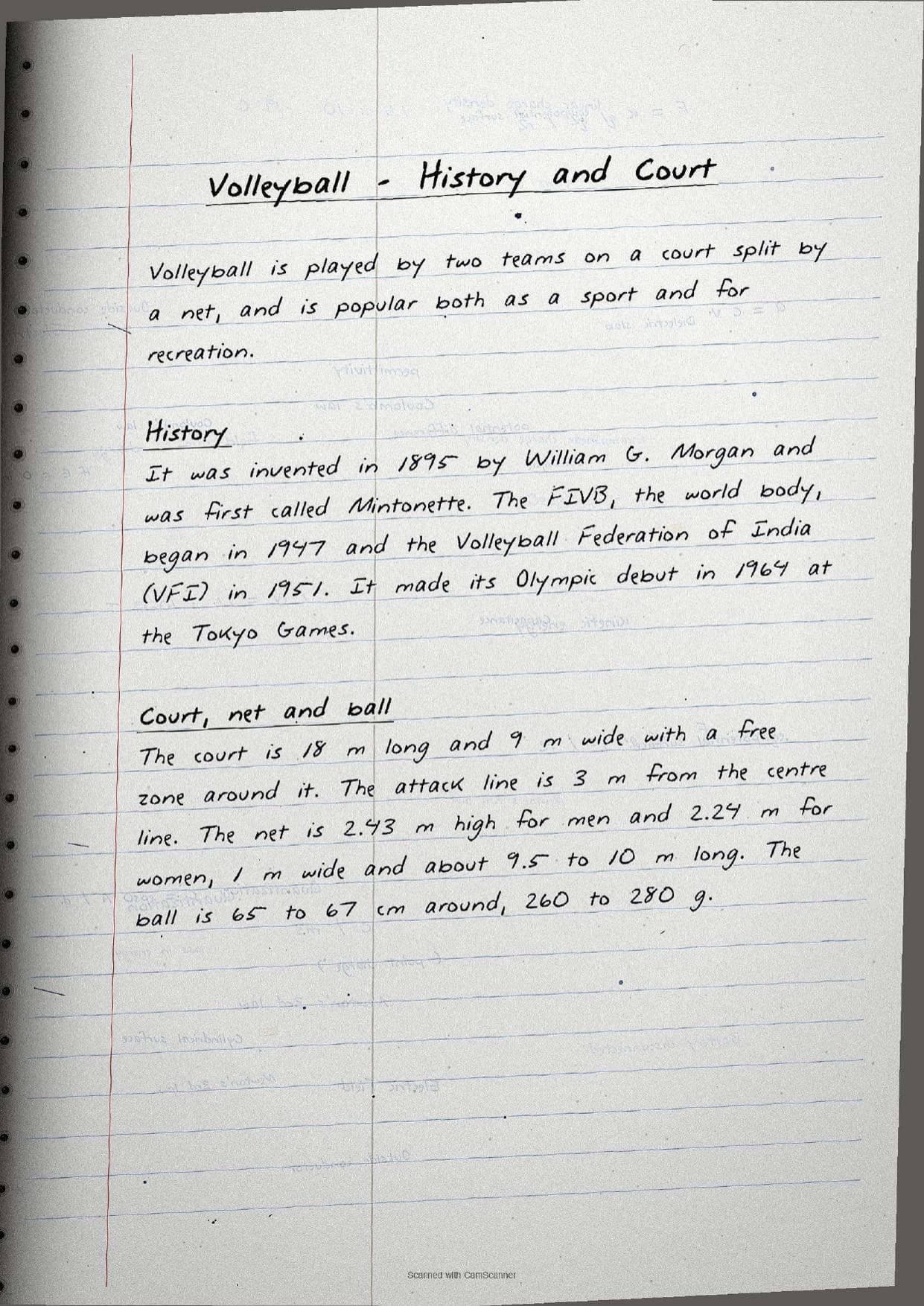
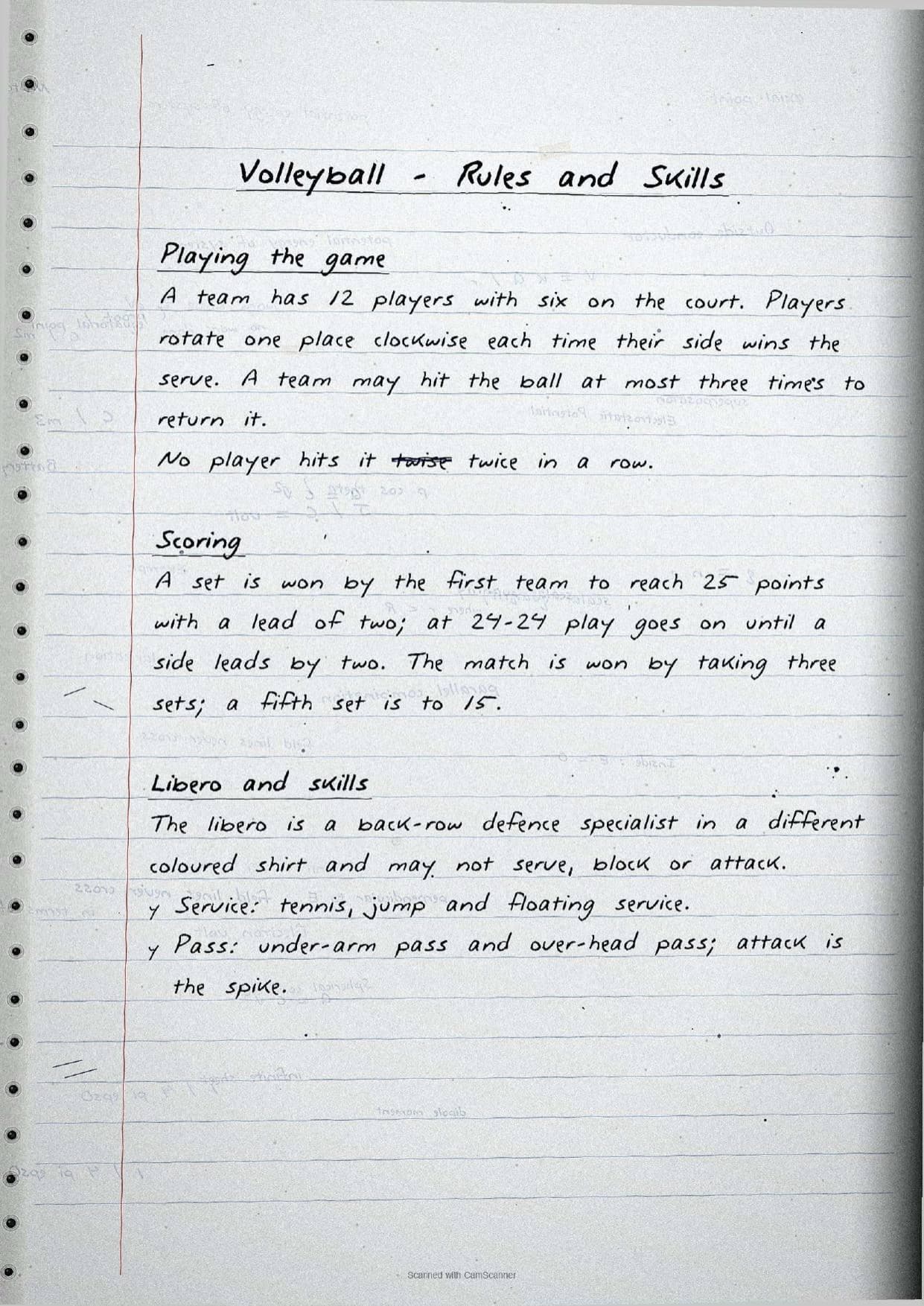
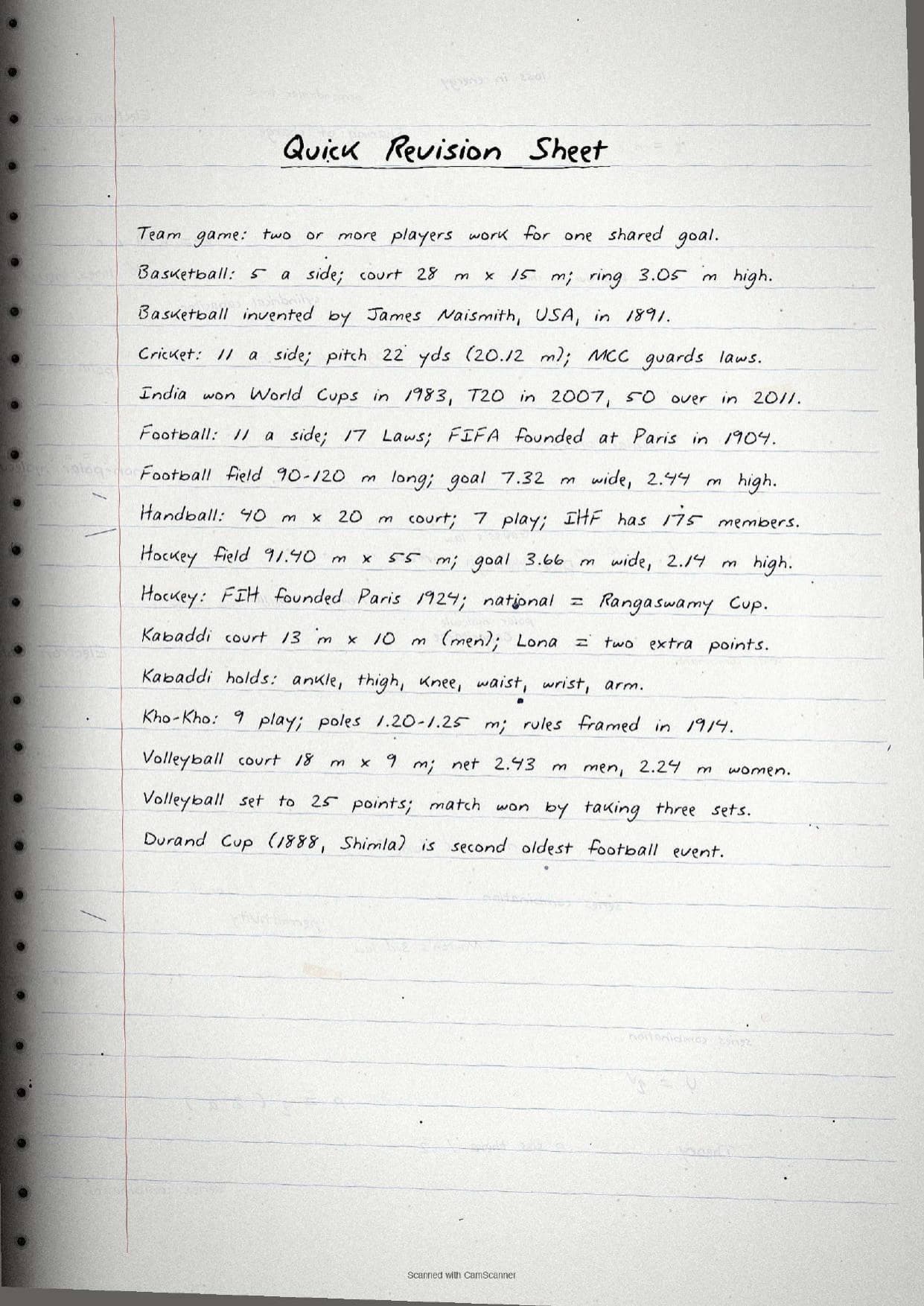
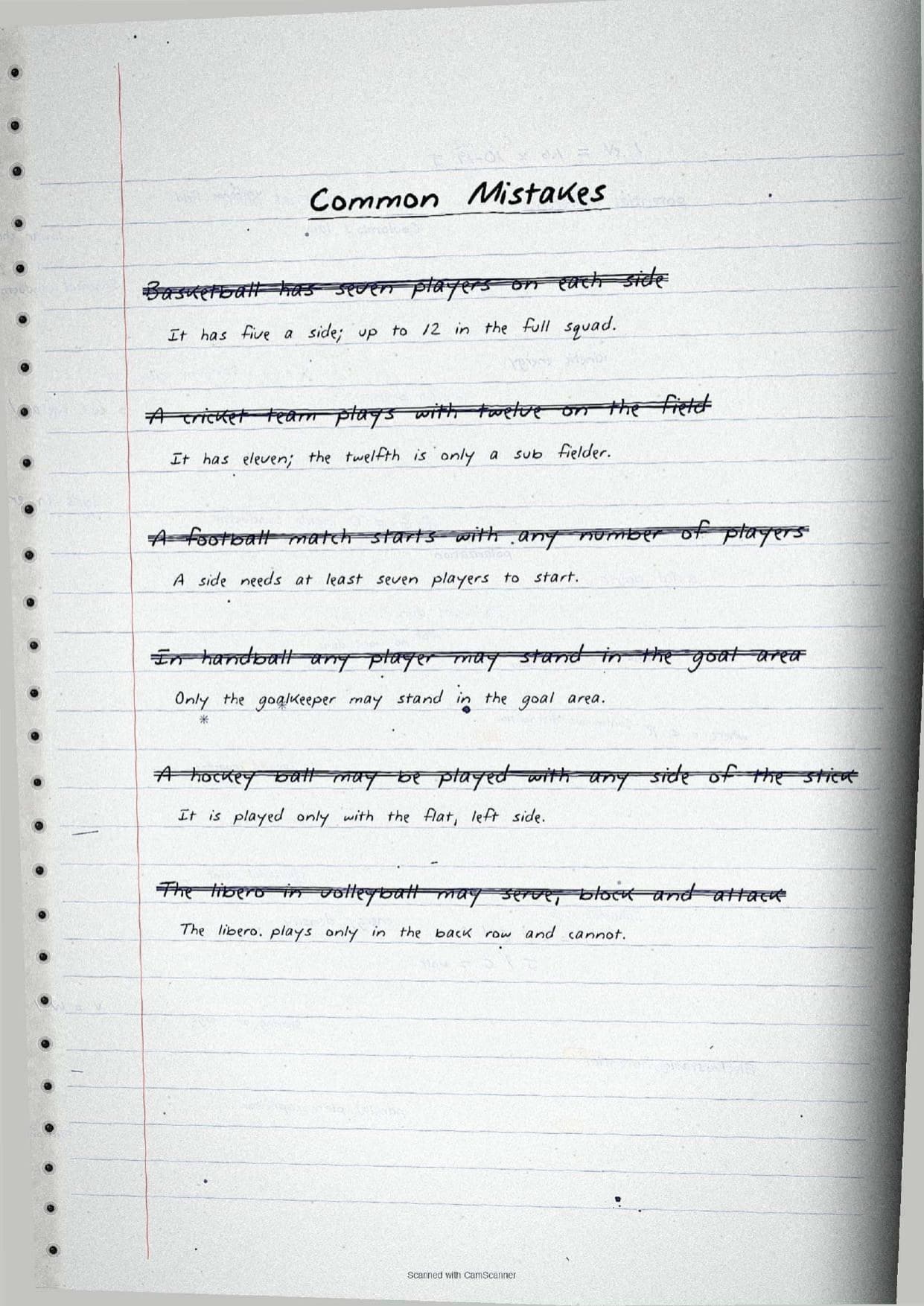
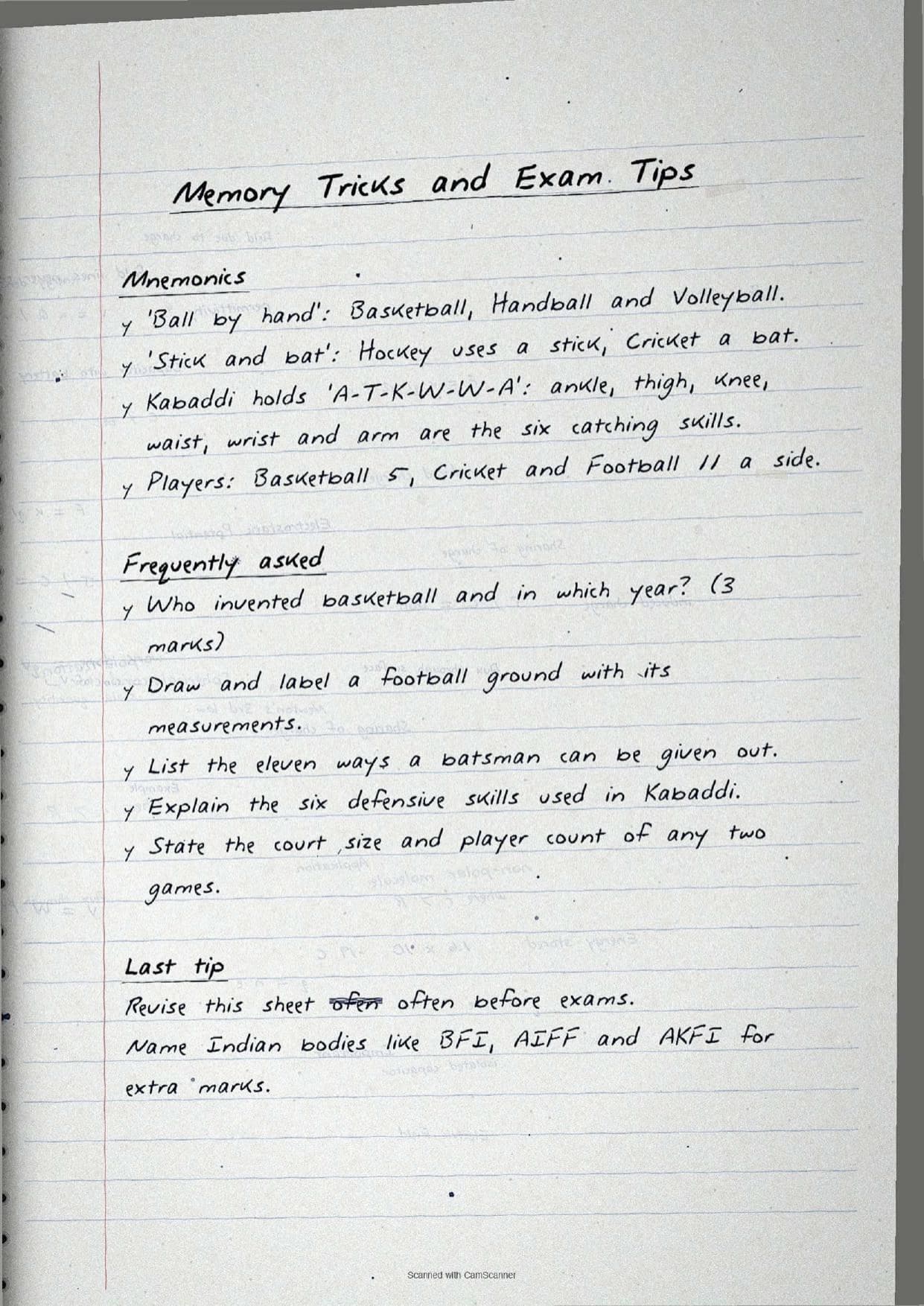
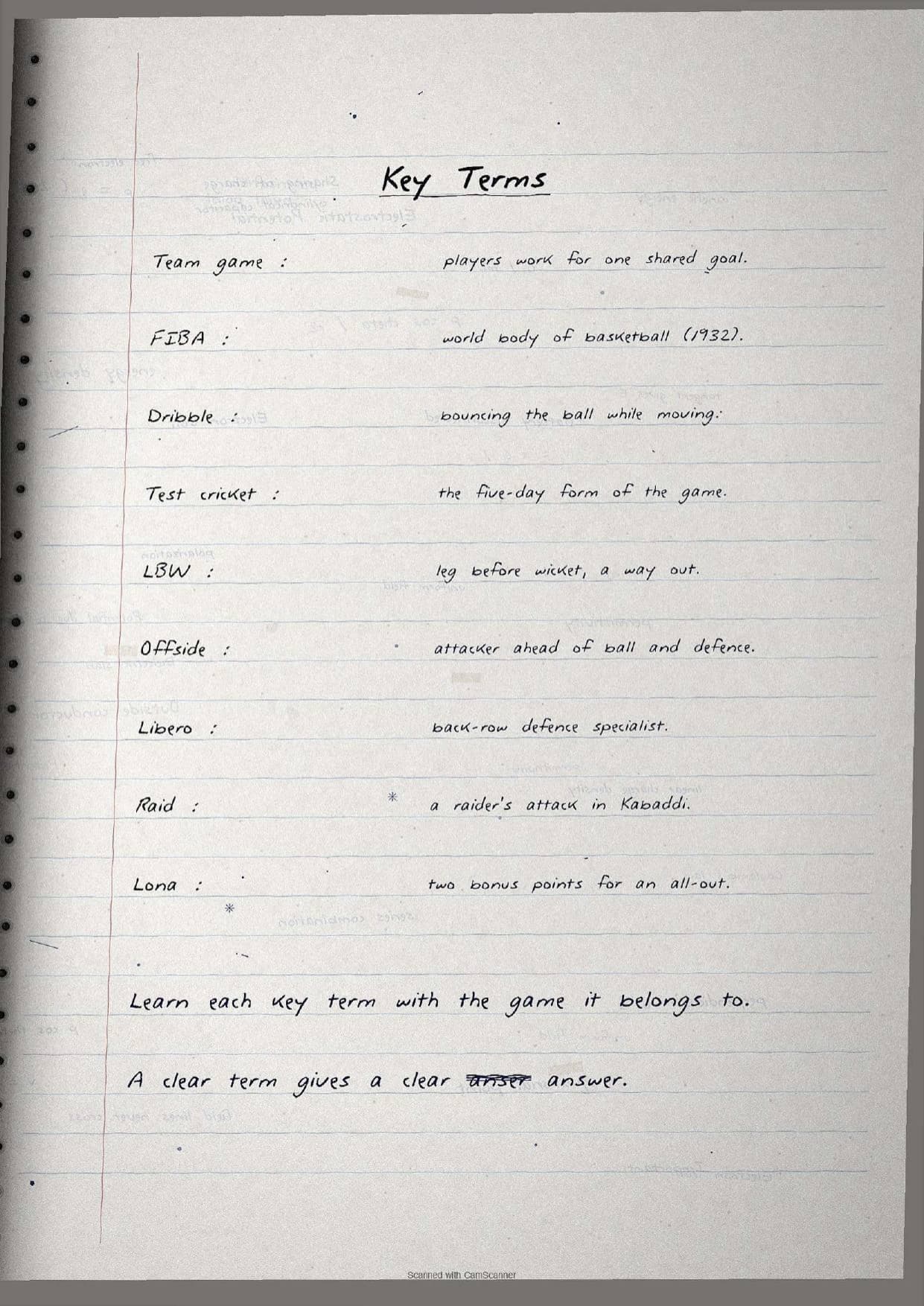
- Handwritten pages with boxed measurements, labelled court diagrams and skill lists for all eight games.
- Team Games is one of the highest-scoring chapters in the Class 11 Physical Education paper because it is full of exact figures.
- Pairs with the Notes and Book PDF for the same chapter, linked lower on this page.
These Team Games handwritten notes are prepared from the official NCERT Health and Physical Education textbook and checked against recent CBSE Class 11 Physical Education question papers.
Student Feedback: In a Collegedunia poll of 5,280 Class 11 Physical Education students before their final exam, 74% of students said the handwritten court diagrams helped them lock in the ground sizes and player numbers faster than printed text, because the boxed figures and labelled arrows made each game easy to tell apart.
Source: 2026-27 Class 11 Physical Education student poll. Sample of 5,280 students from CBSE schools across 11 states.
What These Team Games Handwritten Notes Contain
Team Games is Chapter 5 of Class 11 Physical Education. The NCERT book explains a team game as an activity where two or more players work together toward a shared objective under a set of rules to beat the opposing team. These handwritten notes condense the eight games in the chapter into pages that read like a topper's own notebook.
Each game is written on its own set of pages under the same four headings, so nothing gets mixed up:
- History: who invented the game, when its world body and Indian federation were formed.
- Ground or court: the exact length, width and equipment sizes, drawn as a labelled diagram.
- Players and rules: the number of players, playing time and the main functional rules.
- Skills and key terms: the basic skills and the words the paper likes to ask about.
Because the pages are handwritten, the numbers sit in boxes and tables rather than long paragraphs. A student can flip through the Team Games Class 11 pages in a few minutes and still recall the court sizes, player counts and governing bodies before walking into the exam.
Grounds, Courts and Player Numbers at a Glance
The exam loves one-mark and two-mark questions on exact sizes and player numbers, so the handwritten notes gather them into one master table drawn on a single page. The table below is the same one, built straight from the NCERT figures for each game.
| Game | Ground / Court | Players on field | Key equipment size |
|---|---|---|---|
| Basketball | 28 m × 15 m court | 5 (squad of 12) | Ring 3.05 m high; ball 749–780 mm, 567–650 g (men) |
| Cricket | Pitch 20.12 m × 3.05 m | 11 (+ 5 extras = 16) | Bat 965 mm; ball 155.9–163 g; stumps 28 in high |
| Football | 90–120 m × 45–90 m | 11 (incl. goalkeeper) | Ball 68–70 cm, 410–450 g |
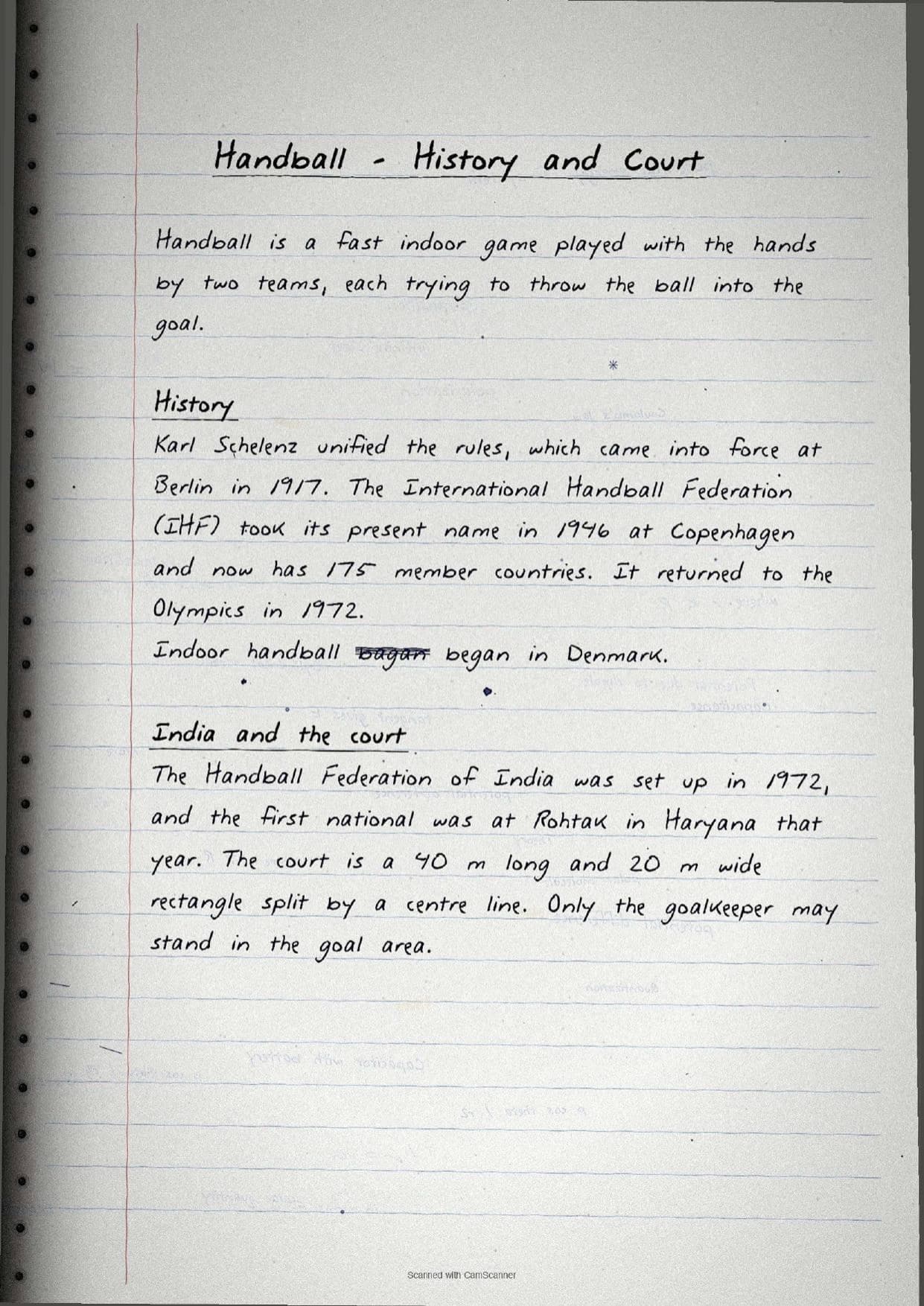
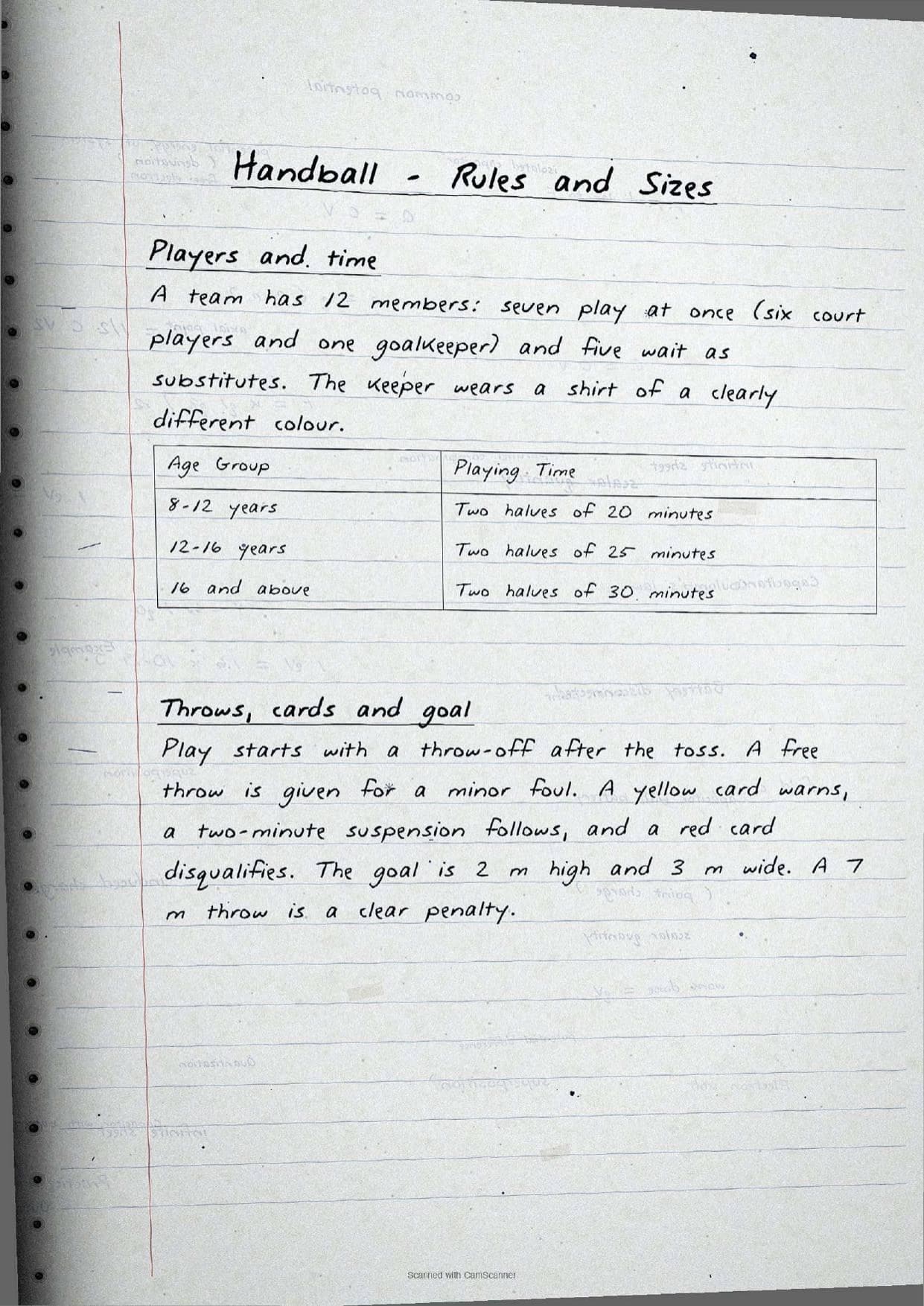
| Handball | 40 m × 20 m court | 7 (6 court + 1 GK) | Goal 2 m × 3 m; ball 58–60 cm, 425–475 g (men) |
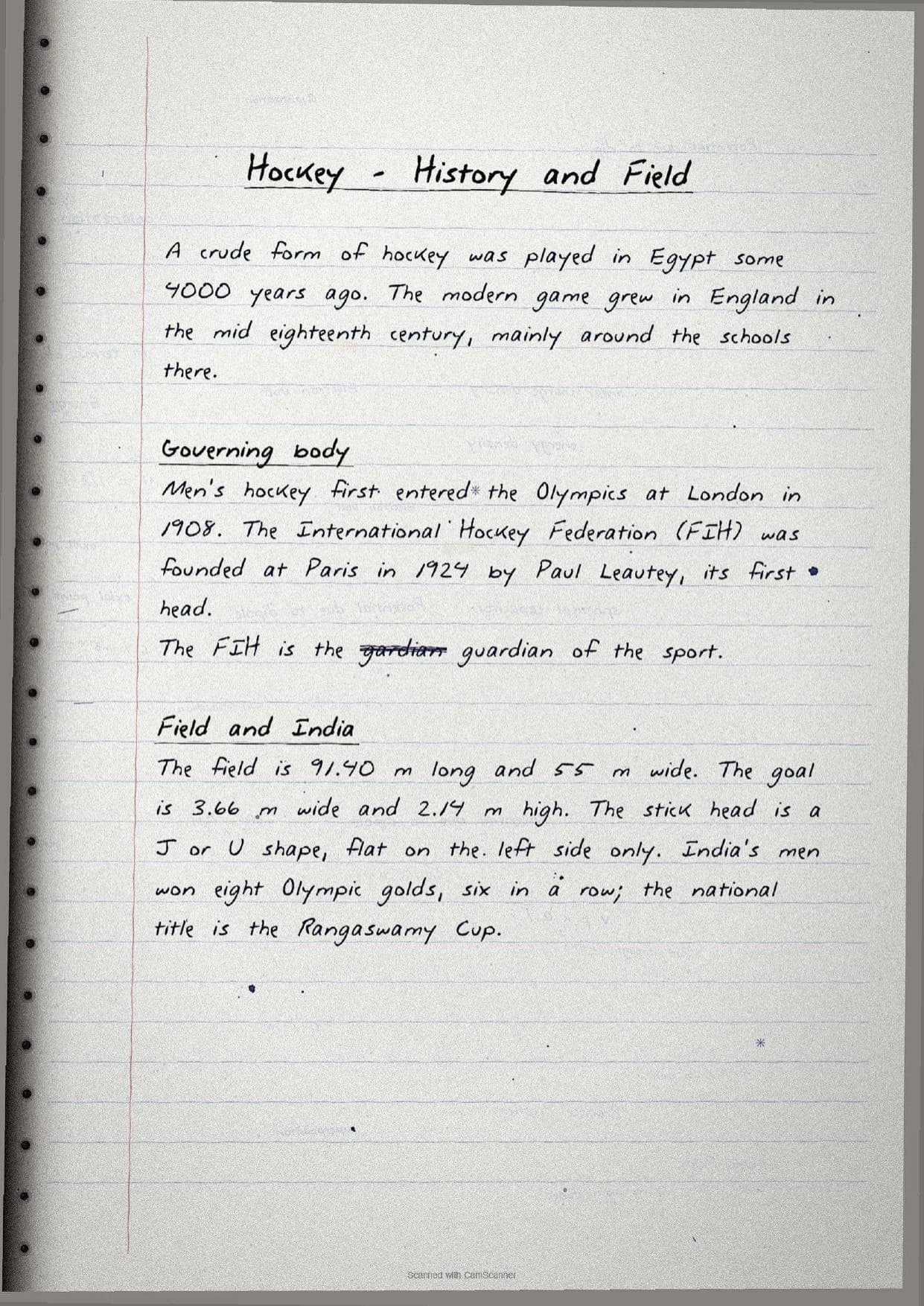
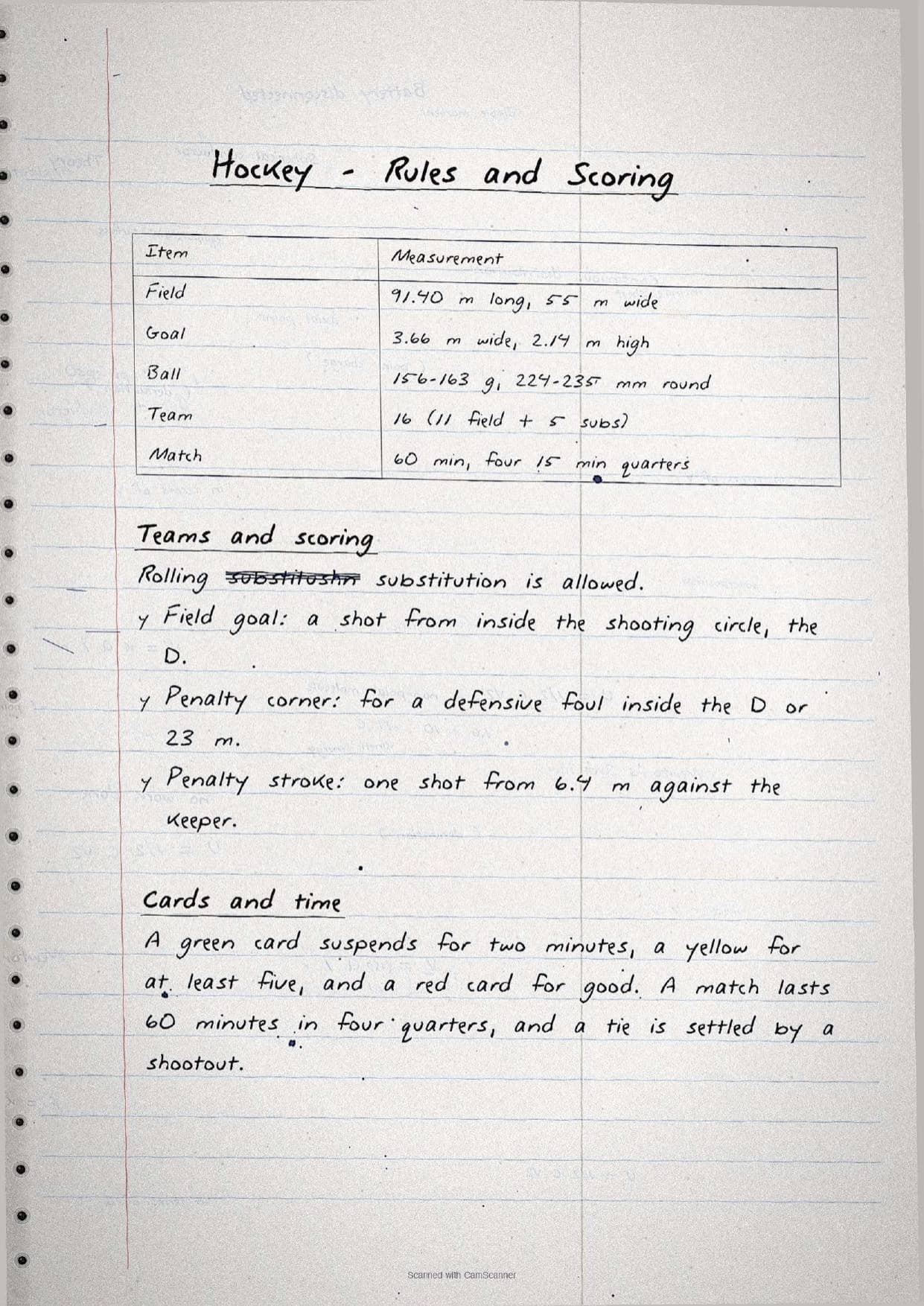
| Hockey | 91.40 m × 55 m | 11 (10 + 1 GK) | Goal 3.66 m × 2.14 m; ball 156–163 g |
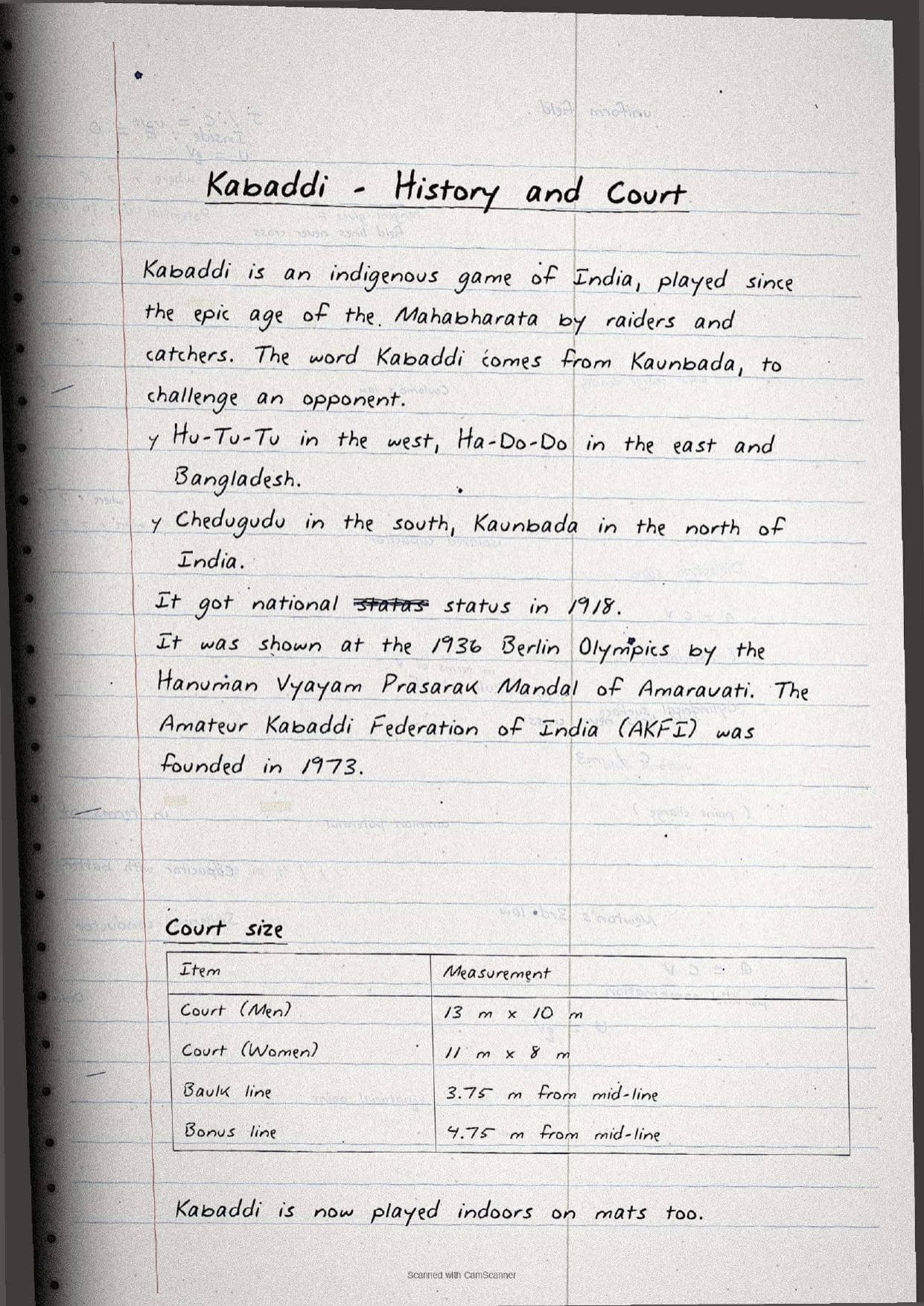
| Kabaddi | 13 m × 10 m (men) | 7 (squad of 10–12) | Baulk line 3.75 m, bonus line 4.75 m from mid-line |
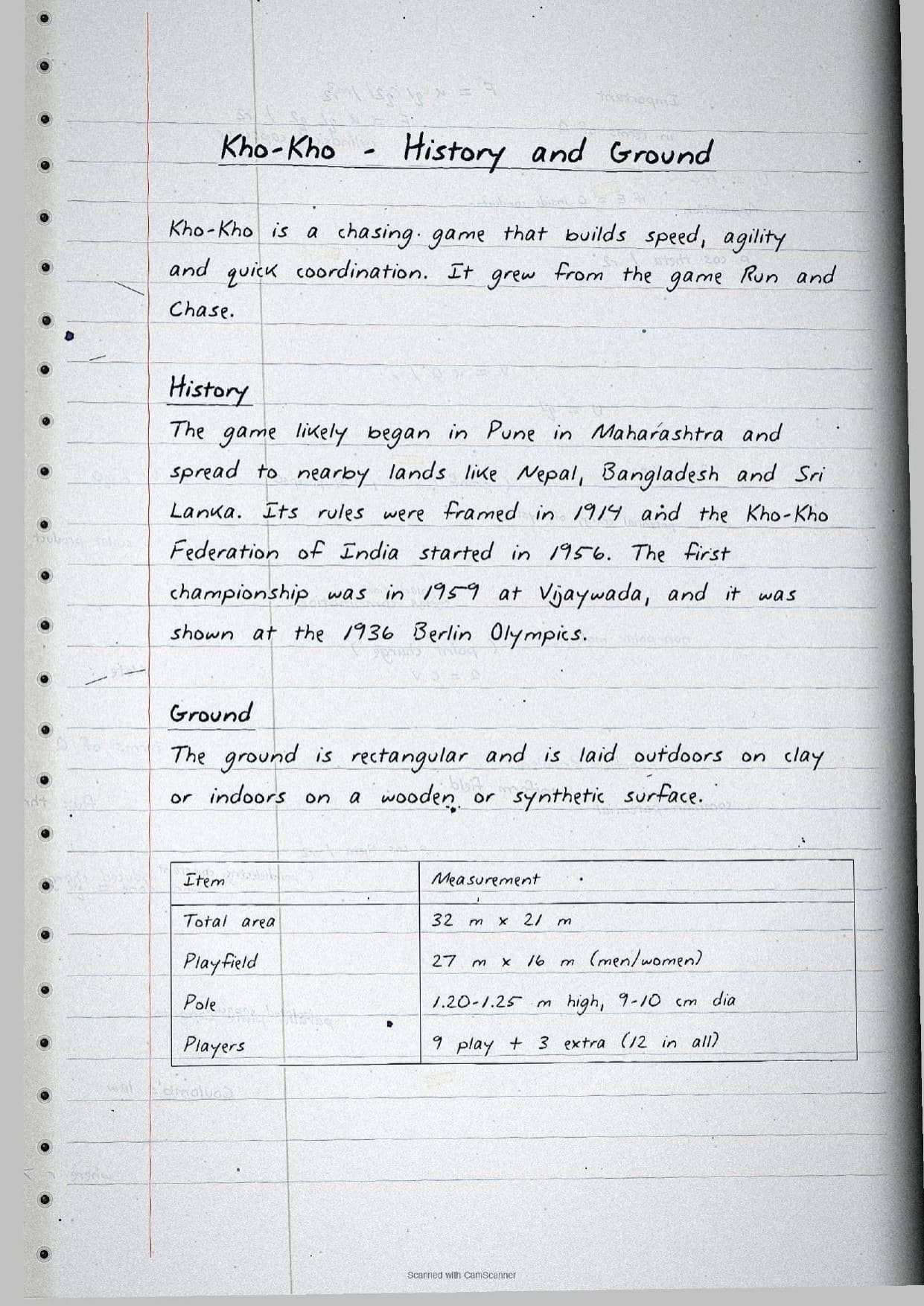
| Kho-Kho | 27 m × 16 m playfield | 9 (+ 3 extra) | Pole 1.20–1.25 m high, 9–10 cm diameter |
| Volleyball | 18 m × 9 m court | 6 (squad of 12) | Net 2.43 m (men) / 2.24 m (women); ball 65–67 cm, 260–280 g |
Seeing all eight games in one grid is the fastest way to avoid mixing them up. A student who can reproduce this table has already secured most of the direct-figure marks the Team Games chapter offers.
History, Skills and Rules of Each Team Game
The bulk of the handwritten notes explain each game in its own block. The pages keep the history dates, the governing bodies and the basic skills as short boxed points, because these are the parts that turn into short-answer and long-answer questions.
- Basketball: invented by Dr. James Naismith in December 1891 at Springfield, USA; world body FIBA (1932), Indian body BFI (1950). Skills to remember are stance, dribbling, passing-receiving, shooting and rebounding, and the game runs 4 quarters of 10 minutes.
- Cricket: first recorded in 16th-century England; the MCC (1787) is the custodian of the laws, the ICC was formed in 1907 and the BCCI in 1928. The notes box the 11 ways a batsman can be given out, from bowled and caught to LBW and run out.
- Football: governed by FIFA (1904) and played under 17 Laws across two 45-minute halves. Key terms drawn on the page are offside, direct and indirect free kick, penalty kick, and the yellow and red cards.
- Handball: rules unified by Karl Schelenz (1917); the world body IHF took its name in 1946 and the Handball Federation of India was set up in 1972. The 6-metre goal-area line, the 9-metre free-throw line and the 7-metre throw are the pinned points.
- Hockey: the modern game grew in England; the world body FIH was founded in Paris in 1924. The notes stress that the ball is played only with the flat left side of the stick, and that a team of 16 fields 11 players.
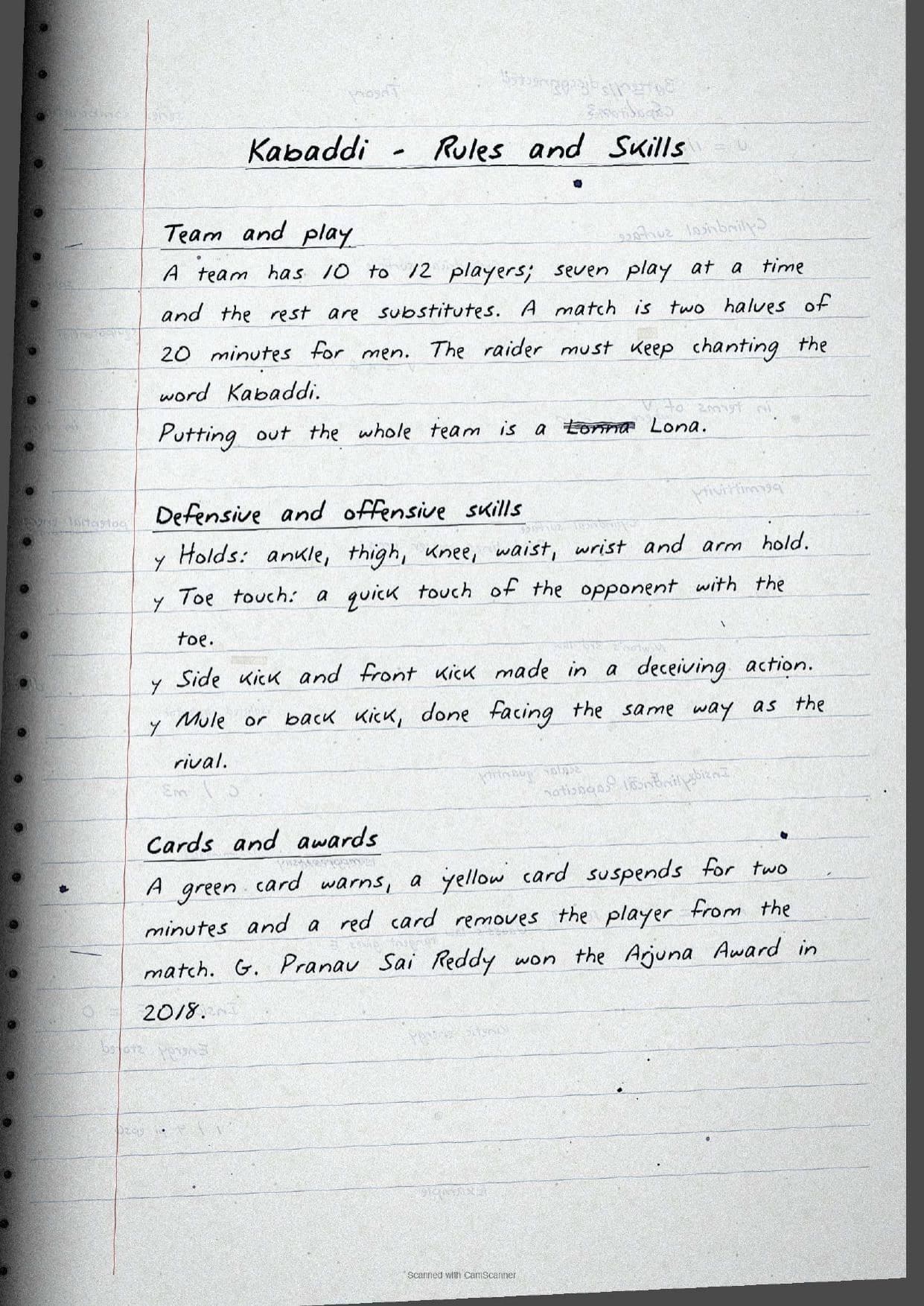
- Kabaddi: an indigenous Indian game that gained national status in 1918; the AKFI was founded in 1973. Boxed points cover the raider chanting "Kabaddi", the baulk and bonus lines, and two halves of 20 minutes.
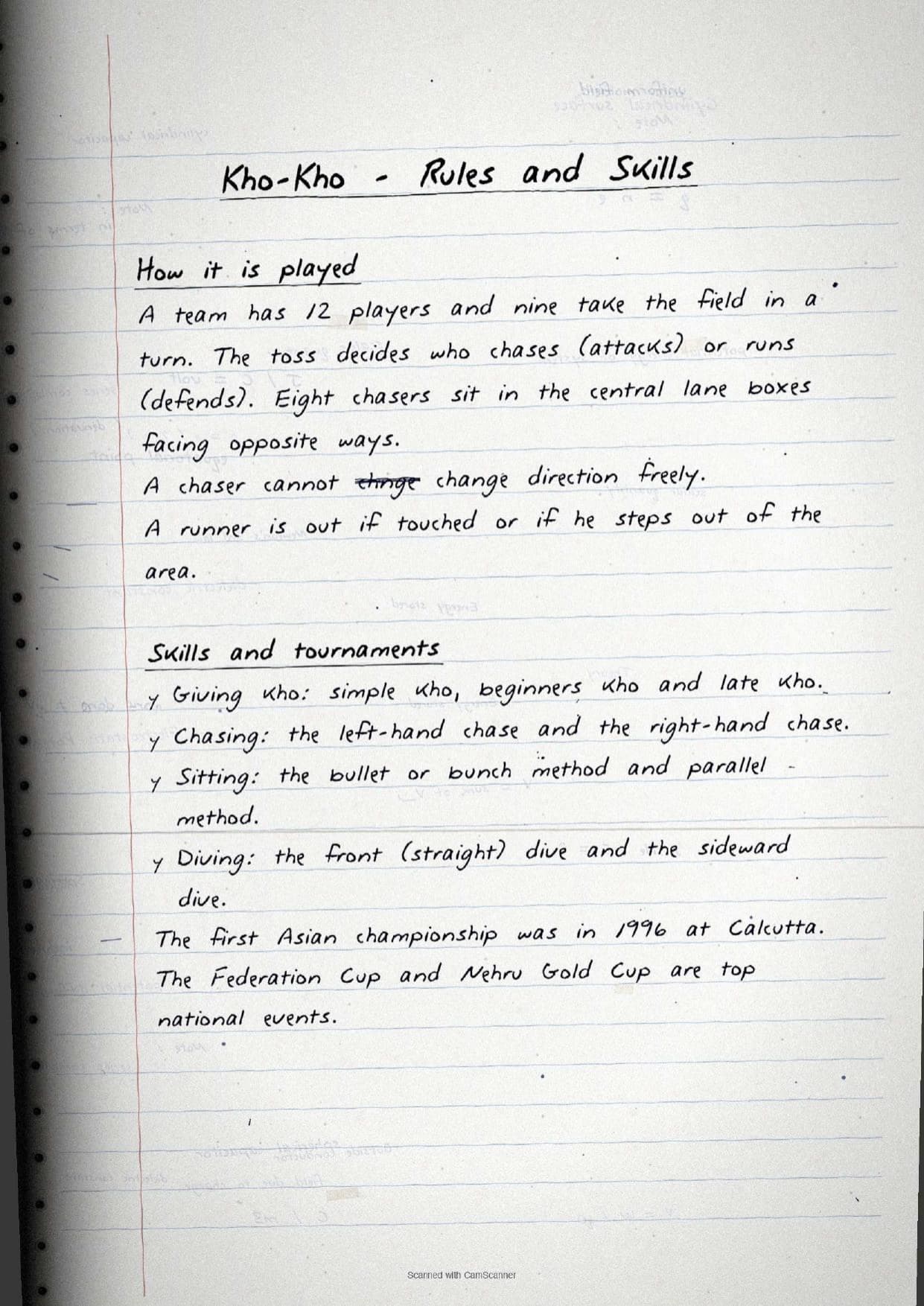
- Kho-Kho: originated in Pune, Maharashtra, with rules framed in 1914; the Kho-Kho Federation of India was formed in 1956. The pages note 9 playing members, the chasing "Kho" and the pole-to-pole running.
- Volleyball: invented as "Mintonette" by William G. Morgan in 1895; world body FIVB (1947), Indian body VFI (1951), Olympic debut in 1964. The rotation of six players and the net heights are the exam favourites.
Grouping each game under the same four headings means students can compare them quickly. That habit helps the most in long-answer questions that ask you to describe the history, rules and skills of any one game in full.
How to Use These Handwritten Notes
Handwritten notes work best as a final-revision tool, not a first read. The steps below show how to get the most out of the Team Games handwritten notes in the last days before a test.
- Download: tap the download card above to save the handwritten pages to your device.
- First read: read the printed Notes once so these pages act as a refresher, not your first source.
- Recall drill: cover the master table and try to write each game's court size and player count from memory.
- Night before: flip through the boxed history dates and governing bodies for a quick last-minute recall.
Many students search for Team Games Class 11 notes on their phone the night before a test, so a saved set of handwritten pages means they can revise offline. Use the handwritten notes for speed, then check the printed Notes to confirm the exact figures.
Common Mistakes These Notes Help You Avoid
A few errors cost marks every year. The handwritten notes flag each one in the margin so students can fix it before the exam. These five are the most common.
- Swapping court sizes. Basketball is 28 m × 15 m while handball is 40 m × 20 m; do not mix them.
- Wrong player numbers. Volleyball fields 6, handball 7, kho-kho 9, and basketball only 5.
- Mixing up governing bodies. Football is FIFA, hockey is FIH, basketball is FIBA and volleyball is FIVB.
- Forgetting football has 17 Laws and cricket has 11 ways of getting a batsman out.
- Missing that kabaddi and kho-kho are indigenous Indian games, not imported ones.
Students who fix these five points usually move from average to high marks. The handwritten notes box the sizes, player counts and federation names, so the soft points are hard to miss when you revise.
How These Handwritten Notes Pair with the Notes and Book PDF
These handwritten notes are a fast revision tool. To prepare fully, students should use them alongside the other resources for the same chapter, linked in the table below. Read the printed Notes, then use these pages for a final recall of the figures.
| Resource | Best used for |
|---|---|
| Team Games Class 11 Notes | Quick chapter summary with all eight games, sizes and rules in one place |
| Team Games NCERT Book PDF | Reading the original NCERT chapter text, tables and court diagrams |
Tip: read the printed Notes first, then keep these handwritten pages for the final night-before flip. Using them for recall, not for the first read, builds memory faster.
All Class 11 Physical Education Handwritten Notes by Chapter
The table links the handwritten notes for every chapter in Class 11 Physical Education, so students can move across the course in one click. Team Games is highlighted.
| Chapter | Handwritten Notes |
|---|---|
| Chapter 1 | Physical Education |
| Chapter 2 | Understanding Health |
| Chapter 3 | Physical and Physiological Aspects of Physical Education and Sports |
| Chapter 4 | Individual Games |
| Chapter 5 | Team Games |
| Chapter 6 | Yoga and its Relevance in the Modern Times |
| Chapter 7 | Safety and Security |
| Chapter 8 | Health Related Physical Fitness |
| Chapter 9 | Measurement and Evaluation |
| Chapter 10 | Tournaments and Competitions |
| Chapter 11 | Adventure Sports |
FAQs on Team Games Handwritten Notes
Team Games Class 11 Physical Education Handwritten Notes Common Questions
Ques. Where can I download the Team Games handwritten notes PDF?
Ans. You can download the Team Games Class 11 Physical Education handwritten notes PDF directly from this page. It is free, follows the 2026-27 NCERT, and presents the history, court sizes, player numbers, skills and rules of all eight games as handwritten pages.
Ques. Which games are covered in Class 11 Physical Education Chapter 5?
Ans. The chapter explains eight team games: Basketball, Cricket, Football, Handball, Hockey, Kabaddi, Kho-Kho and Volleyball. The handwritten notes cover each game under the same headings of history, ground or court, players, and basic skills.
Ques. Are handwritten notes good for revising Team Games?
Ans. Yes. Handwritten notes are best for fast, last-minute revision because the boxed measurements and labelled court diagrams make the sizes and player numbers easy to skim. Use them after a first read of the printed Notes, not as your only source.
Ques. What are the court sizes I must remember for this chapter?
Ans. The main ones are a basketball court of 28 m by 15 m, a handball court of 40 m by 20 m, a volleyball court of 18 m by 9 m, a hockey field of 91.40 m by 55 m, a cricket pitch of 20.12 m by 3.05 m and a men's kabaddi court of 13 m by 10 m. The notes gather all of these into one table.
Ques. Who prepared these handwritten notes?
Ans. They are written and proofread by hand by a subject expert with an MPEd, NIS coaching certification and ten years of CBSE Class 11 Physical Education teaching, using the official NCERT textbook and recent Class 11 question papers.



Comments