



The Heredity Class 10 Science handwritten notes are scanned, boxed and built for fast last-minute revision, fully matched to the 2026-27 CBSE syllabus. They cover Mendel's experiments, dominant and recessive traits, the monohybrid and dihybrid crosses, the rules of inheritance, and how the sex of a child is decided, all in clear ruled-page form with hand-drawn Punnett squares and labelled crosses.
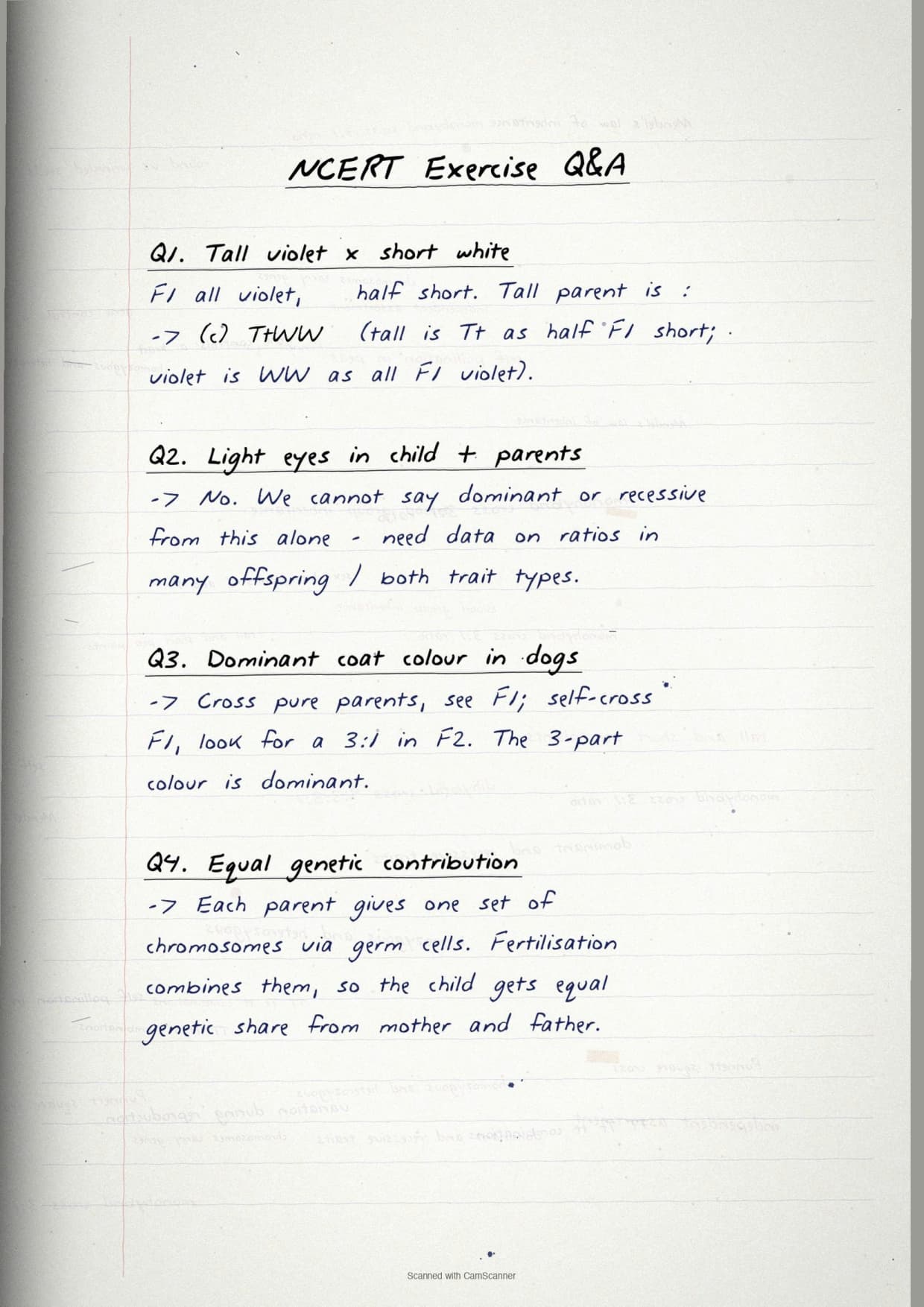
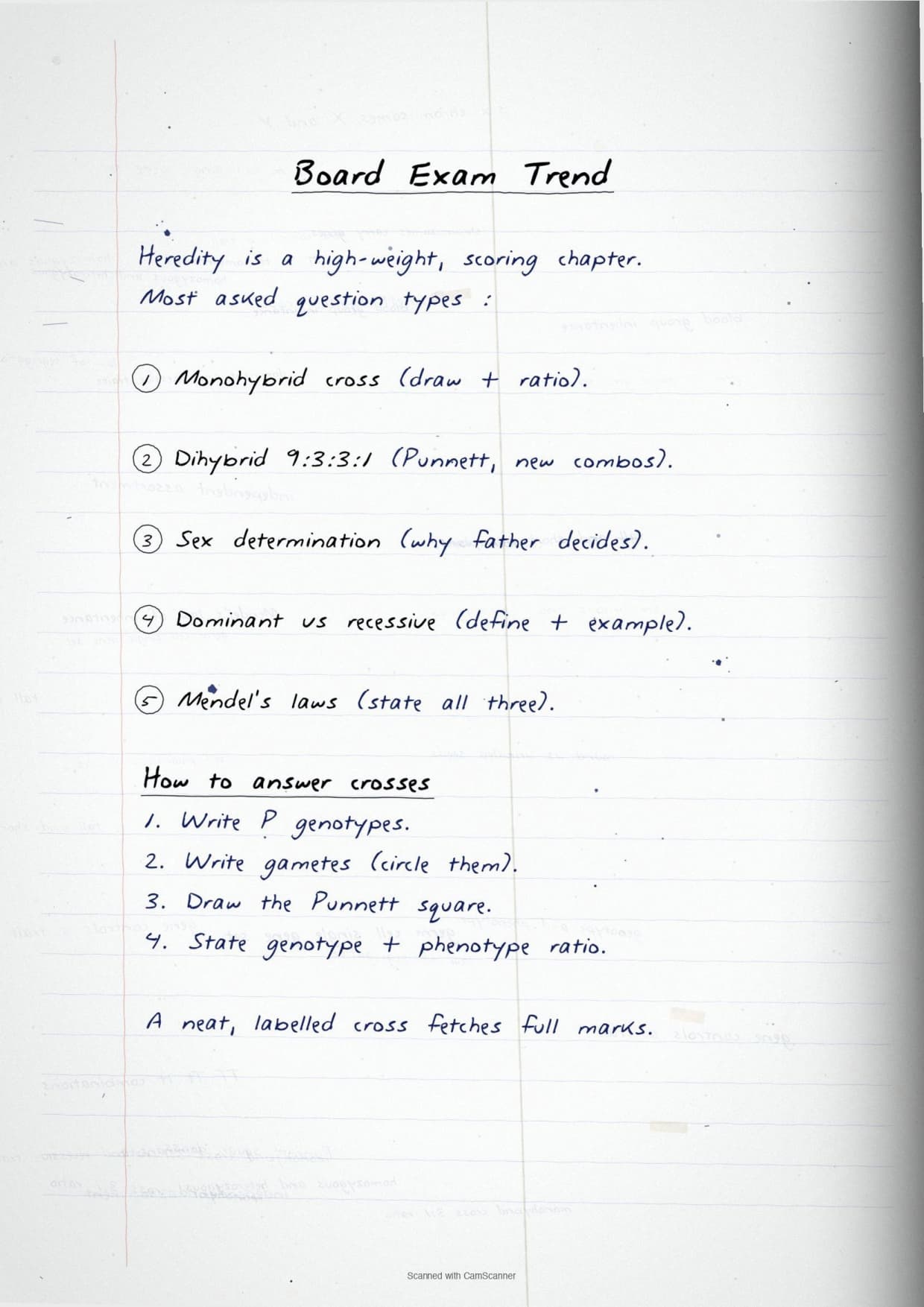
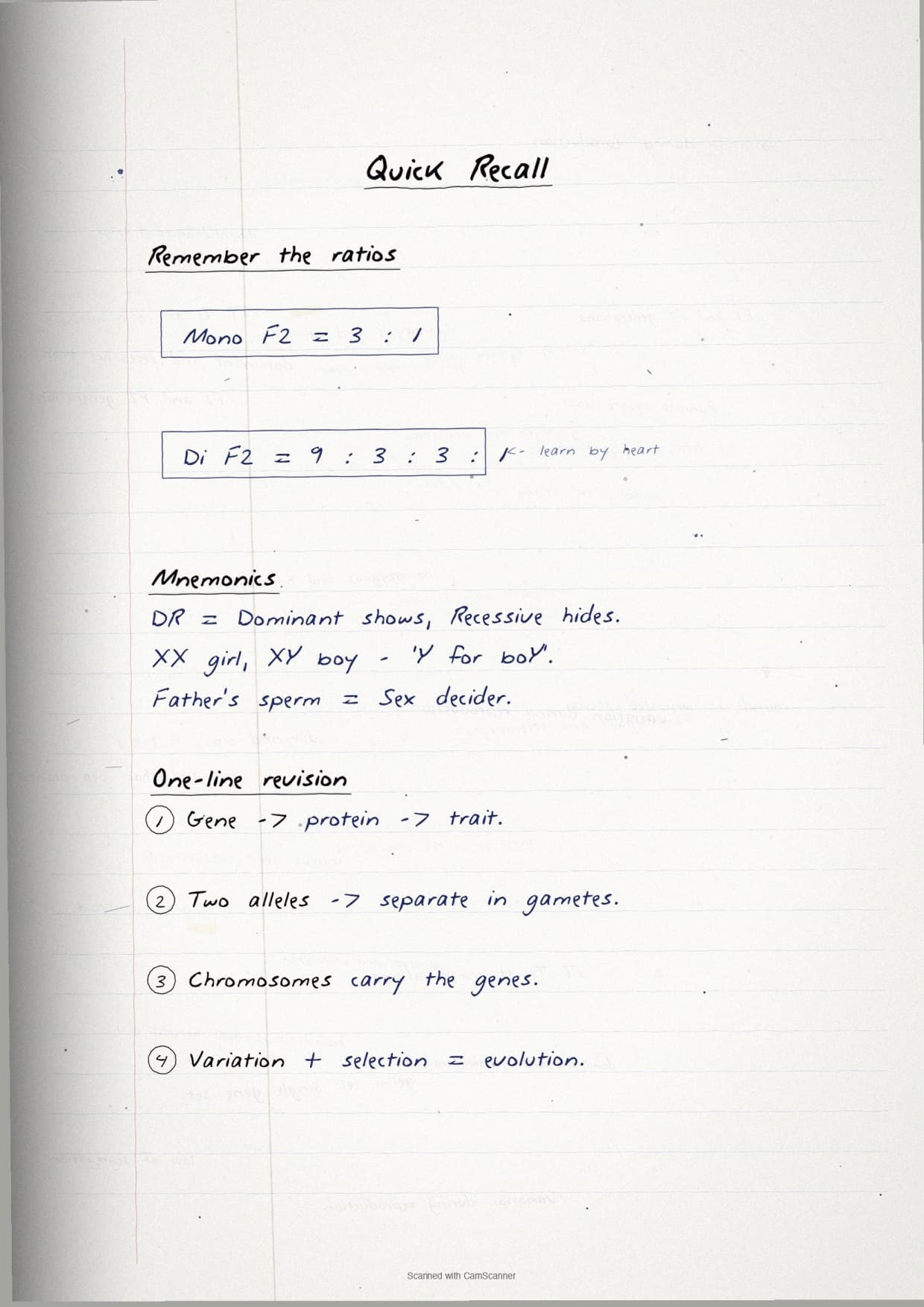
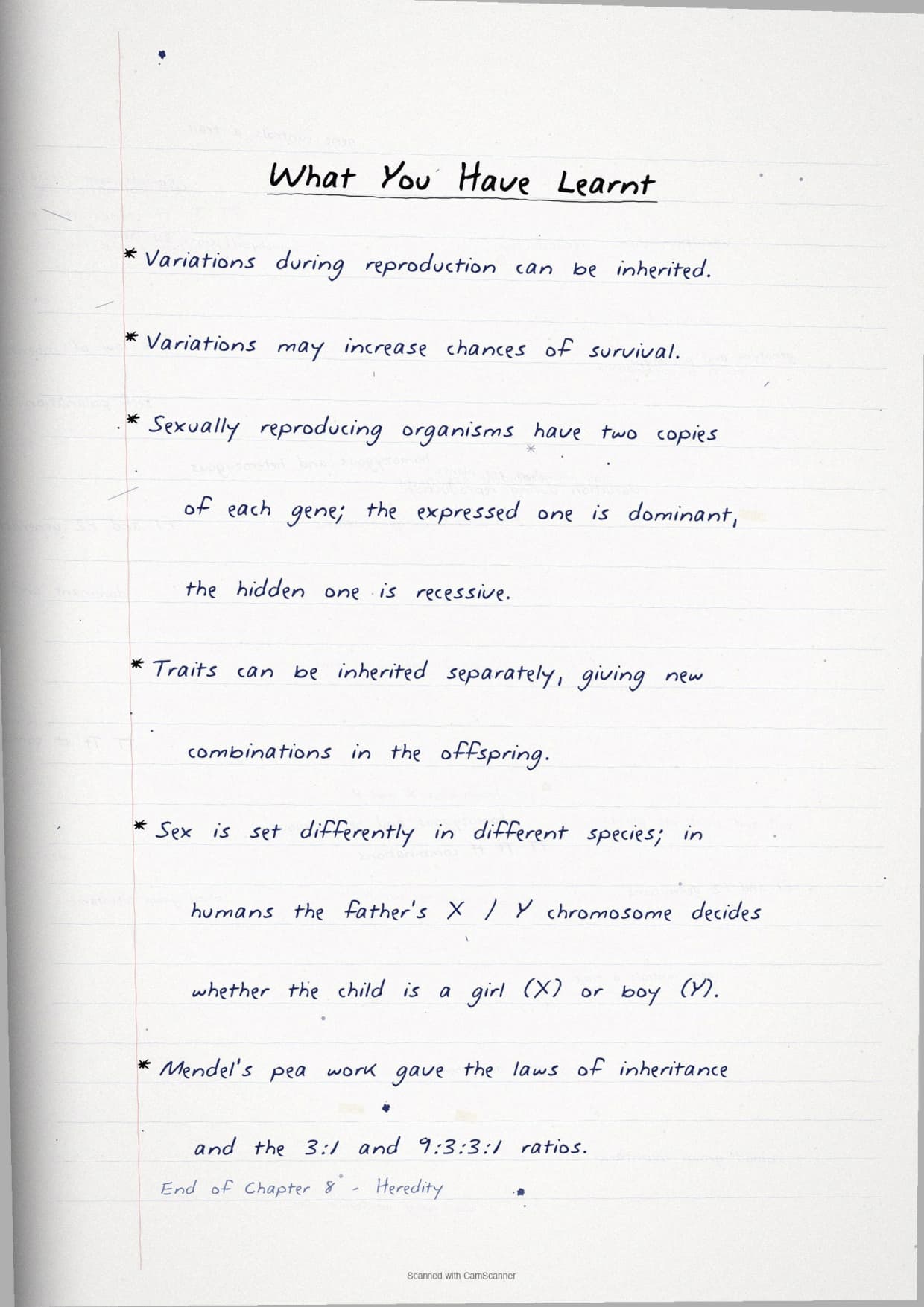
- CBSE Weightage: 4 to 6 marks from the World of the Living unit, often as 3-mark and 5-mark questions on Mendel's crosses, the F1 and F2 ratios and sex determination.
- Boxed definitions and a hand-drawn Punnett square for every cross, ratio and term the board paper asks about.
- Pairs with the NCERT Solutions, Notes and Book PDF linked lower on this page.
These Heredity handwritten notes are prepared from the official NCERT Science textbook and matched to the 2026-27 CBSE syllabus.
Student Feedback: In a Collegedunia poll of 11,600 Class 10 Science students before the 2026 boards, 81% of students said the hand-drawn Punnett squares and the F2 ratio box were the fastest way to revise this chapter. Most students copied the boxed monohybrid and dihybrid crosses straight onto practice answer sheets.
Source: 2026-27 Class 10 Science student poll. Sample of 11,600 students from CBSE schools across 15 states.
Solved by Collegedunia: Every cross and definition in these Heredity handwritten notes is checked by Collegedunia's Class 10 Science team against the latest 2026-27 NCERT textbook, so what you revise matches exactly what the CBSE board paper expects.
What These Heredity Handwritten Notes Include
These Heredity handwritten notes condense the whole chapter into 21 scanned pages of ruled paper, with every cross drawn by hand and every key term underlined. The pages are built around the three big ideas that the CBSE board paper tests:
- Traits and variation: what heredity means, inherited versus acquired traits, and why variation appears.
- Mendel's experiments: monohybrid and dihybrid crosses on pea plants, the F1 and F2 results, the 3:1 and 9:3:3:1 ratios.
- Inheritance and sex: dominant and recessive alleles, the rules of inheritance, and how chromosomes decide a child's sex.
Heredity Class 10 Science Video Lecture
Source: Magnet Brains on YouTube
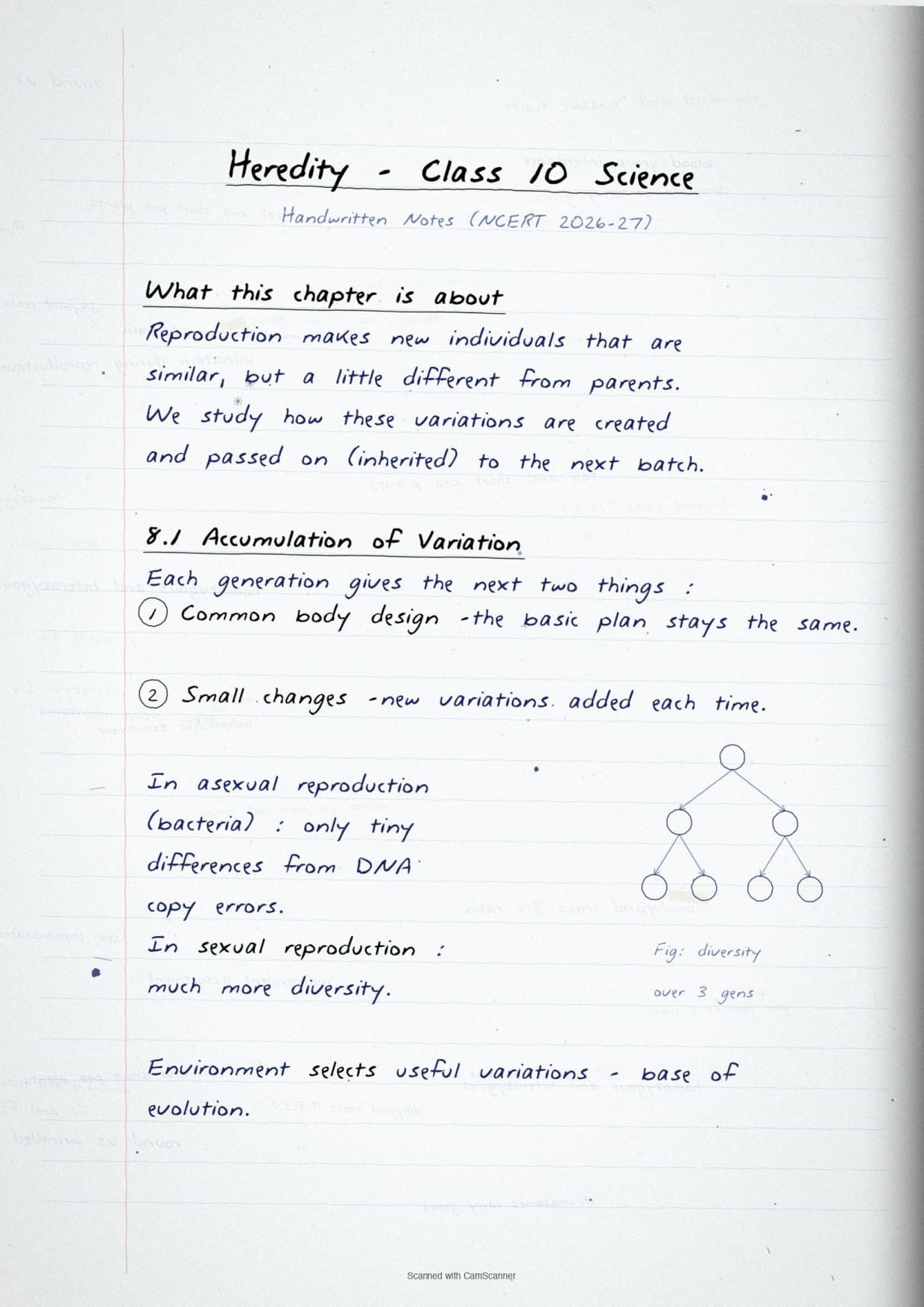
Heredity, Traits and Variation: The First Page of the Notes
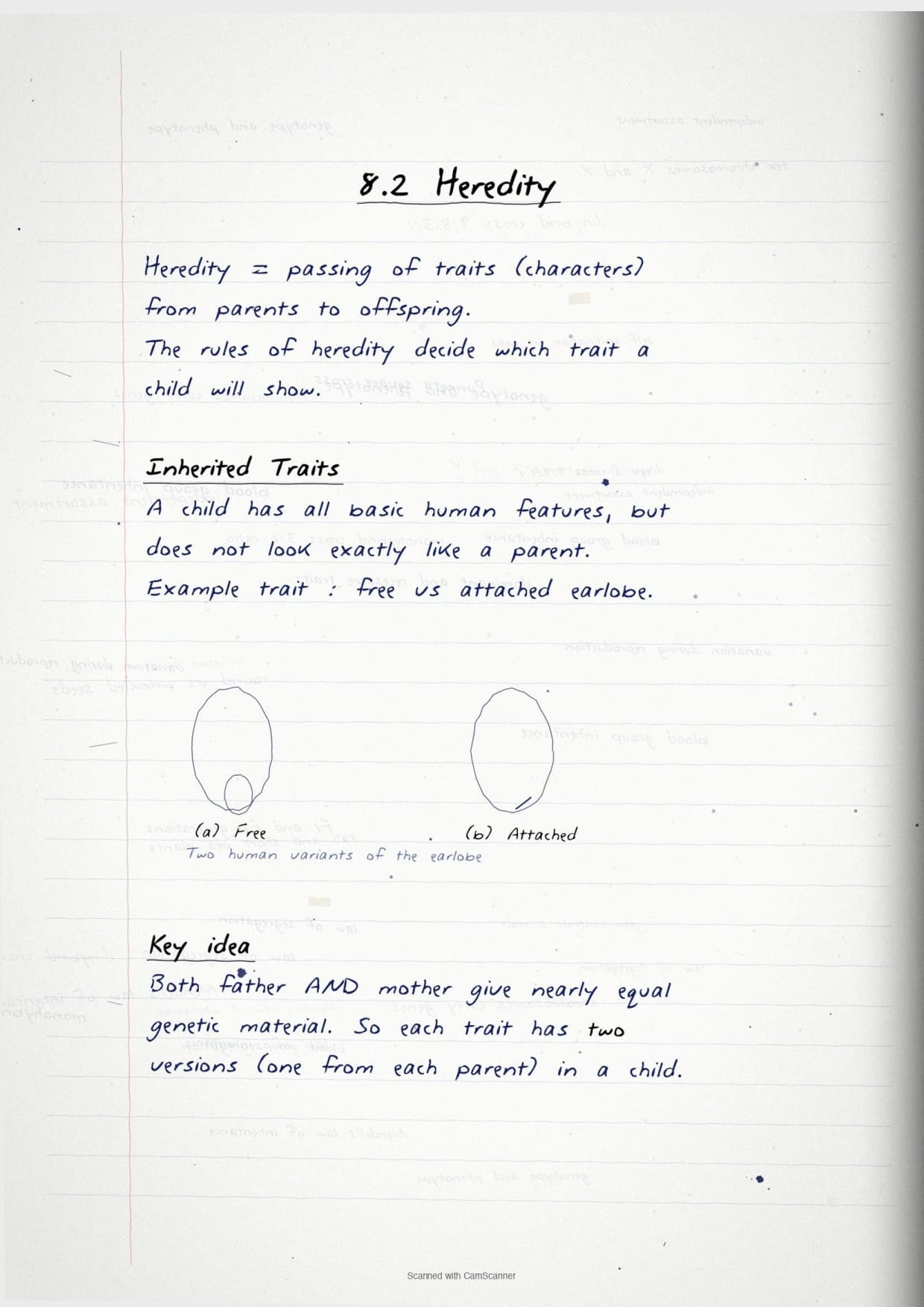
The opening page settles the most basic board question: what heredity is and how an inherited trait differs from an acquired one. Heredity is the passing of characters, or traits, from parents to their offspring through the genes.
- Heredity: the transmission of traits across generations through the DNA in the genes.
- Inherited trait: a character passed on through the germ cells, like eye colour or ear-lobe type; it reaches the next generation.
- Acquired trait: a change gained during life in the body cells, like low body weight from poor diet; it is not passed on.
Acquired traits are not inherited (a favourite reasoning question): a change in a body (somatic) cell does not reach the germ cells that make the next generation, so only changes in germ-cell DNA can be passed down.
- Variation: the small differences between parents and offspring, and among the offspring.
- Source: sexual reproduction mixes two parents' genes, giving more variation than asexual reproduction.
- Exam line: variation is the raw material of evolution, useful at the species level.
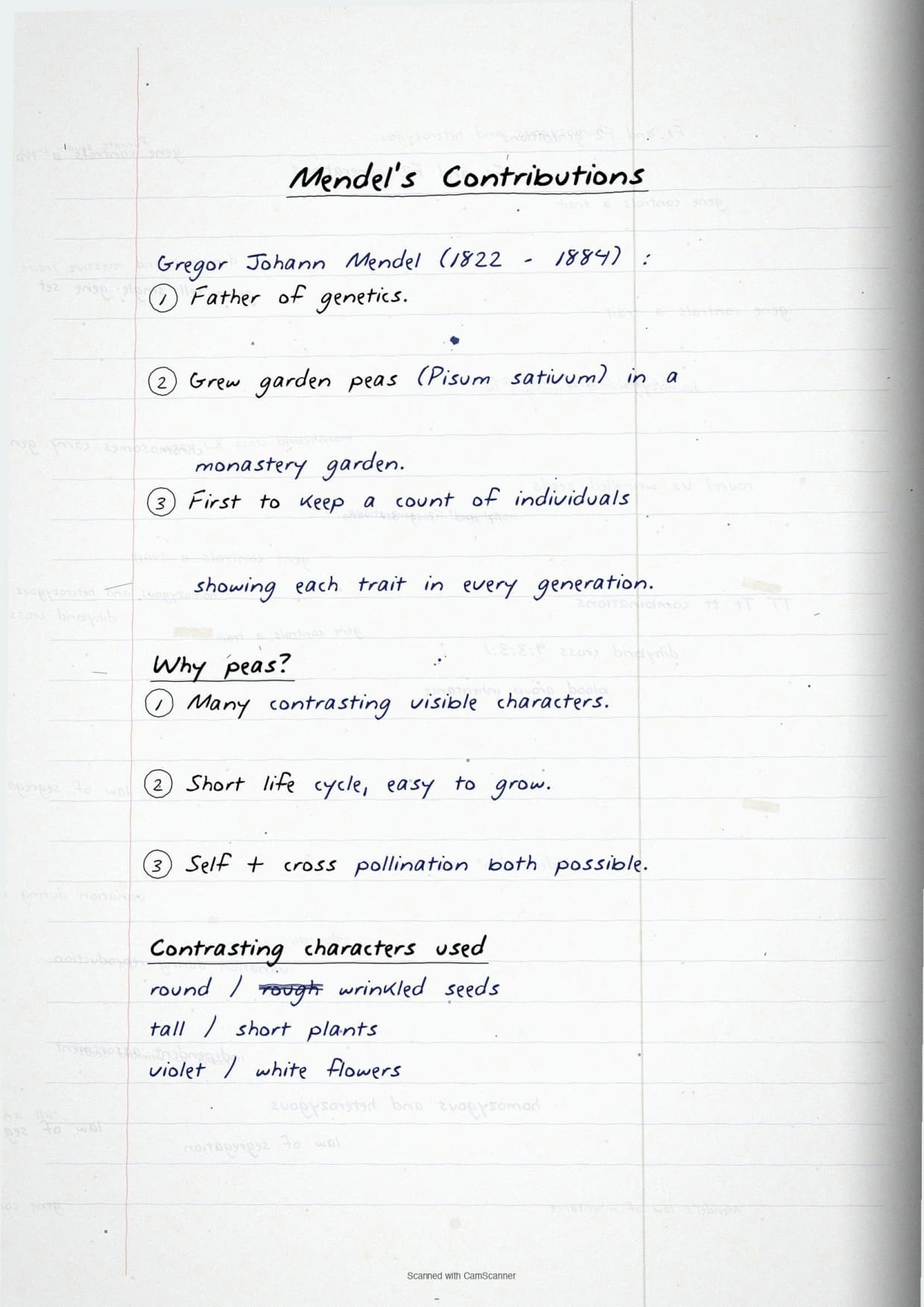
Mendel's Monohybrid Cross and the 3:1 Ratio
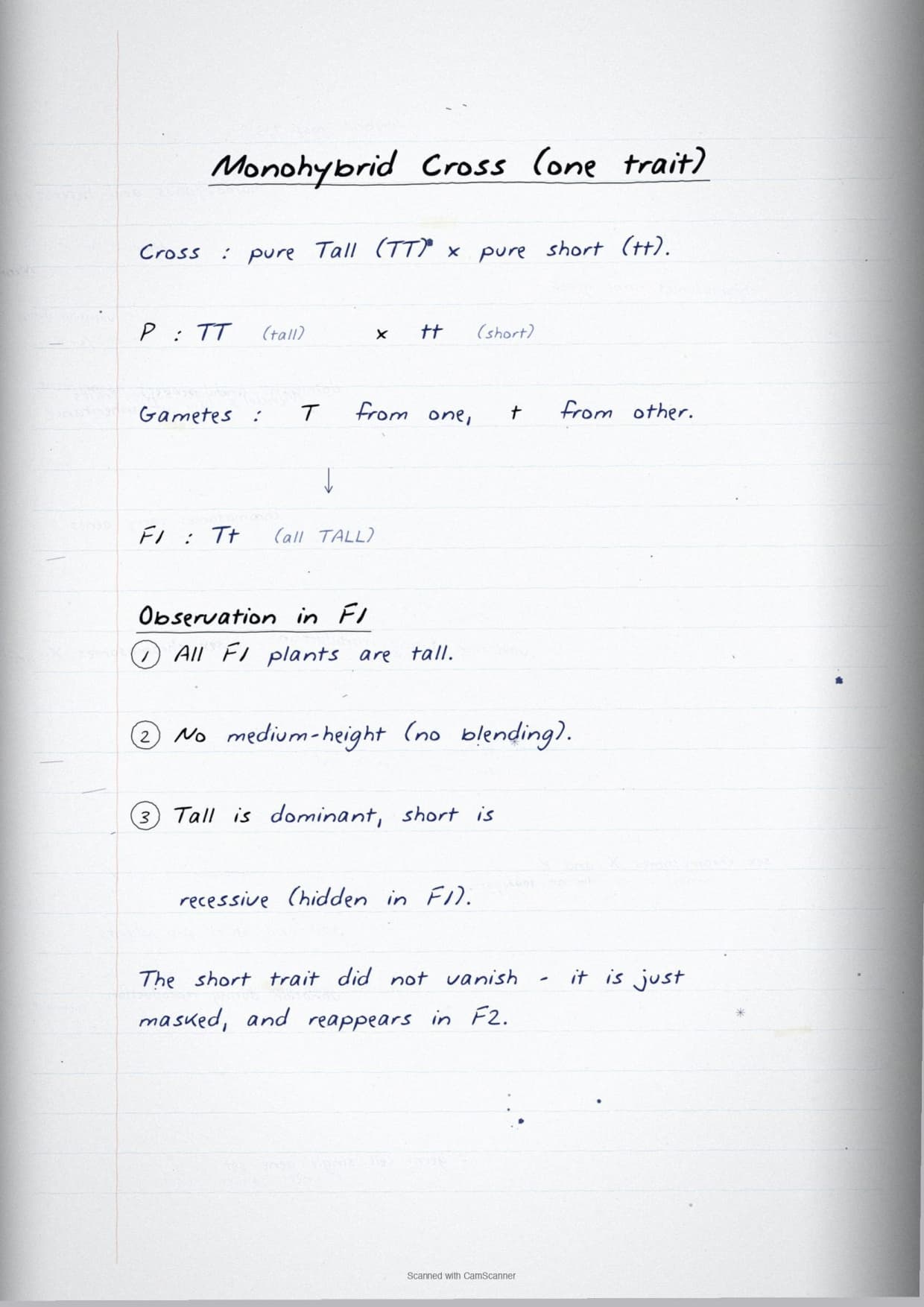
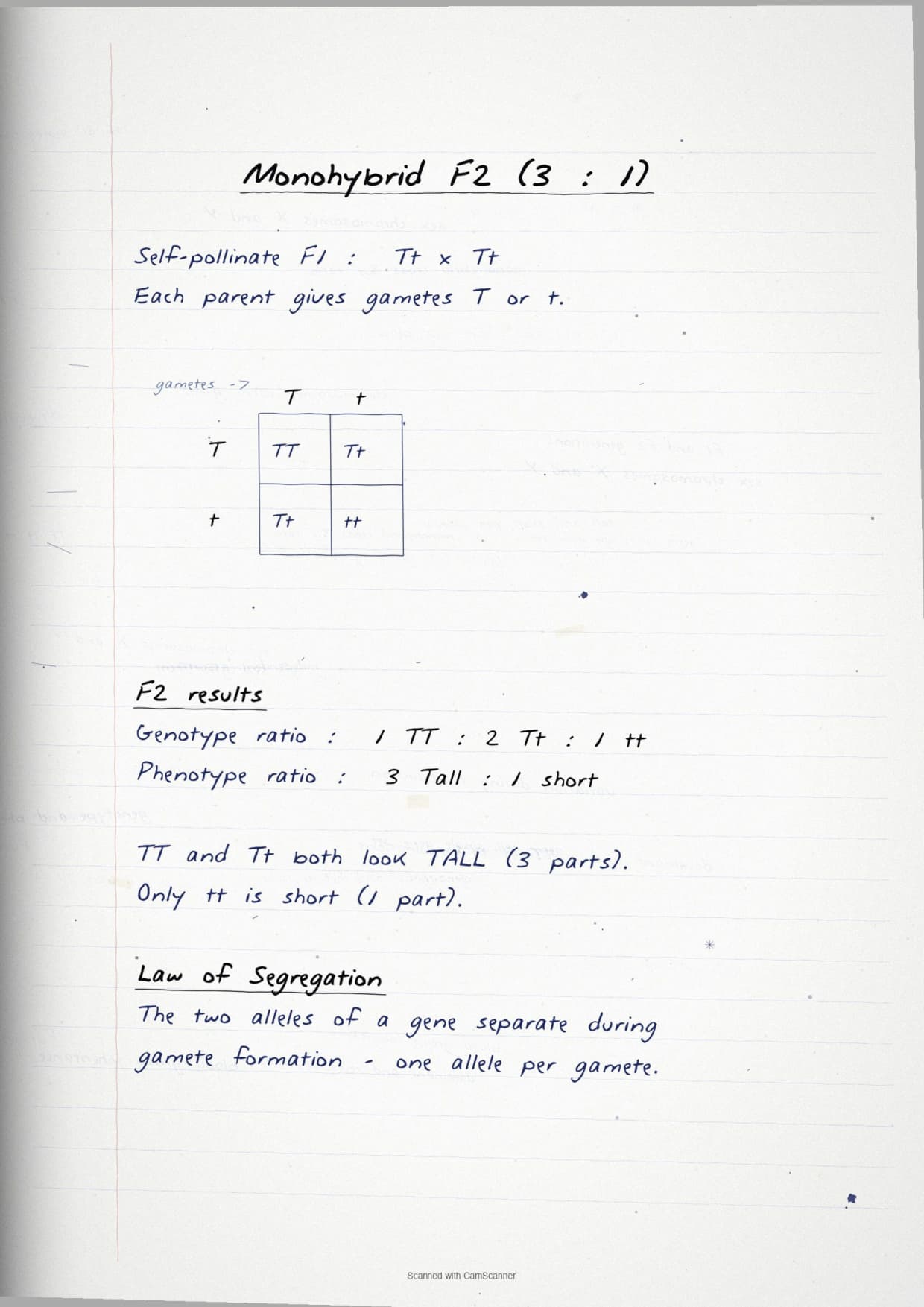
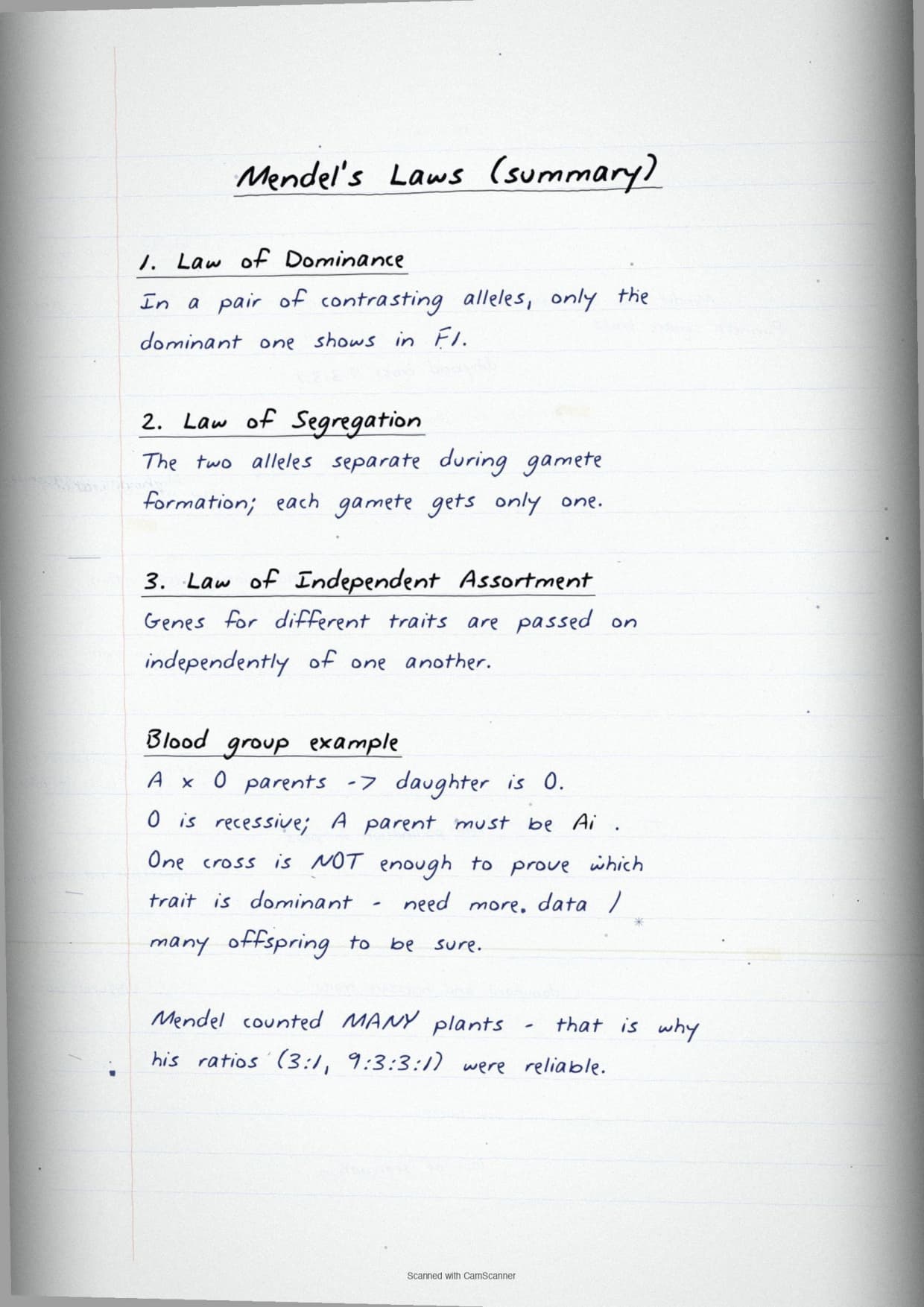
The notes draw Mendel's monohybrid cross as a labelled Punnett square; the F2 ratio is a top 3-mark question. The cross below uses tall (T) and short (t) pea plants.
| Generation | Cross / result | Ratio |
|---|---|---|
| Parents (P) | Tall (TT) crossed with short (tt) | - |
| F1 generation | All tall plants (Tt) | All tall |
| F2 generation | Tall and short plants reappear | 3 tall : 1 short |
| F2 genotype | TT, Tt, Tt, tt | 1 : 2 : 1 |
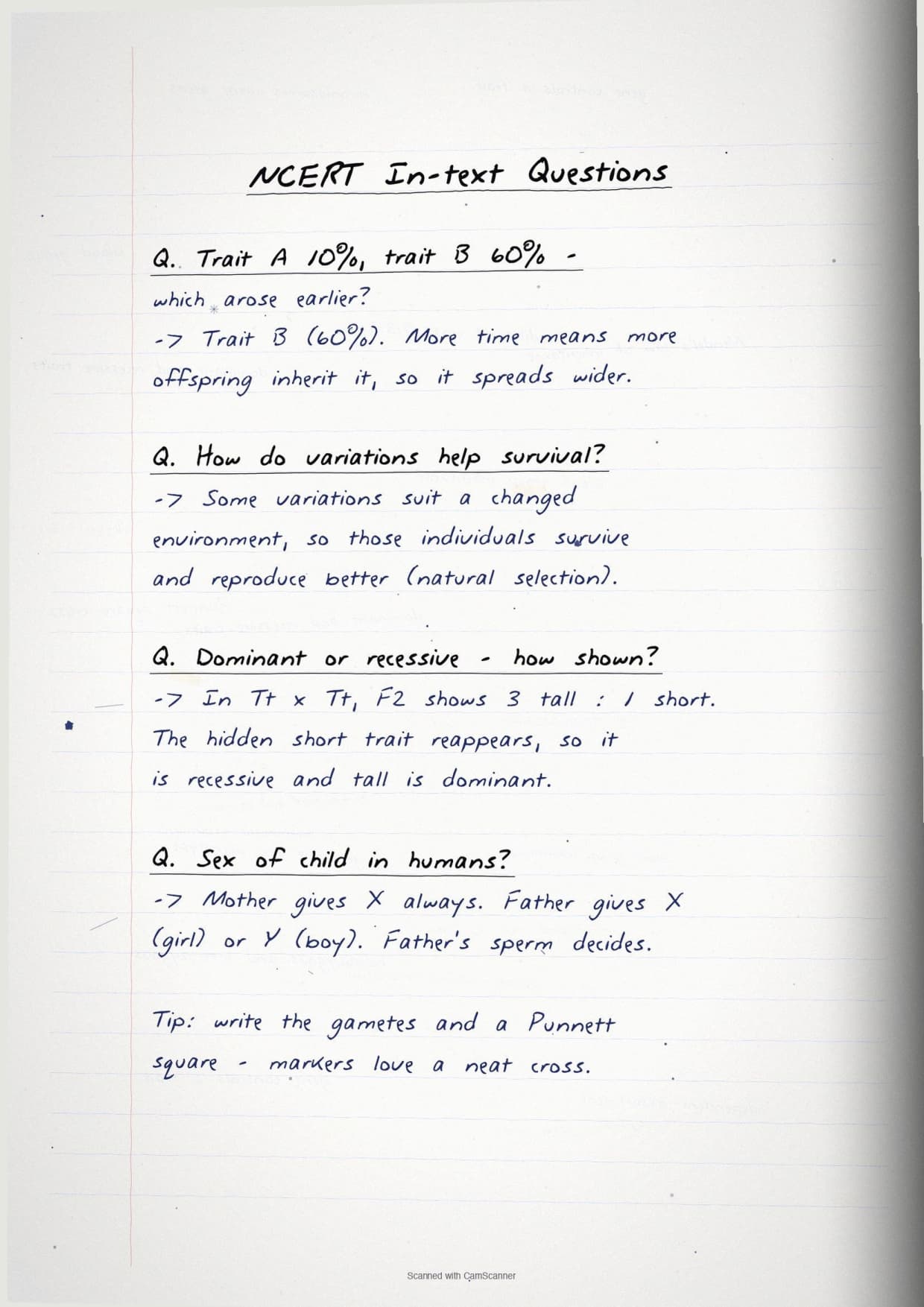
The sharpest point students miss: the short trait disappears in F1 but returns in F2, proving the short factor was hidden, not lost. The two ratios examiners check first:
- Phenotypic ratio: 3 tall : 1 short in F2.
- Genotypic ratio: 1 TT : 2 Tt : 1 tt in F2.
- Why it matters: tall (T) is dominant and short (t) recessive, so a single T makes the plant tall.
Exam line: a recessive trait shows up only when both alleles are recessive (tt). The monohybrid cross proves the two alleles separate during gamete formation, the law of segregation.
Dihybrid Cross and the 9:3:3:1 Ratio in the Notes
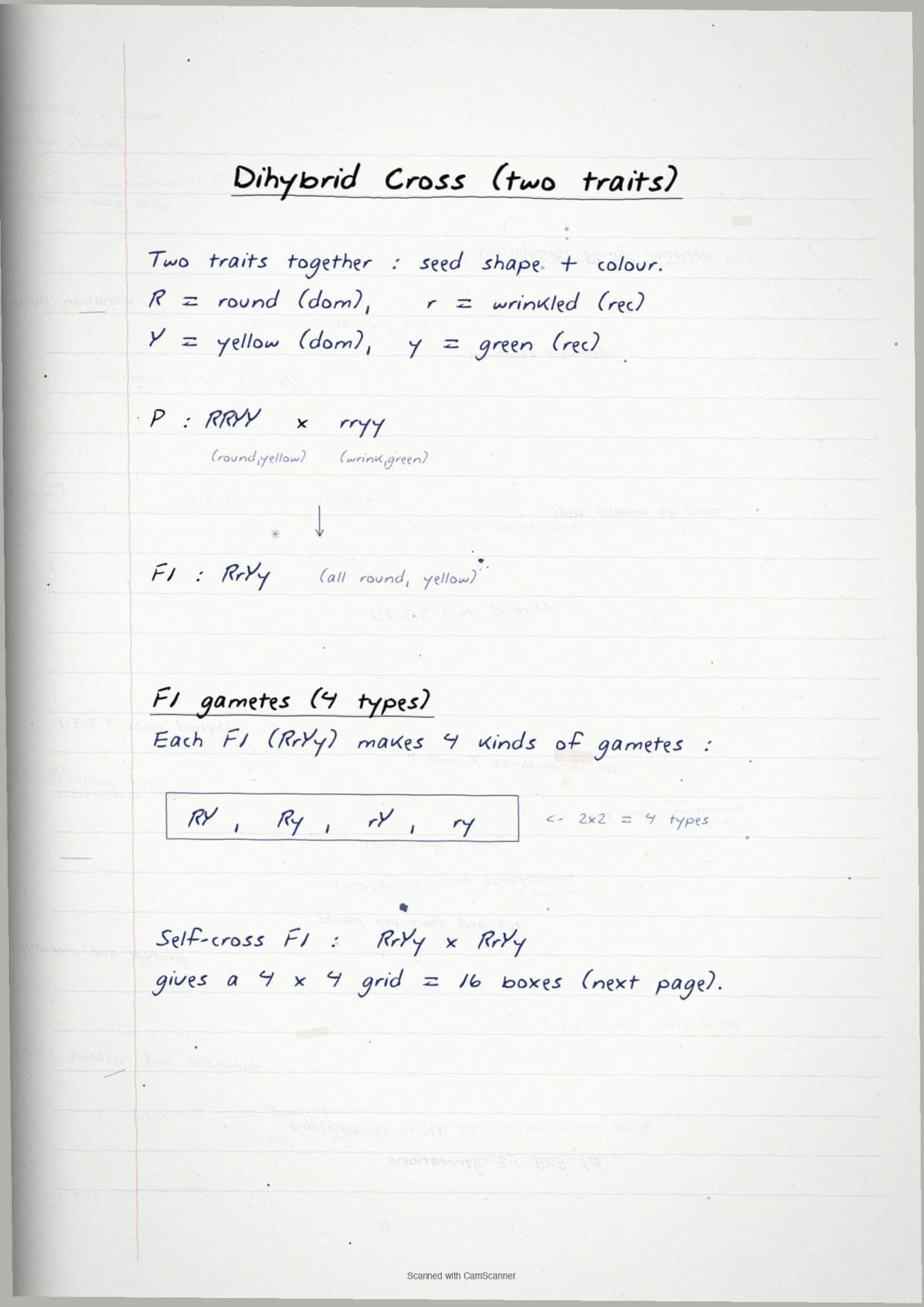
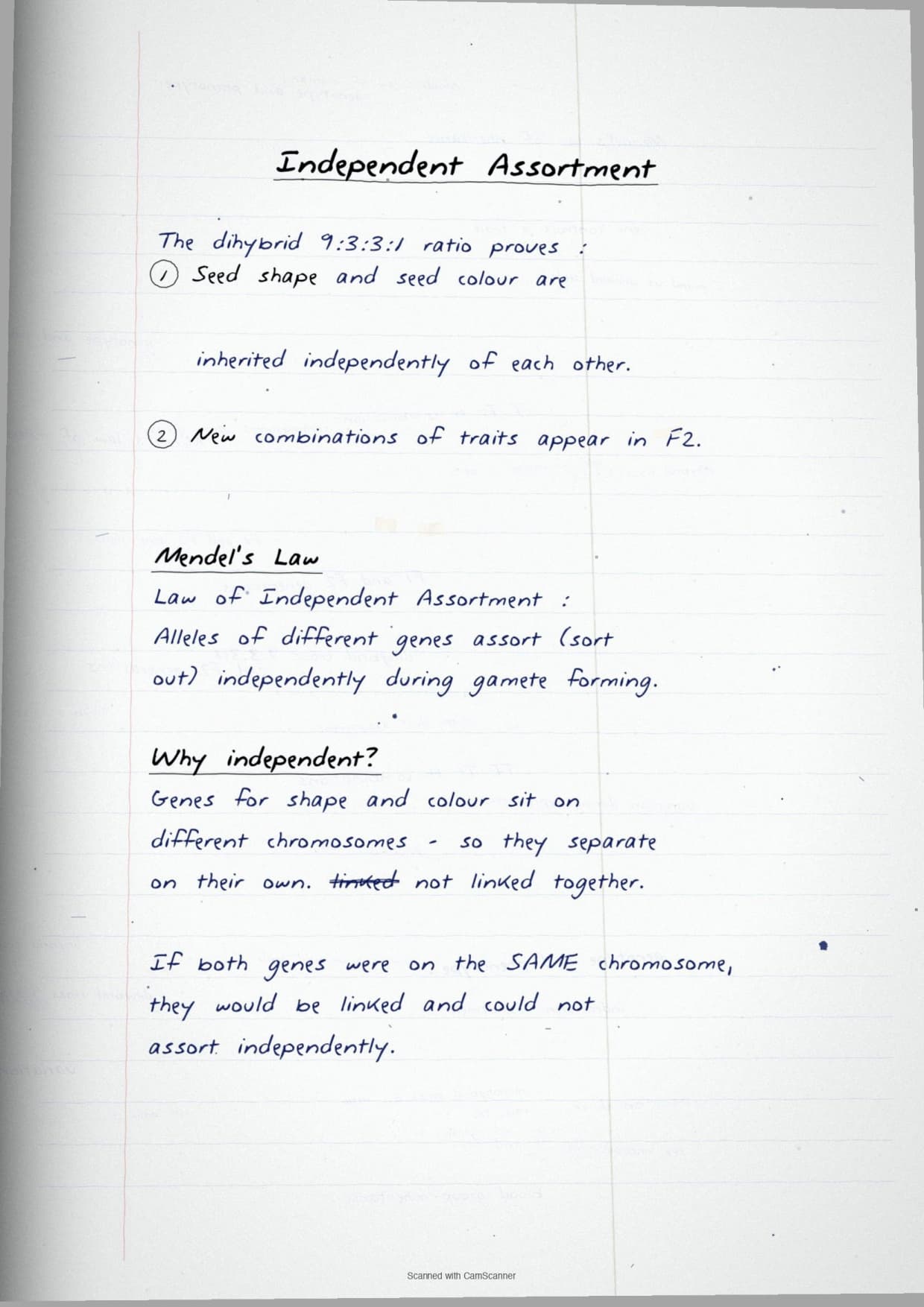
The dihybrid cross follows two traits at once, such as seed shape and colour, a common 5-mark question. The cross uses round-yellow (RRYY) and wrinkled-green (rryy) pea seeds.
- Parents (P): round yellow (RRYY) crossed with wrinkled green (rryy).
- F1 generation: all seeds round and yellow (RrYy), the dominant traits.
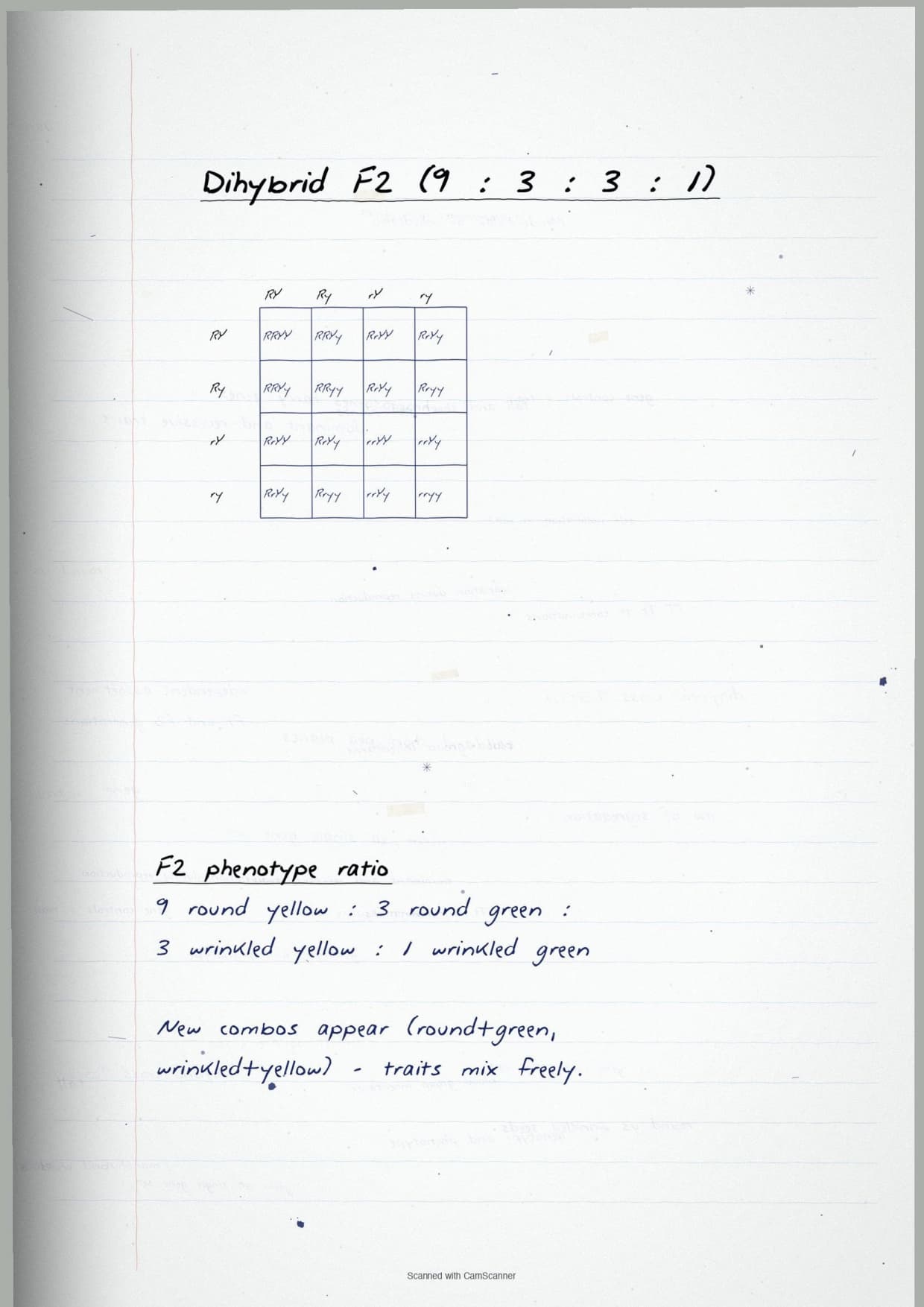
- F2 generation: four seed types in the ratio 9 round-yellow : 3 round-green : 3 wrinkled-yellow : 1 wrinkled-green.
The big idea the board rewards: the new combinations in F2. Round-green and wrinkled-yellow seeds were absent in the parents, proving the two traits are inherited independently.
- Law of independent assortment: the alleles of one trait separate independently of those of another during gamete formation.
- The 9:3:3:1 ratio: the F2 phenotypic ratio in a dihybrid cross.
How Traits Are Inherited: Genes, Alleles and Rules
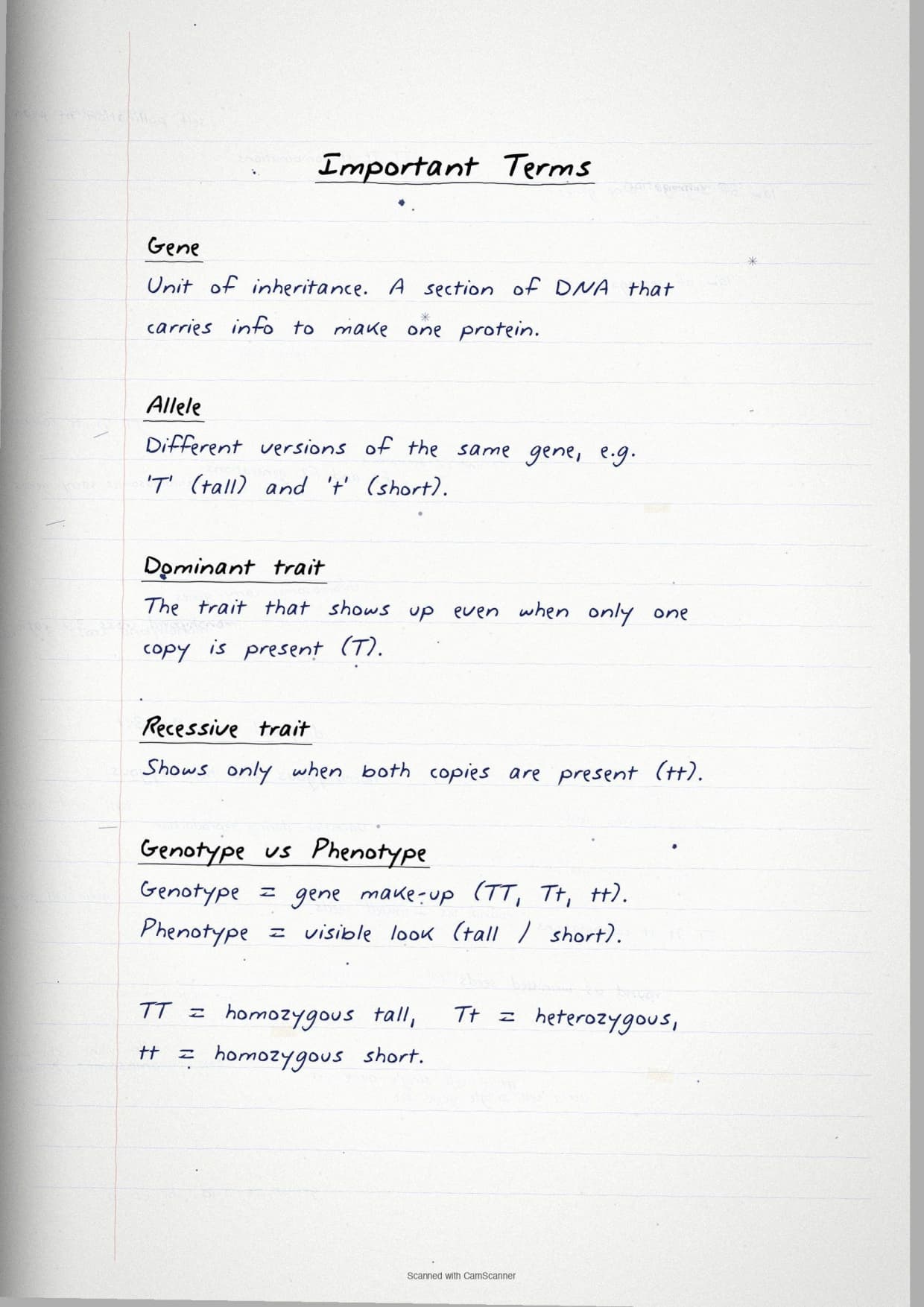
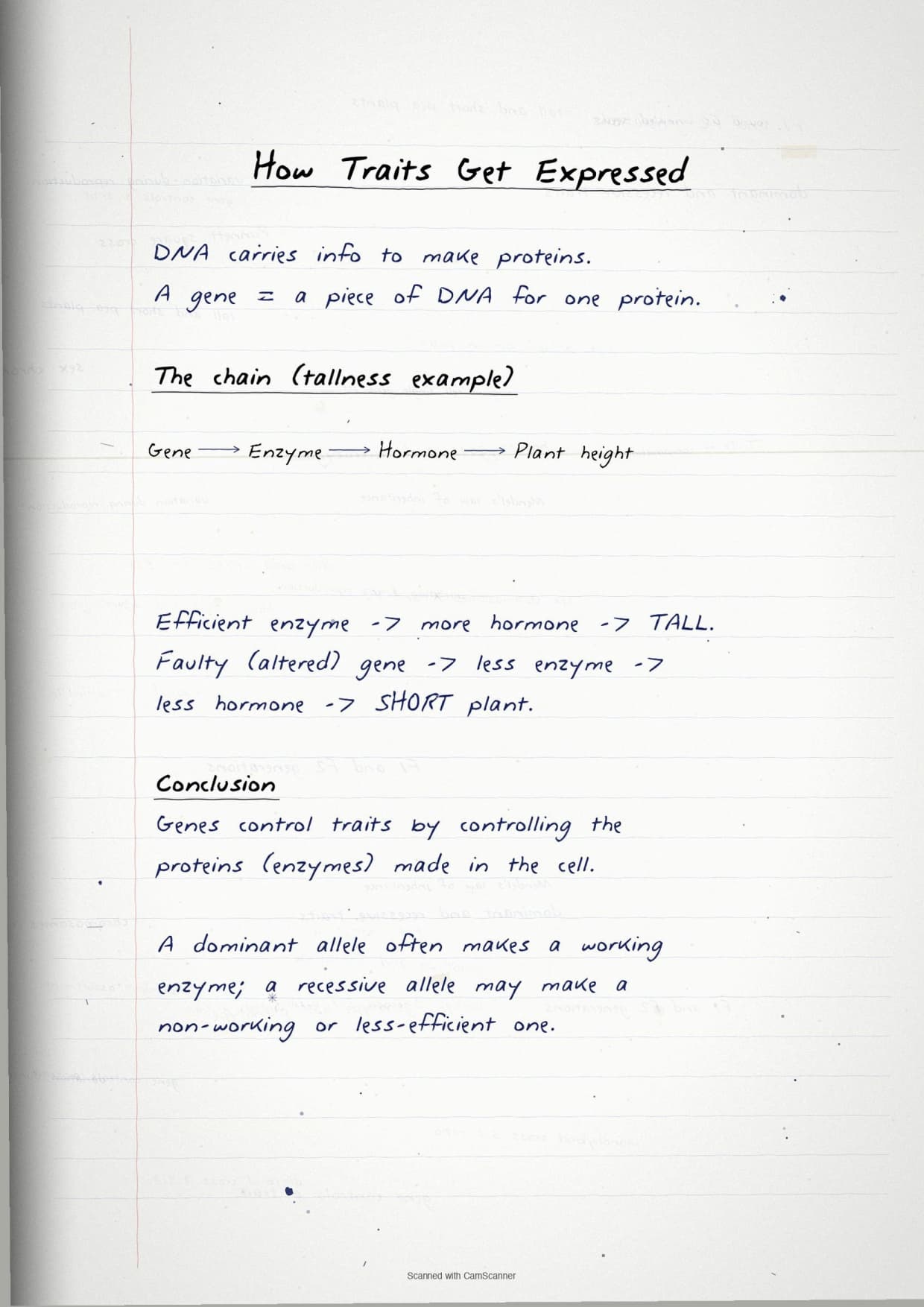
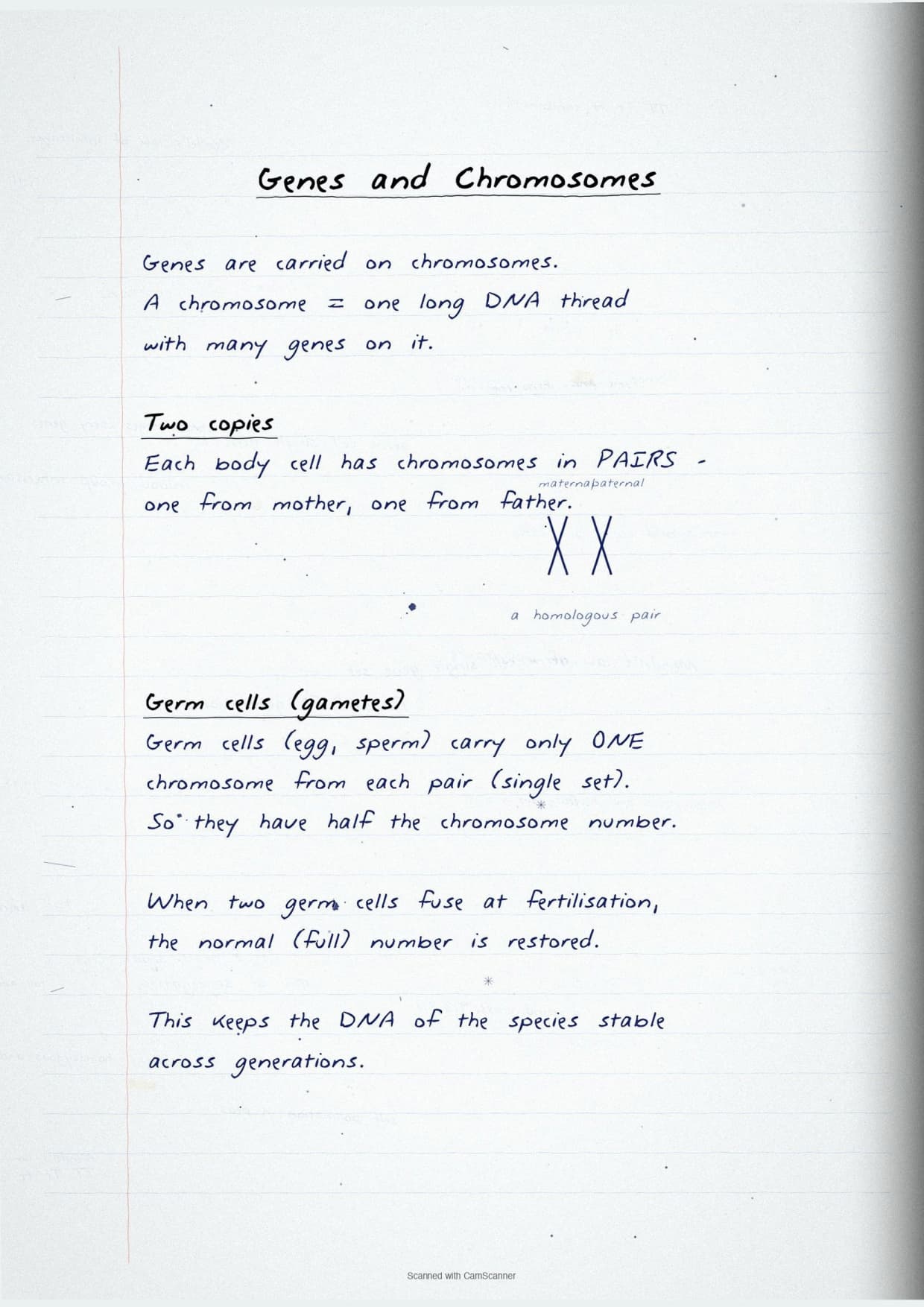
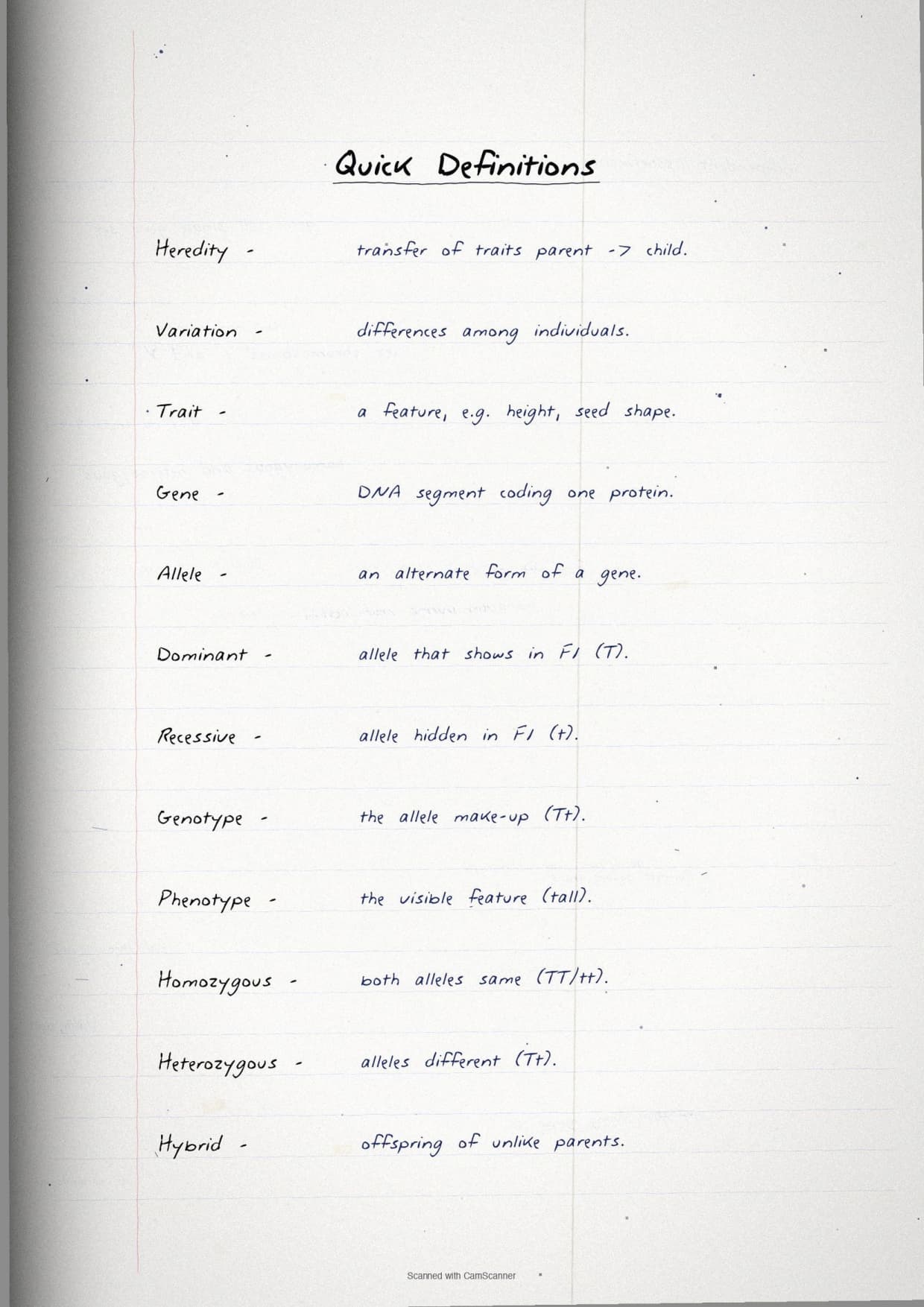
This spread settles the vocabulary the board tests by name: define a gene, an allele or the difference between genotype and phenotype.
- Gene: a unit of DNA on a chromosome that controls a trait, such as plant height.
- Allele: one of the two forms of a gene (T for tall, t for short); one comes from each parent.
- Dominant allele: shows its effect even in a single copy (T in Tt).
- Recessive allele: shows only when both copies are recessive (tt).
The difference students mix up most, genotype versus phenotype:
| Term | What it means | Example |
|---|---|---|
| Genotype | The gene make-up, the actual alleles present | TT, Tt or tt |
| Phenotype | The visible character that results | Tall or short |
| Homozygous | Both alleles are the same | TT or tt |
| Heterozygous | The two alleles are different | Tt |
Exam line: TT and Tt look the same (tall), but their genotypes differ. A tall plant can be pure (TT) or hybrid (Tt), so the recessive trait can reappear later.
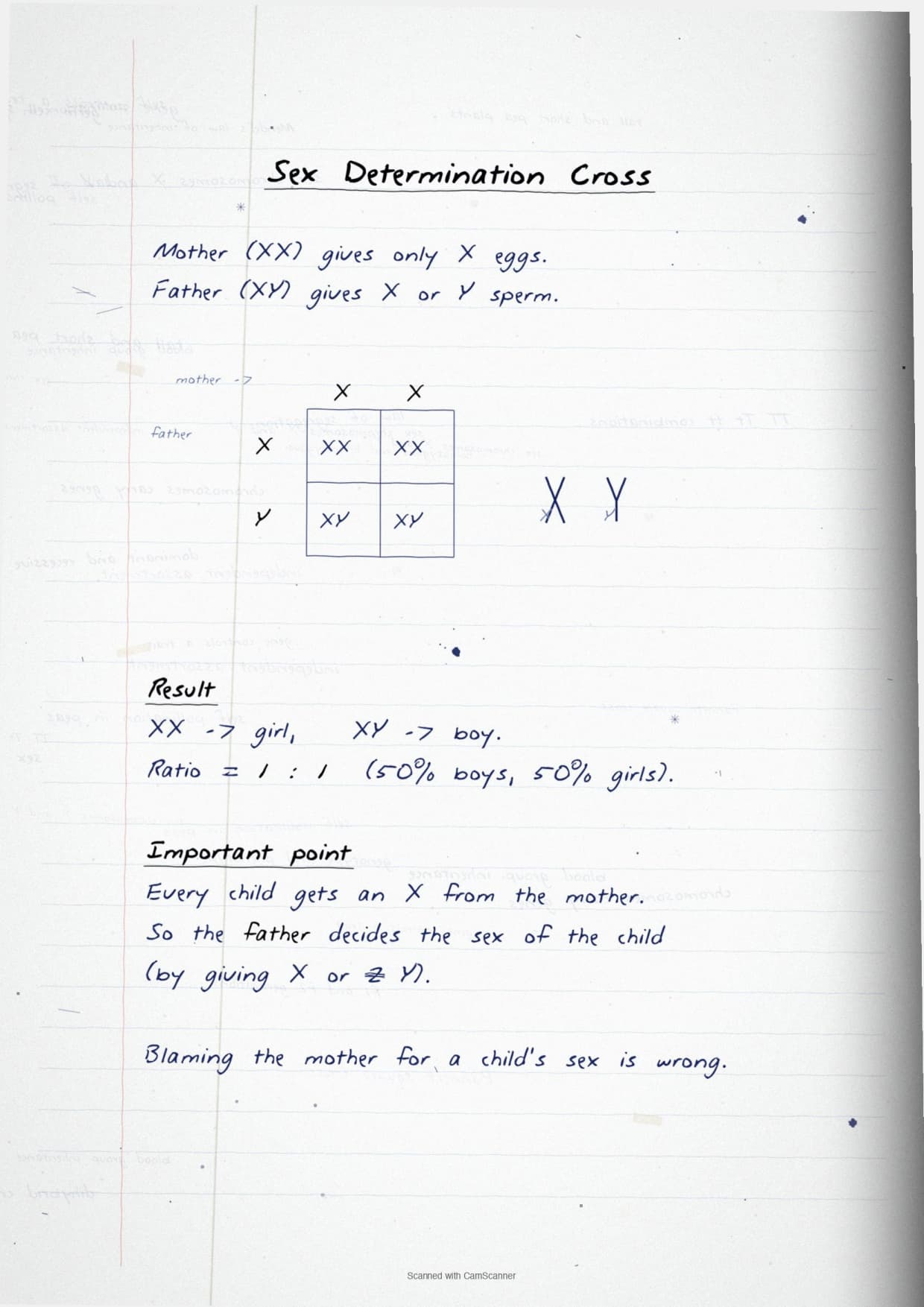
Sex Determination in Humans
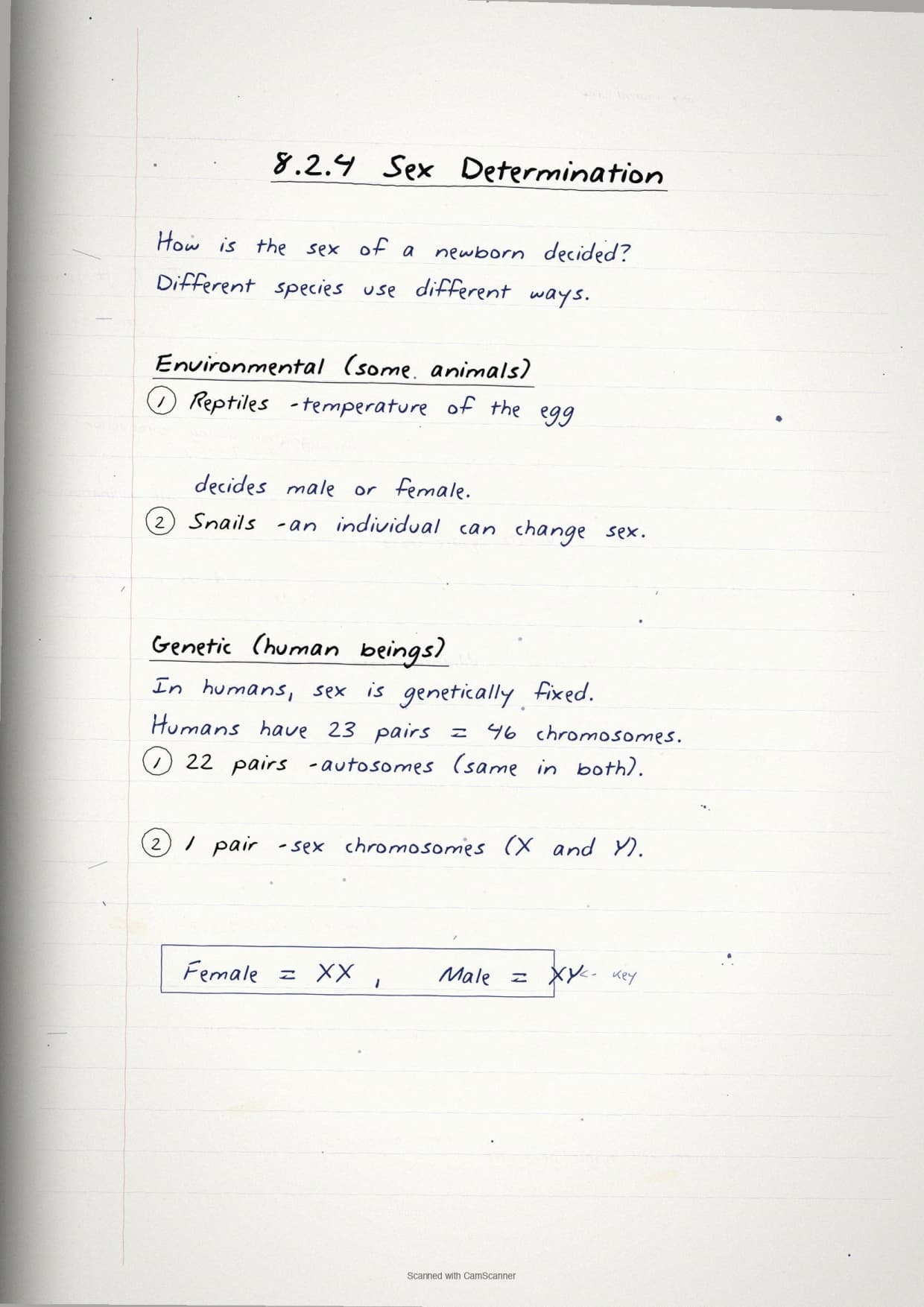
How the sex of a child is decided is a guaranteed 2 to 3-mark question. Humans have 23 pairs of chromosomes, one pair being the sex chromosomes.
- Female: two X chromosomes (XX), so every egg carries an X.
- Male: one X and one Y (XY), so half the sperms carry X and half carry Y.
- Deciding factor: the egg always gives an X, so the sperm decides the child's sex.
- X sperm + X egg: gives XX, so the child is a girl.
- Y sperm + X egg: gives XY, so the child is a boy.
- The ratio: equal chance of a boy or a girl, about 50:50.
Exam point: the sex of the child is decided by the father, because the mother can give only an X chromosome. This corrects the common myth that the mother is responsible for the baby's sex.
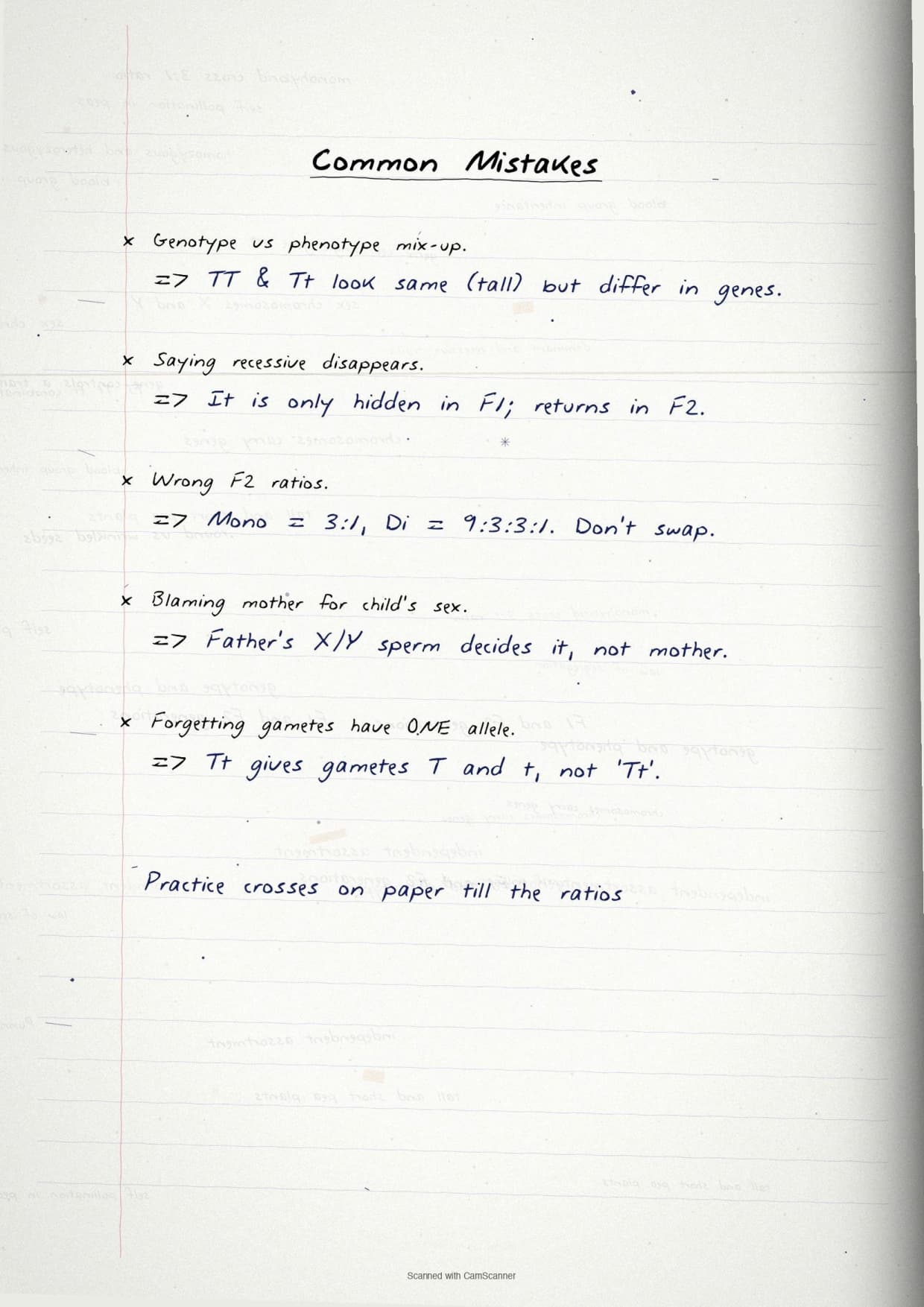
Common Mistakes These Notes Help You Avoid
A few errors cost marks every year, mostly from mixing up genotype with phenotype or writing the wrong F2 ratio.
- Confusing genotype (the alleles, like Tt) with phenotype (the look, like tall).
- Writing the F2 monohybrid ratio as 1:1 instead of 3:1, or forgetting the genotypic 1:2:1.
- Saying the short trait is lost in F1. It is only hidden, and it reappears in F2.
- Writing that the mother decides the baby's sex. The father's sperm decides the sex.
- Calling an acquired trait inheritable. Only changes in the germ-cell DNA are passed on.
The exam rewards exact terms and correct ratios, so always name the alleles, draw the Punnett square and state the ratio.
How These Notes Pair with the Solutions and Book PDF
These handwritten notes are a revision layer. Use them with the other resources for the same chapter, linked in the table below.
| Resource | Best used for |
|---|---|
| Heredity NCERT Solutions | Step-by-step answers for every in-text and back-exercise question |
| Heredity Class 10 Notes | Quick typed summary with every cross, ratio and term in one place |
| Heredity Formula Sheet | One-page quick reference of the key crosses, ratios and definitions |
| Heredity NCERT Book PDF | Reading the original NCERT chapter text from the textbook |
Tip: redraw the monohybrid and dihybrid Punnett squares once from memory, then write the 3:1 and 9:3:3:1 ratios beside them.
All Class 10 Science Handwritten Notes by Chapter
The table links the handwritten notes for every chapter in Class 10 Science. Heredity is highlighted.
| Chapter | Handwritten Notes |
|---|---|
| Chapter 1 | Chemical Reactions and Equations |
| Chapter 2 | Acids, Bases and Salts |
| Chapter 3 | Metals and Non-metals |
| Chapter 4 | Carbon and its Compounds |
| Chapter 5 | Life Processes |
| Chapter 6 | Control and Coordination |
| Chapter 7 | How do Organisms Reproduce? |
| Chapter 8 | Heredity |
| Chapter 9 | Light - Reflection and Refraction |
| Chapter 10 | The Human Eye and the Colourful World |
| Chapter 11 | Electricity |
| Chapter 12 | Magnetic Effects of Electric Current |
| Chapter 13 | Our Environment |
FAQs on Heredity Handwritten Notes
Heredity Class 10 Science Handwritten Notes Common Questions
Ques. Are these class 10 science chapter 8 Heredity handwritten notes free to download?
Ans. Yes. The Heredity handwritten notes are free to download as a PDF from this page. They follow the 2026-27 NCERT syllabus and cover the full chapter across 21 scanned, hand-drawn-cross pages for quick revision.
Ques. What does Chapter 8 Heredity cover in Class 10 Science?
Ans. The notes cover heredity and variation, inherited and acquired traits, Mendel's monohybrid cross (3:1 ratio) and dihybrid cross (9:3:3:1 ratio), the rules of inheritance with genes and alleles, the difference between genotype and phenotype, and sex determination in humans, all of which the CBSE board paper tests directly.
Ques. What is the F2 ratio in Mendel's monohybrid cross?
Ans. In a monohybrid cross the F2 generation shows a phenotypic ratio of 3:1, for example 3 tall plants to 1 short plant. The genotypic ratio is 1:2:1, that is 1 TT : 2 Tt : 1 tt. The recessive short trait, hidden in F1, reappears in one quarter of the F2 plants.
Ques. Who decides the sex of a child in humans?
Ans. The father decides the sex of the child. The mother is XX and always gives an X chromosome through the egg, while the father is XY and gives either an X or a Y through the sperm. An X sperm gives a girl (XX) and a Y sperm gives a boy (XY).
Ques. Are these notes enough for the class 10 science chapter 8 board exam?
Ans. They are a strong final revision layer. For full preparation, pair them with the NCERT Solutions linked on this page so you can write out complete answers and draw the Punnett squares for every in-text and back-exercise question and check them against model answers.



Comments