




The Electricity Class 10 Science handwritten notes are scanned, boxed and built for fast last-minute revision, fully matched to the 2026-27 CBSE syllabus. They cover electric current and potential difference, Ohm's law and resistance, the factors on which resistance depends, resistors in series and parallel, the heating effect of electric current, Joule's law of heating, and electric power, all in clear ruled-page form with hand-drawn circuit diagrams and boxed formulas.
- CBSE Weightage: about 7 to 9 marks from the unit Effects of Current, often as circuit, formula and numerical questions.
- Boxed formulas and a hand-drawn circuit diagram for every law, resistance rule and power relation the board paper asks about.
- Pairs with the NCERT Solutions, Notes and Book PDF linked lower on this page.
These Electricity handwritten notes are prepared from the official NCERT Science textbook and matched to the 2026-27 CBSE syllabus.
Student Feedback: In a Collegedunia poll of 12,600 Class 10 Science students before the 2026 boards, 81% of students said the boxed Ohm's law triangle and the side-by-side series and parallel formulas were the fastest way to revise this chapter. Most students copied the boxed power formulas straight onto practice answer sheets.
Source: 2026-27 Class 10 Science student poll. Sample of 12,600 students from CBSE schools across 17 states.
Solved by Collegedunia: Every circuit diagram, table and formula in these Electricity handwritten notes is checked by Collegedunia's Class 10 Science team against the latest 2026-27 NCERT textbook, so what you revise matches exactly what the CBSE board paper expects.
What These Electricity Handwritten Notes Include
These Electricity handwritten notes condense the chapter into 23 scanned pages of ruled paper, every diagram drawn by hand and every formula boxed in pen, ideal for a fast recap before the board exam. They are built around the three big ideas the CBSE paper tests:
- Current and Ohm's law: electric current, potential difference, Ohm's law, resistance, and the V-I graph.
- Resistance and circuits: the factors that decide resistance, resistivity, and resistors in series and parallel.
- Heating and power: the heating effect of current, Joule's law, and the three forms of the power formula.
Electricity Class 10 Science Video Lecture
Source: Magnet Brains on YouTube
Electric Current and Potential Difference: The First Page of the Notes
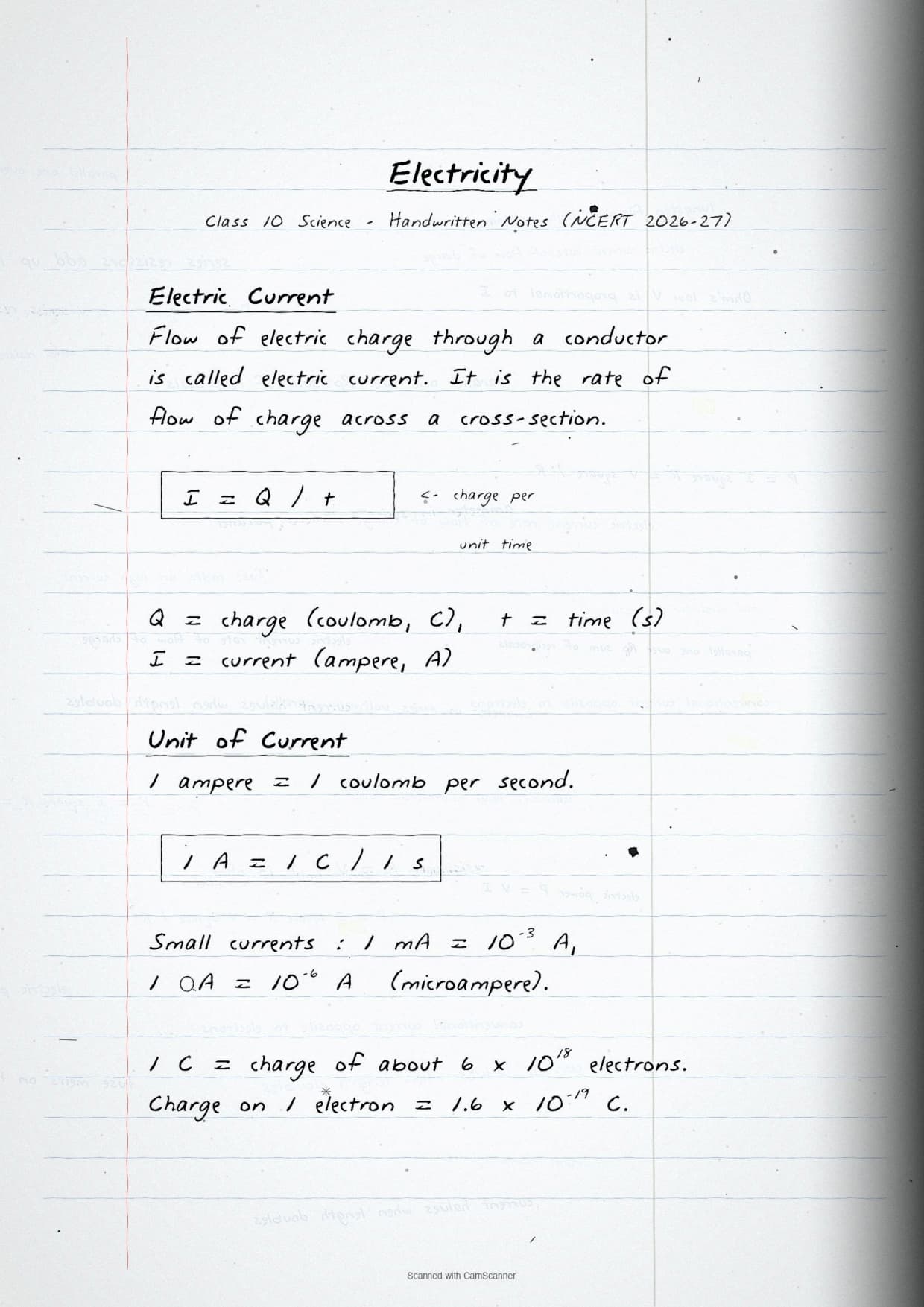
The opening page settles the two most basic board definitions. Electric current is the rate of flow of charge through a conductor.
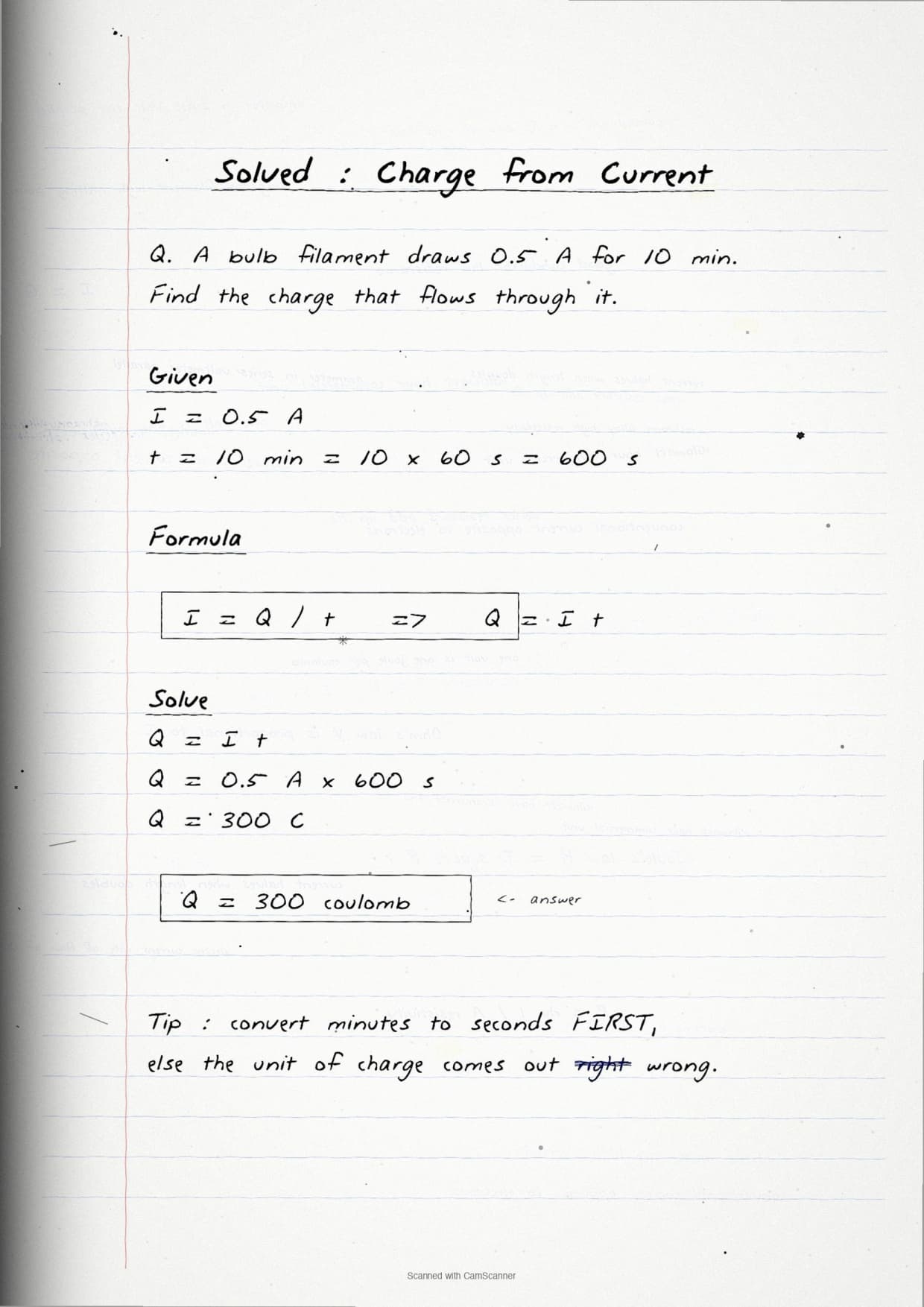
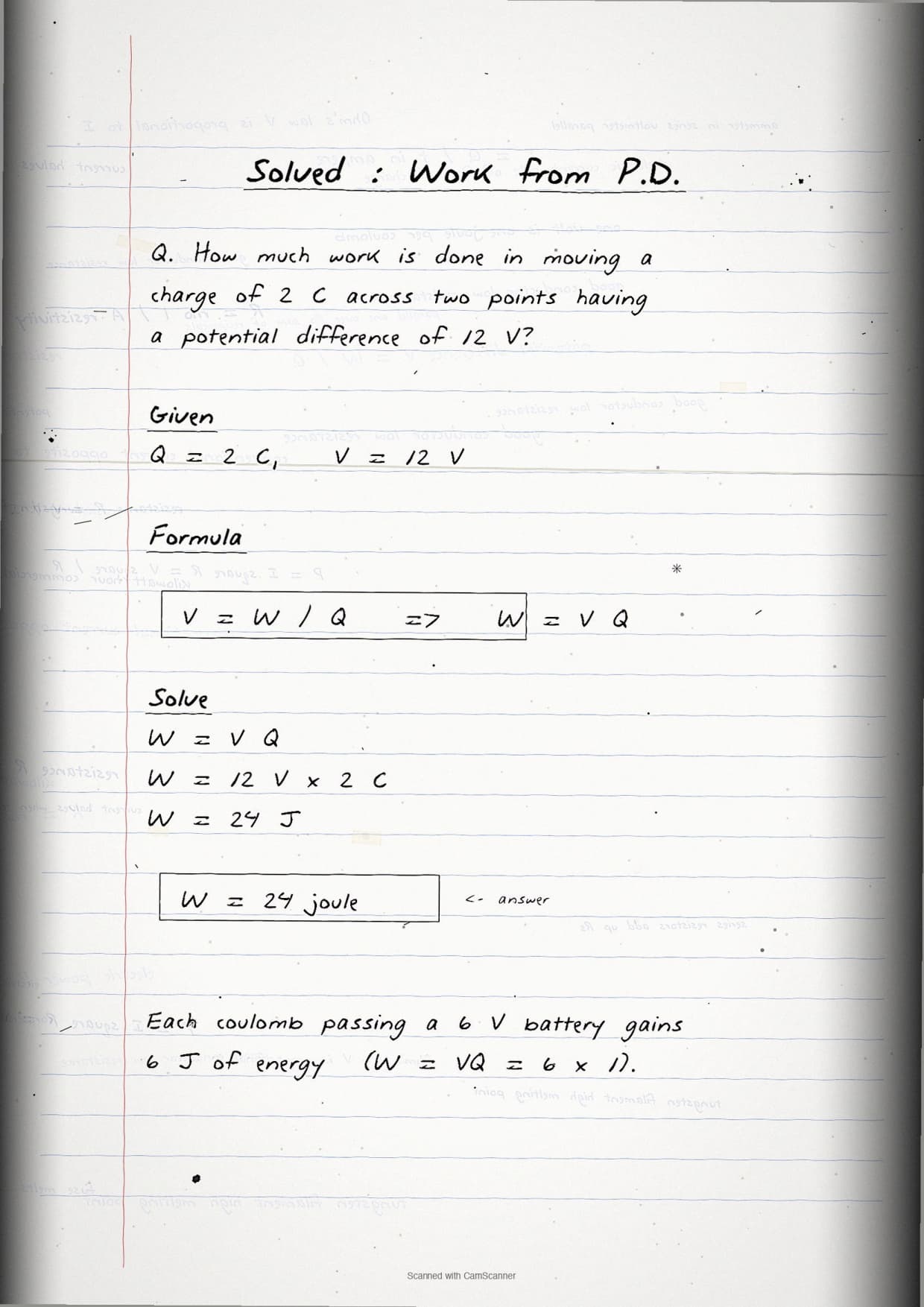
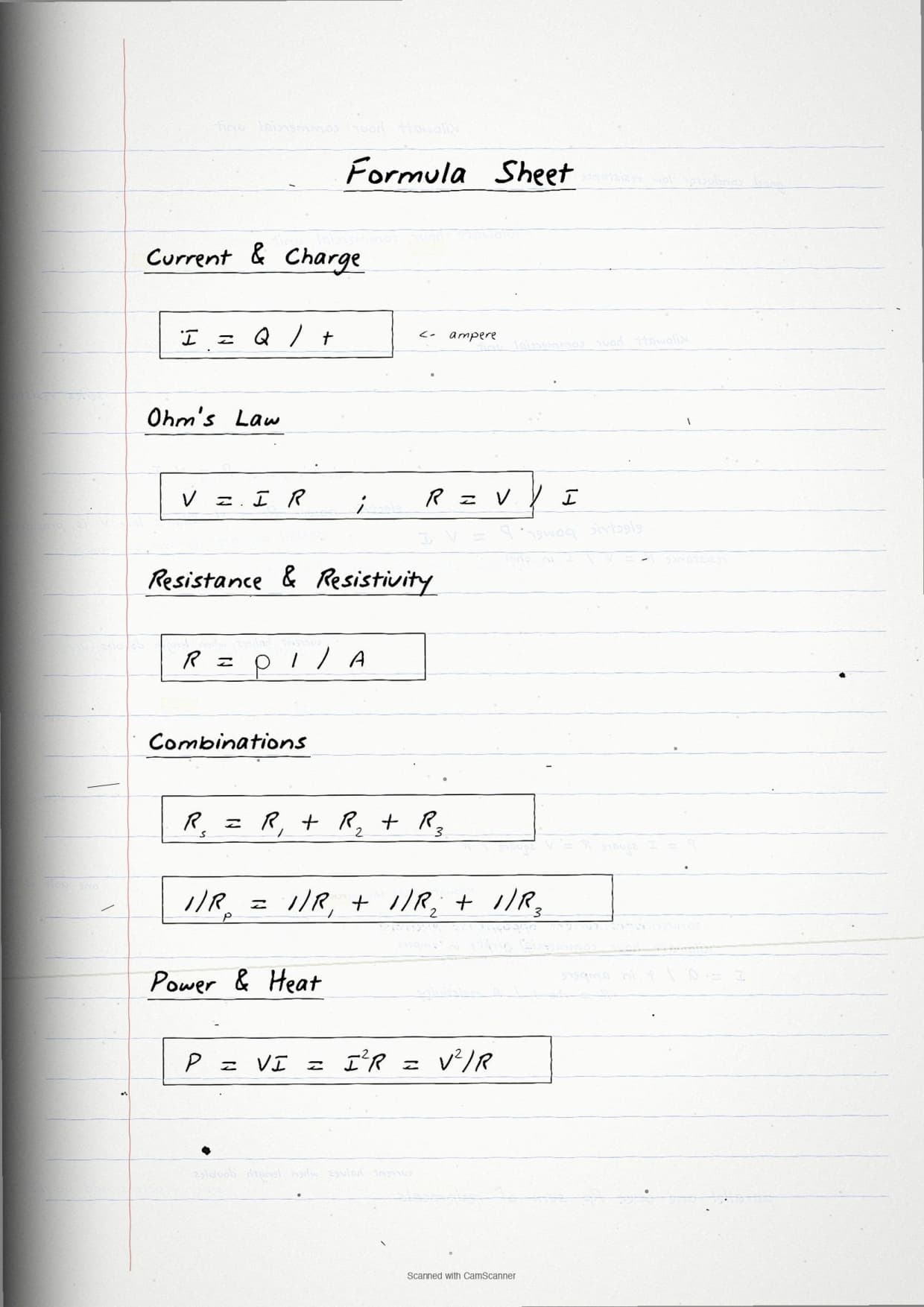
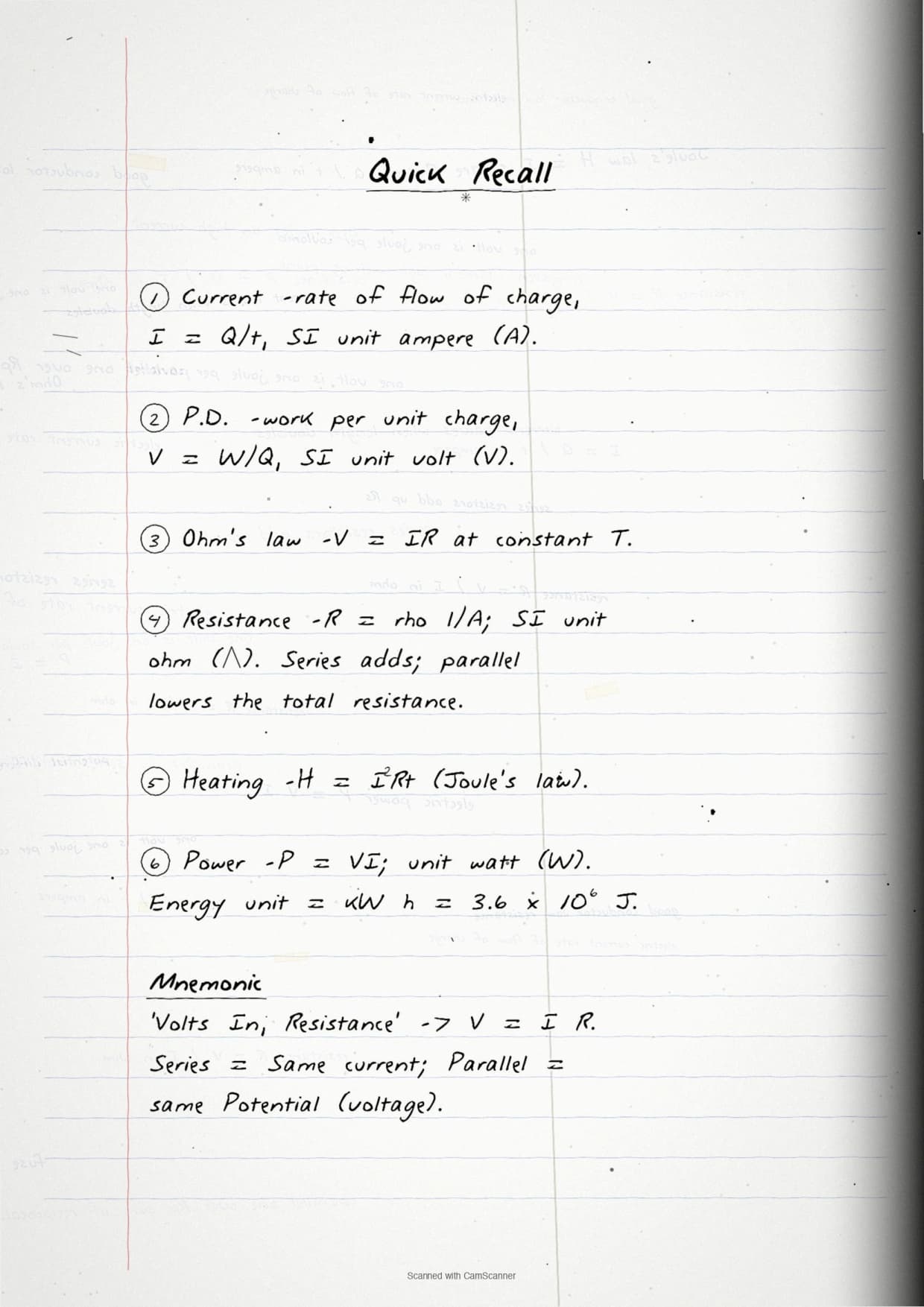
- Electric current (I): charge Q per unit time t, I = Q/t, in ampere (A); 1 A is 1 coulomb per second.
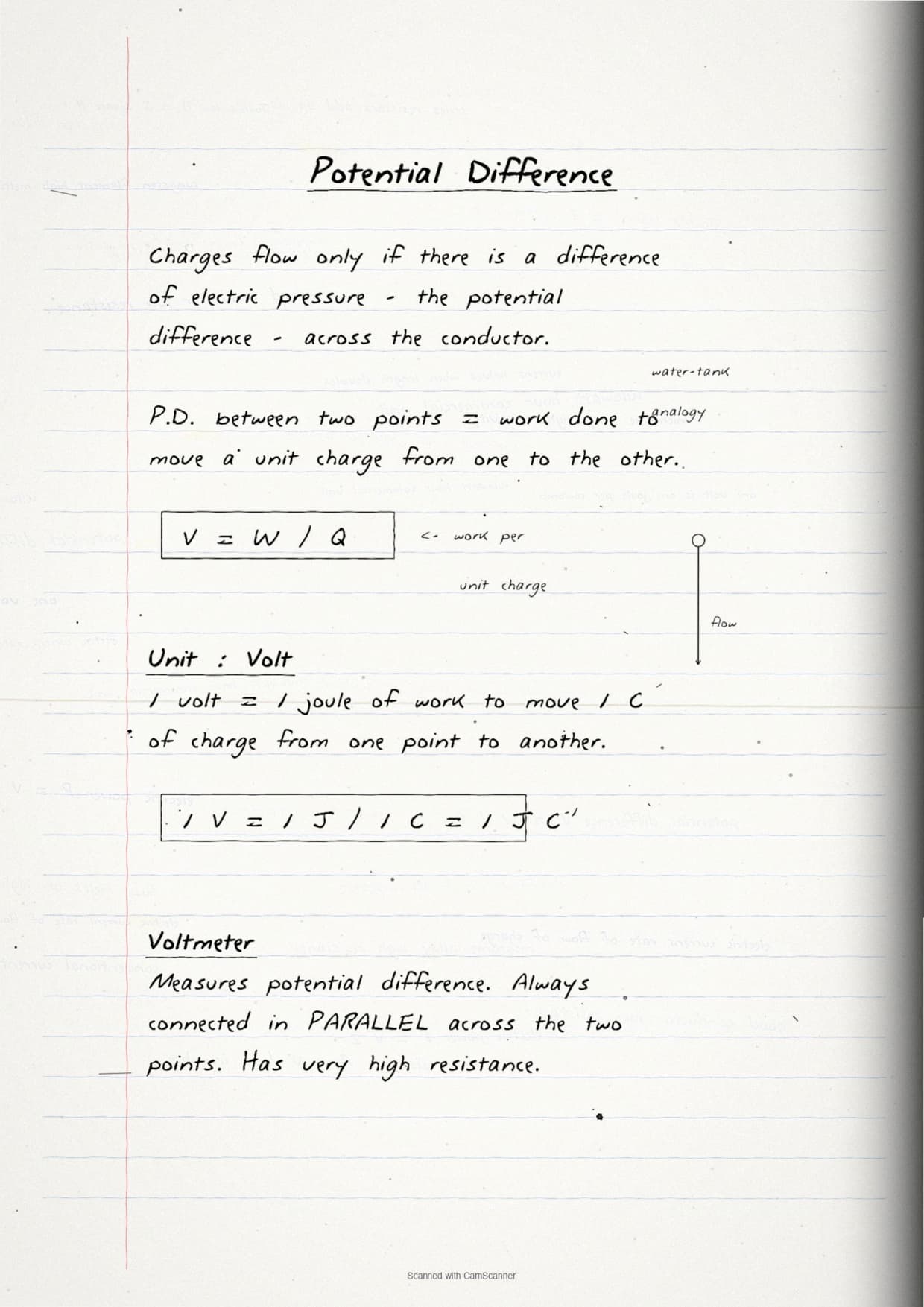
- Potential difference (V): work W to move unit charge Q, V = W/Q, in volt (V).
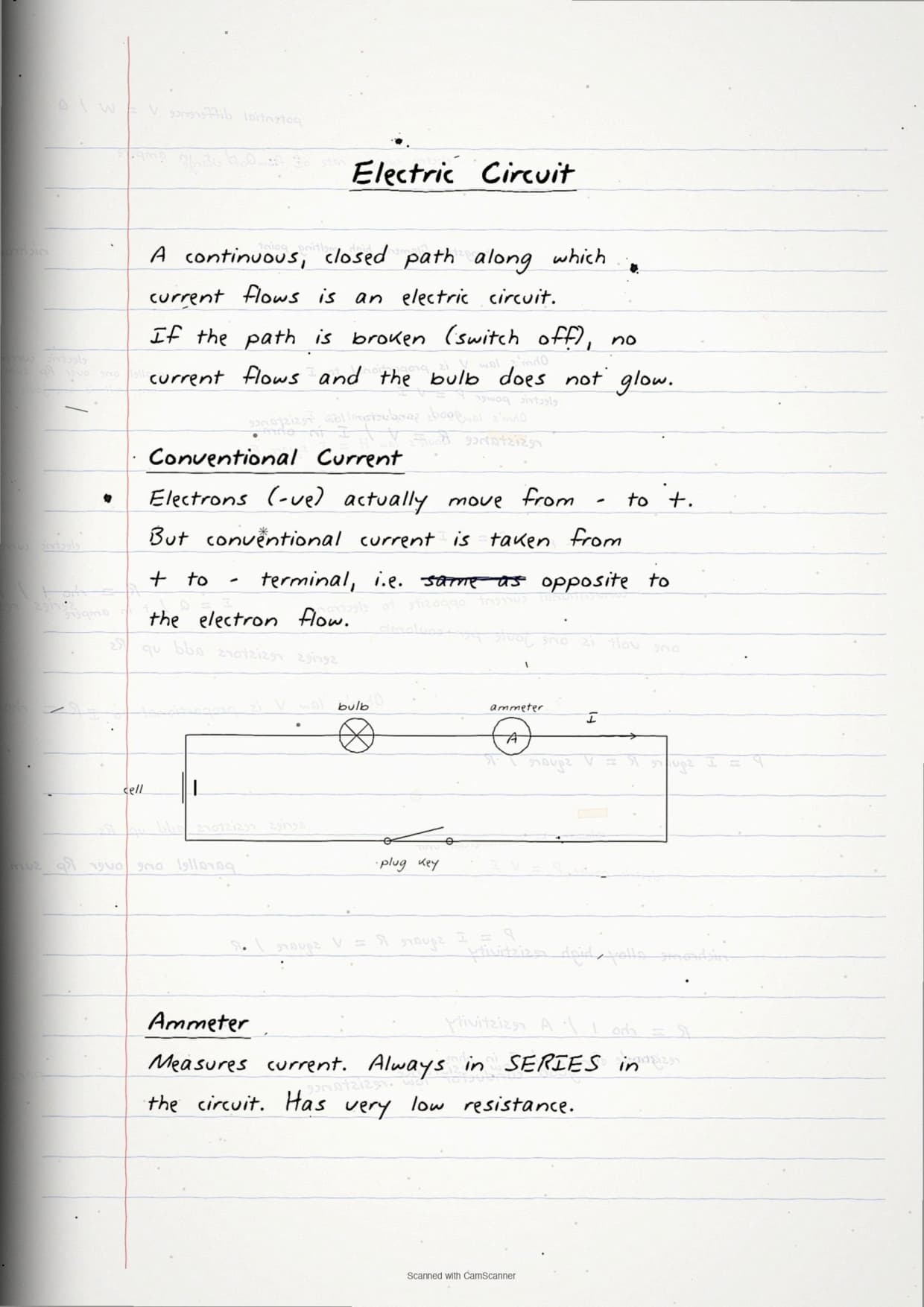
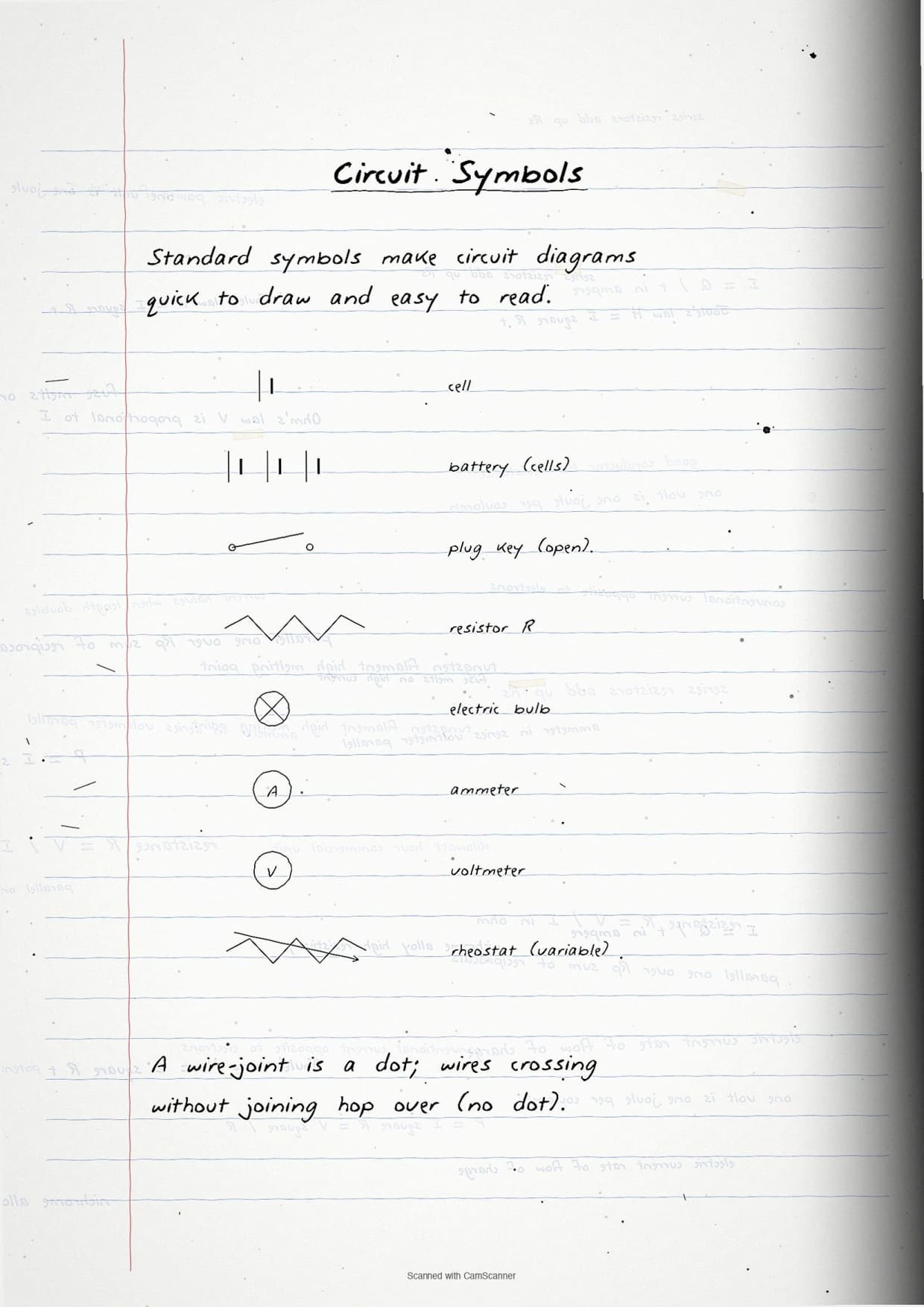
- Ammeter: measures current, connected in series; voltmeter: measures p.d., connected in parallel.
- Conventional current: flows from positive to negative terminal, opposite to electron flow.
Current needs a complete circuit and a potential difference to flow. This sets up Ohm's law, which links the current and the potential difference for a conductor.
Ohm's Law, Resistance and the V-I Graph
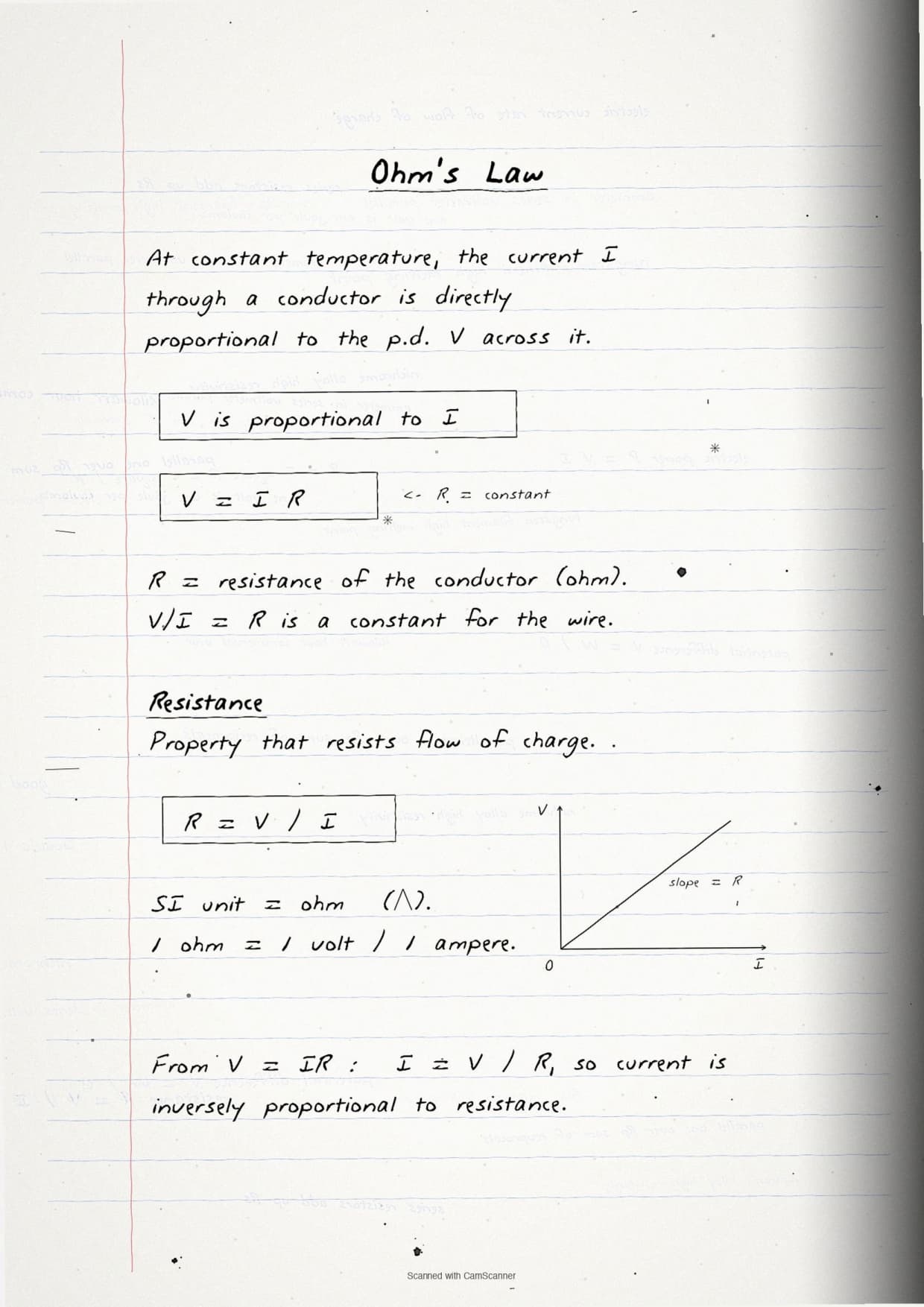
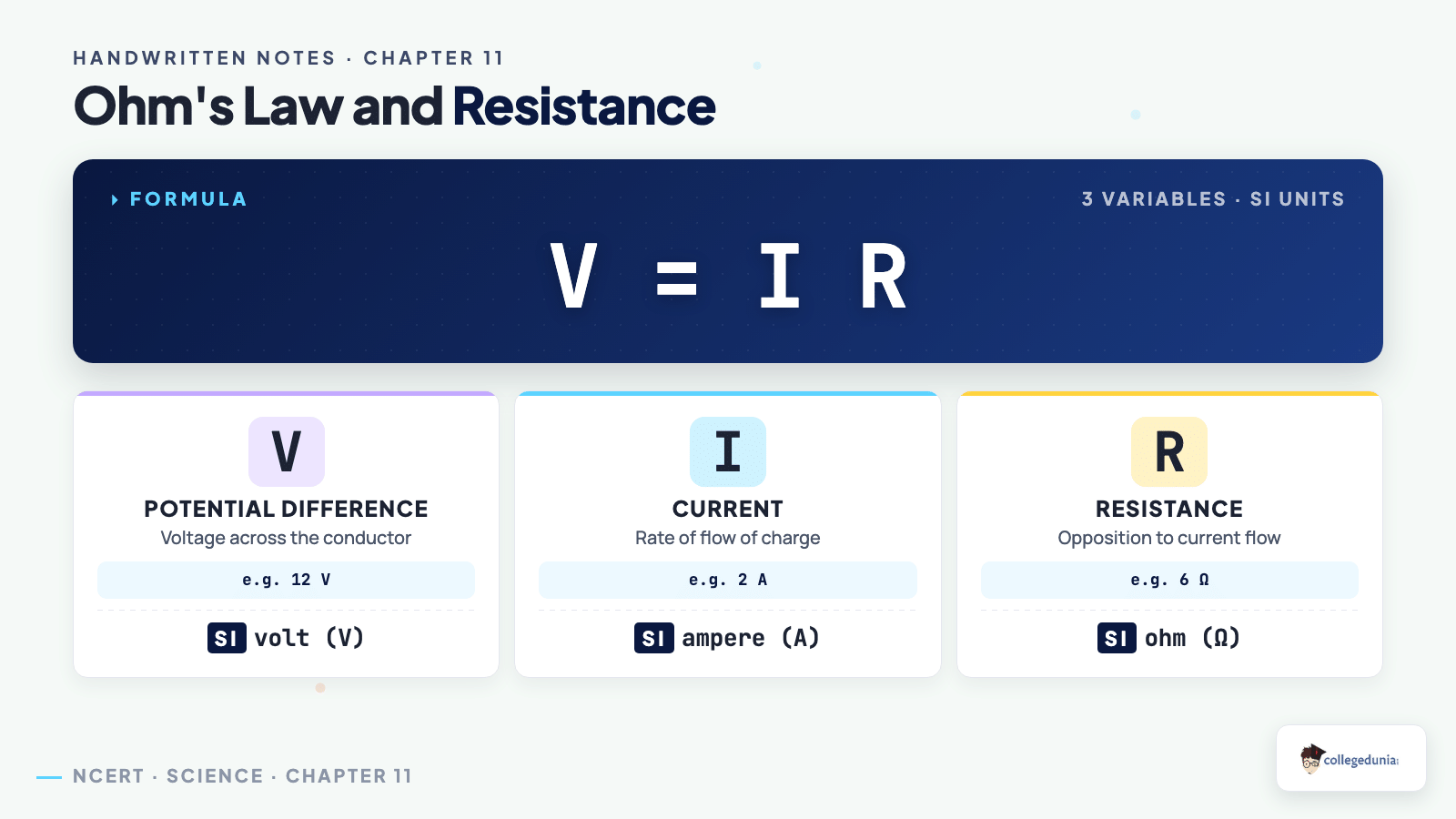
This is the page students revise most. Ohm's law states that, at constant temperature, the current through a conductor is directly proportional to the potential difference across it:
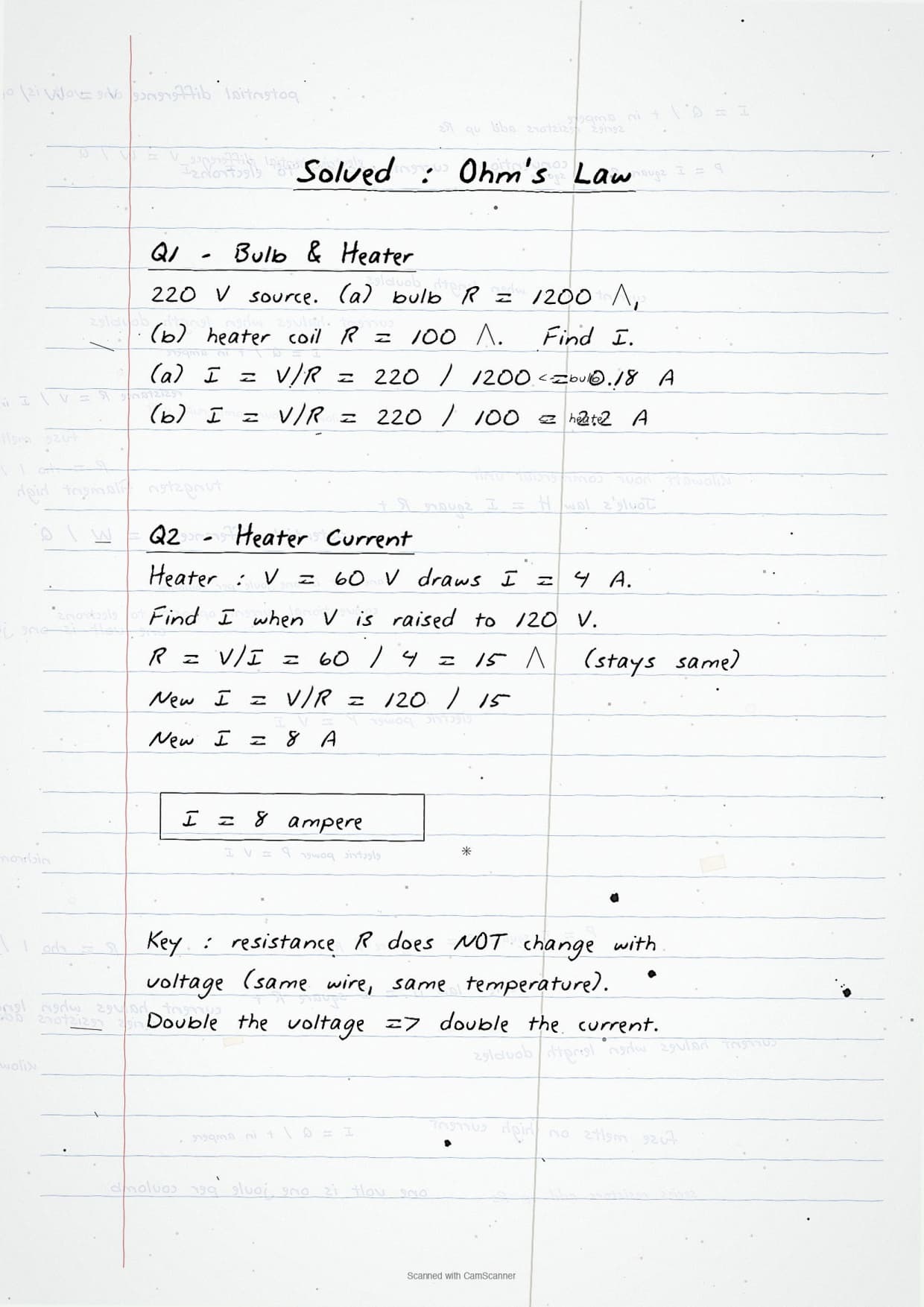
V = I R so R = VI
- Resistance (R): the property that opposes current, in ohm (Ω); 1 Ω when 1 V drives 1 A.
- V-I graph: for an ohmic conductor it is a straight line through the origin, and its slope gives the resistance.
- A good conductor has low resistance; an insulator very high. A rheostat is a variable resistor used to change the current.
Factors Affecting Resistance and Resistivity
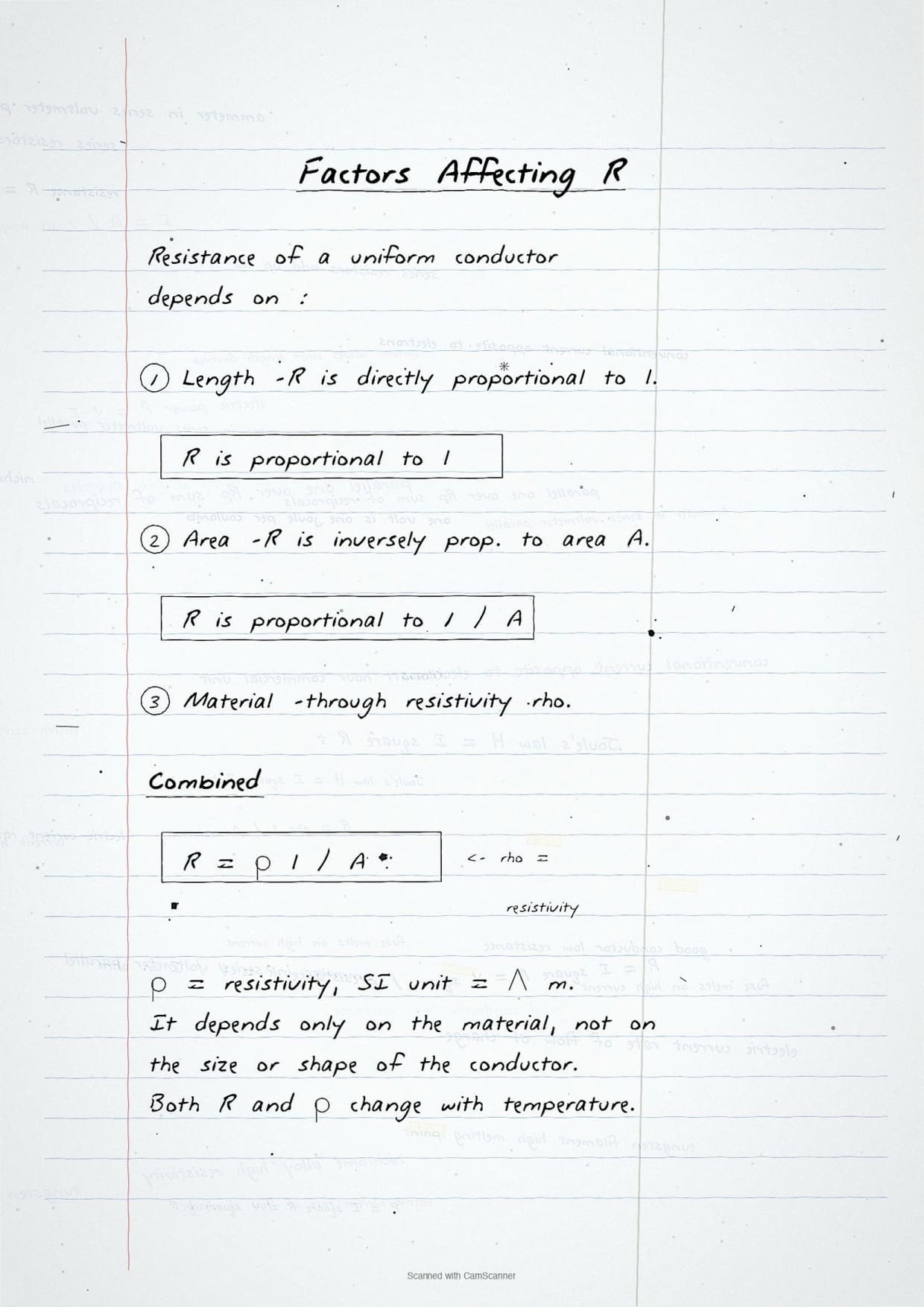
A "factors affecting resistance" question is a guaranteed 3-mark answer. The four factors that decide the resistance of a wire:
- Length (l): resistance is directly proportional to length, so a longer wire has more resistance.
- Area (A): resistance is inversely proportional to the area of cross-section, so a thicker wire has less resistance.
- Material: resistance depends on the nature of the material through its resistivity.
- Temperature: resistance of a metal increases as the temperature rises.
The formula tying the first three factors together, where ρ (rho) is the resistivity:
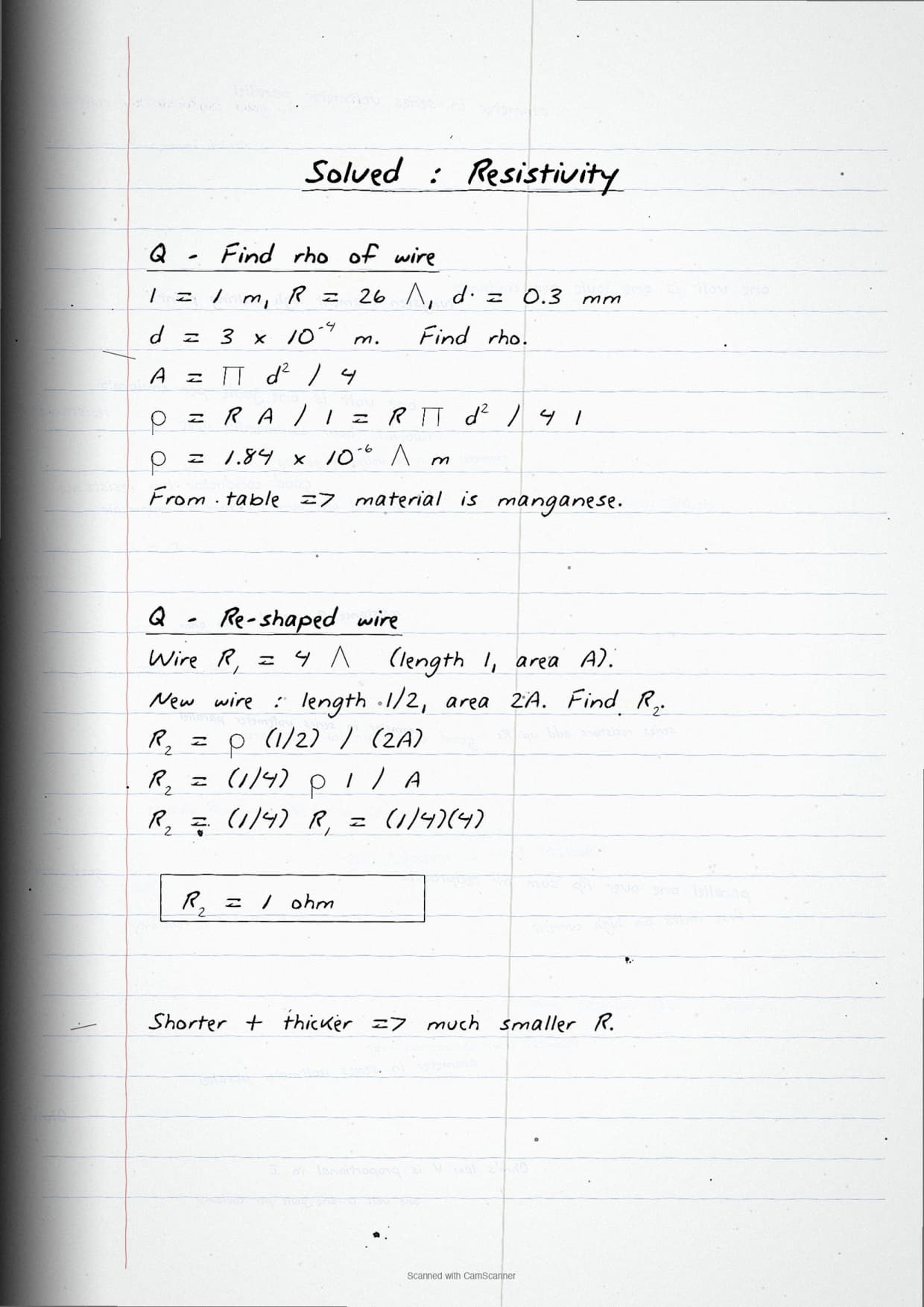
R = ρ lA
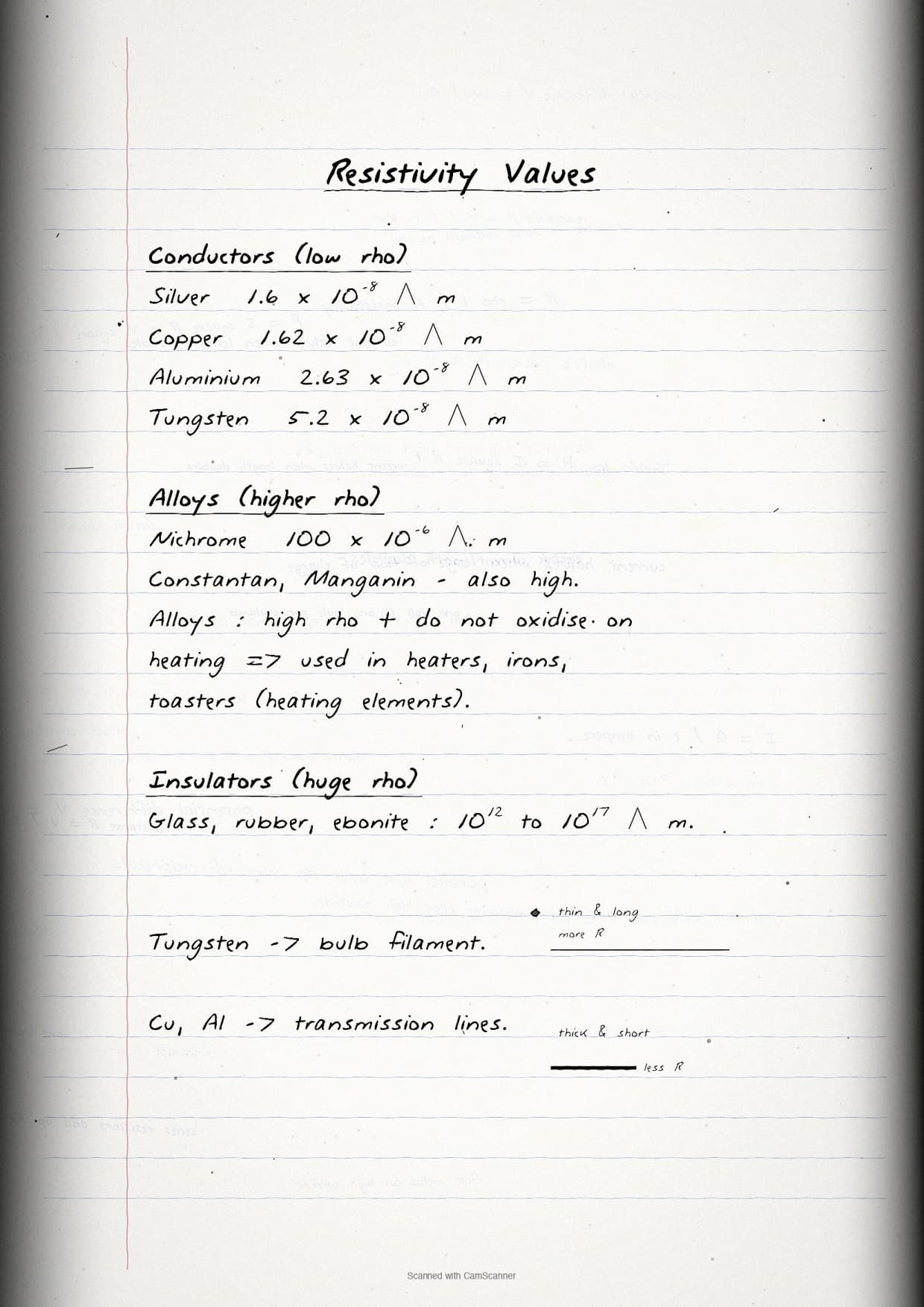
| Material | Type | Resistivity (Ω m) |
|---|---|---|
| Silver | Best conductor | 1.60 × 10⁻⁸ |
| Copper | Conductor | 1.62 × 10⁻⁸ |
| Nichrome | Alloy (heaters) | 100 × 10−8 |
| Rubber | Insulator | 1013–1016 |
Resistivity depends only on the material, while resistance changes with the size of the wire. Alloys like nichrome have high resistivity, so they are used as heating elements.
Resistors in Series and Parallel in the Notes
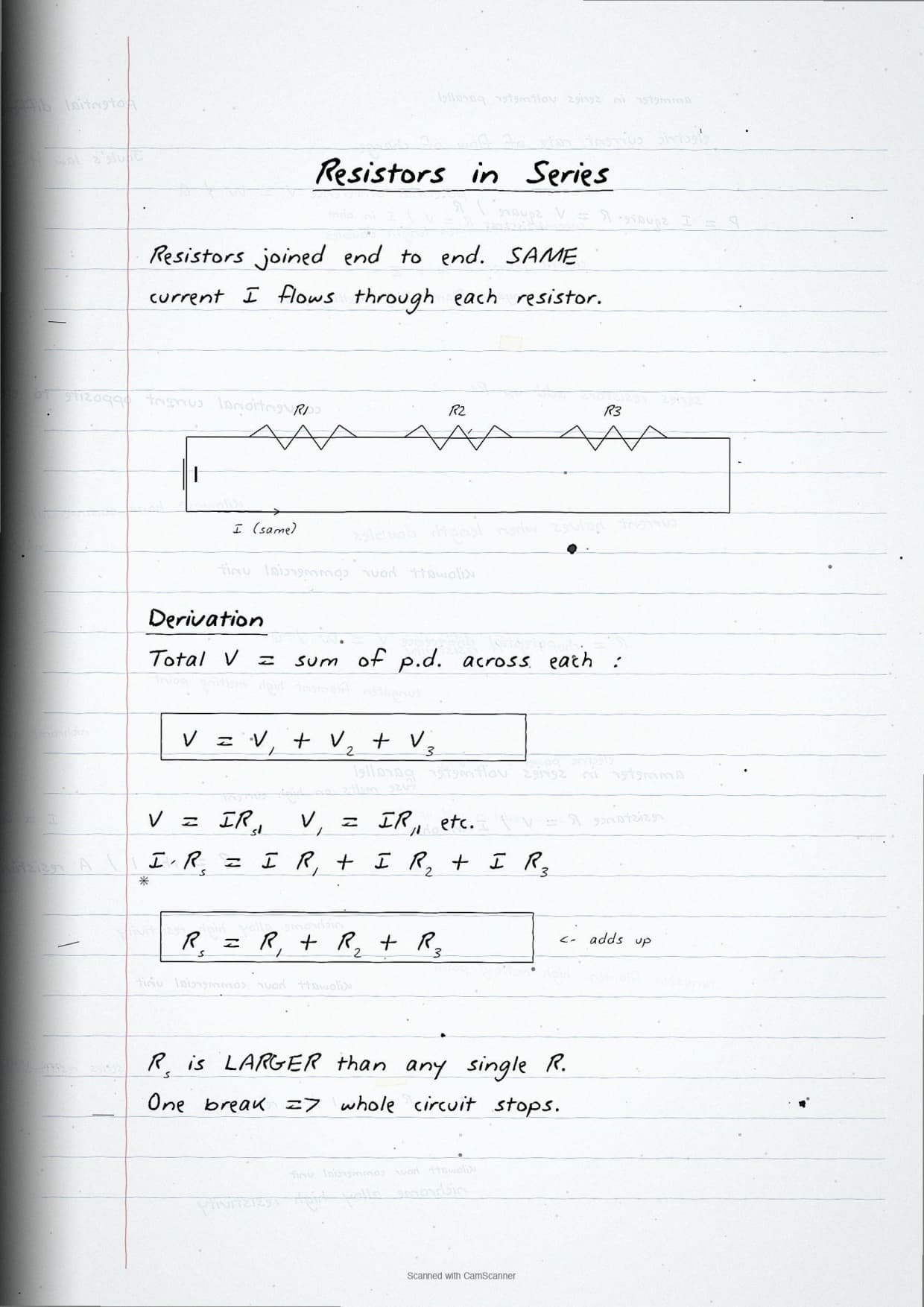
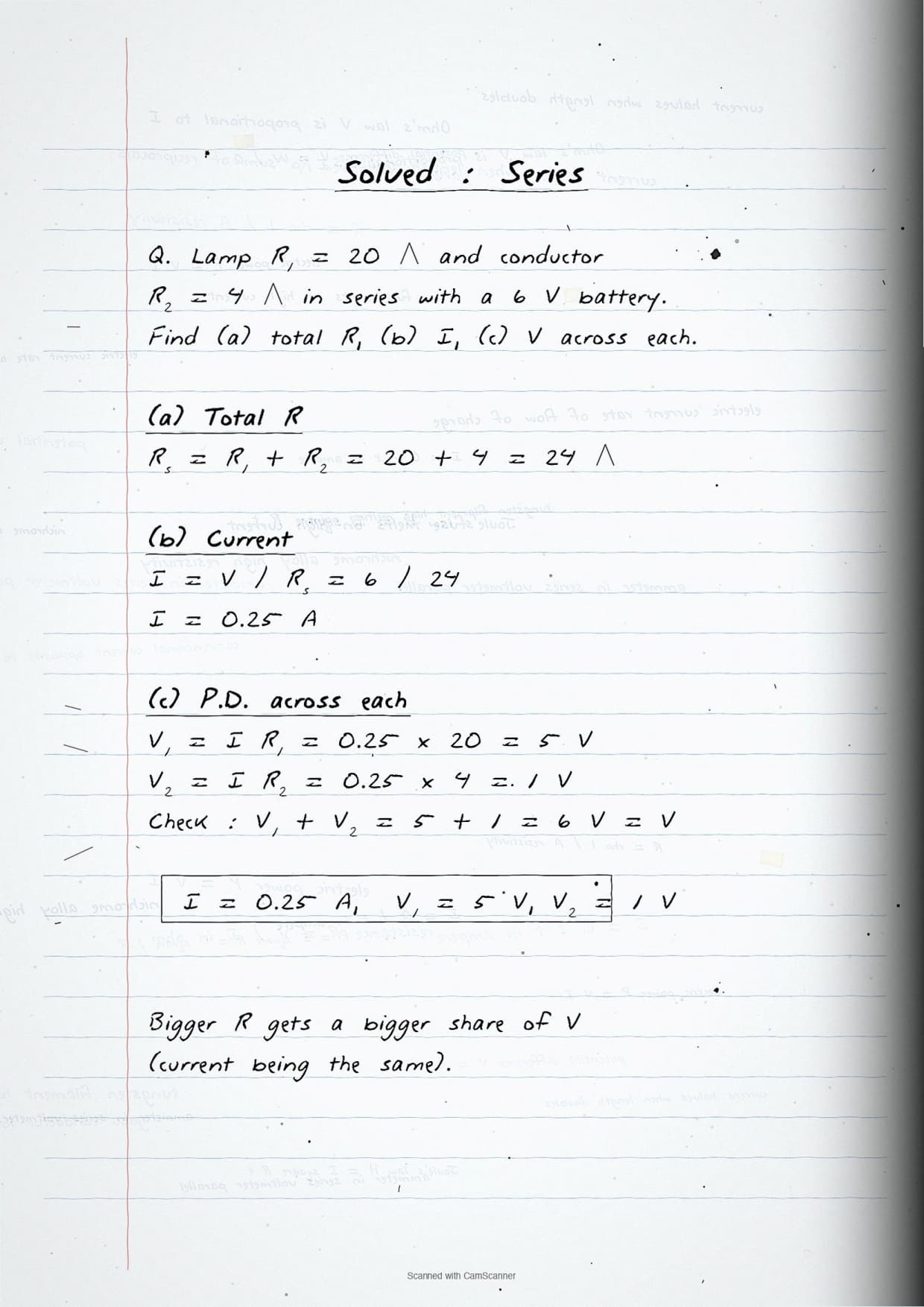
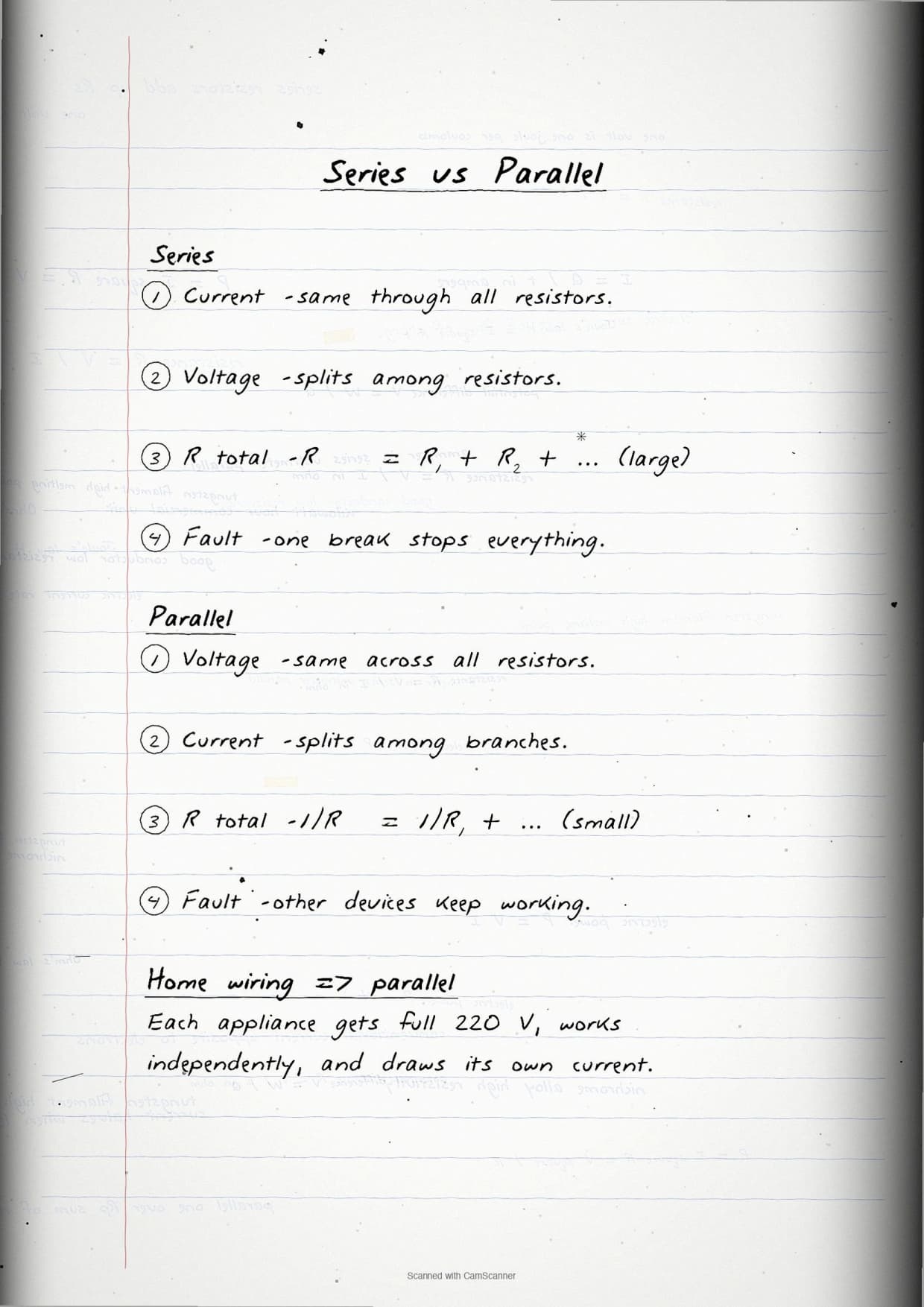
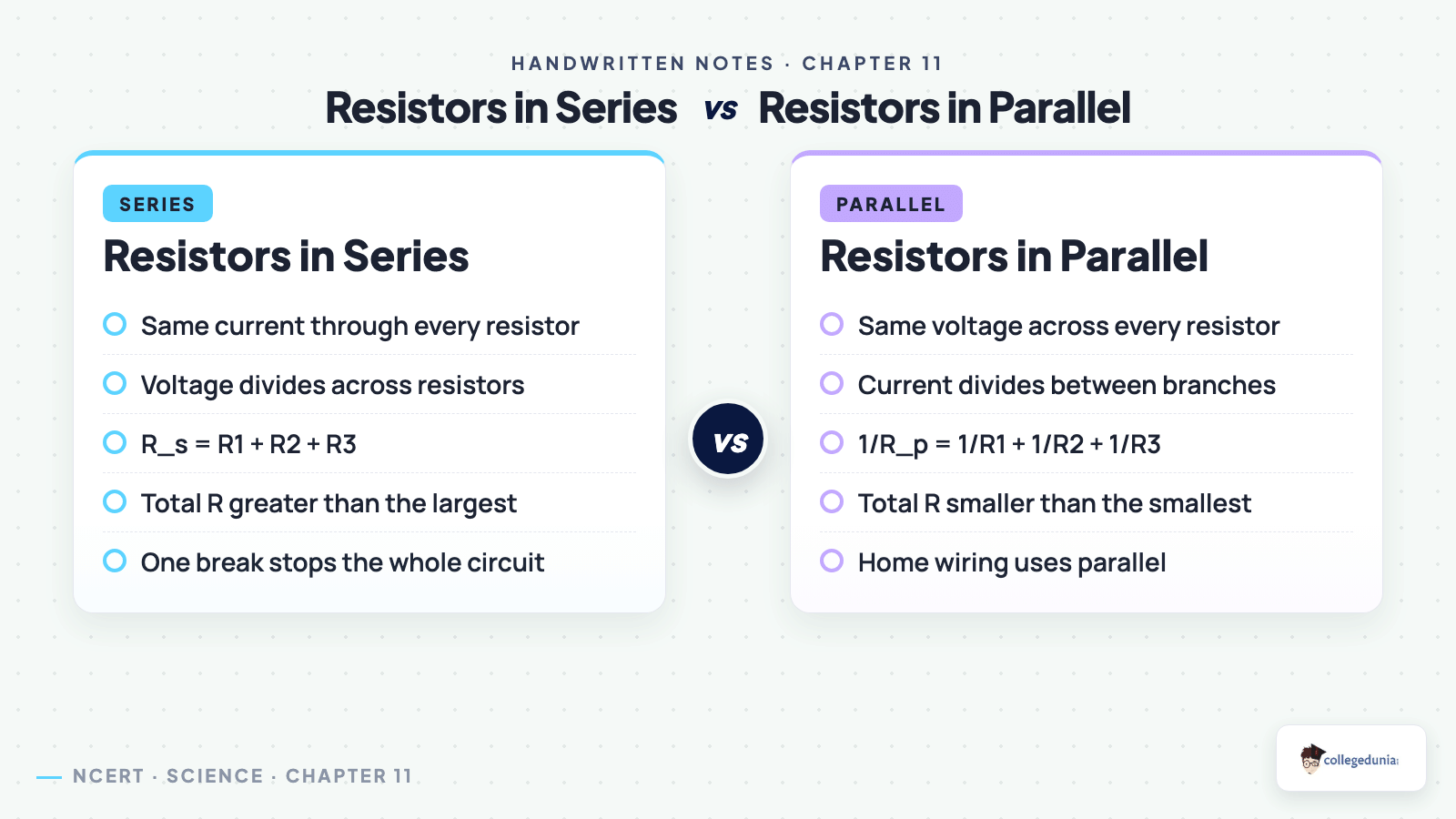
Finding the equivalent resistance is a sure 3-mark numerical. In a series combination the same current flows through each resistor and the equivalent resistance is the simple sum:
Rs = R1 + R2 + R3 + ...
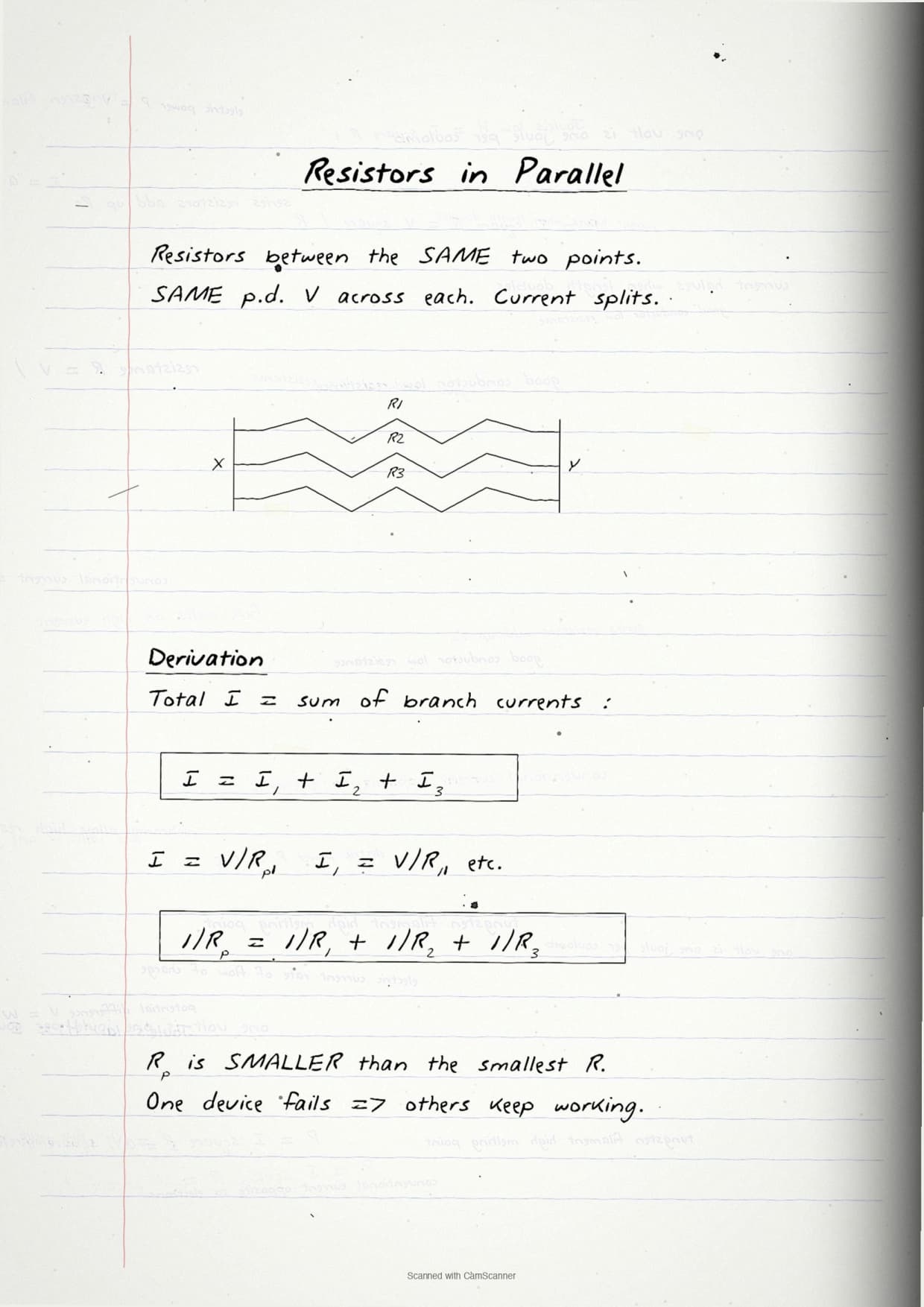
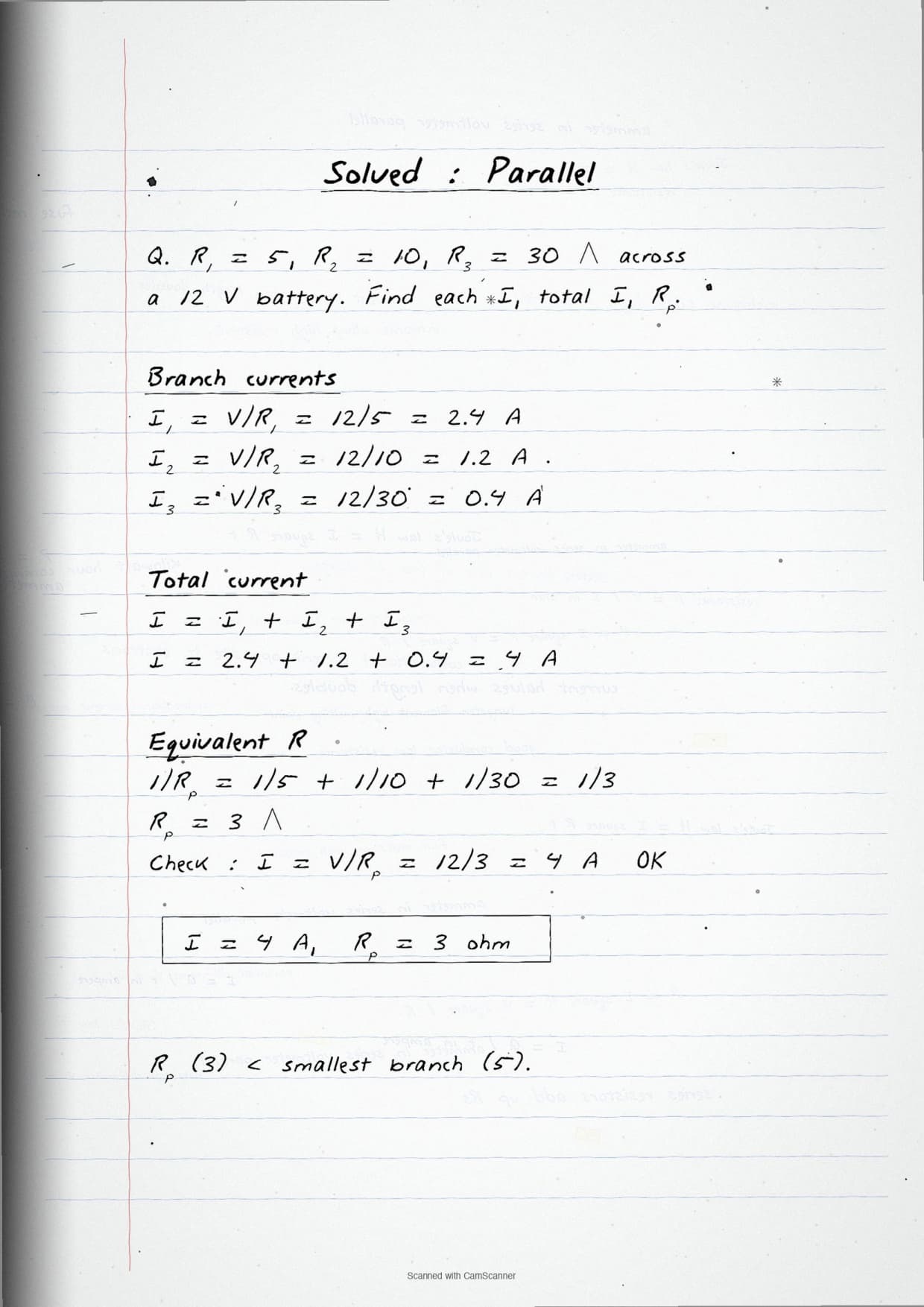
In a parallel combination the potential difference is the same across each resistor and the reciprocals add:
1Rp = 1R1 + 1R2 + 1R3 + ...
- Series current: same current through every resistor; total resistance is greater than the largest single resistor.
- Parallel voltage: same voltage across every resistor; total resistance is smaller than the smallest single resistor.
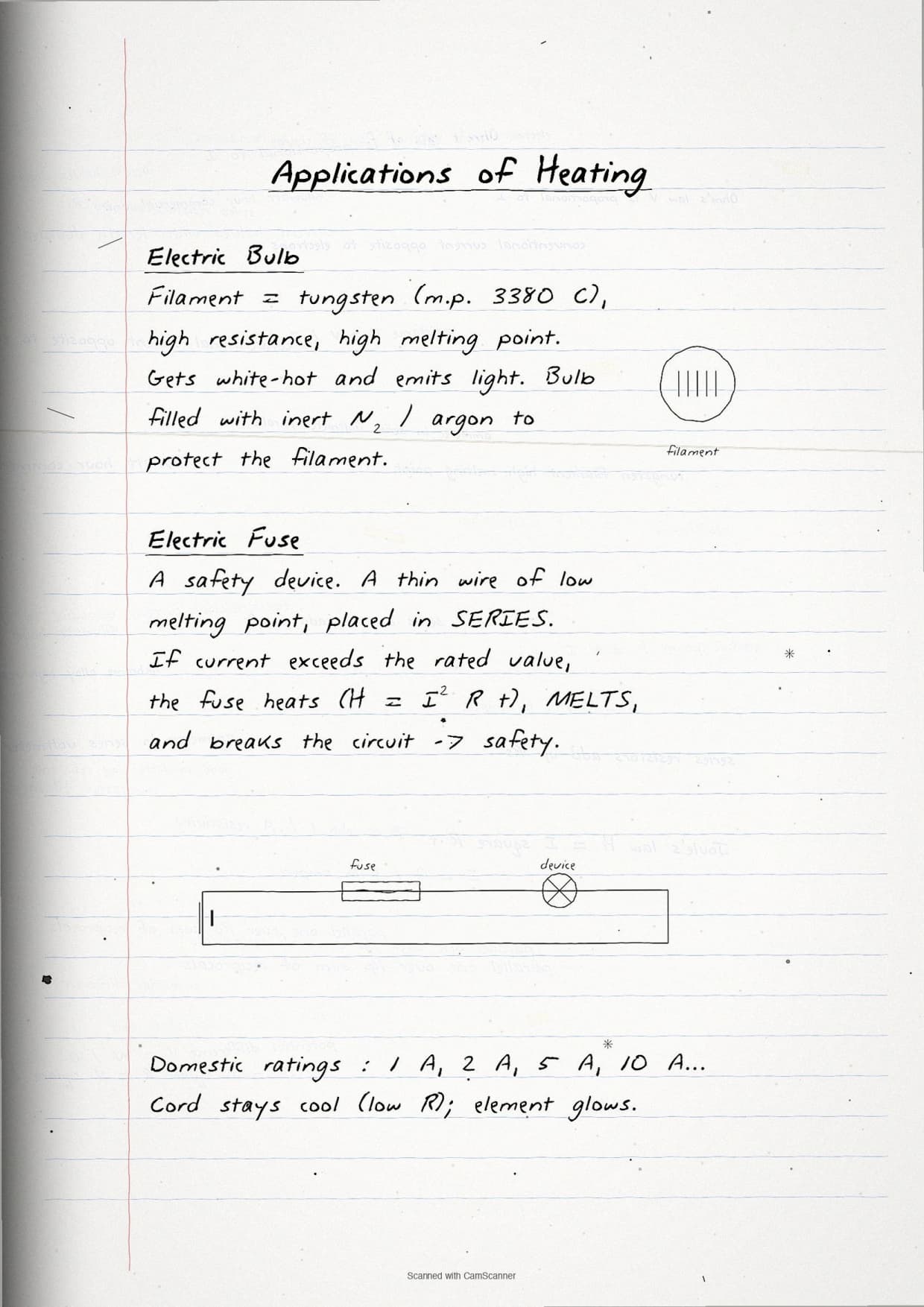
- Home wiring: appliances are in parallel, so each runs at full 220 V and any one can be switched off on its own.
Heating Effect, Joule's Law and Electric Power
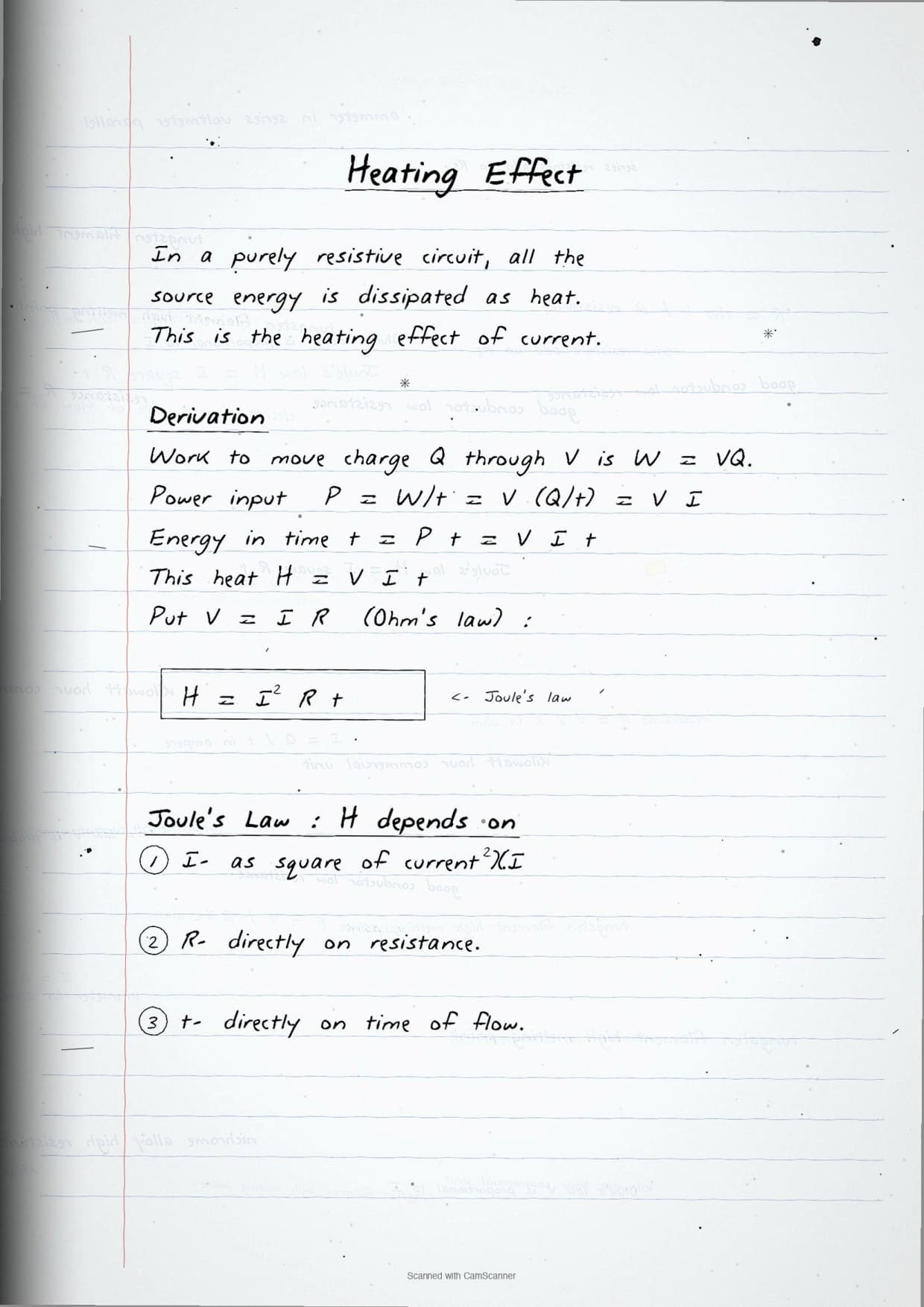
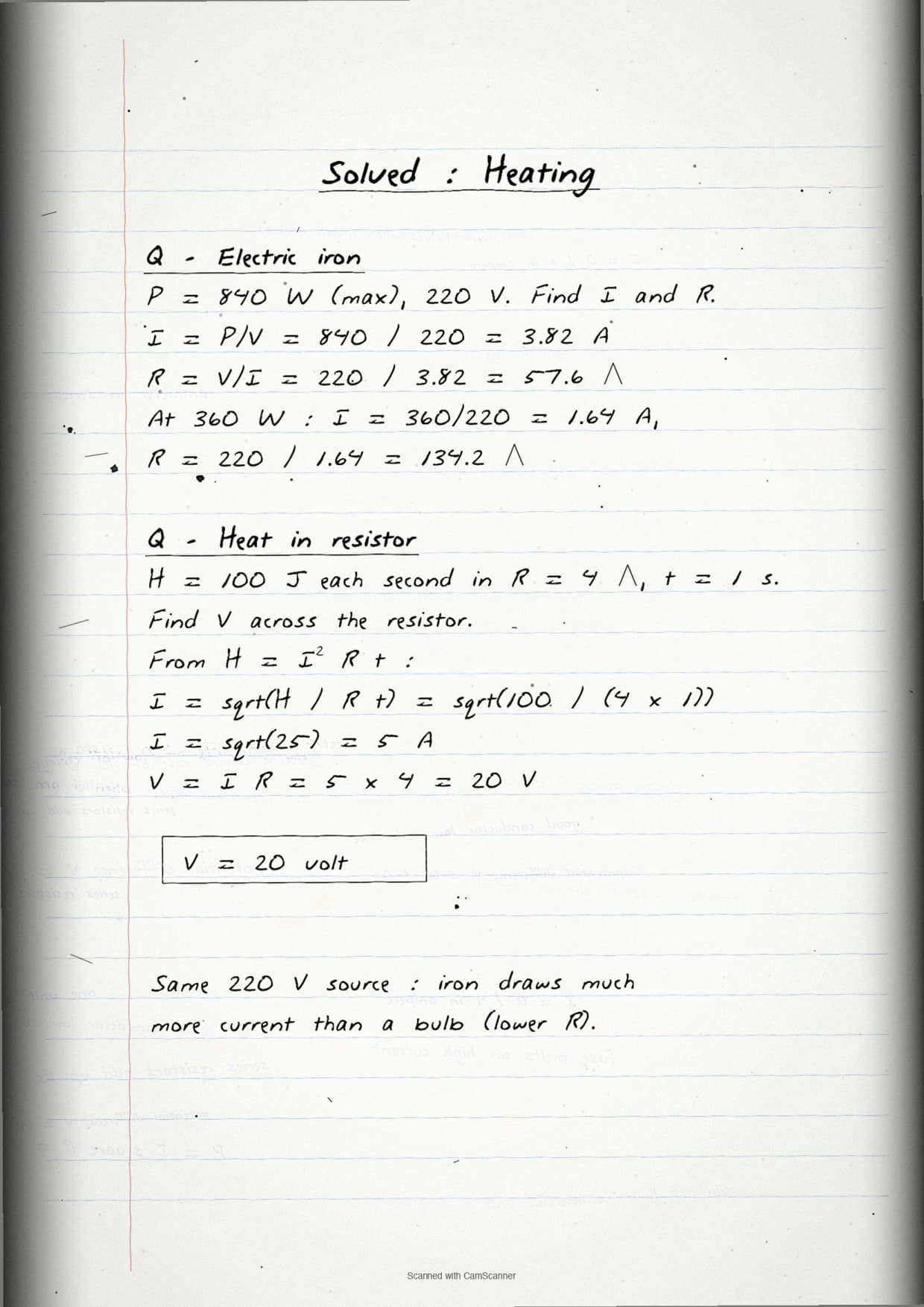
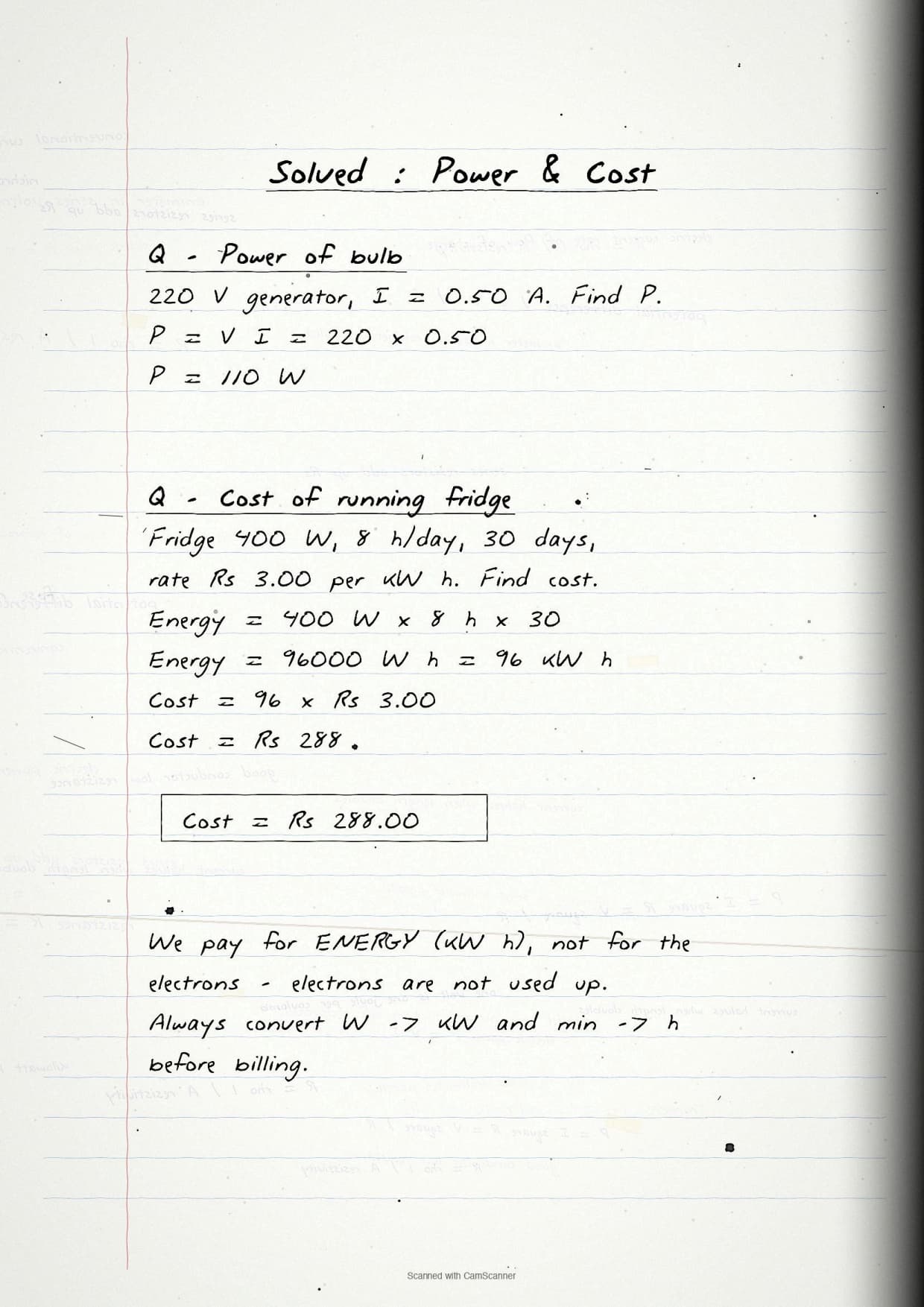
Most marks come from the heating effect, where a power or energy numerical appears in nearly every paper. Joule's law gives the heat H in a resistor R carrying current I for time t:
H = I2 R t
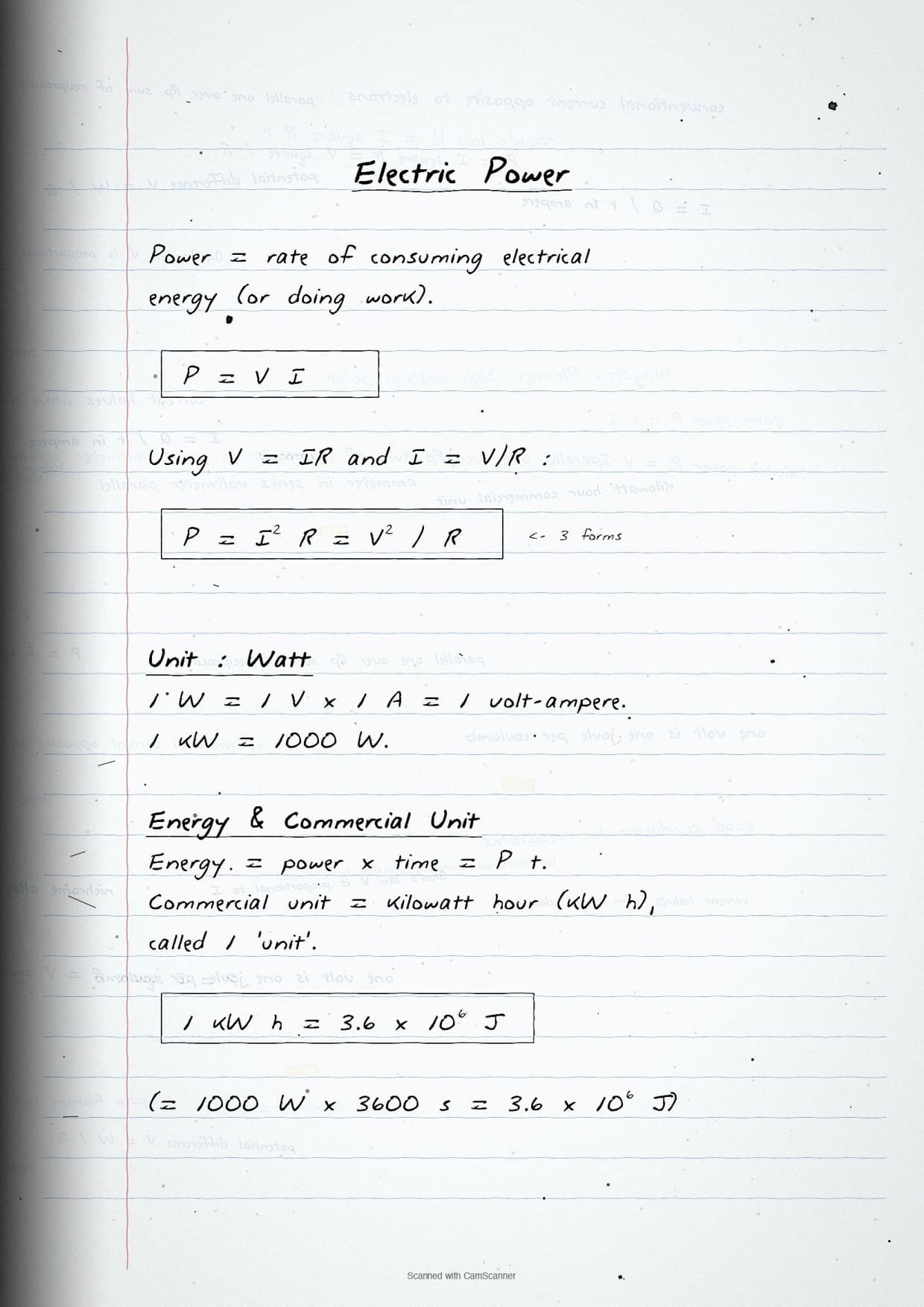
The electric power P is the rate at which energy is used, in three forms, each suiting a different set of given values:
P = V I = I2 R = V2R
- Unit of power: watt (W); 1 W is 1 joule per second, 1 kW = 1000 W.
- Commercial unit of energy: the kilowatt-hour (kWh) or 1 unit, where 1 kWh = 3.6 × 10⁶ J.
- Heating devices: a heater filament is nichrome for its high resistivity and melting point.
The heat is proportional to the square of the current, so doubling the current makes the heat four times as much. When voltage is fixed, choose P = V²/R; when current is fixed, choose P = I²R.
How to Use These Handwritten Notes Effectively
Handwritten notes work best as a final layer of revision. Use the Electricity handwritten notes like this before the board exam:
- First pass: read the pages in order, current and Ohm's law, then resistance and circuits, then heating and power.
- Active recall: cover the boxed diagrams and redraw the series and parallel circuits from memory.
- Formula drill: write Ohm's law, the series and parallel rules, Joule's law and the three power forms with units.
- Self-test: attempt a short drill to check the small facts and numericals.
Common Mistakes These Notes Help You Avoid
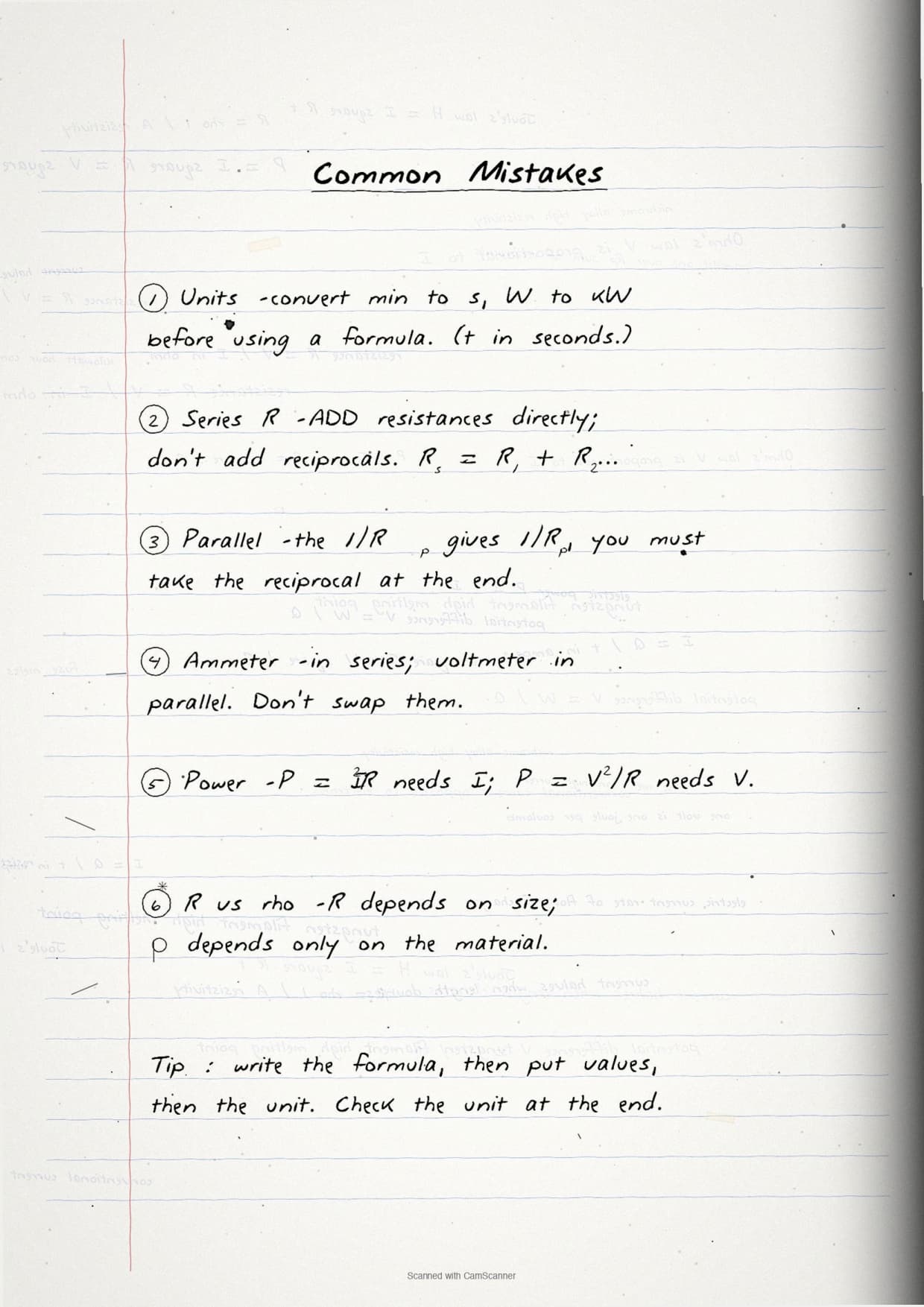
A few errors cost marks every year, mostly from swapping the series and parallel rules or picking the wrong power formula:
- Adding resistances directly in parallel. The reciprocals add: 1/Rp = 1/R1 + 1/R2.
- Connecting the ammeter in parallel. An ammeter is always in series, a voltmeter in parallel.
- Writing heat as H = I R t. Joule's law has a square: H = I2R t.
- Treating resistivity as if it changes with length. Resistivity depends only on the material.
- Using the kWh as a unit of power. The kWh is a unit of energy, not power.
The exam rewards exact formulas and correct units, so always state the law, write the right equation and label the circuit.
How These Notes Pair with the Solutions and Book PDF
These handwritten notes are a revision layer. Use them with the other resources for the same chapter, linked below.
| Resource | Best used for |
|---|---|
| Electricity NCERT Solutions | Step-by-step answers and numericals for every in-text and back-exercise question |
| Electricity Class 10 Notes | Quick typed summary with every law, circuit diagram and formula in one place |
| Electricity Formula Sheet | One-page quick reference of Ohm's law, resistance, power and energy formulas |
| Electricity NCERT Book PDF | Reading the original NCERT chapter text from the textbook |
All Class 10 Science Handwritten Notes by Chapter
The table links the handwritten notes for every chapter in Class 10 Science. Electricity is highlighted.
| Chapter | Handwritten Notes |
|---|---|
| Chapter 1 | Chemical Reactions and Equations |
| Chapter 2 | Acids, Bases and Salts |
| Chapter 3 | Metals and Non-metals |
| Chapter 4 | Carbon and its Compounds |
| Chapter 5 | Life Processes |
| Chapter 6 | Control and Coordination |
| Chapter 7 | How do Organisms Reproduce? |
| Chapter 8 | Heredity |
| Chapter 9 | Light - Reflection and Refraction |
| Chapter 10 | The Human Eye and the Colourful World |
| Chapter 11 | Electricity |
| Chapter 12 | Magnetic Effects of Electric Current |
| Chapter 13 | Our Environment |
FAQs on Electricity Handwritten Notes
Electricity Class 10 Science Handwritten Notes Common Questions
Ques. Are these class 10 science chapter 11 Electricity handwritten notes free to download?
Ans. Yes. The Electricity handwritten notes are free to download as a PDF from this page. They follow the 2026-27 NCERT syllabus and cover the full chapter across 23 scanned, hand-drawn-diagram pages for quick revision.
Ques. What does Chapter 11 Electricity cover in Class 10 Science?
Ans. The notes cover electric current and potential difference, Ohm's law and resistance, the V-I graph, the factors that affect resistance and resistivity, resistors in series and parallel, the heating effect of current, Joule's law of heating, and the three forms of the electric power formula, all of which the CBSE board paper tests directly.
Ques. What is the difference between resistors in series and in parallel?
Ans. In a series combination the same current flows through each resistor and the equivalent resistance adds up directly, Rs = R1 + R2 + R3. In a parallel combination the same voltage acts across each resistor and the reciprocals add, 1/Rp = 1/R1 + 1/R2 + 1/R3, so the equivalent resistance is smaller than the smallest single resistor.
Ques. What is Joule's law of heating in Class 10 Electricity?
Ans. Joule's law of heating states that the heat produced in a resistor is H = I2R t, where I is the current, R is the resistance and t is the time. The heat is directly proportional to the square of the current, so doubling the current makes the heat four times as much. This law explains how electric heaters, irons and toasters work.
Ques. Are these notes enough for the class 10 science chapter 11 board exam?
Ans. They are a strong final revision layer. For full preparation, pair them with the NCERT Solutions linked on this page so you can write out complete answers, draw the circuit diagrams and solve the numericals for every in-text and back-exercise question and check them against model answers.



Comments