




Class 10 Maths Chapter 8 Introduction to Trigonometry carries about 6 to 8 marks in the CBSE Board exam and opens the Trigonometry unit. These class 10 maths handwritten notes chapter 8 Introduction to Trigonometry cover the six trigonometric ratios, the standard-angle table, complementary angles, and the three core identities.
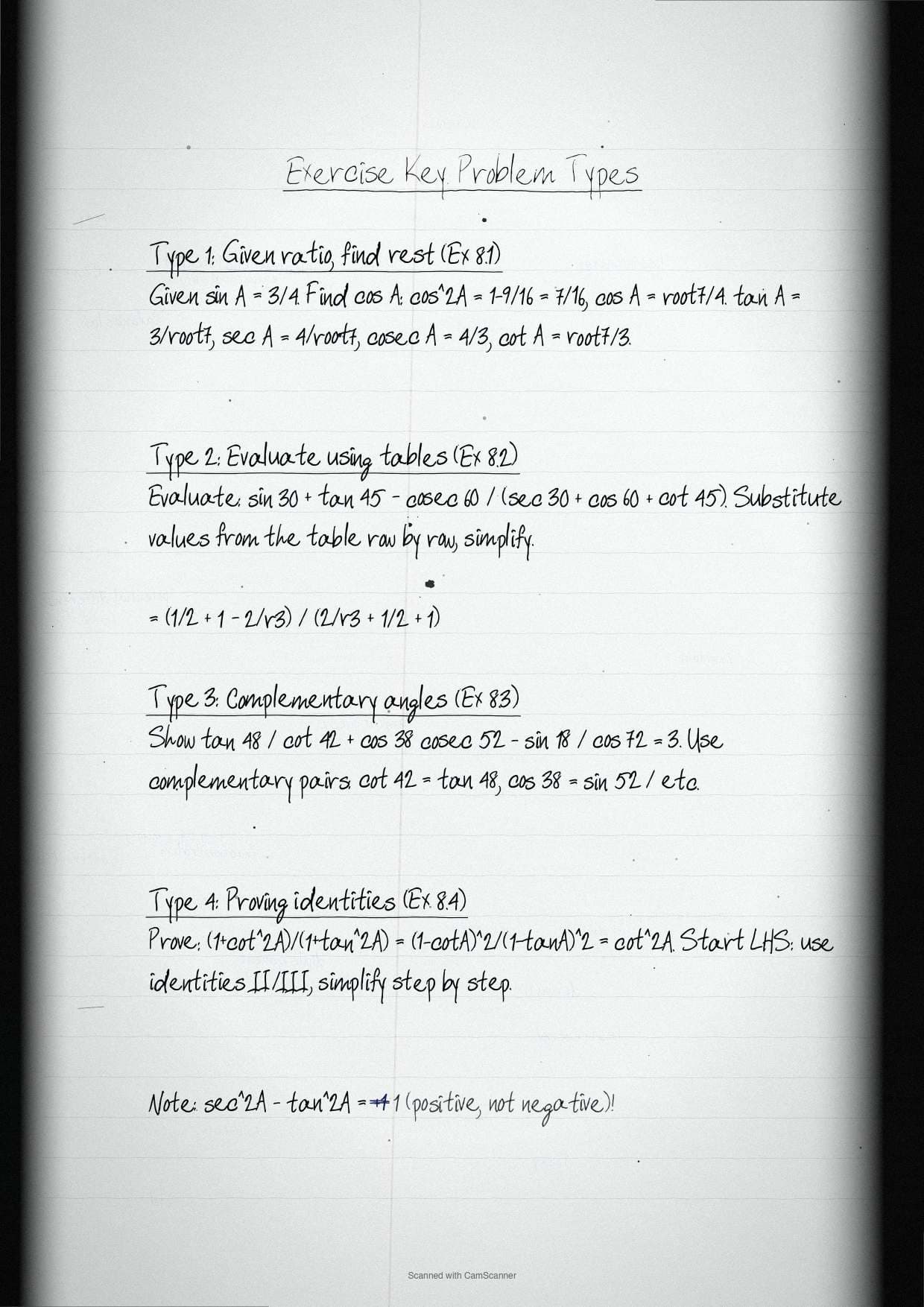
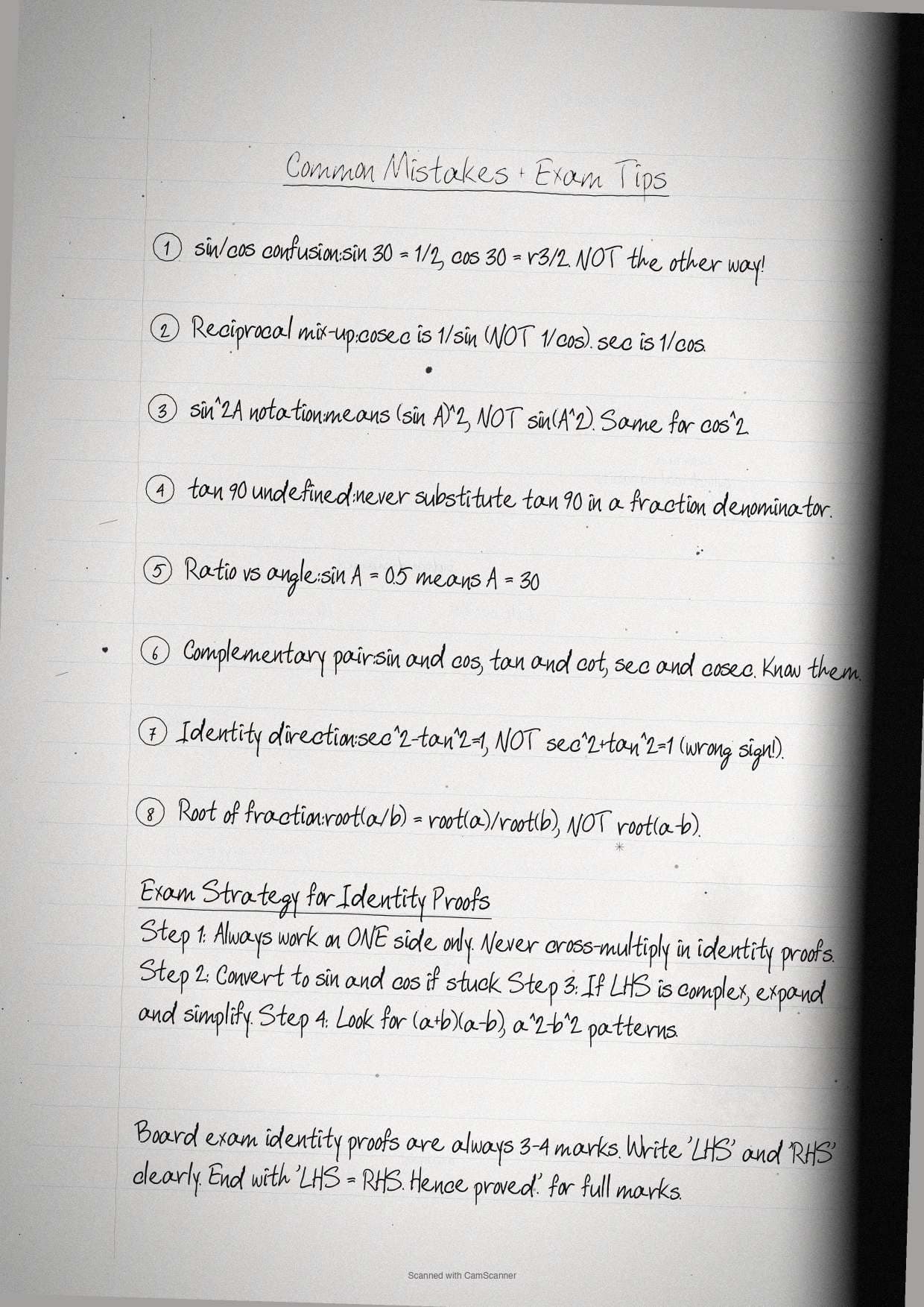
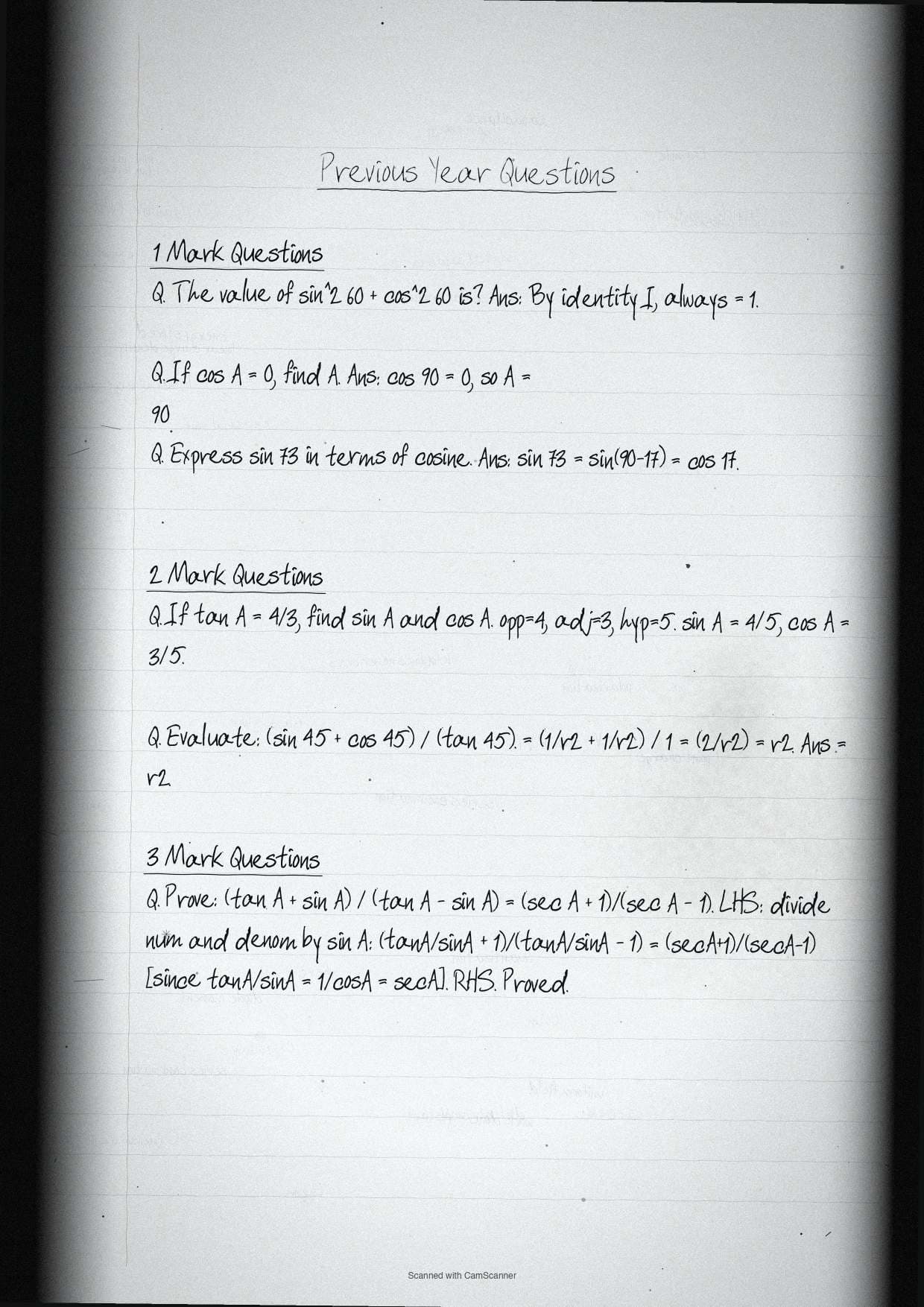
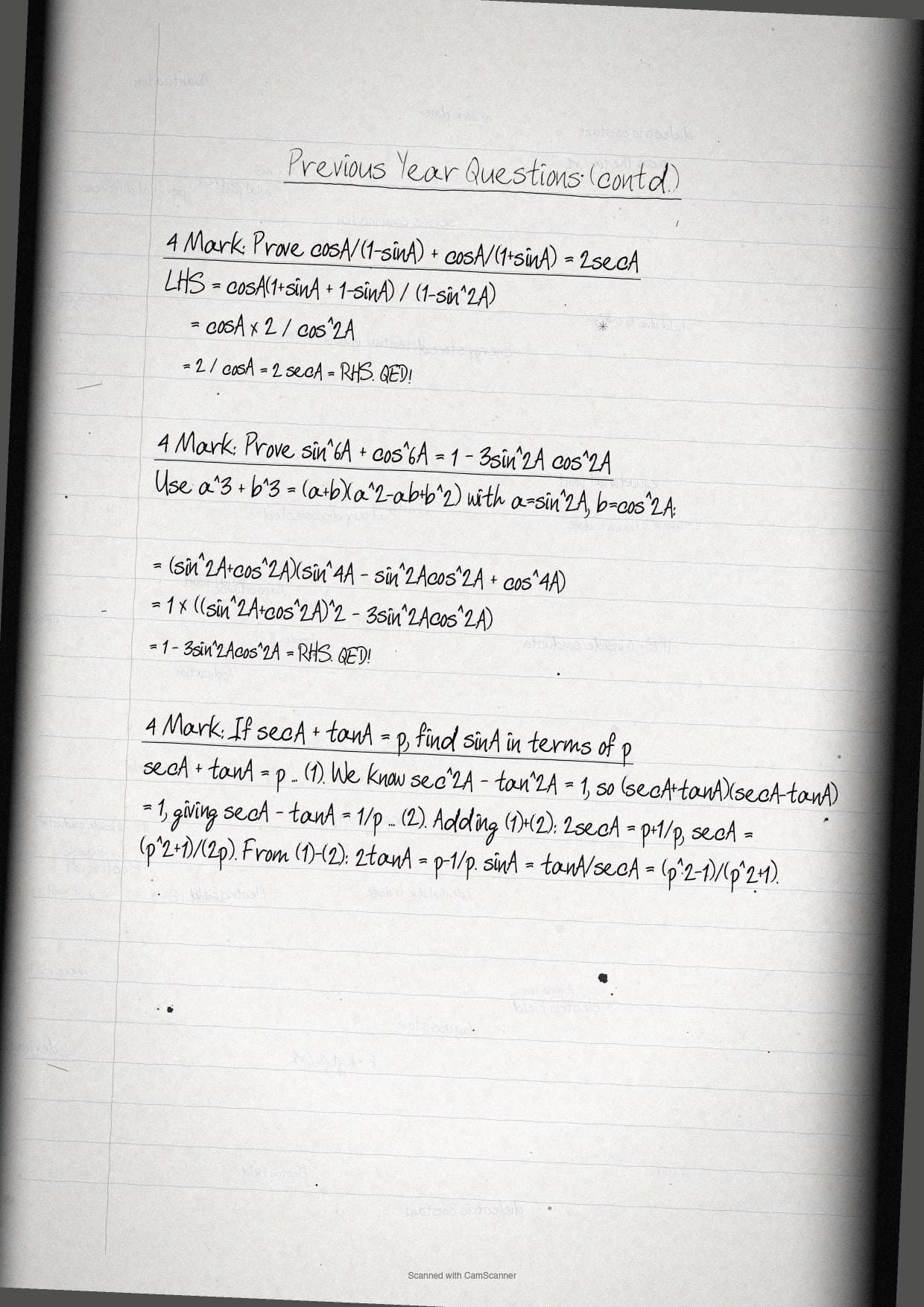
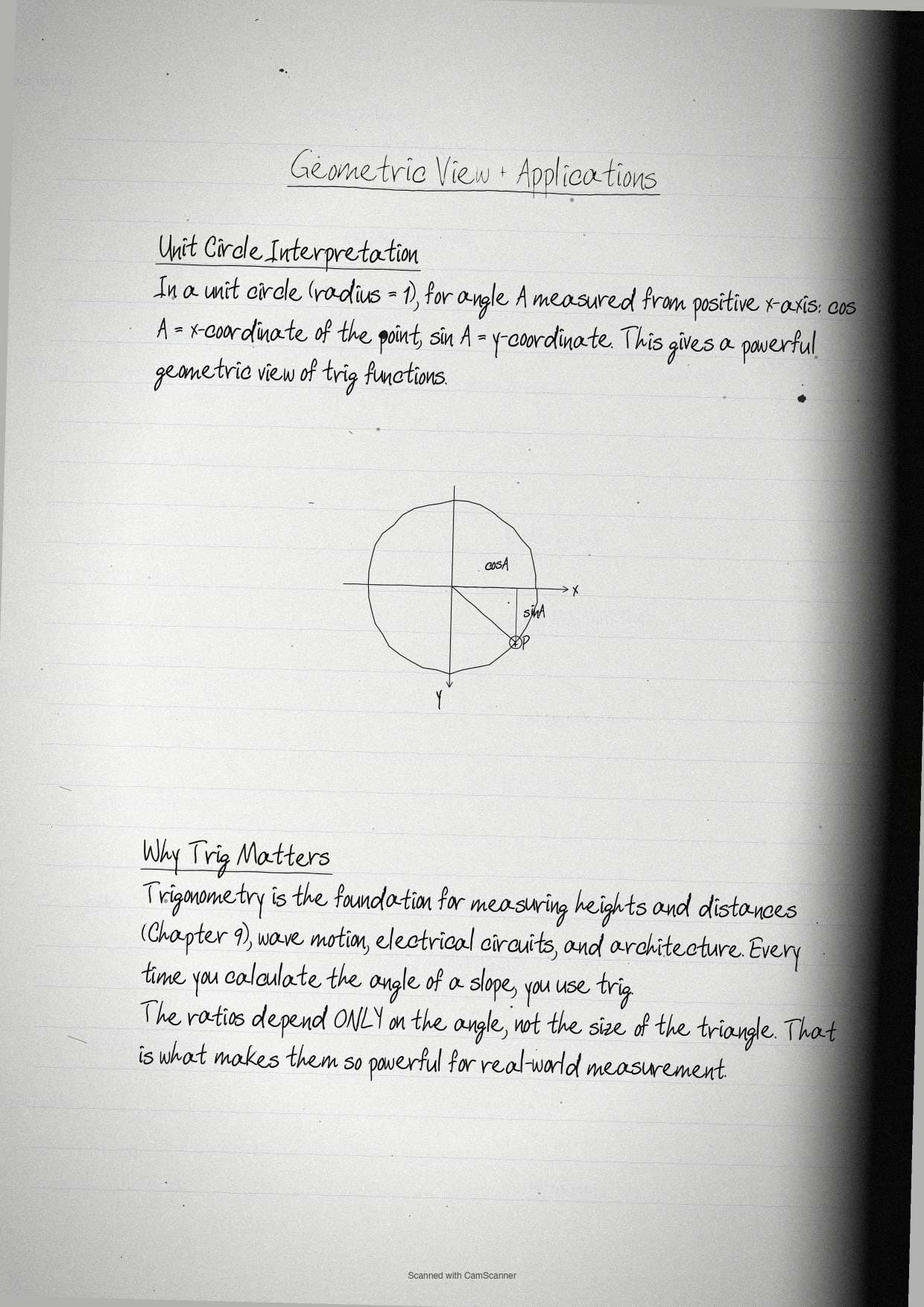
- CBSE Board: about 6 to 8 marks across the full Trigonometry unit, usually one ratio sum plus one identity proof
- JEE Main: the ratios and identities form the base for wider trigonometry in higher classes
The handwritten notebook opens with the diagram list, walks through the six ratios and the standard-angle table, then ends with a recall card. Every page matches the 2026-27 NCERT print.
|
Table of Contents |
Watch Introduction to Trigonometry Class 10 Maths Chapter 8 Explained
Source: Magnet Brains on YouTube
Topics Covered in Class 10 Maths Chapter 8 Introduction to Trigonometry Handwritten Notes
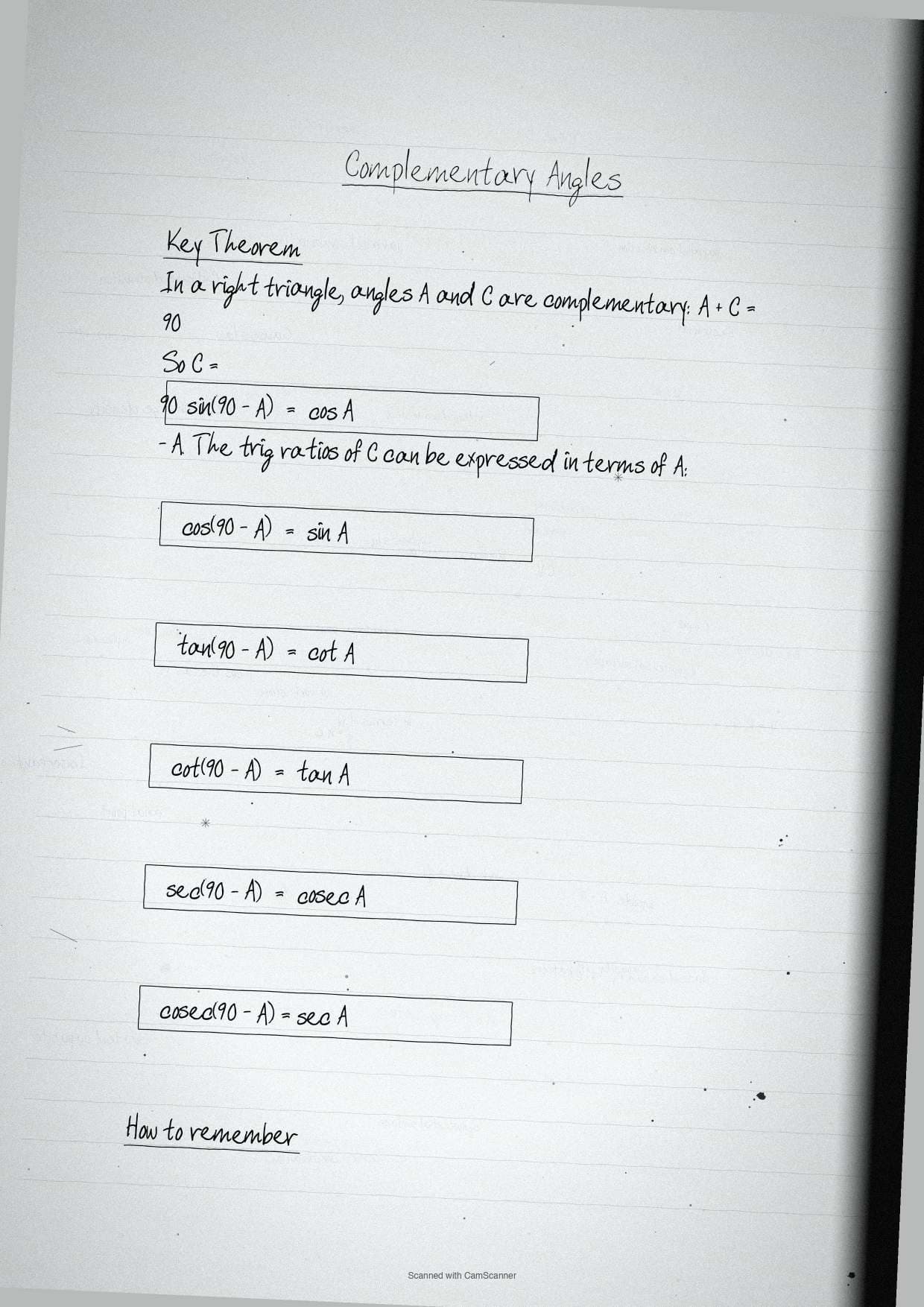
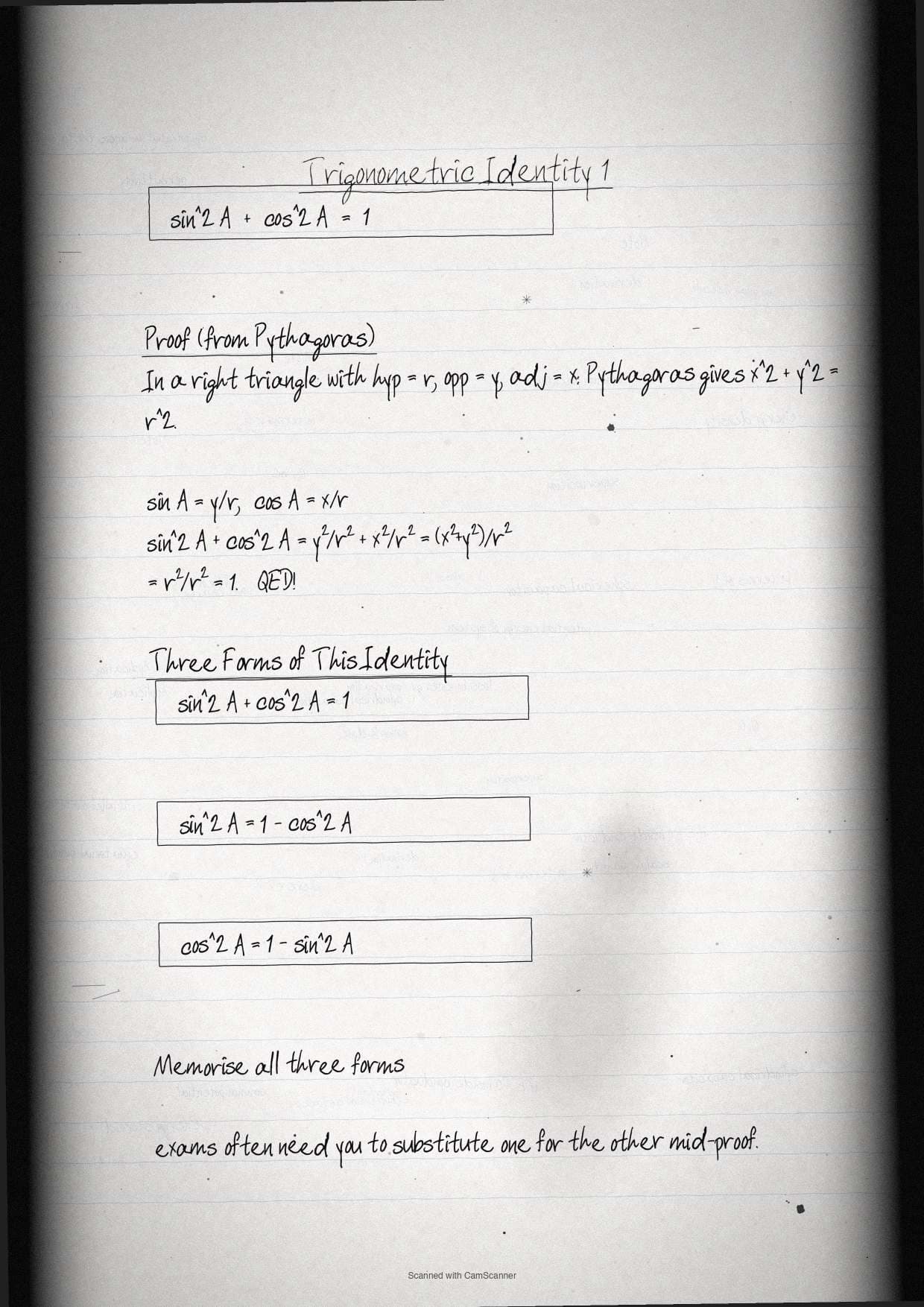
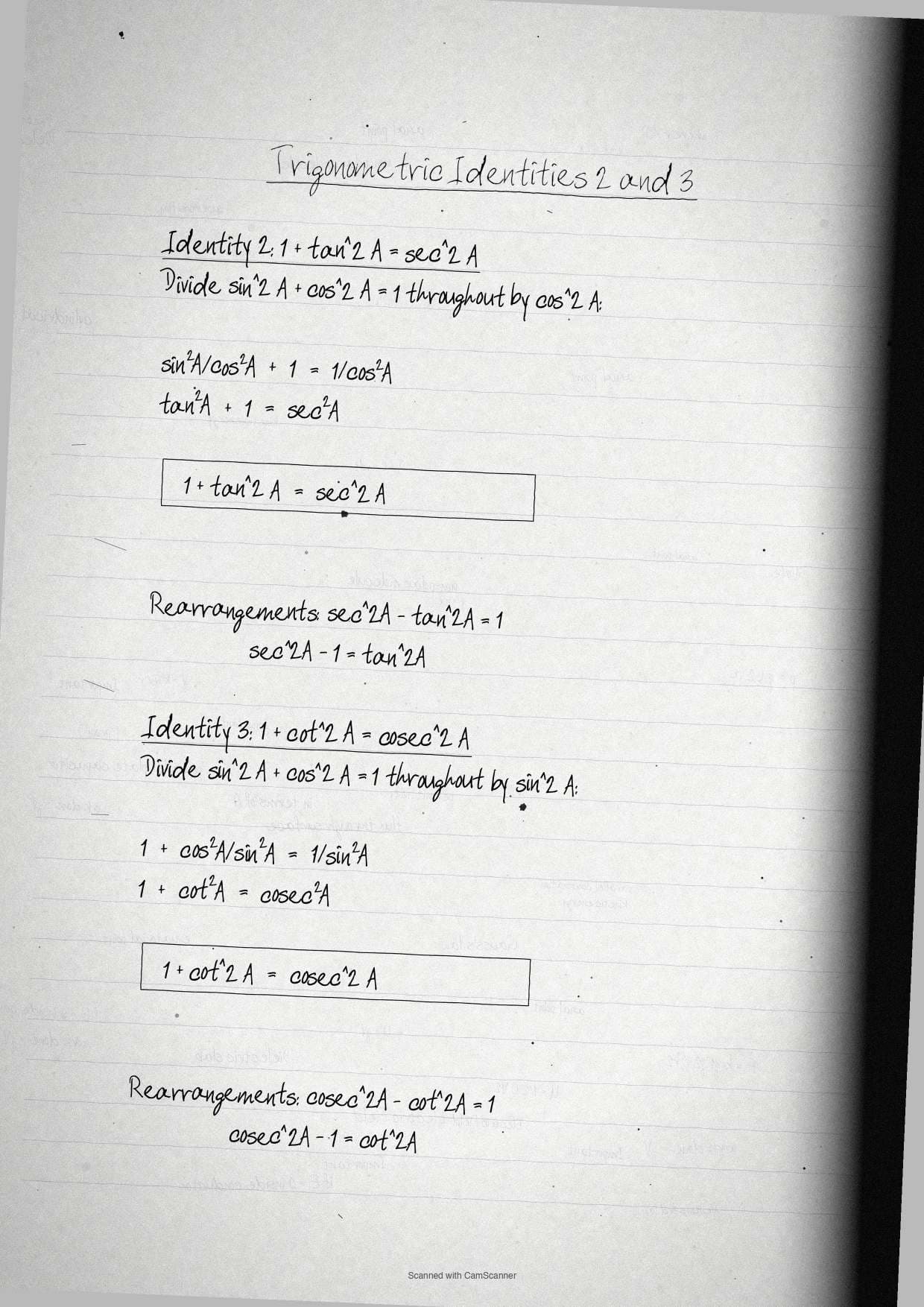
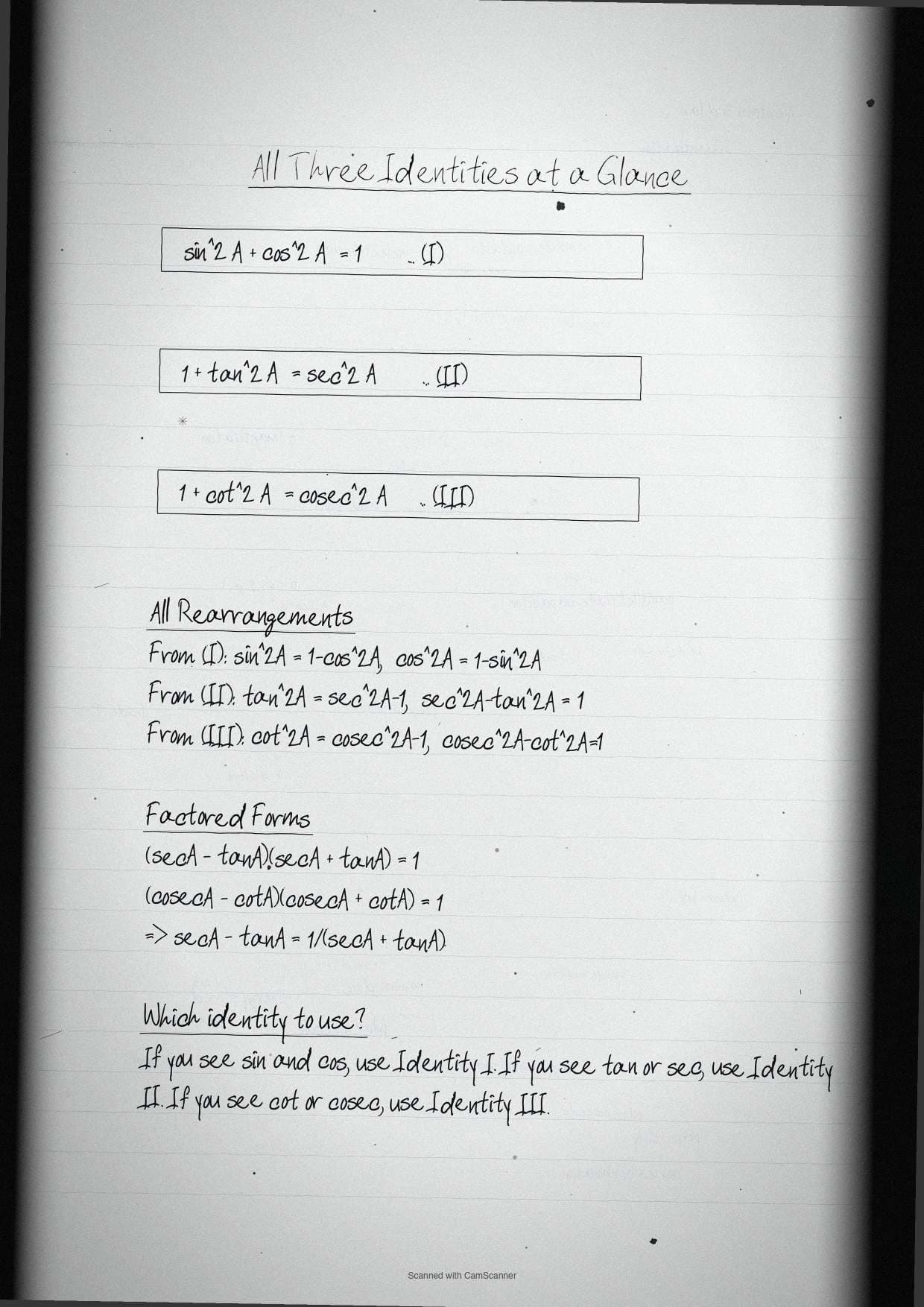
Each page is ink-coded by topic. It starts with the six trigonometric ratios of an acute angle, all from one labelled right triangle. Then come the standard-angle values for 0°, 30°, 45°, 60°, and 90° in one striped table, the complementary angles, and the three identities, sin2 A + cos2 A = 1, 1 + tan2 A = sec2 A, and 1 + cot2 A = csc2 A, each from the Pythagoras theorem.
Introduction to Trigonometry Handwritten Notes: Complete Diagram List for Class 10 Maths
The class 10 maths handwritten notes chapter 8 Introduction to Trigonometry hold 6 hand-sketched diagrams you can copy onto rough paper. The table maps each figure to its page.
| Page | Diagram | What It Shows |
|---|---|---|
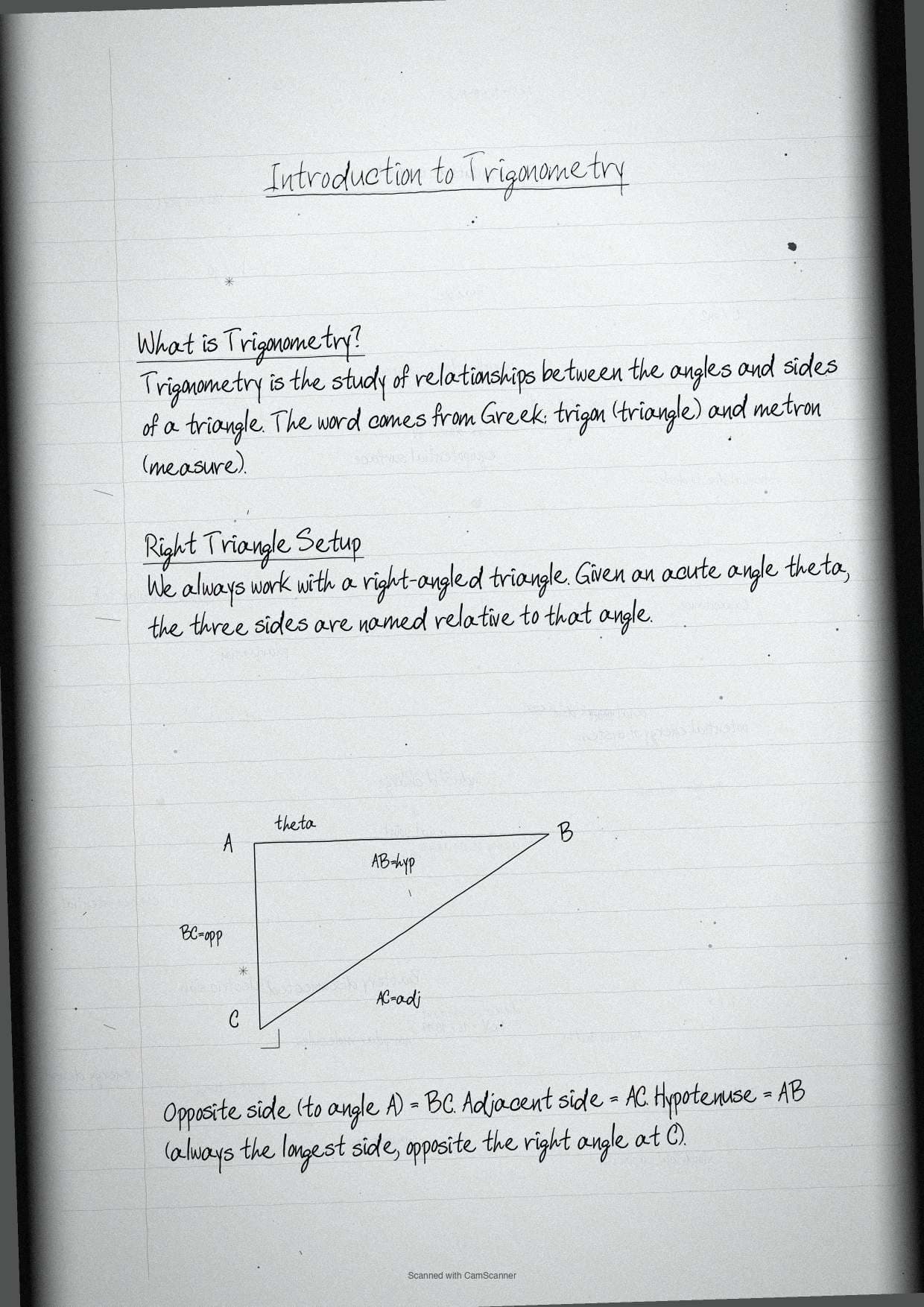
| 2 | Labelled right triangle | The opposite, adjacent, and hypotenuse sides marked against an acute angle A |
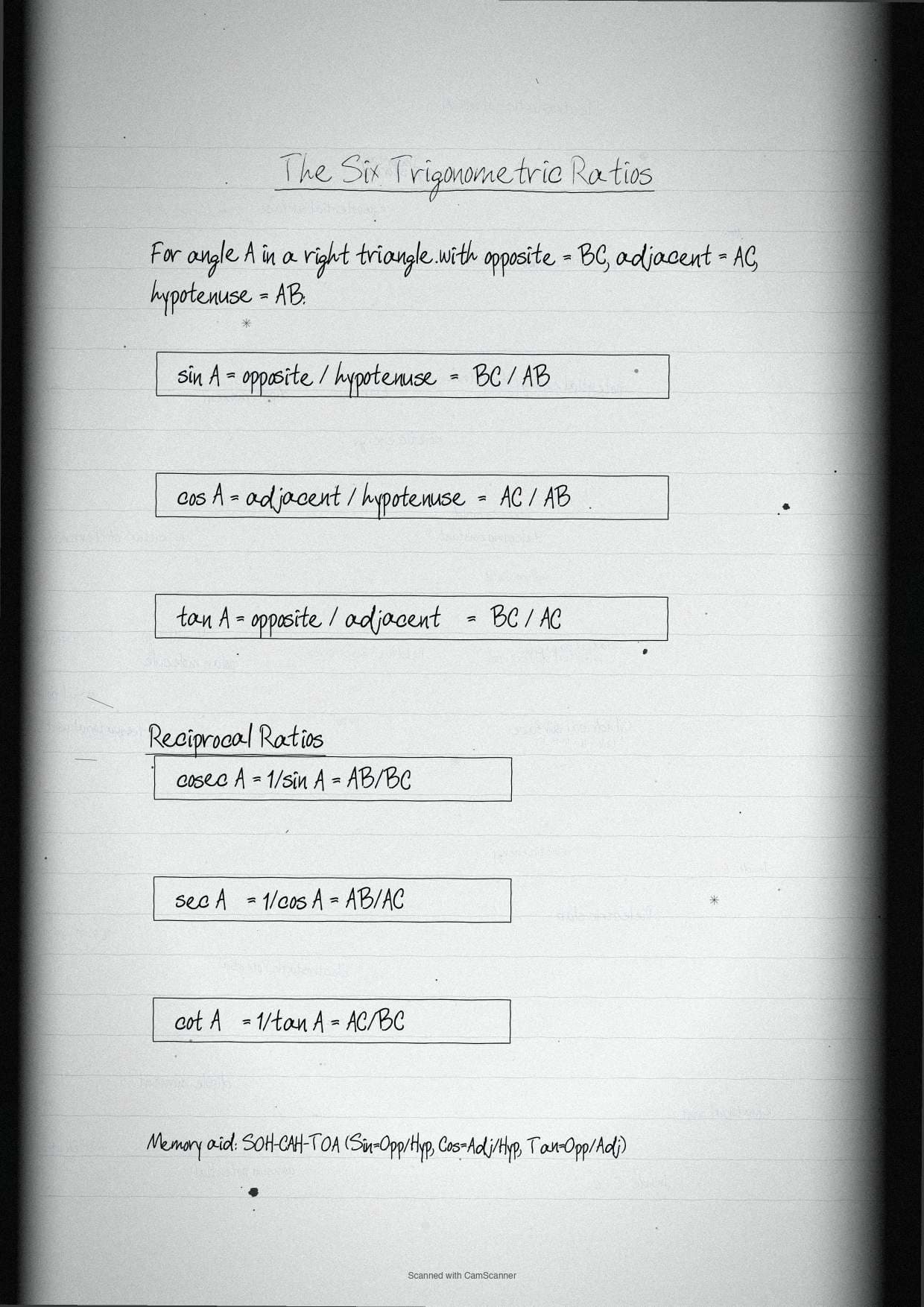
| 3 | Six-ratio wheel | All six ratios placed around the triangle, with each ratio paired to its reciprocal |
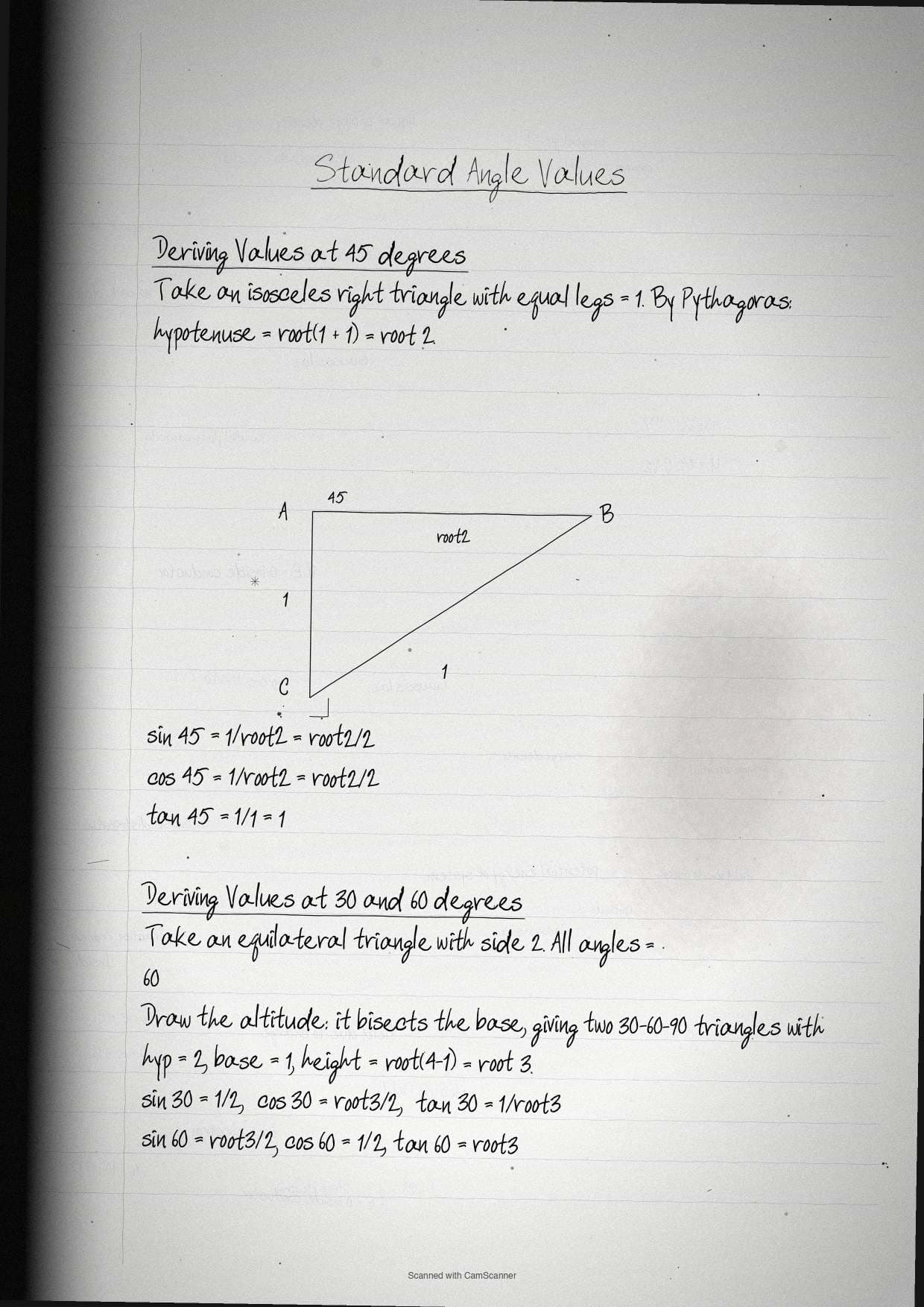
| 4 | Unit-side triangles | The 30-60-90 and 45-45-90 triangles that give the standard-angle values |
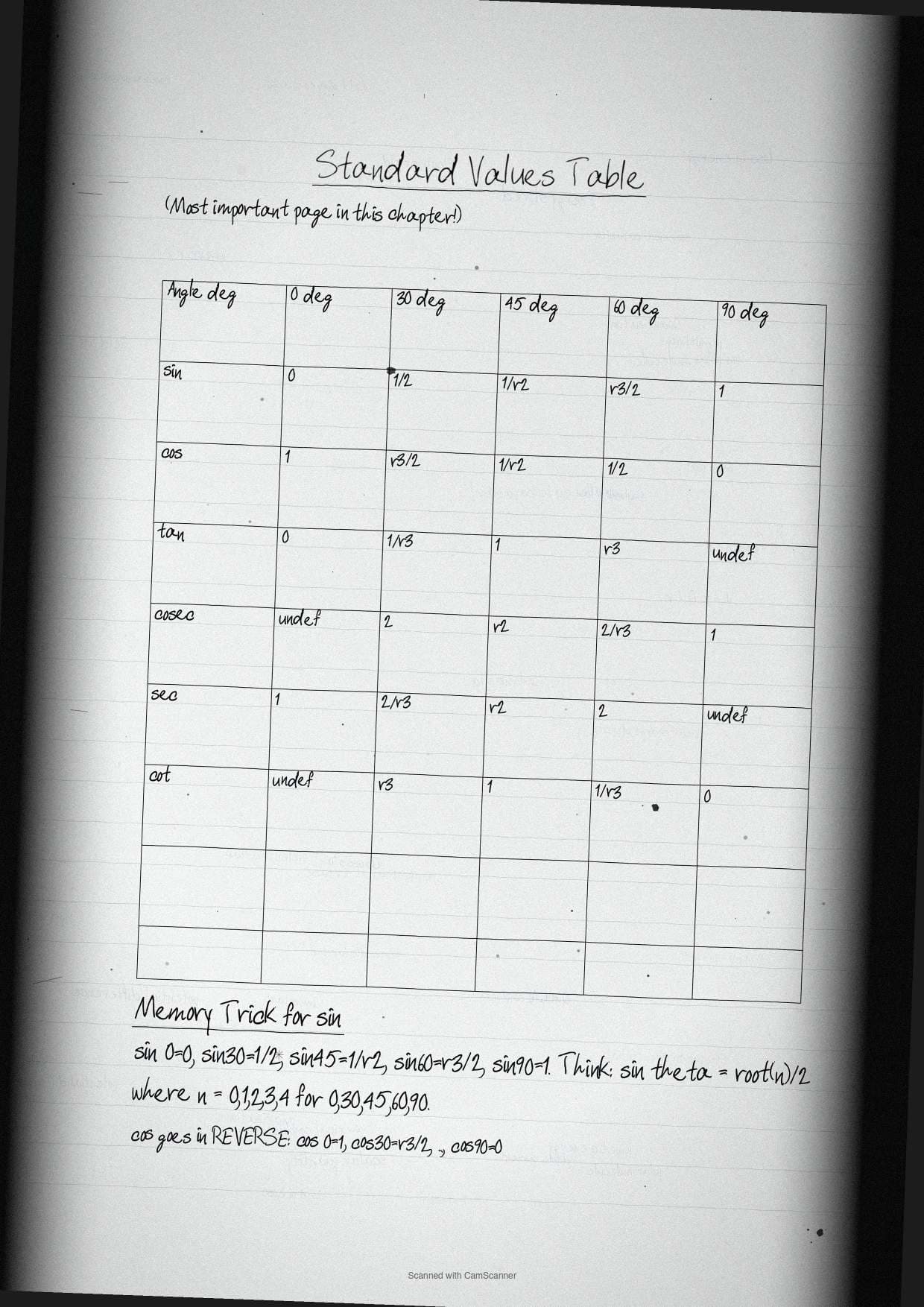
| 5 | Standard-angle value grid | The full table of sin, cos, and tan from 0° to 90° in a clean sketch |
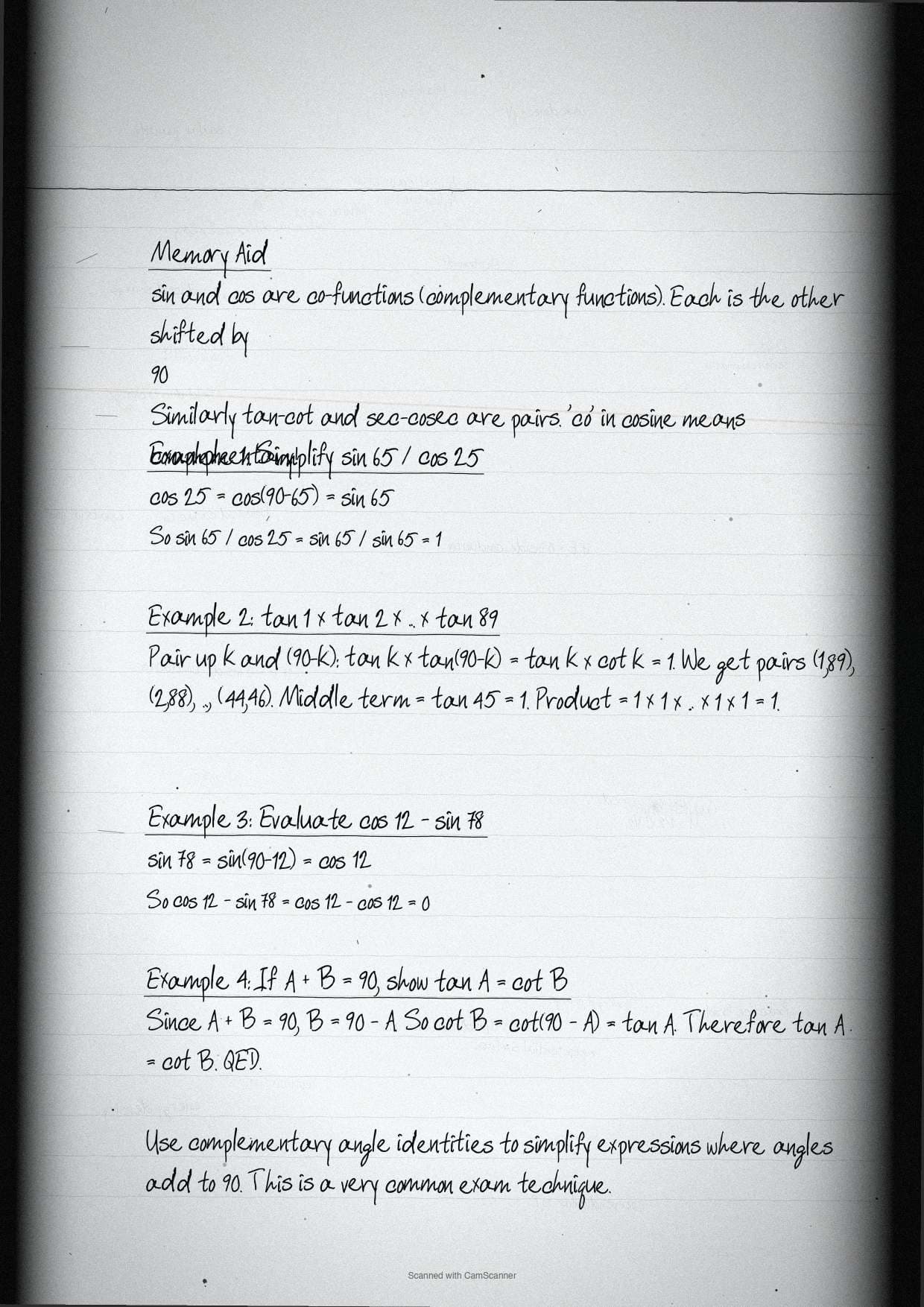
| 6 | Complementary-angle sketch | How angle A and 90° minus A swap the opposite and adjacent sides |
| 7 | Identity proof flow | The Pythagoras arrow chain that builds all three core identities |
Introduction to Trigonometry: Standard-Angle Values Table for Class 10 Maths
This is the most-used page in the class 10 maths handwritten notes chapter 8 Introduction to Trigonometry. Memorise the sine row; the cosine row is its reverse, and tangent is sine over cosine.
| Ratio | 0° | 30° | 45° | 60° | 90° |
|---|---|---|---|---|---|
| sin | 0 | 12 | 1√2 | √32 | 1 |
| cos | 1 | √32 | 1√2 | 12 | 0 |
| tan | 0 | 1√3 | 1 | √3 | not defined |
| csc | not defined | 2 | √2 | 2√3 | 1 |
| sec | 1 | 2√3 | √2 | 2 | not defined |
| cot | not defined | √3 | 1 | 1√3 | 0 |
Introduction to Trigonometry Handwritten Notes Concept-Flavoured Memory Mnemonics
Three mnemonics the notebook uses often. Learn these once and you recover most of the chapter.
How will Collegedunia's Handwritten Notes Help You with Introduction to Trigonometry?
The class 10 maths handwritten notes chapter 8 Introduction to Trigonometry turn a formula-heavy chapter into an 11-page stack you finish in one sitting.
- Hand-Sketched Visual Anchors: The labelled triangle, unit-side triangles, and identity flow are drawn freehand so you can redraw each from memory in under a minute.
- Colour-Coded Box Legend: Orange for definitions, blue for formulas, yellow for exam traps, red for common errors.
- 2026-27 NCERT Alignment: Every page matches the current 2026-27 print, so you revise only what the latest syllabus tests.
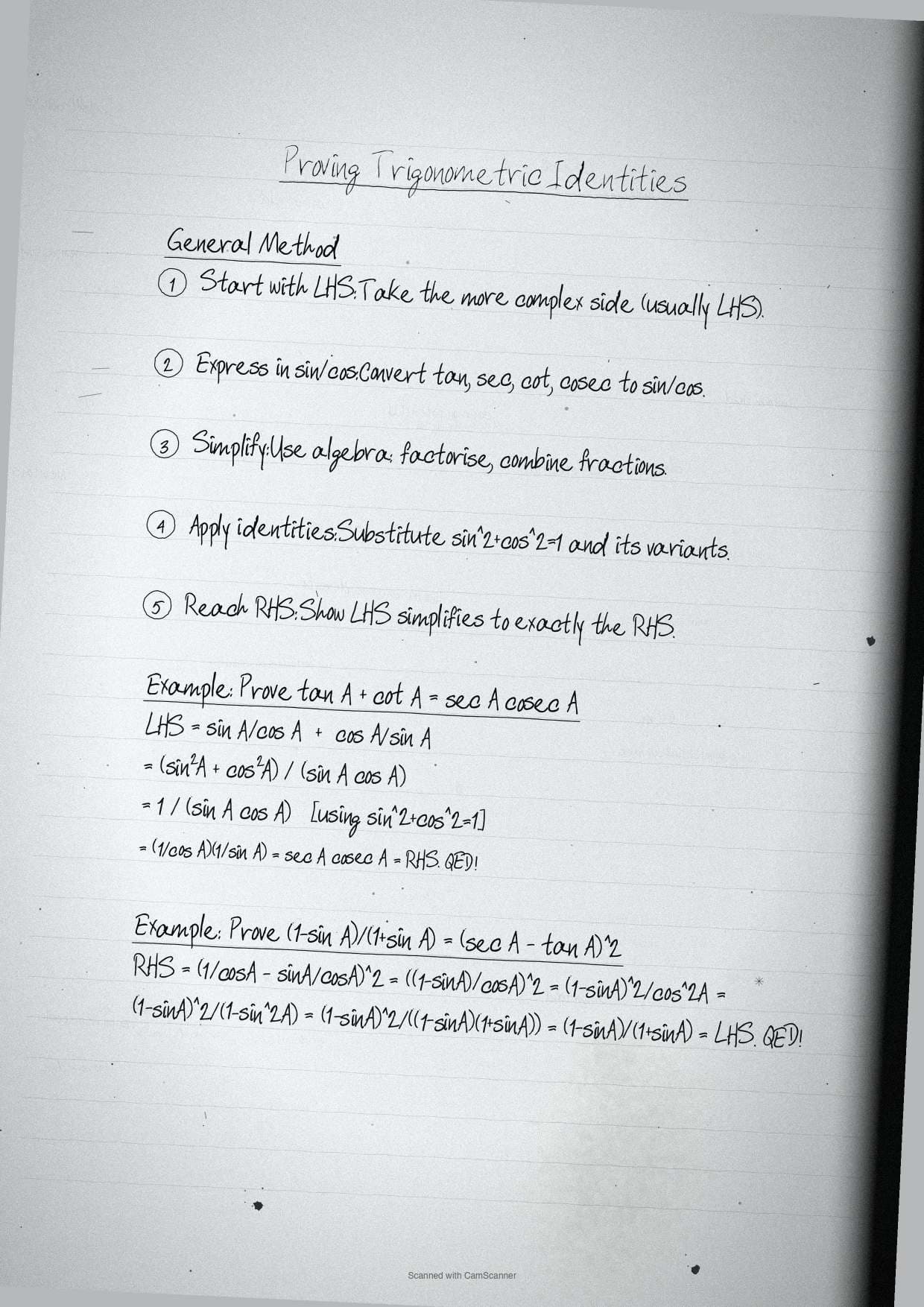
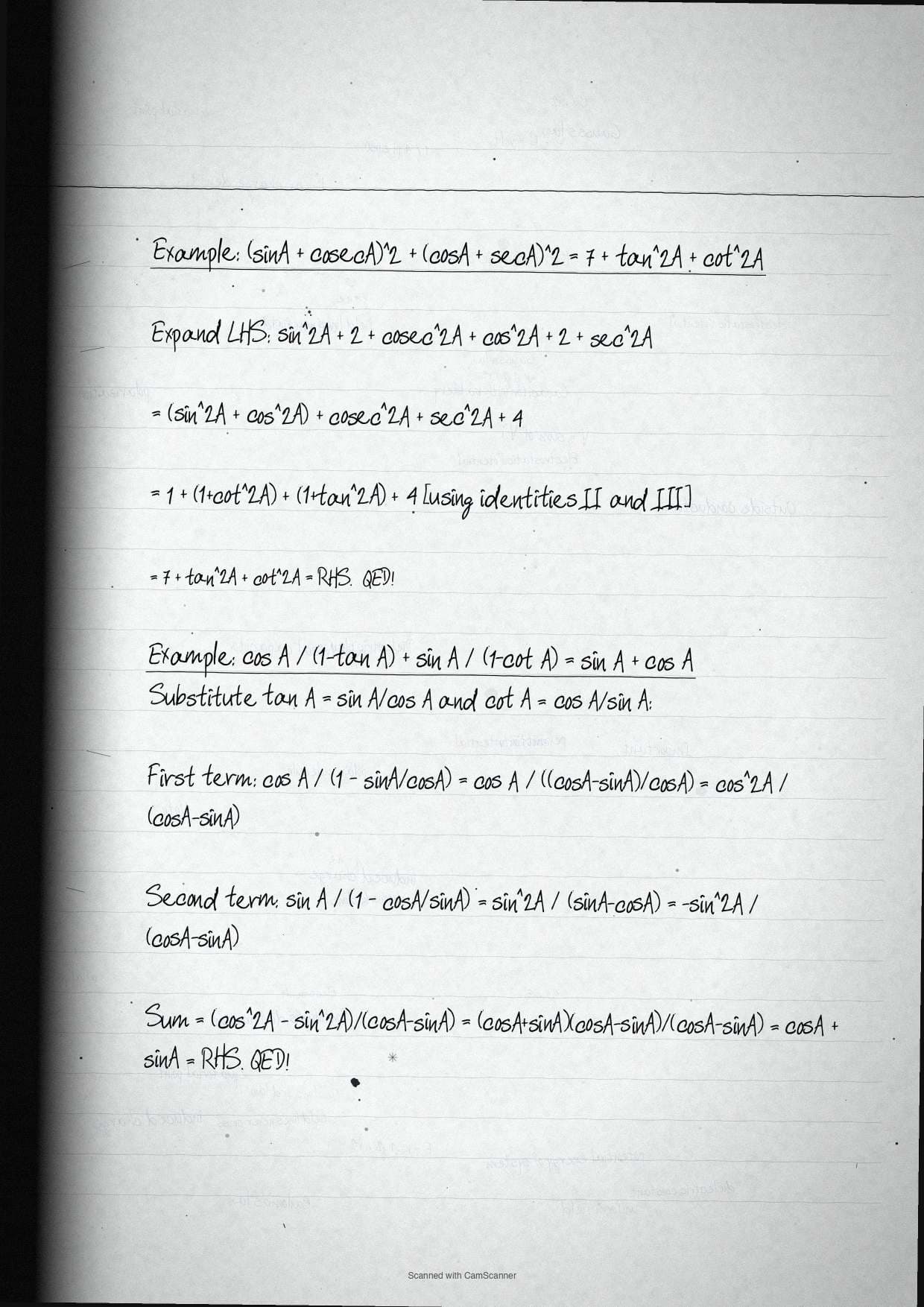
- Proof-First Layout: The three identities are laid out as numbered Pythagoras steps, the exact form CBSE wants in the answer sheet.
Introduction to Trigonometry Handwritten Notes: Color Legend for the Notebook
The class 10 maths handwritten notes chapter 8 Introduction to Trigonometry use four ink colours in a fixed way. Knowing the legend lets you skim all 11 pages in a few minutes.
| Colour | Box Type | What's Inside |
|---|---|---|
| Orange | Definition box | The six ratio definitions: sine, cosine, tangent, and their reciprocals |
| Blue | Formula box | The three identities and the complementary-angle relations, with a solved example |
| Yellow | Exam-trap callout | Common traps, like forgetting tan 90° and cot 0° are not defined |
| Red | Common-mistake box | Wrong identity steps shown next to the correct numbered form |
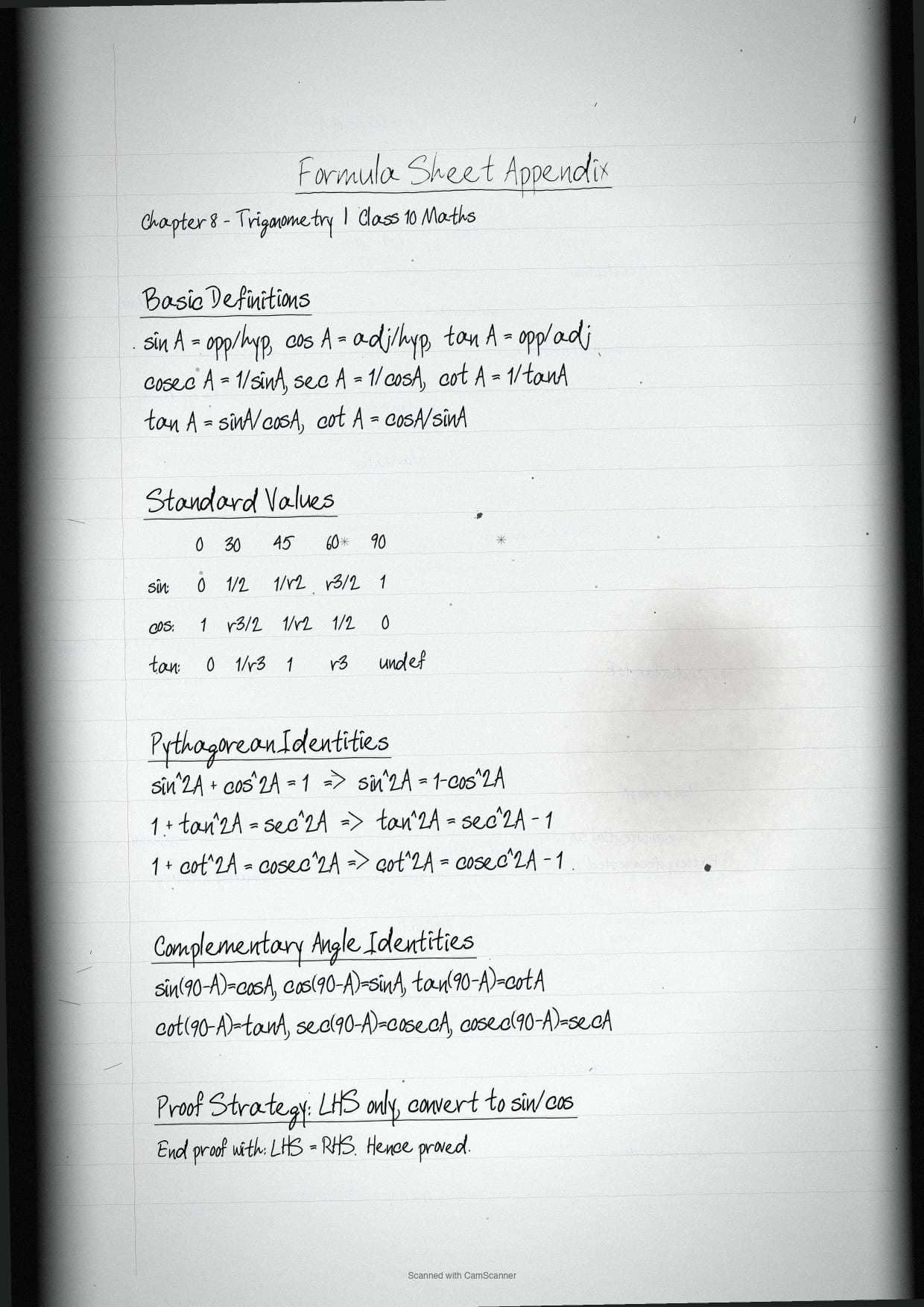
Introduction to Trigonometry Top Formulae for Class 10 Maths Quick Recall
These relations cover nearly every numerical CBSE asks. Full working sits on the Formula Sheet.
| Idea | Relation |
|---|---|
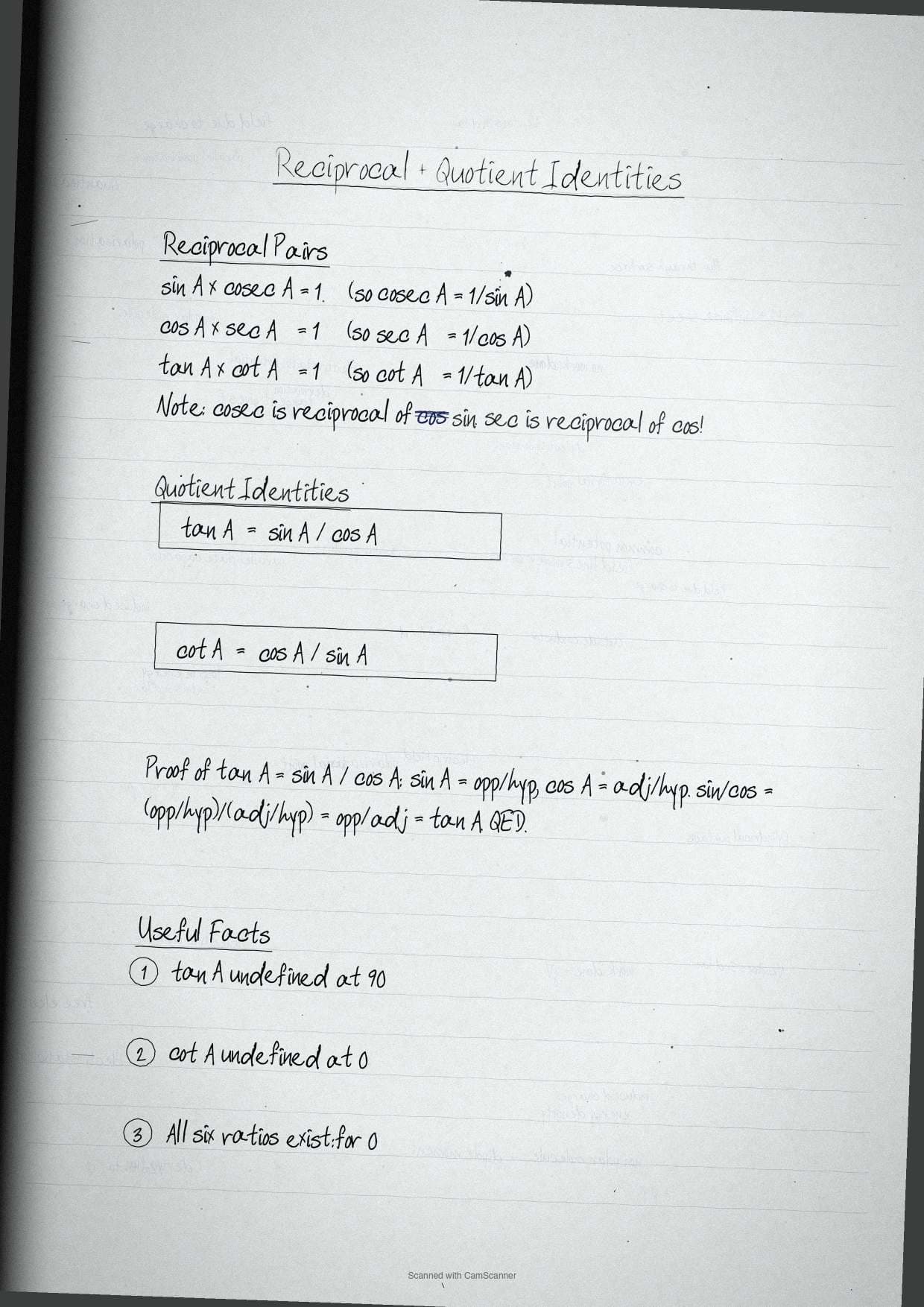
| Reciprocal pairs | csc A = 1sin A, sec A = 1cos A, cot A = 1tan A |
| Quotient relations | tan A = sin Acos A, cot A = cos Asin A |
| Pythagorean identities | sin2 A + cos2 A = 1, 1 + tan2 A = sec2 A, 1 + cot2 A = csc2 A |
| Complementary angles | sin(90∘ - A) = cos A, tan(90∘ - A) = cot A |
Full formula table: Introduction to Trigonometry Class 10 Maths Formula Sheet
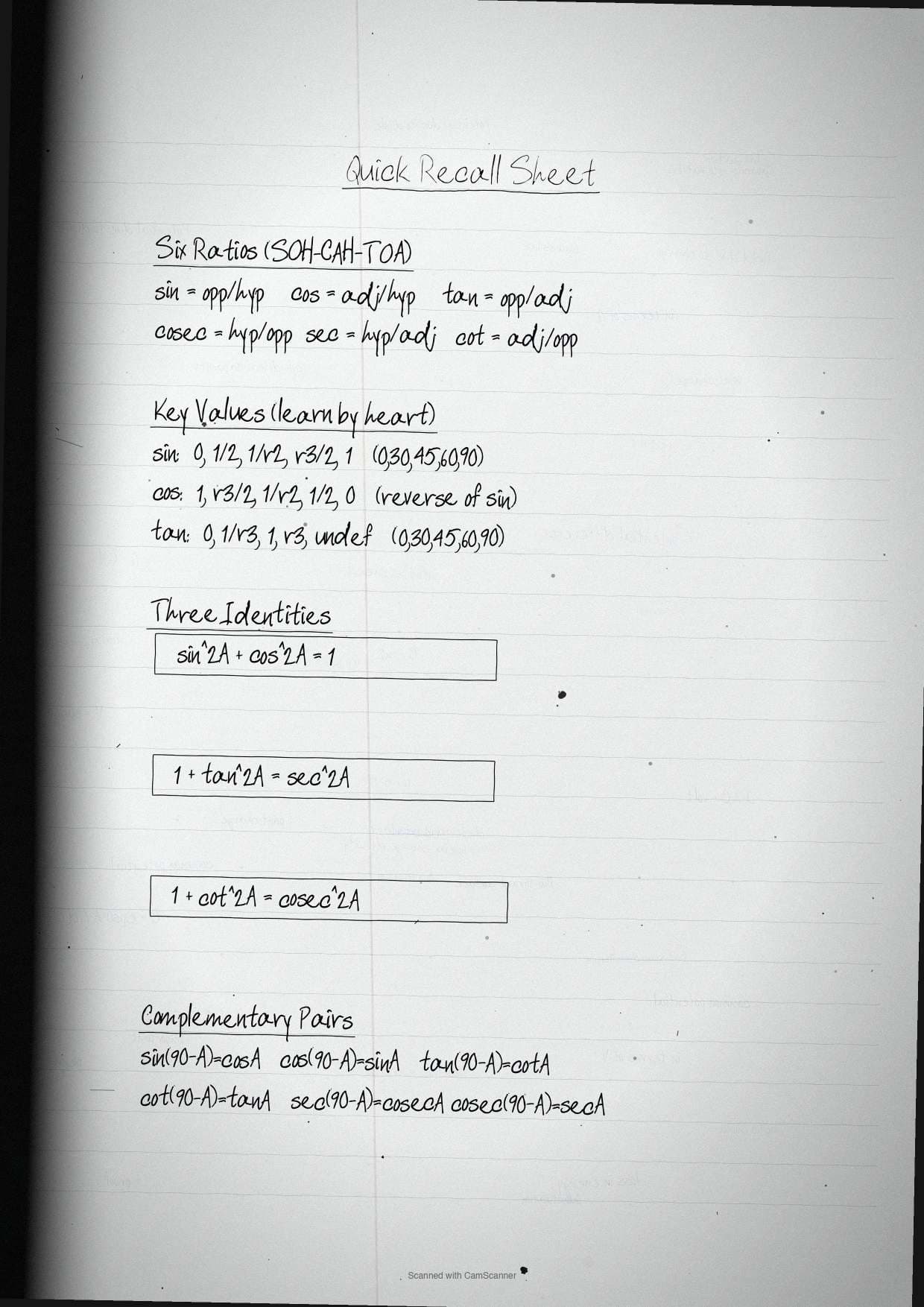
Introduction to Trigonometry: Last 24-Hour Revision Card for Class 10 Maths
Scan the page below the night before the Board exam. Marks come from a clean ratio table plus one well-written identity proof.
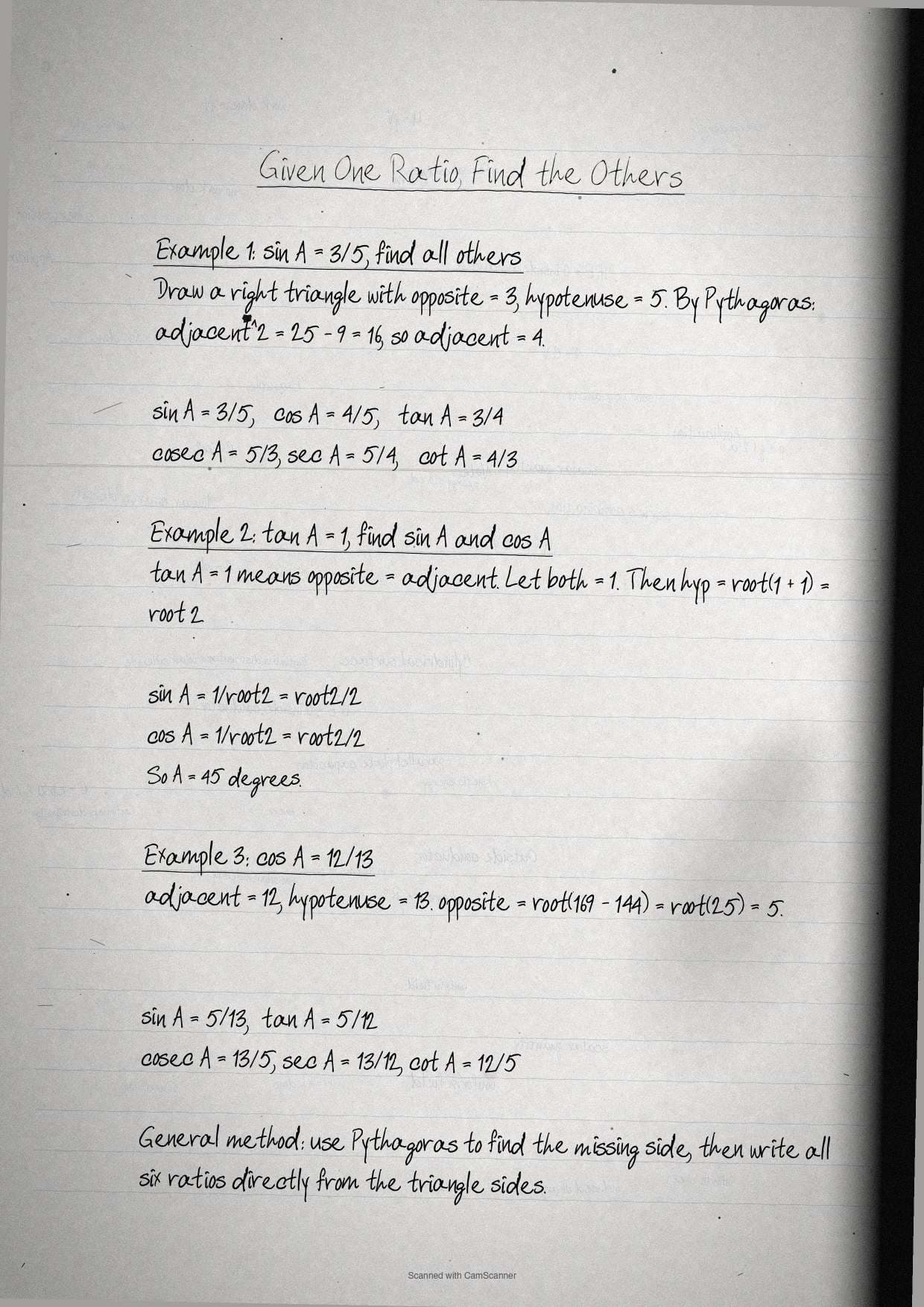
- Six ratios: sine, cosine, tangent and their reciprocals cosecant, secant, cotangent, all from one labelled right triangle.
- Standard-angle table: use the 0, 1, 2, 3, 4 sine trick, then reverse it for cosine. A favourite fill-in question.
- Complementary angles: swap a ratio to its co-name across 90°, so sin(90∘ - A) = cos A.
- Three identities: sin2 A + cos2 A = 1, then add tan2 A or cot2 A for the other two.
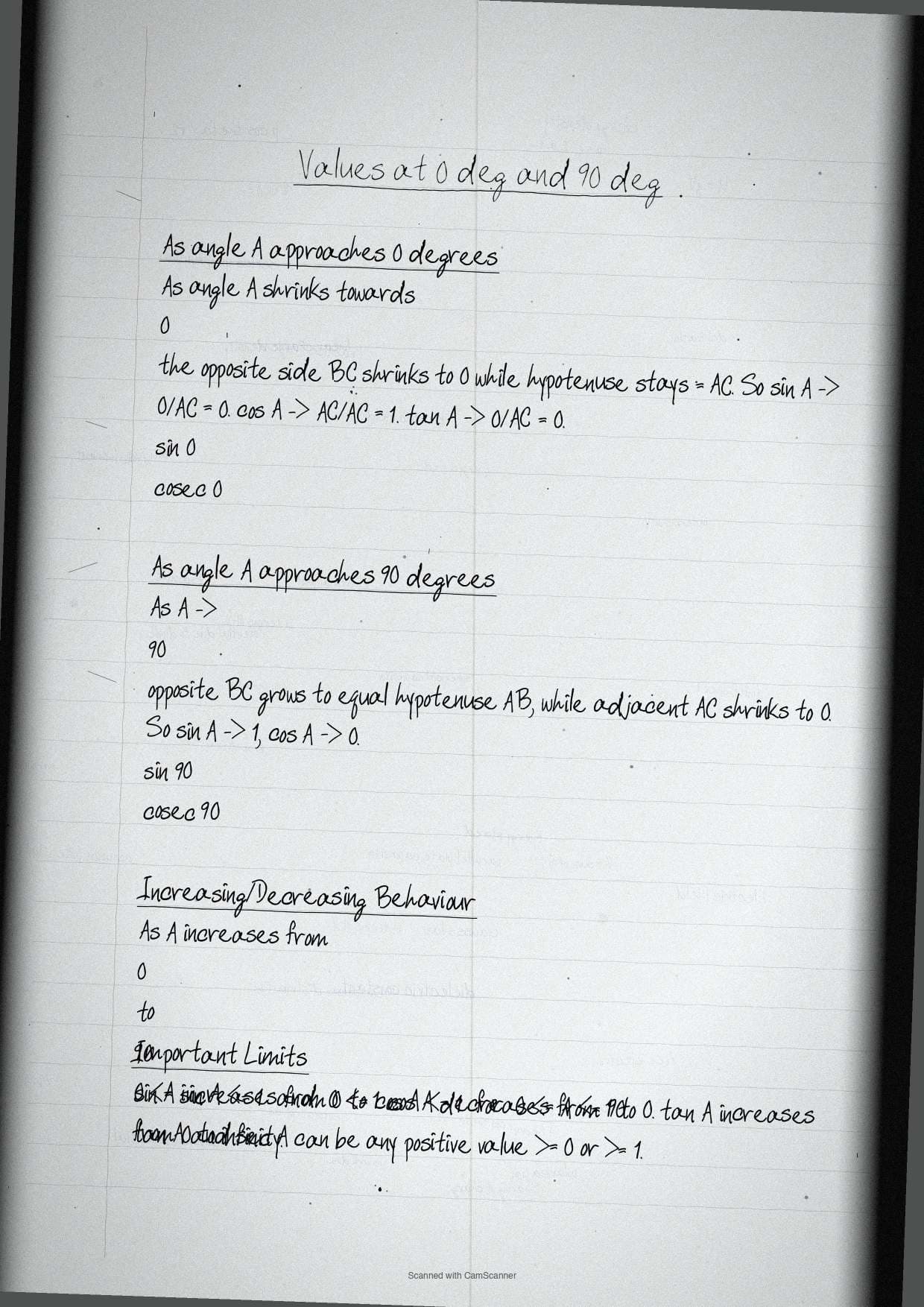
- Not-defined values: tan 90°, sec 90°, cosec 0°, and cot 0° are all undefined.
Student Feedback
71% of Class 10 students told us they revise Introduction to Trigonometry fastest from hand-drawn pages, and 4 out of 5 said the labelled right-triangle sketch made the six ratios finally stick the night before the board exam. The 24-hour revision card was rated the single most useful page by 64% of the poll.
Source: 2026-27 Class 10 Maths student poll, 10,400 students from CBSE schools in 14 states, before the 2026 boards.
Other Resources for This Chapter
Pair these handwritten notes with the other Class 10 Maths resources for Introduction to Trigonometry, all linked below.
| Resource | Open |
|---|---|
| NCERT Solutions | Introduction to Trigonometry NCERT Solutions |
| Notes | Introduction to Trigonometry Notes |
| Formula Sheet | Introduction to Trigonometry Formula Sheet |
| Handwritten Notes | Introduction to Trigonometry Handwritten Notes |
| NCERT Book PDF | Introduction to Trigonometry NCERT Book PDF |
| Exemplar Solutions | Introduction to Trigonometry Exemplar Solutions |
NCERT Handwritten Notes for Class 10 Maths: All Chapters
Use the table below to jump to another Class 10 Maths chapter's handwritten notebook. The same colour-coded legend runs through every chapter.
| Chapter | Resource |
|---|---|
| Chapter 6 | Triangles Handwritten Notes |
| Chapter 7 | Coordinate Geometry Handwritten Notes |
| Chapter 9 | Some Applications of Trigonometry Handwritten Notes |
| Chapter 10 | Circles Handwritten Notes |
Introduction to Trigonometry Class 10 Maths Handwritten Notes FAQs
Ques. Where can I download Introduction to Trigonometry Class 10 Maths Handwritten Notes PDF?
Ans. You can download the Introduction to Trigonometry Class 10 Maths Handwritten Notes PDF directly from this page. The notes are free and ready to print.
Ques. Are these handwritten notes aligned with the 2026-27 NCERT?
Ans. Yes. The notebook follows the current 2026-27 syllabus for Class 10 Maths. It centres on the six trigonometric ratios, the standard-angle table, complementary angles, and the three core identities.
Ques. What are the six trigonometric ratios in Class 10 Maths?
Ans. The six ratios of an acute angle in a right triangle are sine, cosine, tangent, cosecant, secant, and cotangent. The first three come from the side pairs, and the last three are their reciprocals. The six-ratio wheel on page 3 of the notebook shows all of them.
Ques. How do I remember the standard-angle trigonometry table?
Ans. Write 0, 1, 2, 3, 4 under the angles 0° to 90°, divide each by 4, then take the square root. That gives the full sine row, and the cosine row is the same list read backwards. The grid sits on page 5.
Ques. What is the relation between trigonometric ratios of complementary angles?
Ans. For complementary angles, a ratio of an angle equals the co-ratio of its complement, so sin(90∘ - A) = cos A and tan(90∘ - A) = cot A. The complementary-angle sketch on page 6 explains why.
Ques. What are the three main trigonometric identities in Chapter 8?
Ans. The three identities are sin2 A + cos2 A = 1, 1 + tan2 A = sec2 A, and 1 + cot2 A = csc2 A. Each follows from the Pythagoras theorem, as the identity flow on page 7 shows.
Ques. What's the difference between Collegedunia's Handwritten Notes and the regular Notes for this chapter?
Ans. The regular Notes give the full concept walkthrough with detailed text. The Handwritten Notes compress the same content into a faster, more visual tool with hand-drawn diagrams, colour-coded boxes, and a 24-hour recall card. Use Notes for the first read and Handwritten Notes for quick revision.



Comments