




Class 10 Maths Chapter 12 Surface Areas and Volumes carries about 6 to 8 marks in the CBSE Board exam. These notes cover combinations of solids built from the cube, cuboid, cylinder, cone, sphere, and hemisphere.
- CBSE Board: about 6 to 8 marks, usually one long-answer combination-of-solids sum plus one short-answer surface-area question
- JEE Main: rarely a direct question, but the volume and surface-area formulas support solid-mensuration shortcuts
Watch Surface Areas and Volumes Class 10 Maths Chapter 12 Explained
Source: Ritik Mishra - 9th & 10th on YouTube
These notes are prepared by Collegedunia subject mentors, matched to the 2026-27 NCERT print and recent CBSE Board papers.
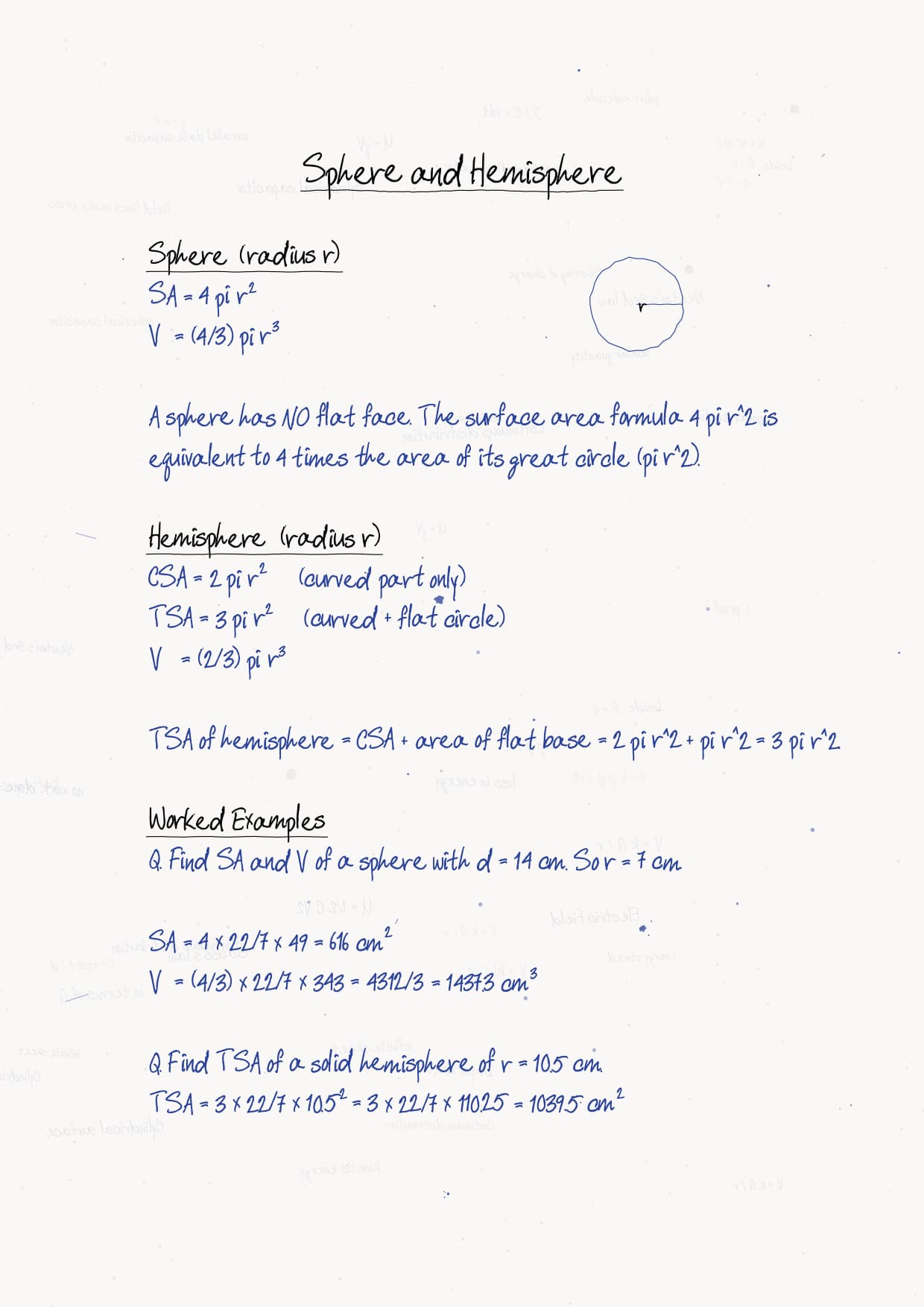
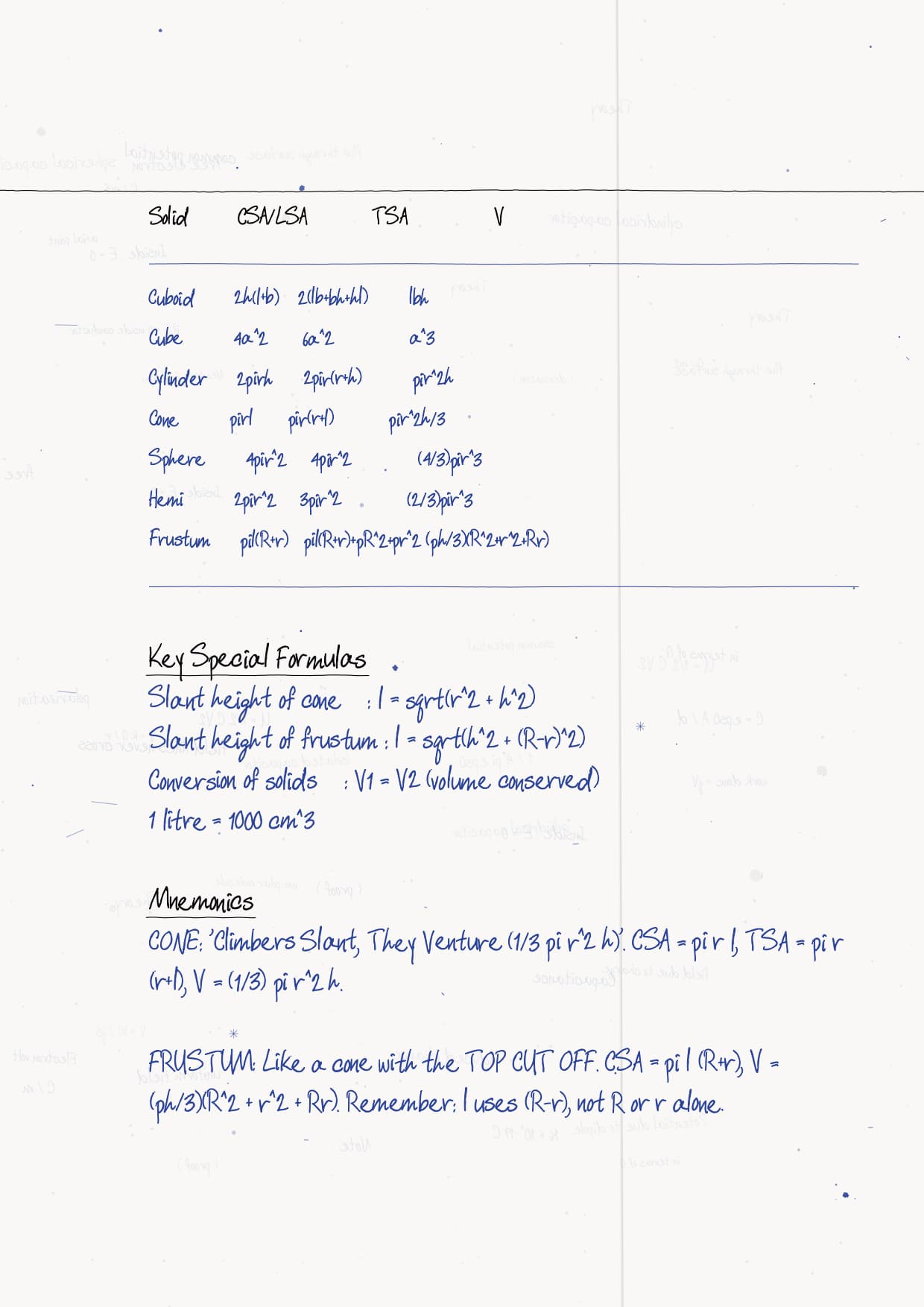
Surface Areas and Volumes Top Formulae for Class 10 Maths Quick Recall
This table covers nearly every numerical CBSE asks in Chapter 12.
| Solid | Surface Area | Volume |
|---|---|---|
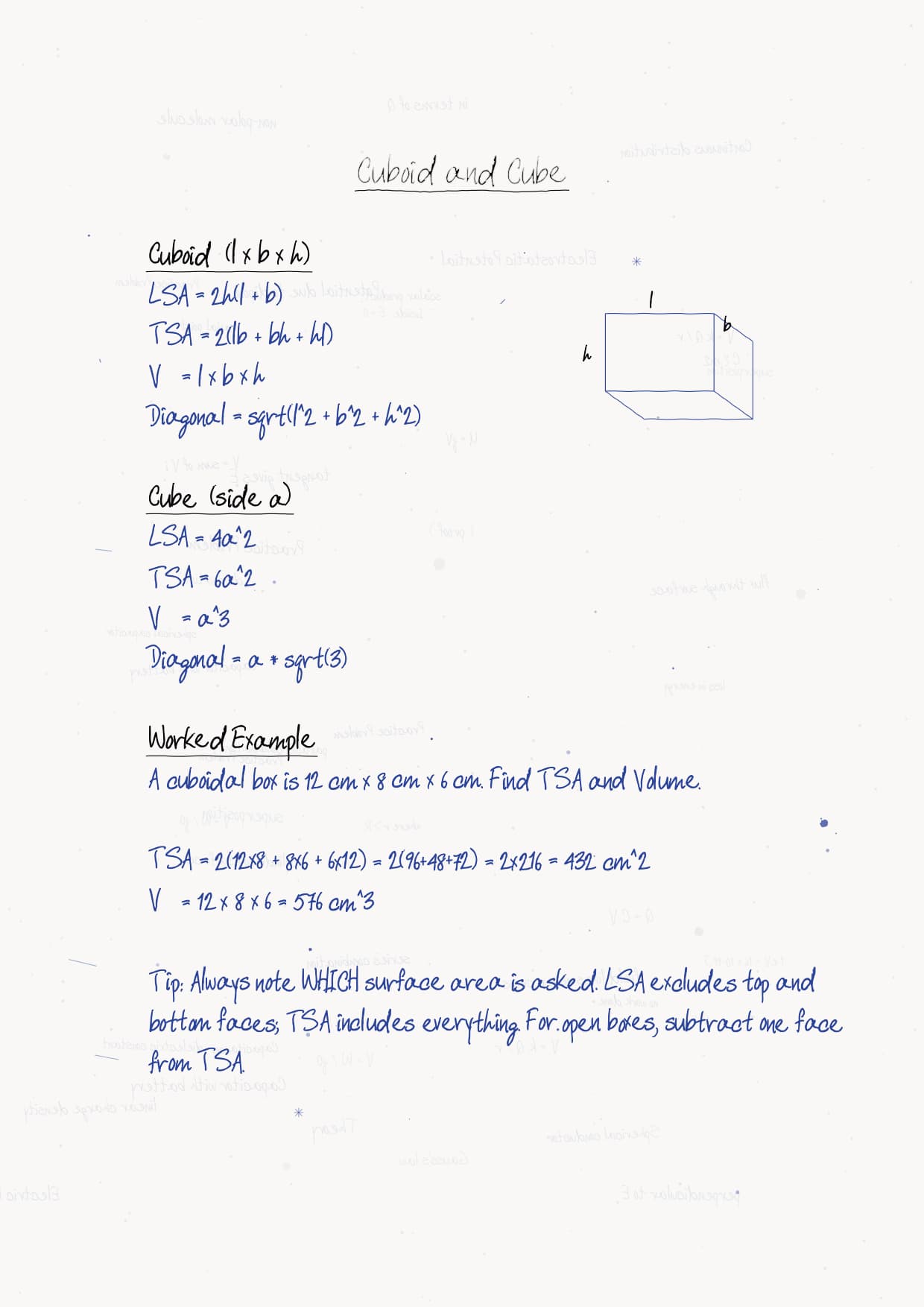
| Cuboid (l, b, h) | 2(lb + bh + hl) | l × b × h |
| Cube (side a) | 6a2 | a3 |
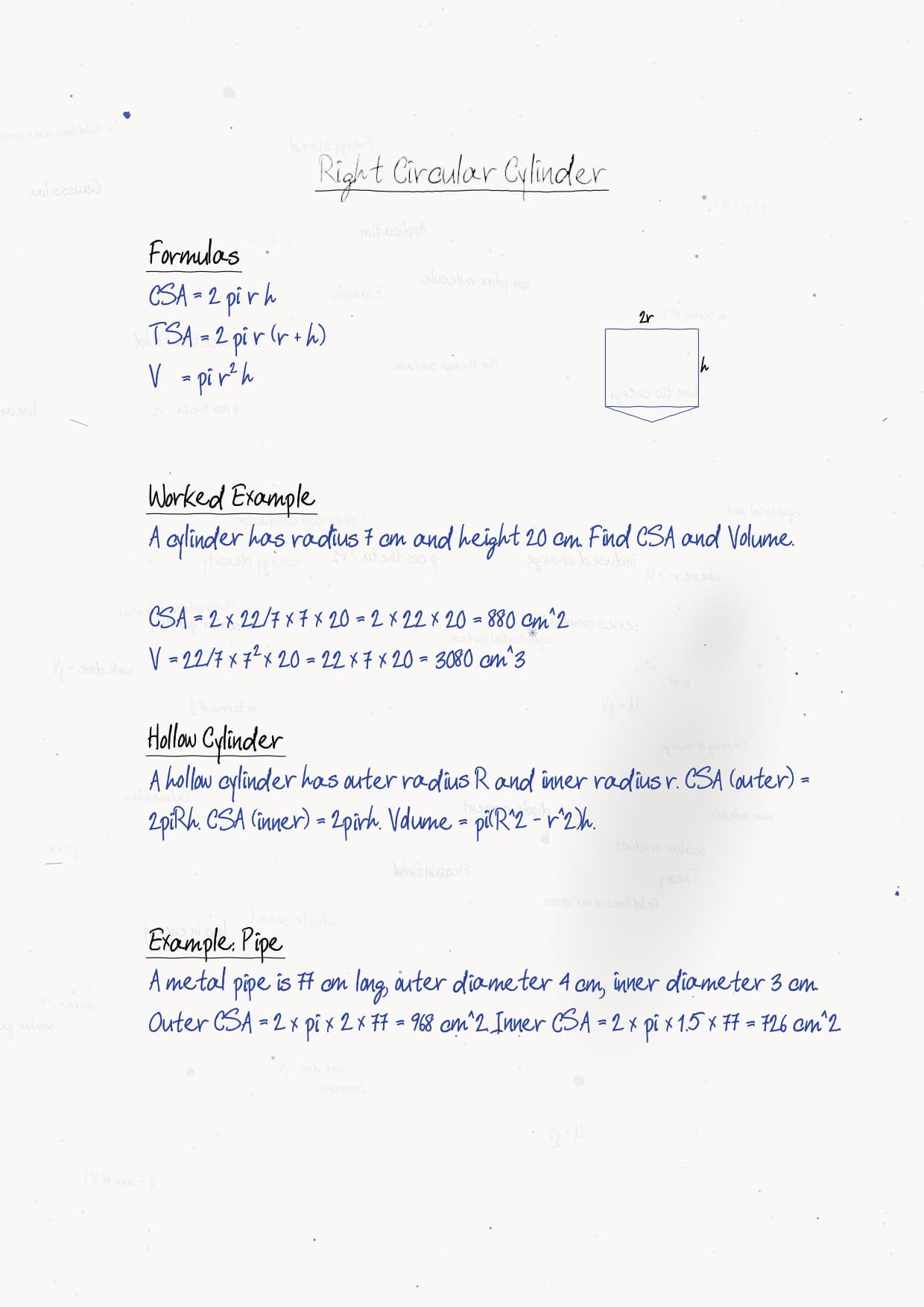
| Cylinder (r, h) | CSA 2π r h, TSA 2π r(r+h) | π r2 h |
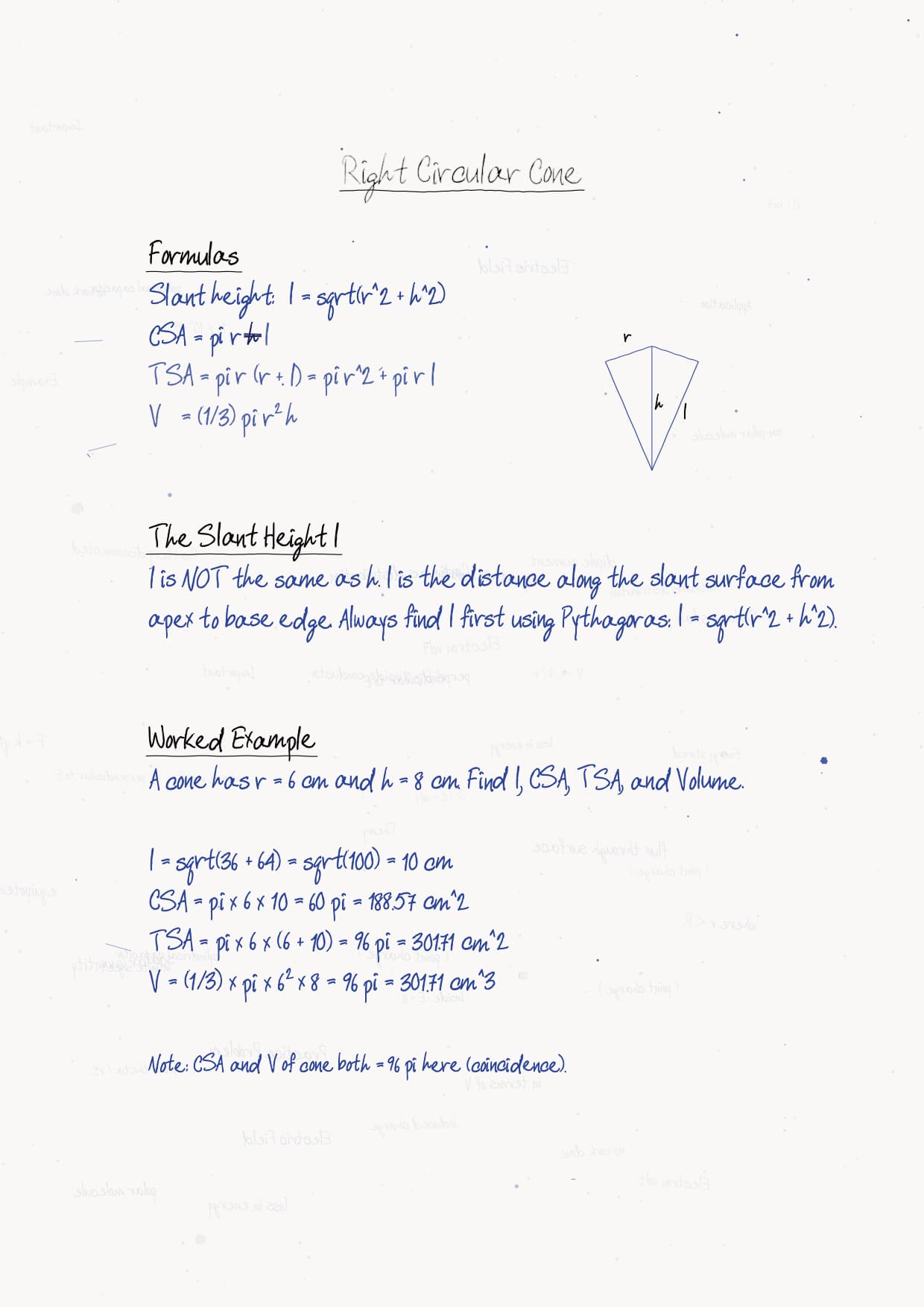
| Cone (r, h, l) | CSA π r l, TSA π r(r+l) | 13π r2 h |
| Sphere (radius r) | 4π r2 | 43π r3 |
| Hemisphere (radius r) | CSA 2π r2, TSA 3π r2 | 23π r3 |
Full formula table: Surface Areas and Volumes Class 10 Maths Formula Sheet
Surface Areas and Volumes Handwritten Notes: Complete Diagram List for Class 10 Maths
These notes hold 7 hand-sketched diagrams. The table maps each figure to its page.
| Page | Diagram | What It Shows |
|---|---|---|
| 2 | Six basic solids chart | Cube, cuboid, cylinder, cone, sphere, and hemisphere drawn side by side |
| 3 | Cone slant-height triangle | The right triangle linking radius, height, and slant height |
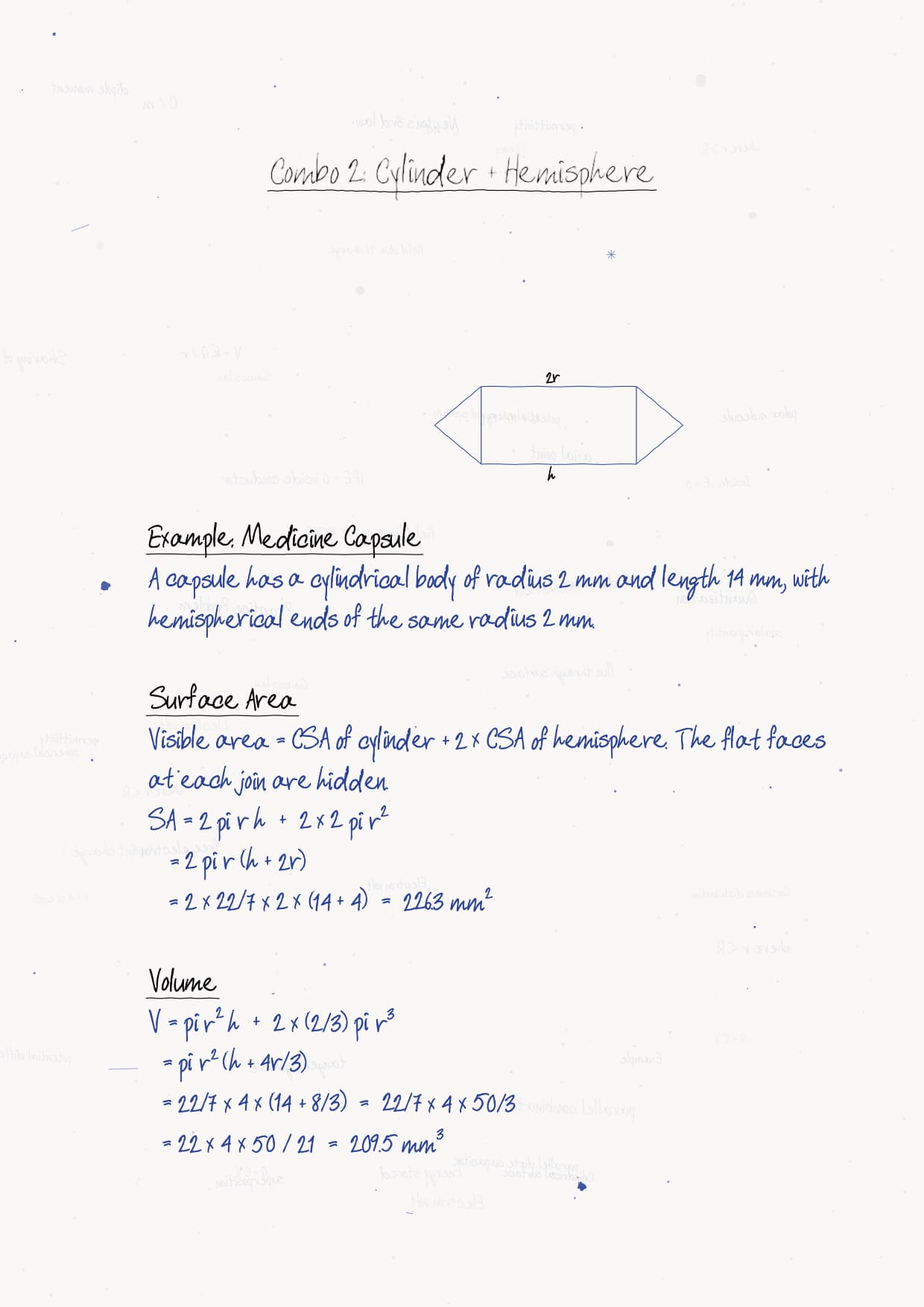
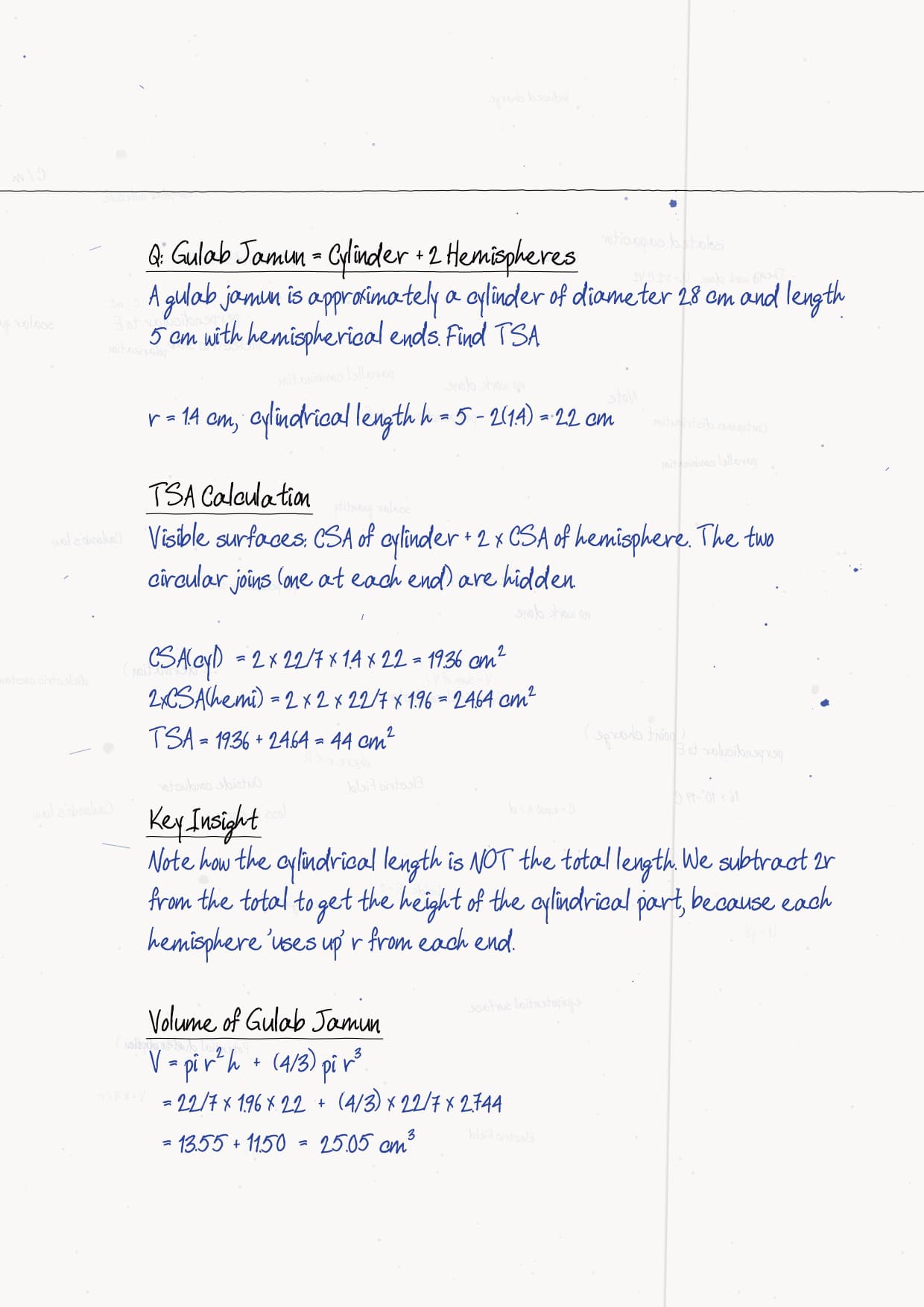
| 4 | Cylinder with two hemispheres | A capsule shape showing how surface areas add and overlaps drop |
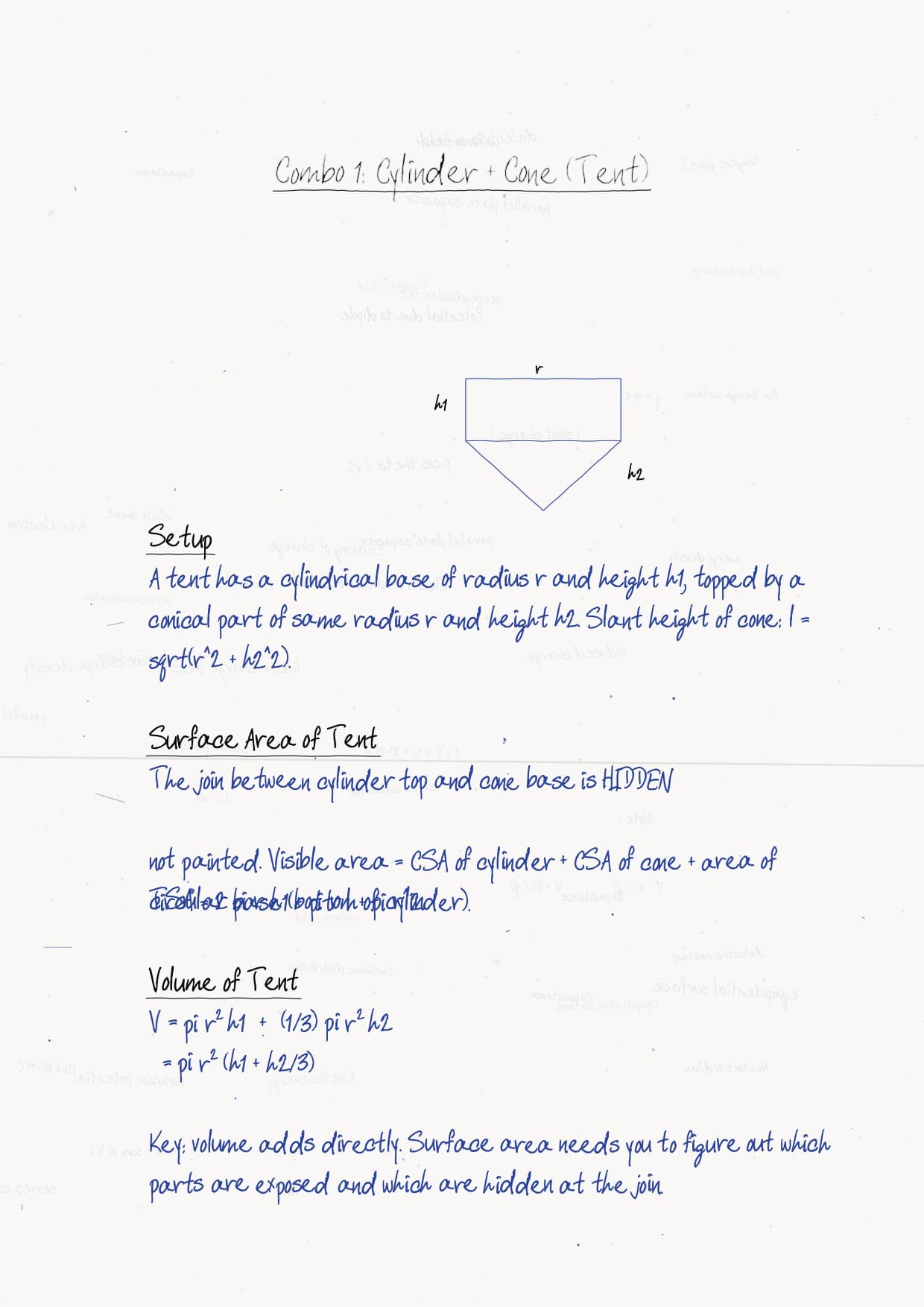
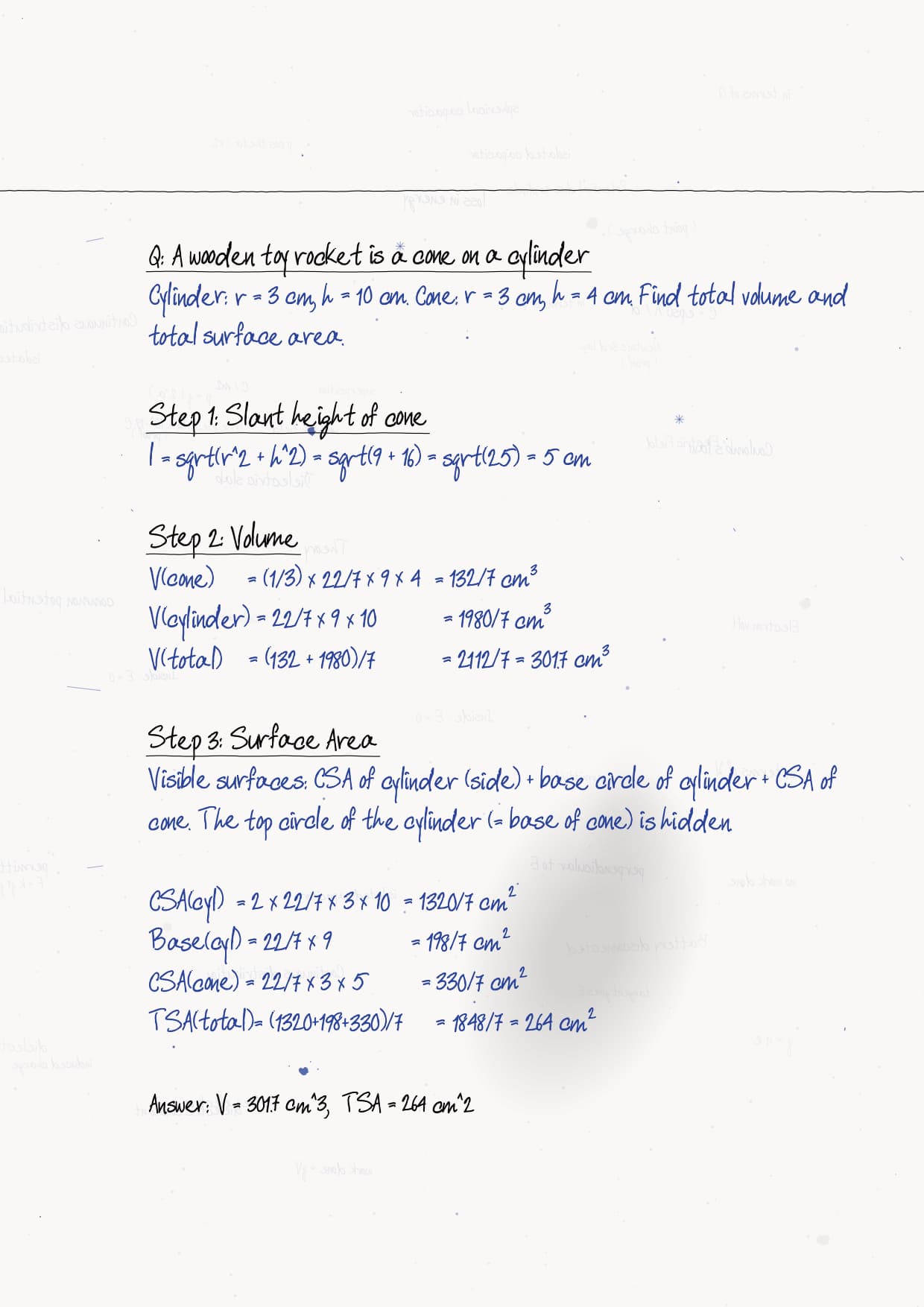
| 5 | Cone on a cylinder | A tent form with the shared circular face marked in red |
| 6 | Hemisphere on a cuboid | A dome on a block, the classic combined-volume sketch |
| 7 | Surface-area overlap flow | The arrow chain showing which faces vanish when solids join |
| 8 | Last-day mind map | One-page tree linking each solid to its formulas |
Topics Covered in Class 10 Maths Chapter 12 Surface Areas and Volumes Handwritten Notes
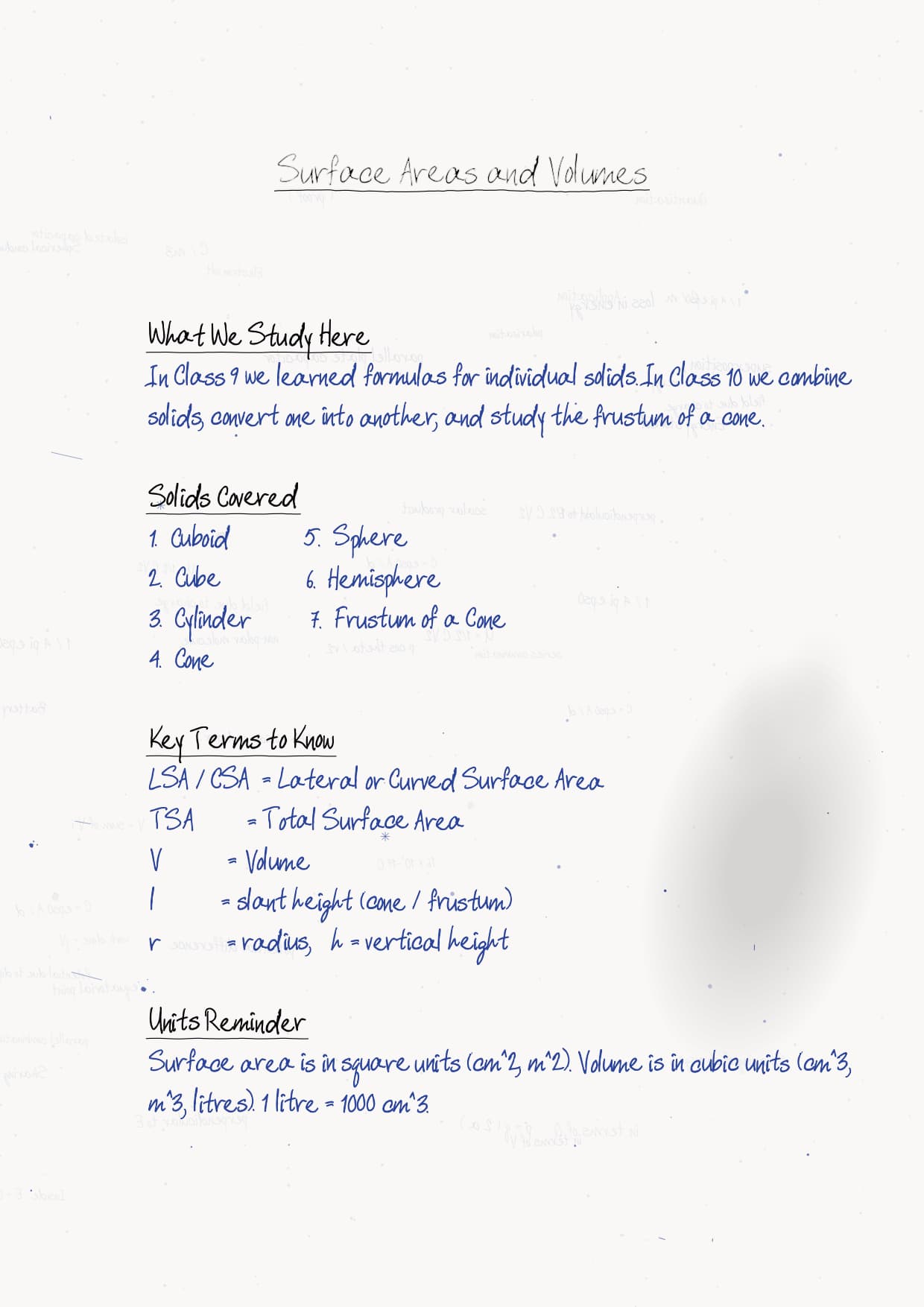
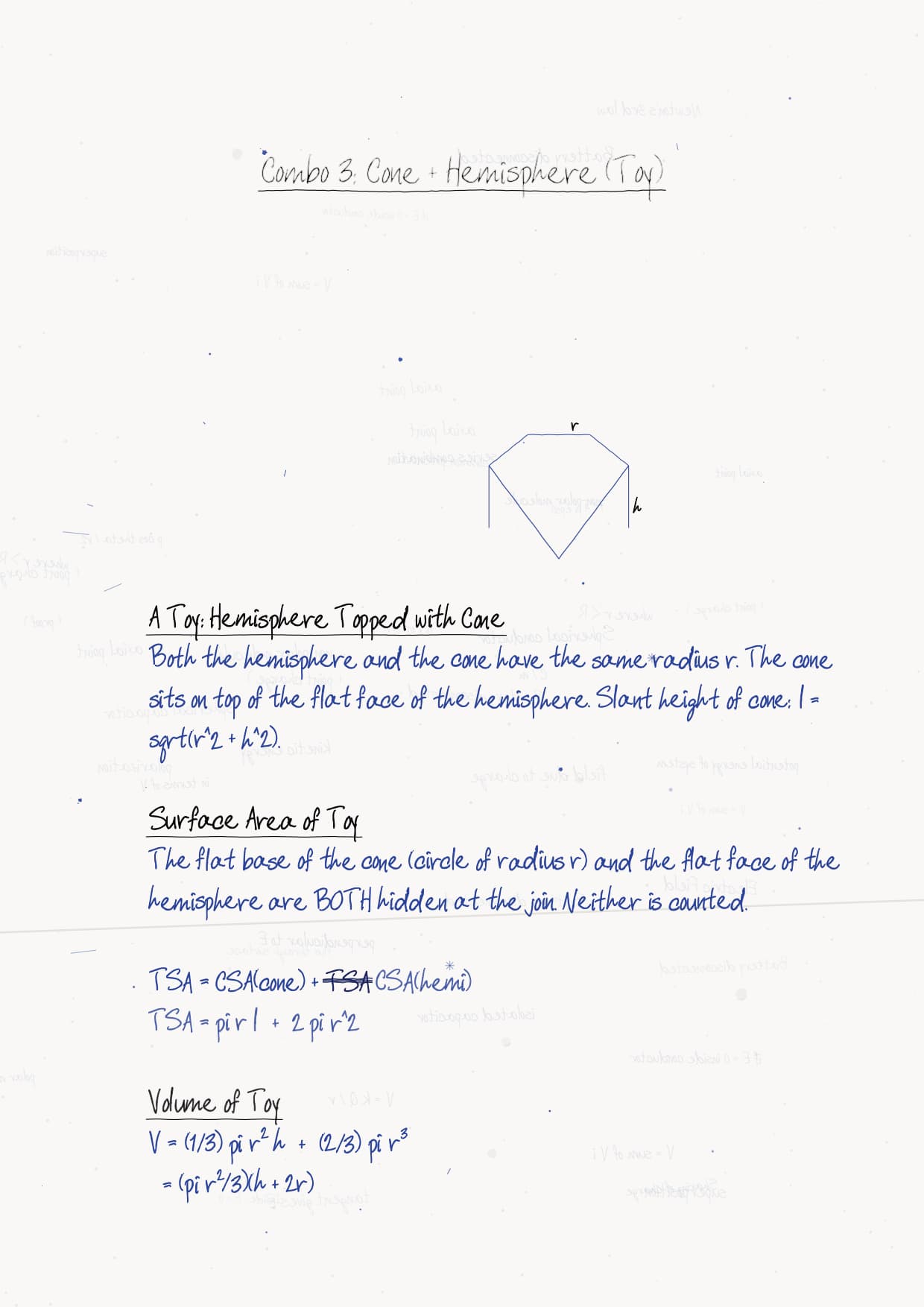
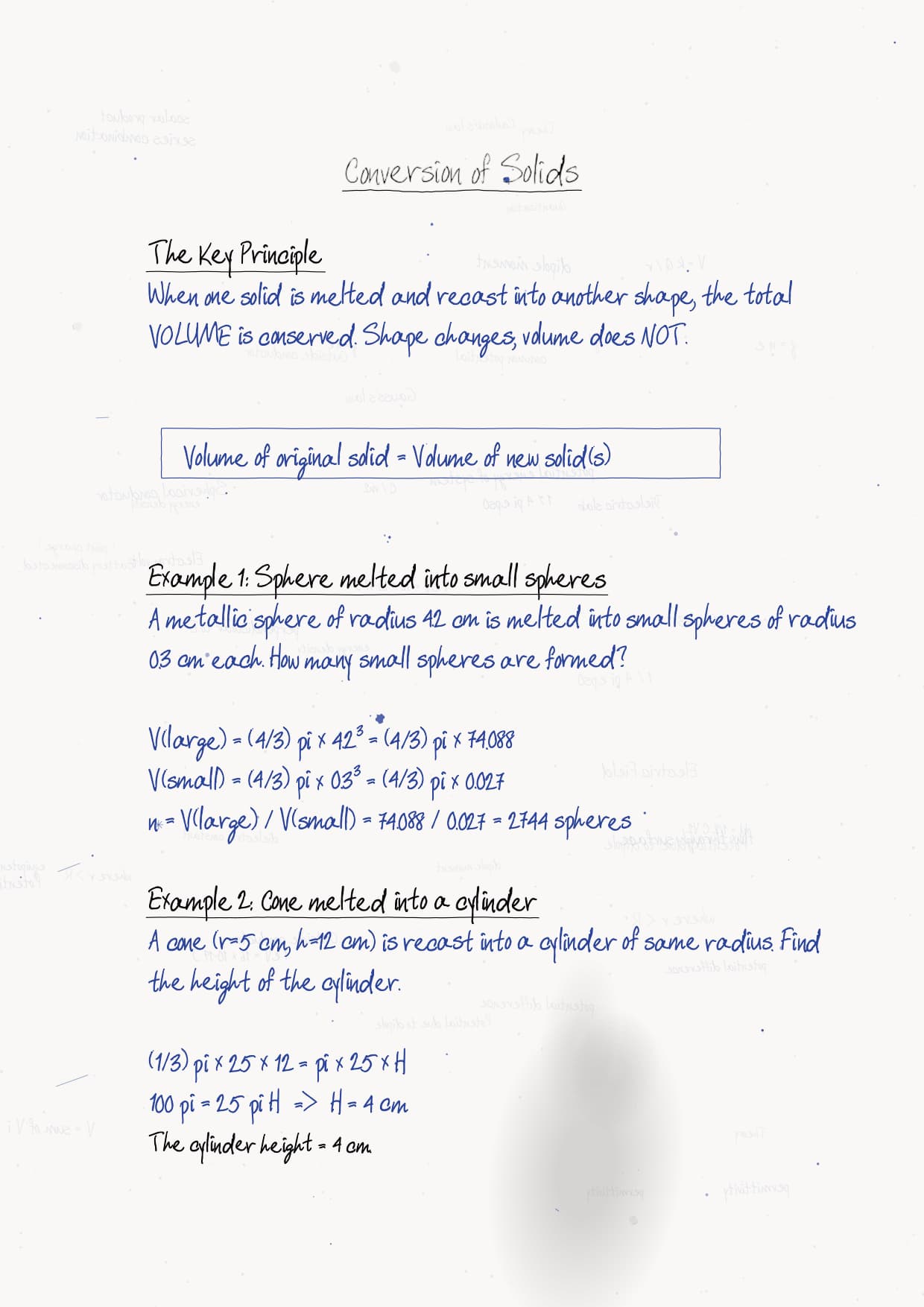
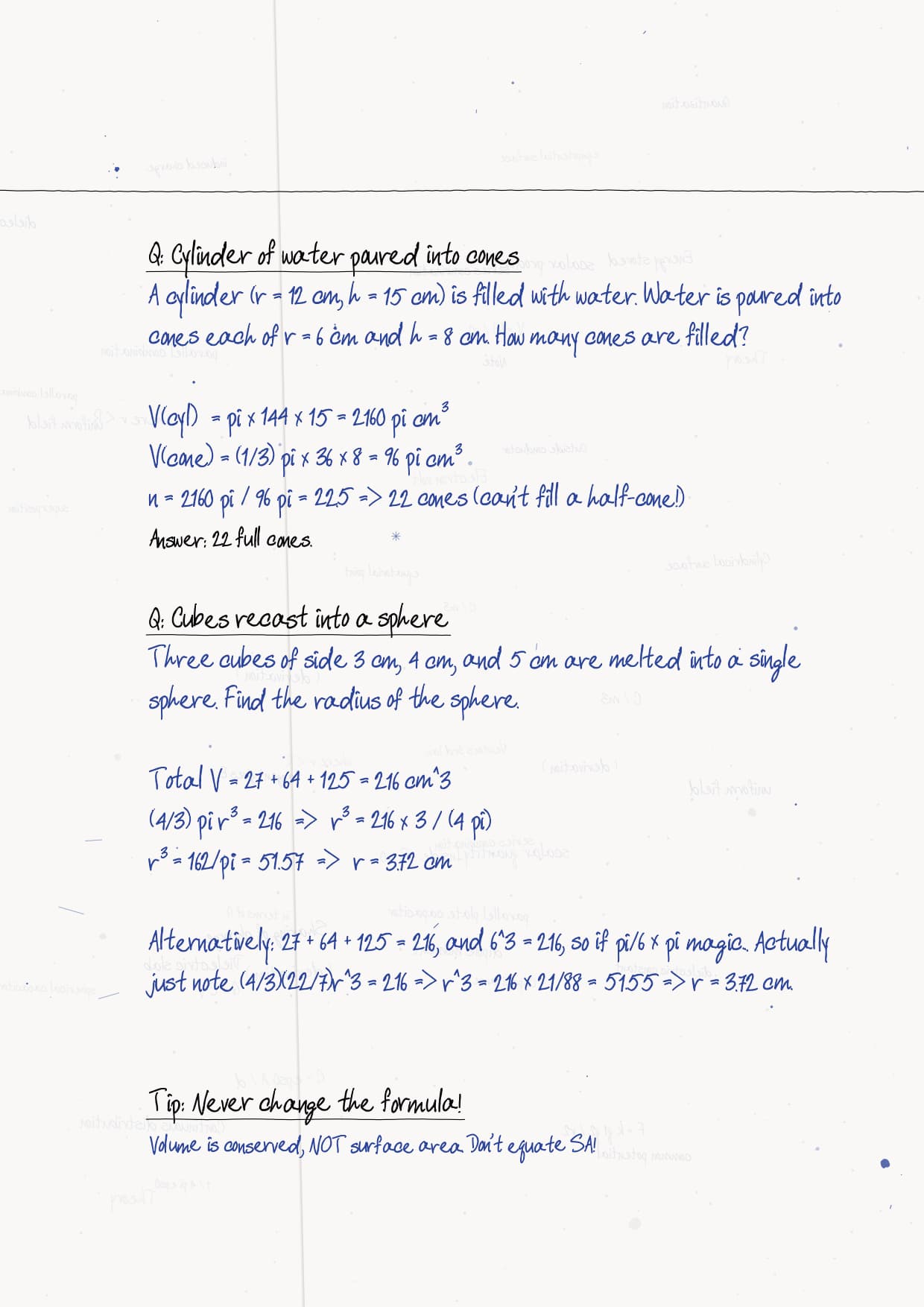
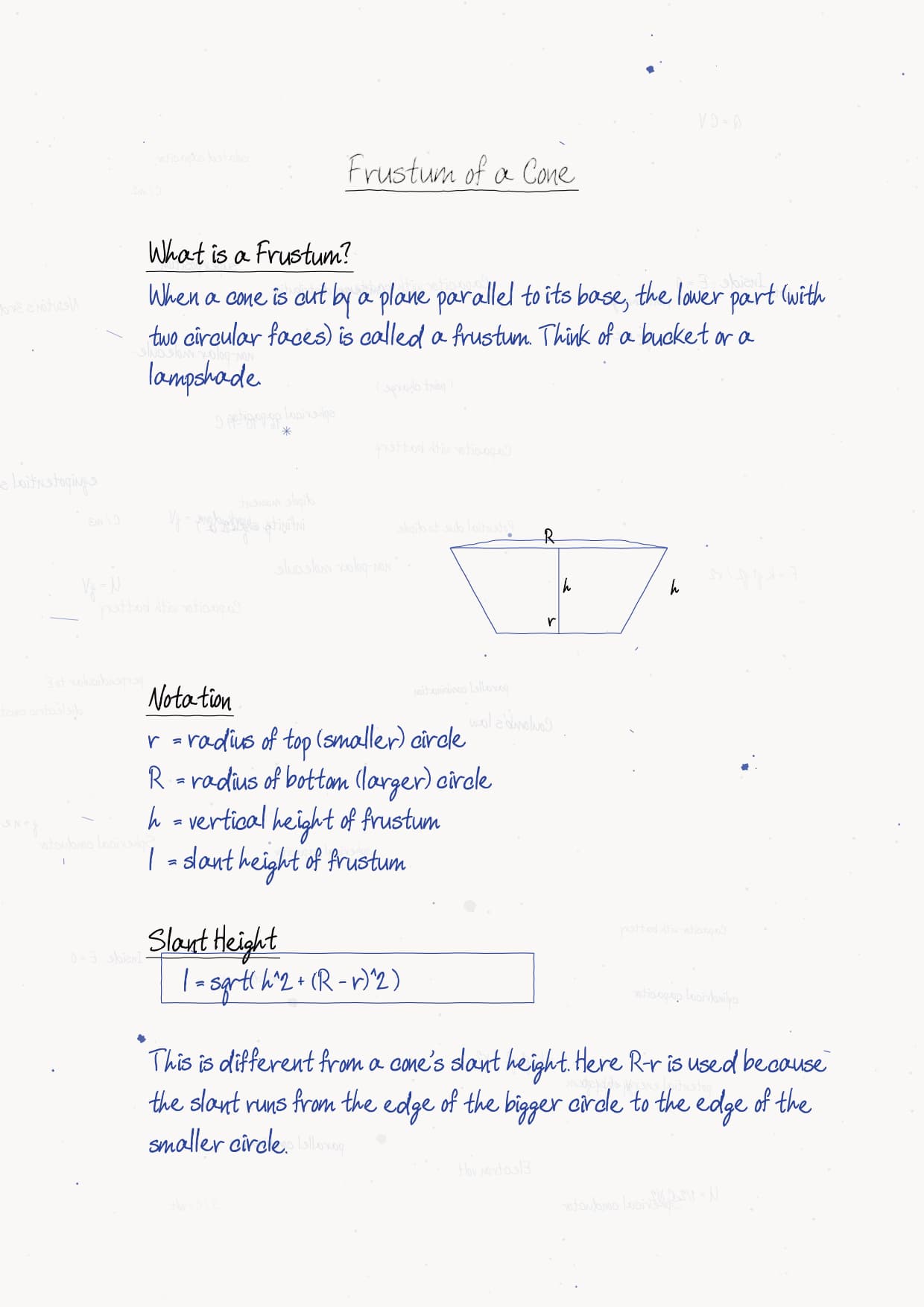
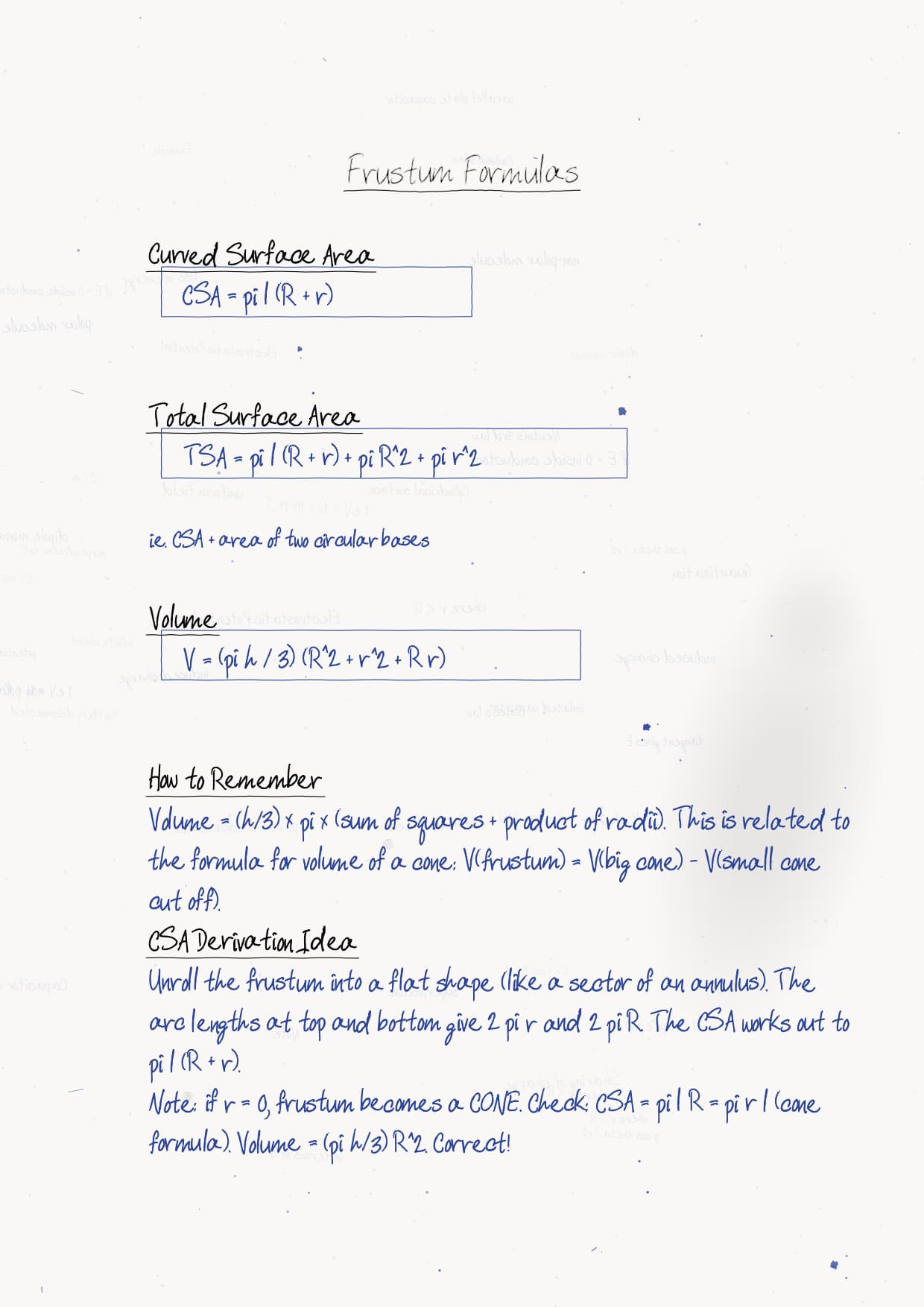
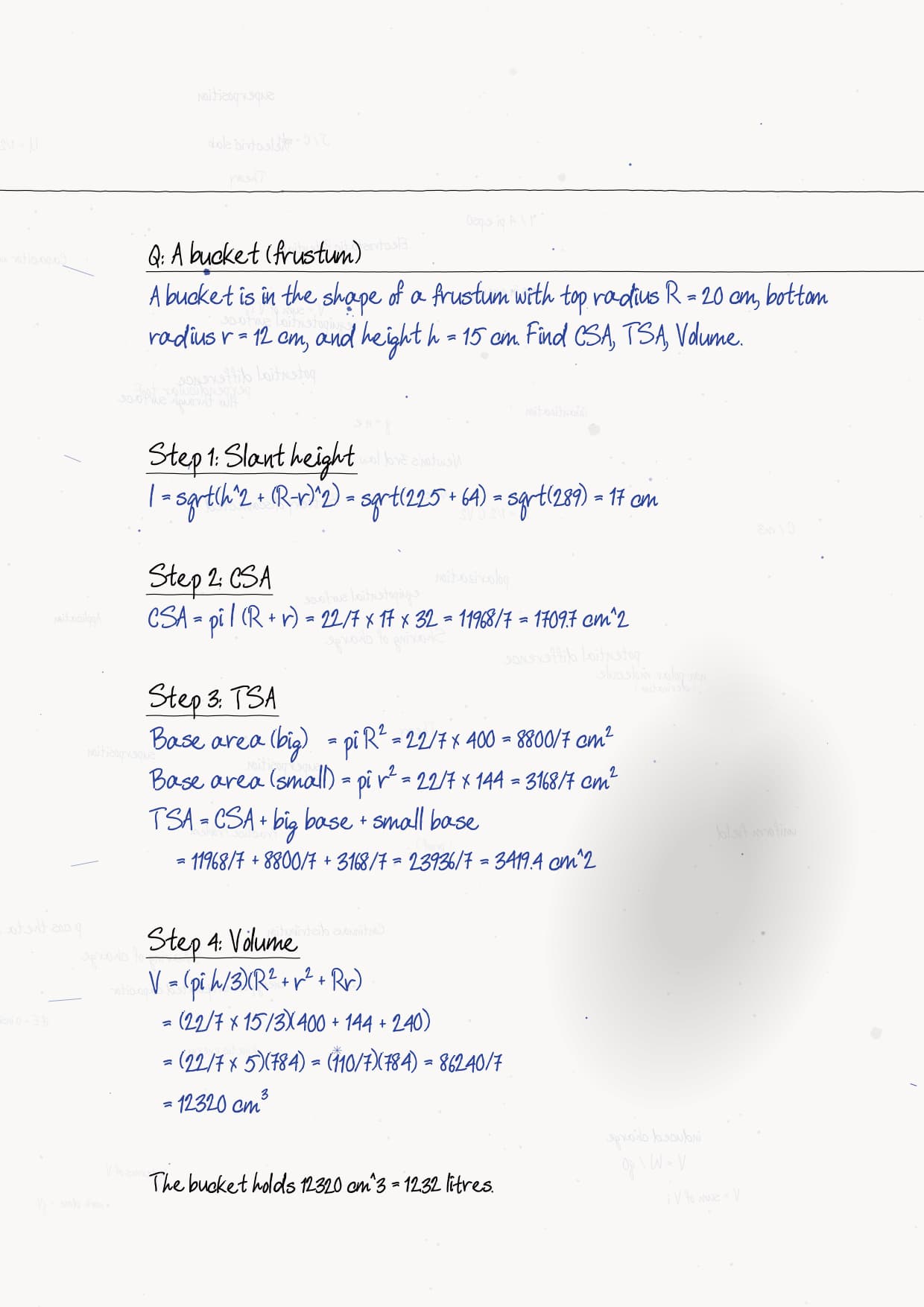
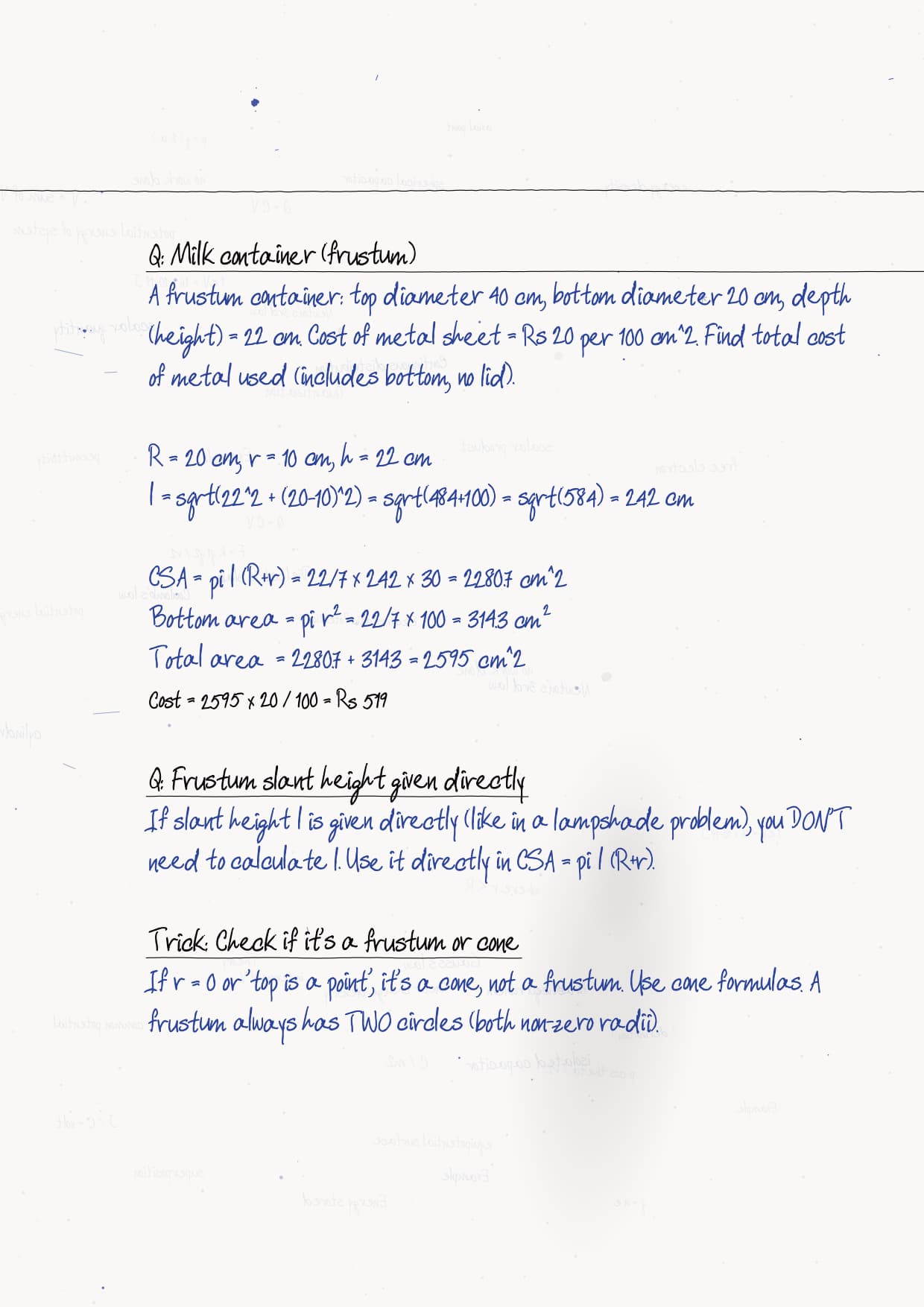
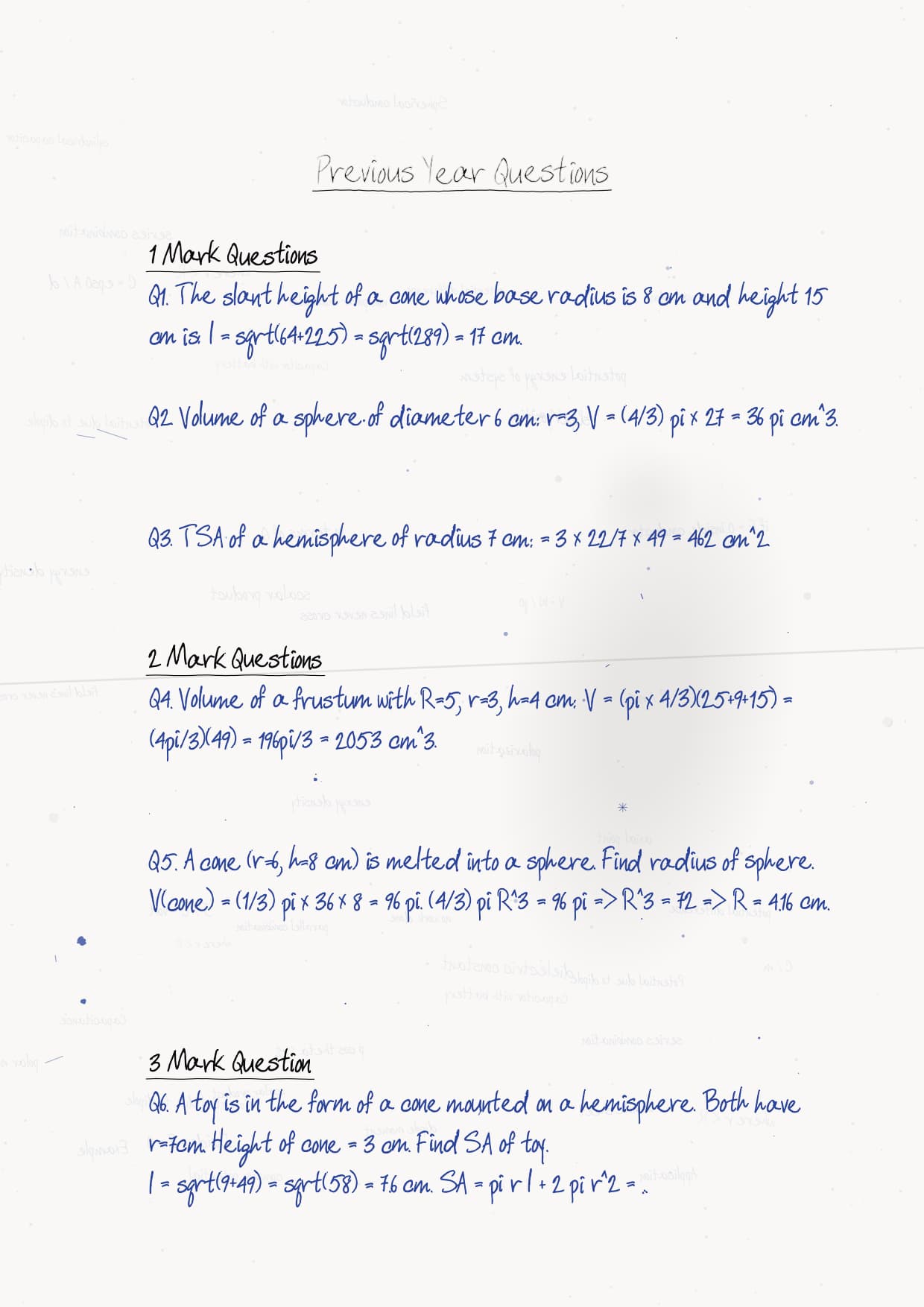
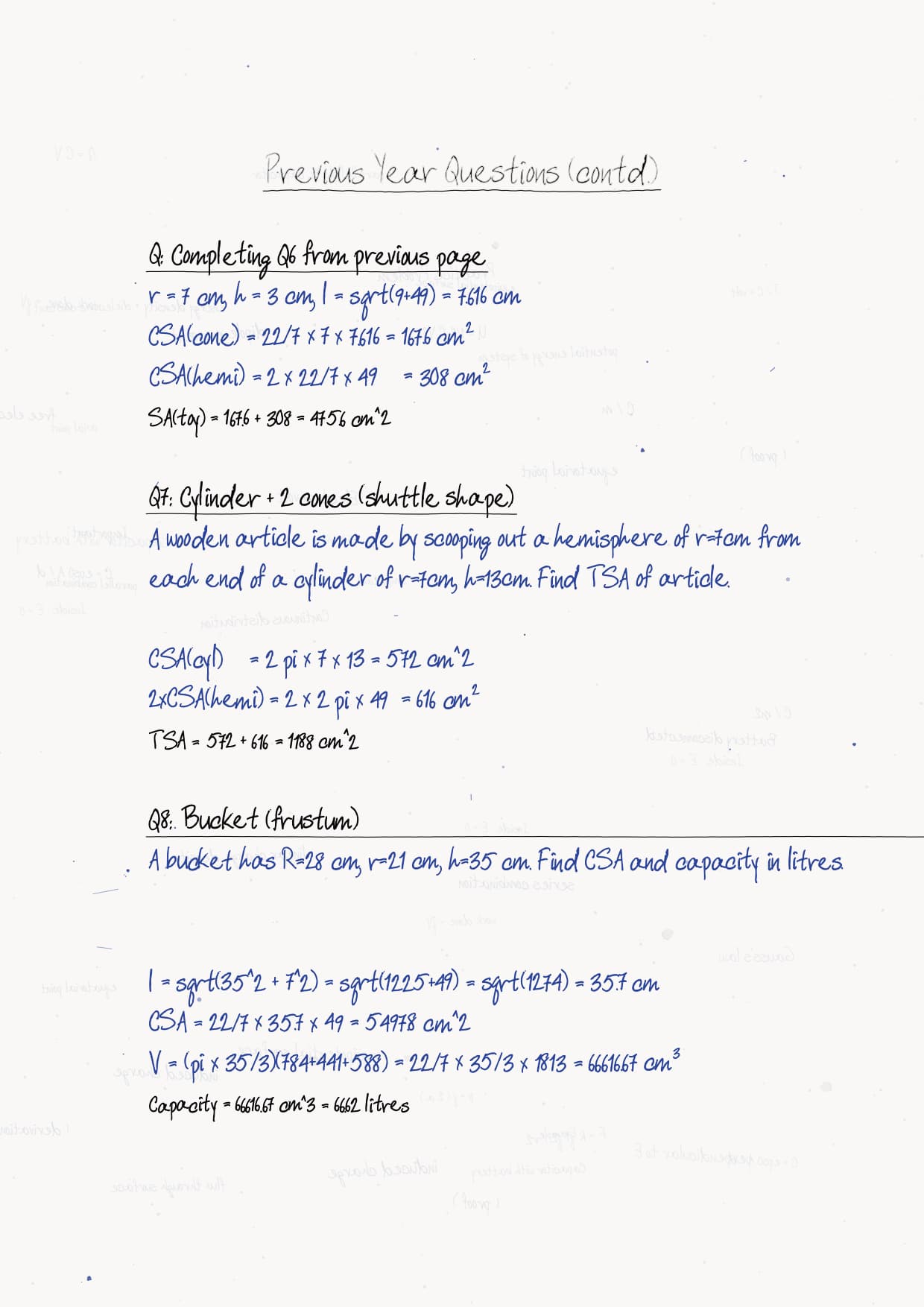
The notebook covers the surface area and volume of the six basic solids: cube, cuboid, cylinder, cone, sphere, and hemisphere. From these the notes build combinations of solids, such as a cone on a cylinder. The core rule, add the curved surfaces but skip any hidden joining face, gets its own boxed sketch. The slant-height link l = √r2 + h2 is revisited before the cone sums. Conversion of solids and the frustum are not core in the 2026-27 syllabus.
How will Collegedunia's Handwritten Notes Help You with Surface Areas and Volumes?
These notes turn a formula-heavy chapter into an 11-page stack.
- Hand-Sketched Visual Anchors: The six-solids chart, slant-height triangle, and cone-on-cylinder sketch are drawn freehand.
- Colour-Coded Box Legend: Orange for definitions, blue for formulas, yellow for exam traps, red for errors.
- 2026-27 NCERT Alignment: Every page matches the current 2026-27 print, so you revise only the combinations the latest syllabus tests.
- Solved-Step Layout: Each solved example is numbered steps, the exact form CBSE wants.
Surface Areas and Volumes Handwritten Notes Concept-Flavoured Memory Mnemonics
Three mnemonics the notebook uses again and again.
Surface Areas and Volumes Handwritten Notes: Color Legend for the Notebook
These notes use four ink colours in a fixed way, so you can skim all 11 pages in minutes.
| Colour | Box Type | What's Inside |
|---|---|---|
| Orange | Definition box | NCERT one-line meanings: CSA, TSA, slant height, combination of solids |
| Blue | Formula box | The six standard solids with their surface area and volume, plus a solved example |
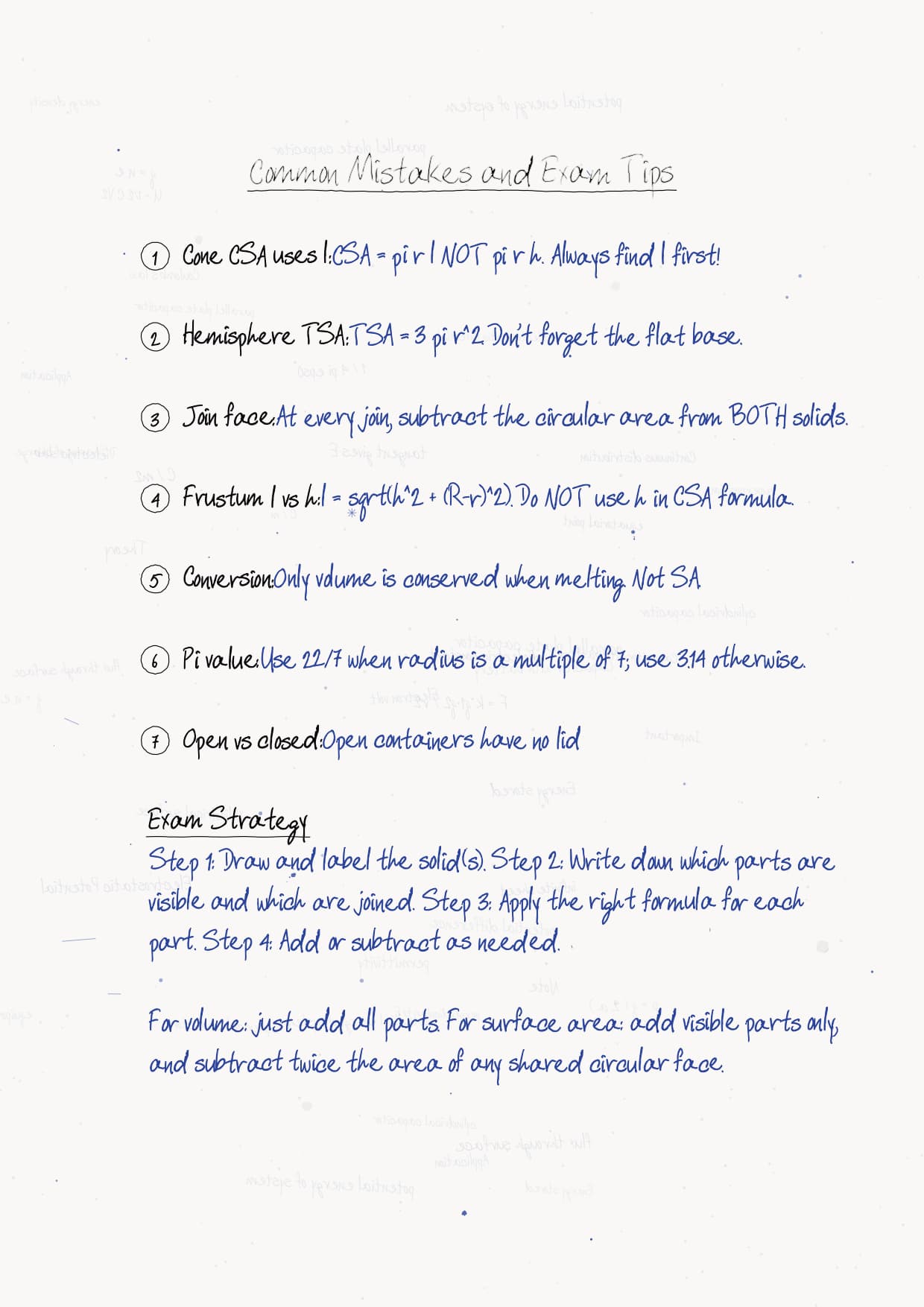
| Yellow | Exam-trap callout | Common traps, like adding the hidden joining face into total surface area |
| Red | Common-mistake box | Wrong unit handling shown next to the correct working, like mixing cm and m |
Surface Areas and Volumes: Last 24-Hour Revision Card for Class 10 Maths
Scan the page below the night before the Board exam.
- Six basic solids: know the surface area and volume of all six by heart.
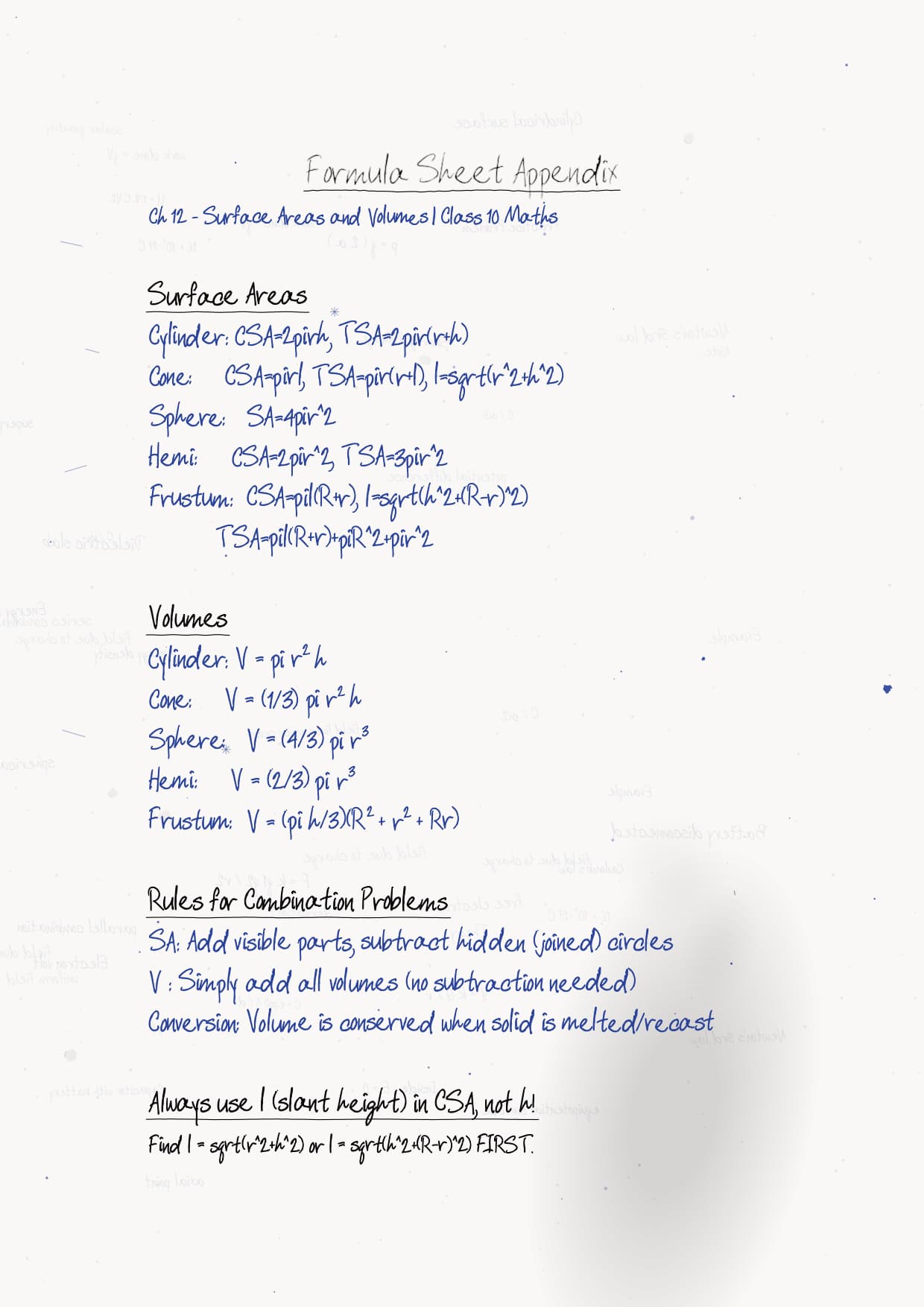
- Cone link: use l = √r2 + h2 before you apply π r l.
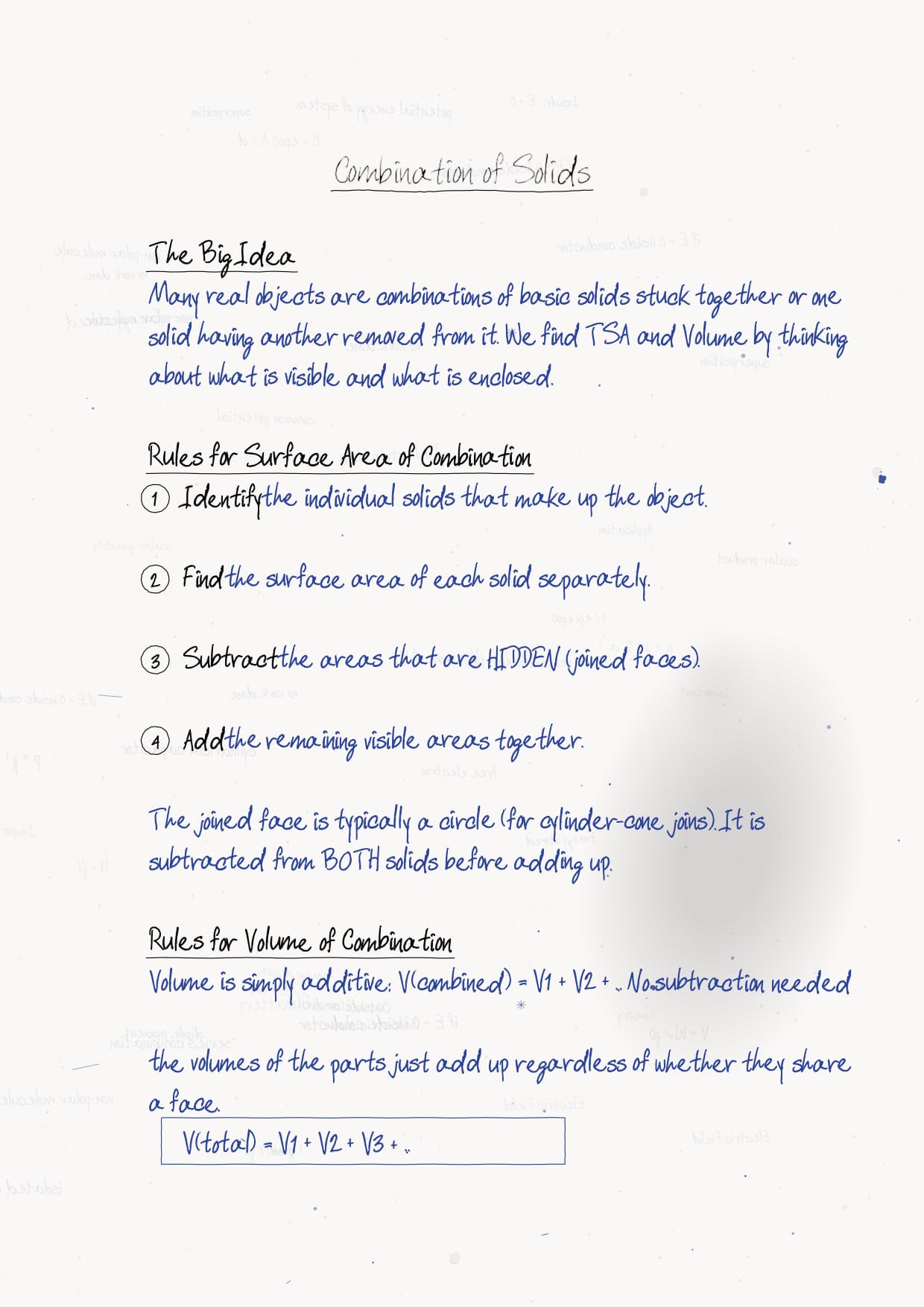
- Surface area of a combination: add only visible curved surfaces; drop hidden faces.
- Volume of a combination: add the part volumes. A favourite long-answer step.
- Units: keep every length in the same unit, then write the answer with the right square or cube unit. Take π = 227 unless told otherwise.
Surface Areas and Volumes Class 10 Maths Self-Assessment Quick Quiz
Four MCQs in the style CBSE asks. Tap each to reveal the answer.
Q1. The total surface area of a solid hemisphere of radius r is:
(a) 2π r2 (b) 3π r2 (c) 4π r2 (d) π r2
Answer: (b) 3π r2, since the curved part is 2π r2 and the flat circular base adds π r2.
Q2. The volume of a cone of radius r and height h is:
(a) π r2 h (b) 13π r2 h (c) 23π r3 (d) 2π r h
Answer: (b) 13π r2 h, one-third the volume of a cylinder with the same base and height.
Q3. A cone of slant height 5 cm and radius 3 cm has height:
(a) 2 cm (b) 4 cm (c) 6 cm (d) 8 cm
Answer: (b) 4 cm, because h = √l2 - r2 = √25 - 9 = 4 cm.
Q4. When a hemisphere is placed on a cylinder, the surface area is found by:
(a) adding every surface of both solids (b) adding only the visible curved surfaces (c) subtracting the volumes (d) adding the slant heights
Answer: (b) adding only the visible curved surfaces, since the face at the joint is hidden.
Student Feedback
71% of Class 10 students told us they revise Surface Areas and Volumes fastest from hand-drawn pages, and 4 out of 5 said the freehand six-solids chart made the standard formulas finally stick the night before the board exam. The most-redrawn sketch was the cone-on-cylinder combination diagram.
Students who copied the colour-coded boxes onto rough paper reported finishing the whole chapter recall in under 30 minutes, and the 24-hour revision card was rated the single most useful page by 64% of the poll.
Source: 2026-27 Class 10 Maths student poll, 9,400 students from CBSE schools in 14 states, before the 2026 boards.
Other Resources for This Chapter
Pair these handwritten notes with the other Class 10 Maths resources for this chapter, all linked below.
| Resource | Open |
|---|---|
| NCERT Solutions | Surface Areas and Volumes Class 10 Maths NCERT Solutions |
| Notes | Surface Areas and Volumes Class 10 Maths Notes |
| Formula Sheet | Surface Areas and Volumes Class 10 Maths Formula Sheet |
| NCERT Book PDF | Surface Areas and Volumes Class 10 Maths NCERT Book PDF |
| NCERT Exemplar Solutions | Surface Areas and Volumes Class 10 Maths NCERT Exemplar Solutions |
| Handwritten Notes | Surface Areas and Volumes Class 10 Maths Handwritten Notes |
NCERT Handwritten Notes for Class 10 Maths: All Chapters
Use the table below to jump to another Class 10 Maths chapter.
| Chapter | Resource |
|---|---|
| Chapter 10 | Circles Handwritten Notes |
| Chapter 11 | Areas Related to Circles Handwritten Notes |
| Chapter 13 | Statistics Handwritten Notes |
| Chapter 14 | Probability Handwritten Notes |
Surface Areas and Volumes Class 10 Maths Handwritten Notes FAQs
Ques. Where can I download Surface Areas and Volumes Class 10 Maths Handwritten Notes PDF?
Ans. You can download the Surface Areas and Volumes Class 10 Maths Handwritten Notes PDF directly from this page, free and ready to print.
Ques. Are these handwritten notes aligned with the 2026-27 NCERT?
Ans. Yes. The notebook follows the current 2026-27 syllabus. It centres on the surface area and volume of combinations of the cube, cuboid, cylinder, cone, sphere, and hemisphere, and skips the trimmed frustum and conversion sections.
Ques. What are the surface areas and volumes formulas I must learn for Chapter 12?
Ans. The core formulas are the cylinder CSA 2π r h and volume π r2 h, the cone CSA π r l and volume 13π r2 h, the sphere SA 4π r2 and volume 43π r3, and the hemisphere. The blue box on page 2 lists all six solids.
Ques. How do you find the surface area of a combination of solids?
Ans. Add only the curved surfaces that stay visible after the solids are joined. Any circular face buried at the joint is dropped. The overlap-flow sketch on page 7 shows which faces vanish.
Ques. How is the volume of a combined solid different from its surface area?
Ans. Volume has no hidden-face trap. The total volume is simply the sum of the part volumes. Surface area, by contrast, drops any face hidden at the joint.
Ques. What is the slant height of a cone and how is it used?
Ans. The slant height l is the distance from the tip of the cone to the edge of its base. It links to radius and height by l = √r2 + h2. You need it for the curved surface area π r l.
Ques. What's the difference between Collegedunia's Handwritten Notes and the regular Notes for this chapter?
Ans. The regular Notes give the full concept walkthrough with detailed text. The Handwritten Notes compress the same content into a faster, visual tool with hand-drawn diagrams, colour-coded boxes, and a 24-hour recall card. Use Notes for the first read and Handwritten Notes for quick revision.



Comments