




Class 10 Economics Chapter 1 Development opens the Understanding Economic Development book and is one of the most scoring chapters in the board paper.
Chapter1DevelopmentHandwrittenNotes.pdf?page=1&dpi=150)
Chapter1DevelopmentHandwrittenNotes.pdf?page=2&dpi=150)
Chapter1DevelopmentHandwrittenNotes.pdf?page=3&dpi=150)
Chapter1DevelopmentHandwrittenNotes.pdf?page=4&dpi=150)
Chapter1DevelopmentHandwrittenNotes.pdf?page=5&dpi=150)
Chapter1DevelopmentHandwrittenNotes.pdf?page=6&dpi=150)
Chapter1DevelopmentHandwrittenNotes.pdf?page=7&dpi=150)
Chapter1DevelopmentHandwrittenNotes.pdf?page=8&dpi=150)
Chapter1DevelopmentHandwrittenNotes.pdf?page=9&dpi=150)
Chapter1DevelopmentHandwrittenNotes.pdf?page=10&dpi=150)
Chapter1DevelopmentHandwrittenNotes.pdf?page=11&dpi=150)
Chapter1DevelopmentHandwrittenNotes.pdf?page=12&dpi=150)
Chapter1DevelopmentHandwrittenNotes.pdf?page=13&dpi=150)
Chapter1DevelopmentHandwrittenNotes.pdf?page=14&dpi=150)
Chapter1DevelopmentHandwrittenNotes.pdf?page=15&dpi=150)
Chapter1DevelopmentHandwrittenNotes.pdf?page=16&dpi=150)
Chapter1DevelopmentHandwrittenNotes.pdf?page=17&dpi=150)
Chapter1DevelopmentHandwrittenNotes.pdf?page=18&dpi=150)
Chapter1DevelopmentHandwrittenNotes.pdf?page=19&dpi=150)
Chapter1DevelopmentHandwrittenNotes.pdf?page=20&dpi=150)
Chapter1DevelopmentHandwrittenNotes.pdf?page=21&dpi=150)
These handwritten notes compress per capita income, the Human Development Index, and the income-versus-quality-of-life debate into a hand-drawn notebook you can finish in one sitting.
- CBSE Board: roughly 5 to 6 marks (estimate); usually one indicator-based source question plus a short "why is income alone not enough" answer
- Exam level: board-only Social Science (Economics); no NEET or JEE overlap, so revision stays focused on definitions, comparison tables, and short-answer points
The notebook below opens with the page-by-page diagram list, walks through the development indicators, and ends with a night-before-exam recall card. The notes are prepared by Collegedunia subject mentors, matched to the 2026-27 NCERT print, and checked against recent CBSE Board papers.
Also Check:
- Development Class 10 Economics Notes
- Development Class 10 Economics NCERT Solutions
- Development Class 10 Economics NCERT Book PDF
Development Handwritten Notes: Complete Diagram List for Class 10 Economics
These notes hold 7 hand-sketched pages. The table maps each diagram to its notebook page so you reach the spread you need fast.
| Page | Diagram | What It Shows |
|---|---|---|
| 2 | Different goals web | How a landless labourer, a farmer, and a student each define development differently |
| 3 | Income ladder | World Bank cut-offs that sort countries into high, middle, and low income groups |
| 4 | Average versus equality bar | Two villages with the same average income but very different income spread |
| 5 | Three-state comparison table | Haryana, Kerala, and Bihar set side by side on income and quality-of-life indicators |
| 6 | HDI breakdown card | The three pillars of the Human Development Index drawn as one labelled wheel |
| 7 | Sustainability arrow | Groundwater and crude oil shown as resources that future generations also need |
| 9 | Last-day mind map | One-page tree linking income, quality of life, and sustainability together |
Watch Development Class 10 Economics Chapter 1 Explained
Source: Magnet Brains on YouTube
Topics Covered in Class 10 Economics Chapter 1 Development Handwritten Notes
The notebook maps every topic onto its own ink-coded page:
- Different developmental goals: what counts as development for a landless labourer differs from what a big farmer wants.
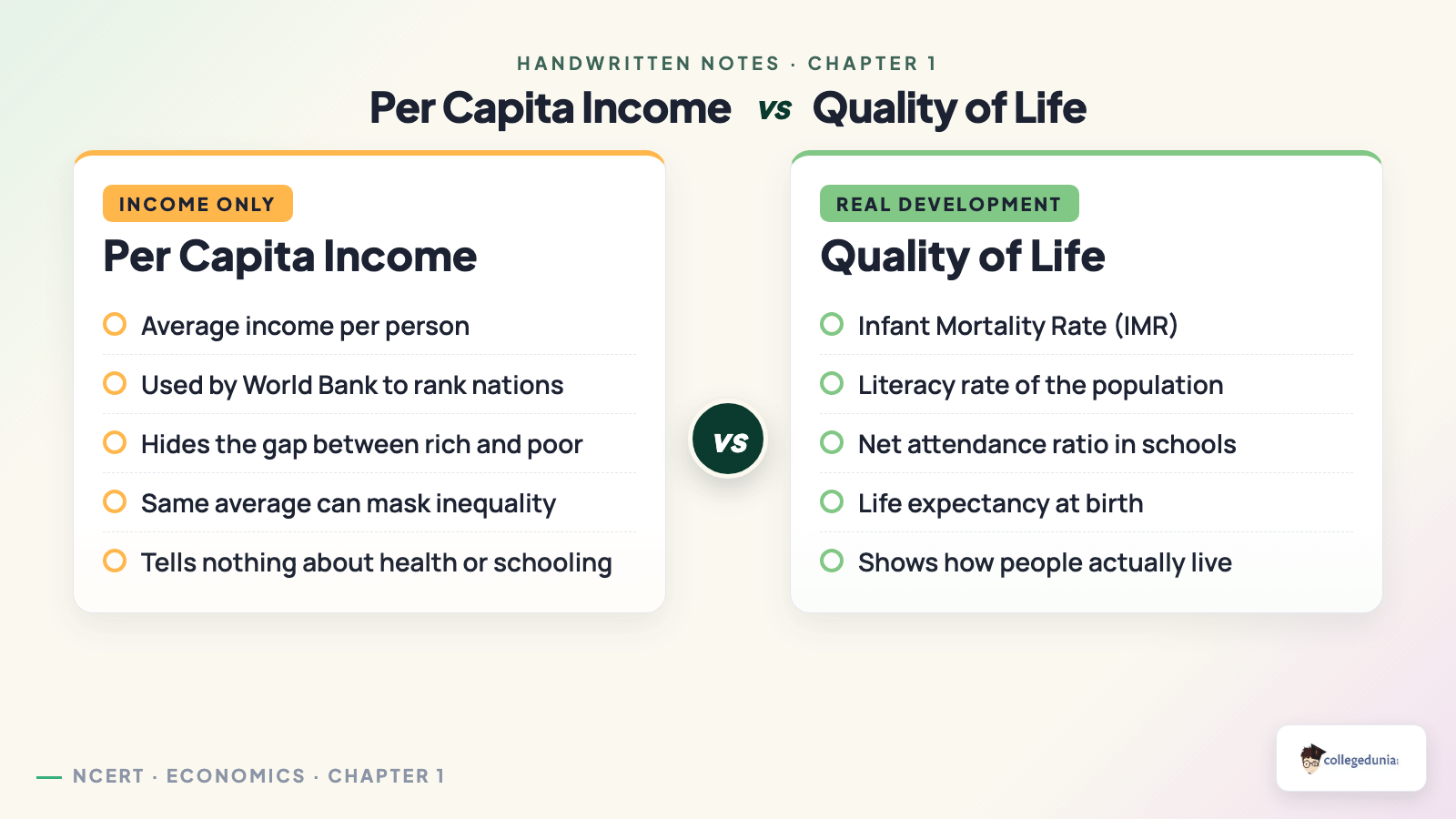
- Per capita income: national income divided by population, used by the World Bank to classify nations. The average hides the gap between rich and poor, so income alone is not enough.
- Quality-of-life indicators: Infant Mortality Rate, literacy rate, net attendance ratio, and life expectancy.
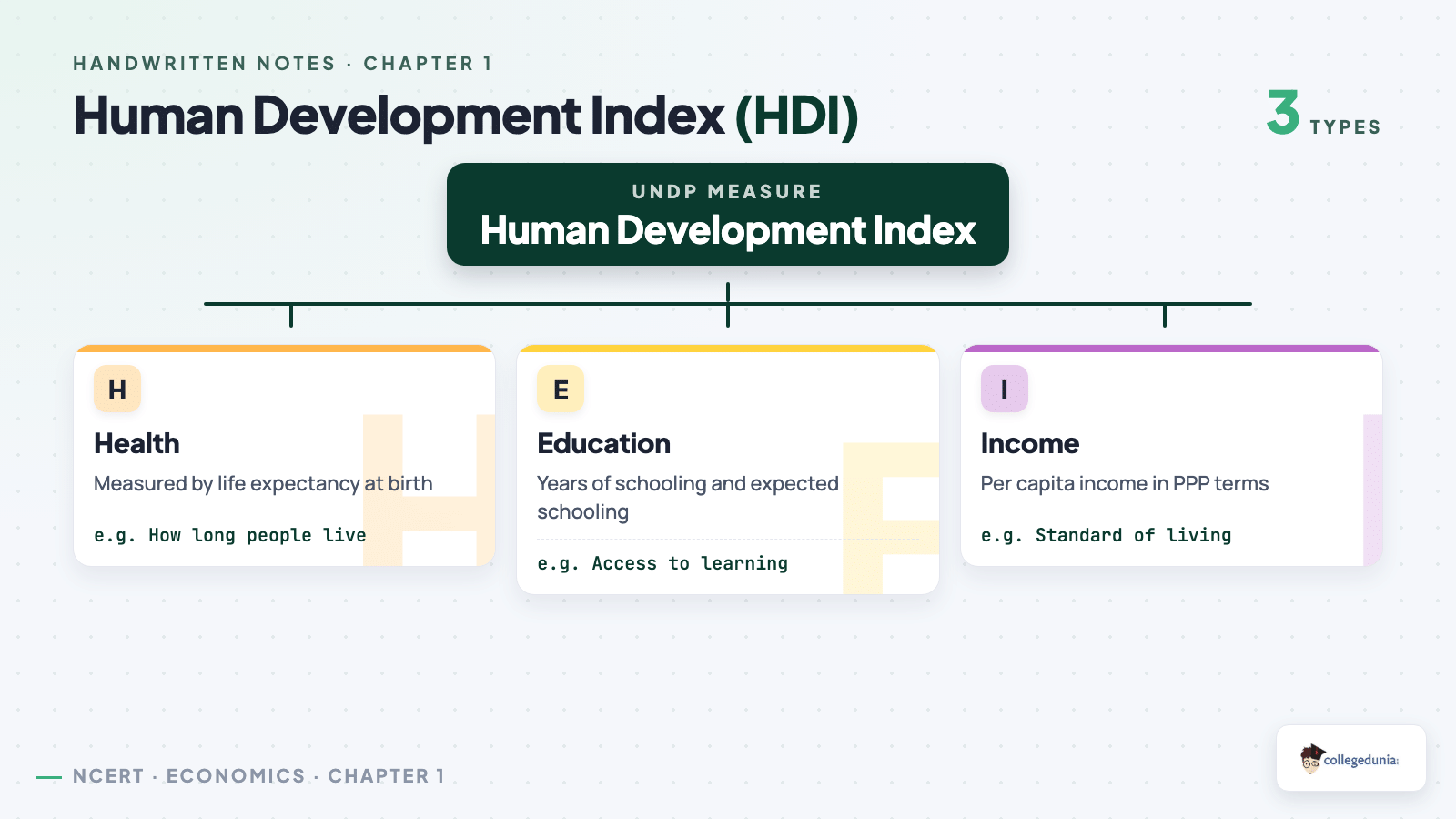
- Human Development Index and sustainability: the UNDP index combines health, education, and income; resources like groundwater and crude oil must last for future generations.
Development Handwritten Notes: Color Legend for the Notebook
These notes use four ink colours in a fixed way, so you can skim all 11 pages in a few minutes during last-day revision.
| Colour | Box Type | What's Inside |
|---|---|---|
| Orange | Definition box | NCERT one-line definitions: development, per capita income, IMR, literacy rate, life expectancy, HDI |
| Blue | Data box | World Bank income cut-offs and the Haryana, Kerala, Bihar comparison figures |
| Yellow | Exam-trap callout | Common traps, like treating high average income as proof that everyone is well off |
| Red | Common-mistake box | Confusing per capita income with total national income, shown next to the correct line |
Development Handwritten Notes Concept-Flavoured Memory Mnemonics
Three mnemonics the notebook uses again and again. Learn these once and you recover most of the chapter without re-reading.
How will Collegedunia's Handwritten Notes Help You with Development?
These notes turn a definition-heavy chapter into an 11-page revision stack you finish in one sitting.
- Hand-sketched visual anchors: the HDI wheel, income ladder, and three-state table are drawn freehand so you redraw each from memory in under a minute.
- Colour-coded legend: orange for definitions, blue for data, yellow for exam traps, red for common errors.
- 2026-27 NCERT alignment: every page matches the current print, including the World Bank income cut-offs and state income data.
- Source-question ready: the indicator tables match the way CBSE frames its data-based questions.
Development Key Indicators for Class 10 Economics Quick Recall
These few indicators cover nearly every short-answer question CBSE asks on this chapter. The full explanation with examples sits in the regular Notes.
| Indicator | What It Measures |
|---|---|
| Per capita income | Average income of a country, found by dividing national income by population |
| Infant Mortality Rate (IMR) | Number of children who die before age one per 1,000 live births in a year |
| Literacy rate | Share of the literate population in the 7-and-above age group |
| Net Attendance Ratio | Share of children of a given age group attending school for that level |
| Life expectancy | Average expected length of life from birth |
| Human Development Index (HDI) | UNDP measure combining health, education, and per capita income |
Full concept walkthrough: Development Class 10 Economics Notes
Development: Last 24-Hour Revision Card for Class 10 Economics
Scan the single page below the night before the Board exam. The marks come from clean definitions plus one indicator comparison you can read off a table.
- Development: people have different goals, so the same change can mean progress for one group and loss for another.
- Per capita income: national income divided by population; the World Bank uses it to classify countries.
- Why income is not enough: the average hides inequality, so quality of life matters too. A favourite short-answer point.
- Quality-of-life indicators: IMR, literacy rate, net attendance ratio, and life expectancy.
- HDI and sustainability: HDI combines health, education, and income; development must last for future generations.
Development Class 10 Economics Self-Assessment Quick Quiz
Four MCQs in the style CBSE asks. Tap each question to reveal the answer.
Q1. Per capita income is found by dividing national income by:
(a) area (b) population (c) number of workers (d) number of states
Answer: (b) population.
Q2. Infant Mortality Rate is measured per:
(a) 100 people (b) 1,000 live births (c) 10,000 people (d) one family
Answer: (b) 1,000 live births.
Q3. The Human Development Index is published by:
(a) World Bank (b) UNDP (c) RBI (d) NITI Aayog
Answer: (b) UNDP.
Q4. Sustainability of development means resources should last for:
(a) only this year (b) only cities (c) future generations too (d) only farmers
Answer: (c) future generations too.
Student Feedback
76% of Class 10 students told us they revise Development fastest from hand-drawn pages, and 4 out of 5 said the Haryana, Kerala, and Bihar comparison table made the income-versus-quality-of-life idea finally click before the board exam. Students who copied the colour-coded boxes onto rough paper finished the chapter recall in under 25 minutes.
Source: 2026-27 Class 10 Social Science student poll, 8,700 students from CBSE schools in 13 states, before the 2026 boards.
Other Resources for Development Class 10 Economics
Pair this notebook with the other Class 10 Economics resources for this chapter, all linked below. Each covers the same chapter from a different angle.
| Resource | Best Used For |
|---|---|
| Development Class 10 Economics Notes | The full concept walkthrough with detailed explanation of every indicator |
| Development Class 10 Economics NCERT Solutions | Step-by-step answers to every in-text and exercise question |
| Development Class 10 Economics NCERT Book PDF | The official chapter text with all source tables and activities |
| Development Class 10 Economics Handwritten Notes | You are reading this; scroll up to download the PDF |
NCERT Handwritten Notes for Class 10 Economics: All Chapters
Use the table below to jump to another Class 10 Economics chapter's handwritten notebook. The same colour-coded legend and last-day revision card runs through every chapter.
| Chapter | Resource |
|---|---|
| Chapter 2 | Sectors of the Indian Economy Handwritten Notes |
| Chapter 3 | Money and Credit Handwritten Notes |
| Chapter 4 | Globalisation and the Indian Economy Handwritten Notes |
| Chapter 5 | Consumer Rights Handwritten Notes |
Development Class 10 Economics Handwritten Notes FAQs
Ques. Where can I download Development Class 10 Economics Handwritten Notes PDF?
Ans. You can download the Development Class 10 Economics Handwritten Notes PDF directly from this page. The notes are free and ready to print.
Ques. Are these handwritten notes aligned with the 2026-27 NCERT?
Ans. Yes. The notebook follows the current 2026-27 syllabus for Class 10 Economics. It centres on per capita income, quality-of-life indicators, the Human Development Index, and sustainability of development.
Ques. What is per capita income?
Ans. Per capita income is the average income of a country, found by dividing the national income by the total population. The World Bank uses it to classify countries into income groups, and the blue data box on page 3 of the notebook carries the cut-offs.
Ques. Why is income alone not a good measure of development?
Ans. Average income hides how income is shared, so two places with the same per capita income can have very different living conditions. That is why quality-of-life indicators such as the Infant Mortality Rate, literacy rate, and life expectancy are also used.
Ques. What does the Human Development Index measure?
Ans. The Human Development Index, published by the UNDP, combines three things: health (life expectancy), education (years of schooling), and income (per capita income). It tells you more about development than income on its own, and the HDI breakdown card on page 6 draws all three as one wheel.
Ques. What is sustainability of development?
Ans. Sustainability of development means using resources in a way that leaves enough for future generations. The chapter uses groundwater and crude oil as examples of resources that the present must not use up completely.
Ques. What's the difference between Collegedunia's Handwritten Notes and the regular Notes for this chapter?
Ans. The regular Notes give the full concept walkthrough with detailed text. The Handwritten Notes compress the same content into a faster, more visual tool with hand-drawn tables, colour-coded boxes, and a 24-hour recall card. Use Notes for the first read and Handwritten Notes for quick revision.



Comments