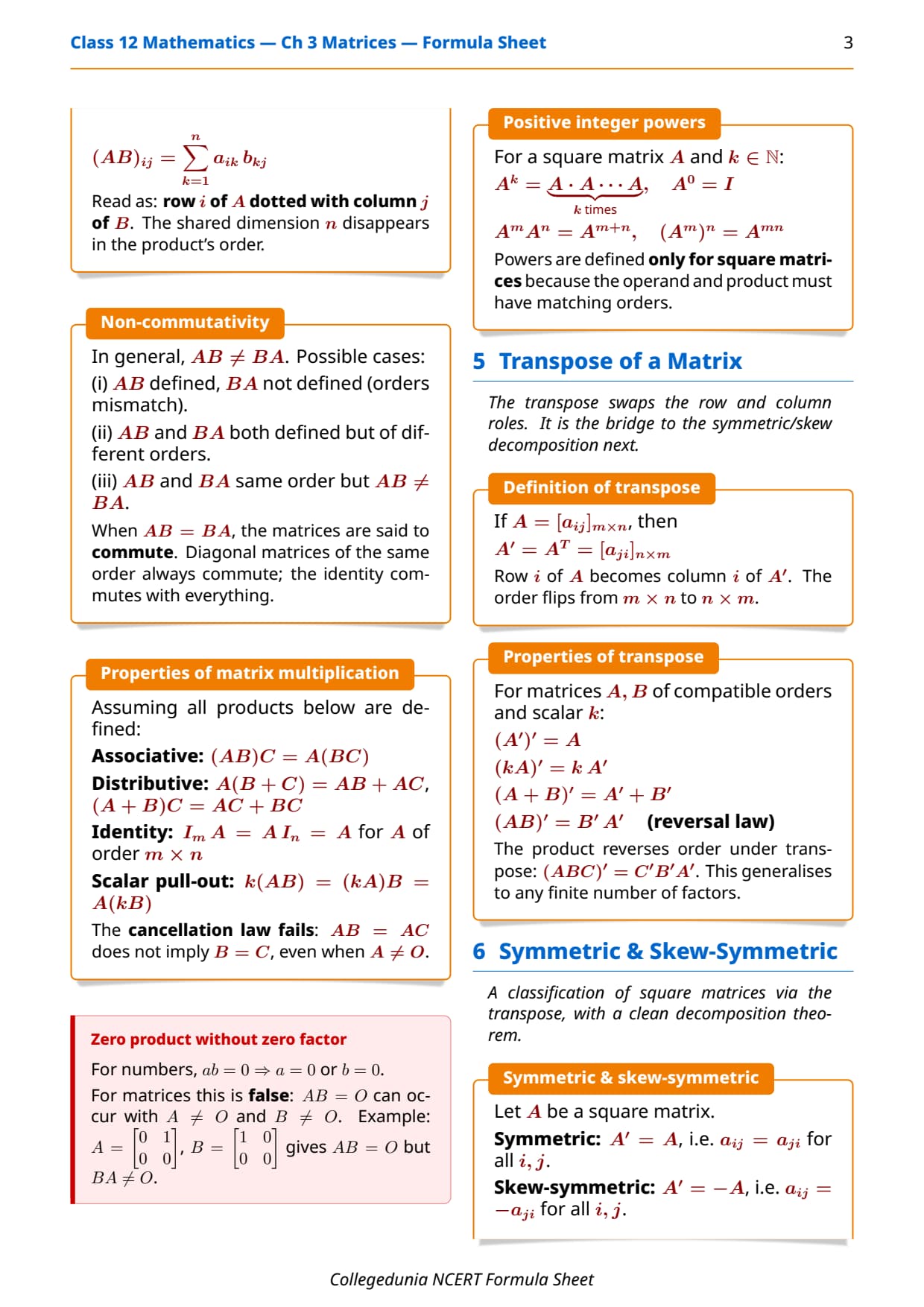
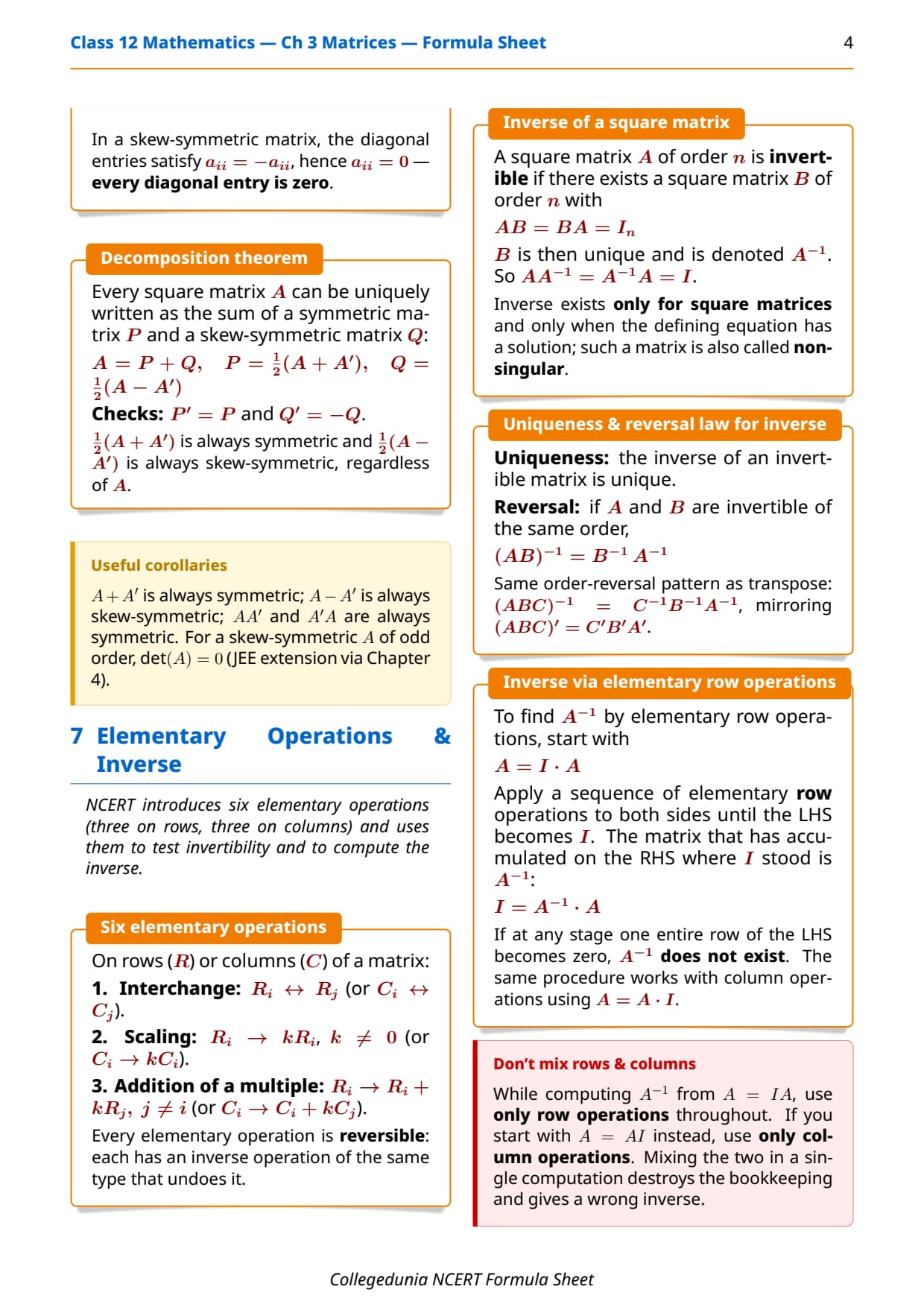
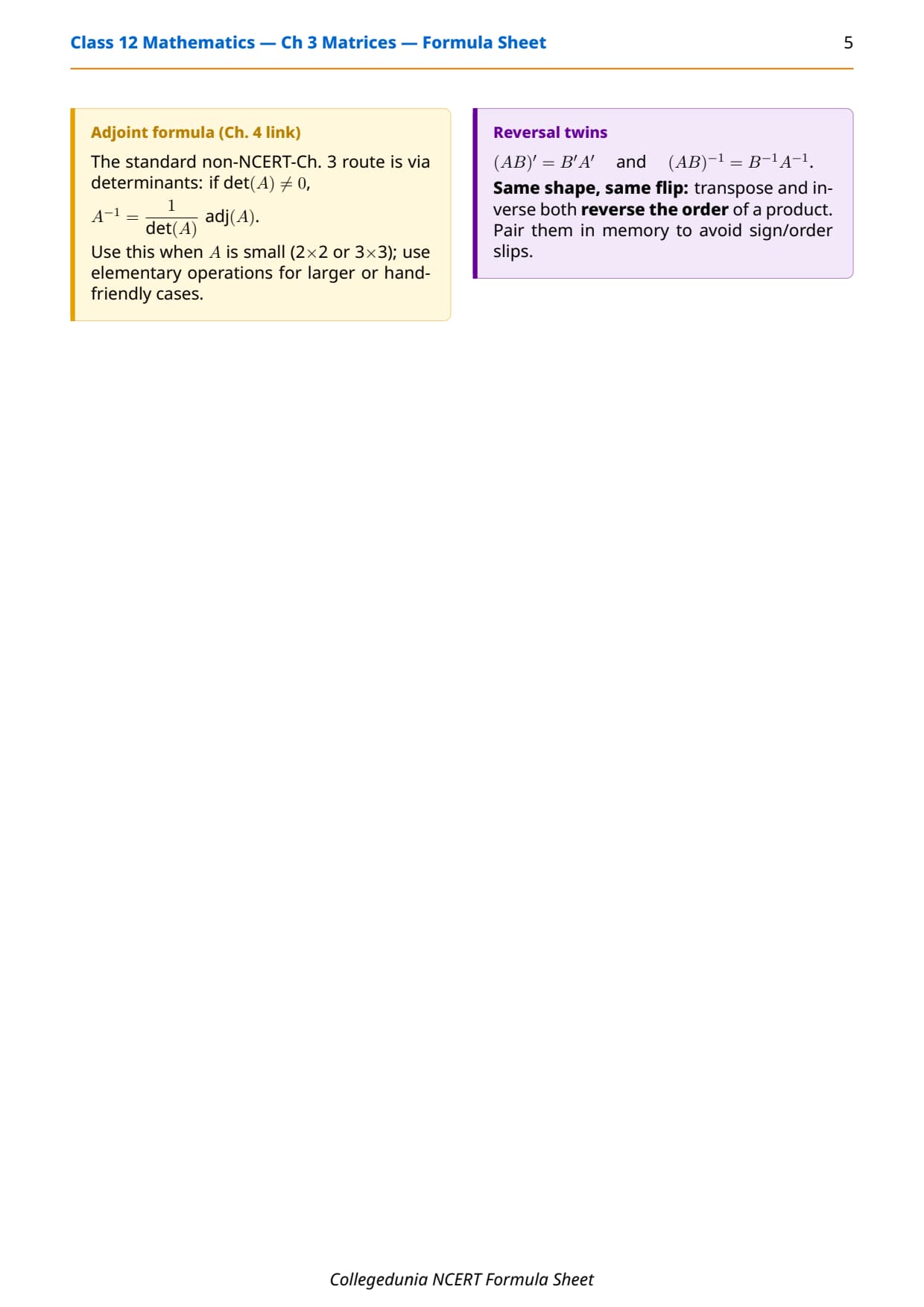
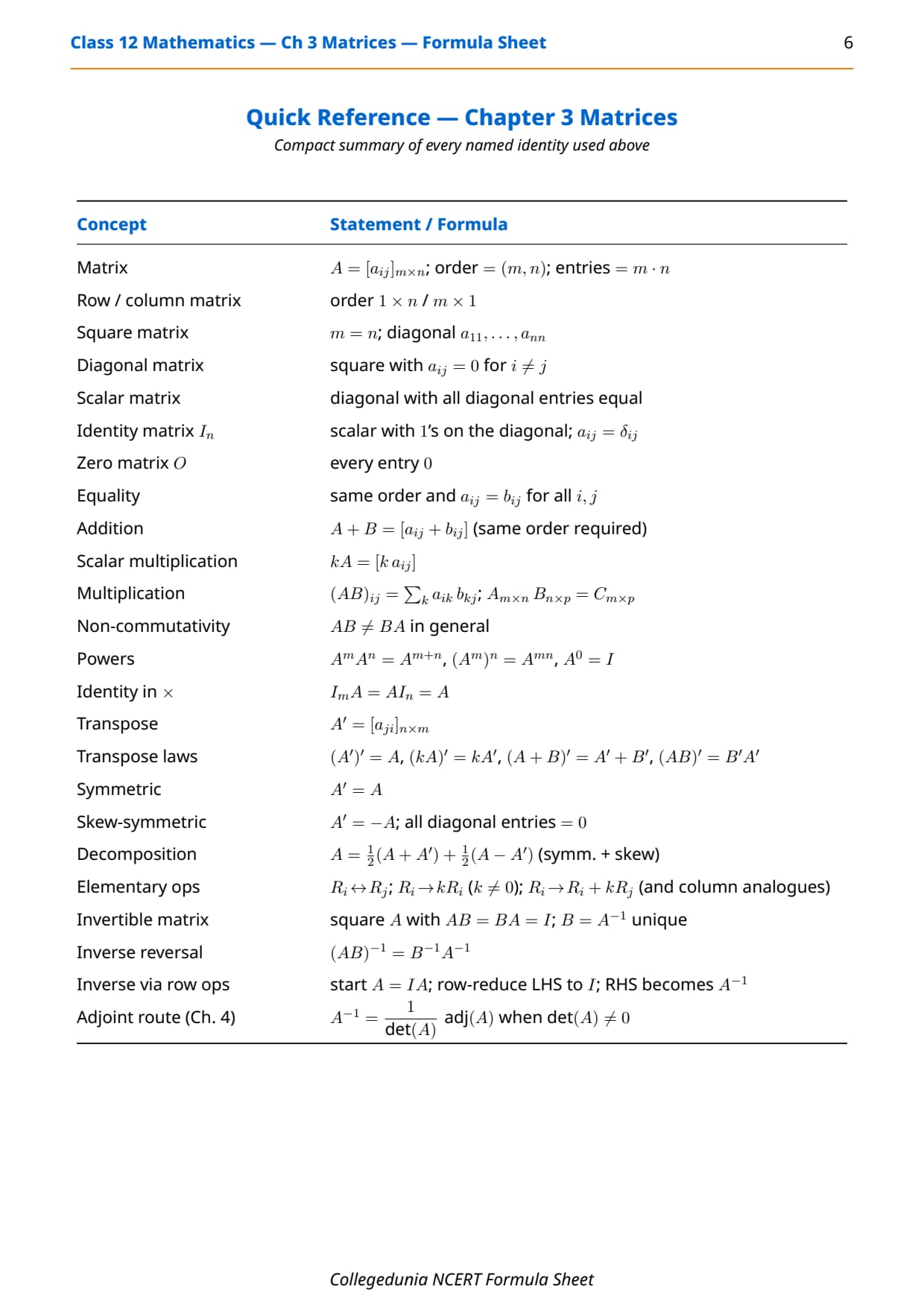
The Matrices Class 12 Formula Sheet page compiles NCERT Class 12 Mathematics Chapter 3 into a single download-ready resource, aligned to the 2026-27 NCERT syllabus. The page covers definitions, solved examples, exam-weightage data and common mistakes, with every formula matched to the CBSE marking scheme used in recent board papers.
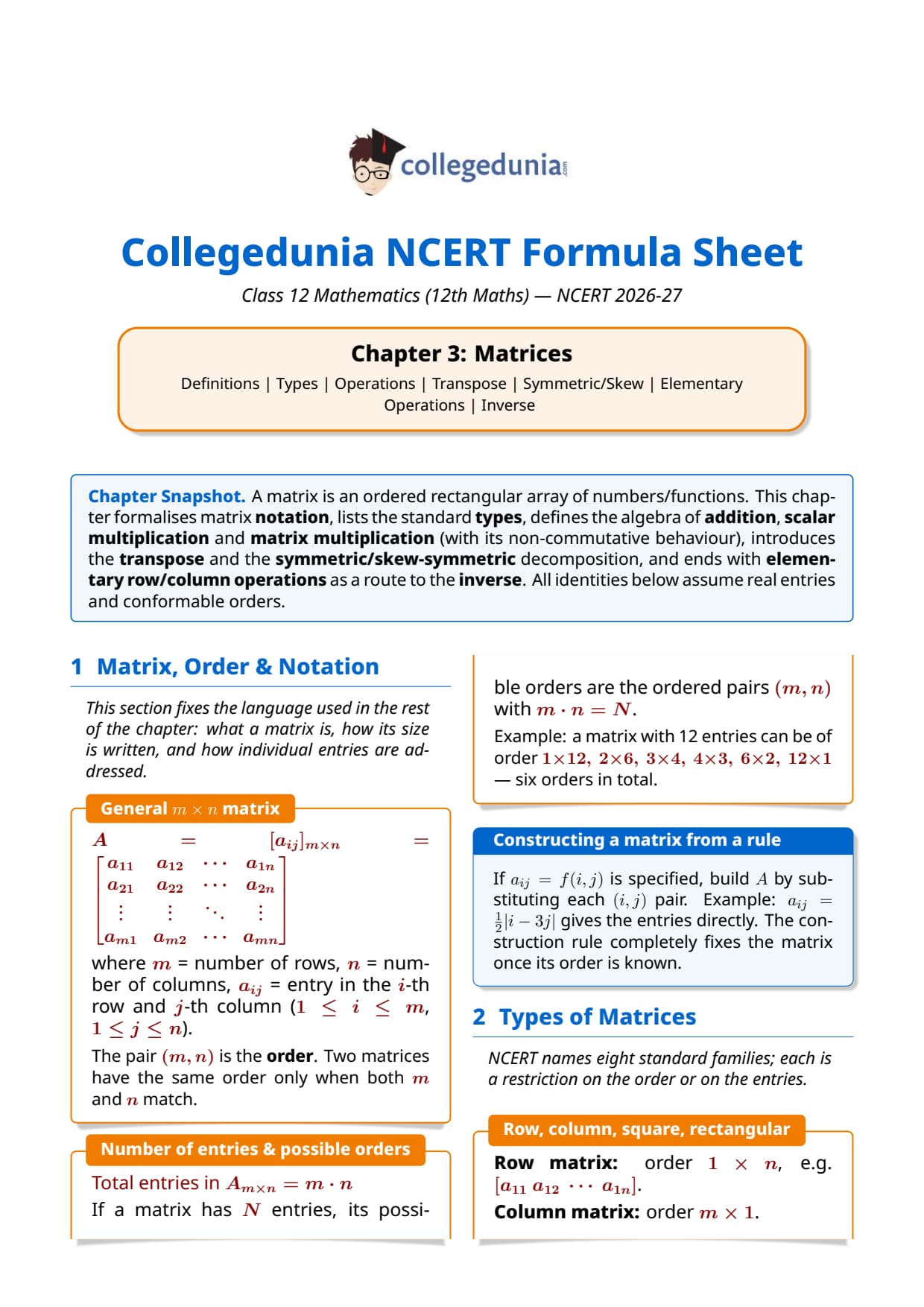
- CBSE Weightage: 5 to 7 marks (one short answer plus one MCQ or assertion-reason item).
- JEE Main Weightage: 3 to 5% of the Maths section (1 to 2 questions per paper).
- CUET (UG) Weightage: 1 to 2 MCQs in nearly every shift.
This Formula Sheet is curated by Class 12 Maths experts at Collegedunia, mapped to the 2026-27 NCERT edition, and refined against the last five years of CBSE Board and JEE Main papers.

All Matrices Formulas for Class 12 Maths in One learn Table
The this Class 12 page address this in the same order as the NCERT textbook.
The table below catalogues every formula, identity, and special-matrix definition from Class 12 Maths Chapter 3, mapped to the exact NCERT section where it is introduced. Each row has surfaced in a CBSE or JEE Main question in the last five years, so anchor your revision around it.
| Concept | Formula / Rule | NCERT Section | Common Use |
|---|---|---|---|
| Order of a matrix | Am × n has m rows, n columns | 3.2 | Compatibility check |
| Number of elements | m × n | 3.2 | 1-mark MCQ |
| Number of matrices of order m × n with entries from a set of size k | km · n | 3.2 (extension) | JEE counting |
| Equality of matrices | A = B aij = bij for all i, j and same order | 3.3 | Solving entry equations |
| Addition | (A + B)ij = aij + bij , same order | 3.4.1 | Operation MCQ |
| Scalar multiplication | (kA)ij = k · aij | 3.4.2 | Solving kA = B |
| Subtraction | (A - B)ij = aij - bij , same order | 3.4.3 | Operation MCQ |
| Multiplication compatibility | Am × n · Bn × p = (AB)m × p | 3.4.4 | Order matching |
| Matrix multiplication entry | (AB)ij = k=1n aik bkj | 3.4.4 | 3-mark CBSE compute |
| Non-commutativity | In general, AB ≠ BA | 3.4.4 | Assertion-reason |
| Associativity | (AB)C = A(BC) | 3.4.4 | Multi-step proof |
| Distributivity | A(B + C) = AB + AC | 3.4.4 | Identity proofs |
| Identity matrix | AIn = In A = A , where A is n × n | 3.4.4 | Standard recall |
| Zero product property failure | AB = O does NOT imply A = O or B = O | 3.4.4 | Assertion-reason MCQ |
| Transpose | (AT)ij = aji | 3.5 | Definition recall |
| Transpose of sum | (A + B)T = AT + BT | 3.5 | 2-mark CBSE |
| Transpose of scalar product | (kA)T = k AT | 3.5 | 1-mark MCQ |
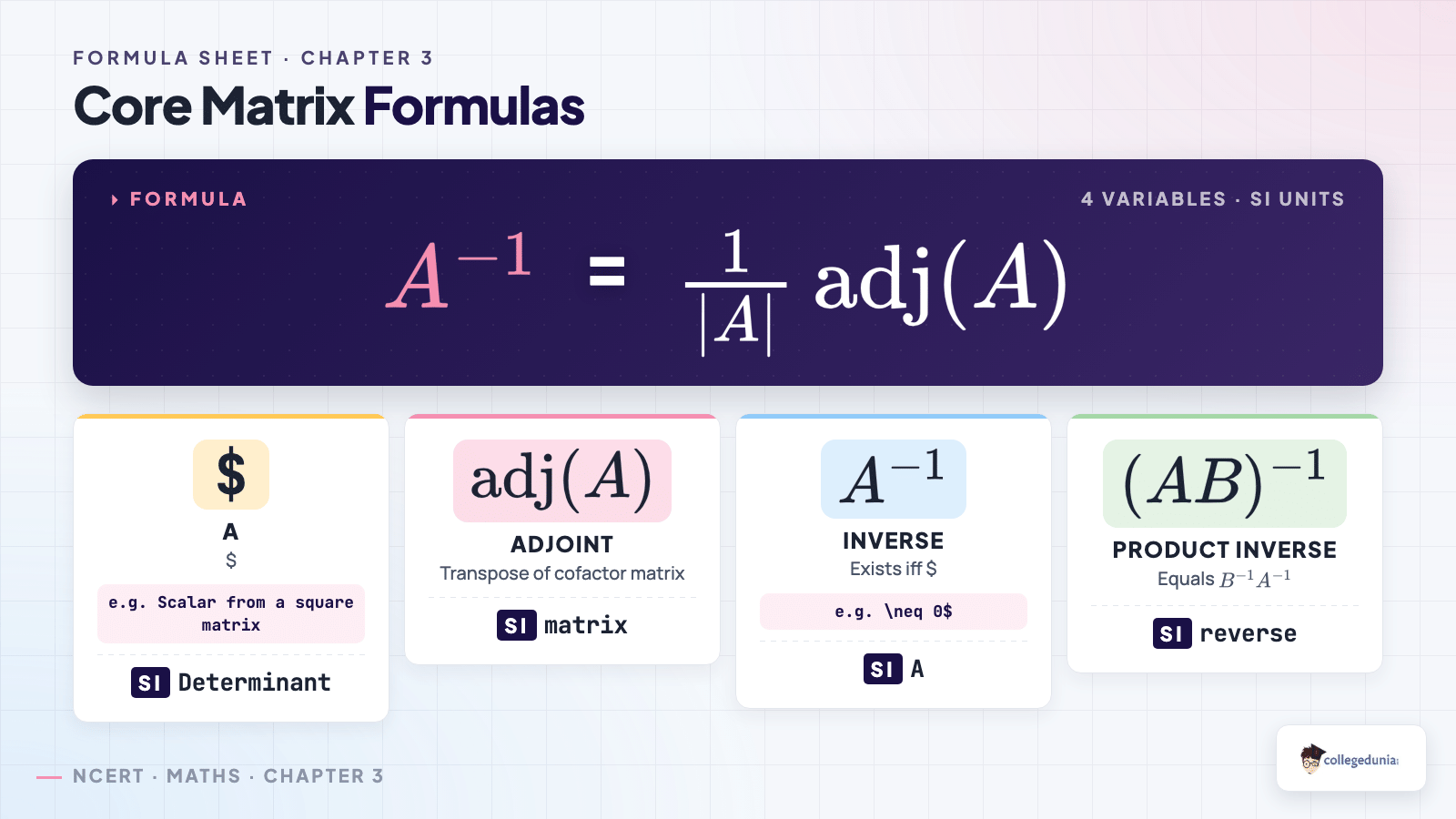
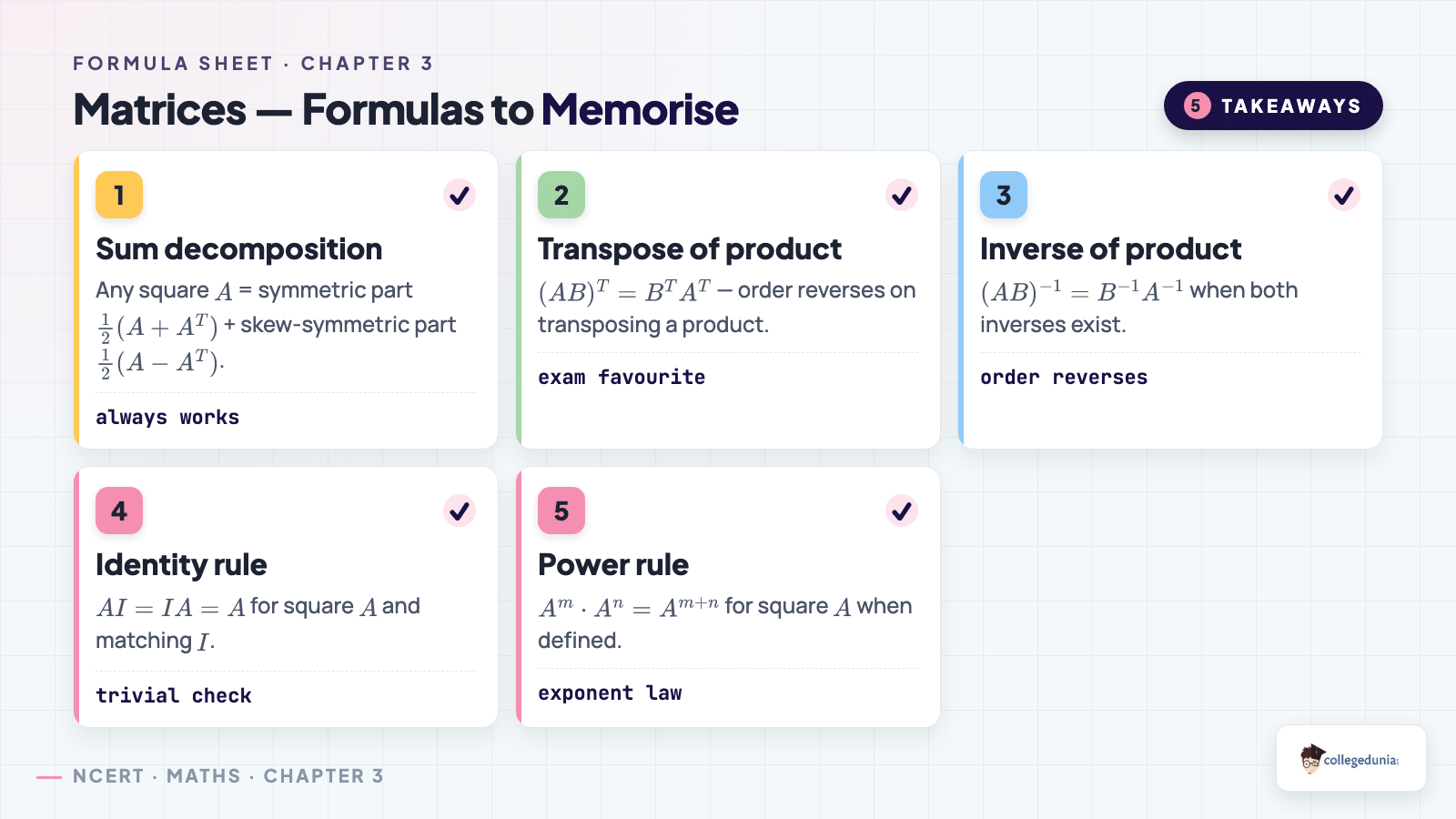
| Transpose of product (reversal law) | (AB)T = BT AT | 3.5 | JEE Main |
| Double transpose | (AT)T = A | 3.5 | Definition recall |
| Symmetric matrix | AT = A , so aij = aji | 3.6 | 3-mark proof |
| Skew-symmetric matrix | AT = -A , so aij = -aji and aii = 0 | 3.6 | 3-mark proof |
| Symmetric part of A | P = 12(A + AT) | 3.6 | Decomposition (Step 1) |
| Skew-symmetric part of A | Q = 12(A - AT) | 3.6 | Decomposition (Step 2) |
| Unique decomposition | Every square matrix A = P + Q (symmetric + skew-symmetric) | 3.6 | 5-mark CBSE |
| Number of independent entries (symmetric, n × n) | n(n+1)2 | 3.6 (extension) | JEE counting |
| Number of independent entries (skew-symmetric, n × n) | n(n-1)2 | 3.6 (extension) | JEE counting |
| Row matrix | Order 1 × n | 3.2 | Definition |
| Column matrix | Order m × 1 | 3.2 | Definition |
| Square matrix | Order n × n | 3.2 | Definition |
| Diagonal matrix | aij = 0 for all i ≠ j | 3.2 | Definition |
| Scalar matrix | Diagonal with all diagonal entries equal | 3.2 | Definition |
| Identity matrix entries | In = [ij] , where ij = 1 if i = j , else 0 | 3.2 | Definition |
| Zero matrix | All entries are 0 | 3.2 | Definition |
| Trace of a square matrix | tr(A) = i=1n aii | 3.4 (extension) | JEE Main |
| Trace properties | tr(A + B) = tr(A) + tr(B), tr(AB) = tr(BA) | 3.4 (extension) | JEE Main |
| Power of a matrix | Ak = A · A · … · A (k times); valid only for square A | 3.4 (extension) | Cayley-style problems |
Around 8 of these 36 rules cover the entire 5 to 7 mark CBSE budget for the the resource every year.
Matrices Video Walkthrough
Source: Magnet Brains on YouTube
Matrices Quick-Fact Cards for Last-Minute Recall
The chapter notes address this in the same order as the NCERT textbook.
The seven cards below collapse the learn table into the highest-use numerical facts from Chapter 3. Memorise them as raw values; CBSE 1-mark MCQs and JEE Main counting questions almost always test one of these directly.
Types of Matrices: Compact Definition Strip
The the PDF address this in the same order as the NCERT textbook.
Class 12 Maths Chapter 3 catalogues eight standard matrix types, and CBSE 1-mark questions routinely ask students to identify one from a sample. The strip below lists the order signature for each type so you can classify any given matrix in seconds.
| Type | Defining Rule | Example Order |
|---|---|---|
| Row matrix | Single row | 1 × n |
| Column matrix | Single column | m × 1 |
| Square matrix | Rows = columns | n × n |
| Diagonal matrix | Square, off-diagonal entries all 0 | n × n |
| Scalar matrix | Diagonal with equal diagonal entries | n × n |
| Identity matrix In | Scalar with diagonal entry 1 | n × n |
| Zero matrix O | All entries 0 | m × n |
| Symmetric / Skew-symmetric | AT = A or AT = -A | n × n |
How the Matrices Formulas for Class 12 on the Matrices Formulas for Class 12 Help You
This sheet is built around the four habits CBSE toppers share when revising Chapter 3: order-compatibility checks, the reversal law for transpose, the symmetric or skew-symmetric decomposition template, and counting-rule recall for MCQs.
- 2026-27 NCERT Alignment: Every formula matches the current edition. Topics dropped from the board syllabus (elementary row operations, inverse via row reduction) are flagged so board-only students can skip them and JEE aspirants know to keep them.
- Order-Compatibility Strip: The multiplication rule Am × n · Bn × p = (AB)m × p sits at the top because missing the dimension check is the most common 1-mark slip.
- Decomposition Template: The two symmetric and skew-symmetric formulas appear together, written in the exact sequence CBSE awards the 5 marks of a decomposition question.
- JEE Counting Extensions: The kmn, n(n+1)/2 and n(n-1)/2 extension rows are kept on the same sheet so JEE Main aspirants do not need a separate handout.
Matrix Multiplication: When to Use Which Compatibility Rule
Picking the wrong order loses you the entire mark of an MCQ even when the arithmetic is right. The decision tree below maps the typical question setup to the rule CBSE expects, with the dimension check in front of every step.
- Question asks "find AB": first verify the inner dimensions match. Am × n and Bp × q multiply only when n = p; the result is m × q.
- Question asks "find AB and BA": compute both, then quote AB ≠ BA as the conclusion. The mark is awarded for the explicit non-commutativity statement, not just the numbers.
- Question asks "verify (AB)T = BT AT ": compute the left and right sides element-by-element. Do NOT skip steps; CBSE marking schemes reserve a mark for the explicit transpose computation.
- Question asks "express A as the sum of a symmetric and skew-symmetric matrix": compute AT, then P = 12(A + AT) (1.5 marks), then Q = 12(A - AT) (1.5 marks), and conclude A = P + Q (1 mark + 1 mark verification).
- Question asks "is A symmetric / skew-symmetric": compute AT, compare entry-by-entry with A and -A. Diagonal entries of a skew-symmetric matrix must all be zero, this is often the fast disqualifier.
- Question gives a matrix equation kA + lB = O: equate corresponding entries and solve the resulting linear system. The "same order" condition is implicit, students lose 1 mark for not stating it.
Top 5 Most-Asked Topics from Matrices in Class 12 Board Exams
The ranking below shows which sub-topics of Matrices have driven the most marks in CBSE Class 12 Maths papers from 2025 back to 2021. Anchor your last revision pass on these five.
- Symmetric and skew-symmetric decomposition of a 3x3 matrix (5 marks, almost every year).
- Matrix multiplication and order matching (2 to 3 marks, every year).
- Transpose reversal law verification (AB)T = BT AT (2 marks, 4 of last 5 years).
- Matrix equality and entry equations (2 marks, recurring).
- Special-matrix type identification (1 mark assertion-reason or MCQ).
Full year-wise PYQ map: Matrices Class 12 Maths NCERT Solutions
Memory Mnemonics for Class 12 Maths Matrices
Use these short-form mnemonics in the last hour before the exam. They map abstract definitions to concrete actions, which is what CBSE marking schemes actually reward.
One-Shot Revision Tips for Class 12th Maths Chapter 3 Matrices
The five tips below summarise what to revise in the final 60 minutes before the board exam. Each one targets a specific high-frequency CBSE error pattern that costs Class 12 candidates marks every year.
- Always state the order: begin every matrix-operation answer with the explicit orders of the operands. CBSE marking schemes award the first mark for this dimension check.
- Compute AT before the decomposition: write AT as a separate intermediate matrix, never inline. Skipping this step is the single most common 5-mark slip.
- Verify symmetry of P and skew-symmetry of Q: after writing P = 12(A + AT) and Q = 12(A - AT), check that PT = P and QT = -Q. The verification carries one mark.
- Counting MCQs: remember that the number of m × n matrices with entries from a k-element set is kmn, not km + n. This is the most common 1-mark trap.
- Non-commutativity is an answer, not an obstacle: when a question asks you to find both AB and BA, end with the explicit statement AB ≠ BA . The conclusion carries the final mark.
More Class 12 Maths Matrices Resources from Collegedunia
NCERT Formula Sheet for Class 12 Maths: All Chapters
Use the table below to jump to the Formula Sheet of any other Class 12 Maths chapter. Each link opens the same learn-table format you have on this page.
| Chapter | Resource |
|---|---|
| Chapter 1 | Relations and Functions Formula Sheet |
| Chapter 2 | Inverse Trigonometric Functions Formula Sheet |
| Chapter 4 | Determinants Formula Sheet |
| Chapter 5 | Continuity and Differentiability Formula Sheet |
| Chapter 6 | Application of Derivatives Formula Sheet |
| Chapter 7 | Integrals Formula Sheet |
| Chapter 8 | Application of Integrals Formula Sheet |
| Chapter 9 | Differential Equations Formula Sheet |
| Chapter 10 | Vector Algebra Formula Sheet |
| Chapter 11 | Three Dimensional Geometry Formula Sheet |
| Chapter 12 | Linear Programming Formula Sheet |
| Chapter 13 | Probability Formula Sheet |
this chapter: available above as a free PDF download, aligned to the 2026-27 NCERT Class 12 Mathematics syllabus.
Exercise-wise Breakdown of the Matrices Chapter
The Matrices chapter splits into 4 numbered exercises plus a Miscellaneous Exercise. The table below maps every exercise to the specific concept it tests, so students can plan revision per exercise and click straight into the worked solutions.
| Exercise | Topic Tested |
|---|---|
| Exercise 3.1 | Order, types, equality of matrices |
| Exercise 3.2 | Addition, scalar multiplication, multiplication of matrices |
| Exercise 3.3 | Transpose, symmetric and skew-symmetric matrices |
| Exercise 3.4 | Inverse using elementary row operations |
| Miscellaneous Exercise | Mixed matrix operations and proofs |
PDF Download Formats and Languages for the Matrices Chapter
The Matrices Class 12 PDF on this page is available in three formats - each suited to a different revision style. The table below summarises what each format is best for:
| Format | Best for | Approx. size |
|---|---|---|
| Normal-resolution PDF | Phone reading, quick revision between classes | 2-3 MB |
| HD PDF | Print-ready, desk study, board hall photocopy | 8-10 MB |
| Handwritten Notes PDF | Mirrors how a topper writes the chapter under Sunday-revision pace | 5-7 MB |
The matrices class 12 ncert pdf and the parallel Hindi-medium edition both follow the same notation and equation numbering as the printed NCERT 2026-27 release. Key points students should know:
- NCERT-faithful: Every definition, theorem and exercise on the matrices class 12 ncert pdf matches the printed textbook line for line.
- Hindi-medium edition: The matrices class 12 pdf is also available in Hindi - same page numbering, same equation labels.
- Formula PDF separate: The the PDF formulas pdf is a one-page A4 reference sheet listing every identity used in the chapter.
- Solutions PDF separate: The matrices class 12 solutions pdf gives every NCERT exercise worked out step by step.
- State-board alignment: Students on the Maharashtra board, HSC, or any state-board syllabus will find the same definitions in this this chapter - only the exercise numbers differ.
Tip: Many toppers keep two parallel copies - a printed formula sheet on A4 for desk revision (the this chapter formulas pdf), and the full these notes on a phone for commute revision. Both files are free and linked above.
Important Questions and Previous Year Trends for the Matrices Chapter
The most repeated question patterns in CBSE Class 12 Maths for the Matrices chapter have settled into a stable cluster across 2019 to 2024 boards. Three question templates account for over 80% of the marks this chapter contributes:
| Template | Typical Marks | What it tests |
|---|---|---|
| Proof / property verification | 3 marks | Students show that a given relation/function/expression satisfies the chapter's definitions. |
| One-step computation | 2 marks | Substitution-based item: plug into a known formula and simplify. |
| Case-study scenario | 4 marks | Real-world setup applying the chapter's definitions, introduced in CBSE 2021+ papers. |
Walking through one example of each template before the exam covers most of the predictable these notes important questions you will see on board day.
- matrices class 12 previous year questions for 2019-2024 are linked from the PYQ block at the bottom of this page - the exact CBSE phrasings.
- The this Class 12 page important questions with solutions set is reused by toppers in the last fortnight of revision.
- For NCERT Exemplar practice, the matching matrices class 12 extra questions set adds advanced problems suitable for JEE Main and JEE Advanced.
- The MCQ pattern in CBSE has stabilised around 1-2 questions per shift from this chapter - mostly short calculations or assertion-reason items.
Year-wise PYQ Distribution
The table below maps the dominant question type asked from the Matrices chapter across recent CBSE Class 12 Maths boards:
| Year | Dominant Question Type | Approx. Marks |
|---|---|---|
| 2024 | Property verification + case-study item | 5-6 marks |
| 2023 | Computation with proof + assertion-reason MCQ | 5-6 marks |
| 2022 | Long-answer derivation + 2-mark substitution | 5-7 marks |
| 2021 | Definition recall + property check | 4-5 marks |
| 2020 | One-step computation + 3-mark proof | 5 marks |
The full the resource important questions with solutions set (every year, every paper, every question type) is linked from the PYQ page at the bottom of this article.
How the Matrices Notes Pair with NCERT Solutions and the Formula Sheet
The chapter notes notes work best when paired with two sister resources from the Class 12 Maths hub. The table below shows how each resource fits into a typical revision week:
| Resource | Use it for | When |
|---|---|---|
| Matrices Notes (this page) | Theory, definitions, exam patterns | First pass, before practice |
| matrices class 12 ncert solutions PDF | Step-by-step solved exercises | Second pass, during NCERT practice |
| the PDF formulas PDF | One-page identity recall | Third pass, alongside mock papers |
| Handwritten Notes PDF | Quick reading in topper's handwriting | Anytime, especially commute revision |
Around 60 percent of the chapter's scoring vocabulary appears on all three pages, so cross-resource use reinforces recall without adding study time.
- The matrices class 12 ncert solutions cover every back-of-chapter exercise plus the miscellaneous exercise.
- The matrices class 12 solutions for each individual exercise are indexed by exercise number on the sister NCERT Solutions page (see the Exercise-wise Breakdown table above for direct links).
- The this chapter formulas reference sheet is the same A4 file students sometimes refer to as these notes all formulas - it lists every identity used in the chapter.
- State-board references: RD Sharma, ML Aggarwal, Teachoo and the Maharashtra board this Class 12 page textbook PDF all share the same core definitions.
- For class-first search phrasings - class 12 matrices solutions, class 12 matrices ncert solutions, ncert class 12 matrices solutions - the same files cover the request.
Reference Books and State-Board Mapping
Students using reference books beyond NCERT, or studying under a state board, can map this chapter cleanly:
| Reference | How it maps to the resource |
|---|---|
| RD Sharma Class 12 Matrices | Question patterns overlap with NCERT at ~70%; an advanced supplement. |
| ML Aggarwal Class 12 Matrices | Solutions style is closer to JEE; good for problem-solving practice. |
| Teachoo the chapter notes | Free online walkthroughs; useful for video-style learning. |
| Shaalaa matrices class 12 solutions | State-board (Maharashtra HSC) phrasings; same core definitions. |
| Maharashtra board the PDF textbook PDF | Same chapter content under the HSC syllabus; exercise numbers differ. |
| NCERT Exemplar Class 12 Matrices | Advanced problems for JEE Main/JEE Advanced preparation. |
How to Use the Matrices Notes Page Most Effectively
The recommended study plan for the this chapter chapter splits across three sittings. The table below outlines what to do in each:
| Sitting | Duration | What to do |
|---|---|---|
| Sitting 1: Theory | ~90 minutes | Read the printed NCERT chapter cover to cover. Mark every definition and theorem statement. Then read the formula recall section on this page. |
| Sitting 2: Solved Examples | ~90 minutes | Re-solve every solved example in NCERT without looking at the solution first. Compare your steps against the printed working. Use the matrices class 12 ncert solutions PDF if stuck. |
| Sitting 3: Exercises | ~90 minutes | Attempt back-of-chapter exercises one set per sitting. Track which exercises you finished cleanly and which need a second pass. Click into the linked exercise pages above for verification. |
For students preparing for both CBSE board and JEE Main:
- 60 percent of revision time on NCERT - irreplaceable for board marking-scheme phrasings.
- 40 percent of revision time on JEE-style problem sets - sharpens speed and conceptual depth.
- The these notes important questions set on the previous-year page is the closest free analogue to a JEE-style problem set for this chapter.
- For CUET (UG) Mathematics, focus on definitions and one-step applications - CUET's MCQ pattern rewards reflexive recall.
Matrices Formulas for Class 12 - Frequently Asked Questions
Ques. Where can I download these notes for free?
Ans. You can download the Class 12 Maths Chapter 3 Matrices Formula Sheet PDF directly from the download card on this page. Both the Normal and HD versions are free and cover every formula listed in the learn table above, including the symmetric or skew-symmetric decomposition and the JEE Main counting extensions.
Ques. Is the Matrices formula sheet aligned with the 2026-27 NCERT?
Ans. Yes. Every formula matches the current 2026-27 syllabus for Class 12 Maths Chapter 3. Topics dropped from the board syllabus (elementary row operations, inverse via row reduction) are flagged as "extension" rows so board-only students know they can skip them, while JEE aspirants still get the full coverage.
Ques. How many pages is the Class 12 Maths Chapter 3 Matrices Formula Sheet PDF?
Ans. The Matrices Formula Sheet PDF runs 7 pages and packs every operation rule, transpose identity, symmetric or skew-symmetric definition, and counting extension from Chapter 3, plus the quick-fact card grid and the compatibility-rule decision tree.
Ques. What is the formula for the transpose of a product of matrices in Class 12 Maths?
Ans. The reversal law states (AB)T = BT AT . The transpose of a product equals the product of the individual transposes in the reverse order. The same rule extends to three or more matrices: (ABC)T = CT BT AT .
Ques. How do I express a square matrix as the sum of a symmetric and skew-symmetric matrix?
Ans. Use the decomposition template. Step 1: compute AT. Step 2 (1.5 marks): write the symmetric part P = 12(A + AT) . Step 3 (1.5 marks): write the skew-symmetric part Q = 12(A - AT) . Step 4 (1 mark): verify PT = P and QT = -Q. Step 5 (1 mark): conclude A = P + Q .
Ques. How many independent entries does an n by n symmetric matrix have?
Ans. A symmetric matrix of order n × n has exactly n(n+1)2 independent entries (the diagonal plus one triangle). A skew-symmetric matrix of the same order has only n(n-1)2 independent entries, because the diagonal entries are forced to be zero. For n = 3, this gives 6 and 3 respectively.
Ques. Is matrix multiplication commutative in Class 12 Maths Chapter 3?
Ans. No, matrix multiplication is not commutative in general. For most square matrices A and B, AB ≠ BA . Commutativity only holds in special cases (e.g. when one of the matrices is the identity or a scalar matrix, or when both matrices are diagonal). CBSE assertion-reason MCQs exploit this fact almost every year.
Ques. What is the number of matrices of order 2 by 2 with entries 0 or 1?
Ans. Using the counting formula kmn with k = 2 (two choices per entry) and mn = 4 (four entries), the total is 24 = 16 . This counting question is a recurring 1-mark JEE Main and CUET MCQ; the same logic gives 34 = 81 for entries from 0, 1, 2, and so on.





Comments