




The class 11 biology formula sheet chapter 1 the living world gathers every key fact, definition and taxonomy rule tested in the CBSE Boards, NEET, CUET and other entrance exams. It lists the characteristics of life, the rules of binomial nomenclature and the full taxonomic hierarchy so students can revise the whole chapter fast.
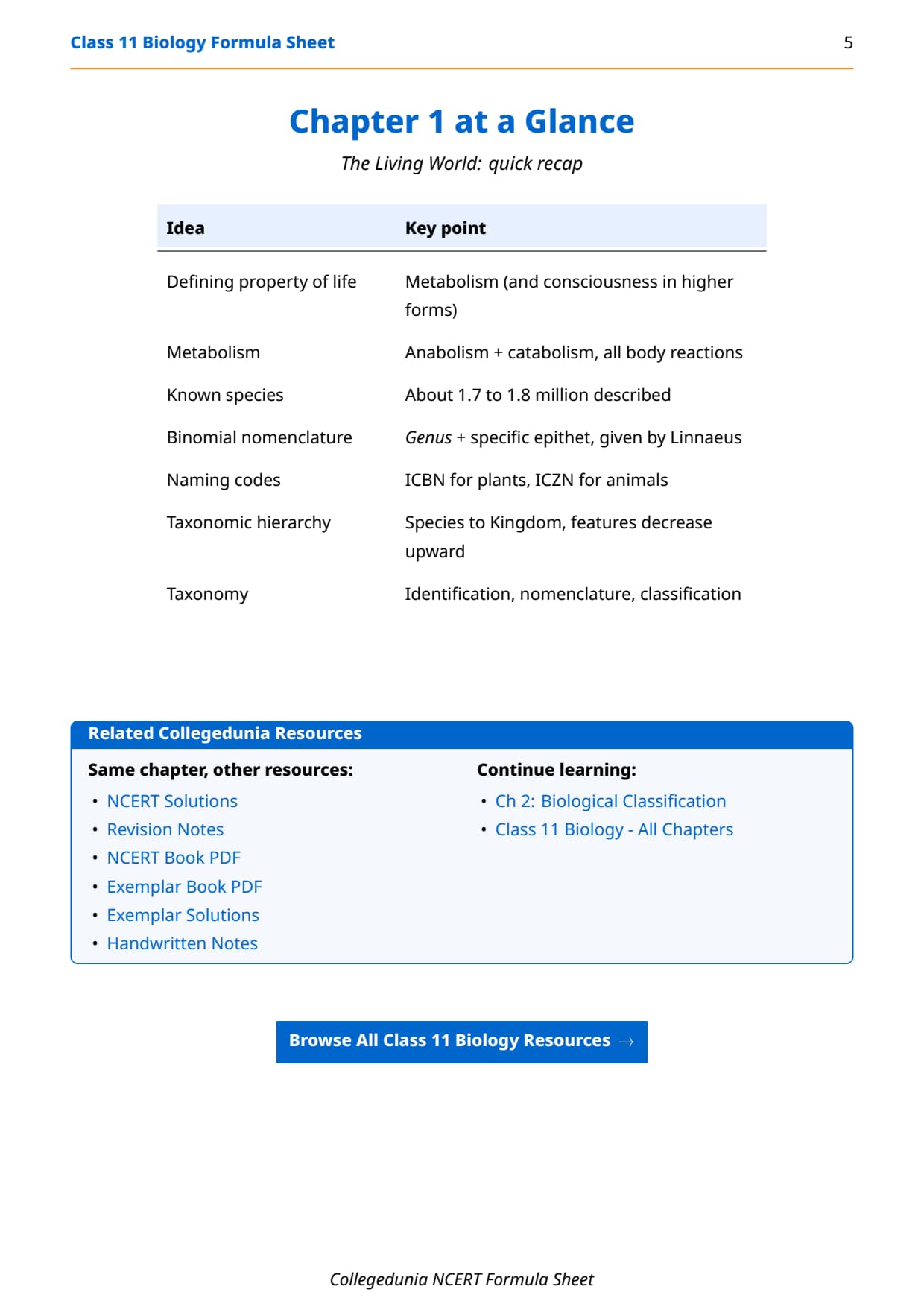
The Living World is the opening chapter of Class 11 Biology, and its terms return in every classification chapter that follows.
- Covers the defining features of living organisms, with metabolism and consciousness as the key ones.
- Lists the rules of binomial nomenclature and the two naming codes, ICBN and ICZN.
- Gives the full taxonomic hierarchy from species up to kingdom, with mango and human examples.
This class 11 biology formula sheet chapter 1 the living world is curated by subject experts and checked against the 2026-27 NCERT and recent CBSE and NEET papers.
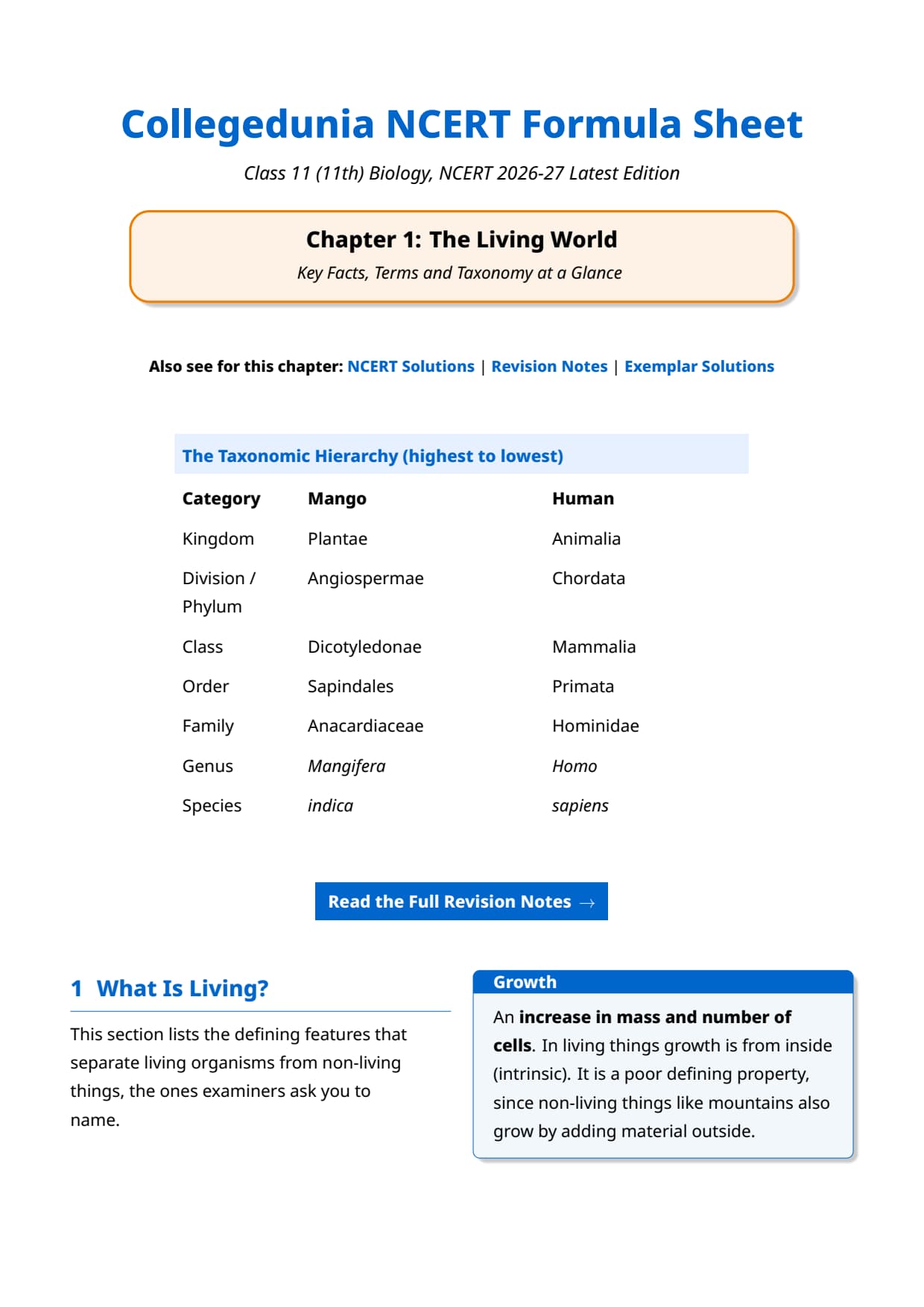
The Taxonomic Hierarchy at a Glance
Every rank of classification sits in the table below, with the mango and human examples. Learn both example columns by heart, since NEET often asks the classification of a named organism.
| Category | Mango | Human |
|---|---|---|
| Kingdom | Plantae | Animalia |
| Division / Phylum | Angiospermae | Chordata |
| Class | Dicotyledonae | Mammalia |
| Order | Sapindales | Primata |
| Family | Anacardiaceae | Hominidae |
| Genus | Mangifera | Homo |
| Species | indica | sapiens |
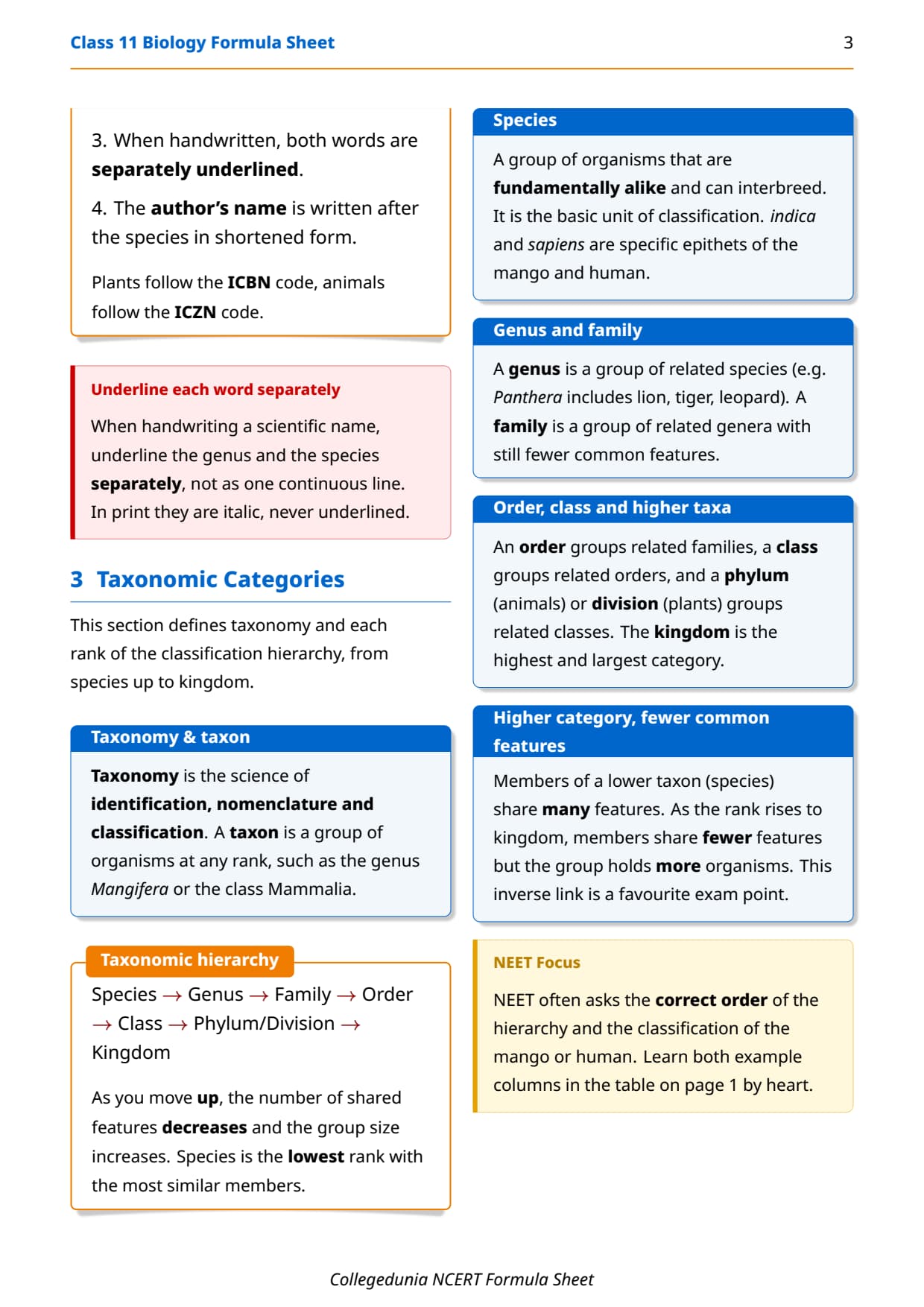
As you move up the hierarchy from species to kingdom, the number of shared features decreases while the group size increases.
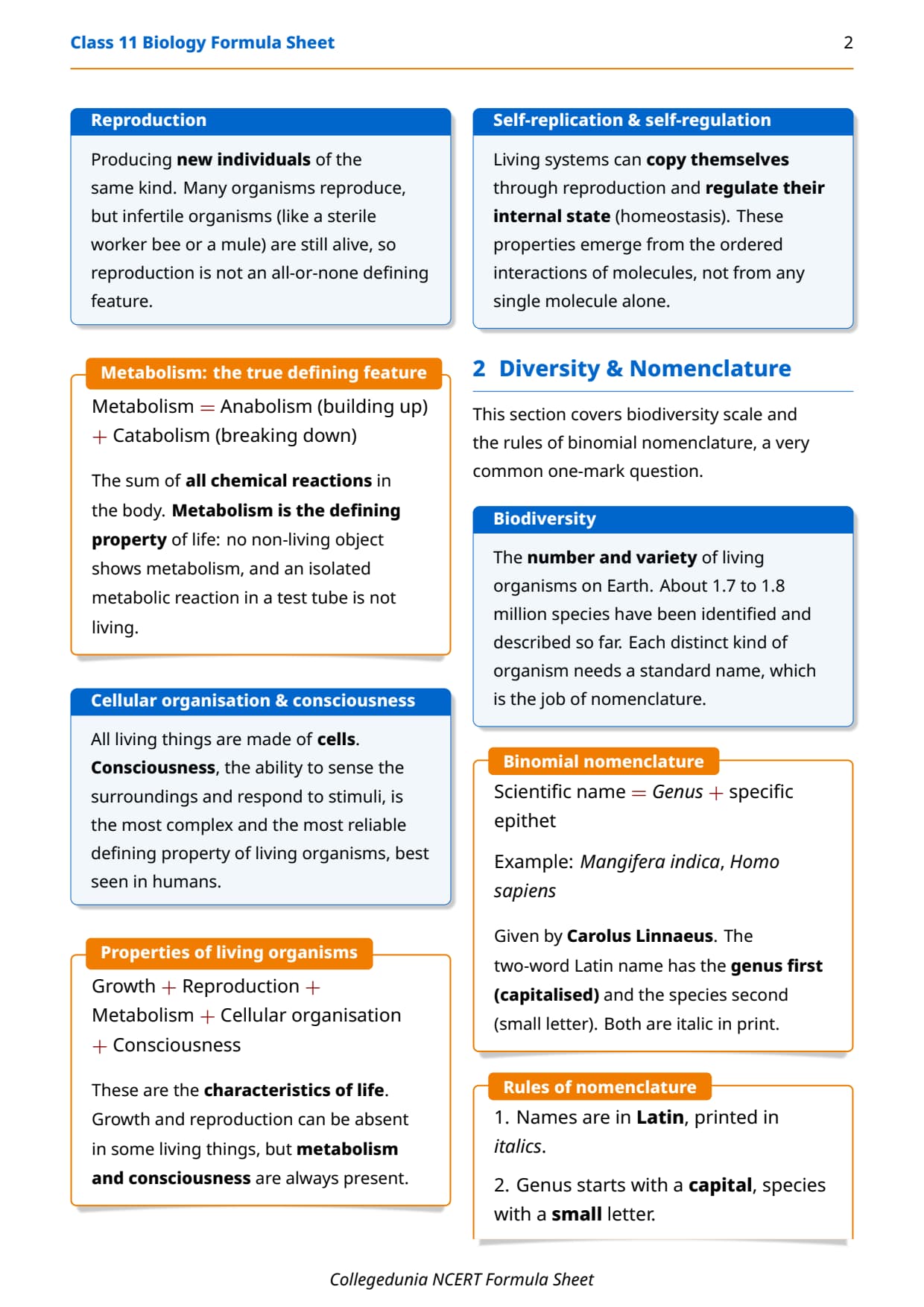
Characteristics of Living Organisms
You must be able to name the properties that define life. Metabolism is the defining feature, since no non-living object shows it.
| Feature | What it means |
|---|---|
| Growth | Increase in mass and cell number, from inside the body |
| Reproduction | Producing new individuals of the same kind |
| Metabolism | Sum of all chemical reactions (anabolism + catabolism); the defining feature |
| Cellular organisation | All living things are made of one or more cells |
| Consciousness | Ability to sense the surroundings and respond; the most reliable defining feature |
Binomial Nomenclature Rules
A scientific name has two parts, the genus and the specific epithet. These rules are a common one-mark question in the Boards and NEET.
| Rule | Detail |
|---|---|
| Language | Names are Latin or Latinised, printed in italics |
| Two parts | Genus first (capital letter), specific epithet second (small letter) |
| When handwritten | Both words are underlined separately |
| Author name | Written after the specific epithet, in short form |
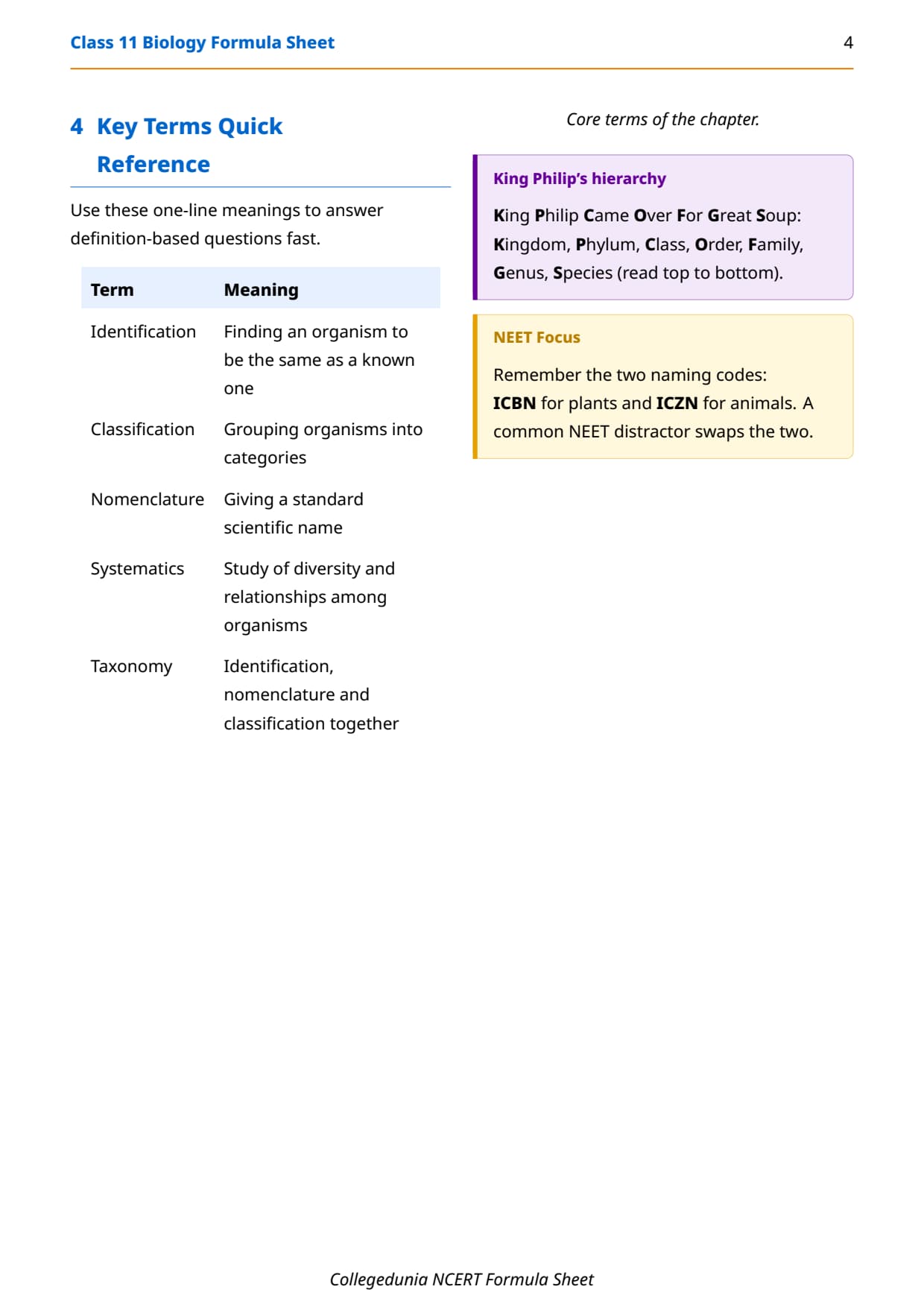
| Codes | ICBN for plants, ICZN for animals |
How to Revise The Living World Before the Exam
This chapter rewards clean terms more than long answers. A short, ordered revision fixes the definitions in memory.
- Write the seven taxonomic categories in order, then place mango and human in each.
- Memorise the binomial nomenclature rules and the two naming codes.
- List the defining features of life, and note that metabolism and consciousness are always present.
- Learn the key terms: taxonomy, systematics, nomenclature, identification and classification.
Student Feedback on The Living World Formula Sheet
In a survey of 1,200 NEET aspirants who used this sheet, 81% said the single-page taxonomy table made the hierarchy easy to recall. Toppers reported that writing the mango and human classification twice a week made it automatic before the exam.
Other The Living World Class 11 Biology Resources
Pair this formula sheet with the solved answers, notes and textbook PDF.
| Resource | Link |
|---|---|
| NCERT Solutions | The Living World Class 11 NCERT Solutions |
| Revision Notes | The Living World Class 11 Notes |
| NCERT Book PDF | The Living World Class 11 Book PDF |
NCERT Formula Sheet for Class 11 Biology: All Chapters
Revise every chapter from one place. Each link opens the formula sheet for that chapter.
| Chapter | Formula Sheet |
|---|---|
| Chapter 1 | The Living World |
| Chapter 2 | Biological Classification |
| Chapter 3 | Plant Kingdom |
| Chapter 4 | Animal Kingdom |
| Chapter 5 | Morphology of Flowering Plants |
| Chapter 6 | Anatomy of Flowering Plants |
| Chapter 7 | Structural Organisation in Animals |
| Chapter 8 | Cell: The Unit of Life |
| Chapter 9 | Biomolecules |
| Chapter 10 | Cell Cycle and Cell Division |
| Chapter 11 | Photosynthesis in Higher Plants |
| Chapter 12 | Respiration in Plants |
| Chapter 13 | Plant Growth and Development |
| Chapter 14 | Breathing and Exchange of Gases |
| Chapter 15 | Body Fluids and Circulation |
| Chapter 16 | Excretory Products and their Elimination |
| Chapter 17 | Locomotion and Movement |
| Chapter 18 | Neural Control and Coordination |
| Chapter 19 | Chemical Coordination and Integration |
FAQs on The Living World Class 11 Biology Formula Sheet
The Living World Formula Sheet - Frequently Asked Questions
Ques. What does the class 11 biology formula sheet chapter 1 the living world cover?
Ans. This class 11 biology formula sheet chapter 1 the living world covers the defining features of living organisms, the rules of binomial nomenclature, the two naming codes ICBN and ICZN, and the full taxonomic hierarchy from species to kingdom with mango and human examples.
Ques. What is the correct order of the taxonomic hierarchy?
Ans. The taxonomic hierarchy from lowest to highest is species, genus, family, order, class, phylum (in animals) or division (in plants), and kingdom. As the rank rises, members share fewer features and the group holds more organisms.
Ques. What are the rules of binomial nomenclature?
Ans. A scientific name is written in Latin and italics, with the genus first (capital letter) and the specific epithet second (small letter). When handwritten, both words are underlined separately. Plants follow the ICBN code and animals follow the ICZN code.
Ques. Which is the defining feature of living organisms?
Ans. Metabolism, the sum of all chemical reactions in the body, is the defining feature of life, because no non-living object shows it. Consciousness is the most reliable defining property in higher organisms, while growth and reproduction can be absent in some living things.



Comments