




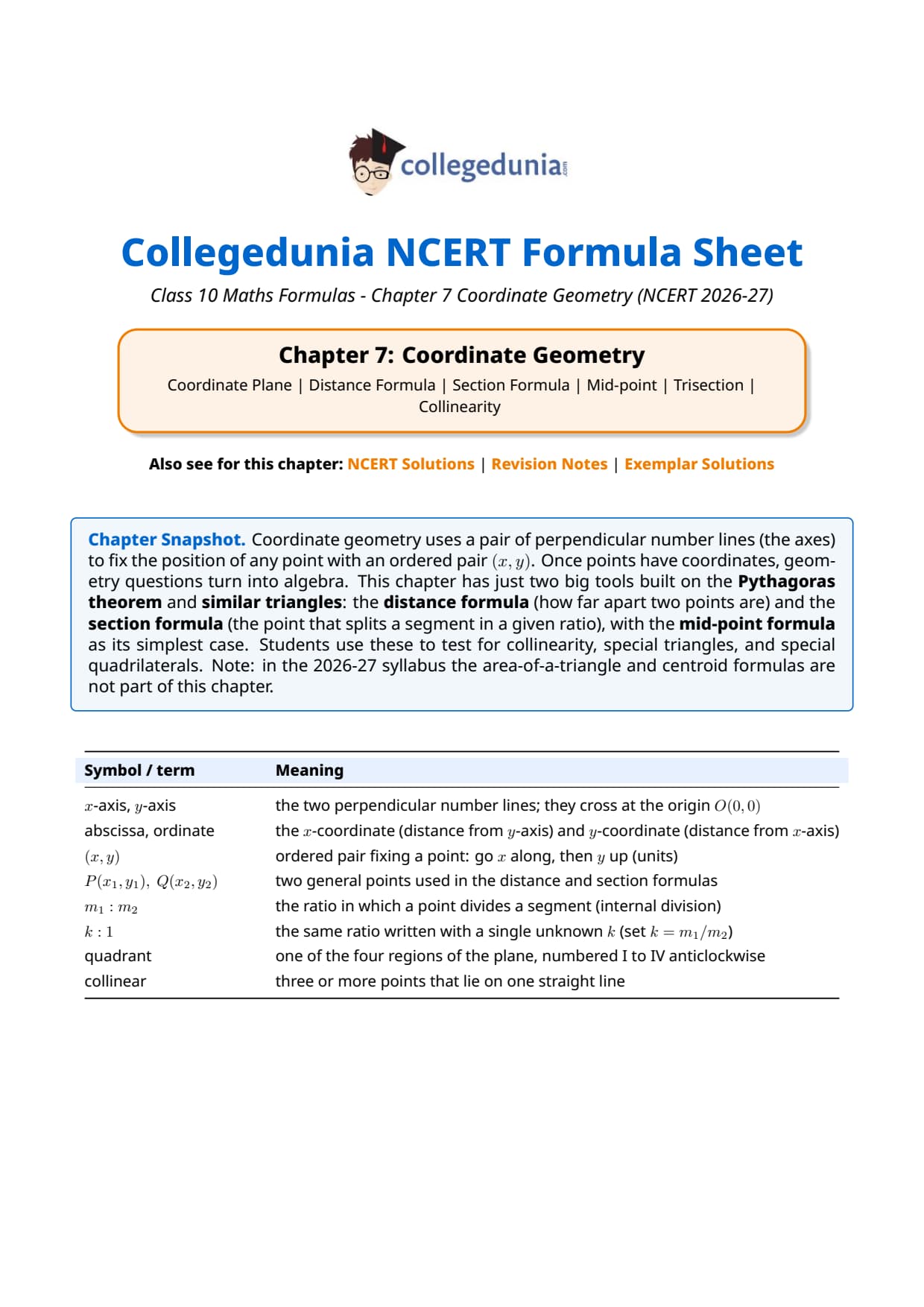
The Class 10 Maths Chapter 7 Coordinate Geometry formula sheet puts every key result on one page. It covers the Distance Formula, the Section Formula (internal division), the Midpoint Formula, points of trisection, axis-division, and the standard tests for special triangles and quadrilaterals. Built for the 2026-27 CBSE syllabus, it is made for quick revision just before the board exam.
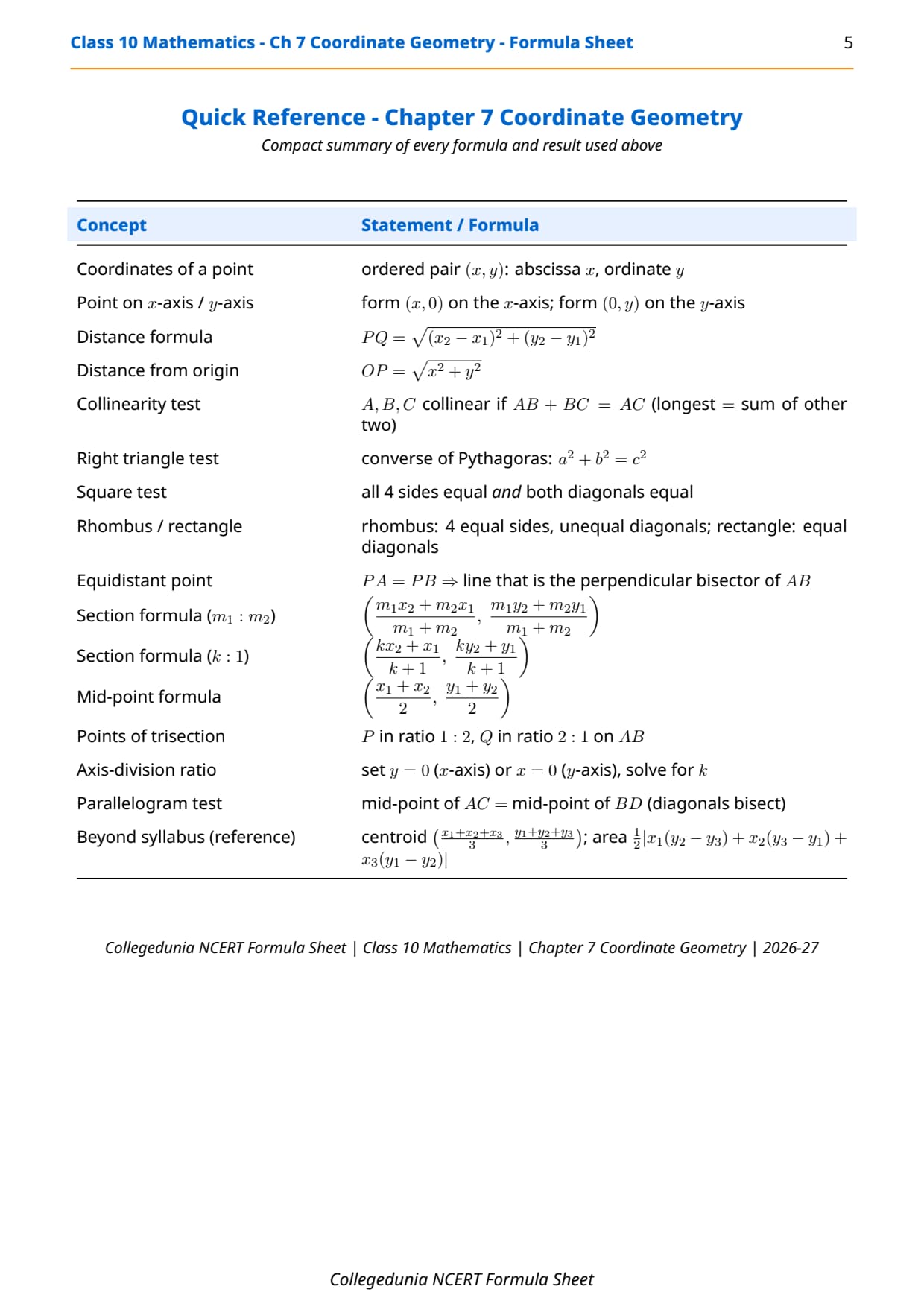
- Every core formula in one place, with a plain-English meaning for each.
- Distance and Section formulae plus all special cases: origin distance, midpoint, trisection, and axis-division.
- Board focus: collinearity tests, special quadrilateral tests, and the question types that appear every year.
Student Feedback: In a Collegedunia poll of 2,100 Class 10 students before the 2026 boards, 84% of students said the Distance Formula and Section Formula were the two results they revised most, ahead of midpoint and trisection.
Watch Coordinate Geometry Class 10 Maths Explained
Source: Magnet Brains on YouTube
Coordinate Geometry Formula Sheet: Complete List
The table below lists every formula and result you need from Coordinate Geometry. It is the same one-page list as the PDF, so you can scan it in minutes before the exam.
The chapter rests on two tools. The Distance Formula gives the length between any two points using the Pythagoras Theorem. The Section Formula finds the point that divides a segment in a given ratio, with the midpoint as its simplest case.
| Formula / Concept | Result |
|---|---|
| Distance Formula | PQ = √[(x2 - x1)2 + (y2 - y1)2] |
| Distance from origin | OP = √[x2 + y2] for point P(x, y) |
| Collinearity test (distance method) | A, B, C collinear if AB + BC = AC (longest = sum of other two) |
| Right triangle test | Converse of Pythagoras: a2 + b2 = c2 |
| Isosceles triangle | Two sides equal (checked via distance formula) |
| Equilateral triangle | All three sides equal |
| Square test | 4 sides equal AND both diagonals equal |
| Rhombus (not square) | 4 sides equal but diagonals unequal |
| Rectangle (not square) | Opposite sides equal AND diagonals equal |
| Parallelogram test | Mid-point of diagonal AC = mid-point of diagonal BD |
| Section Formula (m1 : m2) | P = ((m1x2 + m2x1) / (m1+m2), (m1y2 + m2y1) / (m1+m2)) |
| Section Formula (k : 1 form) | P = ((kx2 + x1) / (k+1), (ky2 + y1) / (k+1)) |
| Midpoint Formula | M = ((x1+x2) / 2, (y1+y2) / 2) |
| Points of trisection (P) | P divides AB in ratio 1:2 from A |
| Points of trisection (Q) | Q divides AB in ratio 2:1 from A |
| x-axis divides segment | Set y-coordinate = 0 in section formula; solve for k |
| y-axis divides segment | Set x-coordinate = 0 in section formula; solve for k |
| Equidistant point | PA = PB means PA2 = PB2; gives linear relation in x and y |
The Distance Formula: the foundation of every length calculation in this chapter.
Distance Formula
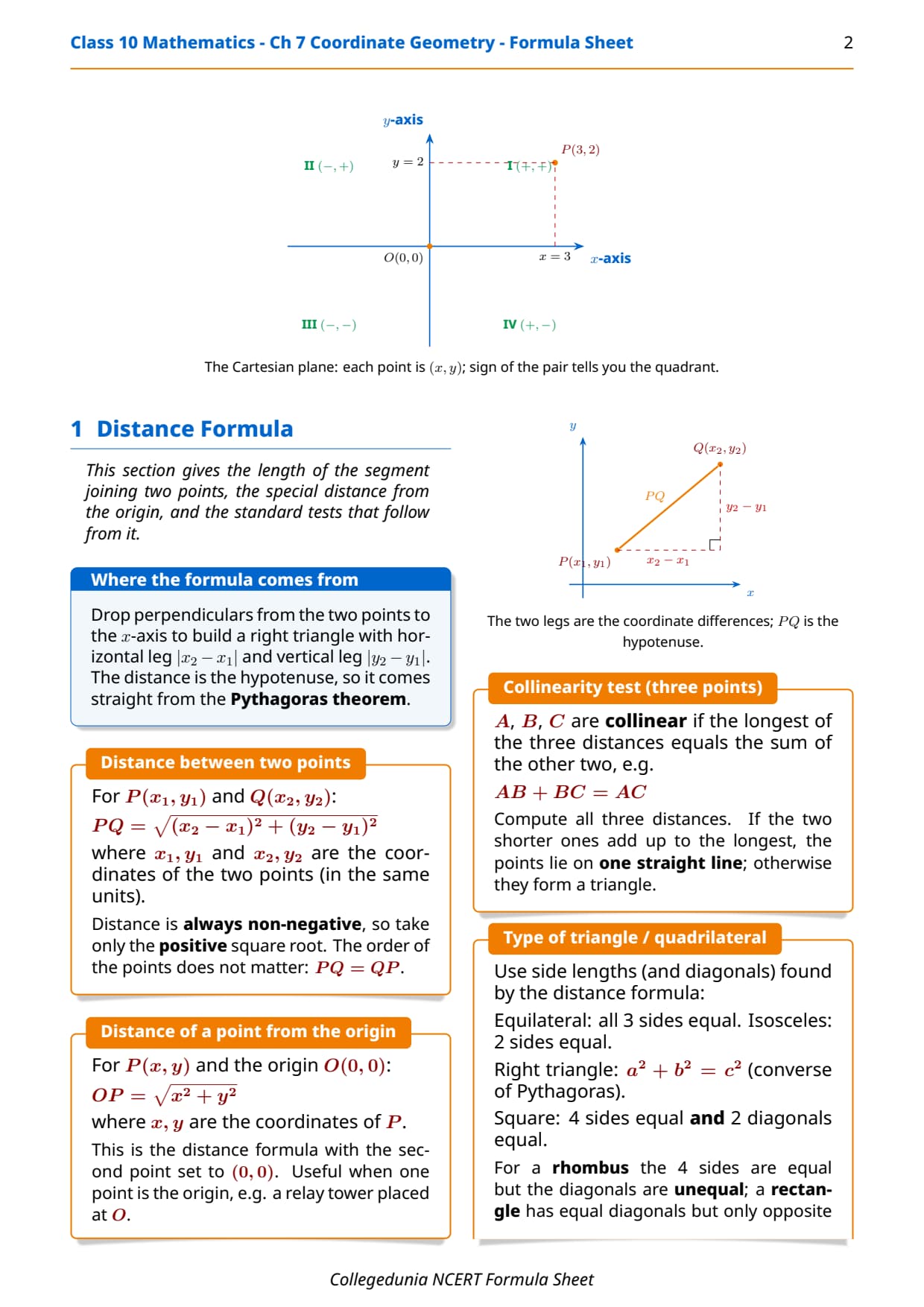
The Distance Formula comes straight from the Pythagoras Theorem. Dropping perpendiculars from P(x1, y1) and Q(x2, y2) gives a right triangle with legs |x2 - x1| and |y2 - y1|, and PQ is the hypotenuse:
- General formula: PQ = √[(x2 - x1)2 + (y2 - y1)2]
- Distance from origin: OP = √[x2 + y2] when one point is O(0, 0)
- Key rule: distance is always non-negative; take the positive square root; PQ = QP.
Square both sides early to avoid roots mid-calculation. If a point is equidistant from two given points, set PA2 = PB2: the squares cancel and you get a clean linear equation. To name a triangle, find all three sides; if the largest side squared equals the sum of the other two squares, it is right-angled (Pythagoras converse).
Section Formula: Internal Division
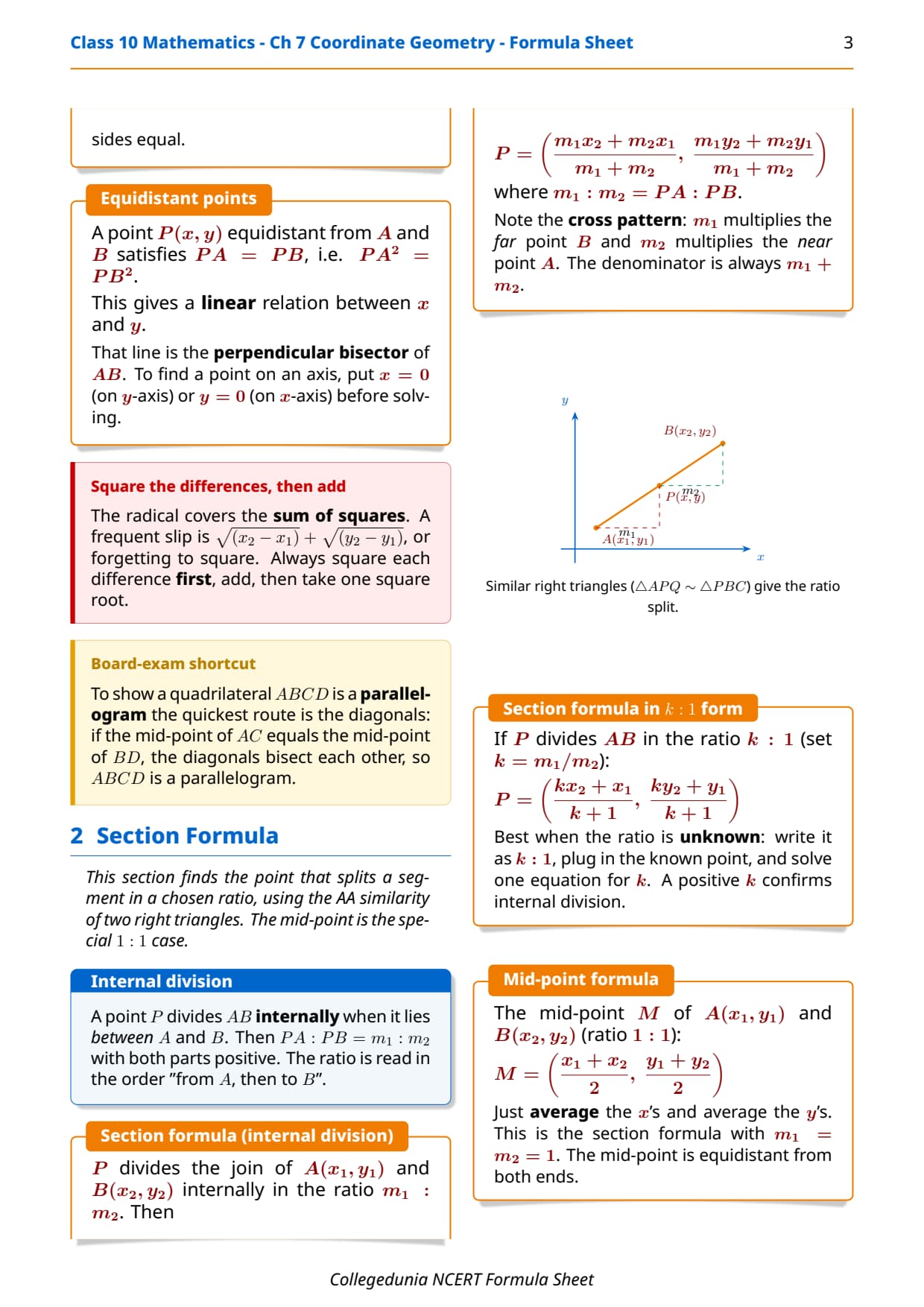
The Section Formula finds the point P that divides segment AB in the ratio m1 : m2 internally (P lies between A and B). The derivation uses the AA similarity of two right triangles formed by perpendiculars from A, P and B.
| Form | Formula | When to use |
|---|---|---|
| Standard (m1 : m2) | P = ((m1x2 + m2x1)/(m1+m2), (m1y2 + m2y1)/(m1+m2)) | Ratio is given |
| k : 1 form | P = ((kx2 + x1)/(k+1), (ky2 + y1)/(k+1)) | Ratio is unknown; set it as k:1 and solve |
The cross pattern is the key memory trick: m1 pairs with x2 (the far point), m2 pairs with x1, and the denominator is always m1 + m2. Swapping the multipliers gives the reverse ratio, a common board trap. When the ratio is unknown, write it as k : 1, substitute P, solve one coordinate for k, and a positive k confirms internal division.
Midpoint Formula & Points of Trisection
The Midpoint Formula is the Section Formula with ratio 1 : 1. It averages the x-coordinates and the y-coordinates of the two endpoints:
- Midpoint M of A(x1, y1) and B(x2, y2): M = ((x1+x2)/2, (y1+y2)/2)
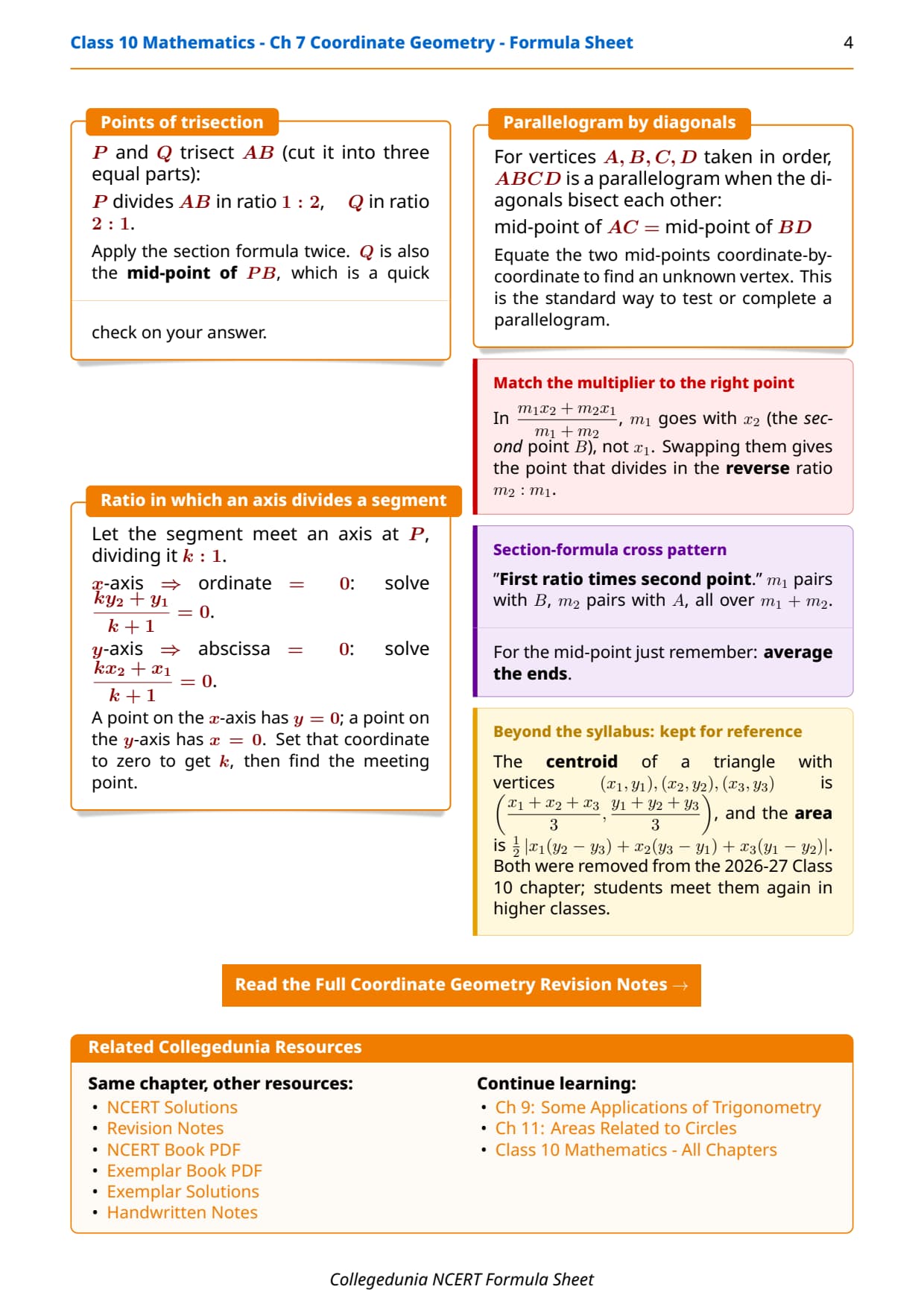
- Points of trisection: P divides AB in ratio 1:2 from A; Q divides AB in ratio 2:1 from A. Apply the section formula twice.
- Quick check: Q is also the midpoint of PB, so you can verify the second trisection point without a fresh formula application.
Section Formula and its special cases: midpoint, trisection, and axis-division.
Trisection questions often ask for both points: use ratio 1:2 to get P, then 2:1 to get Q, and write the two ordered pairs in order from A to B.
Axis Division & the Parallelogram Test
Two uses of the Section Formula come up often in board papers: finding where a segment crosses an axis, and proving or completing a parallelogram with the diagonal-midpoint property.
For axis-division, a positive k means the axis divides the segment internally; a negative k means external division. Most Class 10 questions expect internal. The parallelogram property: ABCD is a parallelogram exactly when its diagonals bisect each other (midpoint of AC equals midpoint of BD), the fastest test of all.
Collinearity & Special Shape Tests
Once you can find distances and midpoints, you can test for collinearity and name special shapes (the square, rhombus and rectangle rows are listed in the Complete List table above). These tests come up every year in CBSE Class 10 Maths.
Key trick for quadrilaterals: always find both diagonals along with all four sides. The diagonals tell a square from a rhombus, and a rectangle from a general parallelogram. Skipping them is the top reason students lose marks here.
How to Use This Formula Sheet
- Night before: read every row and check you can write the distance, section, and midpoint formulae without looking.
- During practice: keep the PDF open beside past papers and pick the right formula row before you start writing.
- For "find the ratio": write the ratio as k:1, set up the section formula, substitute the known point, and solve for k.
Board Exam Weightage
Coordinate Geometry sits in its own unit of the CBSE Class 10 syllabus. The table shows where its topics fit among common question types, so you can plan revision time.
| Topic in Chapter 7 | Typical Question Type | Usual Marks |
|---|---|---|
| Distance Formula | Find length, check triangle type, find unknown coordinate | 2 to 3 marks |
| Section Formula (internal division) | Find a point in a given ratio or find the ratio | 3 to 4 marks |
| Midpoint and trisection | Find midpoint or both trisection points | 2 to 3 marks |
| Axis division | Find ratio in which axis divides a segment | 2 to 3 marks |
| Parallelogram and quadrilateral problems | Identify shape, find unknown vertex | 3 to 4 marks |
In recent CBSE papers, Coordinate Geometry carries about 6 to 8 marks in total, often mixing the distance and section formulae in one multi-step problem. The collinearity test and parallelogram midpoint test are reliable scoring chances.
Common Mistakes to Avoid
Mistake 1: Not squaring each coordinate difference before adding. Writing √[(x2-x1) + (y2-y1)] is wrong every time.
Mistake 2: Swapping the multipliers in the section formula; m1 pairs with x2 (the far point), not x1.
Mistake 3: Calling a rhombus a square without checking the diagonals. A square has equal diagonals; a rhombus does not.
Mistake 4: Collinearity: the largest distance must equal the sum of the other two; pick the wrong "longest" side and the test fails.
Each slip can cost 1 to 2 marks in the board exam.
More Coordinate Geometry Resources
Use this formula sheet with the other Coordinate Geometry resources below.
| Resource | Best Used For |
|---|---|
| Coordinate Geometry NCERT Solutions | Step-by-step answers to all textbook questions |
| Coordinate Geometry Notes | Full chapter explanation with solved examples |
| Coordinate Geometry Handwritten Notes | Quick visual revision in a notebook style |
| Coordinate Geometry NCERT Book PDF | The official textbook chapter to read |
| Coordinate Geometry NCERT Exemplar Solutions | Harder practice questions with solutions |
| Coordinate Geometry NCERT Exemplar Book PDF | The official Exemplar problems to attempt |
NCERT Formula Sheets for Class 10 Maths: All Chapters
| Chapter | Formula Sheet |
|---|---|
| Chapter 1 | Real Numbers Formula Sheet |
| Chapter 2 | Polynomials Formula Sheet |
| Chapter 3 | Pair of Linear Equations in Two Variables Formula Sheet |
| Chapter 4 | Quadratic Equations Formula Sheet |
| Chapter 5 | Arithmetic Progressions Formula Sheet |
| Chapter 6 | Triangles Formula Sheet |
| Chapter 7 | Coordinate Geometry Formula Sheet (this page) |
| Chapter 8 | Introduction to Trigonometry Formula Sheet |
| Chapter 9 | Some Applications of Trigonometry Formula Sheet |
| Chapter 10 | Circles Formula Sheet |
| Chapter 11 | Areas Related to Circles Formula Sheet |
| Chapter 12 | Surface Areas and Volumes Formula Sheet |
| Chapter 13 | Statistics Formula Sheet |
| Chapter 14 | Probability Formula Sheet |
Class 10 Maths Chapter 7 Coordinate Geometry Formula Sheet FAQs
Ques. What formulas are in the Class 10 Coordinate Geometry formula sheet?
Ans. It covers the Distance Formula (PQ = √[(x2-x1)2 + (y2-y1)2]), distance from the origin (OP = √[x2+y2]), the collinearity test, the Section Formula in m1:m2 and k:1 forms, the Midpoint Formula, points of trisection, axis-division, the equidistant-point relation, the parallelogram diagonal test, and the conditions for squares, rhombuses, and rectangles.
Ques. What is the Distance Formula in Chapter 7?
Ans. It gives the length of the segment joining P(x1, y1) and Q(x2, y2): PQ = √[(x2-x1)2 + (y2-y1)2]. It comes from the Pythagoras Theorem on the right triangle formed by the horizontal and vertical differences. The distance is always positive, and the order of the points does not matter.
Ques. What is the Section Formula and how is it different from the Midpoint Formula?
Ans. The Section Formula finds the point P that divides segment AB in the ratio m1:m2 internally: P = ((m1x2 + m2x1)/(m1+m2), (m1y2 + m2y1)/(m1+m2)). The Midpoint Formula is the m1 = m2 = 1 case: M = ((x1+x2)/2, (y1+y2)/2). Use the Section Formula when a ratio is given or asked for, and the Midpoint Formula only at ratio 1:1.
Ques. How do you find the ratio in which the x-axis or y-axis divides a line segment?
Ans. Write the ratio as k:1 and apply the Section Formula. For the x-axis, the dividing point has y = 0, so set (ky2 + y1)/(k+1) = 0 and solve for k. For the y-axis, x = 0, so set (kx2 + x1)/(k+1) = 0 and solve. A positive k means the axis divides the segment internally. The ratio is then k:1.
Ques. How do you show that four points form a parallelogram, rhombus, or square?
Ans. Find all four sides and both diagonals with the Distance Formula. Parallelogram: the midpoints of both diagonals coincide (fastest test). Rhombus: all four sides equal but diagonals unequal. Rectangle: opposite sides equal and diagonals equal. Square: all four sides equal AND both diagonals equal. Never skip the diagonals when naming the exact quadrilateral.
Ques. Where can I download the Coordinate Geometry formula sheet PDF?
Ans. You can download the Class 10 Maths Chapter 7 Coordinate Geometry formula sheet PDF using the download card near the top of this page. It fits all the key formulas and results on one page for quick revision under the 2026-27 CBSE syllabus.



Comments