




The Class 10 Maths Chapter 2 Polynomials formula sheet puts every key result on one page. It covers the degree and types of polynomials, the zero of a polynomial, and the relations between zeroes and coefficients for quadratics and cubics. It follows the 2026-27 CBSE syllabus for quick night-before revision.
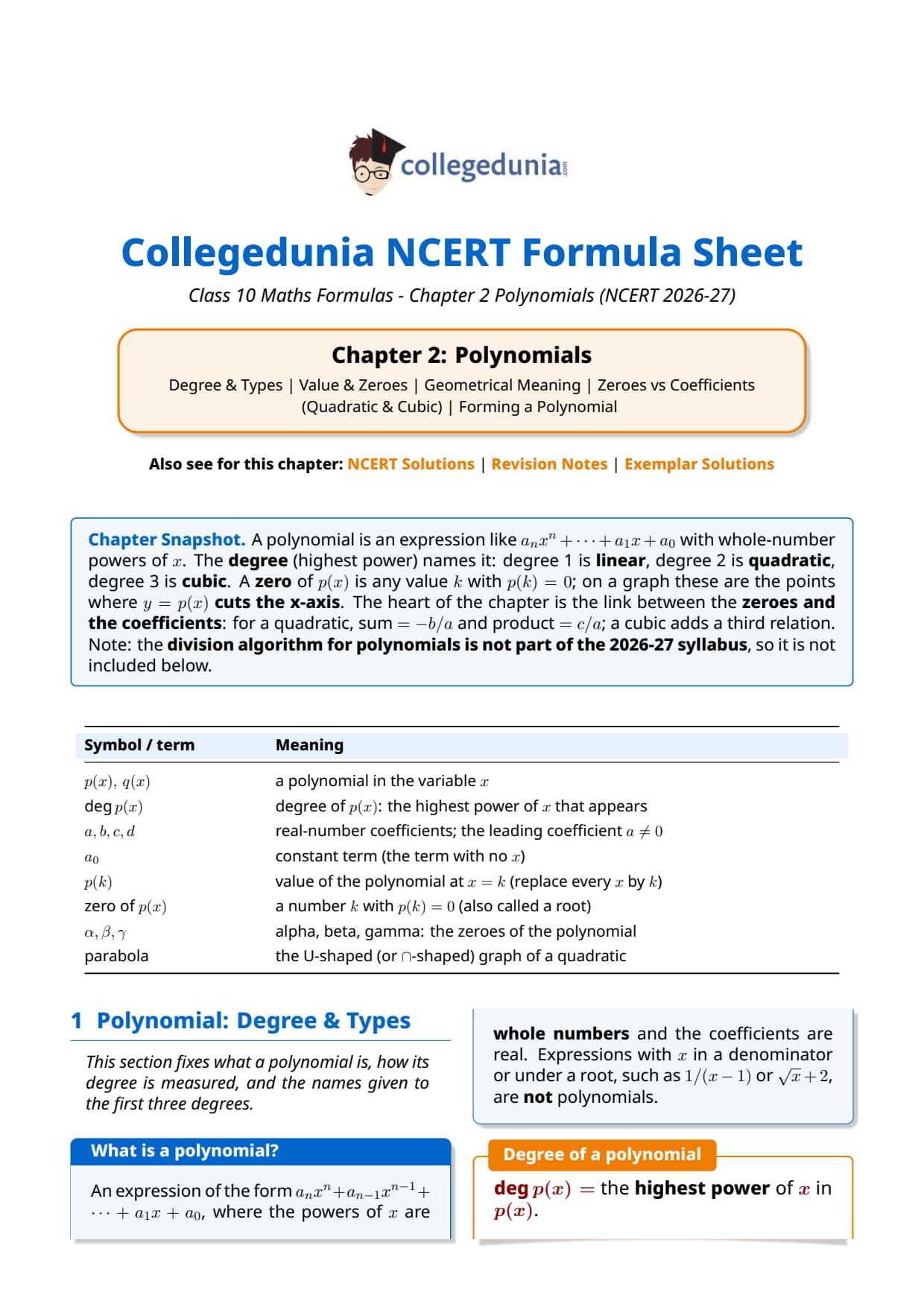
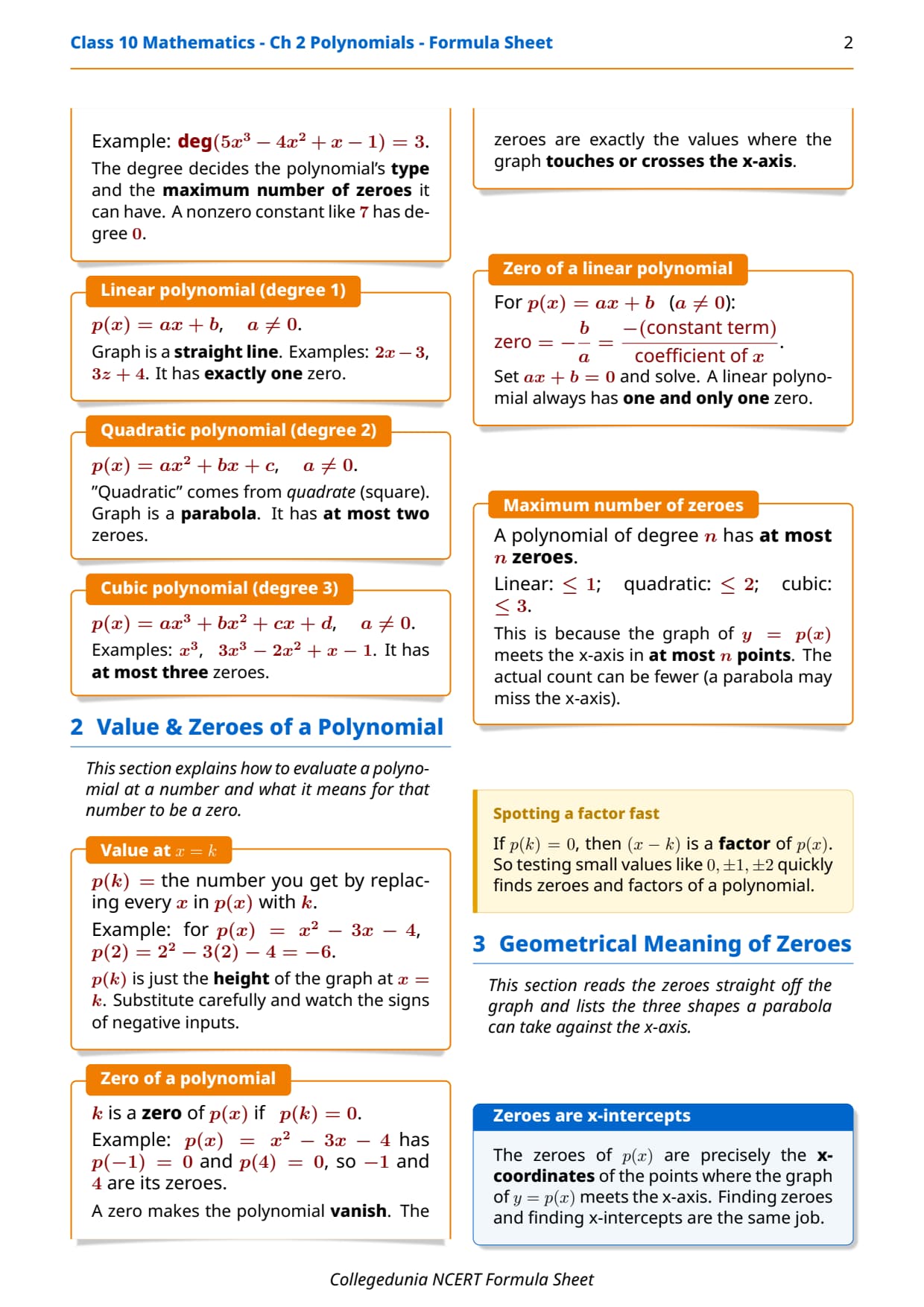
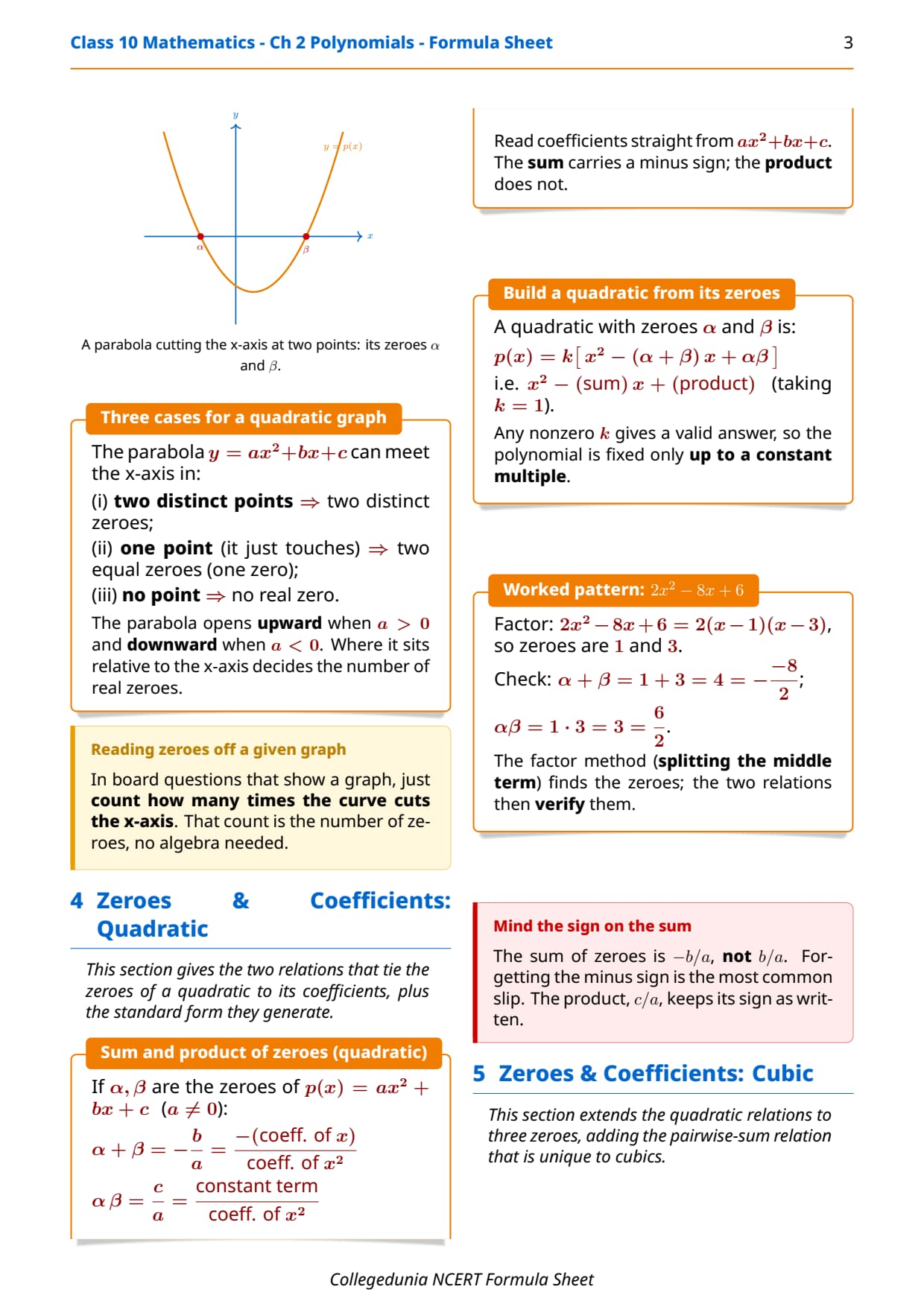
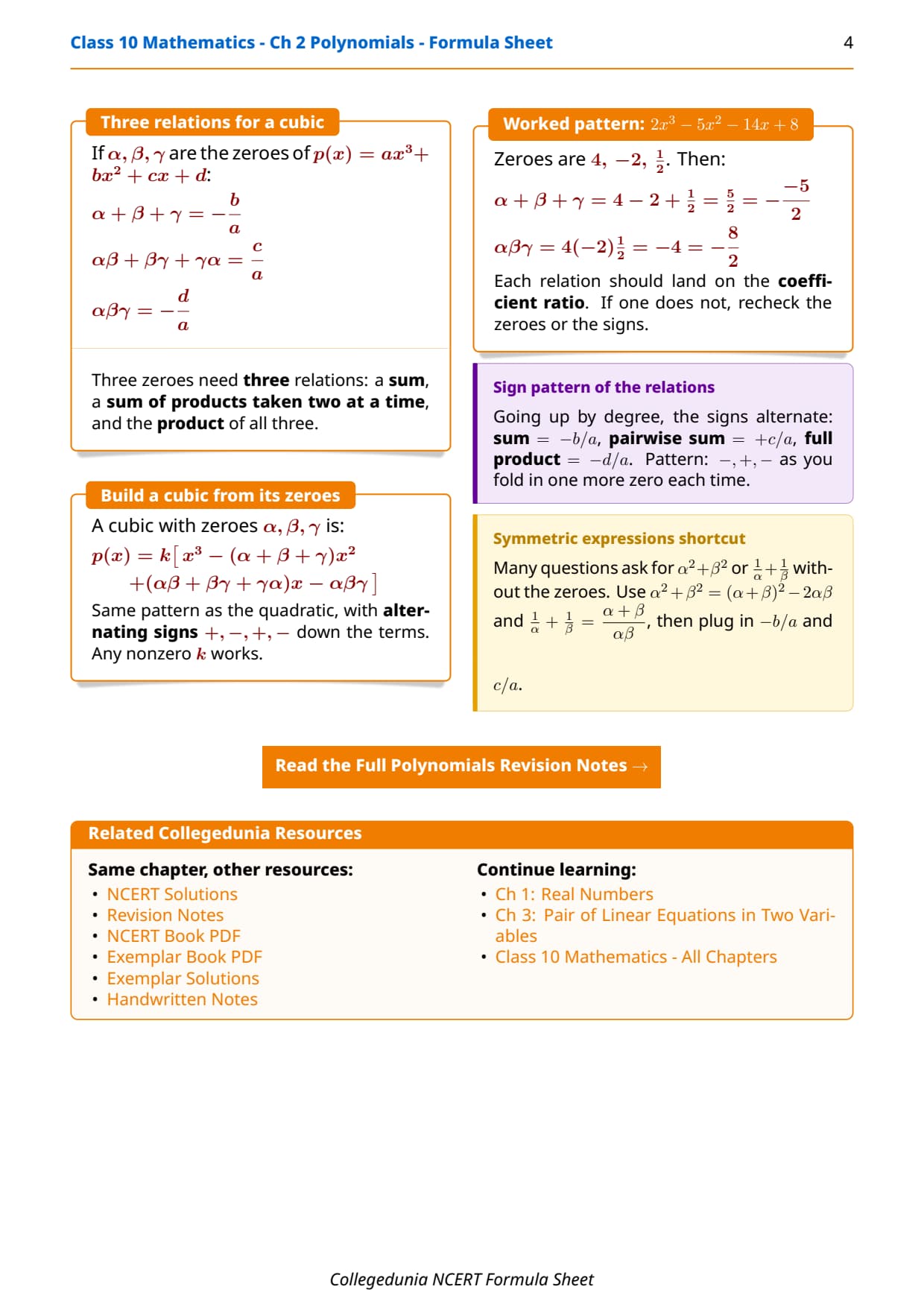
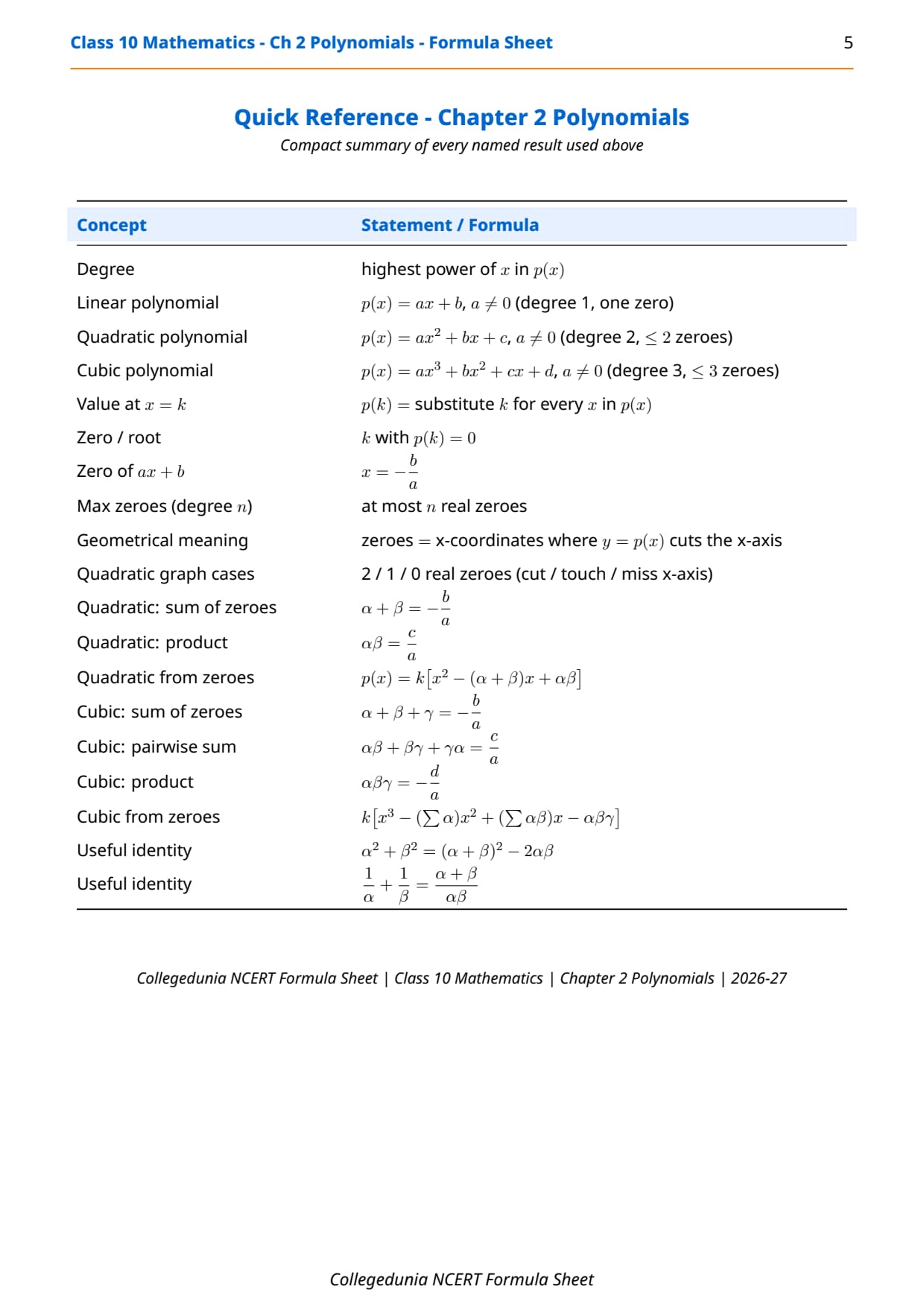
- All core formulas of Polynomials in one place, in plain English.
- Zeroes and coefficients relations for quadratics and cubics, plus how to build a polynomial from its zeroes.
- Graph toolkit: zeroes as x-intercepts and the three parabola cases.
|
Table of Contents |
Watch Polynomials Class 10 Maths Explained
Source: Magnet Brains on YouTube
Polynomials Formula Sheet: Complete List
The table below lists every named result you need, with each formula in plain words.
The chapter rests on two ideas: the degree sets the maximum number of zeroes, and formulas tie the zeroes and coefficients together.
| Concept | Formula / Statement |
|---|---|
| Degree of a polynomial | The highest power of x that appears in p(x) |
| Linear polynomial | p(x) = ax + b, a ≠ 0 (degree 1, one zero) |
| Quadratic polynomial | p(x) = ax2 + bx + c, a ≠ 0 (degree 2, at most 2 zeroes) |
| Cubic polynomial | p(x) = ax3 + bx2 + cx + d, a ≠ 0 (degree 3, at most 3 zeroes) |
| Value at x = k | p(k) = substitute k for every x in p(x) |
| Zero of a polynomial | A number k with p(k) = 0 |
| Zero of ax + b | x = −b / a |
| Maximum zeroes (degree n) | A polynomial of degree n has at most n real zeroes |
| Quadratic: sum of zeroes | α + β = −b / a |
| Quadratic: product of zeroes | α × β = c / a |
| Cubic: sum of zeroes | α + β + γ = −b / a |
| Cubic: sum taken two at a time | αβ + βγ + γα = c / a |
| Cubic: product of zeroes | αβγ = −d / a |
Zeroes of a quadratic linked to its coefficients.
Degree and Types of Polynomials
A polynomial in x has whole-number powers of x and real coefficients, like axn + ... + a1x + a0. Terms with x under a root or in a denominator are not allowed.
The degree is the highest power of x. It sets the name and the maximum number of zeroes.
- Linear (degree 1): p(x) = ax + b. A straight-line graph with exactly one zero.
- Quadratic (degree 2): p(x) = ax2 + bx + c. A parabola with at most two zeroes.
- Cubic (degree 3): p(x) = ax3 + bx2 + cx + d, with at most three zeroes.
- Degree n rule: a polynomial of degree n has at most n real zeroes.
Value and Zeroes of a Polynomial
The value p(k) is what you get by replacing every x with k. A number k is a zero when p(k) = 0, which is where the graph meets the x-axis.
| Idea | Rule | Worked Example (p(x) = x2 − 3x − 4) |
|---|---|---|
| Value p(k) | Replace every x by k | p(2) = 22 − 3(2) − 4 = −6 |
| Zero of p(x) | Any k with p(k) = 0 | p(−1) = 0 and p(4) = 0, so −1 and 4 are the zeroes |
| Zero of ax + b | Set ax + b = 0, so x = −b / a | For 2x − 3, zero is x = 3/2 |
A quick shortcut: if p(k) = 0, then (x − k) is a factor of p(x). So testing small values like 0, ±1 and ±2 often finds a zero at once.
Geometrical Meaning of the Zeroes
The zeroes of p(x) are the x-coordinates where the graph of y = p(x) cuts the x-axis. Finding zeroes and x-intercepts is the same job, so a graph question often needs no algebra.
For a quadratic, the parabola can sit against the x-axis in three ways, each giving a different number of real zeroes:
- Cuts at two points: two distinct zeroes.
- Touches at one point: the two zeroes are equal, so one zero.
- Misses the x-axis: no real zero.
- Direction: the parabola opens up when a > 0, down when a < 0.
So in a graph question, count how many times the curve crosses the x-axis.
Relation Between Zeroes and Coefficients of a Quadratic
This is the most-tested idea in the chapter. If α and β are the zeroes of p(x) = ax2 + bx + c, the sum and product come from the coefficients:
- Sum of zeroes: α + β = −b / a.
- Product of zeroes: α × β = c / a.
- Build from zeroes: p(x) = k[x2 − (α + β)x + αβ], for any nonzero k.
- The sum carries a minus sign; the product does not.
Worked check: for 2x2 − 8x + 6 = 2(x − 1)(x − 3), the zeroes are 1 and 3. Then α + β = 4 = −(−8)/2 and αβ = 3 = 6/2.
Relation Between Zeroes and Coefficients of a Cubic
A cubic needs three relations. If α, β and γ are the zeroes of p(x) = ax3 + bx2 + cx + d:
| Relation | Formula | In Words |
|---|---|---|
| Sum of zeroes | α + β + γ = −b / a | Add all three zeroes |
| Sum taken two at a time | αβ + βγ + γα = c / a | Add the three pairwise products |
| Product of zeroes | αβγ = −d / a | Multiply all three zeroes |
The signs alternate: minus, plus, minus. To build a cubic from its zeroes, use p(x) = k[x3 − (α + β + γ)x2 + (αβ + βγ + γα)x − αβγ]. For symmetric values like α2 + β2, use α2 + β2 = (α + β)2 − 2αβ.
How to Use This Formula Sheet
- Night-before revision: check you can state each rule, especially the sum and product of zeroes, from memory.
- During practice: keep the PDF open to look up the quadratic and cubic relations.
- For graph questions: the number of zeroes equals the x-axis cuts.
Polynomials Weightage in the Board Exam
Polynomials sits in the Algebra unit. The table shows where its topics fit among the high-frequency question types.
| Topic in Chapter 2 | Typical Question Type | Usual Marks |
|---|---|---|
| Zeroes and coefficients (quadratic) | Short answer / verify relations | 2 to 3 marks |
| Find a polynomial from its zeroes | Short answer | 2 marks |
| Geometrical meaning of zeroes | Read a given graph | 1 to 2 marks |
| Zeroes and coefficients (cubic) | Long answer | 3 marks |
Across recent CBSE papers, Polynomials usually carries about 3 to 5 marks. Verify-the-relations is an easy scoring chance.
Common Mistakes With Polynomials Formulas
Mistake 1: Writing the sum of zeroes as b/a. The correct value is −b/a.
Mistake 2: Treating √x or 1/x terms as a polynomial. Polynomials use only whole-number powers of x.
Mistake 3: Forgetting the constant k when forming a polynomial from its zeroes.
Mistake 4: Using the division algorithm. It is no longer in the 2026-27 syllabus.
Each slip can cost 1 to 2 marks.
Student Feedback
In a Collegedunia poll of 2,400 Class 10 students before the 2026 boards, 68% of students said the zeroes-and-coefficients relations were the part of Polynomials they revised most.
Source: Collegedunia Class 10 student poll, 2026.
Other Resources for This Chapter: Polynomials Class 10 Maths
Use this formula sheet with the other Polynomials resources below.
| Resource | Best Used For |
|---|---|
| Polynomials NCERT Solutions | Step-by-step textbook answers |
| Polynomials Notes | Full chapter explanation |
| Polynomials Handwritten Notes | Quick visual revision |
| Polynomials NCERT Book PDF | The official textbook chapter |
| Polynomials NCERT Exemplar Solutions | Harder practice with solutions |
| Polynomials NCERT Exemplar Book PDF | The official Exemplar problems |
Formula Sheets for Class 10 Maths: All Chapters
| Chapter | Formula Sheet |
|---|---|
| Chapter 1 | Real Numbers Formula Sheet |
| Chapter 2 | Polynomials Formula Sheet (this page) |
| Chapter 3 | Pair of Linear Equations in Two Variables Formula Sheet |
| Chapter 4 | Quadratic Equations Formula Sheet |
| Chapter 5 | Arithmetic Progressions Formula Sheet |
| Chapter 6 | Triangles Formula Sheet |
| Chapter 7 | Coordinate Geometry Formula Sheet |
| Chapter 8 | Introduction to Trigonometry Formula Sheet |
| Chapter 9 | Some Applications of Trigonometry Formula Sheet |
| Chapter 10 | Circles Formula Sheet |
| Chapter 11 | Areas Related to Circles Formula Sheet |
| Chapter 12 | Surface Areas and Volumes Formula Sheet |
| Chapter 13 | Statistics Formula Sheet |
| Chapter 14 | Probability Formula Sheet |
Class 10 Maths Chapter 2 Polynomials Formula Sheet FAQs
Ques. What formulas are in the Class 10 Polynomials formula sheet?
Ans. The sheet covers the degree and types, the value p(k) and zeroes, the geometrical meaning of zeroes, and the relations between zeroes and coefficients for quadratics and cubics. The full list is in the table at the top of this page.
Ques. What is the relation between the zeroes and coefficients of a quadratic?
Ans. For p(x) = ax squared + bx + c with zeroes alpha and beta, the sum alpha + beta = minus b over a and the product alpha times beta = c over a. The sum carries a minus sign, while the product does not.
Ques. How do you write the three relations for a cubic polynomial?
Ans. For p(x) = ax cubed + bx squared + cx + d with zeroes alpha, beta and gamma: alpha + beta + gamma = minus b over a, alpha beta + beta gamma + gamma alpha = c over a, and alpha beta gamma = minus d over a. The signs alternate as minus, plus, minus.
Ques. How many zeroes can a polynomial of degree n have?
Ans. A polynomial of degree n has at most n real zeroes. So a linear polynomial has one zero, a quadratic has at most two, and a cubic has at most three. The zeroes are the points where the graph cuts the x-axis.
Ques. How much weightage does Polynomials carry in the CBSE board exam?
Ans. Polynomials usually carries about 3 to 5 marks in the CBSE Class 10 Maths paper, across a verify-the-relations question, forming a polynomial from its zeroes, and a graph-reading question. It is a reliable scoring chapter if you learn the formula sheet well.
Ques. Where can I download the Polynomials formula sheet PDF?
Ans. You can download the Class 10 Maths Chapter 2 Polynomials formula sheet PDF using the download card near the top of this page. It fits the whole chapter on one page for quick revision under the 2026-27 syllabus.



Comments