



The Class 10 Maths Chapter 12 Surface Areas and Volumes formula sheet puts every formula and relation from this chapter on one page. It covers the surface area and volume of basic solids (cuboid, cube, cylinder, cone, sphere, hemisphere) and their combinations, plus the frustum of a cone as a new shape. Every formula follows the standard NCERT derivations and matches the 2026-27 CBSE syllabus.
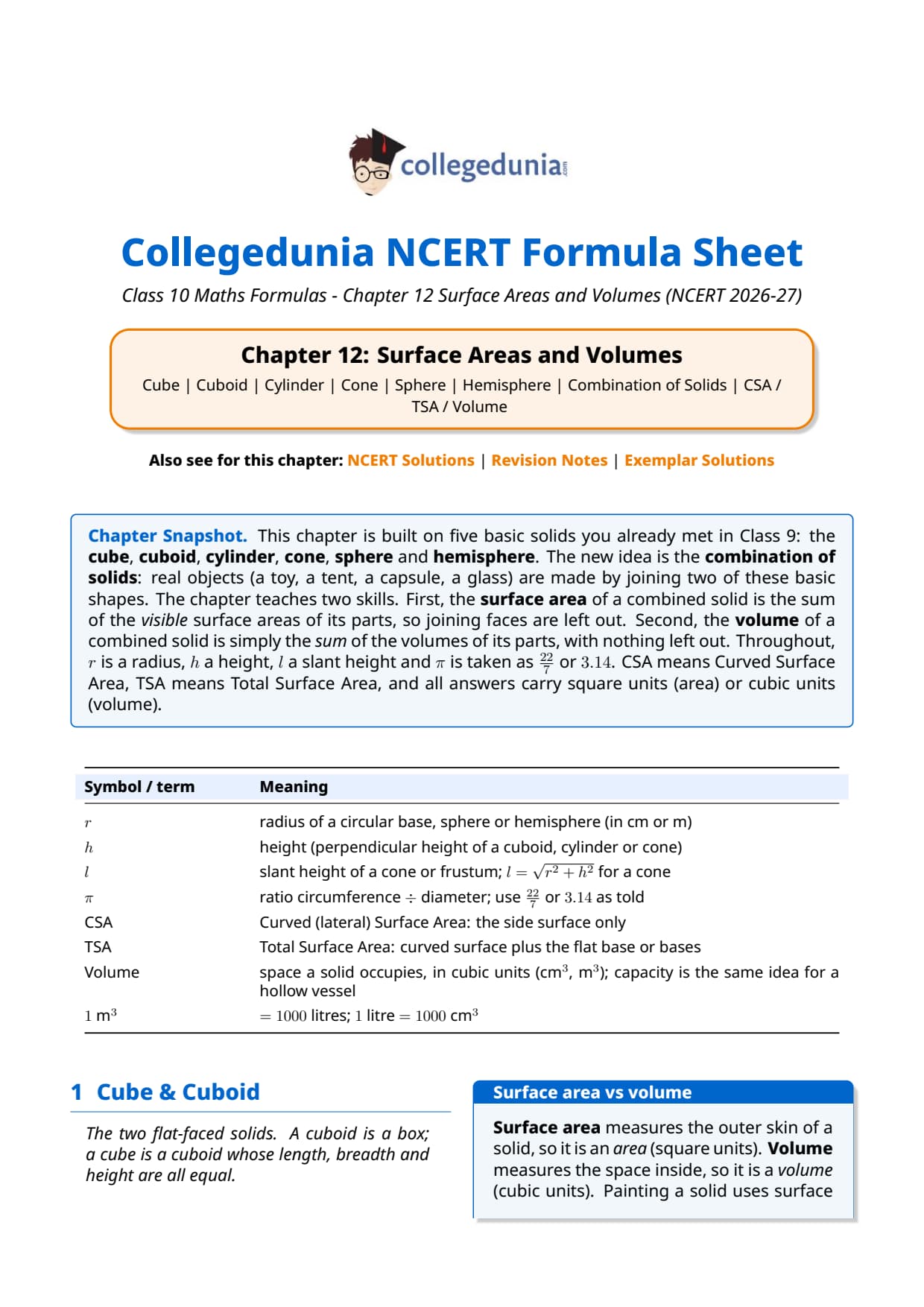
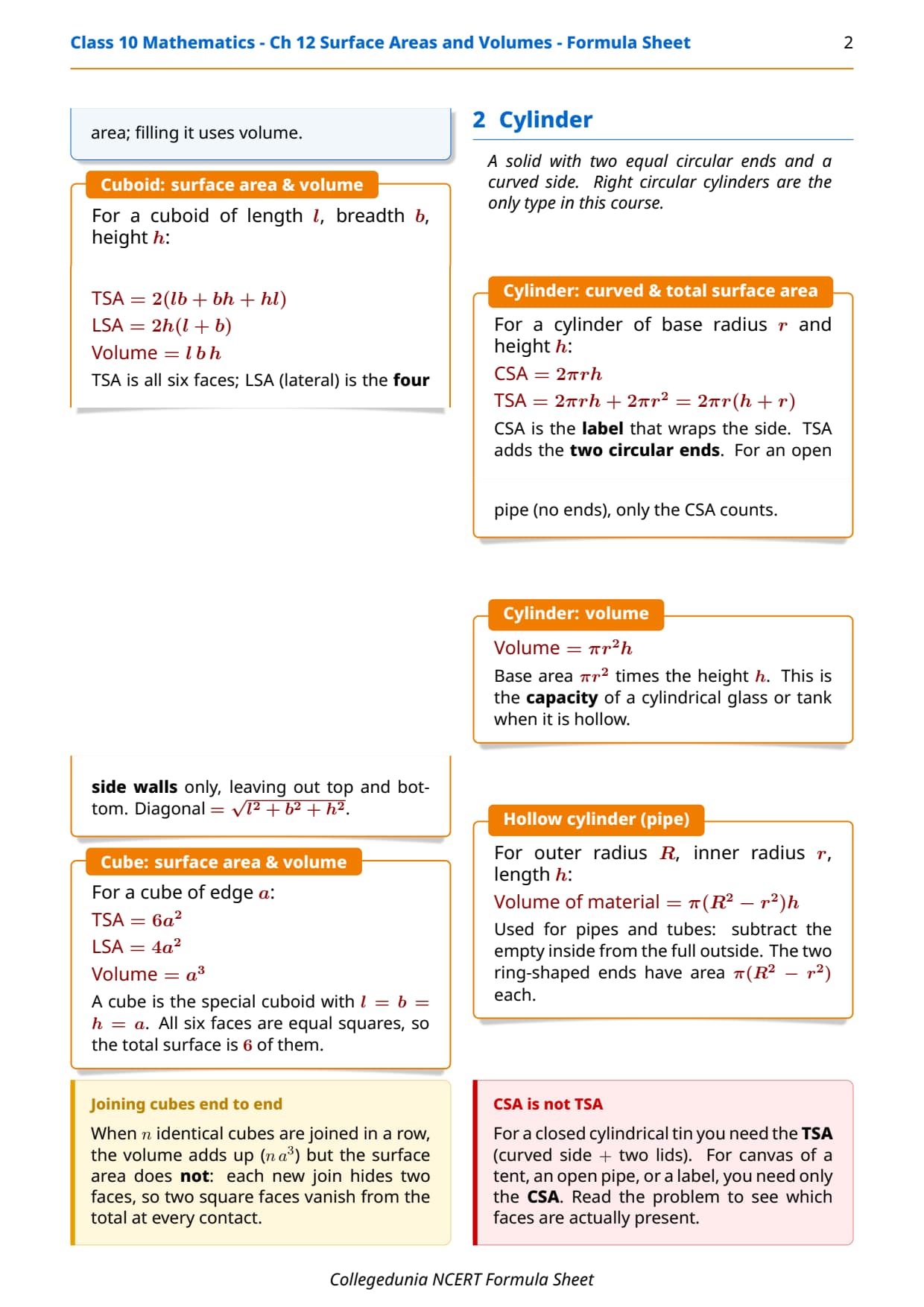
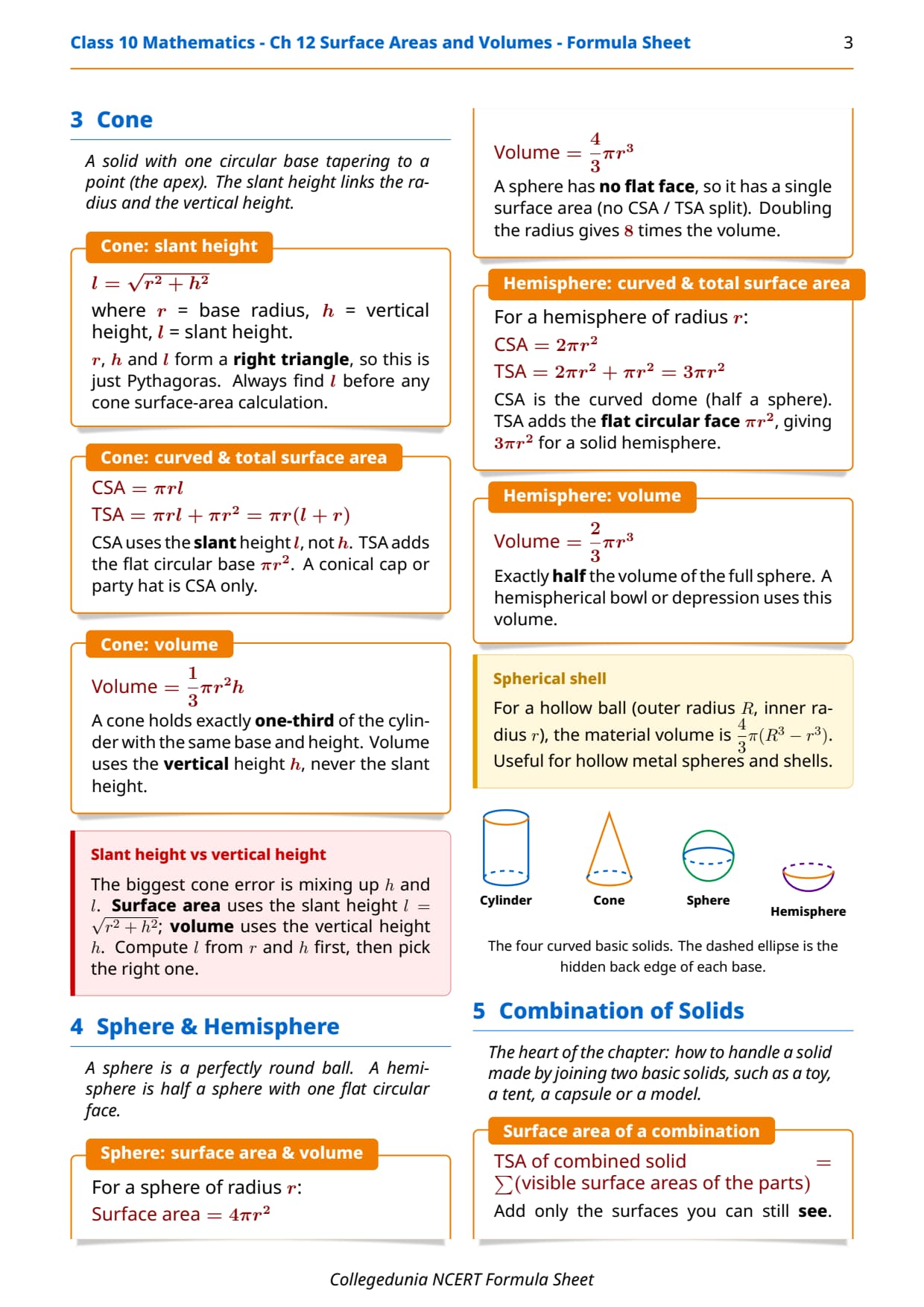
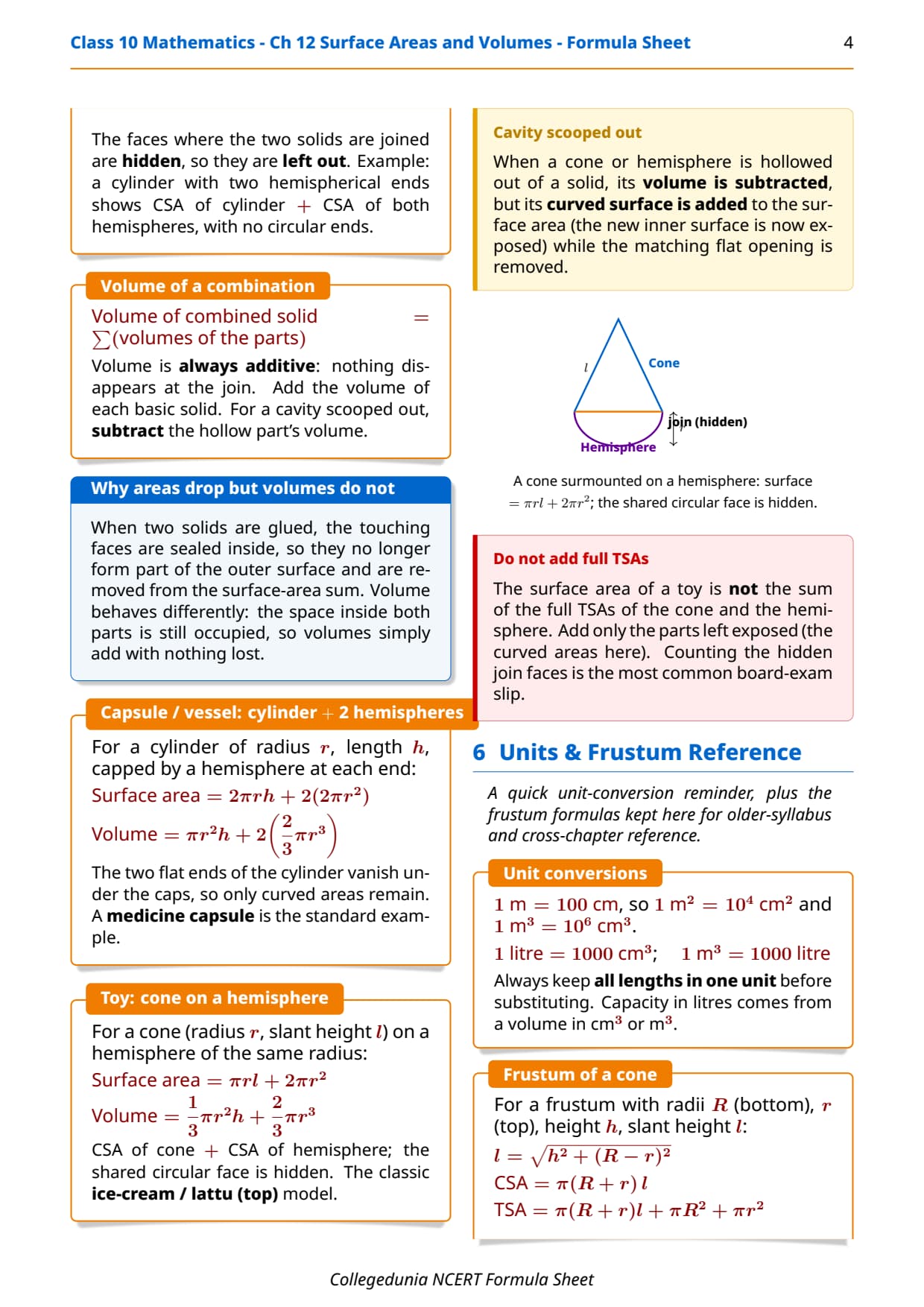
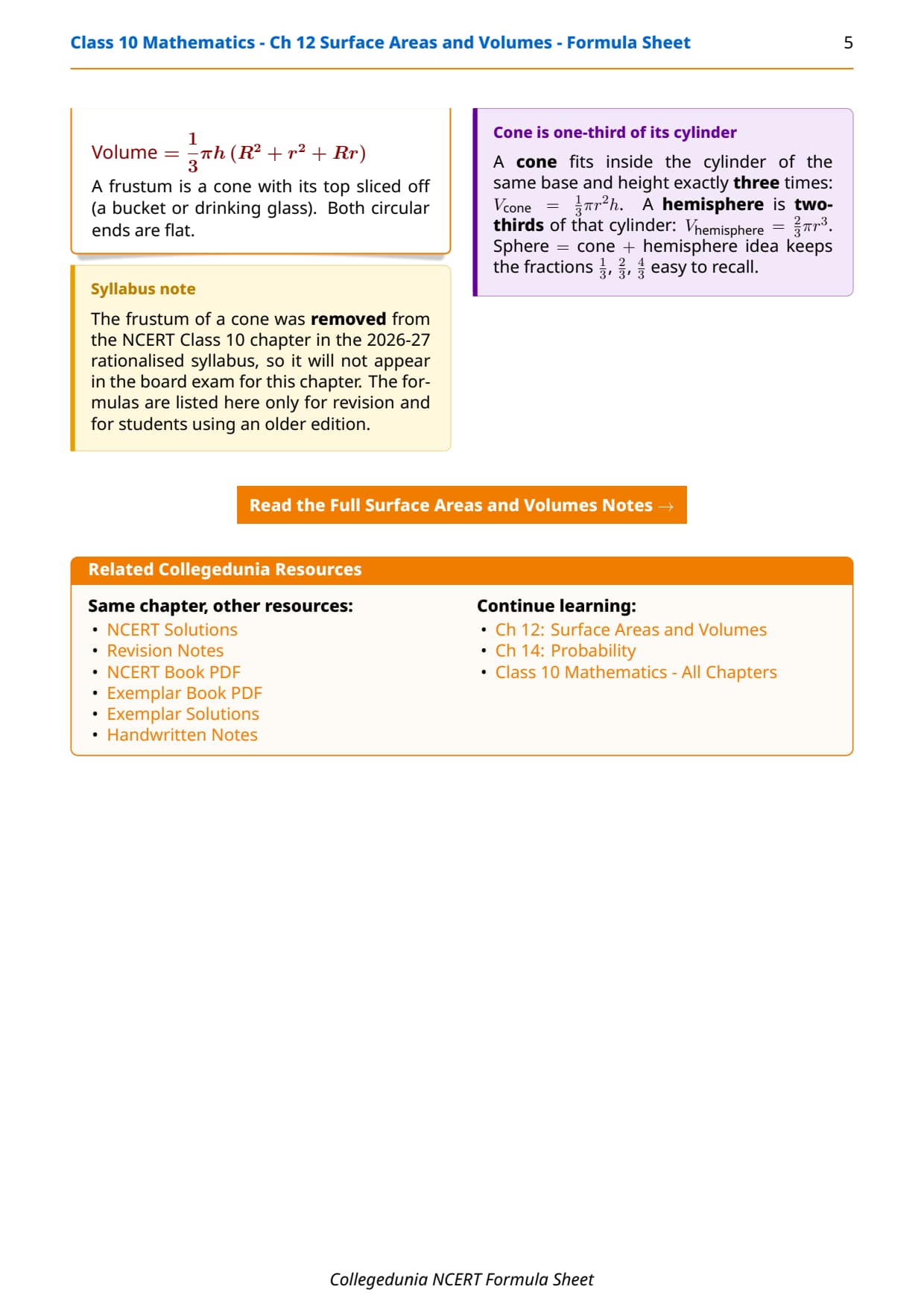
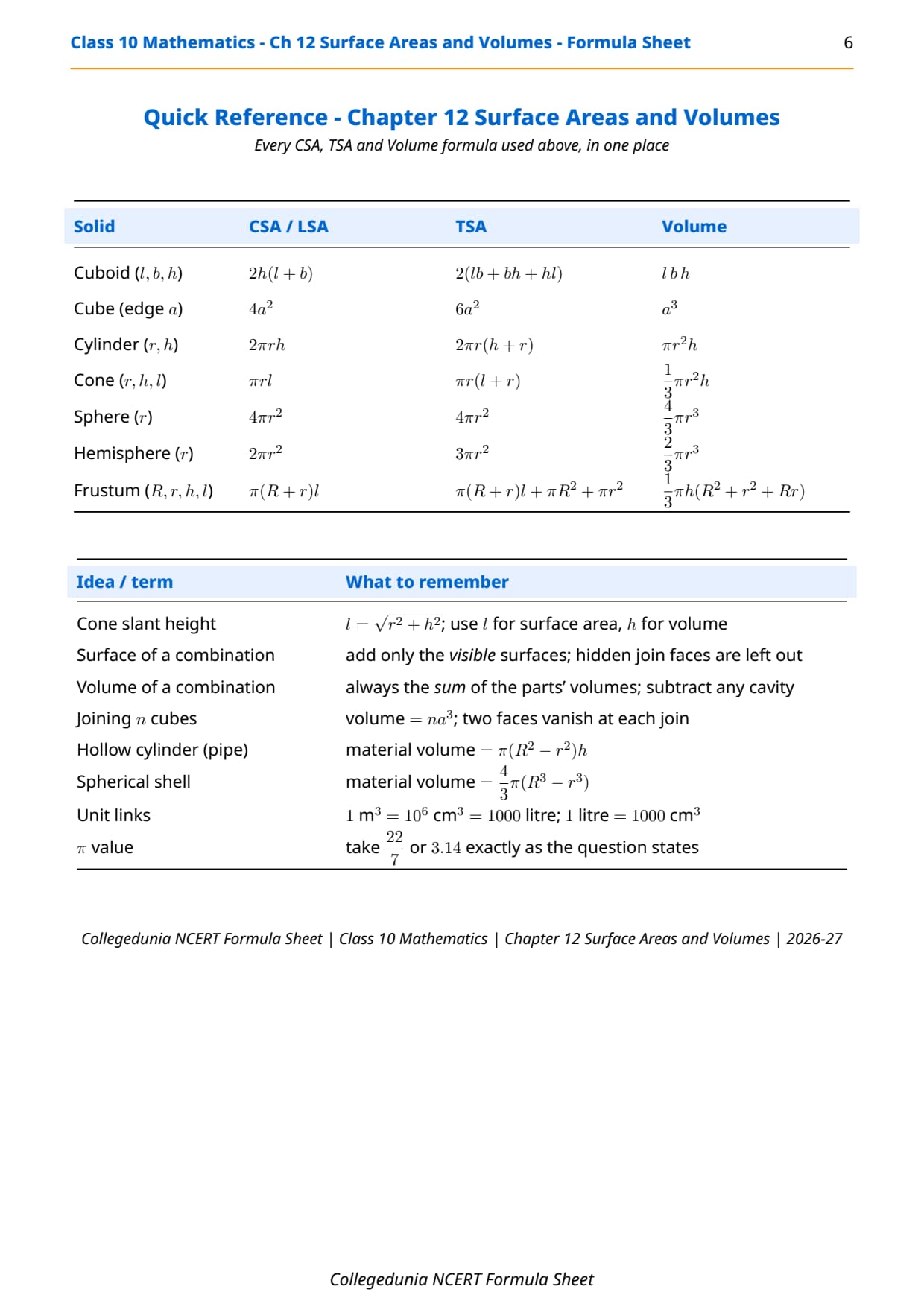
- Core shapes covered: cuboid, cube, cylinder, cone, sphere, hemisphere and frustum. Combination solids are built by adding or removing these basic shapes.
- Board context: this chapter is worth 6 to 8 marks per paper through surface area, volume and frustum problems.
Student Feedback: In a Collegedunia poll of 2,800 Class 10 students before the 2026 boards, 88% of students said the frustum formulas were the hardest part of this chapter. Students who wrote the slant height (l = √(h² + (R - r)²)) at the top of their rough paper solved frustum problems in under 3 minutes.
Watch Surface Areas and Volumes Class 10 Maths Explained
Source: Ritik Mishra - 9th & 10th on YouTube
Complete Formula List
The table below lists every formula from this chapter. Each solid has two measurements: surface area (the outer covering) and volume (the space inside), plus the new frustum of a cone. Every board question asks you to find a surface area or volume, combine two solids, or convert one solid into another.
| Solid | Quantity | Formula |
|---|---|---|
| Cuboid | TSA / LSA / Volume | 2(lb + bh + lh) / 2(l + b)h / lbh, where l, b, h are the edges |
| Cube | TSA / LSA / Volume | 6a² / 4a² / a³, where a = side |
| Cylinder | CSA / TSA / Volume | 2πrh / 2πr(h + r) / πr²h |
| Cone | Slant height / CSA / TSA / Volume | l = √(r² + h²) / πrl / πr(l + r) / (1/3)πr²h |
| Sphere | Surface area / Volume | 4πr² / (4/3)πr³ |
| Hemisphere | CSA / TSA / Volume | 2πr² / 3πr² / (2/3)πr³ |
| Frustum | Slant height / CSA / TSA / Volume | l = √(h² + (R − r)²) / π(R + r)l / π(R + r)l + πR² + πr² / (1/3)πh(R² + r² + Rr) |
Surface area and volume formulas for all six basic solids in Chapter 12: cuboid, cube, cylinder, cone, sphere and hemisphere.
Surface Area Formulas: All Basic Solids
Chapter 12 uses two types of surface area: curved (or lateral) surface area, which counts only the curved or side faces, and total surface area, which also adds the flat bases. Board problems sometimes ask for the curved area (canvas for a tent) and sometimes for the total area (painting a whole can). Identifying which surface area is required is the first step in every answer.
Volume Formulas: All Basic Solids
Volume measures the space inside a solid. The cone and the frustum both carry a factor of 1/3, which prevents the common mistake of using the full cylinder formula for a cone. In fact, volume of cone = (1/3) × volume of cylinder with the same base and height. Board questions on conversion of solids (melting and recasting) rely entirely on equating volumes.
| Solid | Volume | Worked example |
|---|---|---|
| Cylinder | πr²h | r = 7, h = 10: V = (22/7)(49)(10) = 1540 cm³ |
| Cone | (1/3)πr²h | r = 7, h = 12: V = (1/3)(22/7)(49)(12) = 616 cm³ |
| Sphere | (4/3)πr³ | r = 7: V = (4/3)(22/7)(343) = 1437.33 cm³ |
Volume formulas for Chapter 12: note that a cone holds one-third the volume of a cylinder with the same base and height.
Frustum of a Cone: Surface Area and Volume Formulas
The frustum is the portion of a cone left after cutting off the top with a plane parallel to the base. It is the only new shape in Chapter 12, with two circular bases of different radii: the larger radius R at the bottom and the smaller radius r at the top. Its slant height is l = √(h² + (R − r)²), and the surface area formulas depend on l. Students who compute l correctly in the first line almost always get the rest right.
| Quantity | Formula | Note |
|---|---|---|
| Slant height l | l = √(h² + (R − r)²) | Compute this first; needed in both CSA and TSA |
| Curved surface area | π(R + r)l | The outer slanted band only |
| Total surface area | π(R + r)l + πR² + πr² | Adds both circular bases to the CSA |
| Volume | (1/3)πh(R² + r² + Rr) | Note the three terms R², r² and Rr inside the bracket |
Combination of Solids: Which Formula to Use
Many board questions combine two or three basic solids, like an ice cream cone (cylinder with a hemisphere on top) or a tent (cylinder with a cone on top). The strategy is to identify each solid, apply its formula separately, then add or subtract. For surface areas, only count the exposed outer surface; the joining face is hidden. For volumes, always add the individual volumes.
| Combination | Surface area approach | Volume approach |
|---|---|---|
| Cylinder + cone on top | CSA of cylinder + CSA of cone (exclude both flat circles at the joint) | V cylinder + V cone |
| Cylinder + hemisphere on top | CSA of cylinder + CSA of hemisphere (exclude the flat circle at the joint) | V cylinder + V hemisphere |
| Sphere embedded in cylinder | TSA of cylinder + 0 for sphere (sphere is hidden) | V cylinder (sphere inside is already counted in cylinder's height) |
| Cone drilled out of cylinder | CSA of cylinder + base of cylinder + CSA of cone (the drilled hole exposes the inner cone surface) | V cylinder − V cone |
Conversion of Solids: Setting Up the Equation
Conversion problems involve melting or reshaping one solid into another. The key fact is that volume is conserved during melting and recasting, so the number of new solids = original volume / volume of one new solid. These are usually 3-mark questions with three steps. Always carry the exact fraction through and simplify at the last step to avoid rounding errors that cost marks.
CBSE Board Exam Weightage for Chapter 12 Surface Areas and Volumes
Chapter 12 is a consistent source of 3-mark and 5-mark questions, testing both formula recall and multi-step numerical work, especially for combination solids and frustum problems.
| Topic | Typical Question Type | Usual Marks |
|---|---|---|
| Surface area of basic solids | Find TSA or CSA of a cylinder, cone, or sphere given dimensions | 2 to 3 marks |
| Volume of basic solids | Find volume of a cylinder, cone, sphere, or hemisphere | 2 to 3 marks |
| Combination of solids | Find the surface area or volume of a two-solid combination (e.g., cylinder topped with a cone) | 3 to 4 marks |
| Frustum of a cone | Given R, r and h, find the CSA, TSA or volume of the frustum | 3 to 5 marks |
| Conversion of solids | Melting one solid and finding how many new smaller solids are formed | 3 marks |
Chapter 12 typically contributes 6 to 8 marks per paper. The frustum and combination-solid problems are the most frequently tested items.
Common Mistakes in Class 10 Surface Areas and Volumes Problems
Mistake 1: Using vertical height h instead of slant height l in the cone's CSA. The curved surface area is πrl, not πrh; always compute l = √(r² + h²) first.
Mistake 2: Counting the joining face in a combination solid. A shared flat face is interior and must not appear in the surface area.
Mistake 3: Forgetting the 1/3 in the cone and frustum volumes, which gives answers three times too large.
Mistake 4: Missing the Rr term in the frustum volume. The bracket is R² + r² + Rr, not R² + r² (check: r = 0 must give the cone volume).
Mistake 5: Using the diameter instead of the radius. If the problem gives a diameter, write r = d/2 on the first line.
Each of these slips costs 1 to 2 marks in the board exam.
More Class 10 Surface Areas and Volumes Resources
Use this formula sheet alongside the other Chapter 12 resources below.
| Resource | Best Used For |
|---|---|
| Surface Areas and Volumes NCERT Solutions | Step-by-step answers to all textbook questions |
| Surface Areas and Volumes Notes | Full chapter explanation with solved examples |
| Surface Areas and Volumes Handwritten Notes | Quick visual revision in a notebook style |
| Surface Areas and Volumes NCERT Book PDF | The official textbook chapter to read |
| Surface Areas and Volumes NCERT Exemplar Solutions | Harder practice questions with solutions |
| Surface Areas and Volumes NCERT Exemplar Book PDF | The official Exemplar problems to attempt |
NCERT Formula Sheets for Class 10 Maths: All Chapters
Jump to the formula sheet for any other chapter using the table below.
| Chapter | Formula Sheet |
|---|---|
| Chapter 1 | Real Numbers Formula Sheet |
| Chapter 2 | Polynomials Formula Sheet |
| Chapter 3 | Pair of Linear Equations in Two Variables Formula Sheet |
| Chapter 4 | Quadratic Equations Formula Sheet |
| Chapter 5 | Arithmetic Progressions Formula Sheet |
| Chapter 6 | Triangles Formula Sheet |
| Chapter 7 | Coordinate Geometry Formula Sheet |
| Chapter 8 | Introduction to Trigonometry Formula Sheet |
| Chapter 9 | Some Applications of Trigonometry Formula Sheet |
| Chapter 10 | Circles Formula Sheet |
| Chapter 11 | Areas Related to Circles Formula Sheet |
| Chapter 12 | Surface Areas and Volumes Formula Sheet (this page) |
| Chapter 13 | Statistics Formula Sheet |
| Chapter 14 | Probability Formula Sheet |
Class 10 Maths Chapter 12 Surface Areas and Volumes Formula Sheet FAQs
Ques. What formulas are in the Class 10 Chapter 12 Surface Areas and Volumes formula sheet?
Ans. The sheet covers total and curved surface area formulas for cuboid (2(lb + bh + lh) and 2(l + b)h), cube (6a² and 4a²), cylinder (2πr(h + r) and 2πrh), cone (πr(l + r) and πrl, with slant height l = √(r² + h²)), sphere (4πr²), hemisphere (3πr² and 2πr²), and frustum (π(R + r)l + πR² + πr² and π(R + r)l, with l = √(h² + (R - r)²)). Volume formulas are also included for all these shapes, including the frustum volume (1/3)πh(R² + r² + Rr).
Ques. What is the formula for the volume of a frustum?
Ans. The volume of a frustum of a cone is V = (1/3)πh(R² + r² + Rr), where R is the radius of the larger base, r is the radius of the smaller base and h is the vertical height. Note the three terms inside the bracket: R squared, r squared and the cross term Rr. If you set r = 0 (no cut), the formula reduces to (1/3)πhR², the standard cone volume. The slant height of the frustum is l = √(h² + (R - r)²), and this is needed for the surface area formulas: CSA = π(R + r)l and TSA = π(R + r)l + πR² + πr².
Ques. What is the difference between curved surface area and total surface area?
Ans. The curved surface area (CSA), also called lateral surface area, is the area of only the curved or side faces of a solid, excluding the flat bases. The total surface area (TSA) adds the areas of the flat circular or rectangular bases to the CSA. For example, for a cylinder: CSA = 2πrh (the curved tube only) and TSA = 2πr(h + r) (tube plus both circular ends). The type of surface area needed depends on the problem context: a cylindrical tin open at both ends needs CSA; a closed box needs TSA.
Ques. How do you find the surface area of a combination of solids?
Ans. For a combination of solids, the total exposed surface area equals the sum of the outer surfaces of each solid, minus the areas of any faces that are joined together (since joined faces are hidden). For example, if a cone sits on top of a cylinder with the same base radius: the total surface area = CSA of cone + CSA of cylinder + base circle of cylinder (the bottom). The top circle of the cylinder and the base circle of the cone cancel each other out because they are joined. Draw a rough sketch and mark the visible faces before writing the formula.
Ques. Is this formula sheet aligned with the 2026-27 NCERT syllabus?
Ans. Yes. This page reflects the current 2026-27 CBSE Class 10 Mathematics syllabus. Chapter 12 Surface Areas and Volumes is retained in full in the 2026-27 edition, including the frustum of a cone. All formulas on this sheet match the exercises, examples and definitions from the current NCERT textbook for Class 10 Maths.
Ques. Where can I download the Class 10 Maths Chapter 12 Surface Areas and Volumes formula sheet PDF?
Ans. You can download the Class 10 Maths Chapter 12 Surface Areas and Volumes formula sheet PDF using the download card near the top of this page. It contains all key formulas from surface area and volume of basic solids to combination solids and the frustum, organised on one or two pages for quick CBSE board exam revision under the 2026-27 syllabus.



Comments