



The Class 10 Maths Chapter 10 Circles formula sheet collects every theorem, result and formula on a single page. Circles rests on just two theorems. The tangent is perpendicular to the radius at the point of contact. The two tangents from an external point are equal in length. Every board question follows from these two facts plus Pythagoras and basic congruence. The formulas match the 2026-27 CBSE syllabus.
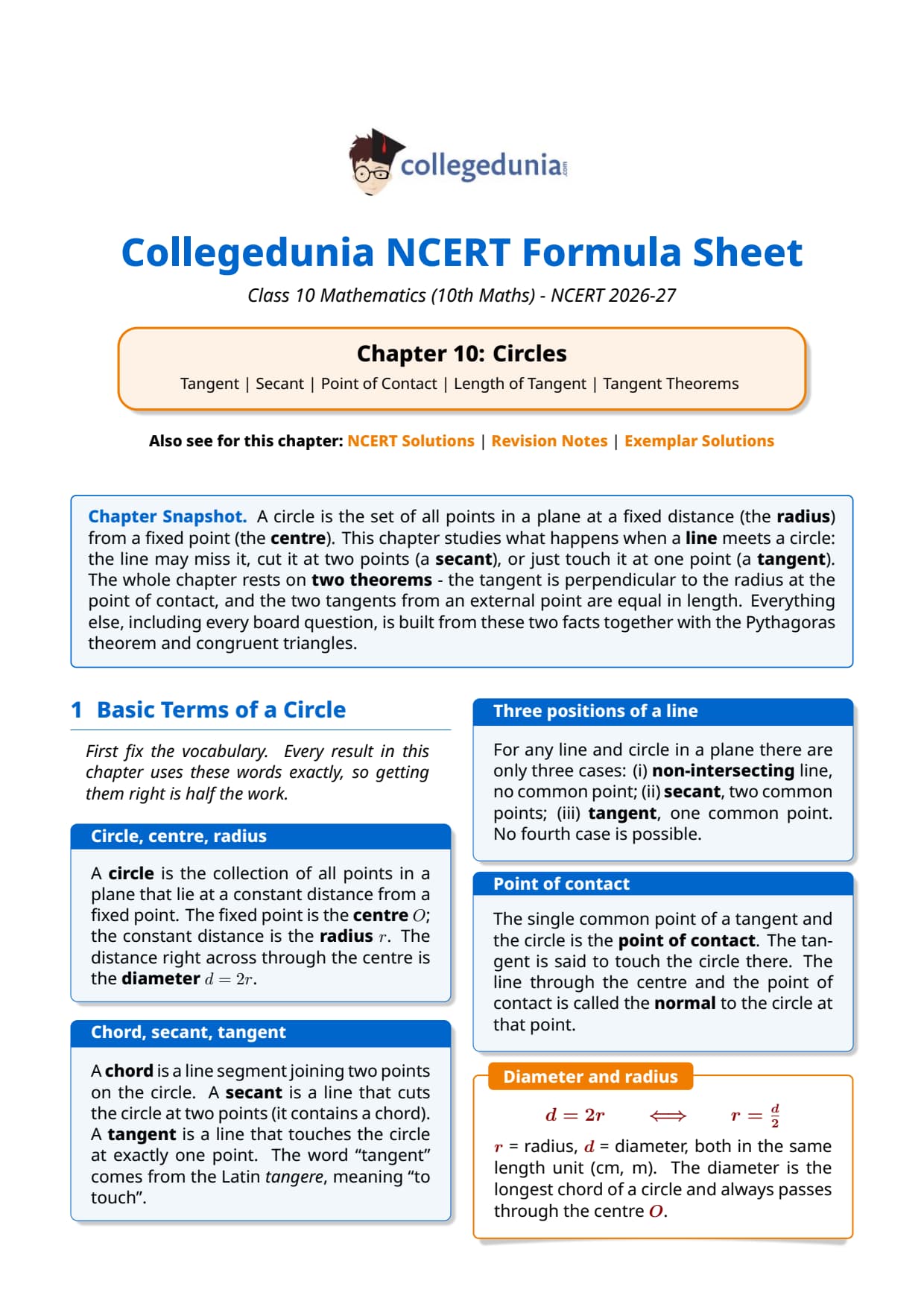
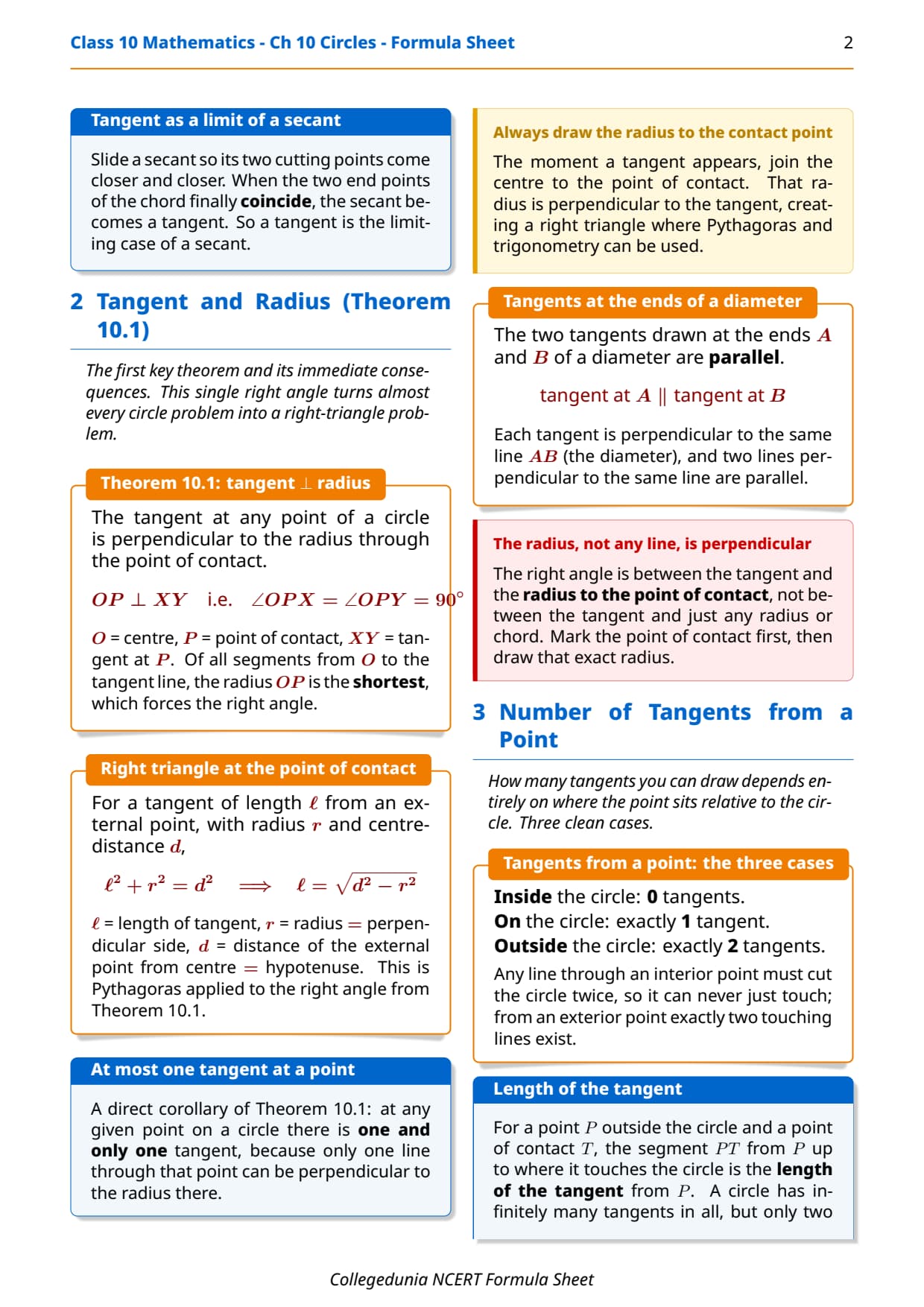
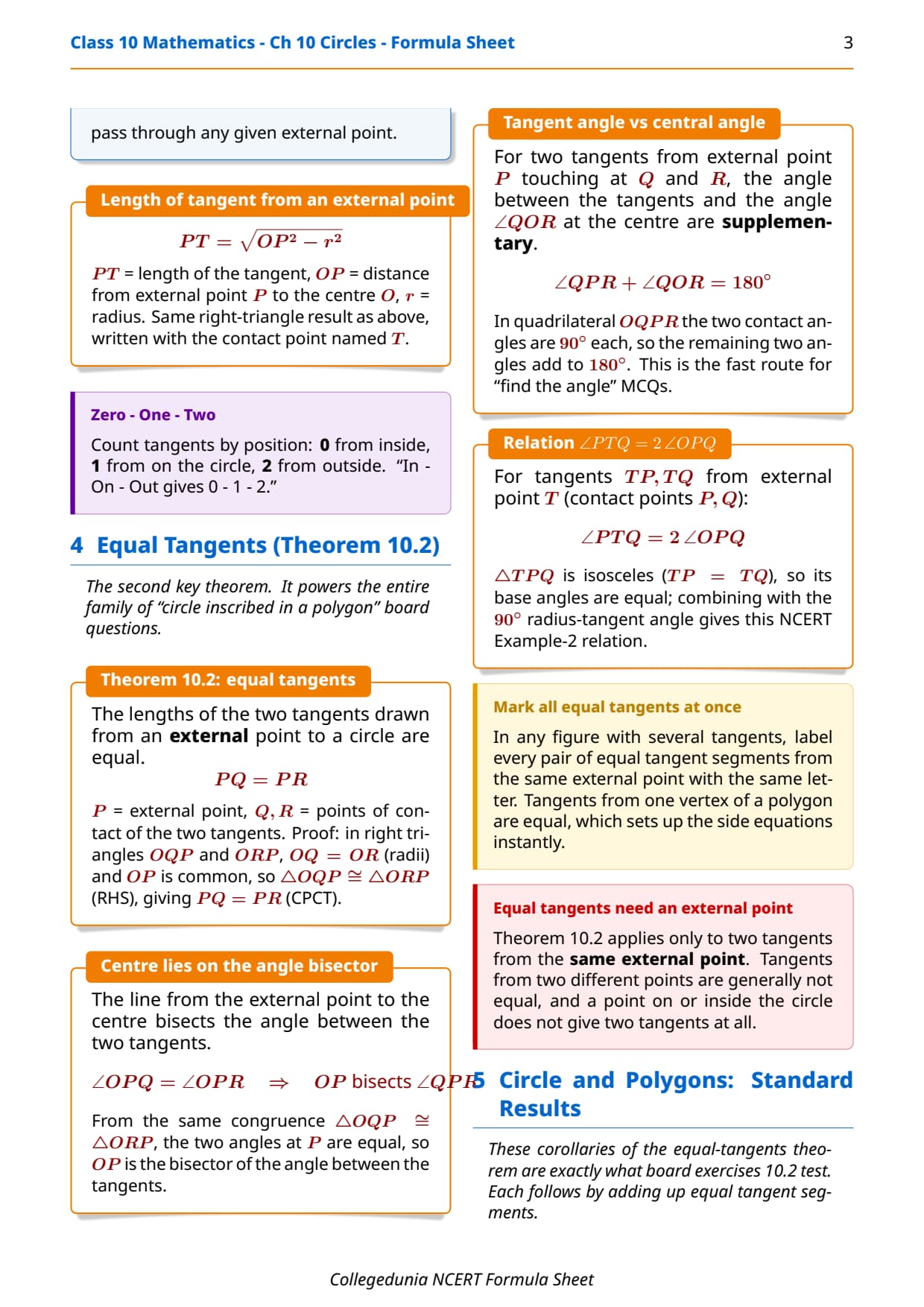
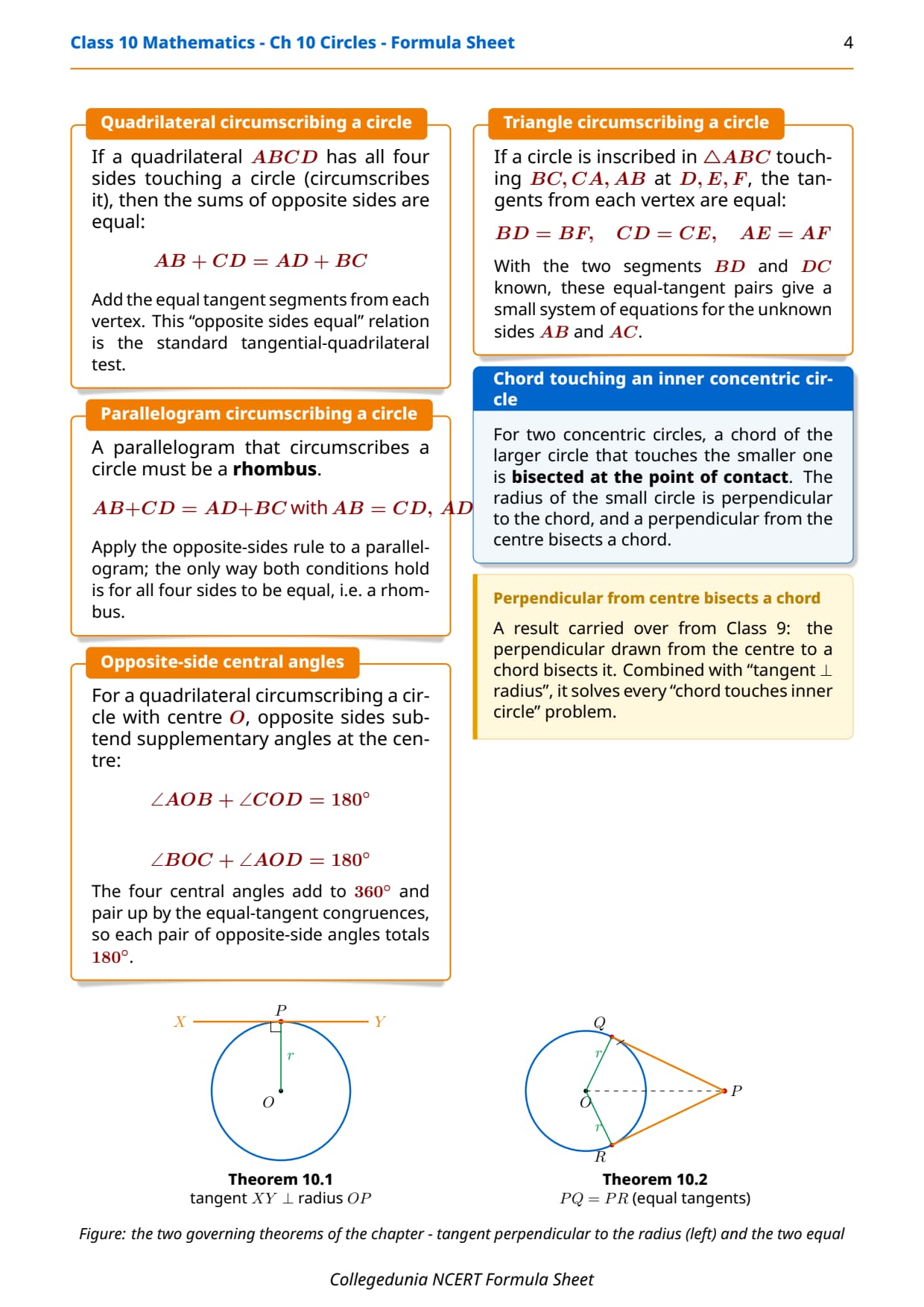
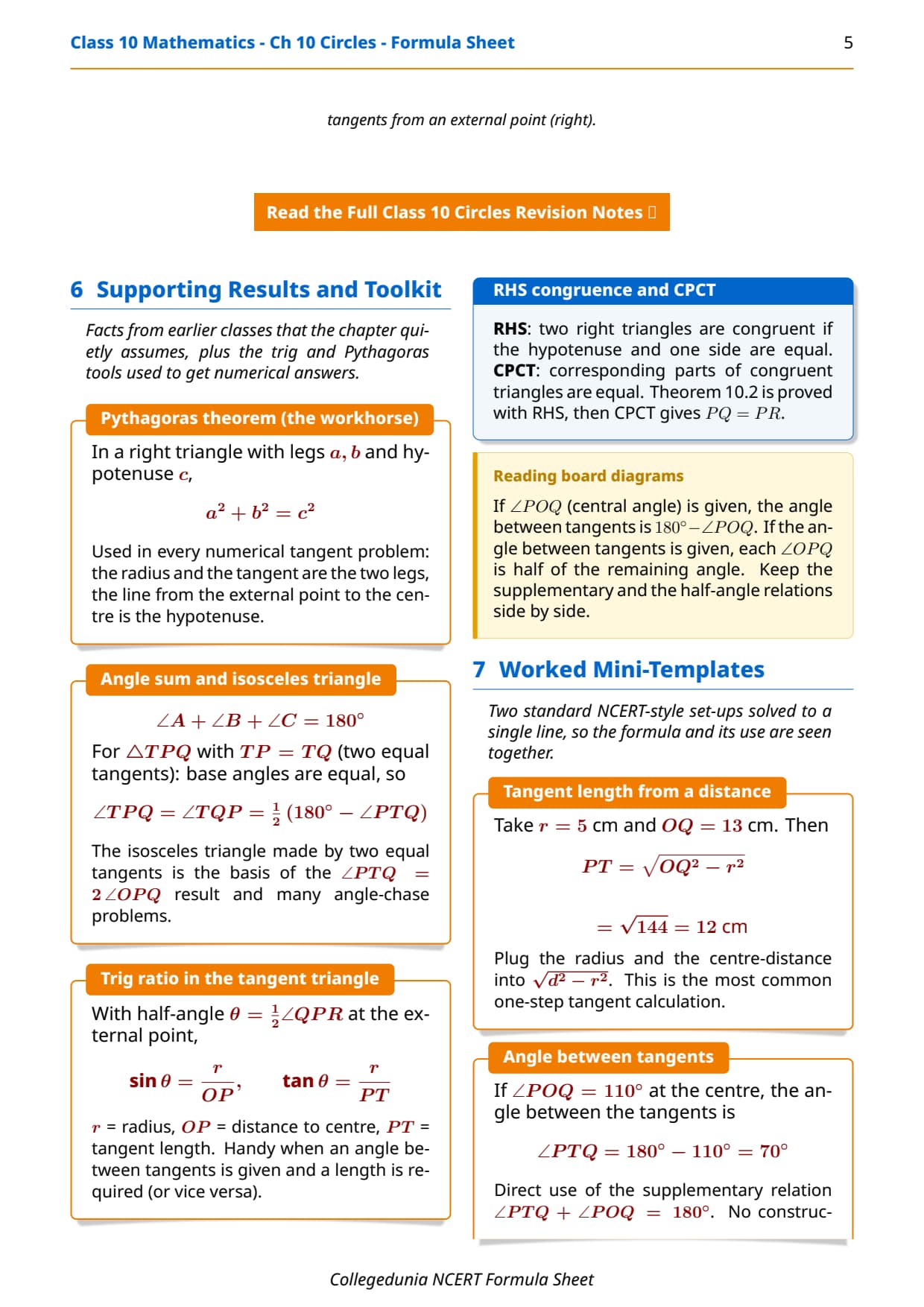
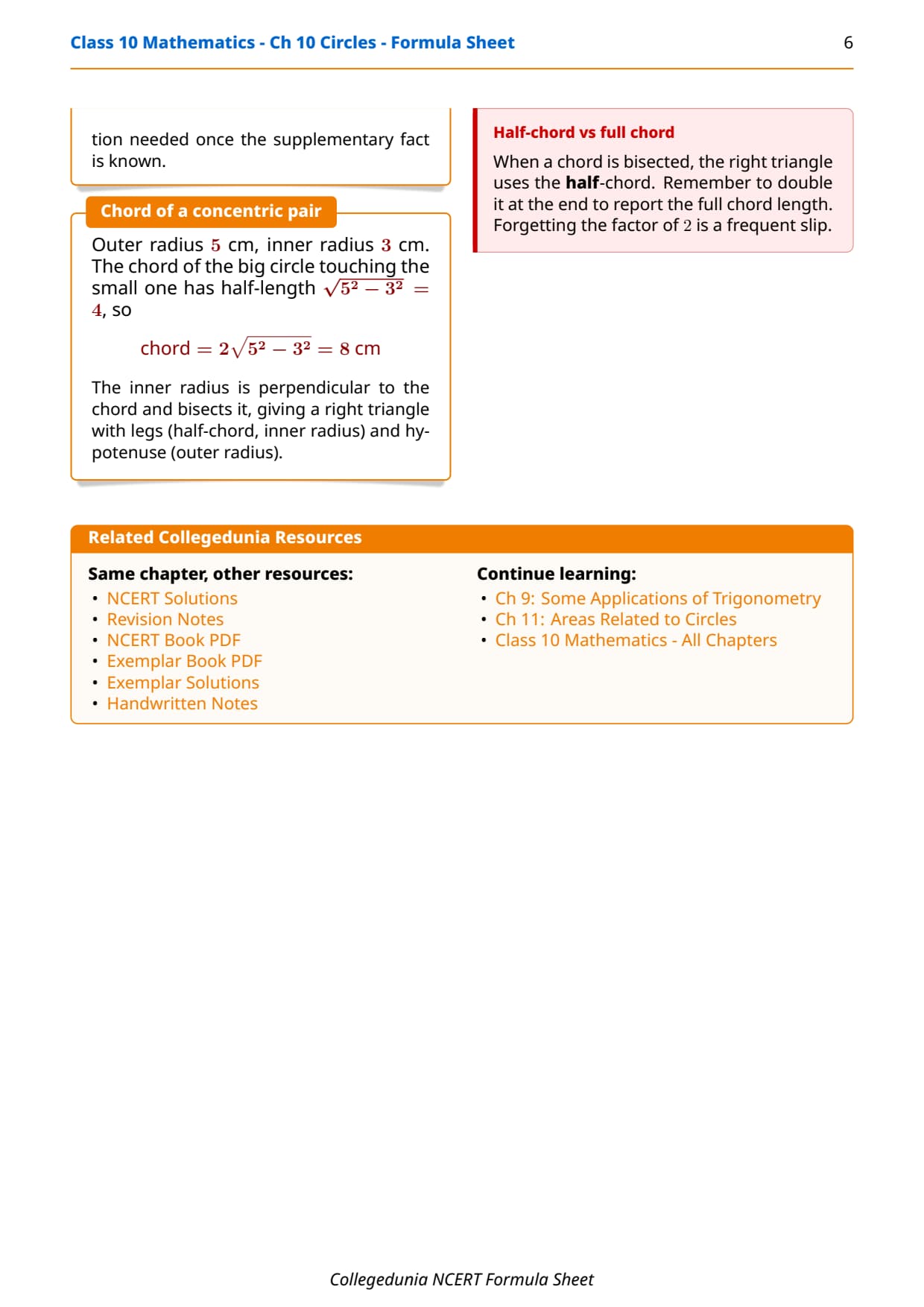
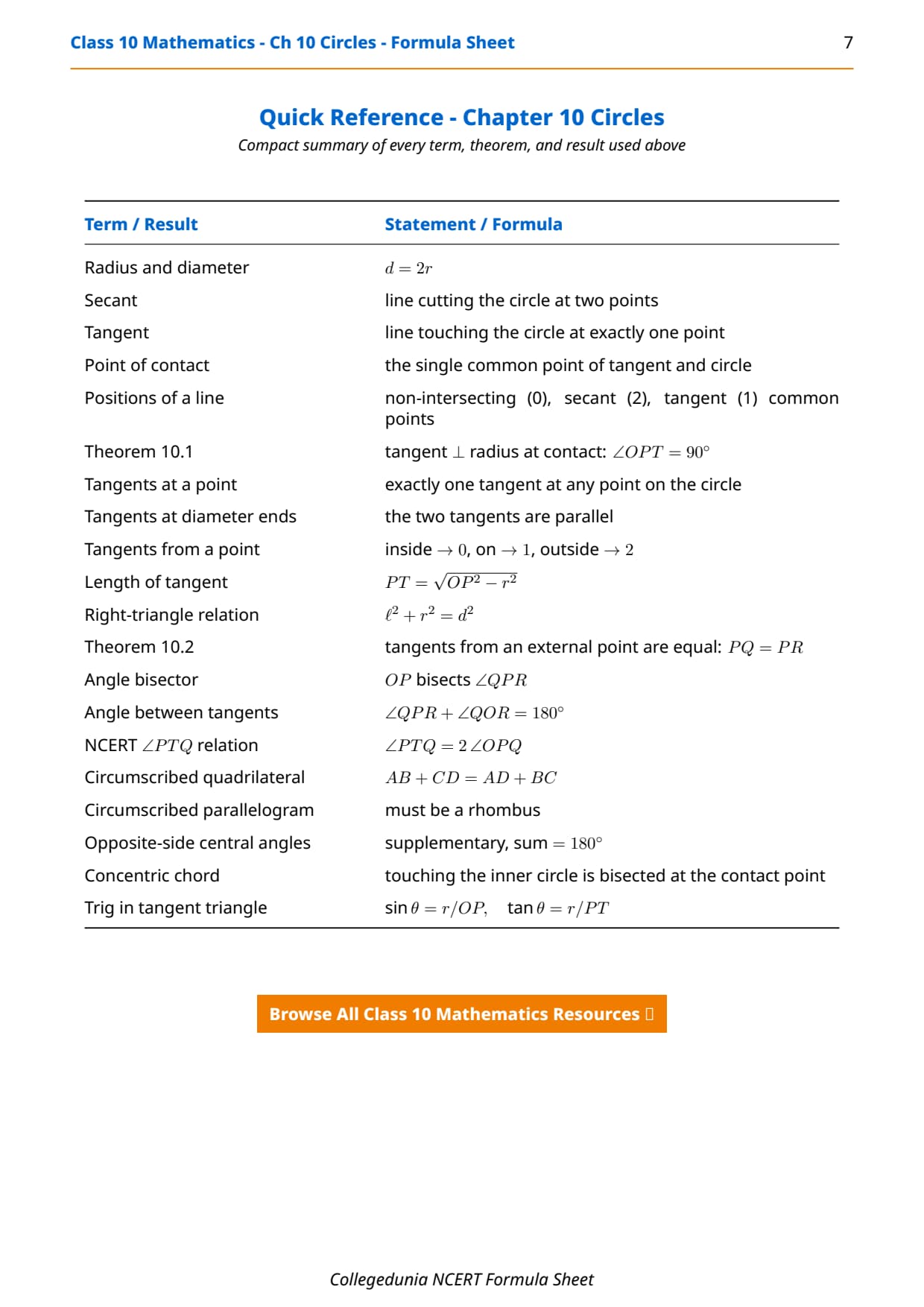
- Two governing theorems: tangent perpendicular to radius (Theorem 10.1) and equal tangents from an external point (Theorem 10.2).
- Core formula: length of tangent PT = √(OP² − r²), derived from Pythagoras on the right triangle at the point of contact.
- CBSE board applications: circumscribed quadrilateral (opposite sides equal), angle between tangents plus central angle equals 180°, and the concentric-circle chord bisection result.
Student Feedback: In a Collegedunia poll of 2,800 Class 10 students before the 2026 board exam, 94% of students said knowing the equal-tangents theorem (PQ = PR from an external point) was the single formula that unlocked the most board questions in Chapter 10, because it applies directly to circumscribed quadrilateral and triangle problems.
|
Table of Contents |
Watch Circles Class 10 Maths Explained
Source: Magnet Brains on YouTube
All Circles Formulas: Complete List
The table below lists every formula, theorem and result you need. It mirrors the single-page PDF. Two theorems do almost all the work: the right angle at the point of contact (Theorem 10.1) and the equal-tangents result (Theorem 10.2). Every board question uses one or both, plus Pythagoras or congruence.
| Concept | Formula / Result |
|---|---|
| Diameter and radius | d = 2r |
| Line vs circle | Non-intersecting (0 pts), secant (2 pts), tangent (1 pt) |
| Theorem 10.1: tangent ⊥ radius | ∠OPT = 90° (tangent at P perpendicular to radius OP) |
| Number of tangents from a point | Inside: 0; On: 1; Outside: 2. Tangents at diameter ends are parallel. |
| Length of tangent from external point | PT = √(OP² − r²), with PT² + r² = OP² |
| Theorem 10.2: equal tangents | PQ = PR; OP bisects ∠QPR |
| Angle between tangents + central angle | ∠QPR + ∠QOR = 180° (supplementary); ∠PTQ = 2∠OPQ |
| Circumscribed quadrilateral | AB + CD = AD + BC; a circumscribed parallelogram is a rhombus |
| Triangle incircle | BD = BF, CD = CE, AE = AF (equal tangent pairs per vertex) |
| Concentric circles chord | Chord of outer circle touching inner circle is bisected; half-chord = √(R² − r²) |
| Trig in tangent triangle | sin θ = r / OP, tan θ = r / PT |
The radius to the point of contact is perpendicular to the tangent (Theorem 10.1), giving the right triangle that powers every tangent-length calculation in Chapter 10.
Tangent Perpendicular to Radius (Theorem 10.1)
The first governing theorem says the tangent at any point of a circle is perpendicular to the radius at that point of contact: ∠OPT = 90°. This single right angle turns every tangent problem into a right-triangle problem where Pythagoras applies at once (PT² + r² = OP²). The NCERT proof: of all segments from centre O to the tangent line, the radius OP is the shortest, and the shortest distance from a point to a line is the perpendicular.
The practical step: whenever a tangent appears in a diagram, immediately draw the radius to the point of contact and mark the right angle. That one action turns the geometry into a right triangle. Forgetting it is the most common setup error in board answers.
Length of Tangent from an External Point
The most used formula is PT = √(OP² − r²). Radius r and tangent PT are the legs of a right triangle and OP is the hypotenuse, so Pythagoras gives PT at once.
| Given | Find | Formula | Example |
|---|---|---|---|
| Radius r, centre distance OP | Tangent length PT | PT = √(OP² − r²) | r = 5, OP = 13 → PT = √144 = 12 cm |
| Tangent PT, radius r | Centre distance OP | OP = √(PT² + r²) | PT = 8, r = 6 → OP = √100 = 10 cm |
| Angle θ, radius r | Tangent length PT | PT = r / tan θ | r = 3, θ = 30° → PT = 3√3 cm |
A useful check: the tangent length is always shorter than OP (PT < OP), since PT is a leg and OP the hypotenuse. If your answer gives PT > OP, there is an arithmetic error.
Equal Tangents from an External Point (Theorem 10.2)
The second governing theorem powers the polygon problems. The two tangents from any external point to a circle are equal: PQ = PR. NCERT proves it by RHS congruence: in right triangles OQP and ORP, OQ = OR (radii) and OP is the common hypotenuse, so they are congruent and PQ = PR by CPCT. Two bonus results follow: OP bisects ∠QPR, and ∠QPR + ∠QOR = 180°.
The key application is a circle inscribed in a polygon. Label the equal tangent segments from each vertex with the same letter. For a triangle, if tangents from A, B, C have lengths a, b, c, then AB = a + b, BC = b + c, CA = c + a. This equal-labelling trick solves every circumscribed polygon problem in the chapter.
Equal tangents from the same external point: PQ = PR. This one result drives all circumscribed polygon problems in NCERT Exercise 10.2.
Angle Between Two Tangents
When two tangents are drawn from an external point P, the angle between them (∠QPR) and the central angle (∠QOR) are supplementary: ∠QPR + ∠QOR = 180°. Proof: in quadrilateral OQPR the angles at Q and R are both 90°, so the other two sum to 180°. This is the fast formula for all "find the angle" MCQs.
So if the central angle is 130°, then ∠QPR = 180° − 130° = 50°. Students who memorise this solve such 2-mark questions in seconds. The bisector relation also helps: OP bisects ∠QPR, so ∠OPQ = ∠QPR / 2.
Circumscribed Quadrilateral & Triangle
These Exercise 10.2 results account for the highest-value board questions. They all follow from equal tangents (Theorem 10.2) by adding up equal segments.
| Shape | Result | How to derive it |
|---|---|---|
| Quadrilateral ABCD circumscribing a circle | AB + CD = AD + BC | Add the equal tangent pairs from each vertex; both side-sums equal the total of all four tangent lengths |
| Parallelogram circumscribing a circle | Must be a rhombus | AB = CD and AD = BC, so AB + CD = AD + BC gives AB = AD: all sides equal |
| Triangle incircle (touches BC, CA, AB at D, E, F) | BD = BF, CD = CE, AE = AF | Equal tangents from B, C, A |
| Opposite central angles (circumscribed quad) | ∠AOB + ∠COD = 180° | Four central angles sum to 360° and pair by congruence |
For the triangle incircle problem, let BD = BF = x, CD = CE = y, AE = AF = z. Then AB = x + z, BC = x + y, CA = y + z. Solve these three equations to find any unknown segment.
Concentric Circles: Chord Bisection Formula
For two concentric circles (same centre O, radii R and r with R > r), a chord of the outer circle that is a tangent to the inner circle is bisected at the point where it touches the inner circle.
| Given | Find | Formula | Worked example |
|---|---|---|---|
| Outer R, inner r | Full chord AB | AB = 2√(R² − r²) | R = 5, r = 3 → AB = 2×4 = 8 cm |
| Outer R, chord AB | Inner r | r = √(R² − (AB/2)²) | R = 10, AB = 16 → r = 6 cm |
Why it is bisected: OT (inner radius) is perpendicular to chord AB by Theorem 10.1, and a perpendicular from the centre bisects any chord. So AT = TB = √(R² − r²), and the full chord is twice this. The common mistake is forgetting to double the half-chord when the question asks for the full chord.
CBSE Board Exam Weightage
Circles is a high-value chapter that tests both theorem proofs and numerical work. The table below shows the question types that appear.
| Topic | Typical Question Type | Usual Marks |
|---|---|---|
| Length of tangent from external point | PT = √(OP² − r²) | 2 to 3 |
| Angle between tangents | Supplementary relation with central angle | 2 |
| Circumscribed quadrilateral / triangle incircle | Apply AB + CD = AD + BC, or equal tangent pairs | 3 to 4 |
| Concentric circles chord | Chord length touching the inner circle | 2 to 3 |
| Proof of Theorem 10.1 or 10.2 | Formal proof with congruence steps | 3 |
Chapter 10 on its own usually accounts for a 3-mark or 4-mark question. The circumscribed quadrilateral and the tangent-length calculation are the two most predictable high-value items.
Common Mistakes to Avoid
Mistake 1: Applying equal tangents (PQ = PR) to tangents from different external points. The result holds only for two tangents from the same point.
Mistake 2: Forgetting to double the half-chord in concentric-circle problems. Pythagoras gives the half-chord; multiply by 2 for the full chord AB.
Mistake 3: Writing ∠QPR + ∠QOR = 90°. The angle between tangents and the central angle sum to 180°, not 90°.
Mistake 4: Not marking ∠OPT = 90° first. Without the right angle the Pythagoras step gets skipped.
Each slip costs 1 to 2 marks in the board exam.
More Class 10 Circles Resources
Use this formula sheet alongside the other Chapter 10 Circles resources below. Each covers a different aspect of the chapter, so together they give complete board preparation.
| Resource | Best Used For |
|---|---|
| Circles NCERT Solutions | Step-by-step answers to all textbook questions |
| Circles Notes | Full chapter explanation with solved examples |
| Circles Handwritten Notes | Quick visual revision in a notebook style |
| Circles NCERT Book PDF | The official textbook chapter to read |
| Circles NCERT Exemplar Solutions | Harder practice questions with solutions |
| Circles NCERT Exemplar Book PDF | The official Exemplar problems to attempt |
All Class 10 Maths Formula Sheets
| Chapter | Formula Sheet |
|---|---|
| Chapter 1 | Real Numbers Formula Sheet |
| Chapter 2 | Polynomials Formula Sheet |
| Chapter 3 | Pair of Linear Equations in Two Variables Formula Sheet |
| Chapter 4 | Quadratic Equations Formula Sheet |
| Chapter 5 | Arithmetic Progressions Formula Sheet |
| Chapter 6 | Triangles Formula Sheet |
| Chapter 7 | Coordinate Geometry Formula Sheet |
| Chapter 8 | Introduction to Trigonometry Formula Sheet |
| Chapter 9 | Some Applications of Trigonometry Formula Sheet |
| Chapter 10 | Circles Formula Sheet (this page) |
| Chapter 11 | Areas Related to Circles Formula Sheet |
| Chapter 12 | Surface Areas and Volumes Formula Sheet |
| Chapter 13 | Statistics Formula Sheet |
| Chapter 14 | Probability Formula Sheet |
Class 10 Maths Chapter 10 Circles Formula Sheet FAQs
Ques. What formulas are in the Class 10 Chapter 10 Circles formula sheet?
Ans. The sheet covers the diameter-radius relation (d = 2r), definitions of secant and tangent, the three-cases rule for a line and circle, Theorem 10.1 (tangent perpendicular to radius, ∠OPT = 90°), the tangent-length formula PT = √(OP² − r²), the parallel-tangents result at diameter ends, the three-cases rule for tangents from a point, Theorem 10.2 (equal tangents PQ = PR), the supplementary angle formula (∠QPR + ∠QOR = 180°), the NCERT angle result (∠PTQ = 2∠OPQ), the circumscribed quadrilateral rule (AB + CD = AD + BC), the rhombus result for circumscribed parallelograms, the triangle incircle equal-segment pairs, and the concentric-circle chord bisection formula (AB = 2√(R² − r²)).
Ques. What is the formula for the length of a tangent from an external point?
Ans. The length of the tangent PT from an external point P to a circle with centre O and radius r is PT = √(OP² − r²). This follows from Theorem 10.1: the radius OT is perpendicular to the tangent PT at the contact point T, forming a right triangle with OT = r (leg), PT (leg) and OP (hypotenuse). Pythagoras gives PT² + r² = OP², so PT = √(OP² − r²). For example, if r = 5 cm and OP = 13 cm, then PT = √(169 − 25) = √144 = 12 cm.
Ques. What does the equal tangents theorem say?
Ans. Theorem 10.2 (NCERT Class 10 Chapter 10) states that the two tangents drawn from an external point to a circle are equal in length. If P is the external point and Q, R are the two points of contact, then PQ = PR. The proof uses RHS congruence: in right triangles OQP and ORP, the hypotenuse OP is common and OQ = OR (both radii), so the triangles are congruent (RHS) and PQ = PR follows from CPCT. Two bonus results from the same congruence: OP bisects the angle ∠QPR, and ∠QPR + ∠QOR = 180°.
Ques. What is the formula for the angle between two tangents from an external point?
Ans. The angle between two tangents from external point P (∠QPR) and the angle at the centre (∠QOR, where Q and R are contact points) are supplementary: ∠QPR + ∠QOR = 180°. This is because in quadrilateral OQPR, the angles at Q and R are both 90° (tangent perpendicular to radius), so the four angles sum to 360°, giving ∠QPR + ∠QOR = 360° − 90° − 90° = 180°. Practical use: if the central angle is 120°, the angle between the tangents is 60°. If the angle between the tangents is 70°, the central angle is 110°.
Ques. What is the opposite-sides rule for a circumscribed quadrilateral?
Ans. If a quadrilateral ABCD has all four of its sides touching a circle (that is, the circle is inscribed in the quadrilateral), then the sum of one pair of opposite sides equals the sum of the other pair: AB + CD = AD + BC. The proof labels the equal tangent segments from each vertex: from A the tangents have length p, from B they have length q, from C they have length r, from D they have length s. Then AB = p + q, BC = q + r, CD = r + s, DA = s + p, so AB + CD = p + q + r + s = AD + BC. A special case: if the quadrilateral is also a parallelogram (AB = CD, AD = BC), then 2AB = 2AD, forcing AB = AD, so all sides are equal and the shape must be a rhombus.
Ques. Where can I download the Class 10 Maths Chapter 10 Circles formula sheet PDF?
Ans. You can download the Class 10 Maths Chapter 10 Circles formula sheet PDF using the download card near the top of this page. It contains all key terms, Theorem 10.1 and Theorem 10.2, the tangent-length formula, the angle formulas, the circumscribed polygon results, and the concentric-circle chord formula, all on one page designed for quick CBSE board exam revision under the 2026-27 syllabus.



Comments