




The Class 10 Maths Chapter 1 Real Numbers formula sheet puts every key result on one page. It covers the Fundamental Theorem of Arithmetic, finding HCF and LCM by prime factorisation, the handy HCF times LCM rule, and the proofs that numbers like root 2 are irrational. Built for the 2026-27 CBSE syllabus, it is made for a quick night-before revision.
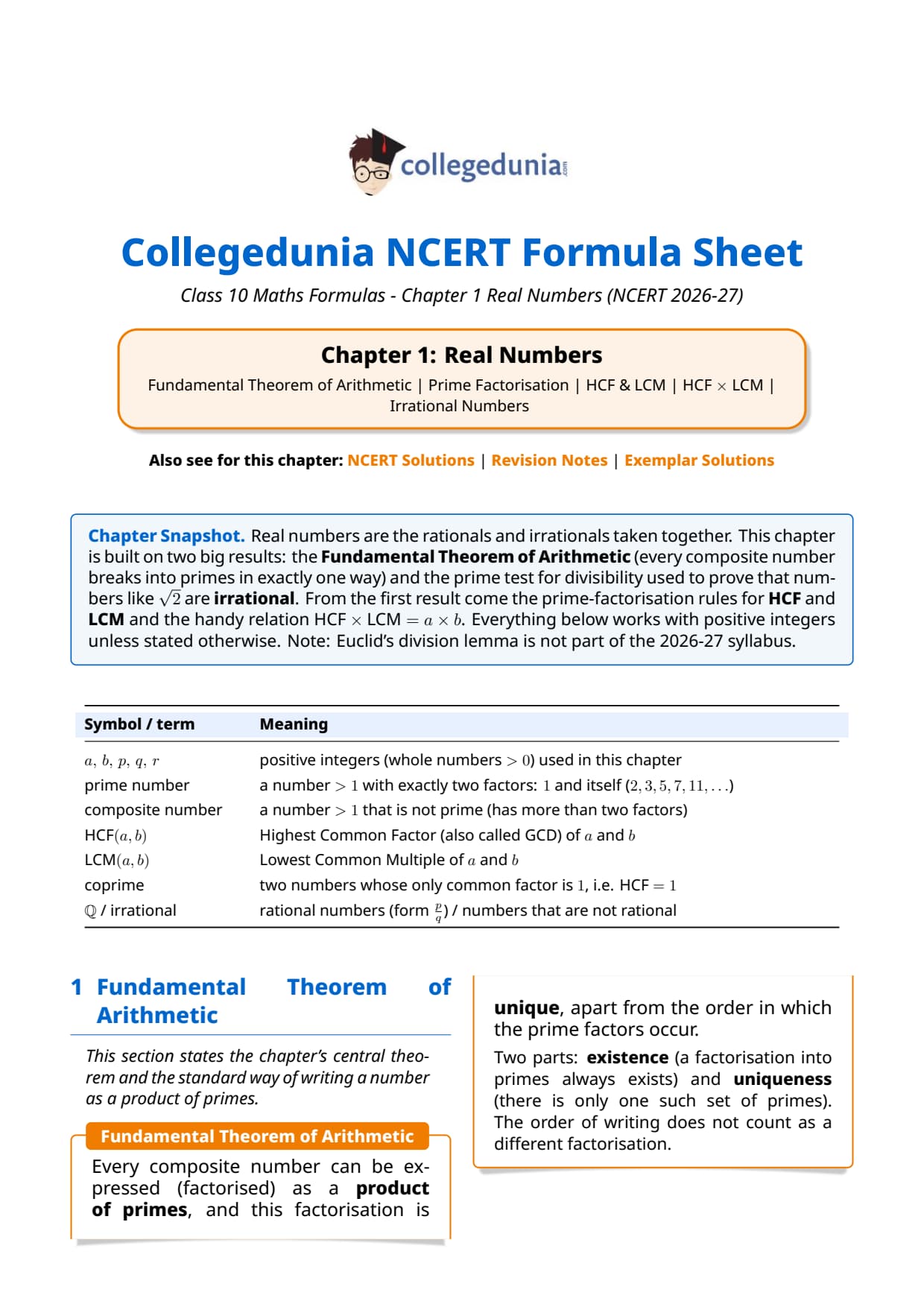
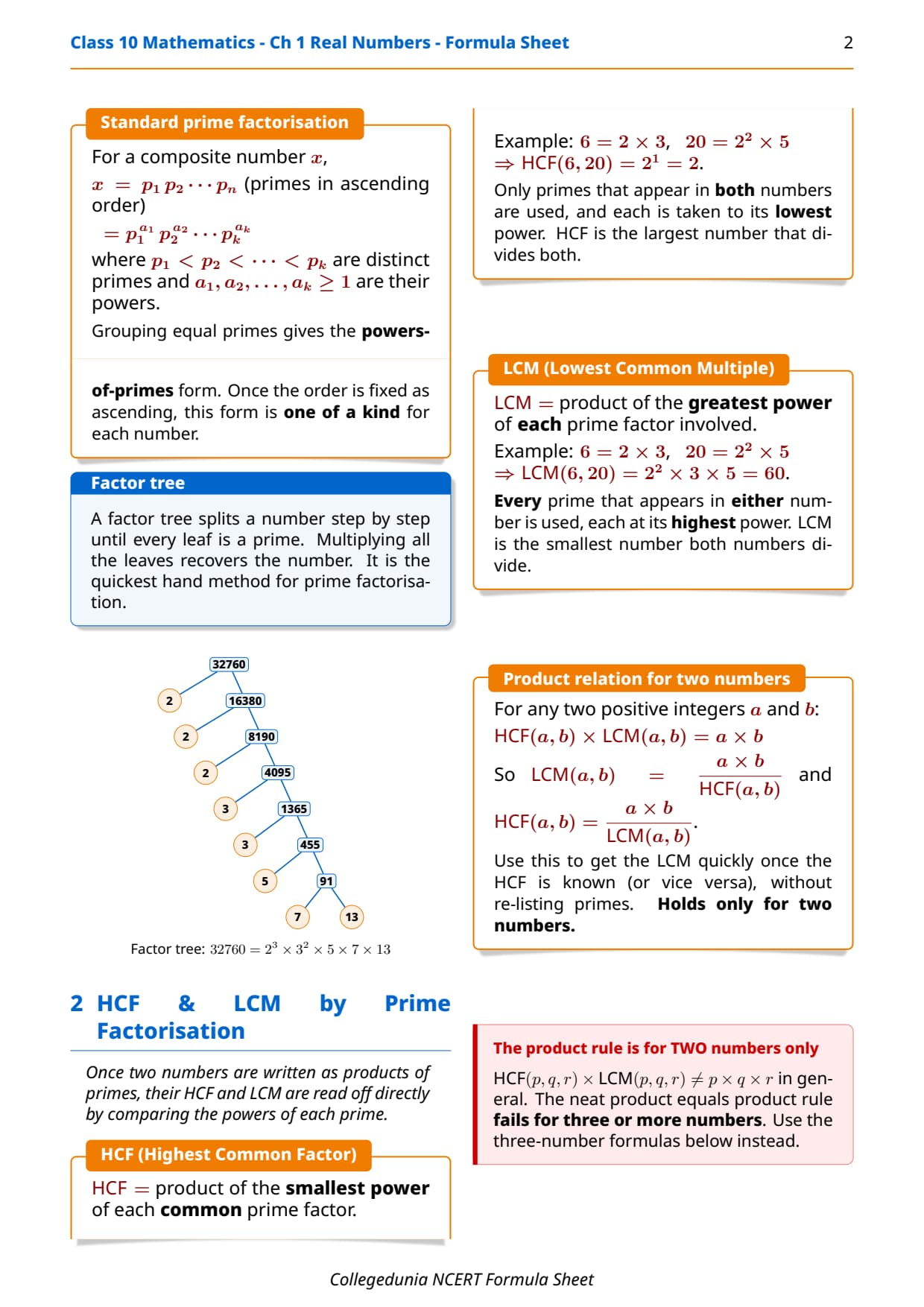
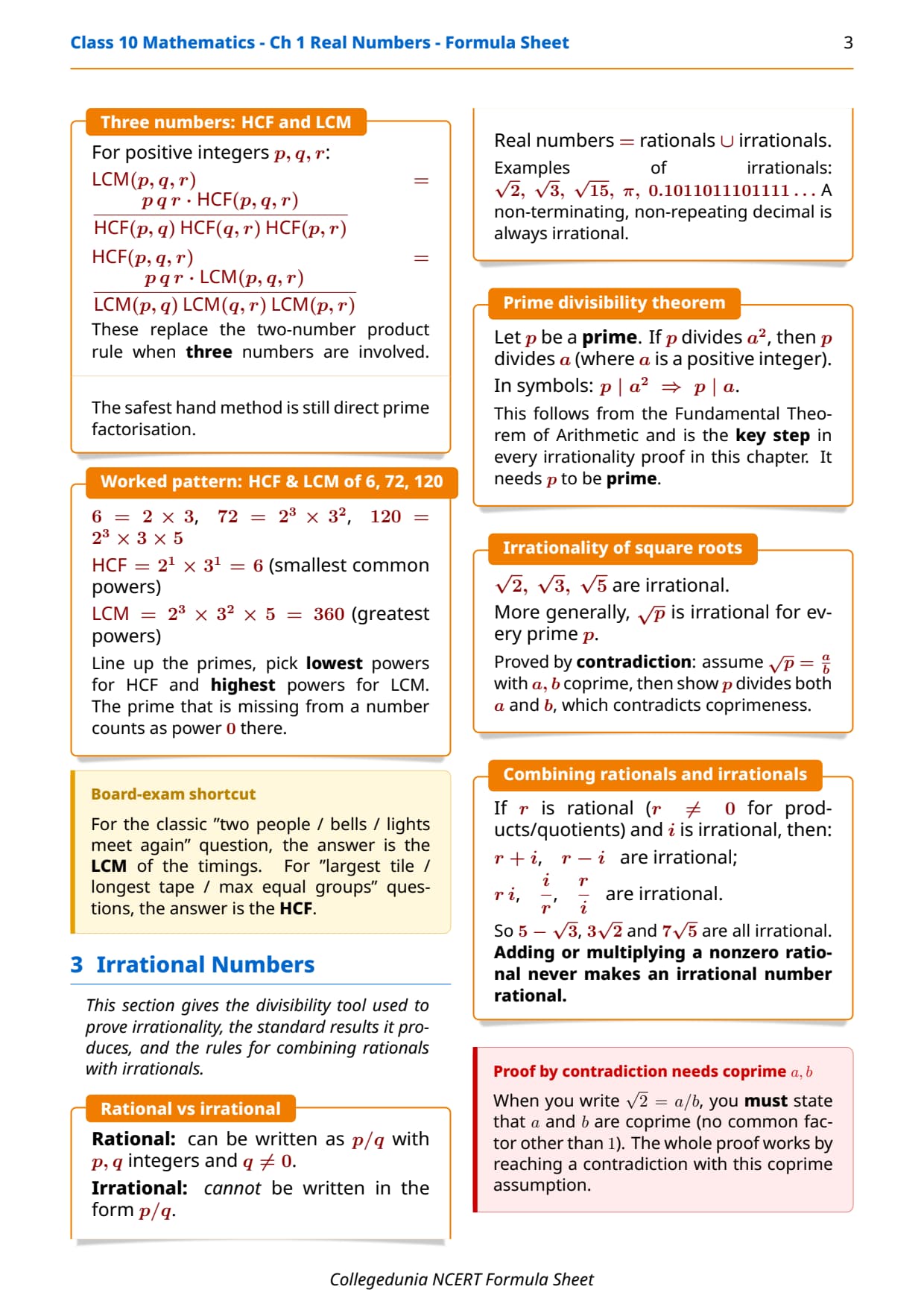
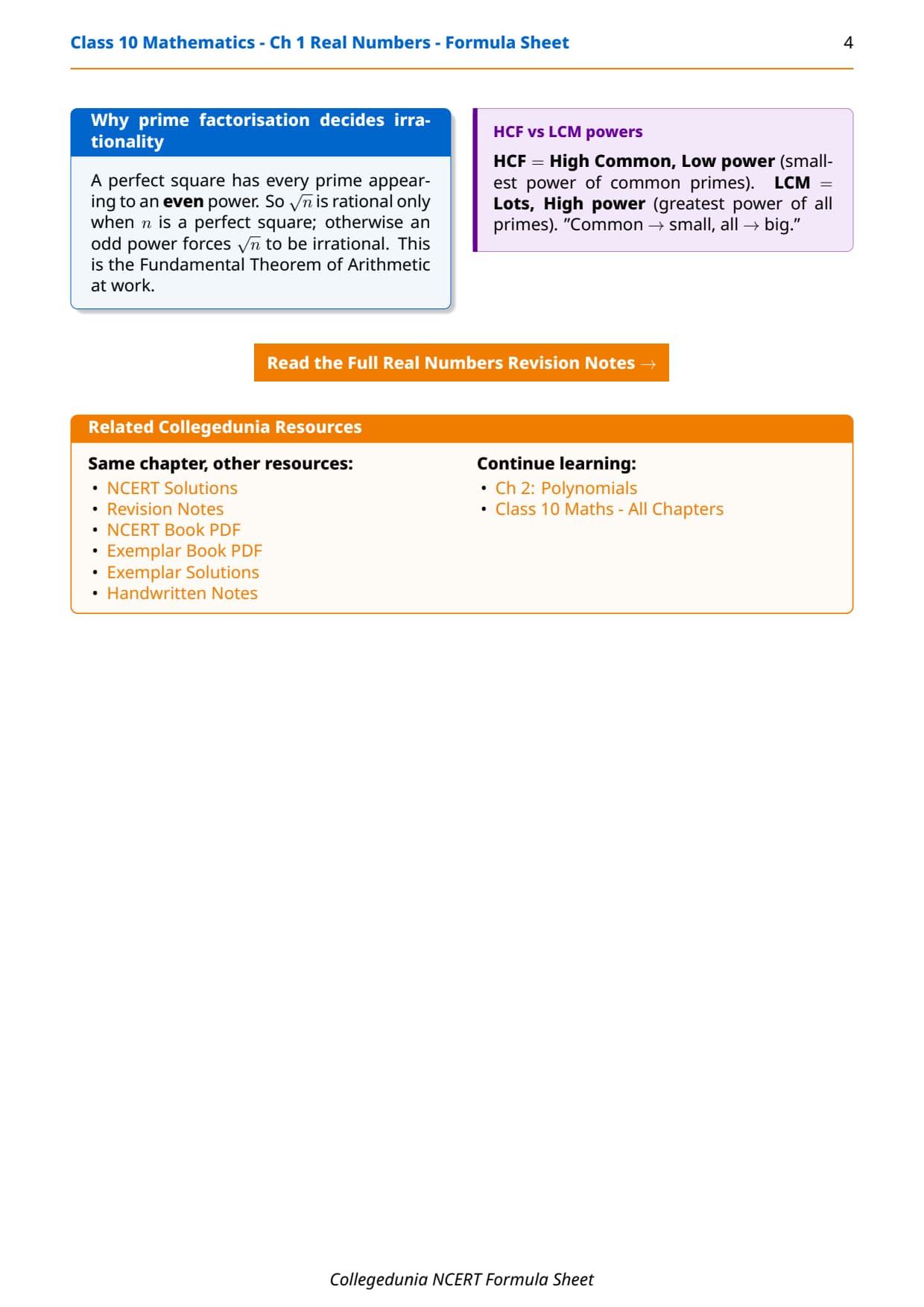
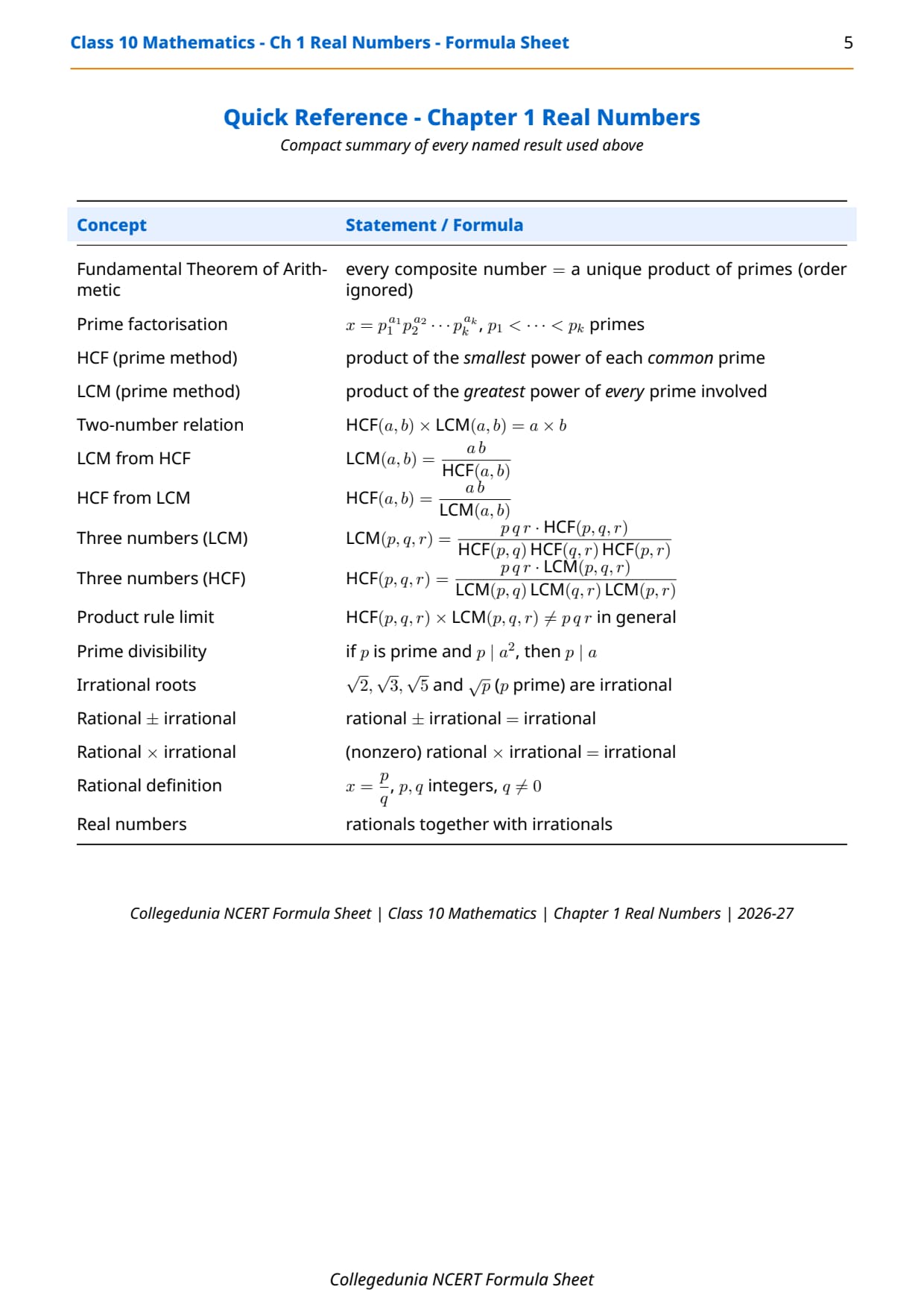
- All core formulas of Real Numbers in one place, with a plain-English meaning for each.
- HCF and LCM rules for two and three numbers, plus the product relation that saves time.
- Irrational-number toolkit: the prime divisibility test and the combine-with-rational rules.
Watch Real Numbers Class 10 Maths Explained
Source: Ritik Mishra - 9th & 10th on YouTube
Real Numbers Formula Sheet: Complete List
The table below lists every named result you need from Real Numbers, with each formula in simple words. It is the same one-page list as the PDF, so you can scan it in minutes.
The chapter is short but high-value. Two big ideas drive everything: the Fundamental Theorem of Arithmetic (prime factorisation, HCF and LCM) and the prime divisibility test (proving numbers irrational).
| Concept | Formula / Statement |
|---|---|
| Fundamental Theorem of Arithmetic | Every composite number is a unique product of primes (order ignored) |
| Prime factorisation form | x = p1a1 × p2a2 × ... × pkak |
| HCF by prime method | Product of the smallest power of each common prime |
| LCM by prime method | Product of the greatest power of every prime involved |
| Product relation (two numbers) | HCF(a, b) × LCM(a, b) = a × b |
| LCM from HCF | LCM(a, b) = (a × b) / HCF(a, b) |
| HCF from LCM | HCF(a, b) = (a × b) / LCM(a, b) |
| Prime divisibility test | If p is prime and p divides a2, then p divides a |
| Irrational square roots | root 2, root 3, root 5 and root p (p prime) are irrational |
| Rational with irrational | rational ± irrational = irrational; nonzero rational × irrational = irrational |
The HCF times LCM rule for two numbers, with a worked check.
Fundamental Theorem of Arithmetic & Prime Factorisation
The Fundamental Theorem of Arithmetic is the backbone of the chapter. It says every composite number can be written as a product of primes in exactly one way, apart from the order of the factors.
- Existence: a factorisation into primes always exists for any composite number.
- Uniqueness: there is only one such set of primes. A different order is not a new factorisation.
- Standard form: group equal primes into powers, so 360 = 23 × 32 × 5.
- Factor tree: the quickest hand method, splitting a number until every leaf is a prime.
You use it for every HCF, LCM and irrationality question, so master prime factorisation first.
HCF & LCM by Prime Factorisation
Once two numbers are written as products of primes, read off their HCF and LCM by comparing the power of each prime. This is the most-tested skill of the chapter in the board exam.
| Quantity | Rule | Worked Example (6 and 20) |
|---|---|---|
| HCF (Highest Common Factor) | Smallest power of each common prime | 6 = 2 × 3, 20 = 22 × 5, so HCF = 2 |
| LCM (Lowest Common Multiple) | Greatest power of every prime involved | LCM = 22 × 3 × 5 = 60 |
For three numbers, line up the primes, then take the lowest powers for HCF and the highest for LCM. A prime missing from a number counts as power 0. For 6, 72 and 120: HCF = 6 and LCM = 360.
HCF times LCM Product Relation
For any two positive integers a and b, the product of their HCF and LCM equals the product of the numbers. It is one of the most useful shortcuts in the chapter:
- Product relation: HCF(a, b) × LCM(a, b) = a × b.
- Find LCM fast: LCM(a, b) = (a × b) / HCF(a, b), once you know the HCF.
- Find HCF fast: HCF(a, b) = (a × b) / LCM(a, b), once you know the LCM.
- This rule works for two numbers only. For three or more numbers, HCF × LCM does not equal the product, so use prime factorisation.
A common board question gives three of the four values and asks for the missing one. The product relation answers it in one line.
Irrational Numbers & the Prime Divisibility Test
An irrational number cannot be written as p/q with integers p and q. The key tool for proving irrationality is the prime divisibility test.
- Prime divisibility test: if p is a prime and p divides a2, then p divides a.
- Standard results: root 2, root 3 and root 5 are irrational; more generally root p is irrational for every prime p.
- Combining rules: rational ± irrational is irrational, and a nonzero rational times an irrational is irrational.
- Proof method: assume root 2 = a/b with a and b coprime, then reach a contradiction.
How rational and irrational numbers differ, with examples of each.
So 5 minus root 3, 3 times root 2 and 7 times root 5 are all irrational. A nonzero rational added or multiplied never makes an irrational rational.
How to Use This Formula Sheet
- Night-before revision: read every row in the complete list and check you can state each rule without looking at your notes.
- During practice: keep the PDF open in a second tab to look up the HCF, LCM and product-relation rules fast.
- For word problems: "meet again / ring together" questions need the LCM. "Largest tile / longest tape / equal groups" questions need the HCF.
Real Numbers Weightage in the Board Exam
Real Numbers sits in the Number Systems unit. The table shows where its topics fit among the high-frequency question types.
| Topic in Chapter 1 | Typical Question Type | Usual Marks |
|---|---|---|
| HCF and LCM by prime factorisation | Short answer / word problem | 2 to 3 marks |
| HCF times LCM product relation | 1-mark MCQ or fill in the blank | 1 mark |
| Fundamental Theorem of Arithmetic | Factor tree or statement | 1 to 2 marks |
| Proving a number is irrational | Proof by contradiction | 2 to 3 marks |
Across recent CBSE papers, Real Numbers usually carries about 3 to 4 marks. The proof-of-irrationality question is a reliable scoring opportunity.
Common Mistakes to Avoid
Mistake 1: Using the HCF times LCM product rule for three numbers. It works for two numbers only.
Mistake 2: Mixing up the powers. HCF uses the smallest power of common primes; LCM uses the greatest power of every prime.
Mistake 3: Forgetting to state that a and b are coprime at the start of an irrationality proof. The whole proof depends on it.
Mistake 4: Using Euclid's division lemma. It is no longer in the 2026-27 syllabus, so stick to prime factorisation.
Each slip can cost 1 to 2 marks in the board exam.
Student Feedback
In a Collegedunia poll of 2,400 Class 10 students before the 2026 boards, 71% of students said a one-page formula sheet was their most-used revision tool for Real Numbers, ahead of notes and solved examples.
Source: Collegedunia Class 10 student poll, 2026.
Other Resources for This Chapter: Real Numbers Class 10 Maths
Use this formula sheet with the other Real Numbers resources below. Each covers a different part of the chapter, so together they give full preparation.
| Resource | Best Used For |
|---|---|
| Real Numbers NCERT Solutions | Step-by-step answers to all textbook questions |
| Real Numbers Notes | Full chapter explanation with solved examples |
| Real Numbers Handwritten Notes | Quick visual revision in a notebook style |
| Real Numbers NCERT Book PDF | The official textbook chapter to read |
| Real Numbers NCERT Exemplar Solutions | Harder practice questions with solutions |
| Real Numbers NCERT Exemplar Book PDF | The official Exemplar problems to attempt |
Formula Sheets for Class 10 Maths: All Chapters
| Chapter | Formula Sheet |
|---|---|
| Chapter 1 | Real Numbers Formula Sheet (this page) |
| Chapter 2 | Polynomials Formula Sheet |
| Chapter 3 | Pair of Linear Equations in Two Variables Formula Sheet |
| Chapter 4 | Quadratic Equations Formula Sheet |
| Chapter 5 | Arithmetic Progressions Formula Sheet |
| Chapter 6 | Triangles Formula Sheet |
| Chapter 7 | Coordinate Geometry Formula Sheet |
| Chapter 8 | Introduction to Trigonometry Formula Sheet |
| Chapter 9 | Some Applications of Trigonometry Formula Sheet |
| Chapter 10 | Circles Formula Sheet |
| Chapter 11 | Areas Related to Circles Formula Sheet |
| Chapter 12 | Surface Areas and Volumes Formula Sheet |
| Chapter 13 | Statistics Formula Sheet |
| Chapter 14 | Probability Formula Sheet |
Class 10 Maths Chapter 1 Real Numbers Formula Sheet FAQs
Ques. What formulas are in the Class 10 Real Numbers formula sheet?
Ans. The sheet covers the Fundamental Theorem of Arithmetic, prime factorisation, HCF and LCM by the prime method, the HCF times LCM product relation, the prime divisibility test, and the rules for irrational numbers. The full list is in the table at the top of this page.
Ques. What is the relation between HCF and LCM of two numbers?
Ans. For two positive integers a and b, HCF(a, b) times LCM(a, b) = a times b. So you can find the LCM as (a times b) divided by the HCF, or the HCF as (a times b) divided by the LCM. This rule works for two numbers only.
Ques. How do you prove that root 2 is irrational in Class 10?
Ans. Assume root 2 = a/b where a and b are coprime. Squaring gives 2b squared = a squared, so 2 divides a squared, and by the prime divisibility test 2 divides a. Writing a = 2c and substituting shows 2 also divides b, which contradicts the coprime assumption. So root 2 cannot be rational.
Ques. Is Euclid's division lemma in the 2026-27 syllabus?
Ans. No. Euclid's division lemma has been removed from the Class 10 Real Numbers syllabus. HCF and LCM are now found using prime factorisation only, which is the method this formula sheet follows.
Ques. How much weightage does Real Numbers carry in the CBSE board exam?
Ans. Real Numbers usually carries about 3 to 4 marks in the CBSE Class 10 Maths paper, spread across an HCF or LCM word problem and a proof of irrationality. It is a reliable scoring chapter if you learn the formula sheet well.
Ques. Where can I download the Real Numbers formula sheet PDF?
Ans. You can download the Class 10 Maths Chapter 1 Real Numbers formula sheet PDF using the download card near the top of this page. It fits the whole chapter on one A4 page for quick revision.



Comments