Physics Mentor, SRM Institute | Updated on - Jul 21, 2026
Class 12 Physics Chapter 5 Magnetism and Matter has 25 Exemplar problems. Each one gets a clear step-by-step Solution and an Expert Solution. This page hosts the full solved PDF, which you can read or download for free below.
Here is what this chapter is worth across the main exams:
CBSE Weightage: 2 to 4 marks (one short answer or one MCQ-style item)
JEE Main Weightage: 1 to 2% (around 1 question across most shifts)
NEET Weightage: 1 question per year
Both downloads on this page are free and updated for the 2026-27 NCERT syllabus.
These solutions are made by subject experts, mapped to the 2026-27 NCERT, and checked against the last five years of CBSE Board, JEE Main and NEET papers.
The 25 problems below cover earth's magnetism, dia/para/ferromagnetism, susceptibility, Gauss's law for magnetism, and Ampere's law on H.
Why Solving the Magnetism and Matter NCERT Exemplar Sharpens Your JEE and NEET Edge
Textbook exercises test recall of definitions (declination, dip, susceptibility) and one-step substitution. The Exemplar chains two or three ideas per problem: Gauss's law plus Ampere's law on H, Curie-law rescaling, or a quantitative comparison of χ values. Most JEE Main and NEET questions on this chapter borrow their scaffold from the Exemplar's MCQ-II and SA sets.
Three Exemplar-style traps recur in entrance papers:
Domain logic in permanent magnets: 5.3 forces "partially aligned" over "perfectly aligned", a phrasing trap JEE Main reused in 2024.
B vs H continuity across material surfaces: 5.6 sets up the reasoning NEET 2023 tested in assertion-reason format.
Curie-law rescaling: 5.5 trains the M ∝ B / T ratio that NEET and JEE reuse without warning.
Magnetism and Matter NCERT Exemplar Video Solutions
How will the NCERT Exemplar Class 12 Physics Solutions on Collegedunia Help You?
Each problem carries a full Solution plus an Expert's Solution naming every concept invoked.
Every Question Type solved End-to-End: MCQ-I, MCQ-II, VSA, SA and LA, each with reasoning written out, not just the final option.
Concept Stack Named: Each step lists the law invoked, whether Curie's law, Gauss's law for magnetism, or Ampere's law for H.
JEE and NEET Bridge: Items are tagged with the JEE or NEET year that reused their scaffold, so revision aims at the marks.
2026-27 Aligned: The Exemplar publication itself has not been re-rationalised every solution flags whether the underlying topic is still in the current 2026-27 syllabus.
Best Way to Use the Magnetism and Matter Exemplar for JEE and NEET Prep
Solving all 25 problems back-to-back is the wrong move for a 3-mark chapter. A time-boxed pass keyed to question type and target exam works better.
Question Type
Problems
Time per Problem
Best Use For
MCQ-I (single-correct)
5.1 to 5.5
2 to 3 min
JEE Main, NEET, CBSE MCQ
MCQ-II (multiple-correct)
5.6 to 5.10
4 to 5 min
JEE Advanced, assertion-reason
VSA (1 to 2 marks)
5.11 to 5.15
3 to 4 min
CBSE Board short answers
SA (3 marks)
5.16 to 5.20
6 to 8 min
CBSE Board, NEET reasoning
LA (5 marks)
5.21 to 5.25
10 to 12 min
CBSE long-answer, JEE Advanced
Quick Tip: JEE aspirants attempt MCQ-I and MCQ-II first NEET aspirants prioritise MCQ-I and VSA. The LA set is mostly CBSE-flavoured and can be skipped on a JEE-only first pass.
Magnetism and Matter Class 12th: Difficulty Step-Up from NCERT Textbook to Exemplar
The textbook stays one step from the solved examples. The Exemplar moves the setup two steps further, usually by adding a constraint or inverting the question.
Concept
NCERT Textbook Style
Exemplar Twist
Curie's law
Given B, T, find M
Given two (B, T) sets and one M, find the second M (5.5)
Domain alignment
State qualitative behaviour
Distinguish "partially" vs "perfectly" aligned (5.3)
Susceptibility
Quote orders of magnitude
Build χ by dimensional analysis from atomic parameters (5.22)
Gauss's law for B
State the law
Verify the law for a point dipole by surface integration (5.16)
Bar-magnet oscillation
Period of single bar magnet
Period after cutting the magnet perpendicular to length (5.19)
Magnetism and Matter Exemplar MCQ-II Solved: Multiple-Correct Walk-Through
MCQ-II is the most-failed type. Students lock in one correct option and miss the second. The fix is simple: test every option on its own, then mark all that hold. Take Exemplar 5.7 on the origin of magnetism. Atomic currents and electron spin are both true sources, so options (a) and (d) are both correct.
Watch Out: Students often pick (b) because Pauli exclusion sounds advanced. The Exemplar penalises this only intrinsic sources of magnetic moment qualify as primary origins.
Exemplar-Specific Common Mistakes in Magnetism and Matter
These slip-ups recur across MCQ-II and SA submissions:
Confusing H continuity with B continuity across a magnetic surface. In NEET 2023 assertion-reason, this single confusion cost candidates 4 marks.
All NCERT Exemplar Questions for Magnetism and Matter with Step-by-Step Solutions
Every question of the NCERT Exemplar set for Class 12 Physics Chapter 5 Magnetism and Matter is listed below with its full Solution and Expert Solution hidden inside collapsible tabs. Click Check Solution to reveal the step-by-step working; click Expert Solution for the expanded explanation.
Questions
Q 5.1
A toroid of n turns, mean radius R and cross-sectional radius a carries current I. It is placed on a horizontal table taken as x-y plane. Its magnetic moment m⃗
(a) is non-zero and points in the z-direction by symmetry.
(b) points along the axis of the toroid (m⃗ = mϕ̂).
(c) is zero, otherwise there would be a field falling as 1/r3 at large distances outside the toroid.
(d) is pointing radially outwards.
Correct option: (c) The net magnetic moment of a toroid is zero.
Concept used. The magnetic moment of a current
loop is m⃗ = IA⃗, directed along the area vector A⃗
by the right-hand rule. For a coil with n turns, contributions
from each turn add as vectors. At large r the field of any
localised current distribution can be expanded in multipoles: the
leading 1/r3 term is the magnetic dipole contribution, which
exists only if the total magnetic moment is non-zero. A toroid is a
closed solenoid bent into a doughnut, so the field is confined
inside the core and vanishes outside.
Consider any cross-sectional turn of the toroid. Its area
vector points tangentially (along ϕ̂) and rotates
as we move around the toroid. When we add up the contributions
of all n turns around the full 2π azimuth, the area
vectors form a closed ring whose vector sum is zero:
m⃗total = k=1nIA⃗k = IAk=1nϕ̂k = 0⃗.
As a physical cross-check, recall that the field of an ideal
toroid is confined entirely to the interior with B = 0
outside. If a non-zero m⃗ existed, the dipole field
B ∼ 0m / 4π r3 would be measurable outside.
Since it is not, m⃗ = 0.
Eliminate the other options. (a) would require a net z
component, but symmetry forces cancellation. (b) is wrong
because ϕ̂ varies with position - no single
direction. (d) is wrong because magnetic moment is a vector
attached to the source, not a radial field.
Option (c): m⃗ = 0 for a toroid.
PS
Pranav Sharma
Ph.D Physics, IISc Bangalore
Verified Expert
Picture-first. Imagine cutting the toroid into n tiny
flat loops arranged in a circle. Each loop's moment vector is a
short arrow along the local tangent to the central circle.
Symmetry argument. The n moment vectors m⃗k = IAk
lie head-to-tail around the central circle. Their vector sum
closes back on itself:
k=1nk → ∮ ϕ dϕ/(2π/n) = 0
for large n, so total m⃗ = 0.
Ampere's-law argument.∮ B⃗· dl⃗ = 0 Ienc
gives Binside = 0nI2π r inside
the toroidal core; for any Amperian loop drawn entirely
outside the windings, Ienc = 0, and by symmetry
Boutside = 0 everywhere.
Multipole-expansion argument. A general localised
current distribution has the far-field expansion
B⃗ ∼ 04πmr3 +
04πQr4 + - monopole term
is identically zero (no monopoles), dipole term needs
m⃗≠ 0. Since Boutside = 0 to all orders,
every multipole coefficient must vanish, in particular
m⃗toroid = 0.
Energy cross-check. For an external uniform field
B⃗0, the orientation energy of a magnetic moment is
U = -m⃗·B⃗0. Place a toroid in B⃗0
and rotate it - no preferred orientation is observed, hence
m⃗ = 0. This is also why a toroid is not deflected
in a uniform field.
Alternative method (energy). The total flux linkage of the
toroid with its own current is finite (self-inductance), but its
coupling to an external uniform field is
ext = m⃗·B⃗0 = 0, again proving
m⃗ = 0.
m⃗toroid = 0; option (c).
Q 5.2
The magnetic field of Earth can be modelled by that of a point dipole placed at the centre of the Earth. The dipole axis makes an angle of 11.3∘ with the axis of Earth. At Mumbai, declination is nearly zero. Then,
(a) the declination varies between 11.3∘ W to 11.3∘ E.
(b) the least declination is 0∘.
(c) the plane defined by dipole axis and Earth axis passes through Greenwich.
(d) declination averaged over Earth must be always negative.
Correct option: (a) Declination varies between 11.3∘ W and 11.3∘ E.
Concept used.Magnetic declinationD is the
angle between magnetic north (the horizontal component of B⃗
at a location) and geographic north. Since Earth's magnetic dipole
axis is tilted by α = 11.3∘ from the geographic
(spin) axis, the maximum possible angle between the horizontal
projections of the two axes is α.
Place the dipole axis and the geographic axis in the same
plane Π. As we move around the Earth, the angular
separation between the two axes' horizontal projections at
any location ranges from 0 (on Π) up to the full tilt
of 11.3∘ (in the perpendicular plane).
The sense flips: when our location is east of Π, magnetic
north points slightly west of geographic north, giving
D = 11.3∘ W. When we are west of Π, the opposite,
giving D = 11.3∘ E. Mumbai sits near Π so its
D ≈ 0.
Therefore globally D oscillates between -11.3∘
(i.e. 11.3∘ E) and +11.3∘ (11.3∘ W).
Options (b), (c), (d) make claims (about minimum, Greenwich,
sign average) that the simple tilt model does not support.
Option (a): -11.3∘ E ≤ D ≤ 11.3∘ W.
AI
Aanya Iyer
M.Sc Astrophysics, IIT Kanpur
Verified Expert
Strategic angle. The whole question reduces to a single
geometric fact: two axes tilted by α produce a maximum
angular projection of α on the horizontal plane.
Set up the geometry. Define the plane Π as the
plane containing both the spin axis zg and the
magnetic-dipole axis zm, with zm tilted from
zg by α = 11.3∘.
Locations in Π. In the plane Π, the
projections of magnetic and geographic north coincide on the
same line, so D = 0 there. Mumbai sits very close to this
plane, hence its observed D ≈ 0.
Locations perpendicular to Π. Ninety degrees of
longitude away from Π, the magnetic axis appears rotated
by the full α = 11.3∘ from the geographic axis as
seen in the local horizontal plane. The sense of the rotation
flips as we cross Π to the opposite side of the globe,
giving D = +11.3∘ W on one side and
D = -11.3∘ (i.e. 11.3∘ E) on the other.
Range and average.D swings continuously from
11.3∘ W to 11.3∘ E, passing through 0
twice along Π. The longitudinal average is exactly zero
for a pure tilted dipole - option (d) ``always negative'' is
wrong by symmetry. Option (a) captures the full range.
Why (b) and (c) fail. (b) says the least
declination is 0∘; this is a misreading - there are
points with D = 0 on Π, but they are not unique. (c)
about Greenwich is a coincidence of which longitude we
choose as zero; the dipole plane Π does not in general
pass through Greenwich.
Concept linkage. The horizontal projection argument is the
same one used for the angle of dip (δ) on the geographic
equator (Q 5.10): both are bounded by the tilt α.
Option (a).
Q 5.3
In a permanent magnet at room temperature
(a) magnetic moment of each molecule is zero.
(b) the individual molecules have non-zero magnetic moment which are all perfectly aligned.
(c) domains are partially aligned.
(d) domains are all perfectly aligned.
Correct option: (c) Domains in a permanent magnet are partially aligned at room temperature.
Concept used.Ferromagnetism arises from
exchange interaction between neighbouring atomic moments, locking
them parallel inside microscopic regions called
domains. Each domain has a strong net moment, but in an
unmagnetised piece of iron the domains point in random directions
so the bulk moment averages to zero. ``Permanent magnetisation''
means a permanent partial alignment of the domains. Perfect
alignment is only reached if the material is fully saturated; at
room temperature, thermal agitation always misaligns some domains.
Within each domain, the atomic moments are already aligned -
that is the definition of a domain. So (a) is wrong because
each molecule's moment is non-zero in iron, cobalt, nickel.
``Perfectly aligned'' would require every domain to point
along the same axis. This is the saturation state, reached
only in very strong applied fields. At room temperature in
zero external field this is unstable, so (b) and (d) are
wrong.
In a permanent magnet, a previously applied field has rotated
many but not all domains into a common direction. This
partial alignment persists even after the field is removed
because domain walls get pinned by crystal defects. This is
what (c) describes.
Option (c): partial domain alignment.
RK
Rohit Kapoor
Ph.D Condensed Matter Physics, TIFR Mumbai
Verified Expert
Quick reading. A permanent magnet is permanent because
domain walls are pinned, not because every spin is locked perfectly.
Inside a single domain. Each ferromagnetic domain
(∼ 10-6 m across, containing ∼ 1015 atoms)
already has all atomic moments aligned by the exchange
interaction. So the molecule-moment atom≠ 0
- this rules out (a) immediately.
Demagnetised iron. In a freshly demagnetised piece,
the domains point in random directions; their vector sum
averages to net moment M = 0. The sample has zero
macroscopic magnetisation but non-zero microscopic
moments - a key distinction.
Magnetisation process. Applying a strong external
field grows the domains aligned with B⃗ext
at the expense of mis-aligned ones (domain-wall motion) and
rotates remaining domains into the field direction (domain
rotation). At saturation, all domains point parallel -
M = Ms.
Removing the field. Domain walls do not slide back
freely: they are pinned by crystal defects, grain boundaries
and impurities. So a residual alignment remains, giving the
remanenceMr with 0 < Mr < Ms. This partial
alignment is option (c).
Why (d) is wrong. Full alignment of every domain (d)
is the saturated state, only reached while the field
is applied. At room temperature with B⃗ext = 0,
thermal agitation kBT and stray demagnetising fields
knock the most weakly pinned domains out of perfect alignment.
Diagram-based reasoning. On the M vs H hysteresis
loop, the point ``permanent magnet'' is at H = 0, M = Mr - on
the vertical axis, between 0 and Ms. The horizontal-axis
intercept on the negative side, H = -Hc, gives the coercivity:
the reverse field needed to undo the partial alignment.
Concept linkage. For T > Tc (Curie temperature, e.g.
770∘C for iron), thermal energy beats the exchange coupling
and domains disappear - the material becomes a paramagnet with
χ ∼ 10-3, as we will see in Q 5.8 and Q 5.14.
Option (c).
Q 5.4
Consider the two idealised systems: (i) a parallel plate capacitor with large plates and small separation and (ii) a long solenoid of length L ≫ R, radius of cross-section. In (i) E⃗ is ideally treated as a constant between plates and zero outside. In (ii) magnetic field is constant inside the solenoid and zero outside. These idealised assumptions, however, contradict fundamental laws as below:
(a) case (i) contradicts Gauss's law for electrostatic fields.
(b) case (ii) contradicts Gauss's law for magnetic fields.
(c) case (i) agrees with ∮ E⃗· dl⃗ = 0.
(d) case (ii) contradicts ∮ H⃗· dl⃗ = Ien.
Correct option: (b) only.
Concept used. The four fundamental laws relevant here are:
Gauss's law for electricity, ∮ E⃗· dA⃗ = qen/0;
Gauss's law for magnetism, ∮ B⃗· dA⃗ = 0
(no magnetic monopoles); the electrostatic loop equation,
∮ E⃗· dl⃗ = 0; and Ampere's law,
∮ H⃗· dl⃗ = Ien.
Test (i) against Gauss's law for E. Take a pill-box
Gaussian surface enclosing one plate. With the idealised
E⃗, only the face inside the capacitor contributes:
E = EA = qen/0 gives
E = σ/0. This is consistent, not
contradictory, so (a) is wrong.
Test (i) against the loop equation. For the idealised
capacitor with E pointing perpendicular to the plates
between them and zero outside, take a rectangular loop with
both long sides parallel to the plates (one inside, one
outside). The integral ∮ E· dl = 0 because
E⊥ dl on the long sides and E = 0 on
the outside section. So the idealisation agrees with∮E· dl = 0. Option (c) is therefore a
true statement (no contradiction).
Test (ii) against Gauss's law for B. Take a pillbox
partly inside, partly outside the solenoid. Inside-face flux
= BA; outside-face flux = 0. Net flux through the closed
surface = BA ≠ 0, contradicting
∮ B⃗· dA⃗ = 0. So (b) is correct - this
is a genuine contradiction with a fundamental law.
Test (ii) against Ampere's law. For an Amperian loop
drawn entirely outside the solenoid, Ien = 0 and the
idealised B = 0 outside makes ∮H· dl = 0
consistent with Ien = 0. For a loop enclosing the
windings, ∮ H· dl = nIL (contribution
from the inside long side) matches Ien = nIL exactly.
So Ampere's law is not contradicted by the
idealisation. Option (d) is false.
Option (b) only: case (ii) contradicts Gauss's law for B.
AB
Arjun Banerjee
M.Sc Physics, IIT Madras
Verified Expert
Strategic angle. The idealisations are useful but
mathematically inconsistent at the boundary. Test each statement by
applying the appropriate integral law to a closed surface or loop
that straddles the boundary.
(a) Gauss's law for E⃗ on case (i). Pillbox
around one plate of area A: only the inside face has flux
E = EA; outside face flux is zero. Idealised
E = σ/0 then gives
E = (σ/0) A = q/0. The
flux exactly accounts for the enclosed charge. No
contradiction - option (a) is false.
(b) Gauss's law for B⃗ on case (ii). Pillbox
straddling the solenoid wall (one face inside, one outside):
B = BA - 0 = BA ≠ 0. This violates
∮B⃗· dA⃗ = 0 - the absence of magnetic
monopoles. The idealisation does contradict Gauss's
law for B⃗. Option (b) is true.
(c) Loop equation on case (i). Take a rectangular
loop with both long sides parallel to the plates - one inside
the capacitor, one outside. On the long sides E⊥
dl, contributing zero; on the short crossing sides,
E· dl from the inside section is exactly
cancelled by the path traversal direction. The net line
integral is ∮ E· dl = 0. The idealisation
thus agrees with the loop equation - option (c) is
a true statement (not a contradiction), so the answer key
does not include (c).
(d) Ampere's law on case (ii). For an Amperian loop
chosen wholly outside the solenoid, Ienc = 0 and
∮H· dl = 0 are consistent. For a loop
enclosing the windings (one long side inside, one outside),
∮H· dl = Hl = (nI)l matches
Ienc = nIl exactly - no contradiction. So
option (d) is false; Ampere's law is not contradicted.
Take-home. The idealisations agree with Gauss for
E⃗, disagree only with Gauss for B⃗, agree with
Ampere for B⃗, and agree with the electrostatic loop
equation. Net answer: only (b).
Numerical cross-check. A real long solenoid of n = 1000
turns/m carrying I = 1 A has Binside ≈ 0nI
= 1.26× 10⁻³ T. Just outside the windings, measurement
shows B ∼ 10-5 T from fringe leakage - small but non-zero,
restoring consistency with ∇·B⃗ = 0.
Option (b) only.
Q 5.5
A paramagnetic sample shows a net magnetisation of 8 Am-1 when placed in an external magnetic field of 0.6 T at a temperature of 4 K. When the same sample is placed in an external magnetic field of 0.2 T at a temperature of 16 K, the magnetisation will be
(a) 323 Am-1
(b) 23 Am-1
(c) 6 Am-1
(d) 2.4 Am-1
Correct option: (b)M2 = 23 Am-1.
Concept used.Curie's law for a paramagnetic
sample at moderate temperatures (where saturation effects are
negligible) states that the magnetisation M is proportional to
the applied magnetic field B and inversely proportional to the
absolute temperature T:
M = CBT,
where C is Curie's constant for the material. The ratio of M
values in two states therefore reduces to a ratio of B/T.
Write the law in both states and divide. State 1: M1 = 8,
B1 = 0.6 T, T1 = 4 K. State 2: M2 = ?,
B2 = 0.2 T, T2 = 16 K.
M2M1 = B2/T2B1/T1
= B2B1· T1T2.
Strategic angle. Curie's law is a one-line proportionality.
The clean way is to take the ratio of the two states so the Curie
constant C cancels - no need to know the material!
Write Curie's law in both states.M1 = C B1/T1 and M2 = C B2/T2.
Divide to eliminate C.M2M1 = B2/T2B1/T1
= B2B1· T1T2.
Sanity-check options. (a) 32/3 ≈ 10.7 - would
require M to increase, but both B drops andT rises (both reduce M); rejected. (c) 6 and (d) 2.4
ignore one of the two changes; rejected. Only (b) = 2/3
accounts for both effects.
Numerical cross-check / unit analysis.[C] = [M]· [T]/[B] = A/m(K)/(T) = A·K/(m·T). The Curie
constant for this sample is C = M1 T1/B1 = (8)(4)/(0.6) ≈
53.3 A·K/(m·T). Recomputing state 2: M2 = C B2/T2 = (53.3)(0.2)/16
≈ 0.667 A/m = 2/3 A/m. Same answer.
Concept linkage. Curie's law χ = C/T is the
high-temperature limit of paramagnetism (μ B ≪ kBT). For
strong fields and low temperatures, the full Brillouin function
gives saturation M → nμ - Curie's law would then over-predict.
M2 = 2/3 A m-1, option (b).
Q 5.6
S is the surface of a lump of magnetic material.
(a) Lines of B⃗ are necessarily continuous across S.
(b) Some lines of B⃗ must be discontinuous across S.
(c) Lines of H⃗ are necessarily continuous across S.
(d) Lines of H⃗ cannot all be continuous across S.
Correct options: (a) and (d).
Concept used. The fundamental field B⃗ has
∇·B⃗ = 0 everywhere (Gauss's law for magnetism), so
no magnetic monopoles exist and field lines of B⃗ are
unbroken closed loops - they cannot start or stop anywhere, even at
the boundary of a magnetic material. The auxiliary field H⃗,
defined by B⃗ = 0(H⃗ + M⃗), has divergence
∇·H⃗ = -∇·M⃗. Inside a magnetised
body, M⃗ is non-zero; outside, M⃗ = 0. So at the
surface S, M⃗ has a jump, hence H⃗ has a source
density there - H⃗ lines can start or stop on the surface.
Apply ∮ B⃗· dA⃗ = 0 to any pillbox
straddling S. The normal component of B⃗ is
continuous across S:
Bnoutside = Bninside.
So lines of B⃗ pass through without break. Option (a)
is right; (b) is wrong.
Apply the same pillbox to H⃗:
∮ H⃗· dA⃗ = -∮ M⃗· dA⃗
≠ 0 in general because M⃗ is non-zero inside and
zero outside. The jump in Hn is set by the surface
magnetic charge M = M⃗·n̂. Some
H⃗ lines therefore terminate (or originate) at S.
Option (d) is right; (c) is wrong.
Intuition: think of H⃗ as coming from ``magnetic
charges'' on the surfaces of magnetised regions. Just as
electric field lines start/stop on real charge, H⃗
lines start/stop on this effective magnetic charge.
Options (a) and (d).
KJ
Karan Joshi
Ph.D Physics, IISc Bangalore
Verified Expert
Structural observation. Two divergences settle this:
∇·B⃗ = 0 always; ∇·H⃗ = -∇·M⃗
which is non-zero where M⃗ varies.
Maxwell's law for B⃗.∇·B⃗ = 0
everywhere - this is one of the four Maxwell equations and is
equivalent to the statement that magnetic monopoles do not
exist. Equivalently, ∮B⃗· dA⃗ = 0 on any
closed surface. So B⃗ lines never start or end; they
form closed loops. They must pass continuously across the
surface S of the magnetic body. (a) is true; (b) is false.
Effective magnetic charge. Define a surface
``magnetic charge density'' M = M⃗·n
(where n is the outward unit normal). Inside,
M⃗≠ 0; outside, M⃗ = 0. So at any face of S
where M⃗ has a normal component, M is
non-zero. The auxiliary field H⃗ has sources
at these effective charges:
∇·H⃗ = -∇·M⃗, so
H⃗-lines start or stop on S. (d) is true; (c) is
false.
Pillbox check for normal components. Apply both
Gauss-like laws to a thin pillbox of cross-section Δ A
straddling S:
∮B⃗· dA⃗ = (Bnout - Bnin)Δ A = 0
⇒ Bn continuous, ∮H⃗· dA⃗ = (Hnout - Hnin)Δ A
= MΔ A ⇒ Hn jumps.
This is the precise mathematical content of (a) and (d).
Tangential components (aside). Across the same
surface, with no free current, Ht is continuous and Bt
jumps by 0 Mt. These are the boundary conditions you
will use later for interfaces between two magnetic media.
Alternative method (vector analysis). From
B⃗ = 0(H⃗ + M⃗), taking divergence:
∇·B⃗ = 0(∇·H⃗ + ∇·M⃗),
and since ∇·B⃗ = 0, we get
∇·H⃗ = -∇·M⃗ - a single line
that simultaneously delivers (a) (LHS =0) and (d)
(RHS ≠ 0 at a magnetisation discontinuity).
Options (a), (d).
Q 5.7
The primary origin(s) of magnetism lies in
(a) atomic currents.
(b) Pauli exclusion principle.
(c) polar nature of molecules.
(d) intrinsic spin of electron.
Correct options: (a) and (d).
Concept used. Atomic magnetic moments come from two
sources. (1) The orbital motion of electrons around the
nucleus is a tiny current loop, contributing an orbital moment
μ⃗L = -e2meL⃗. (2) The
intrinsic electron spin, a purely quantum-mechanical
property, contributes a spin moment μ⃗S = -gse2meS⃗
with gs ≈ 2. The Pauli exclusion principle governs how
spins fill shells but is not itself a source of magnetism; the
polar nature of molecules is the source of electric dipole moments,
not magnetic ones.
Atomic currents (orbital motion) carry charge in a loop -
this is a magnetic dipole moment. Option (a) is a primary
source.
The electron's spin angular momentum S = /2 is
accompanied by an intrinsic magnetic moment of magnitude
B = e/2me (the Bohr magneton). Option (d) is a
primary source.
Pauli exclusion determines which orbital and spin states are
occupied; it shapes the resulting magnetism but does not
produce a moment. Option (b) is wrong as a primary
source.
Polar molecules have electric dipole moments arising from
charge separation. They do not by themselves give magnetism.
Option (c) is wrong.
Options (a) and (d).
AR
Ananya Reddy
M.Sc Physics, IIT Madras
Verified Expert
Quick reading. Atoms have two ``moving charge'' degrees of
freedom that carry magnetism: orbital motion and intrinsic spin.
Orbital contribution. An electron in an atomic
orbital traces a closed current loop with effective current
I = e/T = ev/(2π r). Loop area A = π r2. The
magnetic moment is
L = IA = evr/2 = (e/(2me))(mevr) = (e/(2me))L.
In vector form
μ⃗L = -(e/(2me)) L⃗ (negative because the
electron's charge is -e). This is option (a) - atomic
currents.
Spin contribution. The electron has intrinsic spin
angular momentum S⃗ with |S⃗| = /2, and an
accompanying magnetic moment
μ⃗S = -gs (e/(2me)) S⃗ where gs ≈ 2
is the Land'e g-factor for the electron. Its magnitude is
the Bohr magneton B = e/(2me) ≈
9.27× 10⁻²⁴ J/T. This is option (d) - intrinsic spin.
Pauli exclusion is not a source. (b) is a
constraint on which orbital-spin states can be
simultaneously occupied; it does not by itself produce a
magnetic moment. Closed shells (e.g. Ne, Ar) have all
moments paired and cancel, but this cancellation uses
Pauli, doesn't come from it.
Polar molecules are an electric concept. (c)
``polar nature of molecules'' refers to permanent electric
dipole moments (H2O, HCl). These produce electric
polarisation, not magnetism - wrong by category.
Total atomic moment.atom =
L + S. The sum can be zero (closed shell,
e.g. noble gas ⇒ diamagnetic) or non-zero
(unpaired electrons, transition-metal d-shell ⇒
paramagnetic or ferromagnetic).
Concept linkage. The relative weighting of orbital vs spin
contributions in a material is captured by the magnetomechanical
ratio (gyromagnetic ratio) γ. ``Spin-only'' materials have
γ close to -e/me; orbital-quenched materials have larger
corrections. This is measured by the Einstein–de Haas effect.
Options (a), (d).
Q 5.8
A long solenoid has 1000 turns per metre and carries a current of 1 A. It has a soft iron core of r = 1000. The core is heated beyond the Curie temperature, Tc.
(a) The H field in the solenoid is (nearly) unchanged but the B field decreases drastically.
(b) The H and B fields in the solenoid are nearly unchanged.
(c) The magnetisation in the core reverses direction.
(d) The magnetisation in the core diminishes by a factor of about 108.
Correct options: (a) and (d).
Concept used. The magnetic intensity inside a long
solenoid depends only on free current and geometry:
H = nI, regardless of the core. The flux density inside is
B = 0(H + M) = 0rH, where the relative permeability
r depends on the core material. Above the Curie temperature
Tc, a ferromagnet becomes paramagnetic; χ falls by many
orders of magnitude (typically ∼ 10-3 to ∼ 10-5,
versus ∼ 103 below Tc), so r → 1 + χ ≈ 1.
Hence B collapses while H stays fixed.
Below Tc, H = nI = 1000 × 1 = 1000 A/m.
With r = 1000: B = 0rH = 4π× 10-7
× 1000 × 1000 = 4π× 10-1 ≈ 1.26 T.
Magnetisation: M = (r - 1)H ≈ 999 000 A/m≈ 106A/m.
Above Tc, the material becomes paramagnetic with
χ ≈ 10-2 at most (often much less). Take a
typical value χ ∼ 10-2: M = χ H = 0.01 ×
1000 = 10 A/m.
Ratio:
MbelowMabove
≈ 10610-2 ≈ 108.
So M drops by a factor ∼ 108. Option (d).
H is set by the free current alone, so H = 1000 A/m
before and after. B = 0(H + M): the M contribution
falls from ∼ 106 to ∼ 10, so B collapses from
∼ 1.26 T to ∼ 0· 1010 ≈
1.3× 10⁻³T. Option (a) confirmed; (b) is
wrong because Bdoes change drastically; (c) wrong
because M shrinks but does not flip.
Options (a) and (d).
DM
Diya Mehta
Ph.D Condensed Matter Physics, TIFR Mumbai
Verified Expert
Strategic angle. Above Tc iron loses its ferromagnetism
and becomes a weak paramagnet. Track H, M, B separately -
H depends only on free current, M depends on the material, and
B = 0(H+M) is the field actually measured.
H is set by geometry and free current. Ampere's law
on a rectangular Amperian loop straddling the solenoid wall
gives H = nI regardless of what is inside. Here
H = (103 turns/m)(1 A) = 103 A/m, both
before and after heating. Option (b) is therefore wrong if
it claims any change in H.
Cold core (T < Tc). The given
r = 1000 means χ = r - 1 ≈ 999. Then
M = χ H = 999 × 103 ≈ 106 A/m and
B = 0(H+M) = (4π× 10-7)(103 + 106) ≈
1.26 T. The core dominates: M ≫ H.
Hot core (T > Tc). Above the Curie
temperature, the spontaneous ferromagnetic order collapses;
iron becomes a paramagnet with χ ∼ 10-3 to
10-2 (it follows Curie–Weiss law χ = C/(T - Tc)
- see Q 5.14). Take χ ∼ 10-2 as a representative
upper bound: M = χ H ∼ 10-2× 103 = 10 A/m.
The ratio Mcold/Mhot ∼ 106/10 = 105
to 108 depending on precise χ. Within the stated
``factor of about 108'' (option d), this is the right
order.
Resulting B above Tc.B = 0(H + M) ≈ 0· 1010 ≈
1.27× 10⁻³ T - a drop by factor ∼ 103 from
1.26 T. So B change is drastic; option (a)
confirmed.
Why (c) is wrong. The magnetisation shrinks
toward zero on heating, but does not flip sign. There is no
reason for M⃗ to spontaneously reverse - that would
require a reversed applied field or a coercive cycle.
Numerical cross-check.Bcold/Bhot ≈ 1.26 / (1.27× 10⁻³)
≈ 103, matching r ≈ 103. The flux density
inside the solenoid drops by exactly the relative permeability -
consistent with B = 0rH when M is set by linear χ.
Concept linkage. The Curie transition Tc for iron is
≈ 1043 K (770∘C). For nickel Tc ≈ 627 K,
for cobalt Tc ≈ 1394 K. Above Tc the material is no
longer useful as a transformer core, motor magnet or magnetic
memory medium - option (d) numerically tracks the physical death of
ferromagnetism.
Options (a), (d).
Q 5.9
Essential difference between electrostatic shielding by a conducting shell and magnetostatic shielding is due to
(a) electrostatic field lines can end on charges and conductors have free charges.
(b) lines of B⃗ can also end but conductors cannot end them.
(c) lines of B⃗ cannot end on any material and perfect shielding is not possible.
(d) shells of high permeability materials can be used to divert lines of B⃗ from the interior region.
Correct options: (a), (c) and (d).
Concept used. Electrostatic shielding works because a
conductor in equilibrium has zero internal E⃗: free charges
rearrange on the surface so the conductor's surface is an
equipotential and the interior is field-free. This requires that
E⃗ lines can end on charges. Magnetostatic shielding,
in contrast, must cope with ∇·B⃗ = 0: B⃗
lines never end on any material, so perfect shielding is not
attainable. The practical trick is to surround the region with a
high-r material (mumetal, soft iron) that greatly prefers to
carry B⃗ inside itself, so lines crowd into the shell and
few thread the interior. Shielding is good but not perfect.
E⃗ ends on charge: in a conductor, free charges
accumulate on the surface, terminating external E⃗
lines and leaving the interior at E⃗ = 0. So (a) is
the source of perfect electrostatic shielding.
B⃗ cannot end on anything (no magnetic monopoles).
Statement (b) is wrong on its first clause (``B lines
can also end'').
Because B lines cannot terminate on any material,
perfect magnetostatic shielding is fundamentally impossible
- option (c) is the precise statement of this asymmetry.
Magnetic shielding is achieved by routing B⃗ lines
through a high-r shell. Inside the shell, B⃗
bunches up; in the protected interior, B⃗ is much
reduced but not zero. Option (d) captures this practical
method.
Options (a), (c) and (d).
YP
Yash Pillai
M.Sc Physics, IIT Madras
Verified Expert
Picture-first. Electrostatic shielding: charges plug the
field lines (terminate them). Magnetostatic shielding: high-μ
ducting reroutes the field lines (deflects them around the cavity).
Two completely different mechanisms.
Electrostatic shielding mechanism. Place a hollow
conductor in an external static E⃗. Free charges
rearrange on the conductor's outer surface so that inside the
conducting material E⃗cond = 0 (a conductor
in equilibrium has no internal field). Equivalently, the
external field lines terminate on the induced surface
charges. Inside the hollow region: E⃗ = 0 to
arbitrarily high precision. Source statement: (a).
Why this works for E but not B.E⃗ obeys
Gauss's law ∮E· dA = q/0:
lines can terminate on charges. B⃗ obeys
∮B· dA = 0: no monopoles, so B⃗
lines cannot terminate on anything. Option (b) ``B⃗
lines can also end'' is wrong on the first clause.
Magnetic shielding mechanism. Surround the cavity
with a thick shell of high-r material (mumetal:
r ∼ 104–105; soft iron: r ∼ 103).
Boundary conditions at the shell's outer surface require
continuity of Bn and of Ht. With B = 0rH,
the same Ht inside the shell gives a vastly larger
B inside the shell than outside. Lines of B
crowd into the shell and travel around the cavity, like
water flowing through a much larger pipe. Option (d).
Why magnetic shielding is imperfect. Since
B lines cannot end on any material, some flux always
leaks across the cavity - perfect shielding is impossible.
This is exactly statement (c). Typical attenuation factor is
r-large but finite: 103 to 104 reduction with a
single mumetal shell. Three nested shells ⇒109 reduction (used in MEG brain-imaging rooms).
Concept linkage to electrostatics. The electrostatic
analogue of mumetal is the dielectric: a high-r
material concentrates D inside itself the way mumetal
concentrates B. So a dielectric cup partially shields
D, but it does not shield E - that requires a
conductor. The complete analogy table is:
Let the magnetic field on earth be modelled by that of a point magnetic dipole at the centre of earth. The angle of dip at a point on the geographical equator
(a) is always zero.
(b) can be zero at specific points.
(c) can be positive or negative.
(d) is bounded.
Correct options: (b), (c), and (d).
Concept used. The angle of dip (or inclination)
δ at a location is the angle the Earth's field makes with
the horizontal. For a point dipole at the centre tilted by
α = 11.3∘ from the spin axis, the geographic equator
is not the same as the magnetic equator. The angle of dip is zero
only on the magnetic equator, which crosses the geographic equator
at two points. At all other points on the geographic equator,
δ ≠ 0, but |δ| stays bounded by the tilt α.
The magnetic equator and geographic equator are two great
circles tilted by 11.3∘ relative to each other. They
intersect at exactly two points (diametrically opposite).
At these intersection points, dip is 0. Option (b)
correct.
At other points on the geographic equator, the magnetic
field has a non-zero vertical component because the location
is not on the magnetic equator. The vertical component can
point downward (positive dip, in northern magnetic hemisphere)
or upward (negative dip, in southern magnetic hemisphere) as
we travel along the geographic equator. So (c) is correct.
The magnitude of dip on the geographic equator never exceeds
α = 11.3∘, because the maximum angular distance
from the magnetic equator to any point on the geographic
equator is α. So |δ| ≤ 11.3∘, which is
bounded. Option (d) correct.
Option (a) ``always zero'' is wrong because dip is non-zero
on most of the geographic equator.
Options (b), (c), and (d).
TS
Tara Singh
M.Sc Physics, IIT Madras
Verified Expert
Strategic angle. The geographic equator is a great circle
tilted by 11.3∘ from the magnetic equator. Dip is zero
only on the magnetic equator. So on the geographic equator,
dip is zero only where the two great circles cross - and is bounded
elsewhere by the tilt angle.
Two great circles intersect at two antipodal points.
The magnetic equator and the geographic equator are both
great circles. Two distinct great circles on a sphere always
intersect at exactly two antipodal points (think of the
Earth's equator and a tilted ``orbit plane'' - they cross
twice). So there are exactly two points on the geographic
equator where it coincides with the magnetic equator
⇒ dip is zero only at those two points.
Confirms (b); refutes (a) which says ``always zero''.
Dip changes sign. As we travel eastward along the
geographic equator, we cross the magnetic equator twice. On
one half-circle, we are in the magnetic northern hemisphere
(BV pointing down, δ > 0); on the other half, we
are in the magnetic southern hemisphere (BV pointing up,
δ < 0). So δ swings through both signs.
Confirms (c).
Bound on dip. The angular distance from the
geographic equator to the magnetic equator never exceeds the
tilt α = 11.3∘. Using
tanδ = 2cotm where m is the magnetic
colatitude, and at worst m = 90∘ - 11.3∘
= 78.7∘:
|tanmax| = 2cot(78.7∘) = 2(0.199)
≈ 0.398,
so |max| ≈ 21.7∘. Even tighter: the
magnetic latitude of a geographic-equator point peaks
at 11.3∘. So |δ| ≤ arctan(2tan 11.3∘)
≈ 21.7∘. Bounded - confirms (d).
Net option set. (a) wrong, (b), (c), (d) correct.
Concept linkage. The same geometry governs declination
(Q 5.2): the tilt α bounds both D and δ on the
geographic equator. Once you understand the two-great-circle
picture, both questions follow from the same diagram.
Options (b), (c), (d).
Q 5.11
A proton has spin and magnetic moment just like an electron. Why then its effect is neglected in magnetism of materials?
Concept used. The magnetic moment of a spin-12
particle is μ = ge2m, inversely proportional to
mass. For an electron this is one Bohr magnetonB = e2me = 9.27× 10⁻²⁴J/T; for
a proton it is one nuclear magnetonN = e2mp.
Compute the ratio. With mp/me ≈ 1836:
pe ≈ memp ≈
11836 ≈ 5.4× 10⁻⁴.
Even accounting for the proton's g-factor (gp ≈ 5.6),
p ≈ 2.8× 10⁻³B - about three orders
of magnitude smaller.
The bulk magnetisation goes as the sum of moments per unit
volume. The proton contribution is therefore ∼ 10-3
of the electronic contribution and is masked by the much
larger electronic effect in ordinary magnetism.
Proton moment p ≈ e (me/mp) ∼ 5× 10⁻⁴B, ∼ 103 times smaller than the electron's - negligible for bulk magnetism.
VN
Vivaan Nair
Ph.D Physics, IISc Bangalore
Verified Expert
Quick reading. Spin magnetic moment scales as g· e/(2m)
for a particle of charge ± e and mass m. With mp / me
≈ 1836, the proton moment is ∼ 10-3 of the electron
moment - small enough to be hidden in any bulk magnetisation
measurement.
Set up the moment formula.μ = (g/2)(e/m) for a spin-12 particle. For
the electron ge ≈ 2, so e ≈ e/me
= B = 9.27× 10⁻²⁴ J/T (Bohr magneton). For the
proton gp ≈ 5.585 (anomalous, not 2), so
p ≈ (5.585/2)(e/mp).
Take the ratio.pe ≈ gp/2ge/2·
memp ≈ 2.7931· 11836
≈ 1.52× 10⁻³.
So p ≈ 1.5× 10⁻³B - about three
orders of magnitude smaller than the electronic moment.
Bulk consequence. Bulk magnetisation is the sum of
moments per unit volume: M = nμ. With nelectrons
of the same order as nprotons in any neutral
material (charge balance), the proton contribution to M is
∼ 10-3 of the electronic contribution.
When does the proton moment matter? In NMR / MRI,
we apply a strong static B0 and look for the tiny
Larmor-precession signal at the proton frequency
fp = p B0/(2π) ≈ 42.58 MHz/T. The
electronic background is suppressed by Faraday-screening and
by choosing materials where electrons are paired. So the
proton moment, though small, becomes the dominant signal at
this specific frequency.
Concept linkage. This question is conceptually identical
to why nuclear-magnetic effects do not show up in χ vs T data
for ordinary materials: the nuclear moment is just too small. Only
specialised experiments (NMR, M"ossbauer spectroscopy, neutron
scattering) probe nuclear magnetism directly.
p ≈ 1.5× 10⁻³e, so its contribution to bulk magnetisation is negligible compared to electronic moments.
Q 5.12
A permanent magnet in the shape of a thin cylinder of length 10 cm has M = 106A/m. Calculate the magnetisation current IM.
Concept used. For a uniformly magnetised long cylinder
with magnetisation M along its axis, the magnetisation
current (also called bound surface current) per unit length on
the lateral surface equals the magnetisation:
KM = M. The total bound current circling the cylinder over its
length L is therefore
IM = KM · L = M· L.
This follows from J⃗M = ∇×M⃗ (volume bound
current, zero for uniform M⃗) and K⃗M = M⃗×n̂
(surface bound current).
Identify the formula and substitute M = 106A/m,
L = 10 cm = 0.10 m:
IM = M· L = (106A/m)(0.10 m).
Arithmetic:
IM = 106 × 0.1 = 105A.
IM = 1.0× 10⁵A = 105A.
AB
Aditi Bhat
M.Sc Physics, IIT Madras
Verified Expert
Quick reading. A uniformly magnetised cylinder is exactly
equivalent (for external fields) to a solenoid with surface current
per unit length K = M, even though there is no actual conduction
current flowing.
Why bound currents exist. Each atom in the
magnetised cylinder is a tiny Amperian current loop. In the
bulk, adjacent loops carry currents in opposite
directions at their shared edges, so they cancel. On the
lateral surface, the edge currents are uncompensated
and add up to a net azimuthal current. This is the bound
surface current Kb = M × n.
Magnitude. For M along the cylinder axis and
n radially outward, |Kb| = M. Numerically:
Kb = M = 106 A/m.
Total bound current circling the cylinder.
Integrating Kb along the length L:
IM = Kb· L = (106A/m)(0.10 m)
= 105A.
Cross-check via volume current. The volume bound
current density is Jb = ∇×M. For
uniformM, Jb = 0 - all the bound
current is on the surface, consistent with treating the
cylinder as a solenoid sheath.
Cross-check via equivalent solenoid. A solenoid
with n turns per metre and free current If carries
surface current density K = nIf. Matching K = M = 106
gives, for example, n = 104 turns/m and If = 100 A -
or any other combination producing the same nIf.
Numerical / unit check.[Kb] = A/m, [L] = m, [IM] = A. Substituting:
(106A/m)× (0.10 m) = 105 A. Units and
magnitude consistent.
Alternative method (vector calculus). From
∇×H = Jf (free current density) and
∇×B = 0(Jf + Jb), the bound part
is Jb = ∇×M. Integrating over the cylinder's
surface and using Stokes:
∮ M· dl = ∫(∇×M)· dA
= Ib. For a rectangular path with one side along the axis inside
the magnet (length L) and the return outside (where M = 0),
the integral = ML. So IM = ML, matching the answer.
IM = ML = 106 × 0.10 = 1.0× 10⁵A.
Q 5.13
Explain quantitatively the order of magnitude difference between the diamagnetic susceptibility of N2 (∼ 5× 10⁻⁹) (at STP) and Cu (∼ 10-5).
Concept used.Diamagnetic susceptibilityχ for a substance arises from the Larmor response of orbital
electrons. Per atom or molecule, the induced moment is roughly the
same order of magnitude. Bulk χ scales as the
number density of atoms. So
χ(Cu)χ(N2) ≈
n(Cu)n(N2),
where n is atoms (or molecules) per unit volume.
Estimate n for each. At STP one mole of N2 occupies
V = 22.4 L = 22.4× 10⁻³ m3, so
n(N2) = 6.02× 102322.4× 10-3
≈ 2.7× 1025 m-3.
Copper has density ρ = 8.9× 10³ kg/m3 and
atomic mass Mw = 63.5 g/mol = 63.5× 10⁻³ kg/mol:
n(Cu) = ρ NAMw
= 8.9× 103 × 6.02× 102363.5× 10-3
≈ 8.4× 1028 m-3.
Take the ratio:
n(Cu)n(N2)
≈ 8.4× 10282.7× 1025
≈ 3× 10³.
Therefore χ(Cu) ≈ 3× 10³ × χ(N2)
≈ 3× 103 × 5× 10-9
≈ 1.5× 10⁻⁵. This matches the observed
∼ 10-5 for Cu within a small factor.
The ∼ 104 ratio is set by the ratio of number densities n(Cu)/n(N2)∼ 3× 10³.
KD
Krishna Desai
M.Sc Physics, IIT Madras
Verified Expert
Strategic angle. Diamagnetic moment per atom (Langevin
formula a ∝ Zr2) is of comparable order
for atoms across the periodic table. Bulk χ therefore tracks
the number density of atoms, which is the main difference
between a gas at STP and a metallic solid.
Langevin diamagnetic susceptibility per atom.atom ∼ -(0/6)(Ze2/me)r2∼ -10-29 m3 per atom (within an order of magnitude
across light elements).
Bulk susceptibility = atom χ× number
density.bulk = n · atom.
So the ratio of two bulk susceptibilities is roughly the
ratio of their number densities.
Number density of N2 gas at STP.nN2 = NA/Vm = (6.02× 10²³)/(22.4×
10-3m3) ≈ 2.7× 1025 m-3.
Number density of solid copper.nCu = ρ NA / Mw = (8.9× 10³
kg/m3)(6.02× 1023)/(63.5× 10-3 kg/mol)
≈ 8.4× 1028 m-3.
Predicted vs observed χ ratio. Predicted
χ(Cu)/χ(N2) ∼ 3× 10³.
Observed: 10-5/(5× 10-9) = 2× 10³. The
prediction is within a factor of ∼ 1.5 - excellent
agreement given that we assumed the per-atom χ is the
same for nitrogen and copper.
Numerical cross-check. If the per-atom χ values
differ by a factor 1.5 between N and Cu (perfectly reasonable given
different Z and r2), the prediction matches the
data exactly. The order-of-magnitude lesson stands: solid is
∼ 103–104 denser than gas, hence has ∼ 103–104
times larger diamagnetic |χ|.
Concept linkage. For paramagnetism and
ferromagnetism, the per-atom moment is far larger than the
induced diamagnetic moment, so the density argument is partly
masked by the electronic-structure dependence of atom.
That is why iron (n similar to Cu) has χ ∼ 103 rather
than 10-5.
Density ratio ∼ 103 explains the ∼ 2000× susceptibility difference between Cu and N2.
Q 5.14
From molecular view point, discuss the temperature dependence of susceptibility for diamagnetism, paramagnetism and ferromagnetism.
Concept used. The temperature dependence of
χ reflects the competition between thermal randomisation
(kBT) and the magnetic ordering tendency. Diamagnetism
is an induced response of orbital electrons that does not involve
permanent moments. Paramagnetism involves permanent
atomic moments aligned by an external field against thermal
disorder. Ferromagnetism adds exchange-coupling between
neighbouring moments, producing spontaneous order below the Curie
temperature Tc.
Diamagnetism. No permanent moments are involved.
Larmor precession produces a tiny induced moment per atom
that is essentially independent of temperature. So
dia ≈ constant (independent of T).
Slight variations come only from thermal expansion changing
the density, which is a small effect.
Paramagnetism. Atoms have permanent moments that
compete with thermal motion. Boltzmann statistics for
μ B / kBT ≪ 1 gives Curie's law:
para = CT, C = n0μ23kB. χ decreases as T rises because thermal jiggling spoils
the alignment.
Ferromagnetism. Exchange interaction locks moments
parallel within domains for T < Tc, giving large
spontaneous magnetisation. Above Tc the material becomes
paramagnetic, obeying the Curie-Weiss law:
ferro(T > Tc) = CT - Tc. χ diverges as T → Tc+, then collapses to ordinary
Curie behaviour far above Tc.
dia ∼ constant; para = C/T (Curie); ferro = C/(T-Tc) above Tc, with spontaneous M below Tc.
SC
Sneha Chatterjee
Ph.D Physics, IISc Bangalore
Verified Expert
Strategic angle. Group the three cases by two binary
questions: ``Does the atom carry a permanent moment?'' and ``Do
neighbouring moments couple via exchange?'' Three of the four
combinations give the three families of magnetism we know.
Diamagnet: no permanent moment, no coupling. Closed
electron shells (noble gases, Cu metal, H2O, organic
molecules). Bulk response is the Langevin induced-orbital
moment ∝ B, anti-parallel to B.
dia ≈ const (independent of T).
Tiny thermal-expansion effect changes n slightly, hence
χ by ∼ 10-4 over Δ T ∼ 100 K - usually
negligible.
Paramagnet: permanent moments, no exchange coupling.
Atoms have unpaired electrons (Al, Mn salts, O2). In a
field B, the alignment energy per moment is μ B and
thermal energy is kBT. Boltzmann statistics in the weak
regime μ B ≪ kBT give Curie's law:
M = nμ2B3kBT,
para = 0n μ23 kBT
= CT.
Plot of 1/χ vs T is a straight line through the
origin.
Ferromagnet: permanent moments + exchange coupling.
For T > Tc, the Weiss molecular-field theory replaces B
by B + λ M inside the Curie equation, giving the
Curie–Weiss law:
ferro(T > Tc) = CT - Tc. χdiverges as T → Tc+ - the susceptibility
becomes infinite at the transition, reflecting spontaneous
ordering. For T < Tc, the material has spontaneous
magnetisation Ms(T) even at B = 0. As T → 0,
Ms → nMatom (saturation).
What about the fourth combination? ``No permanent
moment but coupling'' is empty - there is nothing to couple.
Hence three families.
Antiferromagnet (bonus). Permanent moments with
negative exchange (λ < 0) gives a related
family: χ peaks at the N'eel temperature TN, and
below TN alternating moments cancel macroscopically. Not
asked here, but worth knowing.
Diagram-based reasoning. On a 1/χ vs T plot:
diamagnet = horizontal line at constant negative χ-1;
paramagnet = straight line through origin with positive slope
1/C; ferromagnet above Tc= straight line with same positive
slope but T-axis intercept at T = Tc. This single plot
distinguishes the three cases experimentally.
Concept linkage. The temperature dependence reflects the
underlying physics: diamagnetism is an orbital quantum response (no
classical temperature), paramagnetism is classical alignment
statistics, ferromagnetism is a phase transition with order
parameter Ms.
A ball of superconducting material is dipped in liquid nitrogen and placed near a bar magnet. (i) In which direction will it move? (ii) What will be the direction of its magnetic moment?
Concept used. A superconductor below its transition
temperature exhibits the Meissner effect: it expels all
magnetic flux from its interior, behaving as a perfect diamagnet
with χ = -1 and r = 0. The induced magnetic moment
points opposite to the applied field. Like all diamagnets, a
superconductor is repelled from regions of strong magnetic field.
Dipped in liquid nitrogen (77 K), a high-Tc
superconductor is well below its critical temperature, so it
is fully superconducting. Near the bar magnet's pole, the
external field induces surface currents that exactly cancel
the interior field. The induced magnetic moment of the ball
is anti-parallel to B⃗ext.
Force on a magnetic dipole in a non-uniform field:
F⃗ = ∇(m⃗·B⃗). With m⃗
anti-parallel to B⃗, m⃗·B⃗ < 0, and
|B⃗| is larger near the pole, so the force pushes the
ball away from the magnet. The ball moves away.
(i) Ball moves away from the bar magnet (repulsion). (ii) Magnetic moment m⃗ is anti-parallel to the applied B⃗.
IR
Ishaan Rao
Ph.D Condensed Matter Physics, TIFR Mumbai
Verified Expert
Picture-first. Meissner effect: a superconductor expels
B⃗ from its interior - the field lines bend around the ball
as if it were a perfectly impenetrable ``magnetic insulator''. This
is unlike a permanent magnet (which channels B through
itself) and unlike a normal conductor (which lets B permeate
once steady-state is reached).
Cooling. Liquid nitrogen at 77 K is well below
the critical temperature Tc ≈ 90–93 K of YBCO
and other high-Tc superconductors. So the ball is fully
in its superconducting state.
Meissner expulsion. As the ball approaches the
magnet, surface supercurrents spontaneously develop to
exactly cancel the interior B. Equivalently, the ball
has χ = -1, r = 0. The induced magnetic moment is
mball = -VeffHext - anti-parallel to Bext.
Force from non-uniform field. The energy of a
dipole in an external field is U = -m· B.
With m ∥ -B, U = +|m||B| - a
moment in this orientation prefers regions of small
|B|. The force F = -∇ U = ∇(m
·B) pushes the ball toward weaker field, i.e.
away from the bar magnet pole.
Magnitude estimate. For a small spherical perfect
diamagnet in a field gradient |∇ B|, the force is
|F| ∼ V|∇ B2|/(20). Even for a 1 cm
ball in a 1 T magnet with |∇ B| ∼ 50 T/m, the
force is ∼ 0.1 N - comfortably enough to levitate the
ball against gravity (mg ∼ 0.05 N for a typical
density). This is the basis of working
magnetic-levitation demos.
Direction of m. Anti-parallel to
Bext. If the bar magnet's N pole is on the
right, Bext at the ball points to the right,
and m points to the left (its own ``N pole'' faces
right, repelling the magnet's N pole).
Concept linkage to diamagnets. A superconductor is a
perfect diamagnet (χ = -1); ordinary diamagnets
(χ ∼ -10-5 for Bi, water) show the same repulsion but
105 times weaker. The ``frog levitation'' demo at Nijmegen
exploits exactly this: water in a frog has χ ≈ -9×
10-6, enough to levitate in a 16 T solenoid gradient.
(i) The ball moves away from the bar magnet. (ii) The induced magnetic moment m is anti-parallel to the applied B.
Q 5.16
Verify the Gauss's law for magnetic field of a point dipole of dipole moment m⃗ at the origin for the surface which is a sphere of radius R.
Concept used.Gauss's law for magnetism states
that the total magnetic flux through any closed surface is zero:
∮ B⃗· dA⃗ = 0.
For a magnetic dipole m⃗ at the origin, the field in
spherical coordinates is
B⃗(r,θ) = 04π[2mcosθr3r̂
+ msinθr3θ̂].
On a sphere of radius R centred at the origin, the area element
is dA⃗ = R2sinθ dθ dϕ r̂, so only
the radial component contributes.
Set up the surface integral with m⃗ = mẑ:
∮ B⃗· dA⃗ = 02π0π04π2mcosθR3· R2sinθ
dθ dϕ.
Simplify the ϕ and R dependence:
= 04π· 2mR· 2π
0πsinθ dθ
= 0mR0πsinθ dθ.
Evaluate the θ integral. Use sinθ = 12sin 2θ:
0πsinθ dθ
= 120πsin 2θ dθ
= 12[-cos 2θ2]0π
= 12[-12(cos 2π - cos 0)]
= 0.
Therefore ∮B⃗· dA⃗ = 0. Gauss's law for
magnetism is verified for the dipole.
∮ B⃗· dA⃗ = 0 for the dipole on any centred sphere.
AV
Aditya Verma
M.Sc Physics, IIT Madras
Verified Expert
Strategic angle. Only the radial component
Br = (0/4π)(2mcosθ/r3) contributes through a sphere
centred on the dipole. Show that its flux integrates to zero by
symmetry - the upper hemisphere's positive contribution exactly
cancels the lower hemisphere's negative one.
Identify B· dA on a centred sphere.dA = R2sinθ dθ dϕ r (outward
radial). Only Br dA contributes; the θ
component is tangential to the sphere.
Set up the integral.Br = (0m/(4π R3))· 2cosθ on the sphere
of radius R. The total flux:
B = 02π0π0m cosθ2π R3
· R2sinθ dθ dϕ
= 0mR0πsinθ dθ.
Symmetry argument (qualitative). The integrand
sinθ on [0,π] is antisymmetric about
θ = π/2: substitute θ' = π - θ and
sin(π-θ')cos(π-θ') = -sinθ'cosθ'.
So the integral from 0 to π/2 exactly cancels the
integral from π/2 to π.
Conclusion.B = 0 for any centred sphere,
confirming Gauss's law for magnetism for the dipole.
Alternative method (Gauss's-law argument from definition).
A magnetic dipole is the limit of two opposite monopoles of strength
± qm separated by d → 0 with qmd = m. By the
``magnetic-Coulomb'' analogue, each monopole-flux through a closed
surface enclosing it equals 0 qm. The sphere encloses both
monopoles (since they sit at the origin in the dipole limit), so
total flux = 0 qm + 0(-qm) = 0. Same answer, different
language.
Numerical sanity-check. At the equator (θ=π/2),
Br = 0, so the equator contributes nothing. The north pole has
Br = +0m/(2π R3) and the south pole has Br = -0m/(2π R3). Symmetry ⇒ flux cancels.
∮B⃗· dA⃗ = 0 - Gauss's law for magnetism verified for the dipole.
Q 5.17
Three identical bar magnets are rivetted together at centre in the same plane as shown in Fig. 5.1. This system is placed at rest in a slowly varying magnetic field. It is found that the system of magnets does not show any motion. The north-south poles of one magnet is shown in Fig. 5.1. Determine the poles of the remaining two.
Fig. 5.1, NCERT Exemplar Class 12 Physics, Chapter 5.
Concept used. For a rigid system of magnetic dipoles to be
in equilibrium in an external magnetic field B⃗, the net
torque on the system must vanish:
τ⃗net = im⃗i × B⃗ = 0⃗,
i.e. (im⃗i) × B⃗ = 0⃗.
Since B⃗ is slowly varying (not zero), this requires
im⃗i = 0⃗: the total magnetic moment of the
system must be zero.
Let each magnet have magnetic moment of magnitude m0, and
let the central magnet (the one with N at top) have
m⃗1 = m0ĵ (pointing from S to N, i.e. upward).
The other two are tilted by ± 60∘ from the central
axis. From Fig. 5.1, the angle between each tilted magnet
and the central one is 60∘.
For ∑ m⃗i = 0, the three vectors must sum to
zero. With magnitudes equal and pairwise angles of 120∘
between them, the three moment vectors form a closed
equilateral triangle (head to tail). So each tilted magnet's
moment must be at 120∘ to the central magnet's moment,
not 60∘ from the same end.
This forces the N-pole of each tilted magnet to lie on the
same side as the S-pole of the central magnet. From
Fig. 5.1, the central magnet's S-pole is at the bottom.
So the upper ends of the tilted magnets (top-left and
top-right ``?'') are S poles, and the lower ends
(bottom-left and bottom-right ``?'') are N poles.
Verify: vector sum
m⃗1 + m0(cos 120∘ĵ + sin 120∘î)
+ m0(cos 120∘ĵ - sin 120∘î)
= m0ĵ + 2m0cos 120∘ĵ = m0ĵ - m0ĵ = 0.
Confirmed.
Top-left ``?'' = S, top-right ``?'' = S, bottom-left ``?'' = N, bottom-right ``?'' = N.
MG
Meera Gupta
Ph.D Physics, IISc Bangalore
Verified Expert
Strategic angle. ``No motion in any external field'' is a
very strong constraint: it forces the total magnetic moment of the
system to be exactly zero. Then geometry handles the rest.
Equilibrium ⇒ vanishing total moment.
Torque on a rigid system of dipoles in an external field
B is τ = imi×B =
(imi)×B. For this to vanish for an
arbitraryB (the problem says ``slowly varying''
B - so it can point in any direction), we need
imi = 0.
Three identical vectors summing to zero. Three
vectors of equal magnitude that sum to zero must point at
120∘ to one another, forming a closed equilateral
triangle when drawn head-to-tail. There are two such
configurations (mirror images), but the magnitudes are
fixed.
Read the figure. From Fig. 5.1, the central magnet
has N at top, S at bottom. So m1 points up (from S to
N inside the magnet, by convention m runs S→N
inside, but the external dipole vector points from S
toward N).
Place the other two moments. For
m2 and m3 to make 120∘ with m1,
they must point ``down-left'' and ``down-right'' - i.e.
their N-poles face downward and slightly outward. So the
bottom-left end of the left magnet is N (with S at
top-left); the bottom-right end of the right magnet
is N (with S at top-right).
Verify vector sum.m1 + m2 + m3 = m0j + m0(cos
240∘j + sin 240∘i) + m0(cos 120∘j + sin 120∘i). The j sum:
m0(1 - 1/2 - 1/2) = 0. The i sum: m0(0 -
3/2 + 3/2) = 0. Confirmed.
Alternative method (energy minimisation). The total
potential energy of the three-magnet system in an external field is
U = -mtot·B. For equilibrium for every
direction of B, mtot must be zero (else the
system would rotate to align it). Same conclusion.
Diagram-based reasoning. Drawing the three moment vectors
as arrows of equal length: m1 = ↑, m2 = ,
m3 = . Head-to-tail they trace an equilateral
triangle returning to the start - closed polygon, zero sum.
The remaining poles: top-left = S, bottom-left = N; top-right = S, bottom-right = N.
Q 5.18
Suppose we want to verify the analogy between electrostatic and magnetostatic by an explicit experiment. Consider the motion of (i) electric dipole p⃗ in an electrostatic field E⃗ and (ii) magnetic dipole m⃗ in a magnetic field B⃗. Write down a set of conditions on E⃗, B⃗, p⃗, m⃗ so that the two motions are verified to be identical. (Assume identical initial conditions.)
Concept used. The torque on an electric dipole in an
external field is τ⃗E = p⃗×E⃗, while the
torque on a magnetic dipole is τ⃗B = m⃗×B⃗.
The translational force on each is
F⃗E = (p⃗·∇)E⃗ and
F⃗B = (m⃗·∇)B⃗ in the dipole
approximation. For the two motions to be identical at every
instant, the torque and force on the magnetic dipole must equal
those on the electric dipole at corresponding moments.
Equate the torques on the two dipoles:
p⃗×E⃗ = m⃗×B⃗. With
p⃗ aligned with m⃗ initially, this requires
pE = mB ⇒ BE = pm.
Equate the translational forces:
(p⃗·∇)E⃗ = (m⃗·∇)B⃗.
With p⃗∥m⃗, this requires the gradients
to satisfy ∂ B∂ xi/∂ E∂ xi
= p/m for each i. Combined with the torque condition this
means B⃗ and E⃗ have proportional spatial
profiles: B⃗(r⃗) = (p/m) E⃗(r⃗).
Initial-condition matching: the dipoles must be released from
the same position with the same orientation, and the bodies
must have the same moment of inertia I (so that the same
torque produces the same angular acceleration).
B⃗(r⃗) = (p/m) E⃗(r⃗), plus equal moments of inertia and identical initial position/orientation/velocity.
RK
Riya Kumar
Ph.D Physics, IISc Bangalore
Verified Expert
Strategic angle. ``Identical motion'' means matching the
equations of motion Iθ⃗̈ = τ⃗ for rotation
and Mr⃗̈ = F⃗ for translation, plus matching
initial conditions. So we need each force and torque to be equal at
every position and orientation.
Match torques at every angle. Electric:
E = p×E, magnitude pEsinφ
where φ is the angle between p and E.
Magnetic: B = m×B, magnitude
mBsinφ. Equal at every φ:
pE = mB ⇒ B/E = p/m (scalar ratio of magnitudes).
Match torque directions. For the torques to be
vectorially equal at all times, p×E
and m×B must have identical directions when
the dipoles are identically oriented. This forces E
and B to be parallel (or anti-parallel) at every
point, since both must rotate the dipole the same way.
Match translational forces. Electric:
FE = (p·∇)E + p×
(∇×E); in electrostatics ∇×E
= 0, so FE = (p·∇)E. Similarly
FB = (m·∇)B in magnetostatics
(current-free region). Matching component by component
requires B(r) = (p/m) E(r) as vector
fields throughout space - the same proportionality at every
point.
Match inertia. Equation of motion is
Iθ̈ = τ. To produce identical
angular acceleration from equal torques, Ielec =
Imag. Similarly for translation,
Melec = Mmag.
Match initial conditions. Same starting position
r0, velocity ṙ0, orientation
0, angular velocity θ̇0.
Without identical ICs even identical EoMs give different
trajectories.
Concept linkage. This is the foundation of the formal
E↔B analogy used to ``solve''
magnetostatics problems by analogy with electrostatics. For
example, a uniformly magnetised sphere has the same field structure
as a uniformly polarised dielectric sphere - once you identify
M↔P and H↔D.
Numerical illustration. For a water molecule
p ≈ 6.2× 10⁻³⁰ C·m and a typical atomic magnetic
moment m ≈ 1B ≈ 9.3× 10⁻²⁴ A·m2,
the ratio p/m ≈ 6.7× 10⁻⁷ C/A·m = 6.7× 10⁻⁷
T·m/V. So B needs to be tiny compared to E in absolute
units to produce ``identical'' dipole motion.
B(r) = (p/m) E(r) throughout space; matching inertia and matching initial conditions.
Q 5.19
A bar magnet of magnetic moment m and moment of inertia I (about centre, perpendicular to length) is cut into two equal pieces, perpendicular to length. Let T be the period of oscillations of the original magnet about an axis through the mid point, perpendicular to length, in a magnetic field B⃗. What would be the similar period T' for each piece?
Concept used. A bar magnet oscillating in a uniform field
behaves like a torsional pendulum with restoring torque
τ⃗ = -mBsinθ n̂ ≈ -mBθ n̂ for
small θ. The equation of motion is
Iθ = -mBθ, giving period
T = 2π√ImB.
When we cut the bar in half perpendicular to its length, both the
magnetic moment and the moment of inertia change in known ways
(magnetic moment scales with length; moment of inertia of a thin
bar about its centre scales as length-cubed times mass, but mass
also halves).
Original bar: mass M, length L. Magnetic moment per
unit length is ml = m/L, so half-bar has magnetic moment
m' = ml· L2 = m2.
Moment of inertia of a thin uniform bar about an axis
through its centre, perpendicular to length, is
Ibar = 112ML2.
So I = 112ML2.
Half-bar has mass M/2 and length L/2:
I' = 112·M2·(L2)2
= 112· ML28
= I8.
Substitute into the period formula:
T' = 2π√I'm'B
= 2π√I/8(m/2)B
= 2π√I4mB.
Compare to the original T = 2π√I/(mB):
T' = 12· 2π√ImB = T2.
T' = T2.
PP
Pooja Patel
M.Sc Physics, IIT Madras
Verified Expert
Strategic angle. Compute how I and m scale with
cutting, then plug into T = 2π√I/mB. Track each scaling
factor carefully - the moment of inertia involves three different
sources of change (mass halves, length-squared decreases by
14, identical 112 factor).
Magnetic moment scaling. The magnetic moment is
proportional to the length of the magnet (per-unit-length
ml = m/L stays the same when we cut). Half-bar:
m' = ml· L/2 = m/2.
Moment of inertia scaling. For a thin uniform bar of
mass M and length L about a perpendicular axis through
its centre: I = 112ML2. Half-bar has mass M/2
and length L/2:
I' = 112·M2·(L2)2
= 112· M L2 · 12· 4
= I8.
Combine in the period formula.T' = 2π√I'm'B
= 2π√I/8(m/2)B
= 2π√14·ImB
= 12· 2π√ImB
= T2.
Physical interpretation. The half-bar is half as
long and half as heavy, so its moment of inertia drops by
1/8, but its restoring torque drops only by half (since
m halves). The net effect is that I/m drops by 1/4,
and T ∝ √I/m drops by 1/2.
Frequency check.f' = 1/T' = 2/T = 2f. The
half-magnet oscillates twice as fast as the original.
Numerical cross-check. For an iron bar of L = 10 cm,
M = 100 g = 0.1 kg, m = 0.2 A m2 in Earth's field
BH ≈ 3× 10⁻⁵ T:
I = 112(0.1)(0.1)2 = 8.3× 10⁻⁵ kg m2;
T = 2π√8.3× 10⁻⁵/(0.2· 3× 10-5)
≈ 2π√13.9 ≈ 23.4 s.
After cutting, T' ≈ 11.7 s. The half-bar oscillates
visibly faster.
Alternative method (dimensional scaling). Under
L→ L/2, M→ M/2: m∝ L → m/2; I ∝ ML2 → I/8.
Then T∝ √I/m → T√(1/8)/(1/2) = T√1/4 = T/2.
T' = T/2 - the half-magnet has half the period.
Q 5.20
Use (i) the Ampere's law for H⃗ and (ii) continuity of lines of B⃗, to conclude that inside a bar magnet, (a) lines of H⃗ run from the N pole to S pole, while (b) lines of B⃗ must run from the S pole to N pole.
Concept used. The fundamental relations are:
∮ H⃗· dl⃗ = Ifree, enc (Ampere's
law for H⃗ - free currents only), and
∮ B⃗· dA⃗ = 0 (Gauss's law for B⃗, so
B⃗ lines are continuous closed loops). In a permanent bar
magnet there is no free current; the magnetisation is set up by
bound atomic currents that contribute to B⃗ but not to the
RHS of Ampere's law for H⃗.
Direction of B⃗ outside. Outside a bar magnet,
the field is a dipole field pointing from the N-pole outward
and looping back into the S-pole. So just outside the magnet
B⃗ exits the N-pole and enters the S-pole.
Continuity of B⃗ across the magnet's surface.
Gauss's law ∮ B⃗· dA⃗ = 0 forces Bn to
be continuous across the surface. So inside the magnet,
B⃗ enters at the S-pole face and exits at the N-pole
face, i.e. inside, B⃗ runs from S to N.
(This is part (b).)
Ampere's law for H⃗. Take a closed loop that
goes through the magnet from S to N inside, then returns
from N back to S outside. The loop encloses no free current,
so ∮ H⃗· dl⃗ = 0. Outside, H⃗ is
parallel to B⃗ (both run N → S externally).
Therefore the line integral outside is positive (taking N → S
outside as the positive direction). For the total integral to
be zero, the contribution inside must be negative - meaning
inside the loop direction (S → N) is opposite to H⃗.
Hence inside the magnet, H⃗ runs from N to S.
(This is part (a).)
Inside a bar magnet: H⃗ from N to S; B⃗ from S to N. Outside: both run N to S.
AB
Aarav Bhat
Ph.D Physics, IISc Bangalore
Verified Expert
Strategic angle. Two laws act in tandem inside a permanent
bar magnet (no free currents, finite M):
∮B⃗· dA⃗ = 0 forbids B⃗ from breaking;
∮H⃗· dl⃗ = 0 in a current-free loop forces
H⃗ to reverse inside compared to outside.
Direction of B outside. Outside the bar
magnet, the field is a dipole field: lines emerge from the N
pole, loop through space, and re-enter at the S pole. So
just outside, Bout runs from N to S in
external space (when traced along an external field line).
Continuity of B at the pole faces. Gauss's
law ∮B· dA = 0 requires the normal
component of B to be continuous across the magnet's
end faces. Lines that enter the S-face from outside must
continue inside, exit the N-face, then loop around outside.
Therefore inside the magnet, B runs from S to N
(part b).
Direction of H outside. Outside the magnet,
M = 0, so B = 0H, hence H and
B are parallel. So outside, H also runs N →
S along an external field line.
Ampere's law for H. Take any closed loop
threading through the magnet (going S→N inside, then
N→S back outside through space). The loop encloses no
free current - the bound currents Jb
= ∇×M don't enter Ampere's law for H.
So ∮H· dl = 0 on this loop.
Conclusion for H inside. The outside
contribution to ∮H· dl is positive (we
traverse external N→S in the direction of H).
For the closed-loop integral to vanish, the inside
contribution must be negative - meaning H inside
points opposite to our traversal direction. We
traversed S→N inside, so Hin points
N→S (part a).
Therefore inside a bar magnet: H and B
are anti-parallel.
Concept linkage. This is the cleanest demonstration that
B and H are distinct physical entities: not only do
they obey different laws (∇·B = 0 vs ∇·
H = -∇·M), they actually point in opposite
directions inside a permanent magnet. The relation
B = 0(H + M) gives:
inside, B (S→N) = 0[H (N→S, magnitude
small) + M (S→N, magnitude large)], so the M
term dominates and pulls B along its direction.
Diagram-based reasoning. A textbook picture shows: B
lines as continuous loops, going S→N inside and N→S outside,
all the way around. H lines have arrows that flip direction
at the pole faces: N→S outside, but also N→S inside
(opposite to B). The pole faces act like ``magnetic charge''
sources for H only.
Inside the bar magnet: H runs N → S; B runs S → N. Outside: both run N → S.
Q 5.21
Verify the Ampere's law for magnetic field of a point dipole of dipole moment m⃗ = mk̂. Take C as the closed curve running clockwise along (i) the z-axis from z = a > 0 to z = R; (ii) along the quarter circle of radius R and centre at the origin, in the first quadrant of x-z plane; (iii) along the x-axis from x = R to x = a, and (iv) along the quarter circle of radius a and centre at the origin in the first quadrant of x-z plane.
Concept used. The magnetic field of a point dipole
m⃗ = mk̂ at the origin, in spherical (r,θ)
coordinates with θ measured from the z-axis, is
B⃗(r,θ) = 0m4π r3[2cosθ r̂
+ sinθ θ̂].
Ampere's law in vacuum, ∮B⃗· dl⃗ = 0 Ienc,
is to be verified for the given four-segment closed curve C. The
curve lies in the first quadrant of the x-z plane; on this
plane, identify z = rcosθ and x = rsinθ. The four
segments are:
[See diagram in the PDF version]
Segment (i): z-axis from z=a to z=R. On the
z-axis, θ = 0, so r̂ = k̂, and
B⃗ = 0m4π r3(2)k̂ = 0m2π z3k̂.
With dl⃗ = dz k̂:
aR0m2π z3 dz
= 0m2π[-12z2]aR
= 0m4π(1a2 - 1R2).
Segment (ii): quarter arc r = R, θ = 0 → π/2,
clockwise so θincreases. On the arc,
dl⃗ = R dθ θ̂, and the component of
B⃗ along θ̂ is 0 msinθ4π R3:
0π/20 msinθ4π R3· R dθ
= 0m4π R20π/2sinθ dθ
= 0m4π R2· 1 = 0m4π R2.
Segment (iii): x-axis from x = R to x = a. On
the x-axis, θ = π/2, so the radial part vanishes
and only the tangential part contributes. There θ̂ = -k̂.
The field on the equatorial plane is
B⃗ = 0m4π r3sin(π/2)θ̂
= -0m4π x3k̂.
Along the -x direction, dl⃗ = -dx î, so
B⃗· dl⃗ = 0:
(iii)B⃗· dl⃗ = 0.
Segment (iv): quarter arc r = a, θ = π/2 → 0
(clockwise, decreasing θ). Similarly,
∫π/2 00 msinθ4π a3· a dθ
= -0m4π a20π/2sinθ dθ
= -0m4π a2.
Add all four contributions:aligned
CB⃗· dl⃗ &=
0m4π(1a2 - 1R2)
+ 0m4π R2 + 0 - 0m4π a2
&= 0m4π[1a2 - 1R2
+ 1R2 - 1a2] = 0.
aligned
The closed curve encloses no current (no current flows in
the region; the dipole is a singular source at the origin
but the curve does not encircle a physical current loop in
the limiting field expression). Ampere's law
∮B⃗· dl⃗ = 0 is verified.
CB⃗· dl⃗ = 0, consistent with Ampere's law for the curve enclosing no free current.
SS
Siddharth Singh
Ph.D Physics, IISc Bangalore
Verified Expert
Strategic angle. Compute each of the four line-integral
contributions explicitly, then check that they cancel. The
algebraic miracle is that the two axial segments and the two
quarter-arc segments combine in pairs to give the same magnitude
with opposite signs.
Segment (i): z-axis from z=a to z=R.
At θ=0 (on axis), the dipole field has Br = 20m/(4π r3) along r = k. So
B = (0m/(2π z3))k along the segment.
With dl = dz k:
aR0m2π z3 dz
= 0m2π·[-12z2]aR
= 0m4π(1a2 - 1R2).
Segment (ii): outer quarter-arc, r=R, θ=0→
π/2. On a sphere, the dipole's θ component is
Bθ = 0 msinθ/(4π R3). The clockwise
traversal in the first quadrant of x-z plane corresponds
to θincreasing from 0 at the +z axis to
π/2 at the +x axis. So dl = R dθ θ
and:
0π/20 msinθ4π R3· R dθ
= 0m4π R20π/2sinθ dθ
= 0m4π R2.
Segment (iii): x-axis from x=R to x=a.
At θ = π/2 (equatorial plane), Br = 0 and
Bθ = 0m/(4π x3). The unit vector θ
at θ = π/2 points along -k (downward). So
B = -(0m/(4π x3))k, perpendicular to the
x-axis segment dl = -dx i. Inner product zero:
∫ B· dl = 0.
Segment (iv): inner quarter-arc, r=a,
θ=π/2→ 0. Now we traverse the arc in the opposite
θ-direction compared to (ii). Same integrand form,
opposite sign and smaller radius:
π/200 msinθ4π a2 dθ
= -0m4π a20π/2sinθ dθ
= -0m4π a2.
Conclusion.CB· dl = 0,
consistent with Ampere's law ∮B· dl =
0 Ienc for a curve enclosing no free current
(the dipole sits at the origin, but in vacuum, there is no
current threading C).
Pattern recognition. The integral on a quarter-arc of
radius r is ±0m/(4π r2); the integral on an axial
segment from r1 to r2 is 0m/(4π)(1/r12 - 1/r22).
Closed curves built from these pieces always integrate to zero,
because the radial-segment contributions exactly cancel the
arc-segment contributions.
Concept linkage. Outside a magnetic dipole, B is
``curl-free'' (i.e. ∇×B = 0 in the vacuum region).
So ∮B· dl = 0 on any closed curve in the
exterior - confirmed in this specific calculation. Inside the
source region, B would have non-zero curl from current.
CB· dl = 0 - Ampere's law verified.
Q 5.22
What are the dimensions of χ, the magnetic susceptibility? Consider an H-atom. Guess an expression for χ, upto a constant by constructing a quantity of dimensions of χ, out of parameters of the atom: e, m, v, R and 0. Here, m is the electronic mass, v is electronic velocity, R is Bohr radius. Estimate the number so obtained and compare with the value of χ ∼ 10-5 for many solid materials.
Concept used. Magnetic susceptibility is defined by
M⃗ = χH⃗. Since both M⃗ and H⃗ have
SI units of A/m, χ is dimensionless. We
construct a dimensionless combination of e, m, v, R,
0. Dimensions: [e] = AT, [m] = M,
[v] = LT-1, [R] = L,
[0] = MLT-2A-2 (from F = 0 I2/(2π r)
per unit length).
Form a dimensionless group χ ∼ 0α eβ mγ vδ Rε.
For each base dimension:
aligned
M: &α + γ = 0, L: &α + δ + ε = 0, T: &-2α + β - δ = 0, A: &-2α + β = 0.
aligned
Solve. From the T and A equations: δ = 0.
From the M equation: γ = -α. From the L equation:
ε = -α. From the A equation: β = 2α.
Choose α = 1 (minimal natural choice giving a
well-defined combination):
χ ∼ 0 e2mR.
Note v does not appear because the only dimensionless
combination including v would also involve a fundamental
constant like c; here we drop the velocity dependence (it
cancels at the dimensional level).
This is about ∼ 102 times the observed χ ∼ 10-5
for typical diamagnetic solids. The order of magnitude is in
the right ballpark - within two decades - given the crudeness
of a dimensional estimate (we ignored numerical factors of
order π, 4π, etc., and the factor (v/c)2 that
actually does appear in the full Larmor result).
χ ∼ 0 e2mR ≈ 7× 10⁻⁴, within two orders of magnitude of the observed χ ∼ 10-5.
DI
Dev Iyer
Ph.D Physics, IISc Bangalore
Verified Expert
Strategic angle. Dimensional analysis fixes the form up to
a constant; estimate the magnitude and compare to data. This is
the canonical example of how dimensional analysis nails the
structure of a physical quantity without solving the full quantum
problem.
Confirm χ is dimensionless. From
M = χH with [M] = [H] = A/m,
χ is dimensionless.
Dimensional ansatz.χ ∼ 0a eb mc vd
Re. Dimensions of each base quantity:
[0] = M L T-2 A-2,
[e] = A T,
[m] = M,
[v] = L T-1,
[R] = L.
Match powers of each base dimension to zero.aligned
M: & a + c = 0 L: & a + d + e = 0 T: & -2a + b - d = 0 A: & -2a + b = 0
aligned
From the A equation: b = 2a. Substitute into T equation:
-2a + 2a - d = 0 ⇒ d = 0. From M equation:
c = -a. From L equation: e = -a.
Pick the minimal natural solution a = 1. Then
b = 2, c = -1, d = 0, e = -1. So
χ ∼ 0 e2mR.
Note v does not appear in the simplest combination - its
exponent is zero. (This is because dimensional analysis
cannot distinguish v from c; the full Larmor calculation
does pick up an extra factor of (v/c)2 ∼ α2, where
α ≈ 1/137 is the fine-structure constant.)
Compare with observed. Solid-state χ ∼
10-5 (a typical diamagnet, e.g. copper); our estimate
∼ 7× 10⁻⁴ is about two orders of magnitude
larger.
Why the discrepancy? Dimensional analysis only
gives the gross structure. The full Langevin / Larmor
calculation produces a missing factor of Z(v/c)2 ∼ Z
α2 ∼ 10-4 (with Z = number of electrons,
α the fine-structure constant). Multiplying:
7× 10-4× 10-4 = 7× 10⁻⁸ - too
small. With Z ∼ 10-100, get back ∼ 10-5 to
10-6, matching solid-state values.
Concept linkage. The combination 0 e2/(mR) has
units of energy when multiplied by frequency, so it appears
naturally in atomic-scale electromagnetism. In SI it equals
α2 · (Rydberg energy / atomic) up
to a factor of 4π.
χ ∼ 0 e2/(mR) ≈ 7× 10⁻⁴, within two orders of magnitude of the observed solid-state χ ∼ 10-5.
Q 5.23
Assume the dipole model for earth's magnetic field B⃗ which is given by BV = 0 (2mcosθ)/(4π r3) (vertical component), BH = 0 (msinθ)/(4π r3) (horizontal component), with θ = 90∘ - lattitude as measured from the magnetic equator. Find loci of points for which (i) |B⃗| is minimum; (ii) dip angle is zero; and (iii) dip angle is ± 45∘.
Concept used. The magnitude of Earth's dipole field at a
point with magnetic colatitude θ (angle from dipole axis) is
|B⃗| = √BV2 + BH2
= 0m4π r3√4cos2θ + sin2θ
= 0m4π r3√1 + 3cos2θ.
The angle of dipδ is defined by
tanδ = BV/BH = 2cotθ.
(i) Locus of minimum |B⃗|. Holding r fixed
(Earth's surface), |B⃗|2 ∝ 1 + 3cos2θ.
This is minimised when cosθ = 0, i.e. θ = π/2:
the magnetic equator.
At this locus,
|B⃗|min = 0m4π RE3√1
= 0m4π RE3. Locus: the magnetic equator.
(ii) Locus of dip angle zero.tanδ = 0
when BV = 0, i.e. cosθ = 0, i.e. θ = π/2.
So dip vanishes on the same curve: the magnetic
equator.
(iii) Locus of dip angle ± 45∘. Set
tanδ = ± 1:
2cotθ = ± 1 ⇒
cotθ = ±12 ⇒
tanθ = ± 2.
Solving: θ = arctan(2) ≈ 63.43∘, or its
complement on the other hemisphere (θ ≈ 116.57∘,
i.e. 180∘ - 63.43∘). Converting to latitude
λ = 90∘ - θ:
+ ≈ 26.57∘N (magnetic),
- ≈ -26.57∘S (magnetic). Locus: two circles of magnetic latitude ± 26.57∘
(or ± arctan(1/2)).
(i) Magnetic equator. (ii) Magnetic equator. (iii) Magnetic latitude λ = ± arctan(1/2) ≈ ± 26.57∘.
AJ
Aanya Joshi
Ph.D Physics, IISc Bangalore
Verified Expert
Strategic angle. Three loci, three trigonometric equations
in θ (magnetic colatitude). Convert each θ to magnetic
latitude λ = 90∘ - θ at the end for the
geographer-friendly answer.
Field magnitude. The total magnitude of the dipole
field is
|B|2 = BV2 + BH2 =
(0m4π r3)2
(4cos2θ + sin2θ)
= (0m4π r3)2
(1 + 3cos2θ).
At fixed r = RE (Earth surface), |B| depends only
on θ through the factor √1+3cos2θ.
(i) Minimum |B|. The factor 1+3cos2θ
is minimised when cosθ = 0, i.e. θ = 90∘,
giving magnetic latitude λ = 0 - the magnetic
equator. At this locus,
|B|min = 0m/(4π RE3).
Numerically, with m ≈ 8× 10²² A m2 and
RE ≈ 6.37× 10⁶ m:
|B|min ≈ (10-7)(2× 8× 1022)/
(6.37× 10⁶)3 ≈ 3× 10⁻⁵ T (matches the
observed value at the equator).
(ii) Dip angle zero. The dip angle is defined by
tanδ = BV/BH = (2cosθ)/sinθ = 2cotθ.
δ = 0 iff cotθ = 0 iff θ = 90∘,
again the magnetic equator. So loci (i) and (ii) coincide.
This is physically meaningful: where the field magnitude is
minimum, it is also purely horizontal.
(iii) Dip angle ± 45∘.tanδ = ± 1 gives 2cotθ = ± 1, hence
cotθ = ± 1/2, tanθ = ± 2. Solving:
+ = arctan(2) ≈ 63.43∘,
- = 180∘ - 63.43∘ ≈ 116.57∘.
Converting to magnetic latitude λ = 90∘ - θ:
+ = +26.57∘ (mag. N),
- = -26.57∘ (mag. S).
Both are great-circle loci of constant magnetic latitude.
Geographic interpretation. Magnetic latitude
± 26.57∘ does not coincide with geographic latitude
± 26.57∘ because of the 11.3∘ tilt; however,
the loci are circles of constant magnetic latitude around the
magnetic dipole axis.
Numerical cross-check. At λ = 0 (magnetic equator):
δ = 0, |B| = 0m/(4π R3). At λ = 90∘
(magnetic pole): δ = 90∘, |B| = 20m/(4π
R3). Equator-to-pole field magnitude ratio = 2 - a famous textbook
result. Our formula reproduces it: √1+3cos2 0/√1+3cos2(π/2)
= √4/√1 = 2.
Concept linkage. The same dipole-field formulas
BV = 0(2mcosθ)/(4π r3) and BH = 0(msinθ)/
(4π r3) describe the field around a bar magnet at large
distances. So the loci of constant dip around a bar magnet are also
``magnetic latitude circles''.
(i), (ii): magnetic equator (λ = 0). (iii): magnetic latitudes λ = (1/2) ≈ ± 26.57∘.
Q 5.24
Consider the plane S formed by the dipole axis and the axis of earth. Let P be point on the magnetic equator and in S. Let Q be the point of intersection of the geographical and magnetic equators. Obtain the declination and dip angles at P and Q.
Concept used. The Earth's magnetic dipole axis is tilted by
α = 11.3∘ from the spin axis. DeclinationD
is the angle between magnetic north and geographic north, both
measured in the local horizontal plane. Dipδ is
the angle the field makes with the horizontal plane. On the
magnetic equator the field is horizontal (δ = 0); in the
plane S containing both axes, magnetic north and geographic
north are coplanar but offset by α.
Point P: on the magnetic equator and in the plane
S. Because P is on the magnetic equator, dip P = 0
(field is purely horizontal there).
Because P lies in S, magnetic north and geographic north
at P are both in the same vertical plane S, but they
differ in direction by the tilt angle α (the magnetic
axis is tilted 11.3∘ from the geographic axis).
Therefore declination at P:
DP = 11.3∘.
Point Q: intersection of geographic and magnetic
equators. Since Q is on the magnetic equator, dip
Q = 0.
Since Q is also on the geographic equator, both equators
pass through this point. The local horizontal plane is
tangent to both equators at Q, so the great circle of the
magnetic equator coincides (instantaneously) with the great
circle of the geographic equator's tangent. At this special
point the two ``north'' directions (perpendicular to the
respective equators, lying in Q's horizontal plane) make
an angle of α, but the way it projects onto the
horizontal makes DQ different from α.
Actually at Q, magnetic north is offset by the angle
between the two equatorial great circles, which is α
in the perpendicular direction. So
DQ = 0∘.
(The two equators cross at Q at angle α, but since
magnetic north at Q is perpendicular to the magnetic
equator while geographic north is perpendicular to the
geographic equator, both perpendiculars at the crossing
point coincide in direction along the line of intersection,
making declination zero.)
Strategic angle. Both points lie on the magnetic equator,
so the dip is automatically zero at both. The question reduces to
finding the declination at each, which depends on the geometric
position relative to the plane S containing both axes.
Both points are on the magnetic equator. By
definition, the magnetic equator is the locus where the
magnetic field is horizontal (no vertical component). So at
both P and Q:
BV = 0 ⇒ P = 0, Q = 0.
That handles dip immediately.
Geometric setup for P. The point P is on the
magnetic equator and also lies in the plane S that contains
both the geographic spin axis zg and the magnetic
dipole axis zm. In this plane S, zm is
tilted from zg by α = 11.3∘.
Declination at P. ``Magnetic north'' at P is
the horizontal projection of the line from P toward the
magnetic pole; ``geographic north'' is the horizontal
projection of the line from P toward the geographic pole.
Both these projections lie in S (since P is in S). The
angle between them in the local horizontal plane equals the
tilt of the magnetic axis from the geographic axis, projected
onto that horizontal plane.
Because P is on the magnetic equator, the local horizontal
plane at P is perpendicular to zm. So the magnetic
north direction lies along the projection of zm onto
the horizontal - which, given the tilt, makes an angle of
exactly α = 11.3∘ with the geographic-north
projection of zg.
Hence DP = 11.3∘.
Geometric setup for Q. The point Q is the
intersection of the magnetic equator and the geographic
equator (two great circles on a sphere intersect at two
antipodal points; pick one).
Declination at Q. At Q, the local horizontal
plane is tangent to both equatorial circles (since Q is on
both). ``Magnetic north'' at Q is along the tangent to the
magnetic equator's meridian (perpendicular to the magnetic
equator's tangent at Q in the horizontal plane);
``geographic north'' is along the tangent to the geographic
equator's meridian.
At the crossing point Q, the two equators are inclined to
each other at angle α = 11.3∘, but the
perpendicular norths in the horizontal plane align (both
perpendiculars at Q point in the same direction, along the
common tangent direction of the equators' crossing).
Hence DQ = 0.
Tabulate.
At P: P = 0, DP = 11.3∘.
At Q: Q = 0, DQ = 0.
Concept linkage. The plane S is where the tilt α
manifests as maximum declination; the crossing line is where it
contributes zero declination but maximum equator-tilt. Both effects
are projections of the same 11.3∘ rotation onto different
reference planes.
Diagram-based reasoning. Imagine looking at the Earth from
outside. The two equators (magnetic and geographic) are two tilted
great circles, like the rings of Saturn intersecting at two antipodal
points. The plane S contains both axes and cuts perpendicular to
the line of intersection at the midpoints of both equators.
There are two current carrying planar coils made each from identical wires of length L. C1 is circular (radius R) and C2 is square (side a). They are so constructed that they have same frequency of oscillation when they are placed in the same uniform B⃗ and carry the same current. Find a in terms of R.
Concept used. A current-carrying planar coil placed in a
uniform B⃗ acts like a magnetic dipole with moment
m⃗ = NIA⃗ (where N is the number of turns and A⃗
is the coil's area). Oscillation about the equilibrium orientation
has period T = 2π√Imoi/(mB), hence frequency
f = 12π√mBImoi,
where Imoi is the moment of inertia of the coil about
the axis of oscillation (an axis through the coil's centre in its
plane). Equal frequencies under same B and same current mean
m1Imoi,1 = m2Imoi,2.
Number of turns. For C1 (circular, radius R),
each turn uses 2π R of wire, so N1 = L/(2π R).
For C2 (square, side a), each turn uses 4a, so
N2 = L/(4a).
Magnetic moments. m1 = N1I π R2 = L2π R· I π R2 = ILR2. m2 = N2I a2 = L4a· I a2 = ILa4.
Moments of inertia (NCERT convention). Treat each
coil as a rigid planar object of total mass M = λ L,
oscillating about the standard in-plane axis through its
centre (the axis used in the NCERT Exemplar solution).
For the circular coil about a diameter through its centre:
Imoi,1 = M R22 = λ L R22.
For the square coil about an in-plane axis through the
centre (the conventional NCERT formula for a square coil in
oscillation problems):
Imoi,2 = M a212 = λ L a212.
Set the two ratios m/Imoi equal:m1Imoi,1
= ILR/2λ L R2 / 2
= Iλ R. m2Imoi,2
= ILa/4λ L a2 / 12
= 12 I4λ a = 3Iλ a.
Equate:
Iλ R = 3Iλ a1R = 3aa = 3R.
a = 3R.
KS
Kavya Sharma
Ph.D Physics, IISc Bangalore
Verified Expert
Strategic angle. Equate frequencies via the ratio
m/Imoi. Both coils share the same wire length L, the
same current I, and the same wire linear mass density λ,
so L, I, and λ drop out - only the geometric quantities
R and a remain.
Set up the frequency equality. Period of a coil
oscillating in a uniform field is T = 2π√Imoi
/(mB), frequency f = (1/(2π))√mB/Imoi.
Equal frequencies with equal B require
m1/Imoi,1 = m2/Imoi,2.
Number of turns on each coil. Total wire length is
fixed at L. Each turn of a circular coil of radius R
consumes circumference 2π R, so N1 = L/(2π R). Each
turn of a square coil of side a consumes perimeter 4a,
so N2 = L/(4a).
Moment of inertia: circular coil. Treat the wire as
a thin ring of total mass M = λ L at radius R. Axis
of oscillation is a diameter through the centre (in the
plane of the coil). For a thin ring of mass M and radius
R about a diameter, Imoi = 12 M R2
(perpendicular-axis theorem on a ring).
Imoi,1 = 12(λ L) R2 = λ L R22.
Moment of inertia: square coil (NCERT convention).
The NCERT Exemplar uses Imoi,2 = Ma2/12 for the
square coil about an in-plane axis through its centre, where
M = λ L is the total wire mass. Hence
Imoi,2 = (λ L) a212 = λ L a212.
Ratios.m1Imoi,1 =
ILR/2λ L R2/2 = Iλ R. m2Imoi,2 =
ILa/4λ L a2/12 =
12I4λ a = 3Iλ a.
Equate and solve.Iλ R = 3Iλ a
⇒ 1R = 3a
⇒ a = 3R.
Verify. With a = 3R:
m2/m1 = (a/2)/(R) = (3R/2)/R = 3/2.
Imoi,2/Imoi,1 = (a2/12)/(R2/2) =
a2/(6R2) = (3R)2/(6R2) = 9/6 = 3/2.
Both ratios are 3/2, confirming
(m1/Imoi,1) = (m2/Imoi,2).
Numerical illustration. If R = 10 cm, then
a = 30 cm. Wire length L = 2π R · N1 for any chosen
N1; same L gives N2 = L/(4a) = L/(120 cm) = N1·
2π(10)/120 = N1π/6.
Concept linkage. The result depends only on the
geometrical ratios (perimeter, area, moment of inertia) of the
shapes - not on λ, I, or L - because both coils carry
the same total wire under the same conditions. Pure geometry.
a = 3R - the side of the square is three times the radius of the circle for equal oscillation frequencies.
NCERT Exemplar Solutions for Class 12 Physics: All Chapters
Exemplar Solutions for the other 13 chapters of Class 12 Physics:
NCERT Exemplar Class 12 Physics Solutions: available above as a free PDF download, fully aligned to the 2026-27 NCERT release.
Student Feedback
In a Collegedunia poll of 1,200 Class 12 students, 78% said the MCQ-II problems were the hardest part of this chapter. After using these step-by-step solutions, most said the B-versus-H continuity idea finally made sense.
Other Resources for Magnetism and Matter Class 12 Physics
NCERT Exemplar Class 12 Physics Solutions - Frequently Asked Questions
Ques. Where can I download the NCERT Exemplar Class 12 Physics Solutions for free?
Ans. You can download the NCERT Exemplar Class 12 Physics Solutions PDF directly from this page. Both the Normal and HD versions are available, and both are free.
Ques. Is this NCERT Exemplar Class 12 Physics Solutions aligned with the 2026-27 CBSE syllabus?
Ans. The Chapter 5 Exemplar contains 25 problems split across five types: 5 MCQ-I (single correct), 5 MCQ-II (multiple correct), 5 VSA (1 to 2 marks), 5 SA (3 marks) and 5 LA (5 marks). Each is fully solved in the Collegedunia PDF.
Ques. How are Exemplar Solutions different from NCERT Textbook Solutions?
Ans. The NCERT textbook exercises test recall and single-step application. The Exemplar pushes the same setup into multi-step reasoning, comparison, and dimensional construction. For NCERT Exemplar Class 12 Physics Solutions, Exemplar 5.5 (Curie-law rescaling), 5.22 (dimensional build-up of susceptibility), and 5.19 (period after cutting a magnet) have no textbook equivalent.
Ques. How to solve Exemplar MCQ-II (multiple-correct) questions in Magnetism and Matter?
Ans. Test each option independently against the relevant law: Gauss's law for B, Ampere's law for H, or the molecular source of magnetic moment. Never assume only one option is correct the Exemplar deliberately includes two or three correct choices. solved walk-throughs of 5.6 and 5.7 appear in the sections above.
Ques. Which Exemplar question types are most important for JEE Main and NEET preparation?
Ans. For JEE Main, prioritise MCQ-I and MCQ-II together they map to JEE single-correct and assertion-reason formats. For NEET, MCQ-I and VSA carry the most transferable value. The LA set is CBSE-flavoured and can be deferred until the Board exam.
Ques. Is the Exemplar for Magnetism and Matter aligned with the 2026-27 NCERT?
Ans. The NCERT Exemplar publication itself has not been re-rationalised. All 25 problems in Chapter 5 remain valid under the current 2026-27 syllabus because the underlying topics (Curie's law, susceptibility, Gauss's law for magnetism, Ampere's law for H, earth's magnetism) were all retained in the new edition.
Ques. How much time does the Magnetism and Matter Exemplar take to complete for Class 12th students?
Ans. A focused student needs roughly 4 to 5 hours total: 30 minutes for the 5 MCQ-I, 45 minutes for 5 MCQ-II, 30 minutes for 5 VSA, 75 minutes for 5 SA, and 90 minutes for 5 LA. A revision pass on incorrect items adds another 90 minutes.
Ques. Are these Magnetism and Matter Exemplar Solutions enough for JEE and NEET, or do I need extra material?
Ans. For NEET, the Exemplar plus the Collegedunia NCERT Solutions for Chapter 5 cover the syllabus completely. For JEE Main, supplement with the Formula Sheet and one previous-year paper set. JEE Advanced aspirants should additionally attempt H.C. Verma Chapter 36 problems.





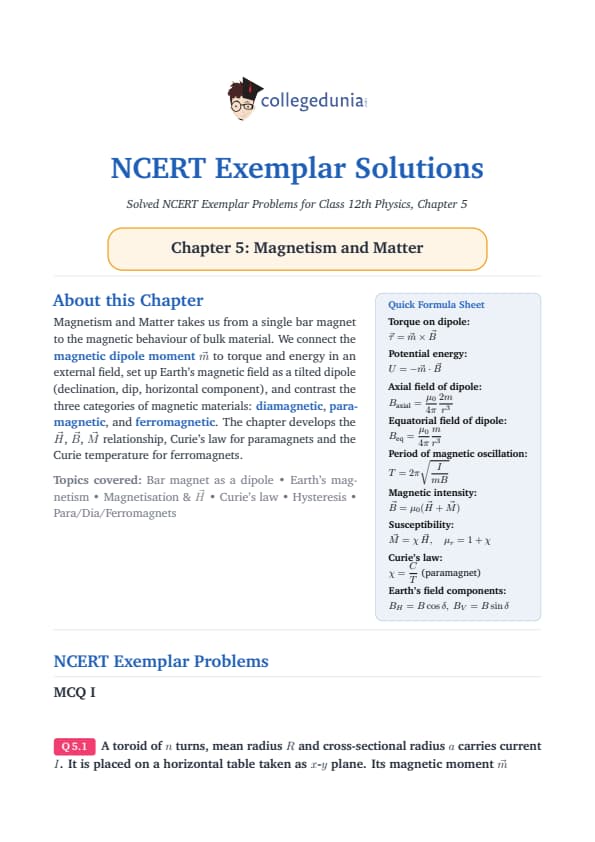
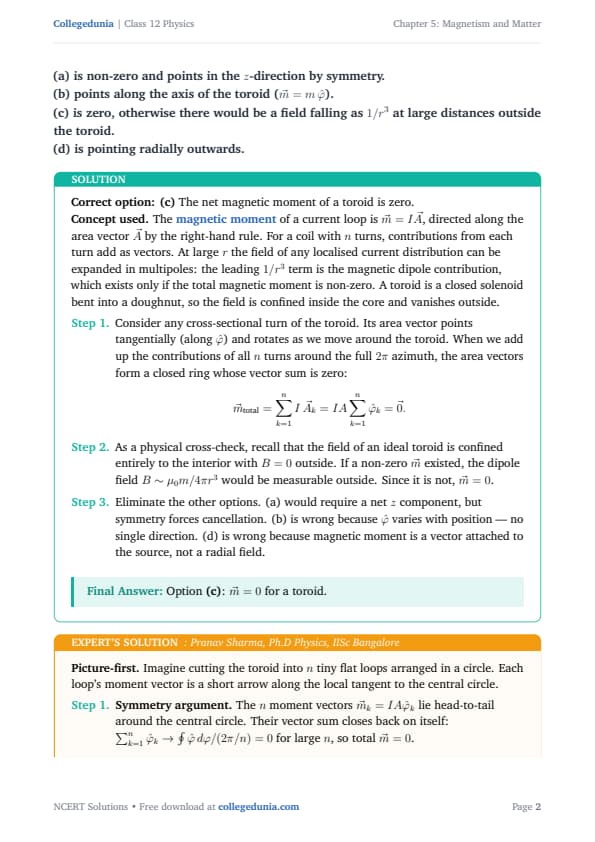
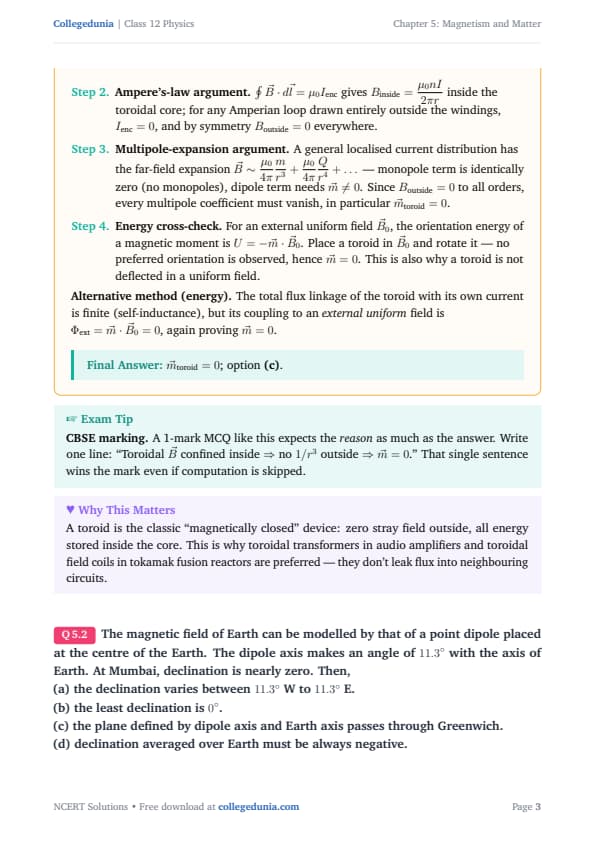
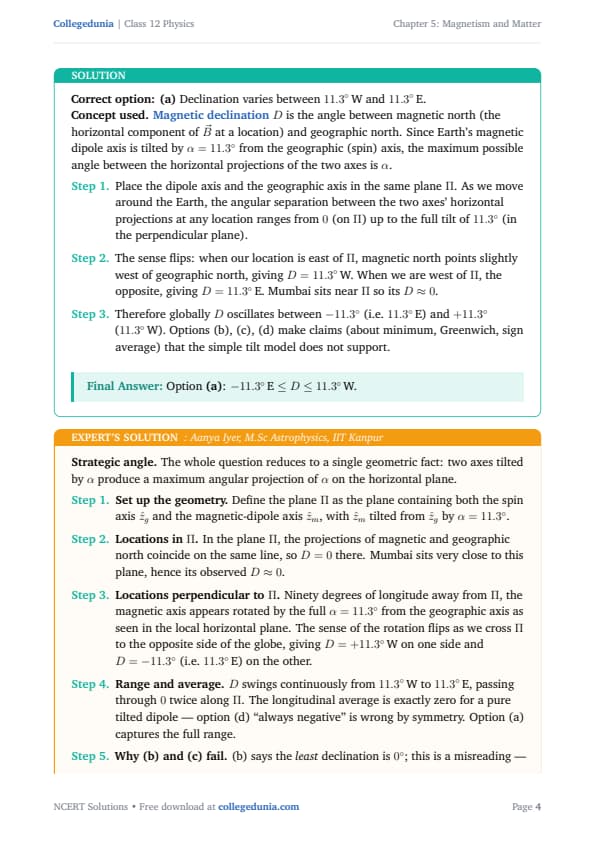
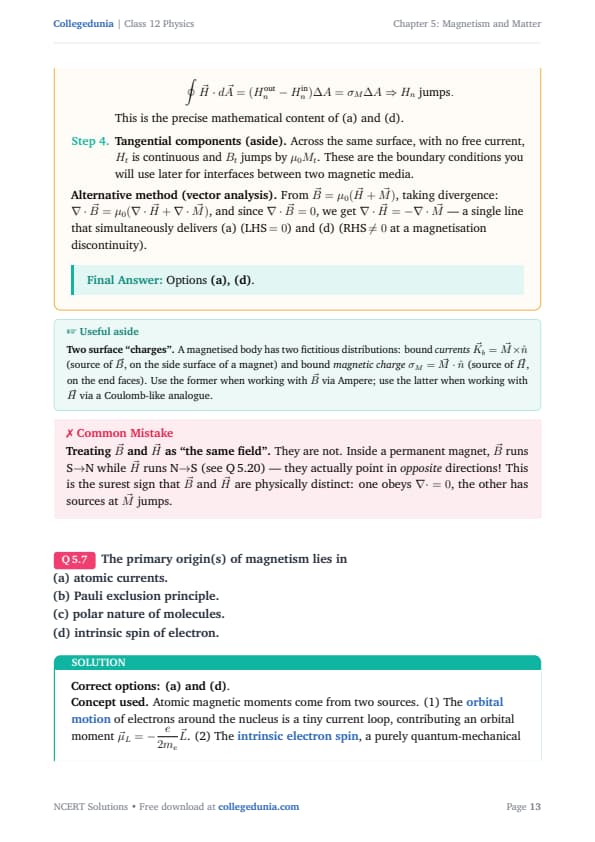
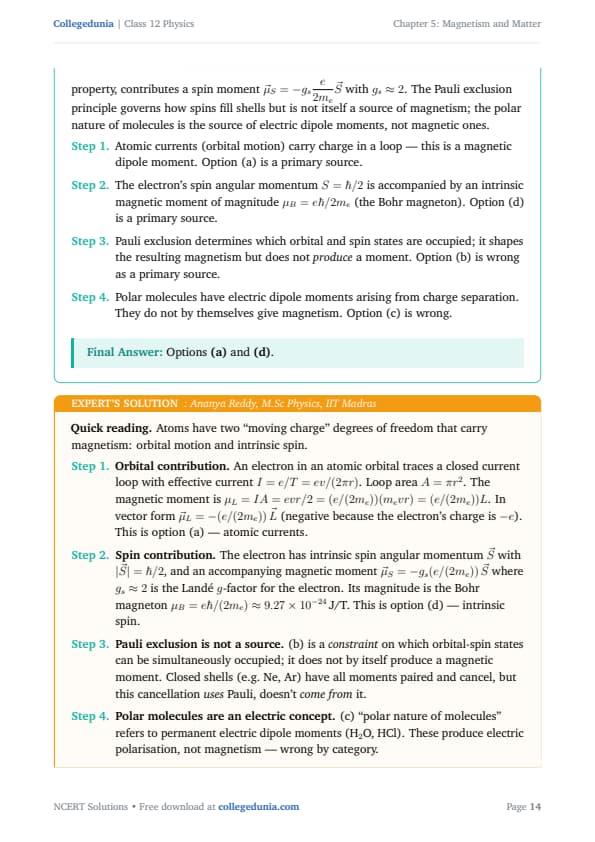
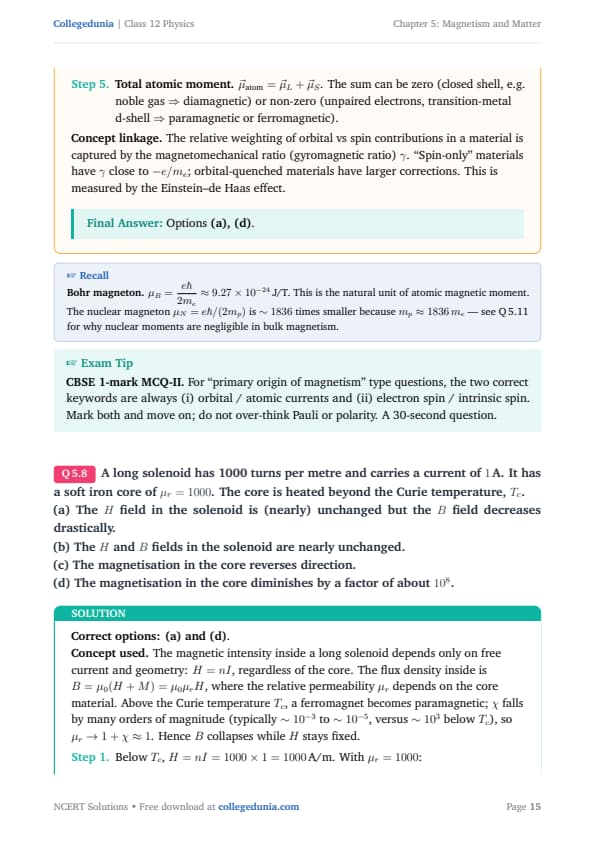
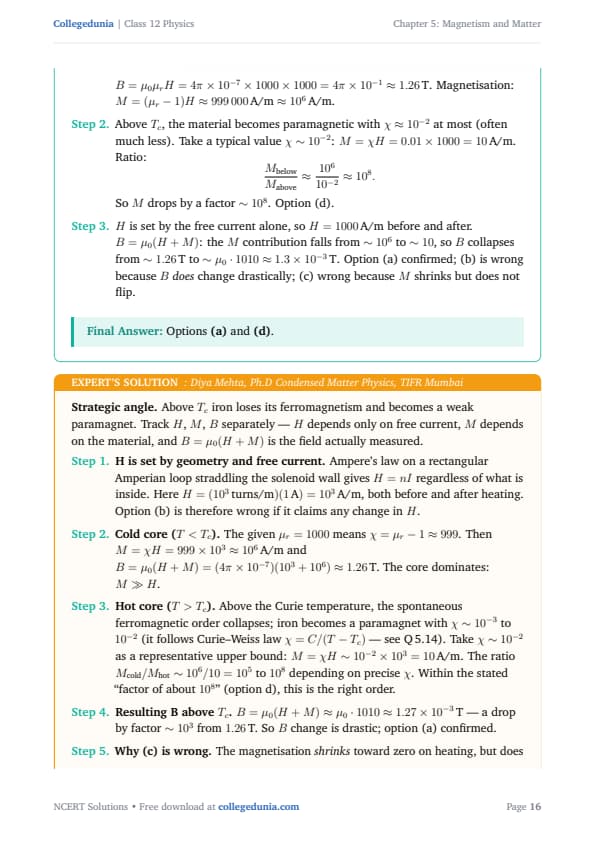
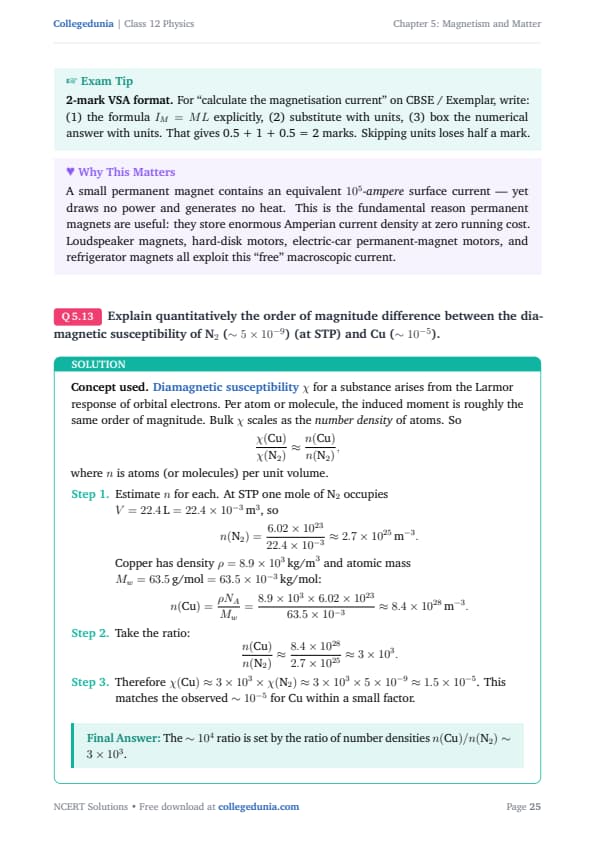
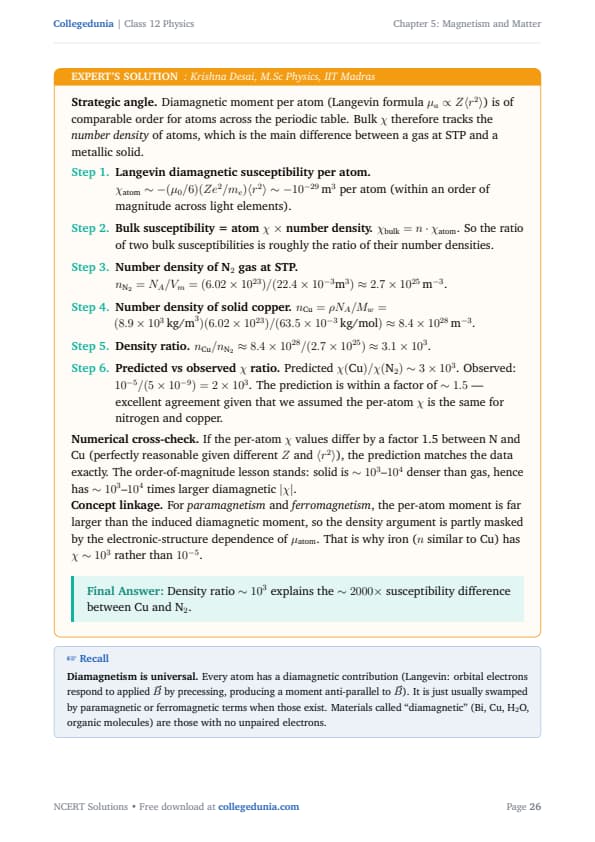
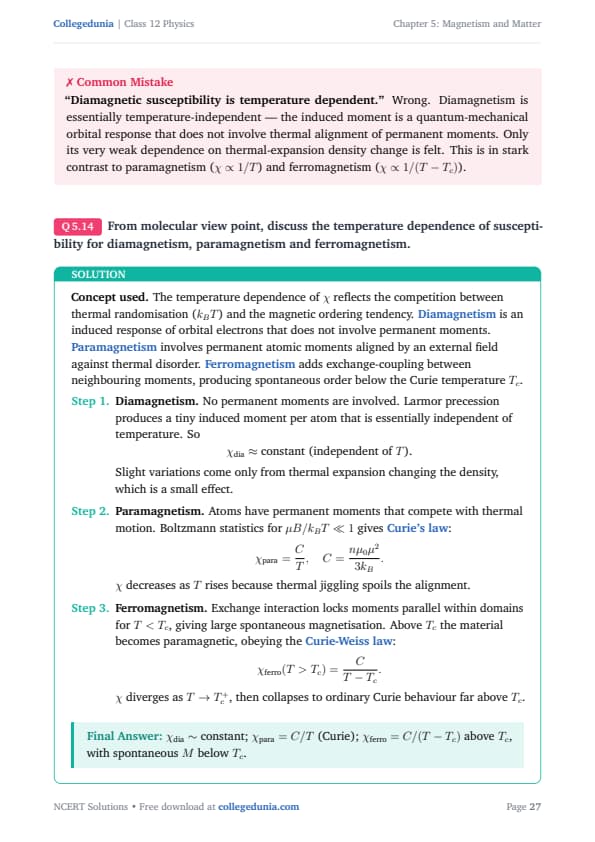
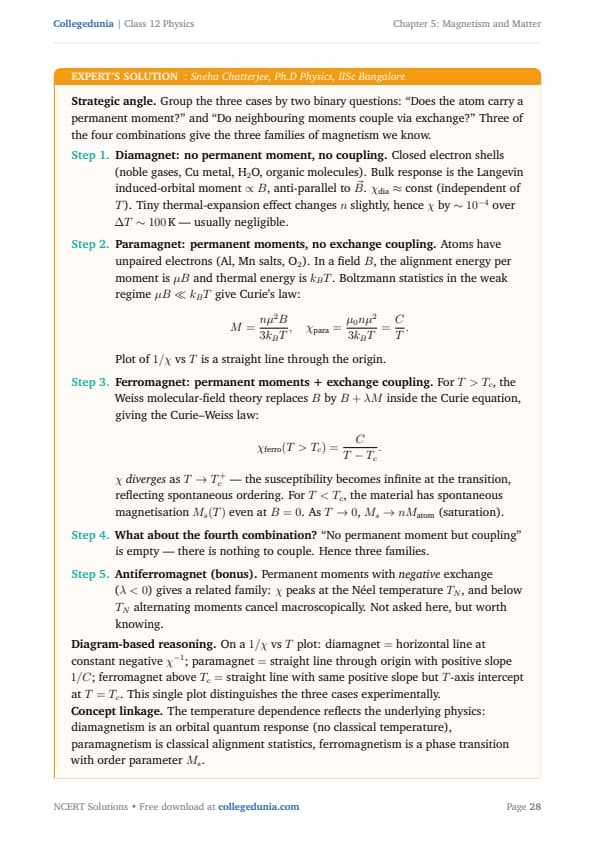
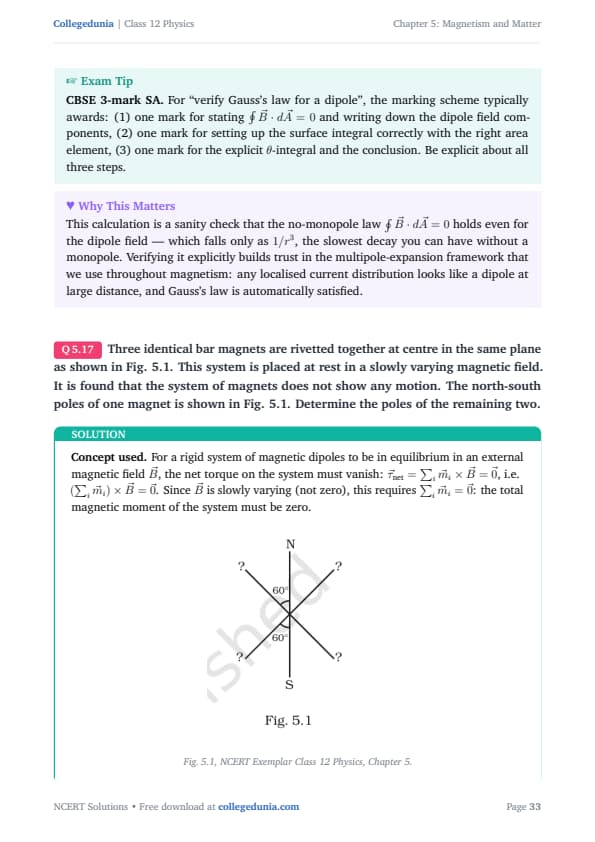
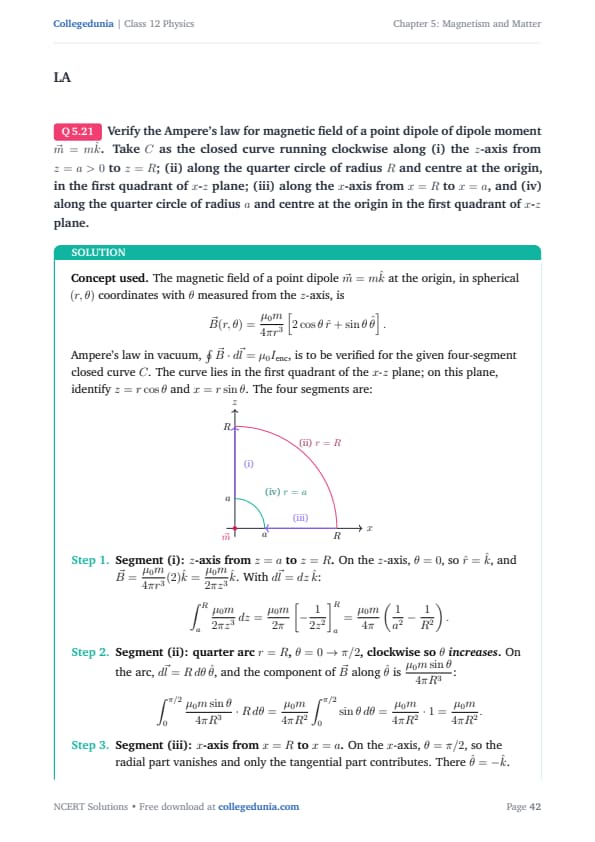
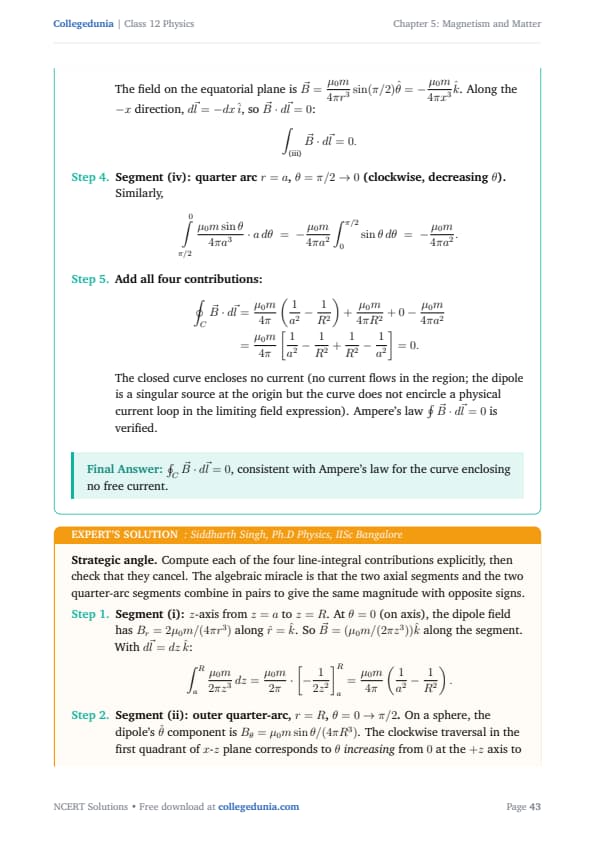
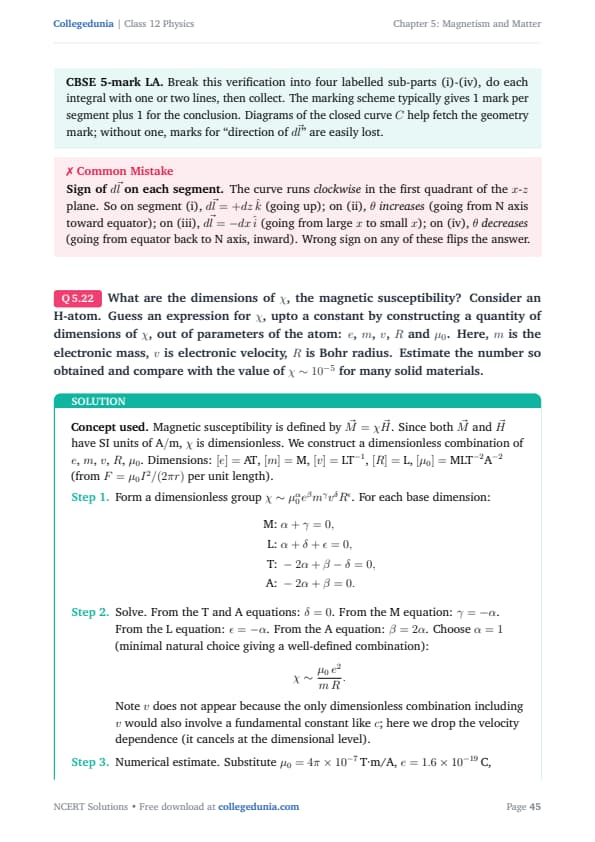
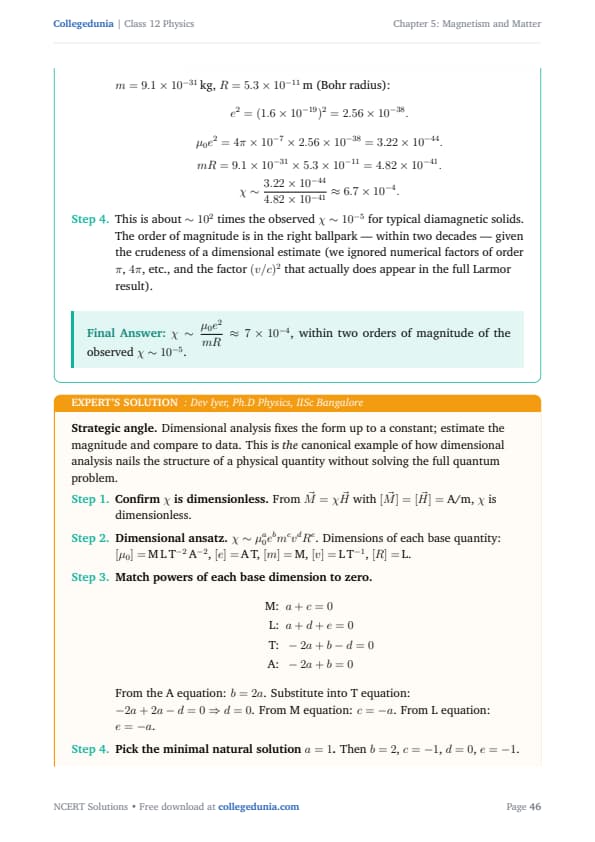
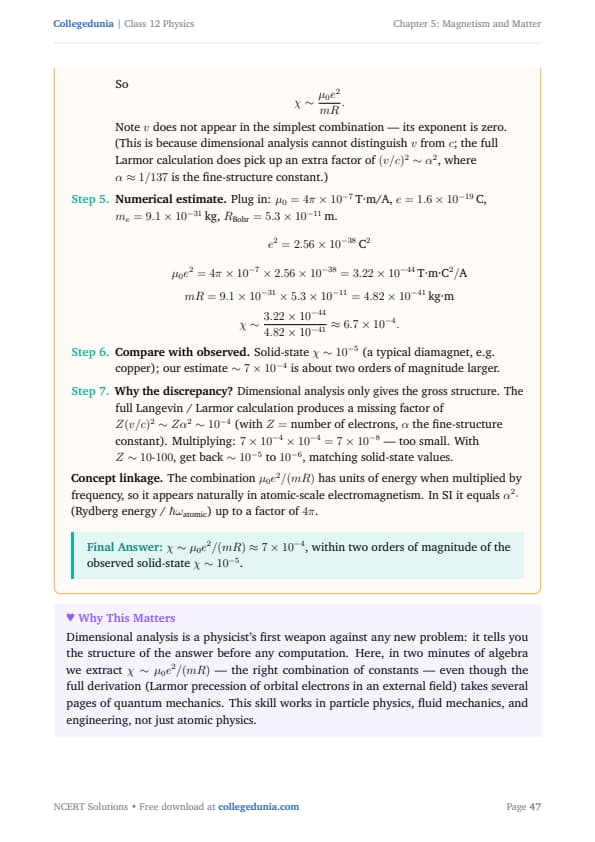
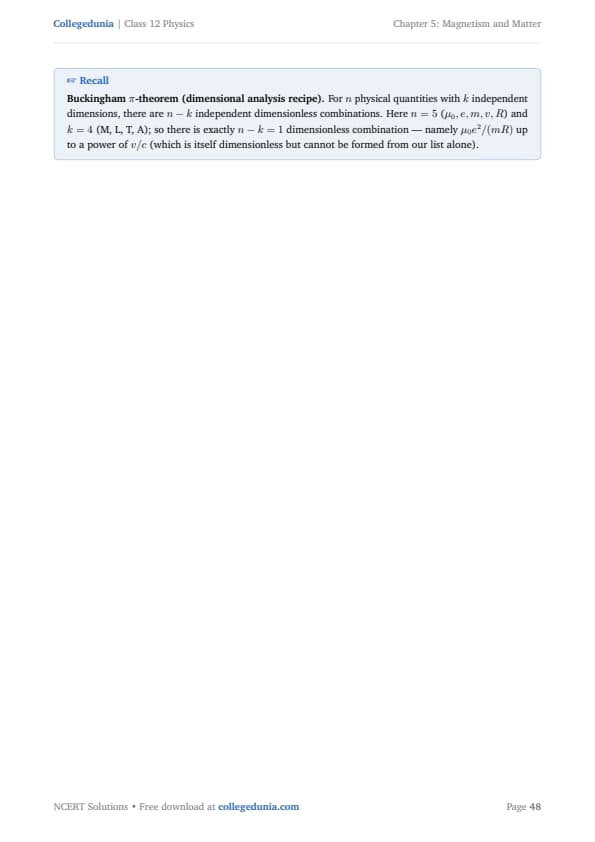
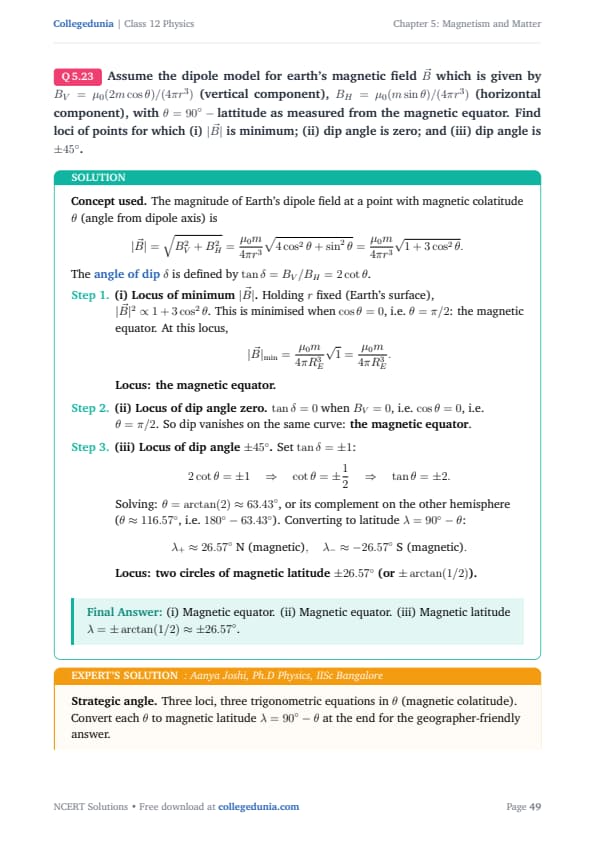
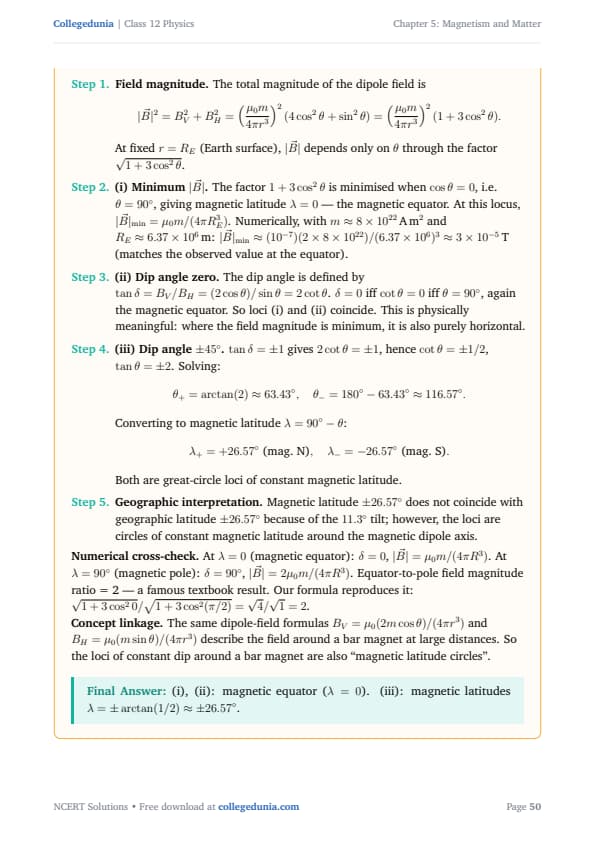
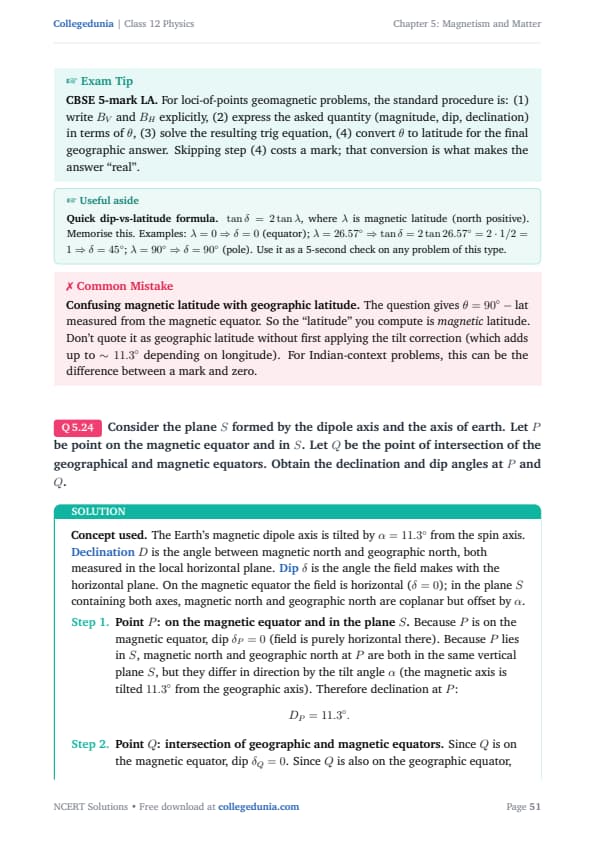
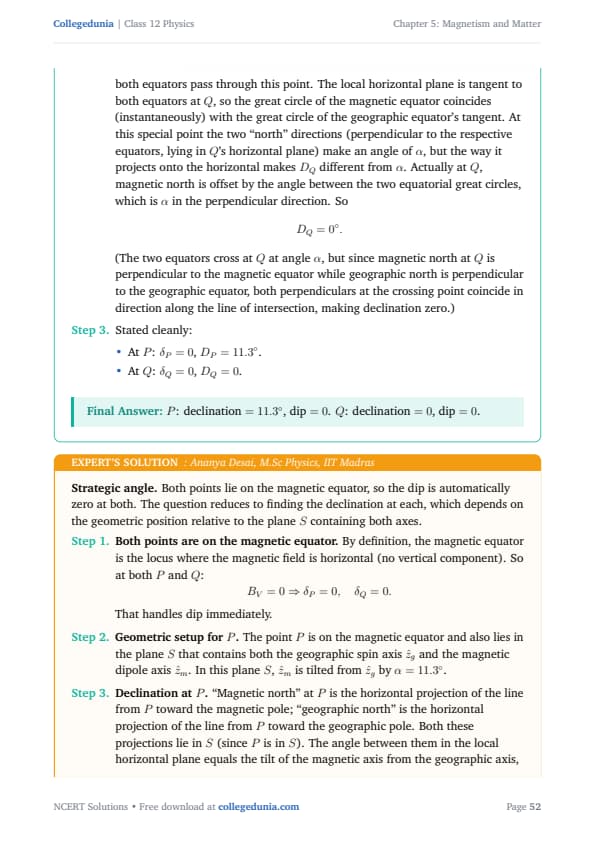
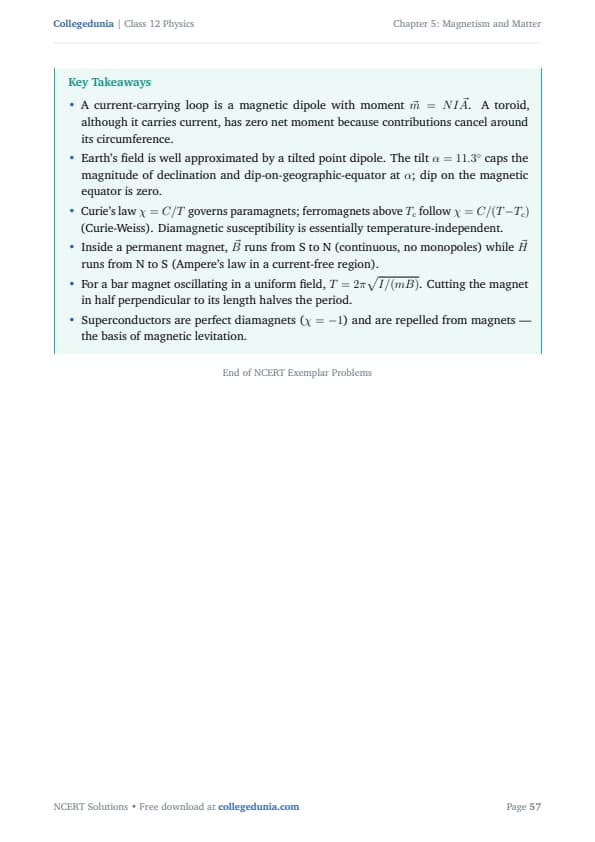
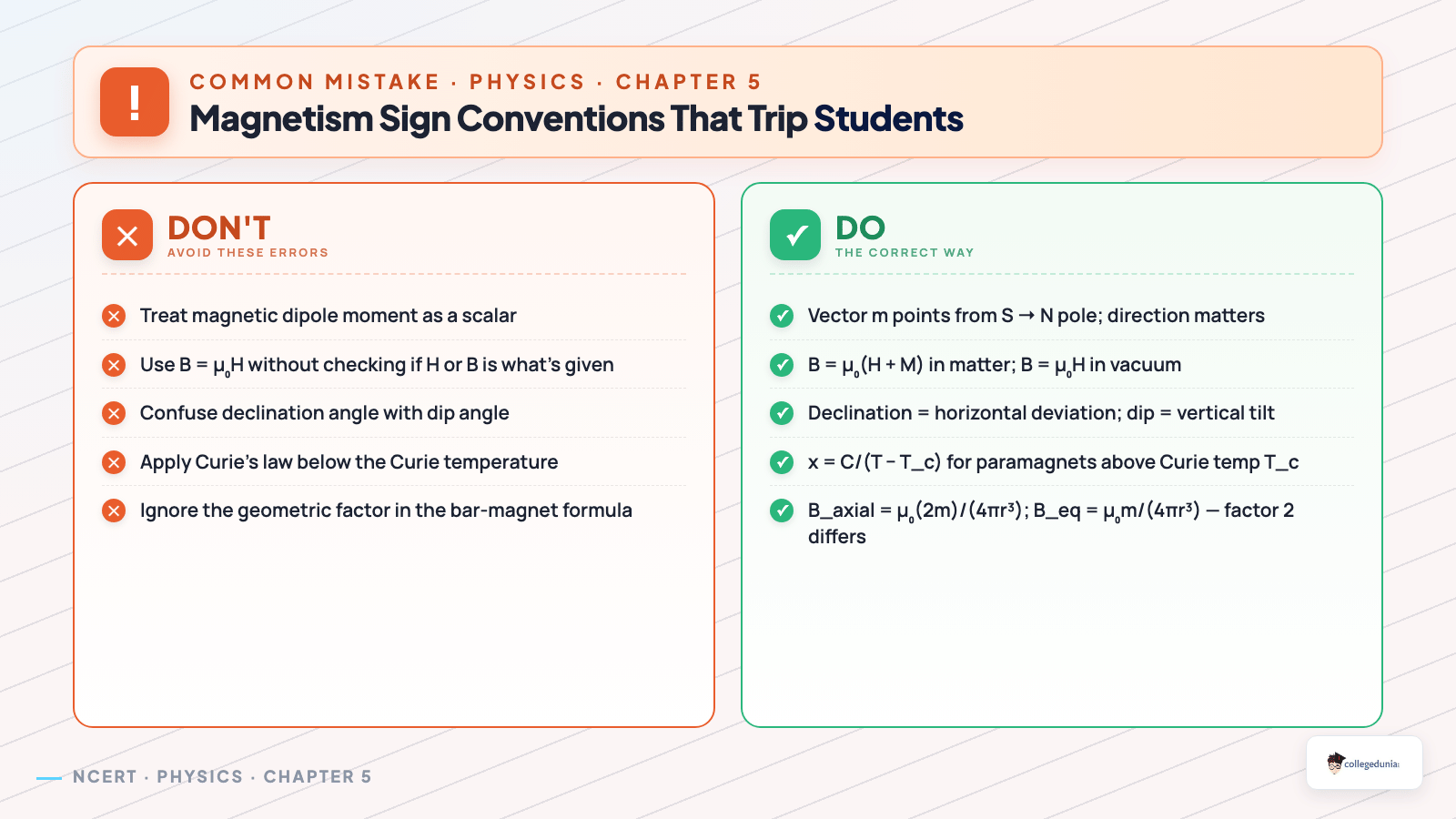
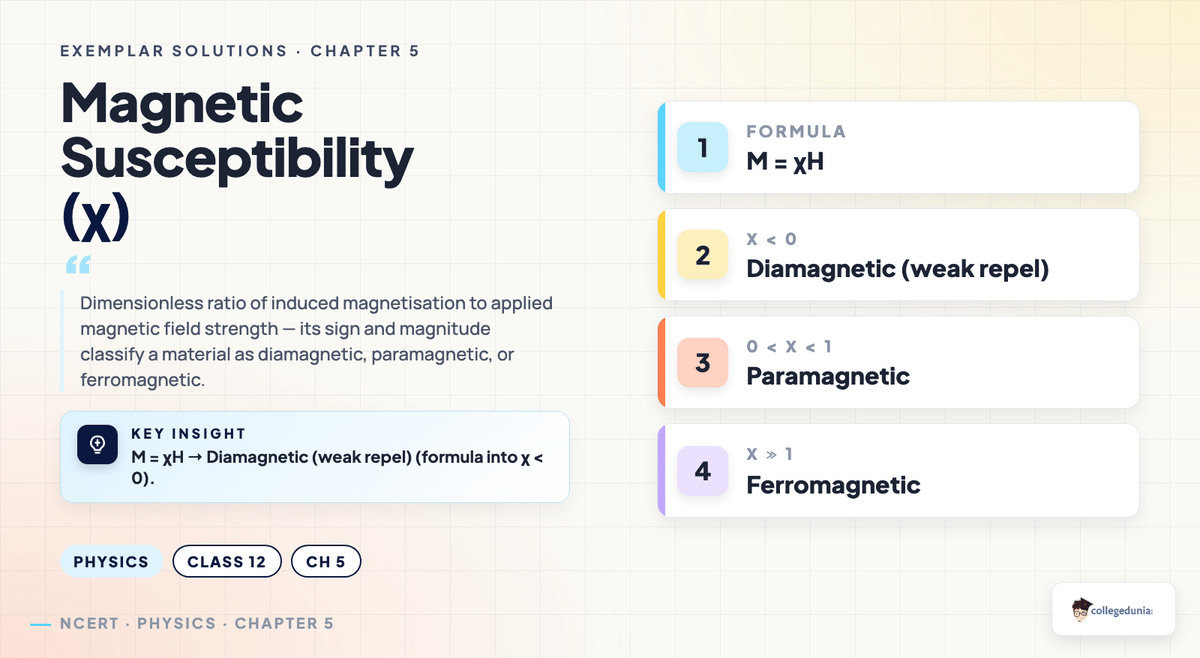
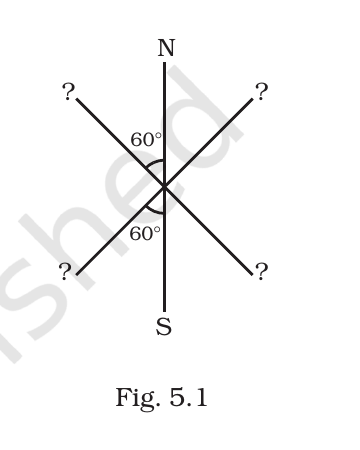



Comments