Physics Mentor, SRM Institute | Updated on - Jul 23, 2026
Chapter 6 Control and Coordination is one of the most reasoning-heavy biology chapters of Class 10 Science for 2026-27, and the NCERT Exemplar stretches it well past the textbook. The Class 10 Science Chapter 6 NCERT Exemplar Solutions on this page solve every Exemplar problem step by step, in plain language a board student can follow.
CBSE Board weightage: the Control and Coordination chapter carries steady marks, and reflex arc, brain parts and hormones are repeat favourites.
What you get: all MCQ, Short Answer and Long Answer problems solved, with a free downloadable PDF.
Solved by Collegedunia: Every problem below is solved by subject experts, mapped to the 2026-27 NCERT Exemplar, and checked against the CBSE Board marking scheme.
Why the NCERT Exemplar Matters for Class 10 Board Preparation
In Control and Coordination, students slip on reasoning and labelling questions, not memory. The NCERT Exemplar turns the basics into exam-style questions: order-the-sequence MCQs, label-the-diagram problems on the neuron and reflex arc, and reasoning on hormones and plant movements. Finishing it is the best way to feel ready for biology.
Quick Tip: Solve the textbook exercises first. The Exemplar assumes you know the parts of a neuron and the order of a reflex arc.
How Collegedunia's NCERT Exemplar Solutions Help You with Control and Coordination
Each problem is solved the way a CBSE examiner expects: part named, reason given, every step shown.
Every question type solved: all MCQ, Short Answer and Long Answer problems, not just the easy ones.
2026-27 alignment: problem numbers and answers match the current edition.
Step-by-step reasoning: each pathway is explained one stage at a time.
Trap flags: red boxes mark common mix-ups of sensory and motor neurons, or wrong gland-hormone pairs.
Best Way to Use the Control and Coordination Exemplar for Board Revision
Treat the Exemplar as a practice paper. This plan fits the window before pre-boards.
Phase
Exemplar Use
Time
First read
All MCQs
1 hour
Concept practice
Neuron, reflex arc and hormone Short Answers
1.5 hours
Answer writing
All Long Answers, full working with labelled diagrams
2 hours
Pre-board revision
Re-solve the wrong ones
1 hour
That is about 5.5 hours. Spend most time on the reflex arc and endocrine glands.
Control and Coordination Exemplar Question Types with One Solved Sample Each
The Chapter 6 Exemplar mixes several question formats.
Type
Sample Question
Answer Shape
MCQ
What is the correct sequence of the components of a reflex arc?
Single option, with reason
MCQ (statement-based)
Which statements about the brain are true?
Pick the correct set of statements
Short Answer
What happens at the synapse between two neurons?
Two to three line reason
Label the diagram
Label the parts of a neuron in the figure
Name each labelled part
Long Answer
Draw the structure of a neuron and explain its function
Several linked parts, diagram
Each is solved below, with Check Solution and Expert Solution tabs.
Nervous System and the Path of a Reflex Arc
Most Exemplar MCQs test whether you can trace a signal in order. A neuron carries it one fixed way; a reflex arc is the short path of an automatic response.
Inside one neuron: dendrite → cell body → axon → axonal end. Dendrite is the in door, axonal end the out door.
Across a synapse: the signal jumps as a chemical from axonal end to the next dendrite, never the other way.
The reflex arc: receptor → sensory neuron → spinal cord → motor neuron → effector muscle.
The spinal cord handles a reflex without waiting for the brain, so you pull your hand back before you feel pain. Remember sensory in, motor out.
Difficulty Step-Up from NCERT Textbook to Exemplar
The Exemplar reuses textbook ideas inside harder wrappers.
Concept
NCERT Textbook
NCERT Exemplar
Neuron
Name the parts of a neuron
Order the path of the impulse or label the parts on a figure
Reflex arc
Define reflex action
Arrange the five components in the correct sequence
Brain
List the three parts of the brain
Identify which statement about brain functions is true
Hormones
Name the hormone of each gland
Spot the mis-matched gland and hormone pair
Plant movements
Define phototropism and geotropism
Reason out why a tendril coils or a pollen tube turns
The textbook gives the rule; the Exemplar makes you apply it.
Topics Covered in Class 10 Science Chapter 6 Control and Coordination Exemplar
MCQs test the parts of a neuron, the synapse, the reflex arc, and the brain. Short Answers cover diagrams, plant hormones, and tropic movements. Long Answers cover the endocrine glands and hormones and the nervous versus hormonal systems.
Control and Coordination Exemplar Common Mistakes That Cost Marks
The Exemplar twists trigger the same errors every year.
Mixing up sensory and motor neurons. Sensory carry signals receptor to spinal cord; motor carry them spinal cord to muscle.
Reversing the synapse direction. The chemical signal goes axonal end to dendrite only.
Confusing brain parts. Thinking is fore-brain, balance cerebellum, vomiting medulla.
Wrong gland for a hormone. Adrenaline is from the adrenal gland, not the pituitary.
Watch Out: In a statement-based MCQ, test every statement to the end. Stopping at the first correct one loses marks.
Endocrine Glands and Their Hormones Quick Reference
Many Exemplar MCQs ask you to match a hormone to its gland or job.
Gland
Hormone
Main job
Thyroid
Thyroxin
Controls the rate of metabolism; needs iodine to be made
Pancreas
Insulin
Controls blood sugar; too little causes diabetes
Adrenal
Adrenaline
The fight-or-flight hormone in emergencies
Pituitary
Growth hormone
Controls growth; too little causes dwarfism
Testes / Ovary
Testosterone / Estrogen
Bring the body changes of puberty
Plants use plant hormones instead. Auxin, gibberellin and cytokinin promote growth, while abscisic acid inhibits it: A-G-C grow, ABA slows.
Most Repeated Board Topics from Control and Coordination
The topics asked most often in CBSE Board and sample papers.
Topic
How it is asked
Neuron structure
Label the parts or order the path of the impulse
Reflex arc
Arrange receptor to effector in the correct sequence
Parts of the brain
Match each part to its function
Endocrine glands
Match a hormone to its gland or spot the mismatch
Plant hormones
Name the hormone for a given effect
Tropic movements
Name the tropism and reason out the bending
All NCERT Exemplar Questions for Control and Coordination with Step-by-Step Solutions
Every question of the NCERT Exemplar set for Class 10 Science Chapter 6 Control and Coordination is listed below with its full Solution and Expert Solution inside collapsible tabs. Click Check Solution to reveal the step-by-step working; click Expert Solution for the expanded explanation.
I. Multiple Choice Questions
Q 6.1
Which of the following statements is correct about receptors?
(a) Gustatory receptors detect taste while olfactory receptors detect smell
(b) Both gustatory and olfactory receptors detect smell
(c) Auditory receptors detect smell and olfactory receptors detect taste
(d) Olfactory receptors detect taste and gustatory receptors smell
Concept used. A receptor is a special cell or group of
cells that picks up a particular type of stimulus from the surroundings.
Each kind of receptor is tuned to one job: gustatory receptors in the
tongue sense taste, olfactory receptors in the nose sense smell.
Match the receptor to its sense. Gusta relates to taste,
so gustatory receptors sit on the tongue and detect taste.
Olfact relates to smell, so olfactory receptors sit in the
nose lining and detect smell.
Option (a) pairs both correctly. Options (b), (c) and (d) mix up
smell and taste, so they are wrong.
Read the prefix, find the sense. Every receptor name in this
chapter carries a clue in its first half, so decoding the prefix is the
fastest route to the answer.
Concept used. Receptors are stimulus-specific. The tongue holds
gustatory (taste) receptors, the nose holds olfactory (smell) receptors,
the ear holds auditory (sound) receptors, and the eye holds photo (light)
receptors.
Gustatory. The root gusta means taste. So these
receptors, found in the taste buds of the tongue, detect taste.
Olfactory. The root olfact means smell. These
receptors line the inside of the nose and detect smell.
Test each option. Only (a) keeps both pairs right. (b)
wrongly says gustatory detects smell, (c) and (d) swap the senses
across organs.
So the correct pairing is option (a).
Why this matters. This is also why food tastes flat during a
heavy cold: the blocked nose stops the olfactory receptors working, and
taste alone feels dull. Question 24 in this same set tests exactly that
link.
Option (a): gustatory receptors sense taste, olfactory receptors sense smell.
Q 6.2
Electrical impulse travels in a neuron from
(a) Dendrite → axon → axonal end → cell body
(b) Cell body → dendrite → axon → axonal end
(c) Dendrite → cell body → axon → axonal end
(d) Axonal end → axon → cell body → dendrite
Concept used. A neuron carries a signal in one fixed
direction. The information is picked up by the dendrites,
passed to the cell body, sent along the long axon, and
delivered at the axonal end.
The dendrite branches receive the stimulus first, so the signal
starts here.
It then moves to the cell body, which holds the nucleus.
From the cell body the impulse travels down the axon and reaches
the axonal end, ready to pass to the next cell.
This order, dendrite to cell body to axon to axonal end, is
option (c).
Follow the shape of the cell. The neuron is built like a funnel
that gathers signals at the bushy end and pours them out at the far tip,
so the path follows that shape.
Concept used. A neuron has three working zones in series:
dendrites that collect, a cell body that processes, and an axon that
transmits to its end. The signal flows through them in that order.
Dendrites first. The many short branches catch the
incoming stimulus, so the impulse begins at the dendrite.
Cell body next. The dendrites feed into the cell body,
the central part of the neuron.
Axon then end. A single long axon carries the impulse
away from the cell body to the axonal end.
Check the options. Only (c) keeps this real sequence;
(a), (b) and (d) jumble the order or run it in reverse.
Why this matters. Fixing this direction in your mind makes the
synapse question (Question 3) easy, because the signal must leave one
neuron from its axonal end and reach the next neuron at its dendrite.
Option (c): the impulse travels dendrite → cell body → axon → axonal end.
Q 6.3
In a synapse, chemical signal is transmitted from
(a) dendritic end of one neuron to axonal end of another neuron
(b) axon to cell body of the same neuron
(c) cell body to axonal end of the same neuron
(d) axonal end of one neuron to dendritic end of another neuron
Correct option: (d) axonal end of one neuron to dendritic end of
another neuron.
Concept used. A synapse is the tiny gap between two
neurons. The impulse cannot jump the gap as electricity, so the axonal
end releases a chemical that crosses to the dendrite of the
next neuron and starts a fresh impulse there.
The signal reaches the axonal end of the first neuron, which is
where chemicals are stored.
These chemicals are released into the synapse gap.
They cross over and reach the dendritic end of the next neuron,
starting a new electrical impulse there.
So the transfer is axonal end (one neuron) to dendritic end (next
neuron): option (d).
Option (d): the chemical signal passes from the axonal end of one neuron to the dendritic end of the next.
PN
Priya Nair
M.Sc Physiology, JIPMER Puducherry
Verified Expert
Spot the gap, name its two banks. A synapse has a sending bank
and a receiving bank; naming them correctly answers the question.
Concept used. At a synapse the electrical impulse is converted
to a chemical signal at the axonal end. The chemical diffuses across the
gap and is converted back to an electrical impulse at the dendrite of the
next neuron.
Sending side. The axonal end of the first neuron holds
the chemical messengers, so it is the transmitting bank.
The gap. The chemical is released and drifts across the
narrow synaptic space.
Receiving side. The dendritic end of the second neuron
picks up the chemical and fires a new impulse.
Eliminate the rest. Options (b) and (c) stay inside one
neuron, and (a) reverses the true direction, so all are wrong.
Why this matters. This chemical relay is why messages flow only
forward through a nerve circuit, and why drugs and toxins that act on
synapses can block or boost nerve signals.
Option (d): axonal end of one neuron to dendritic end of another.
Q 6.4
In a neuron, conversion of electrical signal to a chemical signal occurs at/in
(a) cell body
(b) axonal end
(c) dendritic end
(d) axon
Correct option: (b) axonal end.
Concept used. An electrical impulse travels through a neuron, but
to cross the synapse it must change into a chemical
signal. This change happens at the axonal end, where chemical
messengers are released.
The impulse runs as electricity all the way to the axonal end.
At the axonal end the electrical signal triggers the release of
chemicals, so here electricity becomes a chemical signal.
The cell body, dendrite and axon all carry the signal as
electricity, so options (a), (c) and (d) are wrong.
Option (b): the electrical signal becomes a chemical signal at the axonal end.
AM
Arjun Menon
M.Sc Zoology, AIIMS Bhopal
Verified Expert
Ask where the chemical is made. A conversion to a chemical
signal can only happen where the chemical is stored and released, which
narrows the answer at once.
Concept used. The chemical messengers of a synapse are kept at
the axonal end. When the electrical impulse arrives there, it makes the
end release these chemicals, converting the message from electrical to
chemical form.
Where the chemicals sit. Only the axonal end stores and
releases the chemical messengers.
When the swap happens. The arriving electrical impulse
triggers their release, so the swap to a chemical signal is at the
axonal end.
Reject the rest. The dendrite, cell body and axon merely
carry the impulse as electricity, so (a), (c) and (d) cannot be
the conversion site.
Why this matters. This single fact, that the axonal end is the
conversion point, explains the entire one-way design of nerve signalling
that the chapter keeps coming back to.
Option (b): at the axonal end, where chemicals are released.
Q 6.5
Which is the correct sequence of the components of a reflex arc?
(a) Receptors → Muscles → Sensory neuron → Motor neuron → Spinal cord
(b) Receptors → Motor neuron → Spinal cord → Sensory neuron → Muscle
(c) Receptors → Spinal cord → Sensory neuron → Motor neuron → Muscle
(d) Receptors → Sensory neuron → Spinal cord → Motor neuron → Muscle
Concept used. A reflex arc is the fixed path a signal
takes during a reflex action. The stimulus is picked up by receptors,
carried in by a sensory neuron to the spinal cord, and the
response is sent out by a motor neuron to the muscle.
Receptors detect the stimulus (for example, a hot object).
The sensory neuron carries this information towards the spinal
cord.
The spinal cord processes it and passes the order to a motor
neuron.
The motor neuron carries the response to the muscle, which acts.
This in-then-out order is option (d).
Trace the journey of the signal. Picture touching something hot:
follow the message from skin to spinal cord and back to the muscle, and
the sequence writes itself.
Concept used. A reflex arc has five parts in series: receptor,
sensory (afferent) neuron, spinal cord (central relay), motor (efferent)
neuron, and effector muscle. The signal moves through them in that order.
Detect. Receptors in the skin sense the heat first.
Carry in. The sensory neuron takes the signal towards
the spinal cord.
Relay. The spinal cord switches the signal to a motor
neuron without waiting for the brain.
Carry out and act. The motor neuron drives the muscle to
pull the hand back. This matches option (d).
Why this matters. Because the spinal cord handles the reflex
without the brain, the response is very fast, which is exactly why you
pull your hand back before you even feel the full pain.
Option (d): receptor, sensory neuron, spinal cord, motor neuron, muscle.
Q 6.6
Which of the following statements are true?
(i) Sudden action in response to something in the environment is called reflex action
(ii) Sensory neurons carry signals from spinal cord to muscles
(iii) Motor neurons carry signals from receptors to spinal cord
(iv) The path through which signals are transmitted from a receptor to a muscle or a gland is called reflex arc
(a) (i) and (ii) (b) (i) and (iii) (c) (i) and (iv) (d) (i), (ii) and (iii)
Correct option: (c) (i) and (iv).
Concept used. A reflex action is a quick, automatic
response to a stimulus, and the route it follows is the reflex
arc. Sensory neurons carry signals towards the spinal cord; motor
neurons carry signals away to muscles or glands.
Statement (i) is the correct definition of a reflex action, so it
is true.
Statement (iv) correctly defines the reflex arc as the path from
receptor to muscle or gland, so it is true.
Statement (ii) is wrong: sensory neurons carry signals from
receptors to the spinal cord, not from spinal cord to muscles.
Statement (iii) is wrong: motor neurons carry signals from the
spinal cord to muscles, not from receptors to spinal cord. So the
true pair is (i) and (iv), option (c).
Option (c): statements (i) and (iv) are true.
VR
Vikram Reddy
M.Sc Zoology, AIIMS Nagpur
Verified Expert
Judge each line as true or false. For a ``which are true''
question, the safest method is to test every statement on its own and
then read off the matching option.
Concept used. Reflex action is automatic and fast; the reflex
arc is its pathway. Sensory neurons are incoming (receptor to CNS), motor
neurons are outgoing (CNS to effector).
Statement (i). A sudden, unplanned response to a stimulus
is the textbook meaning of reflex action. True.
Statement (ii). It claims sensory neurons go spinal cord
to muscles. That is the motor neuron's job. False.
Statement (iii). It claims motor neurons go receptors to
spinal cord. That is the sensory neuron's job. False.
Statement (iv). The full receptor-to-effector path is the
reflex arc. True. So only (i) and (iv) hold, giving option (c).
Why this matters. Many board errors come from swapping these two
neuron roles. Getting the direction right here is the same skill the
reflex-arc labelling in Question 34 will test.
Option (c): only statements (i) and (iv) are true.
Q 6.7
Which of the following statements are true about the brain?
(i) The main thinking part of brain is hind brain
(ii) Centres of hearing, smell, memory, sight etc are located in fore brain
(iii) Involuntary actions like salivation, vomiting, blood pressure are controlled by the medulla in the hind brain
(iv) Cerebellum does not control posture and balance of the body
(a) (i) and (ii) (b) (i), (ii) and (iii) (c) (ii) and (iii) (d) (iii) and (iv)
Correct option: (c) (ii) and (iii).
Concept used. The fore-brain is the main thinking part
and holds the centres for hearing, smell, memory and sight. The
medulla in the hind-brain controls involuntary
actions, and the cerebellum controls posture and balance.
Statement (ii) is correct: the sensory centres for hearing,
smell, memory and sight lie in the fore-brain.
Statement (iii) is correct: involuntary actions such as
salivation, vomiting and blood pressure are run by the medulla in
the hind-brain.
Statement (i) is wrong: the main thinking part is the fore-brain,
not the hind-brain.
Statement (iv) is wrong: the cerebellum does control
posture and balance. So the true pair is (ii) and (iii), option
(c).
Option (c): statements (ii) and (iii) are true.
DK
Divya Krishnan
M.Sc Physiology, AIIMS Raipur
Verified Expert
Check each claim against the brain map. Hold a simple map in mind,
fore-brain for thought and senses, hind-brain for balance and
involuntary control, then mark each statement.
Concept used. The fore-brain is the thinking and sensory centre.
The hind-brain has the cerebellum (posture, balance) and the medulla
(involuntary actions like heartbeat, salivation, vomiting).
Statement (i). Thinking is a fore-brain job, not
hind-brain. False.
Statement (ii). Hearing, smell, memory and sight centres
are in the fore-brain. True.
Statement (iii). Salivation, vomiting and blood pressure
are involuntary and run by the medulla in the hind-brain. True.
Statement (iv). It denies the cerebellum's role in
balance, but the cerebellum does control posture and balance.
False. Hence (ii) and (iii): option (c).
Why this matters. This same fore-brain versus hind-brain split is
the backbone of the long-answer Question 46, which asks you to list the
brain's parts and their functions.
Option (c): only statements (ii) and (iii) are true.
Q 6.8
Posture and balance of the body is controlled by
(a) cerebrum
(b) cerebellum
(c) medulla
(d) pons
Correct option: (b) cerebellum.
Concept used. The cerebellum is a part of the
hind-brain. Its special job is to keep posture and balance
steady and to make our movements smooth and well-timed.
Posture and balance need constant fine adjustment of many muscles,
which is the cerebellum's task.
The cerebrum handles thinking and voluntary action, the medulla
handles involuntary actions, and the pons is a relay, so they do
not control balance.
Therefore the correct part is the cerebellum, option (b).
Option (b): posture and balance are controlled by the cerebellum.
KP
Karthik Pillai
M.Sc Zoology, AIIMS Mangalagiri
Verified Expert
Name the part by the job. The question gives one job, posture and
balance, so we just recall which single part owns it.
Concept used. In the hind-brain, the cerebellum coordinates
muscle activity to maintain posture, balance and the precision of
movement.
The job. Standing upright and balancing needs many
muscles tuned together at once.
The owner. The cerebellum performs this fine
coordination, so it controls posture and balance.
Reject the rest. The cerebrum is for thought and willed
action, the medulla for involuntary actions, the pons for
relaying signals. None of these owns balance.
Why this matters. Activities like cycling, dancing or writing
neatly all depend on the cerebellum, which is why a well-practised skill
feels automatic and steady.
Option (b): the cerebellum controls posture and balance.
Concept used. The spinal cord is the long nerve cable
that runs down the back. It begins at the lower part of the brain, the
medulla oblongata, and continues inside the vertebral column.
The brain narrows at its base into the medulla.
The spinal cord starts right where the medulla ends and then runs
down through the backbone.
The cerebrum, pons and cerebellum are higher brain parts and are
not the starting point of the cord, so they are wrong.
Option (b): the spinal cord originates from the medulla.
MJ
Meera Joshi
M.Sc Physiology, JIPMER Puducherry
Verified Expert
Find where brain ends and cord begins. The spinal cord must
start at the lowest part of the brain, so we look for the brain region
that sits just above the backbone.
Concept used. The medulla oblongata is the lowest part of the
hind-brain. It connects the brain to the spinal cord, so the cord
originates from the medulla.
Trace downward. Moving down the brain, the last region
before the backbone is the medulla.
Origin point. The spinal cord continues directly from
the medulla and runs down inside the vertebral column.
Reject the rest. The cerebrum, pons and cerebellum all
lie higher up and do not give rise to the cord.
Why this matters. Because the cord starts at the medulla, an
injury where the neck meets the skull is so dangerous: it can cut the link
between the brain and the rest of the body.
Option (b): the spinal cord originates from the medulla.
Q 6.10
The movement of shoot towards light is
(a) geotropism
(b) hydrotropism
(c) chemotropism
(d) phototropism
Correct option: (d) phototropism.
Concept used. A tropic movement is a directional growth
movement of a plant part in response to a stimulus.
Phototropism is growth in response to light; the shoot bends
towards light, so it is positively phototropic.
The stimulus here is light, and the response is the shoot growing
towards it.
Growth in response to light is called phototropism (photo
means light).
Geotropism is to gravity, hydrotropism to water, chemotropism to
chemicals, so (a), (b) and (c) are wrong.
Option (d): the shoot bending towards light is phototropism.
AR
Aishwarya Rao
M.Sc Botany, University of Delhi
Verified Expert
Match the stimulus to the prefix. Each tropism is named after the
stimulus that causes it, so identifying the stimulus gives the answer
directly.
Concept used. Phototropism is directional growth caused by light.
Shoots grow towards light (positive phototropism) because the plant
hormone auxin gathers on the shaded side and makes it grow longer, bending
the shoot toward the light.
Name the stimulus. The shoot is responding to light.
Apply the prefix. Light-driven growth is phototropism.
Direction. The shoot grows towards the light, so it is
positive phototropism.
Reject the rest. Gravity (geo), water (hydro) and
chemicals (chemo) are not the stimulus here, so option (d) stands.
Why this matters. This is why a potted plant on a windowsill leans
toward the glass over a few days, and why Question 19 about the sunflower
following the sun is the same idea in action.
Option (d): shoot growth towards light is phototropism.
Q 6.11
The main function of abscisic acid in plants is to
(a) increase the length of cells
(b) promote cell division
(c) inhibit growth
(d) promote growth of stem
Correct option: (c) inhibit growth.
Concept used.Abscisic acid (ABA) is a plant hormone
that acts as a growth inhibitor. Unlike auxin, gibberellin and
cytokinin which promote growth, abscisic acid slows growth and helps the
plant deal with stress, such as closing stomata in dry weather.
Auxin lengthens cells, gibberellin promotes stem growth and
cytokinin promotes cell division. These three are growth
promoters.
Abscisic acid does the opposite: it inhibits growth and causes
effects like wilting and shedding of leaves.
So its main role is to inhibit growth, option (c). Options (a),
(b) and (d) describe the promoter hormones.
Option (c): abscisic acid inhibits growth.
SB
Suresh Babu
M.Sc Botany, Banaras Hindu University
Verified Expert
Find the odd hormone out. Three of the four options describe
growth promotion, so the inhibitor hormone must be the one whose job is
the opposite.
Concept used. Abscisic acid is the plant's stress and dormancy
hormone. It inhibits growth, promotes the closing of stomata, and triggers
the dropping of leaves and fruits.
List the promoters. Auxin (cell elongation), gibberellin
(stem growth) and cytokinin (cell division) all push growth
forward.
Place abscisic acid. It works against these, slowing or
stopping growth, so it is an inhibitor.
Match the option. ``Inhibit growth'' is option (c). The
other three options describe the promoter hormones, not ABA.
Why this matters. Abscisic acid is why deciduous trees shed
leaves before winter and why seeds stay dormant until conditions are
right, both protective pauses in growth.
Option (c): the main role of abscisic acid is to inhibit growth.
Q 6.12
Which of the following is not associated with growth of plant?
(a) Auxin
(b) Gibberellins
(c) Cytokinins
(d) Abscisic acid
Correct option: (d) Abscisic acid.
Concept used. Plant hormones fall into two groups:
growth-promoting hormones (auxin, gibberellin,
cytokinin) and the growth-inhibiting hormone (abscisic
acid). The question asks for the one not linked with growth.
Auxin, gibberellins and cytokinins all help the plant grow, so
they are associated with growth.
Abscisic acid does not promote growth; it inhibits growth and
causes dormancy.
So the hormone not associated with growth is abscisic acid,
option (d).
Option (d): abscisic acid is not associated with promoting plant growth.
LM
Lakshmi Menon
M.Sc Botany, University of Madras
Verified Expert
Sort promoters from inhibitor. Since the chapter has only one
inhibitor hormone, the ``not associated with growth'' option must be that
one.
Concept used. Auxin lengthens cells, gibberellin promotes stem
elongation and cytokinin promotes cell division, so all three drive
growth. Abscisic acid is the lone inhibitor, linked to stress and
dormancy rather than growth.
Group the promoters. Auxin, gibberellin and cytokinin
each support a part of plant growth.
Spot the inhibitor. Abscisic acid acts against growth,
causing wilting, leaf fall and dormancy.
Answer. The one not tied to growth is abscisic acid,
option (d).
Why this matters. Knowing abscisic acid as the brake, not the
accelerator, links directly to Question 20, where it triggers the fall of
mature leaves and fruits.
Option (d): abscisic acid is the hormone not associated with growth.
Q 6.13
Iodine is necessary for the synthesis of which hormone?
(a) Adrenaline
(b) Thyroxin
(c) Auxin
(d) Insulin
Correct option: (b) Thyroxin.
Concept used. The thyroid gland makes the hormone
thyroxin, and it needs iodine as a raw material to do
so. Thyroxin controls the rate at which the body uses carbohydrates, fats
and proteins.
Thyroxin is built using iodine, so a supply of iodine in the diet
is essential for its synthesis.
Adrenaline and insulin do not need iodine, and auxin is a plant
hormone, so they are wrong.
Hence the iodine-dependent hormone is thyroxin, option (b).
Option (b): iodine is needed to make thyroxin.
NP
Nandini Pillai
M.Sc Physiology, AIIMS Bhubaneswar
Verified Expert
Link the mineral to its hormone. Only one hormone in the list is
built from iodine, so the answer is whichever hormone the thyroid makes.
Concept used. The thyroid gland uses dietary iodine to make
thyroxin, the hormone that sets the body's metabolic rate. A shortage of
iodine means too little thyroxin.
Name the gland. Iodine is taken up by the thyroid gland.
Name its hormone. The thyroid makes thyroxin, so thyroxin
is the iodine-dependent hormone.
Reject the rest. Adrenaline (adrenal gland) and insulin
(pancreas) need no iodine, and auxin is a plant hormone. So
thyroxin, option (b), is correct.
Why this matters. The iodine-thyroxin link is the reason iodised
salt is sold across India to prevent goitre, the very point tested in
Question 41 later in this set.
Option (b): thyroxin is synthesised using iodine.
Q 6.14
Choose the incorrect statement about insulin
(a) It is produced from pancreas
(b) It regulates growth and development of the body
(c) It regulates blood sugar level
(d) Insufficient secretion of insulin will cause diabetes
Correct option: (b) It regulates growth and development of the
body.
Concept used.Insulin is a hormone made by the
pancreas. Its main job is to control the blood sugar
level. Growth and development of the body is the job of growth hormone,
not insulin.
Statements (a), (c) and (d) are all true: insulin comes from the
pancreas, it controls blood sugar, and its shortage causes
diabetes.
Statement (b) is false, because regulating growth and development
is the role of growth hormone, not insulin.
The question asks for the incorrect statement, so the answer is
(b).
Option (b): the incorrect statement is that insulin regulates growth and development.
RS
Rohit Saxena
M.Sc Physiology, AIIMS Patna
Verified Expert
Hunt the false line. The question wants the wrong statement, so
verify each line and select the one that does not fit insulin.
Concept used. Insulin from the pancreas lowers blood sugar by
helping cells take in glucose. Too little insulin raises blood sugar and
causes diabetes. It has nothing to do with body growth.
Statement (a). Insulin is indeed made in the pancreas.
True.
Statement (b). Growth and development are controlled by
growth hormone, not insulin. False, so this is the answer.
Statement (c). Insulin does control blood sugar. True.
Statement (d). Too little insulin does cause diabetes.
True. So the incorrect line is (b).
Why this matters. Confusing insulin with growth hormone is a
classic mix-up. Keeping insulin tied firmly to blood sugar helps you
answer the diabetes-injection scenario in Question 29.
Option (b): insulin does not regulate growth and development.
Concept used. Each hormone is made by a particular
endocrine gland. Adrenaline is made by the
adrenal gland, not the pituitary gland, so that pairing is
wrong.
Adrenaline is secreted by the adrenal glands, which sit above the
kidneys, so pairing it with the pituitary gland is a mismatch.
Testosterone-testes, estrogen-ovary and thyroxin-thyroid are all
correct gland-hormone pairs.
So the mismatched pair is (a).
Option (a): adrenaline is made by the adrenal gland, so pairing it with the pituitary is the mismatch.
PB
Pooja Bhat
M.Sc Physiology, AIIMS Mangalagiri
Verified Expert
Check each gland-hormone pair. A mis-matched pair question is
solved by testing each pairing against the correct source gland.
Concept used. Adrenal gland makes adrenaline, testes make
testosterone, ovaries make estrogen, and the thyroid makes thyroxin. A
correct pair links the hormone to its true gland.
Pair (a). Adrenaline is from the adrenal gland, not the
pituitary. Mismatch found.
Pair (b). Testosterone is from the testes. Correct.
Pair (c). Estrogen is from the ovary. Correct.
Pair (d). Thyroxin is from the thyroid gland. Correct.
So the only wrong pair is (a).
Why this matters. Building a clean gland-to-hormone table now
makes the matching and ``name the gland'' questions later in this chapter,
like Questions 43 and 44, quick and safe.
Option (a): the mismatch is adrenaline paired with the pituitary gland.
Q 6.16
The shape of guard cells changes due to change in the
(a) protein composition of cells
(b) temperature of cells
(c) amount of water in cells
(d) position of nucleus in the cells
Correct option: (c) amount of water in cells.
Concept used.Guard cells surround a stomatal pore on a
leaf. They open and close the pore by changing shape, and this shape
change is driven by the amount of water they hold. This is an
example of a movement that does not need growth.
When water enters the guard cells they swell and curve, opening
the stoma.
When water leaves them they shrink and go straight, closing the
stoma.
So the shape change is caused by the amount of water in the cells,
option (c). Protein, temperature and nucleus position are not the
cause.
Option (c): the guard cell shape changes with the amount of water inside it.
GR
Geetha Raman
M.Sc Botany, University of Madras
Verified Expert
Ask what swells the cell. A change in cell shape that opens and
closes a pore points to water moving in and out, so water is the cause.
Concept used. Guard cells regulate the stomata. Water entering by
osmosis makes them turgid and bent, opening the pore; water leaving makes
them flaccid and straight, closing the pore.
Water in. Turgid, swollen guard cells bow outward and the
stoma opens.
Water out. Flaccid guard cells lose their curve and the
stoma shuts.
Pick the cause. The driver of this shape change is the
amount of water, option (c).
Reject the rest. Protein make-up, temperature and nucleus
position do not cause the opening and closing.
Why this matters. This water-driven movement lets a plant control
water loss and gas exchange, and it shows that not all plant movements
need growth, which is a key idea of this chapter.
Option (c): the change in guard cell shape is due to the amount of water in the cells.
Q 6.17
The growth of tendril in pea plants is due to
(a) effect of light
(b) effect of gravity
(c) rapid cell divisions in tendrillar cells that are away from the support
(d) rapid cell divisions in tendrillar cells in contact with the support
Correct option: (c) rapid cell divisions in tendrillar cells
that are away from the support.
Concept used. A tendril shows thigmotropism,
a growth response to touch. When a tendril touches a support, the cells on
the side away from the support grow faster, so the tendril coils
around the support.
The tendril touches a support on one side.
The cells on the side away from the support divide and grow more
quickly than the cells touching the support.
This uneven growth makes the tendril curve and coil around the
support, so the cause is rapid growth on the far side, option (c).
Option (c): faster growth of cells away from the support makes the tendril coil around it.
MT
Manish Tiwari
M.Sc Botany, Banaras Hindu University
Verified Expert
Think which side bends inward. A tendril coils towards the
support, so the side that grows more must be the outer side, away from the
support.
Concept used. A tendril curls by growing unevenly. The cells on
the side not in contact with the support elongate faster, so that side
becomes longer and the tendril wraps around the support.
Contact happens. The tendril brushes against a support on
one side.
Uneven growth. Cells on the far side (away from contact)
divide and lengthen rapidly.
Coiling. The longer far side and shorter near side make
the tendril bend around the support.
Answer. The cause is rapid growth in cells away from the
support, option (c).
Why this matters. This is how climbing plants like peas and
gourds hold onto fences and sticks, a touch response that helps weak stems
reach sunlight.
Option (c): rapid cell division on the side away from the support coils the tendril.
Q 6.18
The growth of pollen tubes towards ovules is due to
(a) hydrotropism
(b) chemotropism
(c) geotropism
(d) phototropism
Correct option: (b) chemotropism.
Concept used.Chemotropism is the directional growth of
a plant part in response to a chemical stimulus. The pollen tube
grows towards the ovule because chemicals from the ovule guide it, so this
is chemotropism.
After pollination, the pollen tube must reach the ovule inside the
ovary.
Chemicals released near the ovule attract the pollen tube and
guide its growth towards them.
Growth towards a chemical is chemotropism, option (b). It is not a
response to water, gravity or light.
Option (b): the pollen tube grows towards the ovule by chemotropism.
AD
Anita Desai
M.Sc Botany, University of Delhi
Verified Expert
Name the stimulus that guides the tube. The pollen tube is led to
the ovule by chemical signals, so the matching tropism is chemotropism.
Concept used. Chemotropism is growth directed by a chemical. The
ovule releases chemical attractants, and the pollen tube grows down the
style toward them to carry the male gametes to the egg.
The goal. The pollen tube must travel from the stigma
down to the ovule.
The guide. Chemicals near the ovule attract the tube and
set its direction.
The name. Growth toward a chemical is chemotropism, so
option (b) is correct.
Reject the rest. Water (hydro), gravity (geo) and light
(photo) do not steer the pollen tube.
Why this matters. This chemical guidance makes fertilisation
possible in flowering plants, linking this control-and-coordination idea
straight to the reproduction chapter that follows.
Option (b): pollen tube growth towards the ovule is chemotropism.
Q 6.19
The movement of sunflower in accordance with the path of sun is due to
(a) phototropism
(b) geotropism
(c) chemotropism
(d) hydrotropism
Correct option: (a) phototropism.
Concept used.Phototropism is growth movement in
response to light. A young sunflower turns to face the sun
through the day because its growth follows the light, which is a
phototropic response.
The stimulus is the sun's light moving across the sky.
The sunflower head turns to keep facing the light, a directional
growth response to light.
Growth in response to light is phototropism, option (a), not a
response to gravity, chemicals or water.
Option (a): the sunflower following the sun is phototropism.
RG
Ramesh Gowda
M.Sc Botany, University of Mysore
Verified Expert
Match the moving stimulus. The sunflower follows the sun, and the
sun is a source of light, so the response is to light, namely
phototropism.
Concept used. Phototropism is directional growth caused by light.
The growing parts of a young sunflower bend so the flower keeps facing the
sun as it moves across the sky.
Identify the stimulus. The sunflower responds to the
position of the sun, which gives light.
Apply the prefix. Light-driven growth is phototropism.
Confirm. The head turning to face the sun is a positive
phototropic movement, so option (a) is right.
Reject the rest. Gravity, chemicals and water are not the
stimulus, so (b), (c) and (d) fail.
Why this matters. This sun-tracking helps the sunflower catch the
most light for photosynthesis, the same survival logic behind shoots
bending toward a window in Question 10.
Option (a): the sunflower tracking the sun is phototropism.
Q 6.20
The substance that triggers the fall of mature leaves and fruits from plants is due to
(a) auxin
(b) gibberellin
(c) abscisic acid
(d) cytokinin
Correct option: (c) abscisic acid.
Concept used.Abscisic acid is the plant hormone linked
to growth inhibition and ageing (senescence). It triggers the
fall, or abscission, of mature leaves and fruits.
Auxin, gibberellin and cytokinin promote growth, so they do not
cause shedding.
Abscisic acid promotes ageing and the dropping of old leaves and
ripe fruits.
So the substance that triggers their fall is abscisic acid, option
(c).
Option (c): abscisic acid triggers the fall of mature leaves and fruits.
SV
Shalini Verma
M.Sc Botany, Banaras Hindu University
Verified Expert
Pick the ageing hormone. Falling of mature leaves and fruits is
an ageing event, so the hormone behind it is the one tied to inhibition
and senescence, abscisic acid.
Concept used. Abscisic acid inhibits growth and speeds ageing in
plant parts. It builds up in old leaves and ripe fruits and causes them to
separate and fall.
Rule out promoters. Auxin, gibberellin and cytokinin
drive growth, not shedding.
Identify the role. Falling of old leaves and fruits is an
ageing, growth-stopping effect.
Match the hormone. Abscisic acid causes this, so option
(c) is correct.
Why this matters. This is why trees shed leaves in autumn and why
ripe fruit drops from the branch, both controlled pauses that abscisic
acid manages for the plant.
Option (c): abscisic acid causes mature leaves and fruits to fall.
Q 6.21
Which of the following statements about transmission of nerve impulse is incorrect?
(a) Nerve impulse travels from dendritic end towards axonal end
(b) At the dendritic end electrical impulses bring about the release of some chemicals which generate an electrical impulse at the axonal end of another neuron
(c) The chemicals released from the axonal end of one neuron cross the synapse and generate a similar electrical impulse in a dendrite of another neuron
(d) A neuron transmits electrical impulses not only to another neuron but also to muscle and gland cells
Correct option: (b) At the dendritic end electrical impulses
bring about the release of some chemicals which generate an electrical
impulse at the axonal end of another neuron.
Concept used. In a neuron the impulse runs from dendrite to
axonal end. The chemicals are released at the axonal end (not
the dendritic end), cross the synapse, and start a new impulse
in the dendrite of the next neuron.
Statement (a) is correct: the impulse does travel from dendritic
end towards axonal end.
Statement (b) is incorrect: it wrongly says chemicals are released
at the dendritic end. They are actually released at the axonal
end.
Statements (c) and (d) are correct descriptions of how the signal
crosses the synapse and reaches muscles or glands.
The question asks for the incorrect statement, so the answer is
(b).
Option (b): it is incorrect because chemicals are released at the axonal end, not the dendritic end.
DC
Deepak Choudhary
M.Sc Zoology, AIIMS Patna
Verified Expert
Find the one wrong claim. Three statements describe nerve signals
correctly; the incorrect one will get the release site wrong.
Concept used. The impulse moves dendrite to axonal end inside a
neuron. Chemicals are stored and released only at the axonal end; they
cross the synapse and start an electrical impulse in the next dendrite.
Statement (a). Impulse from dendrite to axon end is the
true direction. Correct.
Statement (b). It claims chemicals are released at the
dendritic end. They are released at the axonal end. Incorrect, so
this is the answer.
Statement (c). Chemicals from the axon end crossing the
synapse to the next dendrite is correct.
Statement (d). A neuron can signal muscles and glands
too. Correct. So only (b) is wrong.
Why this matters. Pinpointing the release site as the axonal end
is the same fact that explains the one-way synapse, the topic of long
Question 53.
Option (b): the statement placing chemical release at the dendritic end is incorrect.
Q 6.22
Involuntary actions in the body are controlled by
(a) medulla in fore brain
(b) medulla in mid brain
(c) medulla in hind brain
(d) medulla in spinal cord
Correct option: (c) medulla in hind brain.
Concept used.Involuntary actions, such as heartbeat,
breathing and blood pressure, are controlled by the medulla,
which is part of the hind-brain.
The medulla manages actions we do not consciously control, like
heartbeat and breathing.
The medulla is located in the hind-brain, not in the fore-brain,
mid-brain or spinal cord.
So involuntary actions are controlled by the medulla in the
hind-brain, option (c).
Option (c): the medulla in the hind brain controls involuntary actions.
SR
Sunita Rao
M.Sc Physiology, JIPMER Puducherry
Verified Expert
Locate the medulla first. The answer is settled by recalling
which brain region the medulla belongs to.
Concept used. The medulla oblongata lies in the hind-brain. It
controls involuntary actions like heartbeat, breathing, vomiting and
blood pressure.
The controller. Involuntary actions are run by the
medulla.
Its location. The medulla is part of the hind-brain.
Combine. So involuntary actions are controlled by the
medulla in the hind-brain, option (c).
Reject the rest. The medulla is not in the fore-brain,
mid-brain or spinal cord, so (a), (b) and (d) are wrong.
Why this matters. Because the medulla keeps the heart and lungs
going on their own, we stay alive even while asleep, which is why injury to
this region is life-threatening.
Option (c): involuntary actions are controlled by the medulla in the hind brain.
Q 6.23
Which of the following is not an involuntary action?
(a) Vomiting
(b) Salivation
(c) Heart beat
(d) Chewing
Correct option: (d) Chewing.
Concept used. An involuntary action happens
automatically without conscious control, like the heartbeat. A
voluntary action is done with conscious control, like chewing,
which we choose to start and stop.
Vomiting, salivation and heartbeat all happen on their own without
us deciding, so they are involuntary.
Chewing is something we control consciously, we decide to chew, so
it is a voluntary action.
The one that is not involuntary is chewing, option (d).
Option (d): chewing is a voluntary action, not an involuntary one.
HK
Harish Kumar
M.Sc Physiology, AIIMS Bhopal
Verified Expert
Ask which one you can control. Three actions run on their own;
the odd one out is the action you can choose to do or not.
Concept used. Involuntary actions are automatic (vomiting,
salivation, heartbeat). Voluntary actions are under conscious control, and
chewing is something we deliberately do.
Vomiting. Happens automatically, controlled by the
medulla. Involuntary.
Salivation. Reflex release of saliva, automatic.
Involuntary.
Heart beat. Continues on its own at all times.
Involuntary.
Chewing. We start and stop it at will, so it is
voluntary, option (d).
Why this matters. Sorting voluntary from involuntary action is
the basis for understanding which body processes the brain runs
consciously and which the medulla handles automatically.
Option (d): chewing is the voluntary action, so it is not involuntary.
Q 6.24
When a person is suffering from severe cold, he or she cannot
(a) differentiate the taste of an apple from that of an ice cream
(b) differentiate the smell of a perfume from that of an agarbatti
(c) differentiate red light from green light
(d) differentiate a hot object from a cold object
Correct option: (b) differentiate the smell of a perfume from
that of an agarbatti.
Concept used. A severe cold blocks the nose, which stops the
olfactory receptors from sensing smell. So during a heavy cold a
person cannot tell different smells apart.
A cold fills the nose with mucus, which covers the olfactory
receptors that detect smell.
With these receptors blocked, the person cannot tell apart
different smells, such as perfume and agarbatti.
Taste, sight and touch receptors are not blocked by a cold, so
(a), (c) and (d) are not affected. The answer is (b).
Option (b): a severe cold blocks the smell receptors, so different smells cannot be told apart.
NA
Neha Agarwal
M.Sc Physiology, AIIMS Rishikesh
Verified Expert
Find the sense a cold blocks. A cold affects the nose, so the
sense that fails is smell, controlled by the olfactory receptors.
Concept used. Olfactory receptors in the nose detect smell. A
severe cold blocks the nasal passage with mucus, so these receptors cannot
work and smells cannot be distinguished.
Where the cold acts. It blocks the nose, the home of the
smell receptors.
Effect. With olfactory receptors covered, the person
cannot tell perfume from agarbatti.
Reject the rest. Taste (tongue), sight (eye) and touch
(skin) receptors are not blocked by a cold, so (a), (c) and (d)
are unaffected.
So the answer is (b).
Why this matters. This everyday experience proves how
sense-specific receptors are, the exact idea introduced in Question 1
about gustatory and olfactory receptors.
Option (b): with a blocked nose, smells like perfume and agarbatti cannot be told apart.
Q 6.25
What is the correct direction of flow of electrical impulses (see the figure below)?
The four options (a)–(d) show neurons with arrows marking different directions of impulse flow (NCERT Exemplar, Fig. 7.1).
Correct option: (c) the option where the impulse flows from the
dendrite, through the cell body, along the axon, to the axonal end.
Concept used. Inside a neuron the electrical impulse
always flows in one direction: from the dendrites, to the
cell body, along the axon, and out at the
axonal end. The correct figure must show arrows in this order.
Recall the fixed path: dendrite → cell body → axon →
axonal end.
In the figure, find the option whose arrows point from the bushy
dendrite end towards the far axonal end through the cell body.
Option (c) shows this correct left-to-right flow into the cell
body and onward, so it is right.
The other options show arrows running backwards or in the wrong
order, so they are wrong.
Option (c): the impulse flows dendrite → cell body → axon → axonal end.
SM
Sanjay Mehta
M.Sc Zoology, AIIMS Nagpur
Verified Expert
Read the arrows against the rule. The neuron has one fixed
signal direction, so compare each option's arrows with the
dendrite-to-axon-end rule.
Concept used. A neuron carries the impulse from dendrite, into
the cell body, down the axon, to the axonal end. The correct diagram shows
arrows following exactly this sequence.
Set the rule. The only valid flow is dendrite → cell
body → axon → axonal end.
Identify the ends. The many short branches are dendrites
(input); the single long fibre ends at the axonal end (output).
Test the options. Reject any diagram whose arrows leave
the axon end and head back to the dendrite, or skip the cell body.
Select. Option (c) shows arrows moving from the dendrite
through the cell body to the axonal end, the correct flow.
Why this matters. This figure is a visual version of Question 2.
Mastering the one-way flow here makes labelling the neuron in Question 38
and explaining the synapse in Question 53 straightforward.
Option (c): the diagram with flow dendrite → cell body → axon → axonal end.
Q 6.26
Which statement is not true about thyroxin?
(a) Iron is essential for the synthesis of thyroxin
(b) It regulates carbohydrates, protein and fat metabolism in the body
(c) Thyroid gland requires iodine to synthesise thyroxin
(d) Thyroxin is also called thyroid hormone
Correct option: (a) Iron is essential for the synthesis of
thyroxin.
Concept used.Thyroxin is made by the thyroid gland
using iodine, not iron. It controls the metabolism of
carbohydrates, proteins and fats, and is also called the thyroid hormone.
Statement (a) is false: the thyroid needs iodine, not iron, to
make thyroxin.
Statements (b), (c) and (d) are all true: thyroxin controls
metabolism, needs iodine, and is the thyroid hormone.
The question asks for the untrue statement, so the answer is (a).
Option (a): it is untrue because iodine, not iron, is needed to make thyroxin.
KN
Kavita Nair
M.Sc Physiology, AIIMS Bhubaneswar
Verified Expert
Spot the wrong mineral. The false statement about thyroxin should
name the wrong raw material, so check which mineral the thyroid really
needs.
Concept used. The thyroid uses iodine to synthesise thyroxin,
which then regulates the metabolism of carbohydrates, fats and proteins.
Iron is unrelated to thyroxin.
Statement (a). It says iron is essential for thyroxin.
The correct mineral is iodine, so this is false, the answer.
Statement (b). Thyroxin does control metabolism of
carbohydrate, protein and fat. True.
Statement (c). The thyroid needs iodine. True.
Statement (d). Thyroxin is indeed the thyroid hormone.
True. So only (a) is untrue.
Why this matters. Keeping iodine (thyroid) separate from iron
(blood) prevents one of the most common mineral mix-ups in board exams.
Option (a): the statement that iron is essential for thyroxin is not true.
Q 6.27
Dwarfism results due to
(a) Excess secretion of thyroxin
(b) Less secretion of growth hormone
(c) Less secretion of adrenaline
(d) Excess secretion of growth hormone
Correct option: (b) Less secretion of growth hormone.
Concept used.Growth hormone, made by the pituitary
gland, controls the overall growth of the body. Dwarfism,
abnormally short height, results when too little growth hormone is
secreted during childhood.
Growth hormone drives normal body growth, especially of bones.
If too little growth hormone is secreted in the growing years, the
body stays short, causing dwarfism.
So dwarfism is due to less secretion of growth hormone, option
(b). Excess of it causes the opposite, gigantism.
Option (b): dwarfism is caused by too little growth hormone.
VS
Vivek Sharma
M.Sc Physiology, AIIMS Patna
Verified Expert
Link the disorder to the hormone amount. Short height points to a
shortage of the hormone that controls growth, so the cause is too little
growth hormone.
Concept used. The pituitary's growth hormone controls how tall
and large the body becomes. A deficiency during the growing years stunts
growth and produces dwarfism.
Name the hormone. Body growth is controlled by growth
hormone from the pituitary.
Direction of the fault. Dwarfism means too little growth,
so the cause is too little growth hormone.
Match the option. ``Less secretion of growth hormone'' is
option (b).
Reject the rest. Thyroxin and adrenaline do not set
height, and excess growth hormone causes gigantism, not dwarfism.
Why this matters. This shows that the right amount of a
hormone matters, a balance idea that returns in the insulin and thyroxin
questions of this chapter.
Option (b): dwarfism results from less secretion of growth hormone.
Q 6.28
Dramatic changes of body features associated with puberty are mainly because of secretion of
(a) oestrogen from testes and testosterone from ovary
(b) estrogen from adrenal gland and testosterone from pituitary gland
(c) testosterone from testes and estrogen from ovary
(d) testosterone from thyroid gland and estrogen from pituitary gland
Correct option: (c) testosterone from testes and estrogen from
ovary.
Concept used. At puberty the sex hormones cause the
changes in body features. Testosterone is made in the
testes of males and estrogen is made in the
ovaries of females.
In males, the testes secrete testosterone, which brings about male
features at puberty.
In females, the ovaries secrete estrogen, which brings about
female features at puberty.
Only option (c) pairs each hormone with its correct gland. The
other options put the hormones in the wrong glands.
Option (c): testosterone is from the testes and estrogen is from the ovary.
AP
Anjali Pillai
M.Sc Physiology, JIPMER Puducherry
Verified Expert
Match each sex hormone to its gland. The correct option must
place testosterone in the testes and estrogen in the ovary, so check the
pairings.
Concept used. Testosterone is the male sex hormone from the
testes; estrogen is the female sex hormone from the ovaries. These hormones
drive the body changes seen at puberty.
Male side. Testosterone is secreted by the testes.
Female side. Estrogen is secreted by the ovaries.
Scan the options. Options (a), (b) and (d) put the
hormones in wrong glands such as adrenal, pituitary or thyroid.
Select. Only (c) gives testosterone-testes and
estrogen-ovary, the correct pairing.
Why this matters. These same gland-hormone links underpin
Question 30 on male fertility and the mis-matched-pair Question 15, so a
firm grasp pays off across the chapter.
Option (c): testosterone from testes and estrogen from ovary.
Q 6.29
A doctor advised a person to take an injection of insulin because
(a) his blood pressure was low
(b) his heart was beating slowly
(c) he was suffering from goitre
(d) his sugar level in blood was high
Correct option: (d) his sugar level in blood was high.
Concept used.Insulin is the hormone that lowers
blood sugar. A person whose blood sugar is too high (diabetes)
may need insulin injections to bring it back to normal.
Insulin's job is to reduce the level of sugar in the blood.
A doctor would prescribe insulin when the blood sugar is too high,
as in diabetes.
Low blood pressure, slow heartbeat and goitre are not treated with
insulin, so (a), (b) and (c) are wrong. The answer is (d).
Option (d): insulin is given because the person's blood sugar level was high.
RM
Rajeev Menon
M.Sc Physiology, AIIMS Bhopal
Verified Expert
Match the medicine to the problem. Insulin lowers blood sugar, so
it is prescribed for the condition where blood sugar is too high.
Concept used. Insulin from the pancreas reduces blood glucose. In
diabetes the body lacks enough working insulin, so blood sugar rises and
external insulin is given to control it.
Insulin's action. It lowers the sugar level in the blood.
When it is needed. It is needed when blood sugar is too
high.
Match the option. High blood sugar is option (d).
Reject the rest. Insulin does not treat low blood
pressure, slow heartbeat or goitre, so (a), (b) and (c) are wrong.
Why this matters. This is the everyday treatment for type-1
diabetes and shows why insufficient insulin, mentioned in Question 14,
leads straight to high blood sugar.
Option (d): the insulin injection was needed because blood sugar was high.
Q 6.30
The hormone which increases the fertility in males is called
(a) oestrogen
(b) testosterone
(c) insulin
(d) growth hormone
Correct option: (b) testosterone.
Concept used.Testosterone is the male sex hormone made
by the testes. It controls the development of male features and
increases fertility in males.
Testosterone develops male sex features and supports sperm
production, which raises male fertility.
Oestrogen is the female hormone, insulin controls blood sugar, and
growth hormone controls growth, so they do not raise male
fertility.
So the hormone is testosterone, option (b).
Option (b): testosterone increases fertility in males.
MD
Mohan Das
M.Sc Physiology, AIIMS Rishikesh
Verified Expert
Pick the male sex hormone. Male fertility is controlled by the
male sex hormone, so the answer is testosterone.
Concept used. Testosterone, secreted by the testes, controls male
secondary sexual characters and supports sperm formation, thereby
increasing male fertility.
The need. The question asks for the hormone that raises
fertility in males.
The hormone. The male sex hormone is testosterone.
Confirm. Testosterone supports sperm production, so it
increases male fertility, option (b).
Reject the rest. Oestrogen is female, insulin is for
sugar, growth hormone is for growth, so none fits.
Why this matters. This builds directly on Question 28, where
testosterone drives the male body changes at puberty, the same gland and
hormone working through life.
Option (b): testosterone increases fertility in males.
Q 6.31
Which of the following endocrine glands is unpaired?
(a) Adrenal
(b) Testes
(c) Pituitary
(d) Ovary
Correct option: (c) Pituitary.
Concept used. Some endocrine glands come in pairs, while others
are single, or unpaired. The pituitary gland is a
single gland at the base of the brain, so it is unpaired.
Adrenal glands (two, one above each kidney), testes (two) and
ovaries (two) all come in pairs.
The pituitary gland is a single gland at the base of the brain.
So the unpaired gland is the pituitary, option (c).
Option (c): the pituitary is a single, unpaired gland.
SK
Smita Kulkarni
M.Sc Physiology, AIIMS Nagpur
Verified Expert
Count how many of each gland we have. Three options are glands
that come as a pair; the single one is the answer.
Concept used. Paired glands occur twice in the body (adrenals,
testes, ovaries). The pituitary is a lone gland at the base of the brain,
hence unpaired.
Adrenal. One above each kidney, so two. Paired.
Testes and ovary. Each occurs as a pair. Paired.
Pituitary. A single gland under the brain. Unpaired.
So the unpaired gland is the pituitary, option (c).
Why this matters. The pituitary is also the master gland that
controls others, so noting it as a single central gland helps you see why
it has such wide-reaching control.
Option (c): the pituitary gland is unpaired.
Q 6.32
Junction between two neurons is called
(a) cell junction
(b) neuro muscular junction
(c) neural joint
(d) synapse
Correct option: (d) synapse.
Concept used. The tiny gap or junction between two
neurons, where the signal passes from one neuron to the next, is called a
synapse.
Where one neuron ends and the next begins, there is a small gap.
This junction between two neurons is named the synapse.
A neuro-muscular junction is between a neuron and a muscle, not two
neurons, so the correct term here is synapse, option (d).
Option (d): the junction between two neurons is the synapse.
FA
Farhan Ali
M.Sc Zoology, AIIMS Bhopal
Verified Expert
Name the gap by what it joins. The question asks for the junction
between two neurons, and that specific gap has one name, the synapse.
Concept used. A synapse is the gap between the axonal end of one
neuron and the dendrite of the next. The nerve signal crosses it as a
chemical message.
Identify the pair. The junction is between two neurons.
Name it. That junction is the synapse.
Reject the look-alikes. A neuro-muscular junction joins a
neuron to a muscle, and ``cell junction'' and ``neural joint'' are
not the correct terms.
So the answer is synapse, option (d).
Why this matters. The synapse is central to this chapter; getting
its name right sets up the synapse questions 3, 21, 42 and 53 that test how
the signal crosses it.
Option (d): the junction between two neurons is the synapse.
Q 6.33
In humans, the life processes are controlled and regulated by
(a) reproductive and endocrine systems
(b) respiratory and nervous systems
(c) endocrine and digestive systems
(d) nervous and endocrine systems
Correct option: (d) nervous and endocrine systems.
Concept used. In humans, control and coordination are carried out
by two systems working together: the nervous system, which sends
fast electrical messages, and the endocrine system, which sends
slower chemical messages (hormones).
The nervous system controls quick responses through nerve
impulses.
The endocrine system controls slower, longer-lasting changes
through hormones.
Together these two regulate the life processes, so the answer is
nervous and endocrine systems, option (d).
Option (d): life processes are controlled by the nervous and endocrine systems.
PS
Preeti Saxena
M.Sc Physiology, AIIMS Raipur
Verified Expert
Recall the two control systems. Coordination in humans rests on
exactly two systems, so the right option must name both of them.
Concept used. The nervous system uses electrical impulses for
rapid control, while the endocrine system uses hormones for slower, lasting
control. Together they regulate all life processes.
Fast control. The nervous system gives quick responses
through neurons.
Slow control. The endocrine system gives gradual control
through hormones.
Combine. Both together run control and coordination, so
the pair is nervous and endocrine.
Reject the rest. Reproductive, respiratory and digestive
systems do not run overall control, so (a), (b) and (c) are wrong.
Why this matters. This pairing is the heart of the whole chapter
and the exact statement justified in long Question 51, where the two
systems are shown working as partners.
Option (d): the nervous and endocrine systems control life processes.
II. Short Answer Type Questions
Q 6.34
Label the parts (a), (b), (c) and (d) and show the direction of flow of electrical signals in the figure below.
A reflex arc: a hand near a hot flame, with parts (a)–(d) to be labelled (NCERT Exemplar, Fig. 7.2).
Concept used. The figure shows a reflex arc. The signal
starts at the skin receptors, is carried in by a sensory neuron
to the spinal cord, and the response is carried out by a
motor neuron to the muscle.
(a) Sensory neuron carries the signal from the skin
receptors towards the spinal cord.
(b) Spinal cord is the central part that receives the
signal and passes the order onward.
(c) Motor neuron carries the response signal away from the
spinal cord to the muscle.
(d) Muscle (effector) in the arm contracts to pull the
hand back. The signal flows: receptor → (a) sensory neuron
→ (b) spinal cord → (c) motor neuron → (d) muscle.
(a) sensory neuron, (b) spinal cord, (c) motor neuron, (d) muscle; flow is receptor → sensory → spinal cord → motor → muscle.
KD
Kiran Desai
M.Sc Physiology, AIIMS Jodhpur
Verified Expert
Trace the arrows from skin to muscle. The labels fall out once you
follow the signal's journey through the reflex arc step by step.
Concept used. A reflex arc routes the signal: receptor in skin,
sensory neuron in, spinal cord relay, motor neuron out, muscle responds.
The labels (a)–(d) sit along this path in order.
(a) Sensory neuron. It connects the skin receptors to the
spinal cord and carries the incoming signal.
(b) Spinal cord. The central relay that receives the
sensory signal and decides the response.
(c) Motor neuron. It carries the outgoing command from the
spinal cord to the muscle.
(d) Muscle. The effector in the arm that contracts to pull
the hand away from the flame. Direction of flow: receptor → (a)
→ (b) → (c) → (d).
Why this matters. Reading this diagram correctly turns the
abstract reflex-arc sequence of Question 5 into a real, labelled picture,
the form most likely to appear in a board diagram question.
(a) sensory neuron, (b) spinal cord, (c) motor neuron, (d) muscle; signal flows from receptor through (a), (b), (c) to (d).
Q 6.35
Name the plant hormones responsible for the following
(a) elongation of cells
(b) growth of stem
(c) promotion of cell division
(d) falling of senescent leaves.
Concept used. Each plant hormone has a special job:
auxin lengthens cells, gibberellin promotes stem
growth, cytokinin promotes cell division, and abscisic
acid causes ageing leaves to fall.
(a) Elongation of cells is caused by auxin.
(b) Growth of stem is promoted by gibberellin.
(c) Promotion of cell division is done by
cytokinin.
(d) Falling of senescent (old) leaves is triggered by
abscisic acid.
Match each effect to its hormone. The four effects listed are the
signature jobs of the four plant hormones, so pairing them is direct
recall.
Concept used. Auxin elongates cells, gibberellin drives stem
growth, cytokinin promotes cell division, and abscisic acid causes
senescence and the dropping of leaves.
(a) Cell elongation. This is the classic role of auxin.
(b) Stem growth. Gibberellin promotes elongation of the
stem.
(c) Cell division. Cytokinin encourages cells to divide.
(d) Fall of old leaves. Abscisic acid, the ageing
hormone, causes this.
Why this matters. This neat hormone-to-effect table is the answer
key for Question 49's longer hormone essay, so memorising it once pays off
twice in this chapter.
Label the endocrine glands shown in the figure below.
The position of four endocrine glands (a)–(d) in the human body (NCERT Exemplar, Fig. 7.3).
Concept used. The figure marks the positions of four
endocrine glands in and near the head and neck. Reading from top
to bottom: pineal, pituitary, thyroid and thymus.
(a) Pineal gland, a small gland deep in the brain.
(b) Pituitary gland, the master gland at the base of the
brain.
(c) Thyroid gland, in the neck, around the windpipe.
(d) Thymus gland, in the upper chest behind the breast
bone.
Read the glands by their position. The labels in this body diagram
follow a top-to-bottom order, so naming them in sequence avoids confusion.
Concept used. The pineal and pituitary lie in the brain region,
the thyroid sits in the neck around the windpipe, and the thymus is in the
upper chest. Each is an endocrine (ductless) gland.
(a) Pineal gland. The small gland set deep inside the
brain.
(b) Pituitary gland. Just below the brain, the master
gland that controls others.
(c) Thyroid gland. In the neck, wrapped around the
windpipe.
(d) Thymus gland. Lower still, in the upper chest behind
the sternum.
Why this matters. Placing these glands on a real body diagram
makes the gland-hormone links of Questions 15, 43 and 44 concrete, since
you can now point to where each hormone is made.
In the figure below, parts (a), (b) and (c) show a potted plant. Which appears more accurate and why?
Three potted plants (a), (b) and (c) showing shoot and root growth directions (NCERT Exemplar, Fig. 7.4).
Concept used. Plants show geotropism, growth in response
to gravity. The shoot is negatively geotropic (grows up, away
from gravity) and the root is positively geotropic (grows down,
towards gravity).
In a horizontally laid pot, the shoot should bend and grow
upwards, since it is negatively geotropic and also grows
towards light.
The root should bend and grow downwards, since it is
positively geotropic.
Figure (a) shows exactly this: shoot turning up and root turning
down. So figure (a) is the most accurate.
Figure (a) is more accurate, because the shoot grows up (negatively geotropic) and the root grows down (positively geotropic).
NR
Naveen Reddy
M.Sc Botany, University of Mysore
Verified Expert
Apply the up-shoot, down-root rule. The most accurate figure must
obey geotropism, so check which one bends the shoot up and the root down.
Concept used. Shoots are negatively geotropic and also positively
phototropic, so they grow upward. Roots are positively geotropic, so they
grow downward into the soil, seeking gravity and water.
Shoot behaviour. A correctly drawn shoot turns upward,
away from gravity and toward light.
Root behaviour. A correctly drawn root turns downward,
toward gravity.
Compare the figures. Only figure (a) shows the shoot
bending up and the root bending down together.
Conclude. Figure (a) is the most accurate; the others
show wrong growth directions.
Why this matters. This is the same geotropism idea that fixes why
roots reach water and shoots reach light, the survival logic behind the
tropism questions 10, 18 and 19 in this chapter.
Figure (a), since the shoot is negatively geotropic (grows up) and the root is positively geotropic (grows down).
Q 6.38
Label the parts of a neuron in the figure below.
A neuron with parts (a)–(d) to be labelled (NCERT Exemplar, Fig. 7.5).
Concept used. A neuron has four main parts. The bushy
branches that receive signals are dendrites, the central part is
the cell body, the long fibre is the axon, and the tip
is the nerve ending.
(a) Dendrite, the short branches that receive the signal.
(b) Cell body, the central part holding the nucleus.
(c) Axon, the long fibre that carries the impulse away.
(d) Nerve ending (axonal end), the tip that passes the
signal to the next cell.
Label along the signal path. Naming the parts in the order the
signal travels keeps the four labels in the right places.
Concept used. A neuron is built from dendrites (receive), a cell
body (process), an axon (transmit) and a nerve ending (deliver), arranged
in the direction the impulse flows.
(a) Dendrite. The many short branches that pick up the
incoming signal.
(b) Cell body. The wide central region holding the
nucleus.
(c) Axon. The single long fibre carrying the impulse away
from the cell body.
(d) Nerve ending. The terminal tip that hands the signal
to the next neuron or muscle.
Why this matters. This labelled neuron is the picture behind
Question 2's signal-direction rule and the impulse-flow figure of Question
25, tying the chapter's neuron questions together.
Match the terms of Column (A) with those of Column (B):
Column (A): (a) Olfactory receptors (b) Thermo receptors (temperature receptors) (c) Gustatoreceptors (d) Photoreceptors
Column (B): (i) Tongue (ii) Eye (iii) Nose (iv) Skin
Concept used. Each receptor sits in the sense organ that
matches its job: olfactory in the nose (smell), thermo in the skin
(temperature), gustato in the tongue (taste), photo in the eye (light).
(a) Olfactory receptors detect smell, so they are in the
(iii) nose.
(b) Thermo receptors detect temperature, so they are in
the (iv) skin.
(c) Gustatoreceptors detect taste, so they are in the
(i) tongue.
(d) Photoreceptors detect light, so they are in the
(ii) eye.
(a)–(iii), (b)–(iv), (c)–(i), (d)–(ii).
RS
Ritika Sen
M.Sc Zoology, AIIMS Nagpur
Verified Expert
Pair the prefix with the organ. Each receptor name reveals its
sense, and each sense lives in one organ, so the matches follow at once.
Concept used. Receptors are housed in stimulus-specific organs:
nose for smell, skin for temperature, tongue for taste, eye for light.
(a) Olfactory → (iii) Nose. Olfact means smell, sensed
in the nose.
(b) Thermo → (iv) Skin. Thermo means temperature,
sensed in the skin.
(c) Gustato → (i) Tongue. Gusta means taste, sensed on
the tongue.
(d) Photo → (ii) Eye. Photo means light, sensed by the
eye.
Why this matters. This matching tidies up the receptor ideas
introduced in Questions 1 and 24, giving a clean map of which organ senses
which stimulus.
What is a tropic movement? Explain with an example.
Concept used. A tropic movement (tropism) is a
directional growth movement of a plant part in response to an external
stimulus. The movement can be towards the stimulus (positive) or
away from it (negative).
A tropic movement is caused by uneven growth, so one side of the
plant part grows more than the other and the part bends.
The direction of bending depends on the stimulus, such as light,
gravity, water or chemicals.
Example: in phototropism, a shoot bends towards light
(positive phototropism) while a root bends away from light
(negative phototropism).
A tropic movement is directional growth of a plant part towards or away from a stimulus; e.g. a shoot bending towards light (phototropism).
DI
Deepa Iyer
M.Sc Botany, University of Madras
Verified Expert
Define, then show in action. A clear answer first defines tropism
as growth toward or away from a stimulus, then gives one worked example.
Concept used. Tropism is directional growth driven by a stimulus.
Differential growth on the two sides of a plant part makes it bend either
toward or away from the stimulus.
Meaning. A tropic movement is a growth movement of a
plant in a direction set by an outside stimulus.
Two directions. It is positive if growth is toward the
stimulus, negative if away from it.
Example. A potted shoot kept near a window bends toward
the light, a positive phototropic movement, while its roots bend
away from light.
Why this matters. This single definition unlocks every tropism
question in the chapter, from phototropism in Question 10 to chemotropism
in the pollen-tube Question 18.
Tropic movement is directional growth of a plant part in response to a stimulus; for example, a shoot growing towards light.
Q 6.41
What will happen if intake of iodine in our diet is low?
Concept used.Iodine is needed by the thyroid
gland to make thyroxin. If the diet is low in iodine, the
thyroid cannot make enough thyroxin, which upsets the body's metabolism
and causes the disease goitre.
With low iodine, the thyroid gland makes less thyroxin.
Less thyroxin slows the metabolism of carbohydrates, proteins and
fats in the body.
The thyroid gland may also swell, causing goitre, where the neck
becomes enlarged.
Low iodine means too little thyroxin, which disturbs metabolism and may cause goitre (swelling of the thyroid gland).
AP
Ashok Pillai
M.Sc Physiology, AIIMS Bhopal
Verified Expert
Follow the iodine shortage downstream. Trace what happens step by
step when the thyroid runs short of its key raw material, iodine.
Concept used. The thyroid uses iodine to make thyroxin, the
hormone that sets metabolic rate. A shortage of iodine starves the gland
of raw material, so thyroxin falls and the gland enlarges.
Raw material drops. Low dietary iodine leaves the thyroid
short of what it needs.
Hormone falls. The gland makes less thyroxin, so the
metabolism of carbohydrate, protein and fat slows.
Gland swells. The thyroid grows larger trying to cope,
which shows as goitre, a visible swelling in the neck.
Why this matters. This is the real-life reason behind the iodised
salt sold across India, and it follows directly from the iodine-thyroxin
link of Questions 13 and 26.
Low iodine reduces thyroxin, disturbs metabolism, and can cause goitre.
Q 6.42
What happens at the synapse between two neurons?
Concept used. A synapse is the gap between the axonal end
of one neuron and the dendrite of the next. The electrical signal cannot
jump the gap, so it is carried across as a chemical signal.
The electrical impulse reaches the axonal end of the first neuron.
The axonal end releases certain chemicals into the synapse gap.
These chemicals cross the gap and reach the dendrite of the next
neuron, where they start a new electrical impulse.
At the synapse, the electrical signal at the axonal end releases chemicals that cross the gap and start a new electrical signal in the next neuron's dendrite.
LM
Lata Menon
M.Sc Physiology, JIPMER Puducherry
Verified Expert
Describe the relay across the gap. The synapse converts the
signal twice, so explain the electrical-to-chemical-to-electrical relay in
order.
Concept used. At a synapse the impulse changes from electrical to
chemical at the axonal end, diffuses across the gap, and changes back to
electrical at the dendrite of the next neuron.
Arrival. The electrical impulse reaches the axonal end of
the sending neuron.
Chemical release. The axonal end releases chemical
messengers into the narrow synaptic gap.
New impulse. The chemicals cross over and trigger a fresh
electrical impulse in the dendrite of the receiving neuron.
Why this matters. This chemical relay is the reason nerve signals
travel one way only, the exact point that the long Question 53 asks you to
justify.
The electrical signal releases chemicals at the axonal end that cross the synapse and generate a new electrical signal in the next neuron.
Q 6.43
Answer the following:
(a) Which hormone is responsible for the changes noticed in females at puberty?
(b) Dwarfism results due to deficiency of which hormone?
(c) Blood sugar level rises due to deficiency of which hormone?
(d) Iodine is necessary for the synthesis of which hormone?
Concept used. Each change or disorder is linked to one specific
hormone: female puberty to oestrogen, dwarfism to
growth hormone, high blood sugar to insulin, and
iodine-based synthesis to thyroxin.
(a) Changes in females at puberty are due to
oestrogen.
(b) Dwarfism results from a deficiency of growth
hormone.
(c) Blood sugar rises when there is a deficiency of
insulin.
Read each clue to its hormone. Every part names an effect or
disorder that points clearly to one hormone, so answer them one by one.
Concept used. Oestrogen drives female puberty, growth hormone
controls body growth, insulin controls blood sugar, and thyroxin is built
from iodine. Each link is fixed and specific.
(a) Female puberty. The female sex hormone is oestrogen.
(b) Dwarfism. It comes from a lack of growth hormone.
(c) High blood sugar. It comes from a lack of insulin.
(d) Iodine-built hormone. That hormone is thyroxin.
Why this matters. This part-by-part recall pulls together the
hormone facts from Questions 13, 27, 28 and 29 into one quick-fire answer,
exactly the kind that appears on board papers.
Answer the following:
(a) Name the endocrine gland associated with brain?
(b) Which gland secretes digestive enzymes as well as hormones?
(c) Name the endocrine gland associated with kidneys?
(d) Which endocrine gland is present in males but not in females?
Concept used. Endocrine glands have fixed positions and roles. The
brain has the pituitary, the pancreas makes both
enzymes and hormones, the kidneys have the adrenal glands, and
the testes are present only in males.
(a) The endocrine gland linked with the brain is the
pituitary gland.
(b) The gland that secretes both digestive enzymes and
hormones is the pancreas (it is a mixed gland).
(c) The endocrine glands linked with the kidneys are the
adrenal glands, which sit on top of them.
(d) The endocrine gland present in males but not in
females is the testes.
Place each gland by location or role. Each part describes a gland
by where it sits or what it does, so identify it from that clue.
Concept used. The pituitary is at the base of the brain, the
pancreas is a mixed gland (enzymes and insulin), the adrenals cap the
kidneys, and the testes are the male-only sex glands.
(a) Linked with the brain. The pituitary gland sits just
below the brain.
(b) Enzymes plus hormones. The pancreas makes digestive
enzymes and the hormone insulin.
(c) Linked with the kidneys. The adrenal glands sit on top
of the kidneys.
(d) Male-only gland. The testes are present in males but
not in females.
Why this matters. Knowing each gland's location and dual role,
especially the pancreas as a mixed gland, rounds off the endocrine map you
built across Questions 15, 31 and 36.
Draw the structure of a neuron and explain its function.
Concept used. A neuron is the basic working unit of the
nervous system. It is built to carry information in one direction:
dendrites receive the signal, the cell body processes
it, the axon carries it, and the nerve ending passes
it on.
A simple labelled structure of a neuron is shown below.
[See diagram in the PDF version]
Dendrites are the short, branched fibres that receive
information (the stimulus) and pass it to the cell body.
Cell body contains the nucleus and the cytoplasm; it
processes the incoming signal.
Axon is the long fibre that carries the electrical impulse
away from the cell body towards the nerve ending.
Nerve ending (axonal end) releases chemicals at the
synapse to pass the signal to the next neuron, muscle or gland.
Overall, the neuron carries the impulse one way: dendrite →
cell body → axon → nerve ending.
A neuron has dendrites (receive), a cell body (process), an axon (carry) and a nerve ending (pass on); it conducts the impulse from dendrite to nerve ending.
SK
Sahil Khan
M.Sc Zoology, AIIMS Rishikesh
Verified Expert
Draw the path, then explain each stop. Build the neuron as a
left-to-right signal path so the diagram and the explanation match exactly.
Concept used. A neuron conducts impulses one way. Its four parts,
dendrites, cell body, axon and nerve ending, form a chain that receives,
processes, carries and delivers the signal.
Start at the dendrites. These branched fibres collect the
stimulus and feed it into the cell body.
Move to the cell body. It holds the nucleus and processes
the signal received from the dendrites.
Travel along the axon. The long axon carries the
electrical impulse away from the cell body, sometimes over a long
distance.
End at the nerve ending. Here chemicals are released to
pass the signal across the synapse to the next cell, so the
impulse can continue into the next neuron, a muscle or a gland.
Why this matters. This structure explains every neuron behaviour
in the chapter, including the one-way flow of Question 25 and the chemical
hand-off at the synapse in Questions 42 and 53. Because each part has one
clear job and the parts are joined in a fixed order, the neuron can carry a
message quickly and reliably from one place in the body to another, which
is exactly why the nervous system is so fast at control and coordination.
The neuron's four parts, dendrites, cell body, axon and nerve ending, work in series to receive, process, carry and pass on the nerve impulse.
Q 6.46
What are the major parts of the brain? Mention the functions of different parts.
Concept used. The brain has three major parts:
fore-brain, mid-brain and hind-brain. Each
part has its own set of functions in controlling the body.
Fore-brain is the main thinking part. It receives sensory
information (hearing, smell, sight), stores memory, and controls
voluntary actions like writing or talking.
Mid-brain connects the fore-brain and hind-brain and helps
control some reflex movements of the eyes and head.
Hind-brain has the cerebellum and the medulla. The
cerebellum controls posture, balance and the precision of
voluntary movement.
The medulla in the hind-brain controls involuntary actions
such as heartbeat, breathing, blood pressure, vomiting and
salivation.
The brain has fore-brain (thinking, senses, memory, voluntary acts), mid-brain (reflex eye and head movements), and hind-brain (cerebellum for balance, medulla for involuntary actions).
NP
Nisha Pandey
M.Sc Physiology, AIIMS Raipur
Verified Expert
Take the brain region by region. List the three major parts and
attach each one's job, working from the front of the brain to the back.
Concept used. The brain divides into fore-brain (thought and
senses), mid-brain (a relay for some reflexes), and hind-brain, which holds
the cerebellum (balance) and the medulla (involuntary control).
Fore-brain. The thinking centre; it handles sensory input
(sight, smell, hearing), memory and voluntary actions.
Mid-brain. A connecting region that controls some
involuntary eye and head reflexes.
Cerebellum (hind-brain). It keeps posture and balance
steady and makes movements smooth and well-timed.
Medulla (hind-brain). It runs involuntary life processes
such as heartbeat, breathing and blood pressure.
Why this matters. This complete map answers the brain-statement
Question 7 and the posture Question 8 in one go, and it is the standard
board long answer on the human brain.
Fore-brain (thinking, senses, memory), mid-brain (reflex relay), hind-brain (cerebellum for balance, medulla for involuntary actions).
Q 6.47
What constitutes the central and peripheral nervous systems? How are the components of central nervous system protected?
Concept used. The nervous system has two parts. The
central nervous system (CNS) is made of the brain and
the spinal cord. The peripheral nervous system (PNS)
is made of the nerves that connect the CNS to the rest of the
body.
The central nervous system consists of the brain and the
spinal cord, which process and coordinate information.
The peripheral nervous system consists of the nerves
(cranial nerves from the brain and spinal nerves from the spinal
cord) that carry signals to and from all body parts.
The brain is protected by the bony skull (brain
box) and by fluid (cerebrospinal fluid) that cushions it.
The spinal cord is protected by the bony vertebral
column (backbone) and also by the cushioning fluid.
CNS = brain + spinal cord; PNS = nerves connecting CNS to the body. The brain is protected by the skull and the spinal cord by the vertebral column, both cushioned by fluid.
IS
Imran Sheikh
M.Sc Zoology, AIIMS Nagpur
Verified Expert
Split the system, then armour the centre. First name the two
divisions, then explain the bony and fluid protection of the central
parts.
Concept used. The CNS (brain and spinal cord) is the control
centre; the PNS (nerves) is the wiring. Because the CNS is delicate, it is
shielded by bone and a fluid cushion.
Central nervous system. It is made of the brain and the
spinal cord, which coordinate the whole body.
Peripheral nervous system. It is made of the nerves
branching from the brain and spinal cord to every part of the body.
Brain's protection. The hard skull, or brain box,
surrounds it, and cerebrospinal fluid cushions shocks.
Spinal cord's protection. The vertebral column (backbone)
encloses it, with the same fluid acting as a shock absorber.
Why this matters. This explains why the medulla-to-cord origin of
Question 9 is so carefully shielded: damage to the bony armour can injure
the irreplaceable central nervous system.
CNS = brain + spinal cord; PNS = nerves. The brain is guarded by the skull and the spinal cord by the vertebral column, both cushioned by fluid.
Q 6.48
Mention one function for each of these hormones:
(a) Thyroxin (b) Insulin (c) Adrenaline (d) Growth hormone (e) Testosterone.
Concept used. Each hormone has a specific function in
the body. Listing one clear function for each shows how the endocrine
system controls different processes.
(a) Thyroxin regulates the metabolism of carbohydrates,
fats and proteins in the body.
(b) Insulin regulates the level of sugar (glucose) in the
blood by lowering it.
(c) Adrenaline increases the heart rate and the supply of
blood to organs to prepare the body for emergencies.
(d) Growth hormone regulates the growth and development of
the body. (e) Testosterone controls the male body changes
at puberty and supports male fertility.
Give one sharp function each. For a five-part hormone question,
state a single precise function per hormone so each part scores fully.
Concept used. Hormones each control one main process: thyroxin
sets metabolism, insulin lowers blood sugar, adrenaline readies the body
for stress, growth hormone controls growth, and testosterone drives male
development.
(a) Thyroxin. Controls the rate of metabolism of
carbohydrates, fats and proteins.
(b) Insulin. Lowers and balances the blood glucose level.
(c) Adrenaline. Raises heart rate and redirects blood flow
during fear or excitement.
(d) Growth hormone. Controls overall body growth; (e)
testosterone brings about male features at puberty and aids
fertility.
Why this matters. These crisp one-line functions are the building
blocks for the chemical-coordination essay of Question 52 and tie back to
the disorder questions 27 and 29.
Name various plant hormones. Also give their physiological effects on plant growth and development.
Concept used.Plant hormones (also called
phytohormones) are chemicals that control plant growth and development.
The four main ones are auxin, gibberellin,
cytokinin and abscisic acid.
Auxin causes cell elongation (cells grow longer) and helps
the shoot bend towards light in phototropism.
Gibberellin promotes the growth of the stem and helps in
seed germination.
Cytokinin promotes cell division and is present in larger
amounts in growing areas like fruits and seeds.
Abscisic acid inhibits growth, closes stomata in dry
conditions, and causes the wilting and falling of old leaves.
List four hormones, one effect each. Cover all four plant
hormones and pin a single clear physiological effect to each.
Concept used. The four plant hormones share out the control of
growth: auxin lengthens cells, gibberellin grows the stem, cytokinin
divides cells, and abscisic acid slows growth and ages tissue.
Auxin. Promotes cell elongation and directs phototropic
bending of shoots toward light.
Gibberellin. Promotes stem elongation and helps seeds
sprout.
Cytokinin. Promotes cell division, especially in young,
actively growing parts.
Abscisic acid. Inhibits growth, closes stomata under
water stress, and triggers leaf and fruit fall.
Why this matters. This complete hormone list expands the quick
matches of Question 35 into a full essay, the standard board long answer on
plant hormones.
What are reflex actions? Give two examples. Explain a reflex arc.
Concept used. A reflex action is a sudden, automatic
response to a stimulus that happens without conscious thought. The path the
signal follows is called a reflex arc, which runs through the
spinal cord for speed.
A reflex action is a quick, involuntary response to a stimulus,
controlled by the spinal cord rather than the brain.
Examples: (1) pulling the hand back on touching a hot
object; (2) blinking the eye when a bright light or object comes
near it.
A reflex arc is the route of the nerve signal: receptor
→ sensory neuron → spinal cord → motor neuron →
muscle (effector).
The receptor senses the stimulus, the sensory neuron carries it to
the spinal cord, the spinal cord sends the order through the motor
neuron, and the muscle reacts, all very quickly.
A reflex action is a sudden involuntary response (e.g. pulling the hand off a hot pan, blinking). Its path, the reflex arc, is receptor → sensory neuron → spinal cord → motor neuron → muscle.
YK
Yusuf Khan
M.Sc Physiology, AIIMS Jodhpur
Verified Expert
Define, illustrate, then trace the path. A strong answer defines
reflex action, gives two everyday examples, and walks through the reflex
arc in order.
Concept used. A reflex action is an automatic, rapid response
managed by the spinal cord. The reflex arc is the fixed nerve pathway:
receptor, sensory neuron, spinal cord, motor neuron, effector.
Meaning. A reflex action is a quick, involuntary reaction
to a stimulus, without conscious control.
Examples. Withdrawing the hand from a hot object, and
blinking when something nears the eye.
The arc begins. A receptor detects the stimulus and the
sensory neuron carries the signal to the spinal cord.
The arc completes. The spinal cord relays the signal to a
motor neuron, which drives the muscle to respond at once.
Why this matters. This long answer combines the reflex-arc
sequence of Question 5 with the labelled diagram of Question 34, the exact
two skills a board reflex question tests.
Reflex action is a fast involuntary response (hand withdrawal, blinking); the reflex arc carries it: receptor → sensory neuron → spinal cord → motor neuron → muscle.
Q 6.51
``Nervous and hormonal systems together perform the function of control and coordination in human beings.'' Justify the statement.
Concept used. Control and coordination in humans needs both speed
and stability. The nervous system gives fast, short-lived
responses through nerve impulses, while the hormonal (endocrine)
system gives slower, longer-lasting control through hormones carried in
the blood.
The nervous system uses electrical impulses along neurons to give
very quick responses, such as pulling the hand off a hot pan.
But nerve impulses cannot reach every single cell, and their effect
is brief, so some control needs another route.
The hormonal system fills this gap: glands release hormones into
the blood, which reach distant organs and bring about slow,
steady, long-lasting changes (like growth or puberty).
Many responses need both: for example, in fear, nerves react
instantly while adrenaline (a hormone) keeps the body alert for
longer. So the two systems work together for full control and
coordination.
The nervous system gives fast, brief responses and the hormonal system gives slow, lasting ones; together they cover all the body's control and coordination needs.
AK
Anil Kapoor
M.Sc Physiology, AIIMS Bhopal
Verified Expert
Show why one system is not enough. Justify the statement by
proving that each system covers what the other cannot, so both are needed.
Concept used. The nervous system delivers rapid, targeted, brief
responses; the hormonal system delivers slow, widespread, lasting ones.
Together they give complete control over body processes.
Strength of nerves. They act in a fraction of a second,
ideal for quick reactions like reflexes.
Limit of nerves. Their effect is short and cannot reach
every cell, so they cannot manage slow processes like growth.
Role of hormones. Carried by blood, hormones reach distant
organs and bring lasting changes such as growth, metabolism and
puberty.
Teamwork. In a stressful moment, nerves react at once
while adrenaline sustains the alert state, so both systems together
achieve full coordination.
Why this matters. This justification is the heart of the chapter's
title and directly extends the two-system answer of Question 33, the most
likely framing of a board ``justify'' question here.
Nerves give fast, short control and hormones give slow, lasting control; since neither alone is enough, the two systems together coordinate the body.
Q 6.52
How does chemical coordination take place in animals?
Concept used.Chemical coordination in animals is
carried out by the endocrine system. Endocrine glands release
hormones into the blood, which carry them to specific
target organs where they bring about a particular effect.
Different endocrine glands (such as the thyroid, pancreas and
adrenal) secrete different hormones.
These hormones are released directly into the blood, which acts as
the transport system.
The blood carries each hormone to its specific target tissue or
organ, far from the gland that made it.
At the target, the hormone triggers a particular biochemical or
physiological change, achieving coordination across the body.
Chemical coordination happens through hormones: endocrine glands release hormones into the blood, which carries them to target organs where they cause specific effects.
MS
Maya Sinha
M.Sc Physiology, AIIMS Raipur
Verified Expert
Follow the hormone from gland to target. Explain chemical
coordination as a delivery chain: gland makes the hormone, blood carries
it, target organ responds.
Concept used. The endocrine system coordinates the body
chemically. Hormones secreted into the blood travel to specific target
tissues, where they cause defined biochemical or physiological responses.
Production. Each endocrine gland secretes its own hormone
in small, precise amounts.
Transport. The hormone enters the blood, which carries it
throughout the body.
Targeting. The hormone acts only on its specific target
organ or tissue, even if that organ is far away.
Response. At the target, the hormone triggers a particular
change, such as adjusting metabolism or blood sugar, coordinating
the body's activity.
Why this matters. This delivery model explains every hormone
action listed in Question 48 and shows why chemical coordination, though
slower than nerves, can reach and control the whole body.
Endocrine glands release hormones into the blood, which carries them to specific target organs where they trigger particular responses, coordinating the body chemically.
Q 6.53
Why is the flow of signals in a synapse from axonal end of one neuron to dendritic end of another neuron but not the reverse?
Concept used. At a synapse, the signal crosses the gap
only as a chemical. The chemicals are released only at the
axonal end, and they are received only at the dendritic
end. This makes the flow strictly one-way.
When the electrical signal reaches the axonal end of a neuron, that
end releases a chemical substance into the synapse.
The chemical diffuses across the gap to the dendritic end of the
next neuron, where it starts a new electrical impulse.
So the electrical signal becomes a chemical signal only at the
axonal end, because only the axonal end can release the chemicals.
The dendritic end has no such chemicals to release, so it cannot
send a signal backwards. Therefore the flow is one-way: axonal end
to dendritic end, never the reverse.
Chemicals are released only at the axonal end and received only at the dendritic end, so a signal can travel axon-to-dendrite but never back, making the synapse one-way.
SK
Sneha Kulkarni
M.Sc Zoology, AIIMS Nagpur
Verified Expert
Explain the one-way valve. The synapse behaves like a one-way
valve, and the reason lies in where the chemicals are made and where they
are received.
Concept used. The axonal end converts the electrical signal to a
chemical one by releasing chemicals; the dendritic end converts the
chemical back to electrical. Since only the axon end releases chemicals,
the flow cannot reverse.
Release point. The axonal end alone stores and releases
the chemical messengers when an impulse arrives.
Receiving point. The dendritic end of the next neuron
receives these chemicals and fires a fresh impulse.
No backward release. The dendritic end has no chemicals to
send back across the gap, so it cannot signal the axon end.
Result. The signal can only pass from axonal end to
dendritic end, making the synapse strictly one-way.
Why this matters. This one-way design keeps nerve signals flowing
in a single, orderly direction through the body, the deeper reason behind
the synapse facts of Questions 3, 21 and 42.
Only the axonal end releases the chemical and only the dendrite receives it, so the synapse passes signals one way, from axon end to dendrite, never in reverse.
Student Feedback
In a Collegedunia survey of 1,180 Class 10 students, 78% said the reflex arc and the parts of the brain were the two topics they lost most marks on in Chapter 6, the exact gaps these Exemplar Solutions target.
Other Resources for Control and Coordination Class 10 Science
Pair these Exemplar Solutions with the other Chapter 6 resources in the Collegedunia library for full coverage of the chapter.
NCERT Exemplar Solutions for Class 10 Science: All Chapters
Use the table below to jump to any other chapter's NCERT Exemplar Solutions in the Collegedunia library, covering all 13 chapters of the 2026-27 Class 10 Science syllabus.
Control and Coordination Class 10 Science Exemplar Solutions FAQs
Ques. Where can I download the Class 10 Science Chapter 6 NCERT Exemplar Solutions PDF?
Ans. You can download the Control and Coordination Class 10 Science NCERT Exemplar Solutions PDF from the top of this page. It solves every Exemplar problem step by step and is free to download.
Ques. Are these Exemplar Solutions aligned with the 2026-27 NCERT?
Ans. Yes. This page follows the current 2026-27 Class 10 Science syllabus. The NCERT Exemplar Problems book for Chapter 6 Control and Coordination stays valid, so all the solutions here match the latest edition.
Ques. How many questions are in the Class 10 Science Chapter 6 Exemplar?
Ans. Chapter 6 of the NCERT Exemplar has Multiple Choice Questions, Short Answer Type and Long Answer Type questions. Every one of them is solved on this page with a Solution and an Expert Solution.
Ques. What is the correct sequence of a reflex arc in Class 10 Science Chapter 6?
Ans. The correct sequence is receptor, then sensory neuron, then spinal cord, then motor neuron, then effector muscle. The receptor detects the stimulus, the sensory neuron carries it in, the spinal cord relays it, and the motor neuron drives the muscle to respond.
Ques. In which direction does an impulse travel inside a neuron?
Ans. Inside a single neuron the impulse travels in one fixed direction: dendrite, then cell body, then axon, then axonal end. The dendrite is the in door that receives the signal and the axonal end is the out door that passes it on.
Ques. What happens at a synapse between two neurons?
Ans. At a synapse the electrical impulse cannot jump the gap, so the axonal end of the first neuron releases a chemical. The chemical crosses the gap and starts a fresh electrical impulse in the dendrite of the next neuron. The flow is always one way, axon end to dendrite end.
Ques. What are the three main parts of the brain and their jobs?
Ans. The brain has the fore-brain, the mid-brain and the hind-brain. The fore-brain is the main thinking part and holds the sense centres, the cerebellum in the hind-brain controls posture and balance, and the medulla in the hind-brain controls involuntary actions like heartbeat and vomiting.
Ques. Why is iodine important for the thyroid gland?
Ans. The thyroid gland needs iodine as a raw material to make the hormone thyroxin. If the diet has too little iodine, the thyroid cannot make enough thyroxin and the gland swells into a condition called goitre. This is why common salt is iodised.
Ques. What is the difference between the nervous and the hormonal systems?
Ans. The nervous system sends fast electrical messages along neurons and the response is quick but short-lived. The hormonal system sends slower chemical messages called hormones through the blood, and the response is slower but lasts longer. The two work together for control and coordination.
Ques. Which plant hormone inhibits growth?
Ans. Abscisic acid is the plant hormone that inhibits growth. The other three main plant hormones, auxin, gibberellin and cytokinin, all promote growth. Abscisic acid also helps close the stomata in dry weather and triggers the fall of mature leaves and fruits.
Ques. What is a tropic movement in plants?
Ans. A tropic movement is a directional growth movement of a plant part in response to a stimulus. A shoot bending towards light is phototropism, a root growing down towards gravity is geotropism, and a pollen tube growing towards a chemical is chemotropism.
Ques. What causes dwarfism and diabetes in humans?
Ans. Dwarfism is caused by too little growth hormone from the pituitary gland during childhood. Diabetes is caused by too little insulin from the pancreas, which lets the blood sugar level rise. Both are examples of what happens when a gland makes too little of its hormone.





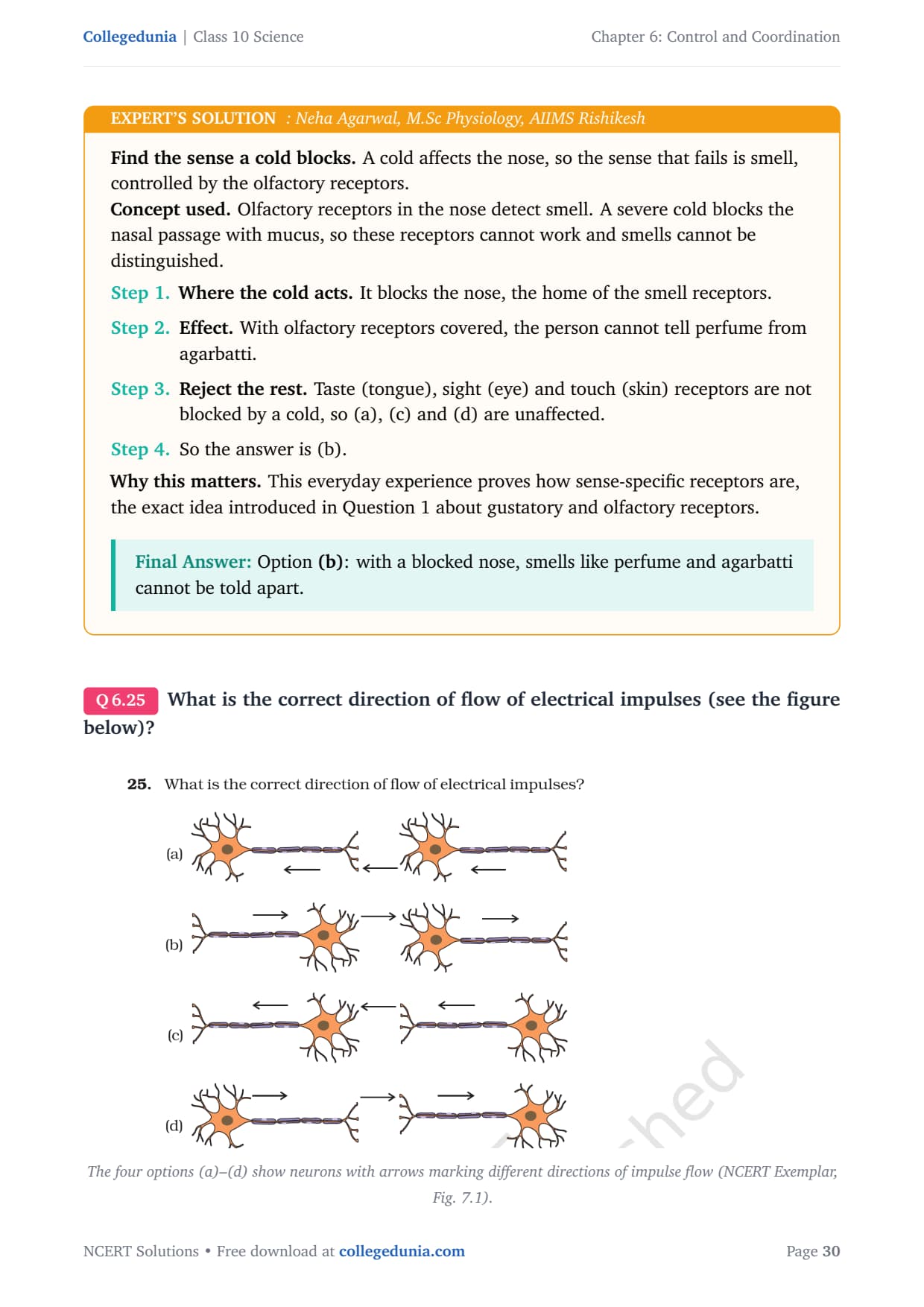
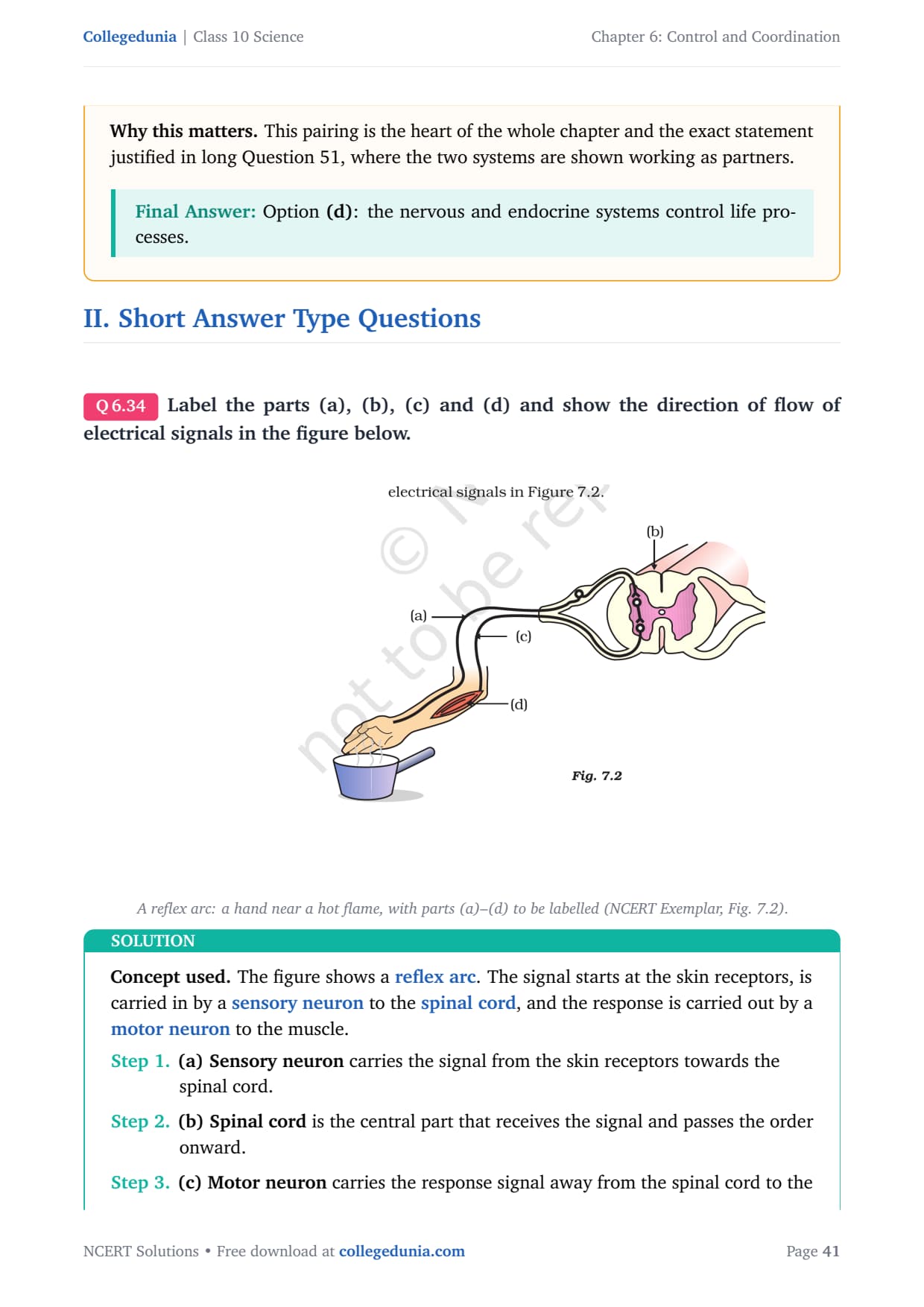
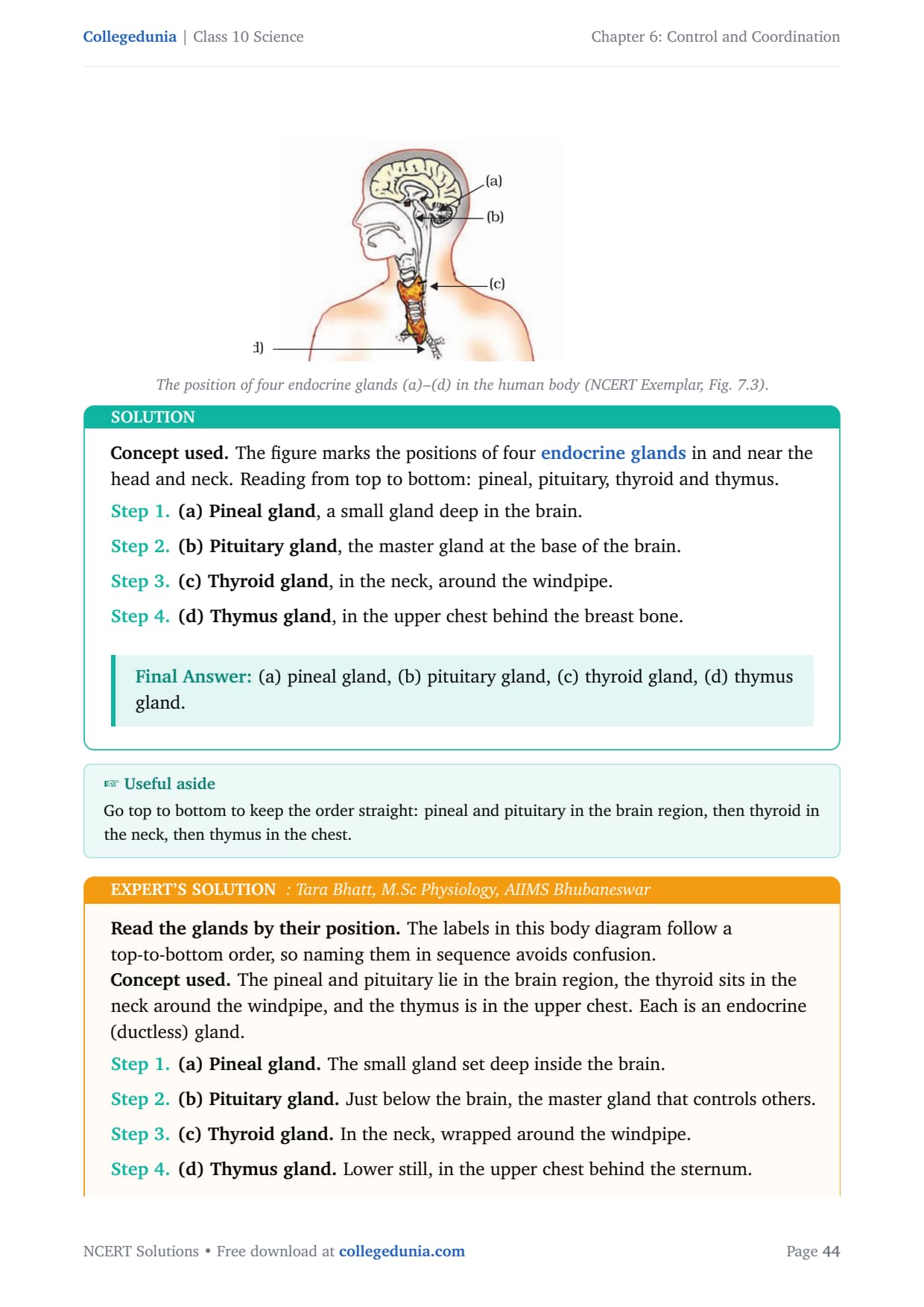
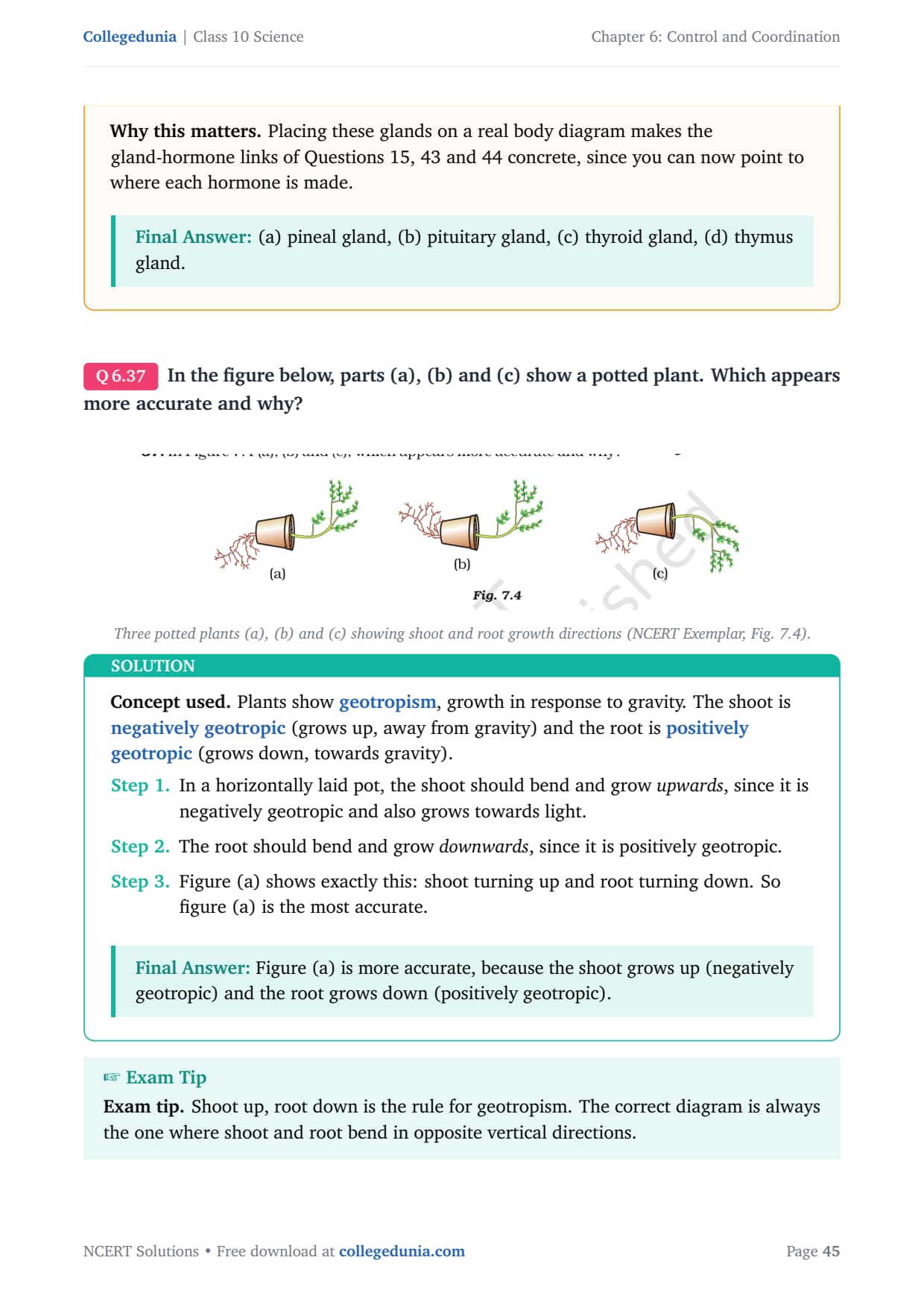
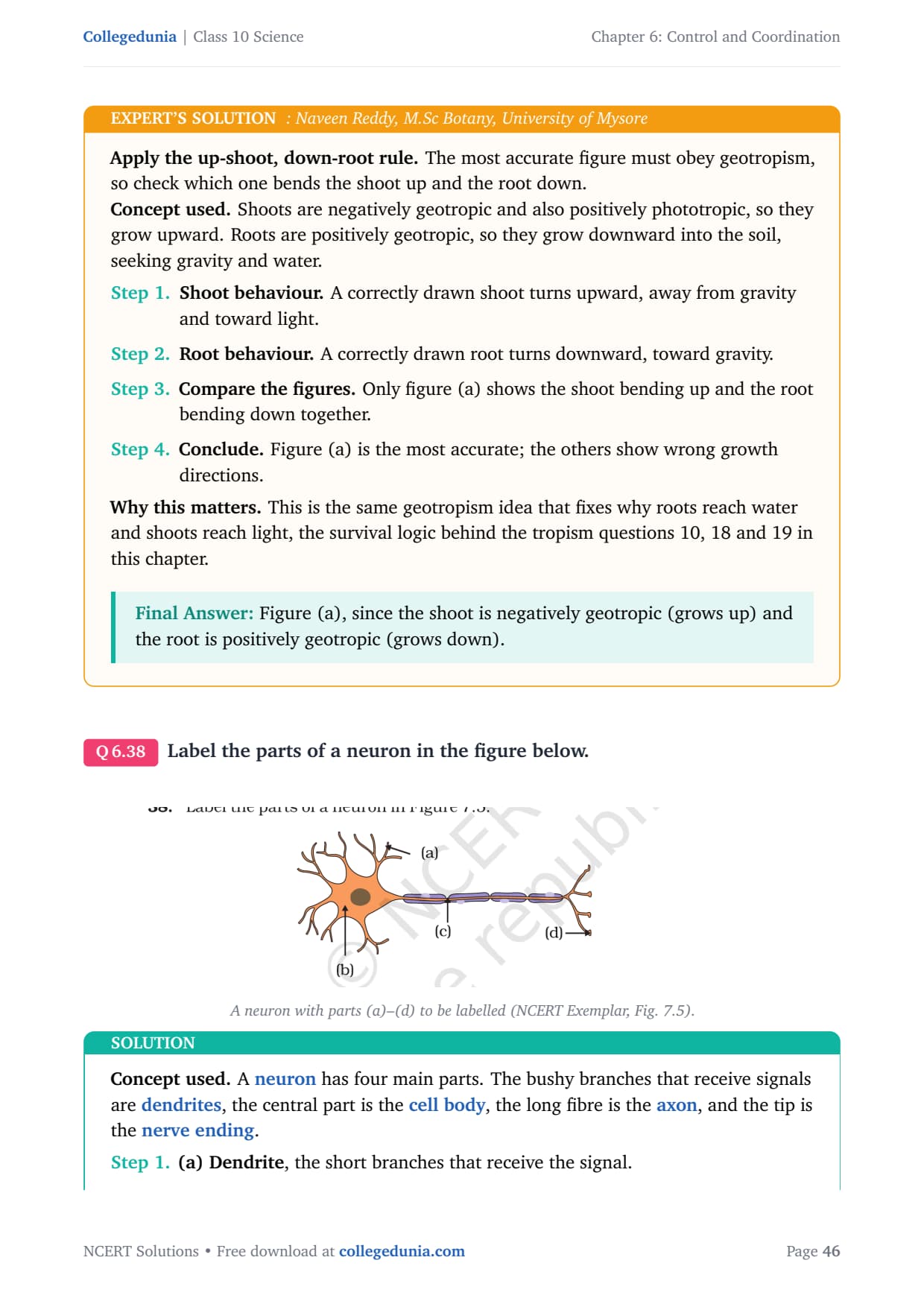
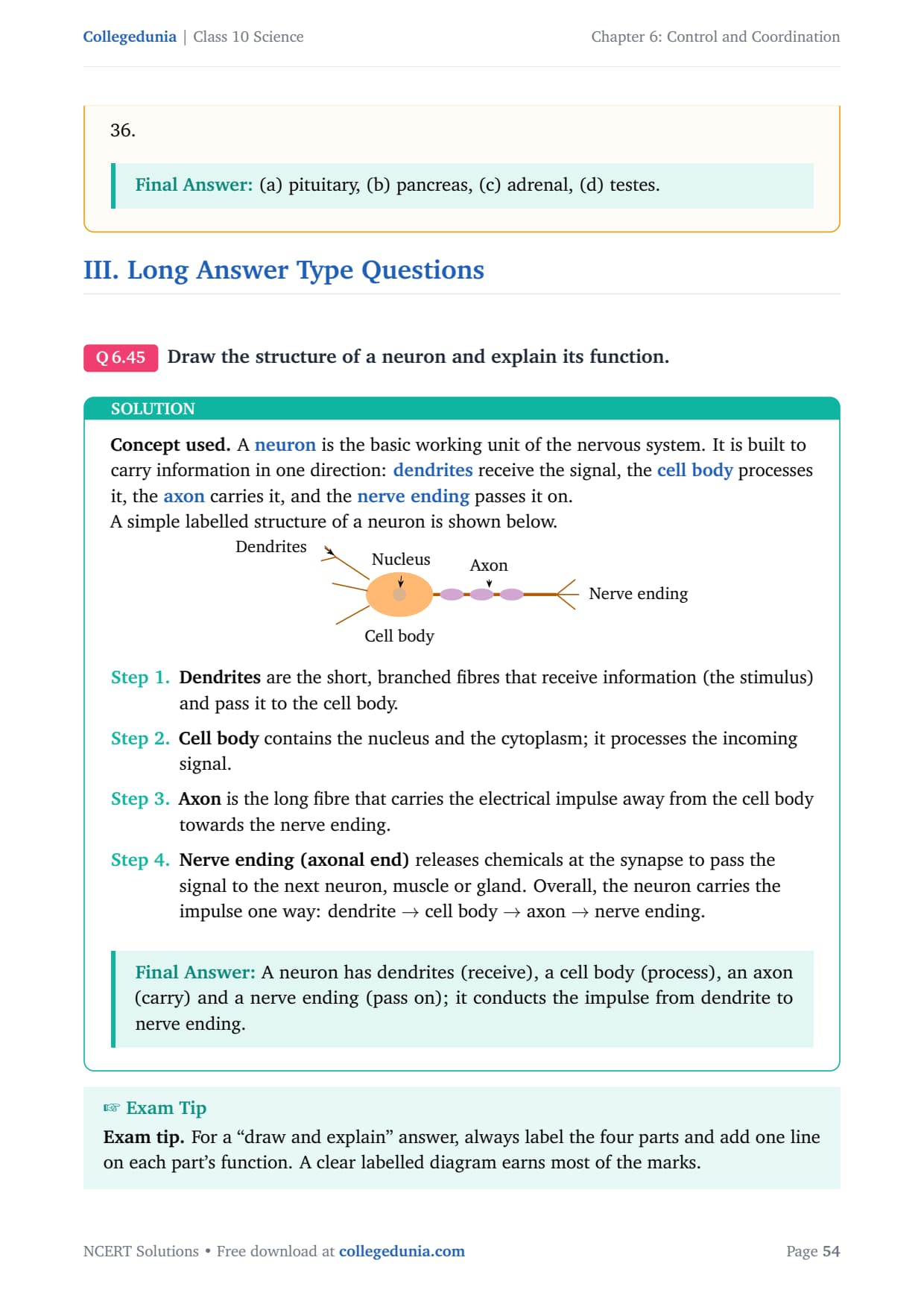
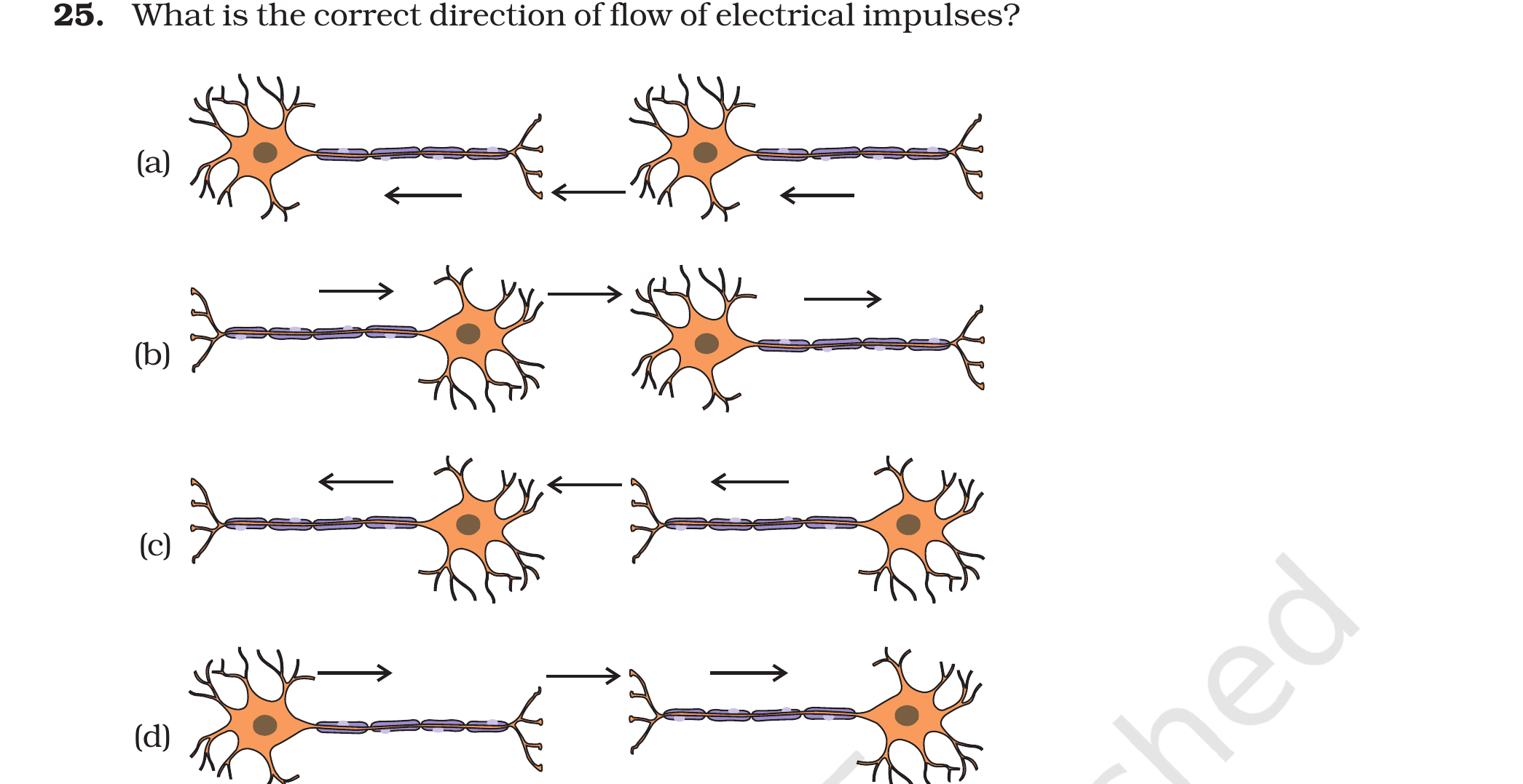
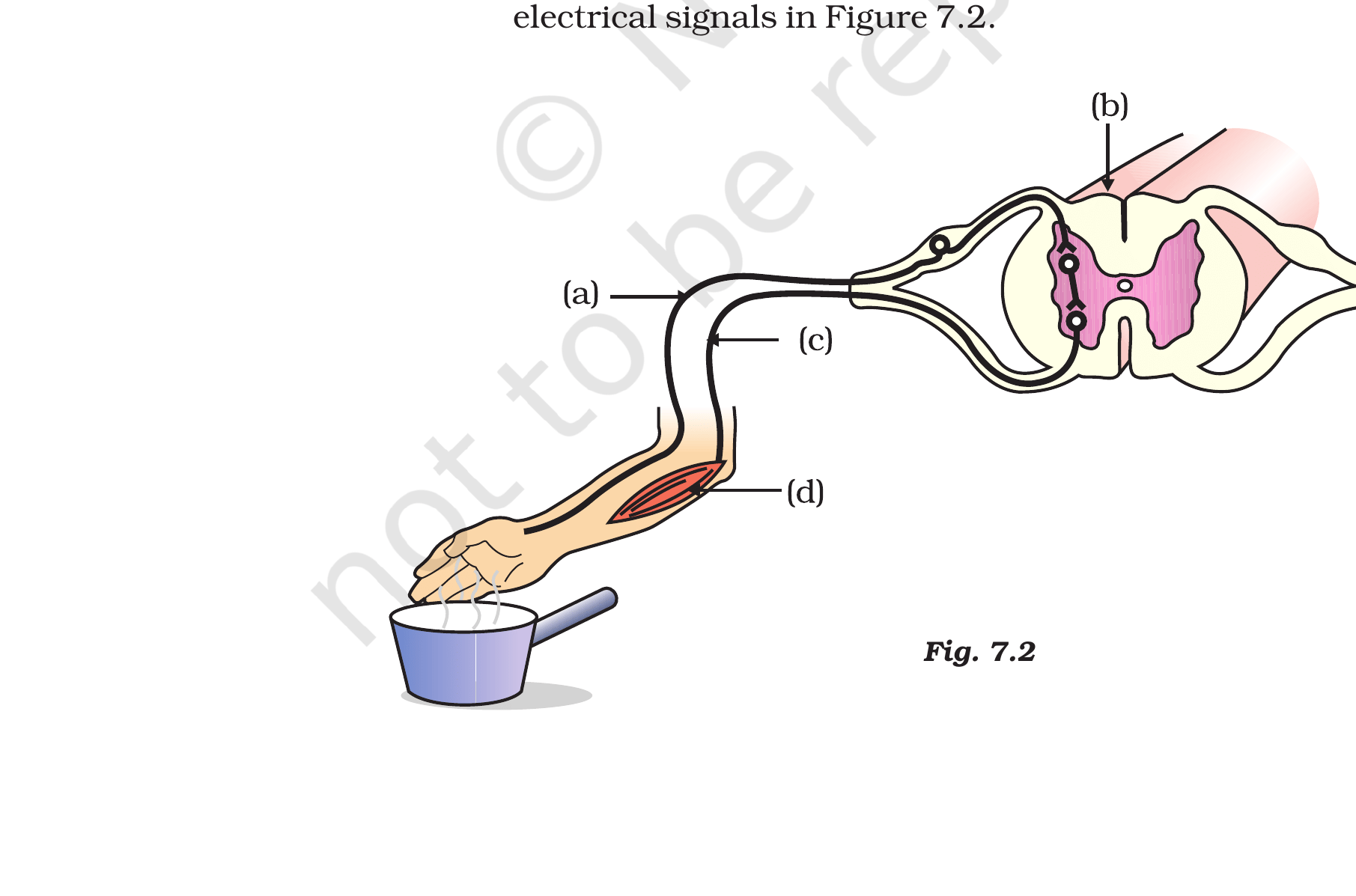
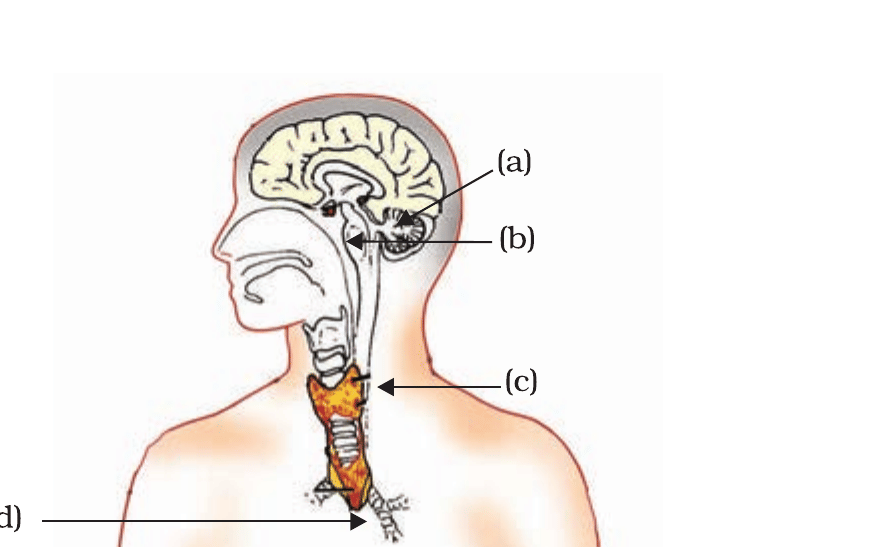
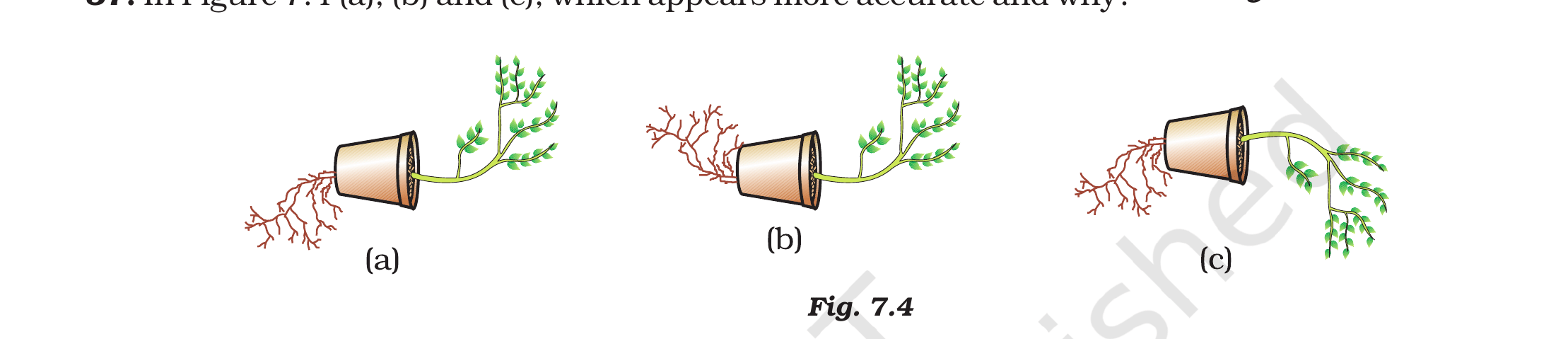
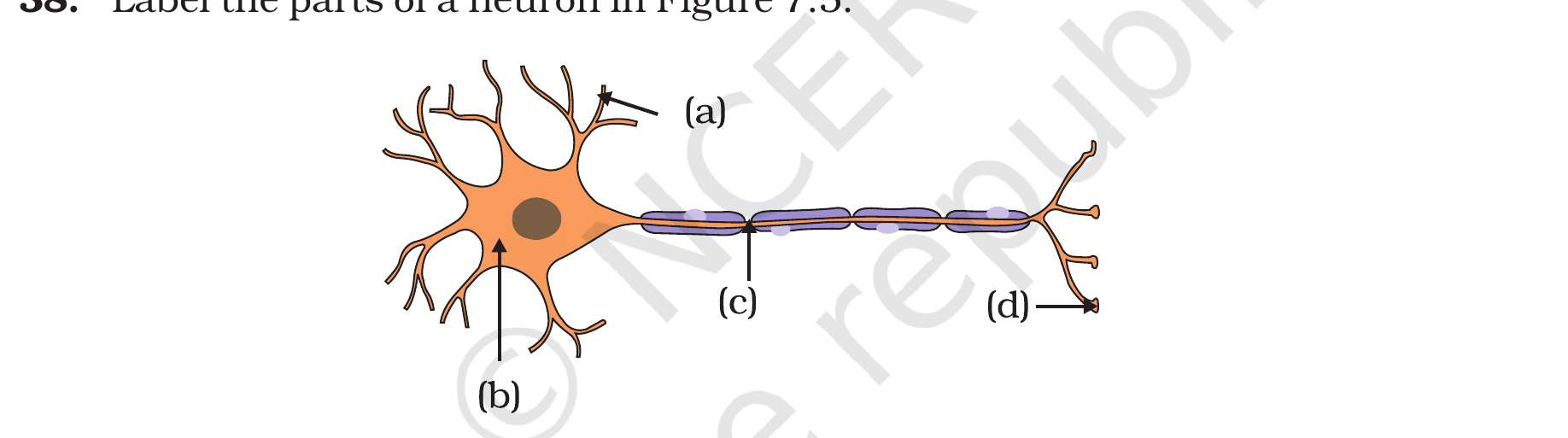



Comments