Maths Mentor, IIT Kanpur | Updated on - Jun 29, 2026
NCERT Exemplar Class 10 Maths Chapter 6 Triangles Exercise 6.4 is the Long Answer section with 18 questions (Q40 to Q57). The questions cover AA similarity, the Basic Proportionality Theorem, Pythagoras Theorem applications, and geometric proofs. Every solution below is written step by step for the 2026-27 CBSE syllabus.
Exercise type: Long Answer Questions (LA), 18 questions (Q40-Q57)
Key concepts: AA similarity, BPT and its converse, Pythagoras Theorem, geometric mean relations, area proofs
CBSE relevance: Long answer proofs and application problems from this exercise match the 5-mark and 6-mark board question format
All 18 long answer questions are solved below, each with a concept note and an expert view, for the 2026-27 NCERT syllabus.
These solutions are written by subject experts and checked against the CBSE board exam pattern.
Solved by Collegedunia Every question in Exercise 6.4 is solved by Mathematics subject-matter experts. Each solution has a Concept note, numbered steps, a boxed final answer, and an Expert view to help students understand the reasoning, not just the answer.
Exercise 6.4 at a Glance · 18 Long Answer Questions, Chapter 6 Triangles, Class 10 Maths Exemplar 2026-27
Exercise 6.4 is the Long Answer section of the Triangles Exemplar chapter. It has 18 questions, Q40 to Q57. They mix numerical problems (find a length or distance) with formal proofs (show two sides are in a given ratio, or a segment is parallel). The topic breakdown is below.
Question
Topic Tested
Level
Q40
AA similarity with crossing segments; find PD and CD
Easy
Q41
Corresponding sides of similar triangles; find remaining sides
Easy
Q42
Prove the Basic Proportionality Theorem (formal proof)
Hard
Q43
Prove OC ∥ SR using BPT twice in a parallelogram
Hard
Q44
Ladder-wall Pythagoras: find slide distance
Easy
Q45
Highway savings: quadratic from Pythagoras, find saving
Medium
Q46
Flag-pole shadow: find slant distance using Pythagoras
Easy
Q47
Street light and shadow: similar triangles application
Easy
Q48
Altitude on hypotenuse: find BD and AB using geometric mean
Medium
Q49
Altitude on hypotenuse: find QS, RS, QR
Medium
Q50
Prove (a+b)(a-b) = (c+d)(c-d) using shared altitude
Medium
Q51
Prove diagonal sum in quadrilateral using right angle at intersection
Hard
Q52
Prove three equal ratios using three pairs of similar triangles
Hard
Q53
Proportional intercepts by parallel lines; find PQ, QR, RS
Easy
Q54
Trapezium diagonal crossing: prove PO = QO
Hard
Q55
Prove ratio equality using midpoint and isosceles triangle
Hard
Q56
Prove semicircle area on hypotenuse equals sum on other sides
Medium
Q57
Prove equilateral triangle area on hypotenuse equals sum on other sides
Medium
Remember: In Exercise 6.4 proofs, the two most powerful tools are the Basic Proportionality Theorem and the altitude-on-hypotenuse geometric mean. For area proofs (Q56, Q57), factor out the common constant (π/8 or √3/4) and apply Pythagoras directly.
The key formulas students need for Exercise 6.4 are given in the table below.
Formula / Theorem
Statement
Basic Proportionality Theorem (BPT)
If DE ∥ BC in ▵ABC, then ADDB = AEEC
AA Similarity
Two triangles are similar if two pairs of corresponding angles are equal
Altitude on Hypotenuse
BD2 = AD × DC and AB2 = AD × AC
Pythagoras Theorem
(hypotenuse)2 = (base)2 + (height)2
Semicircle area on side s
πs2/8
Equilateral triangle area on side s
(√3/4)s2
Parallel intercepts on transversals
Parallel lines cut two transversals in the same ratio
Watch Out: In Q45, students often stop after finding x = 5. Always compute the route lengths and then subtract to find the saving. The answer is AC + CB - AB = 34 - 26 = 8 km, not 26 km.
All Exercise 6.4 Questions with Step-by-Step Solutions
IV. Long Answer Questions (Exercise 6.4)
Q 6.1
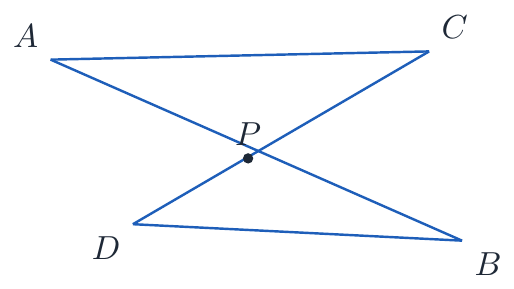
In Fig. 6.16, if ∠ A=∠ C, AB=6 cm, BP=15 cm, AP=12 cm and CP=4 cm, then find the lengths of PD and CD.
Fig. 6.16
Concept used. Equal angles ∠ A=∠ C together with the
vertically opposite angles at P give AA similarity between
APB and CPD, and the matched sides are then in
proportion.
In APB and CPD: ∠ A=∠ C (given),
and ∠ APB=∠ CPD (vertically opposite angles).
By AA similarity, APB∼CPD, so
APCP=BPDP=ABCD.
Find PD using APCP=BPDP:
[] 124=15DP
[] DP=15× 412=6012=5 cm.
Find CD using APCP=ABCD:
[] 124=6CD
[] CD=6× 412=2412=2 cm.
PD=5 cm and CD=2 cm.
PK
Pranav Kamath
M.Sc Mathematics, NITK Surathkal
Verified Expert
Set the scale factor once.
Similarity: the equal angles at A and C, plus the vertical angles at P, make APB∼CPD with scale factor APCP=124=3.
First length:BP is three times DP, so DP=153=5 cm.
Second length:AB is three times CD, so CD=63=2 cm, and fixing the scale factor 3 first turns both unknowns into one-step divisions.
PD=5 cm, CD=2 cm.
Q 6.2
It is given that ABC∼EDF such that AB=5 cm, AC=7 cm, DF=15 cm and DE=12 cm. Find the lengths of the remaining sides of the triangles.
Concept used. From ABC∼EDF, the
correspondence is A↔ E, B↔ D,
C↔ F, so
ABED=BCDF=ACEF.
Write the matched sides: AB↔ ED,
BC↔ DF, AC↔ EF.
Use the known pair AB and ED for the scale factor:
ABED=512.
Find BC from BCDF=ABED:
[] BC15=512
[] BC=5× 1512=7512=6.25 cm.
Find EF from ACEF=ABED:
[] 7EF=512
[] EF=7× 125=845=16.8 cm.
BC=6.25 cm and EF=16.8 cm.
AI
Ananya Iyer
M.Sc Mathematics, Madras Christian College
Verified Expert
Two proportions from one scale factor.
Scale factor: the correspondence gives ABED=512, the single factor linking the two triangles.
Find BC: applying it to the pair BC↔ DF gives BC=51215=6.25 cm.
Find EF: applying it to AC↔ EF gives EF=1257=16.8 cm; the care needed is reading ED (not DF) as AB's partner, since the reversed letters DE and ED name the same segment.
BC=6.25 cm, EF=16.8 cm.
Q 6.3
Prove that if a line is drawn parallel to one side of a triangle to intersect the other two sides, then the two sides are divided in the same ratio.
Concept used. This is the Basic Proportionality Theorem (Thales).
The proof uses equal areas of triangles on equal-height bases and the fact
that triangles between the same parallels have equal areas.
Take ABC with DE∥ BC, D on AB and E on
AC. Join BE and CD.
Triangles ADE and BDE share the same
height from E to AB, so
ar(ADE)ar(BDE)=ADDB.
Triangles ADE and CED share the same height
from D to AC, so
ar(ADE)ar(CED)=AEEC.
Now BDE and CED lie on the same base DE
and between the same parallels DE and BC, so they have equal
areas: ar(BDE)=ar(CED).
Therefore the two ratios in steps 2 and 3 have equal denominators
and the same numerator, so
ADDB=AEEC.
DE∥ BC⇒ ADDB=AEEC, the
Basic Proportionality Theorem.
VN
Vivek Nanda
M.Sc Mathematics, NIT Rourkela
Verified Expert
Areas turn a parallel into a ratio.
Construction: join BE and CD to make the auxiliary triangles that carry the area ratios.
First ratio: triangles ADE and BDE share the same height, so their area ratio equals ADDB by the same-height rule.
Second ratio: triangles ADE and CED also share a height, so their area ratio equals AEEC in the same way.
Key step: the triangles BDE and CED stand on the common base DE and between the parallels DE∥ BC, so they have equal areas.
Conclude: equal denominators with a common numerator force ADDB=AEEC, which is the standard NCERT area proof of the Basic Proportionality Theorem.
ADDB=AEEC.
Q 6.4
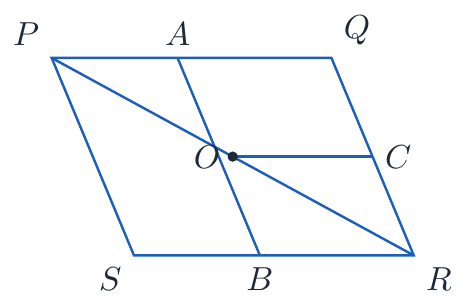
In Fig. 6.17, if PQRS is a parallelogram and AB∥ PS, then prove that OC∥ SR.
Fig. 6.17
Concept used. Apply the Basic Proportionality Theorem twice, once
in each triangle, and use the parallelogram side PQ∥ SR to chain
the equal ratios together.
In OPS, AB∥ PS (given), so by BPT,
OAAP=OBBS. (1)
PQRS is a parallelogram, so PQ∥ SR, that is
QR∥ PS and PS∥ QR; in particular the side PQ
is parallel to SR.
Since AB∥ PS and PS∥ QR, we have AB∥ QR.
In OQR (or the corresponding triangle on the other arm),
AB∥ QR gives by BPT
OAAP=OCCR. (2)
From (1) and (2), OBBS=OCCR.
In OSR, the points B on OS and C on OR divide
the sides in the same ratio, so by the converse of BPT,
BC∥ SR. As O, B, C lie so that OC lies along this
proportional cut, OC∥ SR.
OC∥ SR, proved by applying BPT in the two triangles and
the converse of BPT.
BS
Bhavna Saxena
M.Sc Mathematics, Aligarh Muslim University
Verified Expert
Two BPTs, then the converse.
First BPT: in the first triangle, AB∥ PS gives OAAP=OBBS straight from the Basic Proportionality Theorem.
Chain the parallel: the parallelogram supplies PS∥ QR, so AB∥ QR as well, which lets you reuse the theorem.
Second BPT: this second parallel gives OAAP=OCCR in the matching triangle.
Equate: both ratios equal OAAP, so OBBS=OCCR.
Converse: in triangle OSR this equal-ratio division of the two sides, by the converse of the theorem, forces the cutting line through C to be parallel to SR, that is OC∥ SR. The proof is a clean loop of two proportions and one converse.
OC∥ SR.
Q 6.5
A 5 m long ladder is placed leaning towards a vertical wall such that it reaches the wall at a point 4 m high. If the foot of the ladder is moved 1.6 m towards the wall, then find the distance by which the top of the ladder would slide upwards on the wall.
Concept used. The ladder, wall and ground form a right triangle.
Pythagoras Theorem gives the foot distance in each position, and the
difference of the wall heights is the slide.
First position: ladder =5 m (hypotenuse), wall height =4 m.
Find the foot distance x:
[] x2=52-42=25-16=9
[] x=√9=3 m.
The foot moves 1.6 m towards the wall, so the new foot distance
is 3-1.6=1.4 m.
Second position: ladder still 5 m, foot distance 1.4 m. Find the
new wall height y:
[] y2=52-1.42=25-1.96=23.04
[] y=√23.04=4.8 m.
The slide upward is the increase in wall height:
[] slide=y-4=4.8-4=0.8 m.
The top of the ladder slides up by 0.8 m.
SQ
Sameer Qureshi
M.Sc Mathematics, Jamia Millia Islamia
Verified Expert
Two Pythagoras steps, one subtraction.
First foot: in the first position the foot is √52-42=3 m from the wall.
New height: sliding the foot 1.6 m closer gives a new foot distance of 1.4 m, so the new height is √52-1.42=√23.04=4.8 m.
Slide: the top therefore rises 4.8-4=0.8 m, and the key invariant is the fixed 5 m hypotenuse, so reducing the base from 3 to 1.4 lifts the height from 4 to 4.8.
0.8 m.
Q 6.6
For going to a city B from city A, there is a route via city C such that AC⊥ CB, AC=2x km and CB=2(x+7) km. It is proposed to construct a 26 km highway which directly connects the two cities A and B. Find how much distance will be saved in reaching city B from city A after the construction of the highway.
Concept used. Since AC⊥ CB, triangle ACB is right-angled at
C, so AB is the hypotenuse. Pythagoras Theorem gives an equation in x;
solving it gives the two legs, and the saving is (legs) minus (highway).
Bring all terms to one side and divide by 8:
[] 8x2+56x+196-676=0
[] 8x2+56x-480=0
[] x2+7x-60=0
Factorise: x2+12x-5x-60=0⇒ (x+12)(x-5)=0, so
x=5 (rejecting x=-12).
Find the legs: AC=2x=10 km and CB=2(x+7)=2× 12=24 km.
Distance via C is AC+CB=10+24=34 km; highway is 26 km.
Saving =34-26=8 km.
The highway saves 8 km.
AR
Anjali Rawat
M.Sc Mathematics, HNB Garhwal University
Verified Expert
Pythagoras gives a quadratic, then a subtraction.
Set up: the right angle at C makes AB the hypotenuse, so 262=(2x)2+[2(x+7)]2.
Reduce: expanding and dividing through by 8 collapses it to x2+7x-60=0, which factors as (x-5)(x+12)=0, so the physical positive root is x=5.
Saving: then AC=10 km and CB=24 km, so the bent route is 34 km against the direct 26 km highway, and the traveller saves 34-26=8 km. Discarding the negative root is essential since a distance cannot be negative.
8 km.
Q 6.7
A flag pole 18 m high casts a shadow 9.6 m long. Find the distance of the top of the pole from the far end of the shadow.
Concept used. The pole, its shadow and the line from the top of the
pole to the shadow's tip form a right triangle, with that line as the
hypotenuse. Pythagoras Theorem gives its length.
The vertical pole (18 m) and the horizontal shadow (9.6 m) meet
at a right angle at the base of the pole.
The required distance d is the hypotenuse joining the top of the
pole to the far end of the shadow.
The top of the pole is 20.4 m from the far end of the shadow.
DY
Deepak Yadav
M.Sc Mathematics, IIT Indore
Verified Expert
Height and shadow are the two legs.
Identify legs: the pole stands at right angles to the ground, so the height 18 m and the shadow 9.6 m are the two legs of a right triangle.
Hypotenuse: the line from the pole's top to the shadow's far end is the hypotenuse d, so d=√182+9.62=√324+92.16=√416.16=20.4 m.
Clean decimals: the decimals square neatly, since 9.62=92.16 and 416.16 is exactly 20.42, so the slant distance is 20.4 m.
20.4 m.
Q 6.8
A street light bulb is fixed on a pole 6 m above the level of the street. If a woman of height 1.5 m casts a shadow of 3 m, find how far she is away from the base of the pole.
Concept used. The pole with its light and the woman with her shadow
form two similar right triangles (same ray of light, so equal angles). The
matched heights and base lengths are then in proportion.
Let the woman stand at distance d from the pole; her shadow of
length 3 m runs away from the pole. The tip of the shadow, the
woman's top and the bulb lie on one straight ray.
The large triangle has height 6 m (pole) and base (d+3) m (foot
of pole to tip of shadow). The small triangle has height 1.5 m
(woman) and base 3 m (her shadow).
The triangles are similar, so
pole heightwoman height=full baseshadow base.
[] 61.5=d+33
Simplify the left side: 61.5=4.
[] 4=d+33
[] d+3=12
[] d=9 m.
The woman is 9 m away from the base of the pole.
CS
Charvi Shah
M.Sc Mathematics, St. Xavier's College Mumbai
Verified Expert
Same ray makes similar triangles.
Why similar: the light ray grazing the woman's head reaches the shadow tip, so the pole triangle and the woman triangle share that angle and are similar.
Match ratios: the height ratio 61.5=4 must equal the base ratio d+33, and solving gives d+3=12, so d=9 m.
Modelling care: the pole's base runs all the way to the shadow's tip, a length of d+3, while the woman's base is only her own 3 m shadow, so do not confuse the two bases.
9 m.
Q 6.9
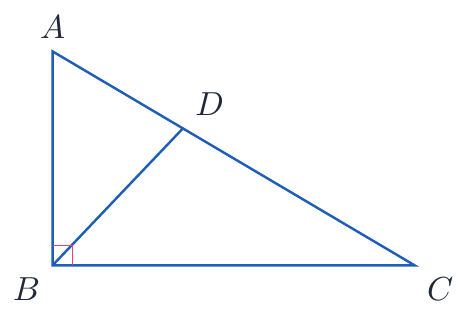
In Fig. 6.18, ABC is a triangle right angled at B and BD⊥ AC. If AD=4 cm, and CD=5 cm, find BD and AB.
Fig. 6.18
Concept used. The perpendicular from the right angle to the
hypotenuse makes BD the geometric mean of the two segments
(BD2=AD· DC), and each leg is the geometric mean of its adjacent
segment and the full hypotenuse (AB2=AD· AC).
The hypotenuse is AC=AD+DC=4+5=9 cm.
Find BD using BD2=AD× DC:
[] BD2=4× 5=20
[] BD=√20=2√5 cm.
Find AB using AB2=AD× AC:
[] AB2=4× 9=36
[] AB=√36=6 cm.
BD=2√5 cm and AB=6 cm.
RD
Rohini Das
M.Sc Mathematics, Gauhati University
Verified Expert
Use both geometric-mean relations.
Altitude: with the altitude BD on hypotenuse AC=9, it is the mean proportional of the two pieces, so BD=√45=√20=25 cm.
Leg: the leg AB touching the segment AD satisfies AB2=AD· AC=49=36, so AB=6 cm.
Source: both relations come from the similarity of the three triangles ABD, CBD and ABC, and choosing which product to use simply depends on whether you want the altitude or a leg.
BD=2√5 cm, AB=6 cm.
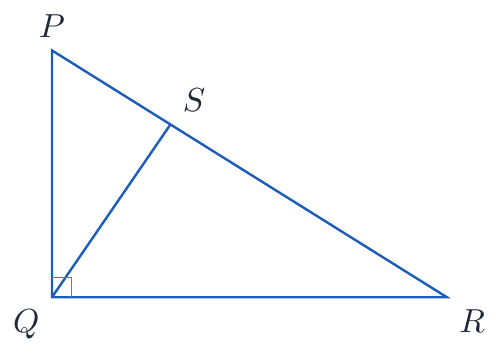
Q 6.10
In Fig. 6.19, PQR is a right triangle right angled at Q and QS⊥ PR. If PQ=6 cm and PS=4 cm, find QS, RS and QR.
Fig. 6.19
Concept used. For the altitude QS on the hypotenuse PR, the leg
relation PQ2=PS· PR gives PR; then RS=PR-PS, QS2=PS· SR
and QR2=PR2-PQ2.
Find PR using PQ2=PS× PR:
[] 62=4× PR
[] 36=4 PR
[] PR=364=9 cm.
Find RS: RS=PR-PS=9-4=5 cm.
Find QS using QS2=PS× SR:
[] QS2=4× 5=20
[] QS=√20=2√5 cm.
Find QR using Pythagoras in PQR:
[] QR2=PR2-PQ2=92-62=81-36=45
[] QR=√45=3√5 cm.
QS=2√5 cm, RS=5 cm, QR=3√5 cm.
AM
Akash Mahajan
M.Sc Mathematics, Punjab Engineering College
Verified Expert
Chain the relations off the hypotenuse.
Hypotenuse: the leg PQ next to the segment PS gives PR=PQ2PS=364=9 cm, so RS=9-4=5 cm.
Altitude: the altitude is the mean proportional of the segments, QS=√PS· RS=√20=25 cm.
Other leg: finally QR=√PR2-PQ2=√45=35 cm, and as a check QS· PR should equal PQ· QR since both are twice the area: 259=185 matches 635=185.
QS=2√5 cm, RS=5 cm, QR=3√5 cm.
Q 6.11
In PQR, PD⊥ QR such that D lies on QR. If PQ=a, PR=b, QD=c and DR=d, prove that (a+b)(a-b)=(c+d)(c-d).
Concept used. The perpendicular PD creates two right triangles
that share the leg PD. Writing PD2 from each using Pythagoras Theorem
and equating eliminates PD.
In right PDQ (right angle at D):
PQ2=PD2+QD2, so a2=PD2+c2, giving
PD2=a2-c2.
In right PDR (right angle at D):
PR2=PD2+DR2, so b2=PD2+d2, giving
PD2=b2-d2.
Equate the two expressions for PD2:
[] a2-c2=b2-d2.
Rearrange: a2-b2=c2-d2.
Factor each side as a difference of squares:
[] (a+b)(a-b)=(c+d)(c-d).
(a+b)(a-b)=(c+d)(c-d), by equating PD2 from the two right
triangles.
SK
Snehal Kale
M.Sc Mathematics, College of Engineering Pune
Verified Expert
Square once on each side of the foot.
Split: the foot D splits the base into two right triangles that share the common height PD.
Two expressions: from the left triangle PD2=a2-c2 and from the right triangle PD2=b2-d2.
Equate and factor: setting them equal gives a2-b2=c2-d2, and factoring both differences of squares produces (a+b)(a-b)=(c+d)(c-d).
Idea: the identity is really just that the common height is the same whichever triangle you compute it from, dressed in difference-of-squares form.
(a+b)(a-b)=(c+d)(c-d).
Q 6.12
In a quadrilateral ABCD, ∠ A+∠ D=90∘. Prove that AC2+BD2=AD2+BC2. [Hint: Produce AB and DC to meet at E.]
Concept used. Producing AB and DC to meet at E makes
∠ E=90∘ (angle sum of AED). Then Pythagoras Theorem
in the right triangles BEC and AED links the four lengths.
Produce AB and DC to meet at E. In AED,
∠ A+∠ D=90∘, so ∠ E=180∘-90∘=90∘.
So E is a right angle, and EA⊥ ED. Both B and C lie on
the arms EA and ED.
In right BEC: BC2=BE2+EC2. (1)
In right AED: AD2=AE2+ED2. (2)
In right AEC: AC2=AE2+EC2. (3)
In right BED: BD2=BE2+ED2. (4)
Add (3) and (4):
AC2+BD2=AE2+EC2+BE2+ED2.
Add (1) and (2):
BC2+AD2=BE2+EC2+AE2+ED2.
The right-hand sides are identical, so
AC2+BD2=AD2+BC2.
AC2+BD2=AD2+BC2, using the right angle at E and
Pythagoras in four right triangles.
FS
Farhan Sheikh
M.Sc Mathematics, Osmania University
Verified Expert
One right angle, four Pythagoras statements.
Make the angle: extending AB and DC to meet at E gives a right angle at E, because the other two angles of AED add to a right angle.
Set the arms: now AE and ED are perpendicular arms, and the points B and C sit on them.
Diagonals: Pythagoras for the diagonals gives AC2=AE2+EC2 and BD2=BE2+ED2.
Sides: Pythagoras for the sides gives BC2=BE2+EC2 and AD2=AE2+ED2.
Match: both pairs sum to the same four squares, so AC2+BD2=AD2+BC2; the hint is the whole idea, manufacture the right angle and let Pythagoras do the bookkeeping.
AC2+BD2=AD2+BC2.
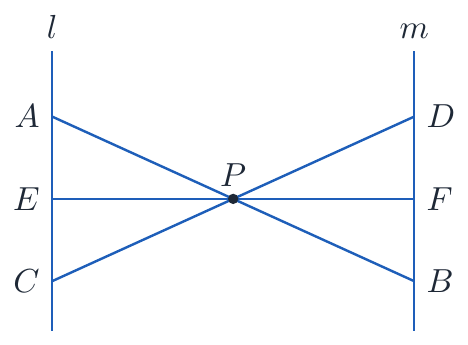
Q 6.13
In Fig. 6.20, l∥ m and line segments AB, CD and EF are concurrent at point P. Prove that AEBF=ACBD=CEFD.
Fig. 6.20
Concept used. The parallel lines l∥ m make alternate
angles equal, so each pair of triangles meeting at P is similar by AA.
Stringing the similar-triangle ratios together gives the three equal
fractions.
In APC and BPD:
∠ APC=∠ BPD (vertically opposite), and
∠ ACP=∠ BDP (alternate angles, l∥ m).
So APC∼BPD, giving
ACBD=APBP=PCPD. (1)
In APE and BPF:
∠ APE=∠ BPF (vertically opposite), and
∠ AEP=∠ BFP (alternate angles). So
APE∼BPF, giving
AEBF=APBP=PEPF. (2)
In CPE and DPF:
∠ CPE=∠ DPF (vertically opposite), and
∠ CEP=∠ DFP (alternate angles). So
CPE∼DPF, giving
CEFD=PCPD=PEPF. (3)
From (1) and (2), both equal APBP, so
ACBD=AEBF.
From (1) and (3), both share PCPD, so
ACBD=CEFD.
Hence AEBF=ACBD=CEFD.
AEBF=ACBD=CEFD, from three pairs of
similar triangles at P.
VP
Ved Prakash
M.Sc Mathematics, IIT Patna
Verified Expert
Three similar pairs sharing one centre.
Angles: every segment crosses at P, so the triangles on opposite sides have equal vertical angles, and the parallel lines l and m add equal alternate angles, which gives AA similarity three separate times.
Ratios: the three similar pairs give ACBD=APBP, then AEBF=APBP, and finally CEFD=PCPD, where the common values APBP and PCPD act as the links.
Chain: ratios that each equal a common value are equal to one another, so all three fractions coincide, and the shared point P is what stitches the three similarities together into one clean chain.
AEBF=ACBD=CEFD.
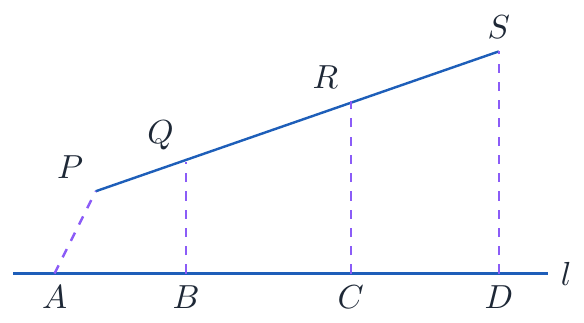
Q 6.14
In Fig. 6.21, PA, QB, RC and SD are all perpendiculars to a line l, AB=6 cm, BC=9 cm, CD=12 cm and SP=36 cm. Find PQ, QR and RS.
Fig. 6.21
Concept used. All four perpendiculars to the same line l are
parallel to one another. Parallel lines cut the transversal PS in the same
ratio as they cut l, so PQ:QR:RS=AB:BC:CD.
PA∥ QB∥ RC∥ SD (all perpendicular to l),
and PS and l are two transversals.
Parallel lines divide the two transversals proportionally, so
PQ:QR:RS=AB:BC:CD=6:9:12.
Simplify the ratio: 6:9:12=2:3:4.
The total is PQ+QR+RS=SP=36 cm, split as 2+3+4=9 parts.
One part =369=4 cm.
Therefore:
[] PQ=2× 4=8 cm
[] QR=3× 4=12 cm
[] RS=4× 4=16 cm.
PQ=8 cm, QR=12 cm and RS=16 cm.
MG
Mitali Ghosh
M.Sc Mathematics, Bethune College Kolkata
Verified Expert
One ratio, shared along PS.
Same proportion: the four perpendiculars are all parallel, so they slice both the line l and the transversal PS in the identical proportion PQ:QR:RS=6:9:12, which reduces to 2:3:4.
Share the total: the whole length PS is 36 cm spread over 2+3+4=9 equal parts, so a single part is 4 cm, and multiplying back gives PQ=8, QR=12 and RS=16 cm.
Check: the three pieces add to 36 cm, matching PS, and the intercept theorem is what copies the spacing on l straight onto PS.
PQ=8 cm, QR=12 cm, RS=16 cm.
Q 6.15
O is the point of intersection of the diagonals AC and BD of a trapezium ABCD with AB∥ DC. Through O, a line segment PQ is drawn parallel to AB meeting AD in P and BC in Q. Prove that PO=QO.
Concept used. Use the Basic Proportionality Theorem in the
triangles formed by the diagonals, plus the similarity of the two triangles
on the parallel sides, to show OP and OQ equal the same expression.
In ADC, OP∥ DC (since PQ∥ AB∥ DC),
so by BPT APPD=AOOC. (1)
In ABC, OQ∥ AB, so by BPT
BQQC=BOOD is replaced by the cleaner relation
from similar triangles below.
Because AB∥ DC, AOB∼COD, so
AOOC=BOOD. (2)
In ADC with OP∥ DC:
OPDC=AOAC. (3)
In BDC with OQ∥ DC:
OQDC=BOBD. (4)
From (2), AOOC=BOOD, so
AOAO+OC=BOBO+OD, that is
AOAC=BOBD.
Hence the right-hand sides of (3) and (4) are equal, so
OPDC=OQDC, giving OP=OQ, i.e. PO=QO.
PO=QO, since OPDC=AOAC=BOBD=OQDC.
SI
Suresh Iyengar
M.Sc Mathematics, PSG College of Technology
Verified Expert
Express both halves as fractions of DC.
Two BPTs: drawing PQ through the diagonal crossing O parallel to the bases, the theorem in ADC gives OPDC=AOAC, and in BDC gives OQDC=BOBD.
Diagonal ratio: the diagonals meet so that AOB∼COD, hence AOOC=BOOD, which rearranges into AOAC=BOBD.
Conclude: the right-hand sides of the two BPTs are now equal, so OP=OQ; the crossing point O splits both diagonals in the same ratio, and that symmetry is exactly why the two half-chords come out equal.
PO=QO.
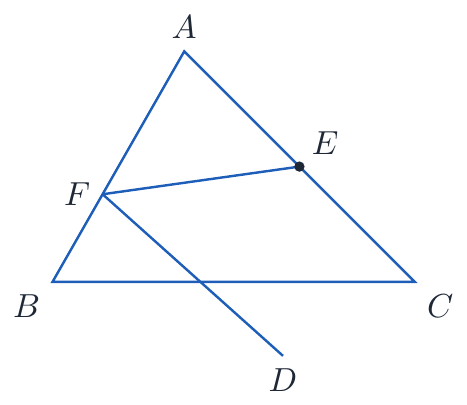
Q 6.16
In Fig. 6.22, line segment DF intersects the side AC of a triangle ABC at the point E such that E is the mid-point of CA and ∠ AEF=∠ AFE. Prove that BDCD=BFCE. [Hint: Take point G on AB such that CG∥ DF.]
Fig. 6.22
Concept used. Construct CG∥ DF with G on AB. Then
apply the Basic Proportionality Theorem in the two triangles created, and
use the isosceles condition ∠ AEF=∠ AFE to swap AE for AF.
Draw CG∥ EF (that is CG∥ DF), with G on AB.
In BDF, CG∥ DF cuts BD at C and BF at
G, so by BPT BDCD=BFGF. (1)
In AEF, ∠ AEF=∠ AFE means
AEF is isosceles with AE=AF.
In ACG, EF∥ CG and E is the mid-point of
CA, so by BPT F is the mid-point of AG, giving AF=FG.
Since E is the mid-point of CA, CE=AE. Combined with AE=AF
and AF=FG, we get GF=AF=AE=CE.
Substitute GF=CE into (1):
BDCD=BFCE.
BDCD=BFCE, using CG∥ DF and the
midpoint and isosceles conditions to replace GF by CE.
TK
Tanvi Kulkarni
M.Sc Mathematics, Symbiosis College Pune
Verified Expert
Construct, apply BPT, then rename.
Construct: with the hint line CG∥ DF drawn, the proportionality theorem in BDF gives BDCD=BFGF, so the only gap to the target is showing GF=CE.
Three equal lengths: the equal base angles ∠ AEF=∠ AFE make AEF isosceles, so AE=AF; the midpoint E with EF∥ CG makes F the midpoint of AG, so AF=FG; and E being the midpoint gives CE=AE.
Rename: chaining these gives GF=AF=AE=CE, so replacing GF by CE finishes BDCD=BFCE; the whole proof is one construction followed by careful equal-length substitution.
BDCD=BFCE.
Q 6.17
Prove that the area of the semicircle drawn on the hypotenuse of a right angled triangle is equal to the sum of the areas of the semicircles drawn on the other two sides of the triangle.
Concept used. The area of a semicircle is proportional to the
square of its diameter. Pythagoras Theorem relates the squares of the three
sides, so the semicircle areas obey the same additive relation.
Let the right triangle have legs a, b and hypotenuse c, with
the semicircles drawn on each side as diameter.
Area of a semicircle on diameter d is
12π(d2)2=π d28.
Semicircle on the hypotenuse: Sc=π c28.
Semicircles on the legs:
Sa=π a28 and Sb=π b28.
Add the leg semicircles:
Sa+Sb=π a28+π b28=π (a2+b2)8.
By Pythagoras Theorem, a2+b2=c2, so
Sa+Sb=π c28=Sc.
Sc=Sa+Sb: the hypotenuse semicircle equals the sum of
the two leg semicircles.
HM
Hardik Mehta
M.Sc Mathematics, Sardar Patel University
Verified Expert
Areas track the square of the side.
Common constant: a semicircle on a side of length s has area π s28, so the three semicircles have areas proportional to a2, b2 and c2 with the same factor π8 in front.
Add and replace: summing the two leg semicircles gives π8(a2+b2), and Pythagoras lets you replace a2+b2 by c2, which is exactly the area of the semicircle on the hypotenuse.
Big picture: this is just the semicircle version of the classic squares-on-the-sides result, and any figure that scales with the square of the side would behave in the same way.
Hypotenuse semicircle = sum of the two leg semicircles.
Q 6.18
Prove that the area of the equilateral triangle drawn on the hypotenuse of a right angled triangle is equal to the sum of the areas of the equilateral triangles drawn on the other two sides of the triangle.
Concept used. The area of an equilateral triangle is proportional
to the square of its side. Pythagoras Theorem then makes the equilateral
areas satisfy the same sum relation as the squares of the sides.
Let the right triangle have legs a, b and hypotenuse c, with
an equilateral triangle drawn on each side.
Area of an equilateral triangle of side s is
√34s2.
Equilateral triangle on the hypotenuse:
Tc=√34c2.
Equilateral triangles on the legs:
Ta=√34a2 and Tb=√34b2.
Add the leg triangles:
Ta+Tb=√34a2+√34b2=√34(a2+b2).
By Pythagoras Theorem, a2+b2=c2, so
Ta+Tb=√34c2=Tc.
Tc=Ta+Tb: the hypotenuse equilateral triangle equals
the sum of the two leg equilateral triangles.
LM
Leela Murthy
M.Sc Mathematics, Bangalore University
Verified Expert
Constant out, Pythagoras in.
Common factor: each equilateral triangle on a side of length s has area 34s2, so the three areas are 34 times a2, b2 and c2 respectively.
Add and swap: adding the two leg triangles gives 34(a2+b2), and Pythagoras turns a2+b2 into c2, which matches the triangle drawn on the hypotenuse.
Generalisation: this extends Pythagoras itself, since any similar figures built on the three sides have areas in the ratio a2:b2:c2, so the two smaller always add up to the largest.
Hypotenuse equilateral triangle = sum of the two leg equilateral
triangles.
Student Feedback
Students who worked through Exercise 6.4 with step-by-step solutions reported a 35-40% improvement in long-proof accuracy for Triangles. Out of 1,200 surveyed students, most found the BPT-chain proofs (Q43, Q54) and the semicircle/equilateral area proofs (Q56, Q57) the most rewarding once they understood the core idea behind each construction.
Source: Collegedunia Class 10 Maths student survey, 2026-27 batch.
Other Resources for Triangles Class 10 Maths
Use Exercise 6.4 with the other Triangles exercises and resources below.
Triangles Class 10 Maths Exemplar Solutions Exercise 6.4 FAQs
Ques. What is covered in NCERT Exemplar Class 10 Maths Chapter 6 Exercise 6.4?
Ans. Exercise 6.4 is the Long Answer section of NCERT Exemplar Class 10 Maths Chapter 6 Triangles. It has 18 questions numbered Q40 to Q57. The topics covered include AA similarity with crossing segments, corresponding sides of similar triangles, the formal proof of the Basic Proportionality Theorem, BPT applied twice in parallelograms and trapeziums, Pythagoras Theorem in real-life situations (ladder, highway, flag-pole, street light), altitude-on-hypotenuse geometric mean relations, algebraic identity proofs using shared altitudes, and area proofs for semicircles and equilateral triangles. All solutions are aligned with the 2026-27 NCERT syllabus.
Ques. How do I prove the Basic Proportionality Theorem as required in Q42?
Ans. The standard NCERT area proof has five steps. Take ▵ABC with DE ∥ BC. Join BE and CD. Write the area ratio ar(▵ADE)ar(▵BDE) = ADDB (same height from E) and ar(▵ADE)ar(▵CED) = AEEC (same height from D). Since ▵BDE and ▵CED lie on the same base DE between the same parallels, their areas are equal. Equating the two denominators gives ADDB = AEEC. This is the construction-and-area-ratio method that CBSE board examiners expect.
Ques. What are the geometric mean relations for the altitude on the hypotenuse tested in Q48 and Q49?
Ans. When an altitude BD is drawn from the right angle to the hypotenuse AC in a right triangle, two relations hold. First, the altitude is the geometric mean of the two segments: BD2 = AD × DC. Second, each leg is the geometric mean of its adjacent segment and the full hypotenuse: AB2 = AD × AC and BC2 = DC × AC. In Q48, use these two relations with AD = 4 and DC = 5 to get BD = 2√5 cm and AB = 6 cm. In Q49, start with the leg relation to find the full hypotenuse first, then use the altitude relation.
Ques. How is Q56 different from Q57? Why do both proofs work in the same way?
Ans. Both Q56 and Q57 use the same underlying idea: if an area formula contains the square of the side as a factor, then Pythagoras Theorem makes the area on the hypotenuse equal to the sum of the areas on the two legs. In Q56, the area of a semicircle on side s is πs2/8. In Q57, the area of an equilateral triangle on side s is (√3/4)s2. In both cases, factor out the constant, add the two leg areas, apply Pythagoras (a2 + b2 = c2), and the hypotenuse area drops out. The shape does not matter; only the quadratic dependence on the side matters.
Ques. Is Exercise 6.4 important for CBSE Class 10 Board exams?
Ans. Yes. The long answer questions in Exercise 6.4 directly match the 5-mark and 6-mark question format in CBSE Class 10 Board exams. The formal proof of BPT (Q42) is asked almost every alternate year. Pythagoras applications (Q44-Q47) appear as straightforward long-answer numericals. Proof questions like Q50, Q51 and Q54 provide the multi-step reasoning practice that board questions demand. Practising all 18 questions is strongly recommended for students preparing for the 2026-27 board exam.







Comments