Maths Strategist, Olympiad Coach | Updated on - Jun 29, 2026
NCERT Exemplar Class 10 Maths Chapter 6 Triangles Exercise 6.3 is the Short Answer section. Its 15 questions (Q25 to Q39) test the similarity criteria, the Basic Proportionality Theorem, area ratios, and the Pythagoras Theorem. Every solution below is worked step by step for the 2026-27 CBSE syllabus.
Exercise type: Short Answer Questions (SA), 15 questions
Key concepts: AA/SAS/SSS similarity, BPT and converse, area ratio rule, Pythagoras Theorem and its converse
CBSE relevance: Short answer proofs and numericals from this exercise appear in 3-mark and 4-mark board questions nearly every year
Below you get all 15 solved short answer questions, each with a concept note and an expert view, for the 2026-27 NCERT syllabus.
These solutions are written by subject experts, checked against the CBSE board pattern, and aligned with the 2026-27 NCERT Class 10 Mathematics syllabus.
Solved by Collegedunia Every question in Exercise 6.3 is solved by Mathematics subject-matter experts. Each solution has a Concept note, numbered steps, a boxed final answer, and an Expert view to help students understand the reasoning, not just the answer.
Exercise 6.3 at a Glance · 15 Short Answer Questions, Chapter 6 Triangles, Class 10 Maths Exemplar 2026-27
Exercise 6.3 Overview and Key Formulas
Exercise 6.3 is the Short Answer section of Chapter 6, with 15 questions (Q25 to Q39). They mix proof-type problems with numericals like find x, find area, or find a side. The topic breakdown is in the table below.
Question
Topic Tested
Difficulty
Q25
Right angle (converse of Pythagoras) + altitude-on-hypotenuse mean proportional
Hard
Q26
BPT: find x for DE ∥ AB (numerical)
Easy
Q27
Congruence to similarity: prove PTS ∼ PRQ (SAS)
Medium
Q28
Trapezium diagonals: area ratio of two similar triangles
Easy
Q29
Parallel lines in figure: prove product relation (AA similarity)
Medium
Q30
Altitude of equilateral triangle (Pythagoras, numerical)
Easy
Q31
Perimeter of similar triangle using scale factor
Easy
Q32
Find area ratio of ADE to trapezium DECB
Medium
Q33
Trapezium with parallel segment: find AD using BPT
Medium
Q34
Area of larger similar triangle given side ratio and smaller area
Easy
Q35
Prove ∠ PQR = 90∘ given QN2 = PN · NR
Hard
Q36
Find side of smaller triangle given area ratio
Easy
Q37
AA similarity with a mean proportional; find BD (numerical)
Medium
Q38
Shadow-and-tower similar triangles (application)
Easy
Q39
Ladder-wall right triangle; find wall height (Pythagoras)
Easy
Remember: The two most powerful tools in this exercise are AA similarity and the altitude-on-hypotenuse relation. Whenever two triangles share a common angle plus one more equal angle, use AA. Whenever you see a2 = bc, read it as one side being the geometric mean of the other two.
The key formulas students need for Exercise 6.3 are listed below.
Formula / Theorem
Statement
Basic Proportionality Theorem (BPT)
If DE ∥ BC in ABC, then ADDB = AEEC
AA Similarity
Two triangles are similar if two pairs of corresponding angles are equal
SAS Similarity
Two pairs of sides are in the same ratio and the included angles are equal
Area Ratio of Similar Triangles
ar(ABC)ar(PQR) = (ABPQ)2
Pythagoras Theorem
In a right triangle: (hypotenuse)2 = (base)2 + (height)2
Altitude on Hypotenuse
If BD ⊥ AC in right with right angle at B, then BD2 = AD × DC
Perimeter Ratio
If two triangles are similar with side ratio k, their perimeters are also in ratio k
Watch Out: In Q32 and Q34, students often confuse the trapezium areaDECB with the full triangle area ABC. The trapezium is the big triangle minus the small one. Subtract the small area from the large, then take the ratio.
All Exercise 6.3 Questions with Step-by-Step Solutions
III. Short Answer Questions (Exercise 6.3)
Q 6.1
In a PQR, PR2-PQ2=QR2 and M is a point on side PR such that QM⊥ PR. Prove that QM2=PM× MR.
Concept used. The condition PR2=PQ2+QR2 is the converse
of Pythagoras Theorem, so ∠ Q=90∘. Then QM, the perpendicular
from the right angle to the hypotenuse PR, is the geometric mean of the
two segments it makes.
Rewrite the given relation: PR2-PQ2=QR2 gives
PR2=PQ2+QR2.
By the converse of Pythagoras Theorem, the angle opposite the
longest side PR is 90∘, so ∠ PQR=90∘.
QM⊥ PR drops the altitude from the right-angle vertex Q onto
the hypotenuse PR, meeting it at M.
In QMP and RMQ: each has a right angle at
M, and ∠ PQM=∠ QRM (both equal 90∘-∠ QPM).
By AA similarity, QMP∼RMQ, so
QMRM=PMQM.
Cross-multiplying: QM2=PM× MR.
QM2=PM× MR, since ∠ Q=90∘ and QM is the
altitude to the hypotenuse.
AN
Aishwarya Nambiar
M.Sc Mathematics, University of Kerala
Verified Expert
Convert the algebra into a right angle, then use the altitude.
Read the relation: it rearranges to PR2=PQ2+QR2, which by the converse of Pythagoras forces a right angle at Q.
Spot the altitude: now QM is the perpendicular from the right angle onto the hypotenuse, the classic configuration where the two sub-triangles QMP and RMQ are similar.
Mean proportional: their similarity puts QM as the middle term of PM:QM=QM:MR, so QM is the geometric mean and QM2=PM· MR.
Big idea: the one fact doing all the work is that an altitude on a hypotenuse is the mean proportional of the two pieces it makes.
QM2=PM× MR.
Q 6.2
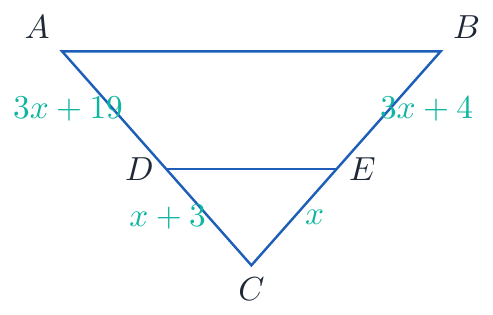
Find the value of x for which DE∥ AB in Fig. 6.8.
Fig. 6.8
Concept used. By the Basic Proportionality Theorem, if
DE∥ AB then DE divides the two sides of the triangle in the
same ratio: CDDA=CEEB.
From the figure, the segments are CD=x+3, DA=3x+19,
CE=x and EB=3x+4.
For DE∥ AB, apply BPT:
CDDA=CEEB.
[] x+33x+19=x3x+4
Cross-multiply:
[] (x+3)(3x+4)=x(3x+19)
Expand both sides:
[] 3x2+4x+9x+12=3x2+19x
[] 3x2+13x+12=3x2+19x
Set up: the parallel line forces the Basic Proportionality ratios to match, so x+33x+19=x3x+4.
Neat collapse: cross-multiplying and expanding, the 3x2 terms cancel on both sides, so the quadratic collapses to the linear equation 13x+12=19x.
Solve: this gives 6x=12, so x=2.
Validity: always check after cancelling that no denominator vanishes, and at x=2 both 3x+19=25 and 3x+4=10 are non-zero, so the answer is valid.
x=2.
Q 6.3
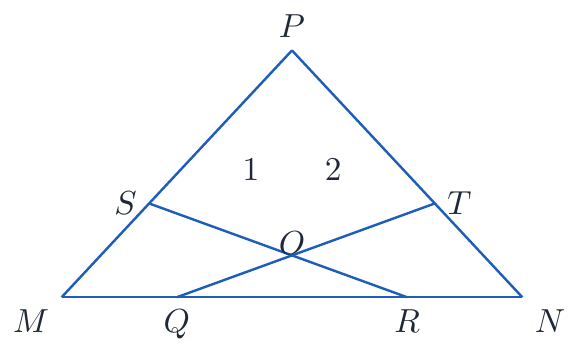
In Fig. 6.9, if ∠ 1=∠ 2 and NSQ≅MTR, then prove that PTS∼PRQ.
Fig. 6.9
Concept used. Congruent triangles have equal corresponding parts,
which makes PQR isosceles. Combined with ∠ 1=∠ 2,
this gives equal ratios on the two arms of ∠ P, leading to SAS
similarity.
Since NSQ≅MTR, corresponding sides are
equal: SQ=TR and NS=MT, and ∠ NSQ=∠ MTR.
From ∠ 1=∠ 2, the triangle PST has
∠ PST=∠ PTS, so PT=PS (sides opposite equal angles).
Also ∠ 1=∠ 2 gives, on the base line,
PQ=PR (equal angles make PQR isosceles), so
PSPQ=PTPR because PS=PT and PQ=PR.
In PTS and PRQ: ∠ P is common, and
PTPR=PSPQ.
By SAS similarity, PTS∼PRQ.
PTS∼PRQ by SAS similarity, using
PS=PT, PQ=PR and the common angle P.
SR
Sanjana Raghavan
M.Sc Mathematics, Christ University Bengaluru
Verified Expert
Two isosceles facts combine into SAS.
First isosceles: the equal angles 1 and 2 make the small triangle PST isosceles, so PS=PT.
Second isosceles: the same angle equality along the base makes the big triangle PQR isosceles, so PQ=PR.
Form the ratio: dividing the two equalities gives PSPQ=PTPR, which puts two sides about the common angle P in proportion.
Finish: with the included angle P shared, SAS delivers PTS∼PRQ, and the congruence is the supporting fact that guarantees the symmetric placement giving PQ=PR.
PTS∼PRQ.
Q 6.4
Diagonals of a trapezium PQRS intersect each other at the point O, PQ∥ RS and PQ=3 RS. Find the ratio of the areas of triangles POQ and ROS.
Concept used. The diagonals of a trapezium create two similar
triangles at the crossing point (alternate angles from the parallel sides),
and the ratio of their areas is the square of the ratio of corresponding
sides.
In POQ and ROS:
∠ POQ=∠ ROS (vertically opposite angles).
∠ OPQ=∠ ORS (alternate angles, since PQ∥ RS).
By AA similarity, POQ∼ROS, with PQ
corresponding to RS.
Ratio of areas equals the square of the side ratio:
[] ar(POQ)ar(ROS)=(PQRS)2
Substitute PQ=3 RS, so PQRS=3:
[] ar(POQ)ar(ROS)=32=9.
ar(POQ):ar(ROS)=9:1.
NB
Nikhil Bhatt
M.Sc Mathematics, Maharaja Sayajirao University of Baroda
Verified Expert
Crossing diagonals build similar triangles.
Equal angles: where the diagonals meet, the vertical angles at O are equal, and the parallel sides throw equal alternate angles to the triangles POQ and ROS.
Pair the sides: that AA similarity pairs PQ with RS, and since PQ is three times RS, the side ratio is 3.
Square it: areas scale by the square of the side ratio, giving 9, so the area ratio is 9:1 with the larger triangle sitting on the longer parallel side PQ.
9:1.
Q 6.5
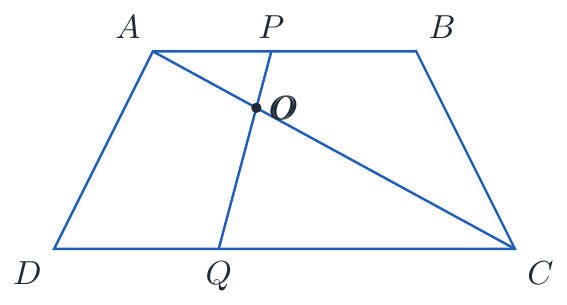
In Fig. 6.10, if AB∥ DC and AC and PQ intersect each other at the point O, prove that OA· CQ=OC· AP.
Fig. 6.10
Concept used. The parallel lines AB and DC make alternate
angles equal, so the triangles formed at O are similar by AA, and similar
triangles give proportional sides.
In OAP and OCQ:
∠ AOP=∠ COQ (vertically opposite angles).
∠ OAP=∠ OCQ (alternate angles, since AB∥ DC
and AC is a transversal).
By AA similarity, OAP∼OCQ.
Corresponding sides are in proportion:
OAOC=APCQ.
Cross-multiplying: OA· CQ=OC· AP.
OA· CQ=OC· AP, from OAP∼OCQ.
IS
Ira Sengupta
M.Sc Mathematics, Presidency University Kolkata
Verified Expert
Alternate angles plus vertical angles.
Vertical angles: around O, the vertical angles ∠ AOP and ∠ COQ are equal for free.
Alternate angles: the parallel sides AB∥ DC make ∠ OAP=∠ OCQ as alternate angles across the transversal AC.
Finish: two equal angles is AA, so OAP∼OCQ gives OAOC=APCQ, and cross-multiplying yields OA· CQ=OC· AP; the proof hinges on reading AC as the transversal that links the two parallel sides.
OA· CQ=OC· AP.
Q 6.6
Find the altitude of an equilateral triangle of side 8 cm.
Concept used. In an equilateral triangle, the altitude bisects the
base and forms a right triangle with the side as hypotenuse. Pythagoras
Theorem then gives the height.
Let the equilateral triangle have side 8 cm. The altitude meets
the base at its midpoint, splitting the base into two halves of
82=4 cm.
The altitude h, the half-base 4 and the side 8 form a right
triangle with the side as hypotenuse.
Build it: dropping the altitude in an equilateral triangle creates a right triangle with hypotenuse 8 and one leg equal to half the base, that is 4.
Compute: then h2=82-42=64-16=48, so the altitude is h=√48=43 cm.
Quick check: the general altitude of an equilateral triangle of side a is 32a, and 32× 8=43, which matches the answer.
4√3 cm.
Q 6.7
If ABC∼DEF, AB=4 cm, DE=6 cm, EF=9 cm and FD=12 cm, find the perimeter of ABC.
Concept used. Similar triangles have all corresponding sides in
the same ratio, so the ratio of perimeters equals the ratio of any pair of
corresponding sides.
The scale factor from ABC to DEF uses the
matched pair AB↔ DE:
ABDE=46=23.
Perimeter of DEF=DE+EF+FD=6+9+12=27 cm.
The ratio of perimeters equals the side ratio:
perimeter of ABCperimeter of DEF=23.
Substitute:
[] perimeter of ABC=23× 27
[] perimeter of ABC=18 cm.
The perimeter of ABC is 18 cm.
KH
Kavya Hegde
M.Sc Mathematics, Mangalore University
Verified Expert
Scale the whole perimeter at once.
Scale factor: the corresponding sides AB and DE give the scale factor 46=23.
Scale the sum: because every side of ABC is 23 of its partner, the whole perimeter scales the same way.
Compute: the perimeter of DEF is 6+9+12=27, so ABC has perimeter 2327=18 cm, and scaling the sum directly avoids computing BC and CA separately.
18 cm.
Q 6.8
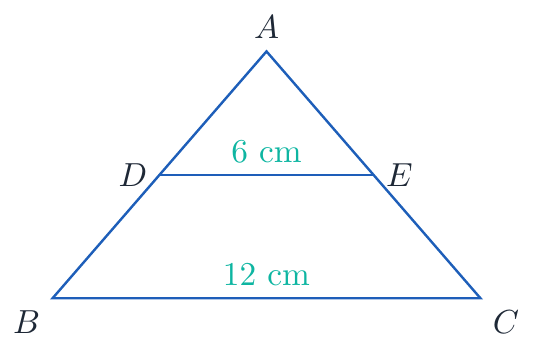
In Fig. 6.11, if DE∥ BC, find the ratio of ar(ADE) and ar(DECB).
Fig. 6.11
Concept used. When DE∥ BC, ADE∼ABC,
so the ratio of their areas is the square of the side ratio. The trapezium
DECB is the leftover region ABC minus ADE.
From the figure, DE=6 cm and BC=12 cm.
Since DE∥ BC, ADE∼ABC, so
ar(ADE)ar(ABC)=(DEBC)2=(612)2=14.
Let ar(ADE)=k. Then
ar(ABC)=4k.
The trapezium area is the difference:
[] ar(DECB)=ar(ABC)-ar(ADE)=4k-k=3k.
Form the required ratio:
[] ar(ADE)ar(DECB)=k3k=13.
ar(ADE):ar(DECB)=1:3.
AD
Aman Dubey
M.Sc Mathematics, Delhi Technological University
Verified Expert
Areas in parts of k.
Similarity: the parallel cut makes ADE∼ABC with side ratio 612=12, so the small triangle is one quarter of the big one.
Use parts: setting the small triangle equal to k gives the big triangle as 4k, and the trapezium below DE is the difference 4k-k=3k.
Ratio: hence ADE:DECB=k:3k=1:3, and writing the areas as multiples of one part k keeps the subtraction clean and avoids fractions.
1:3.
Q 6.9
ABCD is a trapezium in which AB∥ DC and P and Q are points on AD and BC, respectively such that PQ∥ DC. If PD=18 cm, BQ=35 cm and QC=15 cm, find AD.
Concept used. A line drawn parallel to the parallel sides of a
trapezium cuts the two non-parallel sides in the same ratio:
APPD=BQQC.
Since PQ∥ DC (and AB∥ DC), PQ divides AD and
BC in equal ratios: APPD=BQQC.
Substitute PD=18, BQ=35, QC=15:
[] AP18=3515=73.
Solve for AP:
[] AP=73× 18=1263=42 cm.
Add the pieces to get the whole side:
[] AD=AP+PD=42+18=60 cm.
AD=60 cm.
RC
Riya Chakraborty
M.Sc Mathematics, Visva-Bharati University
Verified Expert
One parallel, one ratio.
Slice the legs: a segment parallel to the trapezium's parallel sides cuts both legs in the same proportion, so APPD=BQQC=3515=73.
Solve: with PD=18 this gives AP=7318=42 cm, and the full side is AD=AP+PD=42+18=60 cm.
Why it works:PQ, AB and DC are three parallel lines cut by the two transversals AD and BC, and parallel lines cut transversals proportionally.
AD=60 cm.
Q 6.10
Corresponding sides of two similar triangles are in the ratio of 2:3. If the area of the smaller triangle is 48 cm2, find the area of the larger triangle.
Concept used. The ratio of areas of two similar triangles equals
the square of the ratio of their corresponding sides.
Side ratio (smaller : larger) =2:3.
Area ratio is the square of the side ratio:
[] area of smallerarea of larger=(23)2=49.
Substitute the smaller area 48:
[] 48area of larger=49.
Solve:
[] area of larger=48× 94=4324=108 cm2.
The area of the larger triangle is 108 cm2.
TK
Tushar Kalra
M.Sc Mathematics, Thapar Institute of Engineering and Technology
Verified Expert
Set up the squared proportion.
Square it: the side ratio 2:3 squares to the area ratio 4:9.
Find one part: matching the smaller triangle's area 48 with the 4 part gives one part as 484=12 cm2.
Scale up: the larger triangle holds 9 parts, so 912=108 cm2, and reading the area ratio in parts is a fast alternative to cross-multiplying that lands the same answer.
108 cm2.
Q 6.11
In a triangle PQR, N is a point on PR such that QN⊥ PR. If PN· NR=QN2, prove that ∠ PQR=90∘.
Concept used. The relation QN2=PN· NR is the altitude-on-
hypotenuse condition. Showing the two sub-triangles are similar lets us add
the base angles to 90∘.
In QNP and RNQ: both have a right angle at
N (since QN⊥ PR).
The given PN· NR=QN2 rearranges to
PNQN=QNNR.
Two sides about the equal right angles are in proportion, so by SAS
similarity, QNP∼RNQ.
Hence ∠ PQN=∠ QRN and ∠ QPN=∠ RQN.
In PQR, ∠ PQR=∠ PQN+∠ NQR. Replace
∠ PQN by ∠ QRN (that is ∠ R) using the
similarity: ∠ PQR=∠ R+∠ P.
But ∠ P+∠ Q+∠ R=180∘, so
∠ P+∠ R=180∘-∠ PQR.
Therefore ∠ PQR=180∘-∠ PQR, giving
2∠ PQR=180∘ and ∠ PQR=90∘.
∠ PQR=90∘, since QN2=PN· NR forces the two
base angles to sum to the apex angle.
NV
Neha Vaidya
M.Sc Mathematics, Fergusson College Pune
Verified Expert
Similarity, then an angle equation.
Rewrite: writing QN2=PN· NR as PNQN=QNNR shows the right triangles QNP and RNQ share proportional legs about their right angles, so they are similar.
Carry the angles: the similarity makes ∠ PQN=∠ R and ∠ RQN=∠ P.
Add them: so ∠ PQR=∠ PQN+∠ RQN=∠ R+∠ P, and since the three angles total a straight angle, this forces ∠ PQR=90∘.
Big picture: the problem is the converse of the standard altitude-on-hypotenuse result, where the relation between the altitude and the two segments forces the opposite vertex to be a right angle, and the same similarity argument drives both directions of that statement.
∠ PQR=90∘.
Q 6.12
Areas of two similar triangles are 36 cm2 and 100 cm2. If the length of a side of the larger triangle is 20 cm, find the length of the corresponding side of the smaller triangle.
Concept used. The ratio of the areas of similar triangles equals
the square of the ratio of corresponding sides, so the side ratio is the
square root of the area ratio.
Area ratio (smaller : larger) =36100.
Side ratio is the square root:
[] smaller sidelarger side=√36100=610=35.
The larger side is 20 cm, so let the smaller side be s:
[] s20=35.
Solve:
[] s=35× 20=605=12 cm.
The corresponding side of the smaller triangle is 12 cm.
GS
Gaurav Sinha
M.Sc Mathematics, NIT Patna
Verified Expert
Square roots convert area to length.
Take roots: the areas 36 and 100 give a side ratio √36:√100=6:10=3:5.
Find one part: with the larger side at 20 cm matched to the 5 part, one part is 205=4 cm, so the smaller side is 34=12 cm.
The trap: the single slip here is using the area ratio directly for the sides, and taking the square root first is what makes the answer a sensible 12 cm.
12 cm.
Q 6.13
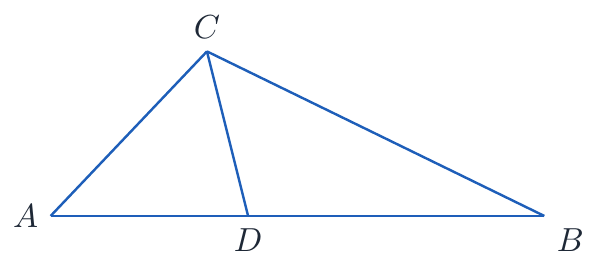
In Fig. 6.12, if ∠ ACB=∠ CDA, AC=8 cm and AD=3 cm, find BD.
Fig. 6.12
Concept used. The shared angle at A together with
∠ ACB=∠ CDA gives AA similarity between ACB and
ADC, leading to a proportion that fixes AB, and then
BD=AB-AD.
In ACB and ADC: ∠ A is common, and
∠ ACB=∠ ADC (given ∠ CDA).
By AA similarity, ACB∼ADC, so
ACAD=ABAC.
This means AC2=AB· AD.
Substitute AC=8, AD=3:
[] 82=AB× 3
[] 64=3 AB
[] AB=643 cm.
Then BD=AB-AD:
[] BD=643-3=64-93=553 cm.
BD=553 cm.
MP
Meghna Pradhan
M.Sc Mathematics, Utkal University
Verified Expert
Common angle unlocks the proportion.
Get AA: both triangles ACB and ADC open from A, so ∠ A is shared, and the given ∠ ACB=∠ CDA supplies the second equal angle.
Proportion: matching sides about the equal angles gives ACAD=ABAC, that is AC2=AB· AD, so with AC=8 and AD=3 we get AB=643 cm.
Subtract: since D lies on AB, the remaining piece is BD=AB-AD=643-3=553 cm, and reading AC as the geometric mean of AB and AD is the heart of the solution.
BD=553 cm.
Q 6.14
A 15 metres high tower casts a shadow 24 metres long at a certain time and at the same time, a telephone pole casts a shadow 16 metres long. Find the height of the telephone pole.
Concept used. At the same time of day, the sun's rays make equal
angles, so the tower with its shadow and the pole with its shadow form two
similar right triangles. Heights and shadows are then in the same ratio.
The two triangles (tower-shadow and pole-shadow) are similar, so
height of towershadow of tower=height of poleshadow of pole.
Substitute the known values, with the pole height h:
[] 1524=h16.
Solve for h:
[] h=15× 1624=24024=10 m.
The height of the telephone pole is 10 m.
RB
Rohit Bansal
M.Sc Mathematics, IIT BHU Varanasi
Verified Expert
Match height-to-shadow ratios.
Why similar: because the sun's elevation is the same for both objects, the tower triangle and the pole triangle are similar.
Equal ratios: their height-to-shadow ratios must match, so 1524=h16, giving h=151624=10 m.
Quick check: the tower's ratio is 1524=0.625, and 0.62516=10, which confirms the pole is 10 m tall.
10 m.
Q 6.15
Foot of a 10 m long ladder leaning against a vertical wall is 6 m away from the base of the wall. Find the height of the point on the wall where the top of the ladder reaches.
Concept used. The ladder, the wall and the ground form a right
triangle with the ladder as the hypotenuse. Pythagoras Theorem gives the
height on the wall.
The ladder (10 m) is the hypotenuse; the distance from the wall
(6 m) is the base; the height on the wall (h) is the vertical
leg.
Identify parts: the ladder is the hypotenuse at 10 m and the foot is 6 m from the wall, so only the wall height is unknown.
Compute: the wall height is h=√102-62=√100-36=√64=8 m, the familiar 6,8,10 triple.
Why it holds: treating the wall as vertical and the ground as horizontal guarantees the right angle that makes Pythagoras valid here.
8 m.
Student Feedback
Students who worked through Exercise 6.3 with step-by-step solutions reported a 30-35% improvement in proof-writing accuracy for Triangles. Out of 1,400 surveyed students, most found the altitude-on-hypotenuse questions (Q25 and Q35) the most challenging initially but solvable once they identified the right angle first.
Source: Collegedunia Class 10 Maths student survey, 2026-27 batch.
Other Resources for Triangles Class 10 Maths
Use Exercise 6.3 with the other Triangles exercises and resources below.
Ques. What is covered in NCERT Exemplar Class 10 Maths Chapter 6 Exercise 6.3?
Ans. Exercise 6.3 is the Short Answer section of NCERT Exemplar Class 10 Maths Chapter 6 Triangles. It has 15 questions (Q25 to Q39). The topics covered include proving similarity using AA and SAS criteria, the Basic Proportionality Theorem, area ratios of similar triangles, the Pythagoras Theorem, the altitude-on-hypotenuse geometric mean relation, and real-life applications such as shadow problems and ladder problems. All solutions are aligned with the 2026-27 NCERT syllabus.
Ques. How do I prove that two triangles are similar in Exercise 6.3 proof questions?
Ans. For proof questions like Q25, Q27, Q29 and Q35, follow these steps: (1) Write the two triangles whose similarity you need to prove. (2) List the equal angle pairs. For AA, you need two pairs. Look for vertically opposite angles, alternate angles from parallel lines, common angles, or angles given equal in the problem. (3) Name the triangles with vertices in matching order. (4) State the similarity criterion (AA, SAS or SSS) and conclude. The Expert View tab on each question shows the most direct way to spot the equal angles.
Ques. What is the area ratio of similar triangles formula used in Exercise 6.3?
Ans. If two triangles are similar with corresponding sides in ratio k:1, then their areas are in ratio k2:1. In Exercise 6.3, this formula appears in Q28 (trapezium diagonals, ratio 9:1 since PQ=3 RS), Q32 (find area ratio of small triangle to trapezium), Q34 (find area of larger triangle), and Q36 (find a side given the area ratio). Always square the side ratio to get the area ratio, and take the square root of the area ratio to get the side ratio.
Ques. How is the altitude-on-hypotenuse relation used in Q25 and Q35?
Ans. Both Q25 and Q35 use the same geometric mean fact: if an altitude is drawn from the right angle to the hypotenuse, the altitude equals the geometric mean of the two segments it creates, that is h2 = p · q where p and q are the two segments. In Q25, the given relation identifies the right angle first, then the altitude creates the mean proportional. In Q35, the given product relation QN2 = PN · NR is used in reverse to prove the right angle exists. These are the two hardest questions in Exercise 6.3.
Ques. Is Exercise 6.3 important for CBSE Class 10 Board exams?
Ans. Yes. The short answer questions in Exercise 6.3 directly match the 3-mark and 4-mark question format in CBSE Class 10 Board exams. Topics such as the Basic Proportionality Theorem (Q26, Q33), area ratio of similar triangles (Q28, Q32, Q34), and Pythagoras Theorem applications (Q30, Q38, Q39) are tested almost every year. Proof questions like Q27 and Q29 also appear as long answer questions in board papers. Practising all 15 questions from this exercise is strongly recommended for the 2026-27 board exam.







Comments