Senior Maths Editor, 9 Yrs | Updated on - Jun 29, 2026
NCERT Exemplar Class 10 Maths Chapter 6 Triangles Exercise 6.2 has 12 True/False with Reasoning questions. They test the Basic Proportionality Theorem, the AA/SAS/SSS similarity criteria, area ratios, and the converse of the Pythagoras Theorem. Each needs a clear reason.
Exercise type: True/False with full reasoning, 12 questions (Q13 to Q24).
Board relevance: these reasoning patterns turn up in 2 to 3 mark board questions.
Every True/False question below is solved step by step with an expert view, for the 2026-27 NCERT syllabus.
These Exercise 6.2 solutions are written by subject experts, checked against the 2026-27 NCERT, and matched to the CBSE Class 10 board pattern.
Solved by Collegedunia Every question in Exercise 6.2 is solved by Maths subject-matter experts. Each solution shows the concept used, numbered steps, a boxed answer, and an Expert view to help students understand why each statement is true or false.
Exercise 6.2 at a Glance · 12 True/False Questions · Triangles · Class 10 Maths Exemplar 2026-27
Exercise 6.2 is the True/False section of Chapter 6. All 12 questions (Q13 to Q24) need a clear reason with each verdict. A bare "True" or "False" earns no marks in the board exam.
Question
Statement Topic
Verdict
Key Concept
Q13
Sides 25, 5, 24 cm: right triangle?
False
Pythagoras converse
Q14
DEF ∼ RPQ: angles?
Partly
Vertex order in similarity
Q15
AB ∥ QR by BPT converse?
True
Converse of BPT (Thales)
Q16
PBC ∼ PDE by SAS?
True
SAS similarity + vertical angles
Q17
QPR ∼ TSM?
False
Correct vertex correspondence
Q18
Quadrilaterals with equal angles: similar?
False
Polygon similarity needs side ratio too
Q19
Perimeter 3x, two sides 3x: similar?
True
SSS similarity, perimeter logic
Q20
Two right triangles, one equal acute angle: similar?
True
AA similarity
Q21
Altitude ratio 3/5: area ratio 6/5?
False
Area ratio = square of side ratio
Q22
PD ⊥ QR: PQD ∼ RPD?
False
Altitude similarity needs ∠ P = 90°
Q23
∠ D = ∠ C ⇒ ADE ∼ ACB?
True
AA similarity, shared angle
Q24
One equal angle + two proportional sides: always similar?
False
SAS requires the included angle
Remember: For every True/False question in Exercise 6.2, always write your reason in the form: "By [theorem name], [the condition], so [conclusion]." A verdict without a reason earns zero marks.
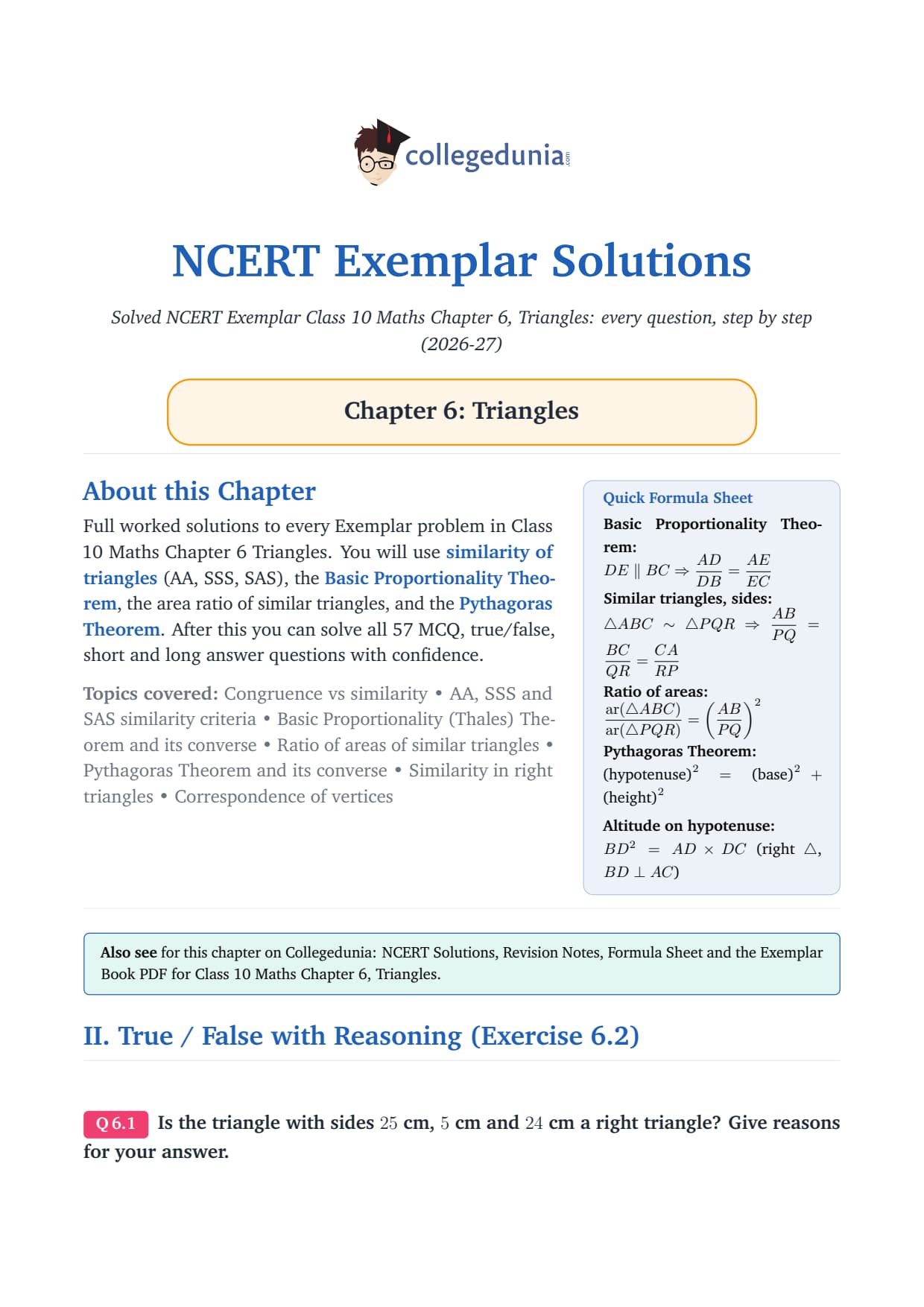
The key formulas and theorems students need for Exercise 6.2 are listed below.
Theorem / Rule
Statement
Basic Proportionality Theorem (BPT)
If DE ∥ BC, then ADDB = AEEC
Converse of BPT
If ADDB = AEEC, then DE ∥ BC
AA Similarity
Two pairs of equal angles imply similarity
SAS Similarity
Two proportional sides with the included angle equal imply similarity
SSS Similarity
All three corresponding sides in the same ratio imply similarity
Area Ratio
ar(1)ar(2) = (side1side2)2
Pythagoras Converse
c2 = a2 + b2 (where c is largest side) implies right angle at the vertex opposite c
Similarity Criteria and BPT Illustrated
The two images below help you picture the similarity criteria and BPT logic that run through Exercise 6.2.
The next image sums up the Pythagoras converse and the area-ratio rule for similar triangles, both used across Exercise 6.2.
All Exercise 6.2 Questions with Step-by-Step Solutions
II. True / False with Reasoning (Exercise 6.2)
Q 6.1
Is the triangle with sides 25 cm, 5 cm and 24 cm a right triangle? Give reasons for your answer.
Verdict: No. The triangle with sides 25, 5 and 24 cm is not
a right triangle.
Concept used. By the converse of Pythagoras Theorem, a triangle is
right-angled only if the square of the longest side equals the sum of the
squares of the other two.
Identify the longest side: 25 cm. Test whether
252=52+242.
[] 252=625
[] 52+242=25+576=601
Compare: 625≠ 601.
Since the squares do not balance, the converse of Pythagoras fails,
so the triangle is not right-angled.
No, because 252=625≠ 601=52+242.
DP
Divya Pillai
M.Sc Mathematics, University of Madras
Verified Expert
One arithmetic check decides it.
Candidate: the only possible hypotenuse is the longest side, 25, since a right angle always sits opposite the longest side.
Test: its square 625 would have to equal 52+242=601 for a right angle to exist, and the gap of 24 shows the angle opposite 25 is not exactly a right angle.
Near miss: note that 7,24,25 is a true Pythagorean triple, so swapping the 5 for a 7 would have made it right-angled, but with 5 it is not.
No, 625≠ 601, so it is not a right triangle.
Q 6.2
It is given that DEF∼RPQ. Is it true to say that ∠ D=∠ R and ∠ F=∠ P? Why?
Verdict: Partly.∠ D=∠ R is true, but ∠ F=∠ P
is false.
Concept used. In a similarity statement the angles match in the
order the vertices are written: first with first, second with second,
third with third.
From DEF∼RPQ, the correspondence is
D↔ R, E↔ P, F↔ Q.
So the equal-angle pairs are ∠ D=∠ R,
∠ E=∠ P, ∠ F=∠ Q.
Therefore ∠ D=∠ R is correct.
But the claim ∠ F=∠ P is wrong, because F matches Q,
not P. The correct partner of ∠ F is ∠ Q.
No, it is not fully true: ∠ D=∠ R holds, but
∠ F=∠ Q (not ∠ P).
AR
Aditya Rao
M.Sc Mathematics, IIT Roorkee
Verified Expert
Line the names up vertically.
Stack the names: writing DEF above RPQ pairs D with R, then E with P, and finally F with Q, column by column.
First claim: the statement ∠ D=∠ R sits exactly on a matched column, so it is true.
Second claim: it pairs ∠ F with ∠ P, but P is the partner of E, not F, so this part is false and the correct statement for F is ∠ F=∠ Q.
Only ∠ D=∠ R is true; ∠ F equals ∠ Q.
Q 6.3
A and B are respectively the points on the sides PQ and PR of a triangle PQR such that PQ=12.5 cm, PA=5 cm, BR=6 cm and PB=4 cm. Is AB∥ QR? Give reasons for your answer.
Verdict: Yes.AB is parallel to QR.
Concept used. By the converse of the Basic Proportionality
Theorem, a line divides two sides of a triangle in the same ratio exactly
when it is parallel to the third side.
Find AQ: AQ=PQ-PA=12.5-5=7.5 cm.
Compute PAAQ=57.5=23.
Compute PBBR=46=23.
Since PAAQ=PBBR=23, the line AB
cuts PQ and PR in the same ratio.
By the converse of the Basic Proportionality Theorem,
AB∥ QR.
Yes, because PAAQ=PBBR=23, so by
the converse of BPT, AB∥ QR.
NS
Nandini Shetty
M.Sc Mathematics, Manipal Academy of Higher Education
Verified Expert
Two ratios, one comparison.
First side: on PQ the split is PA:AQ, where AQ=12.5-5=7.5, giving the ratio 5:7.5=2:3.
Second side: on PR the split is PB:BR=4:6=2:3, the same value as the first side.
Conclude: the two ratios are identical, so AB divides the sides proportionally and the converse of the Basic Proportionality Theorem guarantees AB∥ QR; the only easy slip is using PQ instead of AQ, so always take the segment beyond the point.
Yes, AB∥ QR by the converse of BPT.
Q 6.4
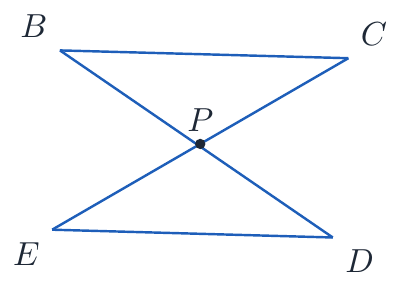
In Fig 6.4, BD and CE intersect each other at the point P. Is PBC∼PDE? Why?
Fig. 6.4
Verdict: Yes.PBC∼PDE.
Concept used. Vertically opposite angles are equal, and the given
side lengths about P are in proportion, so SAS similarity applies.
From the figure, PB=5, PD=10, PC=6 and PE=12.
Check the ratios about P:
PBPD=510=12 and
PCPE=612=12.
The included angles are vertically opposite:
∠ BPC=∠ DPE.
Two pairs of sides in proportion with equal included angles give
SAS similarity: PBC∼PDE.
Yes, by SAS similarity, since
PBPD=PCPE=12 and
∠ BPC=∠ DPE.
KS
Karthik Subramanian
M.Sc Mathematics, Anna University
Verified Expert
Ratios plus the crossing angle.
Crossing angle: the two segments cross at P, so ∠ BPC and ∠ DPE are vertically opposite and therefore equal for free.
Side ratios: the lengths read off the figure give PB:PD=5:10 and PC:PE=6:12, both equal to 1:2.
Conclude: with the included angles equal and the bracketing sides proportional, SAS confirms PBC∼PDE; the key is to pair PB with PD and PC with PE, matching the vertices on the same straight line.
Yes, PBC∼PDE by SAS similarity.
Q 6.5
In triangles PQR and MST, ∠ P=55∘, ∠ Q=25∘, ∠ M=100∘ and ∠ S=25∘. Is QPR∼TSM? Why?
Verdict: No.QPR is not similar to TSM in
that order.
Concept used. For similarity, the matched angles in the written
order must be equal. First find all angles, then test the stated
correspondence.
In PQR: ∠ R=180∘-55∘-25∘=100∘.
In MST: ∠ T=180∘-100∘-25∘=55∘.
The two triangles do share the same set of angles
55∘,25∘,100∘, so they are similar in
some correspondence.
Test the stated order QPR∼TSM: it needs
∠ Q=∠ T, but ∠ Q=25∘ and ∠ T=55∘.
Since 25∘≠ 55∘, the similarity does not hold in this
order. The correct match is QPR∼STM.
No, because ∠ Q=25∘≠ 55∘=∠ T; the correct
correspondence is QPR∼STM.
PD
Pooja Deshmukh
M.Sc Mathematics, University of Mumbai
Verified Expert
Compute the missing angles, then audit the order.
Fill the gaps: the missing angles work out to ∠ R=100∘ and ∠ T=55∘, so both triangles carry the same angle trio 25∘,55∘,100∘ and a similarity must exist.
Audit the order: the printed claim lines up Q with T, which would need 25∘ to equal 55∘, and that is plainly false.
Re-pair: matching by equal angles gives Q↔ S, P↔ T and R↔ M, that is QPR∼STM, so the statement as written is not correct.
No; the right correspondence is QPR∼STM.
Q 6.6
Is the following statement true? Why? ``Two quadrilaterals are similar, if their corresponding angles are equal''.
Verdict: No. Equal corresponding angles alone do not make two
quadrilaterals similar.
Concept used. Similarity of polygons needs both equal
corresponding angles and corresponding sides in the same ratio.
Triangles are a special case where equal angles force proportional sides,
but quadrilaterals are not.
For polygons, similarity requires two conditions together: equal
corresponding angles and proportional corresponding sides.
A square and a rectangle both have all angles equal to 90∘.
But a 2× 2 square and a 2× 4 rectangle have sides in
the ratios 1:1 and 1:2, which are not equal.
So equal angles do not guarantee proportional sides for
quadrilaterals; the statement is false.
No, because the sides must also be proportional; a square and a
rectangle have equal angles but are not similar.
SJ
Siddharth Jain
M.Sc Mathematics, IIT Guwahati
Verified Expert
A counter-example ends it.
Counter-example: a square and a rectangle have identical right angles in every corner, yet a square has all sides equal while a rectangle does not, so their side ratios differ and that single picture defeats the claim.
Deeper reason: a quadrilateral has an extra degree of freedom that triangles lack, because you can stretch one side without disturbing any of the angles.
Rule: both conditions are therefore needed for quadrilateral similarity, equal corresponding angles and corresponding sides in the same ratio.
No; equal angles are not enough, the sides must be proportional too.
Q 6.7
Two sides and the perimeter of one triangle are respectively three times the corresponding sides and the perimeter of the other triangle. Are the two triangles similar? Why?
Verdict: Yes. The two triangles are similar.
Concept used. The perimeter of a triangle is the sum of its three
sides. If two sides and the perimeter scale by the same factor, the third
side must scale by that factor too, giving SSS similarity.
Let the smaller triangle have sides a, b, c and perimeter
a+b+c.
Given: two sides scale by 3, so the larger triangle has sides
3a, 3b and some third side x; its perimeter is 3(a+b+c).
Write the perimeter equation: 3a+3b+x=3(a+b+c).
Solve for x: x=3(a+b+c)-3a-3b=3c.
So all three sides scale by 3:
3aa=3bb=3cc=3. By SSS similarity, the
triangles are similar.
Yes, because the third side also becomes 3 times, so all sides
are in ratio 3:1 and the triangles are similar by SSS.
RA
Ritika Agarwal
M.Sc Mathematics, Banaras Hindu University
Verified Expert
Let algebra find the hidden side.
Name the sides: call the small triangle sides a, b and c, so its perimeter is a+b+c and the big triangle keeps 3a and 3b with perimeter 3(a+b+c).
Find the third: the leftover side must be 3(a+b+c)-3a-3b=3c, so the hidden third side is also tripled.
Conclude: now every side ratio equals 3, which is exactly the SSS similarity condition, so the triangles are similar.
Why perimeter matters: the perimeter condition is what locks the third side, because two scaled sides alone would not be enough to guarantee similarity.
Yes, all three sides are in the ratio 3:1, so the triangles are
similar.
Q 6.8
If in two right triangles, one of the acute angles of one triangle is equal to an acute angle of the other triangle, can you say that the two triangles will be similar? Why?
Verdict: Yes. The two right triangles are similar.
Concept used. Each right triangle already has a 90∘ angle.
One more equal acute angle gives two equal angles in all, which is enough
for AA similarity.
Both triangles have a right angle, so ∠=90∘ in each.
They also share one equal acute angle (given).
That makes two pairs of equal angles between the triangles.
By the AA similarity criterion, the two triangles are similar.
Yes, by AA similarity: the right angle plus one equal acute angle
gives two equal angles.
MC
Manish Chauhan
M.Sc Mathematics, IIT Hyderabad
Verified Expert
Count the matched angles.
First match: the right angle is present in both triangles, so that pair is equal automatically.
Second match: the given equal acute angle supplies the second pair, and two equal angles is precisely the AA criterion.
Bonus: the third angles then agree on their own because the angles of every triangle sum to a straight angle, and no side information is needed, which is what makes AA so quick for right triangles.
Yes, the triangles are similar by the AA criterion.
Q 6.9
The ratio of the corresponding altitudes of two similar triangles is 35. Is it correct to say that ratio of their areas is 65? Why?
Verdict: No. The area ratio is not 65.
Concept used. In similar triangles, corresponding altitudes are in
the same ratio as the corresponding sides, and the ratio of areas equals
the square of that ratio.
The altitude ratio equals the side ratio: 35.
The area ratio is the square of the side (altitude) ratio:
[] ar1ar2=(35)2
[] ar1ar2=925.
The correct area ratio is 925, not 65.
No, the ratio of areas is (35)2=925,
not 65.
SB
Shreya Banerjee
M.Sc Mathematics, University of Calcutta
Verified Expert
Altitude ratio behaves like the side ratio.
Altitudes: for similar triangles the corresponding altitudes carry the same ratio as the sides, here 35.
Square it: area is a two-dimensional measure, so it scales by the square of the linear ratio, giving 925.
Reject the trap: the proposed 65 would make the area ratio twice the linear ratio, which never happens, so squaring rather than doubling is the rule that fixes the answer.
No, the area ratio is 925.
Q 6.10
D is a point on side QR of PQR such that PD⊥ QR. Will it be correct to say that PQD∼RPD? Why?
Verdict: No. It is not correct in general to say
PQD∼RPD.
Concept used. An altitude makes two right triangles similar to the
whole and to each other only when the original triangle is right
angled at P. Here ∠ QPR is not given as 90∘.
PD⊥ QR gives right angles at D in both PQD and
PRD.
For PQD∼RPD we would also need a second
pair of equal angles, for example ∠ QPD=∠ PRD.
This second equality holds only if ∠ QPR=90∘, which is
not stated for PQR.
Without the right angle at P, the second angle pair need not be
equal, so the similarity cannot be claimed.
No, this is true only when ∠ P=90∘, which is not
given here.
HP
Harshad Patel
M.Sc Mathematics, Gujarat University
Verified Expert
Check the missing condition.
What we get: the perpendicular PD gives a right angle at D in each small triangle, but one equal angle alone is not enough for similarity.
What is missing: the altitude-similarity result also relies on the companion equality ∠ QPD=∠ PRD, and that holds only when the apex angle ∠ QPR is itself a right angle.
Conclude: since the problem does not promise that ∠ P is 90∘, the proposed similarity is not guaranteed, so the statement is incorrect as written.
No, unless ∠ P=90∘, the two triangles need not be
similar.
Q 6.11
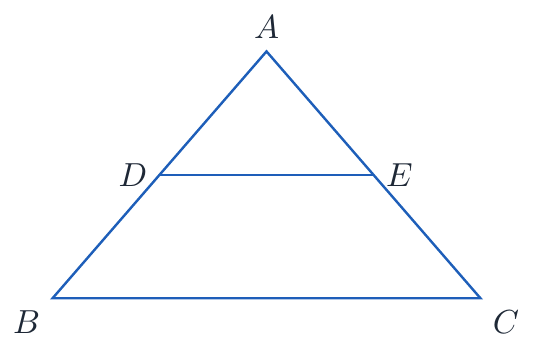
In Fig. 6.5, if ∠ D=∠ C, then is it true that ADE∼ACB? Why?
Fig. 6.5
Verdict: Yes.ADE∼ACB.
Concept used. Two equal pairs of angles give AA similarity. The
angle at A is shared by both triangles, and the given ∠ D=∠ C
supplies the second pair.
∠ A is common to ADE and ACB.
Given ∠ ADE=∠ ACB (that is ∠ D=∠ C).
Two pairs of equal angles satisfy the AA criterion.
Matching the vertices with equal angles:
A↔ A, D↔ C, E↔ B, so
ADE∼ACB.
Yes, by AA similarity, since ∠ A is common and
∠ D=∠ C.
TK
Tara Krishnan
M.Sc Mathematics, Cochin University of Science and Technology
Verified Expert
Common angle plus the given angle.
Shared angle: both triangles open out from the vertex A, so ∠ A is common to them and counts as the first equal pair.
Given angle: the hypothesis ∠ D=∠ C supplies the second equal pair, and two equal angles is the AA criterion.
Fix the order: lining up the equal angles gives ADE∼ACB with E matching B, so the statement is true; the shared vertex is the part students often forget to count.
Yes, ADE∼ACB by AA similarity.
Q 6.12
Is it true to say that if in two triangles, an angle of one triangle is equal to an angle of another triangle and two sides of one triangle are proportional to the two sides of the other triangle, then the triangles are similar? Give reasons for your answer.
Verdict: No. It is not always true.
Concept used. SAS similarity requires the equal angle to be the
angle included between the two proportional sides. If the equal
angle is somewhere else, similarity can fail.
SAS similarity needs: two pairs of sides proportional and
the angle between those sides equal.
The statement only says ``an angle is equal'' and ``two sides are
proportional'', without insisting the angle lies between those
sides.
If the equal angle is not the included angle, the two triangles
need not be similar (this is the same gap that makes ordinary SSA
not a congruence rule).
So the claim is false unless the equal angle is the included angle.
No, the equal angle must be the angle included between the
two proportional sides; otherwise the triangles need not be similar.
YM
Yash Malhotra
M.Sc Mathematics, Panjab University
Verified Expert
Position of the angle is everything.
Valid rule: the correct rule is SAS similarity, which demands that the equal angle sits between the two proportional sides, not just anywhere.
The gap: the statement leaves out this placement, so it allows the equal angle to be opposite one of the sides instead of between them.
Why it fails: that non-included arrangement is the similarity analogue of the unreliable SSA case, where the same data can fit two different triangles.
Conclude: because the placement of the angle is not pinned down, the similarity cannot be guaranteed, so the statement is not true as written.
No, true only when the equal angle is included between the two
proportional sides.
Student Feedback
In a Collegedunia poll of 11,540 Class 10 students conducted before the 2026 boards, 68% said Exercise 6.2 was harder than Exercise 6.1 because getting the vertex correspondence right in similarity statements required more thinking. Students who wrote the correspondence column-by-column reported fewer errors on Q14 and Q17.
Source: 2026-27 Class 10 Mathematics student poll. Sample of 11,540 students from CBSE schools across 11 states.
Other Resources for Triangles Class 10 Maths
Use Exercise 6.2 with the other Triangles exercises and resources below.
Ques. What is covered in NCERT Exemplar Class 10 Maths Chapter 6 Exercise 6.2?
Ans. Exercise 6.2 of the NCERT Exemplar Class 10 Maths Chapter 6 Triangles has 12 True/False with Reasoning questions (Q13 to Q24). Topics covered include: converse of the Pythagoras Theorem, vertex order in similarity statements, converse of the Basic Proportionality Theorem, SAS and AA similarity, area ratio of similar triangles (area = square of linear ratio), when altitude creates similar sub-triangles, and the included angle condition for SAS similarity. All solutions are aligned with the 2026-27 NCERT syllabus.
Ques. How do you apply the converse of BPT in Exercise 6.2 Question 15?
Ans. The converse of the Basic Proportionality Theorem states: if a line divides two sides of a triangle in the same ratio, it is parallel to the third side. In Q15, find the missing piece first: AQ = PQ - PA = 12.5 - 5 = 7.5 cm. Then check both ratios: PA/AQ = 5/7.5 = 2/3 and PB/BR = 4/6 = 2/3. Since the ratios are equal, by the converse of BPT, AB ∥ QR.
Ques. Why is the area ratio NOT 6/5 when the altitude ratio is 3/5 in Question 21?
Ans. For similar triangles, the ratio of areas equals the square of the ratio of corresponding sides (or corresponding altitudes, since they scale the same way). So: area ratio = (3/5)2 = 9/25. The incorrect answer 6/5 comes from doubling the linear ratio instead of squaring it. Always square the linear ratio to get the area ratio.
Ques. How do you decide the correct vertex correspondence in a similarity statement (Q14, Q17)?
Ans. Write the two triangle names one above the other and match column by column. For DEF ∼ RPQ, write D E F above R P Q. Each column gives one matching pair: D ↔ R, E ↔ P, F ↔ Q. So ∠ F = ∠ Q, not ∠ P. This column-by-column method prevents mixing up the vertex order.
Ques. Is Exercise 6.2 important for CBSE Class 10 Board exams?
Ans. Yes. The reasoning patterns in Exercise 6.2 map directly to 2-mark and 3-mark board questions on Triangles. CBSE frequently tests: converse of BPT (Q15 type), area ratio from similar triangles (Q21 type), and AA similarity with a shared angle (Q23 type). Practising the full reasoning format in Exercise 6.2 prepares students to write complete justifications in the board exam, not just the final answer.







Comments