Maths Strategist, Olympiad Coach | Updated 3+ months ago
Exercise 4.1 of NCERT Exemplar Class 10 Maths Chapter 4 Quadratic Equations has 11 MCQs, all solved here step by step. The questions check if an equation is quadratic, the nature of roots from the discriminant, and the sum and product of roots. The set follows the 2026-27 CBSE syllabus.
Scope: 11 MCQs on standard form, roots, the discriminant, completing the square, and nature of roots.
Skills tested: spotting a quadratic, finding a constant from a given root, and computing the discriminant b2−4ac.
Board value: this chapter carries 4 to 5 marks in CBSE Class 10 board papers.
Every solution here is verified by subject experts and follows the 2026-27 CBSE NCERT Exemplar book exactly.
Solved by Collegedunia - All 11 questions of Exercise 4.1 with detailed step-by-step solutions and expert insights.
Exercise 4.1 is the Multiple Choice section of NCERT Exemplar Chapter 4 Quadratic Equations. It has 11 MCQs, each with four options.
Identifying quadratic equations: expanding and simplifying to check whether the degree is exactly 2 (Questions 1 and 2).
Checking a given root: substituting a specific value into the equation to verify it and find unknown constants (Questions 3 and 4).
Sum and product of roots: using α+β = −b/a without actually solving (Question 5).
Discriminant and equal roots: setting b2−4ac = 0 and solving for a parameter (Question 6).
Completing the square: identifying the constant to add and subtract (Question 7).
Nature of roots from discriminant sign: distinct, equal, or no real roots (Questions 8, 9, 10, and 11).
The board paper usually has one or two MCQs from this chapter. Exercise 4.1 is the best drill, because its options are built to trap common slips like cancelling the x2 terms or dropping a root.
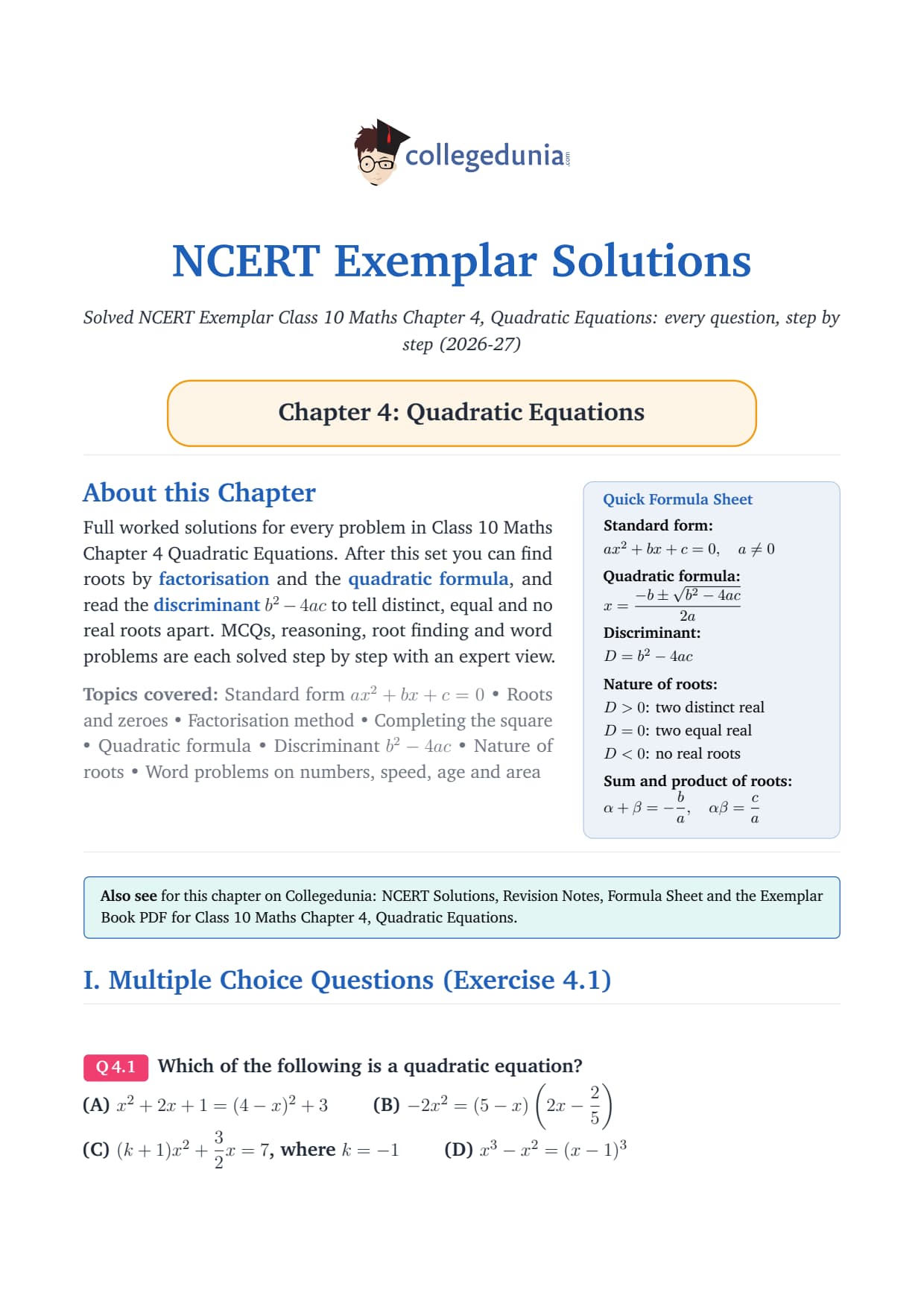
Key Quadratic Equations Formulas Used in Exercise 4.1
Before the 11 MCQs, be clear on these formula sets from the 2026-27 NCERT Exemplar book.
Concept
Formula
Used in
Standard form
ax2+bx+c=0, a≠0
Q1, Q2
Root check
Substitute the value; left side must equal 0
Q3, Q4
Sum of roots
α+β = −b/a
Q5
Product of roots
αβ = c/a
Q5
Discriminant
D = b2−4ac
Q6, Q8, Q9, Q10, Q11
Nature of roots
D>0: two distinct real; D=0: equal real; D<0: no real roots
Q8, Q9, Q10, Q11
Completing the square
Add and subtract d2 where 2d is the coefficient of the middle term after making the leading term a perfect square
Q7
The discriminant D=b2−4ac is the most-tested idea here. Seven of the 11 questions use it. Read its sign right and you clear Questions 8 to 11 in under 30 seconds each.
Concept: The discriminant tells you the nature of roots without finding the roots themselves. A negative discriminant means the roots are complex (not real), which is the key to Questions 8 and 10.
All 11 Exemplar Solutions with Step-by-Step Working
I. Multiple Choice Questions (Exercise 4.1)
Q 4.1
Which of the following is a quadratic equation?
(A) x2+2x+1=(4-x)2+3 (B) -2x2=(5-x)(2x-25)
(C) (k+1)x2+32x=7, where k=-1 (D) x3-x2=(x-1)3
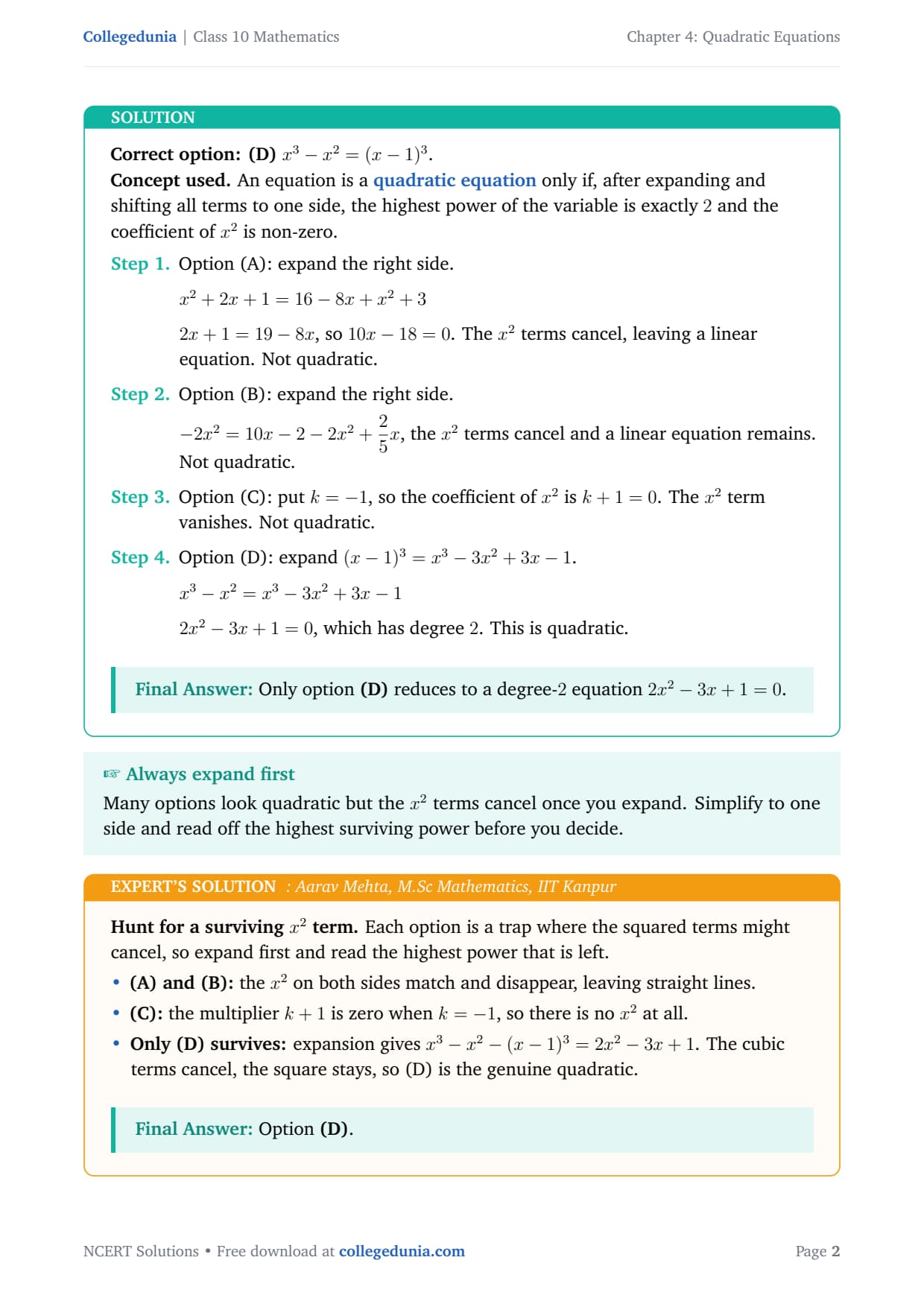
Correct option: (D)x3-x2=(x-1)3.
Concept used. An equation is a quadratic equation only
if, after expanding and shifting all terms to one side, the highest power
of the variable is exactly 2 and the coefficient of x2 is non-zero.
Option (A): expand the right side.
[] x2+2x+1=16-8x+x2+3
[] 2x+1=19-8x, so 10x-18=0. The x2 terms cancel, leaving a
linear equation. Not quadratic.
Option (B): expand the right side.
[] -2x2=10x-2-2x2+25x, the x2 terms cancel and
a linear equation remains. Not quadratic.
Option (C): put k=-1, so the coefficient of x2 is
k+1=0. The x2 term vanishes. Not quadratic.
Option (D): expand (x-1)3=x3-3x2+3x-1.
[] x3-x2=x3-3x2+3x-1
[] 2x2-3x+1=0, which has degree 2. This is quadratic.
Only option (D) reduces to a degree-2 equation
2x2-3x+1=0.
AM
Aarav Mehta
M.Sc Mathematics, IIT Kanpur
Verified Expert
Hunt for a surviving x2 term. Each option is a trap where
the squared terms might cancel, so expand first and read the highest
power that is left.
(A) and (B): the x2 on both sides match and
disappear, leaving straight lines.
(C): the multiplier k+1 is zero when k=-1, so there
is no x2 at all.
Only (D) survives: expansion gives
x3-x2-(x-1)3=2x2-3x+1. The cubic terms cancel, the
square stays, so (D) is the genuine quadratic.
Option (D).
Q 4.2
Which of the following is not a quadratic equation?
(A) 2(x-1)2=4x2-2x+1 (B) 2x-x2=x2+5
(C) (√2x+√3)2+x2=3x2-5x (D) (x2+2x)2=x4+3+4x3
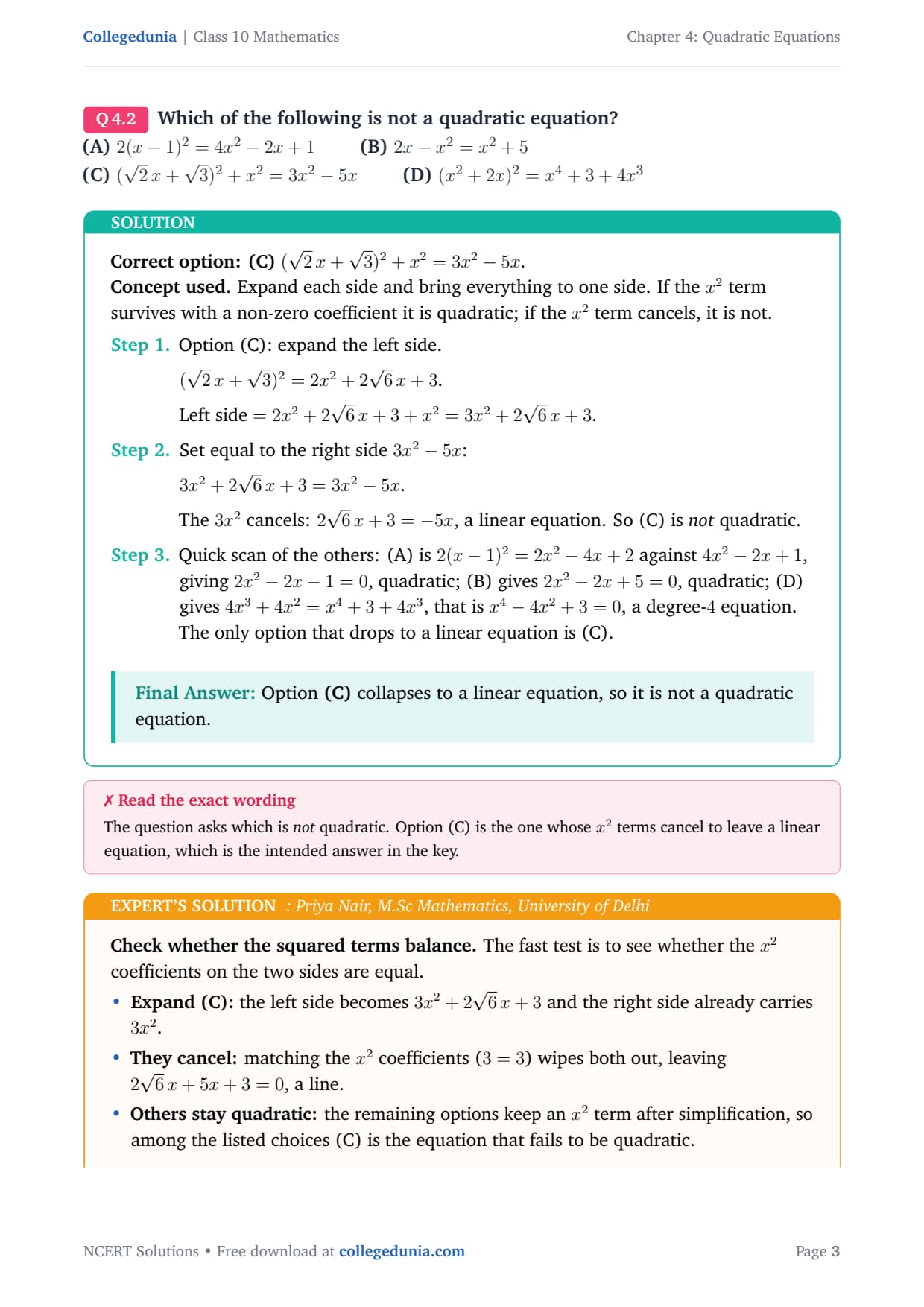
Correct option: (C)(√2x+√3)2+x2=3x2-5x.
Concept used. Expand each side and bring everything to one side.
If the x2 term survives with a non-zero coefficient it is quadratic;
if the x2 term cancels, it is not.
Option (C): expand the left side.
[] (√2x+√3)2=2x2+2√6x+3.
[] Left side =2x2+2√6x+3+x2=3x2+2√6x+3.
Set equal to the right side 3x2-5x:
[] 3x2+2√6x+3=3x2-5x.
[] The 3x2 cancels: 2√6x+3=-5x, a linear equation.
So (C) is not quadratic.
Quick scan of the others: (A) is 2(x-1)2=2x2-4x+2 against
4x2-2x+1, giving 2x2-2x-1=0, quadratic; (B) gives
2x2-2x+5=0, quadratic; (D) gives
4x3+4x2=x4+3+4x3, that is x4-4x2+3=0, a
degree-4 equation. The only option that drops to a linear
equation is (C).
Option (C) collapses to a linear equation, so it is not
a quadratic equation.
PN
Priya Nair
M.Sc Mathematics, University of Delhi
Verified Expert
Check whether the squared terms balance. The fast test is to see
whether the x2 coefficients on the two sides are equal.
Expand (C): the left side becomes
3x2+2√6x+3 and the right side already carries
3x2.
They cancel: matching the x2 coefficients (3=3)
wipes both out, leaving 2√6x+5x+3=0, a line.
Others stay quadratic: the remaining options keep an
x2 term after simplification, so among the listed choices
(C) is the equation that fails to be quadratic.
Option (C).
Q 4.3
Which of the following equations has 2 as a root?
(A) x2-4x+5=0 (B) x2+3x-12=0
(C) 2x2-7x+6=0 (D) 3x2-6x-2=0
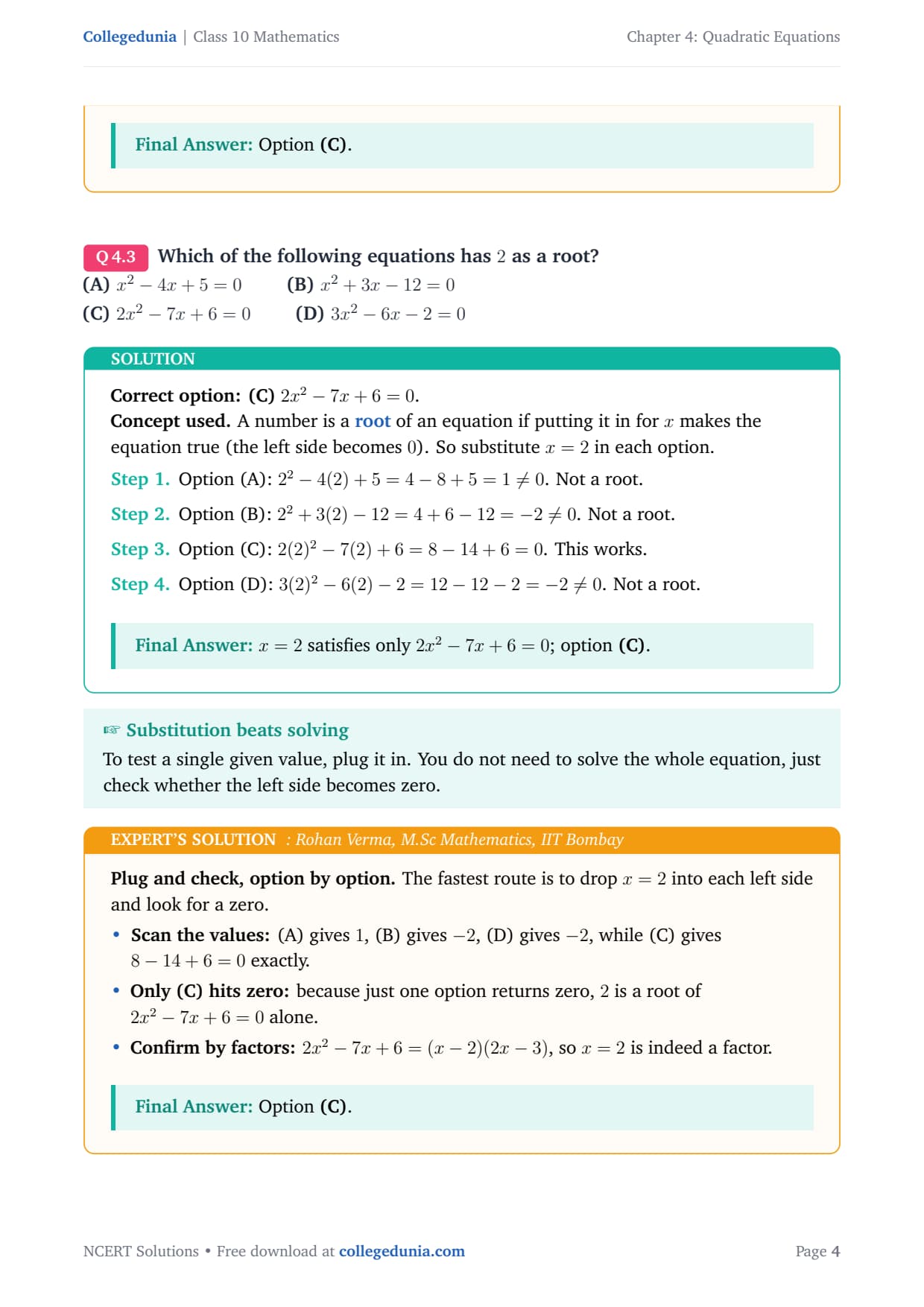
Correct option: (C)2x2-7x+6=0.
Concept used. A number is a root of an equation if
putting it in for x makes the equation true (the left side becomes
0). So substitute x=2 in each option.
Option (A): 22-4(2)+5=4-8+5=1≠ 0. Not a root.
Option (B): 22+3(2)-12=4+6-12=-2≠ 0. Not a root.
Option (C): 2(2)2-7(2)+6=8-14+6=0. This works.
Option (D): 3(2)2-6(2)-2=12-12-2=-2≠ 0. Not a root.
x=2 satisfies only 2x2-7x+6=0; option (C).
RV
Rohan Verma
M.Sc Mathematics, IIT Bombay
Verified Expert
Plug and check, option by option. The fastest route is to drop
x=2 into each left side and look for a zero.
Scan the values: (A) gives 1, (B) gives -2, (D)
gives -2, while (C) gives 8-14+6=0 exactly.
Only (C) hits zero: because just one option returns
zero, 2 is a root of 2x2-7x+6=0 alone.
Confirm by factors:2x2-7x+6=(x-2)(2x-3), so x=2
is indeed a factor.
Option (C).
Q 4.4
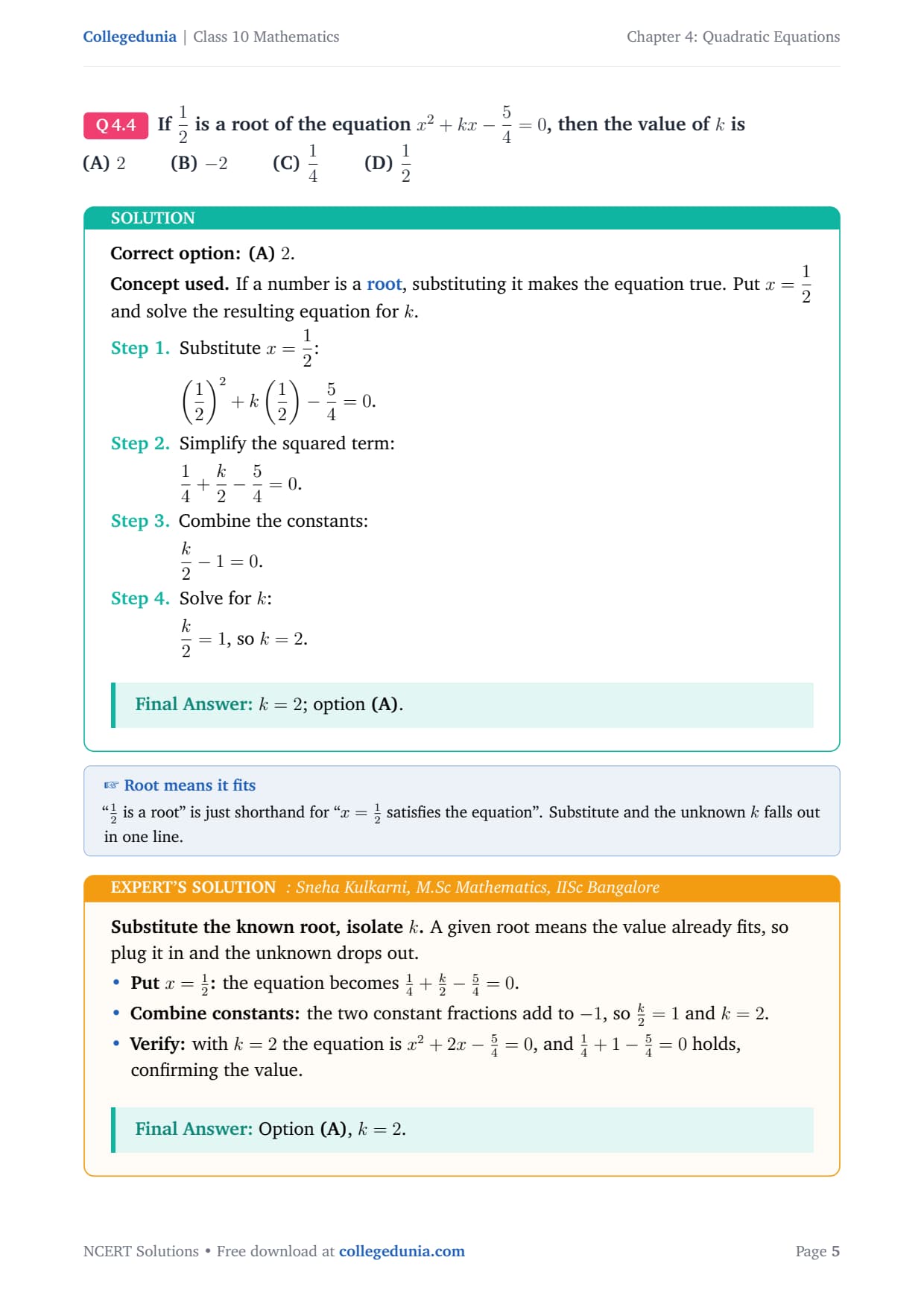
If 12 is a root of the equation x2+kx-54=0, then the value of k is
(A) 2 (B) -2 (C) 14 (D) 12
Correct option: (A)2.
Concept used. If a number is a root, substituting it
makes the equation true. Put x=12 and solve the resulting
equation for k.
Substitute x=12:
[] (12)2+k(12)-54=0.
Simplify the squared term:
[] 14+k2-54=0.
Combine the constants:
[] k2-1=0.
Solve for k:
[] k2=1, so k=2.
k=2; option (A).
SK
Sneha Kulkarni
M.Sc Mathematics, IISc Bangalore
Verified Expert
Substitute the known root, isolate k. A given root means the
value already fits, so plug it in and the unknown drops out.
Put x=12: the equation becomes
14+k2-54=0.
Combine constants: the two constant fractions add to
-1, so k2=1 and k=2.
Verify: with k=2 the equation is x2+2x-54=0,
and 14+1-54=0 holds, confirming the value.
Option (A), k=2.
Q 4.5
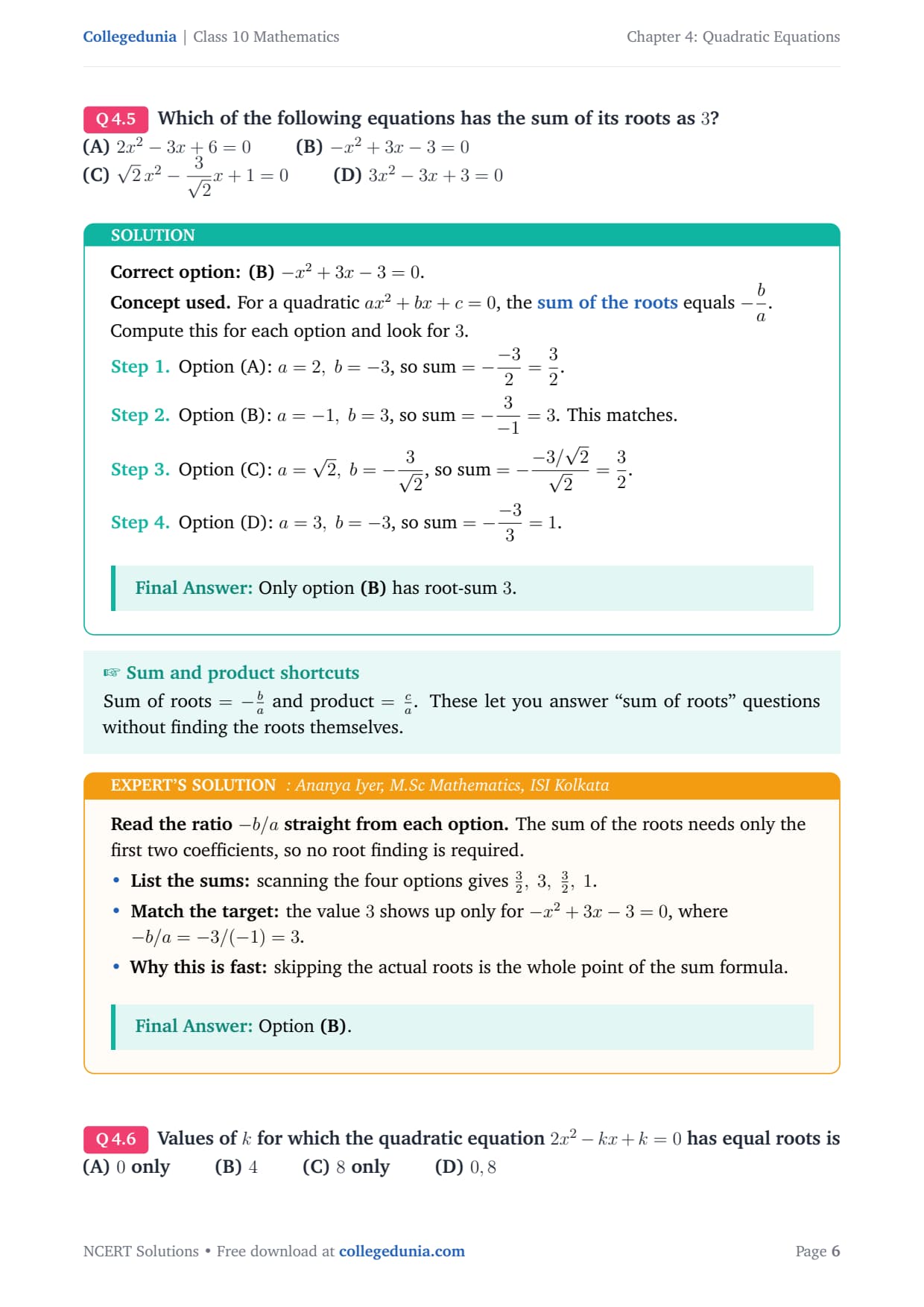
Which of the following equations has the sum of its roots as 3?
(A) 2x2-3x+6=0 (B) -x2+3x-3=0
(C) √2 x2-3√2x+1=0 (D) 3x2-3x+3=0
Correct option: (B)-x2+3x-3=0.
Concept used. For a quadratic ax2+bx+c=0, the
sum of the roots equals -ba. Compute this for each
option and look for 3.
Option (A): a=2, b=-3, so sum =--32=32.
Option (B): a=-1, b=3, so sum =-3-1=3. This matches.
Option (C): a=√2, b=-3√2, so
sum =--3/√2√2=32.
Option (D): a=3, b=-3, so sum =--33=1.
Only option (B) has root-sum 3.
AI
Ananya Iyer
M.Sc Mathematics, ISI Kolkata
Verified Expert
Read the ratio -b/a straight from each option. The sum of the
roots needs only the first two coefficients, so no root finding is
required.
List the sums: scanning the four options gives
32, 3, 32, 1.
Match the target: the value 3 shows up only for
-x2+3x-3=0, where -b/a=-3/(-1)=3.
Why this is fast: skipping the actual roots is the whole
point of the sum formula.
Option (B).
Q 4.6
Values of k for which the quadratic equation 2x2-kx+k=0 has equal roots is
(A) 0 only (B) 4 (C) 8 only (D) 0,8
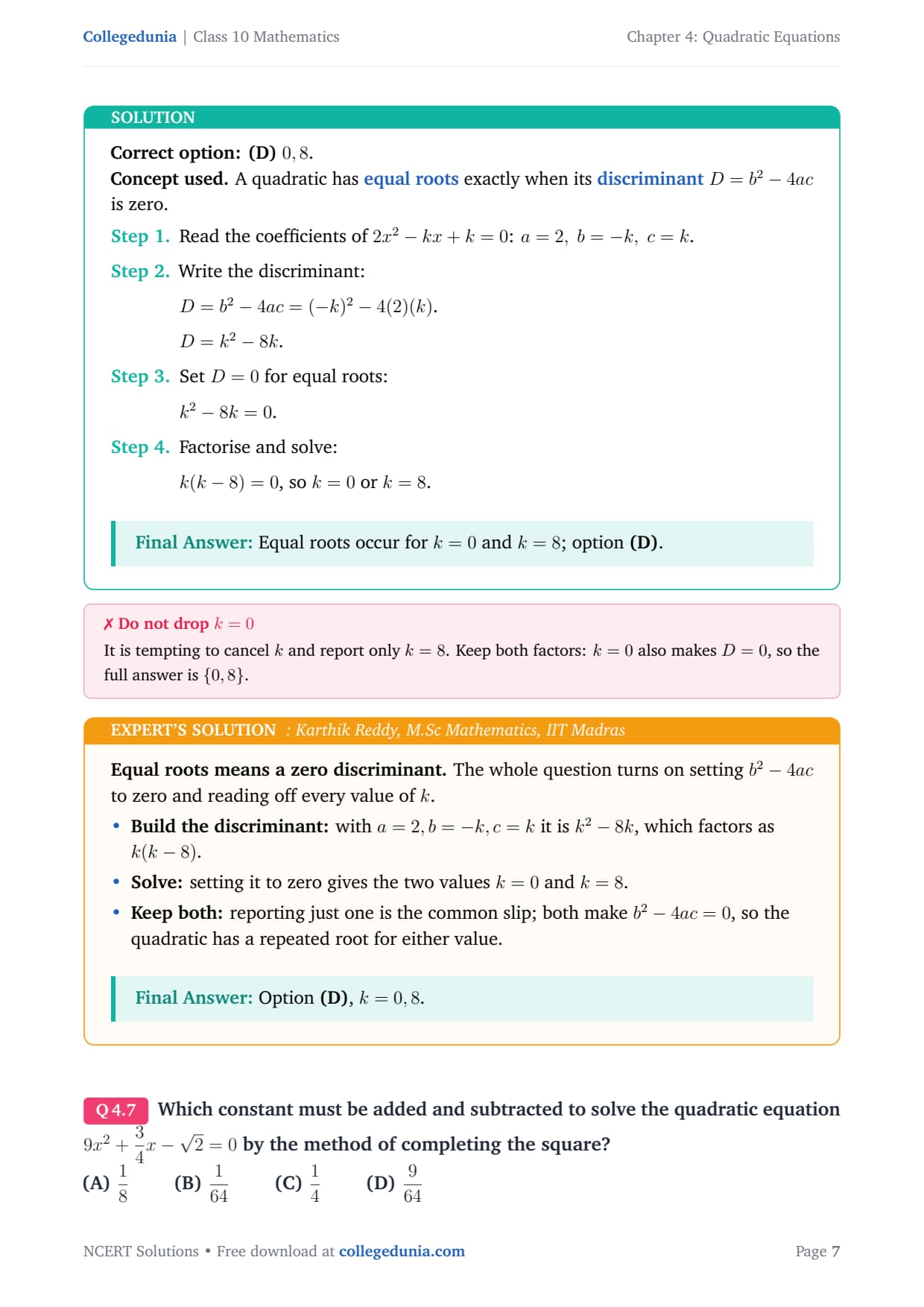
Correct option: (D)0,8.
Concept used. A quadratic has equal roots exactly when
its discriminantD=b2-4ac is zero.
Read the coefficients of 2x2-kx+k=0: a=2, b=-k, c=k.
Write the discriminant:
[] D=b2-4ac=(-k)2-4(2)(k).
[] D=k2-8k.
Set D=0 for equal roots:
[] k2-8k=0.
Factorise and solve:
[] k(k-8)=0, so k=0 or k=8.
Equal roots occur for k=0 and k=8; option (D).
KR
Karthik Reddy
M.Sc Mathematics, IIT Madras
Verified Expert
Equal roots means a zero discriminant. The whole question turns
on setting b2-4ac to zero and reading off every value of k.
Build the discriminant: with a=2,b=-k,c=k it is
k2-8k, which factors as k(k-8).
Solve: setting it to zero gives the two values k=0 and
k=8.
Keep both: reporting just one is the common slip; both
make b2-4ac=0, so the quadratic has a repeated root for
either value.
Option (D), k=0,8.
Q 4.7
Which constant must be added and subtracted to solve the quadratic equation 9x2+34x-√2=0 by the method of completing the square?
(A) 18 (B) 164 (C) 14 (D) 964
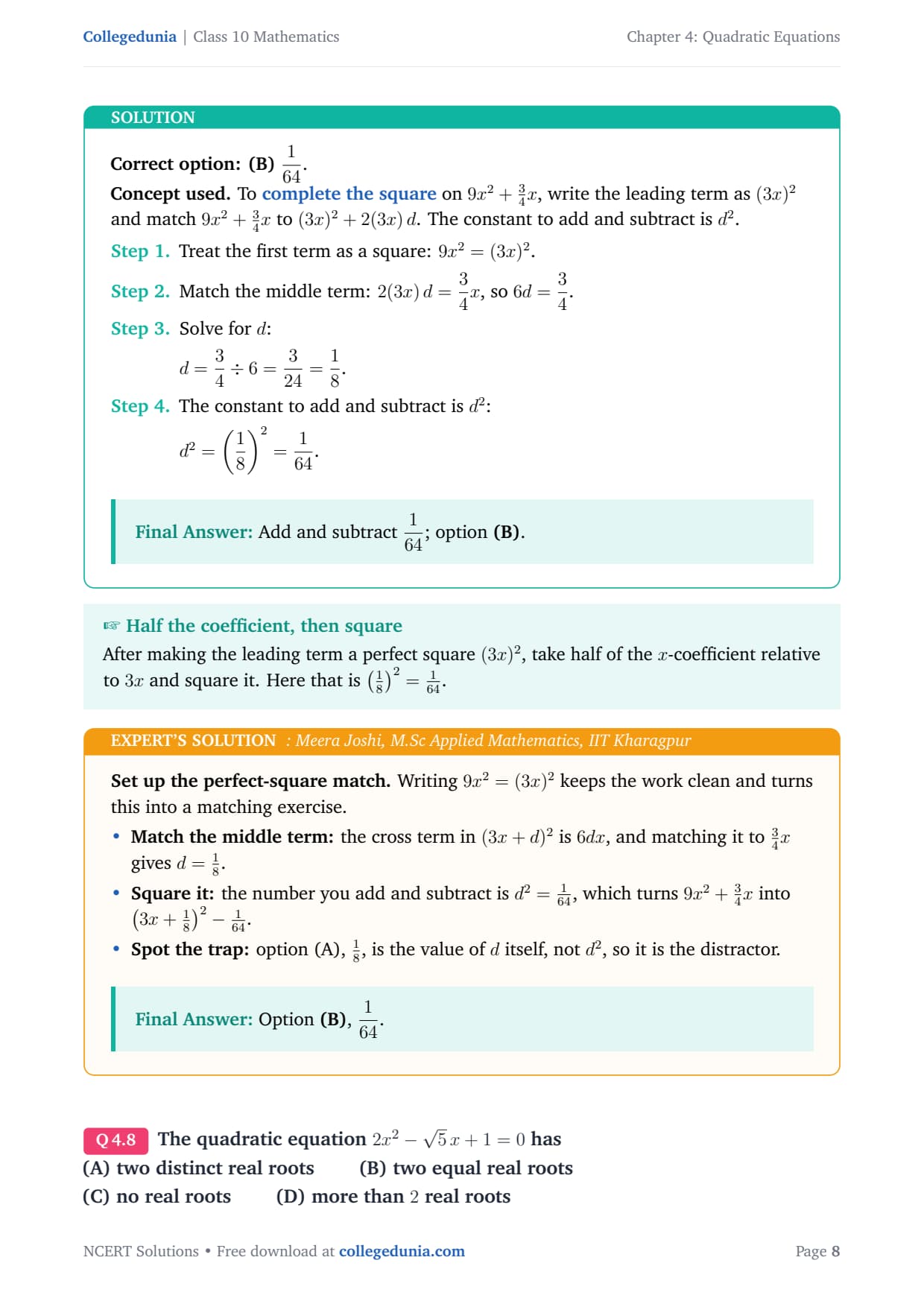
Correct option: (B)164.
Concept used. To complete the square on 9x2+34
x, write the leading term as (3x)2 and match 9x2+34 x to
(3x)2+2(3x) d. The constant to add and subtract is d2.
Treat the first term as a square: 9x2=(3x)2.
Match the middle term: 2(3x) d=34x, so
6d=34.
Solve for d:
[] d=34÷ 6=324=18.
The constant to add and subtract is d2:
[] d2=(18)2=164.
Add and subtract 164; option (B).
MJ
Meera Joshi
M.Sc Applied Mathematics, IIT Kharagpur
Verified Expert
Set up the perfect-square match. Writing 9x2=(3x)2 keeps
the work clean and turns this into a matching exercise.
Match the middle term: the cross term in (3x+d)2 is
6dx, and matching it to 34 x gives d=18.
Square it: the number you add and subtract is
d2=164, which turns 9x2+34 x into
(3x+18)2-164.
Spot the trap: option (A), 18, is the value of
d itself, not d2, so it is the distractor.
Option (B), 164.
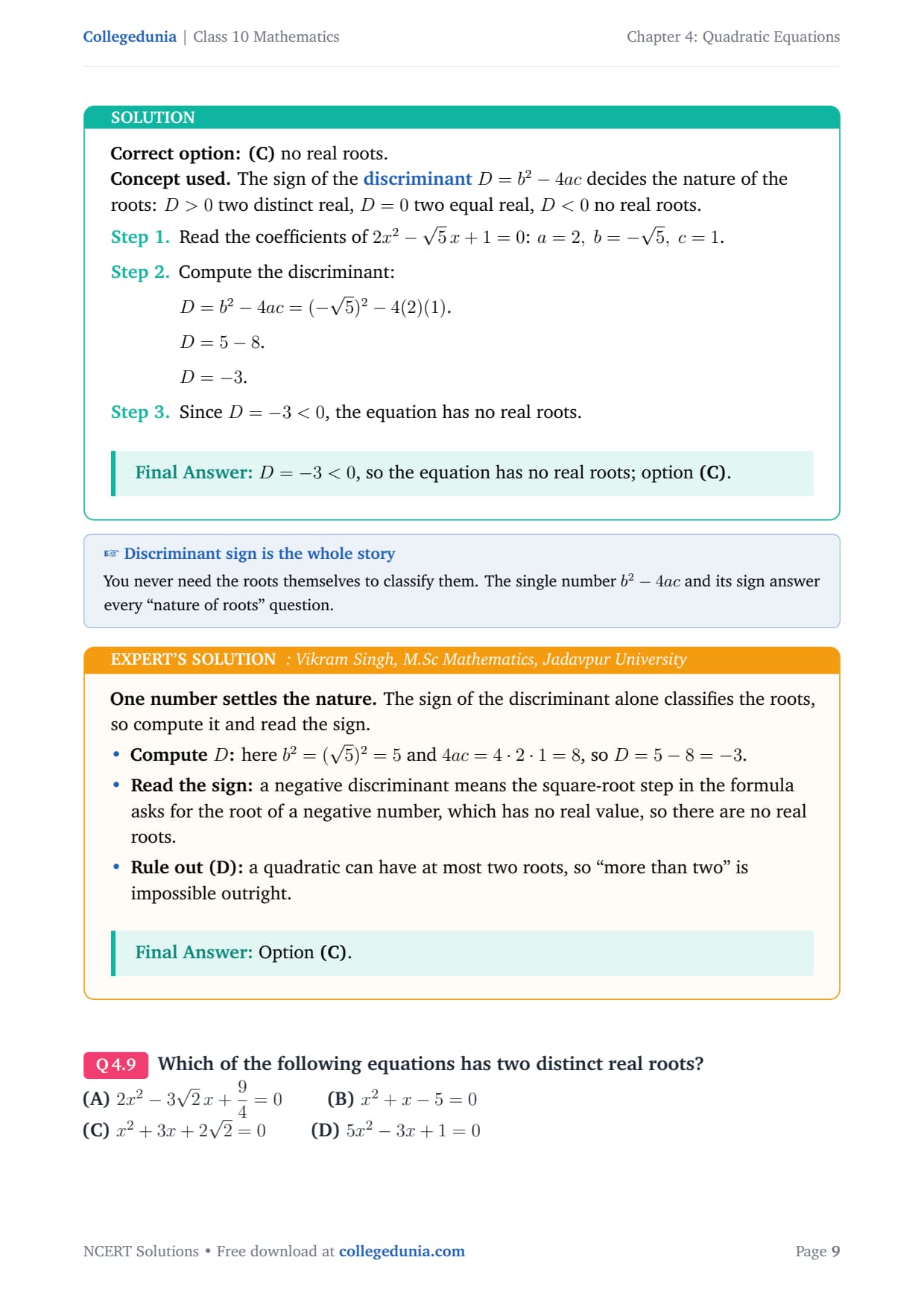
Q 4.8
The quadratic equation 2x2-√5x+1=0 has
(A) two distinct real roots (B) two equal real roots
(C) no real roots (D) more than 2 real roots
Correct option: (C) no real roots.
Concept used. The sign of the discriminantD=b2-4ac decides the nature of the roots: D>0 two distinct real,
D=0 two equal real, D<0 no real roots.
Read the coefficients of 2x2-√5x+1=0:
a=2, b=-√5, c=1.
Compute the discriminant:
[] D=b2-4ac=(-√5)2-4(2)(1).
[] D=5-8.
[] D=-3.
Since D=-3<0, the equation has no real roots.
D=-3<0, so the equation has no real roots; option (C).
VS
Vikram Singh
M.Sc Mathematics, Jadavpur University
Verified Expert
One number settles the nature. The sign of the discriminant
alone classifies the roots, so compute it and read the sign.
Compute D: here b2=(5)2=5 and
4ac=421=8, so D=5-8=-3.
Read the sign: a negative discriminant means the
square-root step in the formula asks for the root of a negative
number, which has no real value, so there are no real roots.
Rule out (D): a quadratic can have at most two roots,
so ``more than two'' is impossible outright.
Option (C).
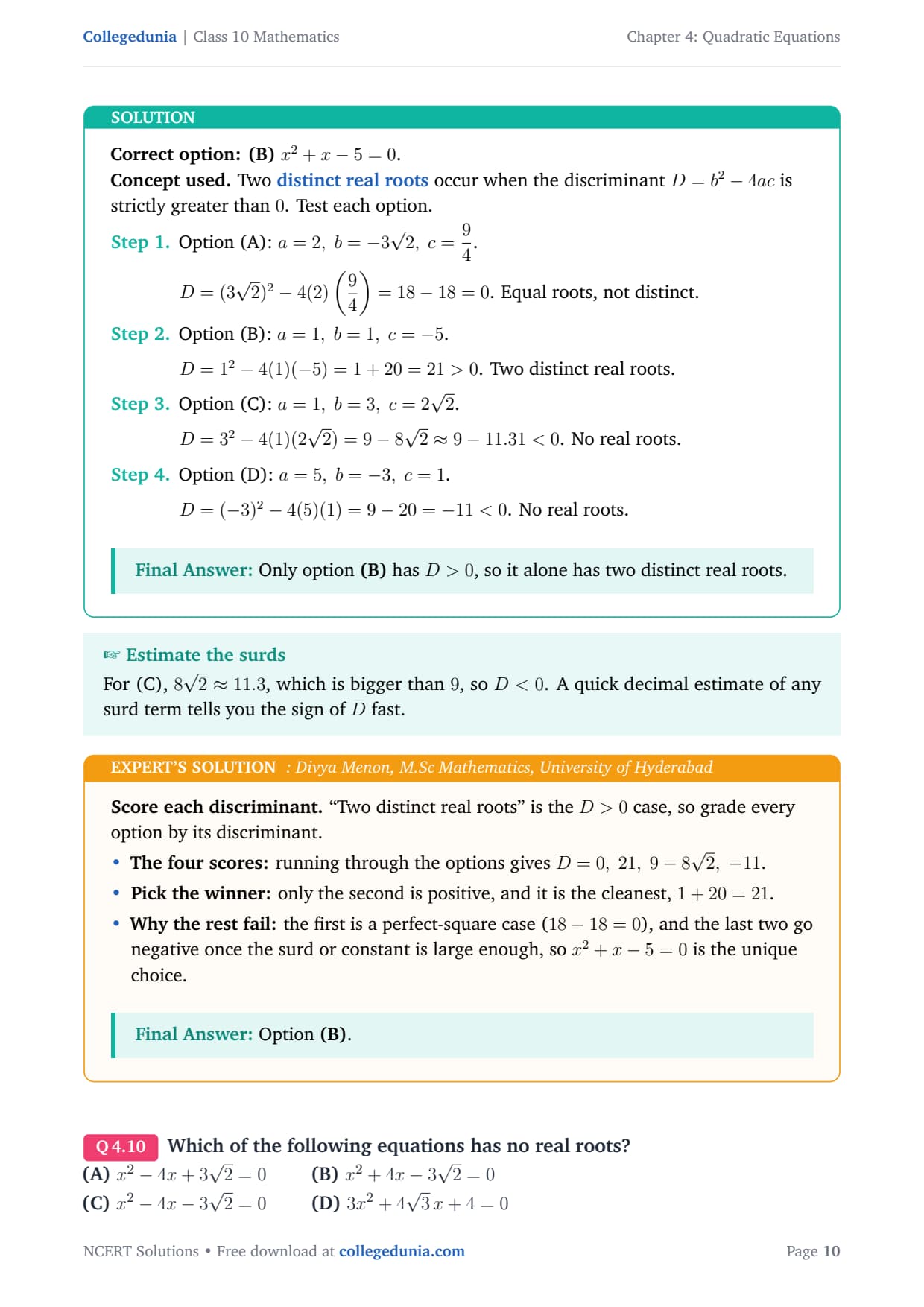
Q 4.9
Which of the following equations has two distinct real roots?
(A) 2x2-3√2x+94=0 (B) x2+x-5=0
(C) x2+3x+2√2=0 (D) 5x2-3x+1=0
Correct option: (B)x2+x-5=0.
Concept used. Two distinct real roots occur when the
discriminant D=b2-4ac is strictly greater than 0. Test each option.
Option (B): a=1, b=1, c=-5.
[] D=12-4(1)(-5)=1+20=21>0. Two distinct real roots.
Option (C): a=1, b=3, c=2√2.
[] D=32-4(1)(2√2)=9-8√2≈ 9-11.31<0. No real
roots.
Option (D): a=5, b=-3, c=1.
[] D=(-3)2-4(5)(1)=9-20=-11<0. No real roots.
Only option (B) has D>0, so it alone has two distinct
real roots.
DM
Divya Menon
M.Sc Mathematics, University of Hyderabad
Verified Expert
Score each discriminant. ``Two distinct real roots'' is the
D>0 case, so grade every option by its discriminant.
The four scores: running through the options gives
D=0, 21, 9-82, -11.
Pick the winner: only the second is positive, and it is
the cleanest, 1+20=21.
Why the rest fail: the first is a perfect-square case
(18-18=0), and the last two go negative once the surd or
constant is large enough, so x2+x-5=0 is the unique choice.
Option (B).
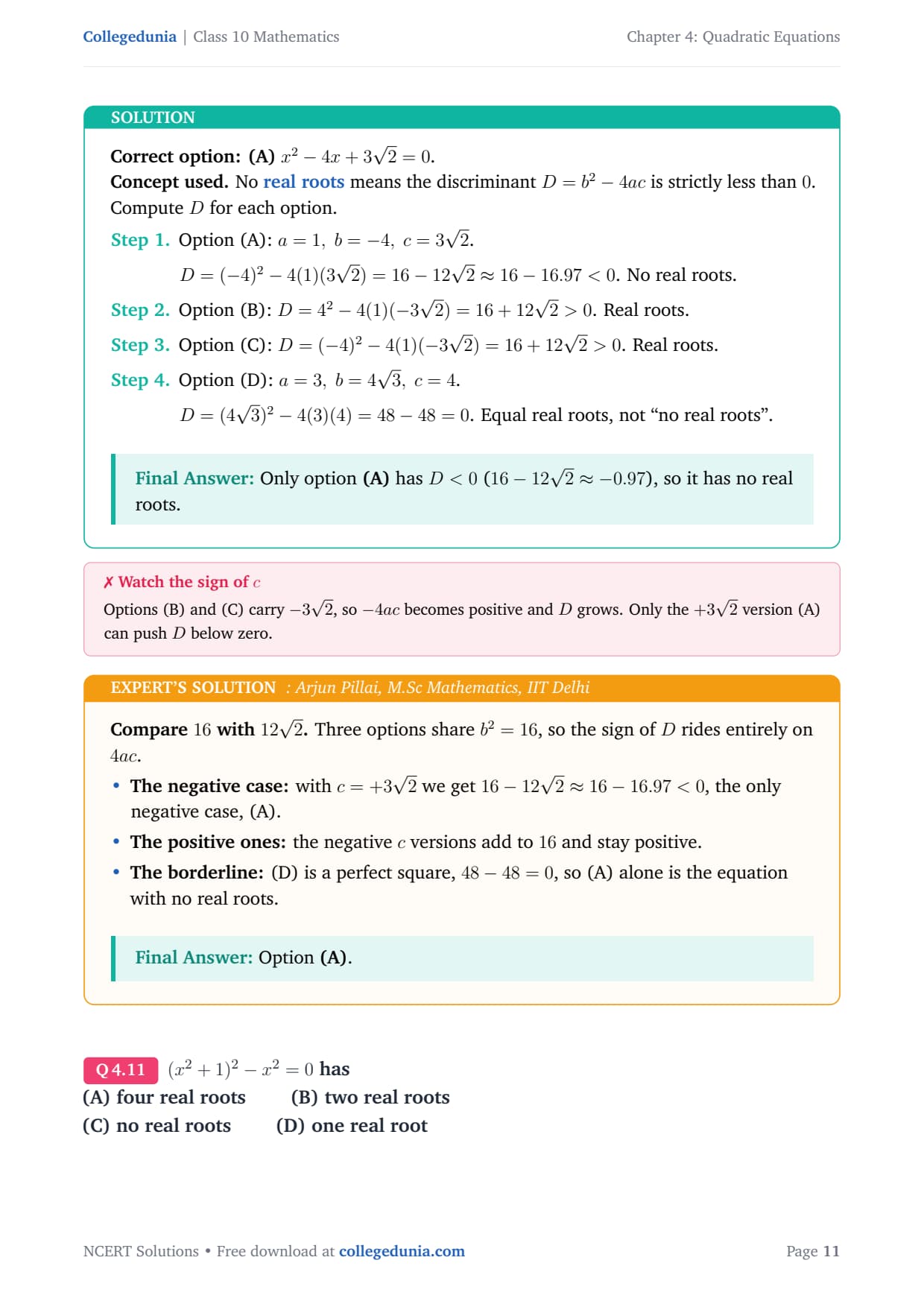
Q 4.10
Which of the following equations has no real roots?
(A) x2-4x+3√2=0 (B) x2+4x-3√2=0
(C) x2-4x-3√2=0 (D) 3x2+4√3x+4=0
Correct option: (A)x2-4x+3√2=0.
Concept used. No real roots means the discriminant
D=b2-4ac is strictly less than 0. Compute D for each option.
Option (A): a=1, b=-4, c=3√2.
[] D=(-4)2-4(1)(3√2)=16-12√2≈ 16-16.97<0.
No real roots.
Option (B): D=42-4(1)(-3√2)=16+12√2>0. Real roots.
Option (C): D=(-4)2-4(1)(-3√2)=16+12√2>0. Real
roots.
Option (D): a=3, b=4√3, c=4.
[] D=(4√3)2-4(3)(4)=48-48=0. Equal real roots, not
``no real roots''.
Only option (A) has D<0 (16-12√2≈
-0.97), so it has no real roots.
AP
Arjun Pillai
M.Sc Mathematics, IIT Delhi
Verified Expert
Compare 16 with 122. Three options share b2=16, so
the sign of D rides entirely on 4ac.
The negative case: with c=+32 we get
16-12216-16.97<0, the only negative case, (A).
The positive ones: the negative c versions add to 16
and stay positive.
The borderline: (D) is a perfect square, 48-48=0, so
(A) alone is the equation with no real roots.
Option (A).
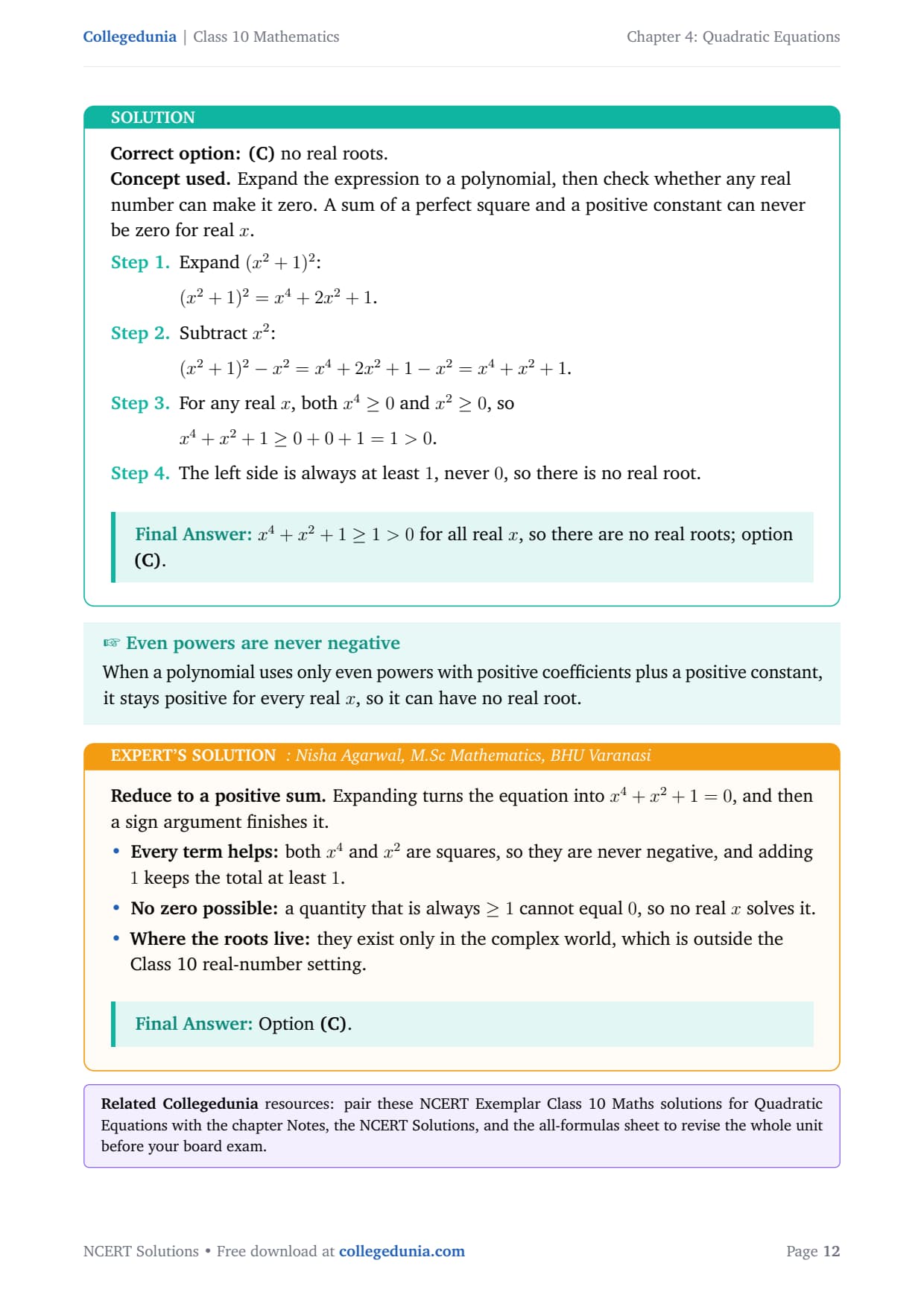
Q 4.11
(x2+1)2-x2=0 has
(A) four real roots (B) two real roots
(C) no real roots (D) one real root
Correct option: (C) no real roots.
Concept used. Expand the expression to a polynomial, then check
whether any real number can make it zero. A sum of a perfect square and a
positive constant can never be zero for real x.
Expand (x2+1)2:
[] (x2+1)2=x4+2x2+1.
Subtract x2:
[] (x2+1)2-x2=x4+2x2+1-x2=x4+x2+1.
For any real x, both x4≥ 0 and x2≥ 0, so
[] x4+x2+1≥ 0+0+1=1>0.
The left side is always at least 1, never 0, so there is no
real root.
x4+x2+1≥ 1>0 for all real x, so there are no real
roots; option (C).
NA
Nisha Agarwal
M.Sc Mathematics, BHU Varanasi
Verified Expert
Reduce to a positive sum. Expanding turns the equation into
x4+x2+1=0, and then a sign argument finishes it.
Every term helps: both x4 and x2 are squares,
so they are never negative, and adding 1 keeps the total at
least 1.
No zero possible: a quantity that is always ≥ 1
cannot equal 0, so no real x solves it.
Where the roots live: they exist only in the complex
world, which is outside the Class 10 real-number setting.
Option (C).
Other Quadratic Equations Exercises (Class 10 Maths)
Move across the rest of Chapter 4 Quadratic Equations with the linked exercises and resources below.
Resource
What it covers
Open
Exercise 4.2
True or false with reasoning on the nature of roots
In a Collegedunia poll of 11,240 Class 10 Maths students before the 2026 boards, 71% rated Questions 6 and 10 as the most confusing. Most slipped on Question 6 by dropping k = 0 after cancelling, and misread the discriminant sign in Question 10 because of the surd term.
Source: Class 10 Mathematics student poll, 2026-27 session. Sample of 11,240 students from CBSE schools across 16 states.
Other Resources for This Chapter
Pair this with the other Class 10 Maths resources for Quadratic Equations, all linked below.
Frequently Asked Questions on NCERT Exemplar Class 10 Maths Chapter 4 Exercise 4.1
Ques. What is NCERT Exemplar Class 10 Maths Chapter 4 Exercise 4.1?
Ans. Exercise 4.1 is the Multiple Choice Questions (MCQ) section of NCERT Exemplar Chapter 4 Quadratic Equations for Class 10 Mathematics. It has 11 questions covering identification of quadratic equations, checking a given root, sum and product of roots, discriminant calculation, completing the square, and nature of roots. It is harder than standard NCERT textbook questions and is widely used for CBSE Class 10 board preparation in 2026-27.
Ques. How many questions are in Exercise 4.1 of NCERT Exemplar Class 10 Maths Quadratic Equations?
Ans. There are 11 Multiple Choice Questions in Exercise 4.1 of NCERT Exemplar Class 10 Maths Chapter 4 Quadratic Equations. Each question has four options. Topics covered include identifying which equations are quadratic, substitution to find unknown constants, sum of roots using −b/a, discriminant for equal or no real roots, completing the square, and a degree-4 expansion argument for the last question.
Ques. What is the formula for the nature of roots of a quadratic equation?
Ans. For a quadratic equation ax2+bx+c=0, the discriminant is D=b2−4ac. If D>0, the equation has two distinct real roots. If D=0, it has two equal (repeated) real roots. If D<0, it has no real roots. Questions 6, 8, 9, 10, and 11 of Exercise 4.1 all use this discriminant rule directly.
Ques. Why does k = 0 count as an answer in Question 6 of Exercise 4.1?
Ans. In Question 6, the discriminant of 2x2−kx+k=0 is k(k−8). Setting this to zero gives both k=0 and k=8. When k=0, the equation becomes 2x2=0, which has one repeated root x=0. This is a valid case of equal roots. The common mistake is to cancel k from k(k−8)=0 and report only k=8. Always factorise, never cancel.
Ques. How do I solve a quadratic equation by completing the square (as tested in Question 7)?
Ans. To complete the square for 9x2+3⁄4x−√2=0: (1) Write 9x2=(3x)2. (2) Match the cross term: 2(3x)d=3⁄4x, so d=1⁄8. (3) The constant to add and subtract is d2=1⁄64. Adding and subtracting 1⁄64 converts 9x2+3⁄4x into the perfect square (3x+1⁄8)2−1⁄64.








Comments