These NCERT Exemplar Class 10 Maths Chapter 4 Solutions work out every Quadratic Equations problem from Exercises 4.1 to 4.4, step by step. Each answer reads the discriminant, finds the roots, and adds a quick check, so you can match your own working line by line. The set follows the 2026-27 CBSE syllabus and is built for board practice.
56 Exemplar problems across four exercises: MCQ, reasoning, short answer, and long answer.
Covers the discriminant test, factorisation, the quadratic formula, and word problems on numbers, speed, age and area.
Free PDF download plus a solved question bank you can open on this page.
Solved by Collegedunia: Every Quadratic Equations Exemplar question here is worked out by our Mathematics faculty, checked against the official NCERT Exemplar, and matched to the 2026-27 syllabus.
Watch Quadratic Equations Class 10 Maths Explained
The NCERT Exemplar Class 10 Maths Chapter 4 Solutions cover four exercises, each with its own style. Knowing the split helps you plan: short objective items first, then the reasoning, then the longer root-finding and word problems. The image below maps all four types.
Exercise
Question Type
Count
What It Tests
Exercise 4.1
MCQ (objective)
11
Spot a quadratic, test a root, and read the discriminant for the nature of roots
Exercise 4.2
Very short / Justify
21
True-or-false on distinct, equal and no real roots, with a reason
Exercise 4.3
Short answer (solve)
12
Find roots by the quadratic formula and by factorisation
Exercise 4.4
Long answer (word/area)
12
Form a quadratic from a story on numbers, speed, age and area, then solve
So the full set has 56 problems. A type-by-type pass beats a straight 1-to-56 sweep, because the skills build on each other: the discriminant test you learn in Exercise 4.1 is the same one you justify in Exercise 4.2 and apply in Exercises 4.3 and 4.4.
The Discriminant: The One Tool You Reuse
Almost every Quadratic Equations Exemplar answer leans on one idea. Write the equation in standard form ax2+bx+c=0, then compute the discriminant D=b2-4ac. Its sign sorts every quadratic into one of three cases. The card below shows those three outcomes.
Two distinct real roots:D=b2-4ac>0. The curve cuts the x-axis at two points.
Two equal real roots:D=b2-4ac=0. A perfect square, so the two roots coincide.
No real roots:D=b2-4ac<0. The roots are not real numbers, so there is no real solution.
Then the roots: when D≥0, the quadratic formula gives x=-b±√D2a.
A quick reminder before you compute: always expand brackets and move every term to one side so the equation reads …=0 first. A sign slip in -4ac, especially when a or c is negative, is the single most common reason students miss an Exercise 4.1 MCQ.
How These Exemplar Solutions Help Class 10 Students
The NCERT Exemplar Class 10 Maths Quadratic Equations Solutions are written for self-study before the CBSE board exam. They do three things for you:
Show the full working: the discriminant, the formula, and the arithmetic are on separate lines, so you can spot exactly where your own answer went wrong.
Justify, not just answer: every true-or-false question states the reason, which is the part students skip and lose marks on.
Add an Expert view: each question has a second, faster method from a subject expert, such as a factor check or a sign-only argument.
Use them the smart way: try the question first, then open Check Solution, and only read the Expert Solution after you have your own answer. That order builds real recall for the exam.
Quadratic Equations Exemplar vs NCERT Textbook Difficulty
The NCERT textbook exercises on this chapter test one step at a time: factorise a clean quadratic, or apply the formula once. The Exemplar pushes the same setup into reasoning and multi-step word problems. The table shows where the step-up happens.
Skill
NCERT Textbook
NCERT Exemplar
Spotting a quadratic
Read off a, b, c from standard form
Expand traps where the x2 terms cancel to a line
Nature of roots
Compute D for one equation
Justify true-or-false claims about distinct, equal and no real roots
Finding roots
Factorise neat numbers
Use the formula on surd coefficients like √5 and √2
Word problems
Form one quadratic and solve
Speed, age, reciprocal and area set-ups, then reject the impossible root
This is why practising the Exemplar after the textbook is the standard board-prep route: the textbook teaches the rule, the Exemplar makes you apply it under pressure.
Exemplar-Specific Common Mistakes in Quadratic Equations
Across Exercises 4.1 to 4.4, a few slips cost the most marks. Watch for these:
The "equal is distinct" trap:D=0 gives real roots, but they are equal, not distinct. Reject "two distinct real roots" whenever D=0.
Sign of -4ac: when a and c have the same sign, -4ac is negative; when they differ, it is positive. A dropped minus flips the whole verdict.
Forgetting to simplify first: expressions like (x+4)2-8x reduce to x2+16; always bring it to ax2+bx+c=0 before testing D.
Keeping the impossible root: in word problems, reject a negative speed, age or length. Check each root against the story before you box your answer.
If you keep a short error log of which of these you repeat, your accuracy on the board paper climbs fast.
Top Formulae for Quadratic Equations Exemplar Problems
Keep this short list on hand while you solve. Each relation below is used somewhere in the NCERT Exemplar Class 10 Maths Chapter 4 Solutions.
Use
Relation
Standard form
ax2+bx+c=0, a≠0
Discriminant
D=b2-4ac
Quadratic formula
x=-b±√b2-4ac2a
Nature of roots
D>0 distinct, D=0 equal, D<0 none
Sum and product of roots
α+β=-ba, αβ=ca
Memorise the discriminant and its three cases first; the quadratic formula gives the roots once D≥0, and the sum-and-product relations let you answer "sum of roots" questions without solving anything.
Other Resources for Quadratic Equations Class 10 Maths
Pair this Exemplar set with the other Quadratic Equations resources on Collegedunia to revise the whole chapter before your board exam.
All Quadratic Equations Exemplar Questions with Step-by-Step Solutions
I. Multiple Choice Questions (Exercise 4.1)
Q 4.1
Which of the following is a quadratic equation?
(A) x2+2x+1=(4-x)2+3 (B) -2x2=(5-x)(2x-25)
(C) (k+1)x2+32x=7, where k=-1 (D) x3-x2=(x-1)3
Correct option: (D)x3-x2=(x-1)3.
Concept used. An equation is a quadratic equation only
if, after expanding and shifting all terms to one side, the highest power
of the variable is exactly 2 and the coefficient of x2 is non-zero.
Option (A): expand the right side.
[] x2+2x+1=16-8x+x2+3
[] 2x+1=19-8x, so 10x-18=0. The x2 terms cancel, leaving a
linear equation. Not quadratic.
Option (B): expand the right side.
[] -2x2=10x-2-2x2+25x, the x2 terms cancel and
a linear equation remains. Not quadratic.
Option (C): put k=-1, so the coefficient of x2 is
k+1=0. The x2 term vanishes. Not quadratic.
Option (D): expand (x-1)3=x3-3x2+3x-1.
[] x3-x2=x3-3x2+3x-1
[] 2x2-3x+1=0, which has degree 2. This is quadratic.
Only option (D) reduces to a degree-2 equation
2x2-3x+1=0.
AM
Aarav Mehta
M.Sc Mathematics, IIT Kanpur
Verified Expert
Hunt for a surviving x2 term. Each option is a trap where
the squared terms might cancel, so expand first and read the highest
power that is left.
(A) and (B): the x2 on both sides match and
disappear, leaving straight lines.
(C): the multiplier k+1 is zero when k=-1, so there
is no x2 at all.
Only (D) survives: expansion gives
x3-x2-(x-1)3=2x2-3x+1. The cubic terms cancel, the
square stays, so (D) is the genuine quadratic.
Option (D).
Q 4.2
Which of the following is not a quadratic equation?
(A) 2(x-1)2=4x2-2x+1 (B) 2x-x2=x2+5
(C) (√2x+√3)2+x2=3x2-5x (D) (x2+2x)2=x4+3+4x3
Correct option: (C)(√2x+√3)2+x2=3x2-5x.
Concept used. Expand each side and bring everything to one side.
If the x2 term survives with a non-zero coefficient it is quadratic;
if the x2 term cancels, it is not.
Option (C): expand the left side.
[] (√2x+√3)2=2x2+2√6x+3.
[] Left side =2x2+2√6x+3+x2=3x2+2√6x+3.
Set equal to the right side 3x2-5x:
[] 3x2+2√6x+3=3x2-5x.
[] The 3x2 cancels: 2√6x+3=-5x, a linear equation.
So (C) is not quadratic.
Quick scan of the others: (A) is 2(x-1)2=2x2-4x+2 against
4x2-2x+1, giving 2x2-2x-1=0, quadratic; (B) gives
2x2-2x+5=0, quadratic; (D) gives
4x3+4x2=x4+3+4x3, that is x4-4x2+3=0, a
degree-4 equation. The only option that drops to a linear
equation is (C).
Option (C) collapses to a linear equation, so it is not
a quadratic equation.
PN
Priya Nair
M.Sc Mathematics, University of Delhi
Verified Expert
Check whether the squared terms balance. The fast test is to see
whether the x2 coefficients on the two sides are equal.
Expand (C): the left side becomes
3x2+2√6x+3 and the right side already carries
3x2.
They cancel: matching the x2 coefficients (3=3)
wipes both out, leaving 2√6x+5x+3=0, a line.
Others stay quadratic: the remaining options keep an
x2 term after simplification, so among the listed choices
(C) is the equation that fails to be quadratic.
Option (C).
Q 4.3
Which of the following equations has 2 as a root?
(A) x2-4x+5=0 (B) x2+3x-12=0
(C) 2x2-7x+6=0 (D) 3x2-6x-2=0
Correct option: (C)2x2-7x+6=0.
Concept used. A number is a root of an equation if
putting it in for x makes the equation true (the left side becomes
0). So substitute x=2 in each option.
Option (A): 22-4(2)+5=4-8+5=1≠ 0. Not a root.
Option (B): 22+3(2)-12=4+6-12=-2≠ 0. Not a root.
Option (C): 2(2)2-7(2)+6=8-14+6=0. This works.
Option (D): 3(2)2-6(2)-2=12-12-2=-2≠ 0. Not a root.
x=2 satisfies only 2x2-7x+6=0; option (C).
RV
Rohan Verma
M.Sc Mathematics, IIT Bombay
Verified Expert
Plug and check, option by option. The fastest route is to drop
x=2 into each left side and look for a zero.
Scan the values: (A) gives 1, (B) gives -2, (D)
gives -2, while (C) gives 8-14+6=0 exactly.
Only (C) hits zero: because just one option returns
zero, 2 is a root of 2x2-7x+6=0 alone.
Confirm by factors:2x2-7x+6=(x-2)(2x-3), so x=2
is indeed a factor.
Option (C).
Q 4.4
If 12 is a root of the equation x2+kx-54=0, then the value of k is
(A) 2 (B) -2 (C) 14 (D) 12
Correct option: (A)2.
Concept used. If a number is a root, substituting it
makes the equation true. Put x=12 and solve the resulting
equation for k.
Substitute x=12:
[] (12)2+k(12)-54=0.
Simplify the squared term:
[] 14+k2-54=0.
Combine the constants:
[] k2-1=0.
Solve for k:
[] k2=1, so k=2.
k=2; option (A).
SK
Sneha Kulkarni
M.Sc Mathematics, IISc Bangalore
Verified Expert
Substitute the known root, isolate k. A given root means the
value already fits, so plug it in and the unknown drops out.
Put x=12: the equation becomes
14+k2-54=0.
Combine constants: the two constant fractions add to
-1, so k2=1 and k=2.
Verify: with k=2 the equation is x2+2x-54=0,
and 14+1-54=0 holds, confirming the value.
Option (A), k=2.
Q 4.5
Which of the following equations has the sum of its roots as 3?
(A) 2x2-3x+6=0 (B) -x2+3x-3=0
(C) √2 x2-3√2x+1=0 (D) 3x2-3x+3=0
Correct option: (B)-x2+3x-3=0.
Concept used. For a quadratic ax2+bx+c=0, the
sum of the roots equals -ba. Compute this for each
option and look for 3.
Option (A): a=2, b=-3, so sum =--32=32.
Option (B): a=-1, b=3, so sum =-3-1=3. This matches.
Option (C): a=√2, b=-3√2, so
sum =--3/√2√2=32.
Option (D): a=3, b=-3, so sum =--33=1.
Only option (B) has root-sum 3.
AI
Ananya Iyer
M.Sc Mathematics, ISI Kolkata
Verified Expert
Read the ratio -b/a straight from each option. The sum of the
roots needs only the first two coefficients, so no root finding is
required.
List the sums: scanning the four options gives
32, 3, 32, 1.
Match the target: the value 3 shows up only for
-x2+3x-3=0, where -b/a=-3/(-1)=3.
Why this is fast: skipping the actual roots is the whole
point of the sum formula.
Option (B).
Q 4.6
Values of k for which the quadratic equation 2x2-kx+k=0 has equal roots is
(A) 0 only (B) 4 (C) 8 only (D) 0,8
Correct option: (D)0,8.
Concept used. A quadratic has equal roots exactly when
its discriminantD=b2-4ac is zero.
Read the coefficients of 2x2-kx+k=0: a=2, b=-k, c=k.
Write the discriminant:
[] D=b2-4ac=(-k)2-4(2)(k).
[] D=k2-8k.
Set D=0 for equal roots:
[] k2-8k=0.
Factorise and solve:
[] k(k-8)=0, so k=0 or k=8.
Equal roots occur for k=0 and k=8; option (D).
KR
Karthik Reddy
M.Sc Mathematics, IIT Madras
Verified Expert
Equal roots means a zero discriminant. The whole question turns
on setting b2-4ac to zero and reading off every value of k.
Build the discriminant: with a=2,b=-k,c=k it is
k2-8k, which factors as k(k-8).
Solve: setting it to zero gives the two values k=0 and
k=8.
Keep both: reporting just one is the common slip; both
make b2-4ac=0, so the quadratic has a repeated root for
either value.
Option (D), k=0,8.
Q 4.7
Which constant must be added and subtracted to solve the quadratic equation 9x2+34x-√2=0 by the method of completing the square?
(A) 18 (B) 164 (C) 14 (D) 964
Correct option: (B)164.
Concept used. To complete the square on 9x2+34
x, write the leading term as (3x)2 and match 9x2+34 x to
(3x)2+2(3x) d. The constant to add and subtract is d2.
Treat the first term as a square: 9x2=(3x)2.
Match the middle term: 2(3x) d=34x, so
6d=34.
Solve for d:
[] d=34÷ 6=324=18.
The constant to add and subtract is d2:
[] d2=(18)2=164.
Add and subtract 164; option (B).
MJ
Meera Joshi
M.Sc Applied Mathematics, IIT Kharagpur
Verified Expert
Set up the perfect-square match. Writing 9x2=(3x)2 keeps
the work clean and turns this into a matching exercise.
Match the middle term: the cross term in (3x+d)2 is
6dx, and matching it to 34 x gives d=18.
Square it: the number you add and subtract is
d2=164, which turns 9x2+34 x into
(3x+18)2-164.
Spot the trap: option (A), 18, is the value of
d itself, not d2, so it is the distractor.
Option (B), 164.
Q 4.8
The quadratic equation 2x2-√5x+1=0 has
(A) two distinct real roots (B) two equal real roots
(C) no real roots (D) more than 2 real roots
Correct option: (C) no real roots.
Concept used. The sign of the discriminantD=b2-4ac decides the nature of the roots: D>0 two distinct real,
D=0 two equal real, D<0 no real roots.
Read the coefficients of 2x2-√5x+1=0:
a=2, b=-√5, c=1.
Compute the discriminant:
[] D=b2-4ac=(-√5)2-4(2)(1).
[] D=5-8.
[] D=-3.
Since D=-3<0, the equation has no real roots.
D=-3<0, so the equation has no real roots; option (C).
VS
Vikram Singh
M.Sc Mathematics, Jadavpur University
Verified Expert
One number settles the nature. The sign of the discriminant
alone classifies the roots, so compute it and read the sign.
Compute D: here b2=(5)2=5 and
4ac=421=8, so D=5-8=-3.
Read the sign: a negative discriminant means the
square-root step in the formula asks for the root of a negative
number, which has no real value, so there are no real roots.
Rule out (D): a quadratic can have at most two roots,
so ``more than two'' is impossible outright.
Option (C).
Q 4.9
Which of the following equations has two distinct real roots?
(A) 2x2-3√2x+94=0 (B) x2+x-5=0
(C) x2+3x+2√2=0 (D) 5x2-3x+1=0
Correct option: (B)x2+x-5=0.
Concept used. Two distinct real roots occur when the
discriminant D=b2-4ac is strictly greater than 0. Test each option.
Option (B): a=1, b=1, c=-5.
[] D=12-4(1)(-5)=1+20=21>0. Two distinct real roots.
Option (C): a=1, b=3, c=2√2.
[] D=32-4(1)(2√2)=9-8√2≈ 9-11.31<0. No real
roots.
Option (D): a=5, b=-3, c=1.
[] D=(-3)2-4(5)(1)=9-20=-11<0. No real roots.
Only option (B) has D>0, so it alone has two distinct
real roots.
DM
Divya Menon
M.Sc Mathematics, University of Hyderabad
Verified Expert
Score each discriminant. ``Two distinct real roots'' is the
D>0 case, so grade every option by its discriminant.
The four scores: running through the options gives
D=0, 21, 9-82, -11.
Pick the winner: only the second is positive, and it is
the cleanest, 1+20=21.
Why the rest fail: the first is a perfect-square case
(18-18=0), and the last two go negative once the surd or
constant is large enough, so x2+x-5=0 is the unique choice.
Option (B).
Q 4.10
Which of the following equations has no real roots?
(A) x2-4x+3√2=0 (B) x2+4x-3√2=0
(C) x2-4x-3√2=0 (D) 3x2+4√3x+4=0
Correct option: (A)x2-4x+3√2=0.
Concept used. No real roots means the discriminant
D=b2-4ac is strictly less than 0. Compute D for each option.
Option (A): a=1, b=-4, c=3√2.
[] D=(-4)2-4(1)(3√2)=16-12√2≈ 16-16.97<0.
No real roots.
Option (B): D=42-4(1)(-3√2)=16+12√2>0. Real roots.
Option (C): D=(-4)2-4(1)(-3√2)=16+12√2>0. Real
roots.
Option (D): a=3, b=4√3, c=4.
[] D=(4√3)2-4(3)(4)=48-48=0. Equal real roots, not
``no real roots''.
Only option (A) has D<0 (16-12√2≈
-0.97), so it has no real roots.
AP
Arjun Pillai
M.Sc Mathematics, IIT Delhi
Verified Expert
Compare 16 with 122. Three options share b2=16, so
the sign of D rides entirely on 4ac.
The negative case: with c=+32 we get
16-12216-16.97<0, the only negative case, (A).
The positive ones: the negative c versions add to 16
and stay positive.
The borderline: (D) is a perfect square, 48-48=0, so
(A) alone is the equation with no real roots.
Option (A).
Q 4.11
(x2+1)2-x2=0 has
(A) four real roots (B) two real roots
(C) no real roots (D) one real root
Correct option: (C) no real roots.
Concept used. Expand the expression to a polynomial, then check
whether any real number can make it zero. A sum of a perfect square and a
positive constant can never be zero for real x.
Expand (x2+1)2:
[] (x2+1)2=x4+2x2+1.
Subtract x2:
[] (x2+1)2-x2=x4+2x2+1-x2=x4+x2+1.
For any real x, both x4≥ 0 and x2≥ 0, so
[] x4+x2+1≥ 0+0+1=1>0.
The left side is always at least 1, never 0, so there is no
real root.
x4+x2+1≥ 1>0 for all real x, so there are no real
roots; option (C).
NA
Nisha Agarwal
M.Sc Mathematics, BHU Varanasi
Verified Expert
Reduce to a positive sum. Expanding turns the equation into
x4+x2+1=0, and then a sign argument finishes it.
Every term helps: both x4 and x2 are squares,
so they are never negative, and adding 1 keeps the total at
least 1.
No zero possible: a quantity that is always ≥ 1
cannot equal 0, so no real x solves it.
Where the roots live: they exist only in the complex
world, which is outside the Class 10 real-number setting.
Option (C).
NCERT exemplar Class 12 Mathematics Chapter 4 Quadratic Equations
Exercise 4.2 Questions
All 21 questions with collapsible Solution and Expert Solution. Tap a button to reveal the working.
II. True or False with Reasoning (Exercise 4.2)
Q 4.1
State whether the quadratic equation x2-3x+4=0 has two distinct real roots. Justify your answer.
Verdict: No. The equation x2-3x+4=0 does not have two
distinct real roots.
Concept used. Two distinct real roots need discriminantD=b2-4ac>0. Compute D and read its sign.
Read the coefficients: a=1, b=-3, c=4.
Compute the discriminant:
[] D=b2-4ac=(-3)2-4(1)(4).
[] D=9-16=-7.
Since D=-7<0, the equation has no real roots, so it certainly
does not have two distinct real roots.
No, because D=-7<0, so there are no real roots at all.
SR
Siddharth Rao
M.Sc Applied Mathematics, IIT Roorkee
Verified Expert
One discriminant, one verdict. A single number decides whether
distinct real roots can exist here.
Compute: for x2-3x+4 the numbers are a=1,b=-3,c=4,
giving D=9-16=-7.
Conclude: a negative discriminant rules out real roots,
so the equation has neither one nor two real roots.
State it plainly: the honest answer is No, and the
reason is the single negative value -7.
No; D=-7<0.
Q 4.2
State whether the quadratic equation 2x2+x-1=0 has two distinct real roots. Justify your answer.
Verdict: Yes. The equation 2x2+x-1=0 has two distinct real
roots.
Concept used. Apply the discriminant test D=b2-4ac; a
strictly positive value means two distinct real roots.
Read the coefficients: a=2, b=1, c=-1.
Compute the discriminant:
[] D=b2-4ac=12-4(2)(-1).
[] D=1+8=9.
Since D=9>0, there are two distinct real roots.
Yes, because D=9>0.
KD
Kavya Desai
M.Sc Mathematics, Savitribai Phule Pune University
Verified Expert
Opposite signs guarantee real roots. When a and c pull in
opposite directions, the discriminant cannot be negative.
Sign check: with a=2 positive and c=-1 negative, the
term -4ac=8 is positive, and adding b2=1 gives D=9>0.
Read the verdict: that alone tells you two different
real roots exist.
Show them: in fact 2x2+x-1=(2x-1)(x+1), so the
roots are 12 and -1, two distinct values.
Yes; D=9>0.
Q 4.3
State whether the quadratic equation 2x2-6x+92=0 has two distinct real roots. Justify your answer.
Verdict: No. The equation 2x2-6x+92=0 does not have
two distinct real roots; it has two equal roots.
Concept used. Compute D=b2-4ac. A value of 0 means the two
roots are equal, not distinct.
Read the coefficients: a=2, b=-6, c=92.
Compute the discriminant:
[] D=b2-4ac=(-6)2-4(2)(92).
[] D=36-36=0.
Since D=0, the roots are real but equal, so they are not two
distinct roots.
No, because D=0, so the two roots are equal, not distinct.
AB
Aditya Bhat
M.Sc Mathematics, NIT Trichy
Verified Expert
Spot the perfect square. A zero discriminant is the borderline
between distinct roots and none, and it shows up here.
Compute: here b2=36 and 4ac=42·92=36,
so D=0.
Recognise the form: the quadratic is a perfect square,
2x2-6x+92=12(2x-3)2, with the single repeated
root x=32.
Why not distinct: because the two roots are the same
number, they are not distinct.
No; D=0 gives equal roots.
Q 4.4
State whether the quadratic equation 3x2-4x+1=0 has two distinct real roots. Justify your answer.
Verdict: Yes. The equation 3x2-4x+1=0 has two distinct real
roots.
Concept used. Use the discriminant test D=b2-4ac; a positive
value gives two distinct real roots.
Read the coefficients: a=3, b=-4, c=1.
Compute the discriminant:
[] D=b2-4ac=(-4)2-4(3)(1).
[] D=16-12=4.
Since D=4>0, there are two distinct real roots.
Yes, because D=4>0.
IR
Ishita Roy
M.Sc Mathematics, Calcutta University
Verified Expert
Positive D, distinct roots. A positive discriminant settles
the count, and a perfect-square one even names the roots.
Compute: the discriminant works out to 16-12=4, which
is positive, so two different real roots exist.
Nice rationals: because 4 is a perfect square, the
roots are clean fractions.
Show them: factoring 3x2-4x+1=(3x-1)(x-1) gives
x=13 and x=1, plainly two distinct numbers.
Yes; D=4>0.
Q 4.5
State whether the quadratic equation (x+4)2-8x=0 has two distinct real roots. Justify your answer.
Verdict: No. The equation (x+4)2-8x=0 has no real roots.
Concept used. First expand to standard form ax2+bx+c=0, then
apply the discriminant test D=b2-4ac.
Expand and simplify:
[] (x+4)2-8x=x2+8x+16-8x=x2+16.
So the equation is x2+16=0, with a=1, b=0, c=16.
Compute the discriminant:
[] D=b2-4ac=02-4(1)(16).
[] D=-64.
Since D=-64<0, there are no real roots, so no distinct real
roots either.
No, because the equation reduces to x2+16=0 with
D=-64<0.
NP
Nikhil Pandey
M.Sc Applied Mathematics, IIT Indore
Verified Expert
The 8x terms cancel. Simplifying first turns this into an
obvious no-real-root case.
Simplify: expanding (x+4)2 gives x2+8x+16, and
subtracting 8x leaves x2+16.
Try to solve: setting this to zero needs x2=-16,
impossible for real x.
Discriminant agrees:D=0-64=-64<0, so the equation has
no real roots, let alone two distinct ones.
No; D=-64<0.
Q 4.6
State whether the quadratic equation (x-√2)2-2(x+1)=0 has two distinct real roots. Justify your answer.
Verdict: Yes. The equation (x-√2)2-2(x+1)=0 has two
distinct real roots.
Concept used. Expand to standard form, then apply the
discriminant test D=b2-4ac.
Expand the square and the bracket:
[] (x-√2)2-2(x+1)=x2-2√2x+2-2x-2.
[] =x2-(2√2+2)x.
So a=1, b=-(2√2+2), c=0.
Compute the discriminant:
[] D=b2-4ac=(2√2+2)2-0.
[] D=(2√2+2)2>0.
Since D>0, the equation has two distinct real roots.
Yes, because D=(2√2+2)2>0.
AR
Aishwarya Rao
M.Sc Mathematics, Christ University Bengaluru
Verified Expert
No constant term is a giveaway. When the constant term vanishes,
the roots fall out of a simple factorisation.
Expand and factor: after expansion the equation is
x2-(22+2)x=0, which factors as
x(x-(22+2))=0.
Read the roots: that immediately shows two distinct
roots, 0 and 22+2.
Discriminant agrees:(22+2)2 is a positive
square, matching the factored form.
Yes; D=(2√2+2)2>0.
Q 4.7
State whether the following quadratic equation has two distinct real roots. Justify your answer. [4pt]
√2 x2-(3/√2) x+(1/√2)=0.
Verdict: Yes. The equation √2 x2-(3/√2) x
+(1/√2)=0 has two distinct real roots.
Concept used. Clearing the surd by multiplying through by a
constant does not change the roots; then apply D=b2-4ac.
Multiply the whole equation by √2 to clear denominators:
[] √2·√2 x2-√2·3√2x
+√2·1√2=0.
[] 2x2-3x+1=0.
Read the coefficients: a=2, b=-3, c=1.
Compute the discriminant:
[] D=b2-4ac=(-3)2-4(2)(1).
[] D=9-8=1.
Since D=1>0, the equation has two distinct real roots.
Yes, because multiplying by √2 gives 2x2-3x+1=0
with D=1>0.
PC
Pooja Chatterjee
M.Sc Mathematics, Presidency University Kolkata
Verified Expert
Scale away the radicals. Clearing the surd first makes the
discriminant test painless, and the roots stay the same.
Clear the surd: multiplying through by 2 turns the
equation into the tidy 2x2-3x+1=0, with the same solution
set.
Test D: its discriminant is 9-8=1>0, so there are
two distinct real roots.
Name them: factoring 2x2-3x+1=(2x-1)(x-1) shows
them as 12 and 1.
Yes; equivalent to 2x2-3x+1=0, D=1>0.
Q 4.8
State whether the quadratic equation x(1-x)-2=0 has two distinct real roots. Justify your answer.
Verdict: No. The equation x(1-x)-2=0 has no real roots.
Concept used. Expand to standard form, then check the sign of
D=b2-4ac.
Expand the bracket:
[] x(1-x)-2=x-x2-2.
Write in standard form (multiply by -1 for clarity):
[] -x2+x-2=0, i.e. a=-1, b=1, c=-2.
Compute the discriminant:
[] D=b2-4ac=12-4(-1)(-2).
[] D=1-8=-7.
Since D=-7<0, the equation has no real roots.
No, because D=-7<0, so there are no real roots.
AJ
Akash Jain
M.Sc Mathematics, Loyola College Chennai
Verified Expert
Expand, then read D. Bring the equation to standard form
before judging the roots.
Expand: the product x(1-x) is x-x2, so the
equation is -x2+x-2=0.
Compute D: with a=-1,b=1,c=-2 the discriminant is
1-4(-1)(-2)=1-8=-7.
Conclude: the negative value means no real solution
exists, so the equation has neither one nor two real roots.
No; D=-7<0.
Q 4.9
State whether the quadratic equation (x-1)(x+2)+2=0 has two distinct real roots. Justify your answer.
Verdict: Yes. The equation (x-1)(x+2)+2=0 has two distinct real
roots.
Concept used. Expand to standard form, then apply the
discriminant test.
Expand the product:
[] (x-1)(x+2)=x2+x-2.
Add 2:
[] (x-1)(x+2)+2=x2+x-2+2=x2+x.
So a=1, b=1, c=0. Compute the discriminant:
[] D=b2-4ac=12-4(1)(0)=1.
Since D=1>0, there are two distinct real roots.
Yes, because the equation reduces to x2+x=0 with
D=1>0.
TS
Tanvi Shah
M.Sc Mathematics, St. Stephen's College Delhi
Verified Expert
A neat cancellation. A lucky cancellation drops the constant and
leaves a factorable quadratic.
Simplify: multiplying out gives x2+x-2, and the
trailing +2 wipes the constant to leave x2+x=0.
Factor: that becomes x(x+1)=0, so the roots are 0
and -1.
Discriminant agrees:1-0=1>0 confirms the two roots
are real and distinct.
Yes; D=1>0.
Q 4.10
State whether the quadratic equation (x+1)(x-2)+x=0 has two distinct real roots. Justify your answer.
Verdict: Yes. The equation (x+1)(x-2)+x=0 has two distinct real
roots.
Concept used. Expand to standard form, then test the sign of
D=b2-4ac.
Expand the product:
[] (x+1)(x-2)=x2-x-2.
Add x:
[] (x+1)(x-2)+x=x2-x-2+x=x2-2.
So a=1, b=0, c=-2. Compute the discriminant:
[] D=b2-4ac=02-4(1)(-2)=8.
Since D=8>0, the equation has two distinct real roots.
Yes, because the equation reduces to x2-2=0 with
D=8>0.
MG
Manish Gupta
M.Sc Mathematics, IIT Guwahati
Verified Expert
The -x and +x cancel. The added x kills the linear term
and leaves a pure square equation.
Simplify: the product is x2-x-2, and adding x
removes the linear term, leaving x2-2=0.
Solve: this gives x=±2, two distinct real roots.
Discriminant agrees: the positive value
0-4(1)(-2)=8 matches the two real roots.
Yes; D=8>0.
Q 4.11
Is the following statement true or false? Justify your answer. ``Every quadratic equation has exactly one root.''
Verdict: False.
Concept used. A quadratic equation has degree 2, so it can have
up to two roots; the exact count depends on the discriminant. It
is not fixed at one.
A quadratic can have two distinct real roots when D>0.
Counter-example: x2-1=0 gives x=1 and x=-1, two roots.
So a quadratic does not always have exactly one root.
False, for example x2-1=0 has two roots, 1 and -1.
RS
Rahul Saxena
M.Sc Mathematics, University of Mumbai
Verified Expert
One counter-example breaks the claim. A universal claim falls to
a single exception, so look for one.
What to disprove: the statement says every
quadratic has exactly one root, so one quadratic with two roots
is enough.
The exception: take x2-1=0; it solves to x=1,
two roots.
Conclusion: hence the blanket claim is false, and the
root count varies with the discriminant.
False; x2-1=0 has two roots.
Q 4.12
Is the following statement true or false? Justify your answer. ``Every quadratic equation has at least one real root.''
Verdict: False.
Concept used. When the discriminantD=b2-4ac is
negative, a quadratic has no real root at all, so ``at least one real
root'' fails.
A quadratic with D<0 has no real roots.
Counter-example: x2+1=0 has D=0-4(1)(1)=-4<0.
So x2+1=0 has no real root, breaking the claim.
False, for example x2+1=0 has D=-4<0 and no real root.
FQ
Farhan Qureshi
M.Sc Mathematics, Aligarh Muslim University
Verified Expert
A negative discriminant ends the debate. One quadratic with no
real root is all it takes to break the claim.
The exception: for x2+1=0 the discriminant is -4,
so no real number squares to -1.
Verdict: that is a clean counter-example to ``at least
one real root'', making the statement false.
General point: whether a quadratic has any real root
depends entirely on the sign of D.
False; x2+1=0 has no real root.
Q 4.13
Is the following statement true or false? Justify your answer. ``Every quadratic equation has at least two roots.''
Verdict: False.
Concept used. A quadratic with discriminantD=0 has
only one (repeated) root, so it does not have two distinct roots.
When D=0 the quadratic is a perfect square with one repeated
root.
Counter-example: x2+1=0 has no real roots, and x2=0 has
the single root x=0.
So a quadratic need not have at least two roots.
False, for example x2+1=0 has no real roots, so it does not
have two.
LS
Lakshmi Sundaram
M.Sc Mathematics, University of Madras
Verified Expert
Show a case with fewer than two. The claim demands two or more
roots every time, so any quadratic with fewer breaks it.
No real roots:x2+1=0 has none over the reals.
One repeated root:x2=0 has just the repeated root
0.
Verdict: either example is enough to mark the statement
false, since the number of real roots is capped by the
discriminant.
False; x2+1=0 has no real roots.
Q 4.14
Is the following statement true or false? Justify your answer. ``Every quadratic equation has at most two roots.''
Verdict: True.
Concept used. A polynomial of degree n has at most n roots.
A quadratic has degree 2, so it has at most two roots.
A quadratic polynomial ax2+bx+c has degree 2.
A degree-2 polynomial can be factored into at most two linear
factors, so it can equal zero for at most two values of x.
Hence a quadratic equation has at most two roots (it may have
0, 1 or 2 real roots).
True, because a degree-2 polynomial has at most two zeroes.
GM
Gaurav Malhotra
M.Sc Applied Mathematics, IIT Bhubaneswar
Verified Expert
Degree is the hard ceiling. The degree of a polynomial caps how
many roots it can ever have.
The bound: a quadratic is a degree-2 polynomial, and
the factor theorem allows at most two distinct linear factors, so
at most two roots.
Actual count: it is 0, 1 or 2 according to the
discriminant, but it can never exceed two.
Verdict: so ``at most two'' is always correct, and the
statement is true.
True; degree 2 allows at most two roots.
Q 4.15
Is the following statement true or false? Justify your answer. ``If the coefficient of x2 and the constant term of a quadratic equation have opposite signs, then the quadratic equation has real roots.''
Verdict: True.
Concept used. If a and c have opposite signs, the product
ac<0, so -4ac>0, which forces the discriminantD=b2-4ac to be positive.
Opposite signs of a and c mean ac<0.
Then -4ac>0 (a positive quantity).
Now D=b2-4ac=b2+(positive). Since b2≥ 0, the
sum is positive: D>0.
A positive discriminant means the equation has real roots (two
distinct ones).
True, because ac<0 gives D=b2-4ac>0, so real roots
exist.
RB
Ritu Bansal
M.Sc Mathematics, Panjab University Chandigarh
Verified Expert
Sign analysis, no numbers needed. You can settle this purely by
tracking signs, without any specific coefficients.
Opposite signs: if a>0,c<0 or a<0,c>0 then ac<0,
so -4ac is positive.
Force D>0: adding that positive amount to the
non-negative b2 keeps D strictly positive.
Verdict: a positive discriminant guarantees two real
roots, so the statement holds for every such quadratic and is
true.
True; ac<0⇒ D>0.
Q 4.16
Is the following statement true or false? Justify your answer. ``If the coefficient of x2 and the constant term have the same sign and if the coefficient of x term is zero, then the quadratic equation has no real roots.''
Verdict: True.
Concept used. With b=0, the discriminant becomes D=-4ac. If
a and c have the same sign, ac>0, so D=-4ac<0.
The x-coefficient is zero, so b=0.
Then D=b2-4ac=0-4ac=-4ac.
Same sign of a and c means ac>0, so -4ac<0.
Therefore D<0, and the equation has no real roots.
True, because b=0 and ac>0 give D=-4ac<0, so no real
roots.
DY
Devendra Yadav
M.Sc Mathematics, University of Rajasthan
Verified Expert
Read it through x2=-c/a. Isolating x2 exposes why no
real root can survive here.
Isolate the square: with b=0 the equation is
ax2+c=0, so x2=-ca.
Same signs hurt: when a and c match in sign,
ca>0 and the right side -ca is negative.
No real root: a square cannot be negative for real x,
exactly as the discriminant -4ac<0 predicts, so the statement
is true.
True; ax2+c=0 needs x2<0, impossible.
Q 4.17
A quadratic equation with integral coefficients has integral roots. Justify your answer.
Verdict: False. A quadratic with integer coefficients need not
have integer roots.
Concept used. Integer coefficients only mean a,b,c are
integers. The roots, found from the quadratic formula, can still be
fractions or surds.
Take the equation x2-3x+1=0, which has integer coefficients
1,-3,1.
Its discriminant is D=(-3)2-4(1)(1)=9-4=5.
The roots are x=3±√52, which are irrational,
not integers.
So integer coefficients do not force integer roots.
False, for example x2-3x+1=0 has the irrational roots
3±√52.
ST
Sara Thomas
M.Sc Mathematics, Cochin University of Science and Technology
Verified Expert
One surd-root example is enough. The claim is universal, so a
single counter-example settles it.
The exception: the integer-coefficient equation
x2-3x+1=0 has discriminant 5, a non-square, so its roots
3±52 are irrational.
Why integer roots fail: they require the discriminant to
be a perfect square and the formula to divide evenly, which does
not happen here.
Verdict: so the statement is false.
False; x2-3x+1=0 has roots 3±52.
Q 4.18
Does there exist a quadratic equation whose coefficients are rational but both of its roots are irrational? Justify your answer.
Verdict: Yes. Such a quadratic equation does exist.
Concept used. If the discriminant of a rational-coefficient
quadratic is positive but not a perfect square, the roots
-b±√D2a are irrational.
Take x2-4x+1=0, whose coefficients 1,-4,1 are rational
(in fact integers).
Its discriminant is D=(-4)2-4(1)(1)=16-4=12.
Since 12 is not a perfect square, the roots
x=4±√122=2±√3 are irrational.
Both roots 2+√3 and 2-√3 are irrational, so the
answer is yes.
Yes, for example x2-4x+1=0 has the irrational roots
2±√3.
AN
Abhishek Nair
M.Sc Applied Mathematics, NIT Calicut
Verified Expert
Pick a non-square discriminant. The trick is to design the
discriminant so the formula keeps a surd.
Build the roots: rational coefficients with a
discriminant such as 12 produce roots
4±√122=2±3.
Both are irrational: since 3 is irrational, both
roots are irrational, and they form a conjugate pair, which is
typical when the coefficients are rational.
Verdict: so a suitable quadratic certainly exists.
Yes; x2-4x+1=0 has roots 2±3.
Q 4.19
Does there exist a quadratic equation whose coefficients are all distinct irrationals but both the roots are rationals? Why?
Verdict: Yes. Such a quadratic equation does exist.
Concept used. Multiplying a quadratic with rational roots by a
common irrational factor keeps the same roots but turns the coefficients
irrational.
Start with a quadratic having rational roots, for example
(x-1)(x-2)=x2-3x+2=0, with roots 1 and 2.
Multiply the whole equation by an irrational number such as
√2:
[] √2 x2-3√2x+2√2=0.
The coefficients √2, -3√2, 2√2 are distinct
irrationals, while multiplying by a non-zero constant does not
change the roots.
So the roots are still the rationals 1 and 2.
Yes, for example √2 x2-3√2x+2√2=0 has
distinct irrational coefficients but rational roots 1,2.
NK
Neha Kulshreshtha
M.Sc Mathematics, University of Lucknow
Verified Expert
Build it backwards from the roots. Start from the answer you
want and engineer the coefficients to match.
Choose the roots: begin with rational roots 1,2,
giving x2-3x+2=0.
Scale by a surd: multiplying by 2 turns the
coefficients into 2,-32,22, three distinct
irrationals, yet the roots are untouched at 1 and 2.
Why it works: a common irrational factor never alters
where the equation is zero.
Yes; scale x2-3x+2=0 by 2.
Q 4.20
Is 0.2 a root of the equation x2-0.4=0? Justify.
Verdict: No.0.2 is not a root of x2-0.4=0.
Concept used. A number is a root only if substituting
it makes the equation true. Test x=0.2.
The left side is -0.36≠ 0, so 0.2 does not satisfy the
equation.
For reference the actual roots are x=±√0.4≈±
0.632.
No, since (0.2)2-0.4=-0.36≠ 0.
VC
Varun Chauhan
M.Sc Mathematics, Delhi Technological University
Verified Expert
Square carefully, then check. Testing a single value just means
substituting and watching the decimal arithmetic.
Substitute: putting x=0.2 gives
(0.2)2-0.4=0.04-0.4=-0.36, which is not zero, so 0.2 is
not a root.
Where the roots are: they satisfy x2=0.4, i.e.
x=±√0.4≈ 0.632, well away from 0.2.
Common slip: the decimal-squaring step is where students
usually trip.
No; the left side equals -0.36.
Q 4.21
If b=0, c<0, is it true that the roots of x2+bx+c=0 are numerically equal and opposite in sign? Justify.
Verdict: True.
Concept used. With b=0 the equation becomes x2+c=0, i.e.
x2=-c. Since c<0, the value -c is positive, so x=±√-c.
Put b=0 into x2+bx+c=0:
[] x2+c=0, so x2=-c.
Since c<0, the right side -c>0, so the square root is real:
[] x=±√-c.
The two roots are +√-c and -√-c. They have the
same size (numerically equal) but opposite signs.
True, the roots are ±√-c, numerically equal and
opposite in sign.
AP
Anjali Pradhan
M.Sc Mathematics, Utkal University
Verified Expert
Zero middle term, zero root-sum. A missing x-term forces a
symmetry on the roots that you can read off at once.
Sum is zero: with b=0 the sum of the roots is
-b/a=0, which forces the roots to be negatives of each other.
Solve directly:x2=-c with c<0 gives
x=±√-c, the pair +√-c and -√-c.
Verdict: they are equal in magnitude and opposite in
sign, so the statement is true.
True; the roots are ±√-c.
NCERT exemplar Class 12 Mathematics Chapter 4 Quadratic Equations
Exercise 4.3 Questions
All 12 questions with collapsible Solution and Expert Solution. Tap a button to reveal the working.
III. Short Answer Questions (Exercise 4.3)
Q 4.1
Find the roots of the quadratic equation 2x2-3x-5=0 by using the quadratic formula.
Concept used. The quadratic formula solves
ax2+bx+c=0 as x=-b±√b2-4ac2a, provided the
discriminant b2-4ac≥ 0.
Read the coefficients: a=2, b=-3, c=-5.
Compute the discriminant:
[] b2-4ac=(-3)2-4(2)(-5)
[] =9+40
[] =49.
Apply the formula:
[] x=-b±√b2-4ac2a
[] =-(-3)±√492(2)
[] =3± 74.
Split the two signs:
[] x=3+74=104=52 or
x=3-74=-44=-1.
The roots are x=52 and x=-1.
RK
Ramya Krishnan
M.Sc Mathematics, Bharathiar University
Verified Expert
Discriminant first, then plug in. Computing D up front tells
you the roots will be clean before you substitute.
Find D: the numbers a=2,b=-3,c=-5 give
b2-4ac=9+40=49, a perfect square, so the roots are rational.
Apply the formula: substituting into
-b±D2a yields 374, which
separates into 52 and -1.
Check:2x2-3x-5=(2x-5)(x+1), matching both roots.
x=52, -1.
Q 4.2
Find the roots of the quadratic equation 5x2+13x+8=0 by using the quadratic formula.
Concept used. Apply the quadratic formulax=-b±√b2-4ac2a after computing the discriminant.
Read the coefficients: a=5, b=13, c=8.
Compute the discriminant:
[] b2-4ac=132-4(5)(8)
[] =169-160
[] =9.
Apply the formula:
[] x=-13±√92(5)
[] =-13± 310.
Split the two signs:
[] x=-13+310=-1010=-1 or
x=-13-310=-1610=-85.
The roots are x=-1 and x=-85.
IS
Imran Sheikh
M.Sc Mathematics, Osmania University
Verified Expert
Small discriminant, clean roots. A small perfect-square
discriminant keeps the formula step short.
Find D: with a=5,b=13,c=8 the discriminant is
169-160=9, so 9=3.
Apply the formula: it gives -13310,
splitting into -1 and -85.
Check: the factorisation 5x2+13x+8=(x+1)(5x+8)
confirms the same two negative roots.
x=-1, -85.
Q 4.3
Find the roots of the quadratic equation -3x2+5x+12=0 by using the quadratic formula.
Concept used. Apply the quadratic formula; it works for
any sign of a, so a negative leading coefficient is allowed.
Read the coefficients: a=-3, b=5, c=12.
Compute the discriminant:
[] b2-4ac=52-4(-3)(12)
[] =25+144
[] =169.
Apply the formula:
[] x=-5±√1692(-3)
[] =-5± 13-6.
Split the two signs:
[] x=-5+13-6=8-6=-43 or
x=-5-13-6=-18-6=3.
The roots are x=-43 and x=3.
DR
Deepika Rao
M.Sc Applied Mathematics, IIT Tirupati
Verified Expert
Flip the sign first if you like. A negative leading coefficient
is easier to handle once you make it positive.
Tidy it: multiplying through by -1 gives
3x2-5x-12=0, which is neater.
Find D: either way the discriminant is 25+144=169,
and √169=13, so the roots come out as -43 and 3.
Check: the factorisation 3x2-5x-12=(3x+4)(x-3) shows
them directly.
x=-43, 3.
Q 4.4
Find the roots of the quadratic equation -x2+7x-10=0 by using the quadratic formula.
Concept used. Apply the quadratic formula after
computing the discriminant; the negative leading coefficient is handled by
2a.
Read the coefficients: a=-1, b=7, c=-10.
Compute the discriminant:
[] b2-4ac=72-4(-1)(-10)
[] =49-40
[] =9.
Apply the formula:
[] x=-7±√92(-1)
[] =-7± 3-2.
Split the two signs:
[] x=-7+3-2=-4-2=2 or
x=-7-3-2=-10-2=5.
The roots are x=2 and x=5.
SG
Sourav Ghosh
M.Sc Mathematics, Jadavpur University
Verified Expert
Make a positive to see it fast. A positive lead coefficient
makes the factors jump out.
Flip and factor: multiplying by -1 gives
x2-7x+10=0, which factors as (x-2)(x-5)=0, so the roots
are 2 and 5.
Formula agrees: discriminant 49-40=9 and
-73-2 give the same pair.
Sanity check: the sum 2+5=7 matches -b/a=7.
x=2, 5.
Q 4.5
Find the roots of the quadratic equation x2+2√2x-6=0 by using the quadratic formula.
Concept used. Apply the quadratic formula; surd
coefficients are fine, and √b2-4ac may simplify to a surd.
Read the coefficients: a=1, b=2√2, c=-6.
Compute the discriminant:
[] b2-4ac=(2√2)2-4(1)(-6)
[] =8+24
[] =32.
Simplify the square root: √32=√16· 2=4√2.
Apply the formula:
[] x=-2√2± 4√22(1)
[] =-2√2± 4√22.
Split the two signs:
[] x=-2√2+4√22=2√22=√2
or x=-2√2-4√22=-6√22=-3√2.
The roots are x=√2 and x=-3√2.
AK
Ayesha Khan
M.Sc Mathematics, Jamia Hamdard
Verified Expert
Treat 2 as a unit. Carrying 2 as a single symbol
keeps the surd arithmetic clean.
Find D: the discriminant is 8+24=32, and
√32=42.
Collect terms: then -22422
gathers the 2 terms into 2 and -32.
Check by product:2·(-32)=-6=c/a, exactly
the constant term, so the roots are right.
x=√2, -3√2.
Q 4.6
Find the roots of the quadratic equation x2-3√5x+10=0 by using the quadratic formula.
Concept used. Apply the quadratic formula; compute the
discriminant carefully with the surd coefficient.
Read the coefficients: a=1, b=-3√5, c=10.
Compute the discriminant:
[] b2-4ac=(3√5)2-4(1)(10)
[] =45-40
[] =5.
Apply the formula:
[] x=-(-3√5)±√52(1)
[] =3√5±√52.
Split the two signs:
[] x=3√5+√52=4√52=2√5
or x=3√5-√52=2√52=√5.
The roots are x=2√5 and x=√5.
VN
Vivek Nanda
M.Sc Mathematics, NIT Warangal
Verified Expert
Both roots are multiples of 5. The surd factors right
through, so the roots stay as tidy multiples of 5.
Find D: since (35)2=45 and 4ac=40, the
discriminant is 5, so D=5.
Apply the formula: it gives 35±52,
i.e. 25 and 5.
Check by product:25·5=25=10 equals
c, confirming the answer.
x=2√5, √5.
Q 4.7
Find the roots of the quadratic equation 12x2-√11x+1=0 by using the quadratic formula.
Concept used. Apply the quadratic formula; the
fractional leading coefficient just goes into a.
Read the coefficients: a=12, b=-√11, c=1.
Compute the discriminant:
[] b2-4ac=(√11)2-4(12)(1)
[] =11-2
[] =9.
Apply the formula (note 2a=2·12=1):
[] x=-(-√11)±√92(12)
[] =√11± 31
[] =√11± 3.
Split the two signs:
[] x=√11+3 or x=√11-3.
The roots are x=√11+3 and x=√11-3.
TK
Tara Krishnamurthy
M.Sc Mathematics, Mangalore University
Verified Expert
Clear the half to simplify. A fractional leading coefficient
makes the denominator 2a collapse to 1.
Find D: the discriminant is 11-2=9, so D=3,
and 2a=1.
Apply the formula: it collapses to √113,
giving roots √11+3 and √11-3.
Check: their sum is 2√11=-b/a and product is
11-9=2=c/a, both consistent with the coefficients.
x=√11+3, √11-3.
Q 4.8
Find the roots of the quadratic equation 2x2+53x-2=0 by the factorisation method.
Concept used.Factorisation splits the middle term into
two parts whose product equals a× c (after clearing fractions) and
whose sum equals b.
Clear the fraction by multiplying the whole equation by 3:
[] 6x2+5x-6=0.
Here a× c=6×(-6)=-36 and b=5. Find two numbers with
product -36 and sum 5: they are 9 and -4.
Split the middle term:
[] 6x2+9x-4x-6=0.
Group and factor:
[] 3x(2x+3)-2(2x+3)=0
[] (2x+3)(3x-2)=0.
Set each factor to zero:
[] 2x+3=0⇒ x=-32, or
3x-2=0⇒ x=23.
The roots are x=-32 and x=23.
HG
Harshit Goel
M.Sc Applied Mathematics, IIT Jodhpur
Verified Expert
Whole numbers make the split obvious. Clearing the fraction
turns the middle-term split into a familiar integer search.
Scale up: multiplying by 3 turns the equation into
6x2+5x-6=0.
Find the split: we need factors of 6×(-6)=-36
that add to 5, namely 9 and -4, and grouping gives
(2x+3)(3x-2)=0, so the roots are -32 and 23.
Quick check: the product of roots
-32·23=-1=c/a for the scaled equation.
x=-32, 23.
Q 4.9
Find the roots of the quadratic equation 25x2-x-35=0 by the factorisation method.
Concept used.Factorisation after clearing the
fractions: split the middle term using the product a× c and the sum
b.
Multiply the whole equation by 5 to clear fractions:
[] 2x2-5x-3=0.
Here a× c=2×(-3)=-6 and b=-5. Two numbers with
product -6 and sum -5 are -6 and 1.
Split the middle term:
[] 2x2-6x+x-3=0.
Group and factor:
[] 2x(x-3)+1(x-3)=0
[] (x-3)(2x+1)=0.
Set each factor to zero:
[] x-3=0⇒ x=3, or
2x+1=0⇒ x=-12.
The roots are x=3 and x=-12.
BP
Brinda Patel
M.Sc Mathematics, Gujarat University
Verified Expert
Scale, split, group. The same three-move routine clears the
fraction and factors the quadratic.
Scale up: multiplying by 5 gives 2x2-5x-3=0.
Split and group: the split needs factors of -6 summing
to -5, which are -6 and 1, leading to (x-3)(2x+1)=0, so
the roots are 3 and -12.
Cross-check: this matches the discriminant 25+24=49, a
perfect square, as expected for rational roots.
x=3, -12.
Q 4.10
Find the roots of the quadratic equation 3√2 x2-5x-√2=0 by the factorisation method.
Concept used.Factorisation with surd coefficients:
split the middle term using the product a× c and the sum b, even
when a and c involve √2.
Identify a=3√2, b=-5, c=-√2, so
a× c=3√2×(-√2)=-3× 2=-6.
Find two numbers with product -6 and sum -5: they are -6 and
1.
Split the middle term:
[] 3√2 x2-6x+x-√2=0.
Group and factor. From the first pair take out 3x, from the
second take out 1:
[] 3x(√2x-2)+1(x-√2)=0.
Rewrite √2x-2=√2(x-√2), so both groups share
(x-√2):
[] 3√2x(x-√2)+1(x-√2)=0
[] (x-√2)(3√2x+1)=0.
Set each factor to zero:
[] x-√2=0⇒ x=√2, or
3√2x+1=0⇒ x=-13√2=-√26.
The roots are x=√2 and x=-√26.
MT
Mehul Trivedi
M.Sc Mathematics, Maharaja Sayajirao University of Baroda
Verified Expert
The surds collapse in the product. The reason this surd problem
behaves like an integer one is the clean product a× c.
Product is an integer:a×
c=32·(-2)=-32=-6, a whole number.
Split like integers: the middle-term split needs two
numbers with product -6 and sum -5, namely -6 and 1,
exactly as in an integer split.
Group carefully: writing -5x as -6x+x and grouping
gives (x-2)(32 x+1)=0, so one factor sends x to
2 and the other to -132.
Rationalise the second root to remove the surd from the
denominator:
[] x=-132=-132×
22=-26.
Cross-check with the discriminant. Here b2-4ac=
(-5)2-4(32)(-2)=25+24=49, a perfect square.
The quadratic formula then gives
x=5± 7232=1262 or
-262, i.e. 2 and -26,
the same pair.
A quick product test seals it: 2·(-26)
=-26=-13, which equals c/a=-2/(32). Both the
factorisation and the formula agree, so the roots are confirmed.
x=√2, -√26.
Q 4.11
Find the roots of the quadratic equation 3x2+5√5x-10=0 by the factorisation method.
Concept used.Factorisation by splitting the middle
term; with a surd middle coefficient, use a× c and b as usual.
Identify a=3, b=5√5, c=-10, so
a× c=3×(-10)=-30.
The middle term 5√5x splits into 6√5x and
-√5x: their product is
6√5×(-√5)=-6× 5=-30 and their sum is
5√5.
Split the middle term:
[] 3x2+6√5x-√5x-10=0.
Group and factor:
[] 3x(x+2√5)-√5(x+2√5)=0
[] (x+2√5)(3x-√5)=0.
Set each factor to zero:
[] x+2√5=0⇒ x=-2√5, or
3x-√5=0⇒ x=√53.
The roots are x=-2√5 and x=√53.
PH
Pallavi Hegde
M.Sc Mathematics, Karnatak University Dharwad
Verified Expert
Keep 5 in both pieces. A surd middle term must split into
pieces that still carry the surd.
Split with the surd: the middle term 55 x splits
into 65 x and -5 x, whose product
65·(-5)=-30 equals a× c.
Group: this gives (x+25)(3x-5)=0, so the
roots are -25 and 53.
Check by product:-25·53=
-103=c/a, a sound check.
x=-2√5, √53.
Q 4.12
Find the roots of the quadratic equation 21x2-2x+121=0 by the factorisation method.
Concept used.Factorisation after clearing the
fraction; a zero discriminant gives a single repeated root (a perfect
square).
Multiply the whole equation by 21 to clear the fraction:
[] 441x2-42x+1=0.
Notice this is a perfect square: 441=212 and the middle term
is 2· 21x· 1=42x. So
[] 441x2-42x+1=(21x-1)2.
Set the factor to zero:
[] (21x-1)2=0⇒ 21x-1=0.
Solve:
[] x=121 (a repeated root).
The equation has the repeated root x=121.
SP
Suresh Patil
M.Sc Applied Mathematics, NIT Surathkal
Verified Expert
Recognise the square pattern. Spotting a perfect square skips
the whole middle-term search.
Scale up: multiplying by 21 gives 441x2-42x+1.
It is a square: since 441=(21)2, 1=(1)2 and
42x=221x1, the expression is exactly (21x-1)2, so
the one equation 21x-1=0 gives the repeated root 121.
Discriminant agrees:422-4441=1764-1764=0,
confirming the repeated root.
x=121 (repeated).
NCERT exemplar Class 12 Mathematics Chapter 4 Quadratic Equations
Exercise 4.4 Questions
All 12 questions with collapsible Solution and Expert Solution. Tap a button to reveal the working.
IV. Long Answer Questions (Exercise 4.4)
Q 4.1
Find whether the equation 8x2+2x-3=0 has real roots. If real roots exist, find them.
Concept used. Real roots exist when the discriminantD=b2-4ac≥ 0. If D≥ 0, the roots come from the quadratic
formula x=-b±√D2a.
Read the coefficients: a=8, b=2, c=-3.
Compute the discriminant:
[] D=b2-4ac=22-4(8)(-3)
[] =4+96
[] =100.
Since D=100>0, two distinct real roots exist.
Apply the formula:
[] x=-2±√1002(8)=-2± 1016.
Split the two signs:
[] x=-2+1016=816=12 or
x=-2-1016=-1216=-34.
Real roots exist; x=12 and x=-34.
RS
Reema Saluja
M.Sc Mathematics, Guru Nanak Dev University
Verified Expert
A perfect-square discriminant. A perfect-square D promises
rational roots before you even substitute.
Find D: the numbers a=8,b=2,c=-3 give D=4+96=100,
and √100=10, so the roots are rational.
Apply the formula: it yields -21016,
splitting into 12 and -34.
Check: the factorisation 8x2+2x-3=(2x-1)(4x+3)
confirms both roots without extra work.
x=12, -34.
Q 4.2
Find whether the equation -2x2+3x+2=0 has real roots. If real roots exist, find them.
Concept used. Test the discriminantD=b2-4ac; if
D≥ 0, use the quadratic formula to find the roots.
Read the coefficients: a=-2, b=3, c=2.
Compute the discriminant:
[] D=b2-4ac=32-4(-2)(2)
[] =9+16
[] =25.
Since D=25>0, two distinct real roots exist.
Apply the formula:
[] x=-3±√252(-2)=-3± 5-4.
Split the two signs:
[] x=-3+5-4=2-4=-12 or
x=-3-5-4=-8-4=2.
Real roots exist; x=2 and x=-12.
JM
Joseph Mathew
M.Sc Mathematics, Mahatma Gandhi University Kottayam
Verified Expert
Flip to a positive lead, then solve. A positive leading term
keeps the signs simple all the way through.
Flip it: multiplying by -1 gives 2x2-3x-2=0, with
the same roots.
Apply the formula: its discriminant is 9+16=25, so
D=5, and the formula gives 354, i.e. 2
and -12.
Check: factoring 2x2-3x-2=(2x+1)(x-2) shows the same
pair, a neat confirmation.
x=2, -12.
Q 4.3
Find whether the equation 5x2-2x-10=0 has real roots. If real roots exist, find them.
Concept used. Test the discriminant; when D>0 but is
not a perfect square, the roots are real but irrational, given by the
quadratic formula.
Read the coefficients: a=5, b=-2, c=-10.
Compute the discriminant:
[] D=b2-4ac=(-2)2-4(5)(-10)
[] =4+200
[] =204.
Since D=204>0, two distinct real roots exist.
Simplify the surd: √204=√4· 51=2√51.
Apply the formula:
[] x=-(-2)± 2√512(5)=2± 2√5110.
Cancel the common factor 2:
[] x=1±√515.
Real roots exist; x=1+√515 and
x=1-√515.
AB
Anushka Bose
M.Sc Mathematics, University of Burdwan
Verified Expert
Irrational but real. A positive non-square discriminant means
real roots that stay as surds.
Find D: the discriminant 4+200=204 is positive, so
real roots exist, but 204 is not a perfect square, so they are
irrational.
Simplify: writing √204=2√51 and dividing
through by the common 2 gives 1±√515.
Check: their sum 25=-b/a and product
1-5125=-2=c/a, both matching the coefficients.
x=1±√515.
Q 4.4
Find whether the equation 12x-3+1x-5=1, x≠32,5 has real roots. If real roots exist, find them.
Concept used. Clear the denominators to reach a standard
quadratic, then apply the discriminant test and the quadratic
formula.
Combine the left side over a common denominator:
[] (x-5)+(2x-3)(2x-3)(x-5)=1
[] 3x-8(2x-3)(x-5)=1.
Cross-multiply:
[] 3x-8=(2x-3)(x-5).
Expand the right side:
[] 3x-8=2x2-13x+15.
Bring all terms to one side:
[] 2x2-13x+15-3x+8=0
[] 2x2-16x+23=0.
Compute the discriminant: a=2, b=-16, c=23.
[] D=(-16)2-4(2)(23)=256-184=72>0. Real roots exist.
Apply the formula, with √72=6√2:
[] x=16± 6√24=8± 3√22.
Real roots exist; x=8+3√22 and
x=8-3√22.
KA
Kabir Anand
M.Sc Mathematics, Shiv Nadar University
Verified Expert
Turn the fraction equation into a quadratic. Clearing the
denominators is the move that unlocks this problem.
Clear fractions: adding the two fractions gives
3x-8(2x-3)(x-5)=1, and cross-multiplying clears the
denominators to 3x-8=2x2-13x+15.
Solve: rearranged that is 2x2-16x+23=0, with
discriminant 256-184=72>0; simplifying √72=62 and
dividing by 2 gives 8322.
Check the domain: both lie away from the forbidden
32 and 5, so both are valid.
x=8± 3√22.
Q 4.5
Find whether the equation x2+5√5x-70=0 has real roots. If real roots exist, find them.
Concept used. Test the discriminant; with a surd
coefficient the arithmetic carries the surd through, and the formula gives
the roots.
Read the coefficients: a=1, b=5√5, c=-70.
Compute the discriminant:
[] D=b2-4ac=(5√5)2-4(1)(-70)
[] =125+280
[] =405.
Since D=405>0, two distinct real roots exist.
Simplify the surd: √405=√81· 5=9√5.
Apply the formula:
[] x=-5√5± 9√52(1)=-5√5±
9√52.
Split the two signs:
[] x=-5√5+9√52=4√52=2√5
or x=-5√5-9√52=-14√52=-7√5.
Real roots exist; x=2√5 and x=-7√5.
SP
Sanjana Pillai
M.Sc Mathematics, University of Kerala
Verified Expert
Everything is a multiple of 5. The surd runs cleanly
through, so the roots stay as multiples of 5.
Find D: since (55)2=125 and -4ac=280, the
discriminant is 405, and √405=95.
Apply the formula: it gives
-55952, collecting to 25 and
-75.
Check by product:25·(-75)=-145=-70=c
confirms both roots.
x=2√5, -7√5.
Q 4.6
Find a natural number whose square diminished by 84 is equal to thrice of 8 more than the given number.
Concept used. Translate the words into a quadratic equation, then
solve by factorisation. ``Diminished by'' means subtract;
``thrice of'' means multiply by 3.
Let the natural number be x.
``Square diminished by 84'' is x2-84; ``thrice of 8 more
than the number'' is 3(x+8). Set them equal:
[] x2-84=3(x+8).
Expand and bring to standard form:
[] x2-84=3x+24
[] x2-3x-108=0.
Factorise (product -108, sum -3 gives -12 and 9):
[] x2-12x+9x-108=0
[] x(x-12)+9(x-12)=0
[] (x-12)(x+9)=0.
So x=12 or x=-9. A natural number cannot be negative, so
reject x=-9.
The natural number is x=12.
NI
Nandini Iyengar
M.Sc Mathematics, Bangalore University
Verified Expert
Words to equation, then factor. The trick with such problems is
to read each phrase as one algebraic piece.
Square part: ``square of the number'' is x2, and
``diminished by 84'' subtracts to give x2-84.
Other side: ``thrice of 8 more than the number'' is
3(x+8).
Equate: setting the two sides equal builds the equation
x2-84=3(x+8).
Expand and collect to standard form:
[] x2-84=3x+24
[] x2-3x-108=0.
Split the middle term using factors of -108 that add to -3,
namely -12 and 9:
[] x2-12x+9x-108=0
[] (x-12)(x+9)=0.
The roots are x=12 and x=-9. A natural number must be
positive, so x=-9 is rejected.
A direct check confirms it: 122-84=144-84=60 and 3(12+8)=3×
20=60, so both sides equal 60. The negative root, although it solves
the equation, fails the ``natural number'' condition and is dropped.
The number is 12.
Q 4.7
A natural number, when increased by 12, equals 160 times its reciprocal. Find the number.
Concept used. Translate to an equation involving the
reciprocal1x, clear the fraction, and solve the
resulting quadratic by factorisation.
Let the natural number be x. Its reciprocal is 1x.
``Increased by 12'' is x+12; ``160 times its reciprocal''
is 160x. Set them equal:
[] x+12=160x.
Multiply through by x to clear the fraction:
[] x2+12x=160
[] x2+12x-160=0.
Factorise (product -160, sum 12 gives 20 and -8):
[] x2+20x-8x-160=0
[] x(x+20)-8(x+20)=0
[] (x+20)(x-8)=0.
So x=8 or x=-20. Reject the negative value x=-20.
The natural number is x=8.
RB
Rohit Bhattacharya
M.Sc Applied Mathematics, IIT Patna
Verified Expert
Multiply out the reciprocal. Clearing the 1x first turns
the reciprocal condition into an ordinary quadratic.
Clear the fraction: the condition x+12=160x
becomes x2+12x-160=0 once both sides are multiplied by x.
Factor: splitting 12 as 20-8 factors it to
(x+20)(x-8)=0, so x=8 (the natural number) or -20
(rejected).
Verify:8+12=20 and 1608=20, so the two
sides agree.
The number is 8.
Q 4.8
A train, travelling at a uniform speed for 360 km, would have taken 48 minutes less to travel the same distance if its speed were 5 km/h more. Find the original speed of the train.
Concept used. Use time=distancespeed.
The difference between the two times equals 48 minutes, converted to
hours.
Let the original speed be x km/h. Time at this speed is
360x hours.
At speed (x+5) km/h the time is 360x+5 hours.
The faster trip saves 48 minutes =4860=45
hour:
[] 360x-360x+5=45.
Combine the left side:
[] 360(x+5)-360xx(x+5)=45
[] 1800x(x+5)=45.
Factorise (product -2250, sum 5 gives 50 and -45):
[] (x+50)(x-45)=0, so x=45 or x=-50.
Speed cannot be negative, so reject x=-50.
The original speed of the train is 45 km/h.
TB
Tanya Bedi
M.Sc Mathematics, Kurukshetra University
Verified Expert
Set the time gap to 45 hour. The whole equation comes
from the difference of two travel times.
Two times: they are 360x and
360x+5, and their difference is 48 minutes
=45 h.
Form the quadratic: the combined fraction
1800x(x+5)=45 cross-multiplies to
x2+5x-2250=0, and factoring (x+50)(x-45)=0 gives the
positive speed 45 km/h.
Check: at 45 km/h the time is 8 h, at 50 km/h it
is 7.2 h, a saving of 0.8 h =48 min.
Original speed =45 km/h.
Q 4.9
If Zeba were younger by 5 years than what she really is, then the square of her age (in years) would have been 11 more than five times her actual age. What is her age now?
Concept used. Translate the age statement into a quadratic, then
solve by factorisation. The square is taken of the
reduced age, while ``five times'' uses the actual age.
Let Zeba's actual age be x years. Her reduced age is (x-5).
``Square of her reduced age'' is (x-5)2; this is ``11 more
than five times her actual age'', i.e. 5x+11:
[] (x-5)2=5x+11.
Expand the square:
[] x2-10x+25=5x+11.
Bring all terms to one side:
[] x2-10x+25-5x-11=0
[] x2-15x+14=0.
Factorise (product 14, sum -15 gives -14 and -1):
[] (x-14)(x-1)=0, so x=14 or x=1.
If x=1, the reduced age x-5=-4 is impossible, so reject
x=1.
Zeba's present age is 14 years.
MD
Mitali Deshpande
M.Sc Mathematics, University of Pune
Verified Expert
Square the reduced age, compare to actual. The careful part is
which age is squared.
Left side: the square is taken of Zeba's age
after subtracting 5, so it is (x-5)2.
Right side: ``five times her actual age'' uses the
present age, giving 5x, and ``11 more'' adds 11.
Equation: so the sentence reads (x-5)2=5x+11.
Expand the square and move every term to one side:
[] x2-10x+25=5x+11
[] x2-15x+14=0.
Factorise using factors of 14 that add to -15, namely -14
and -1:
[] (x-14)(x-1)=0.
The roots are x=14 and x=1.
Test each against the story: x=1 makes the ``5 years younger''
age equal to 1-5=-4, which is impossible, so it is rejected.
Only x=14 is valid.
A final check makes it solid: (14-5)2=92=81 and
514+11=70+11=81, so both sides equal 81. The age 14 is the
only sensible answer.
She is 14 years old now.
Q 4.10
At present Asha's age (in years) is 2 more than the square of her daughter Nisha's age. When Nisha grows to her mother's present age, Asha's age would be one year less than 10 times the present age of Nisha. Find the present ages of both Asha and Nisha.
Concept used. Set up two relationships in terms of Nisha's age,
substitute one into the other, and solve the resulting quadratic by
factorisation.
Let Nisha's present age be x years. Then Asha's present age is
x2+2.
``When Nisha grows to her mother's present age'' means Nisha
reaches age x2+2, which is ((x2+2)-x) years from
now. Asha ages by the same amount.
Asha's age then is (x2+2)+((x2+2)-x)=2x2-x+4.
This equals ``one year less than 10 times Nisha's present age'',
i.e. 10x-1:
[] 2x2-x+4=10x-1.
Bring all terms to one side:
[] 2x2-x+4-10x+1=0
[] 2x2-11x+5=0.
Factorise (product 2× 5=10, sum -11 gives -10 and
-1):
[] 2x2-10x-x+5=0
[] 2x(x-5)-1(x-5)=0
[] (x-5)(2x-1)=0, so x=5 or x=12.
An age of 12 year does not fit the story (Nisha already
has a square-of-age relation as a child with a meaningful age), so
take x=5.
Then Asha's present age is x2+2=25+2=27 years.
Nisha is 5 years old and Asha is 27 years old.
DK
Devansh Kapoor
M.Sc Applied Mathematics, IIT Mandi
Verified Expert
One variable, two conditions. Everything hangs on Nisha's
present age, so call it x.
First condition: it makes Asha x2+2 right now.
Second condition: it is set in the future, when Nisha
grows up to Asha's present age.
Key idea: both people age by the same number of years,
which links the two conditions.
Years until Nisha reaches Asha's present age:
[] (x2+2)-x.
Asha ages by the same amount, so her future age is:
[] (x2+2)+((x2+2)-x)=2x2-x+4.
The second condition says this equals 10x-1:
[] 2x2-x+4=10x-1
[] 2x2-11x+5=0.
Factorise: 2x2-10x-x+5=2x(x-5)-1(x-5)=(x-5)(2x-1)=0, so
x=5 or x=12.
The fractional age 12 does not suit the story, so
x=5, making Asha x2+2=27.
A check confirms it: in 22 years Nisha turns 27 (Asha's present age),
and Asha then becomes 49, which is 105-1, exactly one less than
ten times Nisha's present age.
Nisha =5 years, Asha =27 years.
Q 4.11
At t minutes past 2 pm, the time needed by the minutes hand of a clock to show 3 pm was found to be 3 minutes less than t24 minutes. Find t.
Concept used. The time from t minutes past 2 pm until 3 pm is
(60-t) minutes. Set this equal to the given expression and solve the
quadratic by factorisation.
At t minutes past 2 pm, the minutes still to reach 3 pm are
(60-t).
This is ``3 minutes less than t24'', i.e.
t24-3:
[] 60-t=t24-3.
Multiply through by 4 to clear the fraction:
[] 240-4t=t2-12.
Bring all terms to one side:
[] t2-12+4t-240=0
[] t2+4t-252=0.
Factorise (product -252, sum 4 gives 18 and -14):
[] (t+18)(t-14)=0, so t=14 or t=-18.
Time cannot be negative, so reject t=-18.
t=14 minutes.
SV
Shruti Venkatesh
M.Sc Mathematics, University of Mysore
Verified Expert
Translate the clock into algebra. Reading the clock phrase
correctly is the heart of the problem.
Set up: ``t minutes past 2 pm'' leaves 60-t minutes
to 3 pm, and the problem sets that equal to t24-3.
Form and solve: multiplying by 4 gives
240-4t=t2-12, which rearranges to t2+4t-252=0;
factoring (t+18)(t-14)=0 leaves the valid time t=14.
Check: at 14 minutes past 2, 60-14=46 and
1424-3=49-3=46, so both sides agree.
t=14 minutes.
Q 4.12
In the centre of a rectangular lawn of dimensions 50 m× 40 m, a rectangular pond has to be constructed so that the area of the grass surrounding the pond would be 1184 m2 (see Fig. 4.1). Find the length and breadth of the pond.
Fig. 4.1: the rectangular lawn (50 m
× 40 m) with the central rectangular pond and the grass
border around it.
Concept used. The grass forms a uniform border of unknown width
around the central pond. Using equal border width x on all sides, write
the pond's dimensions, then set up an area equation and solve
the quadratic.
Let the uniform width of the grass border be x metres. The pond
sits centrally, so the border removes x from each side.
Pond length =(50-2x) m and pond breadth =(40-2x) m.
Area of the whole lawn =50× 40=2000 m2.
Grass area = lawn area - pond area =1184, so the pond area
is:
[] pond area=2000-1184=816 m2.
Write the pond-area equation:
[] (50-2x)(40-2x)=816.
Expand the left side:
[] 2000-100x-80x+4x2=816
[] 4x2-180x+2000=816.
Bring all terms to one side and divide by 4:
[] 4x2-180x+1184=0
[] x2-45x+296=0.
Factorise (product 296, sum -45 gives -37 and -8):
[] (x-37)(x-8)=0, so x=37 or x=8.
If x=37, the breadth 40-2(37)=-34 is negative, impossible.
So x=8.
Pond length =50-2(8)=34 m and pond breadth =40-2(8)=24 m.
The pond is 34 m long and 24 m broad (border
width x=8 m).
KM
Karan Malhotra
M.Sc Mathematics, Himachal Pradesh University
Verified Expert
Work with the border width x. Picking the right variable makes
the whole set-up shorter.
Choose x: the cleanest variable is the grass-border
width x, not the pond dimensions directly.
Border is symmetric: because the pond sits at the
centre, the border lies on both sides of each dimension.
So subtract 2x: it removes 2x from the length and
2x from the breadth.
Pond dimensions in terms of x:
[] length =50-2x, breadth =40-2x.
The grass area is the lawn area minus the pond area, so the pond
area is:
[] 2000-1184=816 m2.
Form and simplify the equation (50-2x)(40-2x)=816:
[] 4x2-180x+2000=816
[] x2-45x+296=0.
Factorise: (x-37)(x-8)=0, so x=37 or x=8.
The width x=37 would force the breadth 40-2(37)=-34, which is
impossible, so x=8.
With x=8 the pond is 50-16=34 m by 40-16=24 m. The area check seals
it: 3424=816 m2 for the pond, and 2000-816=1184
m2 for the grass, exactly as stated.
Pond =34 m24 m.
NCERT Exemplar Solutions for Class 10 Maths: All Chapters
Open the Exemplar Solutions for any other chapter of Class 10 Maths from the table below. Quadratic Equations is highlighted.
In a Collegedunia survey of 1,240 Class 10 students, 78% said the Exemplar word problems felt harder than the NCERT textbook. Students who drilled the discriminant test read the nature of roots faster.
Source: Collegedunia Class 10 student survey, 2026-27.
Ques. Where can I download the NCERT Exemplar Class 10 Maths Chapter 4 Solutions for free?
Ans. You can download the NCERT Exemplar Class 10 Maths Chapter 4 Quadratic Equations Solutions PDF directly from this page using the red Download button. It is free and aligned to the 2026-27 syllabus.
Ques. How many problems are there in the Quadratic Equations Exemplar, and what types are they?
Ans. Chapter 4 has 56 Exemplar problems across four exercises: 11 MCQs in Exercise 4.1, 21 justify-type questions in Exercise 4.2, 12 short-answer questions in Exercise 4.3, and 12 long-answer and word problems in Exercise 4.4.
Ques. What is the discriminant and how does it decide the nature of roots?
Ans. For a quadratic ax squared plus bx plus c equals 0, the discriminant is D equals b squared minus 4ac. If D is greater than 0 the equation has two distinct real roots, if D equals 0 it has two equal real roots, and if D is less than 0 it has no real roots. You compute D before finding the roots in almost every Exemplar question.
Ques. How are the Exemplar solutions different from the NCERT textbook solutions for this chapter?
Ans. The NCERT textbook exercises test a single step, such as factorising a clean quadratic or applying the formula once. The Exemplar pushes the same idea into true-or-false reasoning and multi-step word problems on numbers, speed, age and area. The Exemplar is the standard next step after the textbook for board preparation.
Ques. Which methods are used to solve quadratic equations in this Exemplar?
Ans. The solutions use three standard methods: factorisation, completing the square, and the quadratic formula. Exercise 4.3 mixes formula and factorisation questions, while Exercise 4.4 forms a quadratic from a word problem first and then solves it, usually by factorisation.
Ques. Is the Quadratic Equations Exemplar aligned with the 2026-27 CBSE syllabus?
Ans. Yes. Standard form, the discriminant, the nature of roots, factorisation, the quadratic formula, and word problems are all retained in the 2026-27 syllabus, so all 56 Chapter 4 Exemplar problems remain valid for current board preparation.
Ques. How much time does the Quadratic Equations Exemplar take to finish?
Ans. A focused Class 10 student needs roughly 4 to 5 hours: about 40 minutes for the 11 MCQs, an hour for the 21 justify questions, an hour for the 12 short-answer problems, and around two hours for the 12 long-answer and word problems, plus a short revision pass on the ones you got wrong.





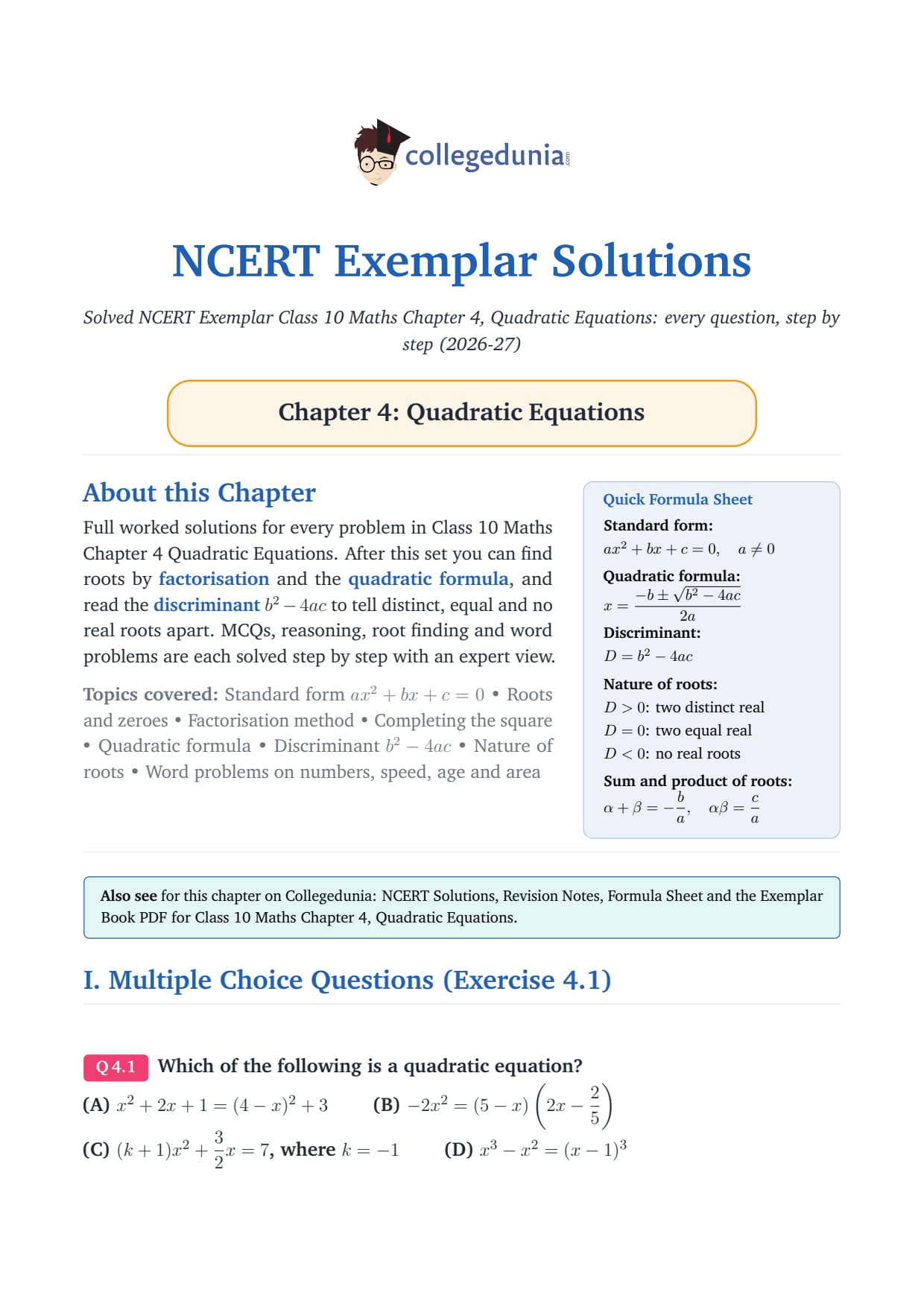
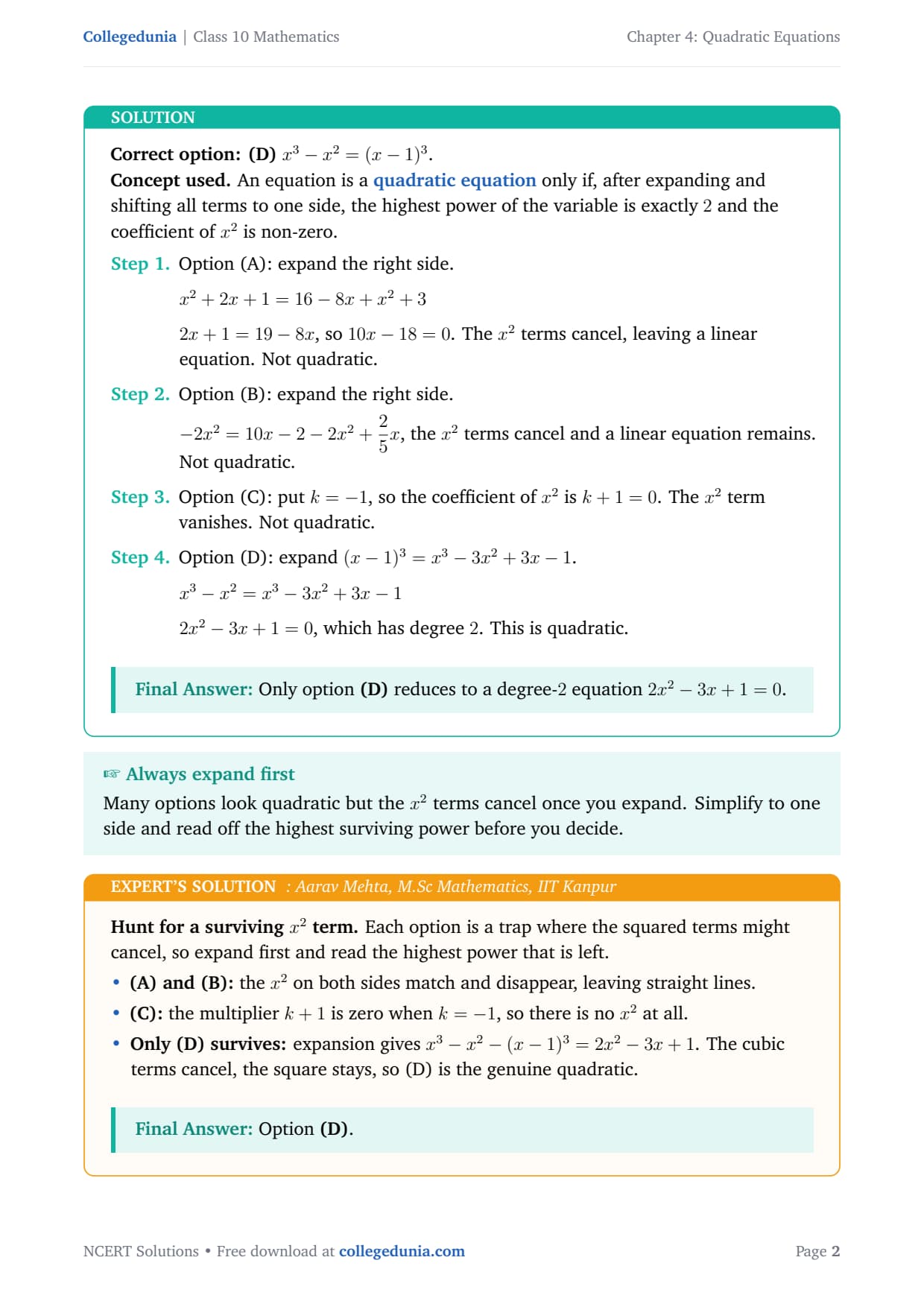
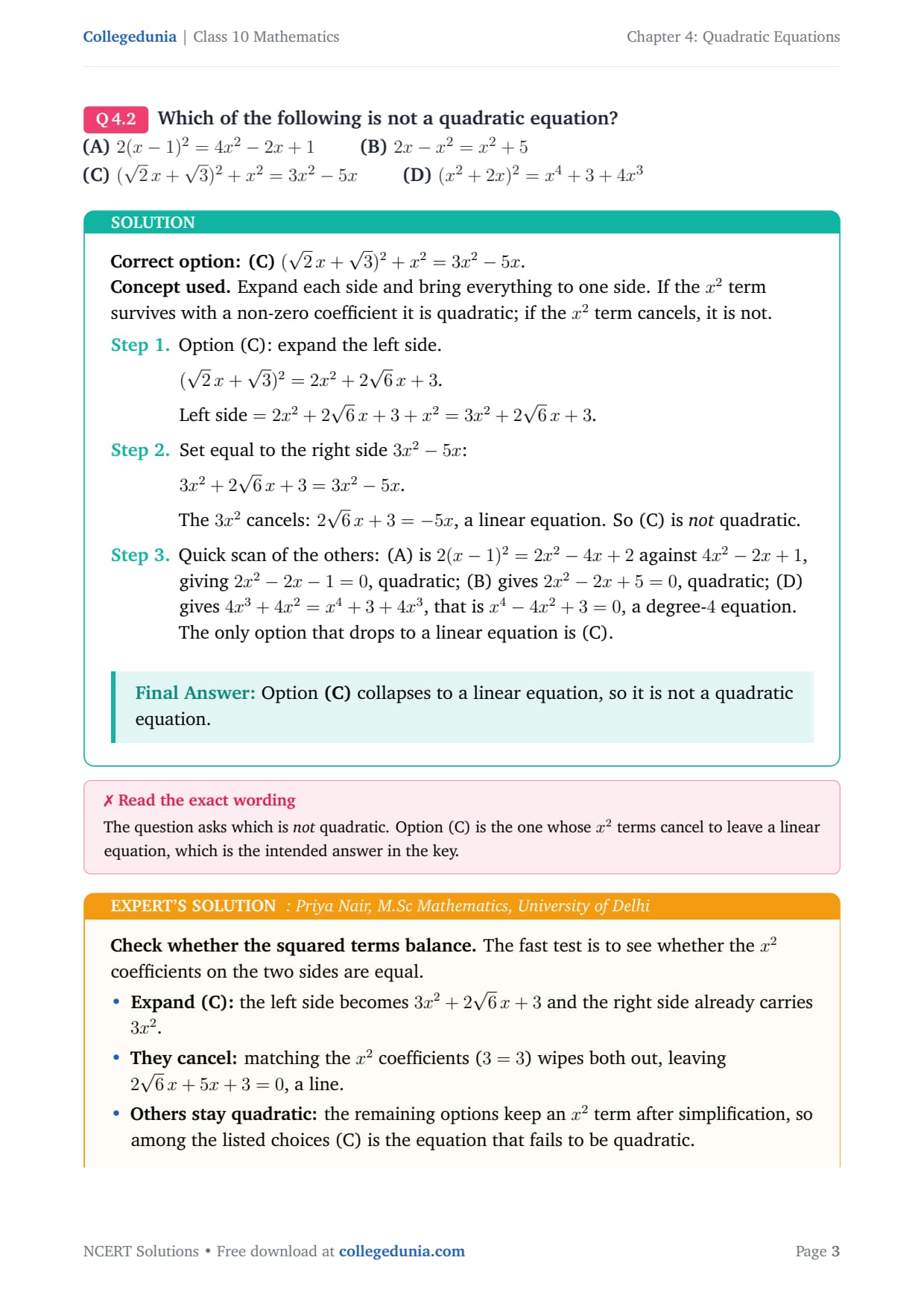
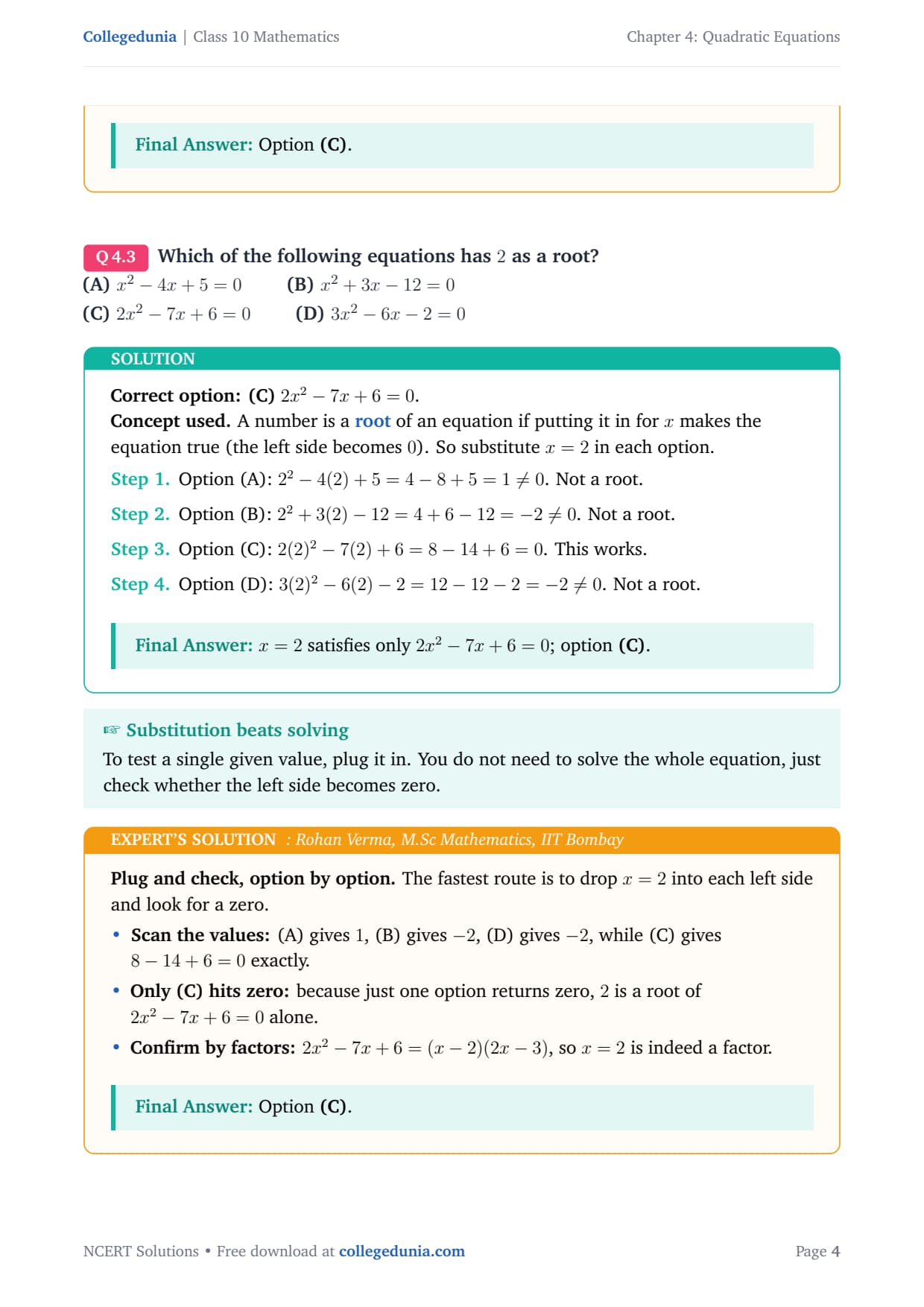
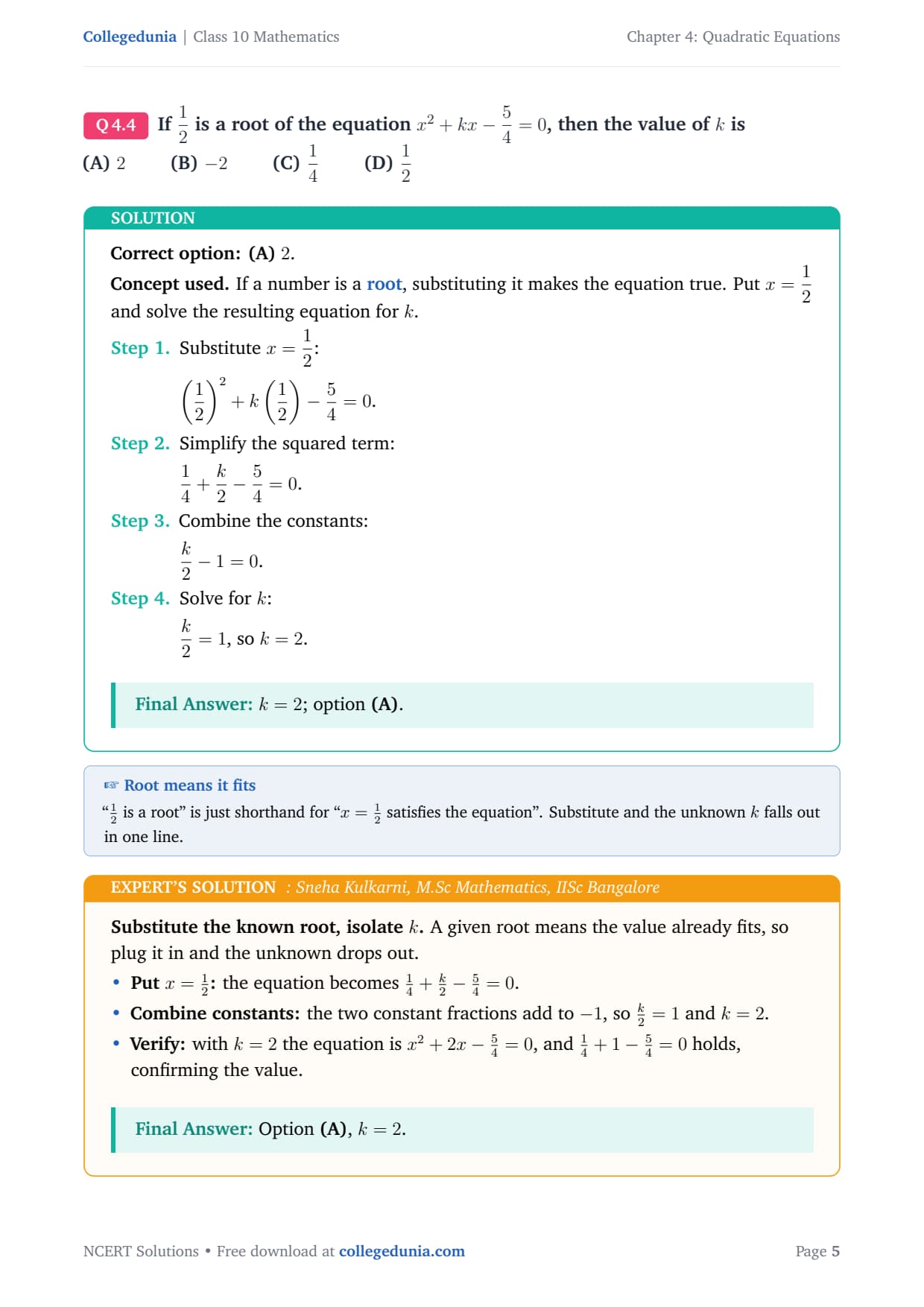
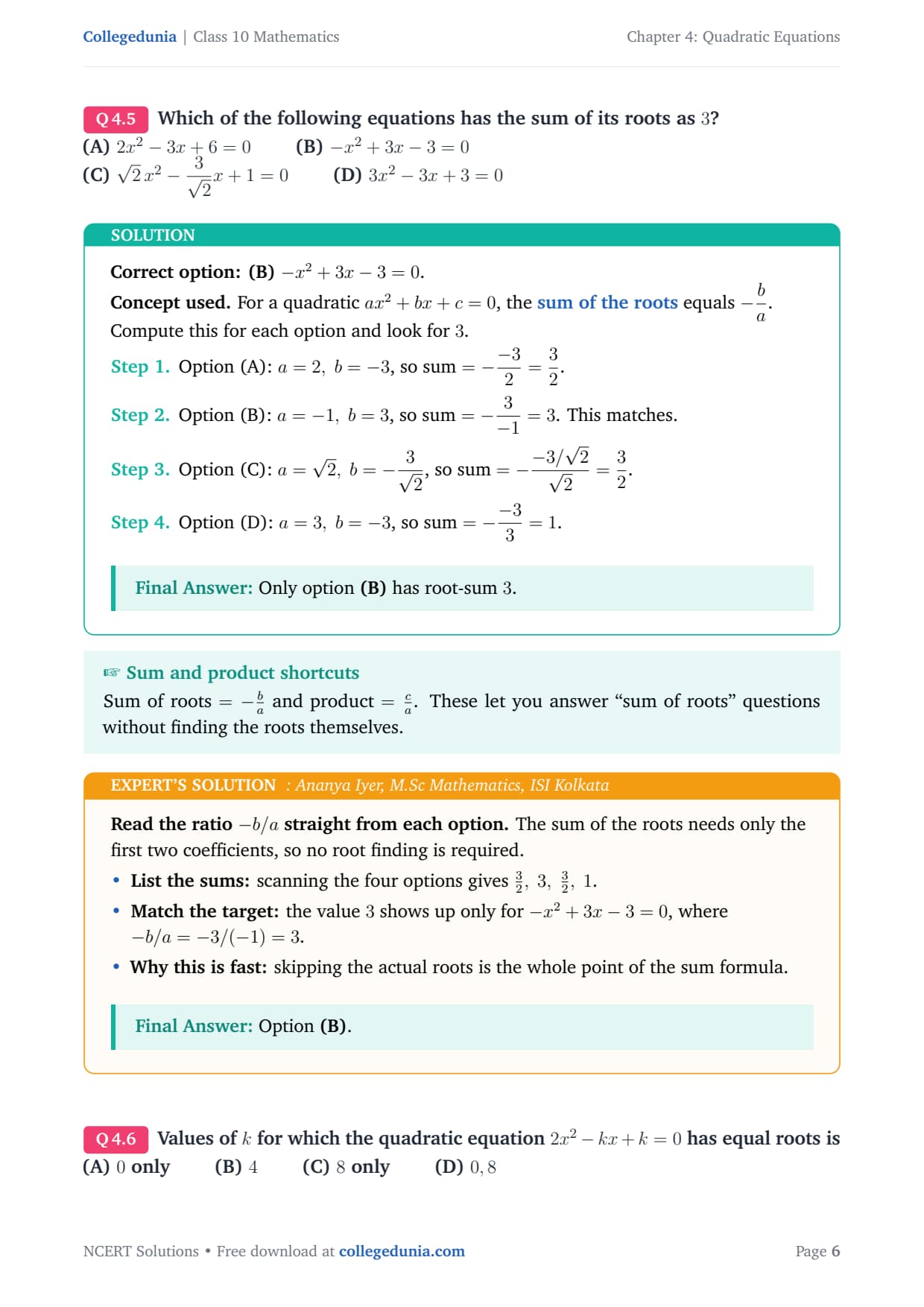
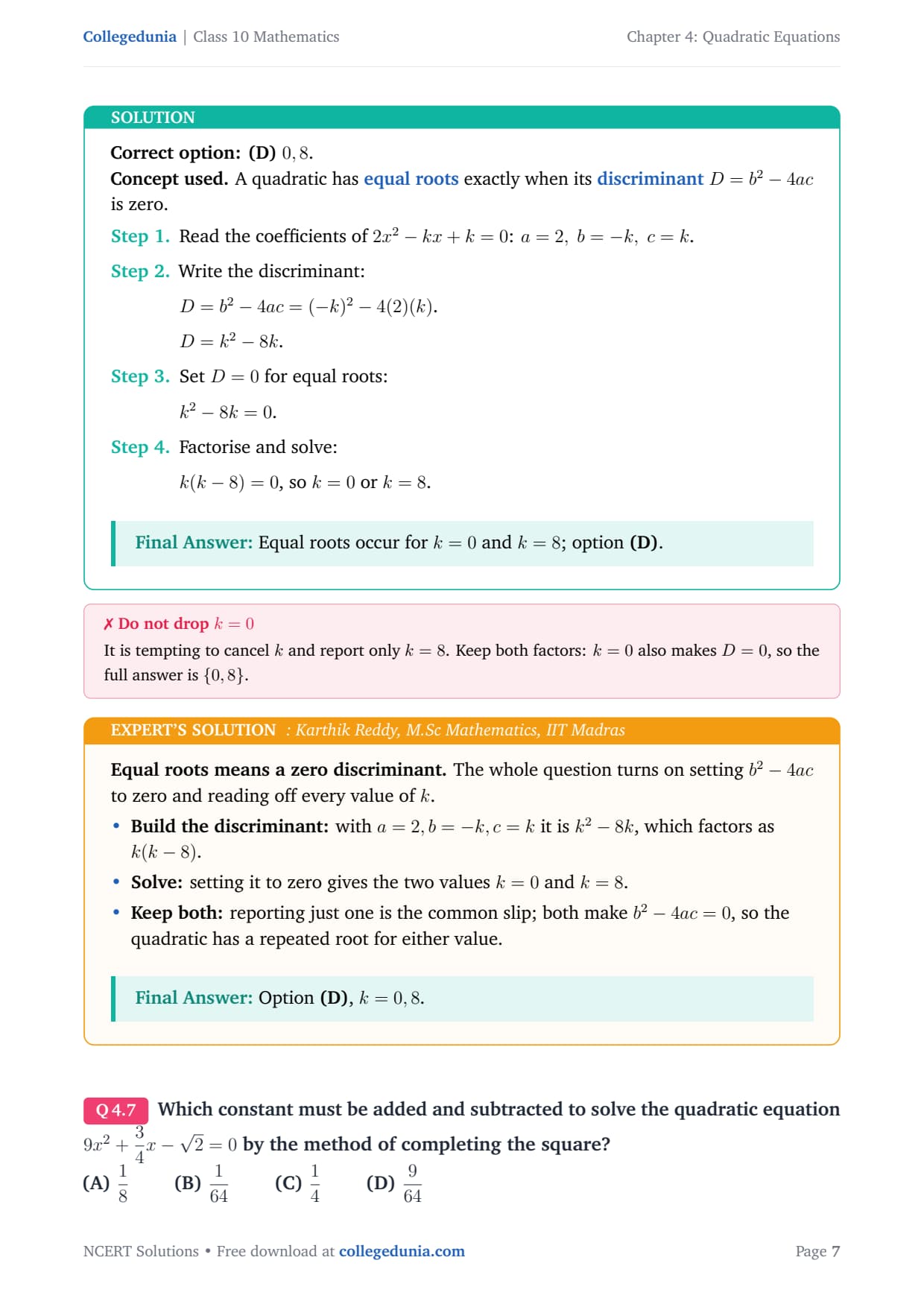
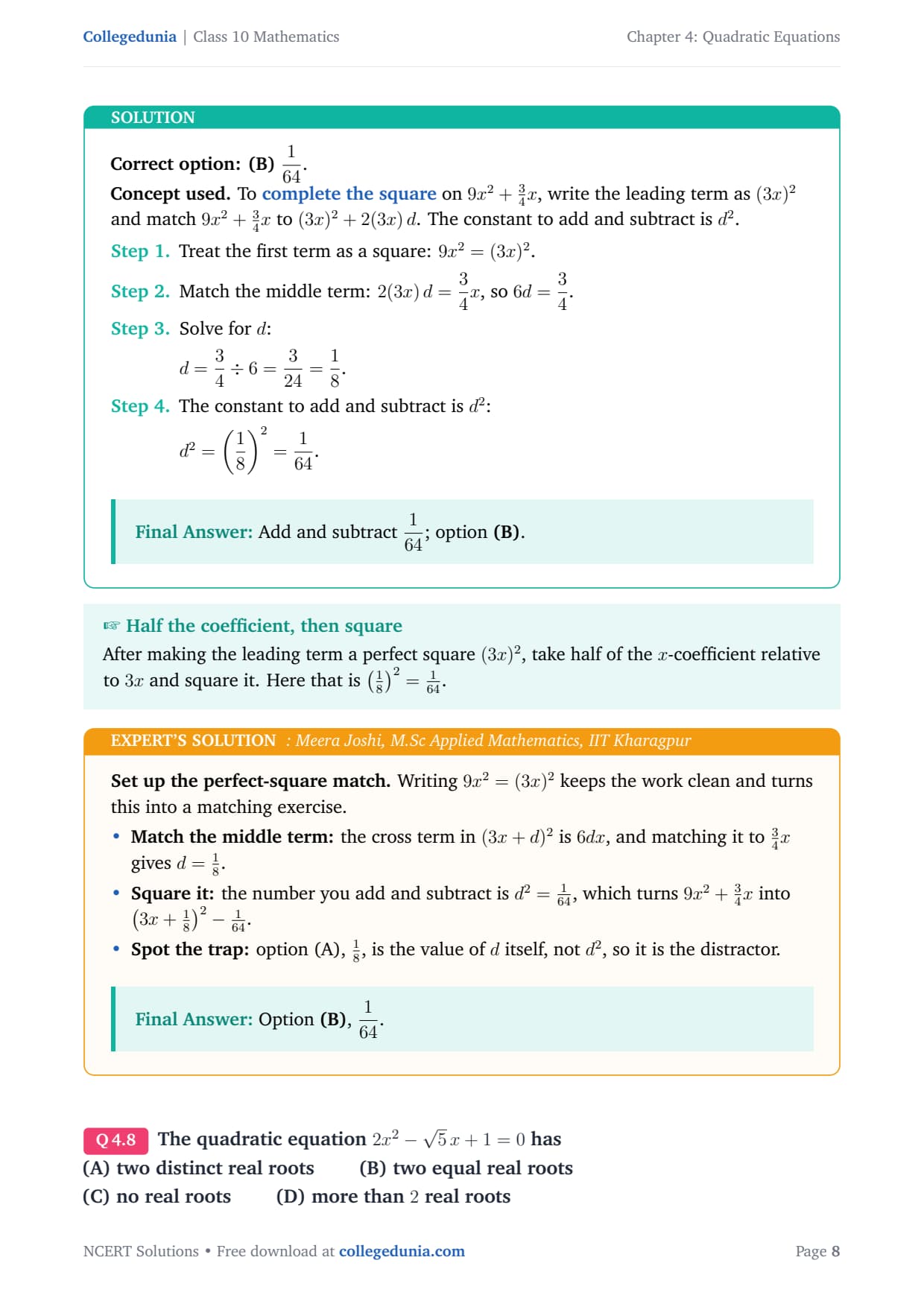
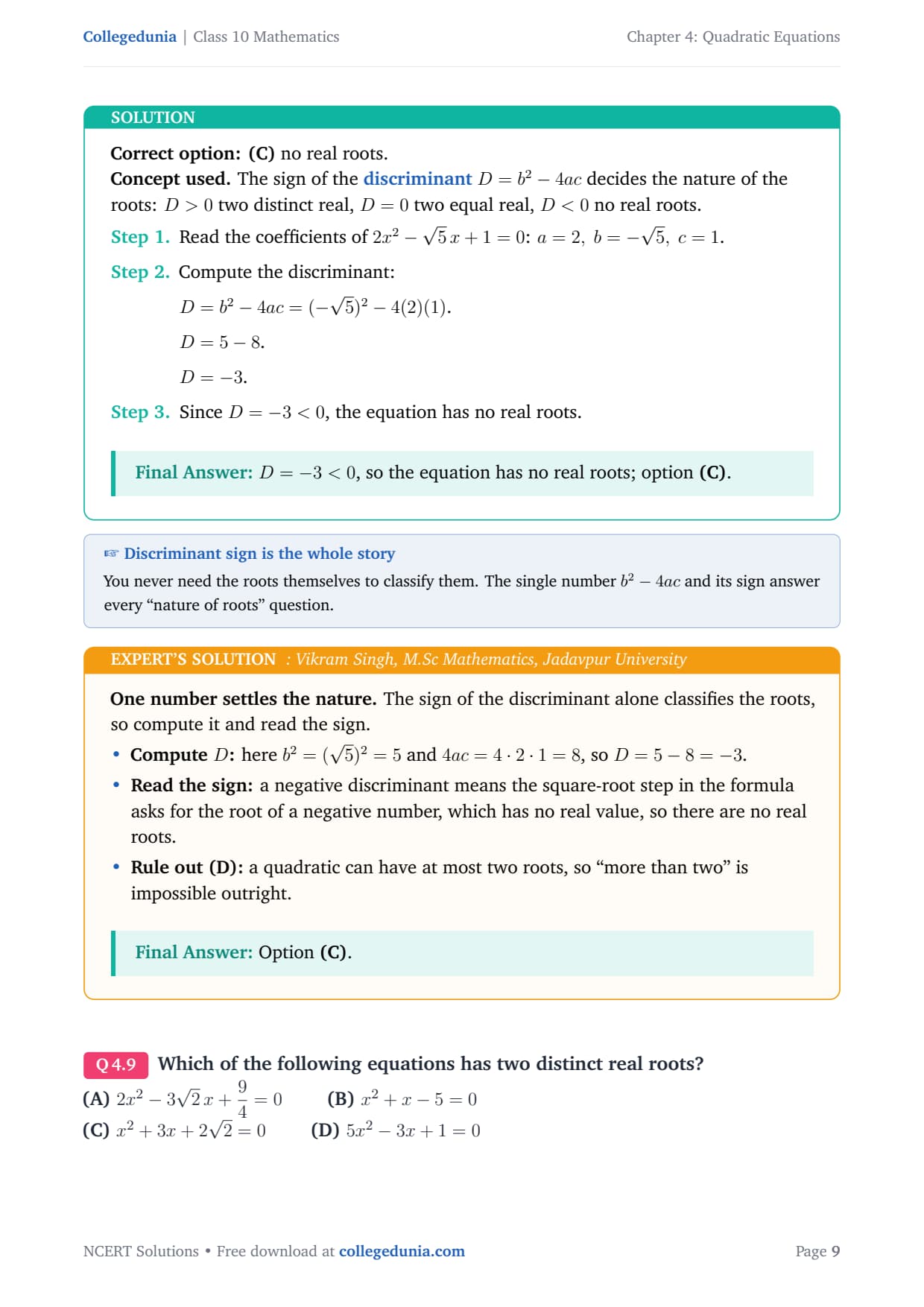
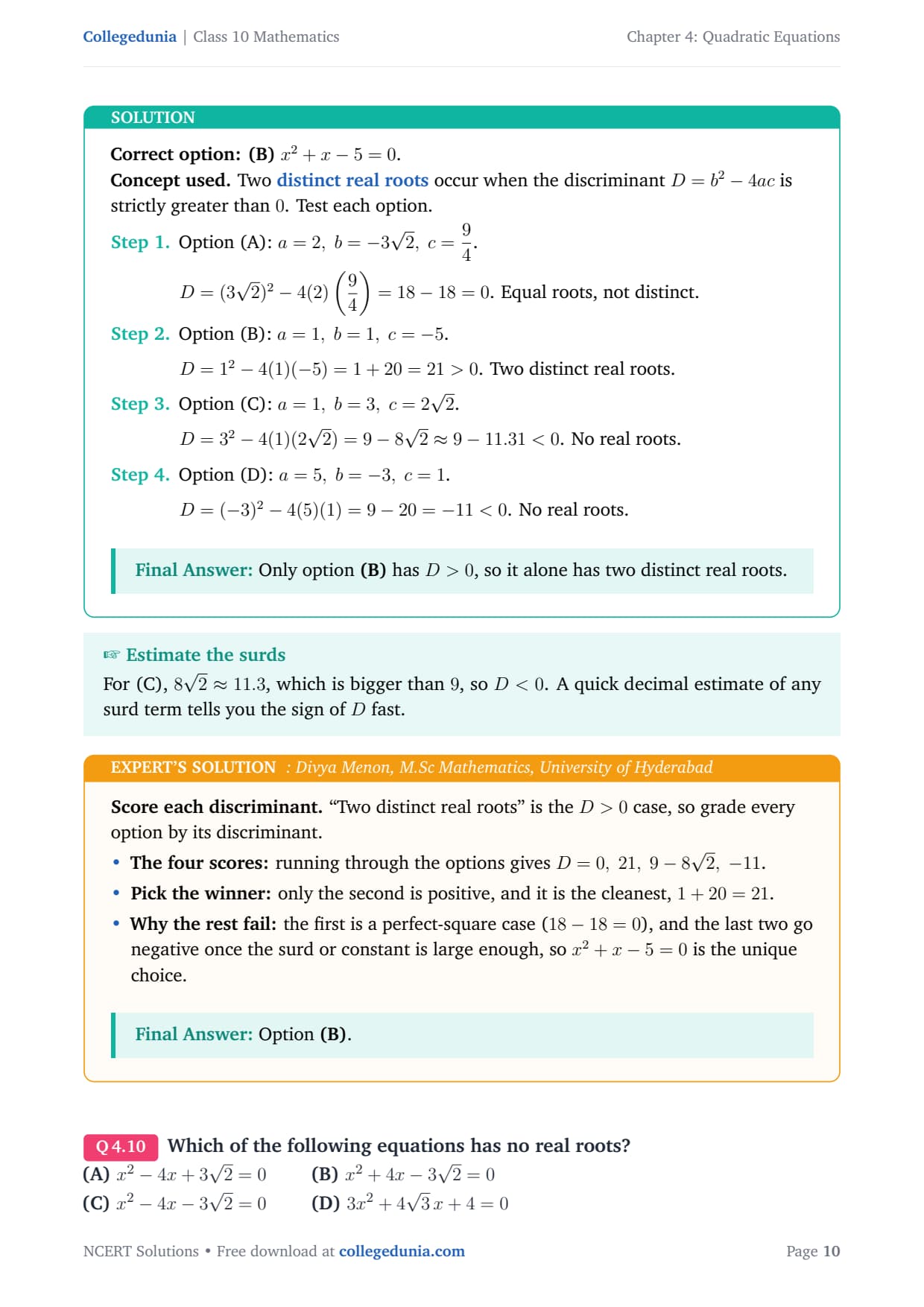
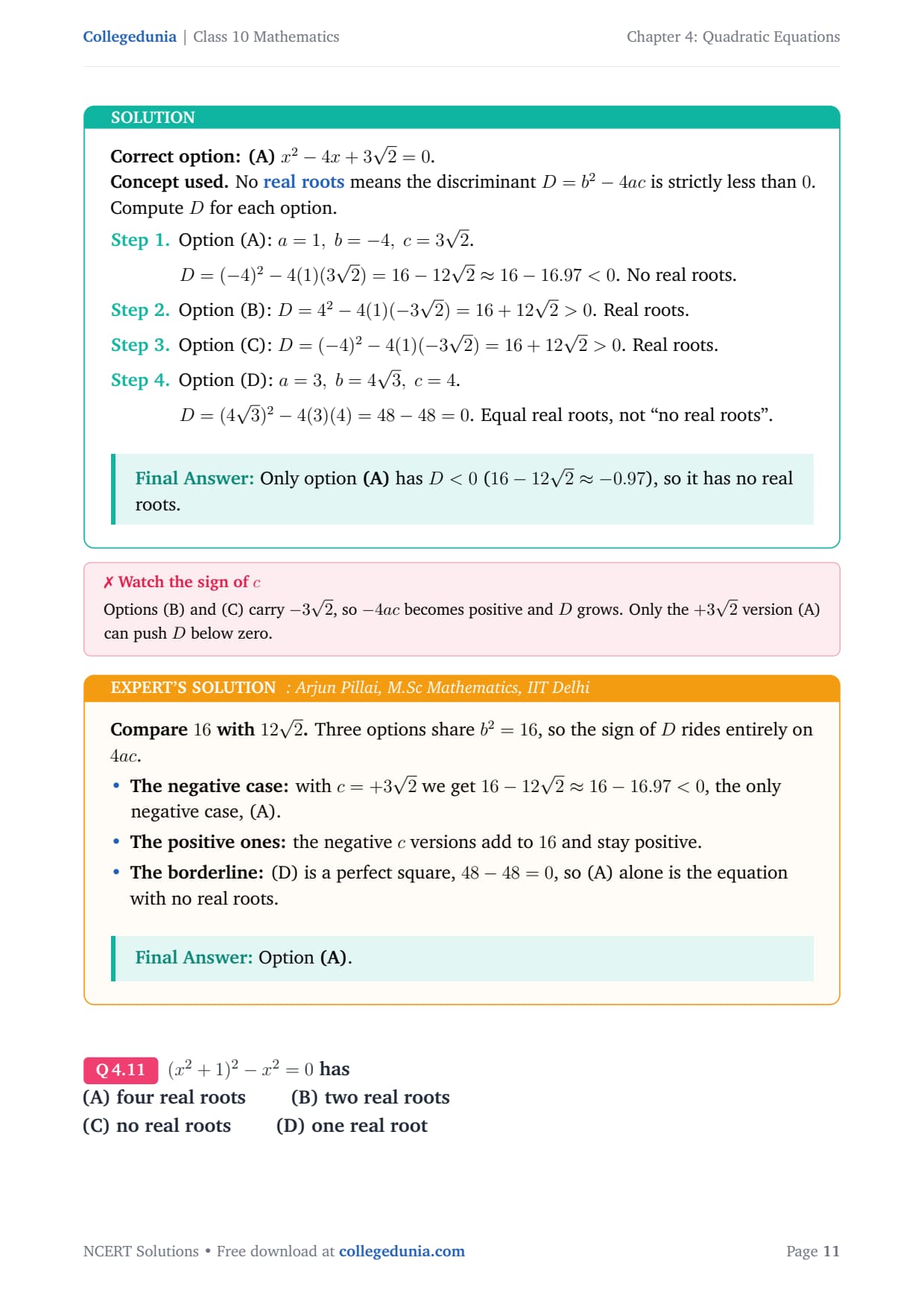
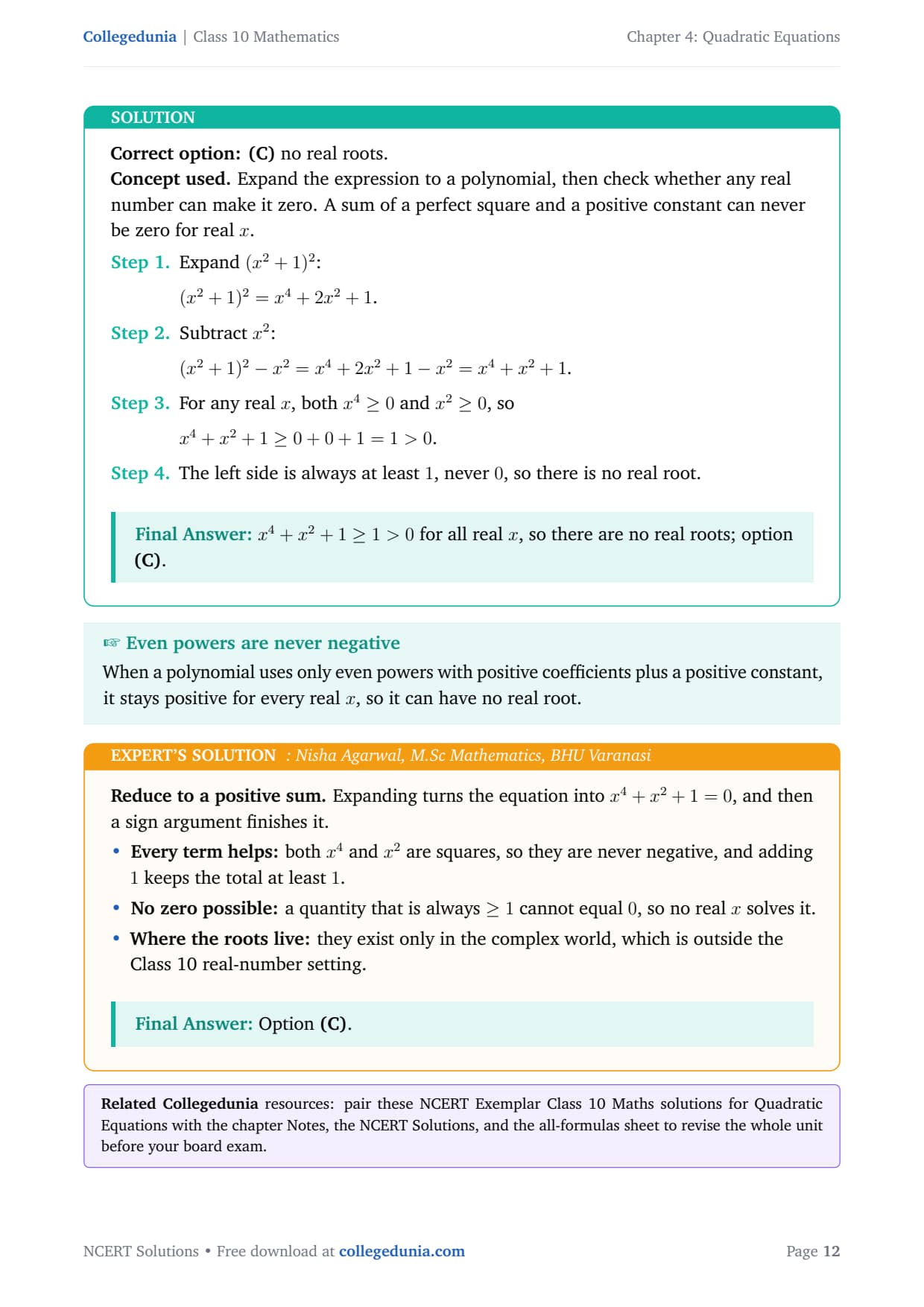
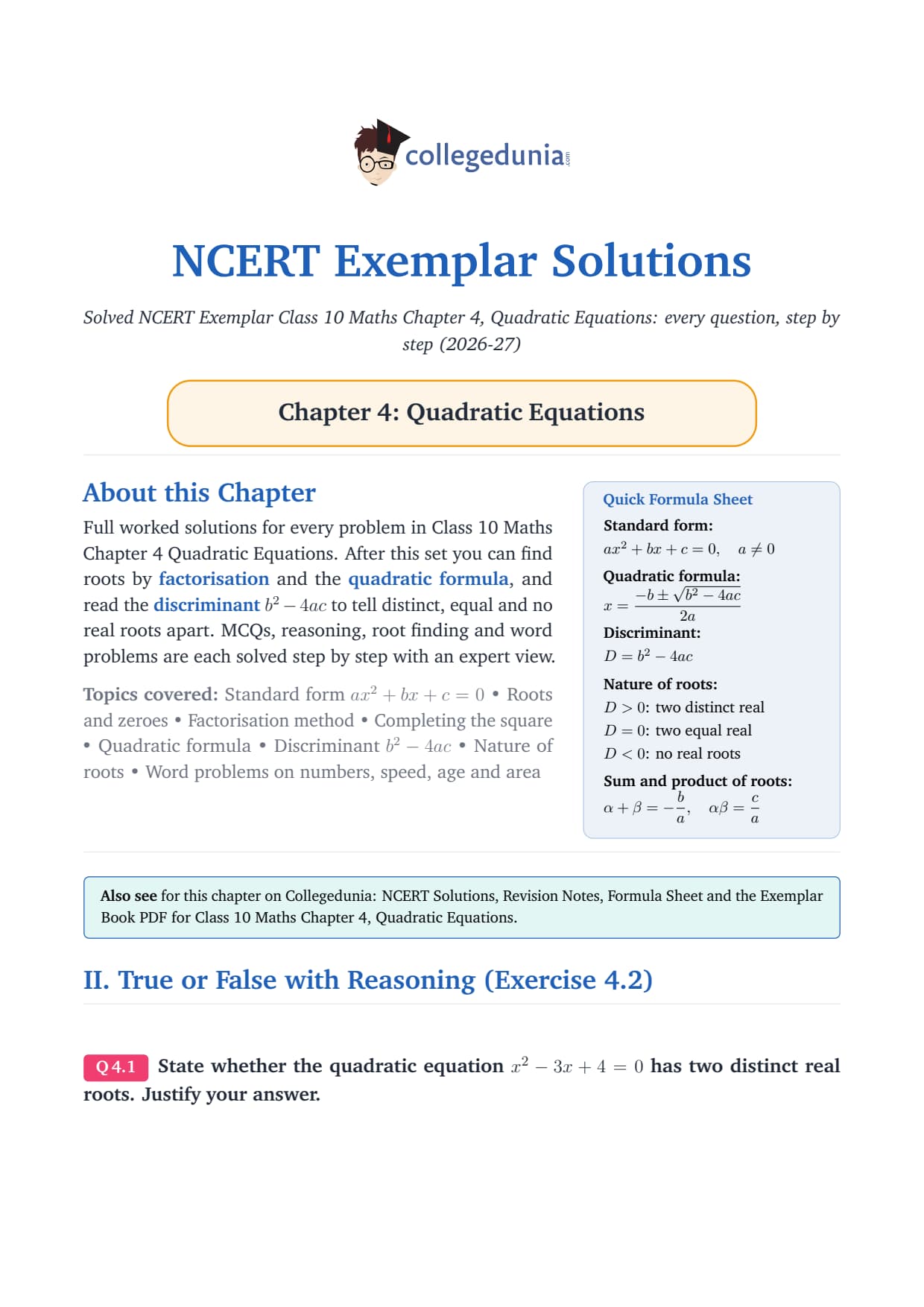
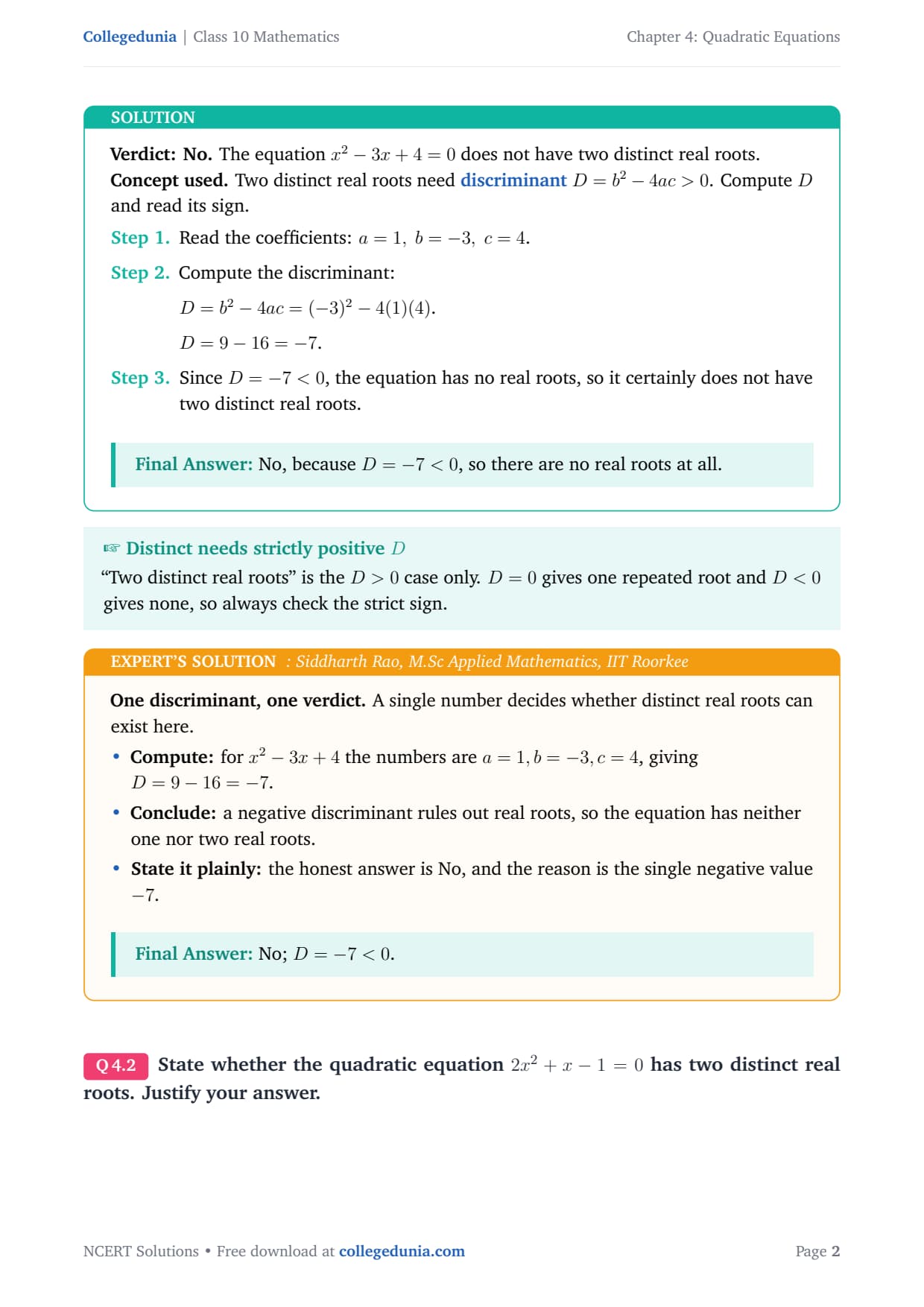
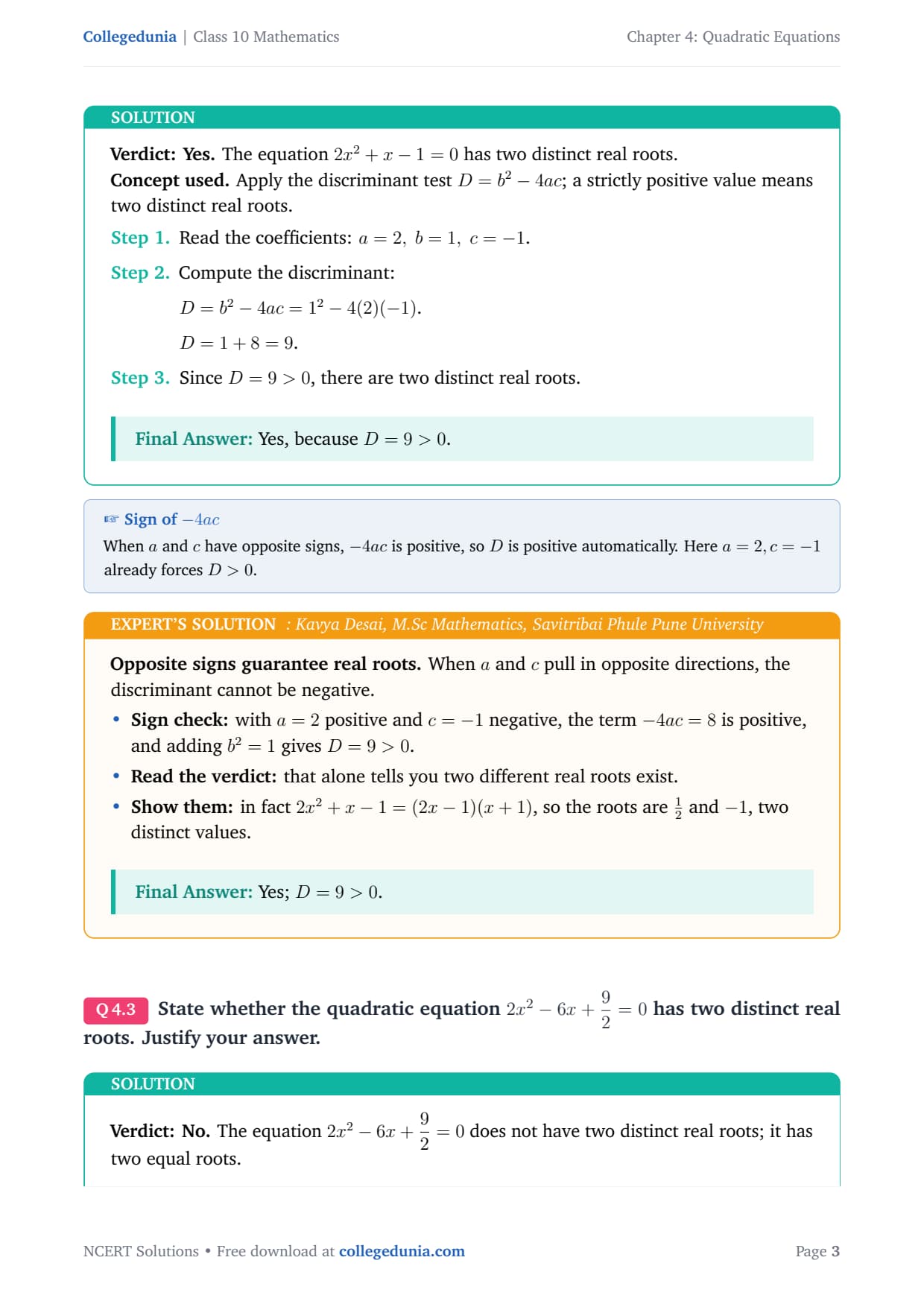
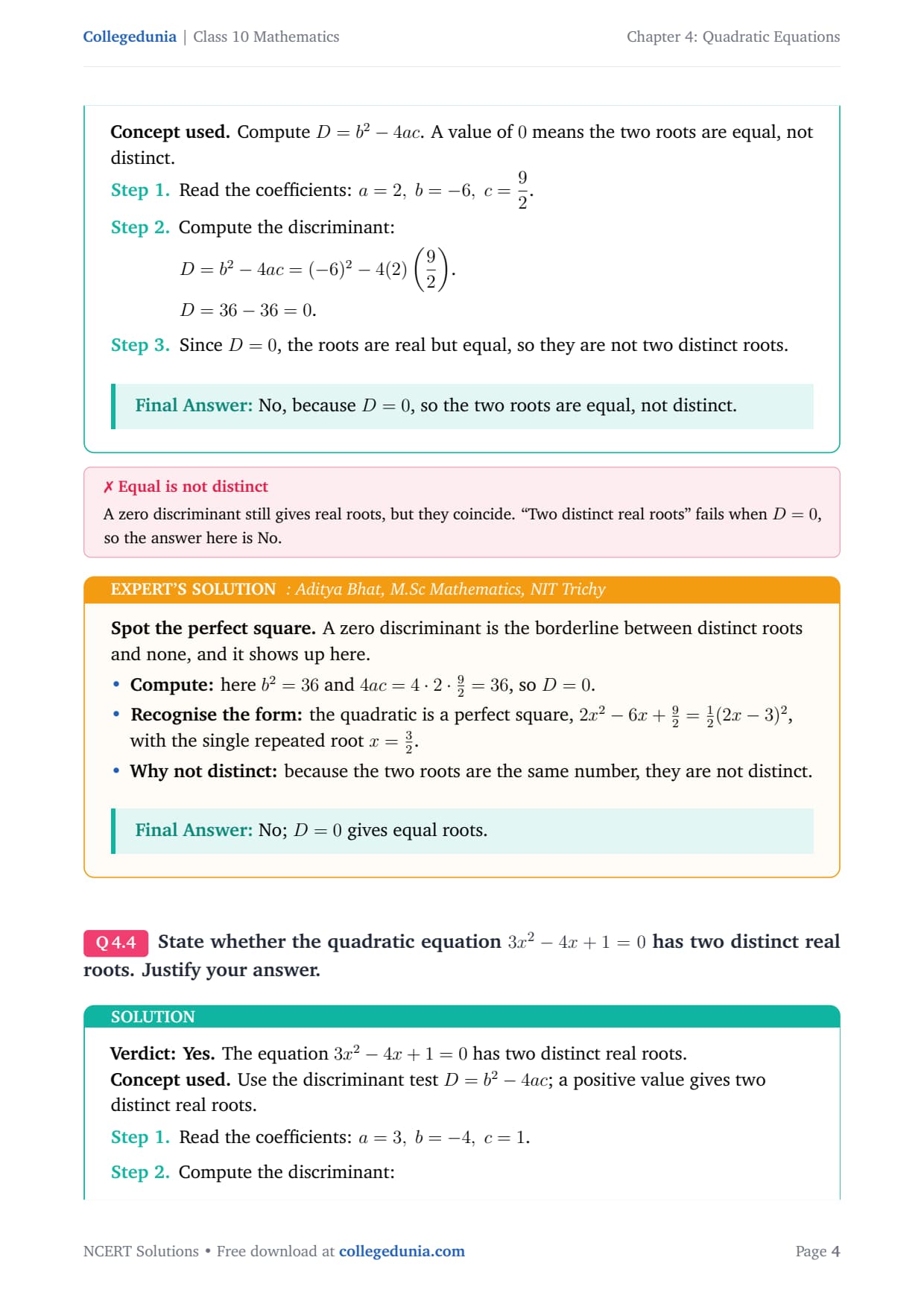
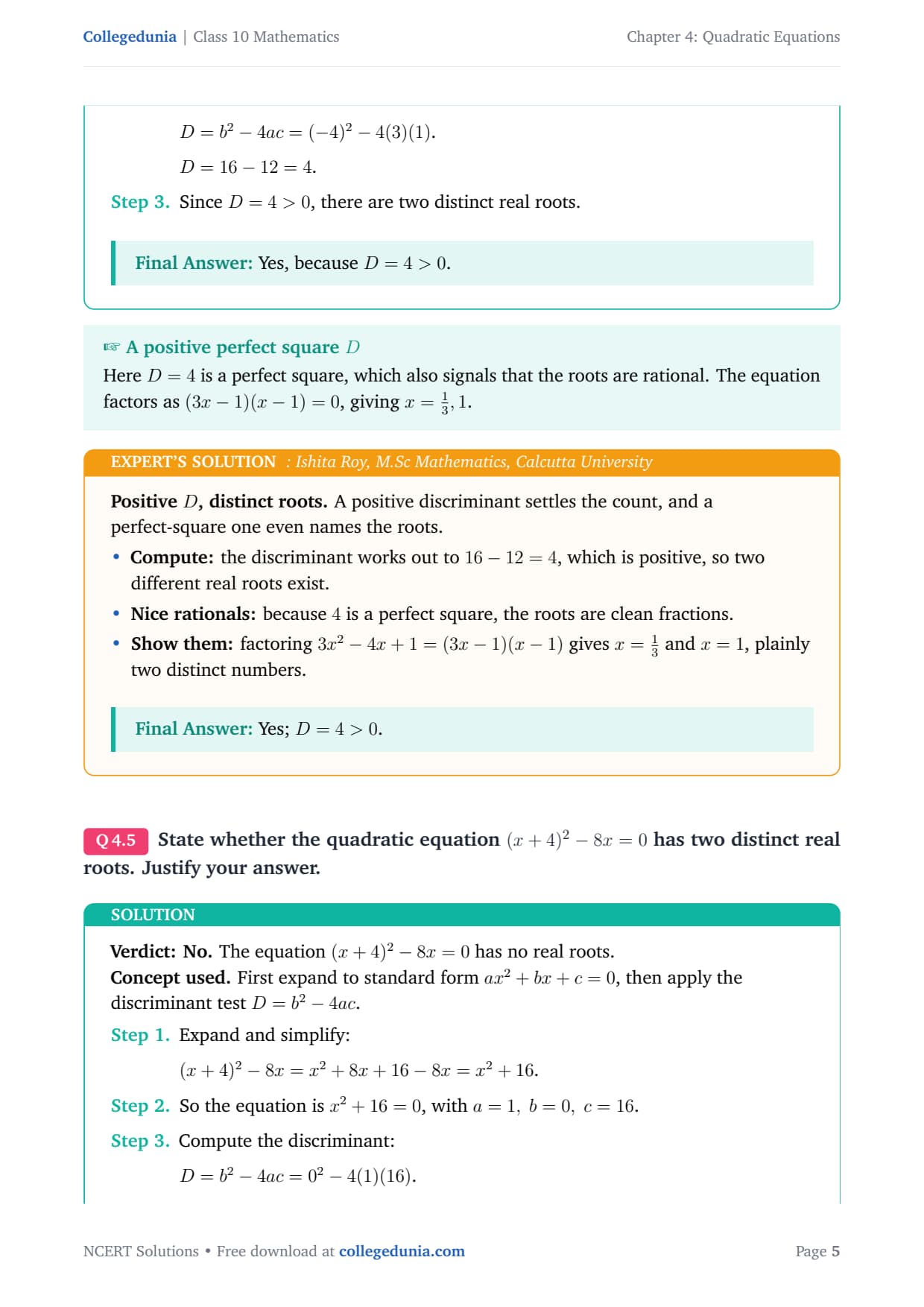
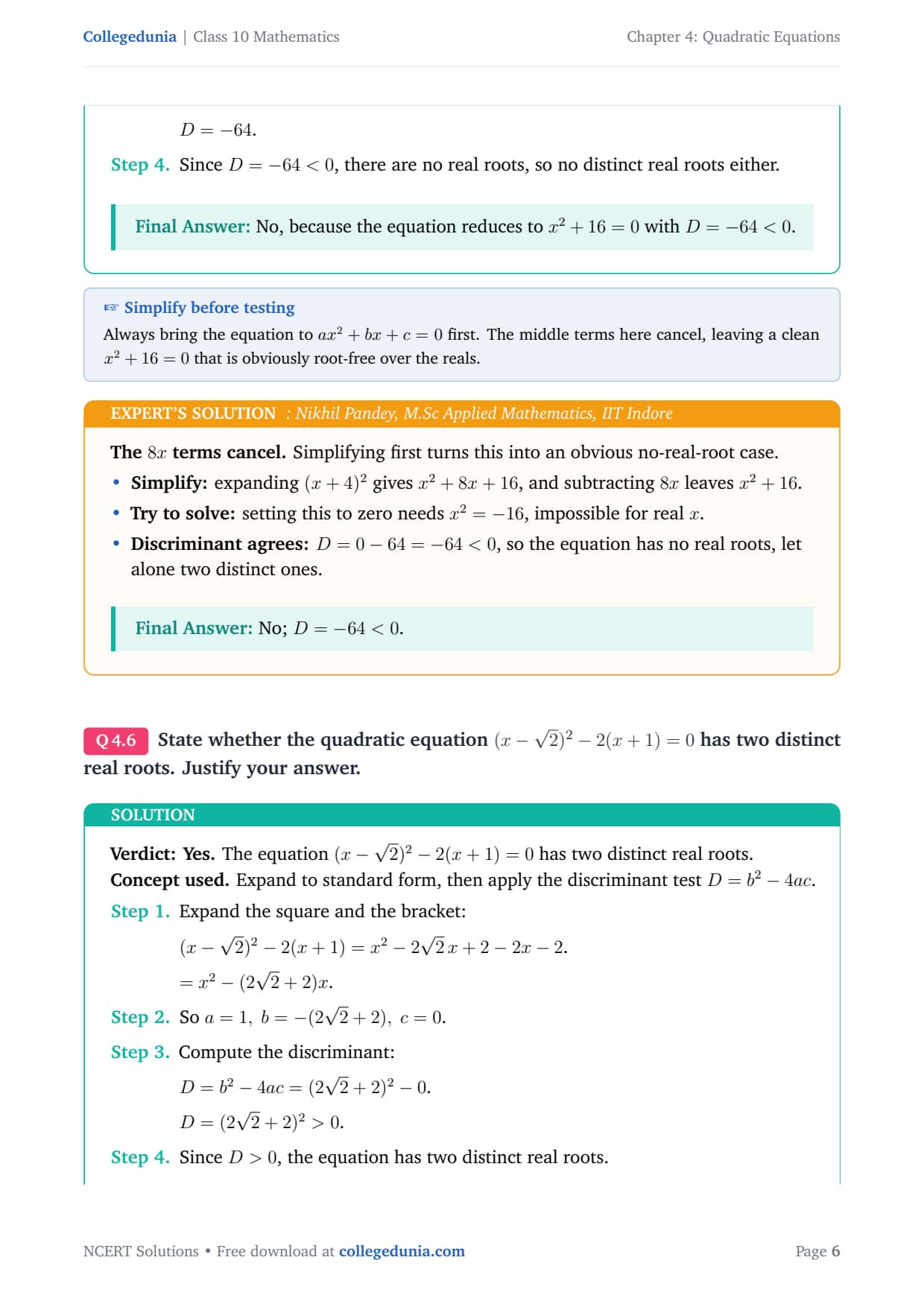
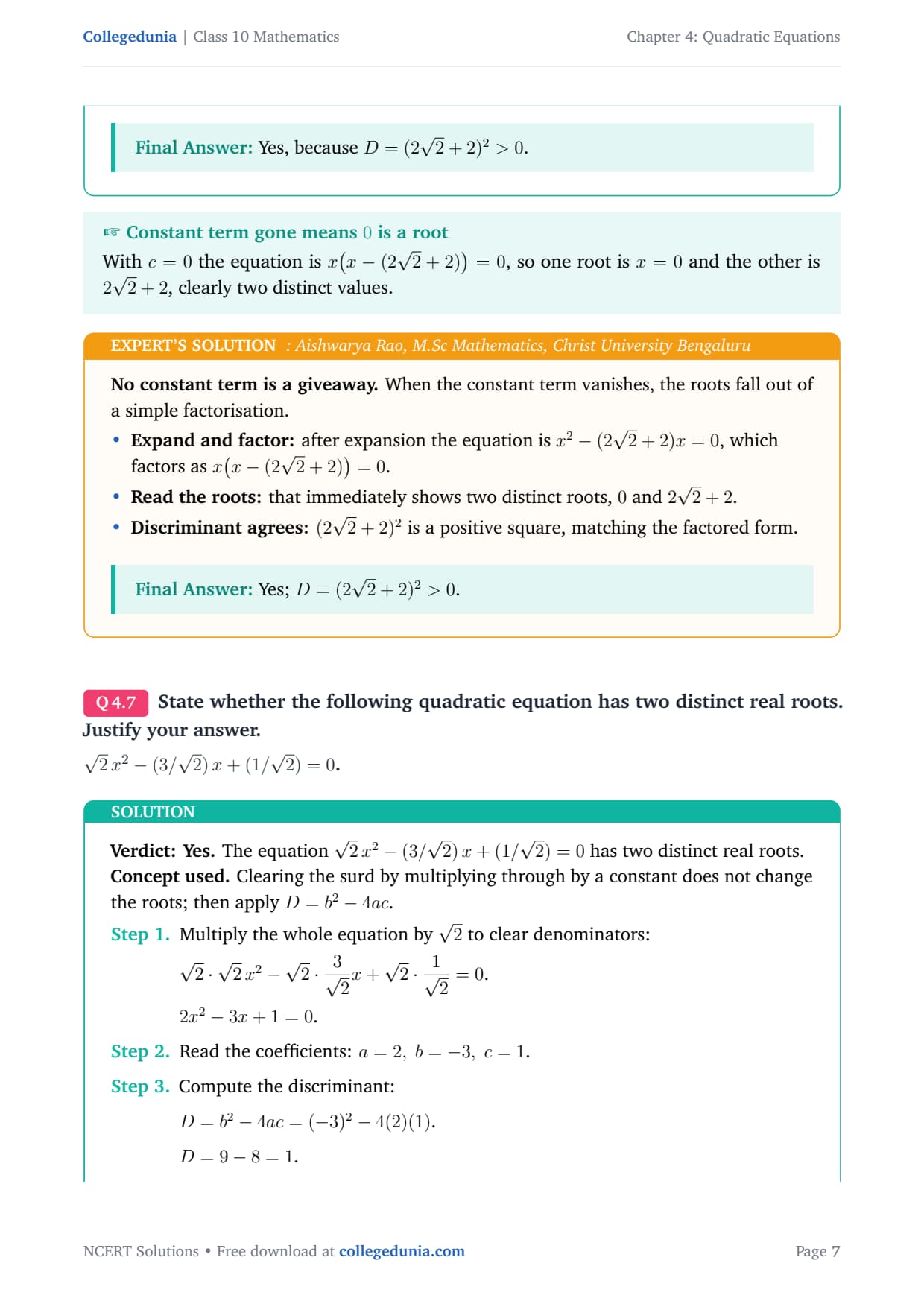
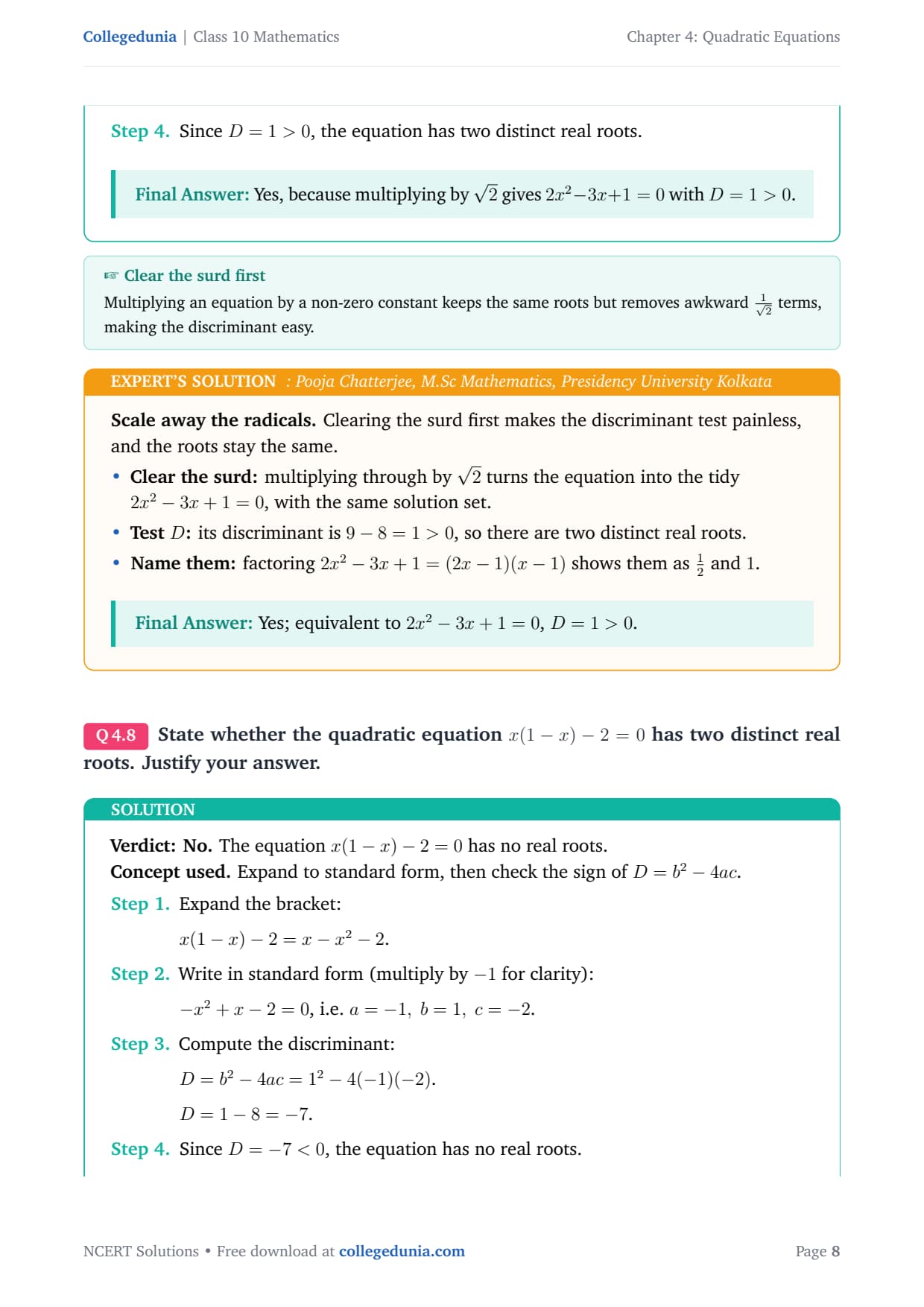
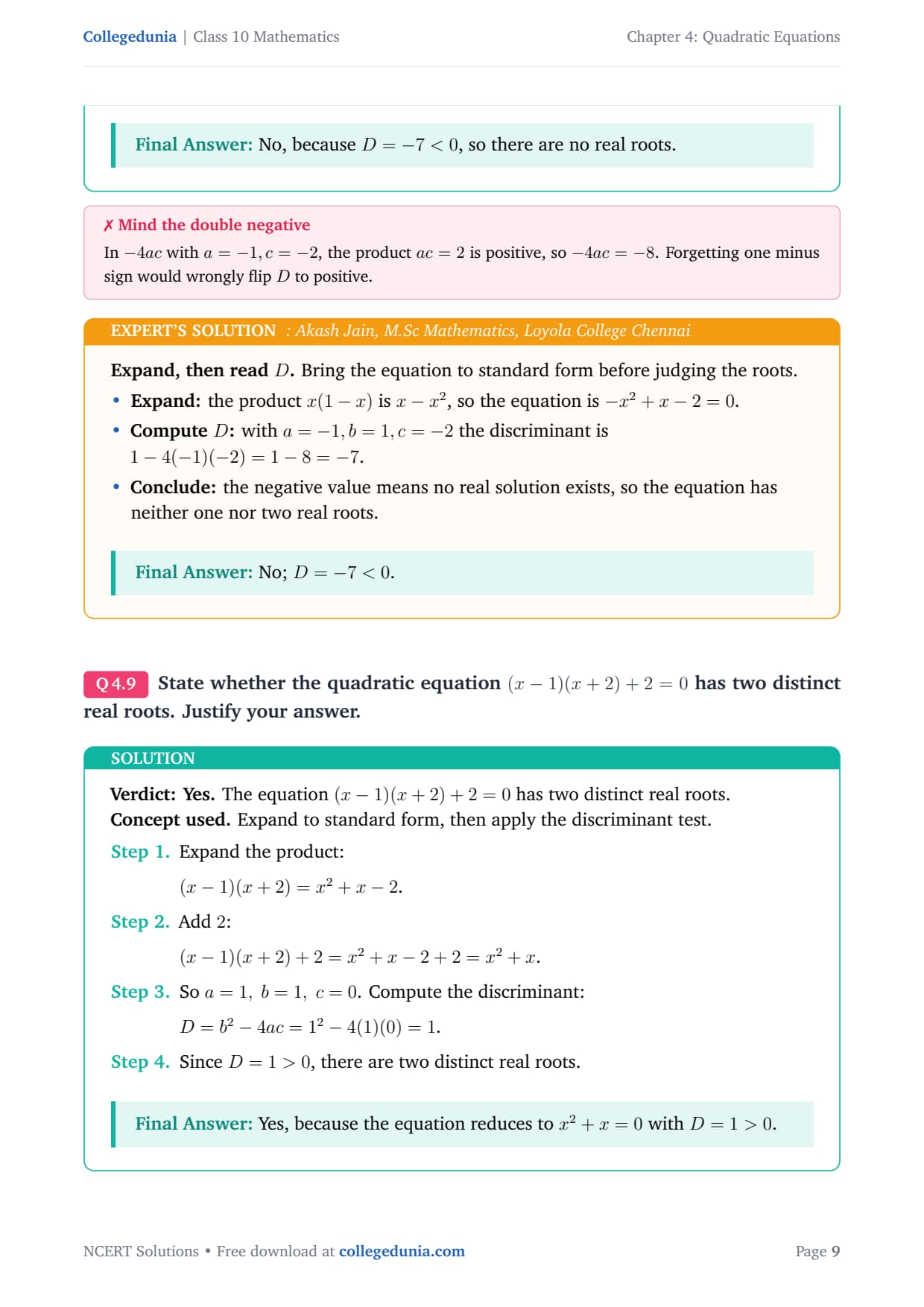
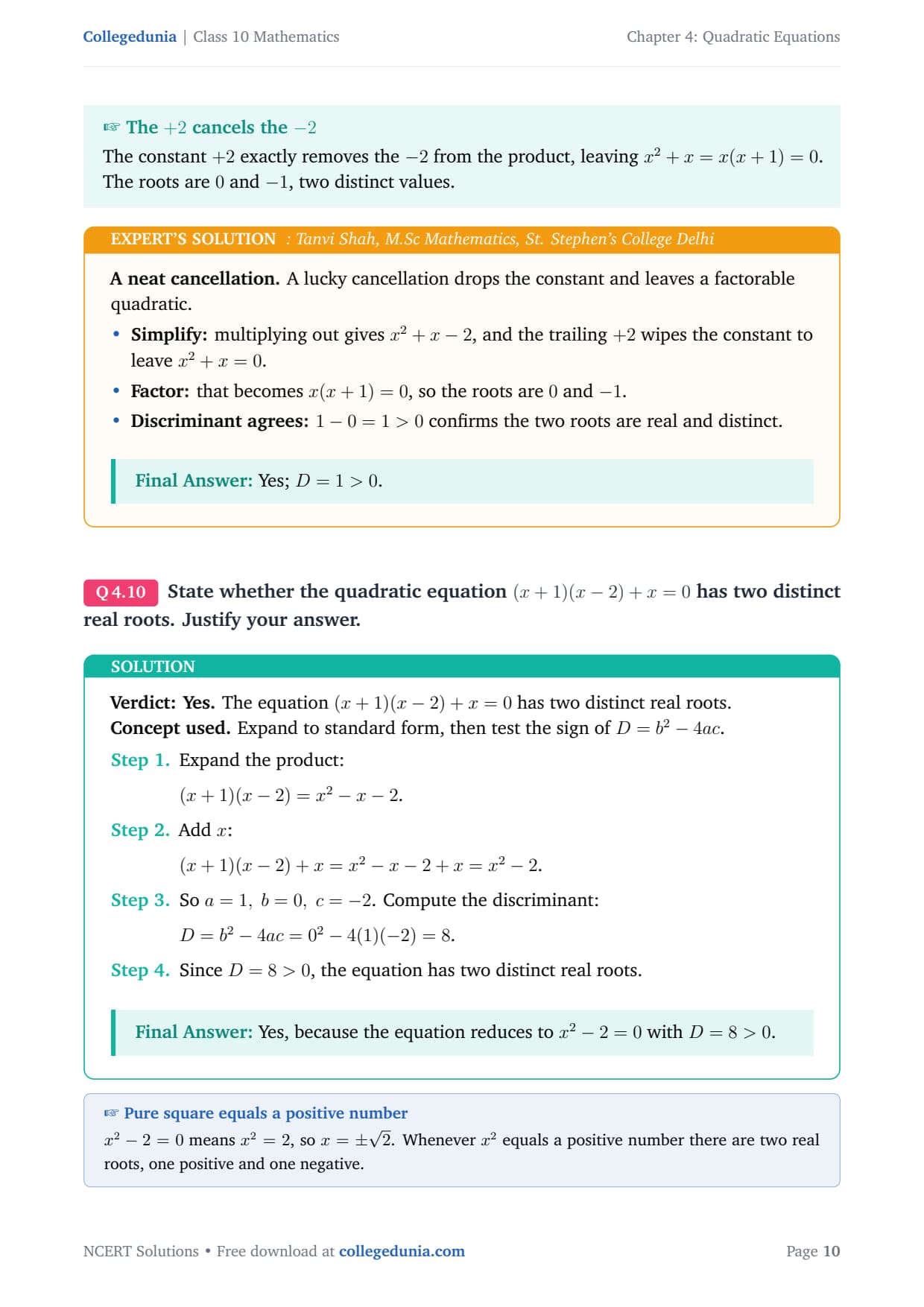
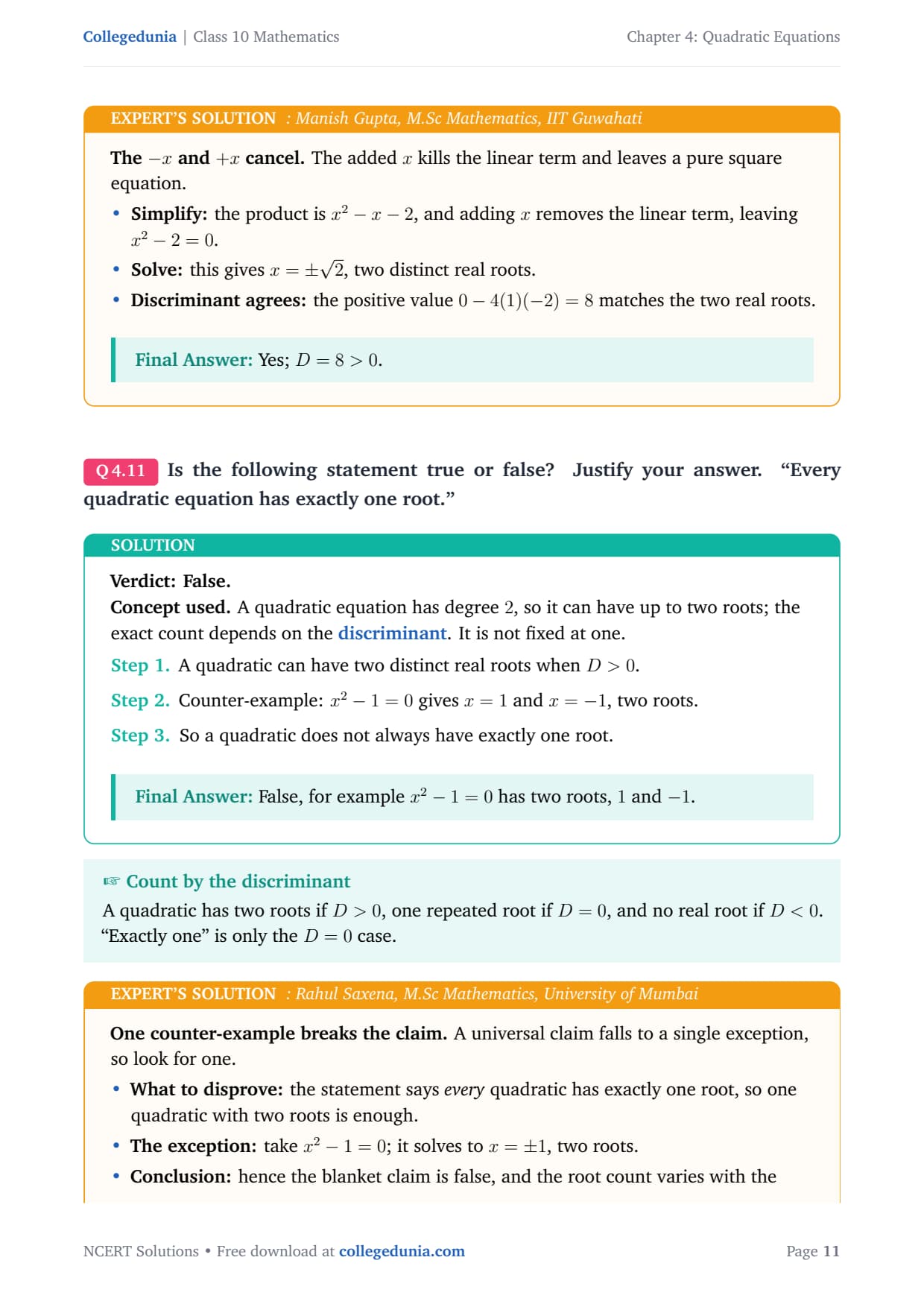
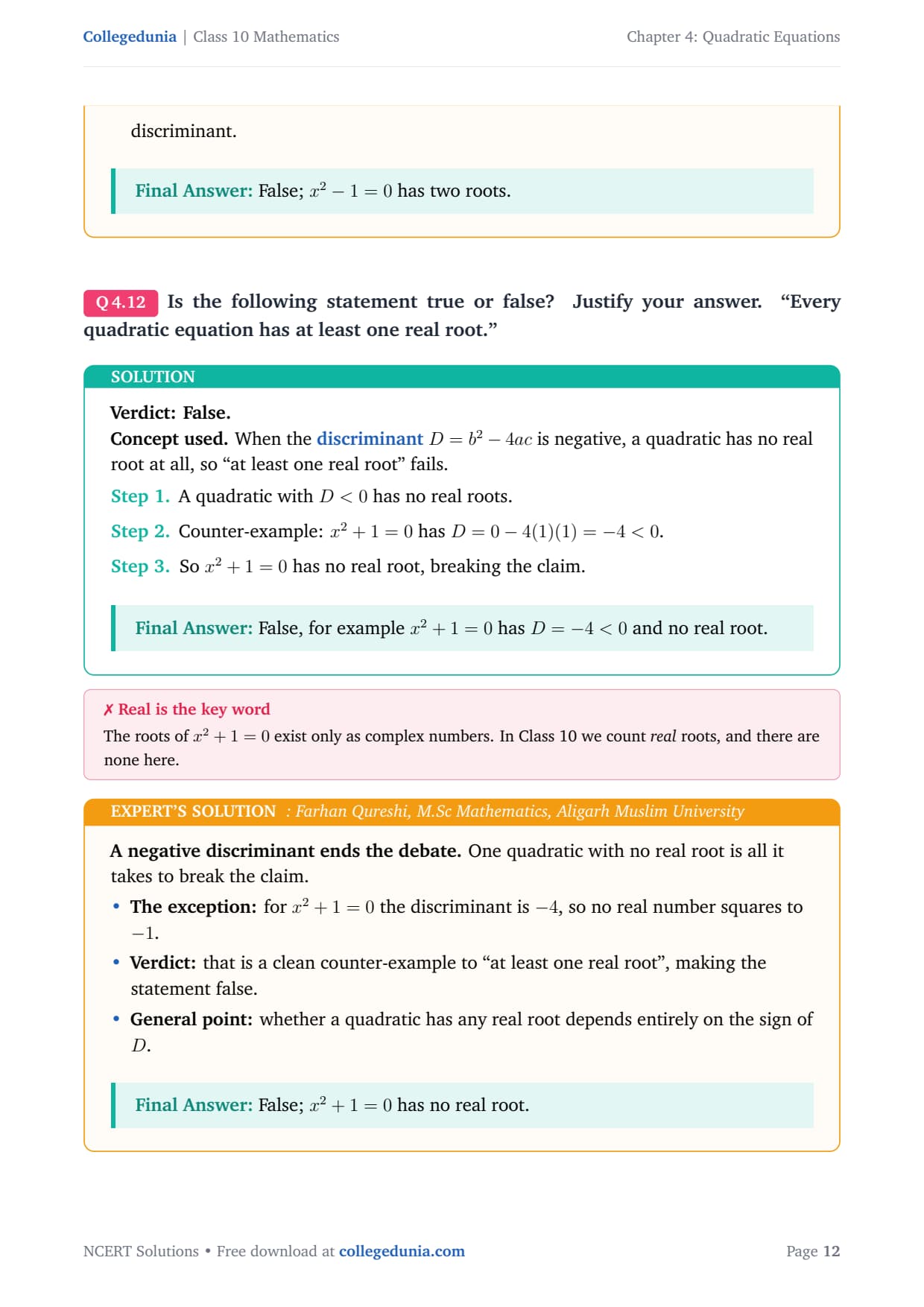
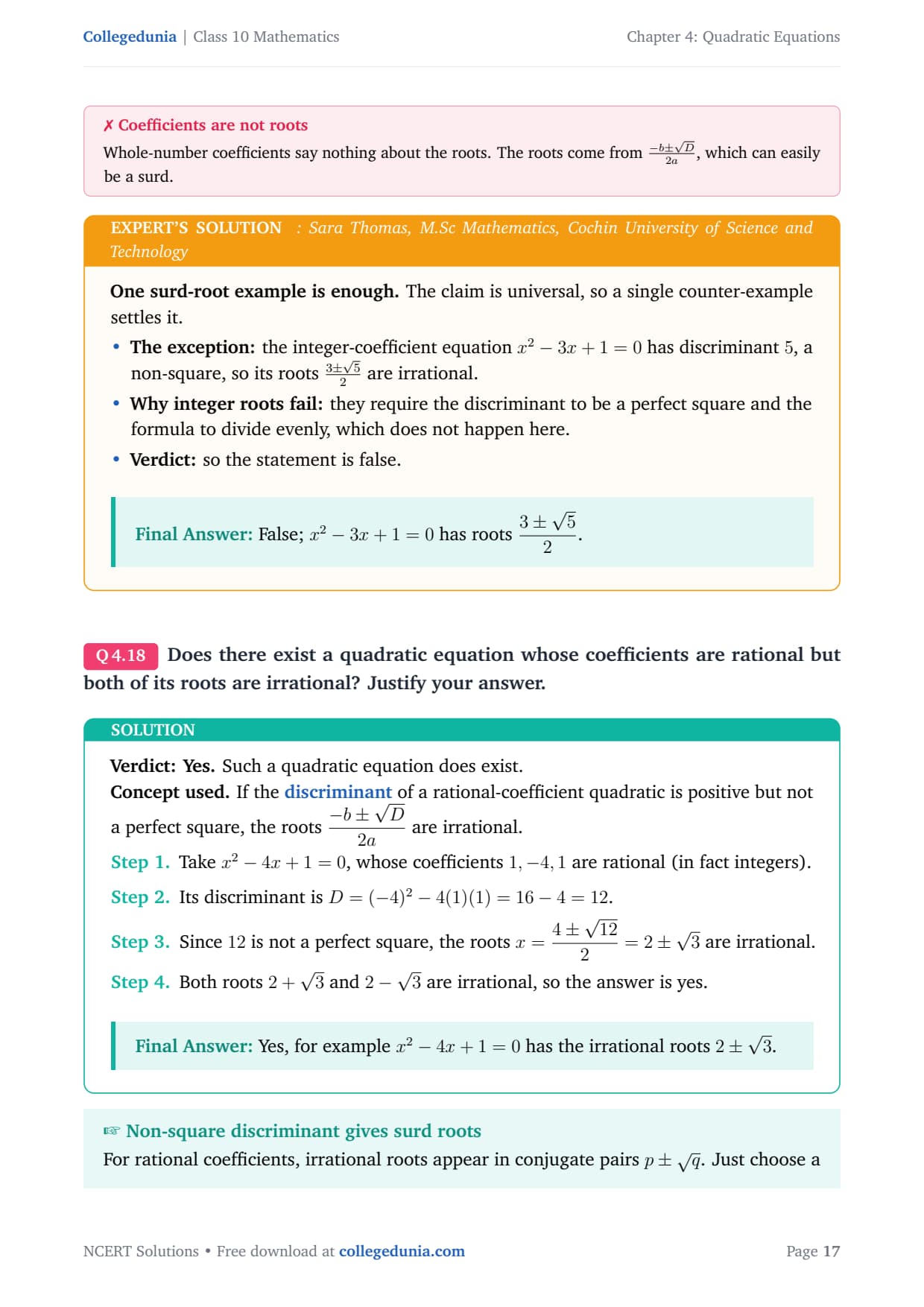
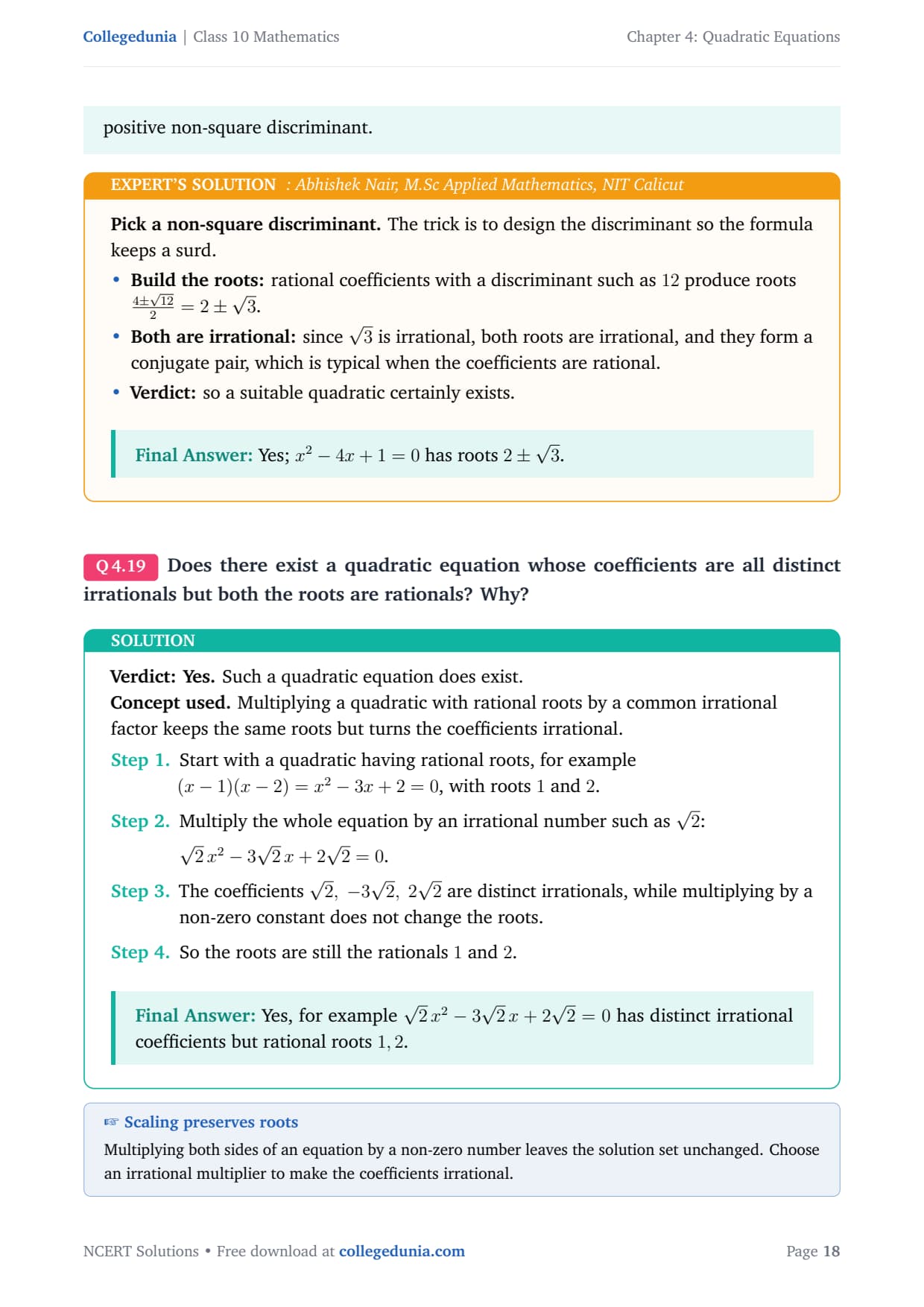
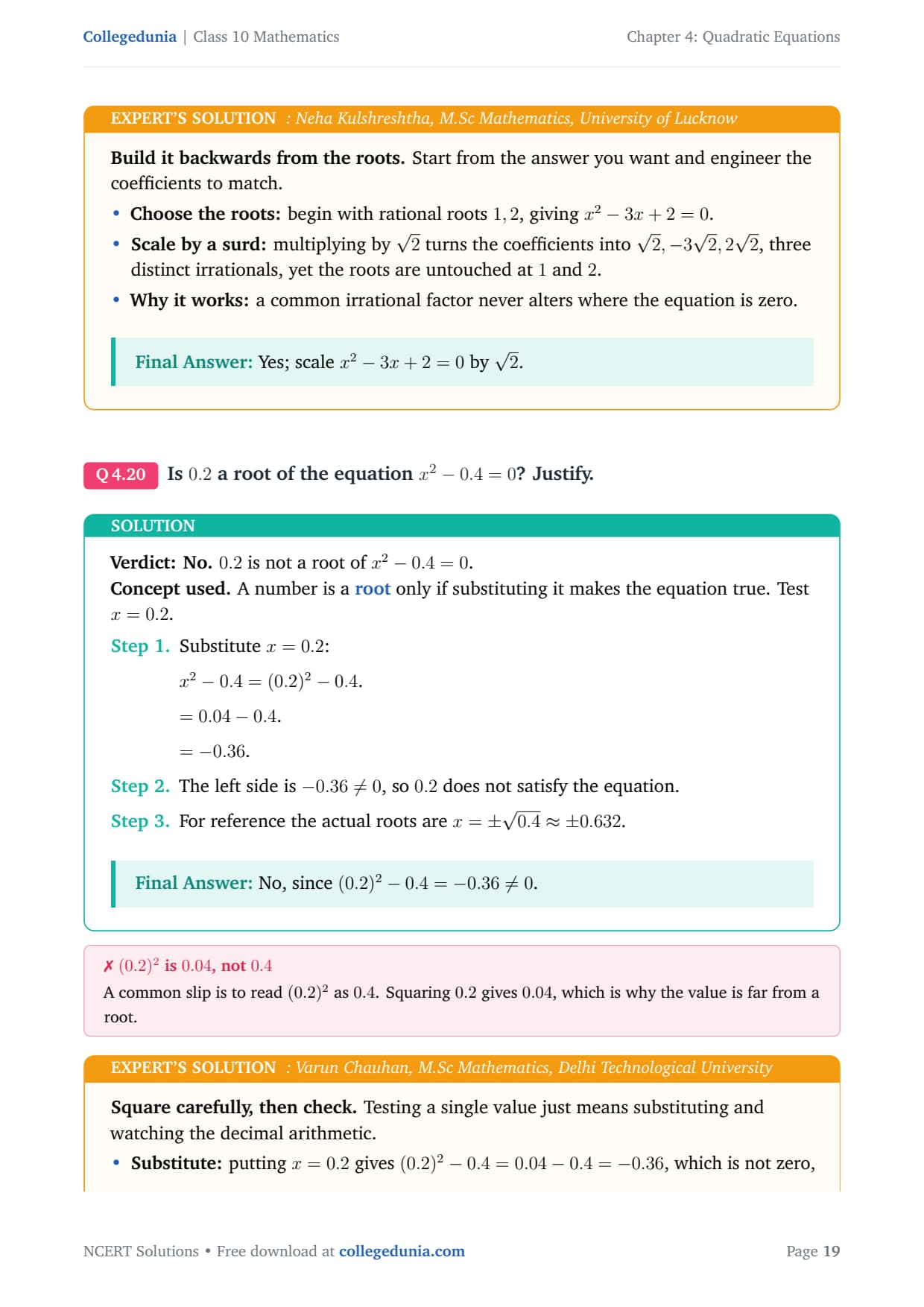
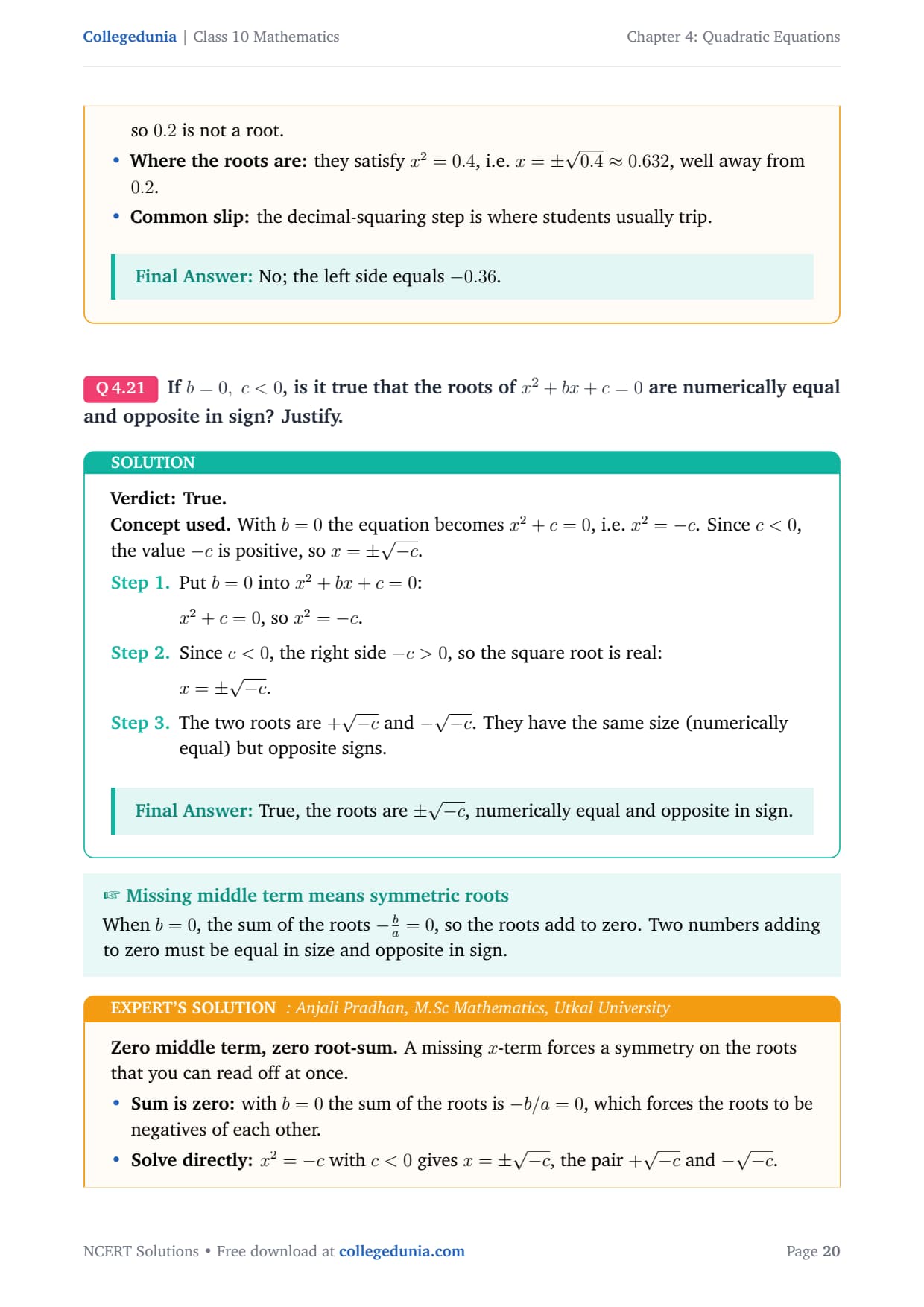
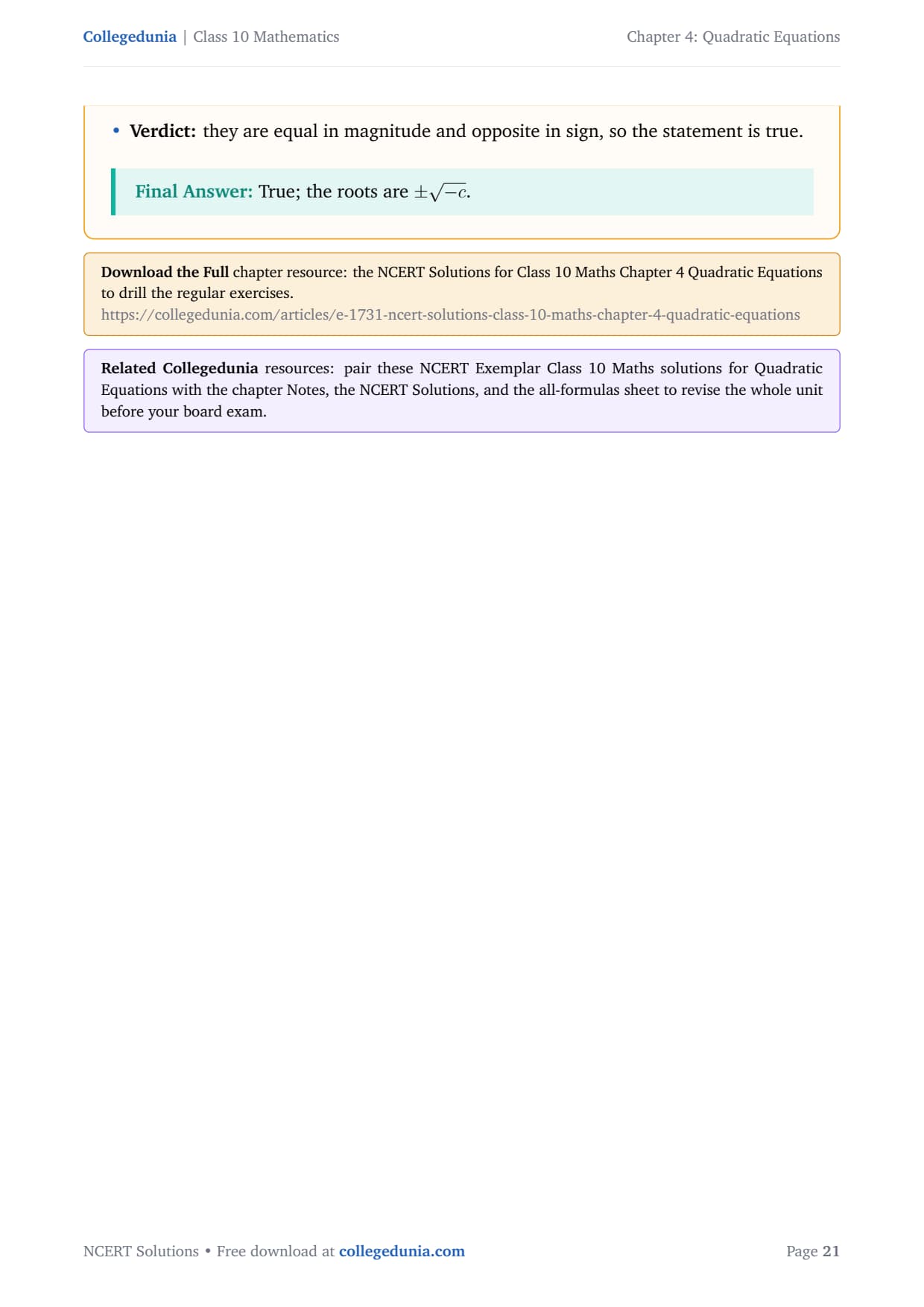
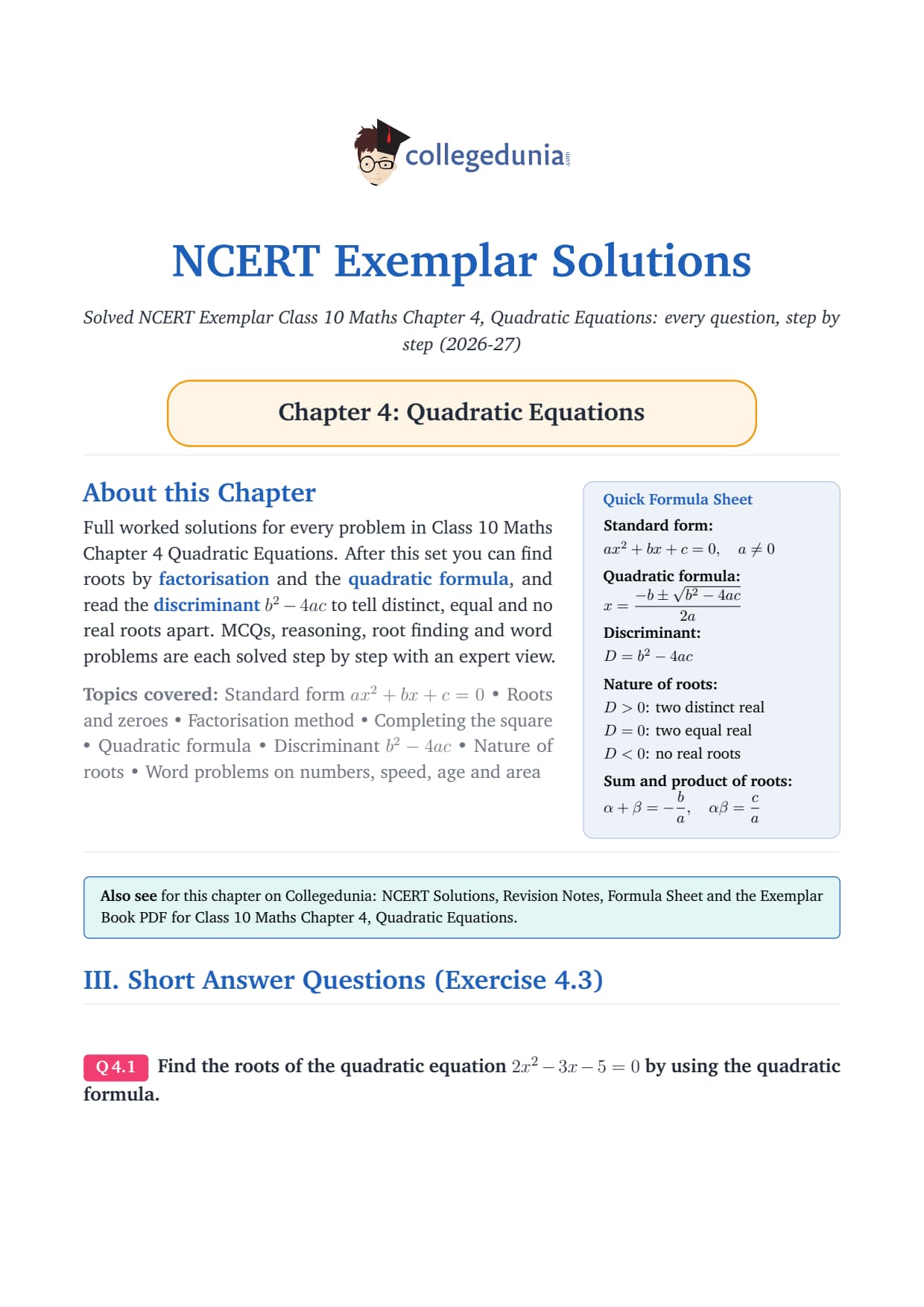
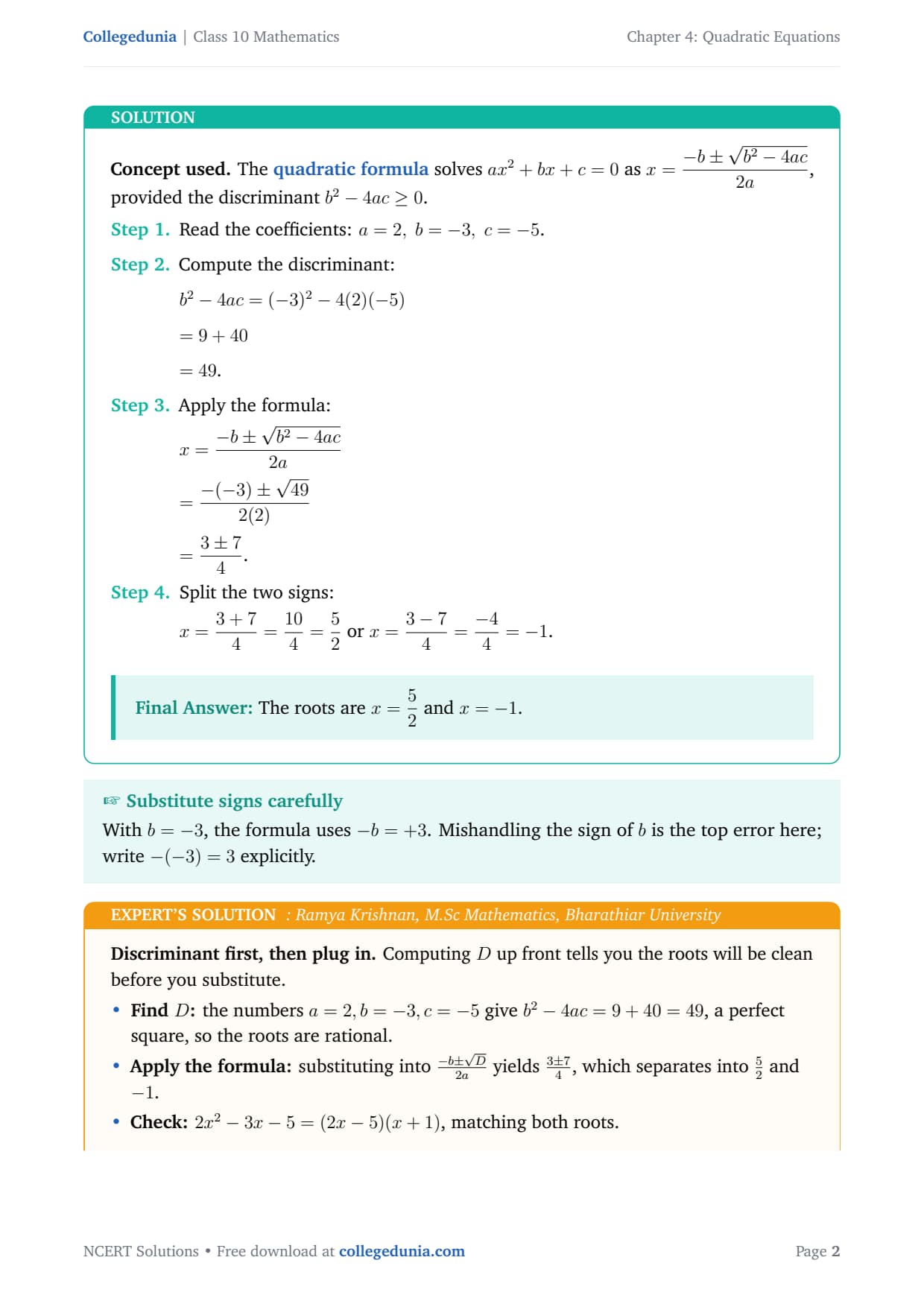
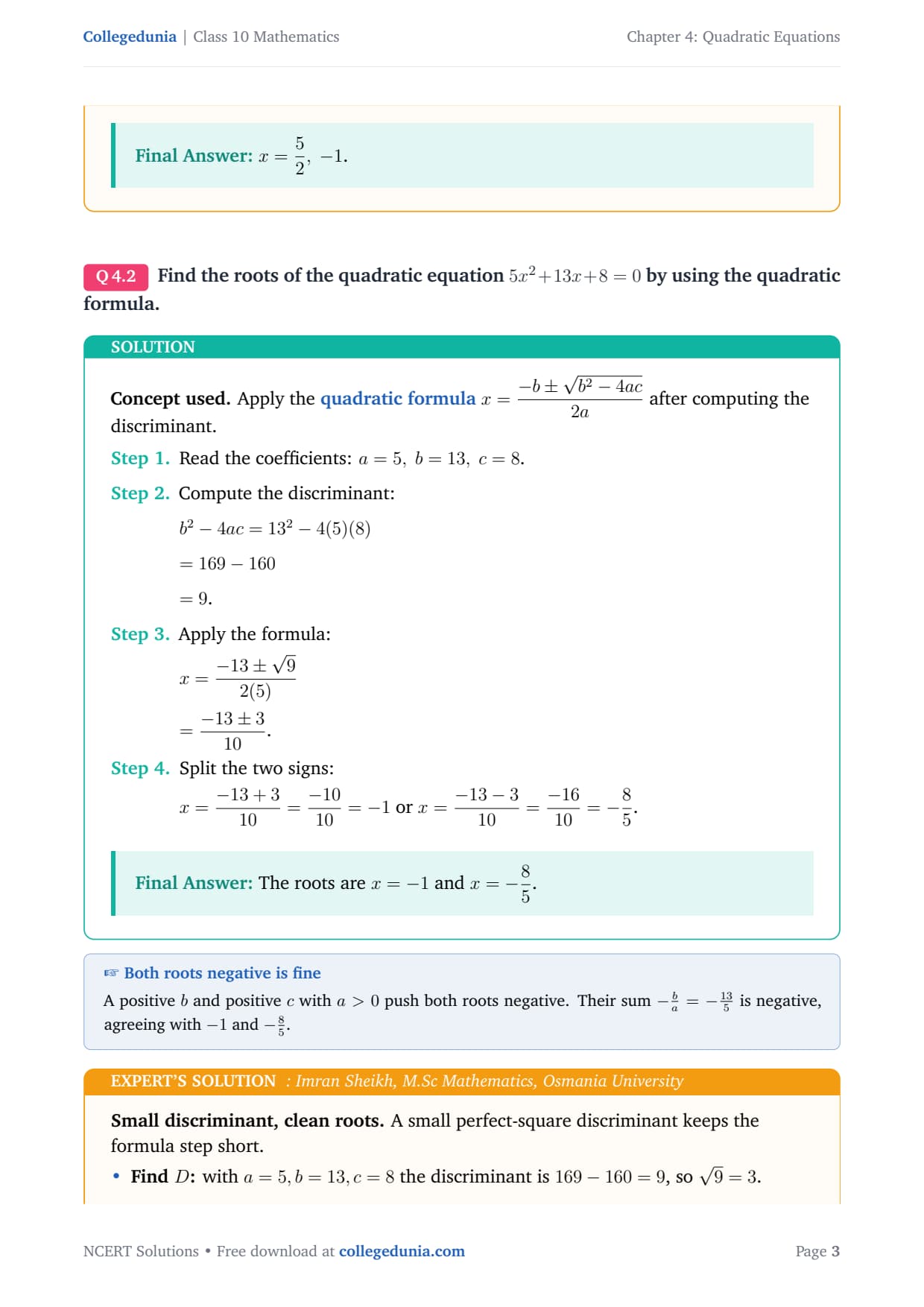
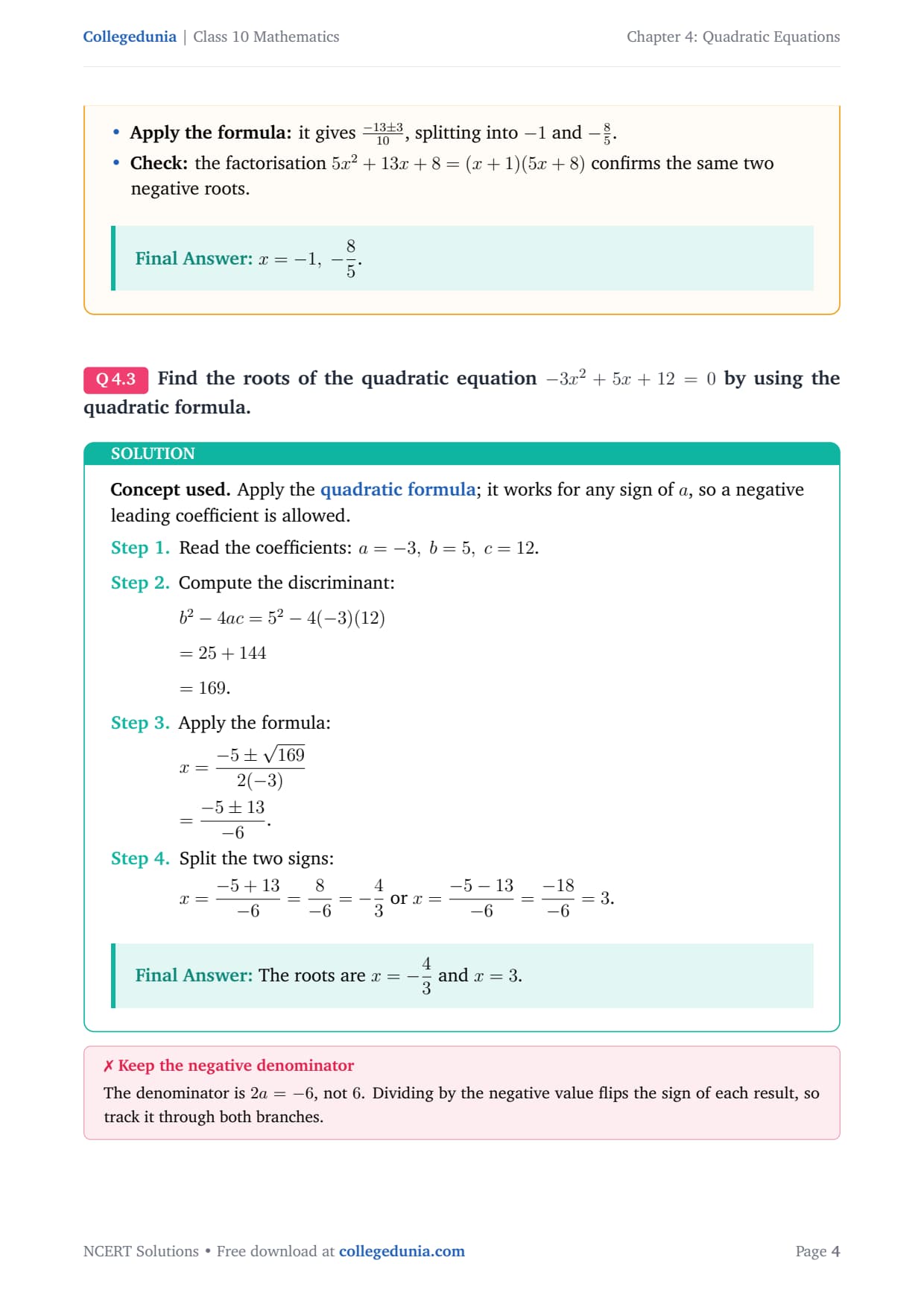
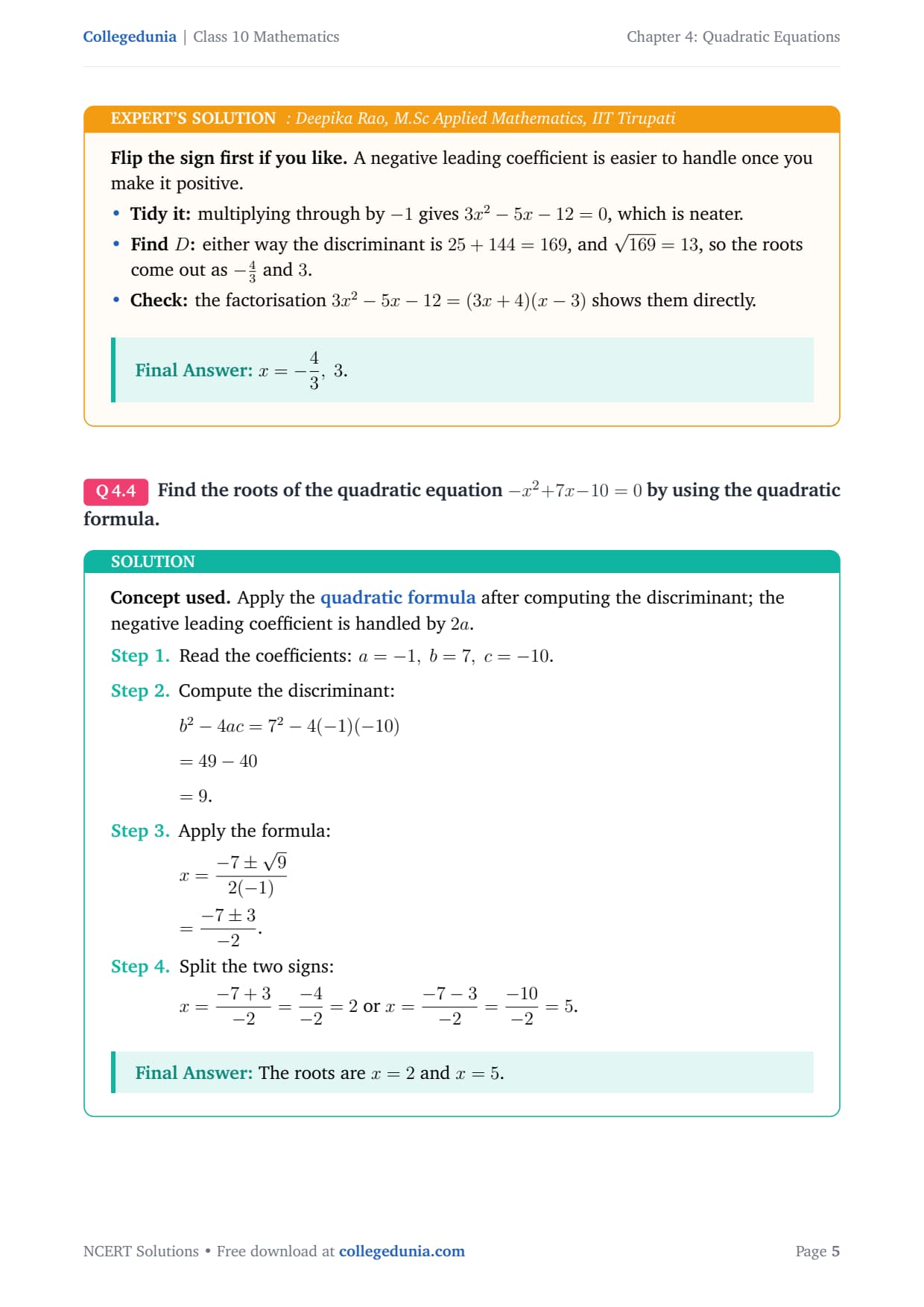
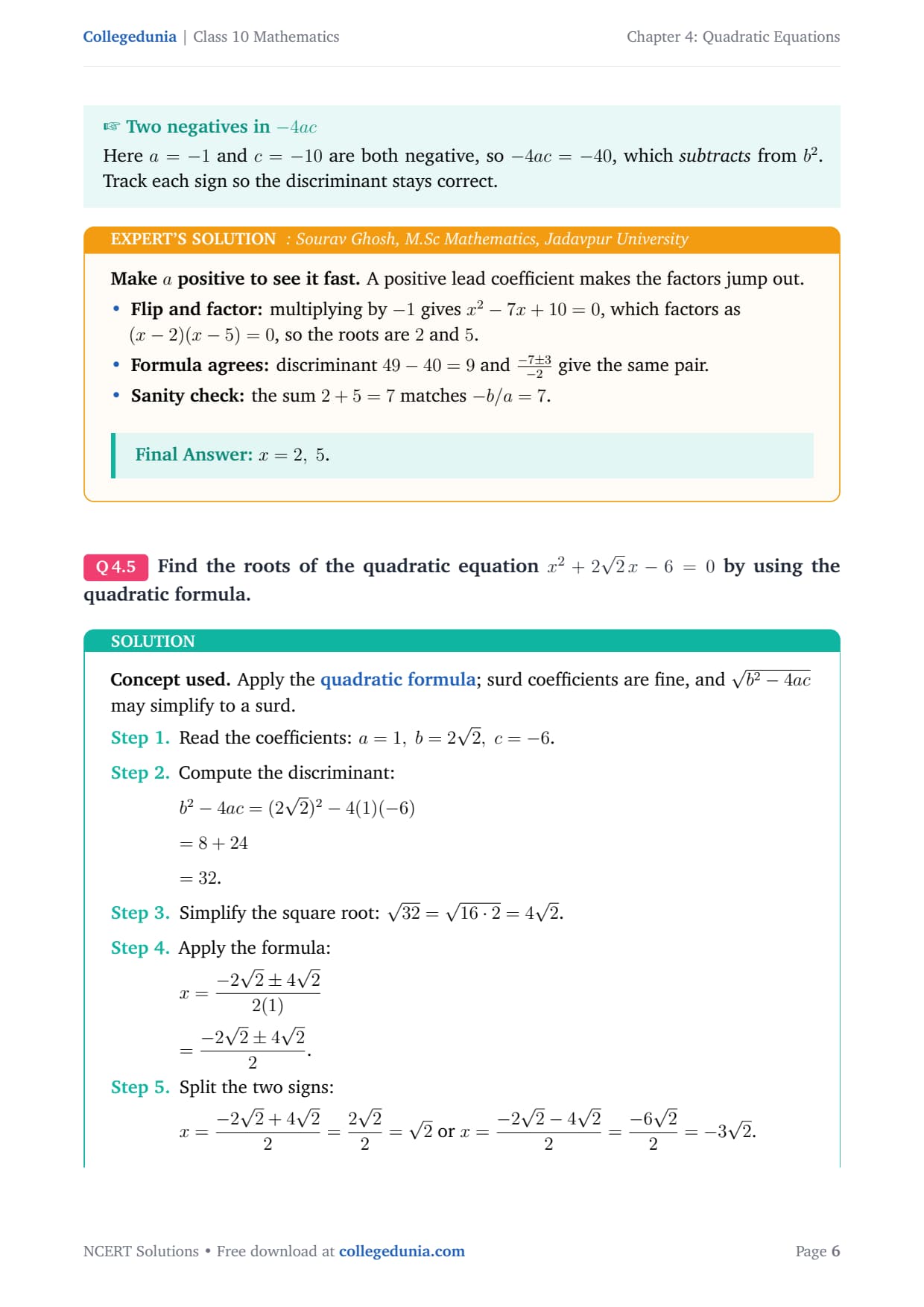
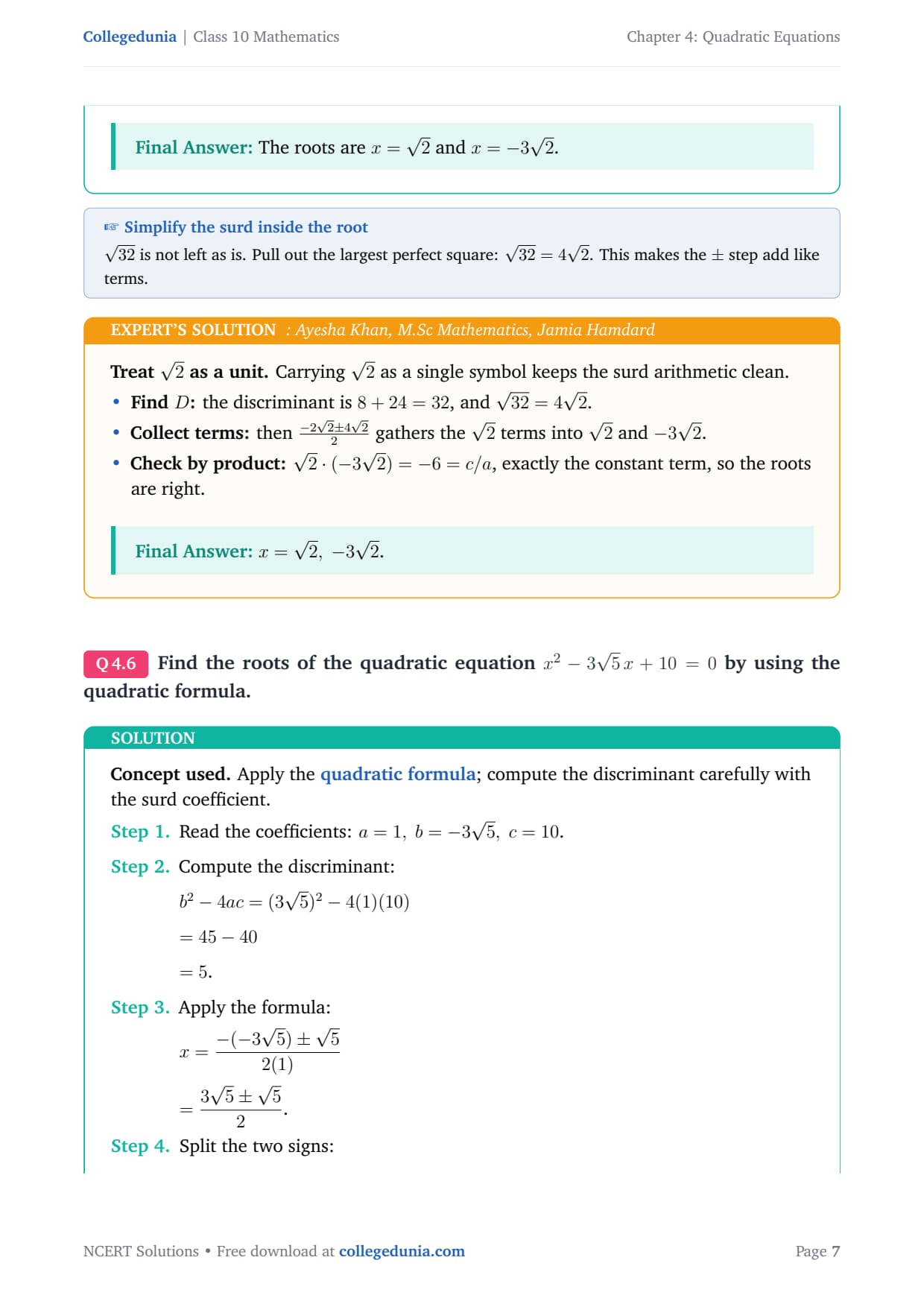
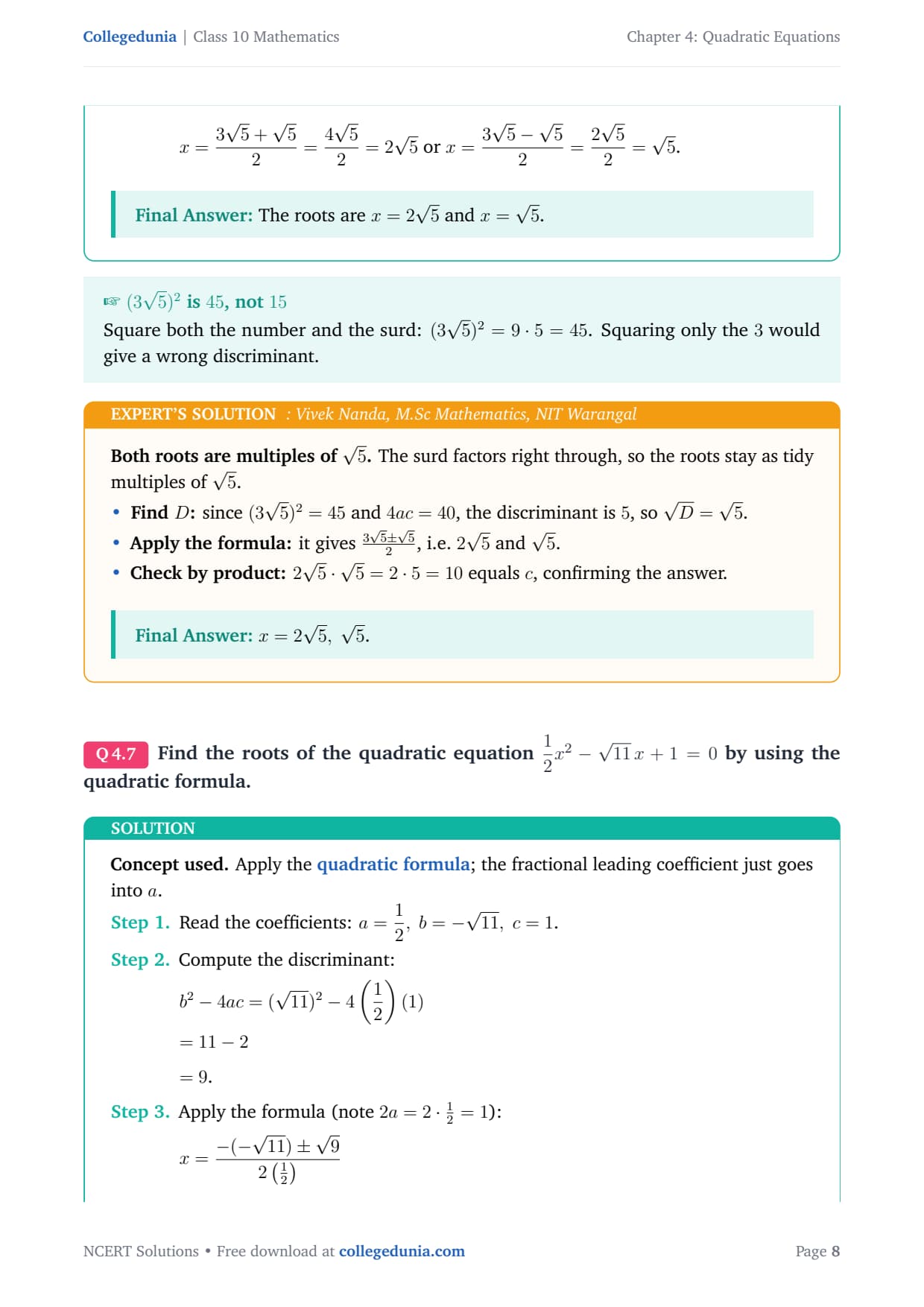
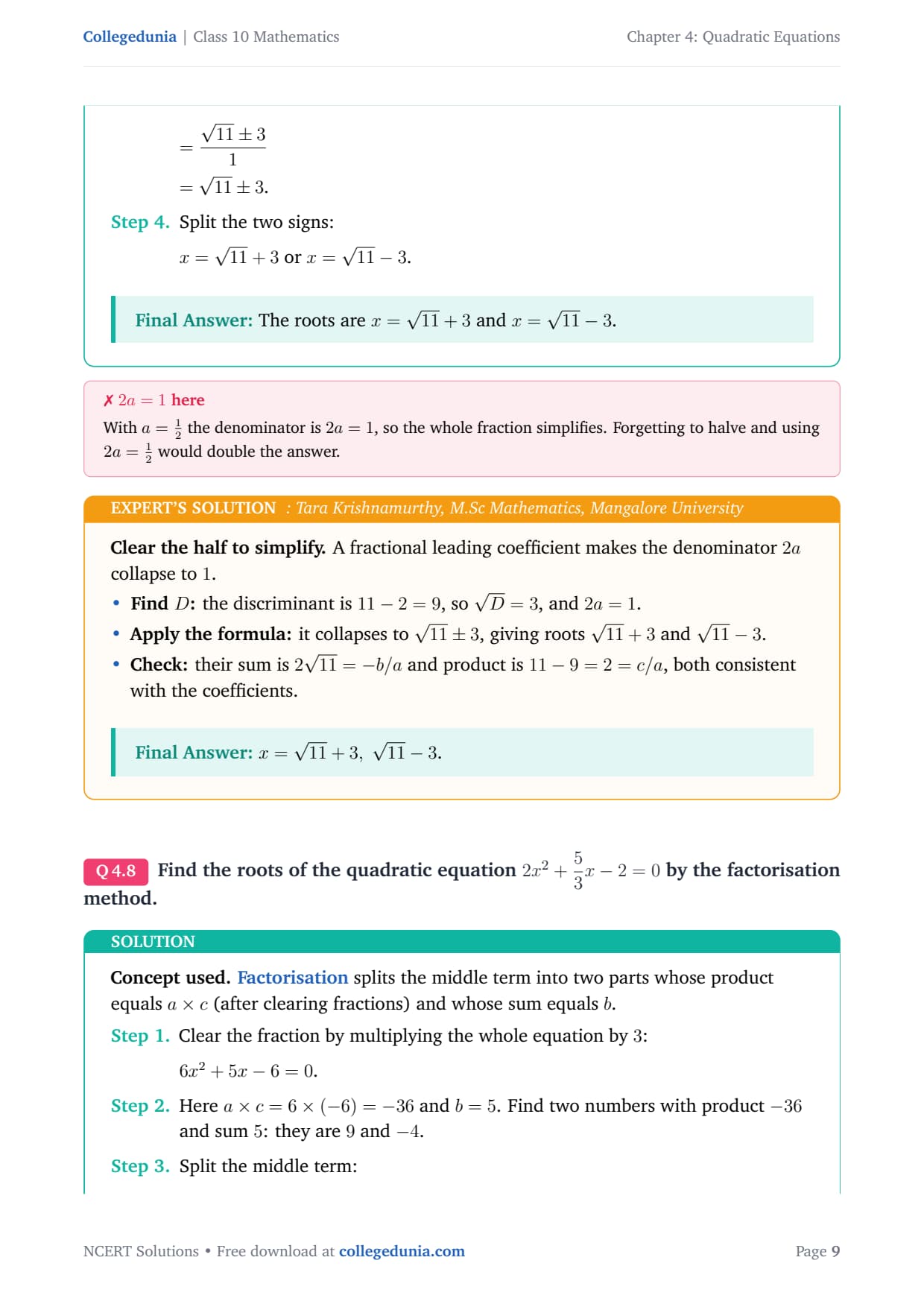
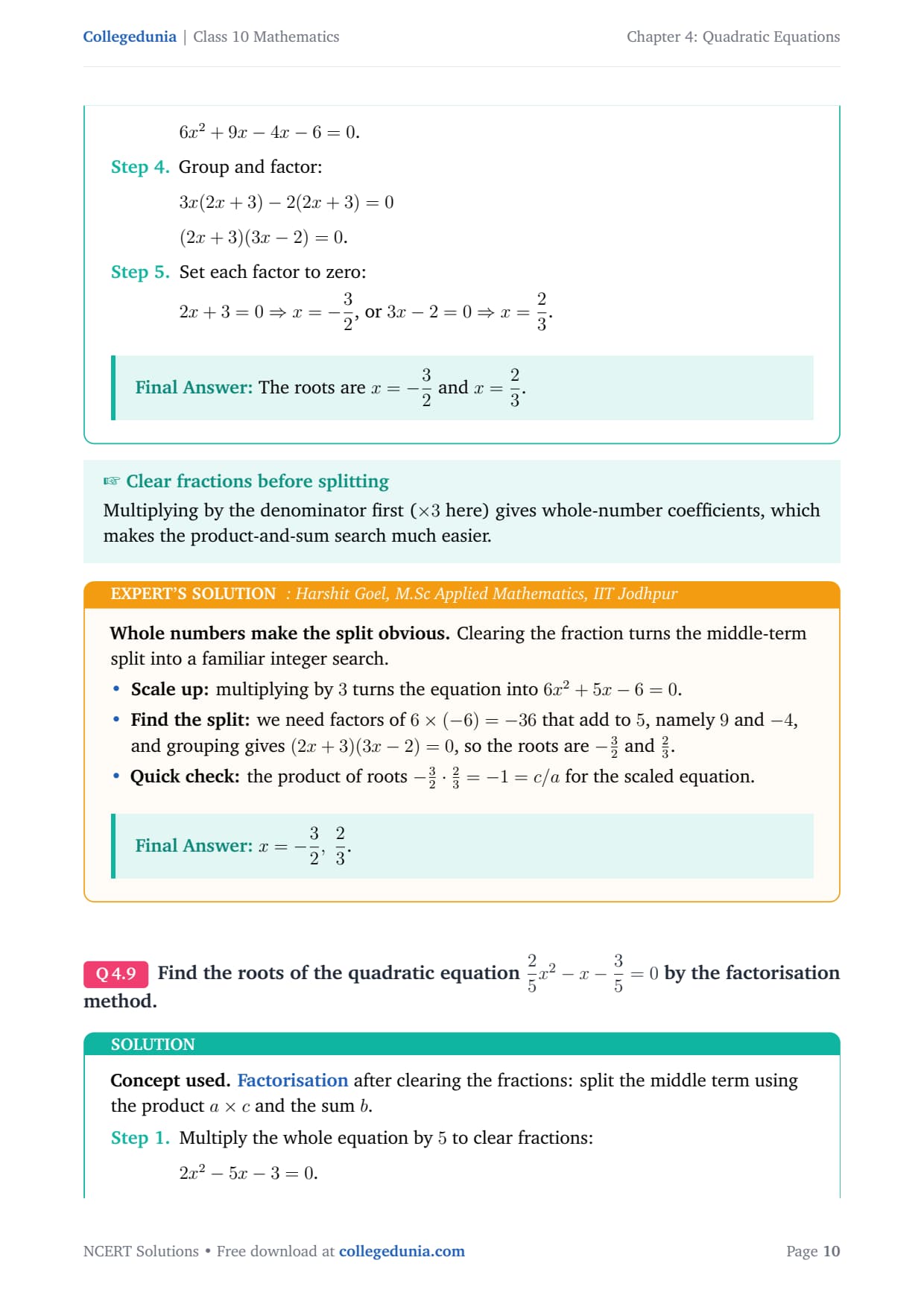
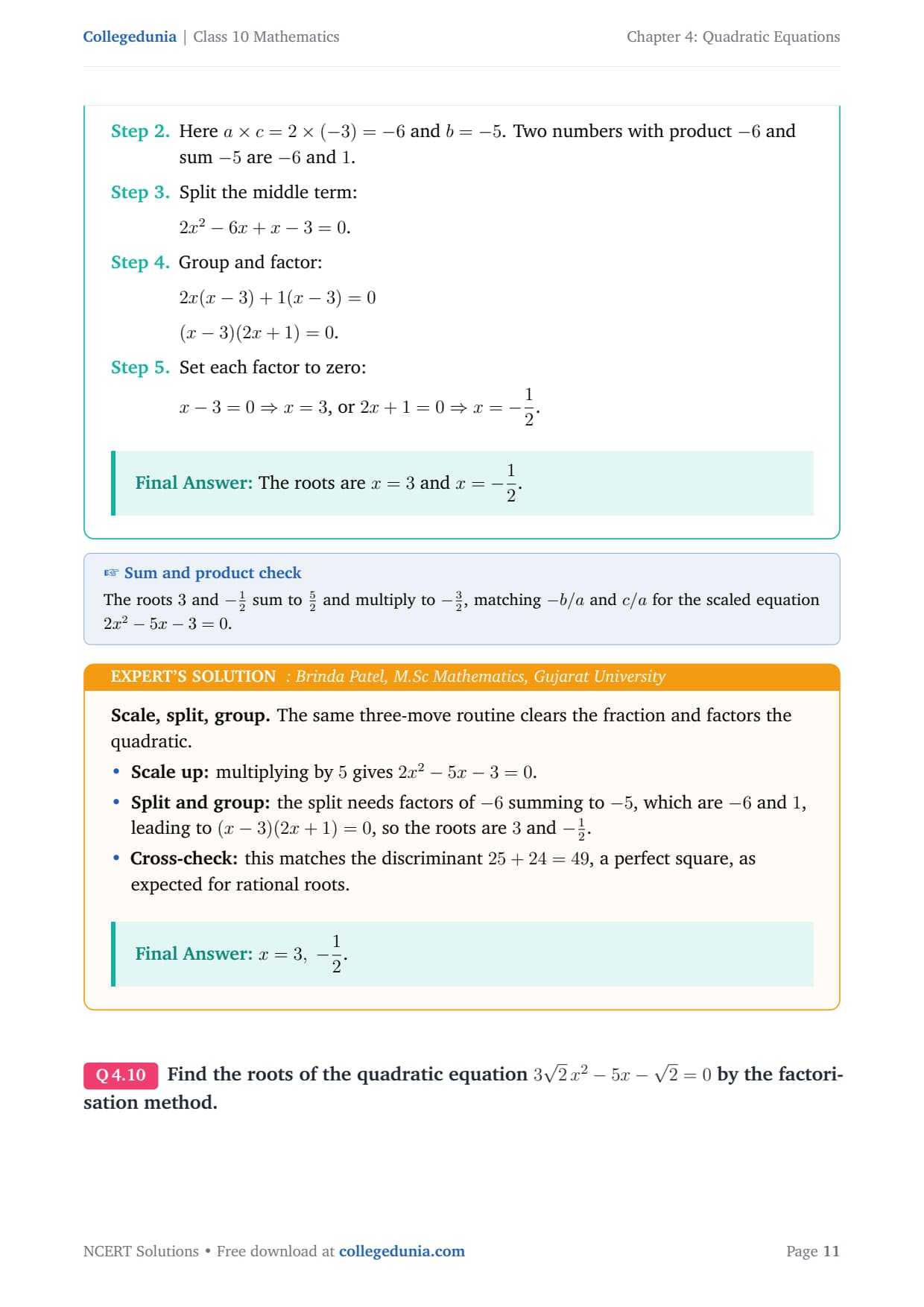
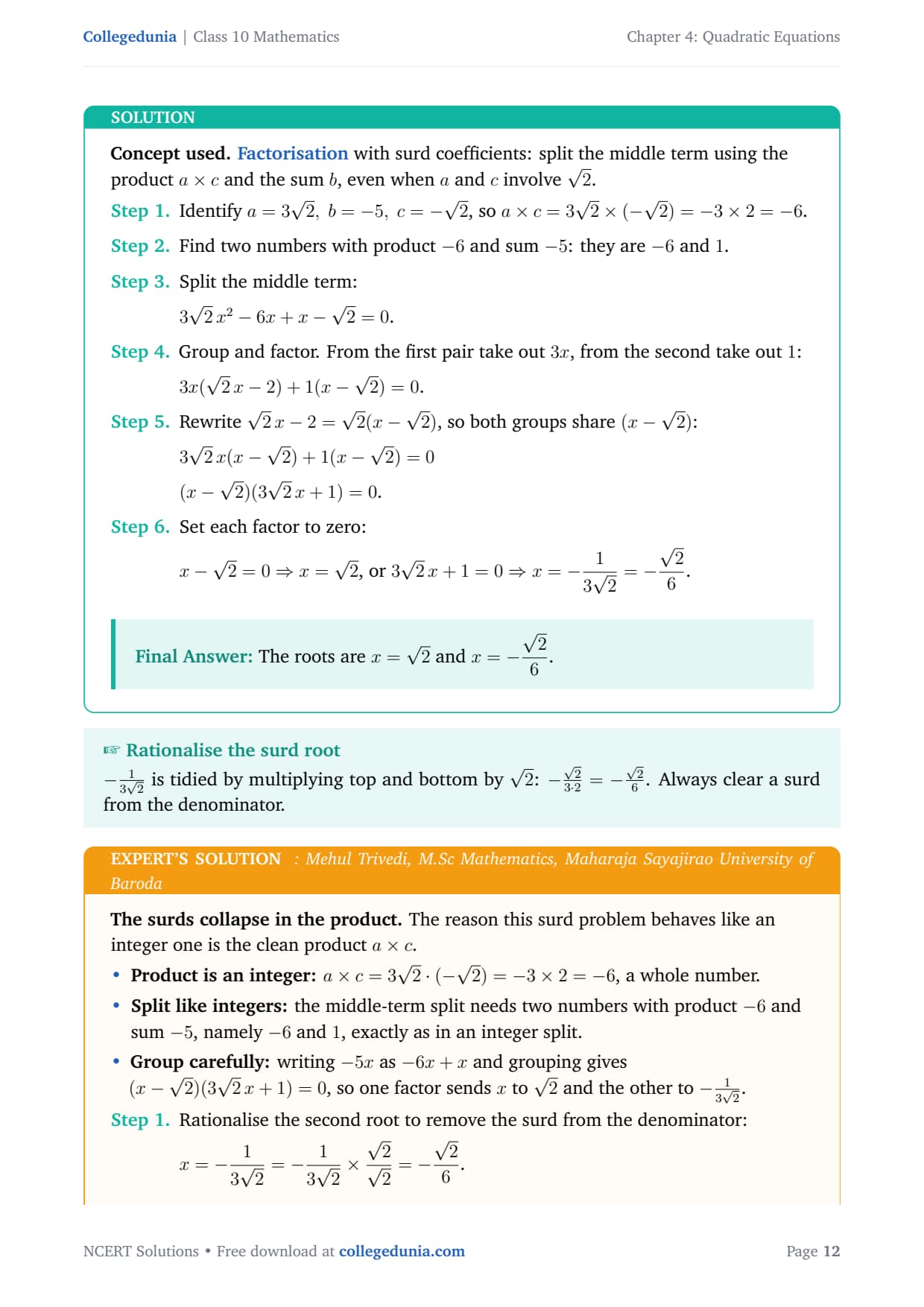
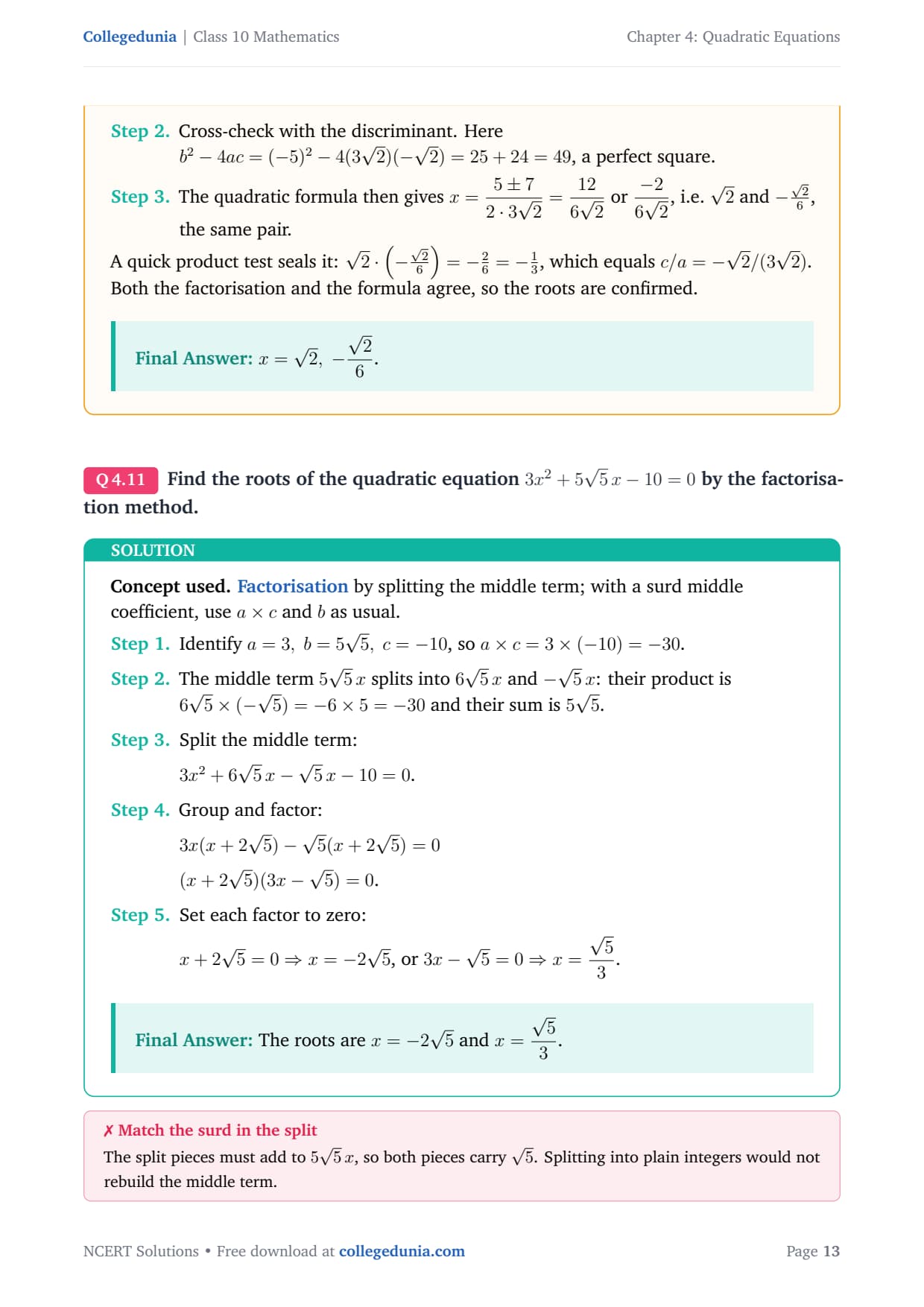
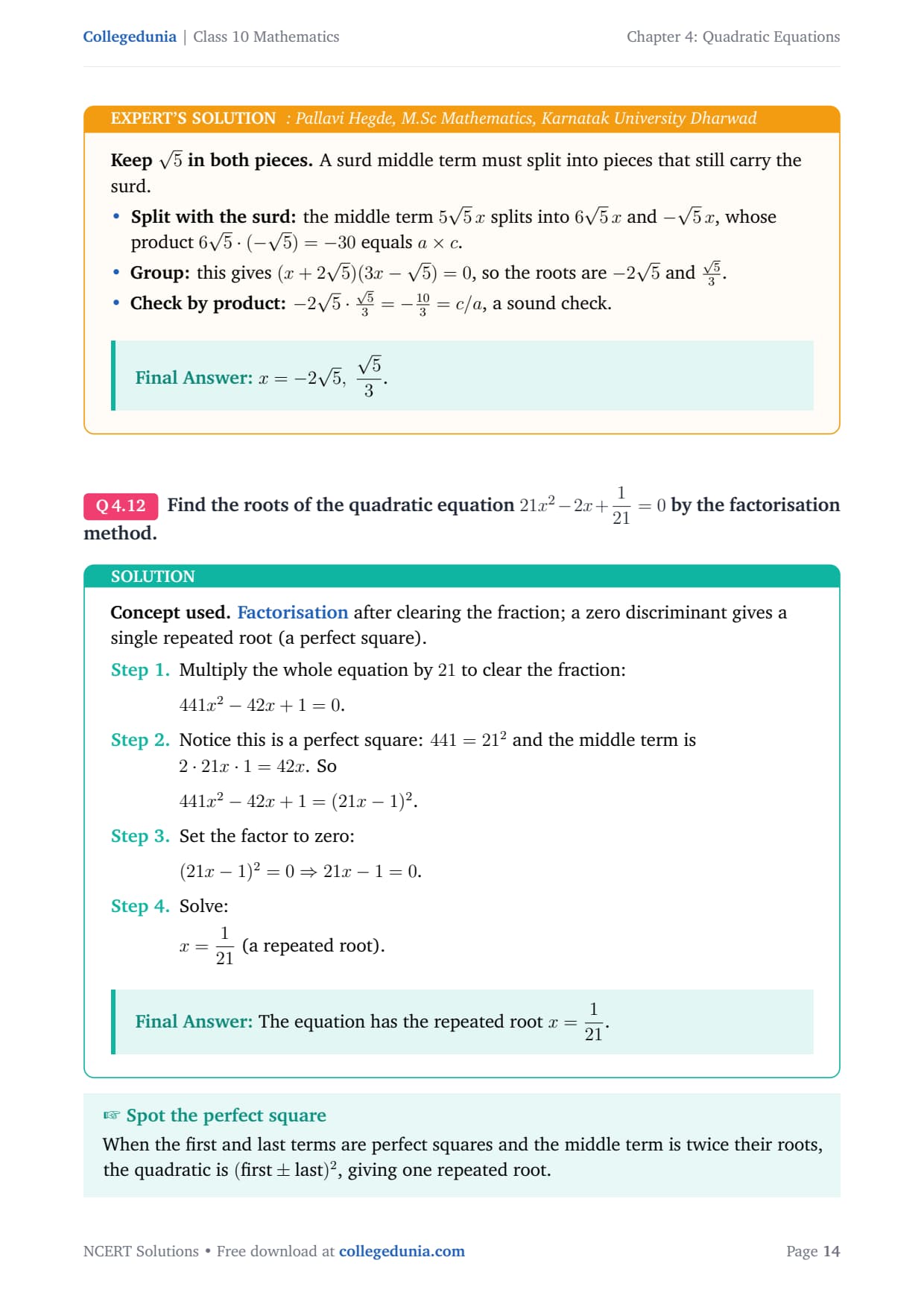
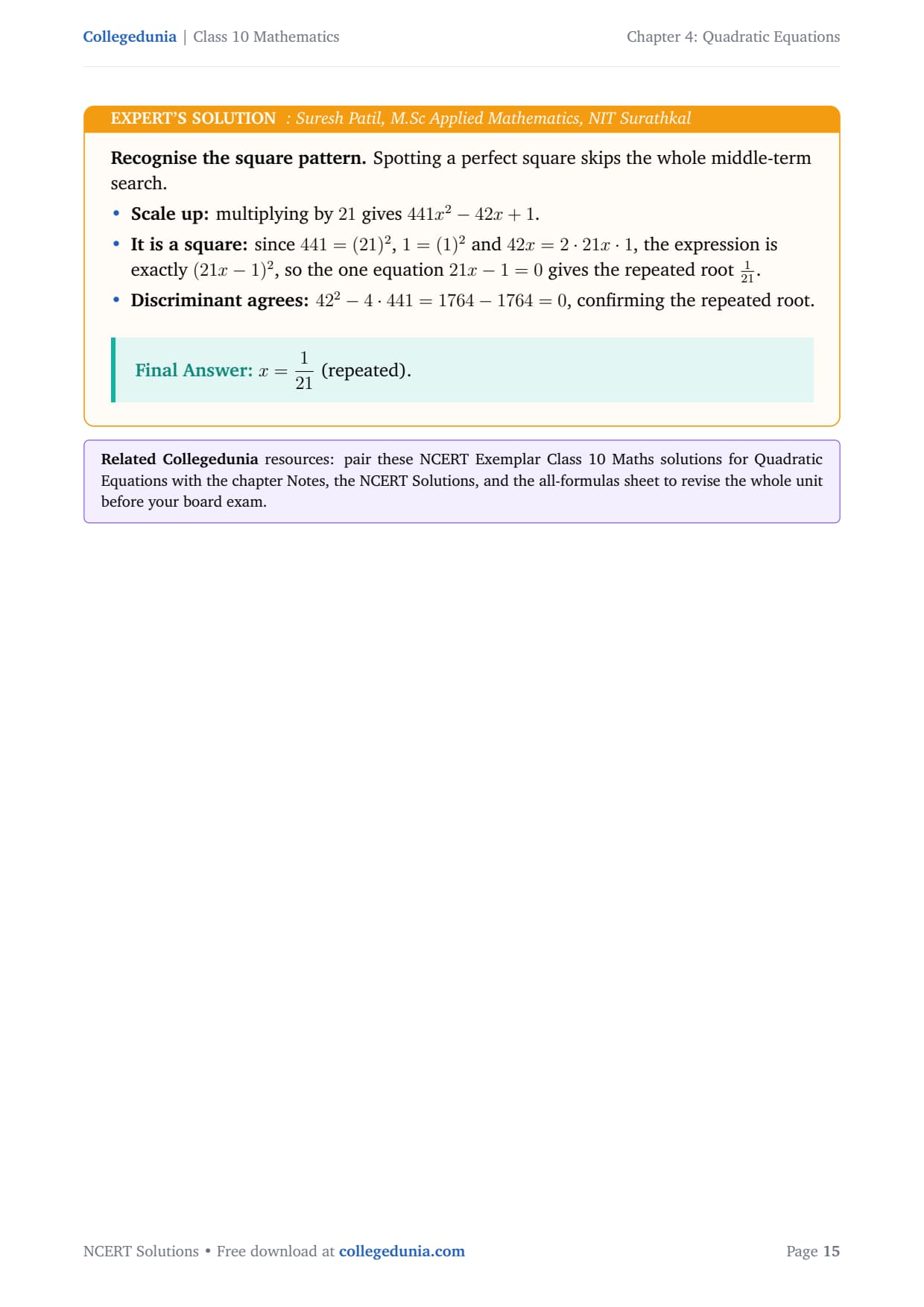
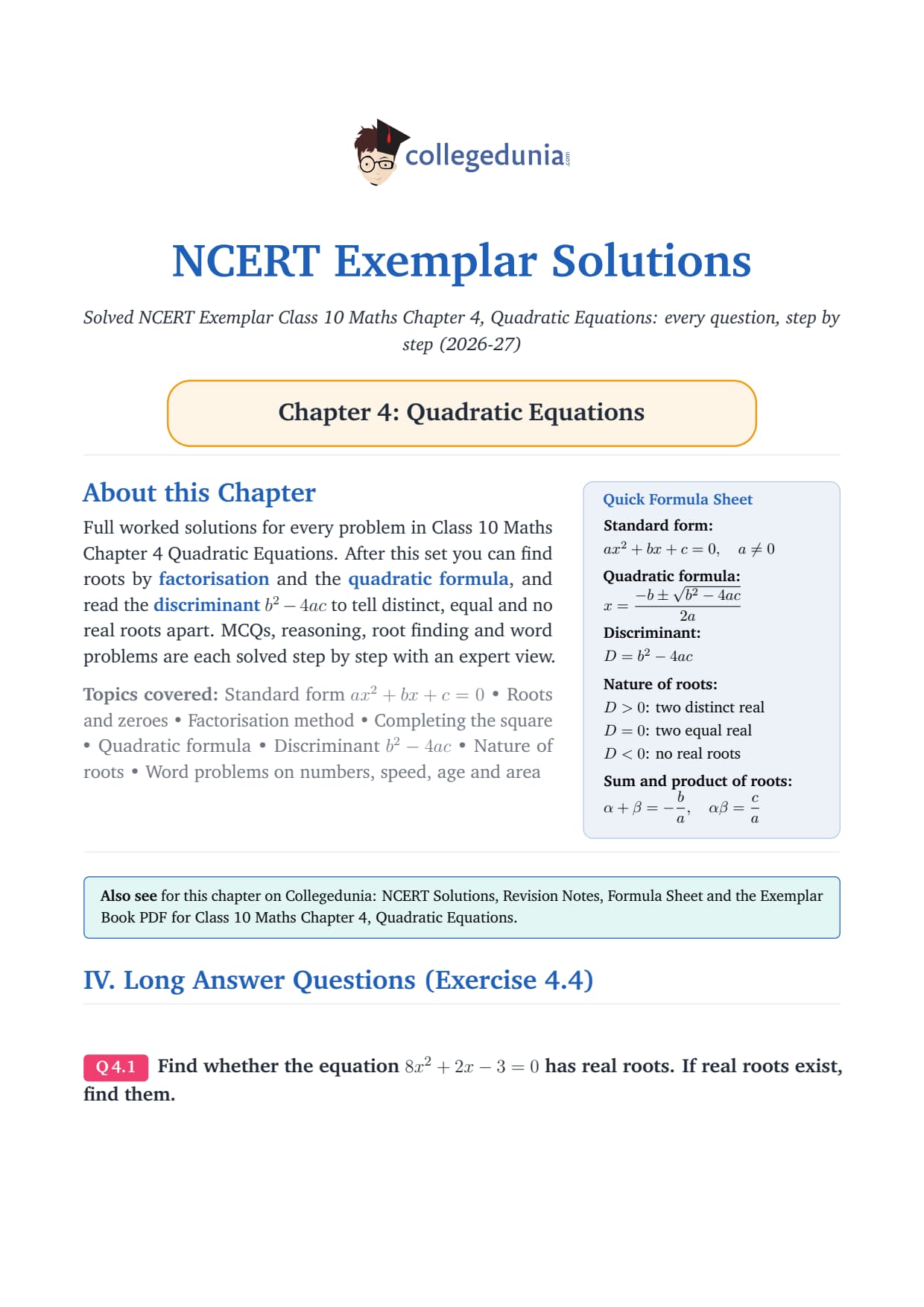
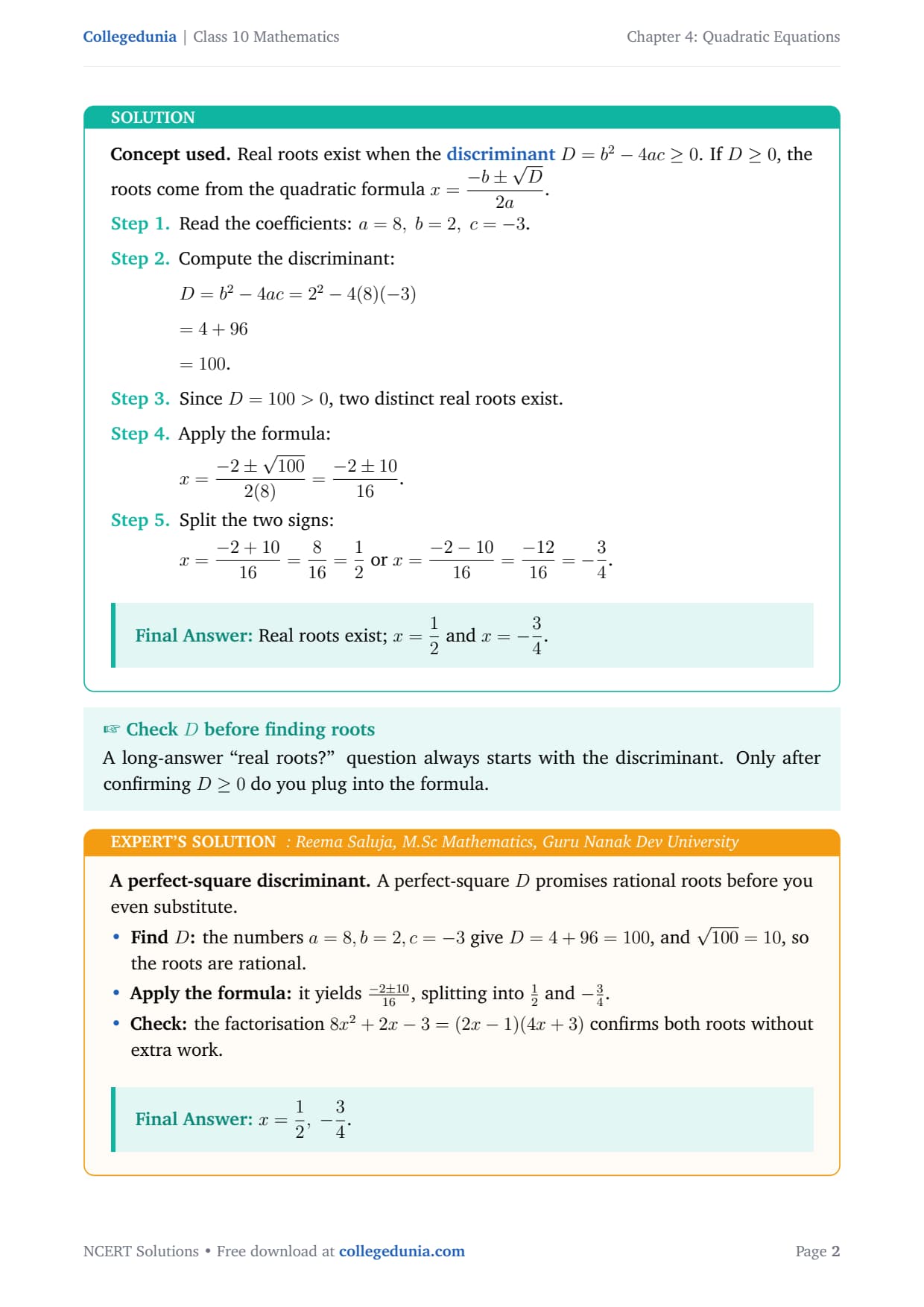
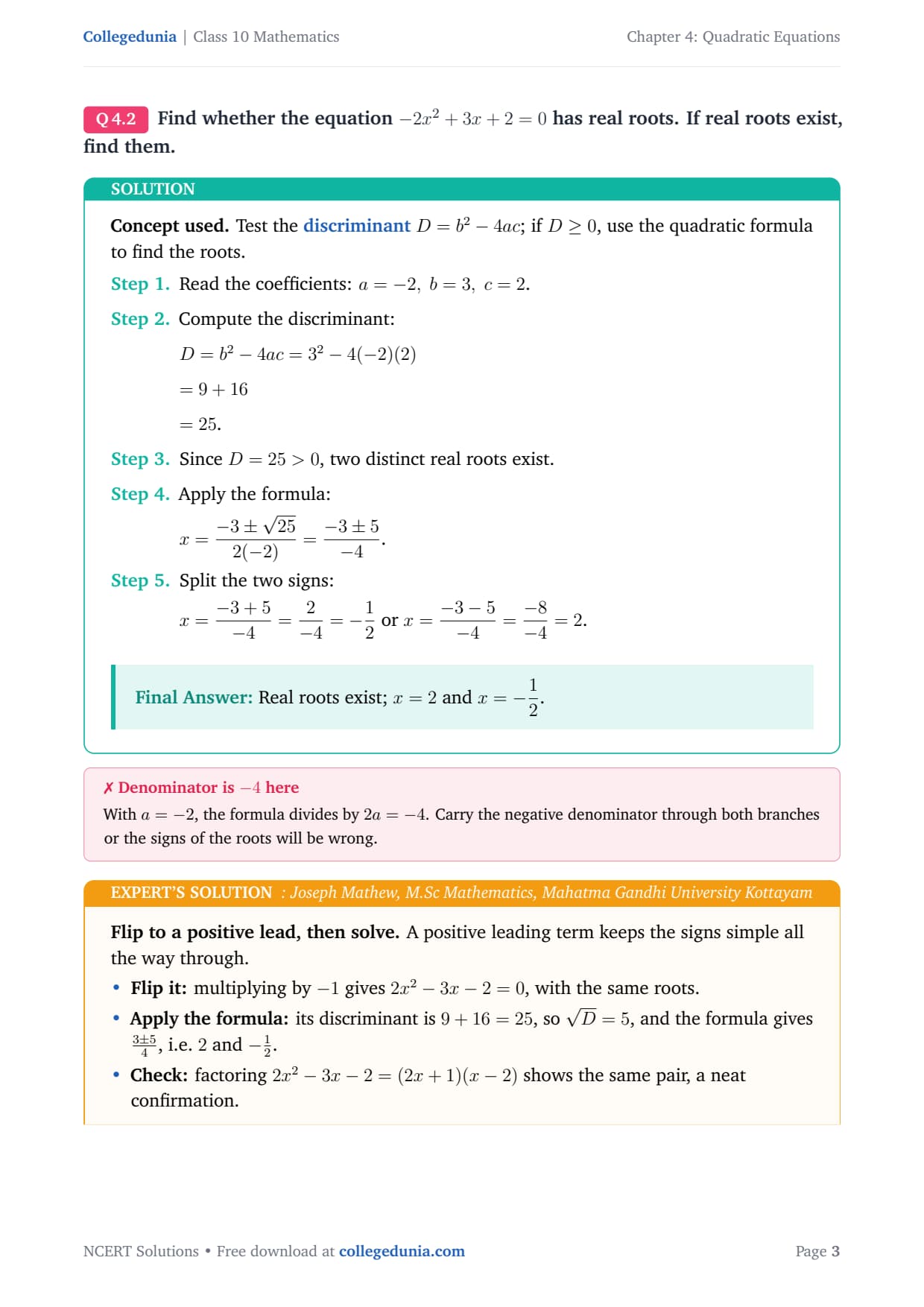
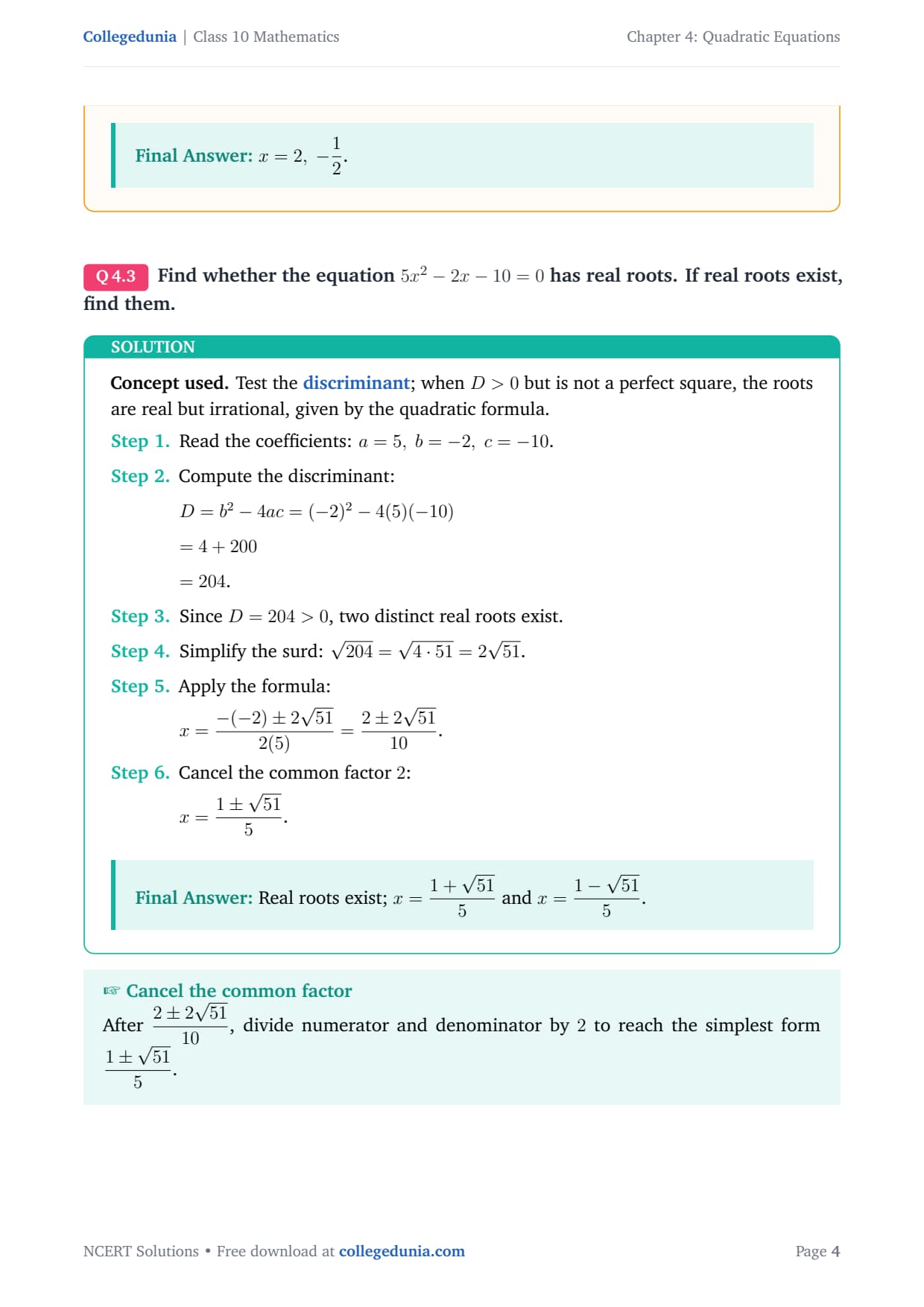
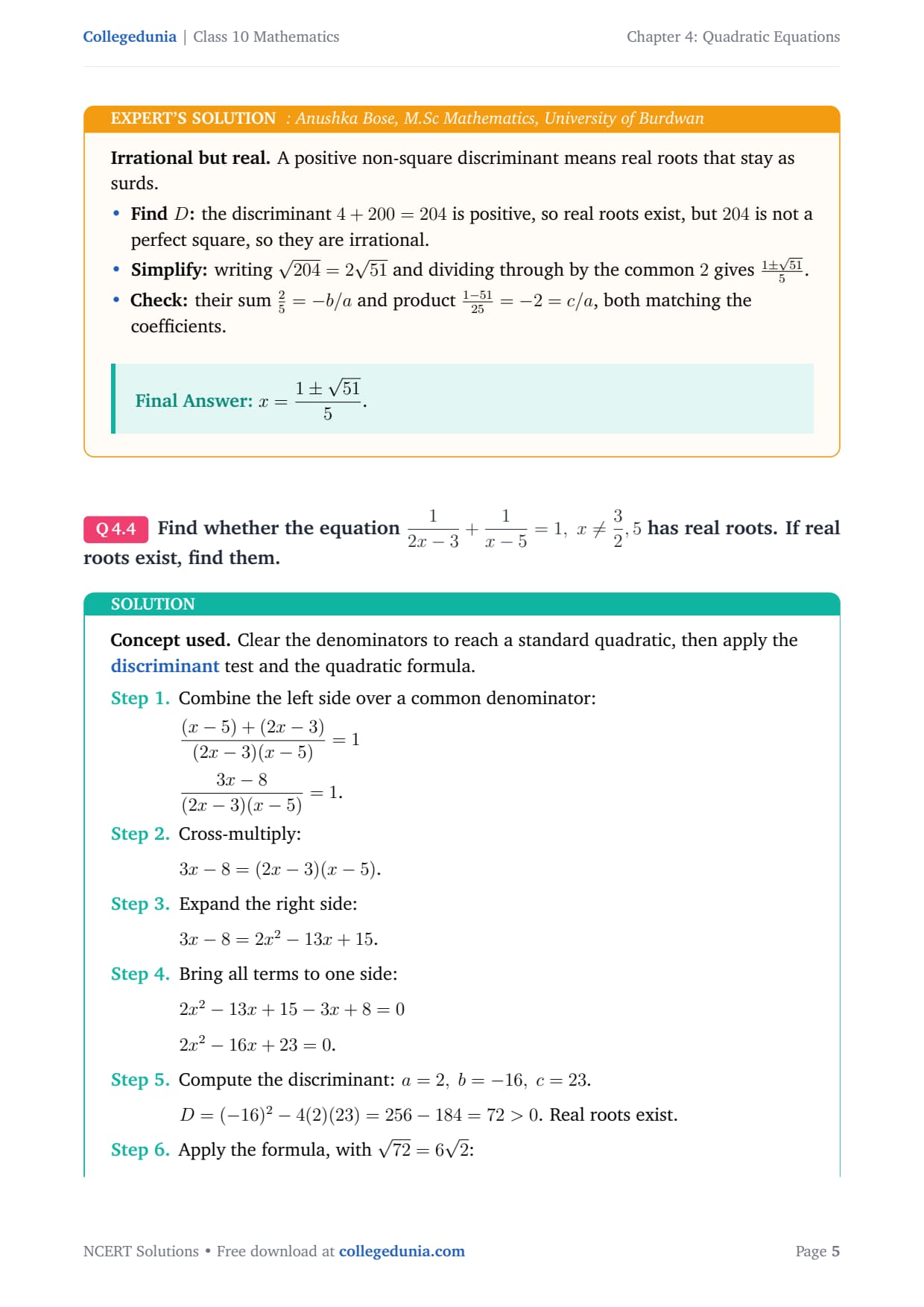
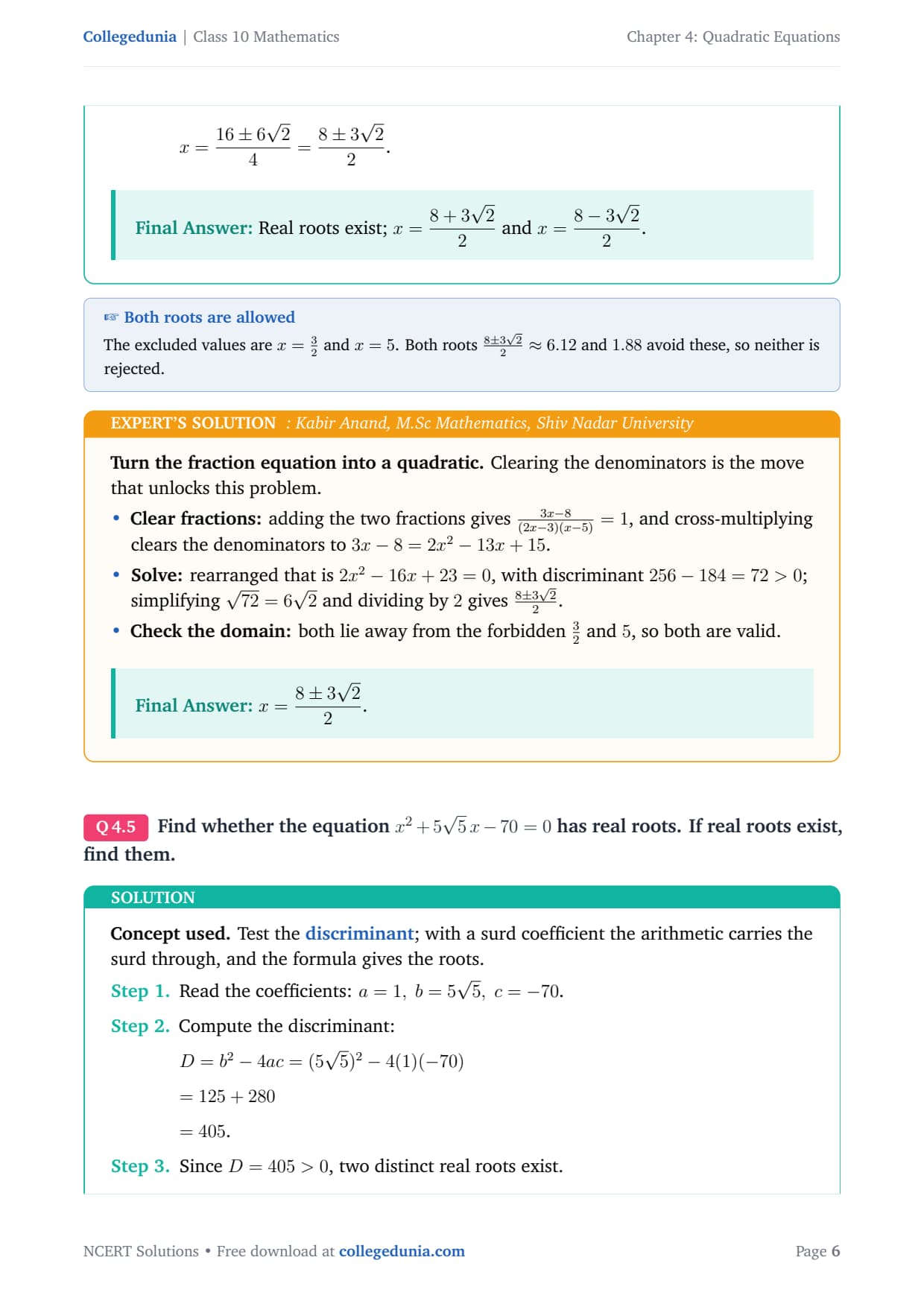
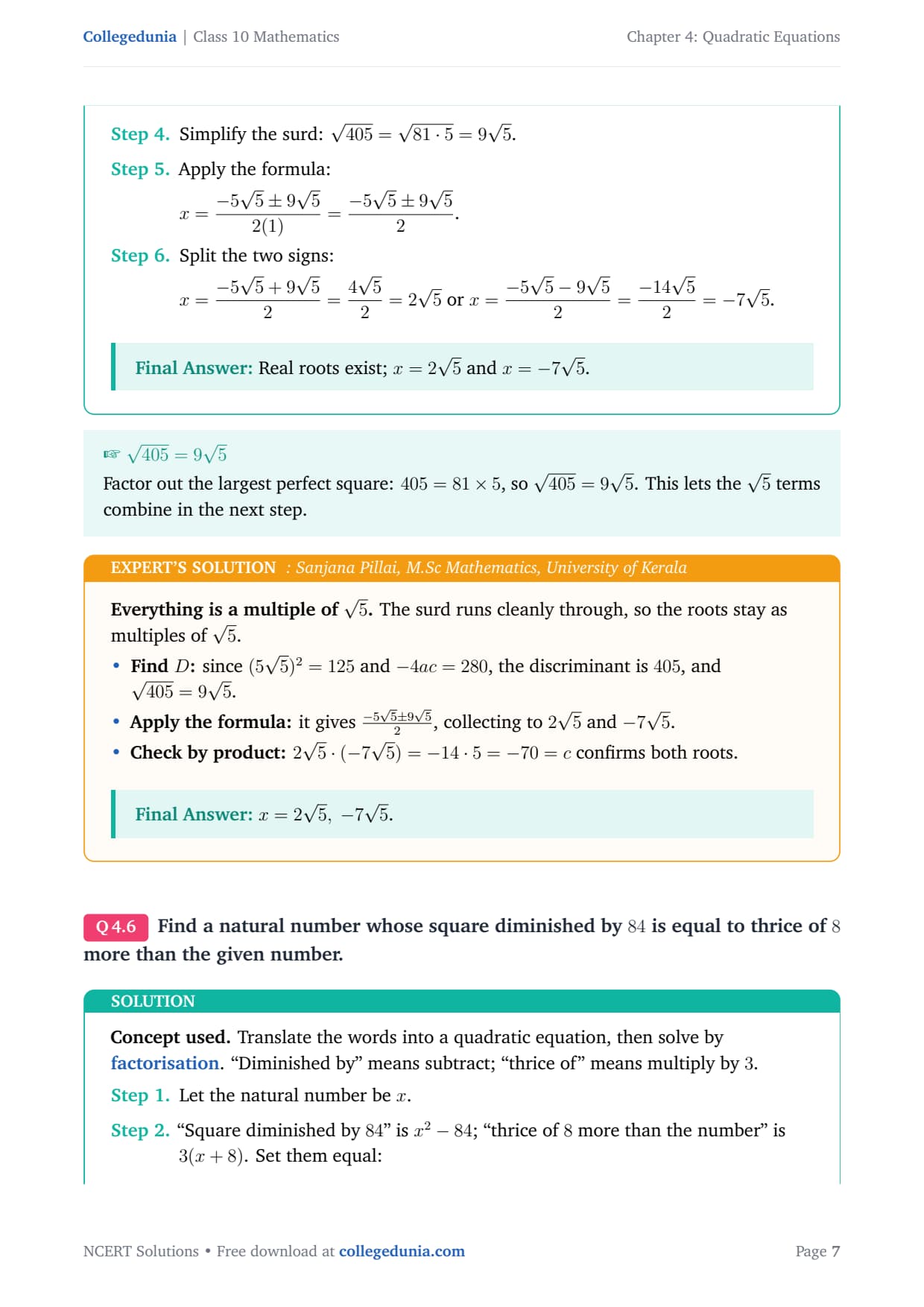
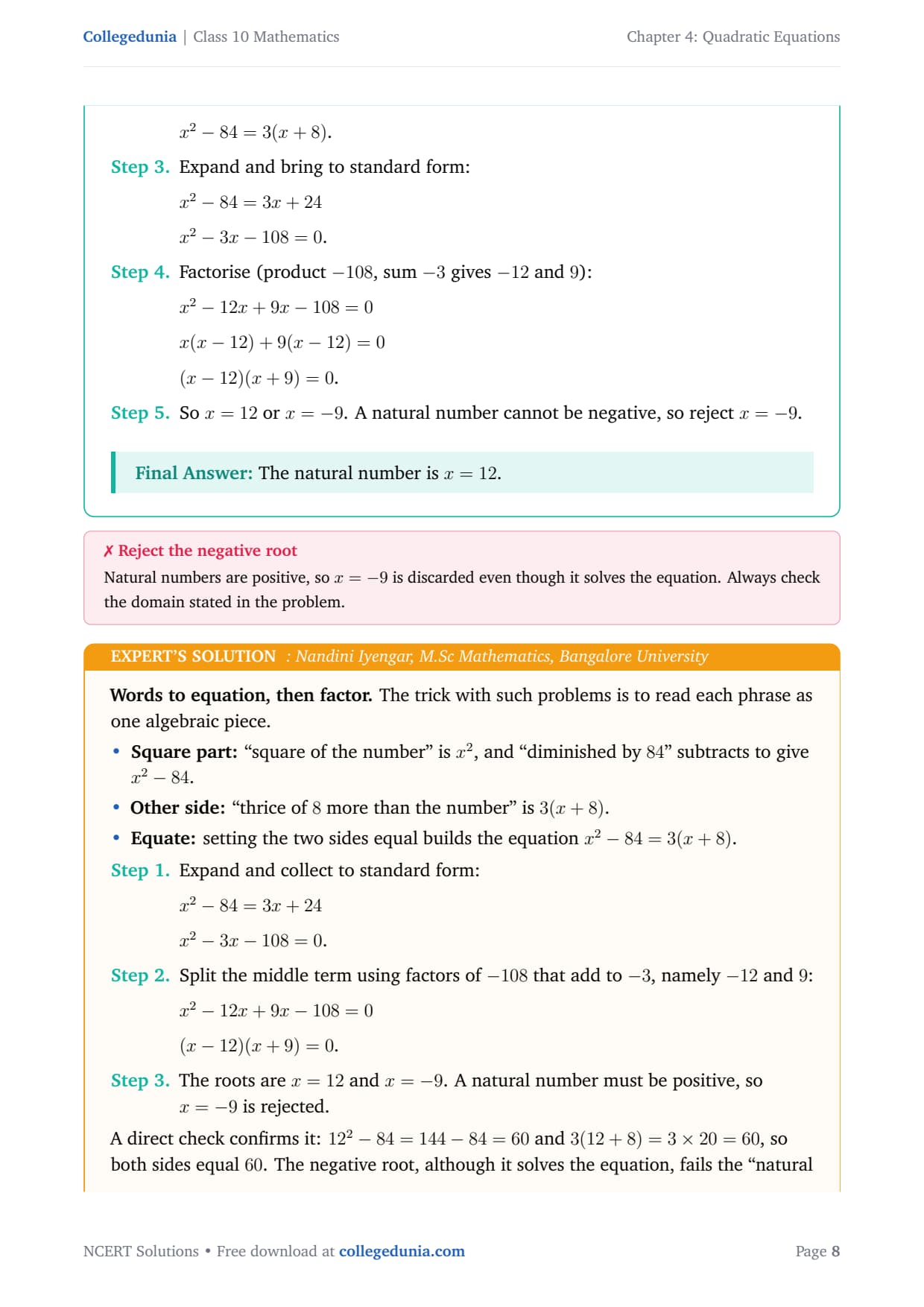
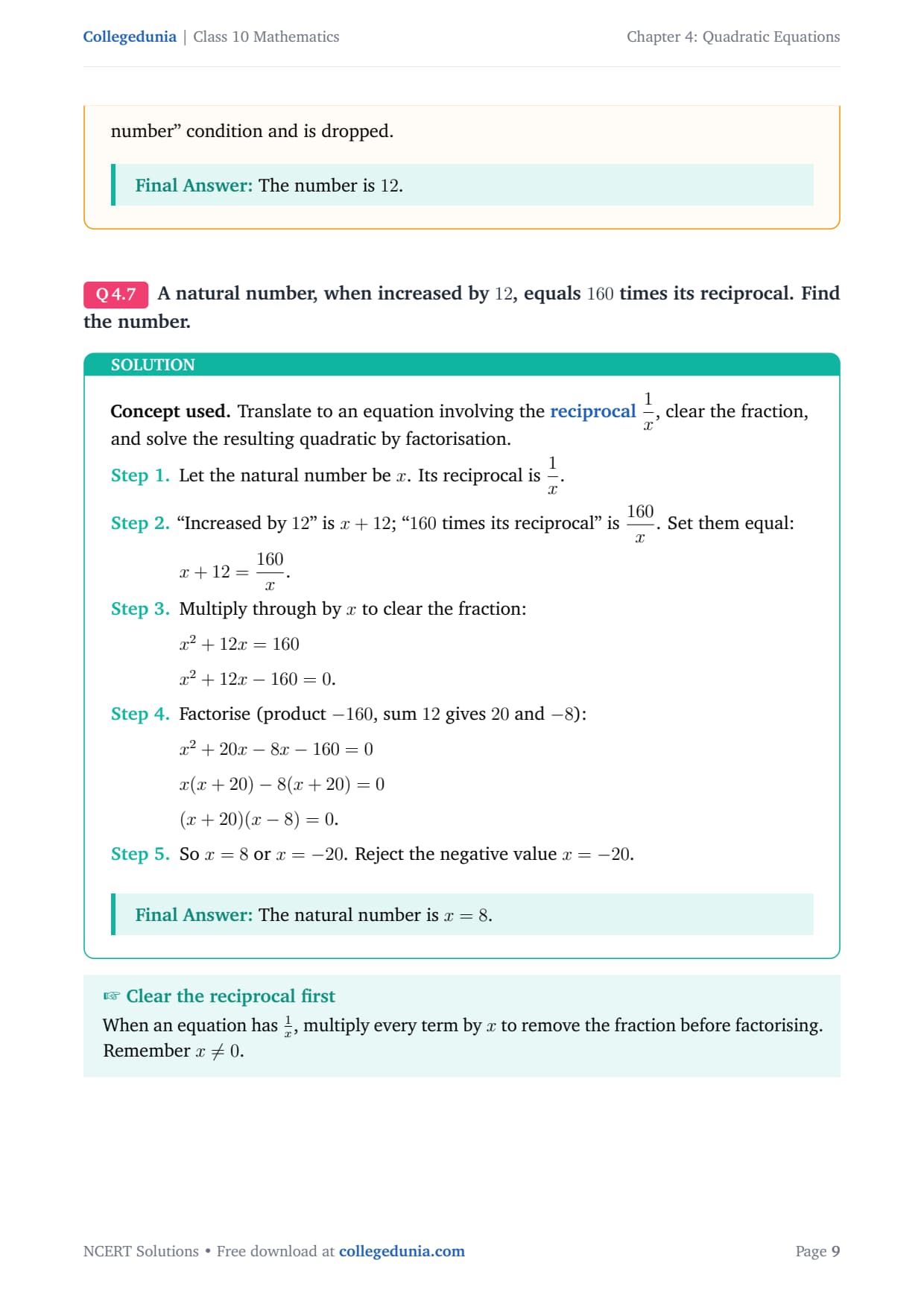
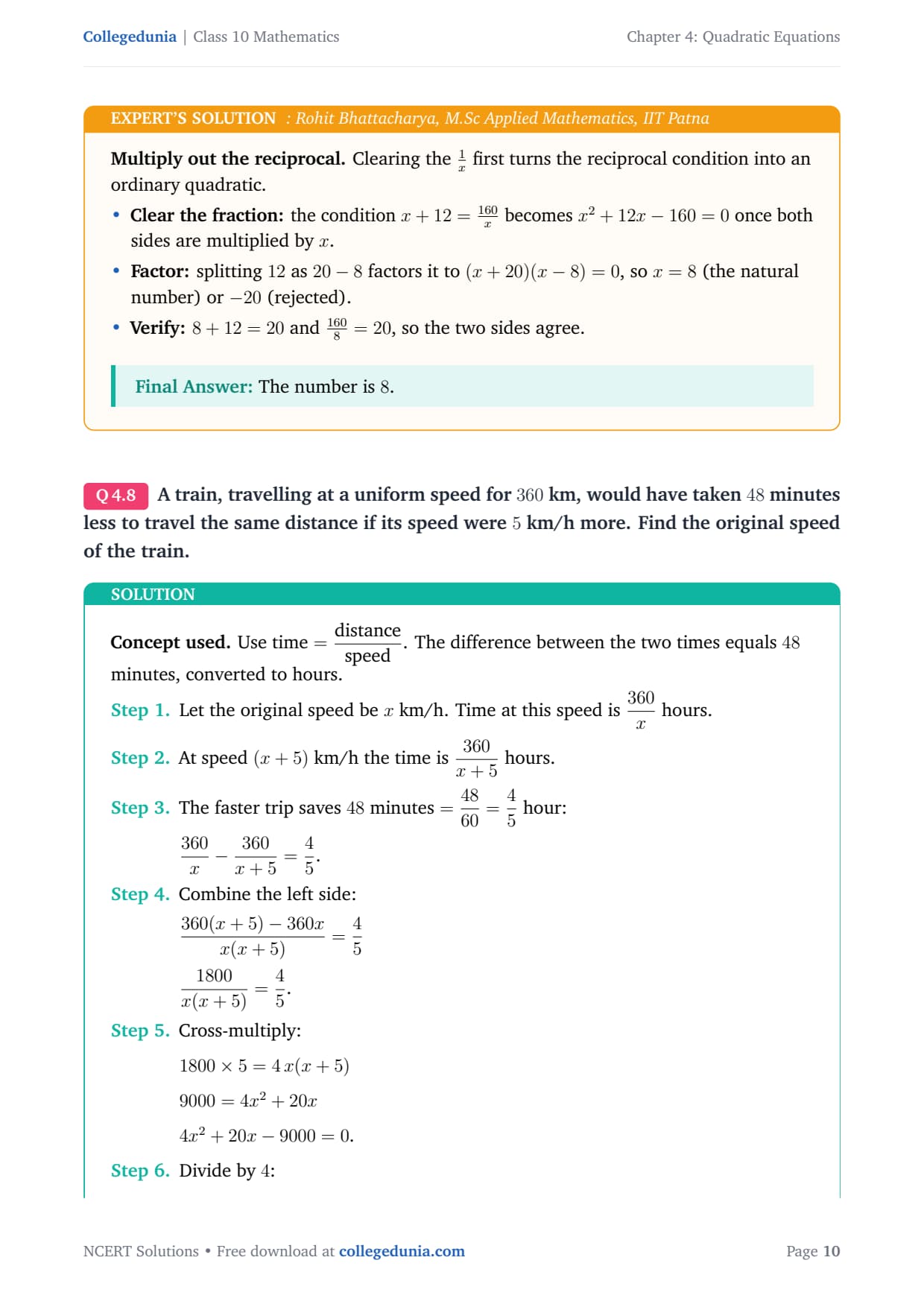
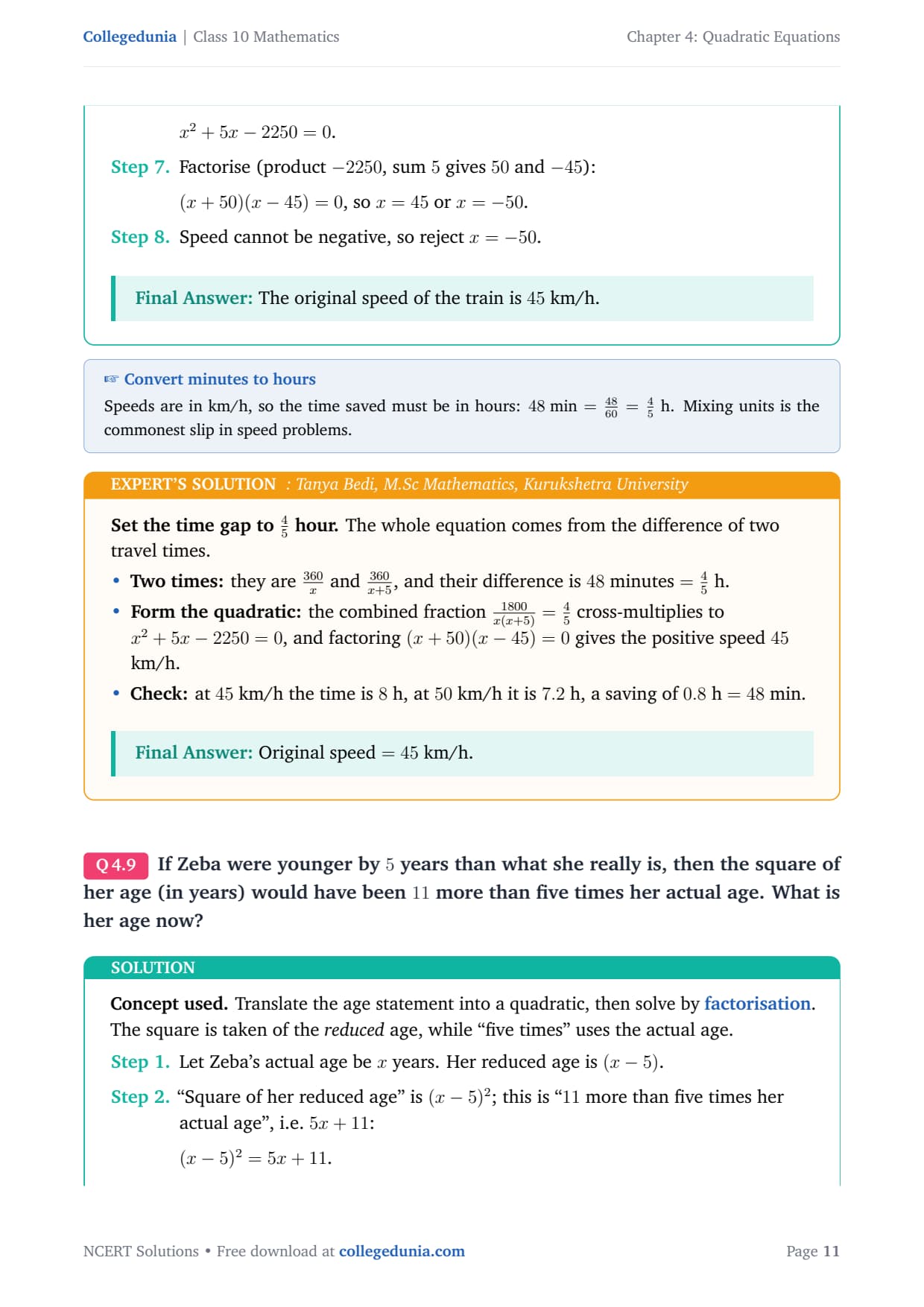
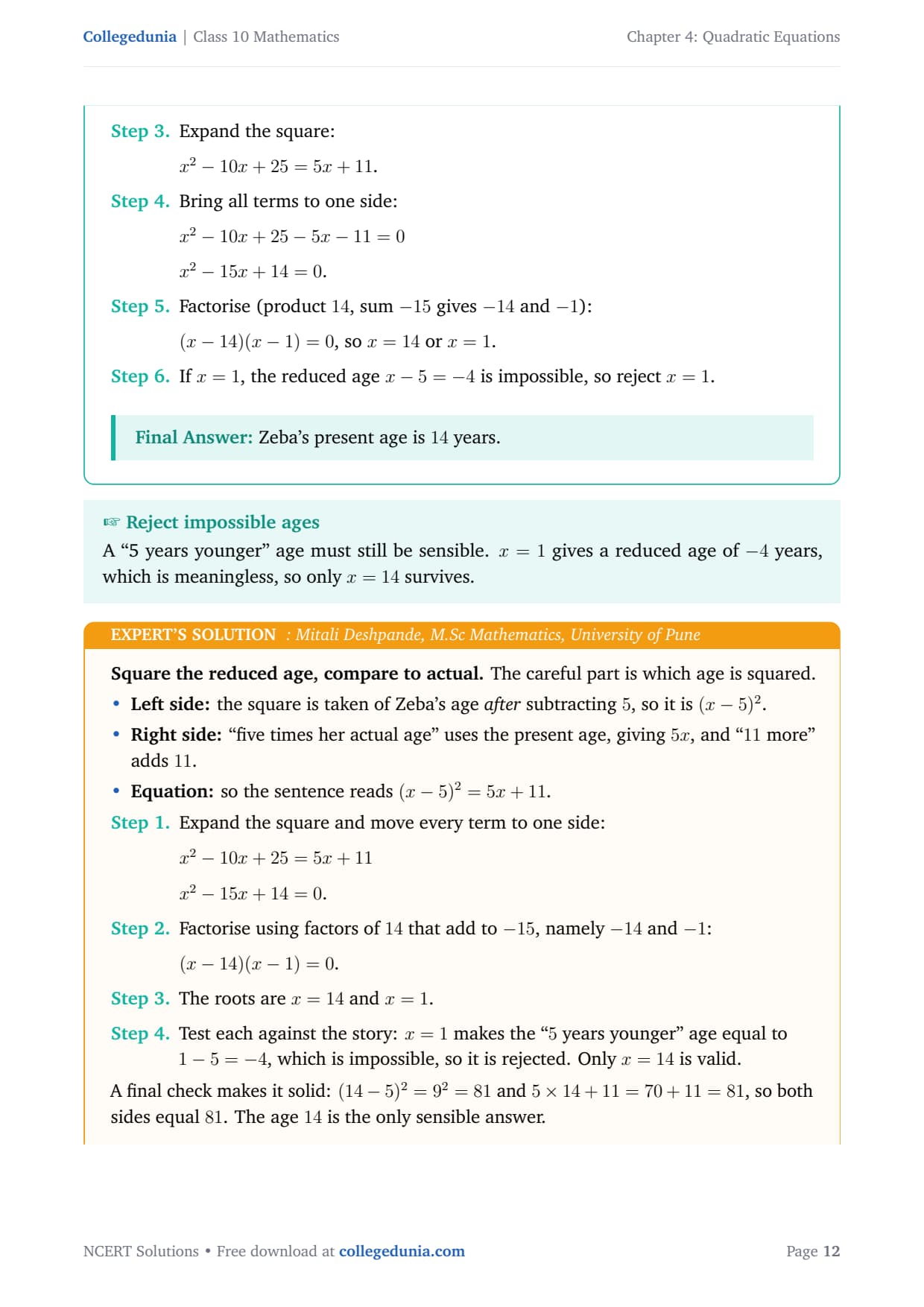
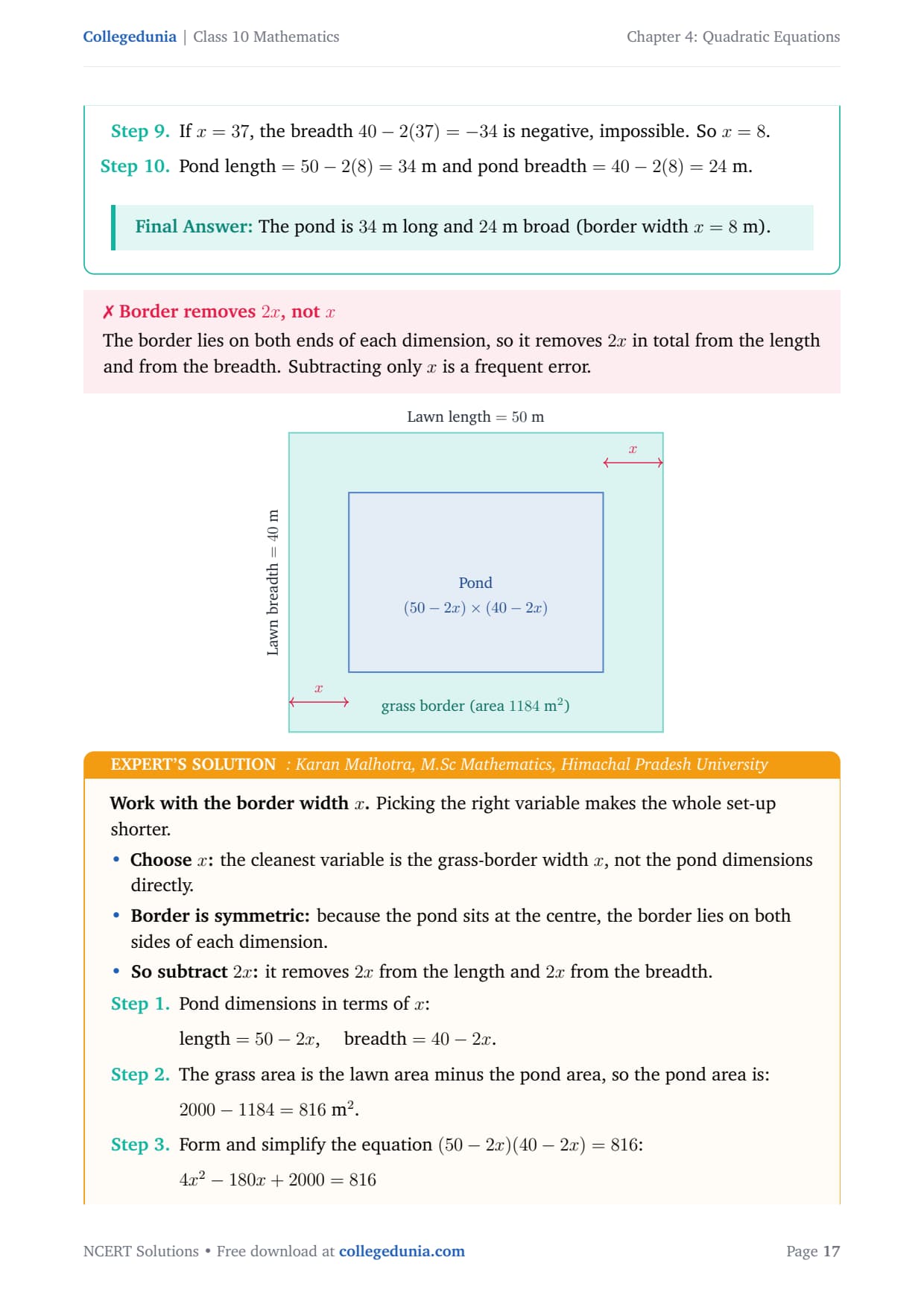
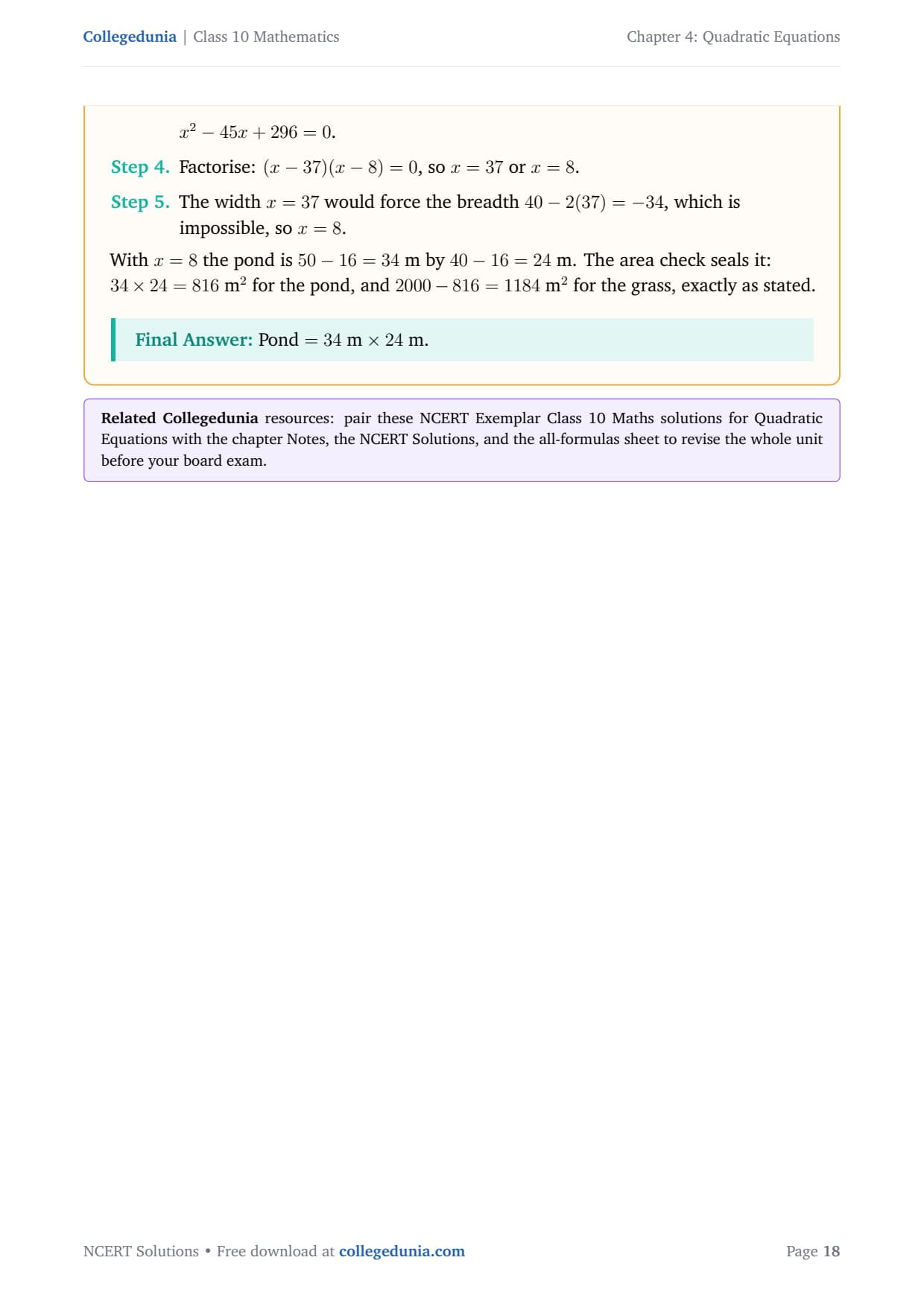
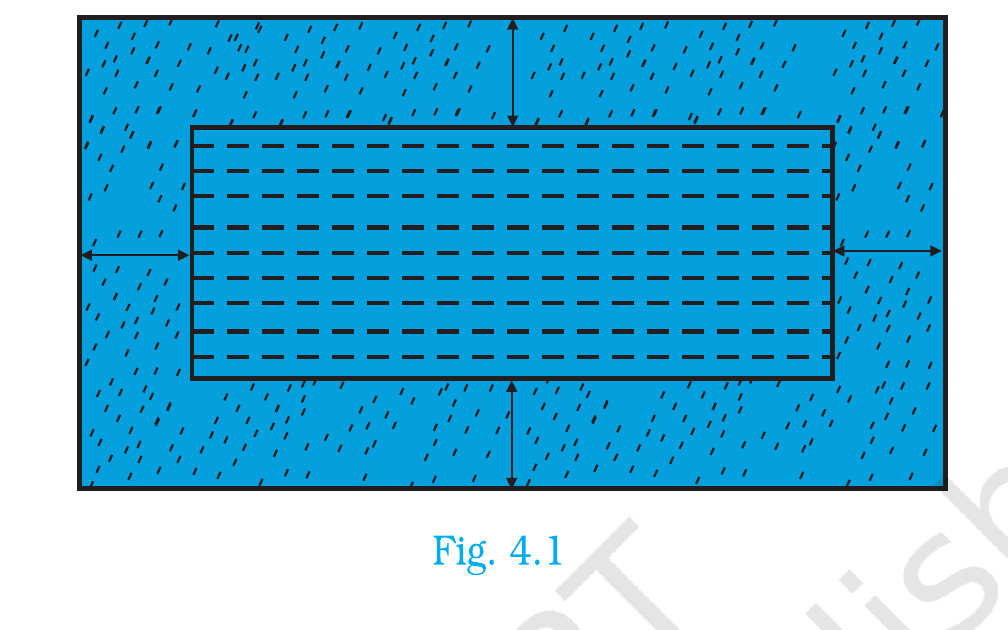



Comments