This page gives complete, step-by-step solutions to Exercise 3.1 of NCERT Exemplar Class 10 Maths Chapter 3 Pair of Linear Equations in Two Variables. All 13 MCQs test the ratio test for consistency, the graph of a line pair, and turning word problems into two equations. Everything follows the 2026-27 CBSE syllabus.
Scope: 13 MCQs on the ratio test, consistency conditions, and word problems.
Key skill: Comparing the ratios a1/a2, b1/b2, c1/c2 to label lines as parallel, intersecting, or coincident.
Board relevance: This chapter carries 3 to 4 marks in most CBSE papers, and Exemplar MCQs are harder than the textbook.
Every solution here is verified by subject experts and follows the 2026-27 CBSE NCERT Exemplar book exactly.
Solved by Collegedunia - All 13 questions of Exercise 3.1 with detailed step-by-step solutions and expert insights.
Exercise 3.1 is the Multiple Choice Questions section of the NCERT Exemplar Chapter 3 for Class 10 Maths. It has 13 questions, each with four options. They fall into three broad groups.
Ratio test for consistency (Questions 1-9): Given a pair of equations, use the ratios a1/a2, b1/b2, c1/c2 to decide if lines are parallel, intersecting, or coincident.
Special-form lines (Questions 4, 5): Recognise lines of the form y = k and x = k as horizontal/vertical, and find their intersection directly.
Word problems as pairs (Questions 12, 13): Translate coin and age problems into two equations and solve.
CBSE papers usually include one or two MCQs from this chapter. Exercise 3.1 is harder than the textbook, so it builds the clarity you need to avoid losing marks on classification questions.
Ratio Test Formulas
Before solving the 13 MCQs, get clear on the three-ratio test. It is the single most important idea here. All 13 questions revolve around it.
Condition
Ratio Comparison
Geometric Meaning
Number of Solutions
Unique solution
a1/a2 ≠ b1/b2
Intersecting lines
Exactly 1
No solution
a1/a2 = b1/b2 ≠ c1/c2
Parallel lines
0
Infinitely many solutions
a1/a2 = b1/b2 = c1/c2
Coincident lines
Infinite
The coincident condition (all three ratios equal) is the most-tested trap here. Questions 6, 8, and 9 all use it. Check only one or two ratios instead of all three, and you lose the mark.
Exercise 3.1 has 13 MCQs · All with detailed Check + Expert solutions below
All 13 Exercise 3.1 Questions with Step-by-Step Solutions
I. Multiple Choice Questions (Exercise 3.1)
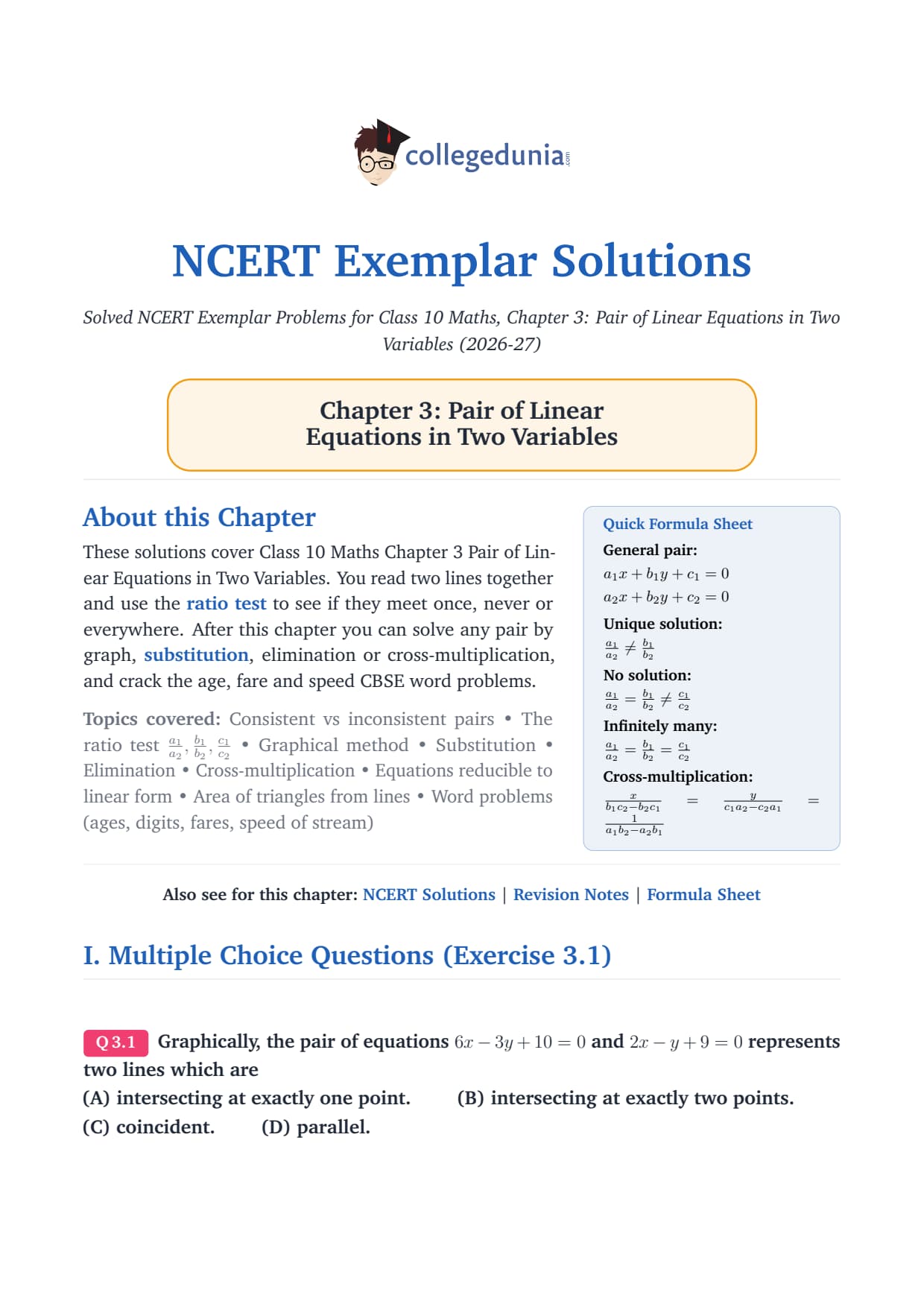
Q 3.1
Graphically, the pair of equations
6x-3y+10=0 and 2x-y+9=0 represents two lines which are
(A) intersecting at exactly one point. (B) intersecting at exactly two points.
(C) coincident. (D) parallel.
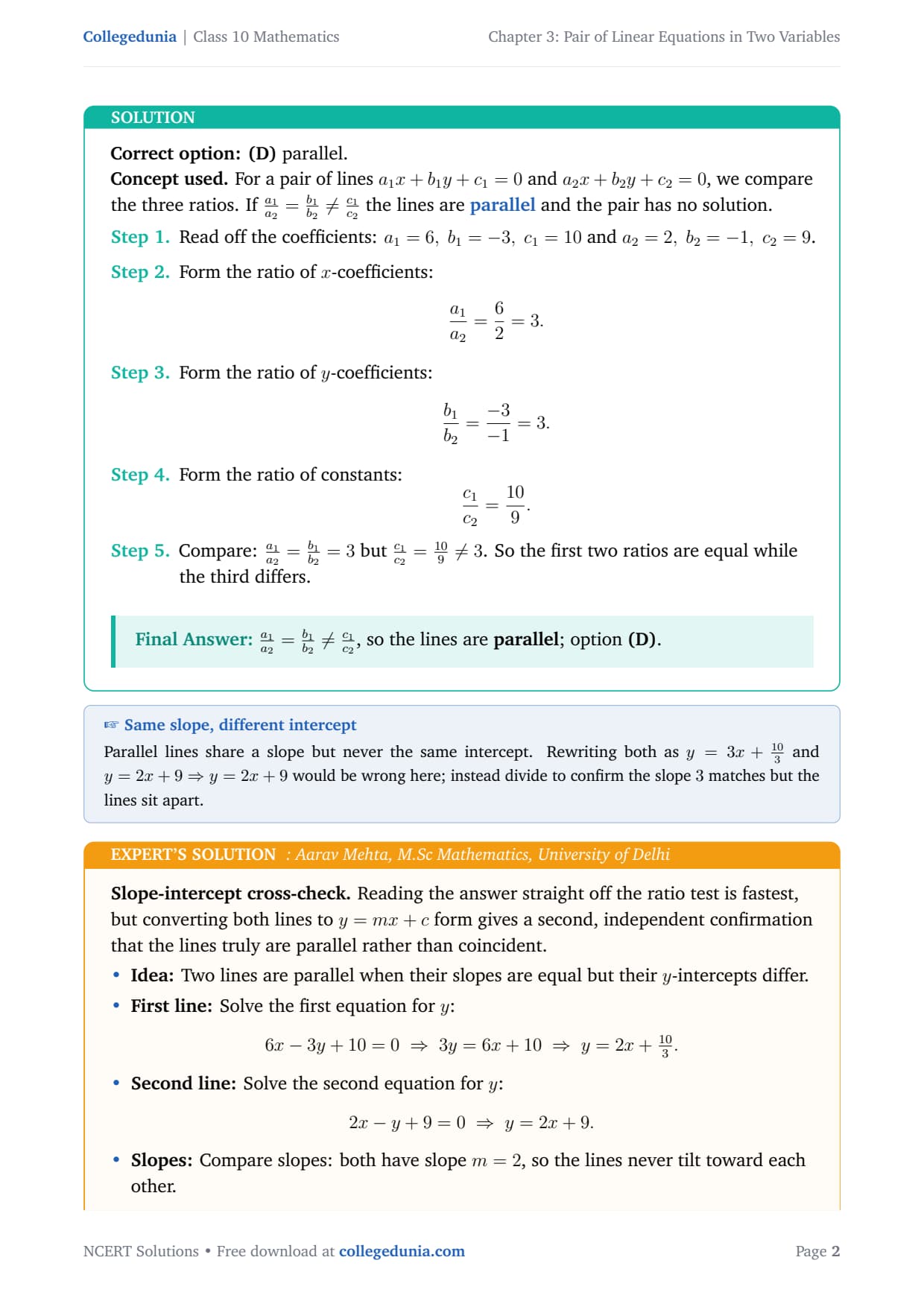
Correct option: (D) parallel.
Concept used. For a pair of lines a1x+b1y+c1=0 and
a2x+b2y+c2=0, we compare the three ratios. If
a1a2=b1b2≠c1c2 the lines are
parallel and the pair has no solution.
Read off the coefficients:
a1=6, b1=-3, c1=10 and a2=2, b2=-1, c2=9.
Form the ratio of x-coefficients:
a1a2=62=3.
Form the ratio of y-coefficients:
b1b2=-3-1=3.
Form the ratio of constants:
c1c2=109.
Compare: a1a2=b1b2=3 but
c1c2=109≠ 3. So the first two ratios are
equal while the third differs.
a1a2=b1b2≠c1c2, so the
lines are parallel; option (D).
AM
Aarav Mehta
M.Sc Mathematics, University of Delhi
Verified Expert
Slope-intercept cross-check. Reading the answer straight off the
ratio test is fastest, but converting both lines to y=mx+c form gives a
second, independent confirmation that the lines truly are parallel rather
than coincident.
Idea: Two lines are parallel when their slopes are equal but their y-intercepts differ.
First line: Solve the first equation for y: 6x-3y+10=0 ⇒ 3y=6x+10 ⇒ y=2x+103.
Second line: Solve the second equation for y: 2x-y+9=0 ⇒ y=2x+9.
Slopes: Compare slopes: both have slope m=2, so the lines never tilt toward each other.
Intercepts: Compare intercepts: 103≈ 3.33 while the other is 9. Equal slope but unequal intercept is the textbook signature of parallel lines, confirming there is no common point.
Equal slope 2, different intercepts ⇒ parallel;
option (D).
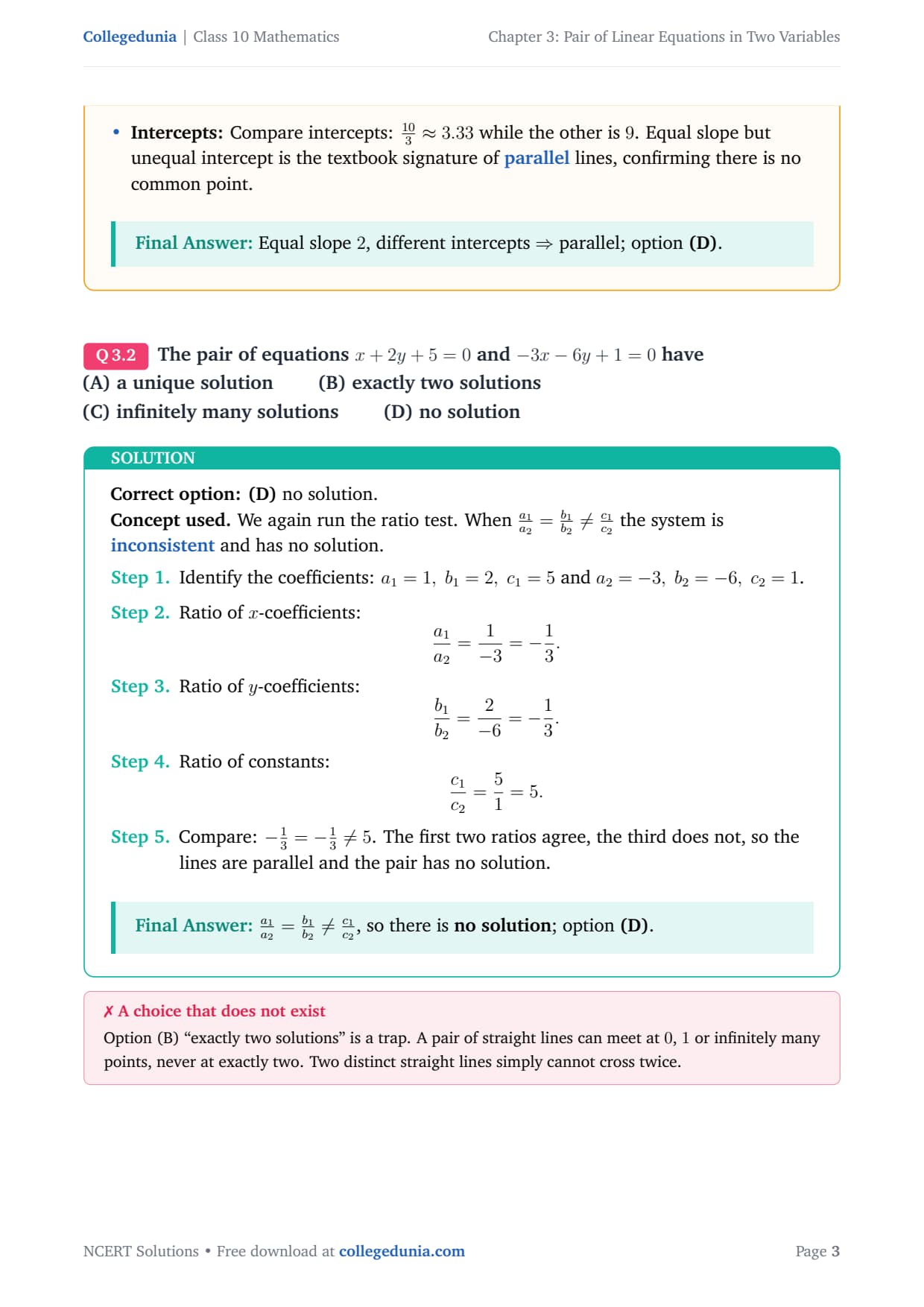
Q 3.2
The pair of equations x+2y+5=0 and -3x-6y+1=0 have
(A) a unique solution (B) exactly two solutions
(C) infinitely many solutions (D) no solution
Correct option: (D) no solution.
Concept used. We again run the ratio test. When
a1a2=b1b2≠c1c2 the system is
inconsistent and has no solution.
Identify the coefficients:
a1=1, b1=2, c1=5 and a2=-3, b2=-6, c2=1.
Ratio of x-coefficients:
a1a2=1-3=-13.
Ratio of y-coefficients:
b1b2=2-6=-13.
Ratio of constants:
c1c2=51=5.
Compare: -13=-13≠ 5. The first two ratios
agree, the third does not, so the lines are parallel and the pair
has no solution.
a1a2=b1b2≠c1c2, so there
is no solution; option (D).
SK
Sneha Kulkarni
M.Sc Mathematics, Savitribai Phule Pune University
Verified Expert
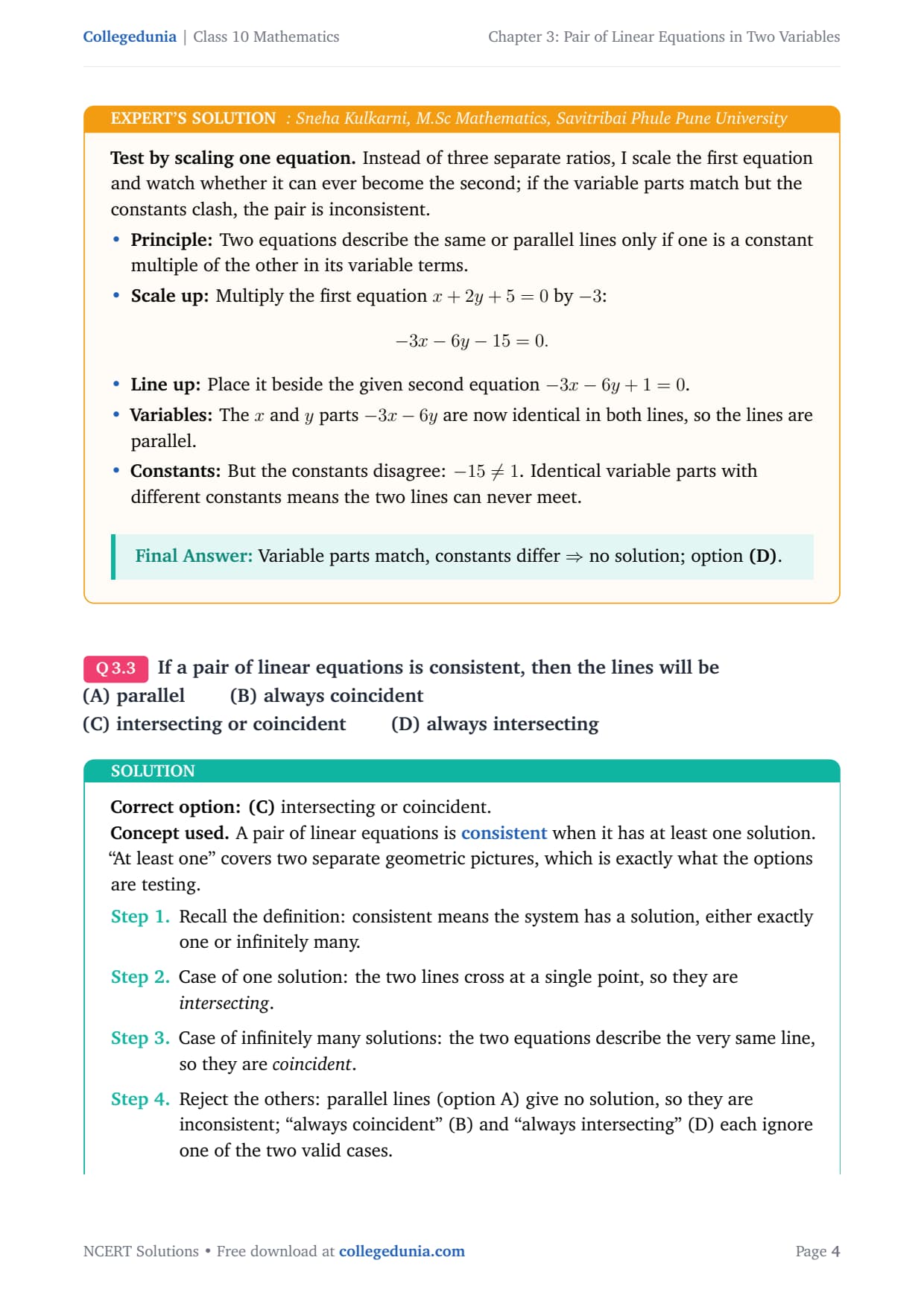
Test by scaling one equation. Instead of three separate ratios, I
scale the first equation and watch whether it can ever become the second;
if the variable parts match but the constants clash, the pair is
inconsistent.
Principle: Two equations describe the same or parallel lines only if one is a constant multiple of the other in its variable terms.
Scale up: Multiply the first equation x+2y+5=0 by -3: -3x-6y-15=0.
Line up: Place it beside the given second equation -3x-6y+1=0.
Variables: The x and y parts -3x-6y are now identical in both lines, so the lines are parallel.
Constants: But the constants disagree: -15≠ 1. Identical variable parts with different constants means the two lines can never meet.
Variable parts match, constants differ ⇒ no
solution; option (D).
Q 3.3
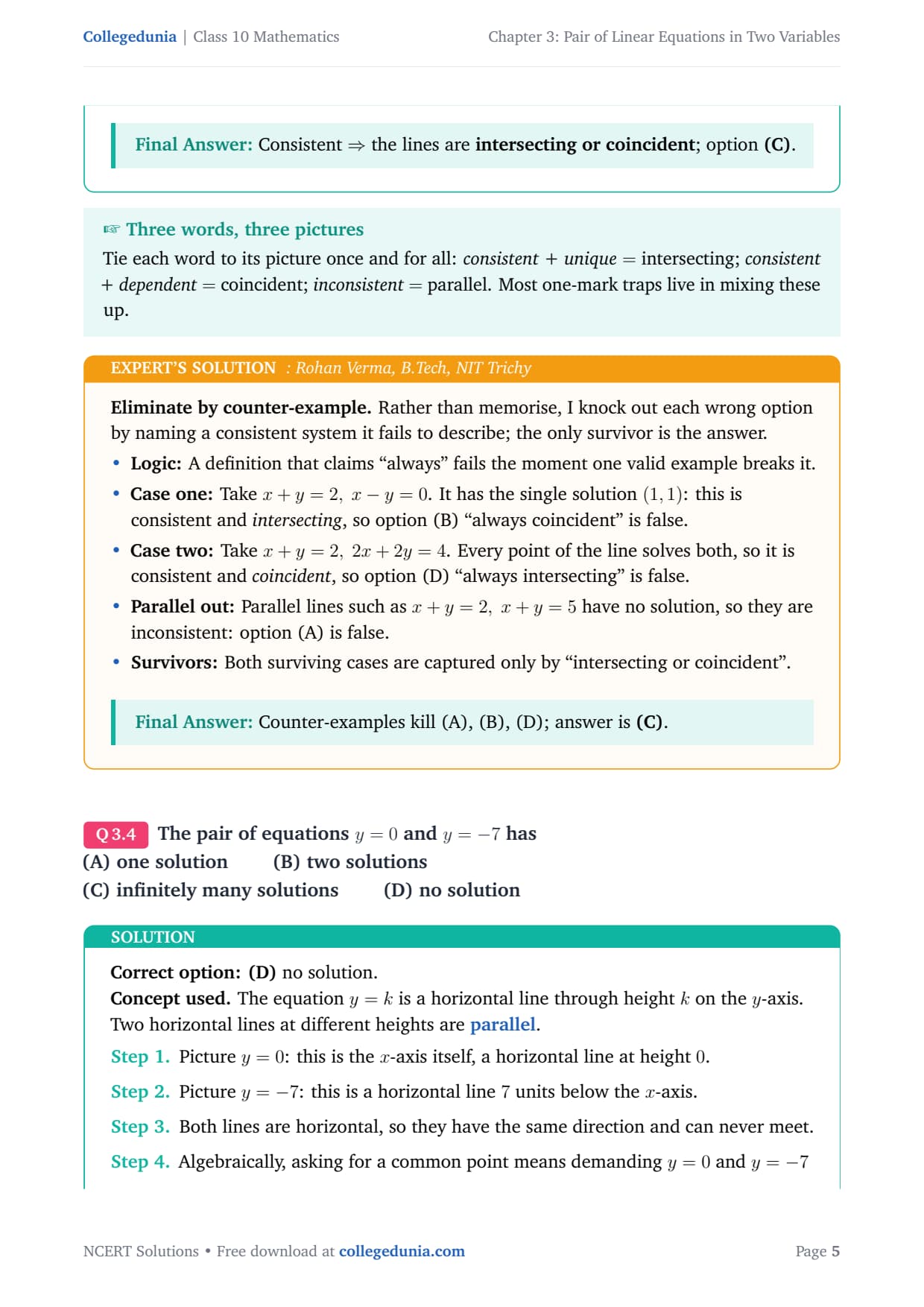
If a pair of linear equations is consistent, then the lines will be
(A) parallel (B) always coincident
(C) intersecting or coincident (D) always intersecting
Correct option: (C) intersecting or coincident.
Concept used. A pair of linear equations is consistent
when it has at least one solution. ``At least one'' covers two separate
geometric pictures, which is exactly what the options are testing.
Recall the definition: consistent means the system has a solution,
either exactly one or infinitely many.
Case of one solution: the two lines cross at a single point, so
they are intersecting.
Case of infinitely many solutions: the two equations describe the
very same line, so they are coincident.
Reject the others: parallel lines (option A) give no solution, so
they are inconsistent; ``always coincident'' (B) and ``always
intersecting'' (D) each ignore one of the two valid cases.
Consistent ⇒ the lines are intersecting or
coincident; option (C).
RV
Rohan Verma
B.Tech, NIT Trichy
Verified Expert
Eliminate by counter-example. Rather than memorise, I knock out
each wrong option by naming a consistent system it fails to describe; the
only survivor is the answer.
Logic: A definition that claims ``always'' fails the moment one valid example breaks it.
Case one: Take x+y=2, x-y=0. It has the single solution (1,1): this is consistent and intersecting, so option (B) ``always coincident'' is false.
Case two: Take x+y=2, 2x+2y=4. Every point of the line solves both, so it is consistent and coincident, so option (D) ``always intersecting'' is false.
Parallel out: Parallel lines such as x+y=2, x+y=5 have no solution, so they are inconsistent: option (A) is false.
Survivors: Both surviving cases are captured only by ``intersecting or coincident''.
Counter-examples kill (A), (B), (D); answer is (C).
Q 3.4
The pair of equations y=0 and y=-7 has
(A) one solution (B) two solutions
(C) infinitely many solutions (D) no solution
Correct option: (D) no solution.
Concept used. The equation y=k is a horizontal line through
height k on the y-axis. Two horizontal lines at different heights are
parallel.
Picture y=0: this is the x-axis itself, a horizontal line at
height 0.
Picture y=-7: this is a horizontal line 7 units below the
x-axis.
Both lines are horizontal, so they have the same direction and can
never meet.
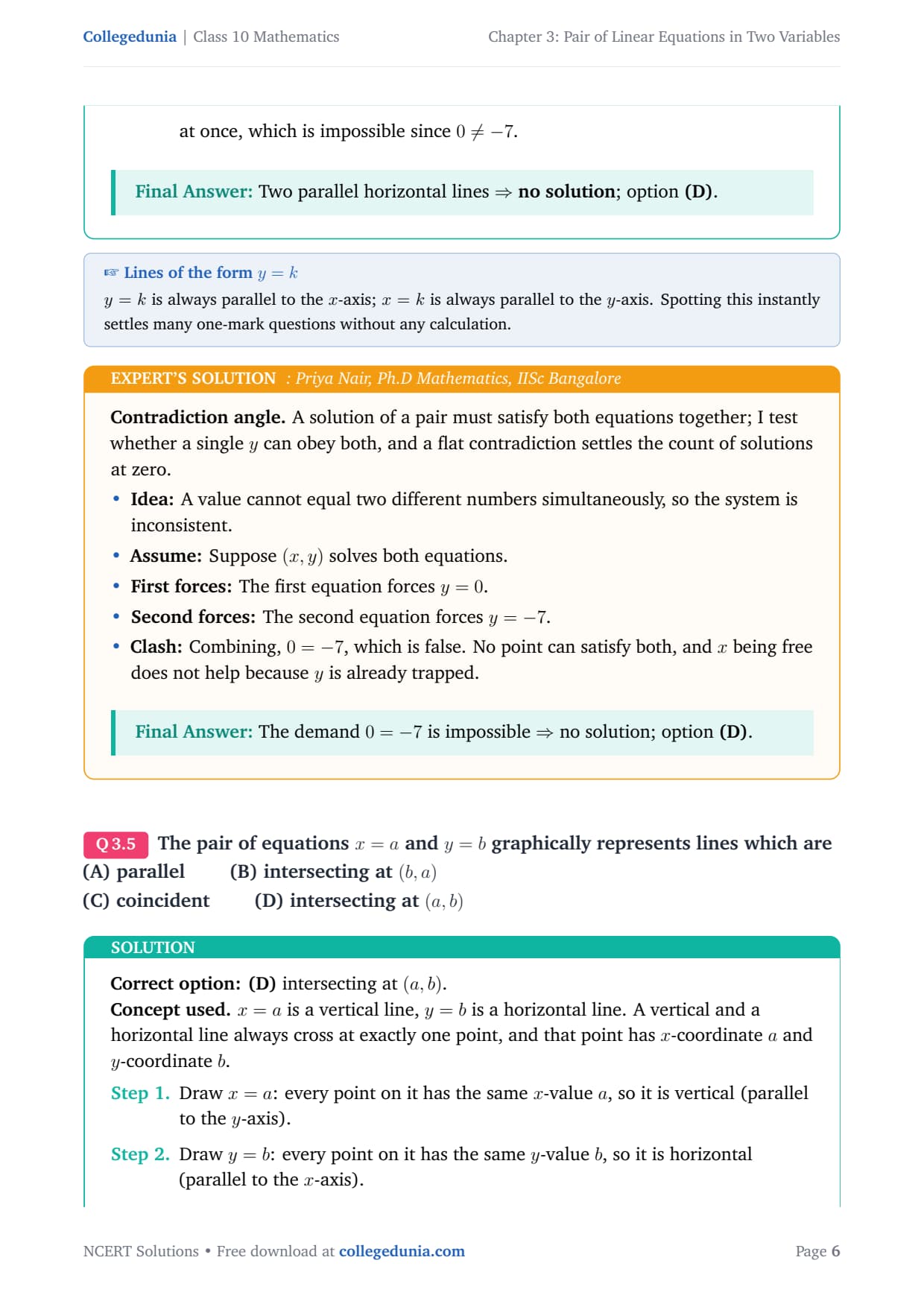
Algebraically, asking for a common point means demanding y=0 and
y=-7 at once, which is impossible since 0≠ -7.
Two parallel horizontal lines ⇒no
solution; option (D).
PN
Priya Nair
Ph.D Mathematics, IISc Bangalore
Verified Expert
Contradiction angle. A solution of a pair must satisfy both
equations together; I test whether a single y can obey both, and a flat
contradiction settles the count of solutions at zero.
Idea: A value cannot equal two different numbers simultaneously, so the system is inconsistent.
Assume: Suppose (x,y) solves both equations.
First forces: The first equation forces y=0.
Second forces: The second equation forces y=-7.
Clash: Combining, 0=-7, which is false. No point can satisfy both, and x being free does not help because y is already trapped.
The demand 0=-7 is impossible ⇒ no solution; option
(D).
Q 3.5
The pair of equations x=a and y=b graphically represents lines which are
(A) parallel (B) intersecting at (b,a)
(C) coincident (D) intersecting at (a,b)
Correct option: (D) intersecting at (a,b).
Concept used.x=a is a vertical line, y=b is a horizontal
line. A vertical and a horizontal line always cross at exactly one point,
and that point has x-coordinate a and y-coordinate b.
Draw x=a: every point on it has the same x-value a, so it is
vertical (parallel to the y-axis).
Draw y=b: every point on it has the same y-value b, so it is
horizontal (parallel to the x-axis).
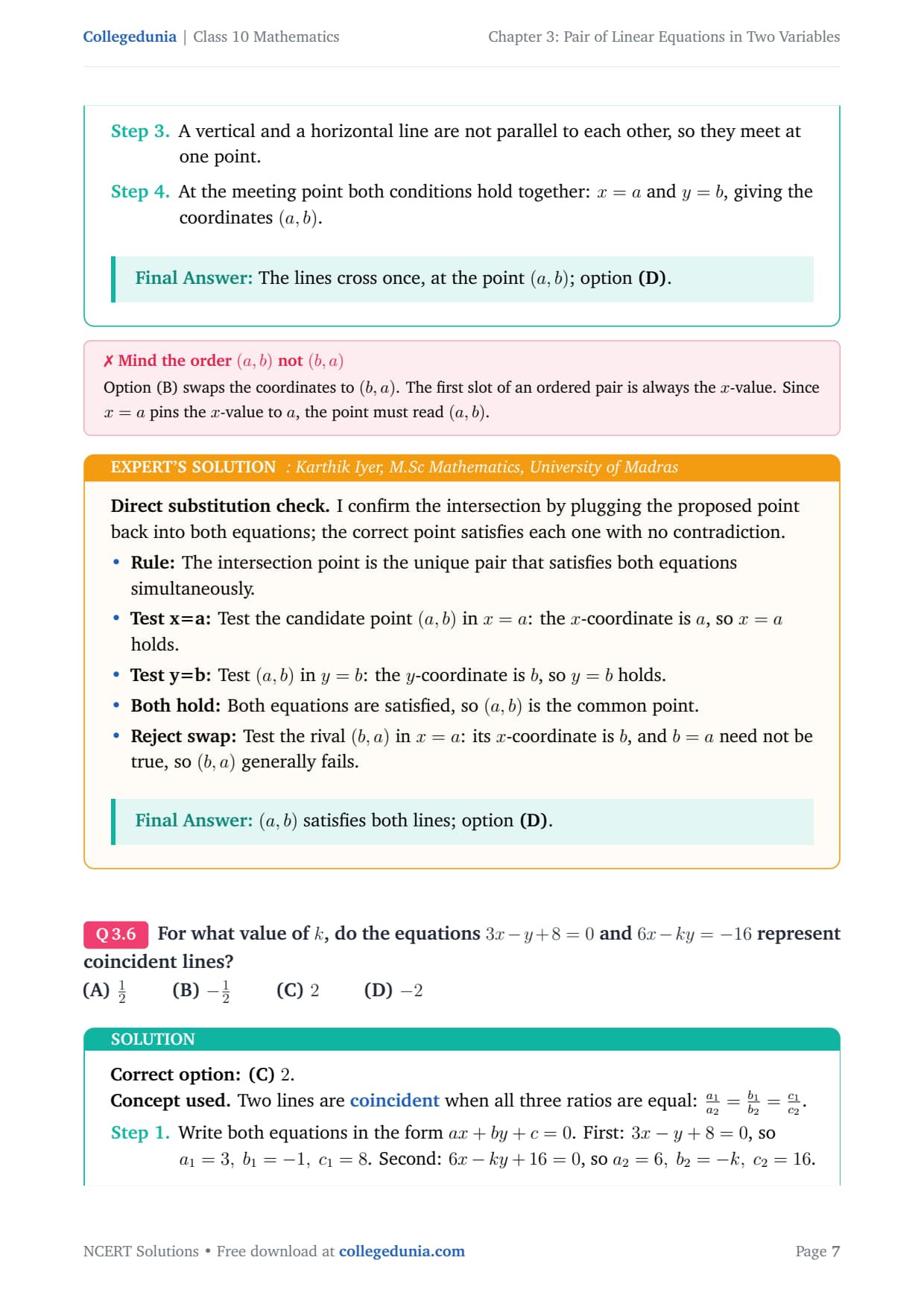
A vertical and a horizontal line are not parallel to each other,
so they meet at one point.
At the meeting point both conditions hold together: x=a and
y=b, giving the coordinates (a,b).
The lines cross once, at the point (a,b); option
(D).
KI
Karthik Iyer
M.Sc Mathematics, University of Madras
Verified Expert
Direct substitution check. I confirm the intersection by plugging
the proposed point back into both equations; the correct point satisfies
each one with no contradiction.
Rule: The intersection point is the unique pair that satisfies both equations simultaneously.
Test x=a: Test the candidate point (a,b) in x=a: the x-coordinate is a, so x=a holds.
Test y=b: Test (a,b) in y=b: the y-coordinate is b, so y=b holds.
Both hold: Both equations are satisfied, so (a,b) is the common point.
Reject swap: Test the rival (b,a) in x=a: its x-coordinate is b, and b=a need not be true, so (b,a) generally fails.
(a,b) satisfies both lines; option (D).
Q 3.6
For what value of k, do the equations 3x-y+8=0 and 6x-ky=-16 represent coincident lines?
(A) 12 (B) -12 (C) 2 (D) -2
Correct option: (C)2.
Concept used. Two lines are coincident when all three
ratios are equal:
a1a2=b1b2=c1c2.
Write both equations in the form ax+by+c=0.
First: 3x-y+8=0, so a1=3, b1=-1, c1=8.
Second: 6x-ky+16=0, so a2=6, b2=-k, c2=16.
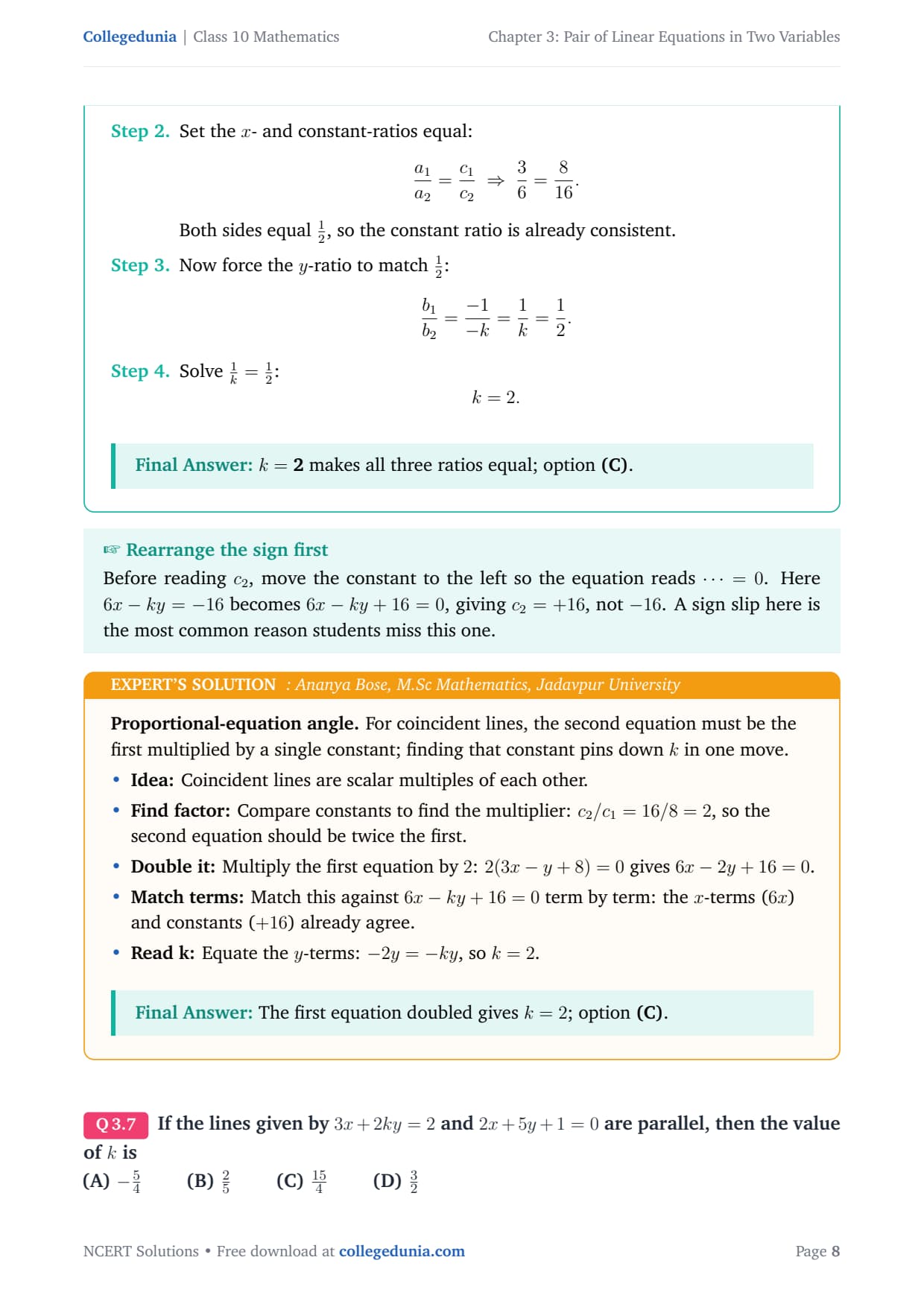
Set the x- and constant-ratios equal:
a1a2=c1c2 ⇒ 36=816.
Both sides equal 12, so the constant ratio is already
consistent.
Now force the y-ratio to match 12:
b1b2=-1-k=1k=12.
Solve 1k=12:
k=2.
k=2 makes all three ratios equal; option
(C).
AB
Ananya Bose
M.Sc Mathematics, Jadavpur University
Verified Expert
Proportional-equation angle. For coincident lines, the second
equation must be the first multiplied by a single constant; finding that
constant pins down k in one move.
Idea: Coincident lines are scalar multiples of each other.
Find factor: Compare constants to find the multiplier: c2/c1=16/8=2, so the second equation should be twice the first.
Double it: Multiply the first equation by 2: 2(3x-y+8)=0 gives 6x-2y+16=0.
Match terms: Match this against 6x-ky+16=0 term by term: the x-terms (6x) and constants (+16) already agree.
Read k: Equate the y-terms: -2y=-ky, so k=2.
The first equation doubled gives k=2; option (C).
Q 3.7
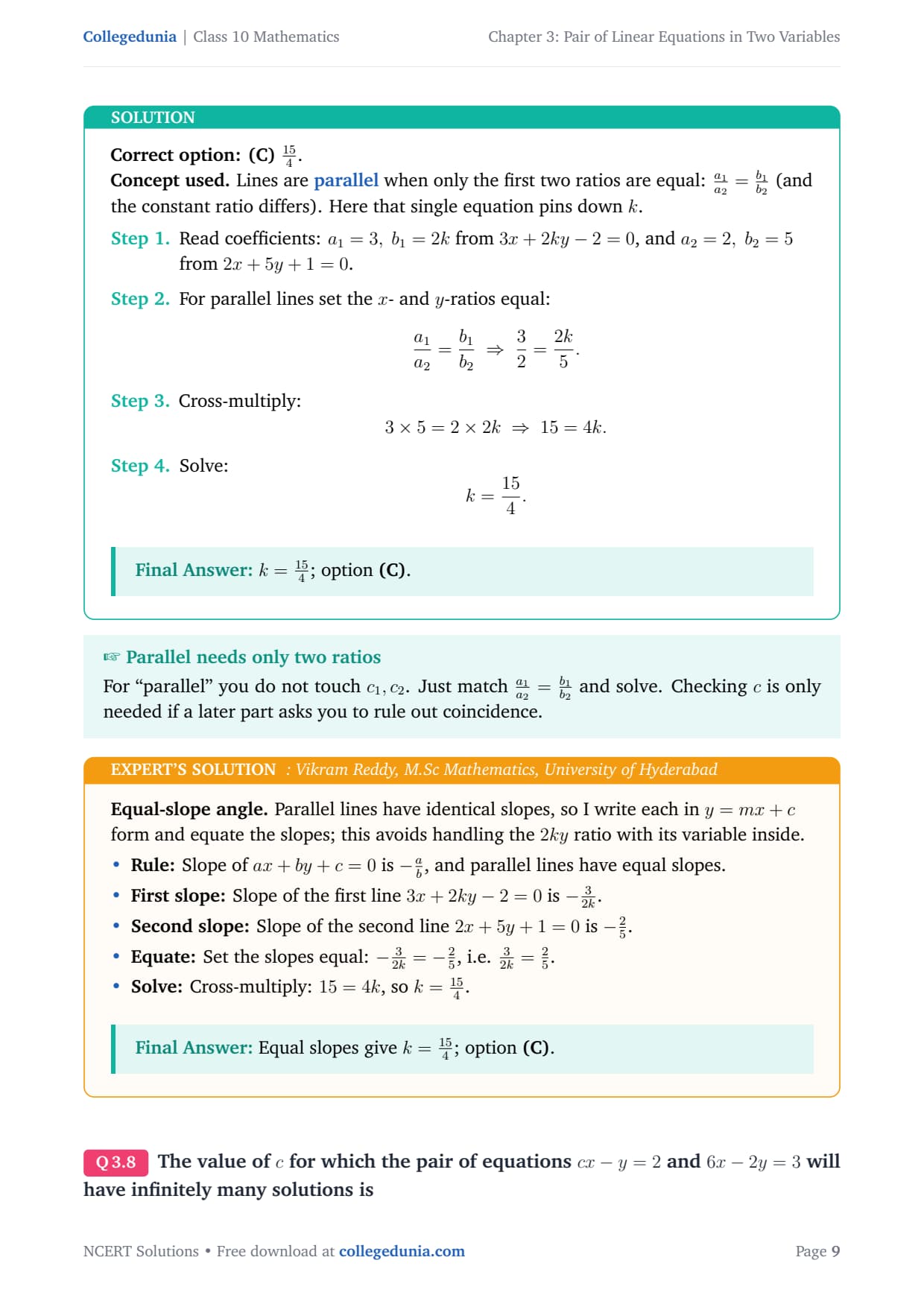
If the lines given by 3x+2ky=2 and 2x+5y+1=0 are parallel, then the value of k is
(A) -54 (B) 25 (C) 154 (D) 32
Correct option: (C)154.
Concept used. Lines are parallel when only the first two
ratios are equal: a1a2=b1b2 (and the constant
ratio differs). Here that single equation pins down k.
Read coefficients: a1=3, b1=2k from 3x+2ky-2=0, and
a2=2, b2=5 from 2x+5y+1=0.
For parallel lines set the x- and y-ratios equal:
a1a2=b1b2 ⇒ 32=2k5.
Cross-multiply:
3× 5 = 2× 2k ⇒ 15=4k.
Solve:
k=154.
k=154; option (C).
VR
Vikram Reddy
M.Sc Mathematics, University of Hyderabad
Verified Expert
Equal-slope angle. Parallel lines have identical slopes, so I
write each in y=mx+c form and equate the slopes; this avoids handling the
2ky ratio with its variable inside.
Rule: Slope of ax+by+c=0 is -ab, and parallel lines have equal slopes.
First slope: Slope of the first line 3x+2ky-2=0 is -32k.
Second slope: Slope of the second line 2x+5y+1=0 is -25.
Equate: Set the slopes equal: -32k=-25, i.e. 32k=25.
Solve: Cross-multiply: 15=4k, so k=154.
Equal slopes give k=154; option (C).
Q 3.8
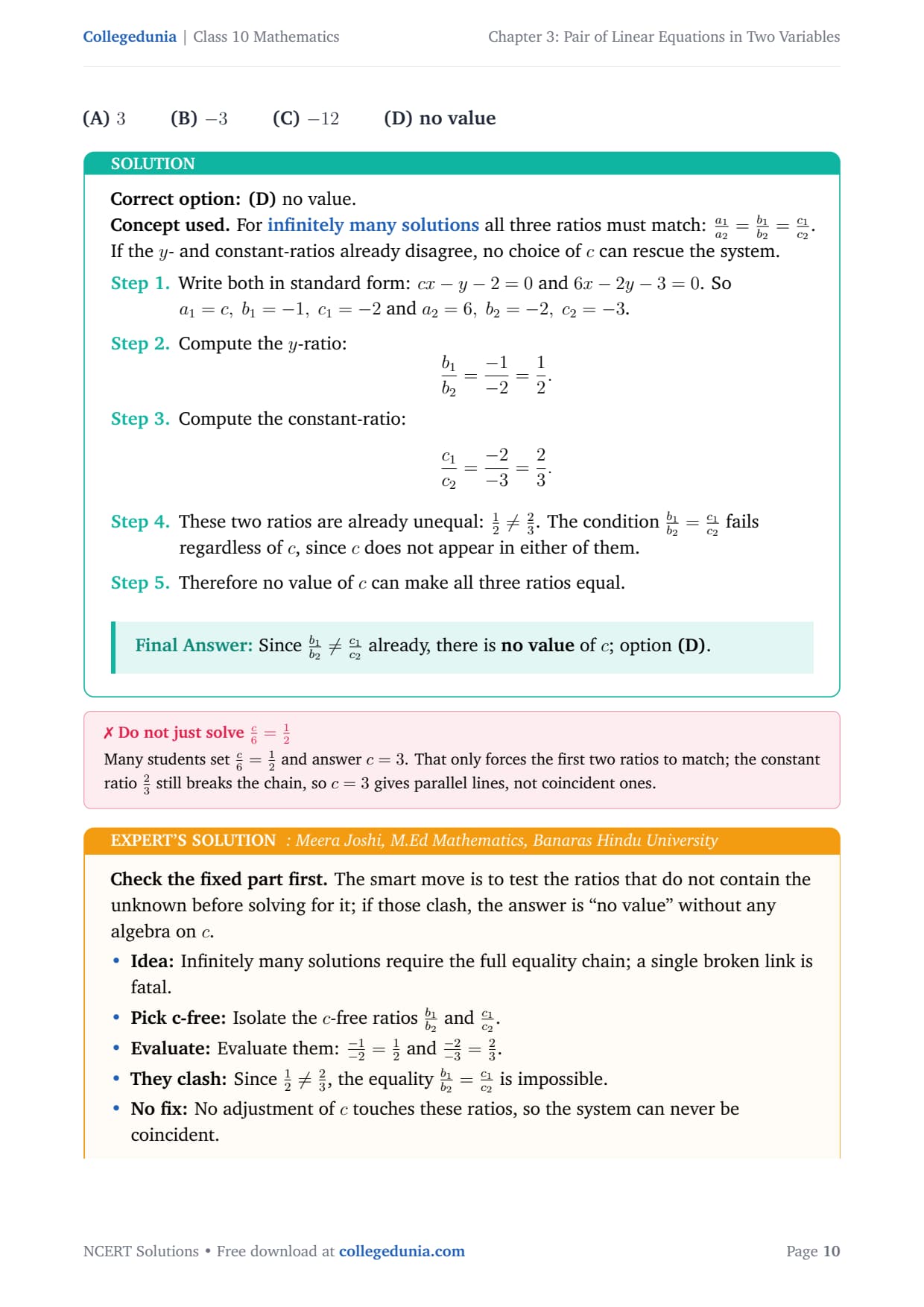
The value of c for which the pair of equations cx-y=2 and 6x-2y=3 will have infinitely many solutions is
(A) 3 (B) -3 (C) -12 (D) no value
Correct option: (D) no value.
Concept used. For infinitely many solutions all three
ratios must match: a1a2=b1b2=c1c2. If
the y- and constant-ratios already disagree, no choice of c can rescue
the system.
Write both in standard form: cx-y-2=0 and 6x-2y-3=0. So
a1=c, b1=-1, c1=-2 and a2=6, b2=-2, c2=-3.
Compute the y-ratio:
b1b2=-1-2=12.
Compute the constant-ratio:
c1c2=-2-3=23.
These two ratios are already unequal: 12≠23.
The condition b1b2=c1c2 fails regardless
of c, since c does not appear in either of them.
Therefore no value of c can make all three ratios equal.
Since b1b2≠c1c2 already, there is
no value of c; option (D).
MJ
Meera Joshi
M.Ed Mathematics, Banaras Hindu University
Verified Expert
Check the fixed part first. The smart move is to test the ratios
that do not contain the unknown before solving for it; if those clash, the
answer is ``no value'' without any algebra on c.
Idea: Infinitely many solutions require the full equality chain; a single broken link is fatal.
Pick c-free: Isolate the c-free ratios b1b2 and c1c2.
Evaluate: Evaluate them: -1-2=12 and -2-3=23.
They clash: Since 12≠23, the equality b1b2=c1c2 is impossible.
No fix: No adjustment of c touches these ratios, so the system can never be coincident.
No value of c works; option (D).
Q 3.9
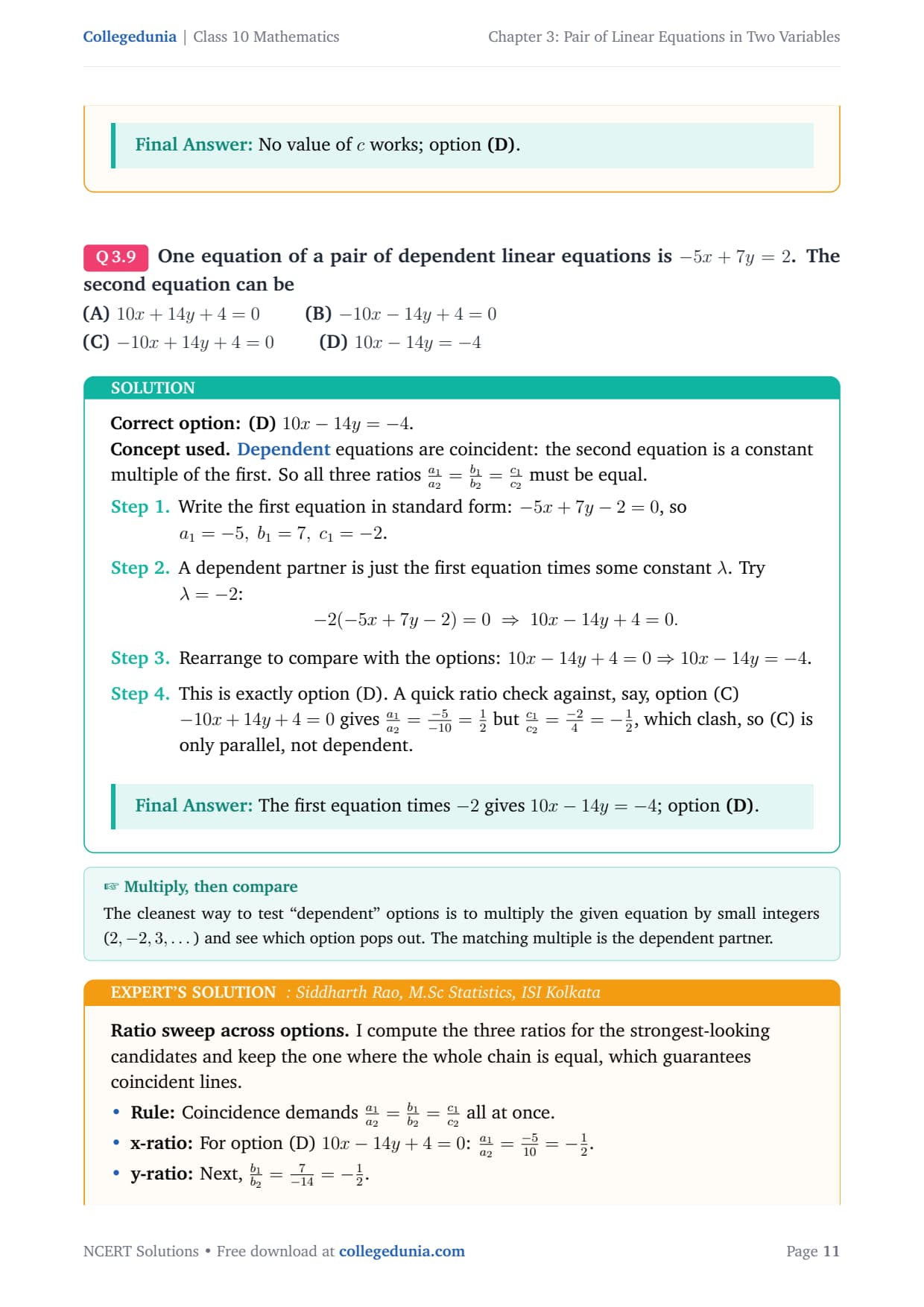
One equation of a pair of dependent linear equations is -5x+7y=2. The second equation can be
(A) 10x+14y+4=0 (B) -10x-14y+4=0
(C) -10x+14y+4=0 (D) 10x-14y=-4
Correct option: (D)10x-14y=-4.
Concept used.Dependent equations are coincident: the
second equation is a constant multiple of the first. So all three ratios
a1a2=b1b2=c1c2 must be equal.
Write the first equation in standard form: -5x+7y-2=0, so
a1=-5, b1=7, c1=-2.
A dependent partner is just the first equation times some constant
λ. Try λ=-2:
-2(-5x+7y-2)=0 ⇒ 10x-14y+4=0.
Rearrange to compare with the options:
10x-14y+4=0 ⇒ 10x-14y=-4.
This is exactly option (D). A quick ratio check against, say,
option (C) -10x+14y+4=0 gives a1a2=-5-10
=12 but c1c2=-24=-12, which
clash, so (C) is only parallel, not dependent.
The first equation times -2 gives 10x-14y=-4; option
(D).
SR
Siddharth Rao
M.Sc Statistics, ISI Kolkata
Verified Expert
Ratio sweep across options. I compute the three ratios for the
strongest-looking candidates and keep the one where the whole chain is
equal, which guarantees coincident lines.
Rule: Coincidence demands a1a2=b1b2=c1c2 all at once.
x-ratio: For option (D) 10x-14y+4=0: a1a2=-510 =-12.
y-ratio: Next, b1b2=7-14=-12.
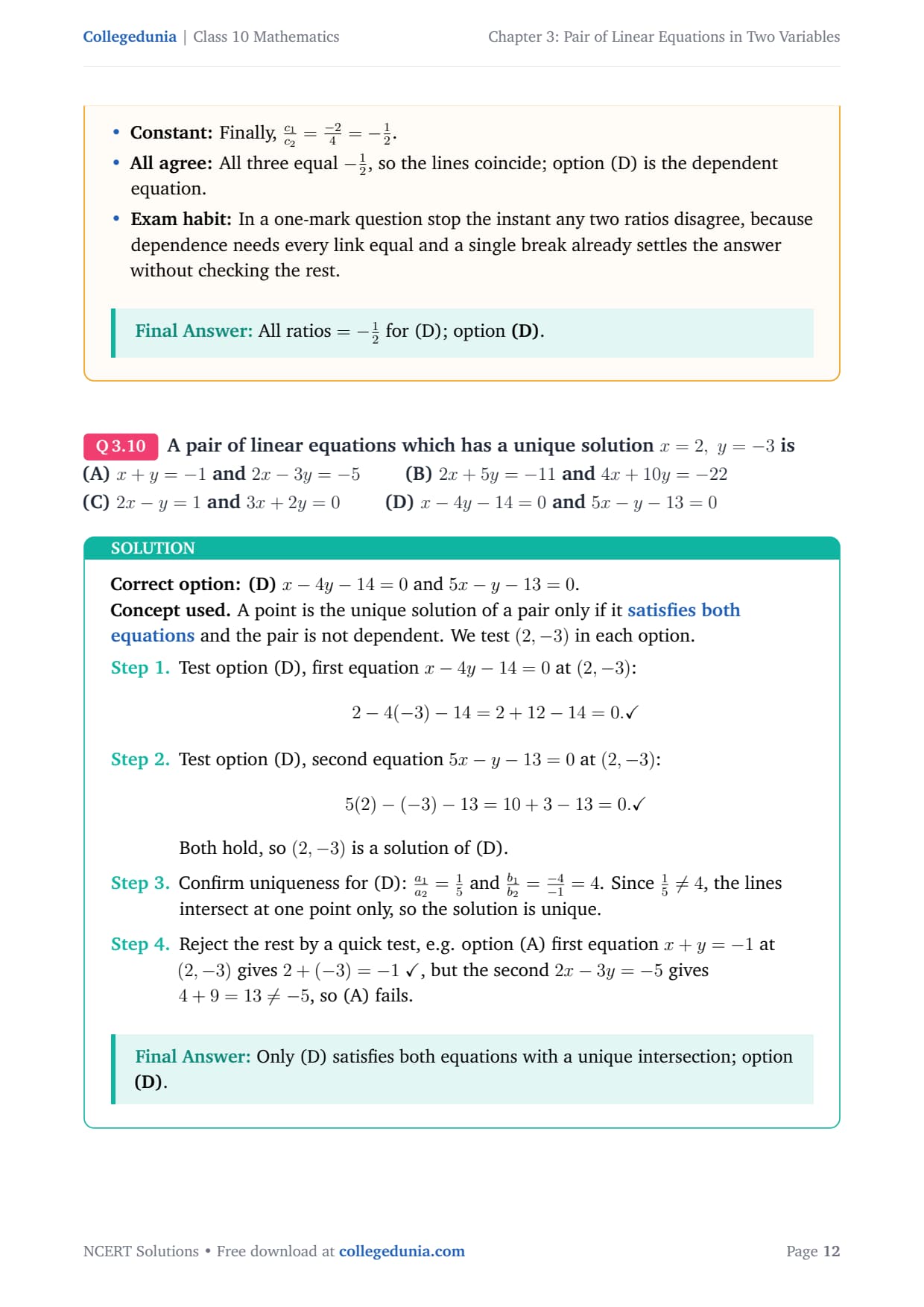
Constant: Finally, c1c2=-24=-12.
All agree: All three equal -12, so the lines coincide; option (D) is the dependent equation.
Exam habit: In a one-mark question stop the instant any two ratios disagree, because dependence needs every link equal and a single break already settles the answer without checking the rest.
All ratios =-12 for (D); option (D).
Q 3.10
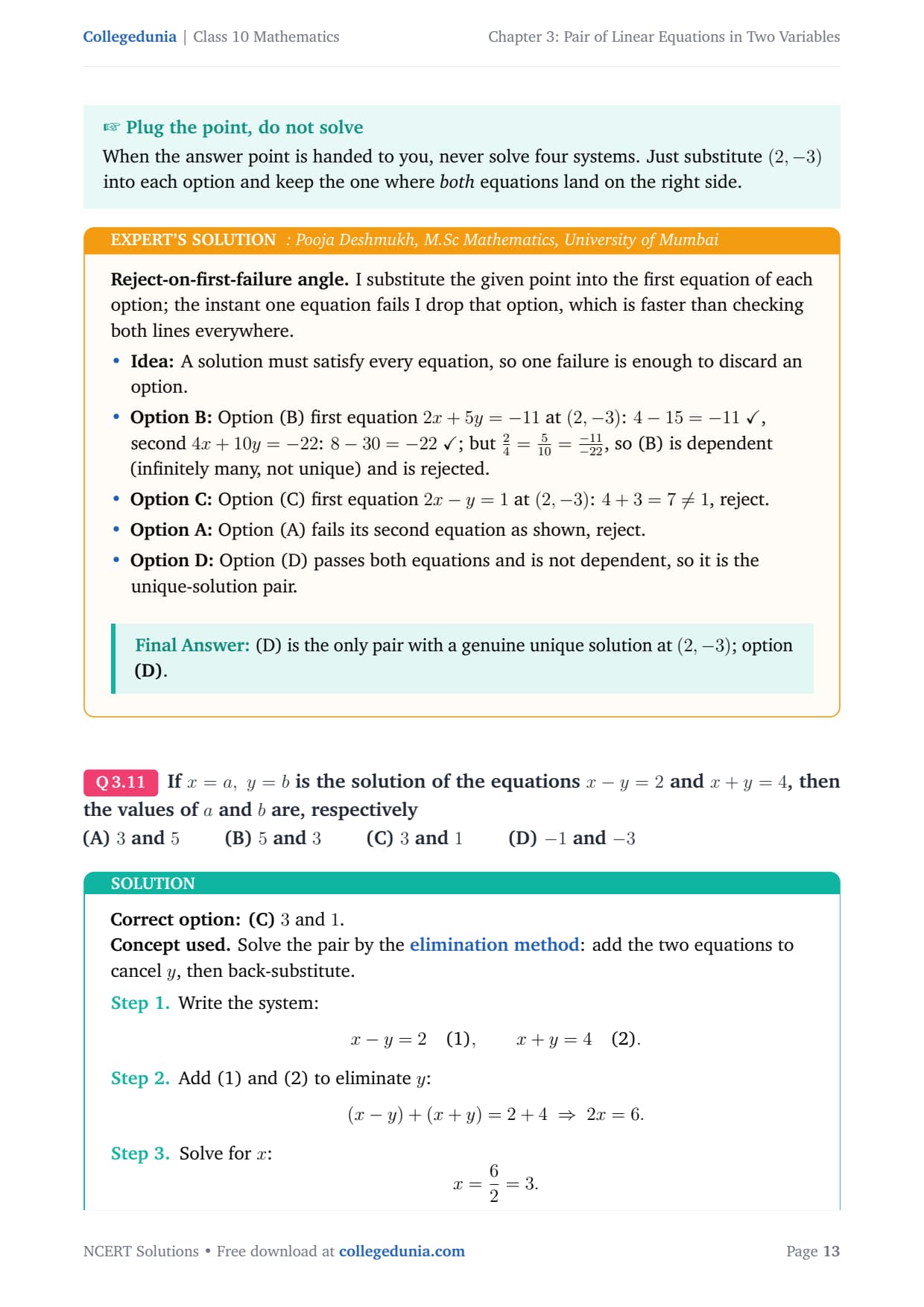
A pair of linear equations which has a unique solution x=2, y=-3 is
(A) x+y=-1 and 2x-3y=-5 (B) 2x+5y=-11 and 4x+10y=-22
(C) 2x-y=1 and 3x+2y=0 (D) x-4y-14=0 and 5x-y-13=0
Correct option: (D)x-4y-14=0 and 5x-y-13=0.
Concept used. A point is the unique solution of a pair only if it
satisfies both equations and the pair is not dependent. We test
(2,-3) in each option.
Test option (D), first equation x-4y-14=0 at (2,-3):
2-4(-3)-14 = 2+12-14 = 0.
Test option (D), second equation 5x-y-13=0 at (2,-3):
5(2)-(-3)-13 = 10+3-13 = 0.
Both hold, so (2,-3) is a solution of (D).
Confirm uniqueness for (D): a1a2=15 and
b1b2=-4-1=4. Since 15≠ 4, the lines
intersect at one point only, so the solution is unique.
Reject the rest by a quick test, e.g. option (A) first equation
x+y=-1 at (2,-3) gives 2+(-3)=-1 , but the second
2x-3y=-5 gives 4+9=13≠ -5, so (A) fails.
Only (D) satisfies both equations with a unique intersection;
option (D).
PD
Pooja Deshmukh
M.Sc Mathematics, University of Mumbai
Verified Expert
Reject-on-first-failure angle. I substitute the given point into
the first equation of each option; the instant one equation fails I drop
that option, which is faster than checking both lines everywhere.
Idea: A solution must satisfy every equation, so one failure is enough to discard an option.
Option B: Option (B) first equation 2x+5y=-11 at (2,-3): 4-15=-11 , second 4x+10y=-22: 8-30=-22 ; but 24=510=-11-22, so (B) is dependent (infinitely many, not unique) and is rejected.
Option C: Option (C) first equation 2x-y=1 at (2,-3): 4+3=7≠ 1, reject.
Option A: Option (A) fails its second equation as shown, reject.
Option D: Option (D) passes both equations and is not dependent, so it is the unique-solution pair.
(D) is the only pair with a genuine unique solution at (2,-3);
option (D).
Q 3.11
If x=a, y=b is the solution of the equations x-y=2 and x+y=4, then the values of a and b are, respectively
(A) 3 and 5 (B) 5 and 3 (C) 3 and 1 (D) -1 and -3
Correct option: (C)3 and 1.
Concept used. Solve the pair by the elimination method:
add the two equations to cancel y, then back-substitute.
Write the system:
x-y=2 (1), x+y=4 (2).
Add (1) and (2) to eliminate y:
(x-y)+(x+y)=2+4 ⇒ 2x=6.
Solve for x:
x=62=3.
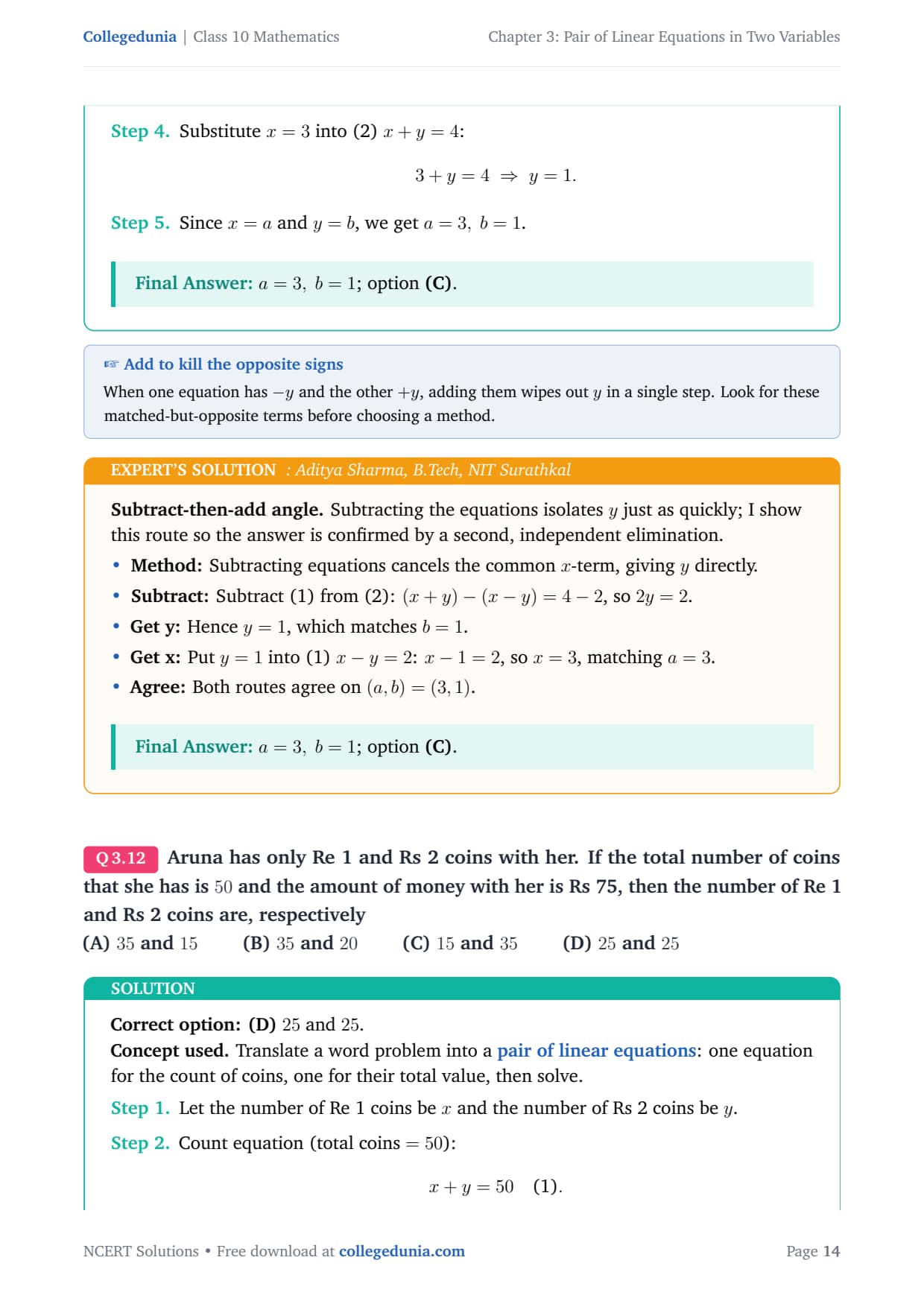
Substitute x=3 into (2) x+y=4:
3+y=4 ⇒ y=1.
Since x=a and y=b, we get a=3, b=1.
a=3, b=1; option (C).
AS
Aditya Sharma
B.Tech, NIT Surathkal
Verified Expert
Subtract-then-add angle. Subtracting the equations isolates y
just as quickly; I show this route so the answer is confirmed by a second,
independent elimination.
Method: Subtracting equations cancels the common x-term, giving y directly.
Subtract: Subtract (1) from (2): (x+y)-(x-y)=4-2, so 2y=2.
Get y: Hence y=1, which matches b=1.
Get x: Put y=1 into (1) x-y=2: x-1=2, so x=3, matching a=3.
Agree: Both routes agree on (a,b)=(3,1).
a=3, b=1; option (C).
Q 3.12
Aruna has only Re 1 and Rs 2 coins with her. If the total number of coins that she has is 50 and the amount of money with her is Rs 75, then the number of Re 1 and Rs 2 coins are, respectively
(A) 35 and 15 (B) 35 and 20 (C) 15 and 35 (D) 25 and 25
Correct option: (D)25 and 25.
Concept used. Translate a word problem into a pair of
linear equations: one equation for the count of coins, one for their total
value, then solve.
Let the number of Re 1 coins be x and the number of Rs 2 coins be
y.
Count equation (total coins =50):
x+y=50 (1).
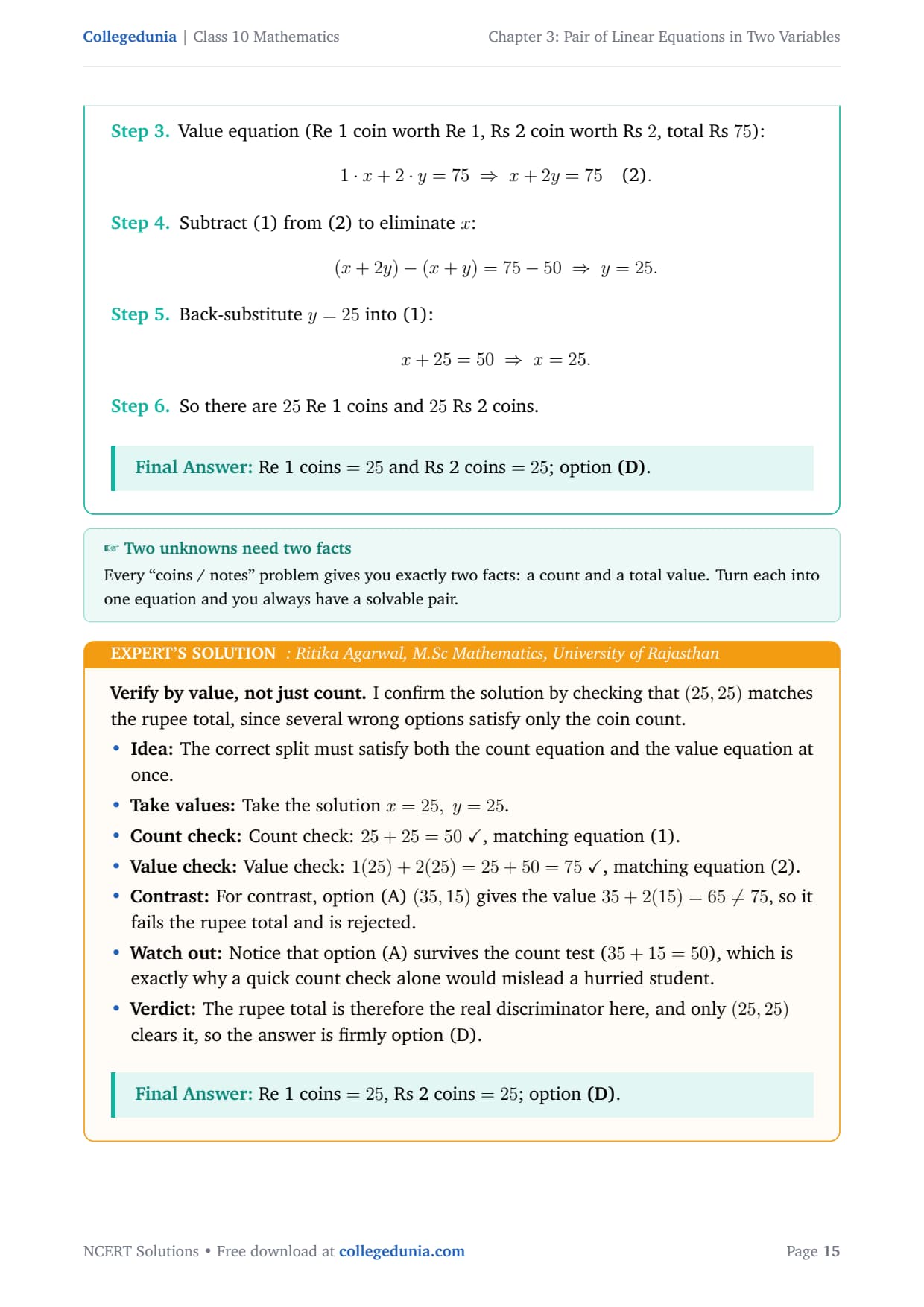
Value equation (Re 1 coin worth Re 1, Rs 2 coin worth Rs 2,
total Rs 75):
1· x + 2· y = 75 ⇒ x+2y=75 (2).
Subtract (1) from (2) to eliminate x:
(x+2y)-(x+y)=75-50 ⇒ y=25.
Back-substitute y=25 into (1):
x+25=50 ⇒ x=25.
So there are 25 Re 1 coins and 25 Rs 2 coins.
Re 1 coins =25 and Rs 2 coins =25; option (D).
RA
Ritika Agarwal
M.Sc Mathematics, University of Rajasthan
Verified Expert
Verify by value, not just count. I confirm the solution by
checking that (25,25) matches the rupee total, since several wrong
options satisfy only the coin count.
Idea: The correct split must satisfy both the count equation and the value equation at once.
Value check: Value check: 1(25)+2(25)=25+50=75 , matching equation (2).
Contrast: For contrast, option (A) (35,15) gives the value 35+2(15)=65≠ 75, so it fails the rupee total and is rejected.
Watch out: Notice that option (A) survives the count test (35+15=50), which is exactly why a quick count check alone would mislead a hurried student.
Verdict: The rupee total is therefore the real discriminator here, and only (25,25) clears it, so the answer is firmly option (D).
Re 1 coins =25, Rs 2 coins =25; option (D).
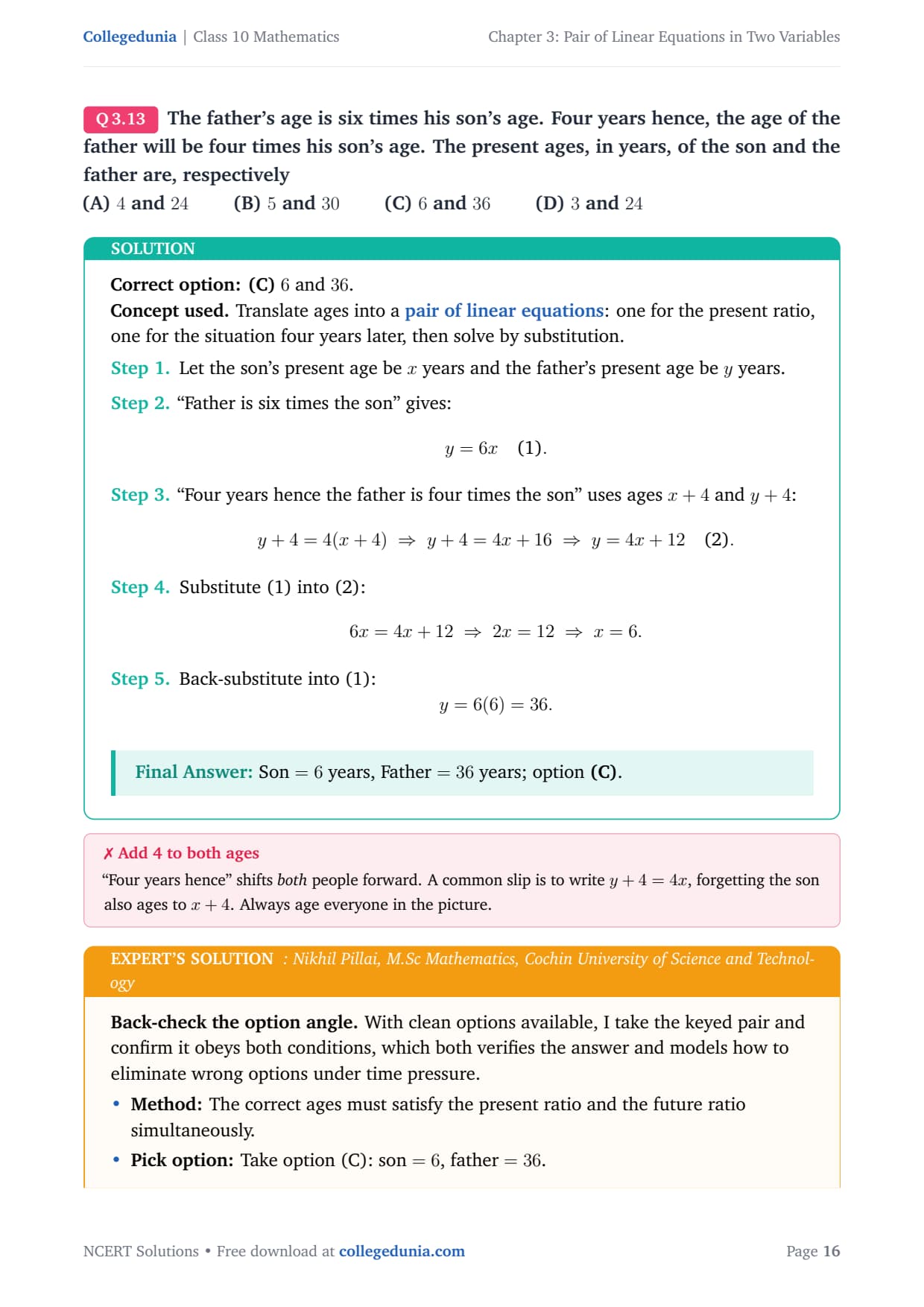
Q 3.13
The father's age is six times his son's age. Four years hence, the age of the father will be four times his son's age. The present ages, in years, of the son and the father are, respectively
(A) 4 and 24 (B) 5 and 30 (C) 6 and 36 (D) 3 and 24
Correct option: (C)6 and 36.
Concept used. Translate ages into a pair of linear
equations: one for the present ratio, one for the situation four years
later, then solve by substitution.
Let the son's present age be x years and the father's present age
be y years.
``Father is six times the son'' gives:
y=6x (1).
``Four years hence the father is four times the son'' uses ages
x+4 and y+4:
y+4=4(x+4) ⇒ y+4=4x+16 ⇒ y=4x+12 (2).
Substitute (1) into (2):
6x=4x+12 ⇒ 2x=12 ⇒ x=6.
Back-substitute into (1):
y=6(6)=36.
Son =6 years, Father =36 years; option (C).
NP
Nikhil Pillai
M.Sc Mathematics, Cochin University of Science and Technology
Verified Expert
Back-check the option angle. With clean options available, I take
the keyed pair and confirm it obeys both conditions, which both verifies
the answer and models how to eliminate wrong options under time pressure.
Method: The correct ages must satisfy the present ratio and the future ratio simultaneously.
Pick option: Take option (C): son =6, father =36.
Now check: Present check: 36=6× 6 , so the ``six times'' rule holds.
Later check: Four years later: son =10, father =40. Is 40=4× 10? Yes .
Verdict: Both conditions pass for (C); for contrast option (A) son 4, father 24 gives future 28 vs 4× 8=32, which fails.
Son 6, father 36; option (C).
Other Exercises & Resources for Chapter 3
Work through the rest of the Exemplar exercises, then pair them with the matching study resources for Pair of Linear Equations.
Resource
What it covers
Open
Exercise 3.1
MCQs on the ratio test, consistency and word problems.
In a Collegedunia poll of 11,320 Class 10 Maths students before the 2026 boards, 71% rated Questions 8 and 9 as the trickiest in this exercise. Most slipped by checking only one ratio for the coincidence test instead of all three. Many also forgot to rewrite the equation in standard form before reading off the constant.
Source: Class 10 Mathematics student poll, 2026-27 session. Sample of 11,320 students from CBSE schools across 16 states.
Other Resources for Pair of Linear Equations Class 10 Maths
Pair this with the other Class 10 Maths resources for Pair of Linear Equations, all linked below.
Ques. What is NCERT Exemplar Class 10 Maths Chapter 3 Exercise 3.1?
Ans. Exercise 3.1 is the MCQ section of the NCERT Exemplar Chapter 3 for Class 10 Maths. Its 13 questions test the ratio test for line type (parallel, intersecting, coincident), special-form lines, and word problems turned into two equations. It is harder than the textbook and widely used for board prep in the 2026-27 session.
Ques. How many questions are in Exercise 3.1 of NCERT Exemplar Class 10 Maths?
Ans. There are 13 MCQs, each with four options. Topics include the ratio test for consistency, the coincident and parallel line conditions, word problems on coins and ages, and special-form lines like x = a and y = b.
Ques. What is the ratio test for a pair of linear equations in NCERT Exemplar Exercise 3.1?
Ans. For a pair a1x + b1y + c1 = 0 and a2x + b2y + c2 = 0, compare three ratios: (1) if a1/a2 ≠ b1/b2 the lines intersect at one point (unique solution); (2) if a1/a2 = b1/b2 ≠ c1/c2 the lines are parallel (no solution); (3) if all three ratios are equal the lines are coincident (infinitely many solutions). This test is used in Questions 1 through 9 of Exercise 3.1.
Ques. Why does Question 8 of Exercise 3.1 have the answer "no value" for c?
Ans. For the pair cx - y = 2 and 6x - 2y = 3, infinitely many solutions need all three ratios equal. The y-ratio is 1/2 and the constant ratio is 2/3. Since 1/2 ≠ 2/3, and c does not appear in either of these ratios, no choice of c can make the constant ratio equal to 1/2. Setting only c/6 = 1/2 gives c = 3, but this only creates parallel lines (not coincident). So the answer is "no value" for c.
Ques. How do I solve age problems as a pair of linear equations in Class 10 Maths?
Ans. For age word problems like Question 13 of Exercise 3.1: (1) let the two unknown ages be variables; (2) write one equation for the present ratio condition; (3) write another equation for the future condition, making sure to add the time to both ages; (4) solve by substitution or elimination. The most common mistake is forgetting to age both people when writing the future equation. For "four years hence, father is four times son", the correct equation is y + 4 = 4(x + 4), not y + 4 = 4x.








Comments