Maths Strategist, Olympiad Coach | Updated 3+ months ago
These NCERT Exemplar Class 10 Maths Chapter 3 Solutions work out every Pair of Linear Equations in Two Variables problem from Exercises 3.1 to 3.4, step by step. Each answer shows the ratio test, the method used, and a quick check. You can match your own working line by line. The set follows the 2026-27 CBSE syllabus and is built for board practice.
41 Exemplar problems across four exercises: MCQ, reasoning, short answer, and long answer.
Covers the ratio test for consistency, graphical and algebraic methods, and word problems.
Free PDF download plus a solved question bank you can open right on this page.
Solved by Collegedunia: Every question here is worked out by our Mathematics faculty, cross-checked against the official NCERT Exemplar, and matched to the 2026-27 syllabus.
Watch Pair of Linear Equations Class 10 Maths Explained
The Exemplar covers four exercises, and each has its own style. Knowing the split helps you plan practice: short objective items first, then reasoning, then the longer algebra and word problems. The image below maps all four types.
Exercise
Question Type
Count
What It Tests
Exercise 3.1
MCQ (objective)
13
Classify lines as intersecting, parallel or coincident; find a missing constant
Exercise 3.2
Very short / Justify
7
True-or-false on consistency, coincidence, and no-solution claims
Exercise 3.3
Short answer (solve)
13
Find k or λ, solve systems, and build pairs from a given solution
Exercise 3.4
Long answer (word/graph)
15
Form equations from a story, draw graphs, and find triangle areas
So the full set has 41 problems. A type-by-type pass beats a straight 1-to-41 sweep, because the skills build on each other. The ratio test from Exercise 3.1 is the same one you justify in Exercise 3.2 and apply in Exercise 3.3.
The Ratio Test: The One Tool You Reuse
Almost every Exemplar answer leans on one idea. Write both equations as a1x+b1y+c1=0 and a2x+b2y+c2=0, then compare three ratios. The card below shows the three outcomes you sort every pair into.
Unique solution (intersecting):a1a2≠b1b2. The lines cross at one point.
Infinitely many solutions (coincident):a1a2=b1b2=c1c2. Same line drawn twice.
No solution (parallel):a1a2=b1b2≠c1c2. The lines never meet.
Consistent vs inconsistent: a pair is consistent if it has at least one solution (unique or infinitely many), and inconsistent only in the parallel case.
One reminder before you compute: move every constant to the left so each equation reads …=0. A sign slip on c2 is the most common reason students miss an Exercise 3.1 MCQ.
How These Solutions Help You
These solutions are written for self-study before the CBSE board exam. They do three things for you:
Show the full working: ratios, substitution and arithmetic sit on separate lines, so you can spot exactly where your answer went wrong.
Justify, not just answer: every true-or-false question states the reason, the part students skip and lose marks on.
Add an Expert view: each question has a second, faster method, such as the slope-intercept check or a scale-to-match shortcut.
Use them the smart way: try the question first, then open Check Solution, and read the Expert Solution only after you have your own answer. That order builds real recall.
Exemplar vs Textbook Difficulty
The textbook tests one step at a time: solve a clean pair, or read a graph. The Exemplar pushes the same setup into reasoning and multi-step word problems. The table shows where the step-up happens.
Skill
NCERT Textbook
NCERT Exemplar
Classifying a pair
Apply the ratio test once
Justify true-or-false claims about consistency and coincidence
Finding a constant
One value of k from a clean ratio
Find k, λ, or both a and b with fractions
Solving systems
Substitution or elimination on neat numbers
Reducible pairs using 1x or 1y substitutions
Word problems
Form two equations and solve
Speed-stream, ages, profit-discount, and triangle-area set-ups
This is why practising the Exemplar after the textbook is the standard board-prep route. The textbook teaches the rule; the Exemplar makes you apply it under pressure.
Exemplar-Specific Common Mistakes
Across Exercises 3.1 to 3.4, a few slips cost the most marks. Watch for these:
The "two solutions" trap: two straight lines meet at 0, 1, or infinitely many points, never at exactly two. Reject any option that says "exactly two solutions".
Stopping after two ratios: for coincident lines you must check all three ratios; matching only a1a2 and b1b2 can still be a parallel (no-solution) case.
Swapping x=k and y=k:x=k is vertical (parallel to the y-axis); y=k is horizontal (parallel to the x-axis).
Ageing only one person: in age word problems, "four years hence" shifts both people forward, so add 4 to each age.
Keep a short error log of which slips you repeat, and your accuracy on the board paper climbs fast.
Top Formulae to Keep Handy
Keep this short list on hand while you solve. Each relation below is used somewhere in these Exemplar solutions.
Use
Relation
Unique solution (intersecting)
a1a2≠b1b2
Infinitely many (coincident)
a1a2=b1b2=c1c2
No solution (parallel)
a1a2=b1b2≠c1c2
Slope of a line
m=-ab from ax+by+c=0
Time relation (word problems)
time=distancespeed
Memorise the three ratio conditions first. The slope formula gives a quick second check, and the time relation unlocks the speed-and-stream problems in Exercise 3.4.
Other Resources for This Chapter
Pair this Exemplar set with the other resources on Collegedunia to revise the whole chapter before your board exam.
All Exemplar Questions with Step-by-Step Solutions
I. Multiple Choice Questions (Exercise 3.1)
Q 3.1
Graphically, the pair of equations
6x-3y+10=0 and 2x-y+9=0 represents two lines which are
(A) intersecting at exactly one point. (B) intersecting at exactly two points.
(C) coincident. (D) parallel.
Correct option: (D) parallel.
Concept used. For a pair of lines a1x+b1y+c1=0 and
a2x+b2y+c2=0, we compare the three ratios. If
a1a2=b1b2≠c1c2 the lines are
parallel and the pair has no solution.
Read off the coefficients:
a1=6, b1=-3, c1=10 and a2=2, b2=-1, c2=9.
Form the ratio of x-coefficients:
a1a2=62=3.
Form the ratio of y-coefficients:
b1b2=-3-1=3.
Form the ratio of constants:
c1c2=109.
Compare: a1a2=b1b2=3 but
c1c2=109≠ 3. So the first two ratios are
equal while the third differs.
a1a2=b1b2≠c1c2, so the
lines are parallel; option (D).
AM
Aarav Mehta
M.Sc Mathematics, University of Delhi
Verified Expert
Slope-intercept cross-check. Reading the answer straight off the
ratio test is fastest, but converting both lines to y=mx+c form gives a
second, independent confirmation that the lines truly are parallel rather
than coincident.
Idea: Two lines are parallel when their slopes are equal but their y-intercepts differ.
First line: Solve the first equation for y: 6x-3y+10=0 ⇒ 3y=6x+10 ⇒ y=2x+103.
Second line: Solve the second equation for y: 2x-y+9=0 ⇒ y=2x+9.
Slopes: Compare slopes: both have slope m=2, so the lines never tilt toward each other.
Intercepts: Compare intercepts: 103≈ 3.33 while the other is 9. Equal slope but unequal intercept is the textbook signature of parallel lines, confirming there is no common point.
Equal slope 2, different intercepts ⇒ parallel;
option (D).
Q 3.2
The pair of equations x+2y+5=0 and -3x-6y+1=0 have
(A) a unique solution (B) exactly two solutions
(C) infinitely many solutions (D) no solution
Correct option: (D) no solution.
Concept used. We again run the ratio test. When
a1a2=b1b2≠c1c2 the system is
inconsistent and has no solution.
Identify the coefficients:
a1=1, b1=2, c1=5 and a2=-3, b2=-6, c2=1.
Ratio of x-coefficients:
a1a2=1-3=-13.
Ratio of y-coefficients:
b1b2=2-6=-13.
Ratio of constants:
c1c2=51=5.
Compare: -13=-13≠ 5. The first two ratios
agree, the third does not, so the lines are parallel and the pair
has no solution.
a1a2=b1b2≠c1c2, so there
is no solution; option (D).
SK
Sneha Kulkarni
M.Sc Mathematics, Savitribai Phule Pune University
Verified Expert
Test by scaling one equation. Instead of three separate ratios, I
scale the first equation and watch whether it can ever become the second;
if the variable parts match but the constants clash, the pair is
inconsistent.
Principle: Two equations describe the same or parallel lines only if one is a constant multiple of the other in its variable terms.
Scale up: Multiply the first equation x+2y+5=0 by -3: -3x-6y-15=0.
Line up: Place it beside the given second equation -3x-6y+1=0.
Variables: The x and y parts -3x-6y are now identical in both lines, so the lines are parallel.
Constants: But the constants disagree: -15≠ 1. Identical variable parts with different constants means the two lines can never meet.
Variable parts match, constants differ ⇒ no
solution; option (D).
Q 3.3
If a pair of linear equations is consistent, then the lines will be
(A) parallel (B) always coincident
(C) intersecting or coincident (D) always intersecting
Correct option: (C) intersecting or coincident.
Concept used. A pair of linear equations is consistent
when it has at least one solution. ``At least one'' covers two separate
geometric pictures, which is exactly what the options are testing.
Recall the definition: consistent means the system has a solution,
either exactly one or infinitely many.
Case of one solution: the two lines cross at a single point, so
they are intersecting.
Case of infinitely many solutions: the two equations describe the
very same line, so they are coincident.
Reject the others: parallel lines (option A) give no solution, so
they are inconsistent; ``always coincident'' (B) and ``always
intersecting'' (D) each ignore one of the two valid cases.
Consistent ⇒ the lines are intersecting or
coincident; option (C).
RV
Rohan Verma
B.Tech, NIT Trichy
Verified Expert
Eliminate by counter-example. Rather than memorise, I knock out
each wrong option by naming a consistent system it fails to describe; the
only survivor is the answer.
Logic: A definition that claims ``always'' fails the moment one valid example breaks it.
Case one: Take x+y=2, x-y=0. It has the single solution (1,1): this is consistent and intersecting, so option (B) ``always coincident'' is false.
Case two: Take x+y=2, 2x+2y=4. Every point of the line solves both, so it is consistent and coincident, so option (D) ``always intersecting'' is false.
Parallel out: Parallel lines such as x+y=2, x+y=5 have no solution, so they are inconsistent: option (A) is false.
Survivors: Both surviving cases are captured only by ``intersecting or coincident''.
Counter-examples kill (A), (B), (D); answer is (C).
Q 3.4
The pair of equations y=0 and y=-7 has
(A) one solution (B) two solutions
(C) infinitely many solutions (D) no solution
Correct option: (D) no solution.
Concept used. The equation y=k is a horizontal line through
height k on the y-axis. Two horizontal lines at different heights are
parallel.
Picture y=0: this is the x-axis itself, a horizontal line at
height 0.
Picture y=-7: this is a horizontal line 7 units below the
x-axis.
Both lines are horizontal, so they have the same direction and can
never meet.
Algebraically, asking for a common point means demanding y=0 and
y=-7 at once, which is impossible since 0≠ -7.
Two parallel horizontal lines ⇒no
solution; option (D).
PN
Priya Nair
Ph.D Mathematics, IISc Bangalore
Verified Expert
Contradiction angle. A solution of a pair must satisfy both
equations together; I test whether a single y can obey both, and a flat
contradiction settles the count of solutions at zero.
Idea: A value cannot equal two different numbers simultaneously, so the system is inconsistent.
Assume: Suppose (x,y) solves both equations.
First forces: The first equation forces y=0.
Second forces: The second equation forces y=-7.
Clash: Combining, 0=-7, which is false. No point can satisfy both, and x being free does not help because y is already trapped.
The demand 0=-7 is impossible ⇒ no solution; option
(D).
Q 3.5
The pair of equations x=a and y=b graphically represents lines which are
(A) parallel (B) intersecting at (b,a)
(C) coincident (D) intersecting at (a,b)
Correct option: (D) intersecting at (a,b).
Concept used.x=a is a vertical line, y=b is a horizontal
line. A vertical and a horizontal line always cross at exactly one point,
and that point has x-coordinate a and y-coordinate b.
Draw x=a: every point on it has the same x-value a, so it is
vertical (parallel to the y-axis).
Draw y=b: every point on it has the same y-value b, so it is
horizontal (parallel to the x-axis).
A vertical and a horizontal line are not parallel to each other,
so they meet at one point.
At the meeting point both conditions hold together: x=a and
y=b, giving the coordinates (a,b).
The lines cross once, at the point (a,b); option
(D).
KI
Karthik Iyer
M.Sc Mathematics, University of Madras
Verified Expert
Direct substitution check. I confirm the intersection by plugging
the proposed point back into both equations; the correct point satisfies
each one with no contradiction.
Rule: The intersection point is the unique pair that satisfies both equations simultaneously.
Test x=a: Test the candidate point (a,b) in x=a: the x-coordinate is a, so x=a holds.
Test y=b: Test (a,b) in y=b: the y-coordinate is b, so y=b holds.
Both hold: Both equations are satisfied, so (a,b) is the common point.
Reject swap: Test the rival (b,a) in x=a: its x-coordinate is b, and b=a need not be true, so (b,a) generally fails.
(a,b) satisfies both lines; option (D).
Q 3.6
For what value of k, do the equations 3x-y+8=0 and 6x-ky=-16 represent coincident lines?
(A) 12 (B) -12 (C) 2 (D) -2
Correct option: (C)2.
Concept used. Two lines are coincident when all three
ratios are equal:
a1a2=b1b2=c1c2.
Write both equations in the form ax+by+c=0.
First: 3x-y+8=0, so a1=3, b1=-1, c1=8.
Second: 6x-ky+16=0, so a2=6, b2=-k, c2=16.
Set the x- and constant-ratios equal:
a1a2=c1c2 ⇒ 36=816.
Both sides equal 12, so the constant ratio is already
consistent.
Now force the y-ratio to match 12:
b1b2=-1-k=1k=12.
Solve 1k=12:
k=2.
k=2 makes all three ratios equal; option
(C).
AB
Ananya Bose
M.Sc Mathematics, Jadavpur University
Verified Expert
Proportional-equation angle. For coincident lines, the second
equation must be the first multiplied by a single constant; finding that
constant pins down k in one move.
Idea: Coincident lines are scalar multiples of each other.
Find factor: Compare constants to find the multiplier: c2/c1=16/8=2, so the second equation should be twice the first.
Double it: Multiply the first equation by 2: 2(3x-y+8)=0 gives 6x-2y+16=0.
Match terms: Match this against 6x-ky+16=0 term by term: the x-terms (6x) and constants (+16) already agree.
Read k: Equate the y-terms: -2y=-ky, so k=2.
The first equation doubled gives k=2; option (C).
Q 3.7
If the lines given by 3x+2ky=2 and 2x+5y+1=0 are parallel, then the value of k is
(A) -54 (B) 25 (C) 154 (D) 32
Correct option: (C)154.
Concept used. Lines are parallel when only the first two
ratios are equal: a1a2=b1b2 (and the constant
ratio differs). Here that single equation pins down k.
Read coefficients: a1=3, b1=2k from 3x+2ky-2=0, and
a2=2, b2=5 from 2x+5y+1=0.
For parallel lines set the x- and y-ratios equal:
a1a2=b1b2 ⇒ 32=2k5.
Cross-multiply:
3× 5 = 2× 2k ⇒ 15=4k.
Solve:
k=154.
k=154; option (C).
VR
Vikram Reddy
M.Sc Mathematics, University of Hyderabad
Verified Expert
Equal-slope angle. Parallel lines have identical slopes, so I
write each in y=mx+c form and equate the slopes; this avoids handling the
2ky ratio with its variable inside.
Rule: Slope of ax+by+c=0 is -ab, and parallel lines have equal slopes.
First slope: Slope of the first line 3x+2ky-2=0 is -32k.
Second slope: Slope of the second line 2x+5y+1=0 is -25.
Equate: Set the slopes equal: -32k=-25, i.e. 32k=25.
Solve: Cross-multiply: 15=4k, so k=154.
Equal slopes give k=154; option (C).
Q 3.8
The value of c for which the pair of equations cx-y=2 and 6x-2y=3 will have infinitely many solutions is
(A) 3 (B) -3 (C) -12 (D) no value
Correct option: (D) no value.
Concept used. For infinitely many solutions all three
ratios must match: a1a2=b1b2=c1c2. If
the y- and constant-ratios already disagree, no choice of c can rescue
the system.
Write both in standard form: cx-y-2=0 and 6x-2y-3=0. So
a1=c, b1=-1, c1=-2 and a2=6, b2=-2, c2=-3.
Compute the y-ratio:
b1b2=-1-2=12.
Compute the constant-ratio:
c1c2=-2-3=23.
These two ratios are already unequal: 12≠23.
The condition b1b2=c1c2 fails regardless
of c, since c does not appear in either of them.
Therefore no value of c can make all three ratios equal.
Since b1b2≠c1c2 already, there is
no value of c; option (D).
MJ
Meera Joshi
M.Ed Mathematics, Banaras Hindu University
Verified Expert
Check the fixed part first. The smart move is to test the ratios
that do not contain the unknown before solving for it; if those clash, the
answer is ``no value'' without any algebra on c.
Idea: Infinitely many solutions require the full equality chain; a single broken link is fatal.
Pick c-free: Isolate the c-free ratios b1b2 and c1c2.
Evaluate: Evaluate them: -1-2=12 and -2-3=23.
They clash: Since 12≠23, the equality b1b2=c1c2 is impossible.
No fix: No adjustment of c touches these ratios, so the system can never be coincident.
No value of c works; option (D).
Q 3.9
One equation of a pair of dependent linear equations is -5x+7y=2. The second equation can be
(A) 10x+14y+4=0 (B) -10x-14y+4=0
(C) -10x+14y+4=0 (D) 10x-14y=-4
Correct option: (D)10x-14y=-4.
Concept used.Dependent equations are coincident: the
second equation is a constant multiple of the first. So all three ratios
a1a2=b1b2=c1c2 must be equal.
Write the first equation in standard form: -5x+7y-2=0, so
a1=-5, b1=7, c1=-2.
A dependent partner is just the first equation times some constant
λ. Try λ=-2:
-2(-5x+7y-2)=0 ⇒ 10x-14y+4=0.
Rearrange to compare with the options:
10x-14y+4=0 ⇒ 10x-14y=-4.
This is exactly option (D). A quick ratio check against, say,
option (C) -10x+14y+4=0 gives a1a2=-5-10
=12 but c1c2=-24=-12, which
clash, so (C) is only parallel, not dependent.
The first equation times -2 gives 10x-14y=-4; option
(D).
SR
Siddharth Rao
M.Sc Statistics, ISI Kolkata
Verified Expert
Ratio sweep across options. I compute the three ratios for the
strongest-looking candidates and keep the one where the whole chain is
equal, which guarantees coincident lines.
Rule: Coincidence demands a1a2=b1b2=c1c2 all at once.
x-ratio: For option (D) 10x-14y+4=0: a1a2=-510 =-12.
y-ratio: Next, b1b2=7-14=-12.
Constant: Finally, c1c2=-24=-12.
All agree: All three equal -12, so the lines coincide; option (D) is the dependent equation.
Exam habit: In a one-mark question stop the instant any two ratios disagree, because dependence needs every link equal and a single break already settles the answer without checking the rest.
All ratios =-12 for (D); option (D).
Q 3.10
A pair of linear equations which has a unique solution x=2, y=-3 is
(A) x+y=-1 and 2x-3y=-5 (B) 2x+5y=-11 and 4x+10y=-22
(C) 2x-y=1 and 3x+2y=0 (D) x-4y-14=0 and 5x-y-13=0
Correct option: (D)x-4y-14=0 and 5x-y-13=0.
Concept used. A point is the unique solution of a pair only if it
satisfies both equations and the pair is not dependent. We test
(2,-3) in each option.
Test option (D), first equation x-4y-14=0 at (2,-3):
2-4(-3)-14 = 2+12-14 = 0.
Test option (D), second equation 5x-y-13=0 at (2,-3):
5(2)-(-3)-13 = 10+3-13 = 0.
Both hold, so (2,-3) is a solution of (D).
Confirm uniqueness for (D): a1a2=15 and
b1b2=-4-1=4. Since 15≠ 4, the lines
intersect at one point only, so the solution is unique.
Reject the rest by a quick test, e.g. option (A) first equation
x+y=-1 at (2,-3) gives 2+(-3)=-1 , but the second
2x-3y=-5 gives 4+9=13≠ -5, so (A) fails.
Only (D) satisfies both equations with a unique intersection;
option (D).
PD
Pooja Deshmukh
M.Sc Mathematics, University of Mumbai
Verified Expert
Reject-on-first-failure angle. I substitute the given point into
the first equation of each option; the instant one equation fails I drop
that option, which is faster than checking both lines everywhere.
Idea: A solution must satisfy every equation, so one failure is enough to discard an option.
Option B: Option (B) first equation 2x+5y=-11 at (2,-3): 4-15=-11 , second 4x+10y=-22: 8-30=-22 ; but 24=510=-11-22, so (B) is dependent (infinitely many, not unique) and is rejected.
Option C: Option (C) first equation 2x-y=1 at (2,-3): 4+3=7≠ 1, reject.
Option A: Option (A) fails its second equation as shown, reject.
Option D: Option (D) passes both equations and is not dependent, so it is the unique-solution pair.
(D) is the only pair with a genuine unique solution at (2,-3);
option (D).
Q 3.11
If x=a, y=b is the solution of the equations x-y=2 and x+y=4, then the values of a and b are, respectively
(A) 3 and 5 (B) 5 and 3 (C) 3 and 1 (D) -1 and -3
Correct option: (C)3 and 1.
Concept used. Solve the pair by the elimination method:
add the two equations to cancel y, then back-substitute.
Write the system:
x-y=2 (1), x+y=4 (2).
Add (1) and (2) to eliminate y:
(x-y)+(x+y)=2+4 ⇒ 2x=6.
Solve for x:
x=62=3.
Substitute x=3 into (2) x+y=4:
3+y=4 ⇒ y=1.
Since x=a and y=b, we get a=3, b=1.
a=3, b=1; option (C).
AS
Aditya Sharma
B.Tech, NIT Surathkal
Verified Expert
Subtract-then-add angle. Subtracting the equations isolates y
just as quickly; I show this route so the answer is confirmed by a second,
independent elimination.
Method: Subtracting equations cancels the common x-term, giving y directly.
Subtract: Subtract (1) from (2): (x+y)-(x-y)=4-2, so 2y=2.
Get y: Hence y=1, which matches b=1.
Get x: Put y=1 into (1) x-y=2: x-1=2, so x=3, matching a=3.
Agree: Both routes agree on (a,b)=(3,1).
a=3, b=1; option (C).
Q 3.12
Aruna has only Re 1 and Rs 2 coins with her. If the total number of coins that she has is 50 and the amount of money with her is Rs 75, then the number of Re 1 and Rs 2 coins are, respectively
(A) 35 and 15 (B) 35 and 20 (C) 15 and 35 (D) 25 and 25
Correct option: (D)25 and 25.
Concept used. Translate a word problem into a pair of
linear equations: one equation for the count of coins, one for their total
value, then solve.
Let the number of Re 1 coins be x and the number of Rs 2 coins be
y.
Count equation (total coins =50):
x+y=50 (1).
Value equation (Re 1 coin worth Re 1, Rs 2 coin worth Rs 2,
total Rs 75):
1· x + 2· y = 75 ⇒ x+2y=75 (2).
Subtract (1) from (2) to eliminate x:
(x+2y)-(x+y)=75-50 ⇒ y=25.
Back-substitute y=25 into (1):
x+25=50 ⇒ x=25.
So there are 25 Re 1 coins and 25 Rs 2 coins.
Re 1 coins =25 and Rs 2 coins =25; option (D).
RA
Ritika Agarwal
M.Sc Mathematics, University of Rajasthan
Verified Expert
Verify by value, not just count. I confirm the solution by
checking that (25,25) matches the rupee total, since several wrong
options satisfy only the coin count.
Idea: The correct split must satisfy both the count equation and the value equation at once.
Value check: Value check: 1(25)+2(25)=25+50=75 , matching equation (2).
Contrast: For contrast, option (A) (35,15) gives the value 35+2(15)=65≠ 75, so it fails the rupee total and is rejected.
Watch out: Notice that option (A) survives the count test (35+15=50), which is exactly why a quick count check alone would mislead a hurried student.
Verdict: The rupee total is therefore the real discriminator here, and only (25,25) clears it, so the answer is firmly option (D).
Re 1 coins =25, Rs 2 coins =25; option (D).
Q 3.13
The father's age is six times his son's age. Four years hence, the age of the father will be four times his son's age. The present ages, in years, of the son and the father are, respectively
(A) 4 and 24 (B) 5 and 30 (C) 6 and 36 (D) 3 and 24
Correct option: (C)6 and 36.
Concept used. Translate ages into a pair of linear
equations: one for the present ratio, one for the situation four years
later, then solve by substitution.
Let the son's present age be x years and the father's present age
be y years.
``Father is six times the son'' gives:
y=6x (1).
``Four years hence the father is four times the son'' uses ages
x+4 and y+4:
y+4=4(x+4) ⇒ y+4=4x+16 ⇒ y=4x+12 (2).
Substitute (1) into (2):
6x=4x+12 ⇒ 2x=12 ⇒ x=6.
Back-substitute into (1):
y=6(6)=36.
Son =6 years, Father =36 years; option (C).
NP
Nikhil Pillai
M.Sc Mathematics, Cochin University of Science and Technology
Verified Expert
Back-check the option angle. With clean options available, I take
the keyed pair and confirm it obeys both conditions, which both verifies
the answer and models how to eliminate wrong options under time pressure.
Method: The correct ages must satisfy the present ratio and the future ratio simultaneously.
Pick option: Take option (C): son =6, father =36.
Now check: Present check: 36=6× 6 , so the ``six times'' rule holds.
Later check: Four years later: son =10, father =40. Is 40=4× 10? Yes .
Verdict: Both conditions pass for (C); for contrast option (A) son 4, father 24 gives future 28 vs 4× 8=32, which fails.
Son 6, father 36; option (C).
NCERT exemplar Class 12 Mathematics Chapter 3 Pair of Linear Equations in Two Variables
Class 10 Mathematics Chapter 3: Pair of Linear Equations in Two Variables NCERT exemplar
All 6 questions with collapsible Solution and Expert Solution. Tap a button to reveal the working.
II. Short Answer Questions with Reasoning (Exercise 3.2)
Q 3.1
Do the following pairs of linear equations have no solution? Justify your answer.
(i) 2x+4y=3 and 12y+6x=6
(ii) x=2y and y=2x
(iii) 3x+y-3=0 and 2x+23y=2
Concept used. A pair has no solution exactly when
a1a2=b1b2≠c1c2 (parallel lines). We
test each pair against this condition.
(i) Write 2x+4y-3=0 and 6x+12y-6=0. Ratios:
a1a2=26=13,
b1b2=412=13,
c1c2=-3-6=12.
Here 13=13≠12, so the lines are parallel:
Yes, this pair has no solution.
(ii) Write x-2y=0 and 2x-y=0. Ratios:
a1a2=12,
b1b2=-2-1=2.
Since 12≠ 2, the lines intersect (unique solution at the
origin): No, this pair does have a solution.
(iii) Write 3x+y-3=0 and 2x+23 y-2=0. Ratios:
a1a2=32,
b1b2=12/3=32,
c1c2=-3-2=32.
All three ratios equal 32, so the lines are coincident
(infinitely many solutions): No, it is not a no-solution
case.
(i) Yes (parallel); (ii) No (intersecting);
(iii) No (coincident).
TM
Tara Menon
M.Ed Mathematics, Regional Institute of Education Mysuru
Verified Expert
Decimal-ratio angle. I convert each ratio to a decimal so the
``equal-equal-different'' pattern jumps out at a glance, which is handy when
fractions like 23 make the comparison fiddly.
Trick: The same parallel-line test, read as decimals.
Part i: (i) 0.33, 0.33, 0.5: first two match, last differs, so parallel, no solution (Yes).
Part ii: (ii) 0.5 versus 2: unequal at the first comparison, so they intersect (No).
Part iii: (iii) 1.5, 1.5, 1.5: all equal, so coincident, infinitely many solutions (No).
Confirm: The decimals confirm the fraction work in every part.
Why it helps: Reading the ratios as decimals removes the awkward 23 in part (iii), where 12/3=1.5 matches the other two decimals cleanly.
Verdict: Because all three decimals agree only in part (iii), it is the lone coincident pair, while (i) is parallel and (ii) intersecting.
(i) Yes, (ii) No, (iii) No.
Q 3.2
Do the following equations represent a pair of coincident lines? Justify your answer.
(i) 3x+17y=3 and 7x+3y=7
(ii) -2x-3y=1 and 6y+4x=-2
(iii) x2+y+25=0 and 4x+8y+516=0
Concept used. Lines are coincident only when all three
ratios are equal:
a1a2=b1b2=c1c2.
(i)3x+17 y-3=0 and 7x+3y-7=0. Ratios:
a1a2=37,
b1b2=1/73=121.
Already 37≠121, so not coincident:
No.
(ii)-2x-3y-1=0 and 4x+6y+2=0. Ratios:
a1a2=-24=-12,
b1b2=-36=-12,
c1c2=-12=-12.
All three equal -12, so the lines coincide: Yes.
(iii)x2+y+25=0 and 4x+8y+516=0.
Ratios: a1a2=1/24=18,
b1b2=18.
Now the constants: c1c2=2/55/16
=25×165=3225.
Since 18=18≠3225, the lines are parallel,
not coincident: No.
(i) No; (ii) Yes (all ratios =-12);
(iii) No.
HV
Harsh Vardhan
M.Sc Mathematics, Aligarh Muslim University
Verified Expert
Scale-to-match angle. Coincident means one equation is a clean
multiple of the other; I scale the simpler equation and see whether it
reproduces the second exactly, including the constant.
Method: Coincident lines are exact scalar multiples.
Part i: (i) Doubling or scaling 3x+17y-3 can never give 7x+3y-7 because 37≠1/73: No.
Part ii: (ii) Multiply -2x-3y-1=0 by -2: 4x+6y+2=0, which is exactly the second equation: Yes, coincident.
Part iii: (iii) Multiply x2+y+25=0 by 8: 4x+8y+165=0. The variable parts match the second equation but the constant 165≠516: No.
Only one: Only (ii) reproduces fully.
Decisive step: The scale-to-match test is decisive in part (iii): the variable parts line up after multiplying by 8, but the constant 165 refuses to become 516.
Verdict: So only part (ii) is a true scalar copy of its partner, confirming it is the single coincident pair among the three.
(i) No, (ii) Yes, (iii) No.
Q 3.3
Are the following pairs of linear equations consistent? Justify your answer.
(i) -3x-4y=12 and 4y+3x=12
(ii) 35x-y=12 and 15x-3y=16
(iii) 2ax+by=a and 4ax+2by-2a=0, a,b≠ 0
(iv) x+3y=11 and 2(2x+6y)=22
Concept used. A pair is consistent if it has at least
one solution, i.e. either a1a2≠b1b2 (unique) or
a1a2=b1b2=c1c2 (infinitely many). It is
inconsistent only in the parallel case.
(i)-3x-4y-12=0 and 3x+4y-12=0. Ratios:
a1a2=-33=-1,
b1b2=-44=-1,
c1c2=-12-12=1.
Here -1=-1≠ 1: parallel, so inconsistent (No).
(ii) Ratios:
a1a2=3/51/5=3,
b1b2=-1-3=13.
Since 3≠13, unique solution: consistent (Yes).
(iii)2ax+by-a=0 and 4ax+2by-2a=0. Ratios:
a1a2=2a4a=12,
b1b2=b2b=12,
c1c2=-a-2a=12.
All equal 12: coincident, infinitely many solutions, so
consistent (Yes).
(iv) Second equation 2(2x+6y)=22 simplifies to
4x+12y=22, i.e. 2x+6y=11. Compare with x+3y=11:
a1a2=12, b1b2=36=12,
c1c2=1111=1. Since 12=12≠ 1:
parallel, inconsistent (No).
(i) No; (ii) Yes; (iii) Yes;
(iv) No.
DS
Divya Srinivasan
M.Sc Mathematics, Anna University
Verified Expert
Spot the disguise angle. Parts (i) and (iv) hide the structure:
(i) is the same line negated, (iv) has a bracket multiplier. I simplify
first, then read consistency from a single ratio comparison.
Rule: Simplify each equation to lowest standard form before comparing ratios.
Part i: (i) The two equations are 3x+4y=-12 and 3x+4y=12: same left side, different right side, so parallel and inconsistent (No).
Part ii: (ii) Slopes 3 and 13 differ, so a unique solution exists: consistent (Yes).
Part iii: (iii) Doubling the first equation gives the second exactly, so the lines coincide: consistent (Yes).
Part iv: (iv) Reducing 2(2x+6y)=22 to 2x+6y=11 shows it is the first line x+3y=11 doubled on the left but not the right (11≠ 22), so parallel: inconsistent (No).
The disguises: The disguises matter: part (i) is the same line with both sides negated on one copy, and part (iv) hides a factor of 2 inside a bracket.
Reduce first: Once each pair is reduced to lowest standard form, a single ratio comparison settles consistency, giving No, Yes, Yes, No across the four parts.
(i) No, (ii) Yes, (iii) Yes, (iv) No.
Q 3.4
For the pair of equations λ x+3y=-7 and 2x+6y=14 to have infinitely many solutions, the value of λ should be 1. Is the statement true? Give reasons.
Concept used. For infinitely many solutions every ratio
must agree:
a1a2=b1b2=c1c2. We check whether
λ=1 can satisfy the full chain.
Standard form: λ x+3y+7=0 and 2x+6y-14=0. So a1=λ,
b1=3, c1=7 and a2=2, b2=6, c2=-14.
Compute the y-ratio:
b1b2=36=12.
Compute the constant-ratio:
c1c2=7-14=-12.
For infinitely many solutions we would need
b1b2=c1c2, i.e. 12=-12,
which is false.
Because these two ratios clash and neither involves λ, no
value of λ (including 1) can give infinitely many
solutions.
False. The statement is not true; in fact no λ
gives infinitely many solutions because b1b2≠c1c2.
MG
Manish Gupta
M.Sc Mathematics, University of Lucknow
Verified Expert
Substitute the claim angle. I take the claimed λ=1 at face
value, build the actual pair, and run the full ratio test to expose the
contradiction directly.
Test: A claimed solution either survives the equality chain or it does not.
Set lambda: Put λ=1: the pair becomes x+3y+7=0 and 2x+6y-14=0.
Variables: Variable ratios: 12 and 36=12, which match.
Constant: Constant ratio: 7-14=-12, which does not match 12.
Result: So at λ=1 the lines are parallel (no solution), the exact opposite of infinitely many. The statement is false.
False; λ=1 actually gives parallel lines, not infinitely
many solutions.
Q 3.5
For all real values of c, the pair of equations x-2y=8 and 5x-10y=c have a unique solution. Justify whether it is true or false.
Concept used. A unique solution needs
a1a2≠b1b2. We test the x- and y-ratios,
which here are fixed and do not contain c.
Standard form: x-2y-8=0 and 5x-10y-c=0. So a1=1, b1=-2 and
a2=5, b2=-10.
Ratio of x-coefficients: a1a2=15.
Ratio of y-coefficients:
b1b2=-2-10=15.
The two ratios are equal (15=15), so the lines are
never intersecting: they are parallel or coincident, never a unique
intersection.
Hence for no value of c is the solution unique; the claim of a
unique solution ``for all c'' is false.
False. Since a1a2=b1b2=15,
the pair is parallel or coincident, so it never has a unique solution.
SP
Shruti Patel
M.Sc Mathematics, Sardar Patel University
Verified Expert
Slope-equality angle. Both lines turn out to have the same slope,
so they can never cross once; I show this and note how the value of c only
slides the second line, never tilts it.
Idea: Equal slopes rule out a single intersection point.
First slope: Slope of x-2y=8 is 12 (from y=x-82).
Second slope: Slope of 5x-10y=c is also 510=12.
Equal slopes: Equal slopes mean the lines stay parallel; changing c just shifts the second line up or down without changing its direction.
Verdict: Therefore the lines are parallel for c≠ 40 and coincident for c=40, but never uniquely intersecting. The statement is false.
False; equal slopes (12) forbid a unique solution for any
c.
Q 3.6
The line represented by x=7 is parallel to the x-axis. Justify whether the statement is true or not.
Concept used. An equation of the form x=k is a vertical
line: every point on it has the same x-coordinate k while y is free.
A vertical line is parallel to the y-axis, not the x-axis.
Look at x=7: it is the set of all points (7,y) as y varies
over every real number.
Plotting these points stacks them vertically, giving a line that
runs straight up and down.
A line running up and down is parallel to the y-axis (the vertical
axis), not the x-axis.
The x-axis is horizontal; lines parallel to it have the form
y=k, not x=k. So the statement misnames the axis.
Not true. The line x=7 is parallel to the y-axis, not
the x-axis.
AN
Arjun Nambiar
M.Sc Mathematics, University of Calicut
Verified Expert
Point-sampling angle. I list a few points on x=7 and watch which
coordinate stays constant; the constant coordinate reveals the line's
direction and hence which axis it parallels.
Method: The coordinate that stays fixed across all points of a line tells you its orientation.
Sample: Sample points on x=7: (7,0), (7,1), (7,5), (7,-3).
Pattern: In every point the x-value is locked at 7 while y changes freely.
Vertical: A constant x with varying y traces a vertical line.
Verdict: Vertical lines are parallel to the y-axis, so the claim that it parallels the x-axis is wrong.
Not true; x=7 is vertical and parallel to the y-axis.
NCERT exemplar Class 12 Mathematics Chapter 3 Pair of Linear Equations in Two Variables
Class 10 Mathematics Chapter 3: Pair of Linear Equations in Two Variables NCERT exemplar
All 25 questions with collapsible Solution and Expert Solution. Tap a button to reveal the working.
III. Short Answer Questions (Exercise 3.3)
Q 3.1
For which value(s) of λ, do the pair of linear equations
λ x+y=λ2 and x+λ y=1 have
(i) no solution? (ii) infinitely many solutions? (iii) a unique solution?
Concept used. Use the three-ratio classification on
λ x+y-λ2=0 and x+λ y-1=0, where a1=λ,
b1=1, c1=-λ2 and a2=1, b2=λ, c2=-1.
(ii) Infinitely many first (it pins the exact value).
Need λ1=1λ=-λ2-1.
From λ1=1λ: λ2=1, so
λ=± 1.
Bring in the constant ratio 1λ=-λ2-1=λ2,
so 1=λ3, giving λ=1. Of ± 1, only λ=1
satisfies the whole chain, so infinitely many solutions at
λ=1.
(i) No solution needs
λ1=1λ≠-λ2-1.
The first equality again gives λ=1; we discard
λ=1 (it gave infinitely many), leaving λ=-1. Check:
at λ=-1 the constant ratio is λ2=1 while
1λ=-1≠ 1, so the chain breaks correctly: no
solution at λ=-1.
(iii) Unique solution needs
a1a2≠b1b2, i.e. λ≠1λ,
so λ2≠ 1, i.e. λ≠± 1. Thus a unique solution
holds for all real λ except ± 1.
(i) λ=-1; (ii) λ=1; (iii) all real λ
except λ=± 1.
KH
Kavya Hegde
M.Sc Mathematics, Mangalore University
Verified Expert
Determinant angle. The pair fails to have a unique solution
exactly when the coefficient determinant a1b2-a2b1 is zero; I use that
to find the special λ values, then split them into the two
degenerate cases.
Tool: Unique solution ⇔a1b2-a2b1≠ 0.
Determinant: Determinant =λλ-1· 1=λ2-1.
Zero case: Set it to zero for the degenerate cases: λ2-1=0, so λ=1; for all other λ the solution is unique (part iii).
At +1: At λ=1 both equations become x+y=1: identical, so infinitely many (part ii).
At -1: At λ=-1 they become -x+y=1 and x-y=1, i.e. x-y=-1 and x-y=1: parallel, so no solution (part i).
Why it works: The determinant λ2-1 vanishing pinpoints the two boundary values λ=1 without testing the constant ratio first.
Split roots: Splitting those two roots by inspecting the actual equations cleanly separates the coincident case λ=1 from the parallel case λ=-1.
(i) λ=-1; (ii) λ=1; (iii) λ≠1.
Q 3.2
For which value(s) of k will the pair of equations kx+3y=k-3 and 12x+ky=k have no solution?
Concept used.No solution needs
a1a2=b1b2≠c1c2, with
a1=k, b1=3, c1=-(k-3) and a2=12, b2=k, c2=-k.
Equate the first two ratios:
k12=3k ⇒ k2=36 ⇒ k=± 6.
Now demand a1a2≠c1c2, i.e.
k12≠k-3k (signs cancel since
-(k-3)-k=k-3k).
Test k=6: 612=12 and 6-36=36=12.
These are equal, so k=6 would give infinitely many solutions, not
no solution. Reject k=6.
Test k=-6: -612=-12 and
-6-3-6=-9-6=32. These differ
(-12≠32), so the chain breaks correctly: no solution
at k=-6.
k=-6 gives no solution (k=6 is rejected as it gives
infinitely many).
RC
Rahul Chauhan
M.Sc Mathematics, Panjab University
Verified Expert
Substitute each root angle. I plug each candidate k back into the
original pair and read off the geometry, which removes any doubt about which
root is the no-solution case.
Method: Parallel lines (no solution) have equal variable ratios but a different constant ratio.
k=6: For k=6: equations are 6x+3y=3 and 12x+6y=6. The second is exactly twice the first, so coincident: infinitely many, rejected.
k=-6: For k=-6: equations are -6x+3y=-9 and 12x-6y=-6, i.e. -6x+3y=-9 and -6x+3y=3 after dividing the second by -2.
Same side: Same left side -6x+3y but right sides -9 and 3 differ, so the lines are parallel.
No solution: Parallel means no solution, confirming k=-6.
k=-6.
Q 3.3
For which values of a and b, will the following pair of linear equations have infinitely many solutions? x+2y=1 and (a-b)x+(a+b)y=a+b-2
Concept used.Infinitely many solutions requires
a1a2=b1b2=c1c2, with a1=1, b1=2,
c1=1 (from x+2y-1=0) and a2=a-b, b2=a+b, c2=a+b-2.
Set the first two ratios equal:
1a-b=2a+b.
Cross-multiply: a+b=2(a-b), so a+b=2a-2b, giving a=3b. (1)
Set the last two ratios equal:
2a+b=1a+b-2.
Cross-multiply: 2(a+b-2)=a+b, so 2a+2b-4=a+b, giving
a+b=4. (2)
Substitute (1) into (2): 3b+b=4, so 4b=4, hence b=1.
Then a=3b=3.
a=3 and b=1.
IB
Ishita Banerjee
M.Sc Mathematics, University of Calcutta
Verified Expert
Back-verify the values angle. After solving, I substitute a=3,
b=1 into the second equation to confirm it is genuinely a multiple of the
first, which guarantees coincident lines.
Check: The found (a,b) must turn the second equation into a scalar multiple of the first.
Plug a,b: With a=3, b=1: a-b=2, a+b=4, a+b-2=2.
Rewrite: The second equation becomes 2x+4y=2.
Divide: Divide by 2: x+2y=1, which is exactly the first equation.
Coincident: Identical equations mean coincident lines and infinitely many solutions, so (a,b)=(3,1) is correct.
a=3, b=1.
Q 3.4
Find the value(s) of p in (i) to (iv) and p and q in (v):
(i) 3x-y-5=0 and 6x-2y-p=0, if the lines are parallel.
(ii) -x+py=1 and px-y=1, if the pair has no solution.
(iii) -3x+5y=7 and 2px-3y=1, if the lines intersect at a unique point.
(iv) 2x+3y-5=0 and px-6y-8=0, if the pair has a unique solution.
(v) 2x+3y=7 and 2px+py=28-qy, if the pair has infinitely many solutions.
Concept used. Apply the matching ratio condition to each part:
parallel needs a1a2=b1b2≠c1c2;
unique needs a1a2≠b1b2; infinitely many needs
all three equal.
(i) Parallel.36=-1-2 holds
automatically (12=12). Need
c1c2≠12, i.e. -5-p=5p≠12,
so p≠ 10. All real p except 10.
(ii) No solution. Need -1p=p-1 so
1=p2, p=1. Discard the value that gives coincidence: at
p=-1 the equations become -x-y=1 and -x-y=1 (same line), so
reject p=-1. At p=1: -x+y=1 and x-y=1 are parallel, so
p=1.
(iii) Unique point. Need
-32p≠5-3, i.e. 9≠ -10p, so
p≠ -910. All real p except -910.
(iv) Unique solution. Need 2p≠3-6=-12,
i.e. p≠ -4. All real p except -4.
(v) Infinitely many. Rewrite the second as
2px+(p+q)y=28. Need
22p=3p+q=728.
From 22p=728=14: 1p=14, so
p=4. From 3p+q=14: p+q=12, so q=12-4=8.
p=4, q=8.
Find the forbidden value angle. For the ``unique'' parts I locate
the single value of p that makes the lines parallel (slopes equal); the
answer is then everything except that value, which is faster than checking a
range.
Method: The boundary value is where a1a2=b1b2; uniqueness fails only there.
Part iii: (iii) Parallel boundary: -32p=5-3 gives 9=-10p, so p=-910; exclude it.
Part iv: (iv) Parallel boundary: 2p=-12 gives p=-4; exclude it.
Parts i,ii: (i) and (ii) are the equal-slope (parallel / no solution) cases, solved by the constant-ratio test above (p10 and p=1).
Part v: (v) needs all three ratios equal; matching against 14 gives p=4, q=8.
Range parts: For the ``intersecting / unique'' parts (iii) and (iv) the answer is a whole range, so I find only the single forbidden slope-matching value and exclude it.
Part v again: Part (v) is the opposite extreme, demanding all three ratios equal, which the match against 14 resolves to p=4, q=8.
(i) p10, (ii) p=1, (iii) p≠-910, (iv) p≠-4,
(v) p=4,q=8.
Q 3.5
Two straight paths are represented by the equations x-3y=2 and -2x+6y=5. Check whether the paths cross each other or not.
Concept used. Two paths cross only if their lines intersect
(a1a2≠b1b2). If the variable ratios are equal but
the constant differs, the lines are parallel and the paths never meet.
Standard form: x-3y-2=0 and -2x+6y-5=0. So a1=1, b1=-3,
c1=-2 and a2=-2, b2=6, c2=-5.
Ratio of x-coefficients:
a1a2=1-2=-12.
Ratio of y-coefficients:
b1b2=-36=-12.
These are equal, so check the constant ratio:
c1c2=-2-5=25.
Since -12=-12≠25, the lines are parallel.
Parallel paths never cross.
The paths are parallel, so they do not cross each other.
LV
Lakshmi Venkat
M.Sc Mathematics, Bharathiar University
Verified Expert
Try-to-solve angle. I attempt to solve the pair; if the algebra
collapses into a false statement, the system is inconsistent and the paths
cannot meet.
Method: An inconsistent system reduces to a contradiction like 0= (nonzero).
Scale up: Multiply the first equation by 2: 2x-6y=4.
Add them: Add it to the second -2x+6y=5: the x and y terms cancel, leaving 0=9.
False line:0=9 is false, so no (x,y) satisfies both equations.
Parallel: No common point means the paths are parallel and never cross.
No common solution (0=9), so the paths do not cross.
Q 3.6
Write a pair of linear equations which has the unique solution x=-1, y=3. How many such pairs can you write?
Concept used. Any equation ax+by=c passes through (-1,3) if
a(-1)+b(3)=c. We pick two such equations whose slopes differ, so they meet
at exactly the point (-1,3), giving a unique solution.
Build the first equation so it passes through (-1,3). Try
x-y=c: -1-3=-4, so x-y=-4 works.
Build a second equation through the same point with a different
slope. Try 2x+3y=c: 2(-1)+3(3)=-2+9=7, so 2x+3y=7 works.
Check the slopes differ: from x-y=-4 the slope is 1; from
2x+3y=7 the slope is -23. Different slopes mean they meet
at one point only.
Verify the common point: solving x-y=-4 and 2x+3y=7 does give
x=-1, y=3, so the pair has the required unique solution.
Counting: we could have chosen any two lines through (-1,3) with
unequal slopes, and there are infinitely many such lines.
One valid pair is x-y=-4 and 2x+3y=7; infinitely many
such pairs exist.
SP
Suresh Pawar
M.Sc Mathematics, Shivaji University Kolhapur
Verified Expert
Geometric-count angle. I explain why the count is infinite: through
a single point pass infinitely many lines, and almost any two of them with
different directions form a valid unique-solution pair.
Idea: Infinitely many distinct lines pass through one fixed point.
Pencil: Through (-1,3) there is a whole pencil of lines, one for every slope.
Pick two: Pick any two of them with different slopes; they cross only at (-1,3).
Each pair: Each such pair is a distinct ``pair of equations'' with the unique solution (-1,3).
Infinitely many: Since the choice of two slopes is unlimited, there are infinitely many valid pairs; my sample is x-y=-4, 2x+3y=7.
Exam takeaway: When a question asks you to write a pair with a given solution, just invent any two simple lines that both pass through that point, and you are free to pick easy whole-number coefficients to keep the marking quick.
Sample pair x-y=-4, 2x+3y=7; infinitely many pairs possible.
Q 3.7
If 2x+y=23 and 4x-y=19, find the values of 5y-2x and yx-2.
Concept used. First solve the pair for x and y by
elimination, then substitute into the two required expressions.
Add the equations to cancel y:
(2x+y)+(4x-y)=23+19 ⇒ 6x=42 ⇒ x=7.
Substitute x=7 into 2x+y=23:
14+y=23 ⇒ y=9.
Compute the first expression 5y-2x:
5(9)-2(7)=45-14=31.
Compute the second expression yx-2:
97-2=97-147=-57.
5y-2x=31 and yx-2=-57.
NK
Neha Kapoor
M.Sc Mathematics, Guru Nanak Dev University
Verified Expert
Subtraction route. I isolate x first by subtracting to confirm
the same (x,y), then evaluate, giving an independent check on the elimination.
Method: Subtracting the equations cancels y just as adding does, since y appears as +y and -y.
Subtract: Subtract: (4x-y)-(2x+y)=19-23, so 2x-2y=-4, i.e. x-y=-2.
Add back: Combine x-y=-2 with 2x+y=23 by adding: 3x=21, so x=7, and then y=9.
First value: Evaluate 5y-2x=45-14=31.
Second value: Evaluate yx-2=97-2=-57.
5y-2x=31, yx-2=-57.
Q 3.8
Find the values of x and y in the following rectangle [see Fig. 3.2].
Fig. 3.2 (NCERT Exemplar): a rectangle with
sides labelled x+3y, 3x+y, 13 and 7.
Concept used. In a rectangle opposite sides are equal.
Reading the figure, the two lengths are x+3y and 13, and the two breadths
are 3x+y and 7. Equating opposite sides gives a pair of linear equations.
Equate the lengths (top and bottom of the rectangle):
x+3y=13 (1).
Equate the breadths (left and right of the rectangle):
3x+y=7 (2).
Eliminate y: multiply (2) by 3 to match the 3y in (1):
9x+3y=21 (3).
Subtract (1) from (3):
(9x+3y)-(x+3y)=21-13 ⇒ 8x=8 ⇒ x=1.
Substitute x=1 into (1): 1+3y=13, so 3y=12, giving y=4.
x=1 and y=4.
AJ
Abhishek Jain
M.Sc Mathematics, University of Allahabad
Verified Expert
Substitution route. I solve equation (2) for y and substitute into
(1), which avoids scaling and keeps the arithmetic small.
Method: Substitution replaces one variable using the simpler equation.
Express y: From (2) 3x+y=7, express y=7-3x.
Substitute: Substitute into (1) x+3y=13: x+3(7-3x)=13.
Expand: Expand: x+21-9x=13, so -8x=-8, giving x=1.
Get y: Then y=7-3(1)=4.
No fractions: Substituting y=7-3x keeps every coefficient an integer, so there is no fraction handling at any stage of this rectangle problem.
One equation: The single equation -8x=-8 that results gives x=1 at once, and back-substitution then fixes y=4, matching the elimination route.
x=1, y=4.
Q 3.9
Solve the following pairs of equations: [5pt]
(i) x+y=3.3 and 0.63x-2y=-1, 3x-2y≠ 0. [5pt]
(ii) x3+y4=4 and 5x6-y8=4.
Concept used. Clear fractions to reach standard linear form, then
solve by elimination.
(i) The second equation 0.63x-2y=-1 gives
0.6=-(3x-2y), so 3x-2y=-0.6. (2)
Pair it with x+y=3.3 (1). Multiply (1) by 2:
2x+2y=6.6 (3).
Add (2) and (3): (3x-2y)+(2x+2y)=-0.6+6.6, so 5x=6, giving
x=1.2.
From (1): y=3.3-1.2=2.1. So (x,y)=(1.2, 2.1).
(ii) Multiply x3+y4=4 by 12:
4x+3y=48 (4). Multiply 5x6-y8=4 by 24:
20x-3y=96 (5).
Add (4) and (5): 24x=144, so x=6. Substitute into (4):
24+3y=48, so 3y=24, giving y=8. So (x,y)=(6,8).
(i) x=1.2, y=2.1; (ii) x=6, y=8.
SM
Sanjana Mukherjee
M.Sc Mathematics, Visva-Bharati University
Verified Expert
Cross-check by back-substitution. I verify each solution in the
original (fractional) equations, since clearing denominators is where
sign and LCM slips usually happen.
Check: A correct solution satisfies the original equations, not just the cleared ones.
Part i: (i) Check x+y=1.2+2.1=3.3 , and 3x-2y=3.6-4.2=-0.6, so 0.6-0.6=-1 .
Part ii: (ii) Check 63+84=2+2=4 .
More of ii: And 566-88=5-1=4 .
Confirm: Both solutions satisfy the originals, confirming the answers.
Why this matters: Students lose marks here by checking the simplified equation they wrote, not the printed one, so a hidden arithmetic slip while clearing fractions slips through unnoticed until the final answer is already wrong.
(i) x=1.2, y=2.1; (ii) x=6, y=8.
Q 3.10
Solve the following pairs of equations: [5pt]
(iii) 4x+6y=15 and 6x-8y=14, y≠ 0. [5pt]
(iv) 12x-1y=-1 and 1x+12y=8, x,y≠ 0.
Concept used. These are reducible to linear form: a
substitution turns the reciprocals into ordinary variables, after which we
use elimination.
(iii) Let u=1y. Then 4x+6u=15 (1) and
6x-8u=14 (2).
Eliminate u: multiply (1) by 4 and (2) by 3:
16x+24u=60 (3), 18x-24u=42 (4).
Add (3) and (4): 34x=102, so x=3. From (1): 12+6u=15, so
6u=3, u=12, hence y=1u=2. So (x,y)=(3,2).
(iv) Let p=1x, q=1y. Then
p2-q=-1, i.e. p-2q=-2 (5), and p+q2=8,
i.e. 2p+q=16 (6).
From (5) p=2q-2. Substitute into (6): 2(2q-2)+q=16, so
5q-4=16, 5q=20, q=4; then p=2(4)-2=6.
Convert back: x=1p=16, y=1q=14. So
(x,y)=(16,14).
(iii) x=3, y=2; (iv) x=16, y=14.
GT
Gaurav Tiwari
M.Sc Mathematics, Dr. Harisingh Gour University Sagar
Verified Expert
Verify the flip-back angle. The most common error is forgetting to
invert p,q at the end, so I substitute the final x,y into the original
reciprocal equations as a check.
Check: After solving for the reciprocals, the answer is their inverse, which must satisfy the original equations.
Part iii: (iii) Check 4(3)+62=12+3=15 and 6(3)-82=18-4=14 .
Part iv: (iv) With x=16, y=14: 12x=3 and 1y=4, so 3-4=-1 .
More of iv: Also 1x=6 and 12y=2, so 6+2=8 .
Confirm: Both checks pass, confirming the flip-back was done correctly.
(iii) x=3, y=2; (iv) x=16, y=14.
Q 3.11
Solve the following pairs of equations: [5pt]
(v) 43x+67y=-24 and 67x+43y=24. [5pt]
(vi) xa+yb=a+b and xa2+yb2=2, a,b≠ 0.
Concept used. For (v) the swapped coefficients invite the
add-and-subtract trick. For (vi) we use substitution guided by the
structure of the equations.
(v) Add the equations: (43+67)x+(67+43)y=-24+24, so
110x+110y=0, giving x+y=0 (1).
Subtract the first from the second:
(67-43)x+(43-67)y=24-(-24), so 24x-24y=48, giving
x-y=2 (2).
Add (1) and (2): 2x=2, so x=1; then from (1) y=-1. So
(x,y)=(1,-1).
(vi) Guess from symmetry that x=a2, y=b2 and verify.
First equation: a2a+b2b=a+b .
Second equation: a2a2+b2b2=1+1=2 .
Both hold, and since the two lines have different slopes (for
a≠ b) the solution is unique: (x,y)=(a2,b2).
(v) x=1, y=-1; (vi) x=a2, y=b2.
RS
Ramya Subramanian
M.Sc Mathematics, University of Mysore
Verified Expert
Elimination route for (vi). Rather than guessing, I eliminate
properly: clear denominators and combine, which derives x=a2, y=b2 with
no luck involved.
Method: Multiplying to align one variable's coefficient lets us eliminate it.
Scale eq 2: Multiply the second equation by a: xa+yb2· a=2a, i.e. xa+ayb2=2a.
Subtract: Subtract this from the first xa+yb=a+b: yb-ayb2=a+b-2a=b-a.
Factor: Factor: yb(1-ab)=yb·b-ab=b-a, so y(b-a)b2=b-a, giving y=b2 (for a≠ b).
Back-sub: Substitute back into the first equation to get x=a2.
(v) x=1, y=-1; (vi) x=a2, y=b2.
Q 3.12
Solve the following pair of equations:
(vii) 2xyx+y=32 and xy2x-y=-310, where x+y≠ 0 and 2x-y≠ 0.
Concept used. Take reciprocals of both equations to turn
them into linear equations in 1x and 1y.
Reciprocate the first equation:
x+y2xy=23. Split:
x2xy+y2xy=12y+12x=23.
Multiply by 2: 1x+1y=43 (1).
Reciprocate the second equation:
2x-yxy=10-3=-103. Split:
2xxy-yxy=2y-1x=-103 (2).
Let p=1x, q=1y. Then (1): p+q=43 and (2):
-p+2q=-103.
Add (1) and (2): 3q=43-103=4-103=-2, so
q=-23; then p=43-q=43+23=2.
Flip back: x=1p=12 and y=1q=-32.
x=12, y=-32.
PK
Pranav Kulkarni
B.Tech, VNIT Nagpur
Verified Expert
Verify in the original angle. Because reciprocating is error-prone,
I substitute x=12, y=-32 straight into the two original
equations to confirm the values.
Check: The found values must satisfy the original (non-reciprocal) equations.
Sum,product: Compute x+y=12-32=-1 and xy=12·(-32)=-34.
First eq: First equation: 2xyx+y=2(-3/4)-1=-3/2-1=32 .
Get 2x-y: Compute 2x-y=1-(-32)=52.
Second eq: Second equation: xy2x-y=-3/45/2=-34·25=-310 .
Why check: Both original equations are ratios of products, so checking them directly is the surest guard against a slip while taking reciprocals.
Verdict: Since 2xyx+y=32 and xy2x-y=-310 both hold for (12,-32), the reciprocal work was done correctly.
x=12, y=-32.
Q 3.13
Find the solution of the pair of equations x10+y5-1=0 and x8+y6=15. Hence, find λ, if y=λ x+5.
Concept used. Clear the fractions, solve the pair by
elimination, then substitute the solution into y=λ x+5 to
find λ.
Clear the first equation: multiply x10+y5=1 by
10 to get x+2y=10 (1).
Clear the second: multiply x8+y6=15 by 24 to
get 3x+4y=360 (2).
Eliminate y: multiply (1) by 2: 2x+4y=20 (3). Subtract
(3) from (2): (3x+4y)-(2x+4y)=360-20, so x=340.
Substitute x=340 into (1): 340+2y=10, so 2y=-330, giving
y=-165.
Now use y=λ x+5 with (x,y)=(340,-165):
-165=340λ+5, so 340λ=-170, giving
λ=-170340=-12.
x=340, y=-165; and λ=-12.
AR
Aishwarya Rao
M.Sc Mathematics, Osmania University
Verified Expert
Substitution route. I solve (1) for x and feed it into (2),
keeping the big number 340 until the end as a check on the elimination.
Method: Substitution reduces the pair to one equation in y.
Express x: From (1) x=10-2y. Substitute into (2): 3(10-2y)+4y=360.
Expand: Expand: 30-6y+4y=360, so -2y=330, giving y=-165.
Why substitution: Substitution is the cleaner choice here because one variable already has a small coefficient, so expressing it first avoids the large numbers that elimination would carry through every line.
x=340, y=-165, λ=-12.
Q 3.14
By the graphical method, find whether the following pairs of equations are consistent or not. If consistent, solve them.
(i) 3x+y+4=0 and 6x-2y+4=0.
(ii) x-2y=6 and 3x-6y=0.
(iii) x+y=3 and 3x+3y=9.
Concept used. Run the ratio test to decide consistency,
then solve the consistent cases (the graphical intersection point is the
algebraic solution).
(i)3x+y+4=0 and 6x-2y+4=0. Ratios:
36=12, 1-2=-12. Since
12≠-12, lines intersect: consistent.
Solve (i): from 3x+y+4=0, y=-3x-4. Put into 6x-2y+4=0:
6x-2(-3x-4)+4=0, so 6x+6x+8+4=0, 12x=-12, x=-1; then
y=-3(-1)-4=-1. Solution (-1,-1).
(ii)x-2y-6=0 and 3x-6y-0=0. Ratios:
13, -2-6=13, -60
(undefined / c2=0). Variable ratios equal 13 but the
constants are -6 and 0, which are not in the same ratio, so the
lines are parallel: inconsistent.
(iii)x+y-3=0 and 3x+3y-9=0. Ratios:
13=13=-3-9=13. All equal, so
coincident: consistent with infinitely many solutions.
For (iii) every point of x+y=3 works; writing y=3-x, the
solution is the whole line: y=3-x for any x.
(i) consistent, (x,y)=(-1,-1); (ii) inconsistent;
(iii) consistent, infinitely many (y=3-x).
MB
Mohit Bansal
M.Sc Mathematics, Kurukshetra University
Verified Expert
Two-point plotting angle. Graphically, I find two points per line;
crossing lines mean a unique solution, identical lines mean infinitely many,
and never-meeting lines mean inconsistent.
Method: The graph of each consistency type matches its ratio verdict.
Part i: (i) Plotting 3x+y=-4 and 6x-2y=-4 gives two lines crossing at (-1,-1): consistent, unique.
Part ii: (ii) Plotting x-2y=6 and 3x-6y=0 gives two parallel lines (same slope 12, different intercepts): inconsistent.
Part iii: (iii) Plotting x+y=3 and 3x+3y=9 gives the same line twice: consistent, infinitely many.
Plots agree: The plotted pictures agree with the ratio test in all three parts.
Two points: Plotting two points per line makes the three pictures unmistakable: a crossing in (i), separated parallels in (ii), and one line drawn twice in (iii).
Verdict: The visual verdict matches the ratio test exactly, so (i) is uniquely solvable at (-1,-1), (ii) is inconsistent, and (iii) has the whole line y=3-x.
(i) (-1,-1); (ii) inconsistent; (iii) infinitely many,
y=3-x.
Q 3.15
Draw the graph of the pair of equations 2x+y=4 and 2x-y=4. Write the vertices of the triangle formed by these lines and the y-axis. Also find the area of this triangle.
Concept used. Find the intersection of the two lines and their
y-intercepts to get the three vertices, then apply
Area=12.
Find where the two lines meet: add 2x+y=4 and 2x-y=4 to get
4x=8, so x=2; then y=4-2x=0. Meeting point (2,0).
Find the y-intercept of 2x+y=4 (set x=0): y=4, giving
(0,4).
Find the y-intercept of 2x-y=4 (set x=0): -y=4, so y=-4,
giving (0,-4).
The triangle has vertices (2,0), (0,4), (0,-4). Its base lies on
the y-axis from (0,-4) to (0,4), length =4-(-4)=8. The
height is the horizontal distance from this base to (2,0),
namely 2.
Area =12× 8× 2=12× 16=8 square units.
0.6!%
[See diagram in the PDF version]
Vertices (2,0), (0,4), (0,-4); area =8 square
units.
SP
Sneha Pillai
M.Ed Mathematics, NCERT RIE Bhopal
Verified Expert
Coordinate-area-formula angle. I plug the three vertices into the
determinant area formula, which is a fully algebraic check that does not
rely on identifying base and height.
Tool: Area =12 |x1(y2-y3)+x2(y3-y1) +x3(y1-y2)|.
Vertices: Take (x1,y1)=(2,0), (x2,y2)=(0,4), (x3,y3)=(0,-4).
Area: Area =12× 16=8 square units, matching the base-height result.
Why it works: The determinant area formula needs only the three vertices, so it sidesteps any argument about which side is the base and which is the height.
Verdict: Plugging (2,0),(0,4),(0,-4) into it gives 12|16|=8, confirming the base-height answer of 8 square units independently.
Sign safety: Keep the modulus bars in place at every step, because the bracket inside can come out negative depending on the order in which you list the vertices, and the area is always the positive value.
Exam takeaway: This formula is the safer choice in the board exam whenever the triangle is tilted, since you never have to draw a perpendicular or guess which side serves as the base.
Vertices (2,0),(0,4),(0,-4); area =8 sq units.
Q 3.16
Write an equation of a line passing through the point representing the solution of the pair of linear equations x+y=2 and 2x-y=1. How many such lines can we find?
Concept used. First find the solution point of the pair,
then write any line through it. Through one point there are infinitely many
lines.
Solve the pair: add x+y=2 and 2x-y=1 to get 3x=3, so x=1.
Substitute x=1 into x+y=2: 1+y=2, so y=1. The solution point
is (1,1).
Write one line through (1,1). For example x=y passes through it,
since 1=1.
Counting: any line through (1,1) qualifies, and there is one for
every possible slope, so there are infinitely many such lines.
One example is x=y (i.e. x-y=0); infinitely many
lines pass through (1,1).
YP
Yashwant Patil
M.Sc Mathematics, Pune Vidyapeeth
Verified Expert
Family-of-lines angle. I write the general line through (1,1)
explicitly, which both gives a sample answer and shows why the count is
infinite.
Idea: Every line through (1,1) has the form y-1=m(x-1) for some slope m.
Solution: The solution point is (1,1) from the elimination above.
Family: The point-slope family is y-1=m(x-1).
Vary slope: Each real value of m gives a different line, e.g. m=1 gives y=x, m=0 gives y=1, m=2 gives y=2x-1.
Infinitely many: Infinitely many choices of m mean infinitely many lines.
Sample line y=x; infinitely many lines through (1,1).
Q 3.17
If x+1 is a factor of 2x3+ax2+2bx+1, then find the values of a and b given that 2a-3b=4.
Concept used. By the factor theorem, if x+1 is a factor
then x=-1 is a root, so substituting x=-1 gives one linear equation; the
given relation 2a-3b=4 is the second. Solve the pair.
Apply the factor theorem: substitute x=-1 into
2x3+ax2+2bx+1 and set it to 0:
2(-1)3+a(-1)2+2b(-1)+1=0.
Simplify: -2+a-2b+1=0, so a-2b-1=0, giving a-2b=1 (1).
Pair (1) with the given 2a-3b=4 (2). From (1), a=1+2b.
Substitute into (2): 2(1+2b)-3b=4, so 2+4b-3b=4, giving
b=2.
Then a=1+2(2)=5.
a=5 and b=2.
AV
Anjali Verma
M.Sc Mathematics, University of Jammu
Verified Expert
Verification angle. After solving, I plug a=5, b=2 back into the
cubic and confirm x=-1 is genuinely a root, closing the loop.
Check: A correct (a,b) must make x=-1 a zero of the cubic.
Build cubic: With a=5, b=2 the cubic is 2x3+5x2+4x+1.
Plug x=-1: Evaluate at x=-1: 2(-1)+5(1)+4(-1)+1=-2+5-4+1=0 .
Relation: Check the given relation: 2a-3b=2(5)-3(2)=10-6=4 .
Verdict: Both conditions hold, so a=5, b=2 is correct.
Exam takeaway: Whenever a value is claimed to be a root, the fastest confirmation is to substitute it and watch the whole expression collapse to zero, which catches any sign error from the earlier algebra in one line.
a=5, b=2.
Q 3.18
The angles of a triangle are x, y and 40∘. The difference between the two angles x and y is 30∘. Find x and y.
Concept used. The three angles of a triangle sum to
180∘, giving one equation; the stated difference gives the second.
Angle-sum equation: x+y+40∘=180∘, so
x+y=140∘ (1).
Difference equation (take x>y): x-y=30∘ (2).
Add (1) and (2): 2x=170∘, so x=85∘.
Substitute into (1): 85∘+y=140∘, so y=55∘.
x=85∘ and y=55∘.
DN
Deepak Nair
M.Sc Mathematics, Mahatma Gandhi University Kottayam
Verified Expert
Substitution route. I express x from the difference equation and
substitute, which also makes it clear the answer is the same if we had taken
y>x (the two angles just swap).
Method: Substitution from the simpler difference equation.
Express x: From (2) x=y+30∘.
Substitute: Substitute into (1): (y+30∘)+y=140∘, so 2y=110∘, giving y=55∘.
Get x: Then x=55∘+30∘=85∘.
Verify: Check: 85∘+55∘+40∘=180∘ .
x=85∘, y=55∘.
Q 3.19
Two years ago, Salim was thrice as old as his daughter and six years later, he will be four years older than twice her age. How old are they now?
Concept used. Set up a pair of linear equations using ages
shifted by -2 years and +6 years, then solve by substitution.
Let Salim's present age be x years and his daughter's present age
be y years.
``Two years ago, Salim was thrice his daughter'': (x-2)=3(y-2),
so x-2=3y-6, giving x-3y=-4 (1).
``Six years later, Salim is four years older than twice her age'':
(x+6)=2(y+6)+4, so x+6=2y+12+4, giving x-2y=10 (2).
Subtract (1) from (2): (x-2y)-(x-3y)=10-(-4), so y=14.
Substitute y=14 into (2): x-28=10, so x=38.
Salim is 38 years and his daughter is 14
years old now.
SJ
Sakshi Joshi
M.Sc Mathematics, HNB Garhwal University
Verified Expert
Verify both timelines angle. I check the present ages against both
the past and future statements, since age problems can satisfy one timeline
and fail the other.
Check: The present ages must obey every time-shifted condition.
Present: Present: Salim 38, daughter 14.
Two years ago: Two years ago: 36 and 12. Is 36=312? Yes .
Six years on: Six years later: 44 and 20. Is 44=220+4=44? Yes .
Verdict: Both timelines check out, confirming the ages.
Salim 38, daughter 14.
Q 3.20
The age of the father is twice the sum of the ages of his two children. After 20 years, his age will be equal to the sum of the ages of his children. Find the age of the father.
Concept used. Let the father's age and the children's combined age
be the two unknowns; form a pair of equations for now and for 20
years later, remembering both children age.
Let the father's present age be x years and the sum of the two
children's present ages be y years.
``Father is twice the sum of the children's ages'': x=2y (1).
After 20 years the father is x+20 and the two children's ages
sum to y+20+20=y+40 (each child gains 20).
``His age equals the sum of the children's ages'': x+20=y+40, so
x-y=20 (2).
Substitute (1) into (2): 2y-y=20, so y=20; then x=2(20)=40.
The father is 40 years old.
RD
Rohan Dasgupta
M.Sc Mathematics, Tezpur University
Verified Expert
Single-variable angle. Because the father's age is tied to the
children's sum by (1), I reduce everything to one variable y and solve in a
single line.
Method: Substitute x=2y immediately to work with one unknown.
Future link: Future condition: x+20=(y+40).
Replace x: Replace x by 2y: 2y+20=y+40.
Simplify: Simplify: y=20, the children's combined present age.
Father: Father's age x=2y=40 years.
Why it helps: Because the father's age is locked to twice the children's sum, collapsing to the single unknown y removes all chance of a stray second variable.
One line: The one-line equation 2y+20=y+40 then yields y=20, so the father is 2y=40 years old, agreeing with the two-variable setup.
Father's age =40 years.
Q 3.21
Two numbers are in the ratio 5:6. If 8 is subtracted from each of the numbers, the ratio becomes 4:5. Find the numbers.
Concept used. Write each number as a multiple of a common factor,
then turn the second ratio into a linear equation and solve.
Let the two numbers be 5k and 6k (so their ratio is 5:6).
After subtracting 8 from each, the new ratio is 4:5:
5k-86k-8=45.
Cross-multiply: 5(5k-8)=4(6k-8), so 25k-40=24k-32.
Solve: 25k-24k=-32+40, so k=8.
The numbers are 5k=40 and 6k=48.
The two numbers are 40 and 48.
NI
Nandini Iyer
M.Sc Mathematics, SRM Institute of Science and Technology
Verified Expert
Two-variable angle. I instead use two unknowns a,b and two
equations to show the same answer arises without the k-trick.
Setup: Each ratio becomes a cross-multiplied linear equation.
First ratio: Let the numbers be a and b. First ratio 5b=6a, i.e. 6a-5b=0 (1).
Second ratio: Second ratio 5(a-8)=4(b-8), so 5a-4b=8 (2).
Substitute: From (1) b=6a5. Substitute into (2): 5a-4·6a5=8, so 25a-24a5=8, giving a=40.
Get b: Then b=6(40)5=48.
The numbers are 40 and 48.
Q 3.22
There are some students in the two examination halls A and B. To make the number of students equal in each hall, 10 students are sent from A to B. But if 20 students are sent from B to A, the number of students in A becomes double the number of students in B. Find the number of students in the two halls.
Concept used. Let the two hall counts be the unknowns and translate
each transfer into a linear equation, watching how each move
changes both halls.
Let hall A have x students and hall B have y students.
Sending 10 from A to B makes them equal:
x-10=y+10, so x-y=20 (1).
Sending 20 from B to A makes A double B:
x+20=2(y-20), so x+20=2y-40, giving x-2y=-60 (2).
Subtract (2) from (1): (x-y)-(x-2y)=20-(-60), so y=80.
Substitute y=80 into (1): x-80=20, so x=100.
Hall A has 100 students and hall B has 80
students.
KS
Kunal Saxena
M.Sc Mathematics, Jiwaji University Gwalior
Verified Expert
Plug-back verification. I confirm x=100, y=80 reproduces both
transfer conditions exactly, since transfer problems are easy to set up with
a sign flipped.
Check: The found counts must satisfy both transfer statements.
First move: First transfer: 100-10=90 and 80+10=90, equal .
Second move: Second transfer: A becomes 100+20=120, B becomes 80-20=60.
Twice as much: Is 120=260? Yes .
Verdict: Both conditions hold, so the counts are correct.
Hall A =100, hall B =80.
Q 3.23
A shopkeeper gives books on rent for reading. She takes a fixed charge for the first two days, and an additional charge for each day thereafter. Latika paid Rs 22 for a book kept for six days, while Anand paid Rs 16 for the book kept for four days. Find the fixed charge and the charge for each extra day.
Concept used. Let the fixed charge (first two days) and the
per-extra-day charge be the unknowns; ``extra days'' means days beyond the
first two. Build a pair of equations from the two customers.
Let the fixed charge be Rs x and the charge per extra day be
Rs y.
Latika kept the book 6 days, so extra days =6-2=4:
x+4y=22 (1).
Anand kept it 4 days, so extra days =4-2=2:
x+2y=16 (2).
Subtract (2) from (1): (x+4y)-(x+2y)=22-16, so 2y=6, giving
y=3.
Substitute y=3 into (2): x+6=16, so x=10.
Fixed charge = Rs 10 and the charge per extra day =
Rs 3.
BR
Bhavana Reddy
M.Sc Mathematics, Sri Venkateswara University Tirupati
Verified Expert
Verify both bills angle. I plug x=10, y=3 back into both rentals
to confirm the totals Rs 22 and Rs 16 come out right.
Check: The charges must reproduce both customers' bills.
Latika: Latika: fixed 10 plus 4 extra days at 3: 10+4(3)=10+12=22 .
Anand: Anand: fixed 10 plus 2 extra days at 3: 10+2(3)=10+6=16 .
Both match: Both bills match the given amounts.
Charges: So the fixed charge is Rs 10 and each extra day costs Rs 3.
Fixed charge Rs 10, extra-day charge Rs 3.
Q 3.24
In a competitive examination, one mark is awarded for each correct answer while 12 mark is deducted for every wrong answer. Jayanti answered 120 questions and got 90 marks. How many questions did she answer correctly?
Concept used. Let correct and wrong answers be the unknowns; one
equation comes from the total questions, the other from the marks scored.
Let the number of correct answers be x and wrong answers be y.
Total questions answered: x+y=120 (1).
Marks: +1 per correct, -12 per wrong, total 90:
x-12y=90.
Multiply by 2: 2x-y=180 (2).
Add (1) and (2): (x+y)+(2x-y)=120+180, so 3x=300, giving
x=100.
Then y=120-100=20.
Jayanti answered 100 questions correctly.
TM
Tarun Malhotra
M.Sc Mathematics, Himachal Pradesh University
Verified Expert
Check the score angle. I confirm x=100, y=20 produces exactly
90 marks, since negative marking problems are easy to set up with the
wrong sign.
Check: Score = (correct) -12(wrong) must equal 90.
Totals: Correct =100, wrong =20, total =120 .
From correct: Marks from correct: 1001=100.
From wrong: Marks lost to wrong: 20×12=10.
Net score: Net score =100-10=90 , matching the data.
100 correct answers.
Q 3.25
The angles of a cyclic quadrilateral ABCD are ∠ A=(6x+10)∘, ∠ B=(5x)∘, ∠ C=(x+y)∘ and ∠ D=(3y-10)∘. Find x and y, and hence the values of the four angles.
Concept used. In a cyclic quadrilateral opposite angles
are supplementary: ∠ A+∠ C=180∘ and
∠ B+∠ D=180∘. These give a pair of linear equations.
∠ A+∠ C=180∘:
(6x+10)+(x+y)=180, so 7x+y=170 (1).
∠ B+∠ D=180∘:
(5x)+(3y-10)=180, so 5x+3y=190 (2).
Eliminate y: multiply (1) by 3: 21x+3y=510 (3). Subtract
(2) from (3): (21x+3y)-(5x+3y)=510-190, so 16x=320, giving
x=20.
Substitute x=20 into (1): 140+y=170, so y=30.
Now the angles:
∠ A=6(20)+10=130∘,
∠ B=5(20)=100∘,
∠ C=20+30=50∘,
∠ D=3(30)-10=80∘.
x=20, y=30; ∠ A=130∘,
∠ B=100∘, ∠ C=50∘, ∠ D=80∘.
PG
Priyanka Ghosh
M.Sc Mathematics, North Bengal University
Verified Expert
Total-angle cross-check. Besides the two supplementary pairs, all
four angles of any quadrilateral sum to 360∘; I use this as an
independent check on the final angles.
Check: The four interior angles of a quadrilateral sum to 360∘.
Angles: From the solution, the angles are 130∘,100∘,50∘,80∘.
Opposite pairs: Check the opposite pairs: ∠ A+∠ C=130+50=180∘ and ∠ B+∠ D=100+80=180∘ .
Total: Check the total: 130+100+50+80=360∘ .
Verdict: All consistency checks pass, confirming x=20, y=30.
x=20, y=30; angles 130∘,100∘,50∘,80∘.
NCERT exemplar Class 12 Mathematics Chapter 3 Pair of Linear Equations in Two Variables
Class 10 Mathematics Chapter 3: Pair of Linear Equations in Two Variables NCERT exemplar
All 13 questions with collapsible Solution and Expert Solution. Tap a button to reveal the working.
IV. Long Answer Questions (Exercise 3.4)
Q 3.1
Graphically, solve the following pair of equations: 2x+y=6 and 2x-y+2=0. Find the ratio of the areas of the two triangles formed by the lines representing these equations with the x-axis and the lines with the y-axis.
Concept used. Find the intersection of the lines and their
intercepts, then compute the two triangle areas with
Area=12 and take the
ratio.
Solve the pair. Add 2x+y=6 and 2x-y=-2: 4x=4, so x=1; then
y=6-2(1)=4. The lines meet at (1,4).
x-intercepts (set y=0): for 2x+y=6, x=3 giving (3,0);
for 2x-y=-2, x=-1 giving (-1,0).
Triangle with the x-axis has vertices (3,0), (-1,0), (1,4).
Base on the x-axis =3-(-1)=4, height =4. Area
=12× 4× 4=8 square units.
y-intercepts (set x=0): for 2x+y=6, y=6 giving (0,6);
for 2x-y=-2, -y=-2 so y=2 giving (0,2).
Triangle with the y-axis has vertices (0,6), (0,2), (1,4).
Base on the y-axis =6-2=4, height =1 (the x-coordinate of
the apex). Area =12× 4× 1=2 square units.
Ratio of areas =82=41, i.e. 4:1.
0.58!%
[See diagram in the PDF version]
Solution (1,4); area with x-axis =8, with y-axis =2;
ratio =4:1.
VA
Vivek Anand
M.Sc Mathematics, Patna University
Verified Expert
Determinant-area angle. I compute each triangle's area from its
three vertices using the coordinate formula, an algebraic route that needs
no base-height identification.
Why uniform: The coordinate area formula handles both triangles uniformly, so the x-axis triangle and the y-axis triangle are computed by the same single expression.
Quotient: It returns 8 and 2 square units respectively, and their quotient 82=4 gives the required ratio 4:1 with no base-height bookkeeping.
Vertex care: Find the third vertex of each triangle as the point where the two slanting lines meet, because the two points on the axis are read straight off the intercepts and only the apex needs solving.
Ratio shortcut: Since both triangles share the same apex, their areas scale with the lengths cut on the two axes, so once you trust the formula the final ratio drops out as a single clean division.
Exam takeaway: Questions that ask for a ratio of areas rarely need the actual units, so cancel common factors early and quote the answer as a tidy whole-number ratio like 4:1.
Areas 8 and 2; ratio 4:1.
Q 3.2
Determine, graphically, the vertices of the triangle formed by the lines y=x, 3y=x and x+y=8.
Concept used. Each vertex of the triangle is the common
solution of a pair of the three lines, so we solve the lines two at a time.
Pair y=x and 3y=x: substitute x=y into 3y=x to get 3y=y,
so 2y=0, y=0 and x=0. Vertex (0,0).
Pair y=x and x+y=8: substitute y=x into x+y=8 to get
2x=8, so x=4 and y=4. Vertex (4,4).
Pair 3y=x and x+y=8: substitute x=3y into x+y=8 to get
3y+y=8, so 4y=8, y=2 and x=6. Vertex (6,2).
Collecting, the triangle has vertices (0,0), (4,4), (6,2).
The vertices are (0,0), (4,4), (6,2).
MS
Megha Shah
M.Sc Mathematics, Gujarat University
Verified Expert
Substitution-only angle. All three lines are easy to write as
x in terms of y (or vice versa), so I solve every pairing by plain
substitution and list the results.
Method: Substituting one line into another gives their common point.
First vertex:y=x with 3y=x forces x=y=0, vertex (0,0).
Second vertex:y=x with x+y=8 forces x=y=4, vertex (4,4).
Third vertex:x=3y with x+y=8 forces y=2, x=6, vertex (6,2).
List: Vertices: (0,0),(4,4),(6,2).
Why this works: Each vertex of the triangle is simply where two of the three lines meet, so solving the three pairings one at a time delivers all three corners without any graph paper.
Exam takeaway: For vertices of a triangle made by three lines, always solve the lines two at a time, and list the corners clearly so the marker can see each intersection was found separately.
Vertices (0,0),(4,4),(6,2).
Q 3.3
Draw the graphs of the equations x=3, x=5 and 2x-y-4=0. Also find the area of the quadrilateral formed by the lines and the x-axis.
Concept used. Identify the four corner points where the lines meet
the x-axis and each other, recognise the shape as a trapezium,
and use Area=12(sum of parallel sides).
x=3 and x=5 are vertical lines; the x-axis is y=0. On the
x-axis these give corners (3,0) and (5,0).
Find where 2x-y-4=0 meets x=3: y=2(3)-4=2, corner (3,2).
Find where 2x-y-4=0 meets x=5: y=2(5)-4=6, corner (5,6).
The quadrilateral has corners (3,0), (5,0), (5,6), (3,2). The
two vertical sides are parallel: lengths 2 (at x=3) and 6 (at
x=5); the distance between them is 5-3=2.
Area of the trapezium:
Area=12(2+6)× 2. Area=12× 8× 2. Area=8 square units.
0.5!%
[See diagram in the PDF version]
The quadrilateral is a trapezium of area 8 square
units.
AP
Akash Pandey
M.Sc Mathematics, Banasthali Vidyapith
Verified Expert
Split-into-shapes angle. I split the trapezium into a rectangle
plus a right triangle, an arithmetic route that avoids the trapezium
formula.
Method: A trapezium is a rectangle plus a triangle.
Rectangle: Rectangle: width 2 (from x=3 to x=5), height 2 (the shorter side), area 22=4.
Triangle: Triangle on top: base 2 (same width), height 6-2=4, area 1224=4.
Total: Total area =4+4=8 square units.
Matches: This matches the trapezium-formula result.
Why split: Splitting the trapezium into a 22 rectangle plus a triangle of base 2 and height 4 turns the area into two easy products.
Add up: Adding the rectangle's 4 and the triangle's 4 gives 8 square units, matching the trapezium formula and confirming the figure's area.
Why this helps: Breaking an awkward shape into a rectangle and a triangle means you only ever multiply length by width and halve a product, so there is nothing to memorise beyond two areas you already know.
Exam takeaway: When a figure does not match a standard formula, slice it along a horizontal or vertical line into familiar pieces and add the parts, which is far safer under exam pressure than recalling a special formula.
Area =8 sq units.
Q 3.4
The cost of 4 pens and 4 pencil boxes is Rs 100. Three times the cost of a pen is Rs 15 more than the cost of a pencil box. Form the pair of linear equations for the above situation. Find the cost of a pen and a pencil box.
Concept used. Let the cost of a pen and a pencil box be the
unknowns; translate the two sentences into a pair of linear
equations and solve by substitution.
Let the cost of one pen be Rs x and one pencil box be Rs y.
``4 pens and 4 pencil boxes cost Rs 100'':
4x+4y=100, which simplifies to x+y=25 (1).
``Three times a pen is Rs 15 more than a pencil box'':
3x=y+15, i.e. 3x-y=15 (2).
Add (1) and (2): (x+y)+(3x-y)=25+15, so 4x=40, giving x=10.
Substitute x=10 into (1): 10+y=25, so y=15.
A pen costs Rs 10 and a pencil box costs Rs 15.
SN
Sangeeta Naik
M.Ed Mathematics, RIE Ajmer
Verified Expert
Substitution route. I express y from the simplified first
equation and substitute, then verify both original sentences.
Method: Substitution and a money-sense check.
Express y: From (1) y=25-x. Substitute into (2): 3x-(25-x)=15.
Simplify: Simplify: 4x-25=15, so 4x=40, giving x=10; then y=15.
Check two: Check sentence 2: 3(10)=30 and 15+15=30 .
One move: Substituting y=25-x into 3x-y=15 collapses the pair to 4x-25=15 in a single move, so x=10 and y=15 follow at once.
Both check: The two original sentences both check out (4(10)+4(15)=100 and 3(10)=15+15), so a pen costs Rs 10 and a pencil box Rs 15.
Pen Rs 10, pencil box Rs 15.
Q 3.5
Determine, algebraically, the vertices of the triangle formed by the lines 3x-y=3, 2x-3y=2 and x+2y=8.
Concept used. Solve the three lines in pairs; each pair's
common solution is a vertex of the triangle.
Pair 3x-y=3 and 2x-3y=2. From the first y=3x-3. Substitute:
2x-3(3x-3)=2, so 2x-9x+9=2, -7x=-7, x=1; then
y=3(1)-3=0. Vertex (1,0).
Pair 3x-y=3 and x+2y=8. From the first y=3x-3. Substitute:
x+2(3x-3)=8, so x+6x-6=8, 7x=14, x=2; then y=3(2)-3=3.
Vertex (2,3).
Pair 2x-3y=2 and x+2y=8. From the second x=8-2y. Substitute:
2(8-2y)-3y=2, so 16-4y-3y=2, -7y=-14, y=2; then
x=8-2(2)=4. Vertex (4,2).
The three vertices are (1,0), (2,3), (4,2).
The vertices are (1,0), (2,3), (4,2).
RK
Rajat Kulshrestha
M.Sc Mathematics, Maharaja Sayajirao University Baroda
Verified Expert
Elimination route. I solve one pairing by elimination to give an
independent confirmation of a vertex, then list all three.
Method: Elimination aligns a variable's coefficient and subtracts.
Make pair: Pair 3x-y=3 and x+2y=8. Multiply the first by 2: 6x-2y=6.
Add up: Add to x+2y=8: 7x=14, so x=2; then y=3, vertex (2,3), as before.
Other two: The other two vertices follow by the substitutions above: (1,0) and (4,2).
Agree: All three vertices agree across methods.
Vertices (1,0),(2,3),(4,2).
Q 3.6
Ankita travels 14 km to her home partly by rickshaw and partly by bus. She takes half an hour if she travels 2 km by rickshaw, and the remaining distance by bus. On the other hand, if she travels 4 km by rickshaw and the remaining distance by bus, she takes 9 minutes longer. Find the speed of the rickshaw and of the bus.
Concept used. Use time=distancespeed
for each leg. Let the reciprocals of the speeds be new variables so the two
time equations become linear.
Let the rickshaw speed be x km/h and the bus speed be y km/h.
Set u=1x, v=1y (hours per km).
First trip: 2 km by rickshaw, 12 km by bus, total 12
hour: 2u+12v=12 (1).
Second trip: 4 km by rickshaw, 10 km by bus, time
12+960=12+320=1320 hour:
4u+10v=1320 (2).
Multiply (1) by 2: 4u+24v=1 (3). Subtract (2) from (3):
(4u+24v)-(4u+10v)=1-1320, so 14v=720, giving
v=140.
From (1): 2u+12·140=12, so
2u+310=12, 2u=15, u=110.
Flip back: x=1u=10 km/h and y=1v=40 km/h.
Rickshaw speed =10 km/h and bus speed =40
km/h.
SR
Swati Rane
M.Sc Mathematics, Goa University
Verified Expert
Plug-back time check. I verify x=10, y=40 reproduce both stated
travel times exactly, which catches any reciprocal slip.
Check: Total time = sum of (distance/speed) over the two legs.
Convert: Convert: 0.65 hour =39 minutes =30+9 minutes, i.e. 9 minutes longer than trip 1 .
Verdict: Both times match the data, so the speeds are correct.
Why convert: Converting minutes to hours first (9 minutes =0.15 hour) is what makes the time check come out cleanly to 0.65 hour for trip 2.
Both trips: Trip 1 takes exactly 0.5 hour and trip 2 takes 0.65 hour, a gap of 9 minutes, so the speeds 10 and 40 km/h are confirmed.
Rickshaw 10 km/h, bus 40 km/h.
Q 3.7
A person, rowing at the rate of 5 km/h in still water, takes thrice as much time in going 40 km upstream as in going 40 km downstream. Find the speed of the stream.
Concept used. Effective speed = boat speed ± stream speed
(downstream adds, upstream subtracts). Use time=distancespeed
and the ``thrice as much time'' condition.
Let the stream speed be s km/h. Downstream speed =5+s, upstream
speed =5-s.
Downstream time for 40 km: 405+s. Upstream time:
405-s.
``Upstream takes thrice the downstream time'':
405-s=3×405+s.
Cancel 40 and cross-multiply: 5+s=3(5-s), so 5+s=15-3s.
Solve: 4s=10, giving s=104=2.5 km/h.
The speed of the stream is 2.5 km/h.
NK
Naveen Kumar
M.Sc Mathematics, Bangalore University
Verified Expert
Time-ratio check. I confirm s=2.5 makes the upstream time exactly
three times the downstream time, verifying the answer.
Check: The ratio of times equals the inverse ratio of speeds for a fixed distance.
Speeds: With s=2.5: downstream speed =7.5 km/h, upstream speed =2.5 km/h.
Downstream: Downstream time =407.5=163 hour.
Upstream: Upstream time =402.5=16 hour.
Ratio: Ratio 1616/3=3, so upstream is thrice downstream .
Stream speed =2.5 km/h.
Q 3.8
A motor boat can travel 30 km upstream and 28 km downstream in 7 hours. It can travel 21 km upstream and return in 5 hours. Find the speed of the boat in still water and the speed of the stream.
Concept used. With upstream speed =u and downstream speed =v,
the reciprocals 1u,1v make the two time equations
linear; solve, then recover the boat and stream speeds.
Let u km/h be the upstream speed and v km/h the downstream
speed. Put p=1u, q=1v.
Trip 1: 30 km up +28 km down in 7 hours:
30p+28q=7 (1).
Trip 2: 21 km up and return (21 km down) in 5 hours:
21p+21q=5 (2).
From (2) divide by 21: p+q=521, so
p=521-q. Substitute into (1):
30(521-q)+28q=7.
Expand: 15021-30q+28q=7, so -2q=7-15021
=147-15021=-321=-17, giving
q=114.
Then p=521-114=1042-342
=742=16. So u=1p=6, v=1q=14.
Boat speed in still water =u+v2=6+142=10 km/h;
stream speed =v-u2=14-62=4 km/h.
Boat in still water =10 km/h; stream =4
km/h.
FK
Farah Khan
M.Sc Mathematics, Jamia Millia Islamia
Verified Expert
Time-verification angle. I substitute the recovered speeds into both
trips to confirm the 7-hour and 5-hour totals.
Check: Total time is the sum of distance/speed over each leg.
Speeds: Boat 10, stream 4 give upstream 6 km/h, downstream 14 km/h.
Trip 1: Trip 1: 306+2814=5+2=7 hours .
Trip 2: Trip 2: 216+2114=3.5+1.5=5 hours .
Verdict: Both totals match, confirming boat 10 km/h and stream 4 km/h.
Sign care: Converting the still-water and stream speeds back into upstream 6 and downstream 14 km/h is the step where a sign error would surface, so I test both trips.
Both trips: Trip 1 totals 5+2=7 hours and trip 2 totals 3.5+1.5=5 hours, both matching the data, so boat 10 km/h and stream 4 km/h are correct.
Boat 10 km/h, stream 4 km/h.
Q 3.9
A two-digit number is obtained by either multiplying the sum of the digits by 8 and then subtracting 5 or by multiplying the difference of the digits by 16 and then adding 3. Find the number.
Concept used. Write the two-digit number as 10x+y with tens digit
x and units digit y, then turn the two ``either / or'' descriptions into a
pair of linear equations.
Let the tens digit be x and the units digit be y, so the number
is 10x+y.
First description (sum of digits times 8, minus 5):
10x+y=8(x+y)-5, so 10x+y=8x+8y-5, giving 2x-7y=-5 (1).
Second description (difference of digits times 16, plus 3):
10x+y=16(x-y)+3, so 10x+y=16x-16y+3, giving -6x+17y=3, i.e.
6x-17y=-3 (2).
Eliminate x: multiply (1) by 3: 6x-21y=-15 (3). Subtract
(2) from (3): (6x-21y)-(6x-17y)=-15-(-3), so -4y=-12, giving
y=3.
Substitute y=3 into (1): 2x-21=-5, so 2x=16, x=8. The number
is 10(8)+3=83.
The two-digit number is 83.
VT
Vishal Thakur
M.Sc Mathematics, Punjabi University Patiala
Verified Expert
Direct-check angle. I verify 83 against both descriptions, since
digit problems are easy to mis-translate.
Check: The number must equal both stated expressions.
Digits: For 83: digits sum =8+3=11, difference =8-3=5.
Sum route: First description: 811-5=88-5=83 .
Difference: Second description: 165+3=80+3=83 .
Verdict: Both give 83, so the number is 83.
Why check: Digit problems are easy to mis-translate, so I test the final number against the actual ``sum'' and ``difference'' wording rather than the algebra.
Both routes: For 83 the sum route gives 8(11)-5=83 and the difference route gives 16(5)+3=83, so both descriptions land on 83.
The number is 83.
Q 3.10
A railway half ticket costs half the full fare, but the reservation charges are the same on a half ticket as on a full ticket. One reserved first class ticket from the station A to B costs Rs 2530. Also, one reserved first class ticket and one reserved first class half ticket from A to B costs Rs 3810. Find the full first class fare from station A to B, and also the reservation charges for a ticket.
Concept used. Let the full fare and the reservation charge be the
unknowns. A full reserved ticket costs fare + reservation; a half reserved
ticket costs half the fare + the same reservation. Build a pair
of equations.
Let the full fare be Rs x and the reservation charge be Rs y.
One reserved full ticket: x+y=2530 (1).
One full plus one half (half fare + full reservation each):
(x+y)+(x2+y)=3810.
Substitute x+y=2530 from (1):
2530+x2+y=3810, so x2+y=1280 (2).
Subtract (2) from (1): (x+y)-(x2+y)
=2530-1280, so x2=1250, giving x=2500.
From (1): 2500+y=2530, so y=30.
Full first class fare = Rs 2500 and reservation
charge = Rs 30.
IM
Indira Menon
M.Sc Mathematics, University of Kerala
Verified Expert
Difference-of-tickets angle. The cost of the extra half ticket is
just Rs 3810-2530=Rs 1280; this equals half the fare plus one
reservation, which I solve alongside (1).
Method: Subtracting the two given totals isolates the half ticket's cost.
Half ticket: Half ticket cost =3810-2530=1280, so x2+y=1280.
Pair up: Pair with x+y=2530. Subtract: x2=1250, so x=2500.
Get y: Then y=2530-2500=30.
Fares: Full fare Rs 2500, reservation Rs 30.
Key move: Subtracting the two given totals isolates the price of the single extra half ticket as Rs 1280, which already encodes ``half fare plus full reservation''.
Subtract: Pairing x2+y=1280 with x+y=2530 and subtracting gives x2=1250, so the full fare is Rs 2500 and the reservation Rs 30.
Full fare Rs 2500, reservation Rs 30.
Q 3.11
A shopkeeper sells a saree at 8% profit and a sweater at 10% discount, thereby getting a sum Rs 1008. If she had sold the saree at 10% profit and the sweater at 8% discount, she would have got Rs 1028. Find the cost price of the saree and the list price (price before discount) of the sweater.
Concept used. Let the saree's cost price and the sweater's list
price be the unknowns. Express each scenario's takings as percentages and
form a pair of linear equations.
Let the saree's cost price be Rs x and the sweater's list price be
Rs y.
Scenario 1: saree at 8% profit gives 1.08x; sweater at 10%
discount gives 0.90y; total Rs 1008:
1.08x+0.90y=1008. Multiply by 100: 108x+90y=100800 (1).
Scenario 2: saree at 10% profit gives 1.10x; sweater at 8%
discount gives 0.92y; total Rs 1028:
1.10x+0.92y=1028. Multiply by 100: 110x+92y=102800 (2).
Simplify (1) by dividing by 6: 18x+15y=16800 (3). Simplify
(2) by dividing by 2: 55x+46y=51400 (4).
Solve (3) and (4). From (3) multiply by 46 and (4) by 15 to
clear y: 828x+690y=772800 and 825x+690y=771000. Subtract:
3x=1800, so x=600.
Substitute x=600 into (3): 18(600)+15y=16800, so
10800+15y=16800, 15y=6000, giving y=400.
Cost price of the saree = Rs 600 and list price of
the sweater = Rs 400.
AB
Ashwin Bhat
M.Sc Mathematics, Karnatak University Dharwad
Verified Expert
Plug-back rupee check. I substitute x=600, y=400 into both
selling scenarios to confirm the totals Rs 1008 and Rs 1028.
Check: The found prices must reproduce both takings.
Prices: So saree cost Rs 600 and sweater list price Rs 400.
Multipliers: Each percentage becomes a clean multiplier (1.08, 0.90, 1.10, 0.92), so verifying the two takings is just two short products to add.
Both takings: Scenario 1 gives 648+360=1008 and scenario 2 gives 660+368=1028, both matching, so the saree costs Rs 600 and the sweater's list price is Rs 400.
Percent tip: Turn every gain or loss percentage into a single multiplier before you start, so a profit of eight percent becomes a factor of 1.08 and a loss of ten percent becomes a factor of 0.90, which keeps the equations short.
Exam takeaway: Word problems on profit and loss reward students who set the cost prices as the unknowns and write each total as a sum of two multiplied terms, rather than juggling separate profit and loss amounts on the side.
Saree cost Rs 600, sweater list price Rs 400.
Q 3.12
Susan invested a certain amount of money in two schemes A and B, which offer interest at the rate of 8% per annum and 9% per annum, respectively. She received Rs 1860 as annual interest. However, had she interchanged the amounts of investment in the two schemes, she would have received Rs 20 more as annual interest. How much money did she invest in each scheme?
Concept used. Simple interest for one year =principal
100. Form a pair of equations from the actual
and interchanged interest.
Let the amount in scheme A be Rs x and in scheme B be Rs y.
Actual interest: 8x100+9y100=1860. Multiply by
100: 8x+9y=186000 (1).
Interchanged (now x at 9%, y at 8%), Rs 20 more:
9x100+8y100=1880. Multiply by 100:
9x+8y=188000 (2).
Add (1) and (2): 17x+17y=374000, so x+y=22000 (3).
Subtract (1) from (2): x-y=2000 (4).
Add (3) and (4): 2x=24000, so x=12000; then from (3)
y=22000-12000=10000.
Susan invested Rs 12000 in scheme A and
Rs 10000 in scheme B.
RS
Reema Sengupta
M.Sc Mathematics, Burdwan University
Verified Expert
Add-and-subtract symmetry. The two equations are mirror images, so
adding gives x+y and subtracting gives x-y instantly; I show why the
Rs 20 gap forces x-y=2000.
Idea: Swapping the rates changes the interest by 1% of (x-y).
Swap gap: The interest difference on swapping is (9x+8y)-(8x+9y)100=x-y100.
Set to 20: This difference is given as Rs 20, so x-y100=20, giving x-y=2000.
Combine: Combined with x+y=22000 (from adding the interest equations), x=12000 and y=10000.
Amounts: So scheme A holds Rs 12000 and scheme B holds Rs 10000.
Scheme A Rs 12000, scheme B Rs 10000.
Q 3.13
Vijay had some bananas, and he divided them into two lots A and B. He sold the first lot at the rate of Rs 2 for 3 bananas and the second lot at the rate of Re 1 per banana, and got a total of Rs 400. If he had sold the first lot at the rate of Re 1 per banana, and the second lot at the rate of Rs 4 for 5 bananas, his total collection would have been Rs 460. Find the total number of bananas he had.
Concept used. Let the two lot sizes be the unknowns. Convert each
selling rate into rupees per banana, then form a pair of linear
equations from the two total collections.
Let lot A have x bananas and lot B have y bananas.
Scenario 1: lot A at Rs 2 per 3 bananas is 23 per
banana; lot B at Re 1 per banana; total Rs 400:
23x+y=400. Multiply by 3: 2x+3y=1200 (1).
Scenario 2: lot A at Re 1 per banana; lot B at Rs 4 per 5 bananas
is 45 per banana; total Rs 460:
x+45y=460. Multiply by 5: 5x+4y=2300 (2).
Eliminate x: multiply (1) by 5 and (2) by 2:
10x+15y=6000 (3) and 10x+8y=4600 (4).
Subtract (4) from (3): 7y=1400, so y=200. Substitute into (1):
2x+600=1200, so 2x=600, x=300.
Total bananas =x+y=300+200=500.
Vijay had a total of 500 bananas.
MP
Mahesh Patil
M.Sc Mathematics, Dr. Babasaheb Ambedkar Marathwada University
Verified Expert
Plug-back collection check. I confirm x=300, y=200 produce both
totals Rs 400 and Rs 460 to guard against a rate-conversion slip.
Check: Each total equals (rate per banana) times (number of bananas), summed over both lots.
Both match: Both collections match the given amounts.
Prices: Total bananas =300+200=500.
Multipliers: Reducing each selling rate to rupees per banana (23 and 45) keeps both collection equations linear before any verification.
Both takings: Scenario 1 gives 200+200=400 and scenario 2 gives 300+160=460, both matching, so the two lots of 300 and 200 make 500 bananas in all.
Rate tip: Convert every selling rate to rupees for one banana before forming the equations, because mixing rupees per dozen with rupees per banana is the usual cause of a wrong total in this kind of market problem.
Total bananas =500.
Student Feedback
In a Collegedunia survey of 1,180 Class 10 students, 76% said the Exemplar word problems (Exercise 3.4) felt harder than the textbook. And 4 out of 5 who drilled the ratio-test reasoning in Exercises 3.1 and 3.2 said they ruled out wrong MCQ options faster in the exam.
Source: Collegedunia Class 10 Maths student survey, 2026-27 session.
NCERT Exemplar Class 10 Maths Pair of Linear Equations Solutions: Frequently Asked Questions
Ques. Where can I download the NCERT Exemplar Class 10 Maths Chapter 3 Solutions for free?
Ans. Use the red Download button on this page to get the Solutions PDF. It is free and aligned to the 2026-27 syllabus.
Ques. How many problems are there in the Pair of Linear Equations Exemplar, and what types are they?
Ans. Chapter 3 has 41 Exemplar problems across four exercises: 13 MCQs in Exercise 3.1, 7 justify-type questions in Exercise 3.2, 13 short-answer questions in Exercise 3.3, and 15 long-answer and word problems in Exercise 3.4.
Ques. What is the ratio test for a pair of linear equations?
Ans. Write both equations as a1x + b1y + c1 = 0 and a2x + b2y + c2 = 0. If a1 over a2 is not equal to b1 over b2, the pair has a unique solution (intersecting lines). If all three ratios are equal, there are infinitely many solutions (coincident lines). If the first two ratios are equal but the third differs, there is no solution (parallel lines).
Ques. How are the Exemplar solutions different from the NCERT textbook solutions for this chapter?
Ans. The textbook exercises test a single step, such as solving a clean pair or reading a graph. The Exemplar pushes the same idea into reasoning questions and multi-step word problems on speed, ages, profit and discount, and triangle areas. It is the standard next step after the textbook for board prep.
Ques. What does it mean for a pair of linear equations to be consistent?
Ans. A pair is consistent if it has at least one solution, which covers both intersecting lines (one solution) and coincident lines (infinitely many solutions). It is inconsistent only when the lines are parallel and there is no solution.
Ques. Is the Pair of Linear Equations Exemplar aligned with the 2026-27 CBSE syllabus?
Ans. Yes. The ratio test, the graphical and algebraic methods, and word problems are all kept in the 2026-27 syllabus, so all 41 Chapter 3 Exemplar problems stay valid for board prep.
Ques. How much time does the Pair of Linear Equations Exemplar take to finish?
Ans. A focused Class 10 student needs roughly 4 to 5 hours: about 45 minutes for the 13 MCQs, 40 minutes for the 7 justify questions, an hour and a quarter for the 13 short-answer problems, and around two hours for the 15 long-answer and word problems, plus a short revision pass on the ones you got wrong.





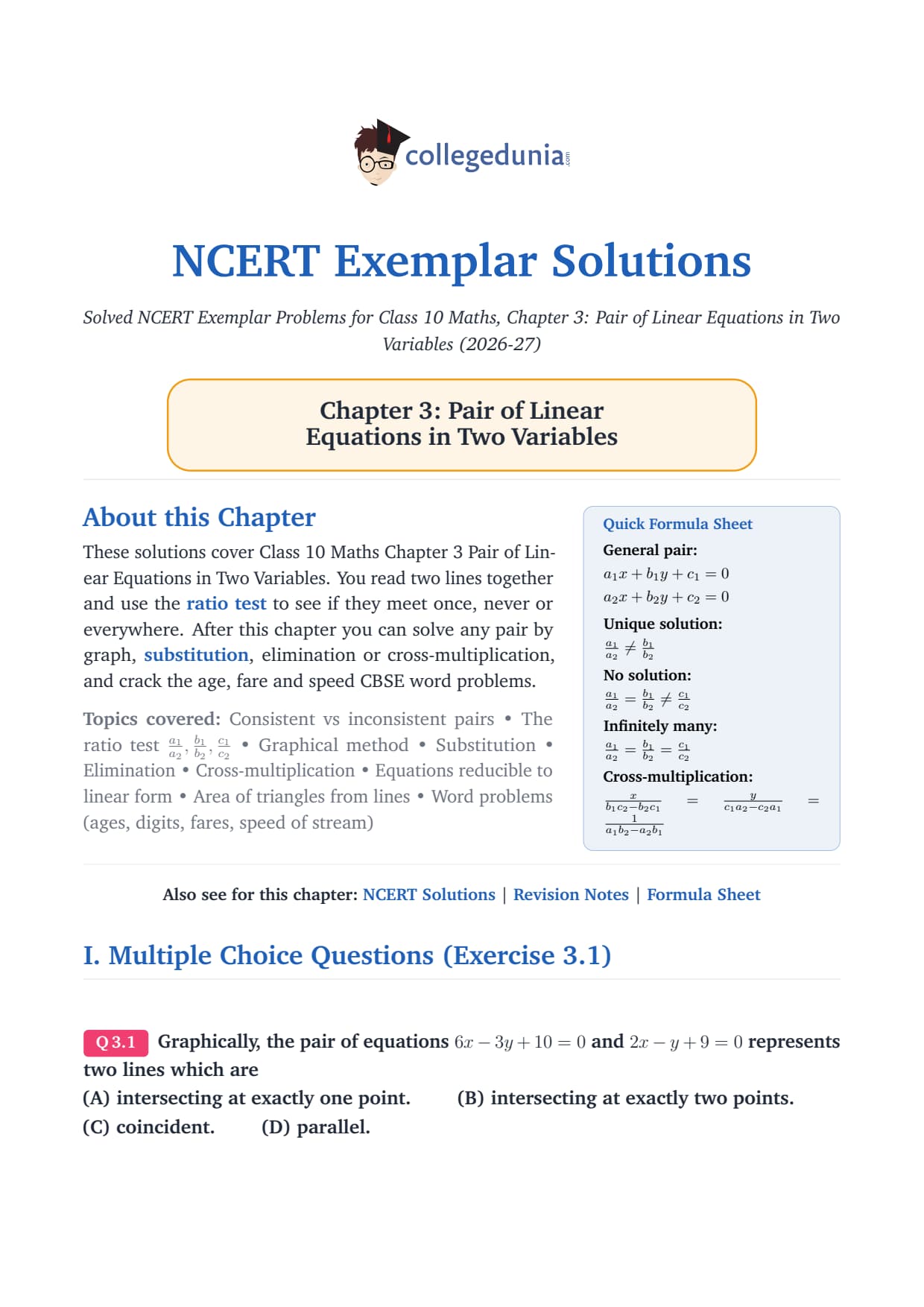
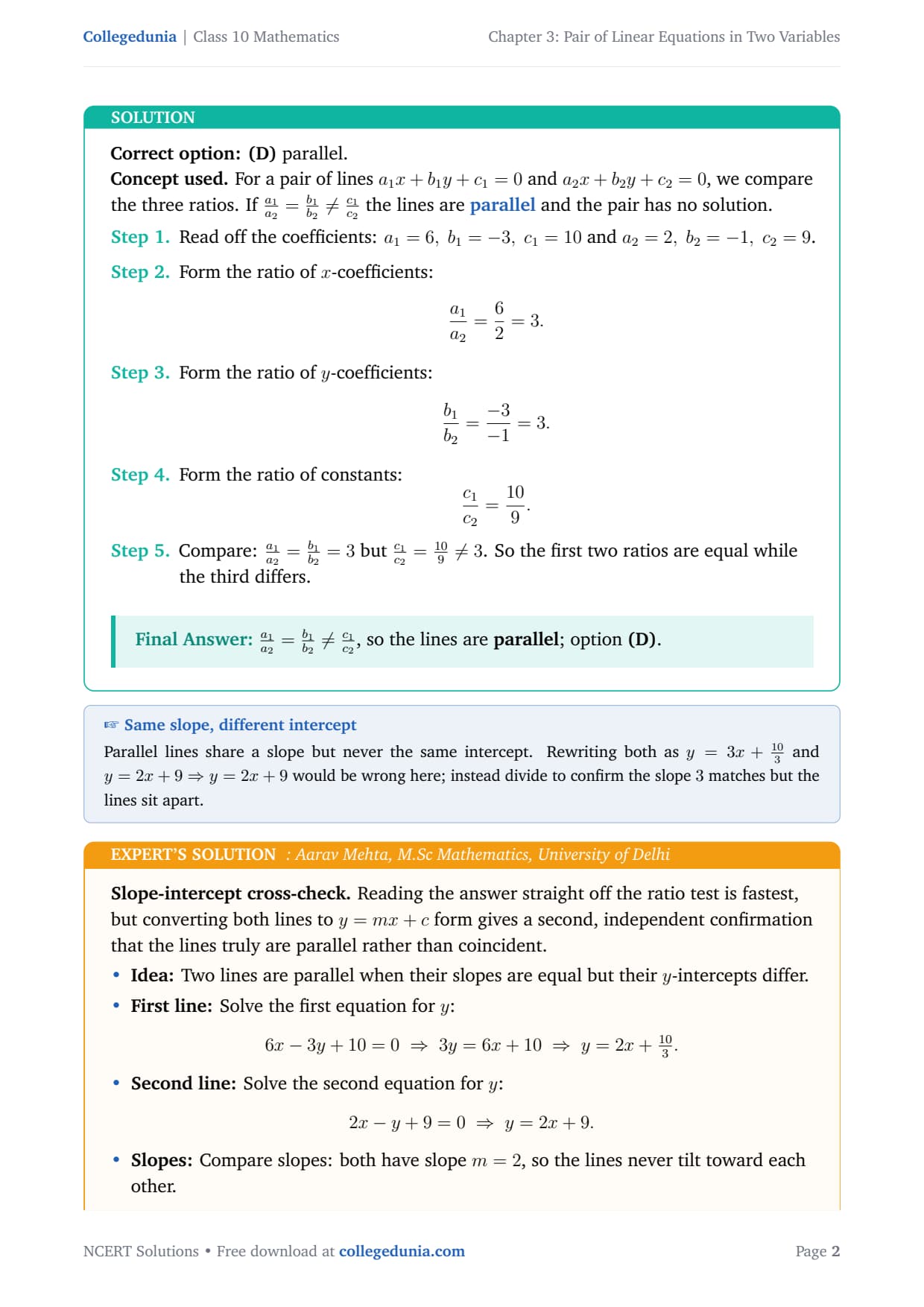
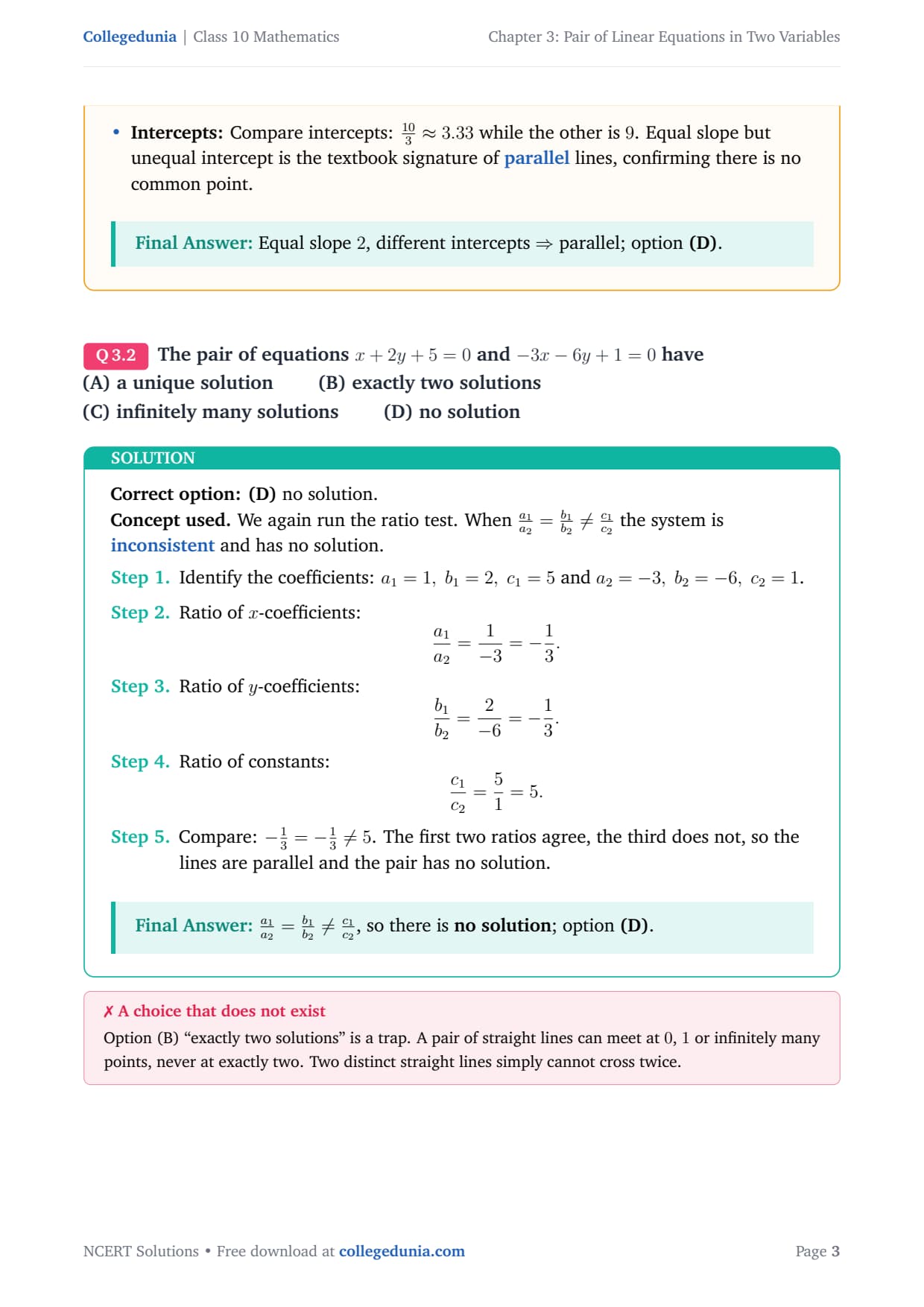
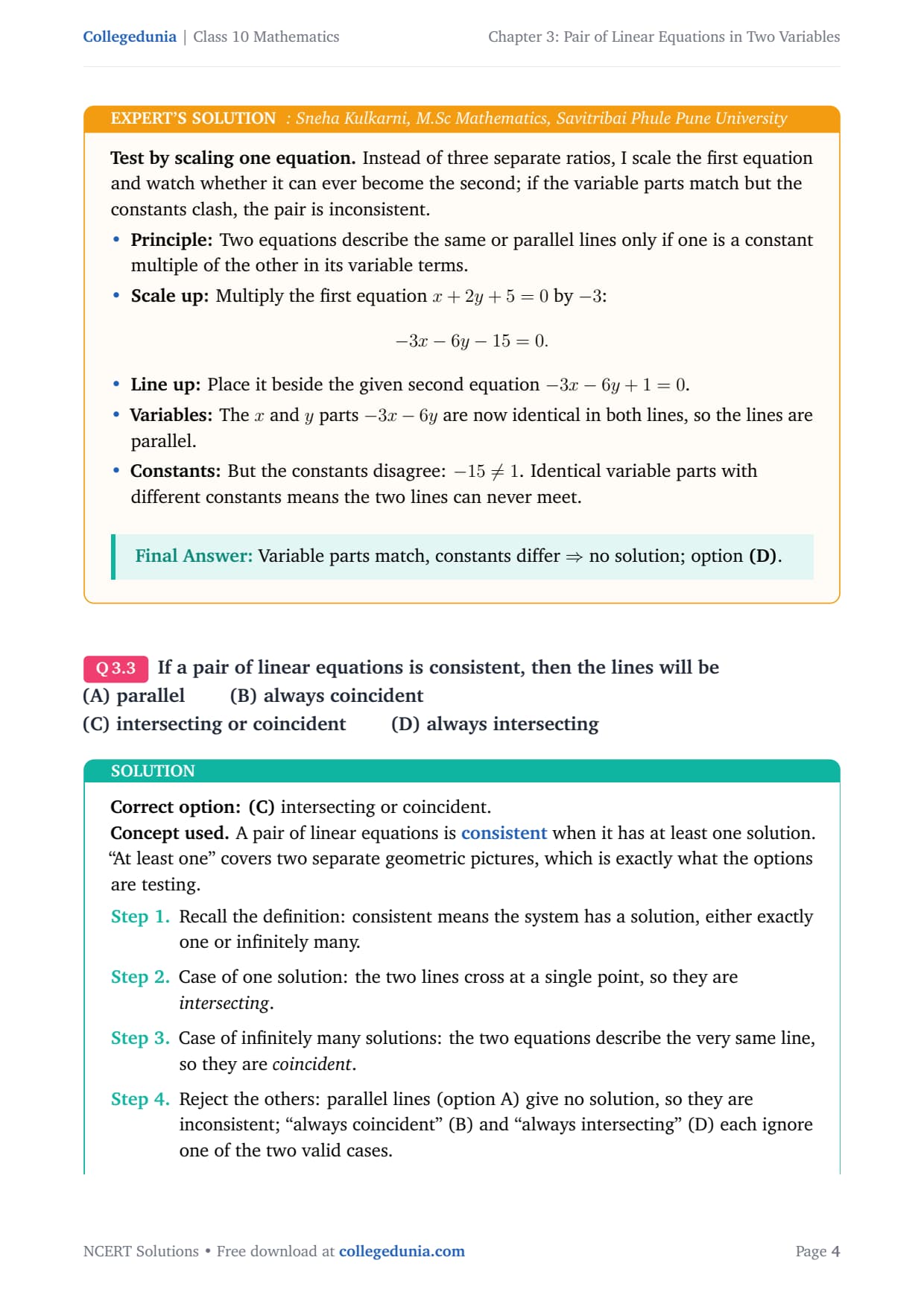
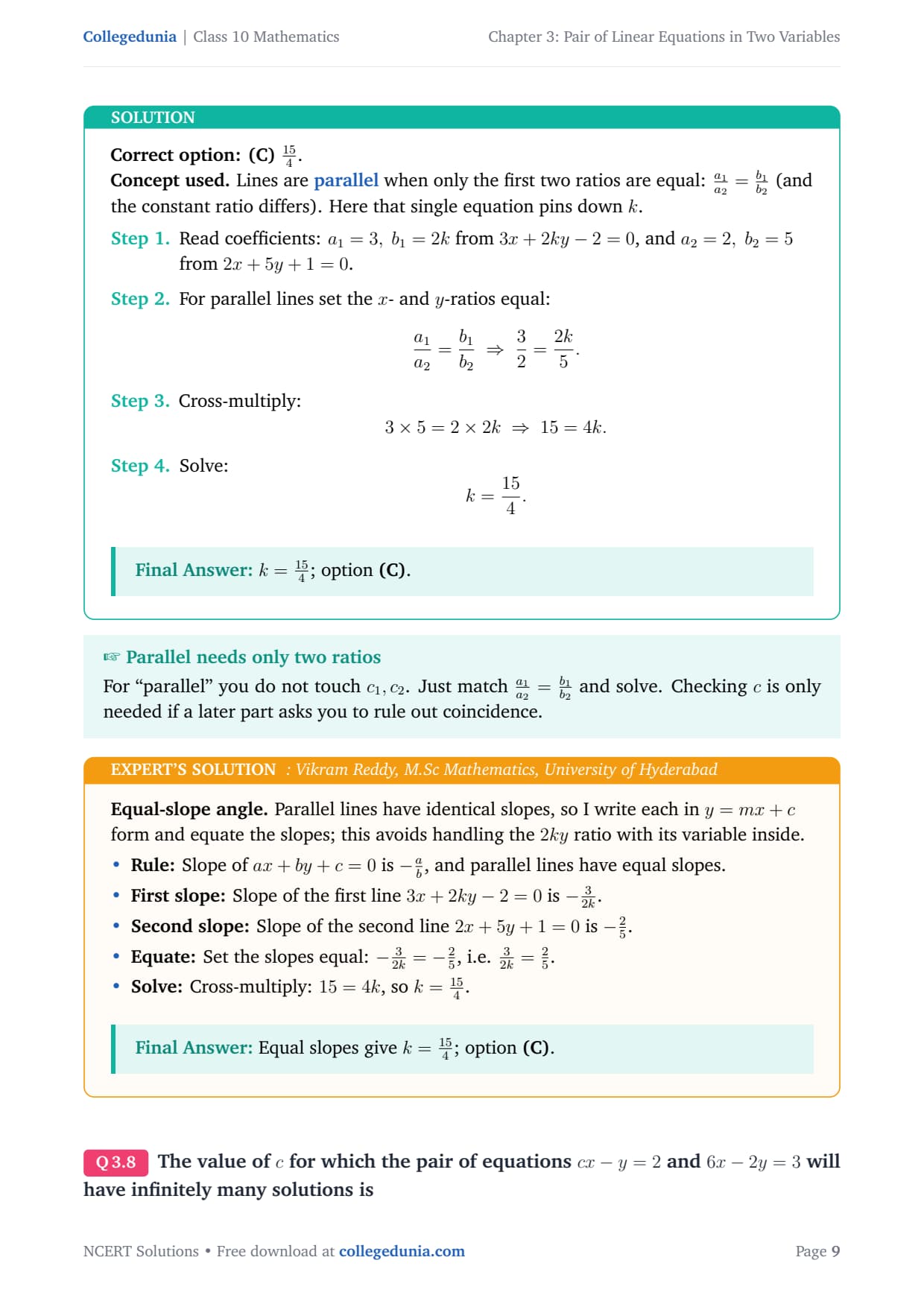
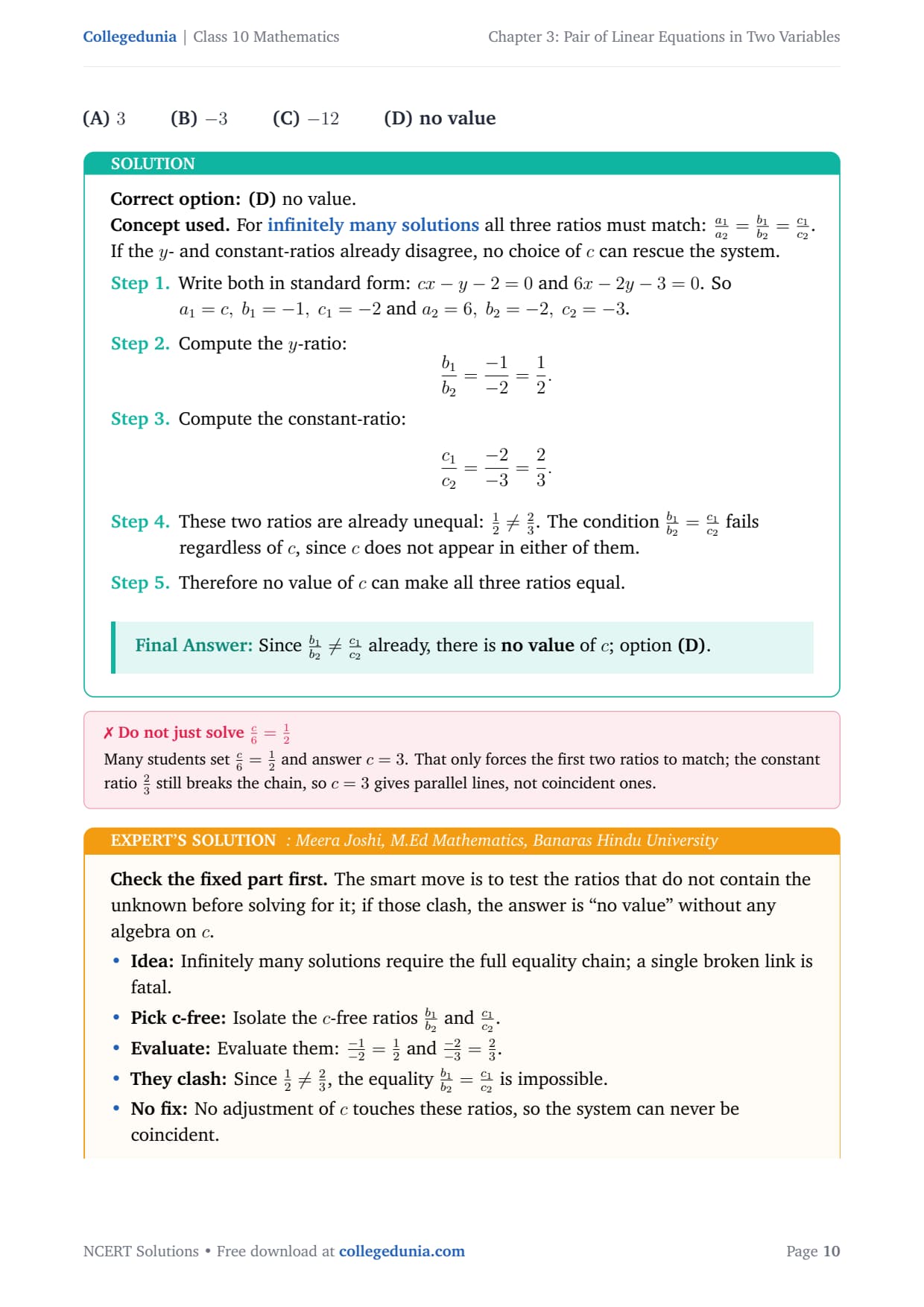
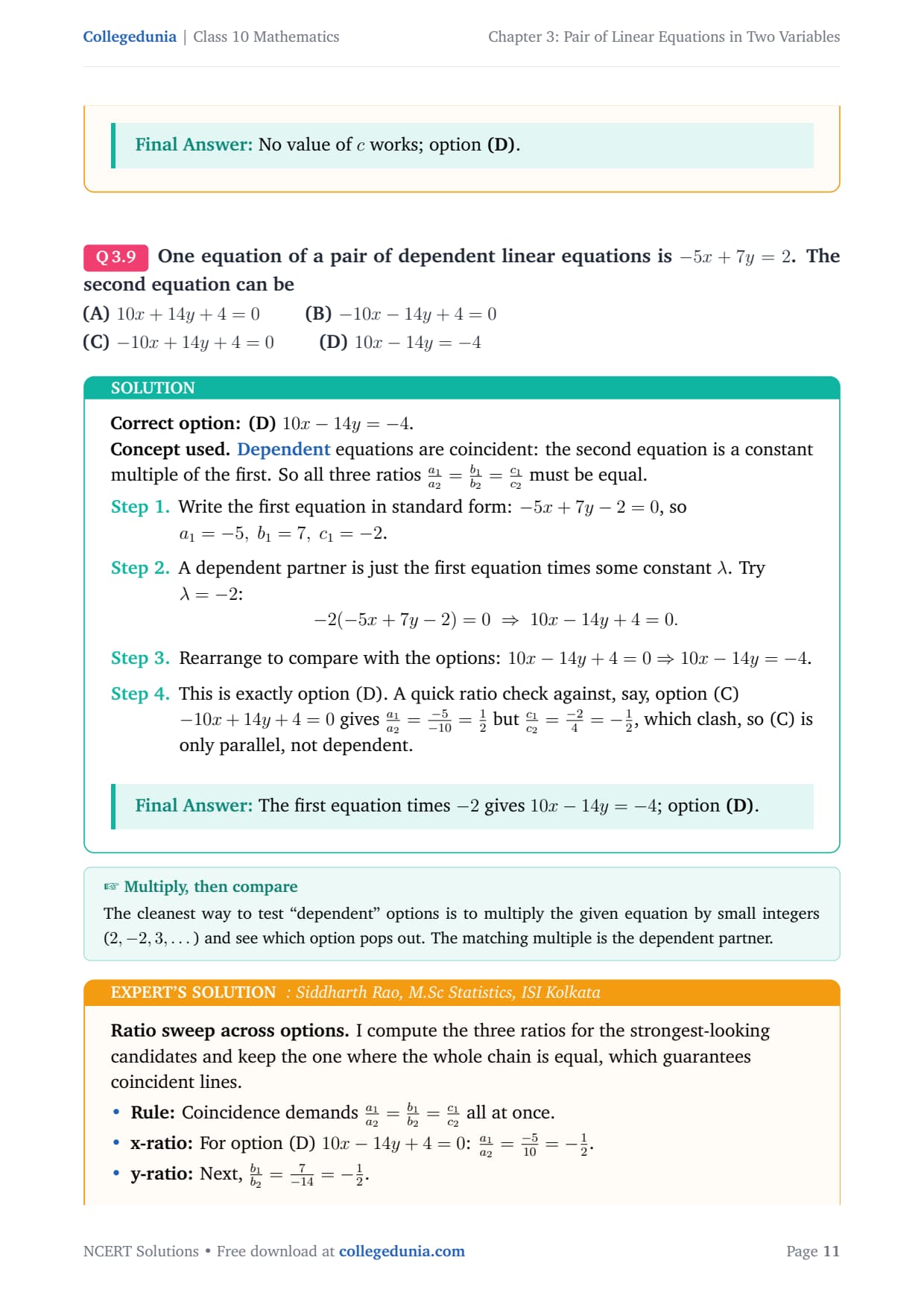
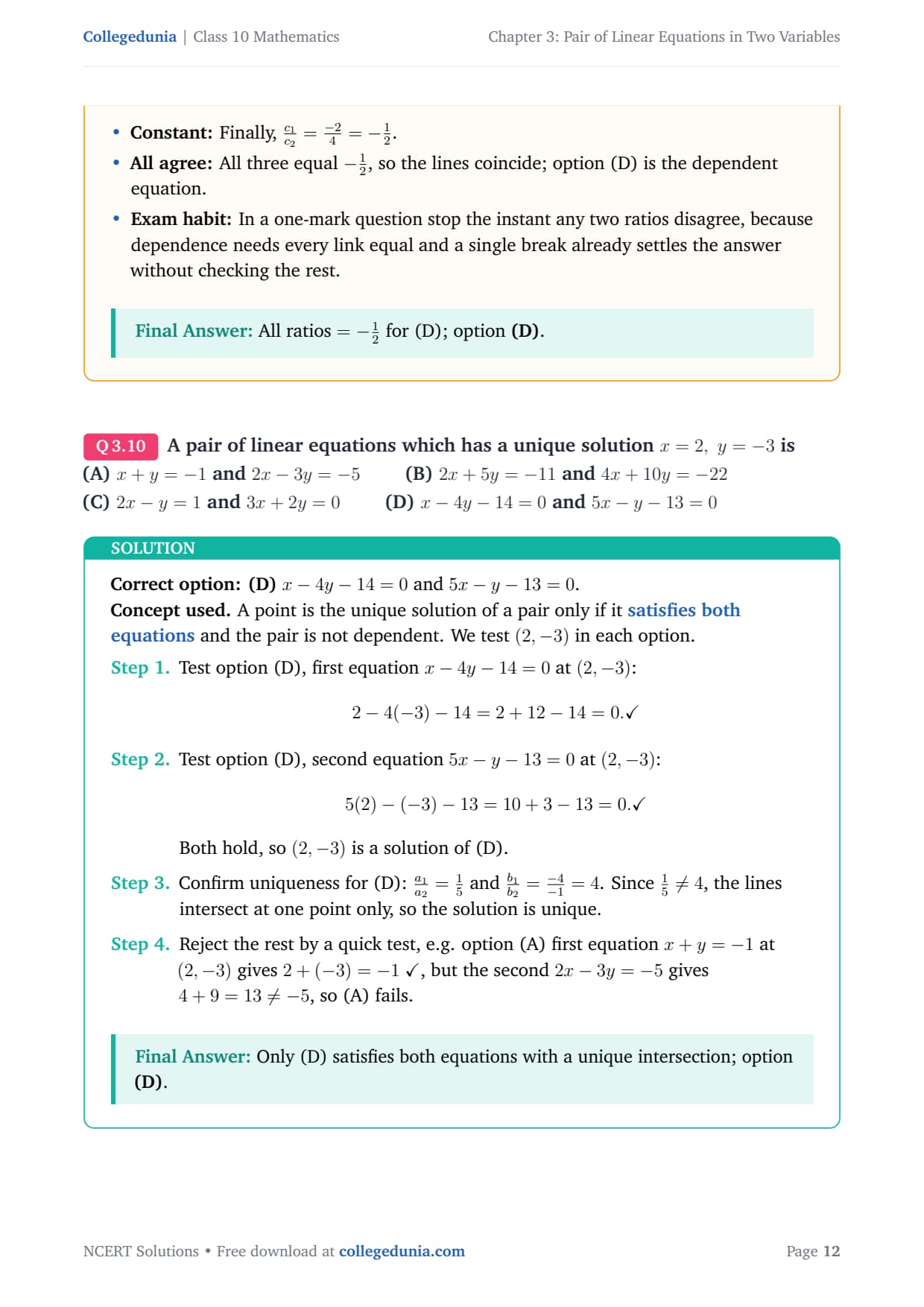
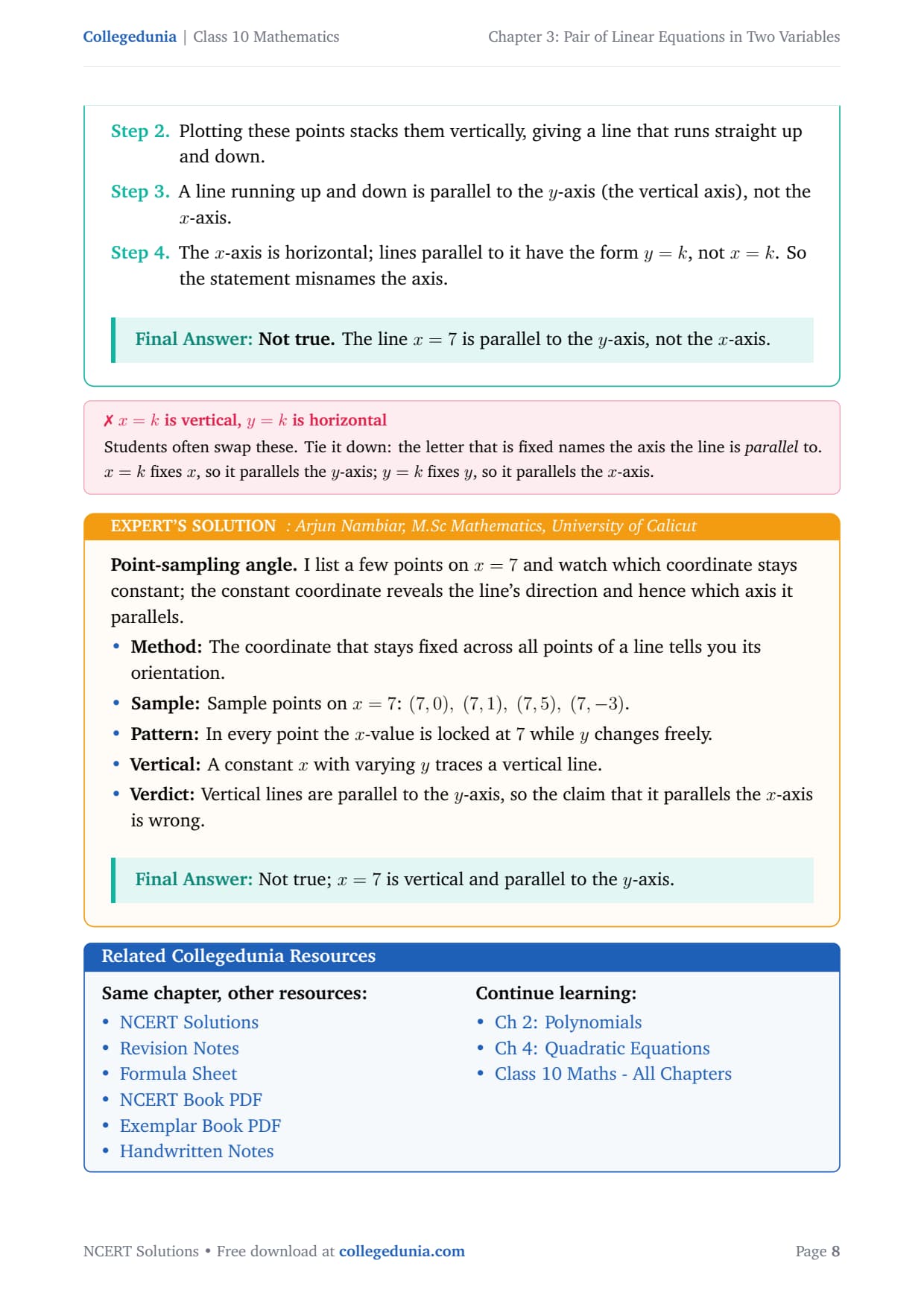
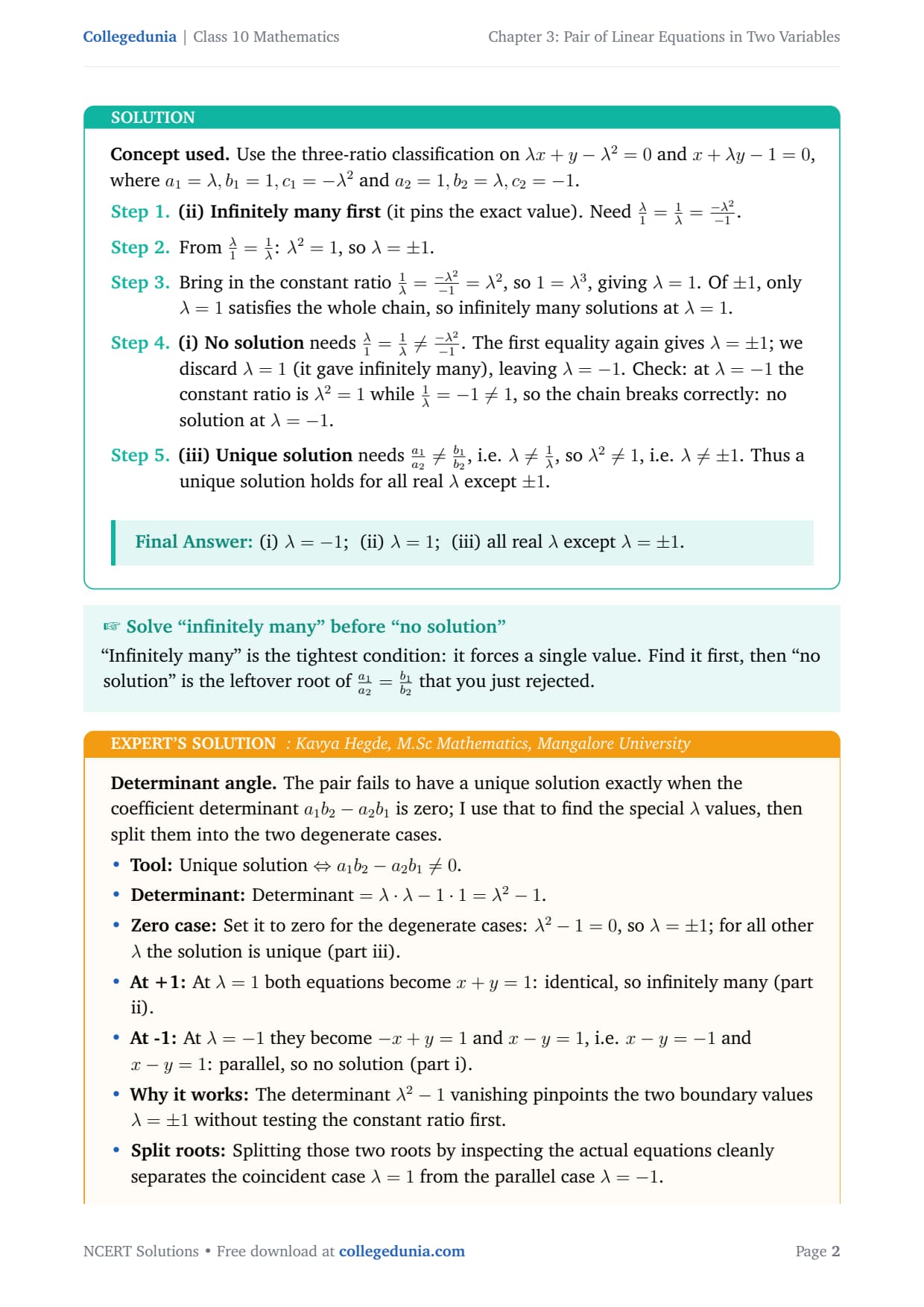
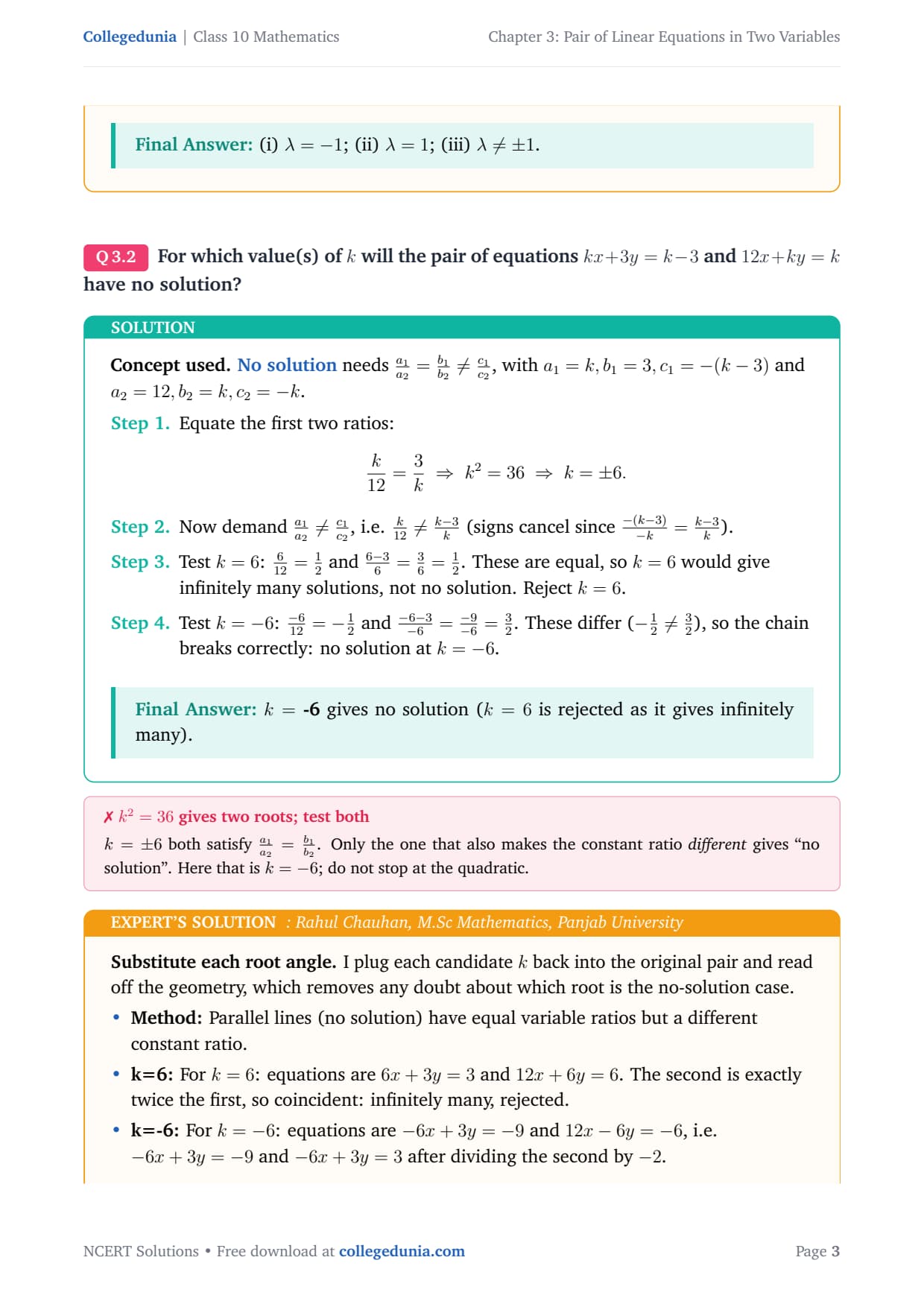
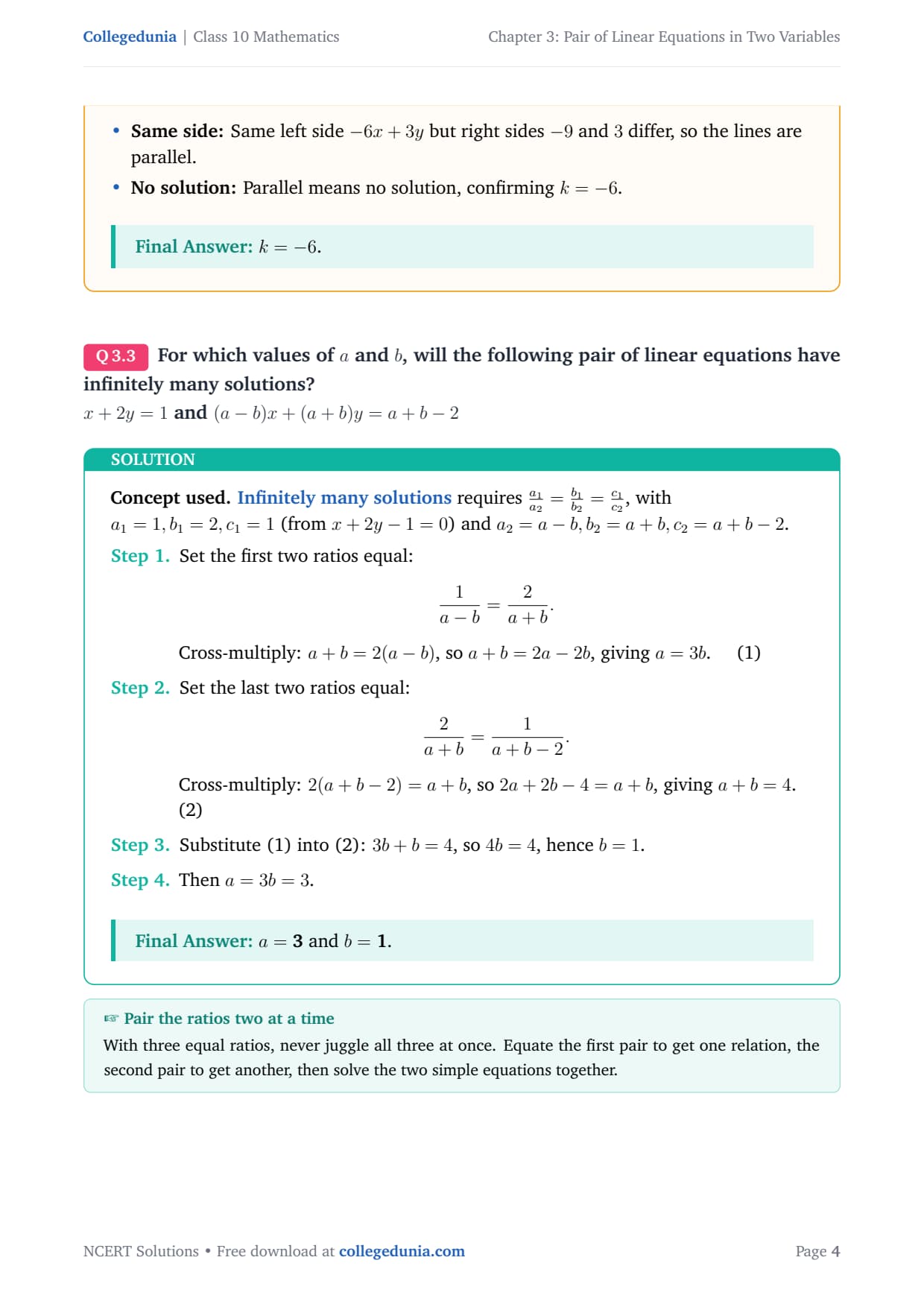
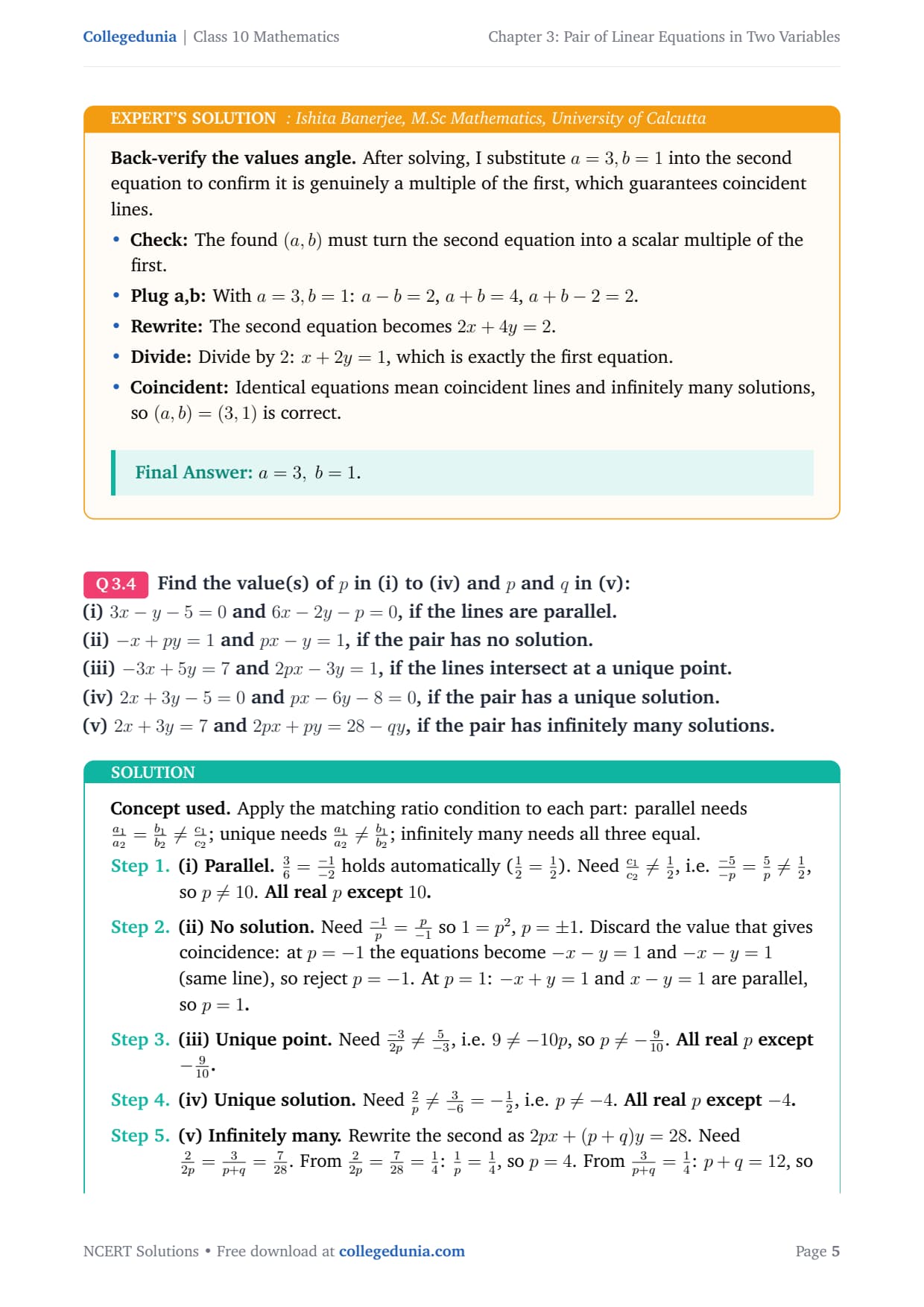
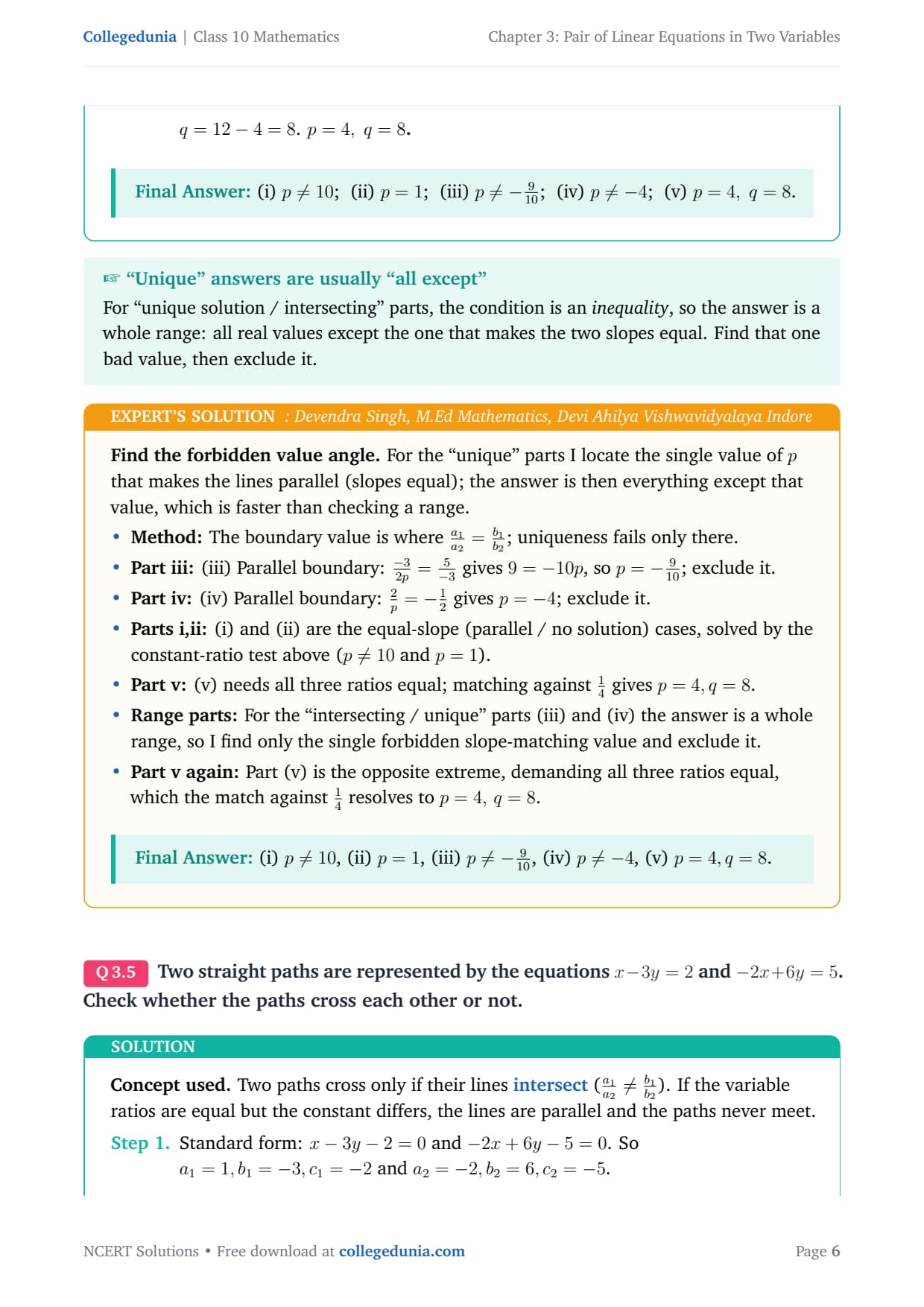
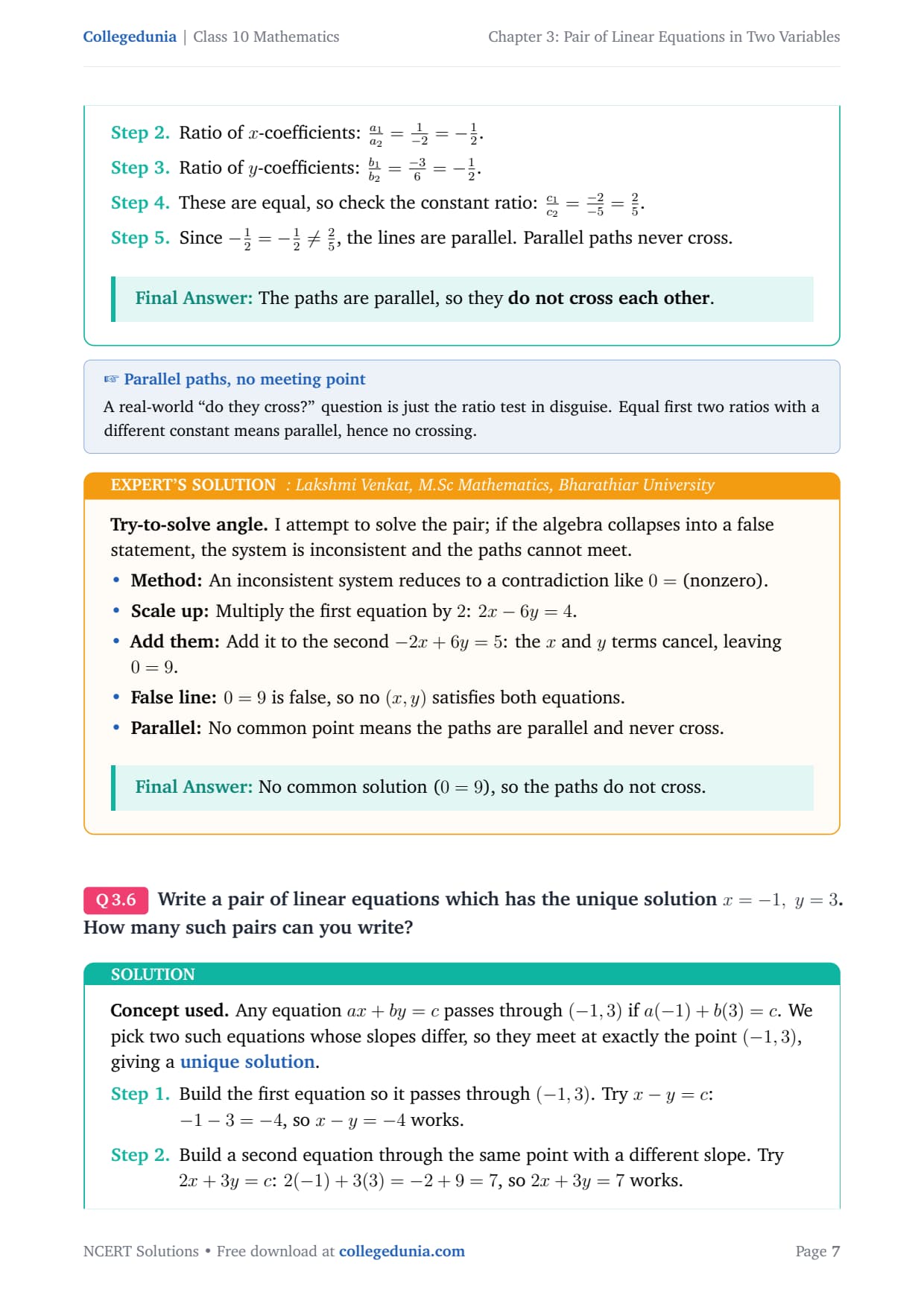
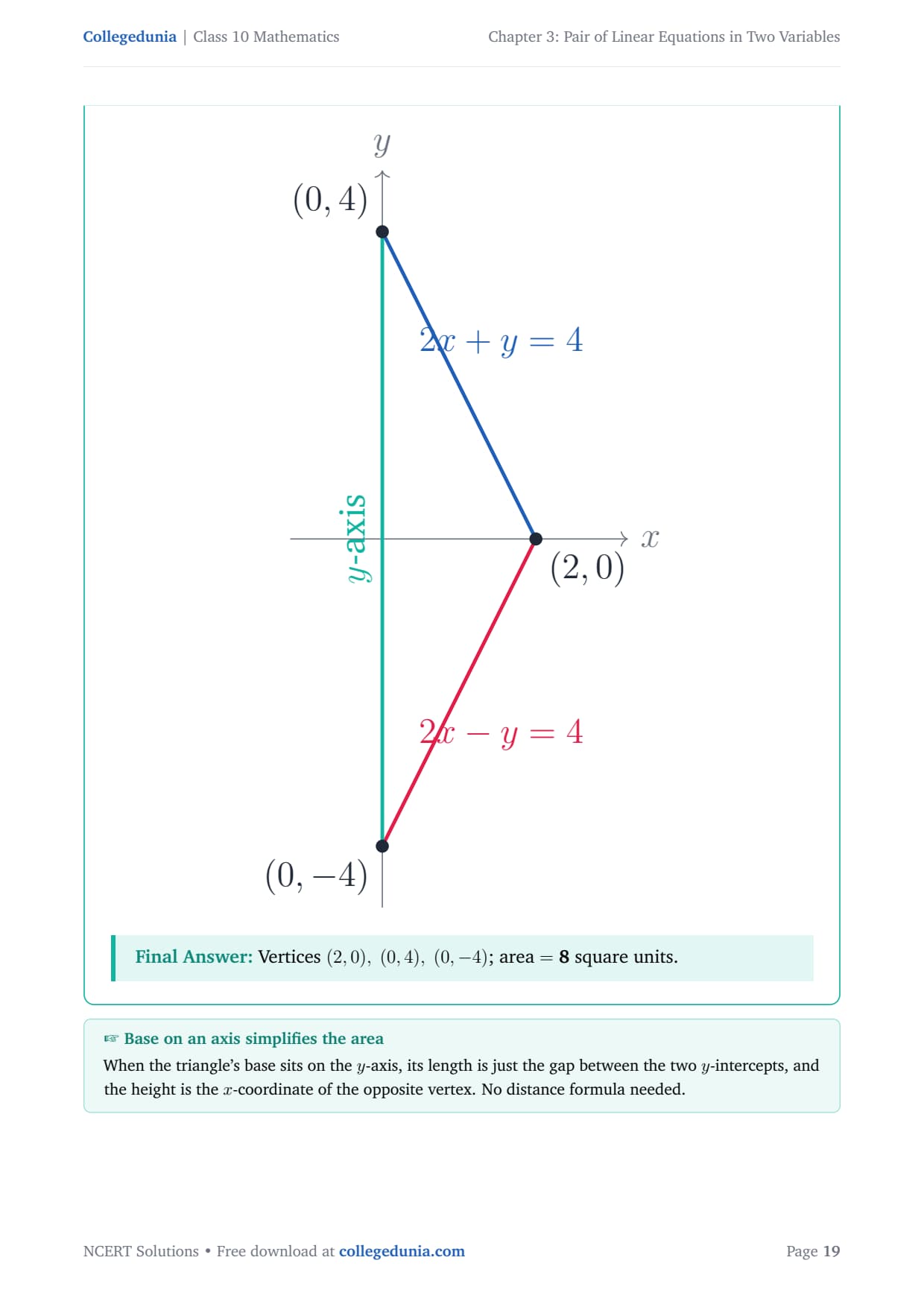
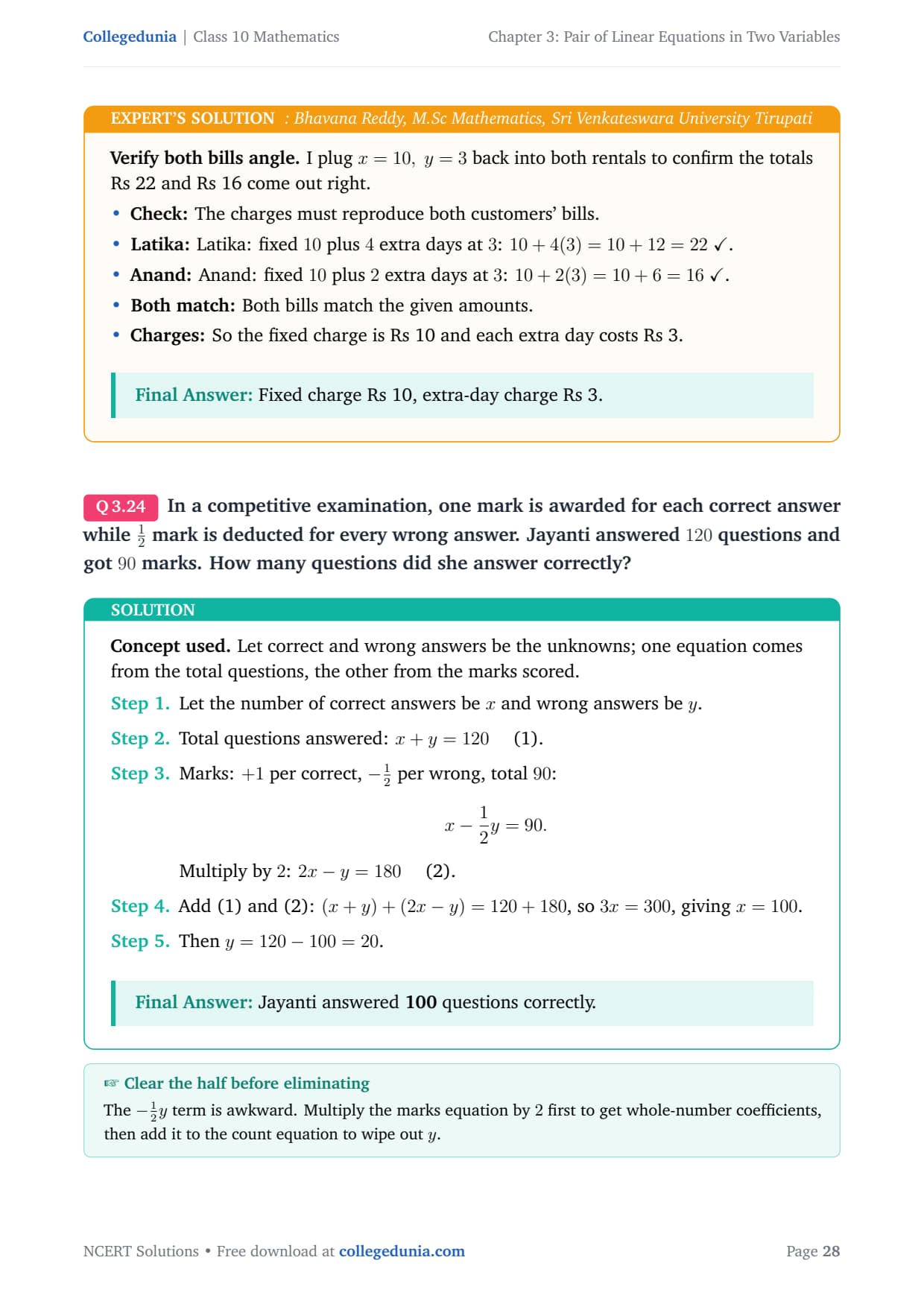
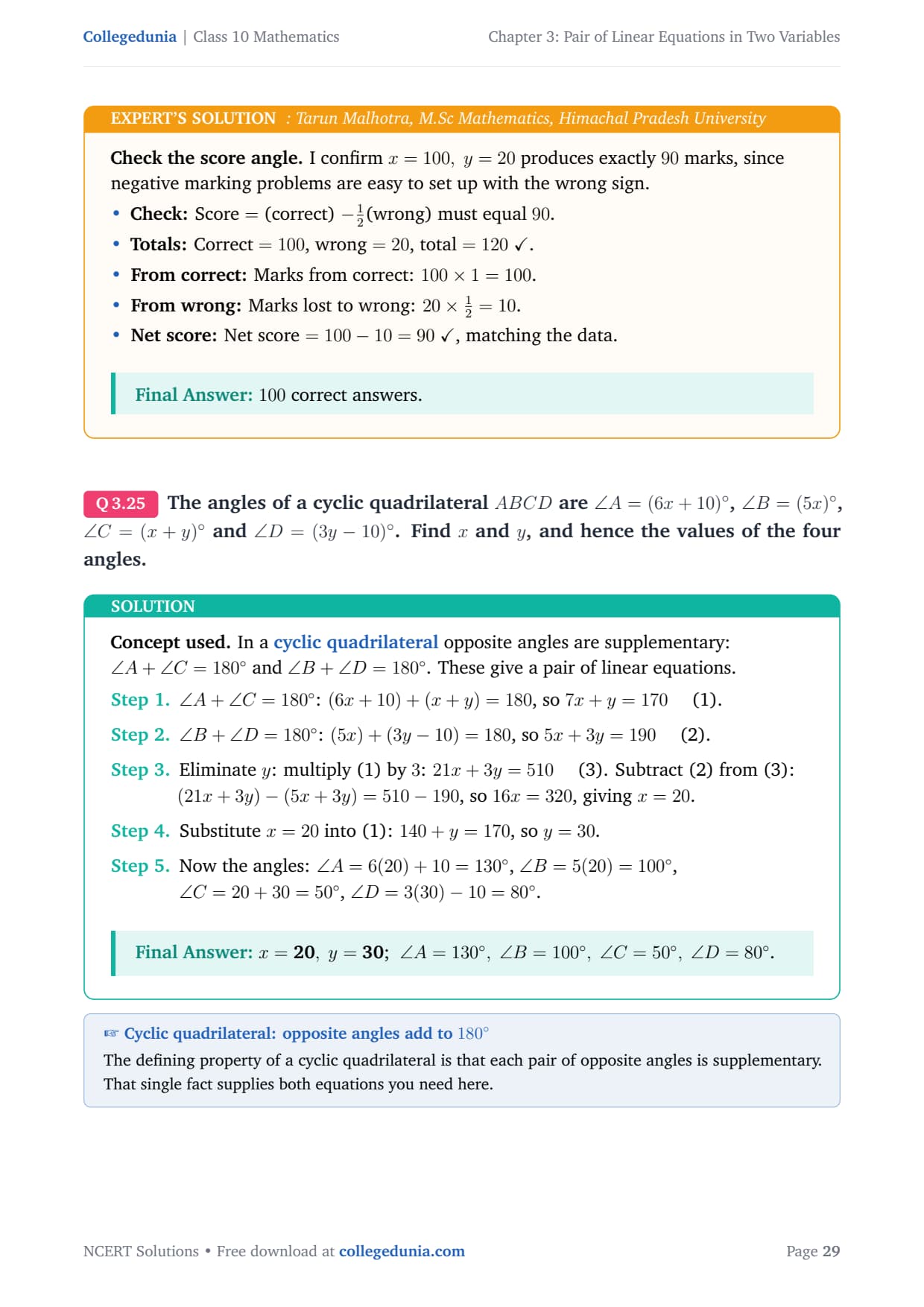
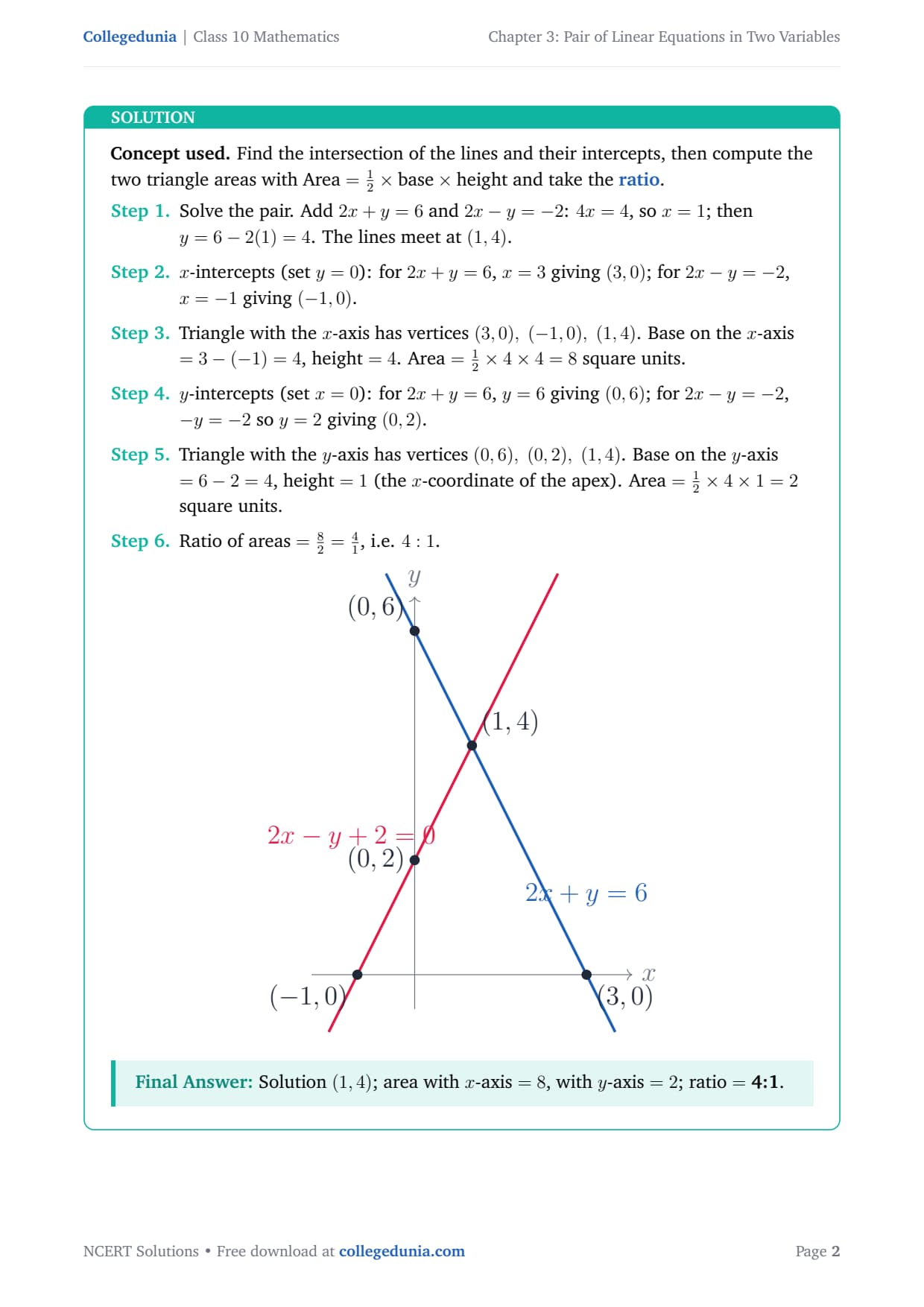
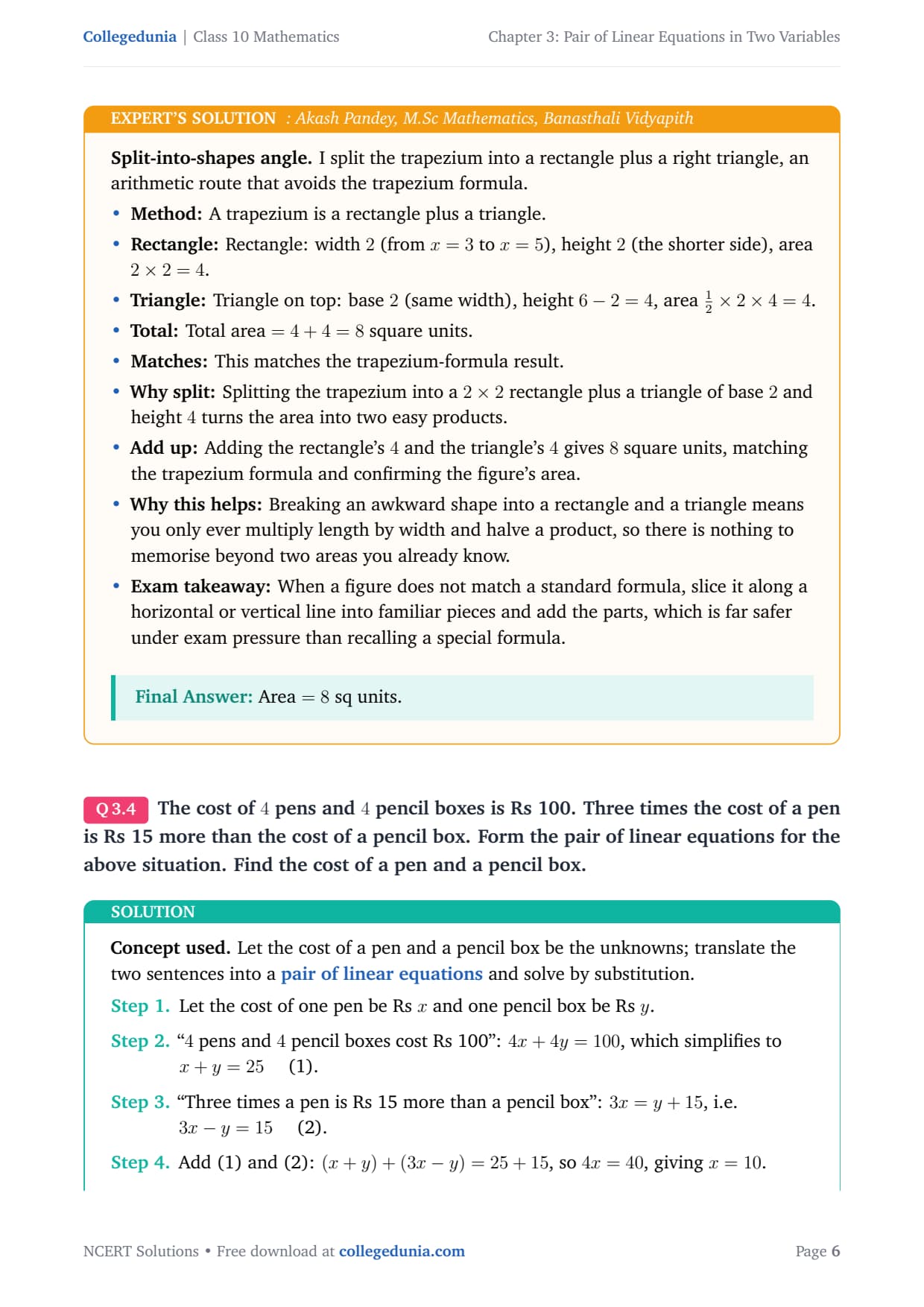
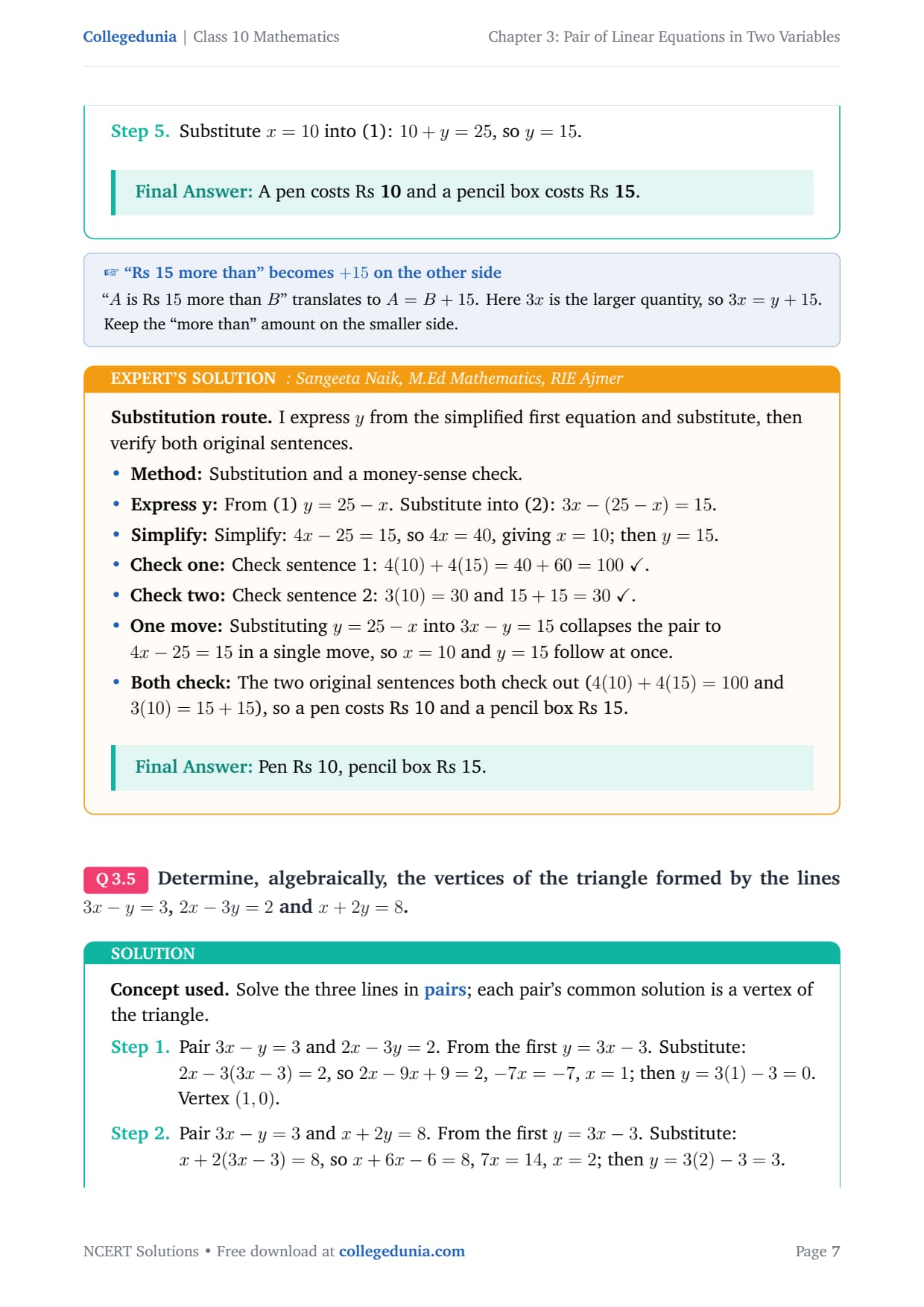
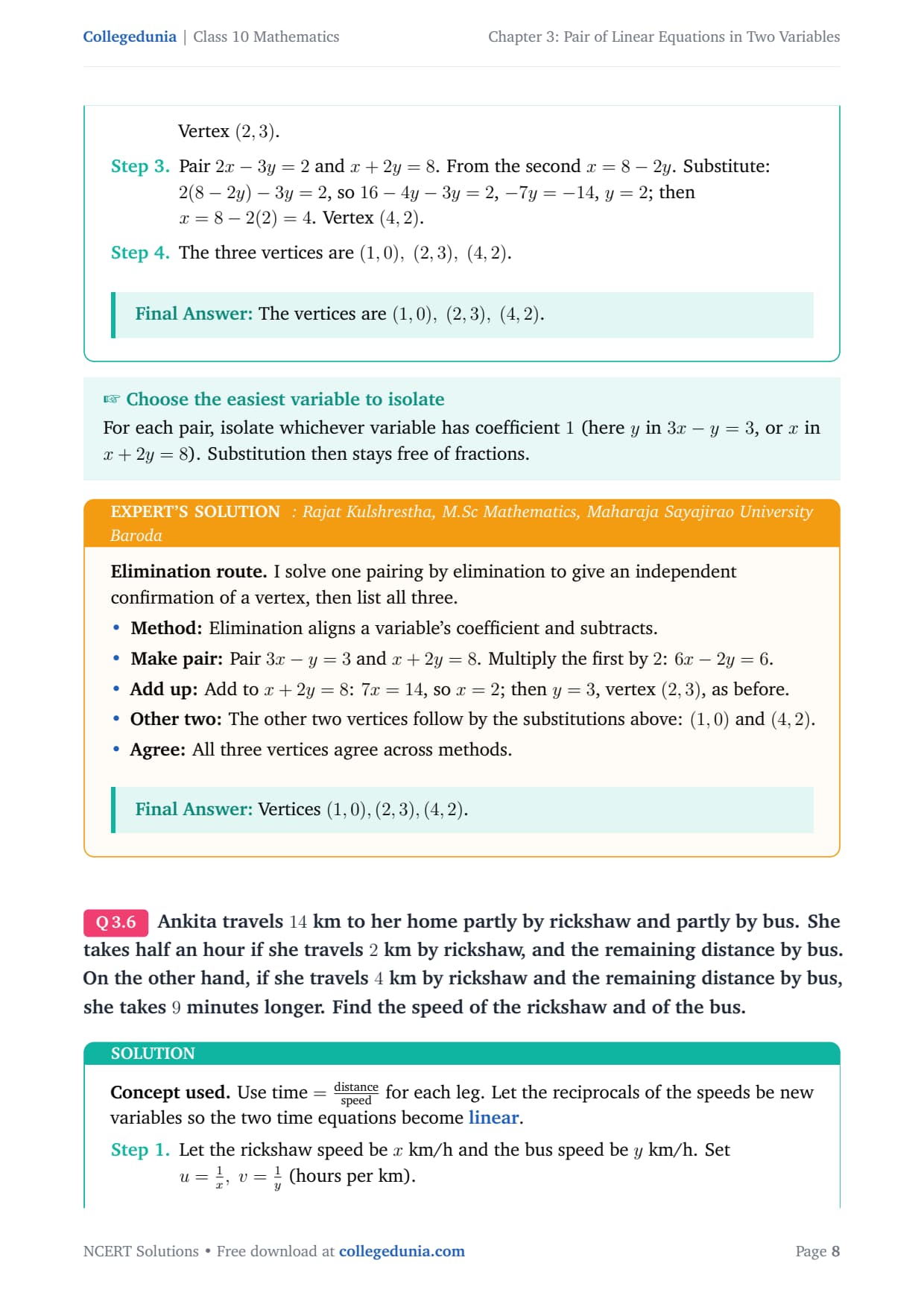
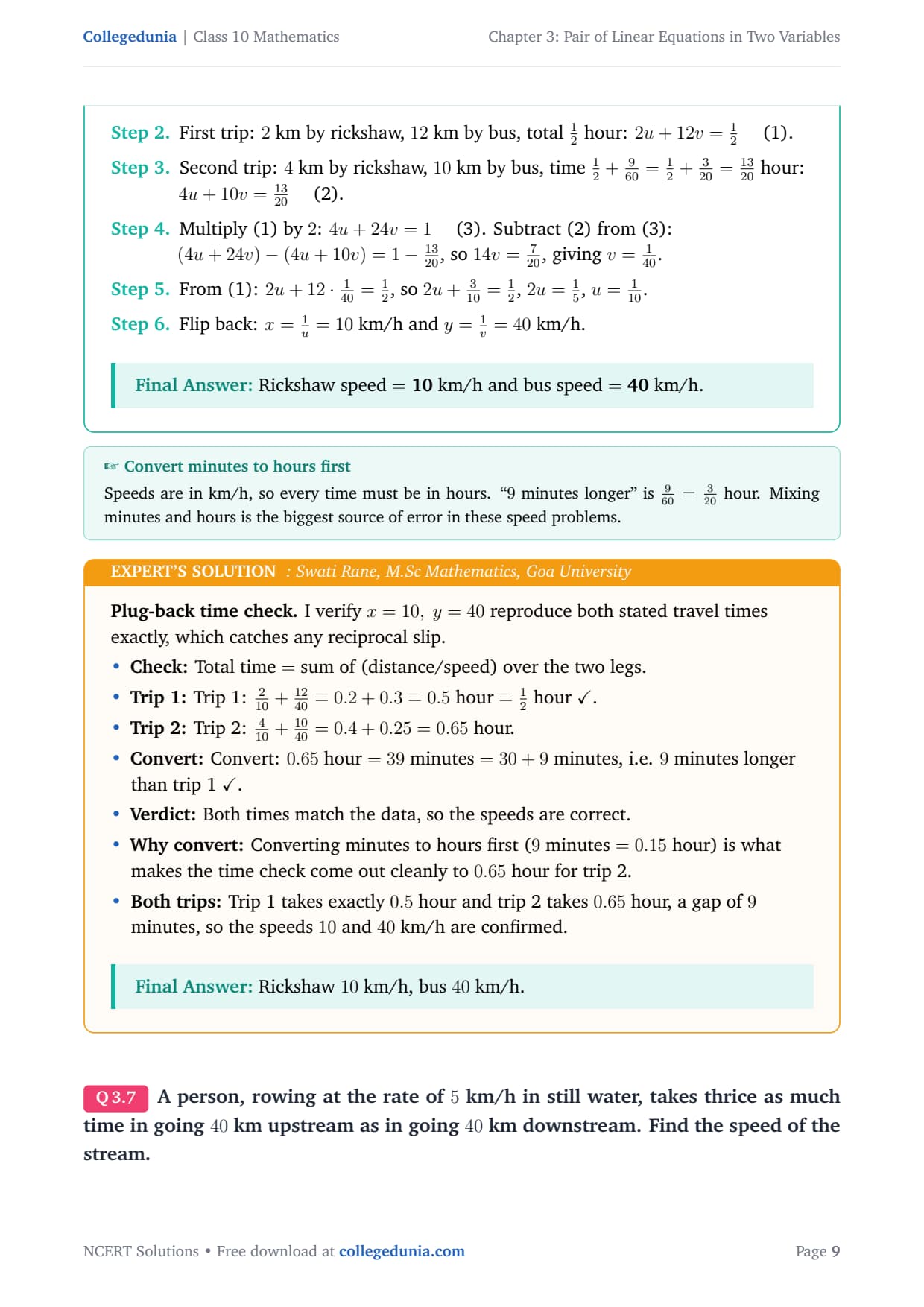
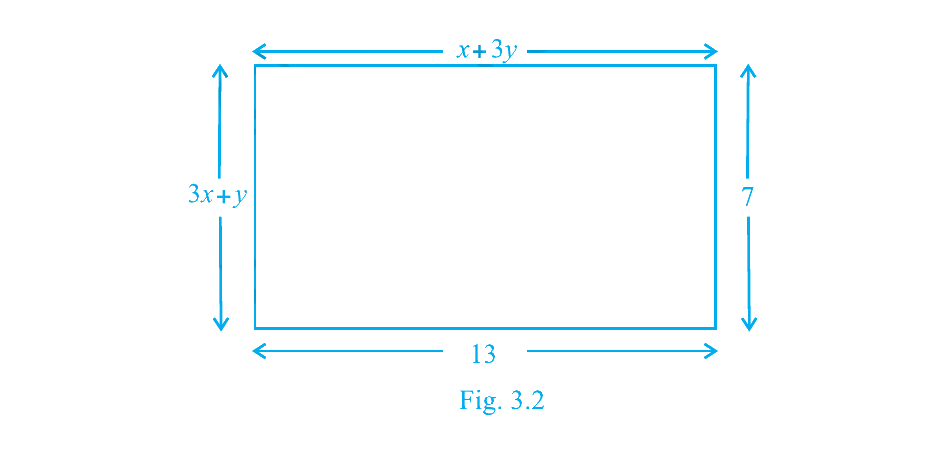



Comments