Polynomials is the chapter where students lose marks on finding zeroes, especially when a coefficient is a surd or a fraction. These NCERT Exemplar Solutions for Class 10 Maths Chapter 2 Polynomials Exercise 2.3 cover all 10 Short Answer questions (Q24 to Q33). Each one has step-by-step factorisation and verification, set to the 2026-27 CBSE syllabus.
10 Short Answer questions - Q24 to Q33 - covering quadratic and cubic polynomials with integer, fractional and surd coefficients.
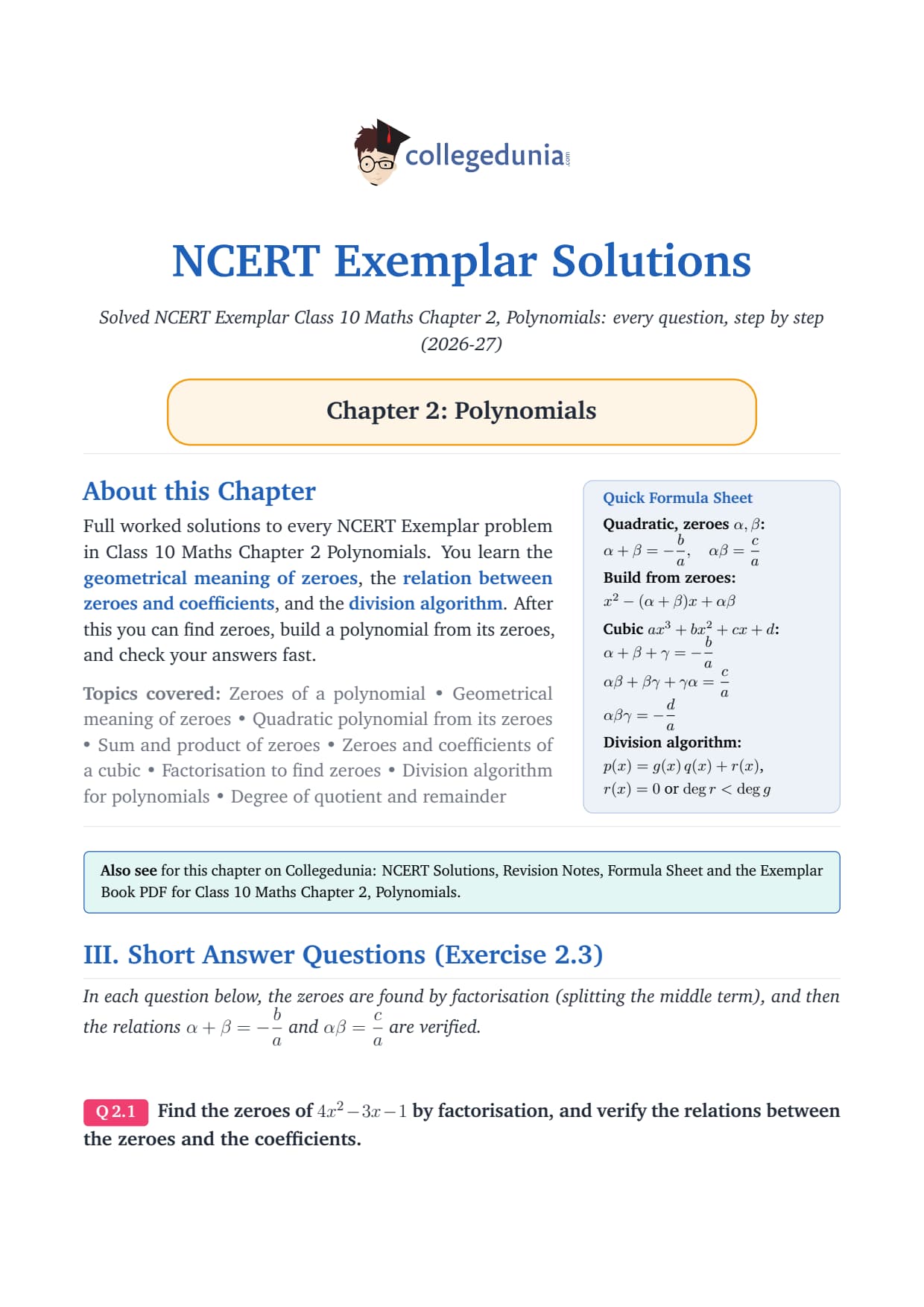
Every question uses split-the-middle-term factorisation, then verifies the sum and product of zeroes against α + β = -ba and αβ = ca.
Q27 is a cubic, verified with all three cubic relations, including the pair-product sum.
Each solution here is written by subject experts, mapped to the 2026-27 rationalised NCERT, and checked against CBSE board paper patterns.
Solved by Collegedunia - Every solution below follows the CBSE marker checklist: split identification, factorisation steps, both verification relations, and a boxed final answer.
What Polynomials Exercise 2.3 Covers in Class 10 Maths
Exercise 2.3 is the Short Answer set of Chapter 2. It has 10 questions (Q24 to Q33). Each one asks you to find the zeroes by factorisation, then verify two relations between the zeroes and the coefficients.
Q24 to Q26: quadratics with integer coefficients - standard split-the-middle-term drill.
Q27: a cubic polynomial - take out the common factor t first, then factor the resulting quadratic. Three verification relations instead of two.
Q28 and Q33: quadratics with fractional coefficients - multiply through to clear fractions, then factor. Verification uses the original coefficients, not the scaled ones.
Q29 to Q31: quadratics with surd coefficients (√2, √3) - the split-the-middle method still works; keep the surd as a symbol throughout.
Q32: fraction and surd together - clear the fraction first, then handle the surd by the usual split.
This set builds on the geometrical meaning of zeroes from Exercise 2.1 and the True/False reasoning from Exercise 2.2. Master it, and Exercise 2.4 (Division Algorithm) feels easy.
Zeroes and Coefficients Formulas
Every question here checks the same two relations (three for cubics). Learn these before you attempt any question.
Polynomial Type
Relation
Formula
Quadraticax2 + bx + c
Sum of zeroes
α + β = -ba
Product of zeroes
αβ = ca
Cubicat3 + bt2 + ct + d
Sum of zeroes
α + β + γ = -ba
Sum of products (pairs)
αβ + γ + γα = ca
Product of zeroes
αγ = -da
Important: For questions with fractional or surd coefficients, always verify using the original a, b, c - not the scaled values used to factor.
The Factorisation Method, Step by Step
The CBSE marker wants every step shown: the split, the grouping, the zeroes, and both verification checks. Skipping any step loses marks. Here is the exact routine:
Find a, b, c from the polynomial.
Compute a × c and find two numbers with that product and whose sum equals b. If coefficients are fractions, multiply through first to clear them.
Split the middle term using those two numbers.
Group in pairs and take out common factors to get two linear brackets.
Read the zeroes from the two brackets. Rationalise if the zero has a surd in the denominator.
Write the sum check explicitly: compute α + β and compare with -ba.
Write the product check explicitly: compute αβ and compare with ca.
Topic-wise Breakdown
The 10 questions cover four coefficient types. Practise each type on its own before mixing them up.
Question(s)
Coefficient Type
Key Technique
Degree
Q24, Q25, Q26
Integer coefficients
Standard split-the-middle
Quadratic
Q27
Integer, no constant
Take out common t, then split; verify 3 cubic relations
Cubic
Q28, Q33
Fractional coefficients
Clear fractions by scaling; verify with original a, b, c
Quadratic
Q29, Q30, Q31
Surd coefficients
Treat surd as a symbol; rationalise the final zero
Quadratic
Q32
Fraction + surd
Clear fraction first, then handle surd; use original a, b, c for verification
Quadratic
All Exercise 2.3 Solutions with Step-by-Step Answers
III. Short Answer Questions (Exercise 2.3)
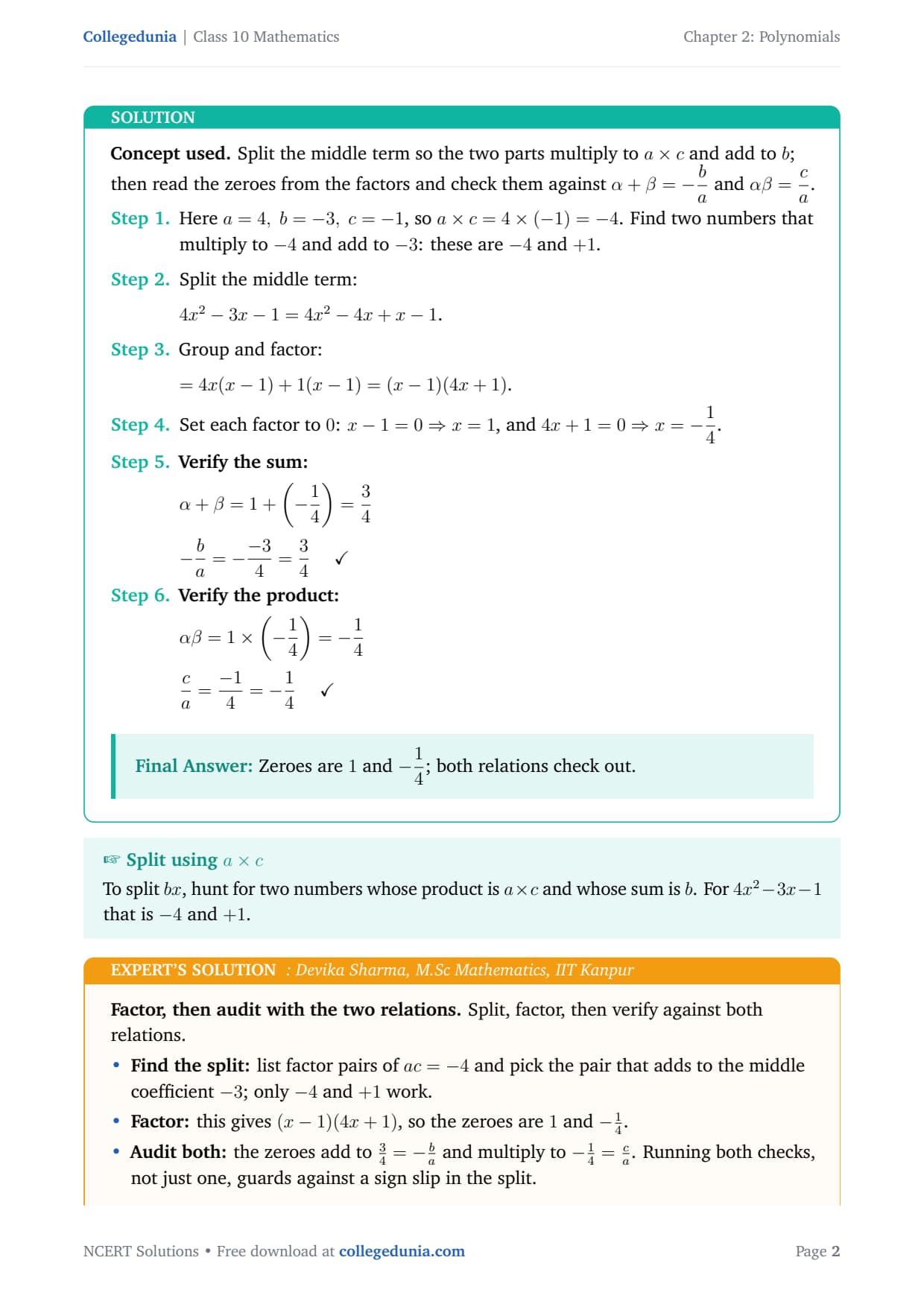
Q 2.1
Find the zeroes of 4x2-3x-1 by factorisation, and verify the relations between the zeroes and the coefficients.
Concept used. Split the middle term so the two parts multiply to
a× c and add to b; then read the zeroes from the factors and
check them against α+β=-ba and
αβ=ca.
Here a=4, b=-3, c=-1, so a× c=4×(-1)=-4. Find two
numbers that multiply to -4 and add to -3: these are
-4 and +1.
Split the middle term:
[] 4x2-3x-1=4x2-4x+x-1.
Group and factor:
[] =4x(x-1)+1(x-1)=(x-1)(4x+1).
Set each factor to 0: x-1=0⇒ x=1, and
4x+1=0⇒ x=-14.
Verify the sum:
[] α+β=1+(-14)=34
[] -ba=--34=34
Verify the product:
[] αβ=1×(-14)=-14
[] ca=-14=-14
Zeroes are 1 and -14; both relations check out.
DS
Devika Sharma
M.Sc Mathematics, IIT Kanpur
Verified Expert
Factor, then audit with the two relations. Split, factor, then
verify against both relations.
Find the split: list factor pairs of ac=-4 and pick the
pair that adds to the middle coefficient -3; only -4 and +1
work.
Factor: this gives (x-1)(4x+1), so the zeroes are 1
and -14.
Audit both: the zeroes add to 34=-ba
and multiply to -14=ca. Running both checks, not
just one, guards against a sign slip in the split.
Zeroes 1 and -14.
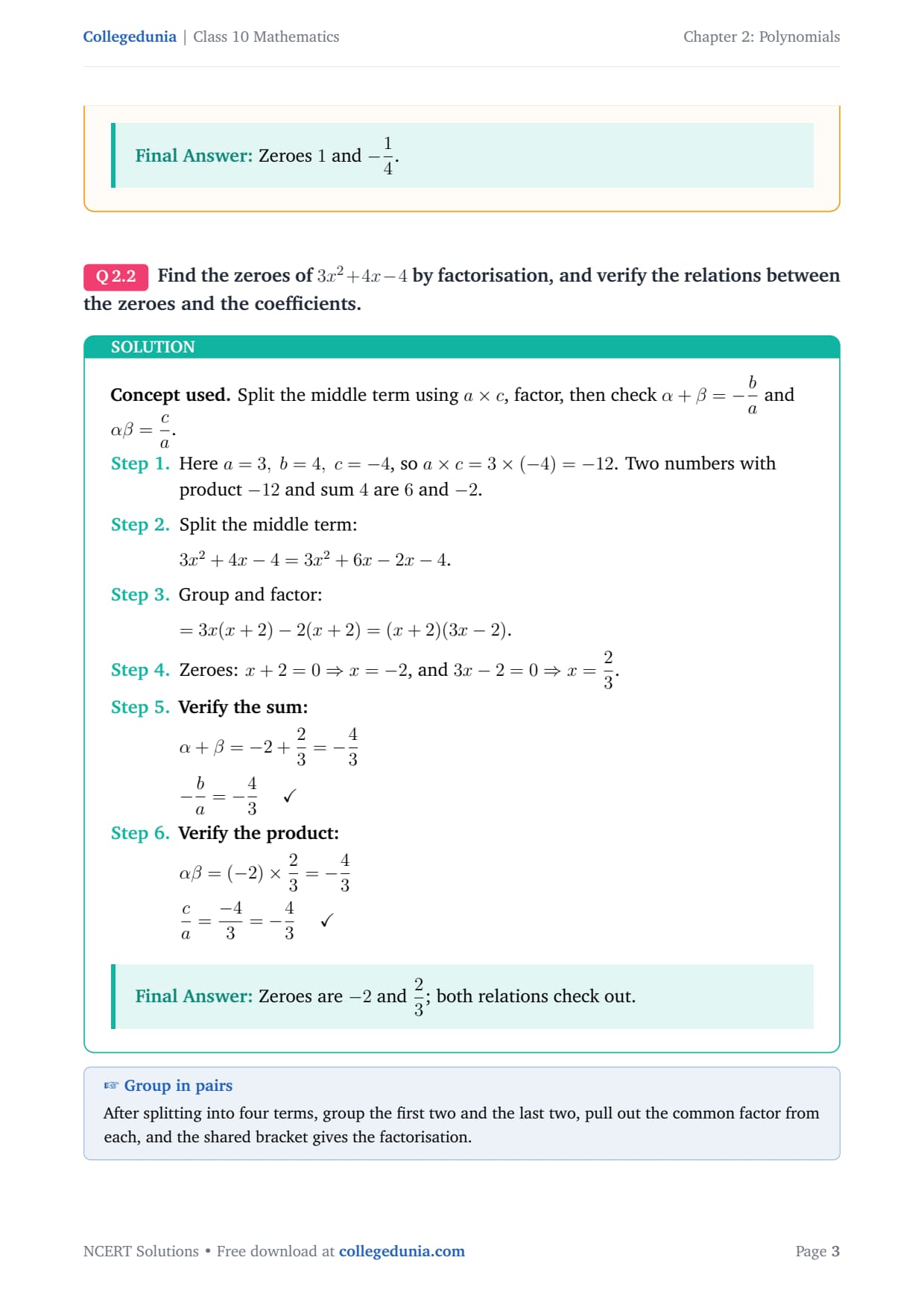
Q 2.2
Find the zeroes of 3x2+4x-4 by factorisation, and verify the relations between the zeroes and the coefficients.
Concept used. Split the middle term using a× c, factor,
then check α+β=-ba and αβ=ca.
Here a=3, b=4, c=-4, so a× c=3×(-4)=-12. Two
numbers with product -12 and sum 4 are 6 and -2.
Split the middle term:
[] 3x2+4x-4=3x2+6x-2x-4.
Group and factor:
[] =3x(x+2)-2(x+2)=(x+2)(3x-2).
Zeroes: x+2=0⇒ x=-2, and
3x-2=0⇒ x=23.
Verify the sum:
[] α+β=-2+23=-43
[] -ba=-43
Verify the product:
[] αβ=(-2)×23=-43
[] ca=-43=-43
Zeroes are -2 and 23; both relations check out.
TK
Tara Krishnan
M.Sc Mathematics, University of Delhi
Verified Expert
Split with product -12, sum 4. A clean split makes the
factorisation almost immediate.
Split: the pair 6 and -2 has product -12 and sum
4, so it breaks the middle term cleanly.
Factor: this gives (x+2)(3x-2), with zeroes -2 and
23.
Verify: the sum -43 equals -ba and
the product -43 equals ca, so the zeroes are
right.
Zeroes -2 and 23.
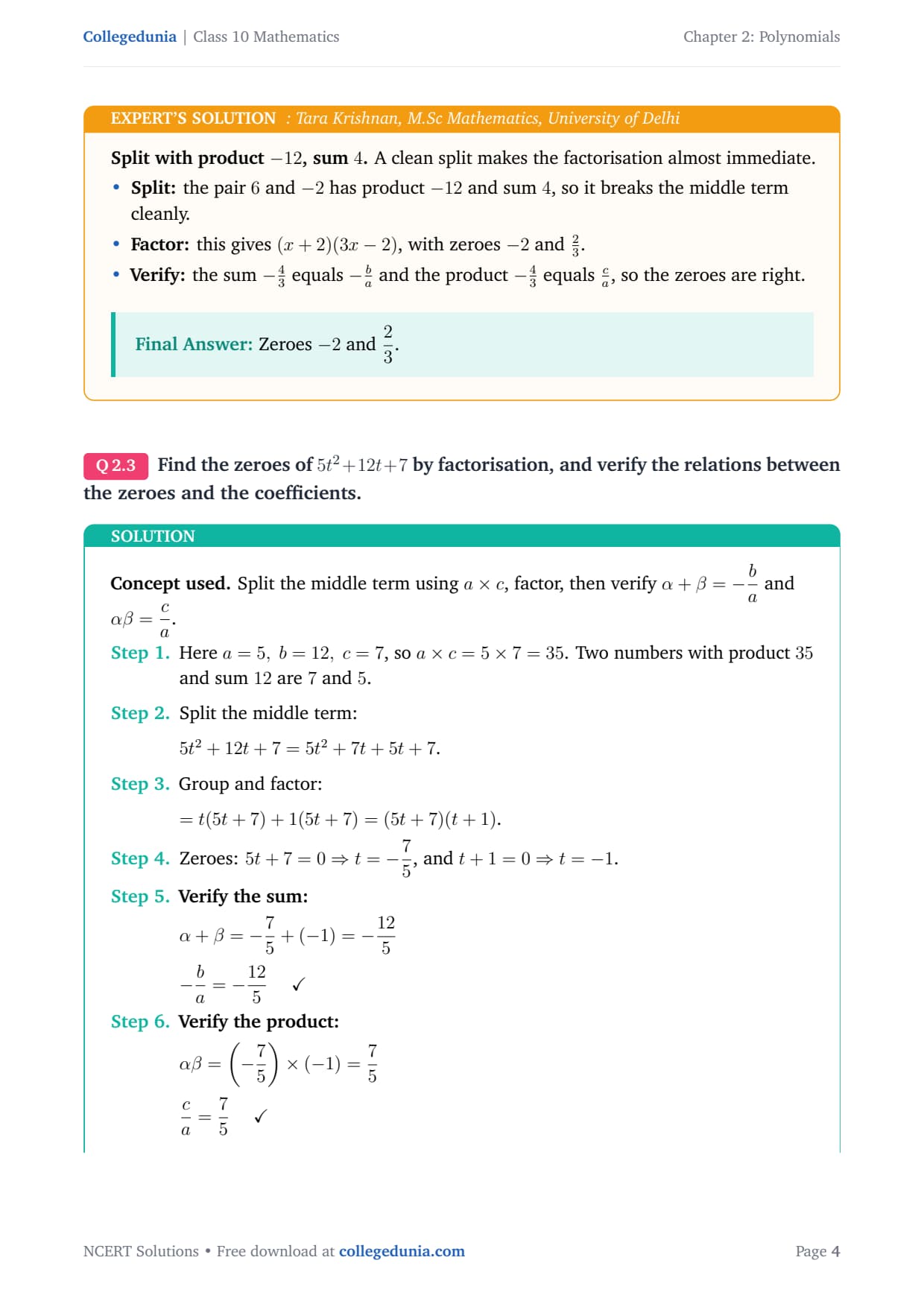
Q 2.3
Find the zeroes of 5t2+12t+7 by factorisation, and verify the relations between the zeroes and the coefficients.
Concept used. Split the middle term using a× c, factor,
then verify α+β=-ba and αβ=ca.
Here a=5, b=12, c=7, so a× c=5× 7=35. Two numbers
with product 35 and sum 12 are 7 and 5.
Split the middle term:
[] 5t2+12t+7=5t2+7t+5t+7.
Group and factor:
[] =t(5t+7)+1(5t+7)=(5t+7)(t+1).
Zeroes: 5t+7=0⇒ t=-75, and
t+1=0⇒ t=-1.
Verify the sum:
[] α+β=-75+(-1)=-125
[] -ba=-125
Verify the product:
[] αβ=(-75)×(-1)=75
[] ca=75
Zeroes are -75 and -1; both relations check out.
AB
Aniket Bose
M.Sc Mathematics, IIT Bombay
Verified Expert
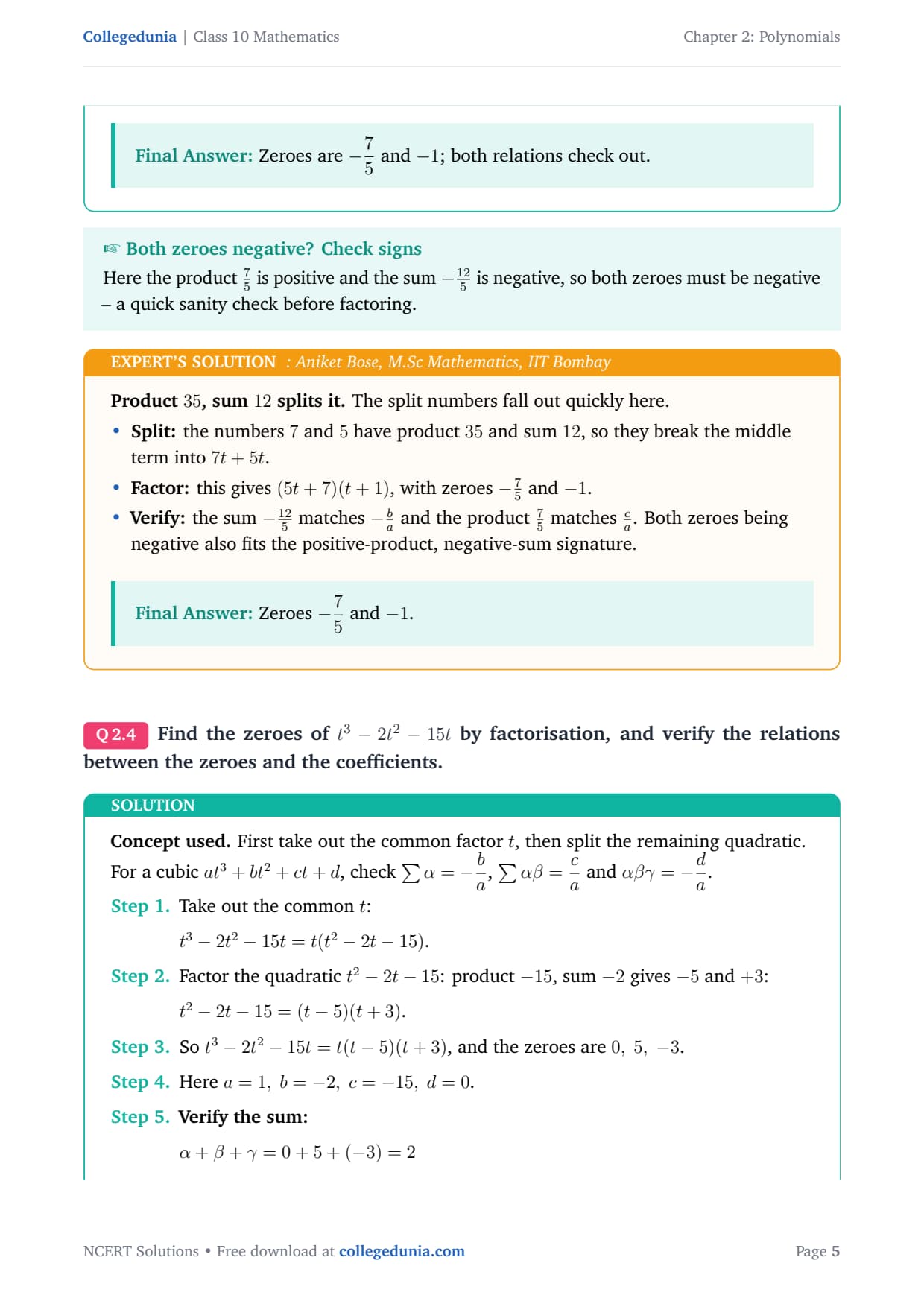
Product 35, sum 12 splits it. The split numbers fall out
quickly here.
Split: the numbers 7 and 5 have product 35 and sum
12, so they break the middle term into 7t+5t.
Factor: this gives (5t+7)(t+1), with zeroes
-75 and -1.
Verify: the sum -125 matches -ba
and the product 75 matches ca. Both zeroes
being negative also fits the positive-product, negative-sum
signature.
Zeroes -75 and -1.
Q 2.4
Find the zeroes of t3-2t2-15t by factorisation, and verify the relations between the zeroes and the coefficients.
Concept used. First take out the common factor t, then split
the remaining quadratic. For a cubic at3+bt2+ct+d, check
α=-ba, αβ=ca and
αγ=-da.
Take out the common t:
[] t3-2t2-15t=t(t2-2t-15).
Factor the quadratic t2-2t-15: product -15, sum -2 gives
-5 and +3:
[] t2-2t-15=(t-5)(t+3).
So t3-2t2-15t=t(t-5)(t+3), and the zeroes are
0, 5, -3.
Here a=1, b=-2, c=-15, d=0.
Verify the sum:
[] α+β+γ=0+5+(-3)=2
[] -ba=--21=2
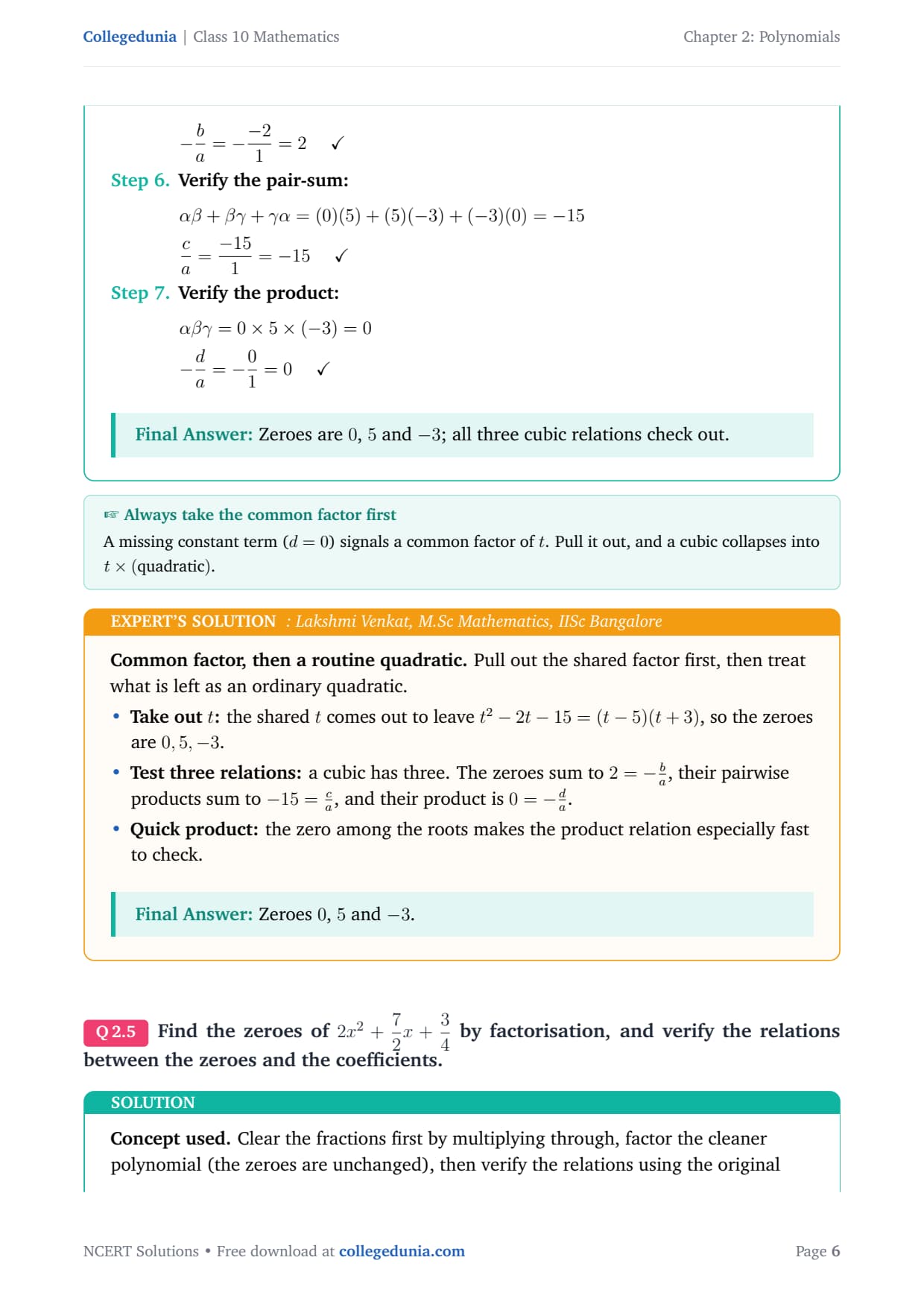
Verify the pair-sum:
[] αβ+γ+α=(0)(5)+(5)(-3)+(-3)(0)=-15
[] ca=-151=-15
Verify the product:
[] αγ=0× 5×(-3)=0
[] -da=-01=0
Zeroes are 0, 5 and -3; all three cubic relations check
out.
LV
Lakshmi Venkat
M.Sc Mathematics, IISc Bangalore
Verified Expert
Common factor, then a routine quadratic. Pull out the shared
factor first, then treat what is left as an ordinary quadratic.
Take out t: the shared t comes out to leave
t2-2t-15=(t-5)(t+3), so the zeroes are 0,5,-3.
Test three relations: a cubic has three. The zeroes sum
to 2=-ba, their pairwise products sum to
-15=ca, and their product is 0=-da.
Quick product: the zero among the roots makes the product
relation especially fast to check.
Zeroes 0, 5 and -3.
Q 2.5
Find the zeroes of 2x2+72x+34 by factorisation, and verify the relations between the zeroes and the coefficients.
Concept used. Clear the fractions first by multiplying through,
factor the cleaner polynomial (the zeroes are unchanged), then verify the
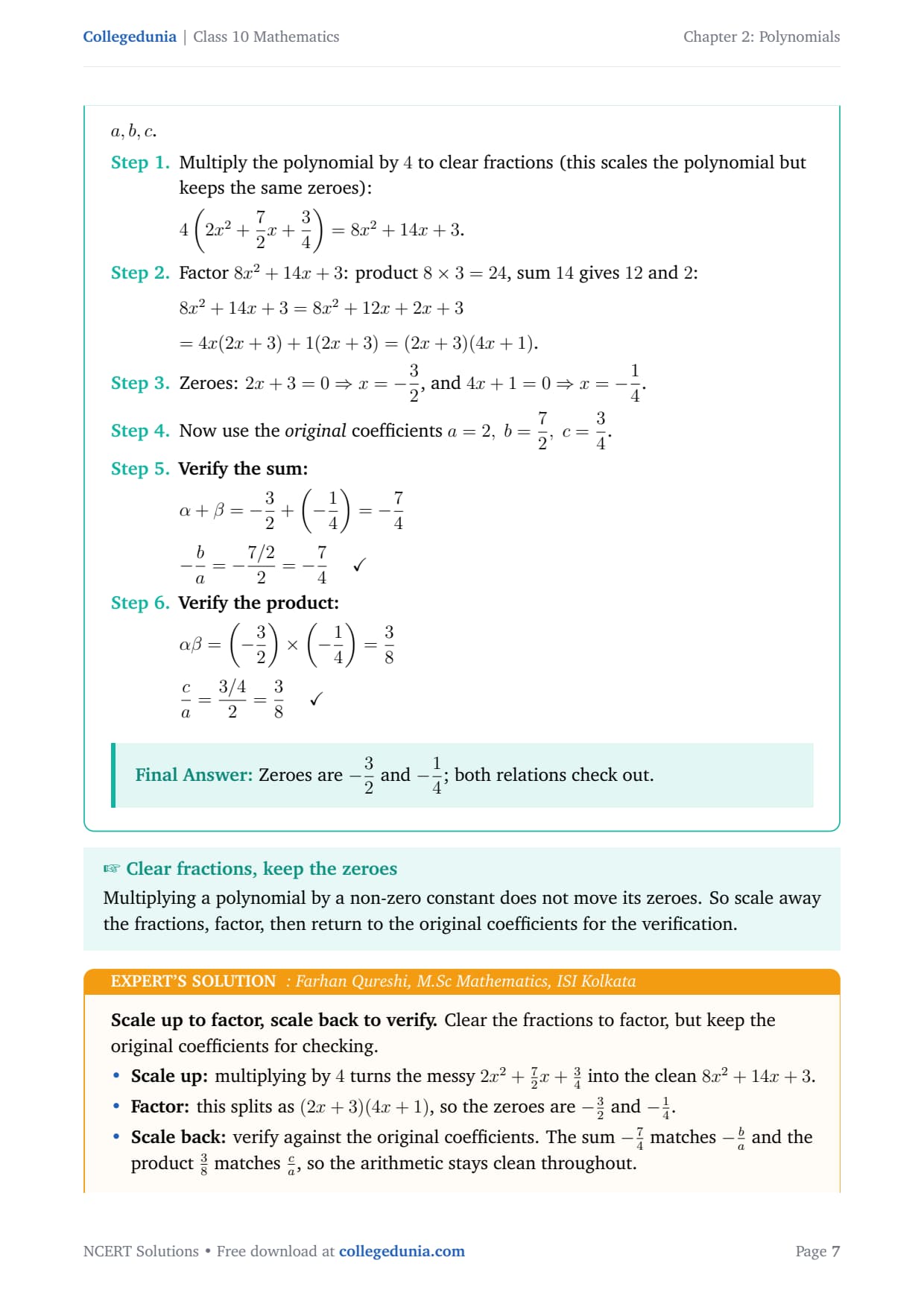
relations using the original a,b,c.
Multiply the polynomial by 4 to clear fractions (this scales the
polynomial but keeps the same zeroes):
[] 4(2x2+72x+34)=8x2+14x+3.
Factor 8x2+14x+3: product 8× 3=24, sum 14 gives
12 and 2:
[] 8x2+14x+3=8x2+12x+2x+3
[] =4x(2x+3)+1(2x+3)=(2x+3)(4x+1).
Zeroes: 2x+3=0⇒ x=-32, and
4x+1=0⇒ x=-14.
Now use the original coefficients
a=2, b=72, c=34.
Verify the sum:
[] α+β=-32+(-14)
=-74
[] -ba=-7/22=-74
Verify the product:
[] αβ=(-32)×
(-14)=38
[] ca=3/42=38
Zeroes are -32 and -14; both relations
check out.
FQ
Farhan Qureshi
M.Sc Mathematics, ISI Kolkata
Verified Expert
Scale up to factor, scale back to verify. Clear the fractions to
factor, but keep the original coefficients for checking.
Scale up: multiplying by 4 turns the messy
2x2+72x+34 into the clean 8x2+14x+3.
Factor: this splits as (2x+3)(4x+1), so the zeroes are
-32 and -14.
Scale back: verify against the original coefficients. The
sum -74 matches -ba and the product 38
matches ca, so the arithmetic stays clean throughout.
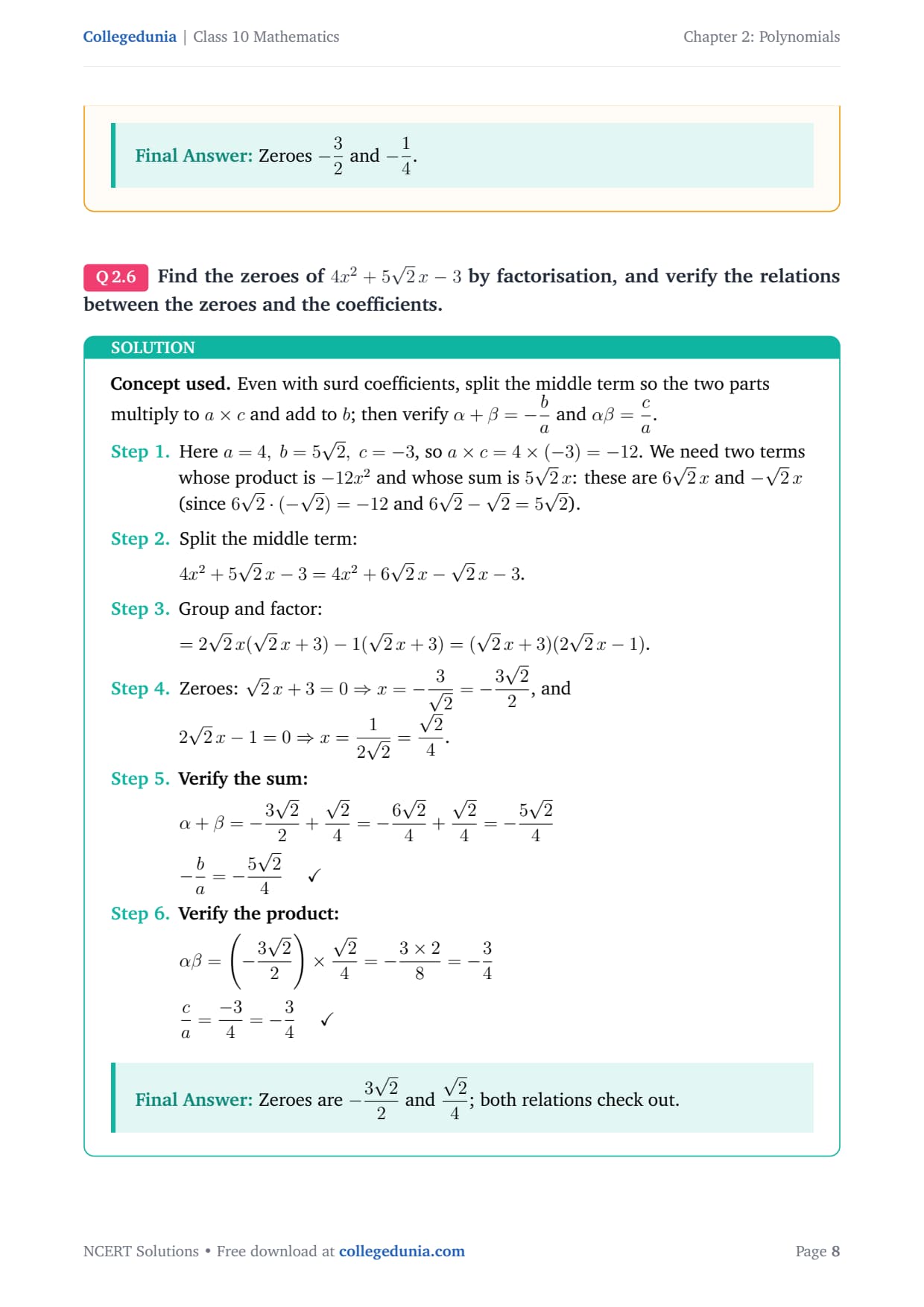
Zeroes -32 and -14.
Q 2.6
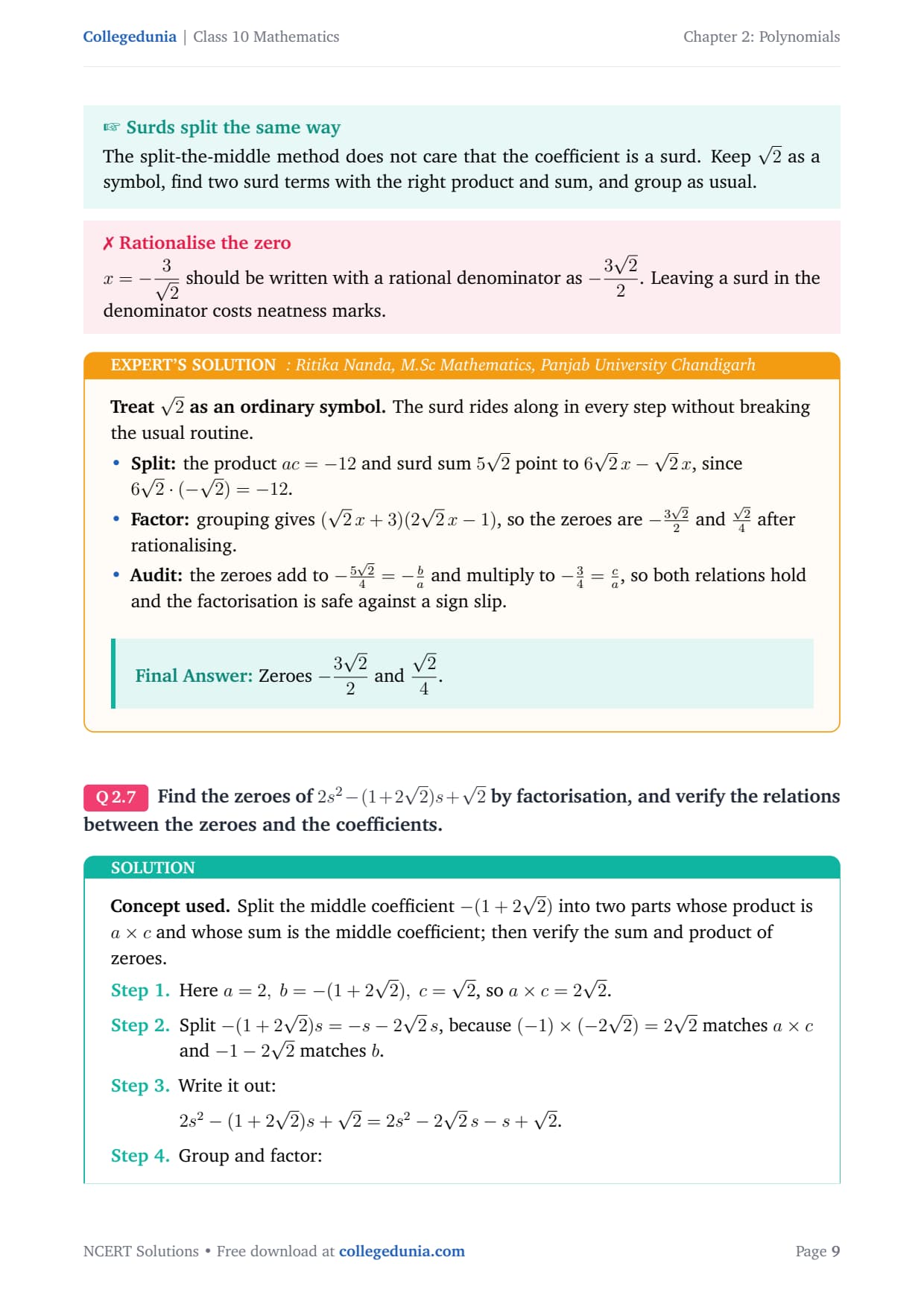
Find the zeroes of 4x2+5√2x-3 by factorisation, and verify the relations between the zeroes and the coefficients.
Concept used. Even with surd coefficients, split the middle term
so the two parts multiply to a× c and add to b; then verify
α+β=-ba and αβ=ca.
Here a=4, b=5√2, c=-3, so a× c=4×(-3)=-12.
We need two terms whose product is -12x2 and whose sum is
5√2x: these are 6√2x and -√2x
(since 6√2·(-√2)=-12 and
6√2-√2=5√2).
Split the middle term:
[] 4x2+5√2x-3=4x2+6√2x-√2x-3.
Group and factor:
[] =2√2x(√2x+3)-1(√2x+3)
=(√2x+3)(2√2x-1).
Zeroes: √2x+3=0⇒
x=-3√2=-3√22, and
2√2x-1=0⇒
x=12√2=√24.
Verify the sum:
[] α+β=-3√22+√24
=-6√24+√24=-5√24
[] -ba=-5√24
Verify the product:
[] αβ=(-3√22)
×√24=-3× 28=-34
[] ca=-34=-34
Zeroes are -3√22 and √24;
both relations check out.
RN
Ritika Nanda
M.Sc Mathematics, Panjab University Chandigarh
Verified Expert
Treat √2 as an ordinary symbol. The surd rides along in
every step without breaking the usual routine.
Split: the product ac=-12 and surd sum 5√2
point to 6√2x-√2x, since
62·(-2)=-12.
Factor: grouping gives (2 x+3)(22 x-1), so
the zeroes are -322 and 24 after
rationalising.
Audit: the zeroes add to -524
=-ba and multiply to -34=ca, so both
relations hold and the factorisation is safe against a sign slip.
Zeroes -3√22 and √24.
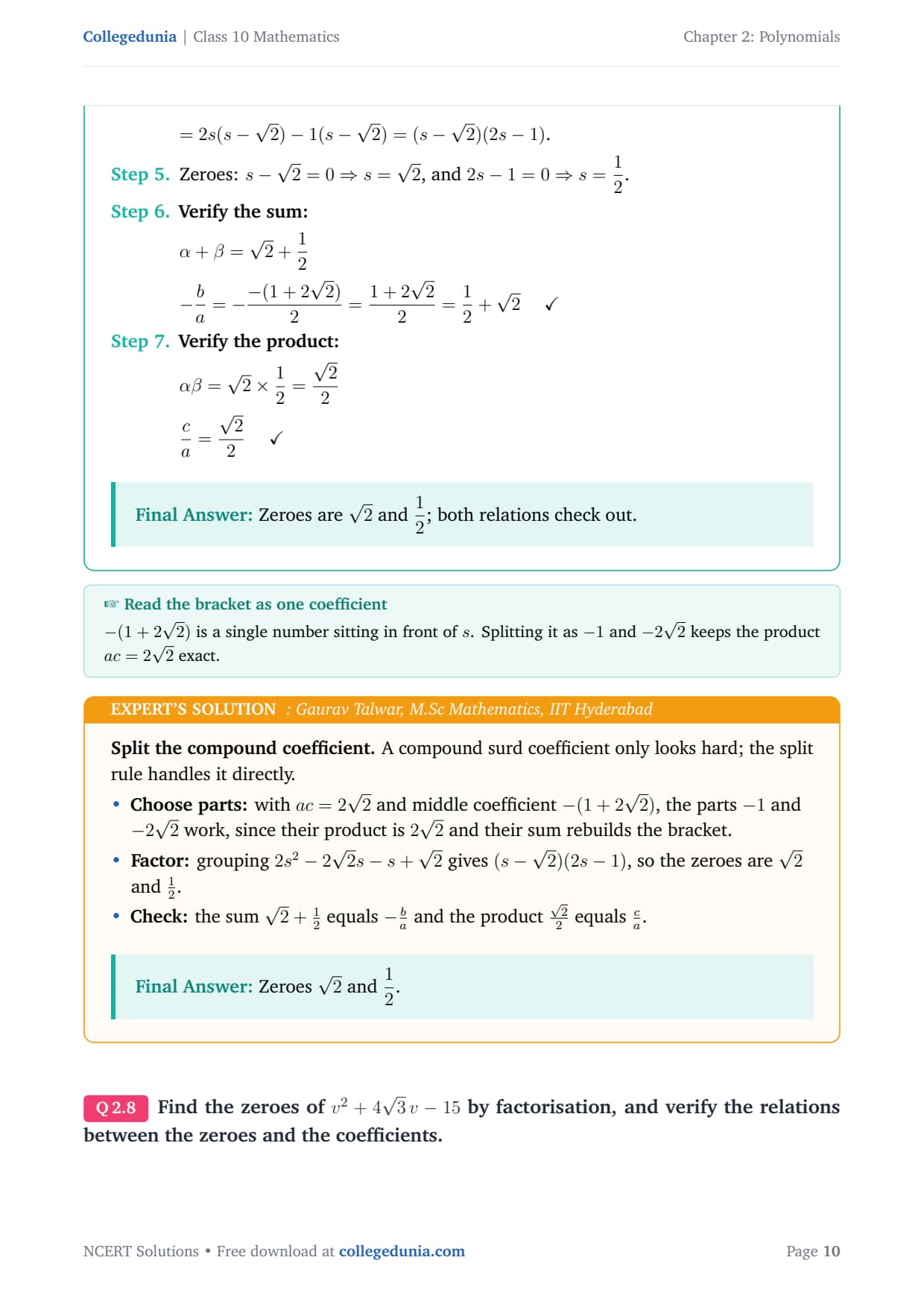
Q 2.7
Find the zeroes of 2s2-(1+2√2)s+√2 by factorisation, and verify the relations between the zeroes and the coefficients.
Concept used. Split the middle coefficient -(1+2√2) into
two parts whose product is a× c and whose sum is the middle
coefficient; then verify the sum and product of zeroes.
Here a=2, b=-(1+2√2), c=√2, so
a× c=2√2.
Split -(1+2√2)s=-s-2√2s, because
(-1)×(-2√2)=2√2 matches a× c and
-1-2√2 matches b.
Write it out:
[] 2s2-(1+2√2)s+√2=2s2-2√2s-s+√2.
Group and factor:
[] =2s(s-√2)-1(s-√2)=(s-√2)(2s-1).
Zeroes: s-√2=0⇒ s=√2, and
2s-1=0⇒ s=12.
Verify the sum:
[] α+β=√2+12
[] -ba=--(1+2√2)2
=1+2√22=12+√2
Verify the product:
[] αβ=√2×12=√22
[] ca=√22
Zeroes are √2 and 12; both relations check
out.
GT
Gaurav Talwar
M.Sc Mathematics, IIT Hyderabad
Verified Expert
Split the compound coefficient. A compound surd coefficient only
looks hard; the split rule handles it directly.
Choose parts: with ac=22 and middle coefficient
-(1+22), the parts -1 and -22 work, since their
product is 22 and their sum rebuilds the bracket.
Factor: grouping 2s2-22 s-s+2 gives
(s-2)(2s-1), so the zeroes are 2 and 12.
Check: the sum 2+12 equals -ba
and the product 22 equals ca.
Zeroes √2 and 12.
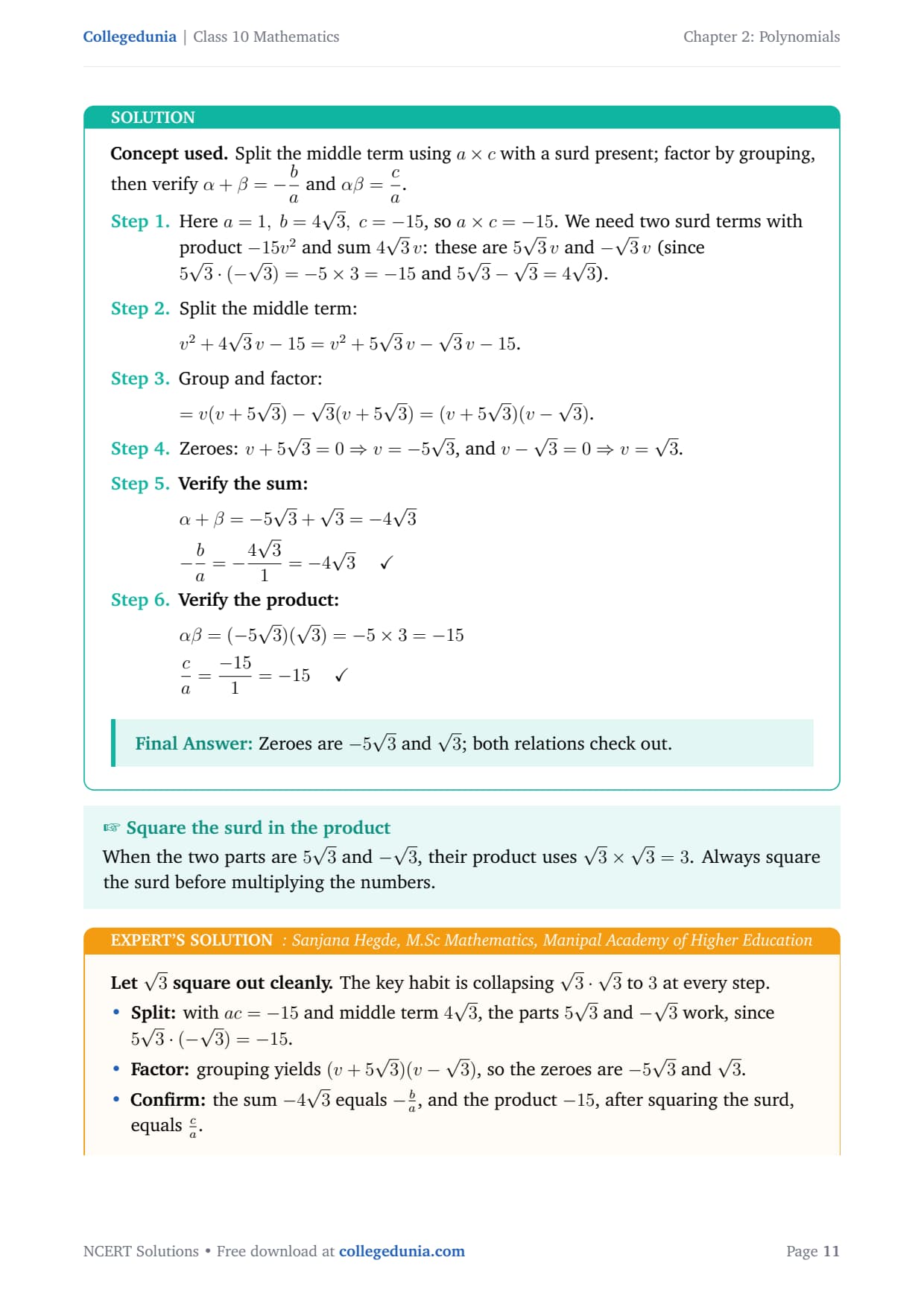
Q 2.8
Find the zeroes of v2+4√3v-15 by factorisation, and verify the relations between the zeroes and the coefficients.
Concept used. Split the middle term using a× c with a surd
present; factor by grouping, then verify α+β=-ba and
αβ=ca.
Here a=1, b=4√3, c=-15, so a× c=-15. We need two
surd terms with product -15v2 and sum 4√3v: these
are 5√3v and -√3v (since
5√3·(-√3)=-5× 3=-15 and
5√3-√3=4√3).
Split the middle term:
[] v2+4√3v-15=v2+5√3v-√3v-15.
Group and factor:
[] =v(v+5√3)-√3(v+5√3)=(v+5√3)(v-√3).
Zeroes: v+5√3=0⇒ v=-5√3, and
v-√3=0⇒ v=√3.
Verify the sum:
[] α+β=-5√3+√3=-4√3
[] -ba=-4√31=-4√3
Verify the product:
[] αβ=(-5√3)(√3)=-5× 3=-15
[] ca=-151=-15
Zeroes are -5√3 and √3; both relations check
out.
SH
Sanjana Hegde
M.Sc Mathematics, Manipal Academy of Higher Education
Verified Expert
Let 3 square out cleanly. The key habit is collapsing
3·3 to 3 at every step.
Split: with ac=-15 and middle term 43, the parts
53 and -3 work, since 53·(-3)=-15.
Factor: grouping yields (v+53)(v-3), so the
zeroes are -53 and 3.
Confirm: the sum -43 equals -ba, and
the product -15, after squaring the surd, equals ca.
Zeroes -5√3 and √3.
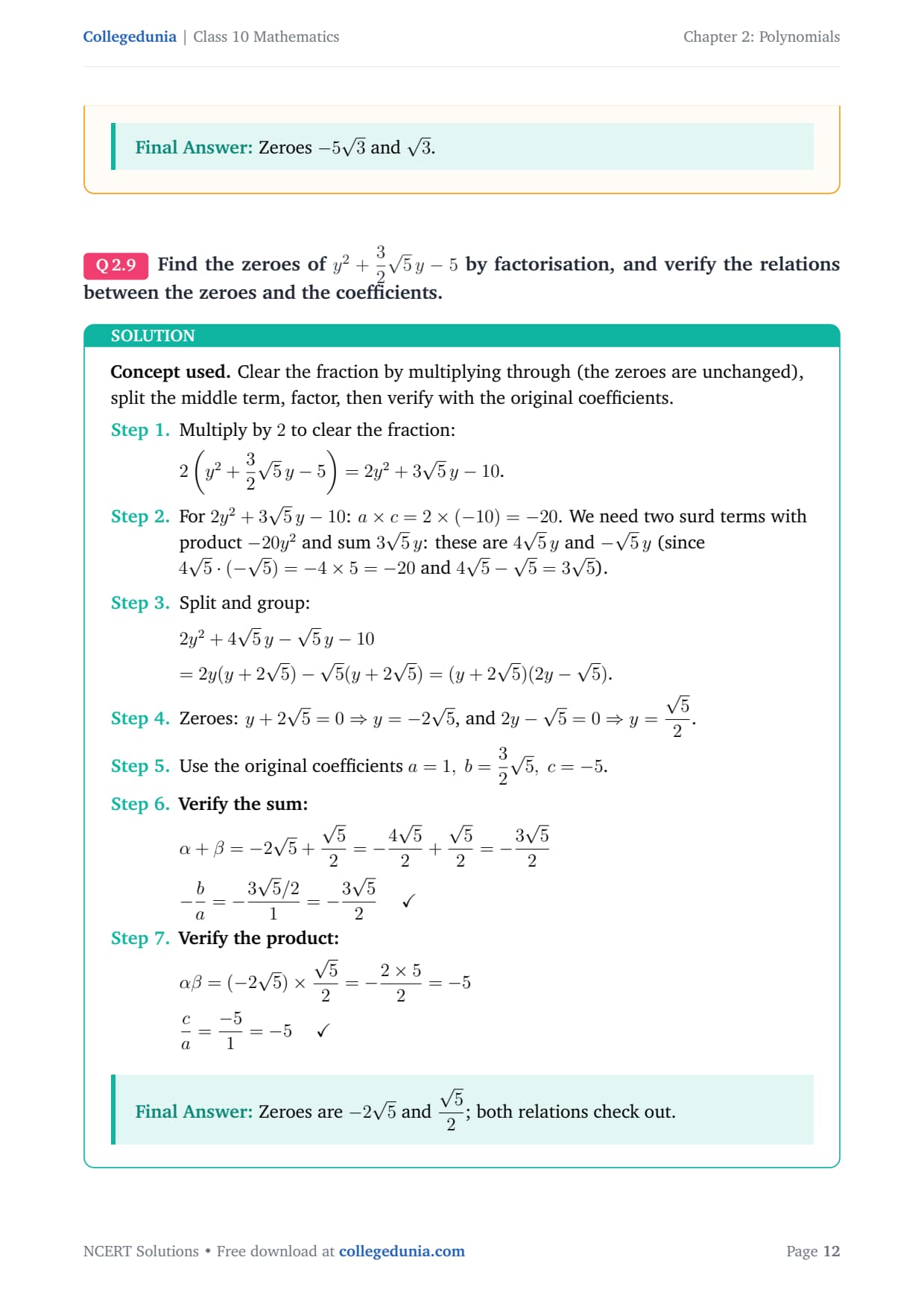
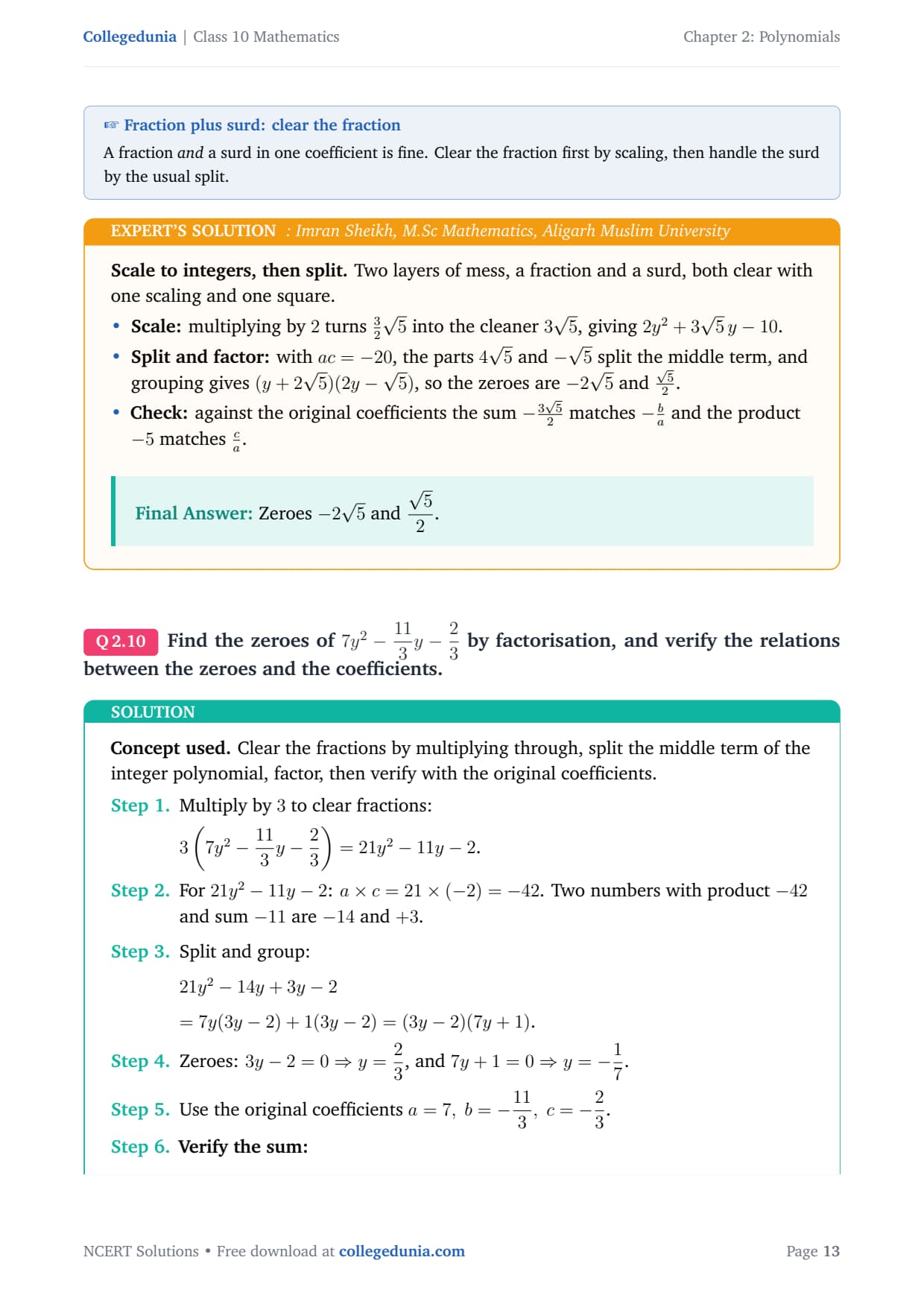
Q 2.9
Find the zeroes of y2+32√5y-5 by factorisation, and verify the relations between the zeroes and the coefficients.
Concept used. Clear the fraction by multiplying through (the
zeroes are unchanged), split the middle term, factor, then verify with
the original coefficients.
Multiply by 2 to clear the fraction:
[] 2(y2+32√5y-5)
=2y2+3√5y-10.
For 2y2+3√5y-10: a× c=2×(-10)=-20. We need
two surd terms with product -20y2 and sum 3√5y:
these are 4√5y and -√5y (since
4√5·(-√5)=-4× 5=-20 and
4√5-√5=3√5).
Split and group:
[] 2y2+4√5y-√5y-10
[] =2y(y+2√5)-√5(y+2√5)
=(y+2√5)(2y-√5).
Zeroes: y+2√5=0⇒ y=-2√5, and
2y-√5=0⇒ y=√52.
Use the original coefficients a=1, b=32√5,
c=-5.
Verify the sum:
[] α+β=-2√5+√52
=-4√52+√52=-3√52
[] -ba=-3√5/21=-3√52
Verify the product:
[] αβ=(-2√5)×√52
=-2× 52=-5
[] ca=-51=-5
Zeroes are -2√5 and √52; both relations
check out.
IS
Imran Sheikh
M.Sc Mathematics, Aligarh Muslim University
Verified Expert
Scale to integers, then split. Two layers of mess, a fraction and
a surd, both clear with one scaling and one square.
Scale: multiplying by 2 turns 325 into the
cleaner 35, giving 2y2+35 y-10.
Split and factor: with ac=-20, the parts 45 and
-5 split the middle term, and grouping gives
(y+25)(2y-5), so the zeroes are -25 and
52.
Check: against the original coefficients the sum
-352 matches -ba and the product -5
matches ca.
Zeroes -2√5 and √52.
Q 2.10
Find the zeroes of 7y2-113y-23 by factorisation, and verify the relations between the zeroes and the coefficients.
Concept used. Clear the fractions by multiplying through, split
the middle term of the integer polynomial, factor, then verify with the
original coefficients.
Multiply by 3 to clear fractions:
[] 3(7y2-113y-23)
=21y2-11y-2.
For 21y2-11y-2: a× c=21×(-2)=-42. Two numbers with
product -42 and sum -11 are -14 and +3.
Split and group:
[] 21y2-14y+3y-2
[] =7y(3y-2)+1(3y-2)=(3y-2)(7y+1).
Zeroes: 3y-2=0⇒ y=23, and
7y+1=0⇒ y=-17.
Use the original coefficients a=7, b=-113,
c=-23.
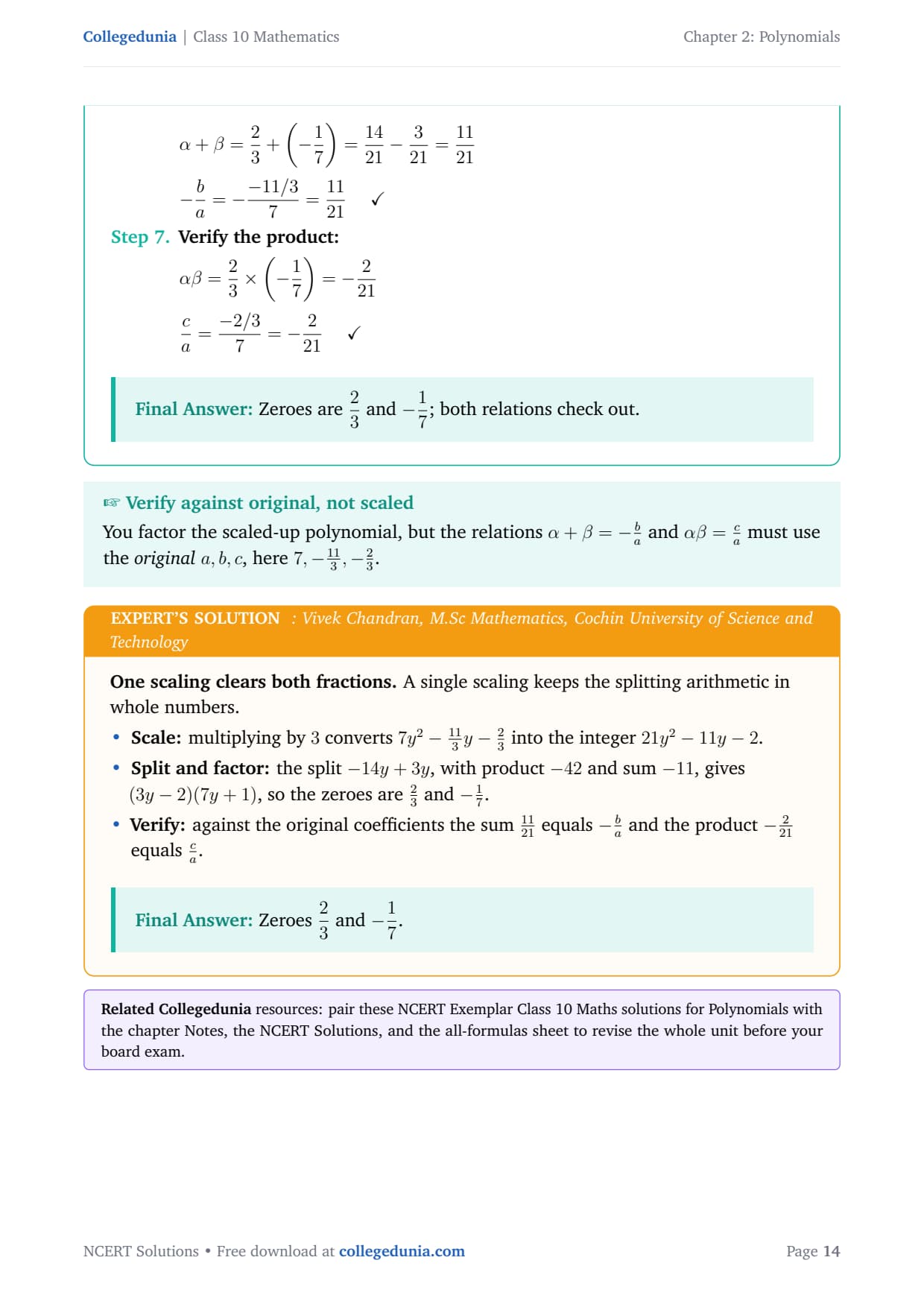
Verify the sum:
[] α+β=23+(-17)
=1421-321=1121
[] -ba=--11/37=1121
Verify the product:
[] αβ=23×(-17)
=-221
[] ca=-2/37=-221
Zeroes are 23 and -17; both relations
check out.
VC
Vivek Chandran
M.Sc Mathematics, Cochin University of Science and Technology
Verified Expert
One scaling clears both fractions. A single scaling keeps the
splitting arithmetic in whole numbers.
Scale: multiplying by 3 converts
7y2-113y-23 into the integer
21y2-11y-2.
Split and factor: the split -14y+3y, with product -42
and sum -11, gives (3y-2)(7y+1), so the zeroes are 23
and -17.
Verify: against the original coefficients the sum
1121 equals -ba and the product
-221 equals ca.
Zeroes 23 and -17.
Polynomials Exemplar: Other Exercises & Resources
Work through the rest of the Polynomials Exemplar, then pair it with the matching study resources for Chapter 2.
Resource
What it covers
Open
Exercise 2.3
Short-answer factorisation and zero-coefficient verification, solved step by step.
In a Collegedunia poll of 11,240 Class 10 Maths students before the 2026 boards, 74% said Q29 (surd coefficients) and Q32 (fraction plus surd) were the hardest in Exercise 2.3. They lost marks by forgetting to rationalise the zero or scale back to the original coefficients. Students who practised the scale, factor, scale-back routine picked up full marks.
Source: 2026-27 Class 10 Mathematics student poll. Sample of 11,240 students from CBSE schools across 14 states.
Other Resources for Polynomials Class 10 Maths
Pair this with the other Class 10 Maths resources for Polynomials, all linked below.
Frequently Asked Questions on NCERT Exemplar Class 10 Maths Chapter 2 Exercise 2.3
Ques. How many questions are there in NCERT Exemplar Class 10 Maths Chapter 2 Exercise 2.3?
Ans. Exercise 2.3 is the third exercise in Chapter 2 Polynomials of the NCERT Exemplar book. It has 10 short answer questions (Q24 through Q33). Each one asks you to find the zeroes of a polynomial by factorisation, then verify the sum and product relations against the coefficients.
Ques. What is the split-the-middle-term method used in Exercise 2.3?
Ans. For a quadratic ax² + bx + c, compute the product ac. Find two numbers p and q with p × q = ac and p + q = b. Replace bx with px + qx, group the four terms in pairs, and take out common factors. The shared bracket gives the two linear factors. Set each factor to zero to read the zeroes. The method still works with surd or fraction coefficients: treat the surd as an ordinary symbol, or clear the fraction first.
Ques. Why do we verify the sum and product of zeroes after factorisation?
Ans. The relations α + β = −b/a and αβ = c/a must hold for any quadratic ax² + bx + c. After finding the zeroes, substitute them into both relations and check that each side matches. This catches the most common error, a wrong sign in the split, and CBSE marking expects it. Skipping either relation loses marks even when the zeroes are right.
Ques. How do you handle surd coefficients in Q29, Q30 and Q31?
Ans. Treat the surd like any other symbol. For Q29 (4x² + 5√2 x − 3), the product ac = −12. Two surd terms with product −12 and sum 5√2 are 6√2 and −√2, since 6√2 × (−√2) = −12. Use them to split the middle term, group and factor. Then rationalise the final zero, for example write x = −3/√2 as −3√2/2. Q30 and Q31 follow the same steps.
Ques. What are the three verification relations for the cubic in Q27?
Ans. Q27 gives t³ − 2t² − 15t, a cubic with d = 0. Take out the common factor t first: t(t² − 2t − 15) = t(t − 5)(t + 3), so the zeroes are 0, 5 and −3. Then verify: sum = 0 + 5 + (−3) = 2 = −(−2)/1; pairwise product sum = (0)(5) + (5)(−3) + (−3)(0) = −15 = −15/1; triple product = 0 × 5 × (−3) = 0 = −0/1. Students often forget the third relation, so write all three in full for maximum marks.







Comments