Maths Mentor, Delhi University | Updated 3+ months ago
These NCERT Exemplar Class 10 Maths Chapter 2 Solutions work out every Polynomials problem from Exercises 2.1 to 2.4. Each answer shows the zero, the relation used, and a quick check. So you can match your own steps line by line. All answers follow the 2026-27 CBSE syllabus and are built for board exam practice.
42 Exemplar problems across four exercises: MCQ, justify, factorise, and build-and-divide.
Covers zeroes of a polynomial, the zero-coefficient relations, and the division algorithm.
Free PDF download plus a solved question bank you can open right here.
Solved by Collegedunia: Every Polynomials Exemplar question here is worked out by our Mathematics faculty, cross-checked against the official NCERT Exemplar, and matched to the 2026-27 syllabus.
The Polynomials Exemplar has four exercises, and each one has its own style. Knowing the split helps you plan practice. Do the short objective items first, then the longer reasoning and algebra. The image below maps all four types.
Exercise
Question Type
Count
What It Tests
Exercise 2.1
MCQ (objective)
11
Find a coefficient, choose the right quadratic, read graphs of zeroes
Exercise 2.2
Very short / Justify
12
True-or-false on quotient, remainder, and degree
Exercise 2.3
Short answer (factorise)
10
Split the middle term, find zeroes, verify the relations
Exercise 2.4
Long answer (build/divide)
9
Form a polynomial from zeroes, apply the division algorithm
So the full set has 42 problems. A type-by-type pass beats a straight 1-to-42 sweep. The skills build on each other: the relations you learn in Exercise 2.1 are the same ones you verify in Exercise 2.3.
Zeroes and Coefficients: Relations You Reuse
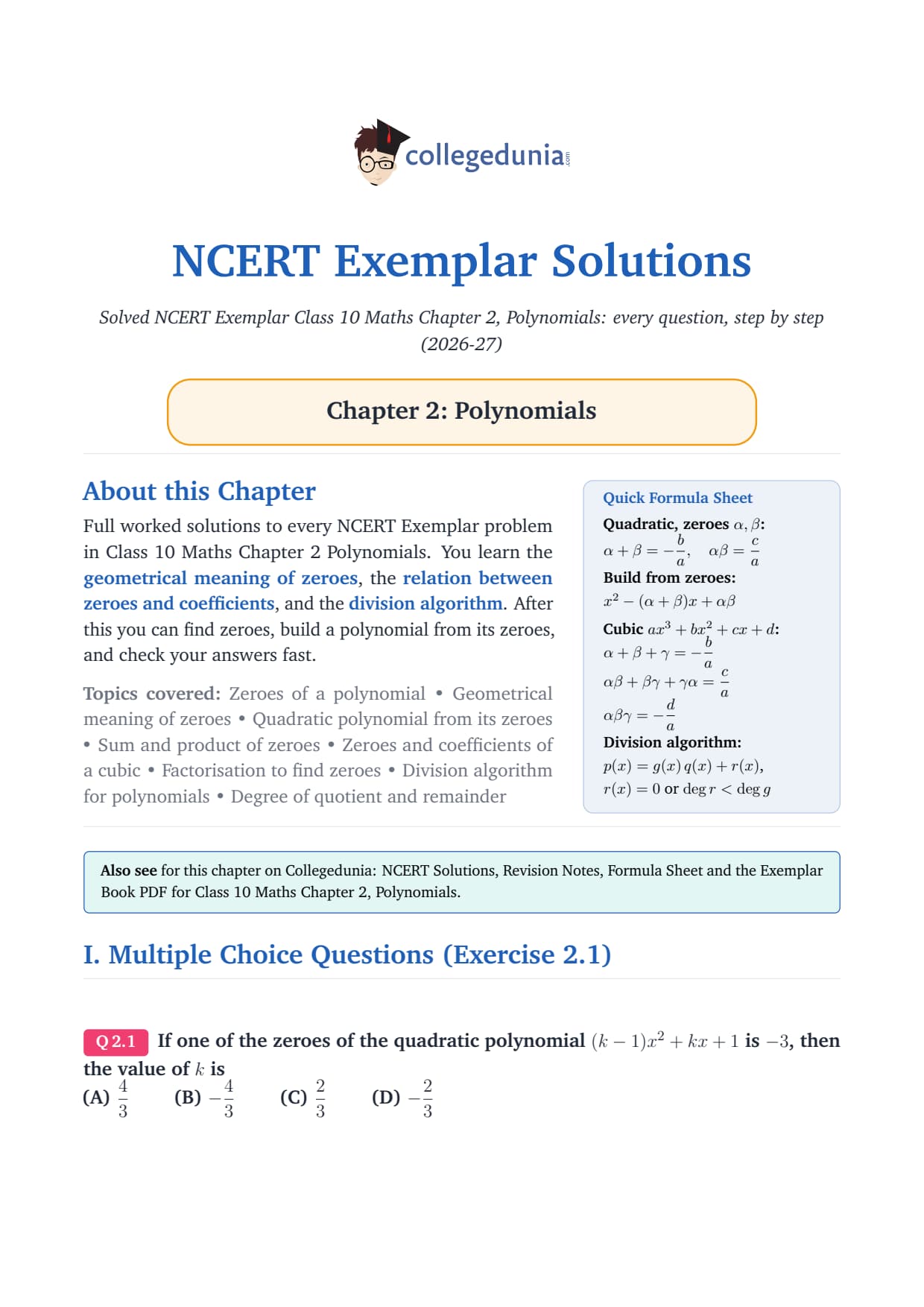
Almost every answer leans on two ideas. A zero is a value of x that makes the polynomial equal to 0. And the zeroes are tied to the coefficients by fixed relations. The card below gathers the relations you reuse across all four exercises.
Quadratic, zeroes α,β:α+β=-ba and αβ=ca.
Build a quadratic:x2-(α+β)x+αβ, then multiply by any non-zero k.
Division algorithm:p(x)=g(x) q(x)+r(x), where r(x)=0 or deg r.
A handy sign rule: a positive product ca means both zeroes share a sign. The sum -ba then tells you which sign. This rule alone answers many Exercise 2.1 MCQs, with no root-finding.
How These Solutions Help You
These solutions are written for self-study before the CBSE board exam. They do three things for you:
Show the full working: formula, substitution, and arithmetic on separate lines. So you can spot exactly where your own answer went wrong.
Verify, not just solve: every factorise answer checks the sum and product of zeroes. This is the step students skip and lose marks on.
Add an Expert view: each question has a second, shorter method from a subject expert. You learn the fast route once you know the long one.
Use them the smart way. Try the question first, then open Check Solution. Read the Expert Solution only after you have your own answer. That order builds real recall for the exam.
Exemplar vs Textbook Difficulty
The textbook exercises test one step at a time: find the zeroes, or verify one relation. The Exemplar pushes the same setup into two and three steps. The table shows where the step-up happens.
Skill
NCERT Textbook
NCERT Exemplar
Finding zeroes
Factorise a clean quadratic
Factorise with surds, fractions, or a cubic with a common factor
Relations
Verify sum and product once
Use the relations to find an unknown coefficient or sign
Division
Divide and read quotient/remainder
Justify whether a quotient or remainder is even possible by degree
Building polynomials
Form a quadratic from two zeroes
Build, scale to clear fractions, then factorise back to the zeroes
This is why practising the Exemplar after the textbook is the standard board-prep route. The textbook teaches the rule; the Exemplar makes you apply it under pressure.
Common Mistakes to Avoid
Across Exercises 2.1 to 2.4, a few slips cost the most marks. Watch for these:
Forgetting the scaling family: the number of polynomials with given zeroes is infinite, not one, because any non-zero k works.
Wrong sign in the sum: the sum of zeroes is -ba, not ba. The minus sign is the most-missed detail.
Skipping the degree check: in Exercise 2.2, a quotient is valid only if deg p=deg g+deg q. Count degrees before you commit.
Verifying only one relation: check both the sum and the product. Checking one can hide a sign slip in the split.
Keep a short log of which slips you repeat. Your accuracy on the board paper then climbs fast.
Top Polynomials Formulae for Class 10 Maths
Keep this short list on hand while you solve. Each relation below is used somewhere in these solutions.
Use
Relation
Sum of zeroes (quadratic)
α+β=-ba
Product of zeroes (quadratic)
αβ=ca
Build from zeroes
k[x2-(α+β)x+αβ]
Cubic sum / triple product
α+β+γ=-ba, αβγ=-da
Division algorithm
p(x)=g(x) q(x)+r(x)
Memorise the four quadratic and cubic relations first. The division algorithm is the one you reach for in the longer Exercise 2.4 problems.
Other Polynomials Resources
Pair this Exemplar set with the other Polynomials resources to revise the whole chapter before your board exam.
All Exemplar Questions with Step-by-Step Solutions
I. Multiple Choice Questions (Exercise 2.1)
Q 2.1
If one of the zeroes of the quadratic polynomial (k-1)x2+kx+1 is -3, then the value of k is
(A) 43 (B) -43 (C) 23 (D) -23
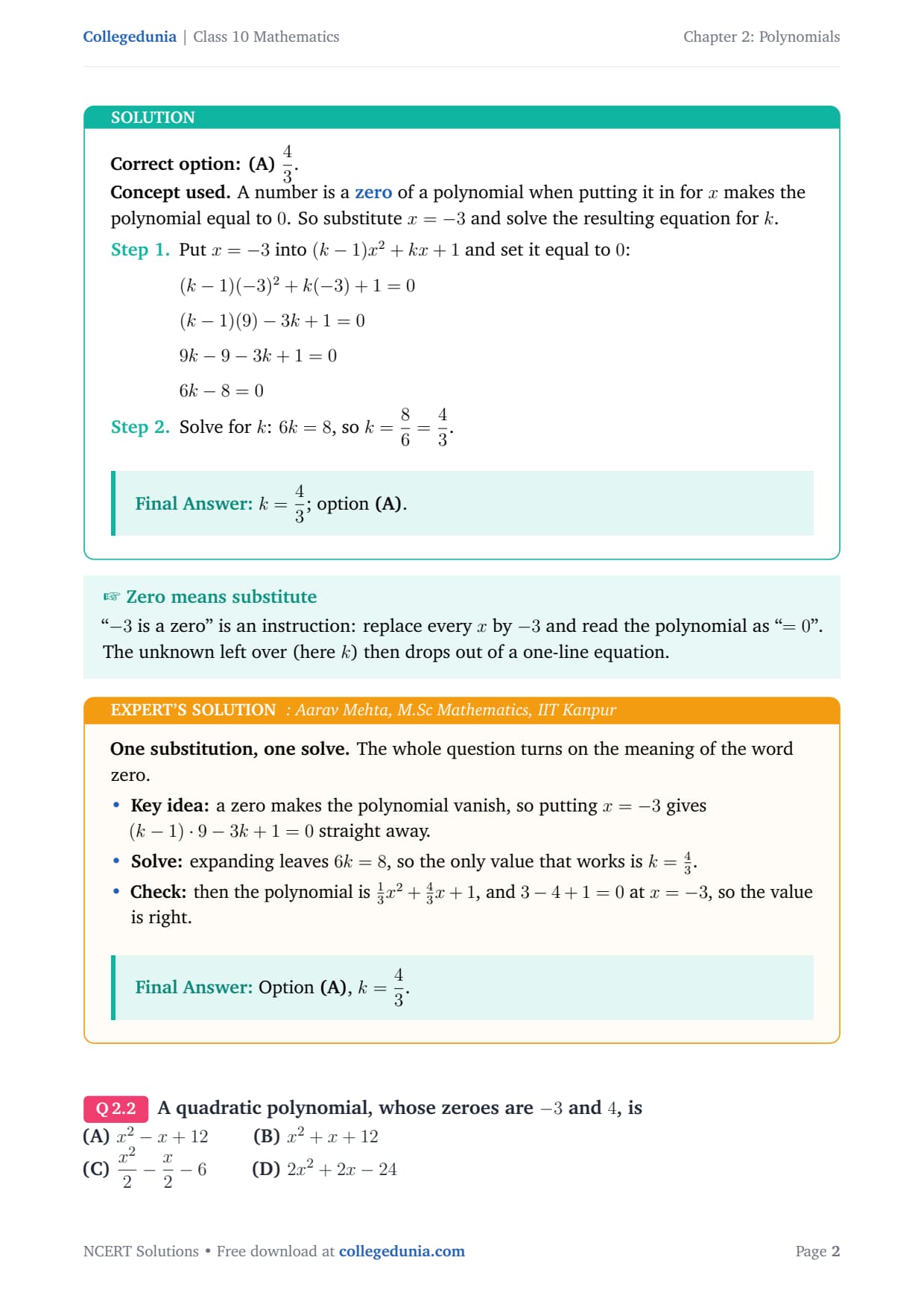
Correct option: (A)43.
Concept used. A number is a zero of a polynomial when
putting it in for x makes the polynomial equal to 0. So substitute
x=-3 and solve the resulting equation for k.
Put x=-3 into (k-1)x2+kx+1 and set it equal to 0:
[] (k-1)(-3)2+k(-3)+1=0
[] (k-1)(9)-3k+1=0
[] 9k-9-3k+1=0
[] 6k-8=0
Solve for k: 6k=8, so k=86=43.
k=43; option (A).
AM
Aarav Mehta
M.Sc Mathematics, IIT Kanpur
Verified Expert
One substitution, one solve. The whole question turns on the
meaning of the word zero.
Key idea: a zero makes the polynomial vanish, so putting
x=-3 gives (k-1)· 9-3k+1=0 straight away.
Solve: expanding leaves 6k=8, so the only value that
works is k=43.
Check: then the polynomial is
13x2+43x+1, and 3-4+1=0 at x=-3, so
the value is right.
Option (A), k=43.
Q 2.2
A quadratic polynomial, whose zeroes are -3 and 4, is
(A) x2-x+12 (B) x2+x+12
(C) x22-x2-6 (D) 2x2+2x-24
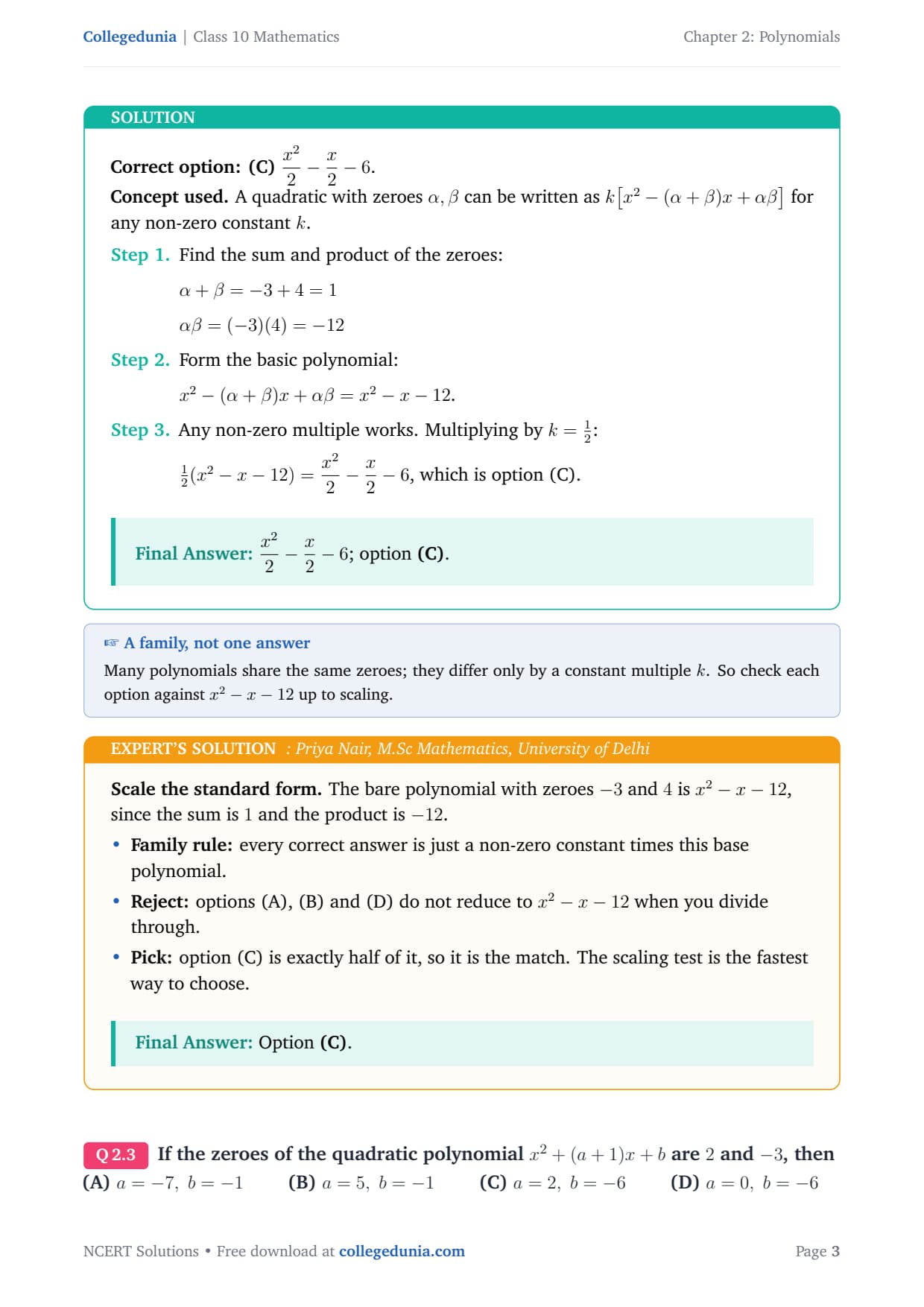
Correct option: (C)x22-x2-6.
Concept used. A quadratic with zeroes α,β can be
written as k[x2-(α+β)x+αβ] for any
non-zero constant k.
Find the sum and product of the zeroes:
[] α+β=-3+4=1
[] αβ=(-3)(4)=-12
Form the basic polynomial:
[] x2-(α+β)x+αβ=x2-x-12.
Any non-zero multiple works. Multiplying by k=12:
[] 12(x2-x-12)=x22-x2-6,
which is option (C).
x22-x2-6; option (C).
PN
Priya Nair
M.Sc Mathematics, University of Delhi
Verified Expert
Scale the standard form. The bare polynomial with zeroes -3
and 4 is x2-x-12, since the sum is 1 and the product is -12.
Family rule: every correct answer is just a non-zero
constant times this base polynomial.
Reject: options (A), (B) and (D) do not reduce to
x2-x-12 when you divide through.
Pick: option (C) is exactly half of it, so it is the
match. The scaling test is the fastest way to choose.
Option (C).
Q 2.3
If the zeroes of the quadratic polynomial x2+(a+1)x+b are 2 and -3, then
(A) a=-7, b=-1 (B) a=5, b=-1 (C) a=2, b=-6 (D) a=0, b=-6
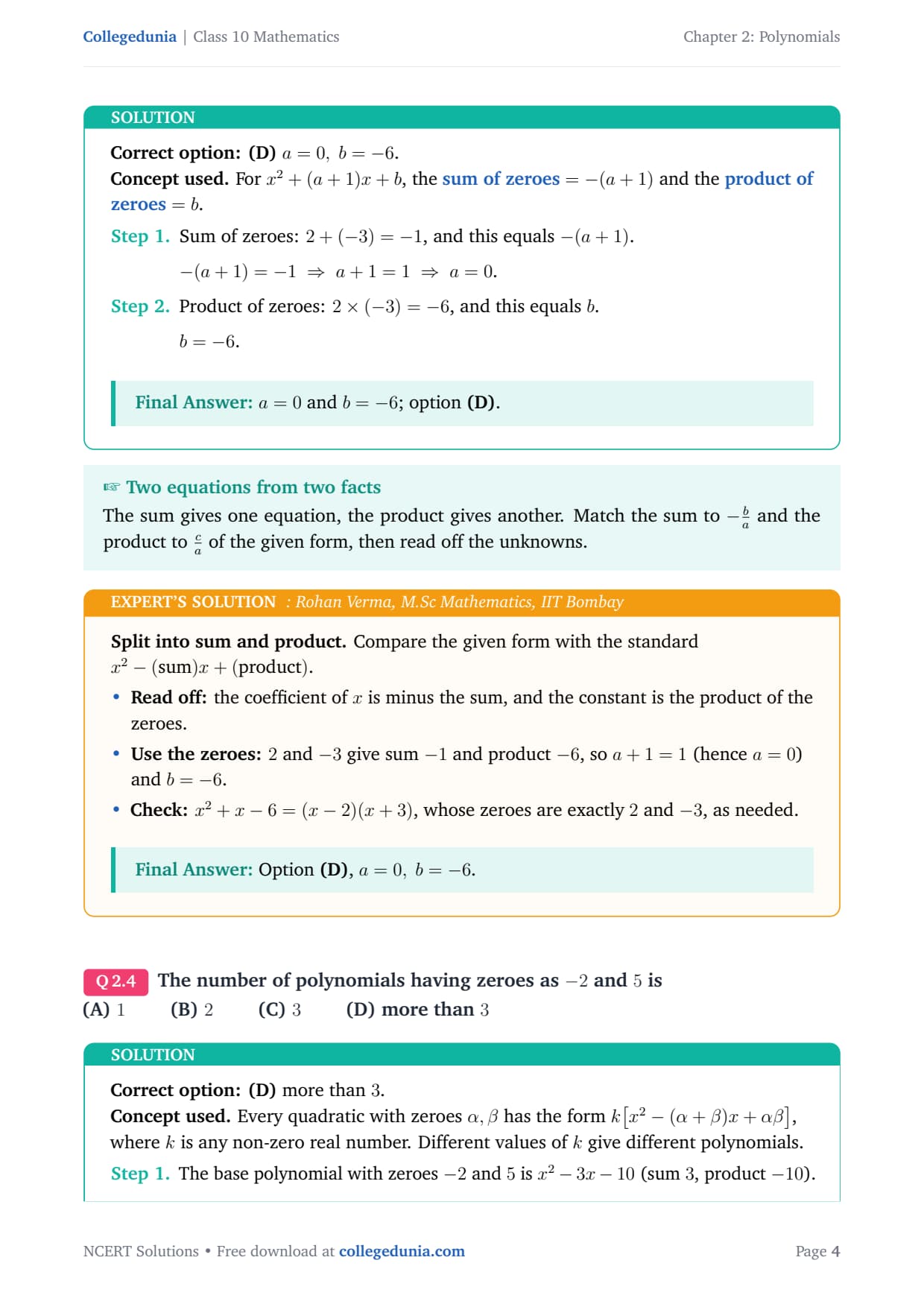
Correct option: (D)a=0, b=-6.
Concept used. For x2+(a+1)x+b, the
sum of zeroes=-(a+1) and the
product of zeroes=b.
Sum of zeroes: 2+(-3)=-1, and this equals -(a+1).
[] -(a+1)=-1 ⇒ a+1=1 ⇒ a=0.
Product of zeroes: 2×(-3)=-6, and this equals b.
[] b=-6.
a=0 and b=-6; option (D).
RV
Rohan Verma
M.Sc Mathematics, IIT Bombay
Verified Expert
Split into sum and product. Compare the given form with the
standard x2-(sum)x+(product).
Read off: the coefficient of x is minus the sum, and
the constant is the product of the zeroes.
Use the zeroes:2 and -3 give sum -1 and product
-6, so a+1=1 (hence a=0) and b=-6.
Check:x2+x-6=(x-2)(x+3), whose zeroes are exactly
2 and -3, as needed.
Option (D), a=0, b=-6.
Q 2.4
The number of polynomials having zeroes as -2 and 5 is
(A) 1 (B) 2 (C) 3 (D) more than 3
Correct option: (D) more than 3.
Concept used. Every quadratic with zeroes α,β has the
form k[x2-(α+β)x+αβ], where k is any
non-zero real number. Different values of k give different
polynomials.
The base polynomial with zeroes -2 and 5 is
x2-3x-10 (sum 3, product -10).
Multiplying by any non-zero k keeps the same zeroes:
k(x2-3x-10).
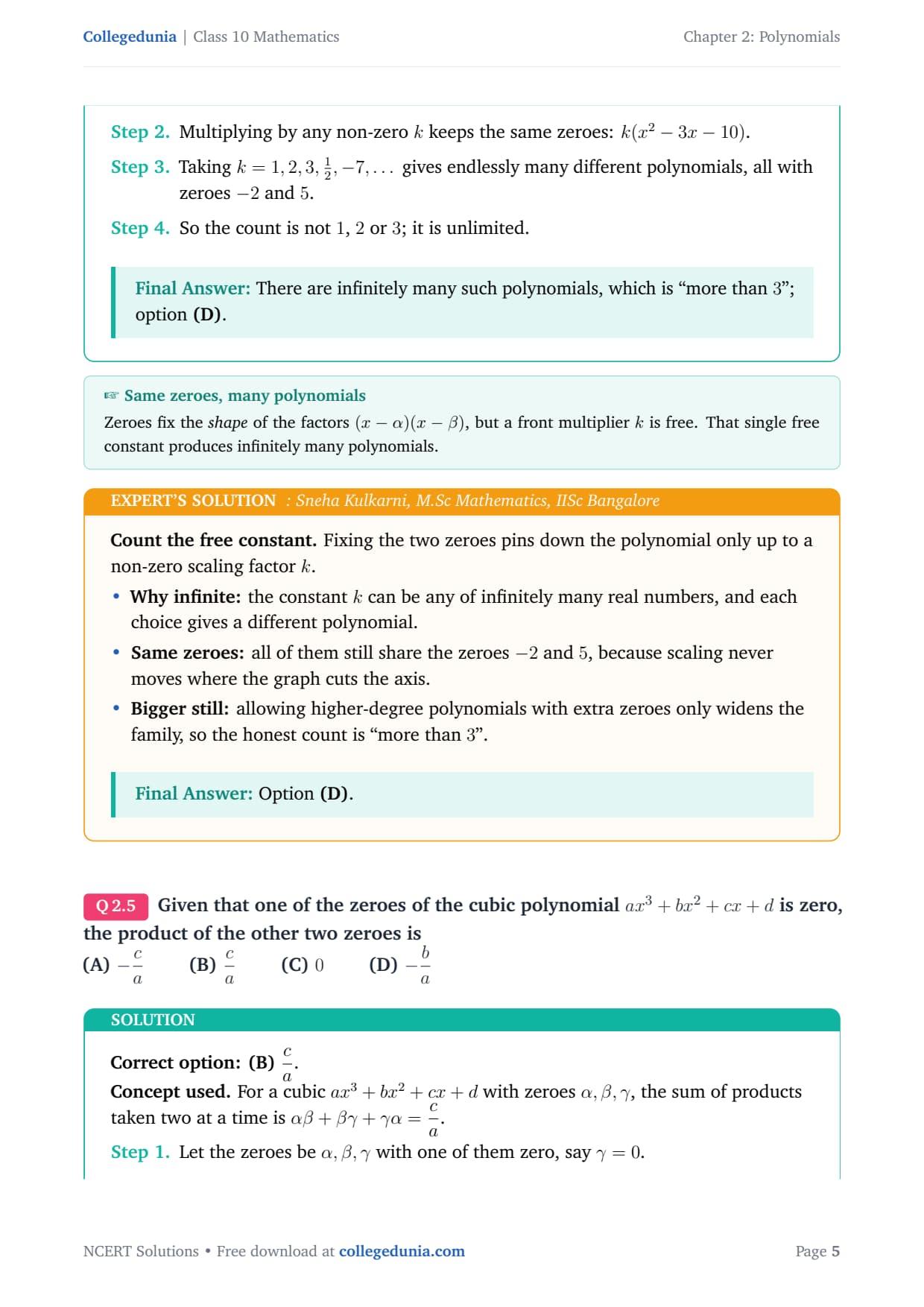
Taking k=1,2,3,12,-7, gives endlessly many
different polynomials, all with zeroes -2 and 5.
So the count is not 1, 2 or 3; it is unlimited.
There are infinitely many such polynomials, which is ``more
than 3''; option (D).
SK
Sneha Kulkarni
M.Sc Mathematics, IISc Bangalore
Verified Expert
Count the free constant. Fixing the two zeroes pins down the
polynomial only up to a non-zero scaling factor k.
Why infinite: the constant k can be any of infinitely
many real numbers, and each choice gives a different polynomial.
Same zeroes: all of them still share the zeroes -2 and
5, because scaling never moves where the graph cuts the axis.
Bigger still: allowing higher-degree polynomials with
extra zeroes only widens the family, so the honest count is
``more than 3''.
Option (D).
Q 2.5
Given that one of the zeroes of the cubic polynomial ax3+bx2+cx+d is zero, the product of the other two zeroes is
(A) -ca (B) ca (C) 0 (D) -ba
Correct option: (B)ca.
Concept used. For a cubic ax3+bx2+cx+d with zeroes
α,β,γ, the sum of products taken two at a time is
αβ+γ+γα=ca.
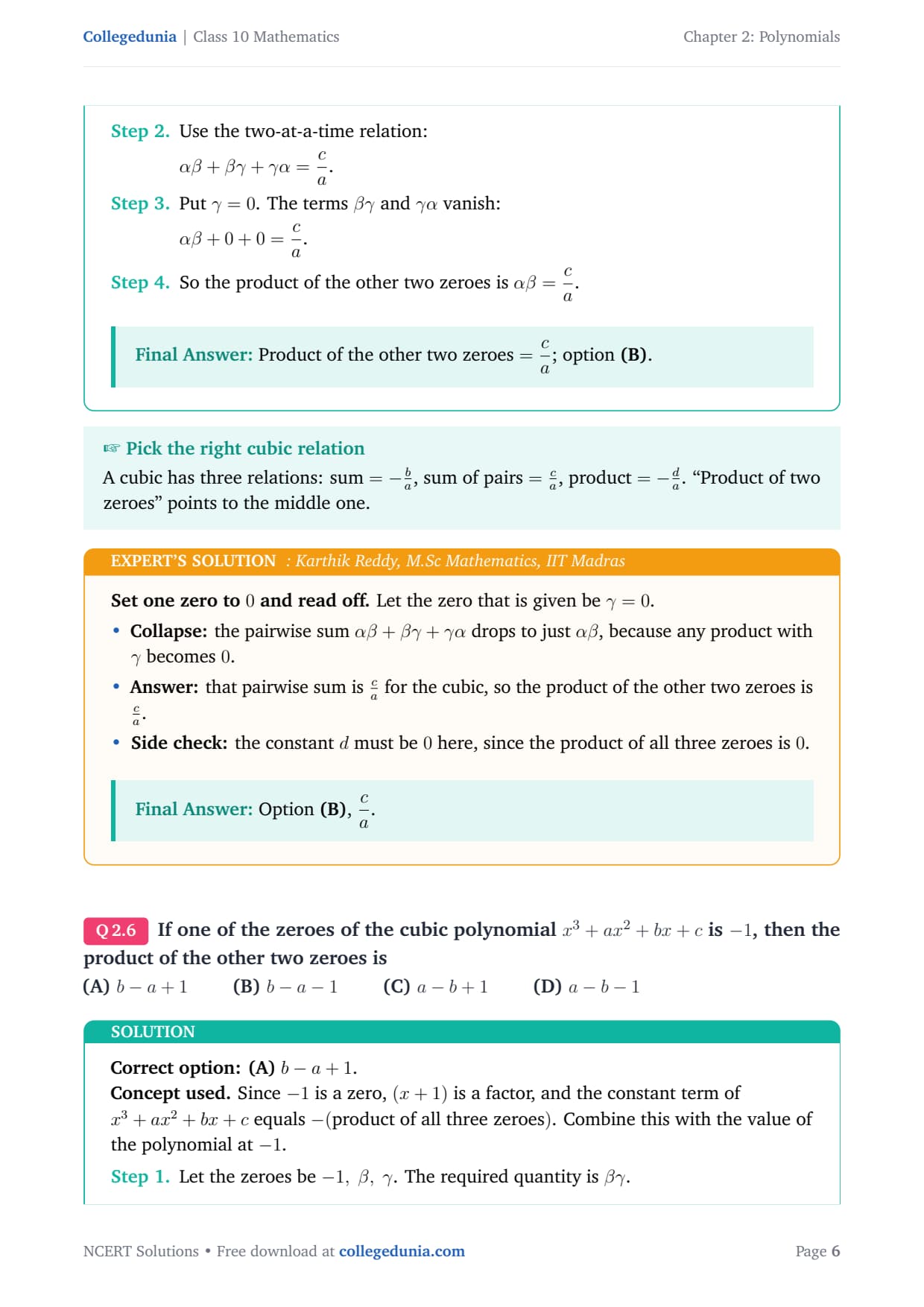
Let the zeroes be α,β,γ with one of them zero, say
γ=0.
Use the two-at-a-time relation:
[] αβ+γ+γα=ca.
Put γ=0. The terms γ and γα vanish:
[] αβ+0+0=ca.
So the product of the other two zeroes is
αβ=ca.
Product of the other two zeroes =ca; option
(B).
KR
Karthik Reddy
M.Sc Mathematics, IIT Madras
Verified Expert
Set one zero to 0 and read off. Let the zero that is given be
γ=0.
Collapse: the pairwise sum
αβ+γ+γα drops to just
αβ, because any product with γ becomes 0.
Answer: that pairwise sum is ca for the
cubic, so the product of the other two zeroes is ca.
Side check: the constant d must be 0 here, since the
product of all three zeroes is 0.
Option (B), ca.
Q 2.6
If one of the zeroes of the cubic polynomial x3+ax2+bx+c is -1, then the product of the other two zeroes is
(A) b-a+1 (B) b-a-1 (C) a-b+1 (D) a-b-1
Correct option: (A)b-a+1.
Concept used. Since -1 is a zero, (x+1) is a factor, and the
constant term of x3+ax2+bx+c equals -(product of all
three zeroes). Combine this with the value of the polynomial at -1.
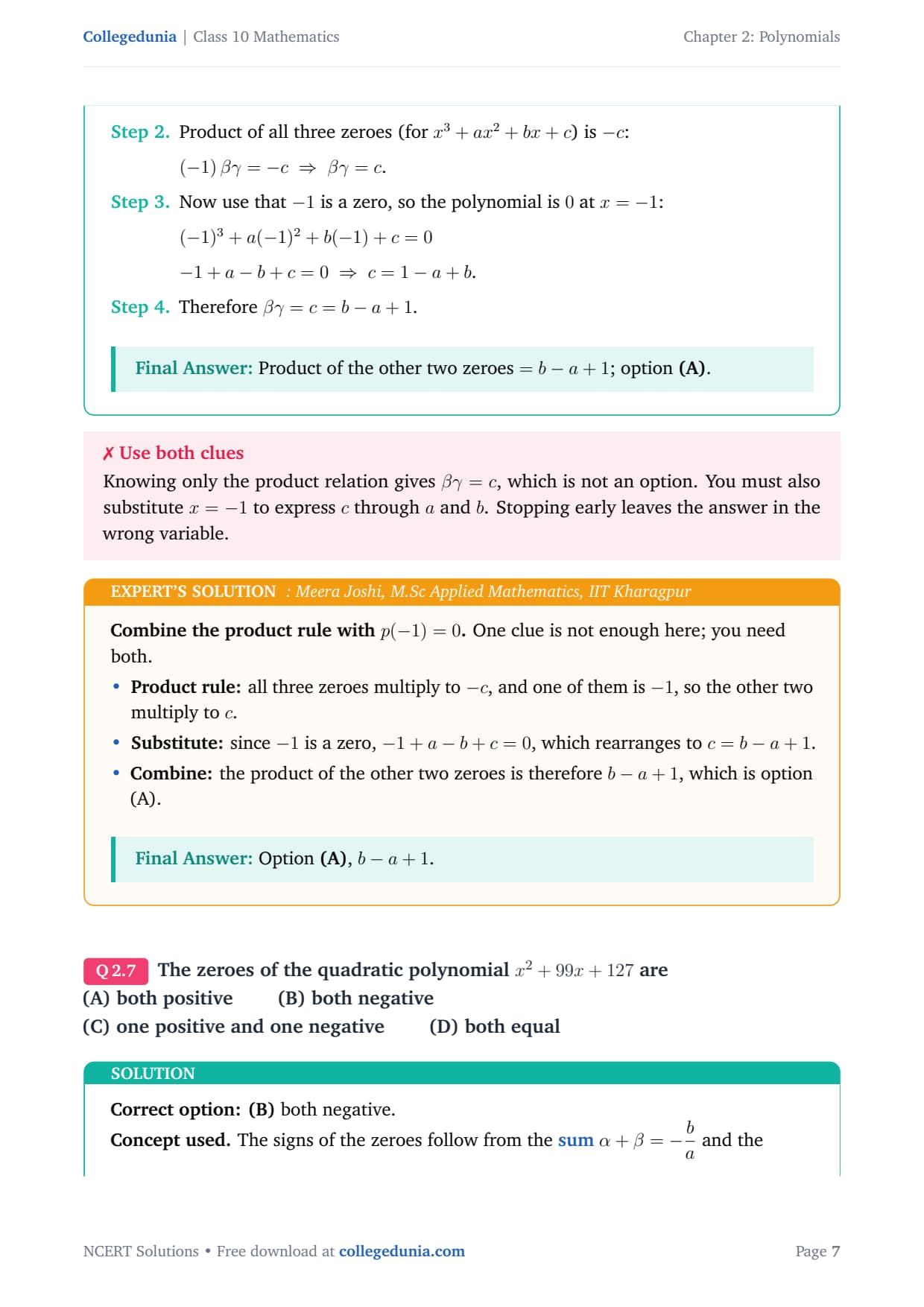
Let the zeroes be -1, β, γ. The required quantity is
γ.
Product of all three zeroes (for x3+ax2+bx+c) is -c:
[] (-1) γ=-c ⇒ γ=c.
Now use that -1 is a zero, so the polynomial is 0 at x=-1:
[] (-1)3+a(-1)2+b(-1)+c=0
[] -1+a-b+c=0 ⇒ c=1-a+b.
Therefore γ=c=b-a+1.
Product of the other two zeroes =b-a+1; option (A).
MJ
Meera Joshi
M.Sc Applied Mathematics, IIT Kharagpur
Verified Expert
Combine the product rule with p(-1)=0. One clue is not enough
here; you need both.
Product rule: all three zeroes multiply to -c, and one
of them is -1, so the other two multiply to c.
Substitute: since -1 is a zero, -1+a-b+c=0, which
rearranges to c=b-a+1.
Combine: the product of the other two zeroes is
therefore b-a+1, which is option (A).
Option (A), b-a+1.
Q 2.7
The zeroes of the quadratic polynomial x2+99x+127 are
(A) both positive (B) both negative
(C) one positive and one negative (D) both equal
Correct option: (B) both negative.
Concept used. The signs of the zeroes follow from the
sumα+β=-ba and the productαβ=ca.
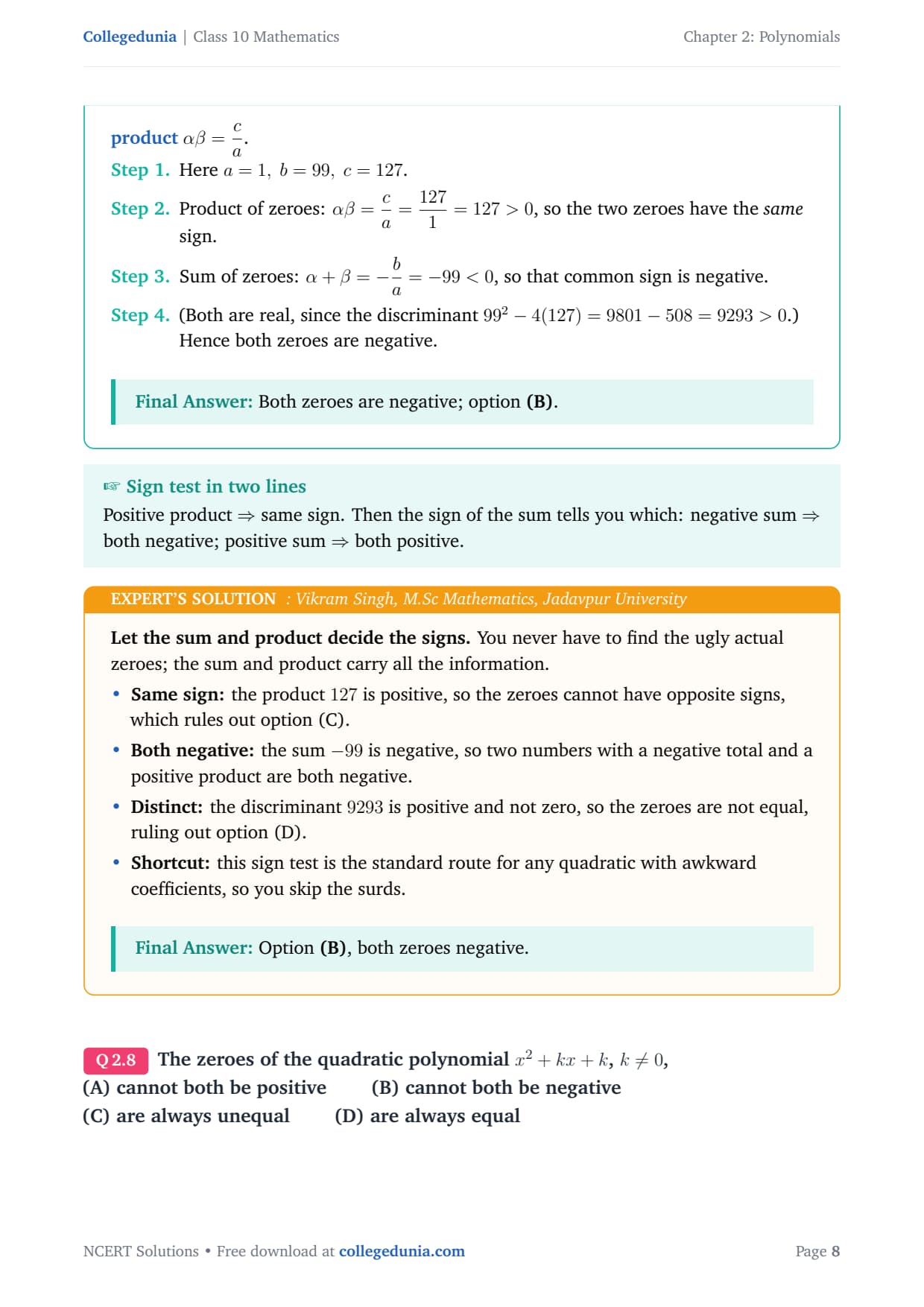
Here a=1, b=99, c=127.
Product of zeroes: αβ=ca=1271=127>0,
so the two zeroes have the same sign.
Sum of zeroes: α+β=-ba=-99<0, so that common
sign is negative.
(Both are real, since the discriminant
992-4(127)=9801-508=9293>0.) Hence both zeroes are negative.
Both zeroes are negative; option (B).
VS
Vikram Singh
M.Sc Mathematics, Jadavpur University
Verified Expert
Let the sum and product decide the signs. You never have to find
the ugly actual zeroes; the sum and product carry all the information.
Same sign: the product 127 is positive, so the zeroes
cannot have opposite signs, which rules out option (C).
Both negative: the sum -99 is negative, so two numbers
with a negative total and a positive product are both negative.
Distinct: the discriminant 9293 is positive and not
zero, so the zeroes are not equal, ruling out option (D).
Shortcut: this sign test is the standard route for any
quadratic with awkward coefficients, so you skip the surds.
Option (B), both zeroes negative.
Q 2.8
The zeroes of the quadratic polynomial x2+kx+k, k≠ 0,
(A) cannot both be positive (B) cannot both be negative
(C) are always unequal (D) are always equal
Correct option: (A) cannot both be positive.
Concept used. For x2+kx+k, the sum of zeroes is -k and the
product is k. Two positive zeroes would need a positive sum
and a positive product at the same time.
Sum of zeroes =-k and product of zeroes =k.
For both zeroes to be positive, we would need sum >0 and
product >0: that is -k>0 and k>0 together.
But -k>0 means k<0, while k>0 means k>0. These cannot
hold at once for any k≠ 0.
So the zeroes can never both be positive. (When k<0 the product
k<0, giving opposite signs; when k>0 the sum -k<0, so they
are both negative if real.)
The zeroes can never both be positive; option (A).
AI
Ananya Iyer
M.Sc Mathematics, ISI Kolkata
Verified Expert
Chase the contradiction in k. The trick is to assume the thing
in option (A) is false and watch it break.
Set up: for both zeroes positive you need the sum -k
positive and the product k positive at the same time.
Contradiction: a positive sum needs k below zero, while
a positive product needs k above zero. No single non-zero value
of k can be on both sides at once, so both positive is
impossible for every allowed k.
Reject the others: the discriminant k2-4k changes
sign as k varies, so the zeroes are equal for some values and
unequal for others. That kills the always-equal claim in option
(D) and the always-unequal claim in option (C).
Conclusion: only option (A) stays true for every value of
k that the question allows.
Option (A).
Q 2.9
If the zeroes of the quadratic polynomial ax2+bx+c, c≠ 0, are equal, then
(A) c and a have opposite signs (B) c and b have opposite signs
(C) c and a have the same sign (D) c and b have the same sign
Correct option: (C)c and a have the same sign.
Concept used. Two real zeroes are equal exactly when
the discriminantb2-4ac=0.
Equal zeroes means b2-4ac=0.
Rearrange: 4ac=b2.
The right side b2≥ 0, and since c≠ 0 we get
b2>0, so 4ac>0, hence ac>0.
ac>0 means a and c have the same sign.
ac>0, so c and a have the same sign; option (C).
NA
Nisha Agarwal
M.Sc Mathematics, BHU Varanasi
Verified Expert
Read the sign of ac off the discriminant. Equal zeroes set the
discriminant to zero, so b2=4ac.
Force positive: a square is never negative, and with
c0 it is strictly positive, so 4ac>0 and hence ac>0.
Same sign: a positive product of a and c means they
carry the same sign, which is option (C).
Ignore b: the options about b are irrelevant, since
b only fixes the size of ac, not the relative sign.
Option (C).
Q 2.10
If one of the zeroes of a quadratic polynomial of the form x2+ax+b is the negative of the other, then it
(A) has no linear term and the constant term is negative.
(B) has no linear term and the constant term is positive.
(C) can have a linear term but the constant term is negative.
(D) can have a linear term but the constant term is positive.
Correct option: (A) has no linear term and the constant term is
negative.
Concept used. If the zeroes are α and -α, then the
sum of zeroes is 0 (which kills the linear term) and the product is
-α2 (which is negative).
Let the zeroes be α and -α.
Sum of zeroes =α+(-α)=0. In x2+ax+b the sum is
-a, so -a=0, i.e. a=0: there is no linear term.
Product of zeroes =α·(-α)=-α2. In
x2+ax+b the product is b, so b=-α2.
Since α≠ 0 (otherwise both zeroes are 0 and not
``negatives'' in any useful sense), -α2<0, so the
constant term b is negative.
The polynomial has no linear term and a negative constant term;
option (A).
SR
Siddharth Rao
M.Sc Applied Mathematics, IIT Roorkee
Verified Expert
Multiply the two factors out. If one zero is the negative of the
other, the zeroes are α and -α, with factors
(x-α) and (x+α).
No middle term: their product is the difference of
squares x2-α2, and the cross terms cancel exactly, so
both options (A) and (B) rightly say there is no linear term.
Negative constant: the constant is -α2, and a
square is positive for non-zero α, so this is strictly
negative. That rules out (B) and confirms (A).
Same by relations: the sum of zeroes is 0, which kills
the coefficient of x, and the product -α2 is the
negative constant. Both routes agree.
Option (A); no linear term, negative constant.
Q 2.11
Which of the following is not the graph of a quadratic polynomial? (See Fig. 2.1 below.)
(A) (B) (C) (D)
Correct option: (D).
Concept used. The graph of a quadratic polynomial is a
parabola. A quadratic has at most 2 zeroes, so its graph can
cross the x-axis in at most 2 points. A graph that meets the x-axis
at 3 points cannot belong to a quadratic.
Recall: a degree-2 polynomial y=ax2+bx+c draws a single
∪ or ∩ shaped parabola.
A parabola can touch or cross the x-axis 0, 1, or 2 times,
never more.
Graphs (A), (B) and (C) are parabolas (single bend), so each can
be a quadratic.
Graph (D) is an S-shaped curve that crosses the x-axis at
three points, which needs degree ≥ 3. So (D) is not the
graph of a quadratic.
Graph (D) crosses the x-axis three times, so it is not a
quadratic; option (D).
KM
Kabir Malhotra
M.Sc Mathematics, IIT Bombay
Verified Expert
Match the bend count to the degree. A quadratic graph turns
exactly once and cuts the x-axis at most twice.
Fair parabolas: diagrams (A), (B) and (C) each show one
single bend, the up-or-down turn of a true parabola, so each one
can be the graph of a quadratic without any problem.
The odd one: diagram (D) bends twice and crosses the axis
three times, which is the signature of a cubic and not a
quadratic, so it is the graph the question is asking you to spot.
Deciding rule: the number of times a graph meets the
x-axis can never exceed the degree, so three crossings demand a
degree of at least three. A quadratic allows at most two meetings.
What to do: look for the single bend first, then count
the crossings. Only diagram (D) breaks both habits at once, so it
is the answer.
Option (D).
NCERT exemplar Class 12 Mathematics Chapter 2 Polynomials
All questions with collapsible Solution and Expert Solution. Tap a button to reveal the working.
II. Short Answer Questions with Reasoning (Exercise 2.2)
Q 2.1
Answer and justify: Can x2-1 be the quotient on division of x6+2x3+x-1 by a polynomial in x of degree 5?
Verdict: No.x2-1 cannot be such a quotient.
Concept used. In the division algorithm p(x)=g(x) q(x)+r(x),
the degree of the dividend equals deg g(x)+deg q(x) when the
remainder has smaller degree. Degrees of the factors must add up
correctly.
Here the dividend p(x)=x6+2x3+x-1 has degree 6, and the
divisor g(x) has degree 5.
If the quotient were q(x)=x2-1 of degree 2, then
deg(g(x) q(x))=5+2=7.
A degree-7 product cannot match a degree-6 dividend (the
remainder has degree <5, so it cannot fix the mismatch).
For a degree-6 dividend and a degree-5 divisor, the quotient
must have degree 6-5=1, not 2.
No, because the quotient of a degree-6 polynomial by a
degree-5 polynomial must have degree 1, not 2.
DM
Divya Menon
M.Sc Mathematics, University of Hyderabad
Verified Expert
Subtract the degrees first. The whole question is settled by
degree arithmetic, before any long division.
Forced degree: dividing a degree-6 polynomial by a
degree-5 one always leaves a quotient of degree one.
Why x2-1 fails: that quotient has degree two, which
pushes the product up to degree seven and overshoots the
dividend. The small remainder cannot rescue the gap.
Clean identity: since deg p=deg g+deg q, fixing the
dividend at six and divisor at five forces the quotient to be
degree one, so a degree-two answer has no room to exist.
No; the quotient must be degree 1.
Q 2.2
Answer and justify: What will the quotient and remainder be on division of ax2+bx+c by px3+qx2+rx+s, p≠ 0?
Verdict / Answer: quotient =0 and remainder =ax2+bx+c.
Concept used. When the dividend has smaller degree
than the divisor, division stops at once: the quotient is 0
and the whole dividend is the remainder.
The dividend ax2+bx+c has degree 2.
The divisor px3+qx2+rx+s has degree 3 (since p≠ 0).
Because deg(dividend)=2<3=deg(divisor), the
divisor cannot ``go into'' the dividend even once.
So the quotient is 0, and the remainder is the dividend itself:
[] ax2+bx+c=(px3+qx2+rx+s)· 0+(ax2+bx+c).
Quotient =0 and remainder =ax2+bx+c.
AP
Arjun Pillai
M.Sc Mathematics, IIT Delhi
Verified Expert
Degree decides everything. A small dividend over a bigger divisor
cannot be reduced even once.
No reduction: a degree-2 dividend has no power of x
high enough for a degree-3 divisor to bite into, so the quotient
is zero.
Read the algorithm: it then becomes
ax2+bx+c=g(x)0+(ax2+bx+c), so the remainder is the
whole dividend.
Valid remainder: the rule deg r holds, since
two is less than three.
Quotient 0, remainder ax2+bx+c.
Q 2.3
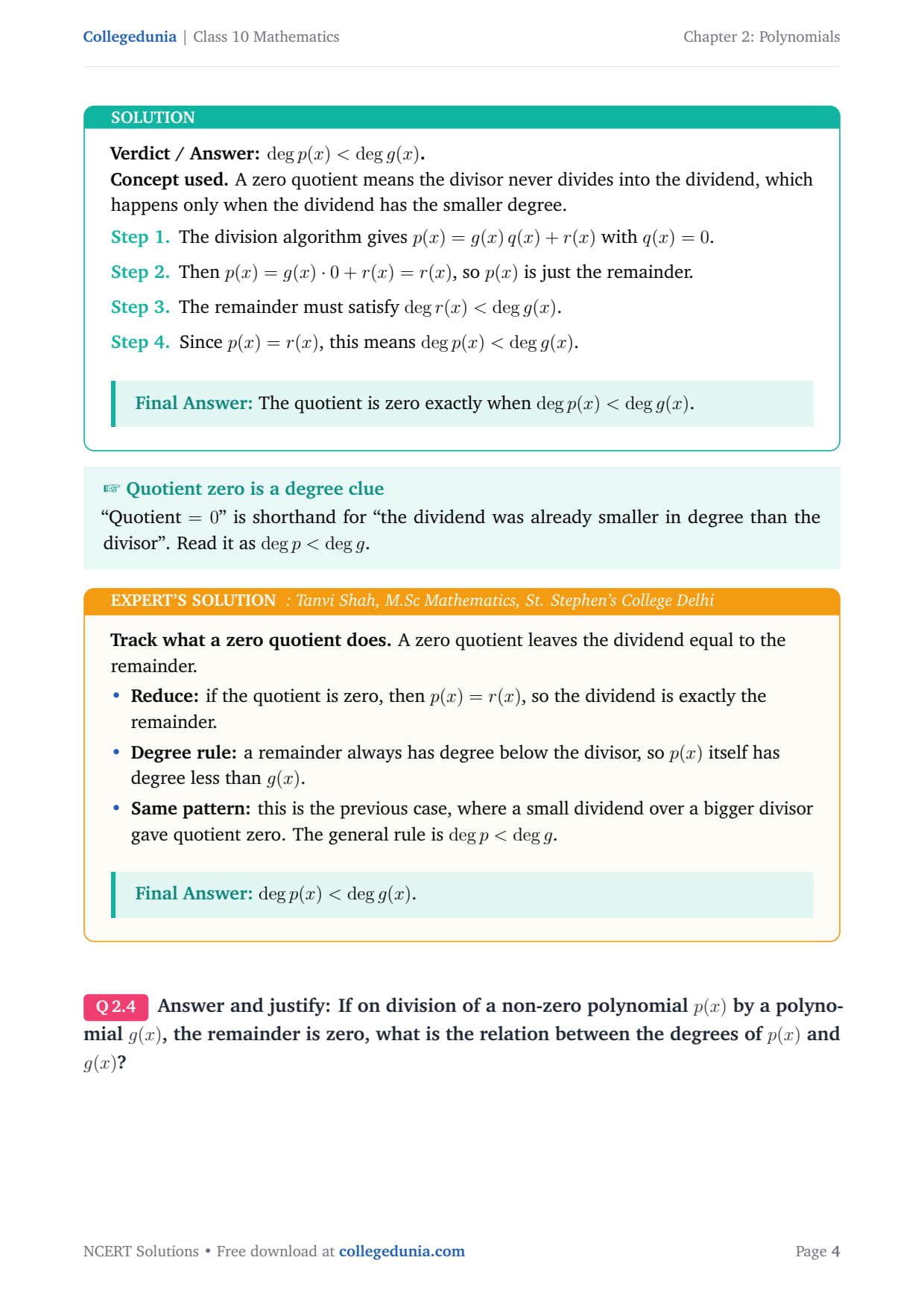
Answer and justify: If on division of a polynomial p(x) by a polynomial g(x), the quotient is zero, what is the relation between the degrees of p(x) and g(x)?
Verdict / Answer: deg p(x).
Concept used. A zero quotient means the divisor never divides
into the dividend, which happens only when the dividend has the smaller
degree.
The division algorithm gives p(x)=g(x) q(x)+r(x) with q(x)=0.
Then p(x)=g(x)· 0+r(x)=r(x), so p(x) is just the
remainder.
The remainder must satisfy deg r(x).
Since p(x)=r(x), this means deg p(x).
The quotient is zero exactly when deg p(x).
TS
Tanvi Shah
M.Sc Mathematics, St. Stephen's College Delhi
Verified Expert
Track what a zero quotient does. A zero quotient leaves the
dividend equal to the remainder.
Reduce: if the quotient is zero, then p(x)=r(x), so the
dividend is exactly the remainder.
Degree rule: a remainder always has degree below the
divisor, so p(x) itself has degree less than g(x).
Same pattern: this is the previous case, where a small
dividend over a bigger divisor gave quotient zero. The general
rule is deg p.
deg p(x).
Q 2.4
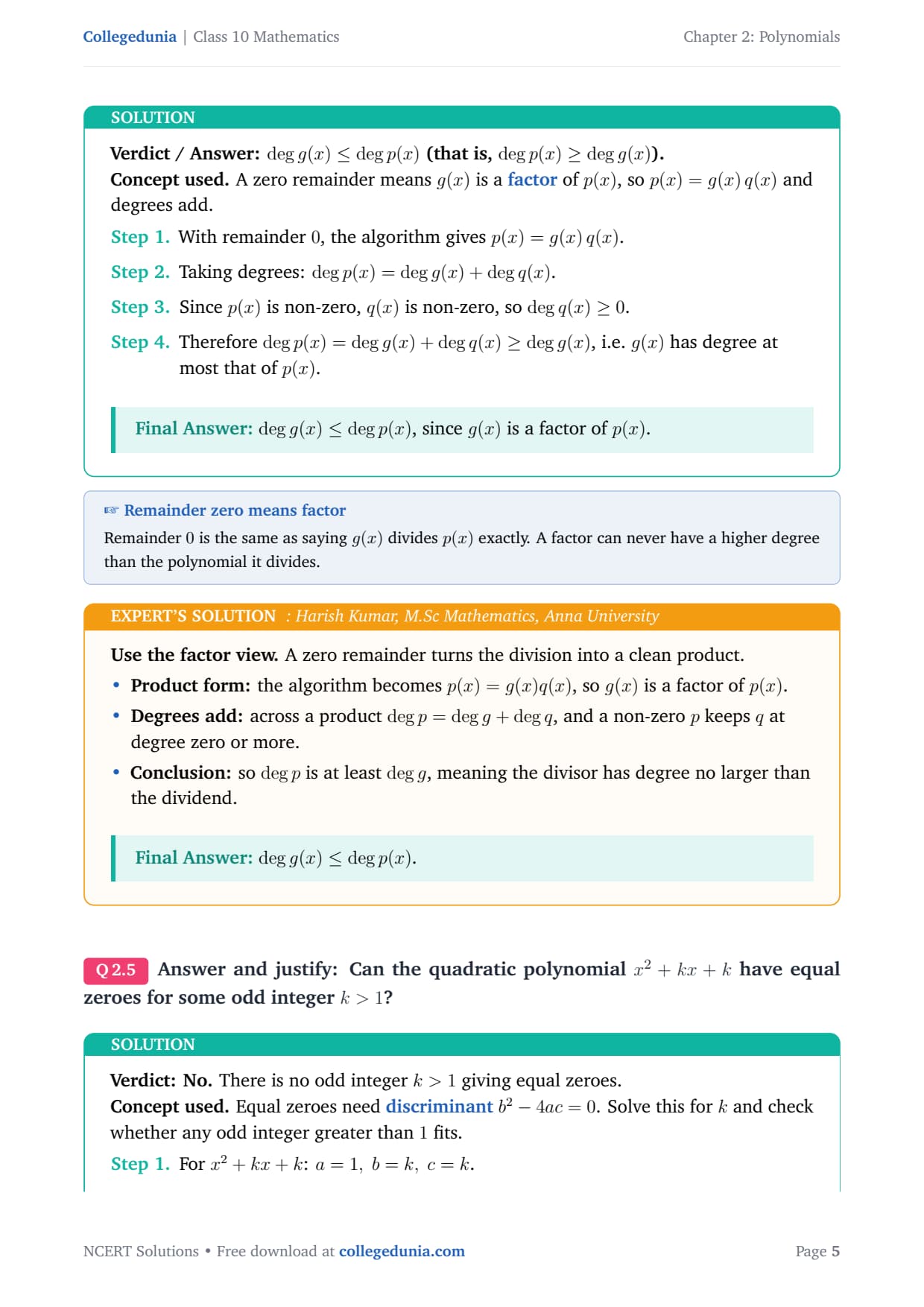
Answer and justify: If on division of a non-zero polynomial p(x) by a polynomial g(x), the remainder is zero, what is the relation between the degrees of p(x) and g(x)?
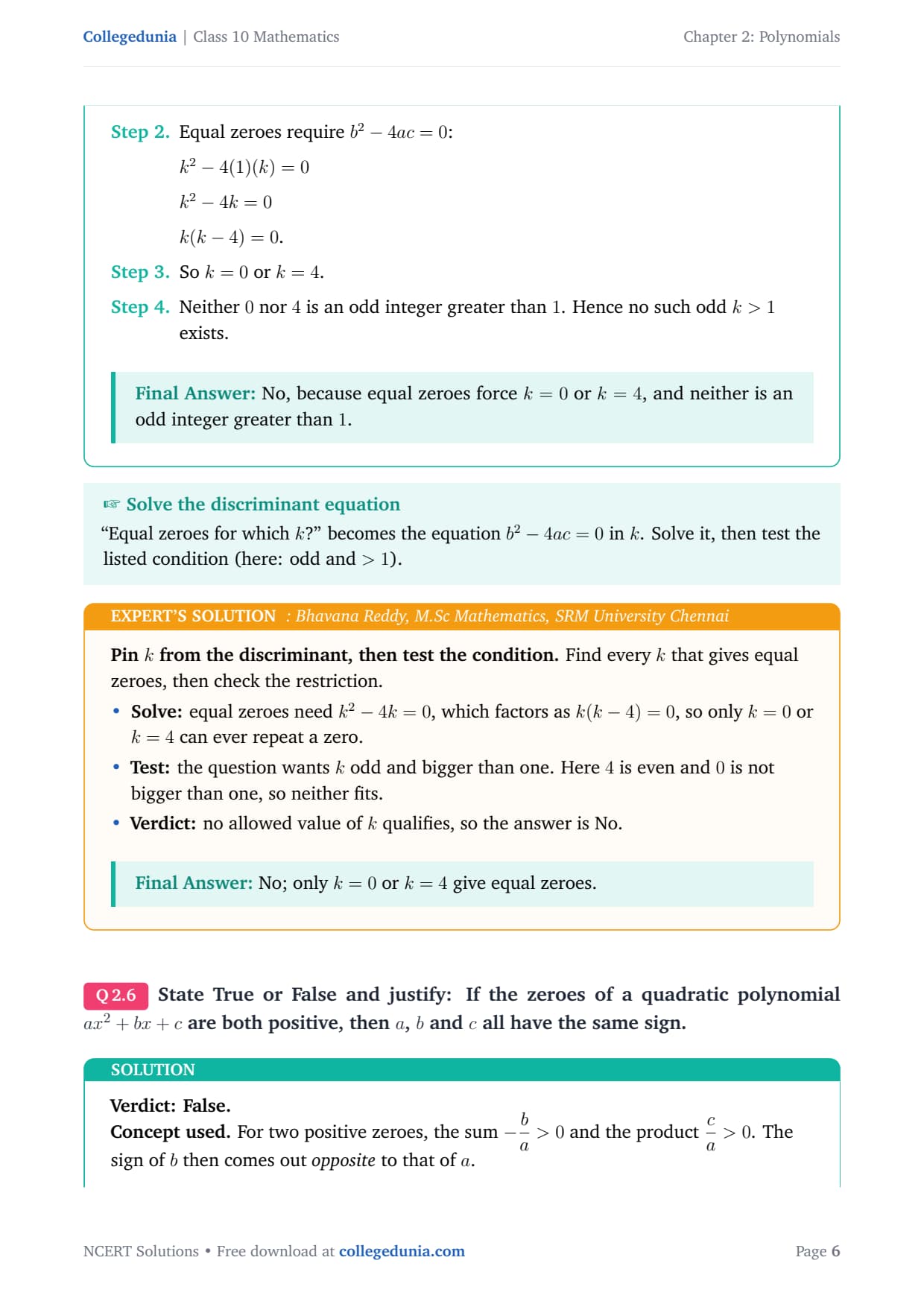
Neither 0 nor 4 is an odd integer greater than 1. Hence no
such odd k>1 exists.
No, because equal zeroes force k=0 or k=4, and neither is an
odd integer greater than 1.
BR
Bhavana Reddy
M.Sc Mathematics, SRM University Chennai
Verified Expert
Pin k from the discriminant, then test the condition. Find
every k that gives equal zeroes, then check the restriction.
Solve: equal zeroes need k2-4k=0, which factors as
k(k-4)=0, so only k=0 or k=4 can ever repeat a zero.
Test: the question wants k odd and bigger than one.
Here 4 is even and 0 is not bigger than one, so neither fits.
Verdict: no allowed value of k qualifies, so the answer
is No.
No; only k=0 or k=4 give equal zeroes.
Q 2.6
State True or False and justify: If the zeroes of a quadratic polynomial ax2+bx+c are both positive, then a, b and c all have the same sign.
Verdict: False.
Concept used. For two positive zeroes, the sum
-ba>0 and the product ca>0. The sign of b then
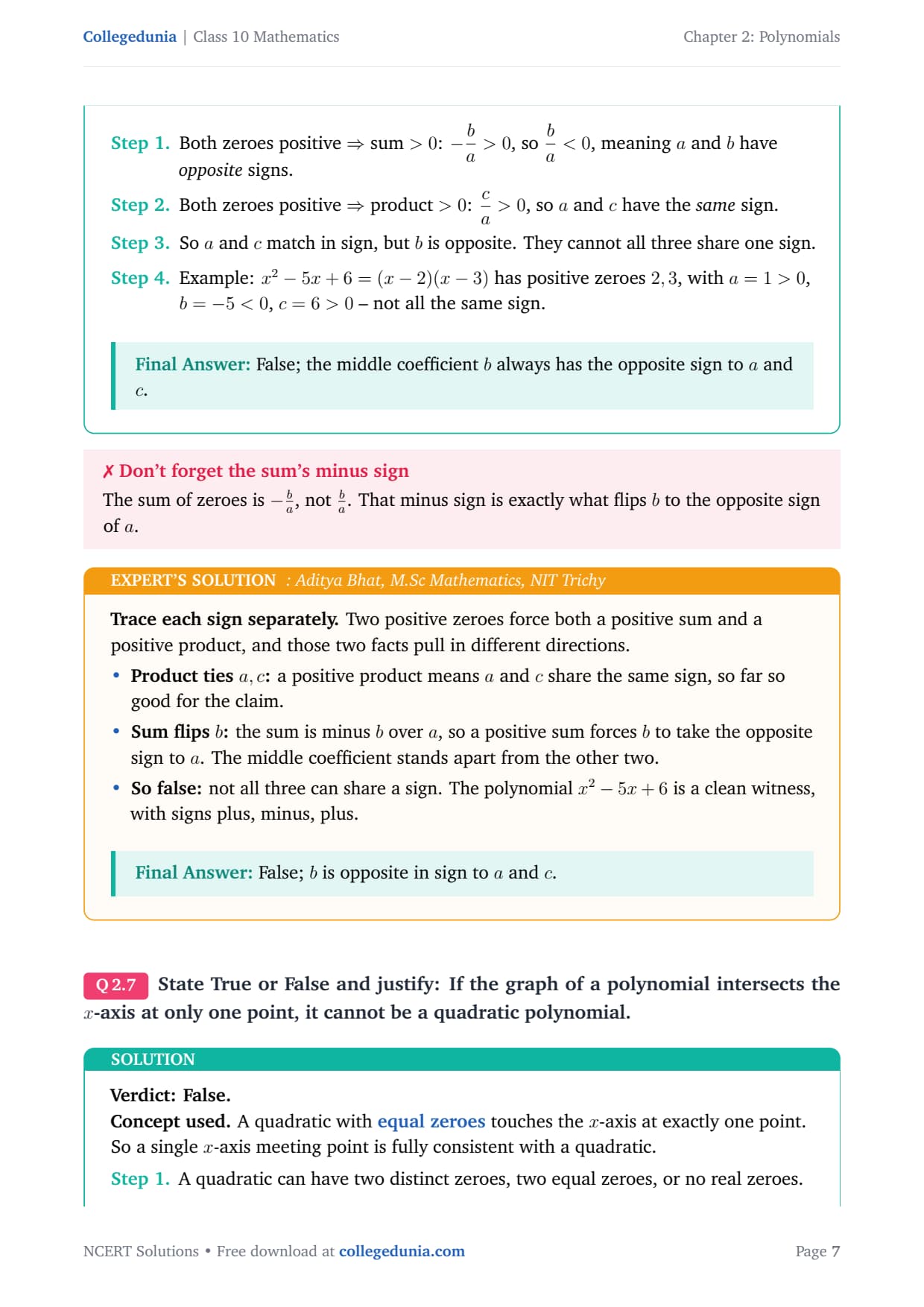
comes out opposite to that of a.
Both zeroes positive ⇒ sum >0:
-ba>0, so ba<0, meaning a and b have
opposite signs.
Both zeroes positive ⇒ product >0:
ca>0, so a and c have the same sign.
So a and c match in sign, but b is opposite. They cannot all
three share one sign.
Example: x2-5x+6=(x-2)(x-3) has positive zeroes 2,3, with
a=1>0, b=-5<0, c=6>0 – not all the same sign.
False; the middle coefficient b always has the opposite sign
to a and c.
AB
Aditya Bhat
M.Sc Mathematics, NIT Trichy
Verified Expert
Trace each sign separately. Two positive zeroes force both a
positive sum and a positive product, and those two facts pull in
different directions.
Product ties a,c: a positive product means a and c
share the same sign, so far so good for the claim.
Sum flips b: the sum is minus b over a, so a
positive sum forces b to take the opposite sign to a. The
middle coefficient stands apart from the other two.
So false: not all three can share a sign. The polynomial
x2-5x+6 is a clean witness, with signs plus, minus, plus.
False; b is opposite in sign to a and c.
Q 2.7
State True or False and justify: If the graph of a polynomial intersects the x-axis at only one point, it cannot be a quadratic polynomial.
Verdict: False.
Concept used. A quadratic with equal zeroes touches the
x-axis at exactly one point. So a single x-axis meeting point is
fully consistent with a quadratic.
A quadratic can have two distinct zeroes, two equal zeroes, or no
real zeroes.
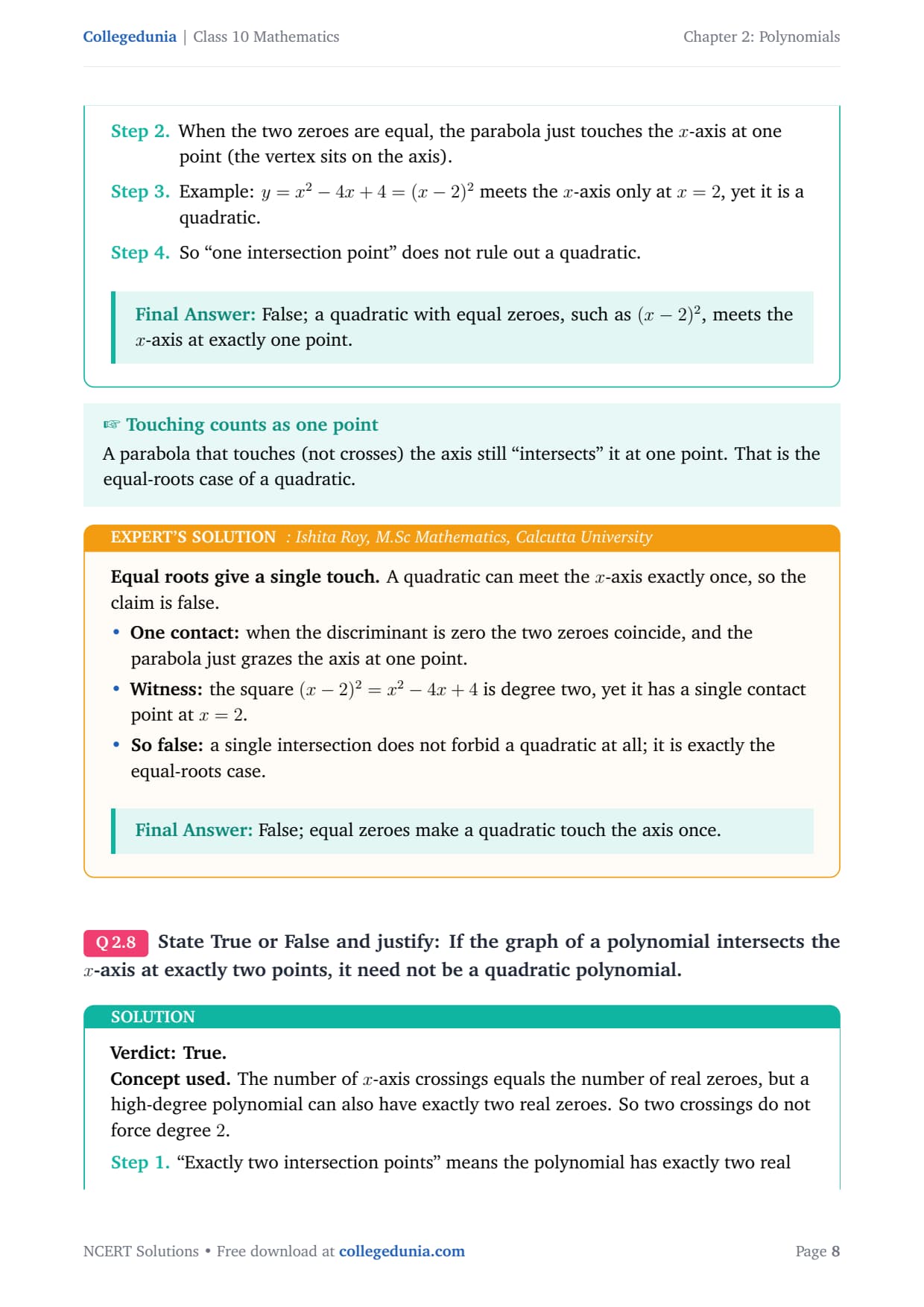
When the two zeroes are equal, the parabola just touches the
x-axis at one point (the vertex sits on the axis).
Example: y=x2-4x+4=(x-2)2 meets the x-axis only at
x=2, yet it is a quadratic.
So ``one intersection point'' does not rule out a quadratic.
False; a quadratic with equal zeroes, such as (x-2)2, meets
the x-axis at exactly one point.
IR
Ishita Roy
M.Sc Mathematics, Calcutta University
Verified Expert
Equal roots give a single touch. A quadratic can meet the
x-axis exactly once, so the claim is false.
One contact: when the discriminant is zero the two zeroes
coincide, and the parabola just grazes the axis at one point.
Witness: the square (x-2)2=x2-4x+4 is degree two,
yet it has a single contact point at x=2.
So false: a single intersection does not forbid a
quadratic at all; it is exactly the equal-roots case.
False; equal zeroes make a quadratic touch the axis once.
Q 2.8
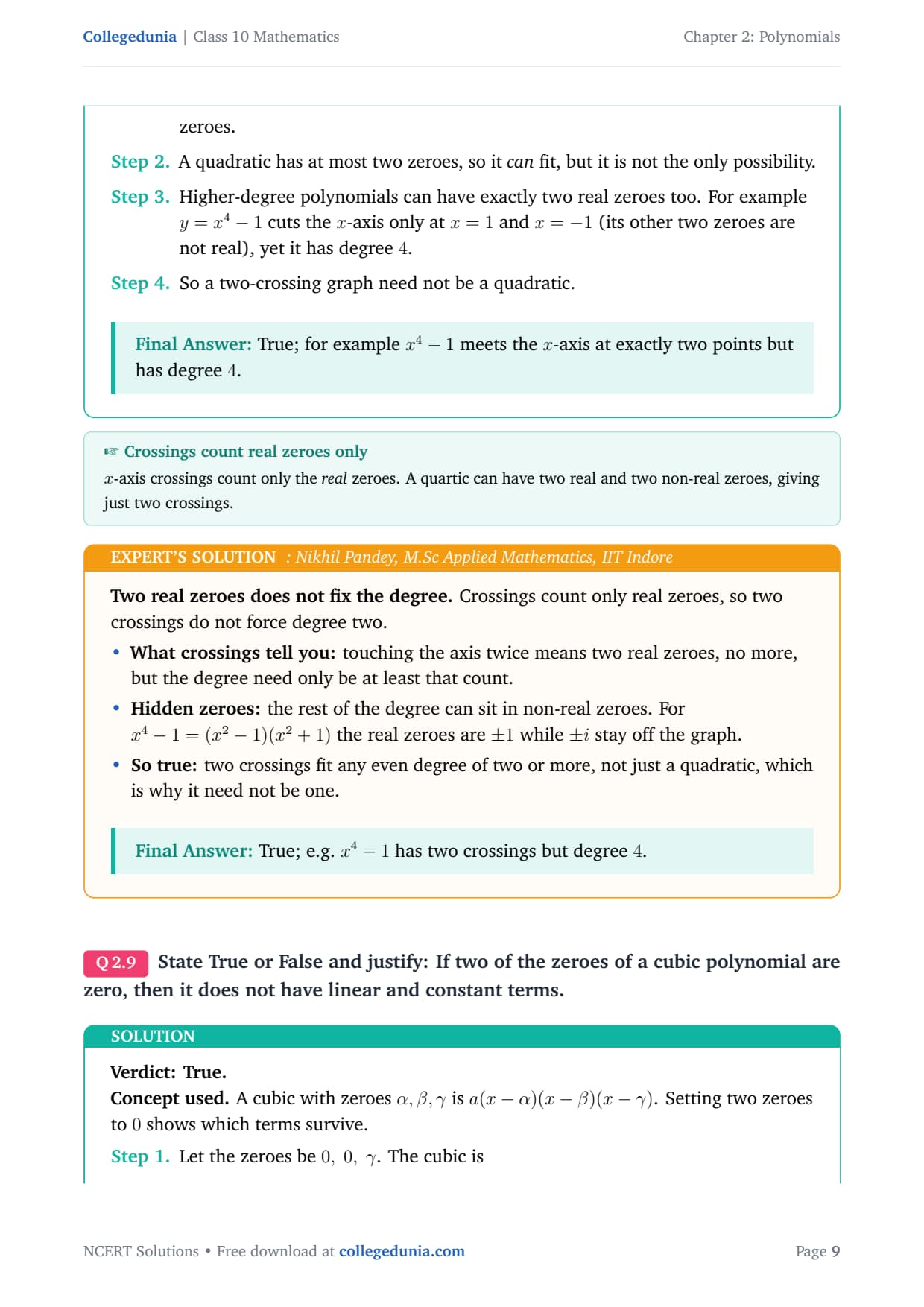
State True or False and justify: If the graph of a polynomial intersects the x-axis at exactly two points, it need not be a quadratic polynomial.
Verdict: True.
Concept used. The number of x-axis crossings equals the number
of real zeroes, but a high-degree polynomial can also have exactly two
real zeroes. So two crossings do not force degree 2.
``Exactly two intersection points'' means the polynomial has
exactly two real zeroes.
A quadratic has at most two zeroes, so it can fit, but it
is not the only possibility.
Higher-degree polynomials can have exactly two real zeroes too.
For example y=x4-1 cuts the x-axis only at x=1 and
x=-1 (its other two zeroes are not real), yet it has degree
4.
So a two-crossing graph need not be a quadratic.
True; for example x4-1 meets the x-axis at exactly two
points but has degree 4.
NP
Nikhil Pandey
M.Sc Applied Mathematics, IIT Indore
Verified Expert
Two real zeroes does not fix the degree. Crossings count only
real zeroes, so two crossings do not force degree two.
What crossings tell you: touching the axis twice means
two real zeroes, no more, but the degree need only be at least
that count.
Hidden zeroes: the rest of the degree can sit in non-real
zeroes. For x4-1=(x2-1)(x2+1) the real zeroes are 1
while ± i stay off the graph.
So true: two crossings fit any even degree of two or
more, not just a quadratic, which is why it need not be one.
True; e.g. x4-1 has two crossings but degree 4.
Q 2.9
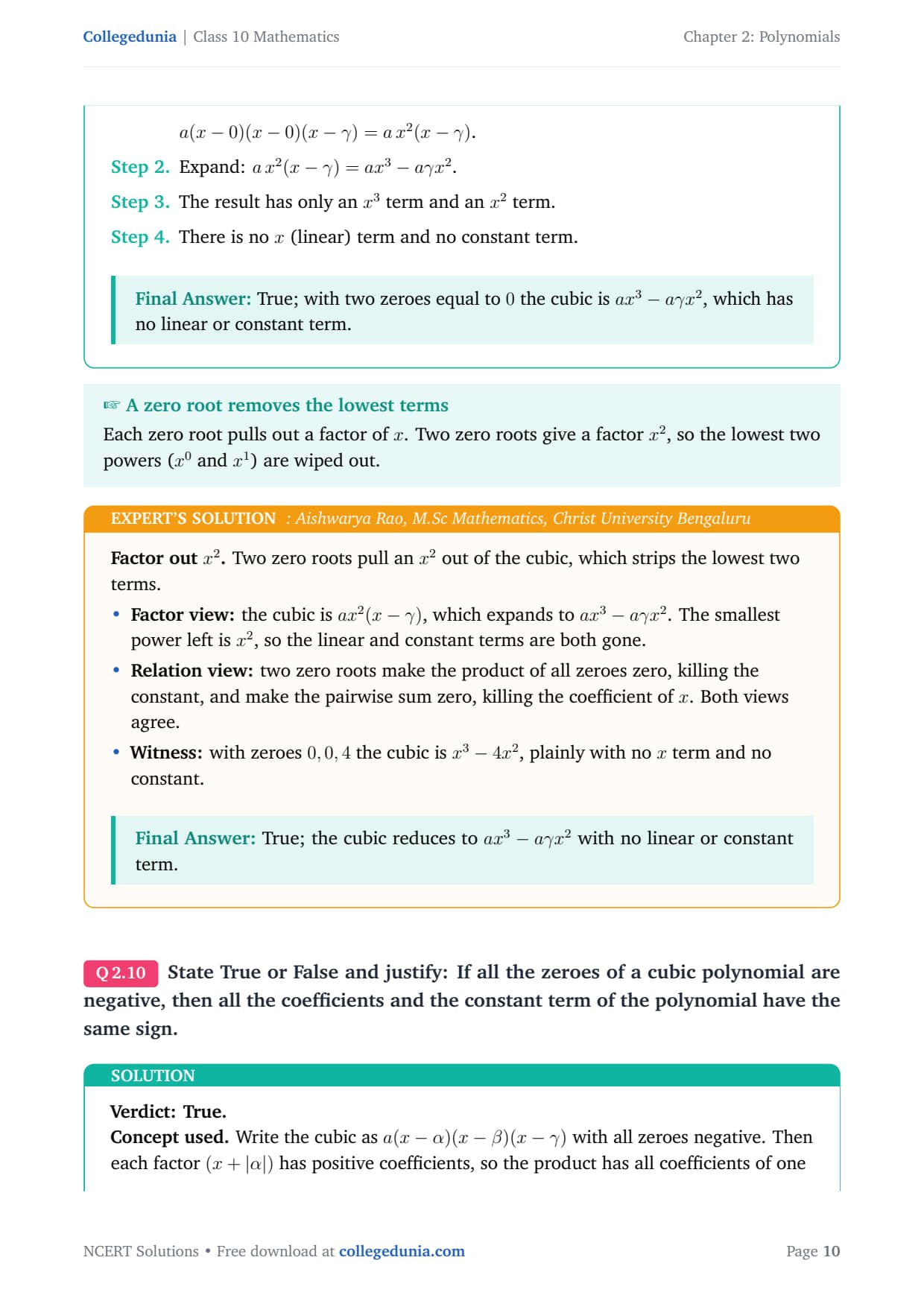
State True or False and justify: If two of the zeroes of a cubic polynomial are zero, then it does not have linear and constant terms.
Verdict: True.
Concept used. A cubic with zeroes α,β,γ is
a(x-α)(x-β)(x-γ). Setting two zeroes to 0 shows which
terms survive.
Let the zeroes be 0, 0, γ. The cubic is
[] a(x-0)(x-0)(x-γ)=a x2(x-γ).
Expand: a x2(x-γ)=a x3-aγ x2.
The result has only an x3 term and an x2 term.
There is no x (linear) term and no constant term.
True; with two zeroes equal to 0 the cubic is
ax3-aγ x2, which has no linear or constant term.
AR
Aishwarya Rao
M.Sc Mathematics, Christ University Bengaluru
Verified Expert
Factor out x2. Two zero roots pull an x2 out of the
cubic, which strips the lowest two terms.
Factor view: the cubic is a x2(x-γ), which
expands to a x3-aγ x2. The smallest power left is
x2, so the linear and constant terms are both gone.
Relation view: two zero roots make the product of all
zeroes zero, killing the constant, and make the pairwise sum zero,
killing the coefficient of x. Both views agree.
Witness: with zeroes 0,0,4 the cubic is
x3-4x2, plainly with no x term and no constant.
True; the cubic reduces to ax3-aγ x2 with no linear
or constant term.
Q 2.10
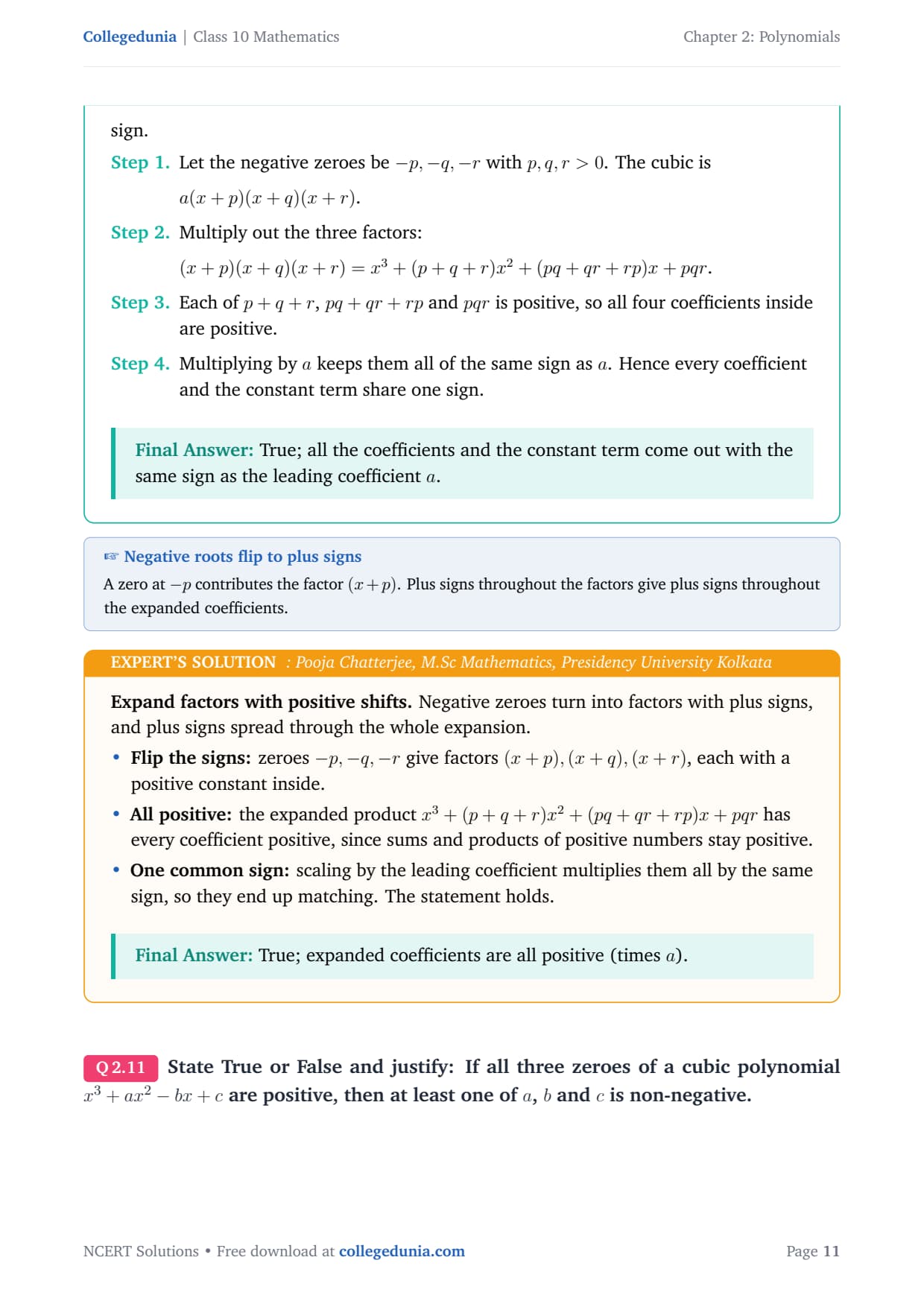
State True or False and justify: If all the zeroes of a cubic polynomial are negative, then all the coefficients and the constant term of the polynomial have the same sign.
Verdict: True.
Concept used. Write the cubic as a(x-α)(x-β)(x-γ)
with all zeroes negative. Then each factor (x+|α|) has positive
coefficients, so the product has all coefficients of one sign.
Let the negative zeroes be -p,-q,-r with p,q,r>0. The cubic is
[] a(x+p)(x+q)(x+r).
Multiply out the three factors:
[] (x+p)(x+q)(x+r)=x3+(p+q+r)x2+(pq+qr+rp)x+pqr.
Each of p+q+r, pq+qr+rp and pqr is positive, so all four
coefficients inside are positive.
Multiplying by a keeps them all of the same sign as a. Hence
every coefficient and the constant term share one sign.
True; all the coefficients and the constant term come out with
the same sign as the leading coefficient a.
PC
Pooja Chatterjee
M.Sc Mathematics, Presidency University Kolkata
Verified Expert
Expand factors with positive shifts. Negative zeroes turn into
factors with plus signs, and plus signs spread through the whole
expansion.
Flip the signs: zeroes -p,-q,-r give factors
(x+p),(x+q),(x+r), each with a positive constant inside.
All positive: the expanded product
x3+(p+q+r)x2+(pq+qr+rp)x+pqr has every coefficient
positive, since sums and products of positive numbers stay
positive.
One common sign: scaling by the leading coefficient
multiplies them all by the same sign, so they end up matching. The
statement holds.
True; expanded coefficients are all positive (times a).
Q 2.11
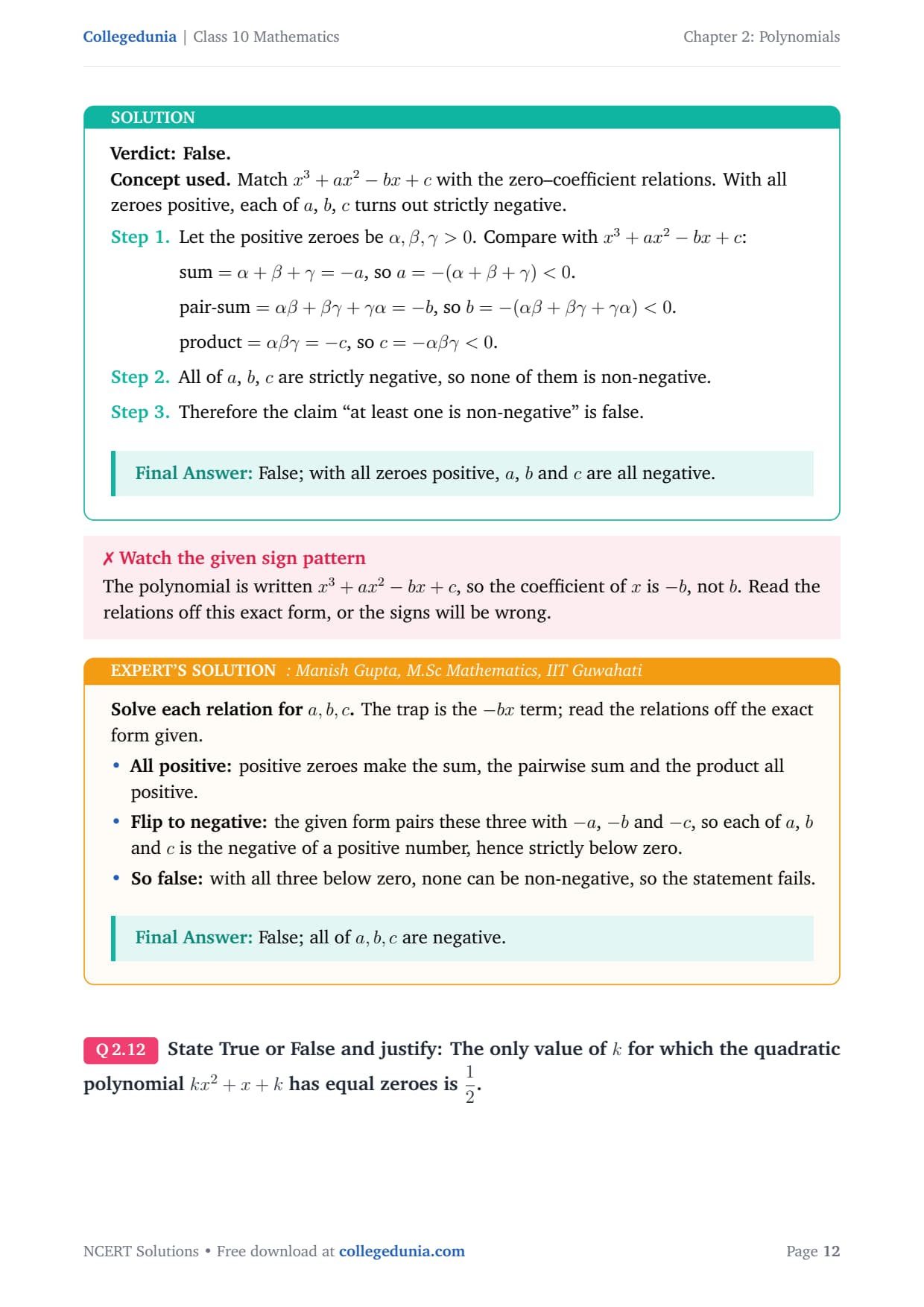
State True or False and justify: If all three zeroes of a cubic polynomial x3+ax2-bx+c are positive, then at least one of a, b and c is non-negative.
Verdict: False.
Concept used. Match x3+ax2-bx+c with the
zero–coefficient relations. With all zeroes positive, each of a, b,
c turns out strictly negative.
Let the positive zeroes be α,β,γ>0. Compare with
x3+ax2-bx+c:
[] sum =α+β+γ=-a, so a=-(α+β+γ)<0.
[] pair-sum =αβ+γ+α=-b, so
b=-(αβ+γ+α)<0.
[] product =αγ=-c, so c=-αγ<0.
All of a, b, c are strictly negative, so none of them is
non-negative.
Therefore the claim ``at least one is non-negative'' is false.
False; with all zeroes positive, a, b and c are all
negative.
MG
Manish Gupta
M.Sc Mathematics, IIT Guwahati
Verified Expert
Solve each relation for a,b,c. The trap is the -bx term;
read the relations off the exact form given.
All positive: positive zeroes make the sum, the pairwise
sum and the product all positive.
Flip to negative: the given form pairs these three with
-a, -b and -c, so each of a, b and c is the negative
of a positive number, hence strictly below zero.
So false: with all three below zero, none can be
non-negative, so the statement fails.
False; all of a,b,c are negative.
Q 2.12
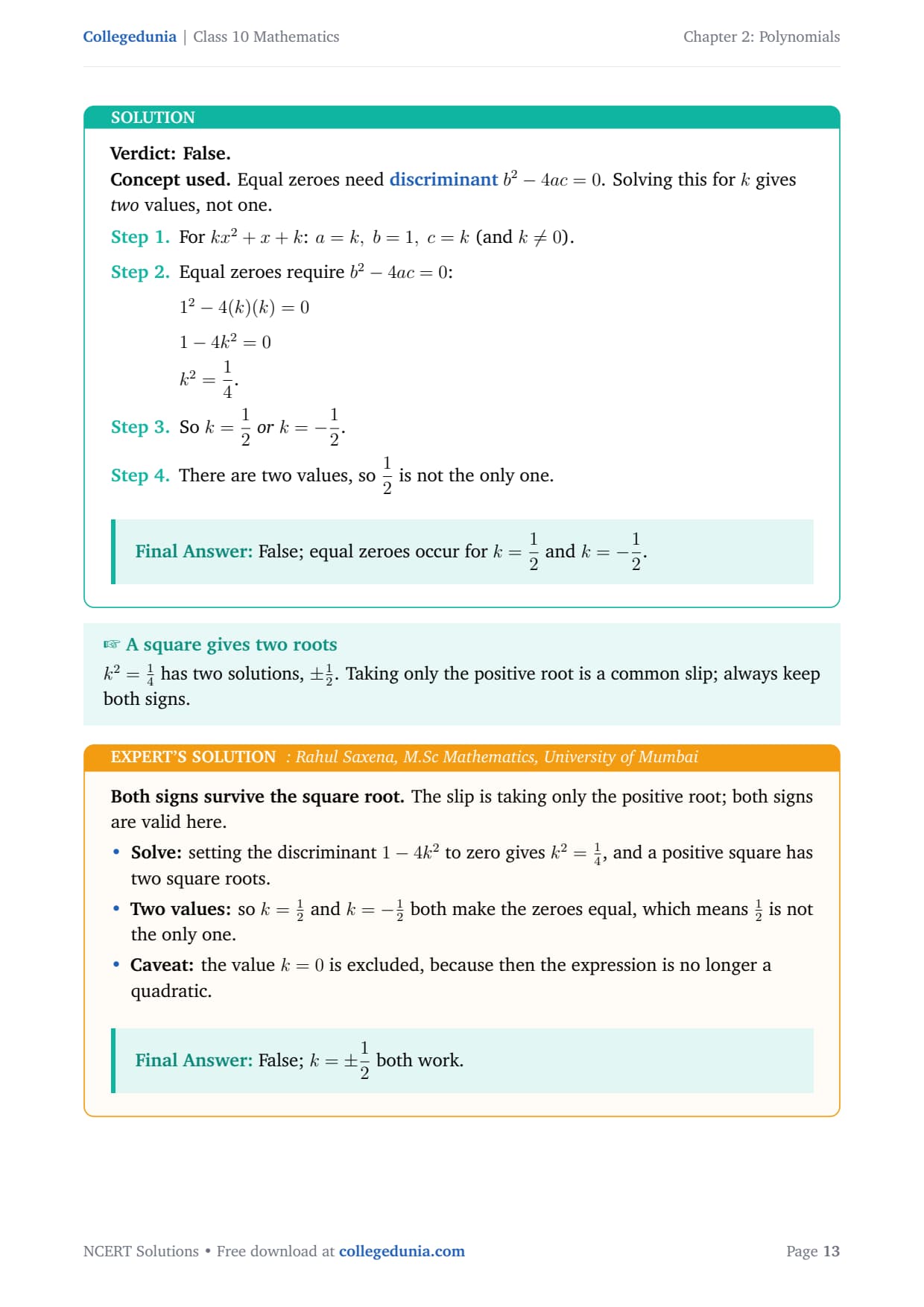
State True or False and justify: The only value of k for which the quadratic polynomial kx2+x+k has equal zeroes is 12.
Verdict: False.
Concept used. Equal zeroes need discriminantb2-4ac=0. Solving this for k gives two values, not one.
Both signs survive the square root. The slip is taking only the
positive root; both signs are valid here.
Solve: setting the discriminant 1-4k2 to zero gives
k2=14, and a positive square has two square roots.
Two values: so k=12 and k=-12 both make
the zeroes equal, which means 12 is not the only one.
Caveat: the value k=0 is excluded, because then the
expression is no longer a quadratic.
False; k=±12 both work.
NCERT exemplar Class 12 Mathematics Chapter 2 Polynomials
All questions with collapsible Solution and Expert Solution. Tap a button to reveal the working.
III. Short Answer Questions (Exercise 2.3)
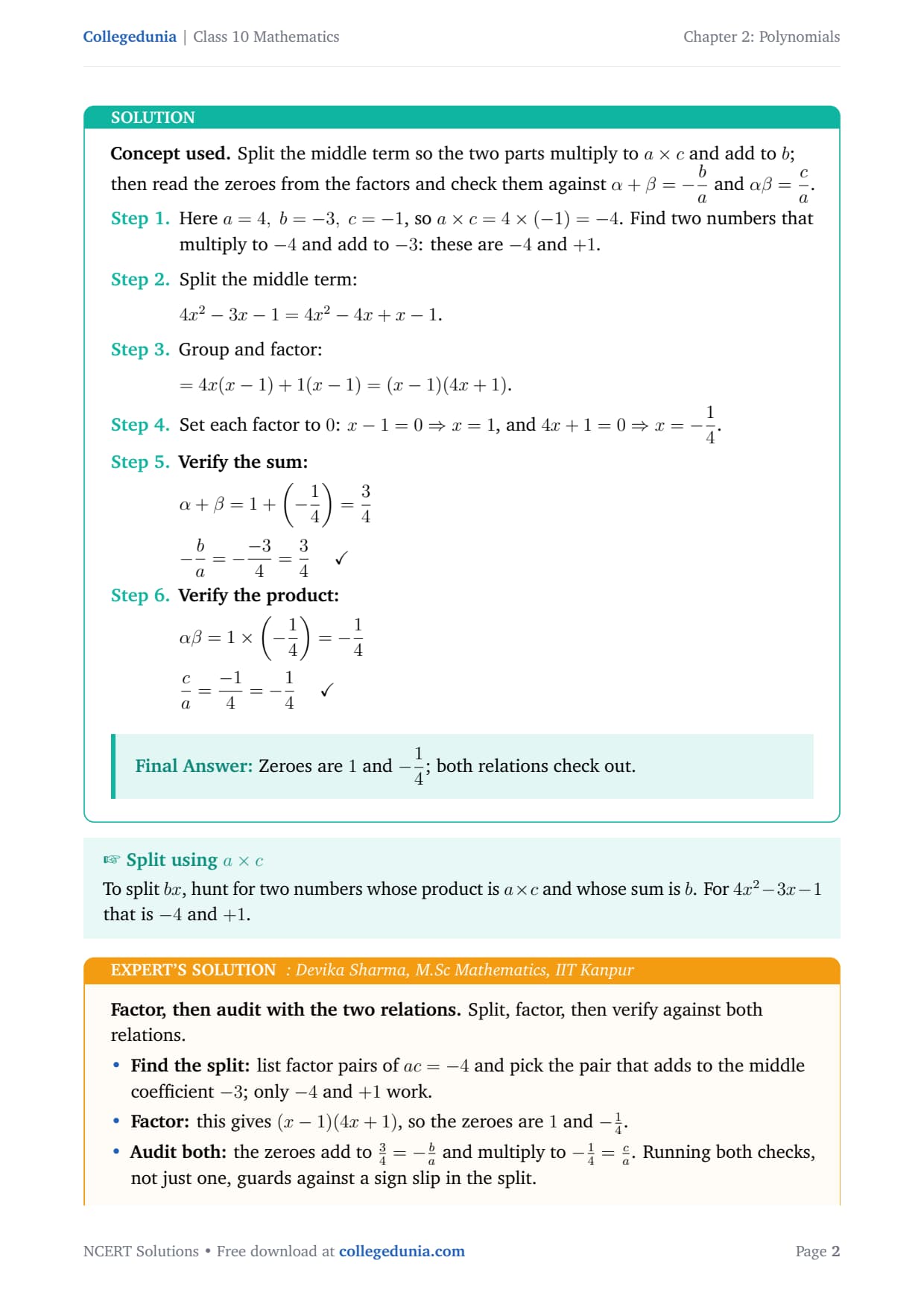
Q 2.1
Find the zeroes of 4x2-3x-1 by factorisation, and verify the relations between the zeroes and the coefficients.
Concept used. Split the middle term so the two parts multiply to
a× c and add to b; then read the zeroes from the factors and
check them against α+β=-ba and
αβ=ca.
Here a=4, b=-3, c=-1, so a× c=4×(-1)=-4. Find two
numbers that multiply to -4 and add to -3: these are
-4 and +1.
Split the middle term:
[] 4x2-3x-1=4x2-4x+x-1.
Group and factor:
[] =4x(x-1)+1(x-1)=(x-1)(4x+1).
Set each factor to 0: x-1=0⇒ x=1, and
4x+1=0⇒ x=-14.
Verify the sum:
[] α+β=1+(-14)=34
[] -ba=--34=34
Verify the product:
[] αβ=1×(-14)=-14
[] ca=-14=-14
Zeroes are 1 and -14; both relations check out.
DS
Devika Sharma
M.Sc Mathematics, IIT Kanpur
Verified Expert
Factor, then audit with the two relations. Split, factor, then
verify against both relations.
Find the split: list factor pairs of ac=-4 and pick the
pair that adds to the middle coefficient -3; only -4 and +1
work.
Factor: this gives (x-1)(4x+1), so the zeroes are 1
and -14.
Audit both: the zeroes add to 34=-ba
and multiply to -14=ca. Running both checks, not
just one, guards against a sign slip in the split.
Zeroes 1 and -14.
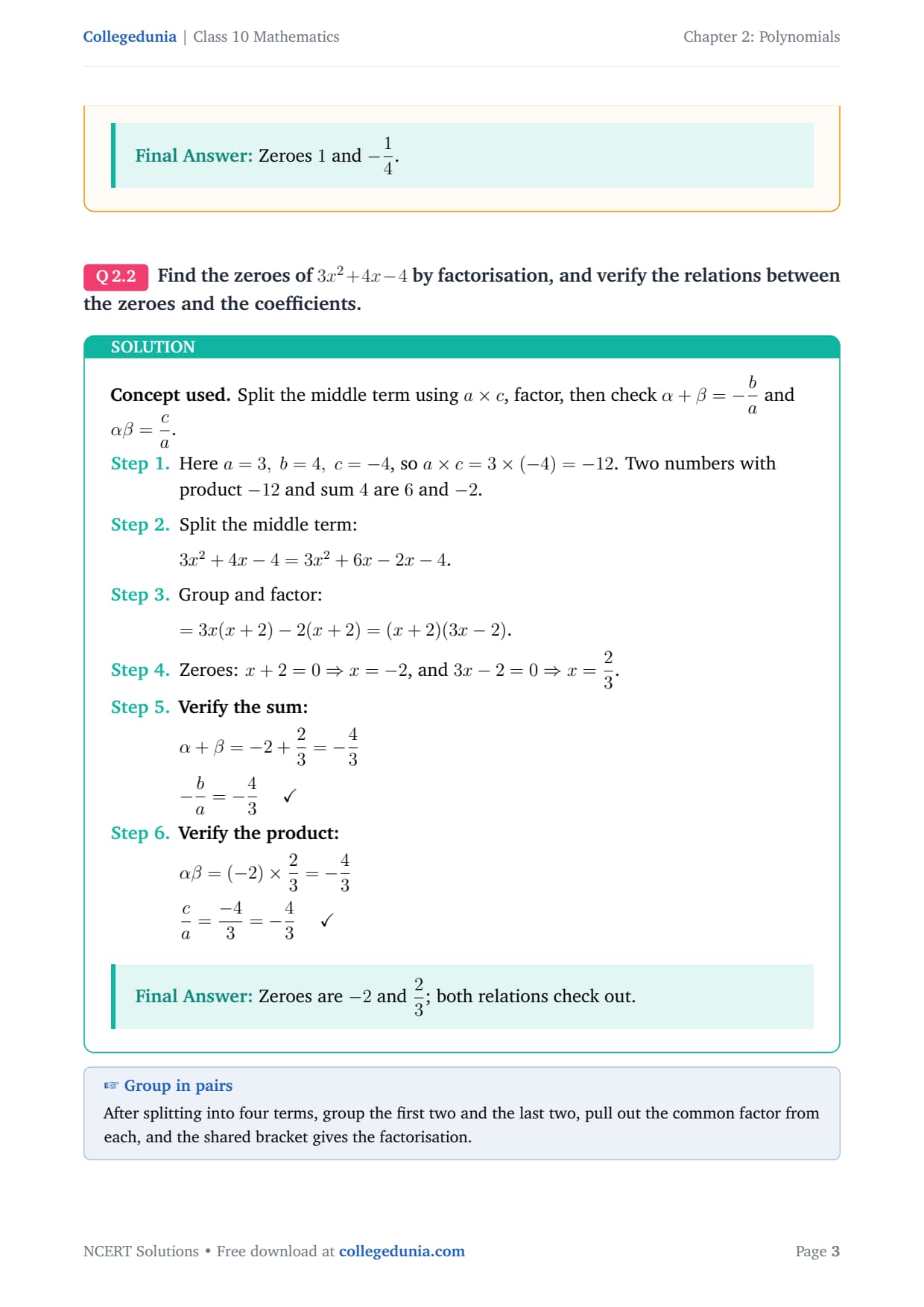
Q 2.2
Find the zeroes of 3x2+4x-4 by factorisation, and verify the relations between the zeroes and the coefficients.
Concept used. Split the middle term using a× c, factor,
then check α+β=-ba and αβ=ca.
Here a=3, b=4, c=-4, so a× c=3×(-4)=-12. Two
numbers with product -12 and sum 4 are 6 and -2.
Split the middle term:
[] 3x2+4x-4=3x2+6x-2x-4.
Group and factor:
[] =3x(x+2)-2(x+2)=(x+2)(3x-2).
Zeroes: x+2=0⇒ x=-2, and
3x-2=0⇒ x=23.
Verify the sum:
[] α+β=-2+23=-43
[] -ba=-43
Verify the product:
[] αβ=(-2)×23=-43
[] ca=-43=-43
Zeroes are -2 and 23; both relations check out.
TK
Tara Krishnan
M.Sc Mathematics, University of Delhi
Verified Expert
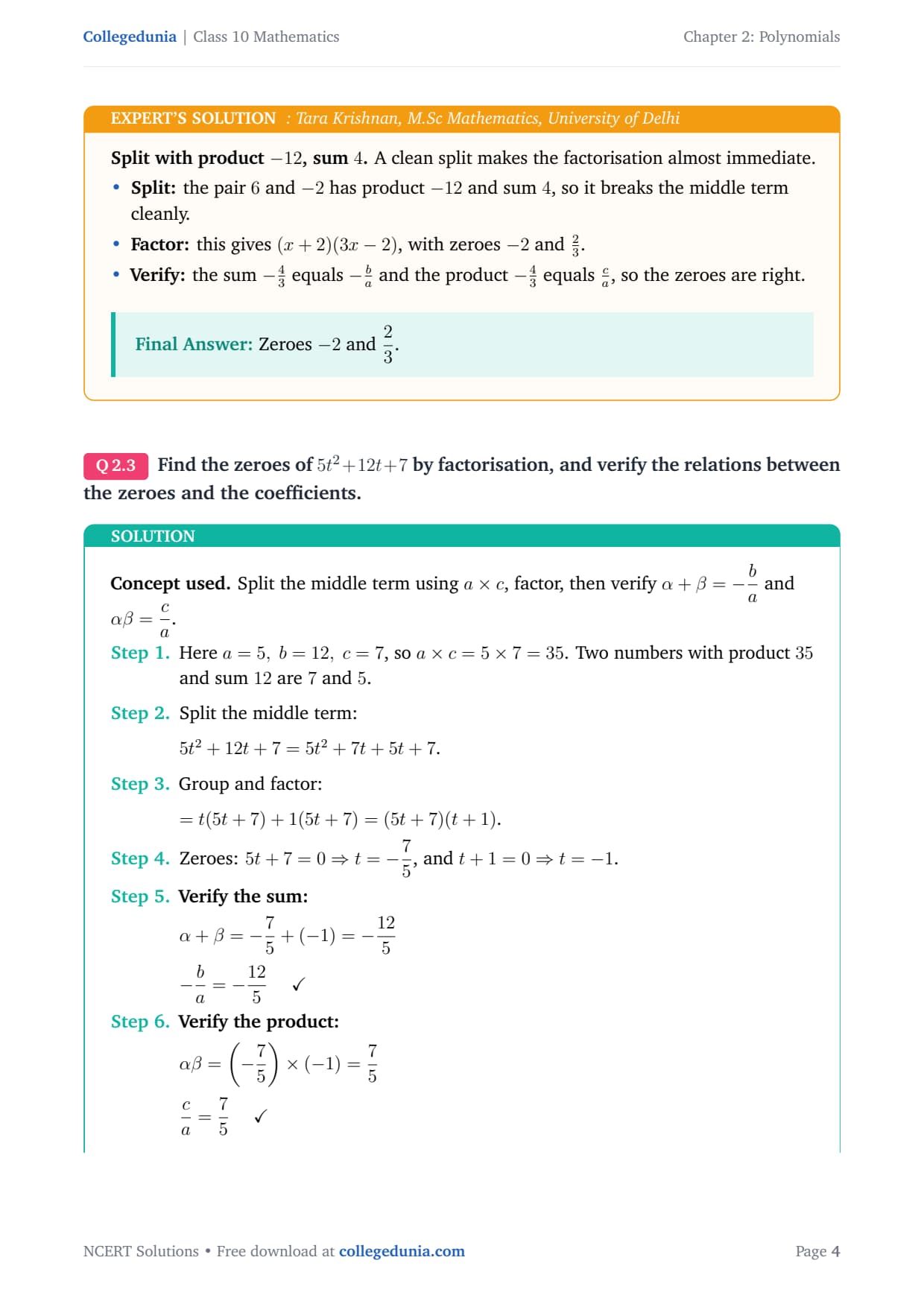
Split with product -12, sum 4. A clean split makes the
factorisation almost immediate.
Split: the pair 6 and -2 has product -12 and sum
4, so it breaks the middle term cleanly.
Factor: this gives (x+2)(3x-2), with zeroes -2 and
23.
Verify: the sum -43 equals -ba and
the product -43 equals ca, so the zeroes are
right.
Zeroes -2 and 23.
Q 2.3
Find the zeroes of 5t2+12t+7 by factorisation, and verify the relations between the zeroes and the coefficients.
Concept used. Split the middle term using a× c, factor,
then verify α+β=-ba and αβ=ca.
Here a=5, b=12, c=7, so a× c=5× 7=35. Two numbers
with product 35 and sum 12 are 7 and 5.
Split the middle term:
[] 5t2+12t+7=5t2+7t+5t+7.
Group and factor:
[] =t(5t+7)+1(5t+7)=(5t+7)(t+1).
Zeroes: 5t+7=0⇒ t=-75, and
t+1=0⇒ t=-1.
Verify the sum:
[] α+β=-75+(-1)=-125
[] -ba=-125
Verify the product:
[] αβ=(-75)×(-1)=75
[] ca=75
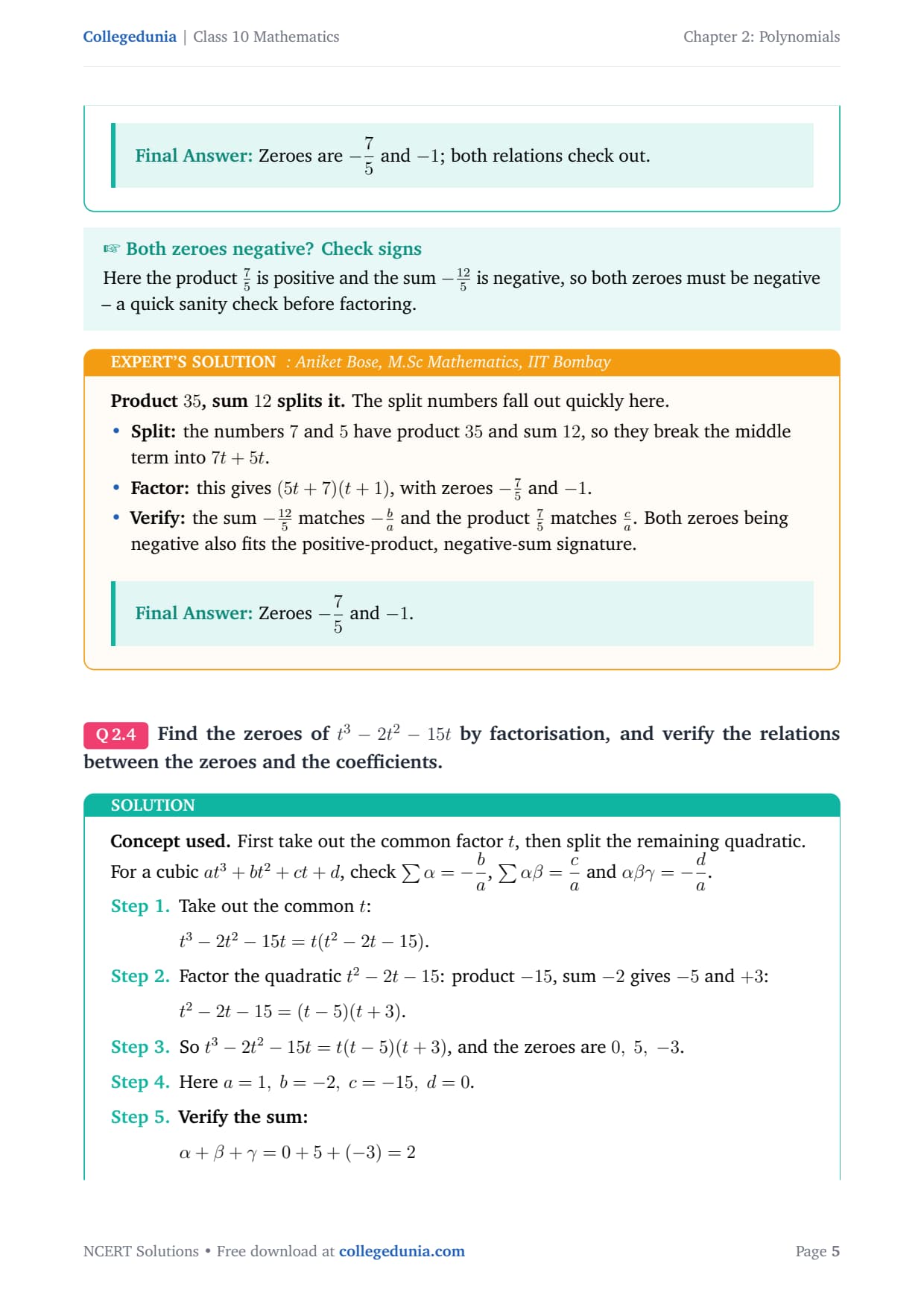
Zeroes are -75 and -1; both relations check out.
AB
Aniket Bose
M.Sc Mathematics, IIT Bombay
Verified Expert
Product 35, sum 12 splits it. The split numbers fall out
quickly here.
Split: the numbers 7 and 5 have product 35 and sum
12, so they break the middle term into 7t+5t.
Factor: this gives (5t+7)(t+1), with zeroes
-75 and -1.
Verify: the sum -125 matches -ba
and the product 75 matches ca. Both zeroes
being negative also fits the positive-product, negative-sum
signature.
Zeroes -75 and -1.
Q 2.4
Find the zeroes of t3-2t2-15t by factorisation, and verify the relations between the zeroes and the coefficients.
Concept used. First take out the common factor t, then split
the remaining quadratic. For a cubic at3+bt2+ct+d, check
α=-ba, αβ=ca and
αγ=-da.
Take out the common t:
[] t3-2t2-15t=t(t2-2t-15).
Factor the quadratic t2-2t-15: product -15, sum -2 gives
-5 and +3:
[] t2-2t-15=(t-5)(t+3).
So t3-2t2-15t=t(t-5)(t+3), and the zeroes are
0, 5, -3.
Here a=1, b=-2, c=-15, d=0.
Verify the sum:
[] α+β+γ=0+5+(-3)=2
[] -ba=--21=2
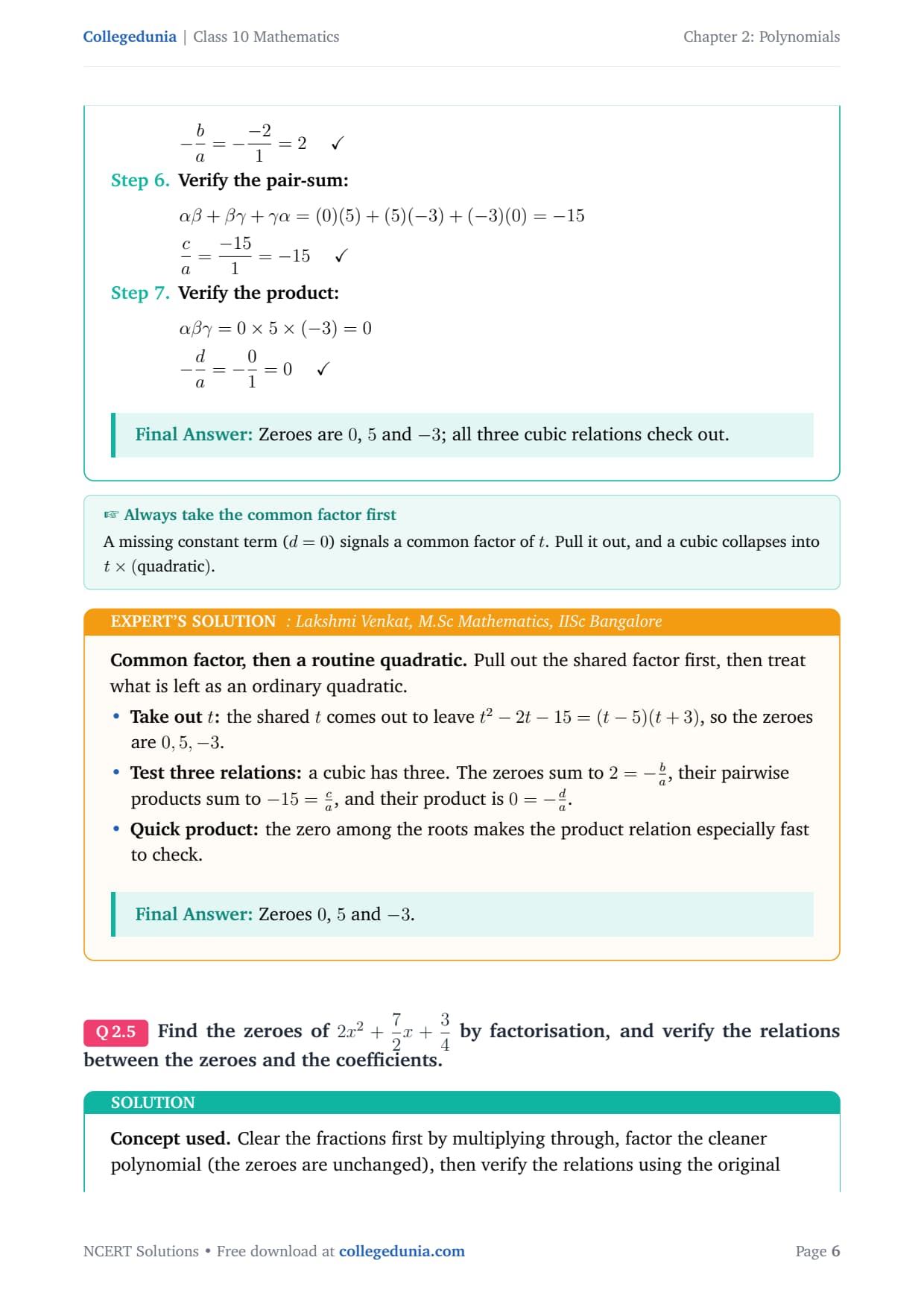
Verify the pair-sum:
[] αβ+γ+α=(0)(5)+(5)(-3)+(-3)(0)=-15
[] ca=-151=-15
Verify the product:
[] αγ=0× 5×(-3)=0
[] -da=-01=0
Zeroes are 0, 5 and -3; all three cubic relations check
out.
LV
Lakshmi Venkat
M.Sc Mathematics, IISc Bangalore
Verified Expert
Common factor, then a routine quadratic. Pull out the shared
factor first, then treat what is left as an ordinary quadratic.
Take out t: the shared t comes out to leave
t2-2t-15=(t-5)(t+3), so the zeroes are 0,5,-3.
Test three relations: a cubic has three. The zeroes sum
to 2=-ba, their pairwise products sum to
-15=ca, and their product is 0=-da.
Quick product: the zero among the roots makes the product
relation especially fast to check.
Zeroes 0, 5 and -3.
Q 2.5
Find the zeroes of 2x2+72x+34 by factorisation, and verify the relations between the zeroes and the coefficients.
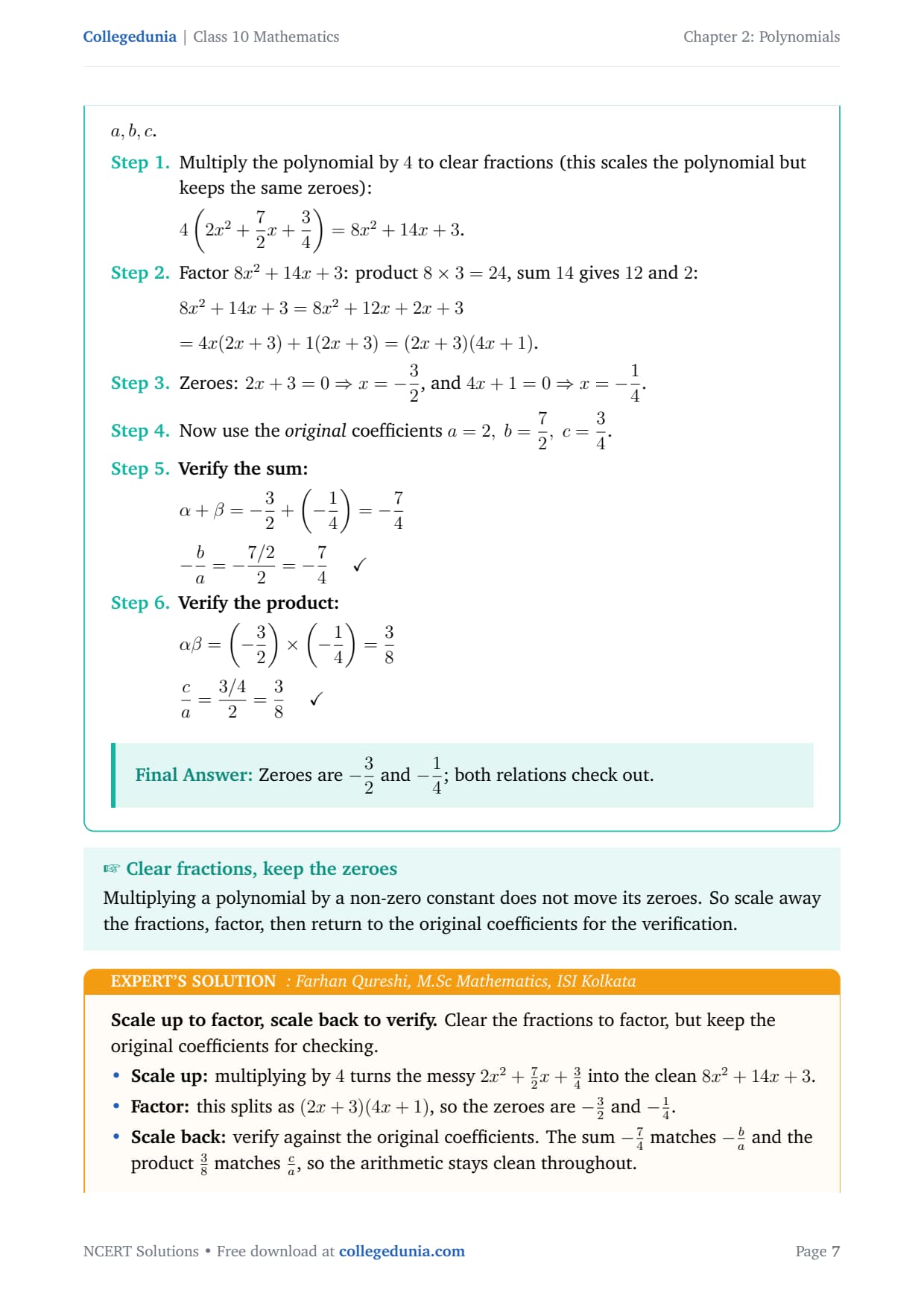
Concept used. Clear the fractions first by multiplying through,
factor the cleaner polynomial (the zeroes are unchanged), then verify the
relations using the original a,b,c.
Multiply the polynomial by 4 to clear fractions (this scales the
polynomial but keeps the same zeroes):
[] 4(2x2+72x+34)=8x2+14x+3.
Factor 8x2+14x+3: product 8× 3=24, sum 14 gives
12 and 2:
[] 8x2+14x+3=8x2+12x+2x+3
[] =4x(2x+3)+1(2x+3)=(2x+3)(4x+1).
Zeroes: 2x+3=0⇒ x=-32, and
4x+1=0⇒ x=-14.
Now use the original coefficients
a=2, b=72, c=34.
Verify the sum:
[] α+β=-32+(-14)
=-74
[] -ba=-7/22=-74
Verify the product:
[] αβ=(-32)×
(-14)=38
[] ca=3/42=38
Zeroes are -32 and -14; both relations
check out.
FQ
Farhan Qureshi
M.Sc Mathematics, ISI Kolkata
Verified Expert
Scale up to factor, scale back to verify. Clear the fractions to
factor, but keep the original coefficients for checking.
Scale up: multiplying by 4 turns the messy
2x2+72x+34 into the clean 8x2+14x+3.
Factor: this splits as (2x+3)(4x+1), so the zeroes are
-32 and -14.
Scale back: verify against the original coefficients. The
sum -74 matches -ba and the product 38
matches ca, so the arithmetic stays clean throughout.
Zeroes -32 and -14.
Q 2.6
Find the zeroes of 4x2+5√2x-3 by factorisation, and verify the relations between the zeroes and the coefficients.
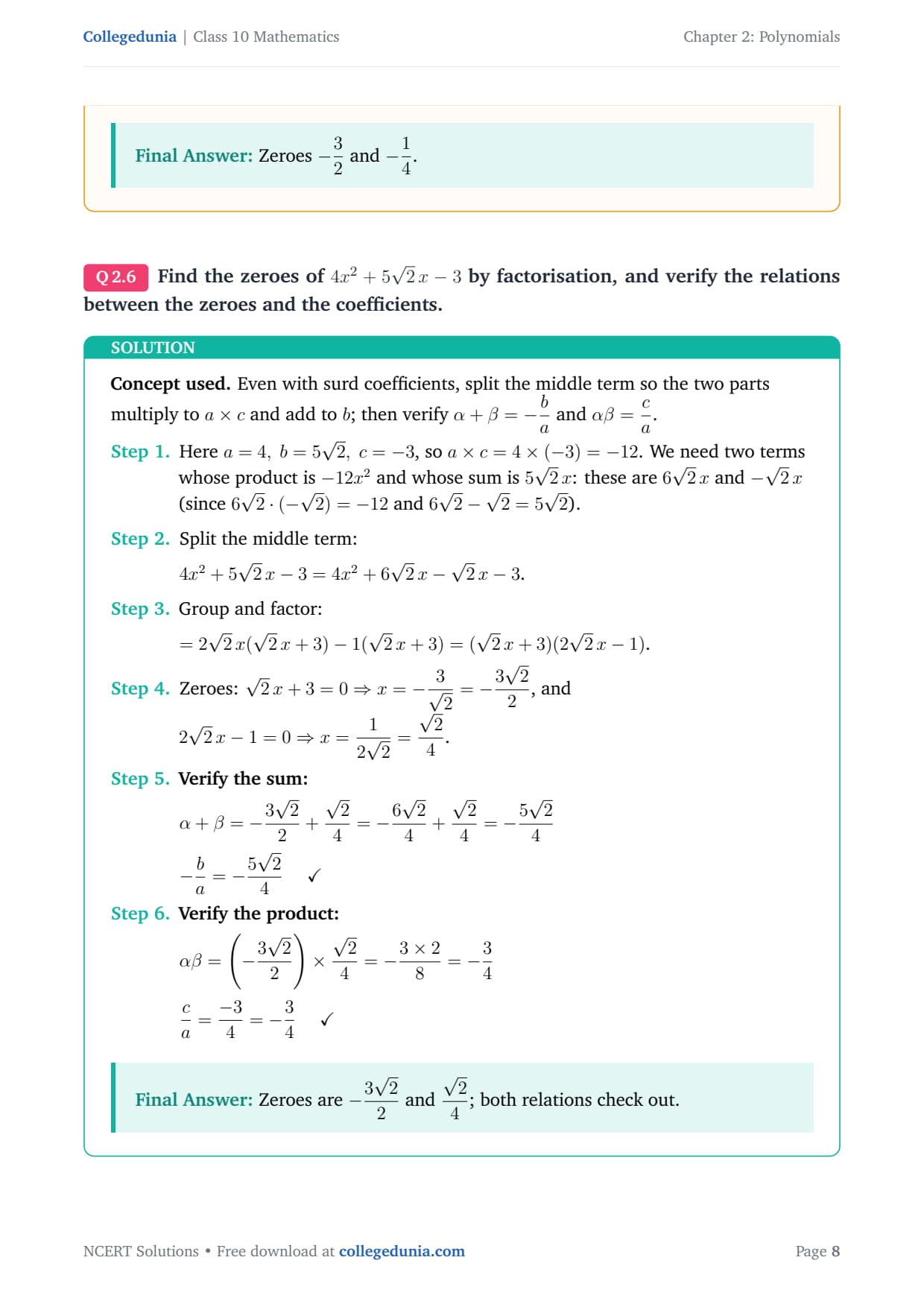
Concept used. Even with surd coefficients, split the middle term
so the two parts multiply to a× c and add to b; then verify
α+β=-ba and αβ=ca.
Here a=4, b=5√2, c=-3, so a× c=4×(-3)=-12.
We need two terms whose product is -12x2 and whose sum is
5√2x: these are 6√2x and -√2x
(since 6√2·(-√2)=-12 and
6√2-√2=5√2).
Split the middle term:
[] 4x2+5√2x-3=4x2+6√2x-√2x-3.
Group and factor:
[] =2√2x(√2x+3)-1(√2x+3)
=(√2x+3)(2√2x-1).
Zeroes: √2x+3=0⇒
x=-3√2=-3√22, and
2√2x-1=0⇒
x=12√2=√24.
Verify the sum:
[] α+β=-3√22+√24
=-6√24+√24=-5√24
[] -ba=-5√24
Verify the product:
[] αβ=(-3√22)
×√24=-3× 28=-34
[] ca=-34=-34
Zeroes are -3√22 and √24;
both relations check out.
RN
Ritika Nanda
M.Sc Mathematics, Panjab University Chandigarh
Verified Expert
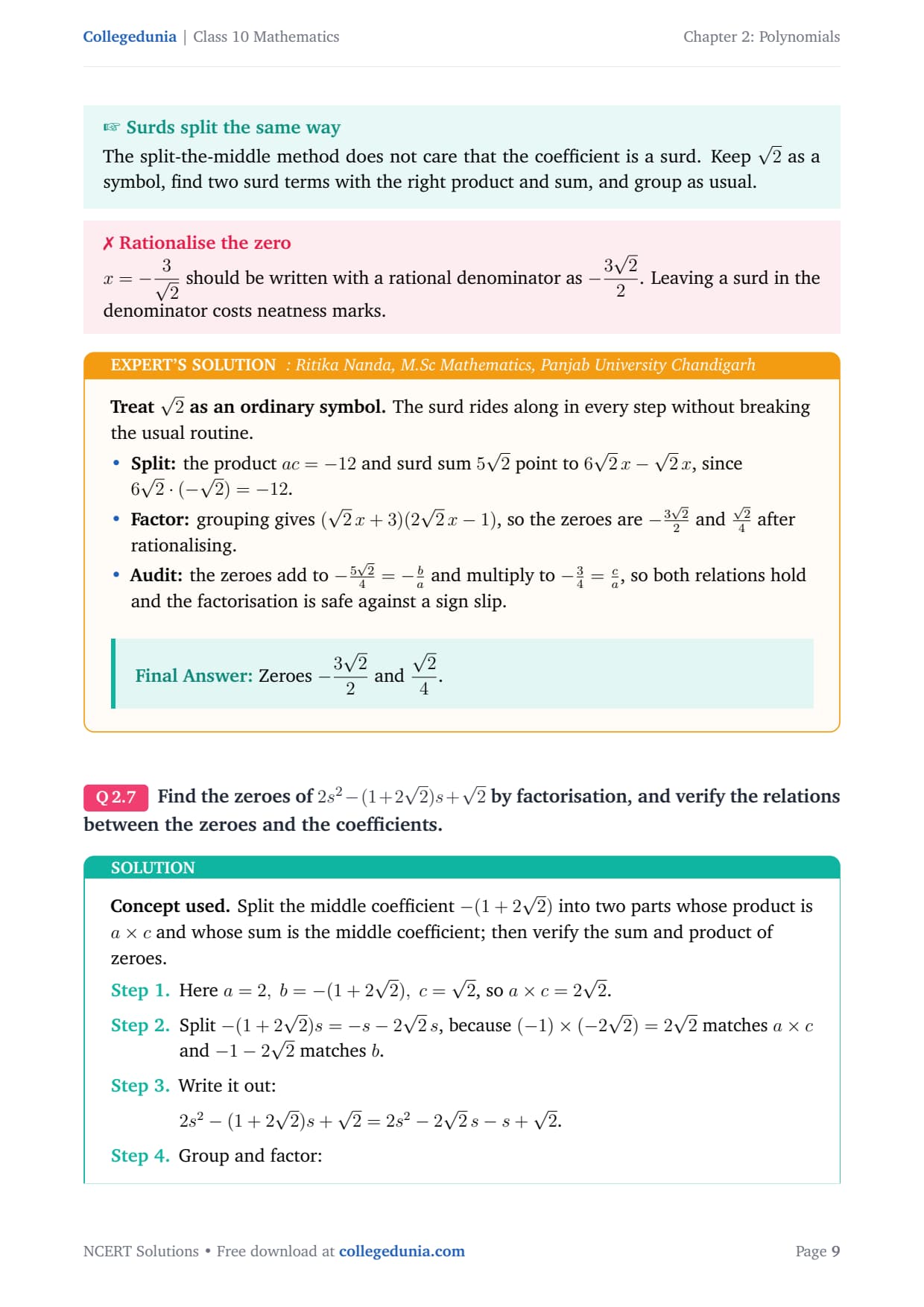
Treat √2 as an ordinary symbol. The surd rides along in
every step without breaking the usual routine.
Split: the product ac=-12 and surd sum 5√2
point to 6√2x-√2x, since
62·(-2)=-12.
Factor: grouping gives (2 x+3)(22 x-1), so
the zeroes are -322 and 24 after
rationalising.
Audit: the zeroes add to -524
=-ba and multiply to -34=ca, so both
relations hold and the factorisation is safe against a sign slip.
Zeroes -3√22 and √24.
Q 2.7
Find the zeroes of 2s2-(1+2√2)s+√2 by factorisation, and verify the relations between the zeroes and the coefficients.
Concept used. Split the middle coefficient -(1+2√2) into
two parts whose product is a× c and whose sum is the middle
coefficient; then verify the sum and product of zeroes.
Here a=2, b=-(1+2√2), c=√2, so
a× c=2√2.
Split -(1+2√2)s=-s-2√2s, because
(-1)×(-2√2)=2√2 matches a× c and
-1-2√2 matches b.
Write it out:
[] 2s2-(1+2√2)s+√2=2s2-2√2s-s+√2.
Group and factor:
[] =2s(s-√2)-1(s-√2)=(s-√2)(2s-1).
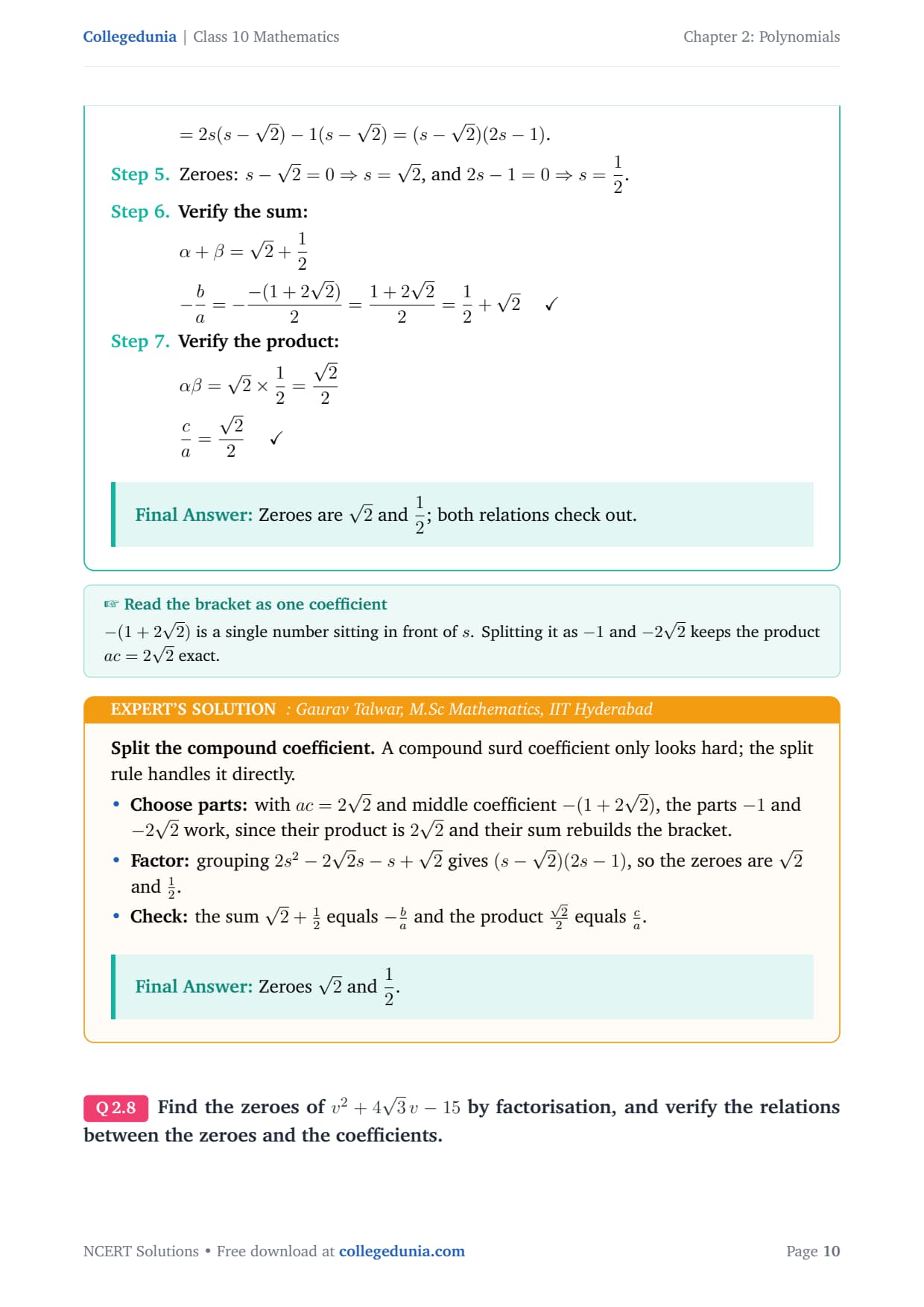
Zeroes: s-√2=0⇒ s=√2, and
2s-1=0⇒ s=12.
Verify the sum:
[] α+β=√2+12
[] -ba=--(1+2√2)2
=1+2√22=12+√2
Verify the product:
[] αβ=√2×12=√22
[] ca=√22
Zeroes are √2 and 12; both relations check
out.
GT
Gaurav Talwar
M.Sc Mathematics, IIT Hyderabad
Verified Expert
Split the compound coefficient. A compound surd coefficient only
looks hard; the split rule handles it directly.
Choose parts: with ac=22 and middle coefficient
-(1+22), the parts -1 and -22 work, since their
product is 22 and their sum rebuilds the bracket.
Factor: grouping 2s2-22 s-s+2 gives
(s-2)(2s-1), so the zeroes are 2 and 12.
Check: the sum 2+12 equals -ba
and the product 22 equals ca.
Zeroes √2 and 12.
Q 2.8
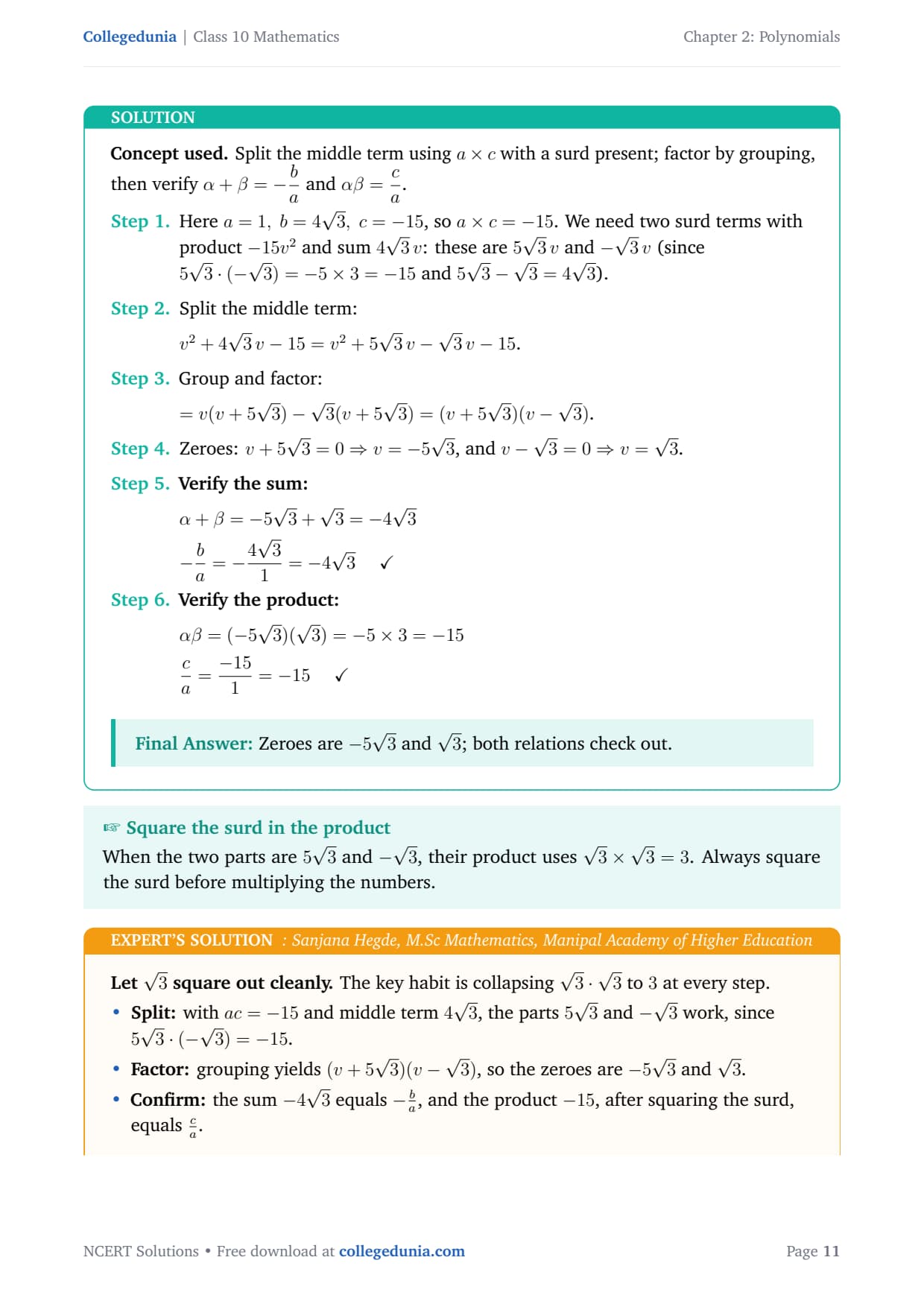
Find the zeroes of v2+4√3v-15 by factorisation, and verify the relations between the zeroes and the coefficients.
Concept used. Split the middle term using a× c with a surd
present; factor by grouping, then verify α+β=-ba and
αβ=ca.
Here a=1, b=4√3, c=-15, so a× c=-15. We need two
surd terms with product -15v2 and sum 4√3v: these
are 5√3v and -√3v (since
5√3·(-√3)=-5× 3=-15 and
5√3-√3=4√3).
Split the middle term:
[] v2+4√3v-15=v2+5√3v-√3v-15.
Group and factor:
[] =v(v+5√3)-√3(v+5√3)=(v+5√3)(v-√3).
Zeroes: v+5√3=0⇒ v=-5√3, and
v-√3=0⇒ v=√3.
Verify the sum:
[] α+β=-5√3+√3=-4√3
[] -ba=-4√31=-4√3
Verify the product:
[] αβ=(-5√3)(√3)=-5× 3=-15
[] ca=-151=-15
Zeroes are -5√3 and √3; both relations check
out.
SH
Sanjana Hegde
M.Sc Mathematics, Manipal Academy of Higher Education
Verified Expert
Let 3 square out cleanly. The key habit is collapsing
3·3 to 3 at every step.
Split: with ac=-15 and middle term 43, the parts
53 and -3 work, since 53·(-3)=-15.
Factor: grouping yields (v+53)(v-3), so the
zeroes are -53 and 3.
Confirm: the sum -43 equals -ba, and
the product -15, after squaring the surd, equals ca.
Zeroes -5√3 and √3.
Q 2.9
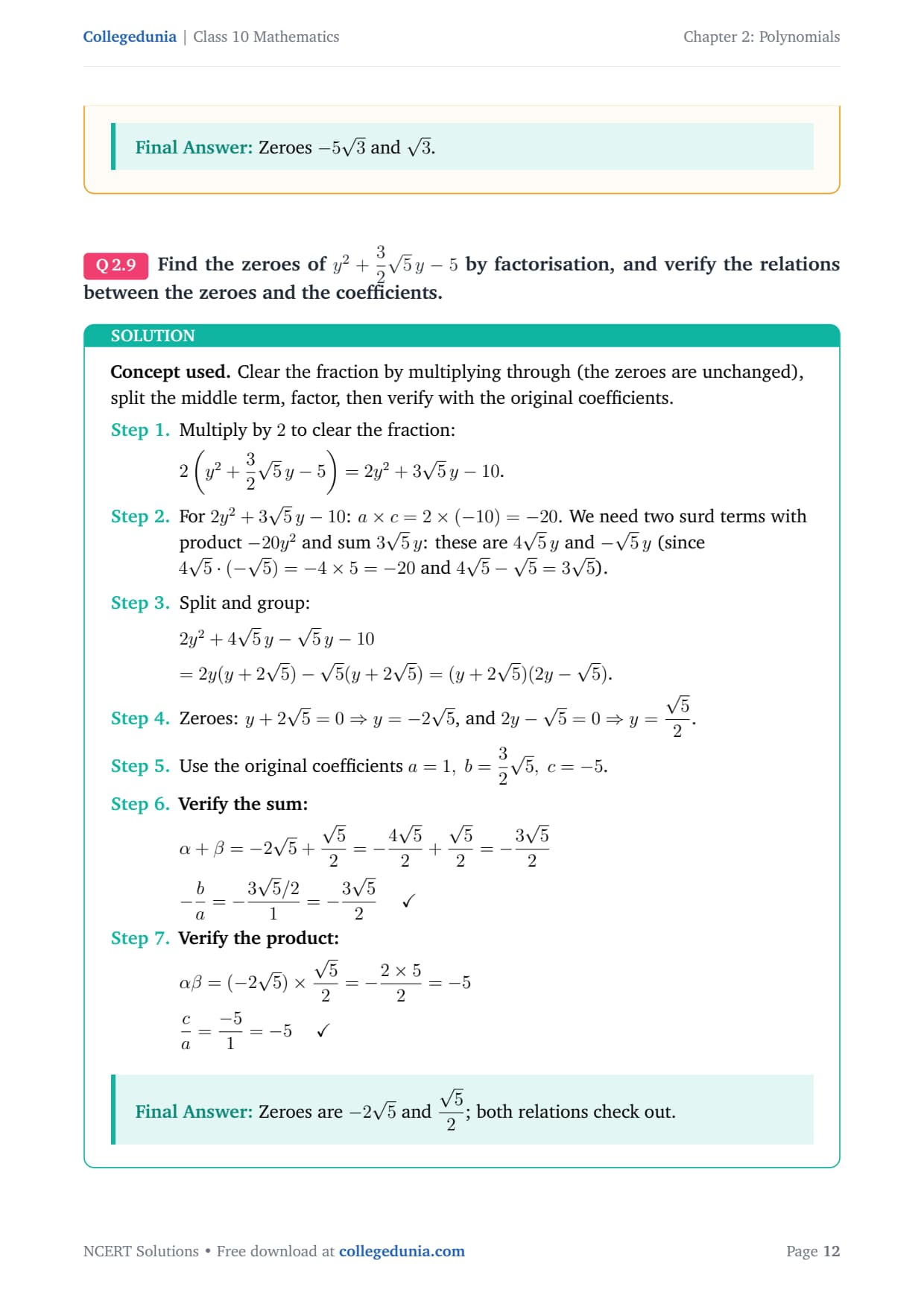
Find the zeroes of y2+32√5y-5 by factorisation, and verify the relations between the zeroes and the coefficients.
Concept used. Clear the fraction by multiplying through (the
zeroes are unchanged), split the middle term, factor, then verify with
the original coefficients.
Multiply by 2 to clear the fraction:
[] 2(y2+32√5y-5)
=2y2+3√5y-10.
For 2y2+3√5y-10: a× c=2×(-10)=-20. We need
two surd terms with product -20y2 and sum 3√5y:
these are 4√5y and -√5y (since
4√5·(-√5)=-4× 5=-20 and
4√5-√5=3√5).
Split and group:
[] 2y2+4√5y-√5y-10
[] =2y(y+2√5)-√5(y+2√5)
=(y+2√5)(2y-√5).
Zeroes: y+2√5=0⇒ y=-2√5, and
2y-√5=0⇒ y=√52.
Use the original coefficients a=1, b=32√5,
c=-5.
Verify the sum:
[] α+β=-2√5+√52
=-4√52+√52=-3√52
[] -ba=-3√5/21=-3√52
Verify the product:
[] αβ=(-2√5)×√52
=-2× 52=-5
[] ca=-51=-5
Zeroes are -2√5 and √52; both relations
check out.
IS
Imran Sheikh
M.Sc Mathematics, Aligarh Muslim University
Verified Expert
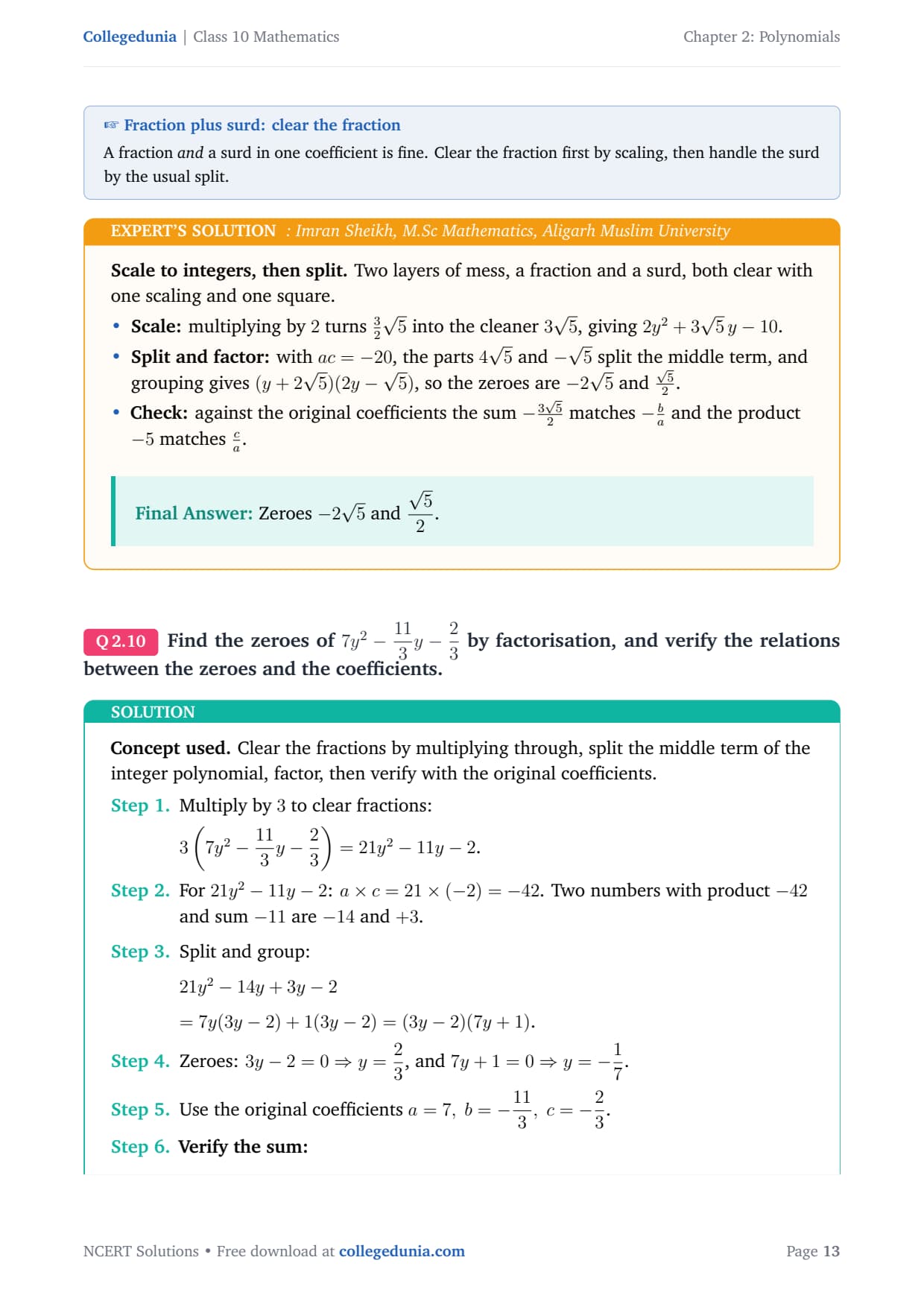
Scale to integers, then split. Two layers of mess, a fraction and
a surd, both clear with one scaling and one square.
Scale: multiplying by 2 turns 325 into the
cleaner 35, giving 2y2+35 y-10.
Split and factor: with ac=-20, the parts 45 and
-5 split the middle term, and grouping gives
(y+25)(2y-5), so the zeroes are -25 and
52.
Check: against the original coefficients the sum
-352 matches -ba and the product -5
matches ca.
Zeroes -2√5 and √52.
Q 2.10
Find the zeroes of 7y2-113y-23 by factorisation, and verify the relations between the zeroes and the coefficients.
Concept used. Clear the fractions by multiplying through, split
the middle term of the integer polynomial, factor, then verify with the
original coefficients.
Multiply by 3 to clear fractions:
[] 3(7y2-113y-23)
=21y2-11y-2.
For 21y2-11y-2: a× c=21×(-2)=-42. Two numbers with
product -42 and sum -11 are -14 and +3.
Split and group:
[] 21y2-14y+3y-2
[] =7y(3y-2)+1(3y-2)=(3y-2)(7y+1).
Zeroes: 3y-2=0⇒ y=23, and
7y+1=0⇒ y=-17.
Use the original coefficients a=7, b=-113,
c=-23.
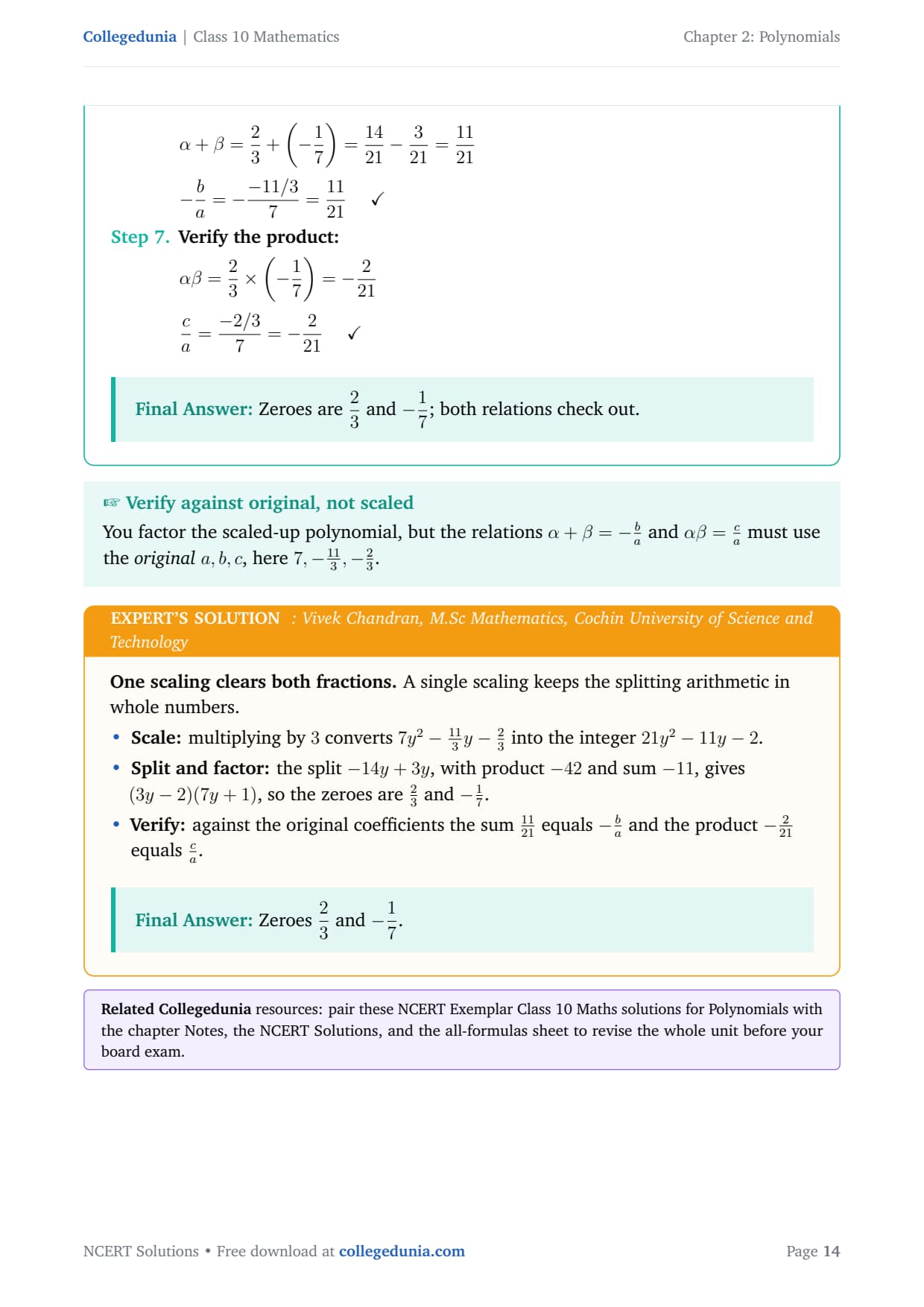
Verify the sum:
[] α+β=23+(-17)
=1421-321=1121
[] -ba=--11/37=1121
Verify the product:
[] αβ=23×(-17)
=-221
[] ca=-2/37=-221
Zeroes are 23 and -17; both relations
check out.
VC
Vivek Chandran
M.Sc Mathematics, Cochin University of Science and Technology
Verified Expert
One scaling clears both fractions. A single scaling keeps the
splitting arithmetic in whole numbers.
Scale: multiplying by 3 converts
7y2-113y-23 into the integer
21y2-11y-2.
Split and factor: the split -14y+3y, with product -42
and sum -11, gives (3y-2)(7y+1), so the zeroes are 23
and -17.
Verify: against the original coefficients the sum
1121 equals -ba and the product
-221 equals ca.
Zeroes 23 and -17.
NCERT exemplar Class 12 Mathematics Chapter 2 Polynomials
All questions with collapsible Solution and Expert Solution. Tap a button to reveal the working.
IV. Long Answer Questions (Exercise 2.4)
Q 2.1
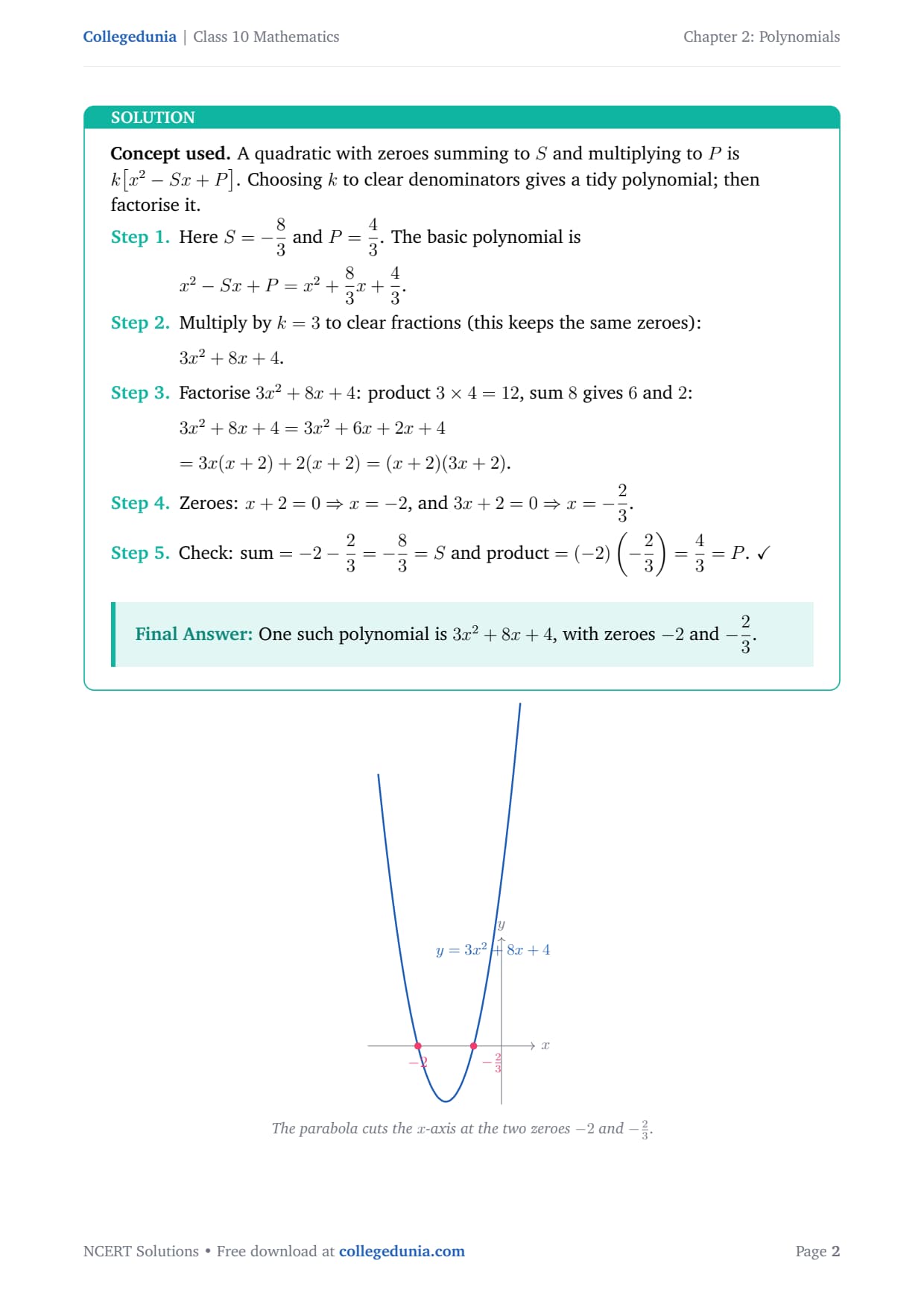
Find a quadratic polynomial whose sum and product of zeroes are -83 and 43 respectively. Also find the zeroes by factorisation.
Concept used. A quadratic with zeroes summing to S and
multiplying to P is k[x2-Sx+P]. Choosing k to clear
denominators gives a tidy polynomial; then factorise it.
Here S=-83 and P=43. The basic polynomial
is
[] x2-Sx+P=x2+83x+43.
Multiply by k=3 to clear fractions (this keeps the same
zeroes):
[] 3x2+8x+4.
Factorise 3x2+8x+4: product 3× 4=12, sum 8 gives 6
and 2:
[] 3x2+8x+4=3x2+6x+2x+4
[] =3x(x+2)+2(x+2)=(x+2)(3x+2).
Zeroes: x+2=0⇒ x=-2, and
3x+2=0⇒ x=-23.
Check: sum =-2-23=-83=S and product
=(-2)(-23)=43=P.
One such polynomial is 3x2+8x+4, with zeroes -2 and
-23.
NB
Neha Bajaj
M.Sc Mathematics, Delhi Technological University
Verified Expert
From the two numbers to the polynomial. Plug the sum and product
into the standard form, then clear fractions.
Build: the sum -83 and product 43 give
x2+83x+43, and scaling by 3 yields the clean
3x2+8x+4.
Factor: splitting the middle term as 6x+2x gives
(x+2)(3x+2), so the zeroes are -2 and -23.
Confirm: a final check recovers the given sum and
product exactly. Any non-zero multiple of 3x2+8x+4 is an
equally valid answer.
3x2+8x+4; zeroes -2 and -23.
Q 2.2
Find a quadratic polynomial whose sum and product of zeroes are 218 and 516 respectively. Also find the zeroes by factorisation.
Concept used. Use x2-Sx+P, scale to clear denominators, then
factorise by splitting the middle term.
Here S=218 and P=516. The basic polynomial
is
[] x2-218x+516.
Multiply by k=16 to clear fractions:
[] 16x2-42x+5.
Factorise 16x2-42x+5: product 16× 5=80, sum -42 gives
-40 and -2:
[] 16x2-42x+5=16x2-40x-2x+5
[] =8x(2x-5)-1(2x-5)=(2x-5)(8x-1).
Zeroes: 2x-5=0⇒ x=52, and
8x-1=0⇒ x=18.
Check: sum =52+18=20+18
=218=S and product
=52×18=516=P.
One such polynomial is 16x2-42x+5, with zeroes
52 and 18.
YR
Yashwant Raut
M.Sc Mathematics, Savitribai Phule Pune University
Verified Expert
Clear to 16, then split. The big numbers are tamed simply by
the right scaling.
Scale: writing x2-218x+516 and
scaling by 16 gives the integer 16x2-42x+5.
Factor: the split -40x-2x, with product 80 and sum
-42, factors it as (2x-5)(8x-1), so the zeroes are 52
and 18.
Confirm: recomputing the sum 218 and product
516 from these zeroes returns the given data.
16x2-42x+5; zeroes 52 and 18.
Q 2.3
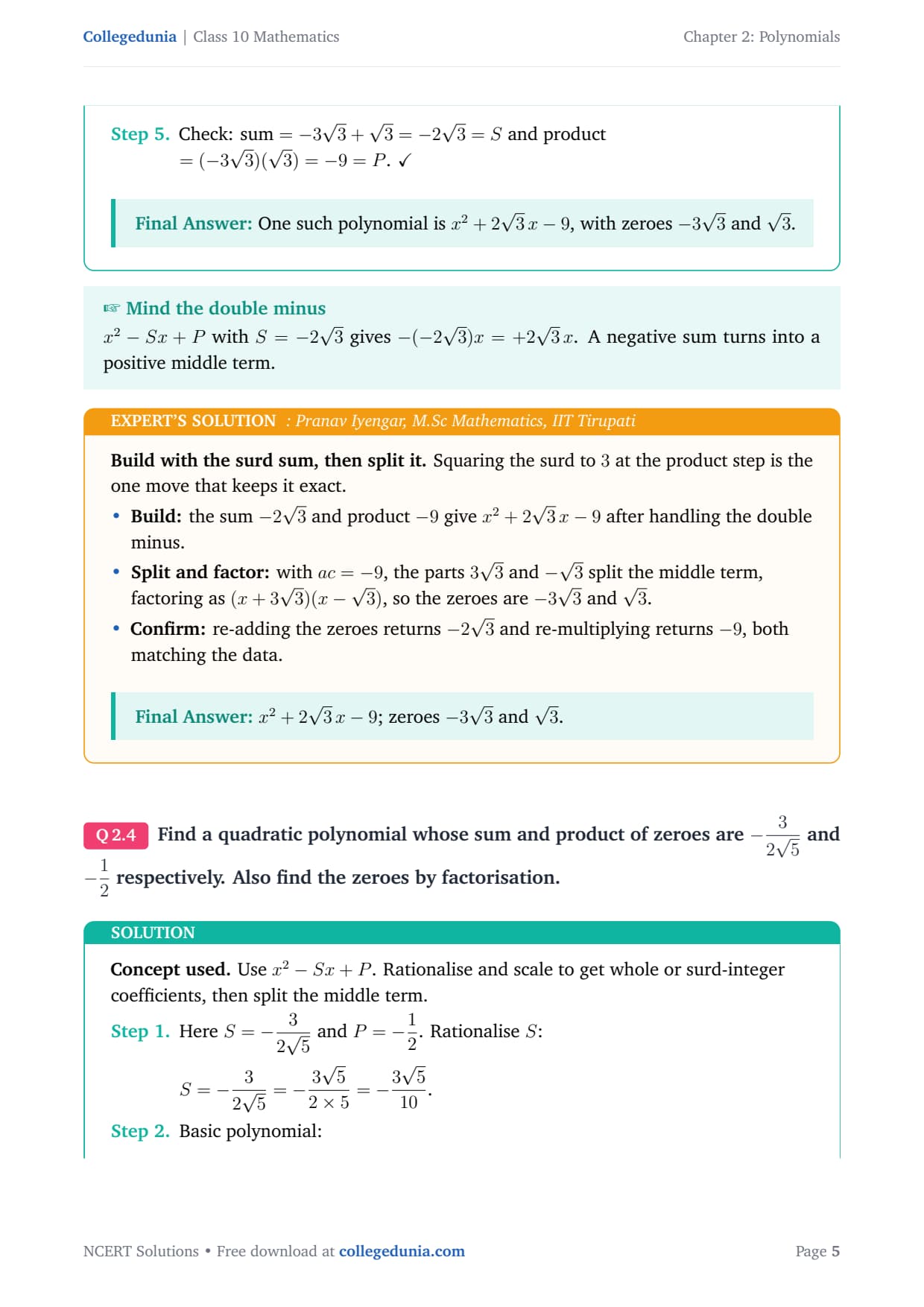
Find a quadratic polynomial whose sum and product of zeroes are -2√3 and -9 respectively. Also find the zeroes by factorisation.
Concept used. Use x2-Sx+P directly (no fractions to clear
here), then split the middle term using a surd.
Here S=-2√3 and P=-9. The polynomial is
[] x2-(-2√3)x+(-9)=x2+2√3x-9.
Factorise x2+2√3x-9: a× c=-9. We need two surd
terms with product -9x2 and sum 2√3x: these are
3√3x and -√3x (since
3√3·(-√3)=-3× 3=-9 and
3√3-√3=2√3).
Split and group:
[] x2+3√3x-√3x-9
[] =x(x+3√3)-√3(x+3√3)
=(x+3√3)(x-√3).
Zeroes: x+3√3=0⇒ x=-3√3, and
x-√3=0⇒ x=√3.
Check: sum =-3√3+√3=-2√3=S and product
=(-3√3)(√3)=-9=P.
One such polynomial is x2+2√3x-9, with zeroes
-3√3 and √3.
PI
Pranav Iyengar
M.Sc Mathematics, IIT Tirupati
Verified Expert
Build with the surd sum, then split it. Squaring the surd to 3
at the product step is the one move that keeps it exact.
Build: the sum -23 and product -9 give
x2+23 x-9 after handling the double minus.
Split and factor: with ac=-9, the parts 33 and
-3 split the middle term, factoring as
(x+33)(x-3), so the zeroes are -33 and 3.
Confirm: re-adding the zeroes returns -23 and
re-multiplying returns -9, both matching the data.
x2+2√3x-9; zeroes -3√3 and √3.
Q 2.4
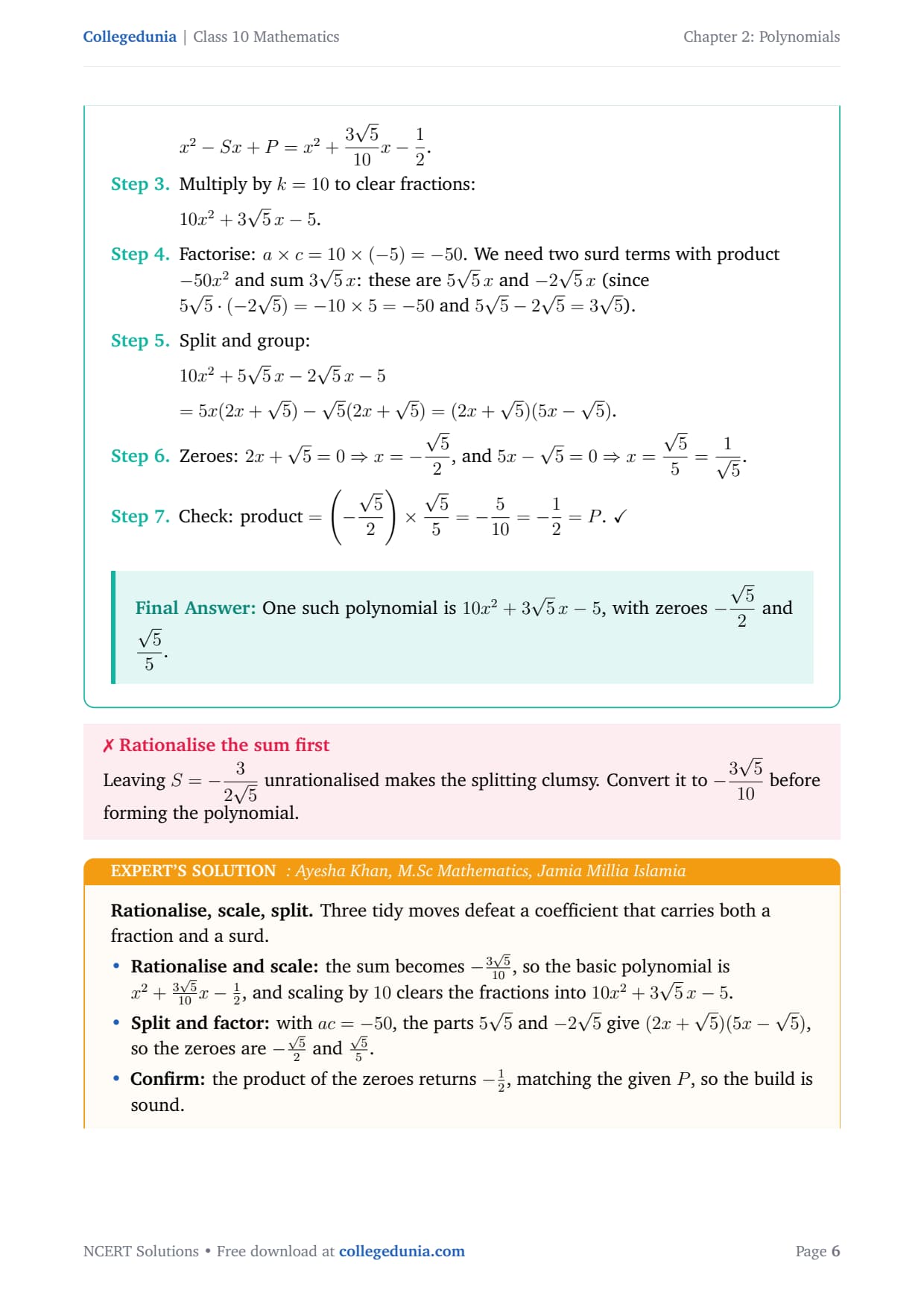
Find a quadratic polynomial whose sum and product of zeroes are -32√5 and -12 respectively. Also find the zeroes by factorisation.
Concept used. Use x2-Sx+P. Rationalise and scale to get
whole or surd-integer coefficients, then split the middle term.
Here S=-32√5 and P=-12. Rationalise
S:
[] S=-32√5=-3√52× 5
=-3√510.
Basic polynomial:
[] x2-Sx+P=x2+3√510x-12.
Multiply by k=10 to clear fractions:
[] 10x2+3√5x-5.
Factorise: a× c=10×(-5)=-50. We need two surd terms
with product -50x2 and sum 3√5x: these are
5√5x and -2√5x (since
5√5·(-2√5)=-10× 5=-50 and
5√5-2√5=3√5).
Split and group:
[] 10x2+5√5x-2√5x-5
[] =5x(2x+√5)-√5(2x+√5)
=(2x+√5)(5x-√5).
Zeroes: 2x+√5=0⇒ x=-√52, and
5x-√5=0⇒ x=√55=1√5.
Check: product =(-√52)
×√55=-510=-12=P.
One such polynomial is 10x2+3√5x-5, with zeroes
-√52 and √55.
AK
Ayesha Khan
M.Sc Mathematics, Jamia Millia Islamia
Verified Expert
Rationalise, scale, split. Three tidy moves defeat a coefficient
that carries both a fraction and a surd.
Rationalise and scale: the sum becomes
-3510, so the basic polynomial is
x2+3510x-12, and scaling by 10 clears
the fractions into 10x2+35 x-5.
Split and factor: with ac=-50, the parts 55 and
-25 give (2x+5)(5x-5), so the zeroes are
-52 and 55.
Confirm: the product of the zeroes returns -12,
matching the given P, so the build is sound.
10x2+3√5x-5; zeroes -√52 and
√55.
Q 2.5
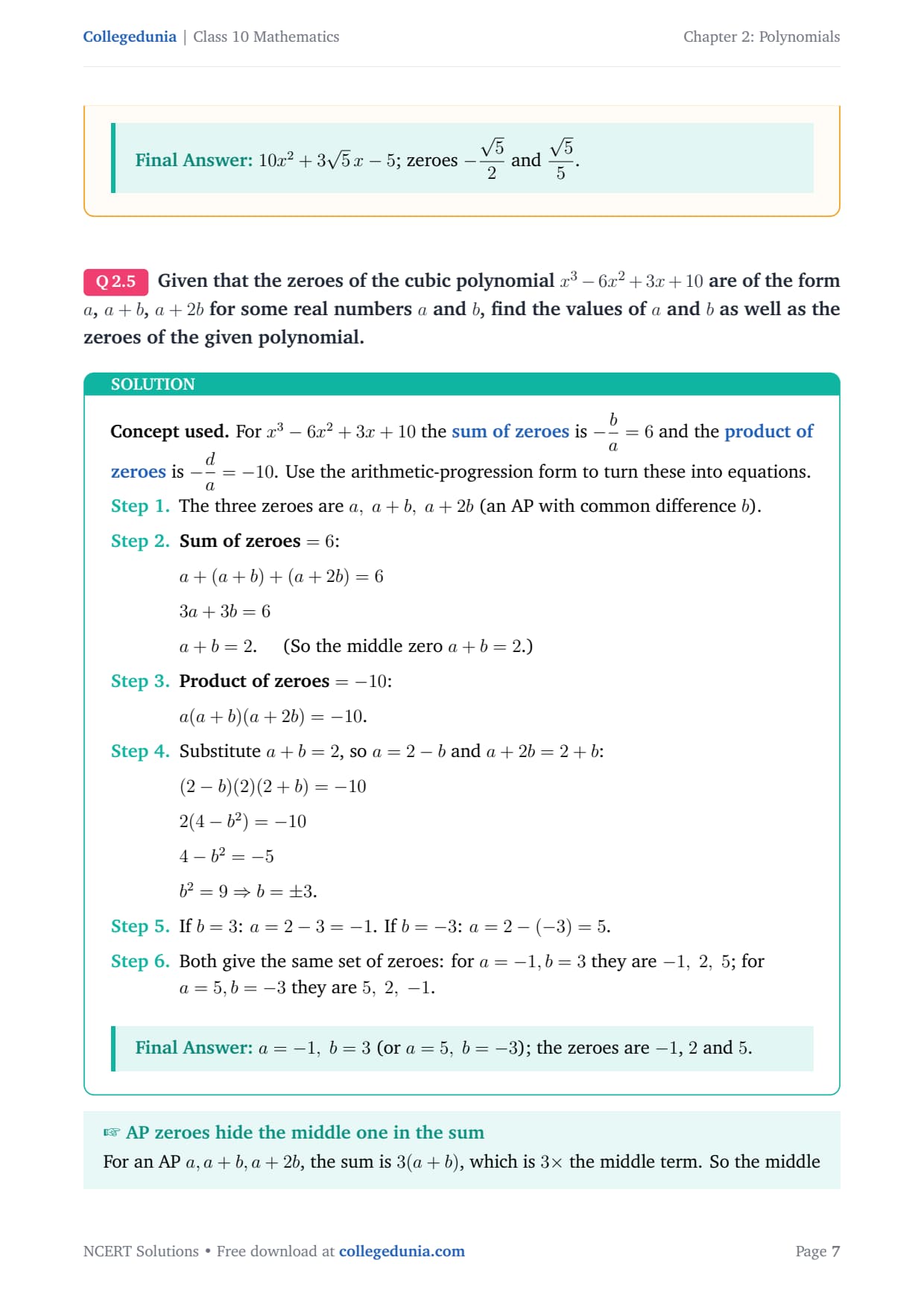
Given that the zeroes of the cubic polynomial x3-6x2+3x+10 are of the form a, a+b, a+2b for some real numbers a and b, find the values of a and b as well as the zeroes of the given polynomial.
Concept used. For x3-6x2+3x+10 the
sum of zeroes is -ba=6 and the product of
zeroes is -da=-10. Use the arithmetic-progression form to
turn these into equations.
The three zeroes are a, a+b, a+2b (an AP with common
difference b).
Sum of zeroes=6:
[] a+(a+b)+(a+2b)=6
[] 3a+3b=6
[] a+b=2. (So the middle zero a+b=2.)
Product of zeroes=-10:
[] a(a+b)(a+2b)=-10.
Substitute a+b=2, so a=2-b and a+2b=2+b:
[] (2-b)(2)(2+b)=-10
[] 2(4-b2)=-10
[] 4-b2=-5
[] b2=9⇒ b=± 3.
If b=3: a=2-3=-1. If b=-3: a=2-(-3)=5.
Both give the same set of zeroes:
for a=-1,b=3 they are -1, 2, 5;
for a=5,b=-3 they are 5, 2, -1.
a=-1, b=3 (or a=5, b=-3); the zeroes are -1, 2 and
5.
RD
Reema D'Souza
M.Sc Mathematics, Goa University
Verified Expert
Let the sum hand you the middle zero. Reading the middle zero
from the sum first turns the product equation into one variable.
Middle zero: for an AP of zeroes the total is three times
the middle value, and the sum is 6, so the middle zero is 2.
One variable: putting a+b=2 into the product equation
a(a+b)(a+2b)=-10 gives 2(4-b2)=-10, so b2=9 and
b=3, with a=-1 or a=5.
Same zeroes: either pairing lists the three zeroes as
-1,2,5.
a=-1, b=3; zeroes -1, 2, 5.
Q 2.6
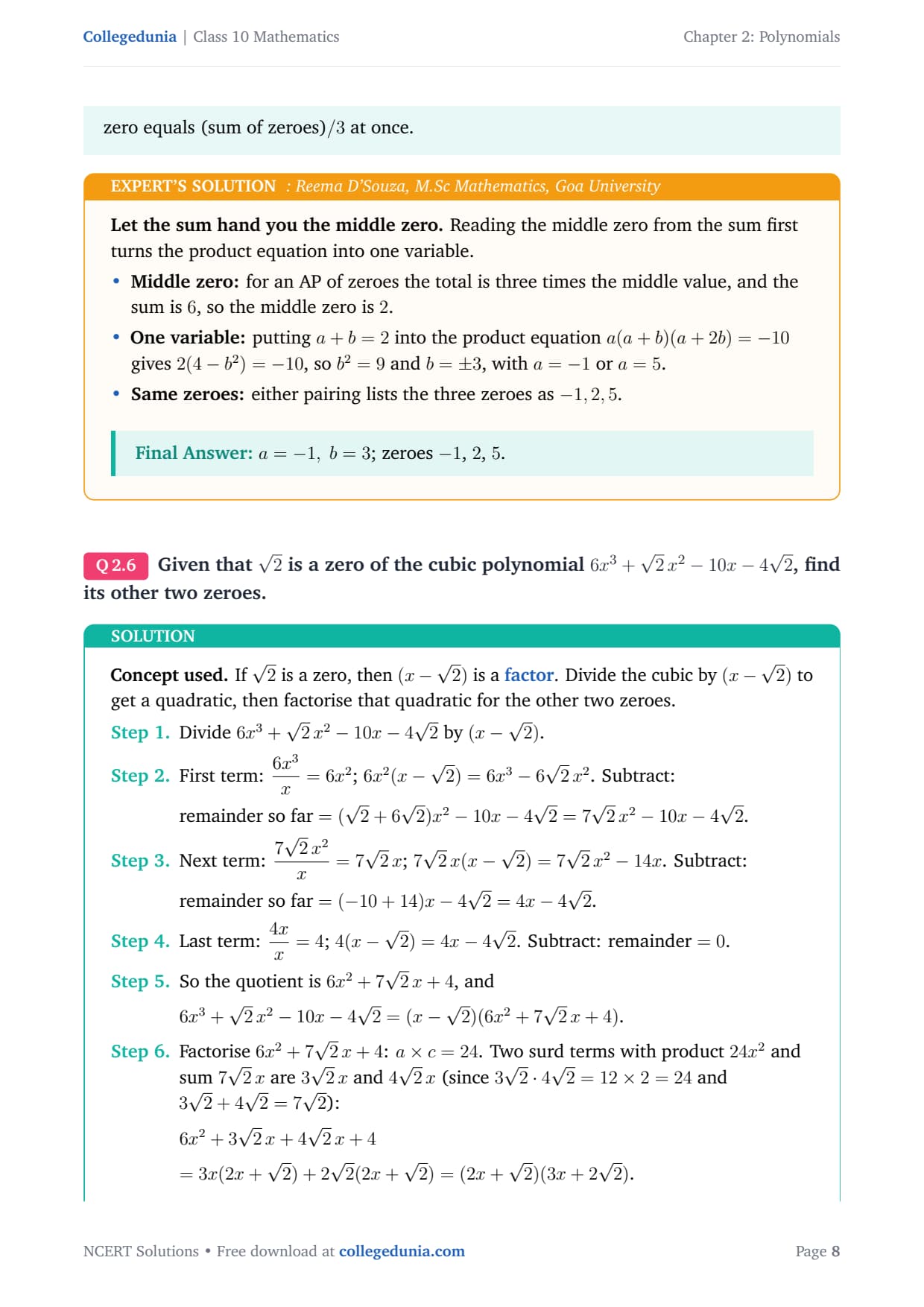
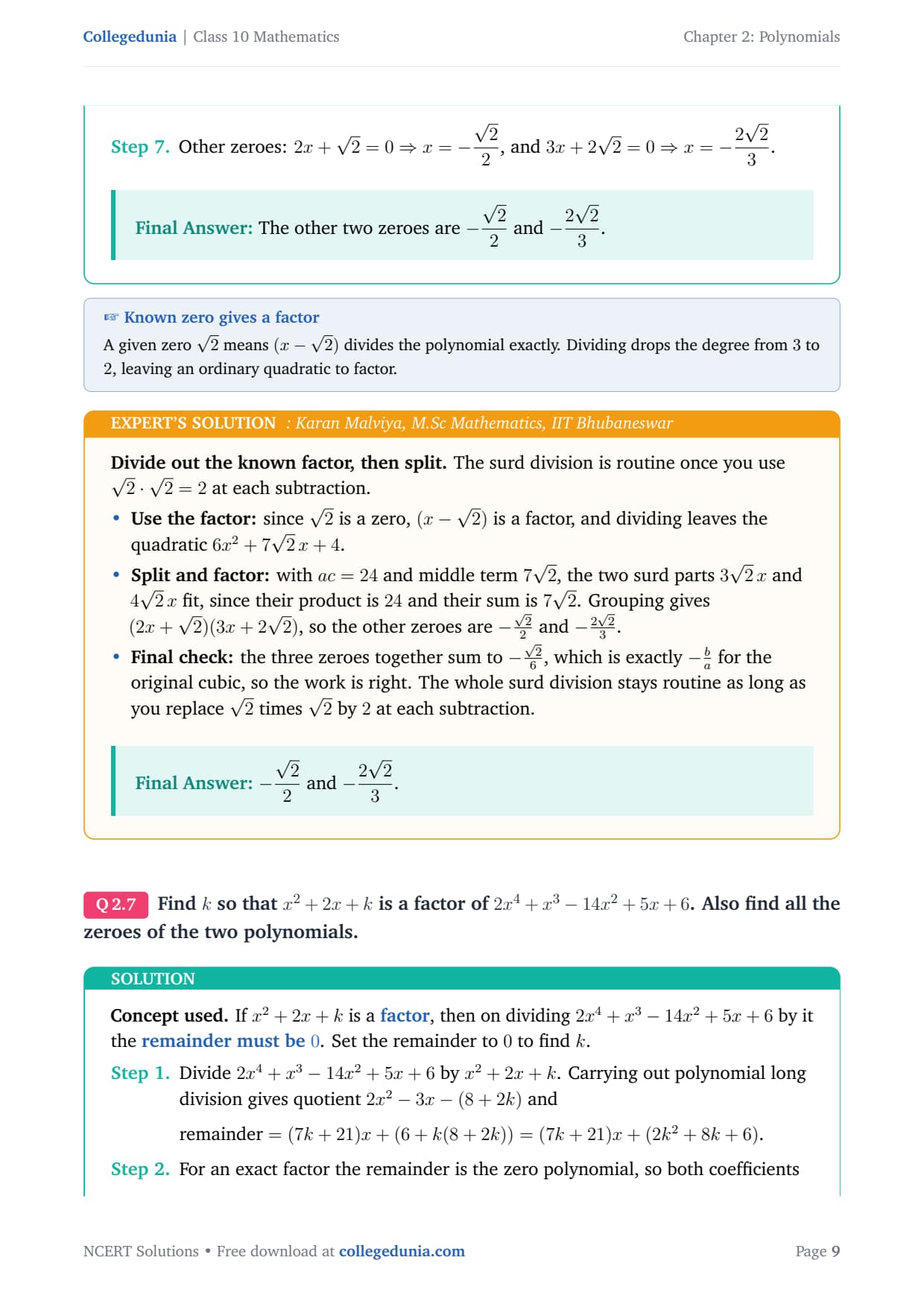
Given that √2 is a zero of the cubic polynomial 6x3+√2 x2-10x-4√2, find its other two zeroes.
Concept used. If √2 is a zero, then (x-√2) is a
factor. Divide the cubic by (x-√2) to get a quadratic,
then factorise that quadratic for the other two zeroes.
Divide 6x3+√2 x2-10x-4√2 by (x-√2).
First term: 6x3x=6x2;
6x2(x-√2)=6x3-6√2 x2. Subtract:
[] remainder so far =(√2+6√2)x2-10x-4√2
=7√2 x2-10x-4√2.
Next term: 7√2 x2x=7√2x;
7√2x(x-√2)=7√2 x2-14x. Subtract:
[] remainder so far =(-10+14)x-4√2=4x-4√2.
Last term: 4xx=4; 4(x-√2)=4x-4√2.
Subtract: remainder =0.
So the quotient is 6x2+7√2x+4, and
[] 6x3+√2 x2-10x-4√2
=(x-√2)(6x2+7√2x+4).
Factorise 6x2+7√2x+4: a× c=24. Two surd terms
with product 24x2 and sum 7√2x are 3√2x
and 4√2x (since 3√2· 4√2=12× 2=24
and 3√2+4√2=7√2):
[] 6x2+3√2x+4√2x+4
[] =3x(2x+√2)+2√2(2x+√2)
=(2x+√2)(3x+2√2).
Other zeroes: 2x+√2=0⇒
x=-√22, and 3x+2√2=0⇒
x=-2√23.
The other two zeroes are -√22 and
-2√23.
KM
Karan Malviya
M.Sc Mathematics, IIT Bhubaneswar
Verified Expert
Divide out the known factor, then split. The surd division is
routine once you use 2·2=2 at each subtraction.
Use the factor: since 2 is a zero, (x-2) is
a factor, and dividing leaves the quadratic 6x2+72 x+4.
Split and factor: with ac=24 and middle term 72,
the two surd parts 32 x and 42 x fit, since their
product is 24 and their sum is 72. Grouping gives
(2x+2)(3x+22), so the other zeroes are
-22 and -223.
Final check: the three zeroes together sum to
-26, which is exactly -ba for the
original cubic, so the work is right. The whole surd division
stays routine as long as you replace 2 times 2 by
2 at each subtraction.
-√22 and -2√23.
Q 2.7
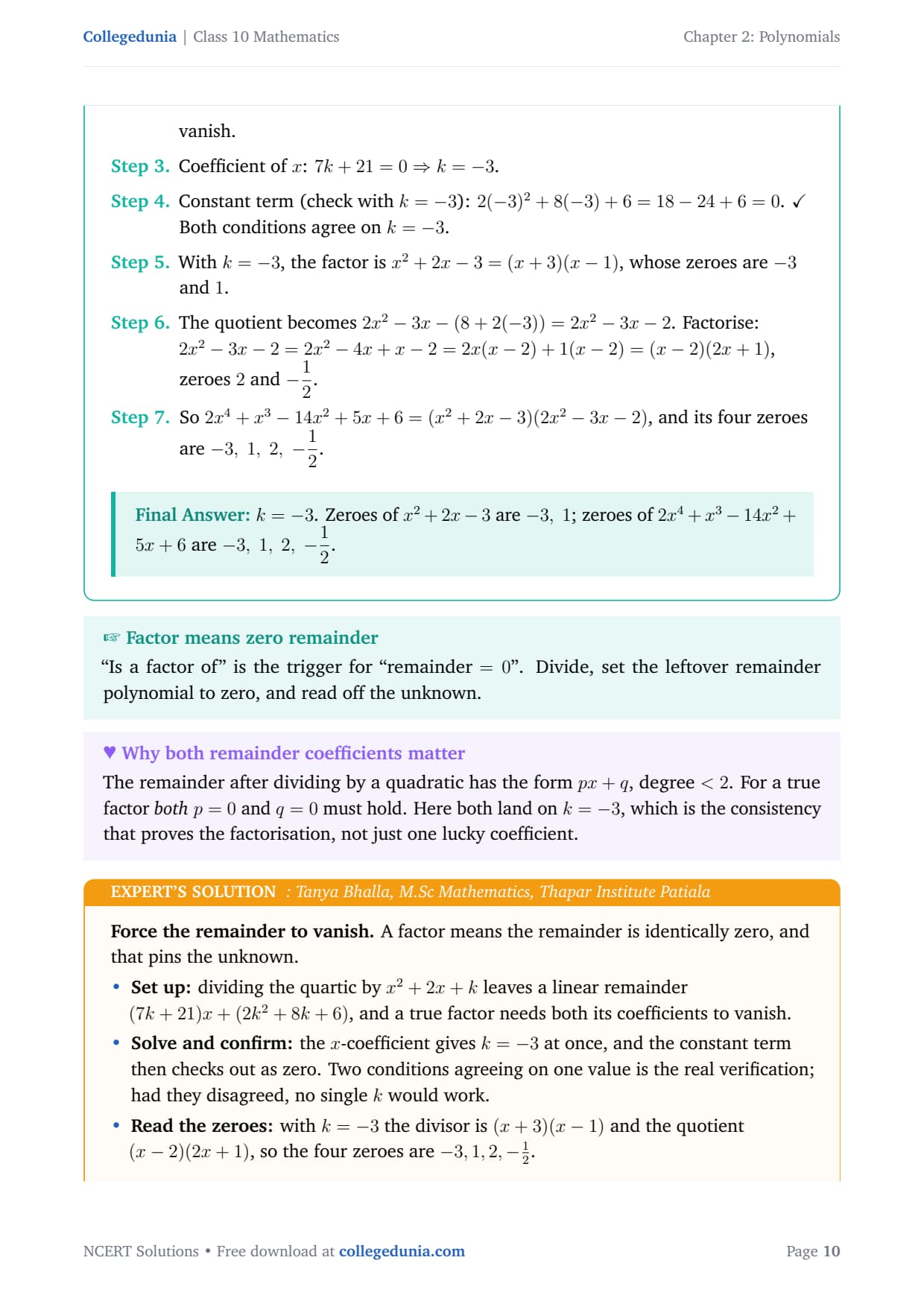
Find k so that x2+2x+k is a factor of 2x4+x3-14x2+5x+6. Also find all the zeroes of the two polynomials.
Concept used. If x2+2x+k is a factor, then on
dividing 2x4+x3-14x2+5x+6 by it the remainder must be
0. Set the remainder to 0 to find k.
Divide 2x4+x3-14x2+5x+6 by x2+2x+k. Carrying out
polynomial long division gives quotient 2x2-3x-(8+2k) and
[] remainder =(7k+21)x+(6+k(8+2k))=(7k+21)x+(2k2+8k+6).
For an exact factor the remainder is the zero polynomial, so both
coefficients vanish.
Coefficient of x: 7k+21=0⇒ k=-3.
Constant term (check with k=-3):
2(-3)2+8(-3)+6=18-24+6=0. Both conditions agree
on k=-3.
With k=-3, the factor is x2+2x-3=(x+3)(x-1), whose zeroes
are -3 and 1.
The quotient becomes 2x2-3x-(8+2(-3))=2x2-3x-2.
Factorise: 2x2-3x-2=2x2-4x+x-2=2x(x-2)+1(x-2)=(x-2)(2x+1),
zeroes 2 and -12.
So 2x4+x3-14x2+5x+6=(x2+2x-3)(2x2-3x-2), and its
four zeroes are -3, 1, 2, -12.
k=-3. Zeroes of x2+2x-3 are -3, 1; zeroes of
2x4+x3-14x2+5x+6 are -3, 1, 2, -12.
TB
Tanya Bhalla
M.Sc Mathematics, Thapar Institute Patiala
Verified Expert
Force the remainder to vanish. A factor means the remainder is
identically zero, and that pins the unknown.
Set up: dividing the quartic by x2+2x+k leaves a
linear remainder (7k+21)x+(2k2+8k+6), and a true factor needs
both its coefficients to vanish.
Solve and confirm: the x-coefficient gives k=-3 at
once, and the constant term then checks out as zero. Two
conditions agreeing on one value is the real verification; had
they disagreed, no single k would work.
Read the zeroes: with k=-3 the divisor is (x+3)(x-1)
and the quotient (x-2)(2x+1), so the four zeroes are
-3,1,2,-12.
k=-3; quartic zeroes -3,1,2,-12.
Q 2.8
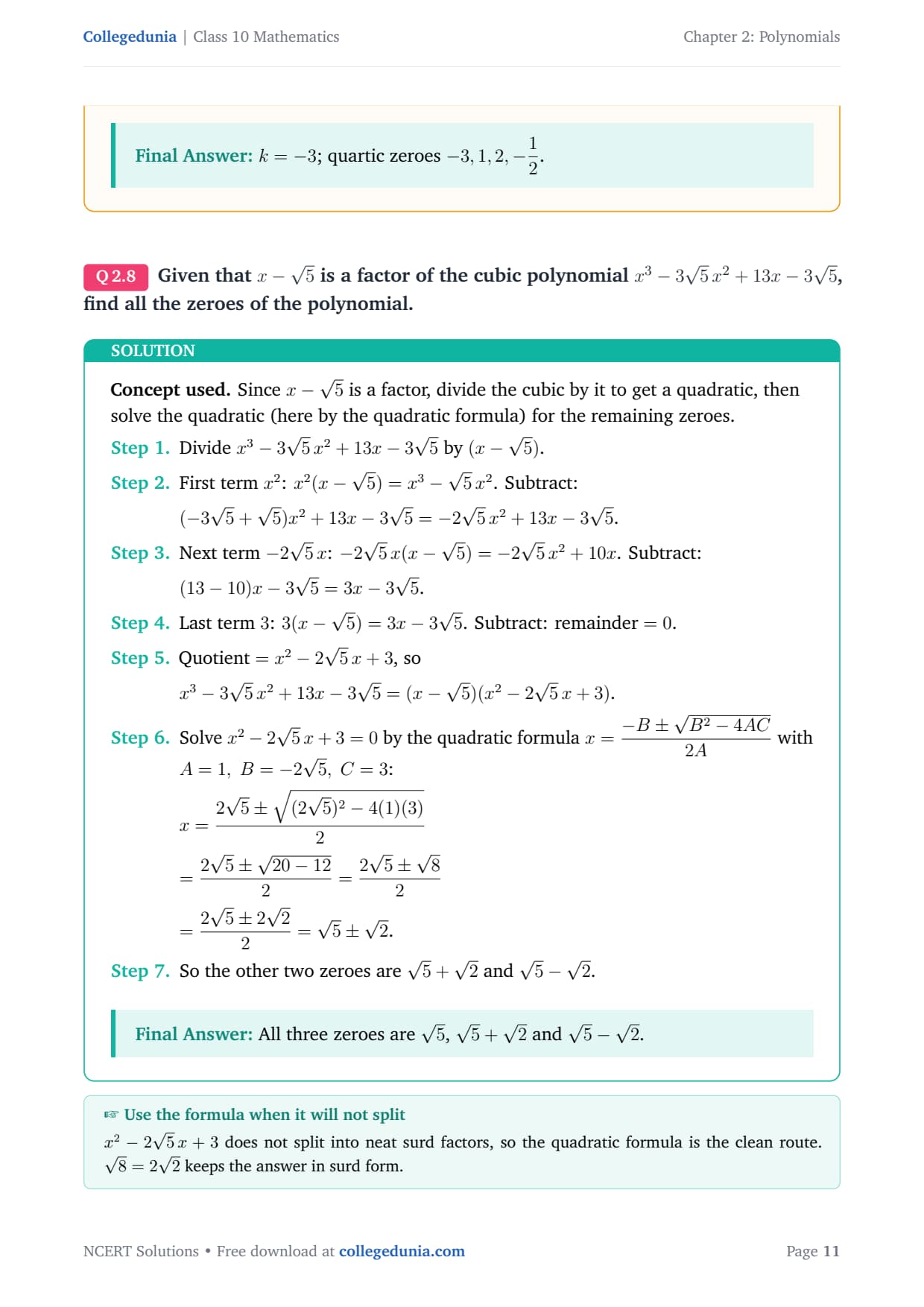
Given that x-√5 is a factor of the cubic polynomial x3-3√5 x2+13x-3√5, find all the zeroes of the polynomial.
Concept used. Since x-√5 is a factor, divide the cubic by
it to get a quadratic, then solve the quadratic (here by the quadratic
formula) for the remaining zeroes.
Divide x3-3√5 x2+13x-3√5 by (x-√5).
First term x2: x2(x-√5)=x3-√5 x2.
Subtract:
[] (-3√5+√5)x2+13x-3√5
=-2√5 x2+13x-3√5.
Next term -2√5x:
-2√5x(x-√5)=-2√5 x2+10x. Subtract:
[] (13-10)x-3√5=3x-3√5.
Last term 3: 3(x-√5)=3x-3√5. Subtract: remainder
=0.
Quotient =x2-2√5x+3, so
[] x3-3√5 x2+13x-3√5
=(x-√5)(x2-2√5x+3).
Solve x2-2√5x+3=0 by the quadratic formula
x=-B±√B2-4AC2A with
A=1, B=-2√5, C=3:
[] x=2√5±√(2√5)2-4(1)(3)2
[] =2√5±√20-122
=2√5±√82
[] =2√5± 2√22=√5±√2.
So the other two zeroes are √5+√2 and
√5-√2.
All three zeroes are √5, √5+√2 and
√5-√2.
OK
Ojas Kulkarni
M.Sc Mathematics, IISER Pune
Verified Expert
Divide, then apply the formula. When the reduced quadratic will
not split, reach for the quadratic formula.
Divide: the known factor x-5 divides the cubic to
leave x2-25 x+3.
Apply the formula: this quadratic resists a tidy split,
so use the quadratic formula instead. The discriminant works out
to 20-12=8, and since 8=22, the two roots come out as
5±2.
Check: the three zeroes together sum to 35, which
matches -ba from the original cubic, a reassuring sign
that no surd was dropped along the way.
√5, √5+√2, √5-√2.
Q 2.9
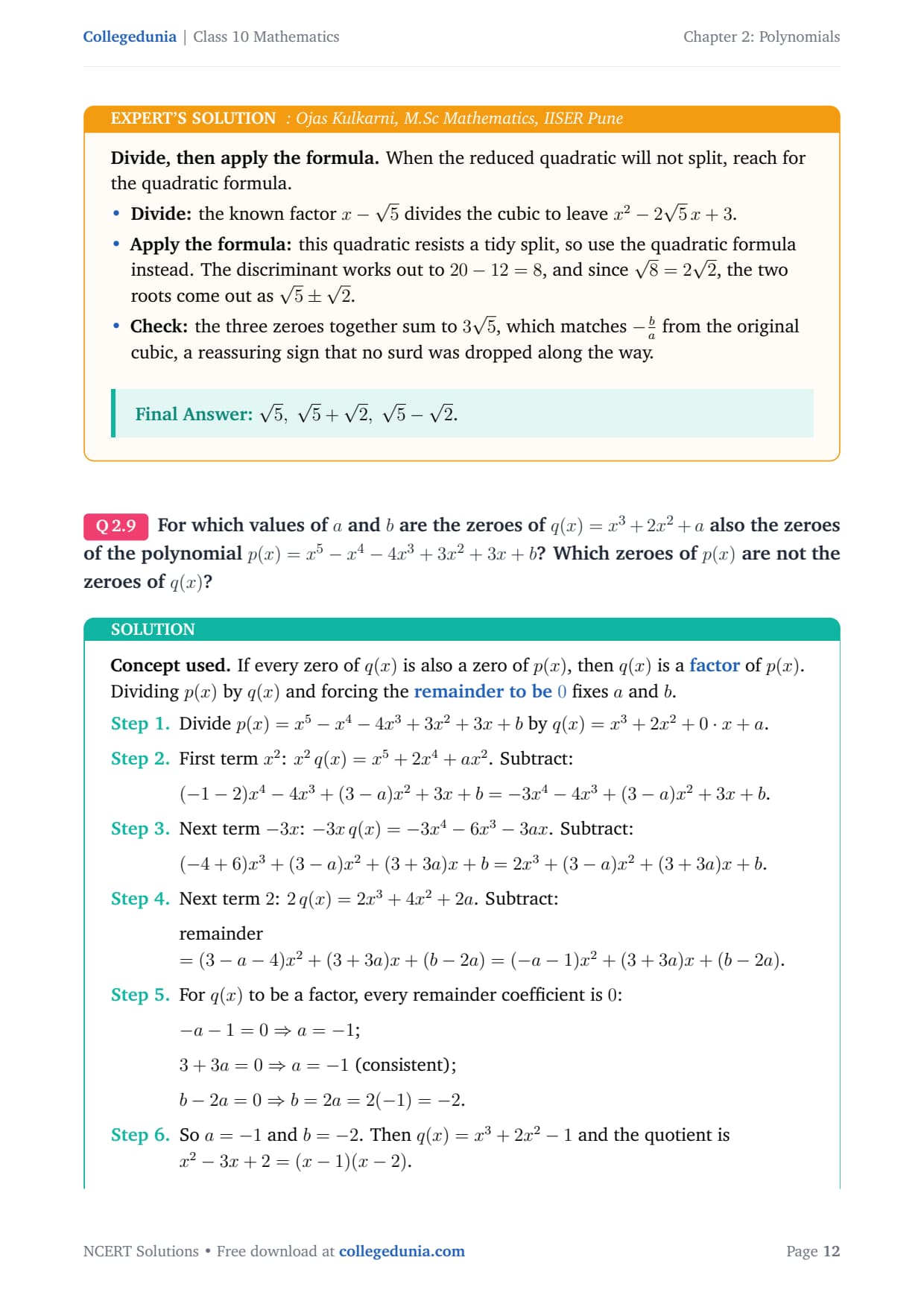
For which values of a and b are the zeroes of q(x)=x3+2x2+a also the zeroes of the polynomial p(x)=x5-x4-4x3+3x2+3x+b? Which zeroes of p(x) are not the zeroes of q(x)?
Concept used. If every zero of q(x) is also a zero of p(x),
then q(x) is a factor of p(x). Dividing p(x) by q(x) and
forcing the remainder to be 0 fixes a and b.
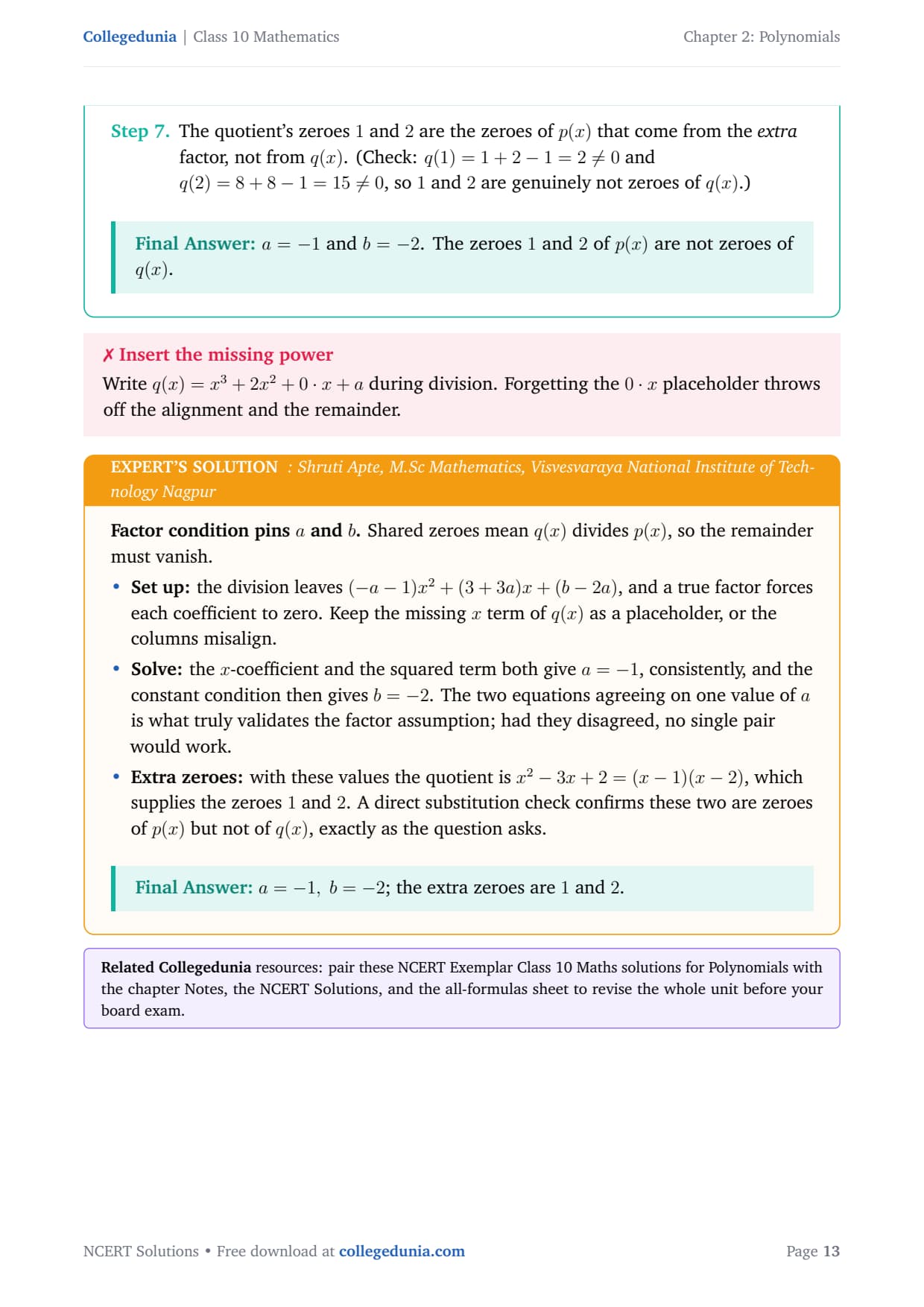
Divide p(x)=x5-x4-4x3+3x2+3x+b by
q(x)=x3+2x2+0· x+a.
First term x2:
x2q(x)=x5+2x4+ax2. Subtract:
[] (-1-2)x4-4x3+(3-a)x2+3x+b
=-3x4-4x3+(3-a)x2+3x+b.
Next term -3x:
-3x q(x)=-3x4-6x3-3ax. Subtract:
[] (-4+6)x3+(3-a)x2+(3+3a)x+b
=2x3+(3-a)x2+(3+3a)x+b.
Next term 2: 2 q(x)=2x3+4x2+2a. Subtract:
[] remainder =(3-a-4)x2+(3+3a)x+(b-2a)
=(-a-1)x2+(3+3a)x+(b-2a).
For q(x) to be a factor, every remainder coefficient is 0:
[] -a-1=0⇒ a=-1;
[] 3+3a=0⇒ a=-1 (consistent);
[] b-2a=0⇒ b=2a=2(-1)=-2.
So a=-1 and b=-2. Then
q(x)=x3+2x2-1 and the quotient is x2-3x+2=(x-1)(x-2).
The quotient's zeroes 1 and 2 are the zeroes of p(x) that
come from the extra factor, not from q(x). (Check:
q(1)=1+2-1=2≠ 0 and q(2)=8+8-1=15≠ 0, so 1 and 2 are
genuinely not zeroes of q(x).)
a=-1 and b=-2. The zeroes 1 and 2 of p(x) are not
zeroes of q(x).
SA
Shruti Apte
M.Sc Mathematics, Visvesvaraya National Institute of Technology Nagpur
Verified Expert
Factor condition pins a and b. Shared zeroes mean q(x)
divides p(x), so the remainder must vanish.
Set up: the division leaves
(-a-1)x2+(3+3a)x+(b-2a), and a true factor forces each
coefficient to zero. Keep the missing x term of q(x) as a
placeholder, or the columns misalign.
Solve: the x-coefficient and the squared term both give
a=-1, consistently, and the constant condition then gives
b=-2. The two equations agreeing on one value of a is what
truly validates the factor assumption; had they disagreed, no
single pair would work.
Extra zeroes: with these values the quotient is
x2-3x+2=(x-1)(x-2), which supplies the zeroes 1 and 2. A
direct substitution check confirms these two are zeroes of p(x)
but not of q(x), exactly as the question asks.
a=-1, b=-2; the extra zeroes are 1 and 2.
Student Feedback
In a Collegedunia survey of 1,150 Class 10 students, 78% said the Exemplar factorisation problems (Exercise 2.3) felt harder than the textbook. And 4 out of 5 who practised the build-from-zeroes set in Exercise 2.4 said their board confidence went up.
Source: Collegedunia Class 10 Mathematics student survey, 2026-27 session. Sample of 1,150 students.
NCERT Exemplar Class 10 Maths Polynomials Solutions: Frequently Asked Questions
Ques. Where can I download the NCERT Exemplar Class 10 Maths Chapter 2 Solutions for free?
Ans. Use the red Download button on this page to get the Polynomials Exemplar Solutions PDF. It is free and follows the 2026-27 syllabus.
Ques. How many problems are there in the Polynomials Exemplar, and what types are they?
Ans. Chapter 2 has 42 Exemplar problems across four exercises: 11 MCQs in Exercise 2.1, 12 justify-type questions in Exercise 2.2, 10 factorisation questions in Exercise 2.3, and 9 build-and-divide questions in Exercise 2.4.
Ques. How are the Exemplar solutions different from the NCERT textbook solutions for Polynomials?
Ans. The NCERT textbook exercises test a single step, such as finding zeroes or verifying one relation. The Exemplar pushes the same idea into two or three steps, with surds, fractions, cubics, and degree-based reasoning. The Exemplar is the standard next step after the textbook for board preparation.
Ques. What is the relation between the zeroes and the coefficients of a quadratic polynomial?
Ans. For a quadratic with zeroes alpha and beta, the sum of zeroes equals minus b over a, and the product of zeroes equals c over a. Both relations are checked in every factorisation answer in Exercise 2.3.
Ques. Why is the number of polynomials with given zeroes more than three?
Ans. If two numbers are the zeroes, the base polynomial is fixed only up to a constant. Multiplying that base by any non-zero constant gives a different polynomial with the same zeroes, so there are infinitely many such polynomials.
Ques. Is the Polynomials Exemplar aligned with the 2026-27 CBSE syllabus?
Ans. Yes. Zeroes of a polynomial, the relation between zeroes and coefficients, and the division algorithm are all retained in the 2026-27 syllabus, so all 42 Chapter 2 Exemplar problems remain valid for current board preparation.
Ques. How much time does the Polynomials Exemplar take to finish?
Ans. A focused Class 10 student needs roughly 3 to 4 hours: about 40 minutes for the 11 MCQs, 45 minutes for the 12 justify questions, an hour for the 10 factorisation problems, and an hour for the 9 build-and-divide problems, plus a short revision pass on the ones you got wrong.










Comments