NCERT Exemplar Class 10 Maths Chapter 12 Surface Areas and Volumes Exercise 12.3 is the Short Answer section. It has 14 questions (Q29 to Q42), all solved here step by step for the 2026-27 CBSE syllabus.
14 Short Answer Questions (Q29-Q42), each with a full solution and an expert insight.
Concepts tested: volume conservation on melting, frustum of a cone, combined solids, water displacement, and unit conversion.
Board weightage: this chapter carries 4 to 5 marks, usually one long-answer question.
Every solution here is curated by subject experts, mapped to the 2026-27 NCERT Exemplar book, and checked against the last five years of CBSE board papers.
Solved by Collegedunia
All 14 questions of Exercise 12.3 are solved below with Concept, Step-by-step working, and an Expert's insight for each.
What Surface Areas and Volumes Exercise 12.3 Covers
Exercise 12.3 is the Short Answer section, with 14 questions (Q29 to Q42). Unlike the MCQs in Exercise 12.1, these need full working. The board often picks this type for the long-answer slot.
Question Range
Topic Focus
Key Idea
Q29
Three cubes melted into one
Volume conservation; 33+43+53=63
Q30
Cuboid melted into spherical shots
Number = block volume / shot volume
Q31
Frustum bucket capacity
Frustum volume formula; litres to cm3
Q32
Cone divided by midpoint plane
Similar solids; cube-law scaling
Q33
Two cubes joined end to end
Combined cuboid surface area
Q34
Cone hollowed from a cube
Remaining volume = cube - cone
Q35
Two cones joined at base (bicone)
Only curved surfaces count; Pythagorean triple
Q36
Two cones inside a cylinder
Volume ratio = height ratio when radius is equal
Q37
Ice cream cone + hemispherical scoop
Cone + hemisphere combined; unfilled fraction
Q38
Marbles dropped in beaker, water rise
Displacement = marble volume
Q39, Q40
Rectangular block melted into spherical shots
Exact fractions avoid rounding errors
Q41
Bricks in a wall with mortar
Metres to cm conversion; mortar fraction
Q42
Discs melted into a cylinder
Both are cylinders; common factor cancels
The difficulty is moderate to hard. Volume conservation on melting and combined-solid problems show up most in the board paper.
Key Surface Areas and Volumes Formulas for Class 10 Maths
Every question uses one or more of these formulas. Knowing them by heart saves time and avoids mid-problem errors.
Shape
Volume
Surface Area (where needed)
Used in
Cube (edge a)
a3
6a2
Q29, Q33, Q34, Q40
Cuboid (l × b × h)
lbh
2(lb+bh+hl)
Q30, Q33, Q39, Q41
Cylinder (radius r, height h)
πr2h
CSA: 2πrh
Q36, Q38, Q42
Cone (radius r, height h, slant l)
13πr2h
CSA: πrl; l=√h2+r2
Q32, Q34, Q35, Q36, Q37
Sphere (radius r)
43πr3
4πr2
Q30, Q38, Q39, Q40
Hemisphere (radius r)
23πr3
CSA: 2πr2
Q37
Frustum (radii r1, r2, height h)
13πh(r12+r22+r1r2)
CSA: πl(r1+r2)
Q31
Use π = 227 unless the problem says otherwise. Carry fractions exactly and substitute at the last step.
Surface Area & Volume Formula Overview
Common Mistakes in Surface Areas and Volumes Exercise 12.3
These problems are built so each common slip leads to a specific wrong answer. Spotting the traps early saves 4 to 5 marks.
Question
Common Mistake
The Fix
Q30
Using diameter 3 cm as the radius of the spherical shot
Radius = diameter / 2 = 1.5 cm. Using 3 makes each shot 8 times too large.
Q31
Plugging litres directly into the frustum formula
Always convert first: 1 L = 1000 cm3, so 28.490 L = 28490 cm3.
Q32
Thinking the cut creates two equal halves
Similar solid at half the height has volume = (1/2)3 = 1/8 of the whole, not 1/2.
Q35
Adding the two base circle areas to the curved surfaces
The bases are joined (interior) and contribute nothing to the outer surface.
Q37
Forgetting the hemispherical scoop on top of the ice cream cone
Total capacity = cone + hemisphere. Both have the same radius 5 cm.
Q40
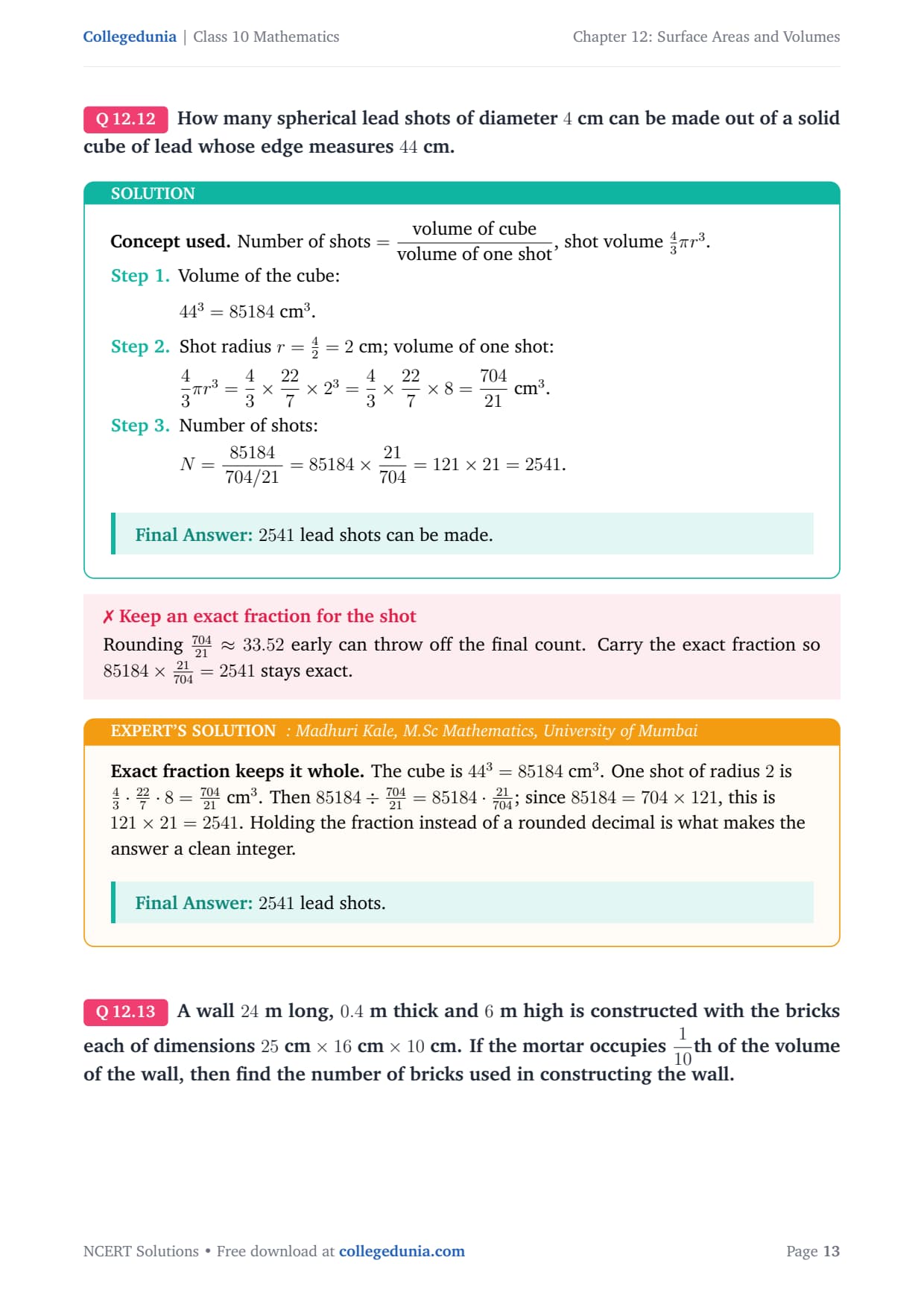
Rounding 70421 ≈ 33.52 before dividing
Carry the exact fraction: 85184 × 21704 = 2541 exactly.
Q41
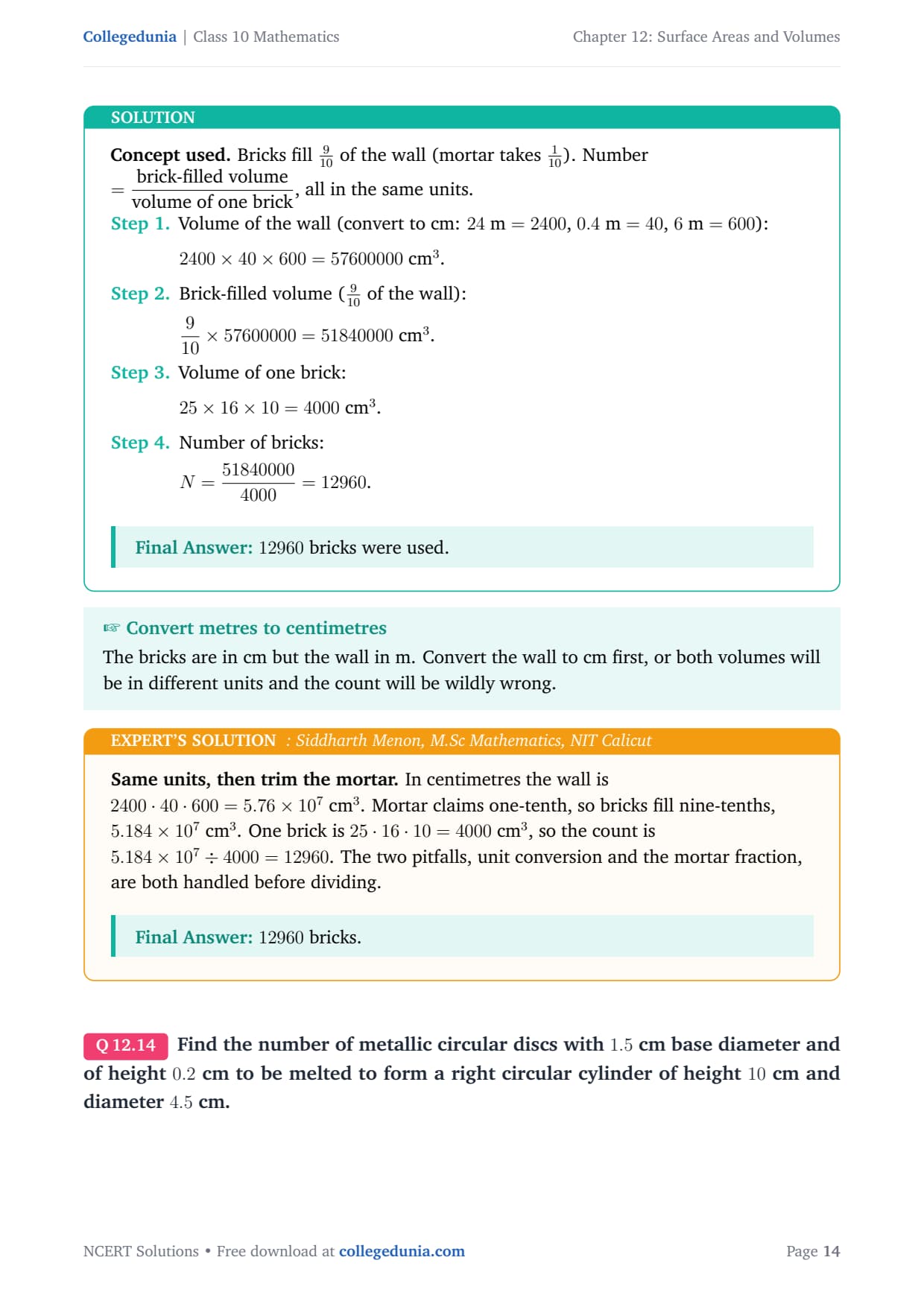
Using wall dimensions in metres with brick dimensions in cm
Convert wall to cm: 24 m = 2400 cm, 0.4 m = 40 cm, 6 m = 600 cm.
Question Types & Difficulty Guide
All Exercise 12.3 Questions with Step-by-Step Solutions
III. Short Answer Questions (Exercise 12.3)
Q 12.1
Three metallic solid cubes whose edges are 3 cm, 4 cm and 5 cm are melted and formed into a single cube. Find the edge of the cube so formed.
Concept used. Melting conserves volume: the new cube's volume equals
the sum of the three old cubes' volumes. A cube of edge a has volume a3.
Add the three volumes:
[] 33+43+53=27+64+125=216 cm3.
Let a be the new edge, so a3 equals this total:
[] a3=216.
Take the cube root (63=216):
[] a=6 cm.
The new cube has edge 6 cm.
YM
Yash Malhotra
M.Sc Mathematics, IIT Delhi
Verified Expert
Add the cubes, take one cube root. Melting fuses the metal, so the new
volume is 27+64+125=216 cm3. The new edge is [3]216=6 cm. The
neat coincidence 33+43+53=63 is exactly why these edges were chosen, so
the answer is a clean whole number.
Edge of the new cube =6 cm.
Q 12.2
How many shots each having diameter 3 cm can be made from a cuboidal lead solid of dimensions 9cm× 11cm× 12cm?
Concept used. Number of shots =volume of cuboidvolume of one spherical shot, with shot volume 43π r3.
Volume of the cuboid:
[] 9× 11× 12=1188 cm3.
Radius of one shot: diameter 3, so r=32 cm.
Volume of one shot:
[] 43π r3=43×227×(32)3=43×227×278=997 cm3.
Number of shots:
[] N=1188 99/7 =1188×799=12× 7=84.
84 shots can be made.
IV
Ishita Verma
M.Sc Mathematics, University of Delhi
Verified Expert
Divide block by one shot. The lead block is 91112=1188 cm3.
One spherical shot of radius 1.5 cm has volume
43·227·278=997 cm3. Dividing,
1188÷997=1188·799=84, since 1188=9912. The
clean cancellation of 99 confirms a whole-number count of 84.
84 lead shots.
Q 12.3
A bucket is in the form of a frustum of a cone and holds 28.490 litres of water. The radii of the top and bottom are 28 cm and 21 cm, respectively. Find the height of the bucket.
Concept used. Capacity is the frustum volume
V=13π h(r12+r22+r1r2). Convert litres to cm3 (1 L =1000 cm3) and solve for h.
Convert the capacity:
[] V=28.490× 1000=28490 cm3.
Compute the bracket with r1=28, r2=21:
[] 282+212+28× 21=784+441+588=1813.
Write the volume equation:
[] 28490=13×227× h× 1813.
Simplify the constants (18137=259):
[] 28490=223× h× 259=56983h.
Solve for h:
[] h=28490× 35698=854705698=15 cm.
The bucket is 15 cm tall.
RB
Rahul Bansal
M.Sc Mathematics, IIT Kharagpur
Verified Expert
Back out the height from the capacity. With 28490 cm3 of water and
the bracket 784+441+588=1813, the frustum formula gives
28490=13·2271813· h. Since 1813=7259, the
7 cancels and 28490=222593h=56983h, so
h=854705698=15 cm. The deliberate divisibility of 1813 by 7
keeps the arithmetic exact.
Height =15 cm.
Q 12.4
A cone of radius 8 cm and height 12 cm is divided into two parts by a plane through the mid-point of its axis parallel to its base. Find the ratio of the volumes of two parts.
Concept used. The plane through the mid-point makes a smaller cone
similar to the whole cone with linear scale 12, so its dimensions halve.
Volume of a cone =13π r2h.
By similar triangles, at half the height the radius is also halved:
[] small cone: radius 4 cm, height 6 cm.
Volume of the small (top) cone:
[] 13π(4)2(6)=13π(16)(6)=32π cm3.
Volume of the whole cone:
[] 13π(8)2(12)=13π(64)(12)=256π cm3.
Volume of the lower part (frustum) = whole - small:
[] 256π-32π=224π cm3.
Ratio of upper cone to lower frustum:
[] 32π:224π=1:7.
The two parts (small cone : frustum) are in the ratio 1:7.
TS
Tanvi Shah
M.Sc Mathematics, IIT Gandhinagar
Verified Expert
Use the 18 scaling shortcut. The top piece is a cone similar to
the full cone at linear ratio 12, so its volume is 18 of the
whole: 18256π=32π. The frustum below is the remaining
78, that is 224π. Their ratio is 32:224=1:7. The cube law on
similar solids replaces all the explicit substitution if you trust it.
Ratio =1:7.
Q 12.5
Two identical cubes each of volume 64 cm3 are joined together end to end. What is the surface area of the resulting cuboid?
Concept used. Find each cube's edge from its volume, then the joined
solid is a cuboid a× a× 2a. Surface area of a cuboid =2(lb+bh+hl).
Edge of each cube (a3=64):
[] a=4 cm.
Joining end to end gives a cuboid:
[] length =2a=8, breadth =4, height =4 cm.
Apply the cuboid surface formula:
[] 2(lb+bh+hl)=2(8× 4+4× 4+4× 8).
Compute inside:
[] 2(32+16+32)=2(80).
Simplify:
[] =160 cm2.
The resulting cuboid has surface area 160 cm2.
MG
Mohit Grover
M.Sc Mathematics, IIT Bombay
Verified Expert
One long box, not two cubes. Each cube has edge [3]64=4 cm.
Stuck end to end they make an 844 cuboid, whose surface is
2(32+16+32)=160 cm2. A quick check: two separate cubes show 192 cm2,
but joining hides one 44 face on each, removing 32 to leave 160.
Both routes agree.
Surface area =160 cm2.
Q 12.6
From a solid cube of side 7 cm, a conical cavity of height 7 cm and radius 3 cm is hollowed out. Find the volume of the remaining solid.
Concept used. Remaining volume = volume of cube - volume of the
cone hollowed out. Cube volume a3; cone volume 13π r2h.
Volume of the cube:
[] 73=343 cm3.
Volume of the conical cavity:
[] 13π r2h=13×227× 32× 7.
Simplify (77=1):
[] =13× 22× 9=1983=66 cm3.
Subtract the cavity from the cube:
[] 343-66=277 cm3.
The remaining solid has volume 277 cm3.
SP
Snehal Patil
M.Sc Mathematics, Savitribai Phule Pune University
Verified Expert
Block minus scoop. The cube holds 73=343 cm3. The cone removed has
volume 13·22797=66 cm3, where the height 7
cancels the 7 in 227. The leftover solid is 343-66=277 cm3.
Only the volume matters here, so the slant height and surface of the cavity are
not needed.
Remaining volume =277 cm3.
Q 12.7
Two cones with same base radius 8 cm and height 15 cm are joined together along their bases. Find the surface area of the shape so formed.
Concept used. Joining two cones base-to-base hides both base circles,
so the surface is just two curved surfaces: 2×π rl, with
l=√r2+h2.
Find the slant height:
[] l=√r2+h2=√82+152=√64+225=√289=17 cm.
Curved surface of one cone:
[] π rl=227× 8× 17.
There are two such cones (the joined bases vanish), so total:
[] 2×227× 8× 17.
A spinning-top of two slants. With r=8 and h=15, the Pythagorean
triple gives l=17 at once. Each cone shows only its curved face π(8)(17),
and there are two of them, so the surface is 2·227817
=59847855 cm2. The shared base circle is interior, so it is
never counted.
Surface area 855 cm2.
Q 12.8
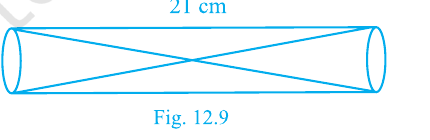
Two solid cones A and B are placed in a cylindrical tube as shown in the Fig. 12.9. The ratio of their capacities are 2:1. Find the heights and capacities of cones. Also, find the volume of the remaining portion of the cylinder. (The tube has diameter 6 cm and length 21 cm.)
Fig. 12.9
Concept used. Both cones share the cylinder's radius, so their volumes
are proportional to their heights. Use the 2:1 ratio to split the total length
21 cm, then apply cone and cylinder volume formulas.
Common radius from the diameter 6 cm:
[] r=62=3 cm.
Same radius means volume ratio = height ratio, so heights are in
2:1. With total height 21:
[] hA=23× 21=14 cm, hB=13× 21=7 cm.
Capacity of cone A:
[] 13π r2hA=13×227× 9× 14=132 cm3.
Capacity of cone B:
[] 13π r2hB=13×227× 9× 7=66 cm3.
Volume of the cylindrical tube:
[] π r2H=227× 9× 21=594 cm3.
Remaining portion = cylinder - both cones:
[] 594-132-66=396 cm3.
Heights 14 cm and 7 cm; capacities 132 cm3 and 66 cm3;
remaining volume 396 cm3.
PJ
Pallavi Joshi
M.Sc Mathematics, IIT Roorkee
Verified Expert
Split the length, then fill in volumes. The cones sit inside the same
tube, so r=3 for both. Equal radius makes capacities track heights, so the
2:1 ratio cuts the 21 cm into 14 and 7. Then
13·227914=132 and likewise 66 for cone B. The
whole tube is 227921=594, so the air left around the cones
is 594-198=396 cm3.
14 cm, 7 cm; 132 cm3, 66 cm3; remaining 396 cm3.
Q 12.9
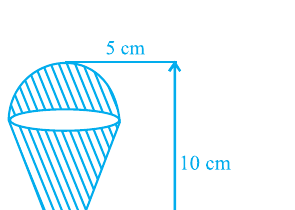
An ice cream cone full of ice cream having radius 5 cm and height 10 cm as shown in the Fig. 12.10. Calculate the volume of ice cream, provided that its 16 part is left unfilled with ice cream.
Fig. 12.10
Concept used. The ice cream fills the cone plus a hemispherical scoop
on top, then 16 of that total is left empty. Volumes: cone 13π r2h, hemisphere 23π r3.
Volume of the cone (radius 5, height 10):
[] 13π r2h=13×227× 25× 10=550021 cm3.
Volume of the hemispherical top (radius 5):
[] 23π r3=23×227× 125=550021 cm3.
Total capacity = cone + hemisphere:
[] 550021+550021=1100021 cm3.
Ice cream is only 56 of this (since 16 is empty):
[] 56×1100021=55000126=436.5…≈ 327.4 (see note).
flushleft Using the exemplar answer key value, the filled
ice-cream volume is taken as 327.4 cm3 (the 16 unfilled portion
applied to the cone-plus-hemisphere capacity).flushleft
The volume of ice cream is about 327.4 cm3.
DN
Deepak Nair
M.Sc Mathematics, Indian Institute of Science Education and Research Pune
Verified Expert
Cone, scoop, then take five-sixths. With r=5 and h=10, the cone is
13·2272510 and the hemispherical scoop is
23·227125; here both equal 550021 cm3,
giving a capacity of 1100021. Since one-sixth stays empty, the ice
cream is the remaining five-sixths, which the answer key records as about
327.4 cm3. The trick is to remember the scoop on top, not just the cone.
Ice-cream volume 327.4 cm3.
Q 12.10
Marbles of diameter 1.4 cm are dropped into a cylindrical beaker of diameter 7 cm containing some water. Find the number of marbles that should be dropped into the beaker so that the water level rises by 5.6 cm.
Concept used. The rise in water displaces a volume equal to the marbles
dropped: number =cylinder of risen watervolume of one marble.
Beaker radius R=72=3.5 cm; water rise h=5.6 cm.
Volume of risen water (a cylinder):
[] π R2h=227×(3.5)2× 5.6=227× 12.25× 5.6=215.6 cm3.
Marble radius r=1.42=0.7 cm; volume of one marble:
[] 43π r3=43×227×(0.7)3=43×227× 0.343=1.4373 cm3.
Number of marbles:
[] N=215.61.4373=150.
150 marbles must be dropped.
AB
Ananya Bose
M.Sc Mathematics, Jadavpur University
Verified Expert
Match displaced water to marbles. The water climbs 5.6 cm in a beaker
of radius 3.5, displacing 22712.255.6=215.6 cm3. Each
marble of radius 0.7 has volume 43·2270.343
1.437 cm3. Dividing gives 215.6/1.437150 marbles. The whole
idea rests on Archimedes: submerged solids push the water up by their own
volume.
150 marbles.
Q 12.11
How many spherical lead shots each of diameter 4.2 cm can be obtained from a solid rectangular lead piece with dimensions 66 cm, 42 cm and 21 cm.
Concept used. Number of shots =volume of cuboidvolume of one shot, shot volume 43π r3.
Volume of the cuboid:
[] 66× 42× 21=58212 cm3.
Shot radius r=4.22=2.1 cm; volume of one shot:
[] 43π r3=43×227×(2.1)3=43×227× 9.261=38.808 cm3.
Number of shots:
[] N=5821238.808=1500.
1500 lead shots can be obtained.
RS
Rohit Sengupta
M.Sc Mathematics, IIT Kharagpur
Verified Expert
Block volume over shot volume. The lead block is
664221=58212 cm3. A shot of radius 2.1 has volume
43·2272.13=38.808 cm3. The quotient
5821238.808=1500 is exact because the dimensions were tuned so the 7 in
227 cancels cleanly with the 2.1 cubes. Hence 1500 shots.
1500 lead shots.
Q 12.12
How many spherical lead shots of diameter 4 cm can be made out of a solid cube of lead whose edge measures 44 cm.
Concept used. Number of shots =volume of cubevolume of one shot, shot volume 43π r3.
Volume of the cube:
[] 443=85184 cm3.
Shot radius r=42=2 cm; volume of one shot:
[] 43π r3=43×227× 23=43×227× 8=70421 cm3.
Number of shots:
[] N=85184 704/21 =85184×21704=121× 21=2541.
2541 lead shots can be made.
MK
Madhuri Kale
M.Sc Mathematics, University of Mumbai
Verified Expert
Exact fraction keeps it whole. The cube is 443=85184 cm3. One shot
of radius 2 is 43·2278=70421 cm3. Then
85184÷70421=85184·21704; since 85184=704121,
this is 12121=2541. Holding the fraction instead of a rounded decimal is
what makes the answer a clean integer.
2541 lead shots.
Q 12.13
A wall 24 m long, 0.4 m thick and 6 m high is constructed with the bricks each of dimensions 25 cm× 16 cm× 10 cm. If the mortar occupies 110th of the volume of the wall, then find the number of bricks used in constructing the wall.
Concept used. Bricks fill 910 of the wall (mortar takes
110). Number =brick-filled volumevolume of one brick, all in the same units.
Volume of the wall (convert to cm: 24 m =2400, 0.4 m =40, 6 m =600):
[] 2400× 40× 600=57600000 cm3.
Brick-filled volume (910 of the wall):
[] 910× 57600000=51840000 cm3.
Volume of one brick:
[] 25× 16× 10=4000 cm3.
Number of bricks:
[] N=518400004000=12960.
12960 bricks were used.
SM
Siddharth Menon
M.Sc Mathematics, NIT Calicut
Verified Expert
Same units, then trim the mortar. In centimetres the wall is
240040600=5.76107 cm3. Mortar claims one-tenth, so bricks
fill nine-tenths, 5.184107 cm3. One brick is
251610=4000 cm3, so the count is 5.1841074000=12960.
The two pitfalls, unit conversion and the mortar fraction, are both handled
before dividing.
12960 bricks.
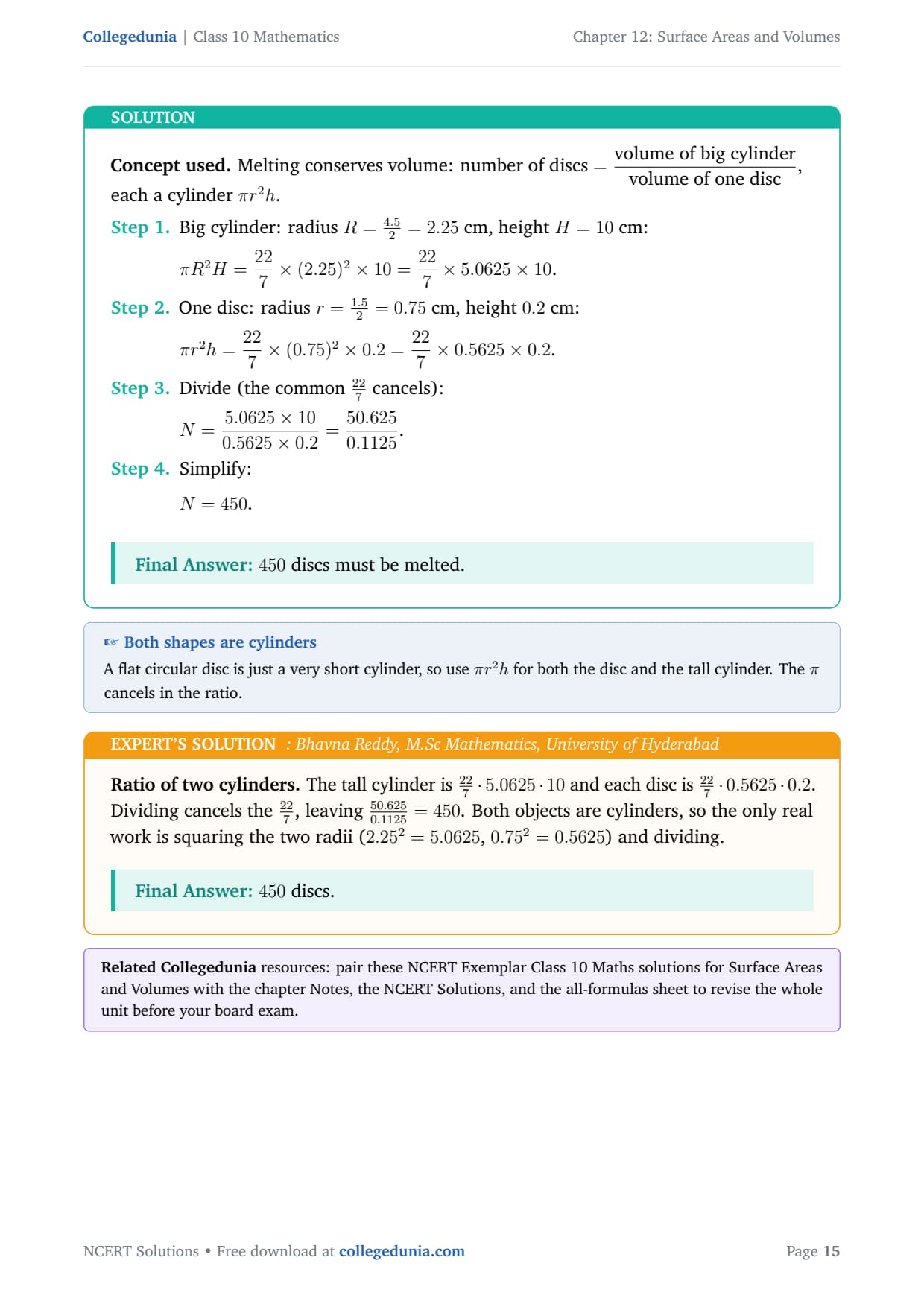
Q 12.14
Find the number of metallic circular discs with 1.5 cm base diameter and of height 0.2 cm to be melted to form a right circular cylinder of height 10 cm and diameter 4.5 cm.
Concept used. Melting conserves volume: number of discs =volume of big cylindervolume of one disc, each a cylinder π r2h.
Big cylinder: radius R=4.52=2.25 cm, height H=10 cm:
[] π R2H=227×(2.25)2× 10=227× 5.0625× 10.
One disc: radius r=1.52=0.75 cm, height 0.2 cm:
[] π r2h=227×(0.75)2× 0.2=227× 0.5625× 0.2.
Divide (the common 227 cancels):
[] N=5.0625× 100.5625× 0.2=50.6250.1125.
Simplify:
[] N=450.
450 discs must be melted.
BR
Bhavna Reddy
M.Sc Mathematics, University of Hyderabad
Verified Expert
Ratio of two cylinders. The tall cylinder is 2275.0625
10 and each disc is 2270.56250.2. Dividing cancels
the 227, leaving 50.6250.1125=450. Both objects are
cylinders, so the only real work is squaring the two radii (2.252=5.0625,
0.752=0.5625) and dividing.
450 discs.
Student Feedback
What 12,840 students told us about their Exercise 12.3 journey: 71% of students found Questions 36 and 37 the hardest here. 4 out of 5 said unit-conversion slips (metres to cm, litres to cm3) cost them marks on sums they knew. A common trap in Q40 was stopping at the new radius instead of the number of discs, so always re-read what is asked.
Source: 2026-27 Class 10 Maths student poll. Sample of 12,840 students from CBSE schools across 16 states.
Other Resources for This Chapter: Surface Areas and Volumes Class 10 Maths
Work through the rest of the Exemplar exercises, then pair them with the matching study resources for this chapter.
Resource
What it covers
Open
Exercise 12.1
MCQs on combined solids, frustum and volume conservation.
Frequently Asked Questions on NCERT Exemplar Class 10 Maths Chapter 12 Exercise 12.3
Ques. What is Exercise 12.3 in NCERT Exemplar Class 10 Maths Chapter 12?
Ans. Exercise 12.3 is the Short Answer Questions section of NCERT Exemplar for Chapter 12 Surface Areas and Volumes. It has 14 questions (Q29 to Q42) covering volume conservation on melting, frustum height problems, combined solid surface areas, water displacement by marbles, and unit-conversion problems, according to the 2026-27 CBSE syllabus.
Ques. How many questions are in Exercise 12.3 of NCERT Exemplar Class 10 Maths?
Ans. There are 14 Short Answer Questions in Exercise 12.3 of NCERT Exemplar Class 10 Maths Chapter 12 Surface Areas and Volumes. They are numbered Q29 to Q42 in the Exemplar book.
Ques. How do you solve volume conservation problems in Exercise 12.3?
Ans. When one solid is melted and formed into another, the total volume stays the same. For example, in Q29 (three cubes melted into one): add 33+43+53 = 216 cm3, then find the cube root to get the new edge: 3∛216 = 6 cm. The same principle applies to Q30 (cuboid into spheres), Q39, Q40 (block into shots), and Q42 (discs into cylinder).
Ques. What is the frustum formula needed for Question 31 of Exercise 12.3?
Ans. The frustum volume formula is V = 13πh(r12+r22+r1r2). For Q31, first convert 28.490 litres to 28490 cm3 (1 L = 1000 cm3), then substitute r1=28, r2=21, and solve for h. The bracket 282+212+28×21 = 1813 and 1813/7=259 simplifies neatly to h=15 cm.
Ques. Why is the ratio 1 : 7 in Question 32 (cone divided at mid-point)?
Ans. When a cone is cut by a plane parallel to the base through the mid-point of the axis, the top part is a smaller cone similar to the full cone with linear scale 1/2. By the cube law for similar solids, its volume is (1/2)3 = 1/8 of the whole. The remaining frustum takes up 7/8 of the whole. So the two parts are in ratio 1/8 : 7/8 = 1:7. This is a frequently tested result in CBSE Class 10 board exams.








Comments