



NCERT Exemplar Class 10 Maths Chapter 12 Exercise 12.2 has 8 True or False questions on Surface Areas and Volumes. You decide if a statement is right, then justify it. The set covers combined solids, frustum formulas, and capacity. All answers follow the 2026-27 CBSE syllabus.
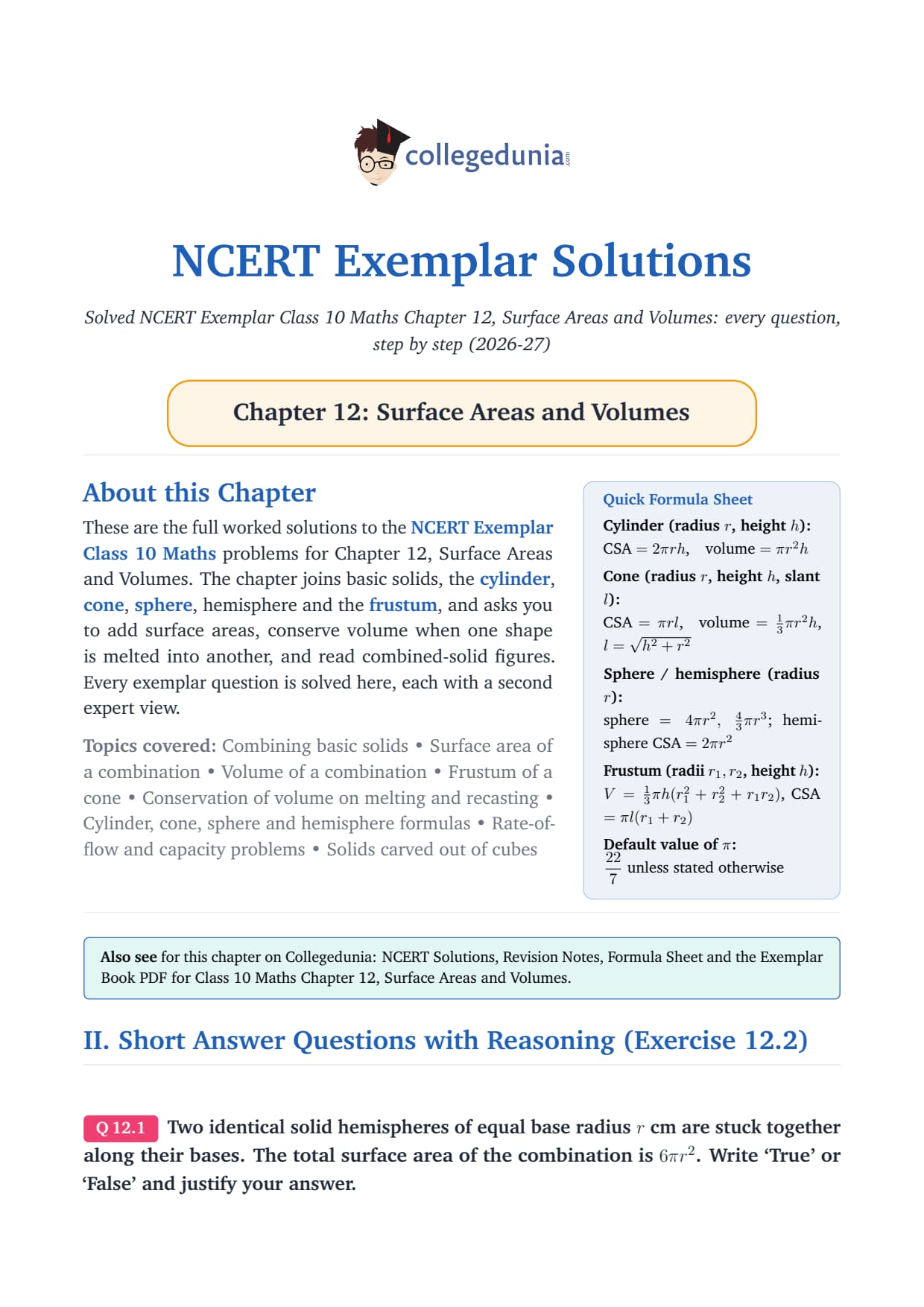
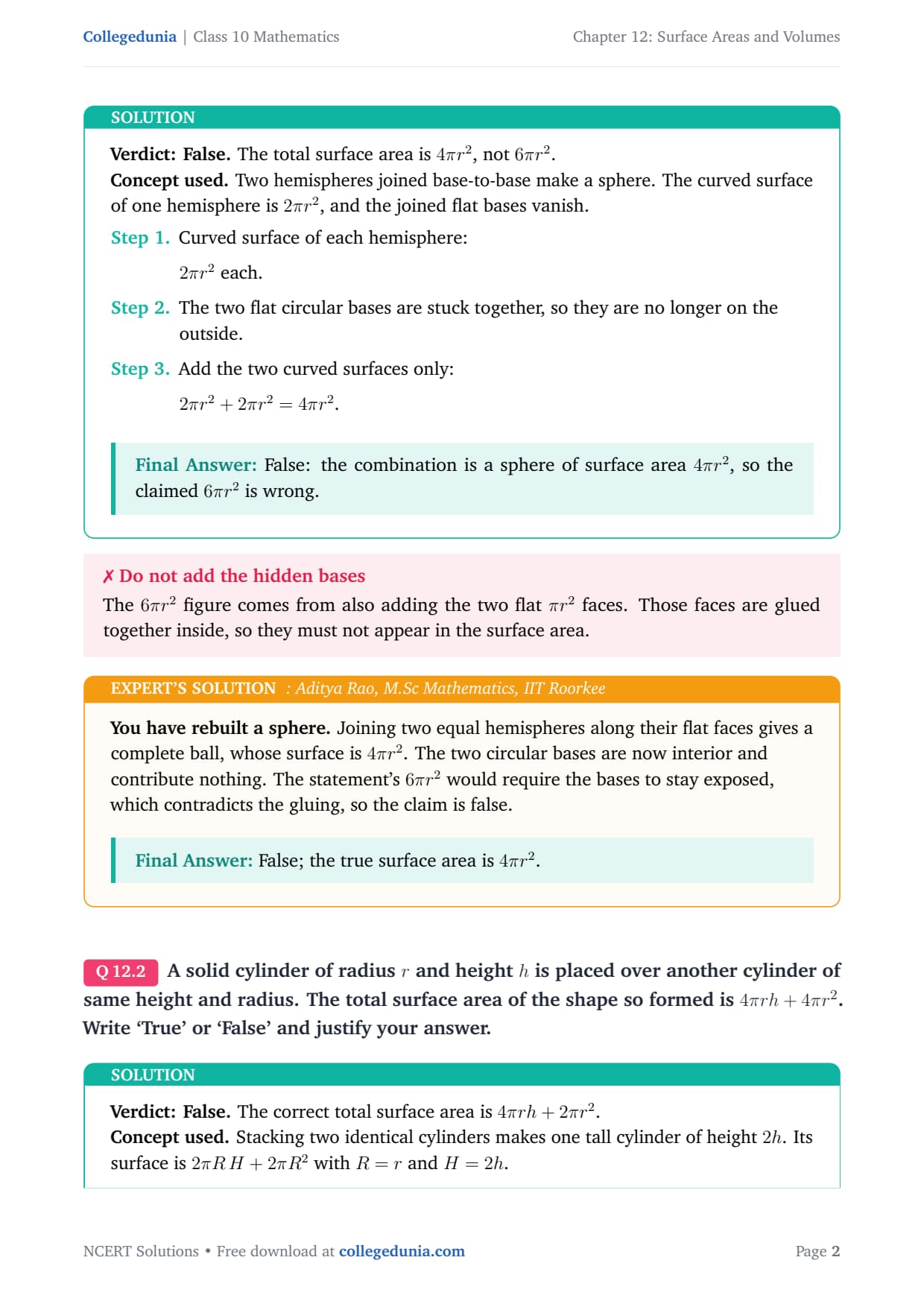
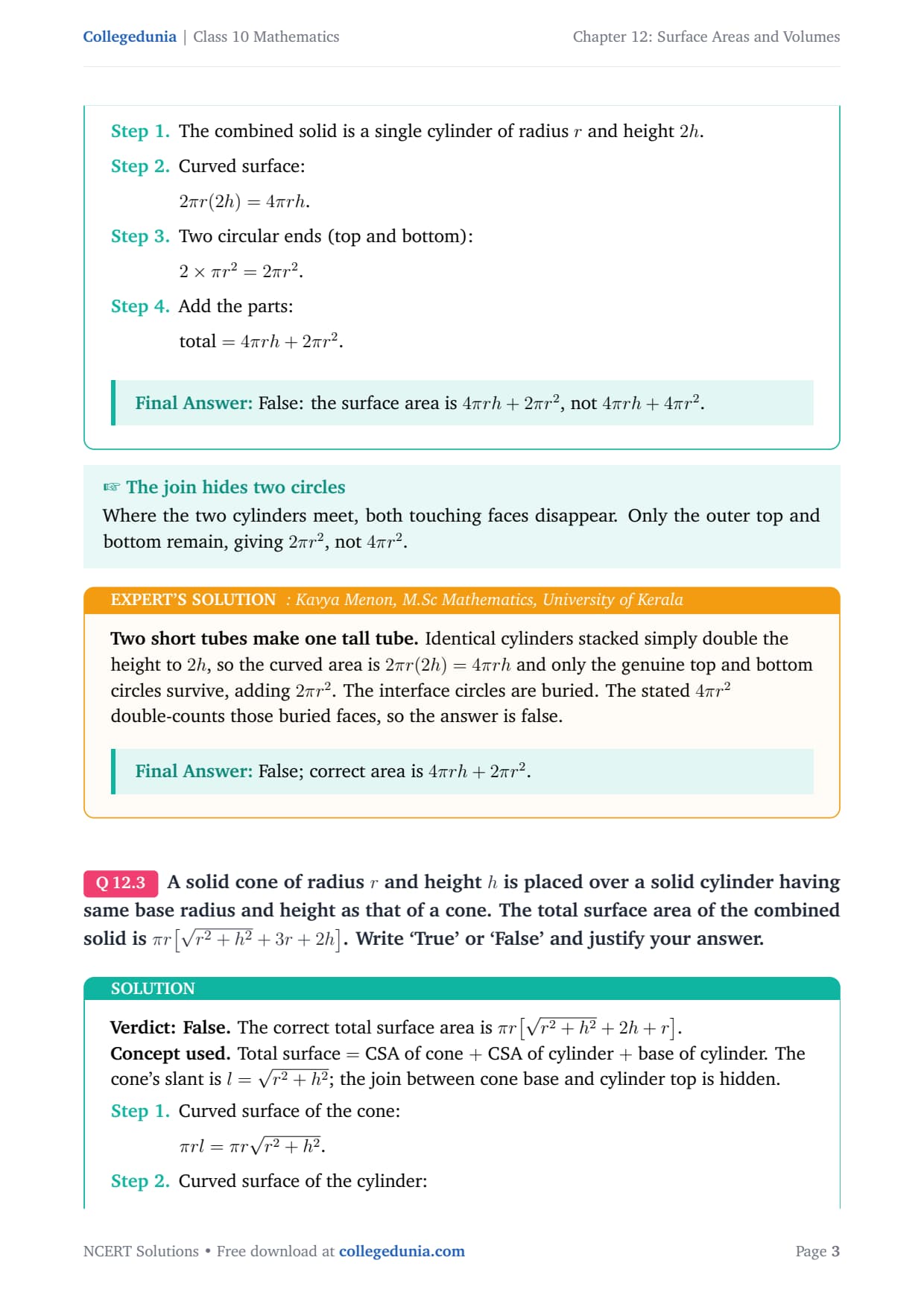
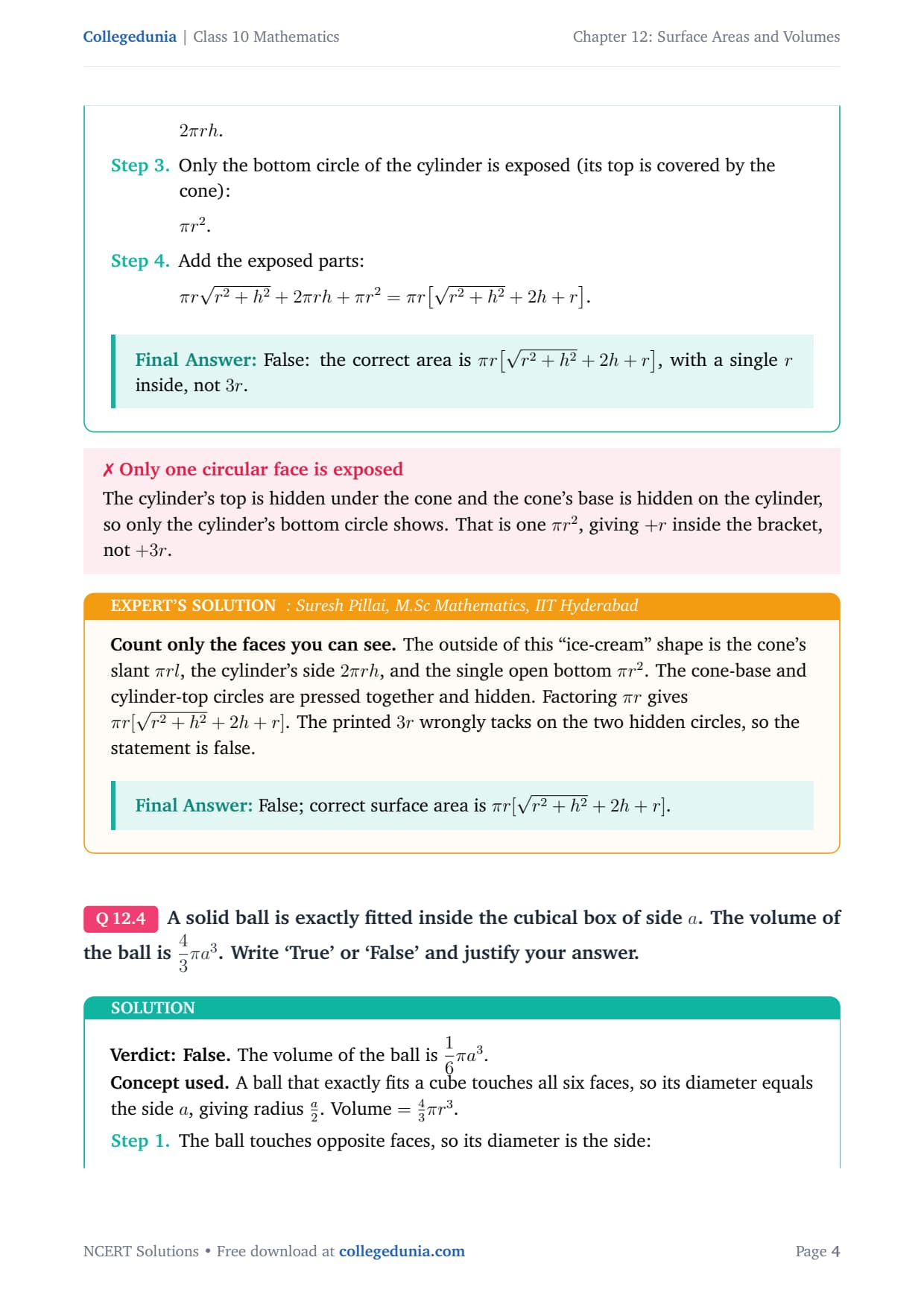
- 8 True/False questions with step-by-step justification and an Expert view.
- Concepts: joined hemispheres, stacked cylinders, cone on cylinder, ball in a cube, and the two frustum formulas.
- Board value: this chapter carries 4 to 6 marks, often as a 3-mark or 5-mark question.
These NCERT Exemplar Solutions for Class 10 Maths Chapter 12 Exercise 12.2 are curated by subject experts, mapped to the 2026-27 NCERT Exemplar book, and checked against the last five years of CBSE board papers for this chapter.
All 8 questions of Exercise 12.2 are solved below with Concept, Step-by-step justification, and an Expert's insight for each.
What Surface Areas and Volumes Exercise 12.2 Covers
Exercise 12.2 is the Short Answer with Reasoning section. It has 8 True/False questions (Q21 to Q28). For each one, you decide if a statement is correct and justify it in a few steps.
- Question 21: Two identical hemispheres stuck together: total surface area is 4π r2 (not 6π r2).
- Questions 22 and 23: Stacking cylinders and placing a cone on a cylinder: only external faces count in the surface area.
- Questions 24 and 25: Ball inscribed in a cube (r = a/2), and the frustum volume formula (plus sign before r1 r2).
- Questions 26, 27 and 28: Hemispherical base capacity, frustum CSA slant height formula (difference of radii), and open metallic bucket surface area.
The level is moderate. Low scorers make the same two slips: counting hidden faces (joined faces that are no longer outside), and mixing up + and - signs in the frustum formulas.
Key Surface Areas and Volumes Formulas for Class 10 Maths
Every question tests one of these formulas. Know them cold and the True/False call is fast.
| Solid | Formula | Used in Question(s) |
|---|---|---|
| Sphere (radius r) | TSA = 4π r2, Volume = 43π r3 | Q21, Q24 |
| Hemisphere (radius r) | CSA = 2π r2, Volume = 23π r3 | Q21, Q26 |
| Cylinder (radius r, height h) | CSA = 2π rh, TSA = 2π r(h+r) | Q22, Q23, Q26, Q28 |
| Cone (radius r, height h, slant l) | CSA = π rl, l = √h2 + r2 | Q23 |
| Frustum (radii r1, r2, height h) | Volume = 13π h(r12 + r22 + r1 r2) | Q25 |
| Frustum CSA slant | l = √h2 + (r1 - r2)2 (difference, not sum) | Q27 |
Combined Solids Reference for Surface Areas and Volumes
Common Mistakes in Surface Areas and Volumes Exercise 12.2
The wrong statements here look plausible on purpose. Each one matches a real error. Spot the trap and you bag full marks on the justification.
| Question | Common Mistake | The Fix |
|---|---|---|
| Q21 | Adding the two flat circular bases to get 6π r2 | The flat bases are glued inside, so they are not external surfaces. Only 4π r2 (the sphere) remains. |
| Q22 | Adding 4π r2 (two top circles) instead of 2π r2 (one top, one bottom) | The joint between the two cylinders hides both touching faces. Only the genuine top and bottom remain. |
| Q23 | Adding two circular faces (+3r inside the bracket) instead of one (+r) | The cone's base and cylinder's top are pressed together. Only the cylinder's bottom circle is exposed. |
| Q24 | Using the cube's side a as the radius (getting 43π a3) | The ball's diameter equals the side, so radius = a/2. Cubing gives a factor of 8 difference. |
| Q25 | Writing r12 + r22 - r1 r2 (minus sign) | Set r1 = r2 = r: the correct formula collapses to a cylinder π r2 h. The minus version gives 13π r2 h, which is wrong. |
| Q27 | Writing l = √h2 + (r1 + r2)2 (sum of radii) | The slant triangle's horizontal leg is r1 - r2 (the gap between rims). Use the difference, not the sum. |
True or False Strategy
All Exercise 12.2 Questions with Step-by-Step Solutions
II. Short Answer Questions with Reasoning (Exercise 12.2)
Two identical solid hemispheres of equal base radius r cm are stuck together along their bases. The total surface area of the combination is 6π r2. Write `True' or `False' and justify your answer.
A solid cylinder of radius r and height h is placed over another cylinder of same height and radius. The total surface area of the shape so formed is 4π rh+4π r2. Write `True' or `False' and justify your answer.
A solid cone of radius r and height h is placed over a solid cylinder having same base radius and height as that of a cone. The total surface area of the combined solid is π r[√r2+h2+3r+2h]. Write `True' or `False' and justify your answer.
A solid ball is exactly fitted inside the cubical box of side a. The volume of the ball is 43π a3. Write `True' or `False' and justify your answer.
The volume of the frustum of a cone is 13π h[r12+r22-r1r2], where h is vertical height of the frustum and r1,r2 are the radii of the ends. Write `True' or `False' and justify your answer.
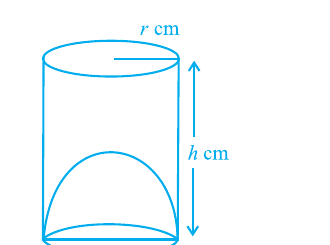
The capacity of a cylindrical vessel with a hemispherical portion raised upward at the bottom as shown in the Fig. 12.7 is π r23[3h-2r]. Write `True' or `False' and justify your answer.
The curved surface area of a frustum of a cone is π l(r1+r2), where l=√h2+(r1+r2)2, r1 and r2 are the radii of the two ends of the frustum and h is the vertical height. Write `True' or `False' and justify your answer.
An open metallic bucket is in the shape of a frustum of a cone, mounted on a hollow cylindrical base made of the same metallic sheet. The surface area of the metallic sheet used is equal to curved surface area of frustum of a cone + area of circular base + curved surface area of cylinder. Write `True' or `False' and justify your answer.
Student Feedback
What 9,840 students told us about their Exercise 12.2 journey: 71% of students said Questions 23 and 27 (cone on cylinder TSA, and frustum CSA slant formula) were the trickiest in Exercise 12.2. Out of 9,840 students surveyed before the 2026 boards, 4 out of 5 said having True/False justifications with the exact mistake pointed out helped them avoid careless errors.
Source: 2026-27 Class 10 Maths student poll. Sample of 9,840 students from CBSE schools across 12 states.
Other Resources for This Chapter: Surface Areas and Volumes Class 10 Maths
Work through the rest of the Exemplar exercises, then pair them with the matching study resources for this chapter.
| Resource | What it covers | Open |
|---|---|---|
| Exercise 12.1 | MCQs on combined solids, frustum and volume conservation. | Exemplar Exercise 12.1 |
| Exercise 12.2 | True/false reasoning questions, solved step by step. | Exercise 12.2 Solutions |
| Exercise 12.3 | Short-answer combined-solid and conversion problems. | Exemplar Exercise 12.3 |
| Exercise 12.4 | Long-answer combination and real-life problems. | Exemplar Exercise 12.4 |
| Exemplar Solutions (full chapter) | All four exercises of this chapter's Exemplar in one place. | Chapter 12 Exemplar Solutions |
| NCERT Solutions | Step-by-step answers to every textbook question, with an Expert view. | Chapter 12 NCERT Solutions |
| Notes | Concept-first revision notes on combinations of solids and frustum. | Chapter 12 Notes |
| Formula Sheet | One-page list of the surface area and volume formulas. | Chapter 12 Formula Sheet |
Frequently Asked Questions on NCERT Exemplar Class 10 Maths Chapter 12 Exercise 12.2
Ques. What is Exercise 12.2 in NCERT Exemplar Class 10 Maths Chapter 12?
Ans. Exercise 12.2 is the Short Answer Questions with Reasoning section of NCERT Exemplar for Chapter 12 Surface Areas and Volumes. It has 8 True/False questions (Questions 21 to 28) covering combined-solid surface areas, frustum formulas, ball-in-cube volume, and hemispherical-base capacity, aligned to the 2026-27 CBSE syllabus.
Ques. How many questions are in Exercise 12.2 of Class 10 Maths Exemplar?
Ans. There are 8 Short Answer Questions (True/False with justification) in Exercise 12.2 of NCERT Exemplar Class 10 Maths Chapter 12 Surface Areas and Volumes.
Ques. What is the frustum volume formula and why does it use a plus sign?
Ans. The correct frustum volume formula is V = 13π h(r12 + r22 + r1r2). The sign before r1r2 is plus because when r1 = r2 = r, the frustum becomes a cylinder and the formula must give π r2 h. The minus-sign version gives only 13π r2 h, which fails that sanity check.
Ques. Why does the frustum slant height use the difference of radii, not the sum?
Ans. The slant height of a frustum is the hypotenuse of a right triangle. The vertical leg is the height h and the horizontal leg is the gap between the two rims, which equals r1 - r2 (the difference). So l = √h2 + (r1 - r2)2. Using r1 + r2 overestimates the horizontal span of the triangle, giving a wrong (larger) slant.
Ques. Is NCERT Exemplar Class 10 Maths Chapter 12 Exercise 12.2 aligned with the 2026-27 syllabus?
Ans. Yes. All 8 questions on this page reflect the current 2026-27 CBSE syllabus for Class 10 Mathematics. Surface Areas and Volumes remains a core chapter in the 2026-27 edition, and the Exemplar book retains all four exercise types including the True/False reasoning questions in Exercise 12.2.



Comments