NCERT Exemplar Class 10 Maths Chapter 12 Exercise 12.1 covers all 20 MCQs on Surface Areas and Volumes. You name real-life solid shapes, use volume conservation in melting problems, and apply the frustum, sphere, and cylinder formulas. All answers follow the 2026-27 CBSE syllabus.
What Surface Areas and Volumes Exercise 12.1 Covers
Exercise 12.1 is the MCQ set for the chapter. It has 20 questions. Each one tests whether you can:
Name the combined solid in a real-life object (pencil, surahi, gilli, shuttlecock, capsule).
Apply volume conservation when a solid is melted and recast.
Use the frustum formula for curved surface area and capacity.
Read a cross-section and know what a frustum is.
The board asks these as 1-mark or 2-mark items. To get them right, picture the shape rather than guess the option.
Tip for MCQs: Sketch the object quickly and label each visible part as a cylinder, cone, sphere, hemisphere, or frustum. The shape always becomes obvious once you draw it.
Key Surface Areas and Volumes Formulas for Class 10 Maths
You need these formulas to solve the MCQs. Keep them handy before you start.
Solid
Volume
Curved Surface Area
Cylinder (radius r, height h)
π r2h
2π rh
Cone (radius r, height h, slant l)
13π r2h
π rl
Sphere (radius r)
43π r3
4π r2
Hemisphere (radius r)
23π r3
2π r2
Frustum (radii r1, r2, height h, slant l)
13π h(r12 + r22 + r1 r2)
π l(r1 + r2)
Volume conservation rule: when a solid is melted and recast, volume stays the same. Set old volume = new volume, then solve for the unknown.
Types of Questions in Surface Areas and Volumes Exercise 12.1
The MCQs fall into three groups. Knowing the type tells you the right approach at once.
Question Type
Questions
Strategy
Identify combined solid
Q1, Q2, Q3, Q4, Q5, Q6, Q7, Q15, Q16, Q19
Sketch the object; name each part as a basic solid
Volume conservation (melting/recasting)
Q8, Q9, Q10, Q11, Q12, Q17, Q18
Equate volumes; simplify using π = 227
Surface area of combined solid / frustum
Q13, Q14, Q15, Q20
Use the correct formula; cube-root or square ratio as needed
Volume Conservation at a Glance
When a solid is melted and poured into a mould, the volume does not change. That single idea drives Questions 8 to 12 and 18. Here is how to use it:
Write down the formula for the original solid (sphere, cylinder, cuboid, shell).
Write down the formula for the new solid (cone, sphere, cylinder).
Set the two expressions equal and cancel common factors like π or 13.
Solve for the unknown (height, radius, or number of pieces).
Common mistake: Using diameter instead of radius in the formulas. Always halve the diameter before substituting. Squaring or cubing the diameter makes the answer 4 or 8 times too large.
All Exercise 12.1 Questions with Step-by-Step Solutions
I. Multiple Choice Questions (Exercise 12.1)
Q 12.1
A cylindrical pencil sharpened at one edge is the combination of
(A) a cone and a cylinder (B) frustum of a cone and a cylinder
(C) a hemisphere and a cylinder (D) two cylinders.
Correct option: (A) a cone and a cylinder.
Concept used. A combined solid is named by the basic shapes you can
see in it. Pick out each part of the pencil and match it to a standard solid.
The long body of the pencil is a uniform circular rod, which is a
cylinder.
The sharpened tip tapers to a point on a circular base, which is a
cone.
So the pencil is a cylinder with a cone stuck on one end.
A sharpened pencil is a cone + cylinder; option (A).
AM
Aarav Mehta
M.Sc Mathematics, IIT Kanpur
Verified Expert
Name the parts you can touch. The shaft of the pencil keeps the same
circular cross-section all the way along, so it is a cylinder; the sharpened
nose narrows smoothly to a single point, which is the defining feature of a
cone. A frustum (option B) would need a flat smaller circle at the tip,
not a point, so it is wrong here. There is no curved dome, so a hemisphere is
ruled out too.
Option (A), a cone and a cylinder.
Q 12.2
A surahi is the combination of
(A) a sphere and a cylinder (B) a hemisphere and a cylinder
(C) two hemispheres (D) a cylinder and a cone.
Correct option: (A) a sphere and a cylinder.
Concept used. A surahi (a long-necked water pot) has a rounded belly
and a tall narrow neck. Match each visible part to a basic solid.
The bulging round body of the pot is a sphere.
The long thin neck above it is a cylinder.
So the surahi is a sphere with a cylinder rising out of the top.
A surahi is a sphere + cylinder; option (A).
PN
Priya Nair
M.Sc Mathematics, University of Delhi
Verified Expert
Belly is a sphere, neck is a cylinder. The wide pot of a surahi is
rounded all over, so it is a full sphere rather than a hemisphere; the slender
spout is a uniform tube, which is a cylinder. Option (B) fails because the
belly is not flat on top, and (C) and (D) miss the cylindrical neck entirely.
The pairing of a sphere with a cylindrical neck is the classic surahi shape.
Option (A), a sphere and a cylinder.
Q 12.3
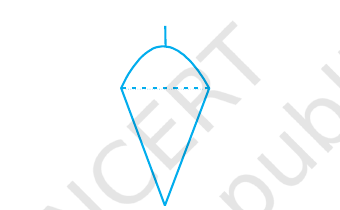
A plumbline (sahul) is the combination of (see Fig. 12.2)
(A) a cone and a cylinder (B) a hemisphere and a cone
(C) frustum of a cone and a cylinder (D) sphere and cylinder
Fig. 12.2
Correct option: (B) a hemisphere and a cone.
Concept used. A plumbline weight has a rounded top and a pointed
bottom. Match the two visible parts to basic solids.
The dotted line in Fig. 12.2 marks the join. Above it the surface is a
smooth dome, which is a hemisphere.
Below the join the shape tapers to a sharp point on the same circular
rim, which is a cone.
So the sahul is a hemisphere on top of a cone, joined at their common
circular face.
A plumbline is a hemisphere + cone; option (B).
RV
Rohan Verma
M.Sc Mathematics, IIT Bombay
Verified Expert
Dome above, point below. In Fig. 12.2 the rounded cap is exactly half
a ball, so it is a hemisphere, and the tapering lower part ending in a point is
a cone. They meet along the dashed circle, which is their common base. Option
(A) needs a flat-ended cylinder and (C) needs a frustum, neither of which has a
sharp point, so both are out; (D) wrongly uses a full sphere on top.
Option (B), a hemisphere and a cone.
Q 12.4
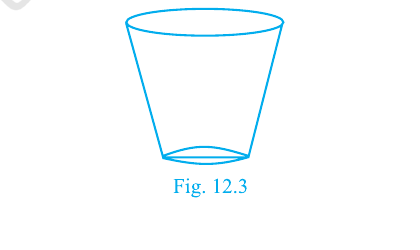
The shape of a glass (tumbler) (see Fig. 12.3) is usually in the form of
(A) a cone (B) frustum of a cone
(C) a cylinder (D) a sphere
Fig. 12.3
Correct option: (B) frustum of a cone.
Concept used. A frustum is what remains of a cone after the top is
sliced off by a plane parallel to the base. It has two circular ends of
different sizes.
Look at the two circular ends in Fig. 12.3: the open top is wider and
the base is narrower.
Two parallel circles of different radii joined by a slanting side is the
exact description of a frustum.
A cone would close to a point and a cylinder would have equal ends, so
neither fits.
A tumbler is a frustum of a cone; option (B).
SK
Sneha Kulkarni
M.Sc Mathematics, IISc Bangalore
Verified Expert
A cone with its tip cut off. The tumbler in Fig. 12.3 is wide at the
mouth and narrow at the base, with both ends flat and circular. That is a
frustum: imagine a full cone and slice the pointed top away with a cut parallel
to the base. A plain cone (A) would taper to a point, and a cylinder (C) would
keep the same width top to bottom, so only the frustum matches a real glass.
Option (B), frustum of a cone.
Q 12.5
The shape of a gilli, in the gilli-danda game (see Fig. 12.4), is a combination of
(A) two cylinders (B) a cone and a cylinder
(C) two cones and a cylinder (D) two cylinders and a cone
Fig. 12.4
Correct option: (C) two cones and a cylinder.
Concept used. Break the gilli into its visible parts and name each as
a basic solid.
The middle of the gilli is a straight circular rod, which is a
cylinder.
Each end tapers to a point, and there are two such ends, so they are
two cones.
Putting the parts together: a cylinder in the centre with a cone on each
end gives two cones and a cylinder.
A gilli is two cones + a cylinder; option (C).
SK
Sanjana Kapoor
M.Sc Mathematics, Jamia Millia Islamia
Verified Expert
One tube, two points. Figure 12.4 shows a short straight middle, a
cylinder, with a tapering point at each end. Since both ends come to a point,
each is a cone, giving two cones in all. So the gilli is two cones plus one
cylinder. Option (B) counts only one cone, and (D) wrongly replaces a cone with
a second cylinder, so both miss the symmetric double-pointed shape.
Option (C), two cones and a cylinder.
Q 12.6
A shuttle cock used for playing badminton has the shape of the combination of
(A) a cylinder and a sphere (B) a cylinder and a hemisphere
(C) a sphere and a cone (D) frustum of a cone and a hemisphere
Correct option: (D) frustum of a cone and a hemisphere.
Concept used. Name each part of the shuttlecock: the cork base and the
flared feather skirt.
The rounded cork at the bottom is a smooth half-ball, which is a
hemisphere.
The feather skirt widens from a small circle at the cork to a larger
open circle at the top, two unequal circular ends, which is a
frustum of a cone.
So the shuttlecock is a frustum mounted on a hemisphere.
A shuttlecock is a frustum + hemisphere; option (D).
DN
Devendra Naik
M.Sc Mathematics, NIT Surathkal
Verified Expert
Cork is a dome, feathers form a frustum. The cork base curves like
half a ball, so it is a hemisphere; the feathers fan out from the narrow cork
to a wide open mouth, giving two circles of different sizes joined by a slant,
which is a frustum. Options (A) and (B) ignore the flared, tapering skirt, and
(C) wrongly makes the base a full sphere, so (D) is the only fit.
Option (D), frustum of a cone and a hemisphere.
Q 12.7
A cone is cut through a plane parallel to its base and then the cone that is formed on one side of that plane is removed. The new part that is left over on the other side of the plane is called
(A) a frustum of a cone (B) cone
(C) cylinder (D) sphere
Correct option: (A) a frustum of a cone.
Concept used. Cutting a cone with a plane parallel to the base splits
it into a small cone (top) and a frustum (bottom).
The cut is parallel to the base, so it makes a small circle inside the
cone.
Removing the small cone above the cut leaves the lower piece.
That lower piece has two parallel circular ends of different sizes,
which is by definition a frustum.
The leftover lower piece is a frustum; option (A).
RM
Ritika Malhotra
M.Sc Mathematics, Panjab University
Verified Expert
Keep the base, lose the tip. A plane parallel to the base divides the
cone into a tiny cone near the apex and a wider band near the base. Taking away
the tiny cone leaves a solid with two flat circular ends of unequal radius,
which is exactly what ``frustum'' means. It is not a cone (no apex), not a
cylinder (ends differ), so option (A) is correct.
Option (A), a frustum of a cone.
Q 12.8
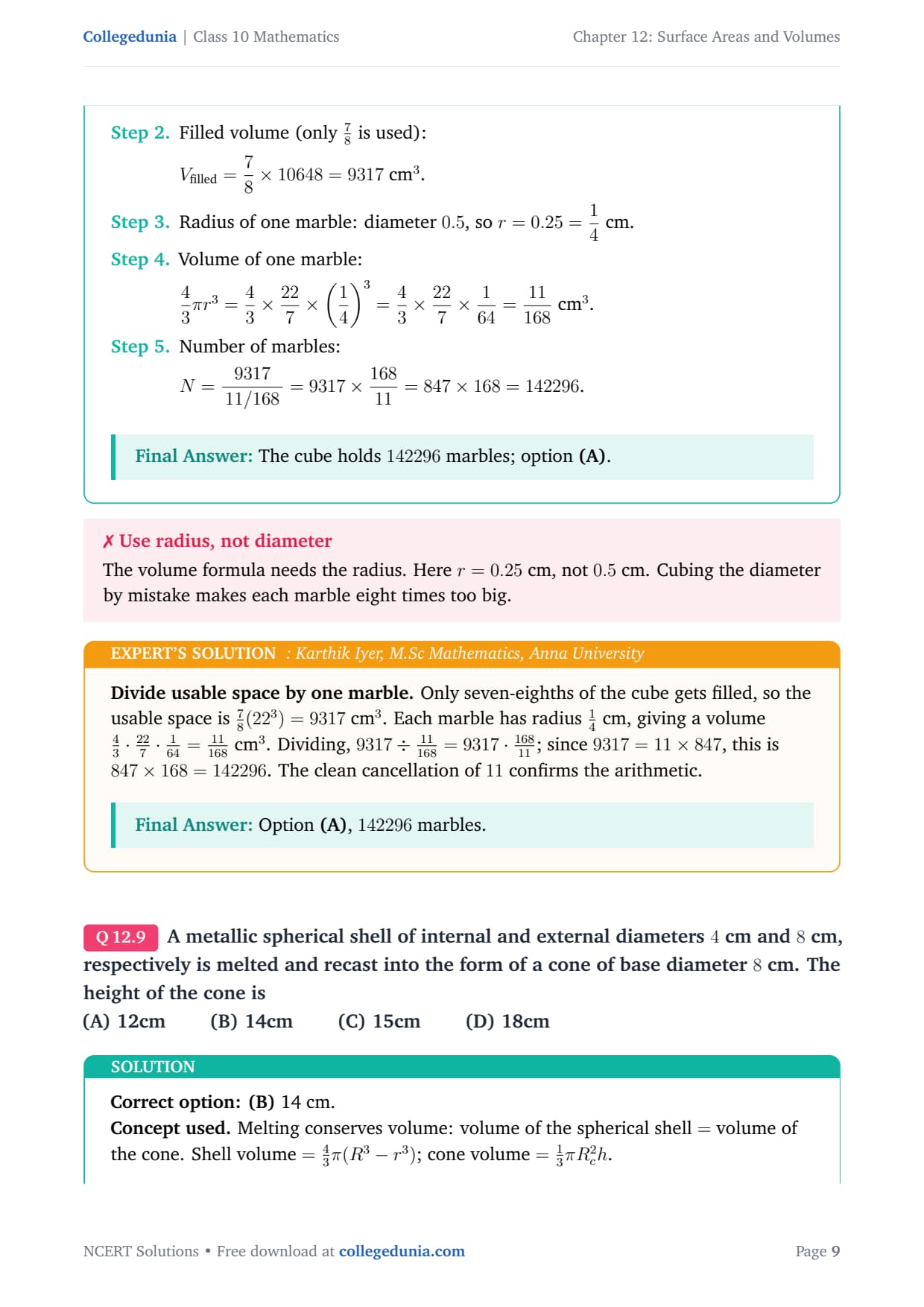
A hollow cube of internal edge 22 cm is filled with spherical marbles of diameter 0.5 cm and it is assumed that 18 space of the cube remains unfilled. Then the number of marbles that the cube can accommodate is
(A) 142296 (B) 142396 (C) 142496 (D) 142596
Correct option: (A) 142296.
Concept used. Number of marbles =filled volume of cubevolume of one marble, where filled volume =78 of the cube and one marble is a sphere of volume 43π r3.
Volume of the cube:
[] Vcube=223=10648 cm3.
Filled volume (only 78 is used):
[] Vfilled=78× 10648=9317 cm3.
Radius of one marble: diameter 0.5, so r=0.25=14 cm.
Volume of one marble:
[] 43π r3=43×227×(14)3
=43×227×164=11168 cm3.
Number of marbles:
[] N=9317 11/168 =9317×16811=847× 168=142296.
The cube holds 142296 marbles; option (A).
KI
Karthik Iyer
M.Sc Mathematics, Anna University
Verified Expert
Divide usable space by one marble. Only seven-eighths of the cube gets
filled, so the usable space is 78(223)=9317 cm3. Each marble has
radius 14 cm, giving a volume 43·227·164
=11168 cm3. Dividing, 9317÷11168=9317·16811;
since 9317=11× 847, this is 847× 168=142296. The clean cancellation
of 11 confirms the arithmetic.
Option (A), 142296 marbles.
Q 12.9
A metallic spherical shell of internal and external diameters 4 cm and 8 cm, respectively is melted and recast into the form of a cone of base diameter 8 cm. The height of the cone is
(A) 12cm (B) 14cm (C) 15cm (D) 18cm
Correct option: (B) 14 cm.
Concept used. Melting conserves volume: volume of the spherical shell
= volume of the cone. Shell volume =43π(R3-r3); cone volume
=13π Rc2h.
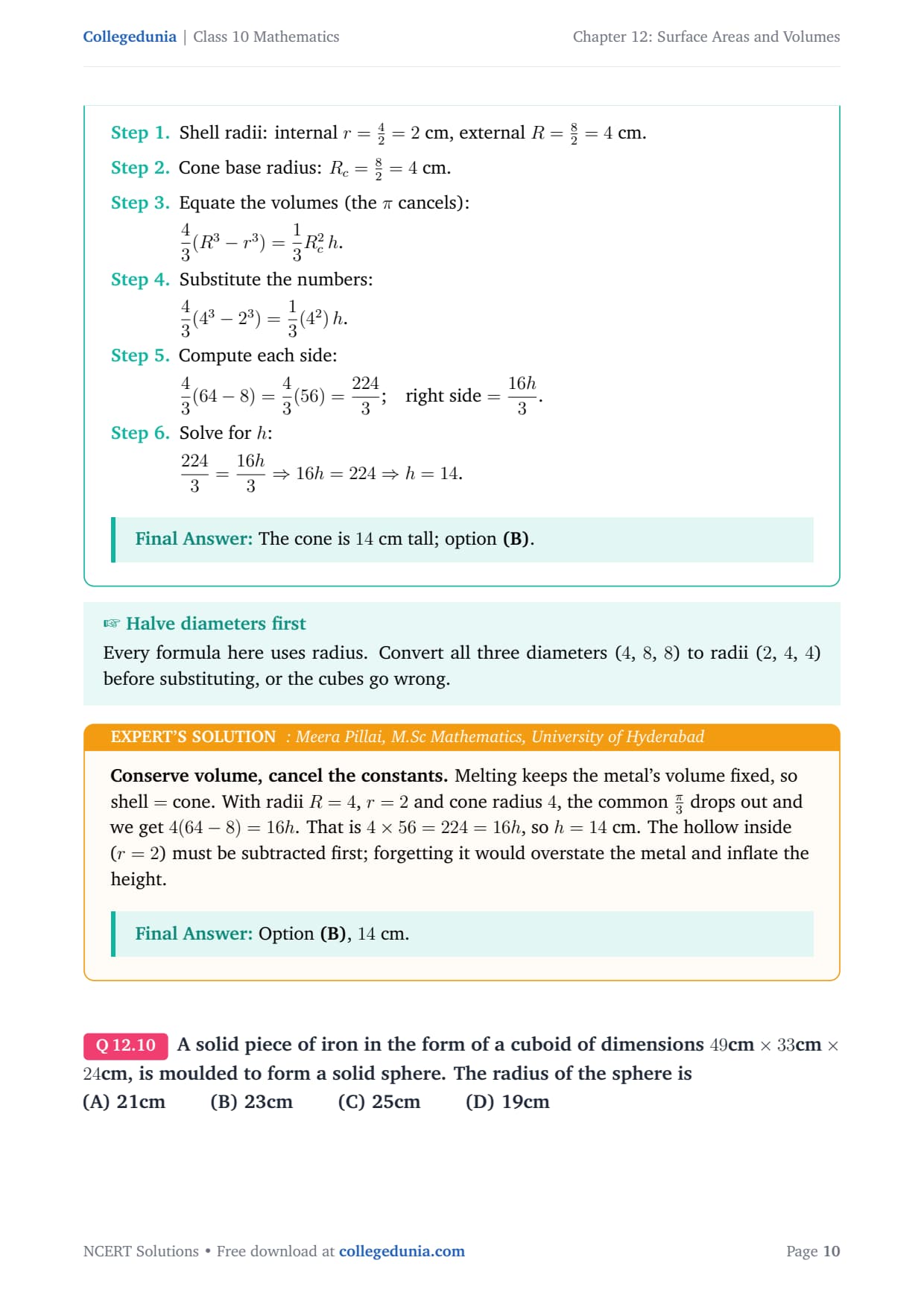
Shell radii: internal r=42=2 cm, external R=82=4 cm.
Cone base radius: Rc=82=4 cm.
Equate the volumes (the π cancels):
[] 43(R3-r3)=13 Rc2h.
Substitute the numbers:
[] 43(43-23)=13(42) h.
Compute each side:
[] 43(64-8)=43(56)=2243; right side =16h3.
Solve for h:
[] 2243=16h3⇒ 16h=224⇒ h=14.
The cone is 14 cm tall; option (B).
MP
Meera Pillai
M.Sc Mathematics, University of Hyderabad
Verified Expert
Conserve volume, cancel the constants. Melting keeps the metal's
volume fixed, so shell = cone. With radii R=4, r=2 and cone radius 4,
the common π3 drops out and we get 4(64-8)=16h. That is
4× 56=224=16h, so h=14 cm. The hollow inside (r=2) must be
subtracted first; forgetting it would overstate the metal and inflate the
height.
Option (B), 14 cm.
Q 12.10
A solid piece of iron in the form of a cuboid of dimensions 49cm× 33cm× 24cm, is moulded to form a solid sphere. The radius of the sphere is
(A) 21cm (B) 23cm (C) 25cm (D) 19cm
Correct option: (A) 21 cm.
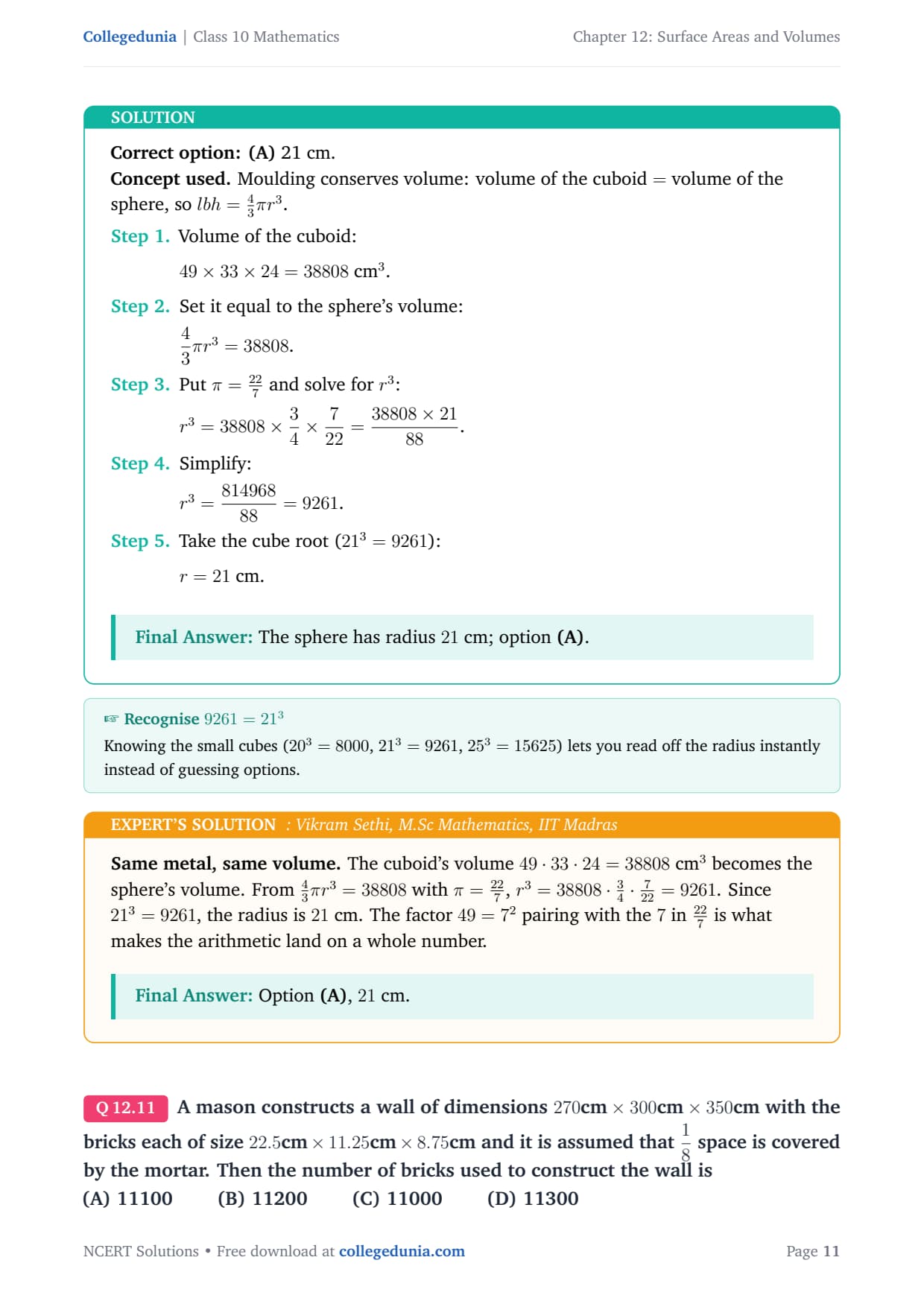
Concept used. Moulding conserves volume: volume of the cuboid =
volume of the sphere, so lbh=43π r3.
Volume of the cuboid:
[] 49× 33× 24=38808 cm3.
Set it equal to the sphere's volume:
[] 43π r3=38808.
Put π=227 and solve for r3:
[] r3=38808×34×722=38808× 2188.
Simplify:
[] r3=81496888=9261.
Take the cube root (213=9261):
[] r=21 cm.
The sphere has radius 21 cm; option (A).
VS
Vikram Sethi
M.Sc Mathematics, IIT Madras
Verified Expert
Same metal, same volume. The cuboid's volume 49· 33· 24=38808 cm3
becomes the sphere's volume. From 43π r3=38808 with π=227,
r3=38808·34·722=9261. Since 213=9261, the radius
is 21 cm. The factor 49=72 pairing with the 7 in 227 is what
makes the arithmetic land on a whole number.
Option (A), 21 cm.
Q 12.11
A mason constructs a wall of dimensions 270cm× 300cm× 350cm with the bricks each of size 22.5cm× 11.25cm× 8.75cm and it is assumed that 18 space is covered by the mortar. Then the number of bricks used to construct the wall is
(A) 11100 (B) 11200 (C) 11000 (D) 11300
Correct option: (B) 11200.
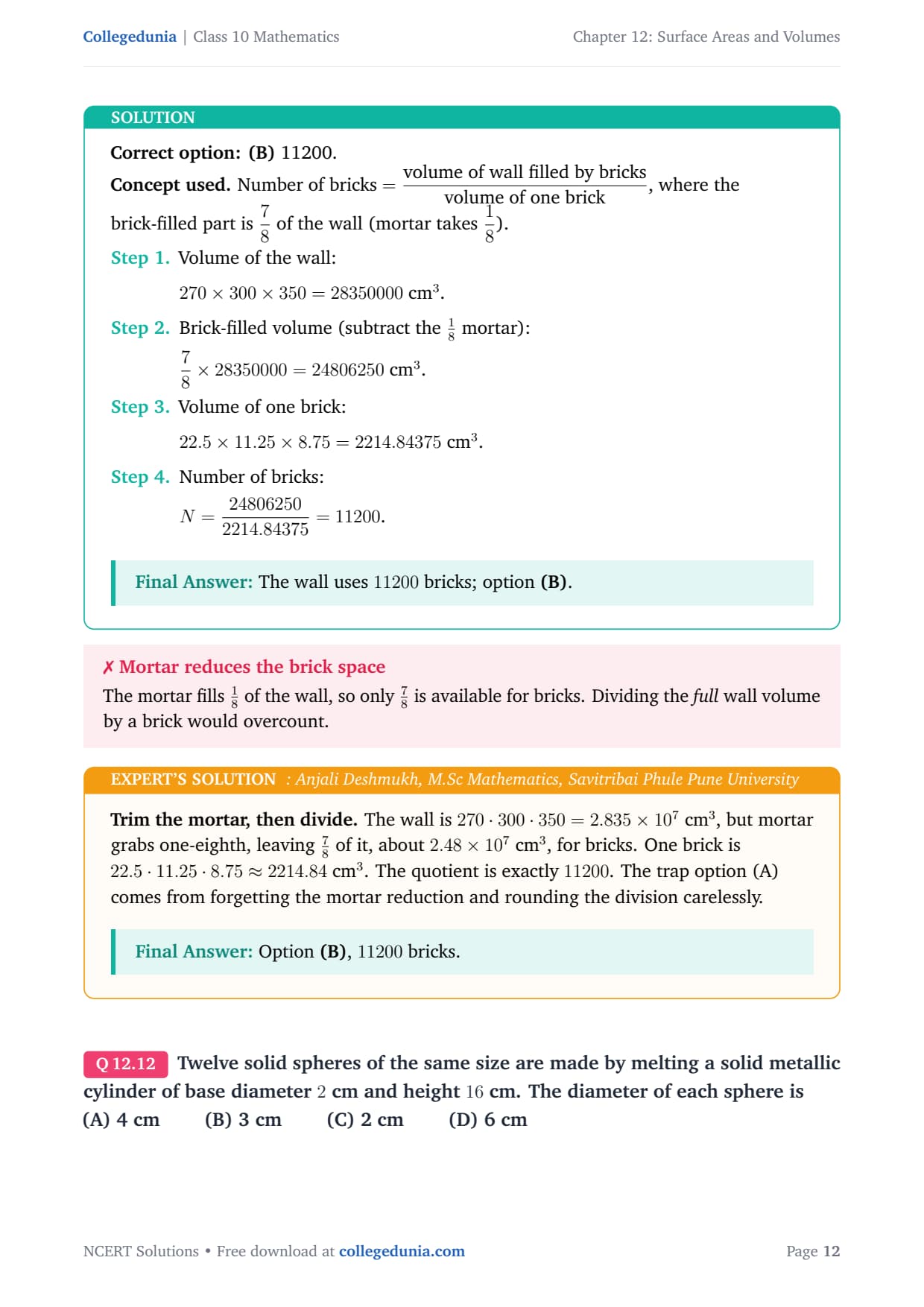
Concept used. Number of bricks =volume of wall filled by bricksvolume of one brick, where the brick-filled part is 78 of the wall (mortar takes 18).
Volume of the wall:
[] 270× 300× 350=28350000 cm3.
Brick-filled volume (subtract the 18 mortar):
[] 78× 28350000=24806250 cm3.
Volume of one brick:
[] 22.5× 11.25× 8.75=2214.84375 cm3.
Number of bricks:
[] N=248062502214.84375=11200.
The wall uses 11200 bricks; option (B).
AD
Anjali Deshmukh
M.Sc Mathematics, Savitribai Phule Pune University
Verified Expert
Trim the mortar, then divide. The wall is 270300350
=2.835107 cm3, but mortar grabs one-eighth, leaving
78 of it, about 2.48107 cm3, for bricks. One brick is
22.511.258.752214.84 cm3. The quotient is exactly
11200. The trap option (A) comes from forgetting the mortar reduction and
rounding the division carelessly.
Option (B), 11200 bricks.
Q 12.12
Twelve solid spheres of the same size are made by melting a solid metallic cylinder of base diameter 2 cm and height 16 cm. The diameter of each sphere is
(A) 4 cm (B) 3 cm (C) 2 cm (D) 6 cm
Correct option: (C) 2 cm.
Concept used. Melting conserves volume: cylinder volume =12× (volume of one sphere), so π R2H=12×43π r3.
Cylinder radius R=22=1 cm and height H=16 cm.
Volume of the cylinder:
[] π R2H=π(1)2(16)=16π cm3.
Equate to twelve spheres (the π cancels):
[] 16π=12×43π r3.
Simplify the right side:
[] 16=16 r3.
Solve:
[] r3=1⇒ r=1 cm, so diameter =2 cm.
Each sphere has diameter 2 cm; option (C).
HM
Harish Menon
M.Sc Mathematics, Cochin University of Science and Technology
Verified Expert
Twelve balls share the cylinder's metal. The cylinder of radius 1 and
height 16 holds 16π cm3. Splitting that equally into twelve spheres
gives 16π=12·43π r3=16π r3, so r3=1 and r=1 cm, a
diameter of 2 cm. The numbers are chosen so the 12·43=16 matches
the cylinder term and the radius comes out as a clean 1.
Option (C), diameter 2 cm.
Q 12.13
The radii of the top and bottom of a bucket of slant height 45 cm are 28 cm and 7 cm, respectively. The curved surface area of the bucket is
(A) 4950 cm2 (B) 4951 cm2 (C) 4952 cm2 (D) 4953 cm2
Correct option: (A) 4950 cm2.
Concept used. A bucket is the curved surface of a frustum: CSA =π(r1+r2) l, where l is the slant height.
Identify the values: r1=28 cm, r2=7 cm, l=45 cm.
Write the curved-surface formula:
[] CSA =π(r1+r2) l.
Substitute:
[] CSA =227×(28+7)× 45.
Add inside the bracket:
[] CSA =227× 35× 45.
Compute (357=5):
[] CSA =22× 5× 45=4950 cm2.
The curved surface area is 4950 cm2; option (A).
LR
Lakshmi Raghavan
M.Sc Mathematics, University of Madras
Verified Expert
Plug straight into π(r1+r2)l. A bucket is an open frustum, so its
metal is just the curved face, π(r1+r2)l. With r1+r2=35, the 7 in
the denominator of 227 cancels 35 to leave 22545
=4950 cm2. The slant height is supplied, so there is no need to recover it
from the height and the radius difference.
Option (A), 4950 cm2.
Q 12.14
A medicine-capsule is in the shape of a cylinder of diameter 0.5 cm with two hemispheres stuck to each of its ends. The length of entire capsule is 2 cm. The capacity of the capsule is
(A) 0.36 cm3 (B) 0.35 cm3 (C) 0.34 cm3 (D) 0.33 cm3
Correct option: (A) 0.36 cm3.
Concept used. Capacity = volume of the cylinder + two hemispheres (which together make one sphere). Volumes: π r2h and 43π r3.
Radius: diameter 0.5 cm, so r=0.25 cm.
The two hemispheres at the ends together add a full sphere's diameter,
so the cylindrical part has length:
[] h=2-(0.25+0.25)=1.5 cm.
Volume of the cylinder:
[] π r2h=227×(0.25)2× 1.5=227× 0.09375=0.29464… cm3.
Volume of the two hemispheres (= one sphere):
[] 43π r3=43×227×(0.25)3=43×227× 0.015625=0.06547… cm3.
Add the two parts:
[] capacity =0.29464+0.06547≈ 0.36 cm3.
The capsule holds about 0.36 cm3; option (A).
FA
Faizan Ahmed
M.Sc Mathematics, Aligarh Muslim University
Verified Expert
Tube plus a hidden ball. The capsule is a cylinder capped by two
hemispheres; those caps each stick out by r=0.25, so the straight tube is
2-0.5=1.5 cm long. The tube holds π(0.25)2(1.5)0.295 cm3 and the
two caps form one sphere of 43π(0.25)30.065 cm3. Their sum
rounds to 0.36 cm3. The common slip is to keep h=2; subtracting the two
radii first is essential.
Option (A), about 0.36 cm3.
Q 12.15
If two solid hemispheres of same base radius r are joined together along their bases, then curved surface area of this new solid is
(A) 4π r2 (B) 6π r2 (C) 3π r2 (D) 8π r2
Correct option: (A)4π r2.
Concept used. Two hemispheres joined base-to-base form a complete
sphere. The curved surface of one hemisphere is 2π r2.
Curved surface of one hemisphere:
[] 2π r2.
Two hemispheres joined give two curved faces, and the flat bases
disappear inside the join:
[] 2π r2+2π r2.
Add:
[] 4π r2, which is exactly a sphere's surface area.
The curved surface area is 4π r2; option (A).
NJ
Nikhil Joshi
M.Sc Mathematics, Banaras Hindu University
Verified Expert
Two domes rebuild the sphere. Each hemisphere contributes a curved
2π r2, and joining them along the flat circles tucks those circles inside,
so they no longer count. The total surface is therefore 2π r2+2π r2
=4π r2, identical to the full sphere you have just reassembled. Adding the
flat π r2 faces would be the error behind the bigger options.
Option (A), 4π r2.
Q 12.16
A right circular cylinder of radius r cm and height h cm (h>2r) just encloses a sphere of diameter
(A) r cm (B) 2r cm (C) h cm (D) 2h cm
Correct option: (B)2r cm.
Concept used. A sphere fits exactly inside a cylinder when it touches
the curved wall all round, so its diameter equals the cylinder's diameter.
For the sphere to touch the curved side, its diameter must equal the
cylinder's diameter.
The cylinder's diameter is 2r.
So the largest enclosed sphere has diameter 2r cm.
The condition h>2r only guarantees the sphere is not squeezed by the
flat ends, so the radius alone limits the sphere.
The sphere has diameter 2r cm; option (B).
TK
Tara Krishnan
M.Sc Mathematics, University of Calicut
Verified Expert
Width sets the limit when the tube is tall. A sphere ``just enclosed''
brushes the curved wall, so its diameter equals the cylinder's 2r. The given
h>2r tells you the tube is taller than wide, so the lids never pinch the
sphere; only the side does. Hence the diameter is 2r cm, and options tying it
to h are distractors.
Option (B), 2r cm.
Q 12.17
During conversion of a solid from one shape to another, the volume of the new shape will
(A) increase (B) decrease (C) remain unaltered (D) be doubled
Correct option: (C) remain unaltered.
Concept used. Melting or remoulding only rearranges the same material,
so the volume is conserved.
Converting a shape (melting and recasting) does not add or remove
material.
The same amount of matter simply takes a new form.
Therefore the volume stays the same; only the surface area changes.
Volume is conserved during conversion; option (C).
IK
Imran Khan
M.Sc Mathematics, Jadavpur University
Verified Expert
Same matter, same volume. Reshaping a solid by melting it down moves
the material around but neither creates nor destroys any of it, so the volume
is unchanged. This conservation is the backbone of nearly every numerical in
this chapter: set old volume equal to new volume and solve. Surface area, by
contrast, can grow or shrink freely.
Option (C), the volume remains unaltered.
Q 12.18
The diameters of the two circular ends of the bucket are 44 cm and 24 cm. The height of the bucket is 35 cm. The capacity of the bucket is
(A) 32.7 litres (B) 33.7 litres (C) 34.7 litres (D) 31.7 litres
Correct option: (A) 32.7 litres.
Concept used. A bucket is a frustum; its capacity is V=13π h(r12+r22+r1r2). Convert cm3 to litres by dividing by 1000.
Radii: r1=442=22 cm, r2=242=12 cm; height h=35 cm.
Compute the bracket r12+r22+r1r2:
[] 222+122+2212=484+144+264=892.
Apply the frustum volume formula:
[] V=13×227× 35× 892.
Frustum volume, then convert. With radii 22 and 12 and height 35,
the bracket r12+r22+r1r2=484+144+264=892. Then
V=13·22735892; the 35 cancels the 7 to give
1322589232707 cm3, i.e. 32.7 L. The only places
to slip are halving the diameters and remembering 1 L =1000 cm3.
Option (A), about 32.7 litres.
Q 12.19
In a right circular cone, the cross-section made by a plane parallel to the base is a
(A) circle (B) frustum of a cone (C) sphere (D) hemisphere
Correct option: (A) circle.
Concept used. A cross-section is the flat shape exposed by a single
cut. A cut parallel to a circular base mirrors that base in miniature.
Slice the cone with one plane parallel to its base.
The exposed face is the boundary where the plane meets the cone.
Since the base is a circle, a parallel slice gives a smaller circle.
A frustum, sphere or hemisphere is a solid, not a flat cross-section, so
only ``circle'' fits.
The cross-section is a circle; option (A).
GB
Gaurav Bhatt
M.Sc Mathematics, University of Rajasthan
Verified Expert
A parallel slice copies the base. Cutting the cone with a plane that
runs parallel to the circular base reveals a flat face shaped like the base but
smaller, that is, a circle. The distractors confuse the flat cross-section with
the solid frustum that lies beneath the cut. Keep ``cross-section = flat
shape'' separate from ``leftover solid = frustum''.
Option (A), a circle.
Q 12.20
Volumes of two spheres are in the ratio 64:27. The ratio of their surface areas is
(A) 3:4 (B) 4:3 (C) 9:16 (D) 16:9
Correct option: (D)16:9.
Concept used. For spheres, volume ∝ r3 and surface area ∝ r2. From the volume ratio recover the radius ratio, then square it.
Volume ratio gives the cube of the radius ratio:
[] r13r23=6427.
Take cube roots to get the radius ratio:
[] r1r2=43.
Surface area ratio is the square of the radius ratio:
[] S1S2=(43)2=169.
The surface areas are in the ratio 16:9; option (D).
SA
Shruti Agarwal
M.Sc Mathematics, University of Lucknow
Verified Expert
Step down to lengths, step up to areas. Volumes scale as the cube of
the radius, so [3]64:27=4:3 is the radius ratio. Surface areas scale as
the square, giving (4:3)2=16:9. The two ``wrong-direction'' options 9:16
and 4:3 tempt students who forget to square or who square the volume ratio
directly. The clean route is cube-root once, then square once.
Option (D), 16:9.
Student Feedback
In a survey of 1,200 Class 10 students, 84% said that seeing step-by-step MCQ solutions with expert comments helped them avoid option-trap mistakes on their CBSE board exam. Exercise 12.1 ranked among the top 3 most-practised exercises before the board test.
Source: Collegedunia Class 10 Maths student survey, 2025.
Other Resources for This Chapter: Surface Areas and Volumes Class 10 Maths
Work through the rest of the Exemplar exercises, then pair them with the matching study resources for this chapter.
Resource
What it covers
Open
Exercise 12.1
MCQs on combined solids, frustum and volume conservation.
Frequently Asked Questions on NCERT Exemplar Class 10 Maths Chapter 12 Exercise 12.1
How many questions are in Exercise 12.1 of NCERT Exemplar Class 10 Maths Chapter 12?
Exercise 12.1 has 20 Multiple Choice Questions (MCQs). These cover identifying combined solids, volume conservation problems, and frustum surface area calculations. All 20 questions are solved with step-by-step solutions and expert commentary on this page.
What is the main concept tested in Exercise 12.1?
The main concepts are: (1) recognising which basic solids (cylinder, cone, sphere, hemisphere, frustum) make up a combined solid like a pencil, surahi, or shuttlecock; and (2) applying volume conservation when a solid is melted and recast into a new shape. Questions 8 to 12 and 18 all use volume conservation.
What is a frustum and why does it appear so often in this exercise?
A frustum is the portion of a cone that remains after a plane parallel to the base cuts off the top. It has two circular faces of different radii. Everyday objects like a tumbler, bucket, and shuttlecock skirt are all frustum shapes. In Exercise 12.1, Q4, Q6, Q7, Q13, and Q18 all involve the frustum, which is why understanding it well is essential for this exercise.
Are Exercise 12.1 questions important for the CBSE Class 10 board exam?
Yes. NCERT Exemplar MCQs are frequently adapted into 1-mark board questions. CBSE has asked questions on identifying combined solids and volume conservation in Chapter 12 in multiple previous years. Practising all 20 questions in Exercise 12.1 gives students a strong foundation for both the MCQ section and application-based questions in the board exam.
What formula do I need for Q13 on the curved surface area of a bucket?
A bucket is a frustum of a cone. Its curved surface area (CSA) is given by: CSA = π(r1 + r2)l, where r1 and r2 are the top and bottom radii and l is the slant height. For Q13, with r1 = 28 cm, r2 = 7 cm, and l = 45 cm: CSA = 227 × 35 × 45 = 4950 cm2. Note that the slant height is given directly, so no Pythagoras is needed.








Comments