These NCERT Exemplar Class 10 Maths Chapter 12 Solutions work out every Surface Areas and Volumes problem step by step. Each answer shows how to use the surface area and volume formulas for solids, combinations, and conversions. The full set follows the 2026-27 CBSE syllabus.
36 Exemplar problems across four exercises: MCQs, true-or-false, short-answer, and long-answer questions on surface areas and volumes of cones, cylinders, spheres, frustums, and combined solids.
Every solution starts with the key formula, works step by step, and checks units so no mark slips away.
Free PDF download, plus a solved question bank you can open right on this page.
Solved by Collegedunia: Every question here is worked out by our Maths faculty, checked against the official NCERT Exemplar, and set to the 2026-27 CBSE syllabus.
The Exemplar set spans four exercises. Each one tests a different skill level. The MCQs check fast formula recall. The long-answer set asks for multi-step problems on combined solids and conversions.
Exercise
Question Type
Count
What It Tests
Exercise 12.1
MCQ (objective)
12
Choose the correct surface area or volume of a solid given its dimensions; all options look plausible if the wrong formula is applied or dimensions are mixed up
Exercise 12.2
True or False (justify)
4
Evaluate statements about volumes and surface areas of solids; write a full justification or provide a counterexample
Exercise 12.3
Short answer (compute)
8
Find surface areas or volumes using given dimensions; some require two-step substitutions involving a frustum or sphere melted into a cylinder
Exercise 12.4
Long answer (application)
12
Solve multi-step real-world problems on combined solids, conversions, and shaded-region volumes
The full set has 36 problems. Start with the MCQs to fix which formula fits each solid, justify the true-or-false statements, build speed on the short-answer set, then finish with the board-style long-answer problems.
Key Formulas & Concepts
Every Exemplar problem rests on the core surface area and volume formulas. Get these right and no problem will block you. The three most tested solids in board exams are the cylinder, cone, and sphere.
Surface Area Formulas
Curved Surface Area of a cylinder = 2πrh. The total surface area adds both circular bases: 2πr(r + h). The most common slip is forgetting the two ends when the question asks for "total surface area".
Curved Surface Area of a cone = πrl, where l is the slant height, l = r2 + h2. Total surface area = πr(r + l). Always compute l first from r and h before substituting into the CSA formula.
Surface area of a sphere = 4πr2. Curved surface area of a hemisphere = 2πr2; total surface area of a hemisphere = 3πr2 (CSA + base circle).
Curved Surface Area of a frustum = π(r1 + r2)l, where l = h2 + (r1 - r2)2. Total surface area of frustum = π(r1 + r2)l + πr12 + πr22.
Volume Formulas
Solid
Volume Formula
Key Note
Cylinder
πr2h
The most frequently used in conversion problems; keep r and h in the same unit
Cone
13πr2h
One-third of the cylinder with the same base; melting a solid often converts cone to sphere or cylinder
Sphere
43πr3
Volume of hemisphere = 23πr3
Frustum of cone
πh3(r12 + r22 + r1r2)
Used when a cone is cut parallel to its base; r1 and r2 are the two circular face radii
Cuboid
l × b × h
Appears in combination problems where a cuboid block has holes drilled through it
Combination Solid Strategy
Decompose the figure into standard solids first. Exercise 12.4 gives rockets (cone on cylinder), toys (hemisphere on cone), and barns (cylinder with conical roof).
For conversion problems, set volumes equal: Volumeoriginal = n × Volumenew, then solve for n or the dimension asked.
A sphere just fitting a cylinder has radius = height / 2.
Before each problem, write the formula, label every sub-solid, and keep π exact unless the question gives a value. Then check that the unit matches.
How These Solutions Help
These solutions are built for self-study before the board exam. Each one does three things:
Decompose the solid first: every solution lists the sub-solids before any calculation.
Show the formula before substitution: CBSE gives a method mark for the formula, even if the arithmetic slips.
Add an Expert view: a faster route, like spotting two solids that share a radius.
Try each question yourself first. Draw the figure, label the sub-solids, then open Check Solution to compare. Read Expert Solution last.
Exemplar vs Textbook: Where Difficulty Jumps
The textbook uses direct formulas on standard solids. The Exemplar raises the bar: judge geometric statements, handle real-world scenarios, and solve word problems without a diagram. The table shows where difficulty climbs.
Skill
NCERT Textbook
NCERT Exemplar
Surface area of a solid
Apply one formula with the given dimensions
MCQs give plausible wrong options that result from using CSA instead of TSA or mixing r and h
Combination solids
Standard two-solid combinations with figures pre-labelled
Exercise 12.4 introduces three-solid combinations and asks for the surface area of the exposed faces only
Conversion of solids
One solid melted into another; dimensions directly given
Exercises 12.3 and 12.4 require finding a missing dimension (radius or height) after melting, not just the number of new solids
True or false
No such exercise type in Chapter 12
Exercise 12.2 asks students to evaluate statements like "if a solid sphere is melted and recast into solid hemispheres, the number is 2" and write a full justification
Real-world context
Straightforward uniform solids
Bucket-as-frustum, toy-on-a-stick, and water-tank-with-hemispherical-dome problems all appear in Exercise 12.4
This is why solving the Exemplar after the textbook is the standard board-prep order. It pushes you to break down unfamiliar figures, judge claims, and find missing dimensions after melting.
Common Mistakes to Avoid
Across all four exercises, these four slips cost the most marks:
CSA instead of TSA: for a closed solid, add the base area(s). A cylinder's TSA = 2πr(r + h), not just 2πrh.
Skipping the slant height: compute l = r2 + h2 first, then use πrl. It is rarely given.
Not subtracting the shared face: a joined face is internal. For a hemisphere on a cylinder, the cylinder top and hemisphere base cancel.
Wrong conversion equation: for melting one solid into n smaller ones, write V1 = n × V2 before solving.
The first two slips cause most errors here. List every face of the solid, and write the slant-height formula before you substitute.
Other Resources for This Chapter
Pair this Exemplar set with the other Chapter 12 resources on Collegedunia. Together they cover the chapter fully before your board exam.
All Exemplar Questions with Step-by-Step Solutions
I. Multiple Choice Questions (Exercise 12.1)
Q 12.1
A cylindrical pencil sharpened at one edge is the combination of
(A) a cone and a cylinder (B) frustum of a cone and a cylinder
(C) a hemisphere and a cylinder (D) two cylinders.
Correct option: (A) a cone and a cylinder.
Concept used. A combined solid is named by the basic shapes you can
see in it. Pick out each part of the pencil and match it to a standard solid.
The long body of the pencil is a uniform circular rod, which is a
cylinder.
The sharpened tip tapers to a point on a circular base, which is a
cone.
So the pencil is a cylinder with a cone stuck on one end.
A sharpened pencil is a cone + cylinder; option (A).
AM
Aarav Mehta
M.Sc Mathematics, IIT Kanpur
Verified Expert
Name the parts you can touch. The shaft of the pencil keeps the same
circular cross-section all the way along, so it is a cylinder; the sharpened
nose narrows smoothly to a single point, which is the defining feature of a
cone. A frustum (option B) would need a flat smaller circle at the tip,
not a point, so it is wrong here. There is no curved dome, so a hemisphere is
ruled out too.
Option (A), a cone and a cylinder.
Q 12.2
A surahi is the combination of
(A) a sphere and a cylinder (B) a hemisphere and a cylinder
(C) two hemispheres (D) a cylinder and a cone.
Correct option: (A) a sphere and a cylinder.
Concept used. A surahi (a long-necked water pot) has a rounded belly
and a tall narrow neck. Match each visible part to a basic solid.
The bulging round body of the pot is a sphere.
The long thin neck above it is a cylinder.
So the surahi is a sphere with a cylinder rising out of the top.
A surahi is a sphere + cylinder; option (A).
PN
Priya Nair
M.Sc Mathematics, University of Delhi
Verified Expert
Belly is a sphere, neck is a cylinder. The wide pot of a surahi is
rounded all over, so it is a full sphere rather than a hemisphere; the slender
spout is a uniform tube, which is a cylinder. Option (B) fails because the
belly is not flat on top, and (C) and (D) miss the cylindrical neck entirely.
The pairing of a sphere with a cylindrical neck is the classic surahi shape.
Option (A), a sphere and a cylinder.
Q 12.3
A plumbline (sahul) is the combination of (see Fig. 12.2)
(A) a cone and a cylinder (B) a hemisphere and a cone
(C) frustum of a cone and a cylinder (D) sphere and cylinder
Fig. 12.2
Correct option: (B) a hemisphere and a cone.
Concept used. A plumbline weight has a rounded top and a pointed
bottom. Match the two visible parts to basic solids.
The dotted line in Fig. 12.2 marks the join. Above it the surface is a
smooth dome, which is a hemisphere.
Below the join the shape tapers to a sharp point on the same circular
rim, which is a cone.
So the sahul is a hemisphere on top of a cone, joined at their common
circular face.
A plumbline is a hemisphere + cone; option (B).
RV
Rohan Verma
M.Sc Mathematics, IIT Bombay
Verified Expert
Dome above, point below. In Fig. 12.2 the rounded cap is exactly half
a ball, so it is a hemisphere, and the tapering lower part ending in a point is
a cone. They meet along the dashed circle, which is their common base. Option
(A) needs a flat-ended cylinder and (C) needs a frustum, neither of which has a
sharp point, so both are out; (D) wrongly uses a full sphere on top.
Option (B), a hemisphere and a cone.
Q 12.4
The shape of a glass (tumbler) (see Fig. 12.3) is usually in the form of
(A) a cone (B) frustum of a cone
(C) a cylinder (D) a sphere
Fig. 12.3
Correct option: (B) frustum of a cone.
Concept used. A frustum is what remains of a cone after the top is
sliced off by a plane parallel to the base. It has two circular ends of
different sizes.
Look at the two circular ends in Fig. 12.3: the open top is wider and
the base is narrower.
Two parallel circles of different radii joined by a slanting side is the
exact description of a frustum.
A cone would close to a point and a cylinder would have equal ends, so
neither fits.
A tumbler is a frustum of a cone; option (B).
SK
Sneha Kulkarni
M.Sc Mathematics, IISc Bangalore
Verified Expert
A cone with its tip cut off. The tumbler in Fig. 12.3 is wide at the
mouth and narrow at the base, with both ends flat and circular. That is a
frustum: imagine a full cone and slice the pointed top away with a cut parallel
to the base. A plain cone (A) would taper to a point, and a cylinder (C) would
keep the same width top to bottom, so only the frustum matches a real glass.
Option (B), frustum of a cone.
Q 12.5
The shape of a gilli, in the gilli-danda game (see Fig. 12.4), is a combination of
(A) two cylinders (B) a cone and a cylinder
(C) two cones and a cylinder (D) two cylinders and a cone
Fig. 12.4
Correct option: (C) two cones and a cylinder.
Concept used. Break the gilli into its visible parts and name each as
a basic solid.
The middle of the gilli is a straight circular rod, which is a
cylinder.
Each end tapers to a point, and there are two such ends, so they are
two cones.
Putting the parts together: a cylinder in the centre with a cone on each
end gives two cones and a cylinder.
A gilli is two cones + a cylinder; option (C).
SK
Sanjana Kapoor
M.Sc Mathematics, Jamia Millia Islamia
Verified Expert
One tube, two points. Figure 12.4 shows a short straight middle, a
cylinder, with a tapering point at each end. Since both ends come to a point,
each is a cone, giving two cones in all. So the gilli is two cones plus one
cylinder. Option (B) counts only one cone, and (D) wrongly replaces a cone with
a second cylinder, so both miss the symmetric double-pointed shape.
Option (C), two cones and a cylinder.
Q 12.6
A shuttle cock used for playing badminton has the shape of the combination of
(A) a cylinder and a sphere (B) a cylinder and a hemisphere
(C) a sphere and a cone (D) frustum of a cone and a hemisphere
Correct option: (D) frustum of a cone and a hemisphere.
Concept used. Name each part of the shuttlecock: the cork base and the
flared feather skirt.
The rounded cork at the bottom is a smooth half-ball, which is a
hemisphere.
The feather skirt widens from a small circle at the cork to a larger
open circle at the top, two unequal circular ends, which is a
frustum of a cone.
So the shuttlecock is a frustum mounted on a hemisphere.
A shuttlecock is a frustum + hemisphere; option (D).
DN
Devendra Naik
M.Sc Mathematics, NIT Surathkal
Verified Expert
Cork is a dome, feathers form a frustum. The cork base curves like
half a ball, so it is a hemisphere; the feathers fan out from the narrow cork
to a wide open mouth, giving two circles of different sizes joined by a slant,
which is a frustum. Options (A) and (B) ignore the flared, tapering skirt, and
(C) wrongly makes the base a full sphere, so (D) is the only fit.
Option (D), frustum of a cone and a hemisphere.
Q 12.7
A cone is cut through a plane parallel to its base and then the cone that is formed on one side of that plane is removed. The new part that is left over on the other side of the plane is called
(A) a frustum of a cone (B) cone
(C) cylinder (D) sphere
Correct option: (A) a frustum of a cone.
Concept used. Cutting a cone with a plane parallel to the base splits
it into a small cone (top) and a frustum (bottom).
The cut is parallel to the base, so it makes a small circle inside the
cone.
Removing the small cone above the cut leaves the lower piece.
That lower piece has two parallel circular ends of different sizes,
which is by definition a frustum.
The leftover lower piece is a frustum; option (A).
RM
Ritika Malhotra
M.Sc Mathematics, Panjab University
Verified Expert
Keep the base, lose the tip. A plane parallel to the base divides the
cone into a tiny cone near the apex and a wider band near the base. Taking away
the tiny cone leaves a solid with two flat circular ends of unequal radius,
which is exactly what ``frustum'' means. It is not a cone (no apex), not a
cylinder (ends differ), so option (A) is correct.
Option (A), a frustum of a cone.
Q 12.8
A hollow cube of internal edge 22 cm is filled with spherical marbles of diameter 0.5 cm and it is assumed that 18 space of the cube remains unfilled. Then the number of marbles that the cube can accommodate is
(A) 142296 (B) 142396 (C) 142496 (D) 142596
Correct option: (A) 142296.
Concept used. Number of marbles =filled volume of cubevolume of one marble, where filled volume =78 of the cube and one marble is a sphere of volume 43π r3.
Volume of the cube:
[] Vcube=223=10648 cm3.
Filled volume (only 78 is used):
[] Vfilled=78× 10648=9317 cm3.
Radius of one marble: diameter 0.5, so r=0.25=14 cm.
Volume of one marble:
[] 43π r3=43×227×(14)3
=43×227×164=11168 cm3.
Number of marbles:
[] N=9317 11/168 =9317×16811=847× 168=142296.
The cube holds 142296 marbles; option (A).
KI
Karthik Iyer
M.Sc Mathematics, Anna University
Verified Expert
Divide usable space by one marble. Only seven-eighths of the cube gets
filled, so the usable space is 78(223)=9317 cm3. Each marble has
radius 14 cm, giving a volume 43·227·164
=11168 cm3. Dividing, 9317÷11168=9317·16811;
since 9317=11× 847, this is 847× 168=142296. The clean cancellation
of 11 confirms the arithmetic.
Option (A), 142296 marbles.
Q 12.9
A metallic spherical shell of internal and external diameters 4 cm and 8 cm, respectively is melted and recast into the form of a cone of base diameter 8 cm. The height of the cone is
(A) 12cm (B) 14cm (C) 15cm (D) 18cm
Correct option: (B) 14 cm.
Concept used. Melting conserves volume: volume of the spherical shell
= volume of the cone. Shell volume =43π(R3-r3); cone volume
=13π Rc2h.
Shell radii: internal r=42=2 cm, external R=82=4 cm.
Cone base radius: Rc=82=4 cm.
Equate the volumes (the π cancels):
[] 43(R3-r3)=13 Rc2h.
Substitute the numbers:
[] 43(43-23)=13(42) h.
Compute each side:
[] 43(64-8)=43(56)=2243; right side =16h3.
Solve for h:
[] 2243=16h3⇒ 16h=224⇒ h=14.
The cone is 14 cm tall; option (B).
MP
Meera Pillai
M.Sc Mathematics, University of Hyderabad
Verified Expert
Conserve volume, cancel the constants. Melting keeps the metal's
volume fixed, so shell = cone. With radii R=4, r=2 and cone radius 4,
the common π3 drops out and we get 4(64-8)=16h. That is
4× 56=224=16h, so h=14 cm. The hollow inside (r=2) must be
subtracted first; forgetting it would overstate the metal and inflate the
height.
Option (B), 14 cm.
Q 12.10
A solid piece of iron in the form of a cuboid of dimensions 49cm× 33cm× 24cm, is moulded to form a solid sphere. The radius of the sphere is
(A) 21cm (B) 23cm (C) 25cm (D) 19cm
Correct option: (A) 21 cm.
Concept used. Moulding conserves volume: volume of the cuboid =
volume of the sphere, so lbh=43π r3.
Volume of the cuboid:
[] 49× 33× 24=38808 cm3.
Set it equal to the sphere's volume:
[] 43π r3=38808.
Put π=227 and solve for r3:
[] r3=38808×34×722=38808× 2188.
Simplify:
[] r3=81496888=9261.
Take the cube root (213=9261):
[] r=21 cm.
The sphere has radius 21 cm; option (A).
VS
Vikram Sethi
M.Sc Mathematics, IIT Madras
Verified Expert
Same metal, same volume. The cuboid's volume 49· 33· 24=38808 cm3
becomes the sphere's volume. From 43π r3=38808 with π=227,
r3=38808·34·722=9261. Since 213=9261, the radius
is 21 cm. The factor 49=72 pairing with the 7 in 227 is what
makes the arithmetic land on a whole number.
Option (A), 21 cm.
Q 12.11
A mason constructs a wall of dimensions 270cm× 300cm× 350cm with the bricks each of size 22.5cm× 11.25cm× 8.75cm and it is assumed that 18 space is covered by the mortar. Then the number of bricks used to construct the wall is
(A) 11100 (B) 11200 (C) 11000 (D) 11300
Correct option: (B) 11200.
Concept used. Number of bricks =volume of wall filled by bricksvolume of one brick, where the brick-filled part is 78 of the wall (mortar takes 18).
Volume of the wall:
[] 270× 300× 350=28350000 cm3.
Brick-filled volume (subtract the 18 mortar):
[] 78× 28350000=24806250 cm3.
Volume of one brick:
[] 22.5× 11.25× 8.75=2214.84375 cm3.
Number of bricks:
[] N=248062502214.84375=11200.
The wall uses 11200 bricks; option (B).
AD
Anjali Deshmukh
M.Sc Mathematics, Savitribai Phule Pune University
Verified Expert
Trim the mortar, then divide. The wall is 270300350
=2.835107 cm3, but mortar grabs one-eighth, leaving
78 of it, about 2.48107 cm3, for bricks. One brick is
22.511.258.752214.84 cm3. The quotient is exactly
11200. The trap option (A) comes from forgetting the mortar reduction and
rounding the division carelessly.
Option (B), 11200 bricks.
Q 12.12
Twelve solid spheres of the same size are made by melting a solid metallic cylinder of base diameter 2 cm and height 16 cm. The diameter of each sphere is
(A) 4 cm (B) 3 cm (C) 2 cm (D) 6 cm
Correct option: (C) 2 cm.
Concept used. Melting conserves volume: cylinder volume =12× (volume of one sphere), so π R2H=12×43π r3.
Cylinder radius R=22=1 cm and height H=16 cm.
Volume of the cylinder:
[] π R2H=π(1)2(16)=16π cm3.
Equate to twelve spheres (the π cancels):
[] 16π=12×43π r3.
Simplify the right side:
[] 16=16 r3.
Solve:
[] r3=1⇒ r=1 cm, so diameter =2 cm.
Each sphere has diameter 2 cm; option (C).
HM
Harish Menon
M.Sc Mathematics, Cochin University of Science and Technology
Verified Expert
Twelve balls share the cylinder's metal. The cylinder of radius 1 and
height 16 holds 16π cm3. Splitting that equally into twelve spheres
gives 16π=12·43π r3=16π r3, so r3=1 and r=1 cm, a
diameter of 2 cm. The numbers are chosen so the 12·43=16 matches
the cylinder term and the radius comes out as a clean 1.
Option (C), diameter 2 cm.
Q 12.13
The radii of the top and bottom of a bucket of slant height 45 cm are 28 cm and 7 cm, respectively. The curved surface area of the bucket is
(A) 4950 cm2 (B) 4951 cm2 (C) 4952 cm2 (D) 4953 cm2
Correct option: (A) 4950 cm2.
Concept used. A bucket is the curved surface of a frustum: CSA =π(r1+r2) l, where l is the slant height.
Identify the values: r1=28 cm, r2=7 cm, l=45 cm.
Write the curved-surface formula:
[] CSA =π(r1+r2) l.
Substitute:
[] CSA =227×(28+7)× 45.
Add inside the bracket:
[] CSA =227× 35× 45.
Compute (357=5):
[] CSA =22× 5× 45=4950 cm2.
The curved surface area is 4950 cm2; option (A).
LR
Lakshmi Raghavan
M.Sc Mathematics, University of Madras
Verified Expert
Plug straight into π(r1+r2)l. A bucket is an open frustum, so its
metal is just the curved face, π(r1+r2)l. With r1+r2=35, the 7 in
the denominator of 227 cancels 35 to leave 22545
=4950 cm2. The slant height is supplied, so there is no need to recover it
from the height and the radius difference.
Option (A), 4950 cm2.
Q 12.14
A medicine-capsule is in the shape of a cylinder of diameter 0.5 cm with two hemispheres stuck to each of its ends. The length of entire capsule is 2 cm. The capacity of the capsule is
(A) 0.36 cm3 (B) 0.35 cm3 (C) 0.34 cm3 (D) 0.33 cm3
Correct option: (A) 0.36 cm3.
Concept used. Capacity = volume of the cylinder + two hemispheres (which together make one sphere). Volumes: π r2h and 43π r3.
Radius: diameter 0.5 cm, so r=0.25 cm.
The two hemispheres at the ends together add a full sphere's diameter,
so the cylindrical part has length:
[] h=2-(0.25+0.25)=1.5 cm.
Volume of the cylinder:
[] π r2h=227×(0.25)2× 1.5=227× 0.09375=0.29464… cm3.
Volume of the two hemispheres (= one sphere):
[] 43π r3=43×227×(0.25)3=43×227× 0.015625=0.06547… cm3.
Add the two parts:
[] capacity =0.29464+0.06547≈ 0.36 cm3.
The capsule holds about 0.36 cm3; option (A).
FA
Faizan Ahmed
M.Sc Mathematics, Aligarh Muslim University
Verified Expert
Tube plus a hidden ball. The capsule is a cylinder capped by two
hemispheres; those caps each stick out by r=0.25, so the straight tube is
2-0.5=1.5 cm long. The tube holds π(0.25)2(1.5)0.295 cm3 and the
two caps form one sphere of 43π(0.25)30.065 cm3. Their sum
rounds to 0.36 cm3. The common slip is to keep h=2; subtracting the two
radii first is essential.
Option (A), about 0.36 cm3.
Q 12.15
If two solid hemispheres of same base radius r are joined together along their bases, then curved surface area of this new solid is
(A) 4π r2 (B) 6π r2 (C) 3π r2 (D) 8π r2
Correct option: (A)4π r2.
Concept used. Two hemispheres joined base-to-base form a complete
sphere. The curved surface of one hemisphere is 2π r2.
Curved surface of one hemisphere:
[] 2π r2.
Two hemispheres joined give two curved faces, and the flat bases
disappear inside the join:
[] 2π r2+2π r2.
Add:
[] 4π r2, which is exactly a sphere's surface area.
The curved surface area is 4π r2; option (A).
NJ
Nikhil Joshi
M.Sc Mathematics, Banaras Hindu University
Verified Expert
Two domes rebuild the sphere. Each hemisphere contributes a curved
2π r2, and joining them along the flat circles tucks those circles inside,
so they no longer count. The total surface is therefore 2π r2+2π r2
=4π r2, identical to the full sphere you have just reassembled. Adding the
flat π r2 faces would be the error behind the bigger options.
Option (A), 4π r2.
Q 12.16
A right circular cylinder of radius r cm and height h cm (h>2r) just encloses a sphere of diameter
(A) r cm (B) 2r cm (C) h cm (D) 2h cm
Correct option: (B)2r cm.
Concept used. A sphere fits exactly inside a cylinder when it touches
the curved wall all round, so its diameter equals the cylinder's diameter.
For the sphere to touch the curved side, its diameter must equal the
cylinder's diameter.
The cylinder's diameter is 2r.
So the largest enclosed sphere has diameter 2r cm.
The condition h>2r only guarantees the sphere is not squeezed by the
flat ends, so the radius alone limits the sphere.
The sphere has diameter 2r cm; option (B).
TK
Tara Krishnan
M.Sc Mathematics, University of Calicut
Verified Expert
Width sets the limit when the tube is tall. A sphere ``just enclosed''
brushes the curved wall, so its diameter equals the cylinder's 2r. The given
h>2r tells you the tube is taller than wide, so the lids never pinch the
sphere; only the side does. Hence the diameter is 2r cm, and options tying it
to h are distractors.
Option (B), 2r cm.
Q 12.17
During conversion of a solid from one shape to another, the volume of the new shape will
(A) increase (B) decrease (C) remain unaltered (D) be doubled
Correct option: (C) remain unaltered.
Concept used. Melting or remoulding only rearranges the same material,
so the volume is conserved.
Converting a shape (melting and recasting) does not add or remove
material.
The same amount of matter simply takes a new form.
Therefore the volume stays the same; only the surface area changes.
Volume is conserved during conversion; option (C).
IK
Imran Khan
M.Sc Mathematics, Jadavpur University
Verified Expert
Same matter, same volume. Reshaping a solid by melting it down moves
the material around but neither creates nor destroys any of it, so the volume
is unchanged. This conservation is the backbone of nearly every numerical in
this chapter: set old volume equal to new volume and solve. Surface area, by
contrast, can grow or shrink freely.
Option (C), the volume remains unaltered.
Q 12.18
The diameters of the two circular ends of the bucket are 44 cm and 24 cm. The height of the bucket is 35 cm. The capacity of the bucket is
(A) 32.7 litres (B) 33.7 litres (C) 34.7 litres (D) 31.7 litres
Correct option: (A) 32.7 litres.
Concept used. A bucket is a frustum; its capacity is V=13π h(r12+r22+r1r2). Convert cm3 to litres by dividing by 1000.
Radii: r1=442=22 cm, r2=242=12 cm; height h=35 cm.
Compute the bracket r12+r22+r1r2:
[] 222+122+2212=484+144+264=892.
Apply the frustum volume formula:
[] V=13×227× 35× 892.
Frustum volume, then convert. With radii 22 and 12 and height 35,
the bracket r12+r22+r1r2=484+144+264=892. Then
V=13·22735892; the 35 cancels the 7 to give
1322589232707 cm3, i.e. 32.7 L. The only places
to slip are halving the diameters and remembering 1 L =1000 cm3.
Option (A), about 32.7 litres.
Q 12.19
In a right circular cone, the cross-section made by a plane parallel to the base is a
(A) circle (B) frustum of a cone (C) sphere (D) hemisphere
Correct option: (A) circle.
Concept used. A cross-section is the flat shape exposed by a single
cut. A cut parallel to a circular base mirrors that base in miniature.
Slice the cone with one plane parallel to its base.
The exposed face is the boundary where the plane meets the cone.
Since the base is a circle, a parallel slice gives a smaller circle.
A frustum, sphere or hemisphere is a solid, not a flat cross-section, so
only ``circle'' fits.
The cross-section is a circle; option (A).
GB
Gaurav Bhatt
M.Sc Mathematics, University of Rajasthan
Verified Expert
A parallel slice copies the base. Cutting the cone with a plane that
runs parallel to the circular base reveals a flat face shaped like the base but
smaller, that is, a circle. The distractors confuse the flat cross-section with
the solid frustum that lies beneath the cut. Keep ``cross-section = flat
shape'' separate from ``leftover solid = frustum''.
Option (A), a circle.
Q 12.20
Volumes of two spheres are in the ratio 64:27. The ratio of their surface areas is
(A) 3:4 (B) 4:3 (C) 9:16 (D) 16:9
Correct option: (D)16:9.
Concept used. For spheres, volume ∝ r3 and surface area ∝ r2. From the volume ratio recover the radius ratio, then square it.
Volume ratio gives the cube of the radius ratio:
[] r13r23=6427.
Take cube roots to get the radius ratio:
[] r1r2=43.
Surface area ratio is the square of the radius ratio:
[] S1S2=(43)2=169.
The surface areas are in the ratio 16:9; option (D).
SA
Shruti Agarwal
M.Sc Mathematics, University of Lucknow
Verified Expert
Step down to lengths, step up to areas. Volumes scale as the cube of
the radius, so [3]64:27=4:3 is the radius ratio. Surface areas scale as
the square, giving (4:3)2=16:9. The two ``wrong-direction'' options 9:16
and 4:3 tempt students who forget to square or who square the volume ratio
directly. The clean route is cube-root once, then square once.
Option (D), 16:9.
NCERT Exemplar Class 10 Mathematics Chapter 12 Surface Areas and Volumes
Class 10 Mathematics Chapter 12: Surface Areas and Volumes NCERT Exemplar
All 8 questions with collapsible Solution and Expert Solution. Tap a button to reveal the working.
II. Short Answer Questions with Reasoning (Exercise 12.2)
Q 12.1
Two identical solid hemispheres of equal base radius r cm are stuck together along their bases. The total surface area of the combination is 6π r2. Write `True' or `False' and justify your answer.
Verdict: False. The total surface area is 4π r2, not 6π r2.
Concept used. Two hemispheres joined base-to-base make a sphere. The
curved surface of one hemisphere is 2π r2, and the joined flat bases vanish.
Curved surface of each hemisphere:
[] 2π r2 each.
The two flat circular bases are stuck together, so they are no longer
on the outside.
Add the two curved surfaces only:
[] 2π r2+2π r2=4π r2.
False: the combination is a sphere of surface area 4π r2, so the
claimed 6π r2 is wrong.
AR
Aditya Rao
M.Sc Mathematics, IIT Roorkee
Verified Expert
You have rebuilt a sphere. Joining two equal hemispheres along their
flat faces gives a complete ball, whose surface is 4π r2. The two circular
bases are now interior and contribute nothing. The statement's 6π r2 would
require the bases to stay exposed, which contradicts the gluing, so the claim
is false.
False; the true surface area is 4π r2.
Q 12.2
A solid cylinder of radius r and height h is placed over another cylinder of same height and radius. The total surface area of the shape so formed is 4π rh+4π r2. Write `True' or `False' and justify your answer.
Verdict: False. The correct total surface area is 4π rh+2π r2.
Concept used. Stacking two identical cylinders makes one tall cylinder
of height 2h. Its surface is 2π RH+2π R2 with R=r and H=2h.
The combined solid is a single cylinder of radius r and height 2h.
Curved surface:
[] 2π r(2h)=4π rh.
Two circular ends (top and bottom):
[] 2×π r2=2π r2.
Add the parts:
[] total =4π rh+2π r2.
False: the surface area is 4π rh+2π r2, not 4π rh+4π r2.
KM
Kavya Menon
M.Sc Mathematics, University of Kerala
Verified Expert
Two short tubes make one tall tube. Identical cylinders stacked simply
double the height to 2h, so the curved area is 2π r(2h)=4π rh and only
the genuine top and bottom circles survive, adding 2π r2. The interface
circles are buried. The stated 4π r2 double-counts those buried faces, so
the answer is false.
False; correct area is 4π rh+2π r2.
Q 12.3
A solid cone of radius r and height h is placed over a solid cylinder having same base radius and height as that of a cone. The total surface area of the combined solid is π r[√r2+h2+3r+2h]. Write `True' or `False' and justify your answer.
Verdict: False. The correct total surface area is
π r[√r2+h2+2h+r].
Concept used. Total surface = CSA of cone + CSA of cylinder +
base of cylinder. The cone's slant is l=√r2+h2; the join between cone
base and cylinder top is hidden.
Curved surface of the cone:
[] π rl=π r√r2+h2.
Curved surface of the cylinder:
[] 2π rh.
Only the bottom circle of the cylinder is exposed (its top is covered by
the cone):
[] π r2.
Add the exposed parts:
[] π r√r2+h2+2π rh+π r2=π r[√r2+h2+2h+r].
False: the correct area is
π r[√r2+h2+2h+r], with a single r inside, not 3r.
SP
Suresh Pillai
M.Sc Mathematics, IIT Hyderabad
Verified Expert
Count only the faces you can see. The outside of this ``ice-cream''
shape is the cone's slant π rl, the cylinder's side 2π rh, and the
single open bottom π r2. The cone-base and cylinder-top circles are pressed
together and hidden. Factoring π r gives
π r[√r2+h2+2h+r]. The printed 3r wrongly tacks on the two hidden
circles, so the statement is false.
False; correct surface area is π r[√r2+h2+2h+r].
Q 12.4
A solid ball is exactly fitted inside the cubical box of side a. The volume of the ball is 43π a3. Write `True' or `False' and justify your answer.
Verdict: False. The volume of the ball is 16π a3.
Concept used. A ball that exactly fits a cube touches all six faces,
so its diameter equals the side a, giving radius a2. Volume
=43π r3.
The ball touches opposite faces, so its diameter is the side:
[] diameter =a, hence r=a2.
Apply the sphere volume:
[] 43π r3=43π(a2)3.
Cube the radius:
[] 43π·a38=4π a324=π a36.
False: the true volume is π a36, eight times smaller
than the claimed 43π a3.
DN
Divya Nambiar
M.Sc Mathematics, NIT Trichy
Verified Expert
Halve the side before cubing. An exactly-fitting ball spans the cube
from face to face, so its diameter is a and its radius is a2. Cubing
the half brings in a factor 18, turning 43π r3 into
π a36. The statement forgot to halve, inflating the answer by a
factor of eight, so it is false.
False; the ball's volume is π a36.
Q 12.5
The volume of the frustum of a cone is 13π h[r12+r22-r1r2], where h is vertical height of the frustum and r1,r2 are the radii of the ends. Write `True' or `False' and justify your answer.
Verdict: False. The correct formula has a +r1r2 term:
V=13π h[r12+r22+r1r2].
Concept used. The standard frustum-volume formula carries a plus sign
before the product r1r2, not a minus.
Recall the correct frustum volume:
[] V=13π h(r12+r22+r1r2).
The given statement uses -r1r2, which changes the value.
Check with equal radii r1=r2=r (frustum becomes a cylinder):
[] correct: 13π h(3r2)=π r2h (a cylinder, right);
[] given: 13π h(r2) (one-third of a cylinder, wrong).
False: the sign before r1r2 must be +, giving
V=13π h(r12+r22+r1r2).
MT
Manoj Tiwari
M.Sc Mathematics, University of Allahabad
Verified Expert
The product term is added. The frustum volume is built so that it
reduces to a cone when one radius is 0 and to a cylinder when the radii match;
both checks need the +r1r2 term. With r1=r2=r the correct formula gives
π r2h, while the minus-sign version gives only 13π r2h, which is
absurd for a cylinder. So the printed formula is false.
False; the correct term is +r1r2.
Q 12.6
The capacity of a cylindrical vessel with a hemispherical portion raised upward at the bottom as shown in the Fig. 12.7 is π r23[3h-2r]. Write `True' or `False' and justify your answer.
Fig. 12.7
Verdict: True. The capacity is indeed π r23(3h-2r).
Concept used. The hemisphere pushes into the vessel, so it
removes space. Capacity = volume of cylinder - volume of hemisphere.
Volume of the cylinder (radius r, height h):
[] π r2h.
Volume of the hemisphere bulging in (radius r):
[] 23π r3.
Subtract, since the hemisphere eats into the holding space:
[] capacity =π r2h-23π r3.
Take out π r23:
[] capacity =π r23(3h-2r).
True: capacity =π r23(3h-2r), matching the figure.
RS
Rekha Sundaram
M.Sc Mathematics, Bharathiar University
Verified Expert
The dome steals space. Fig. 12.7 shows the hemisphere pushed up from
the base into the cylinder, so the liquid the vessel can hold is the cylinder
π r2h minus the intruding hemisphere 23π r3. Pulling out the
common π r23 leaves π r23(3h-2r), exactly the
statement. So it is true. Had the dome bulged outward, you would add instead.
True; capacity =π r23(3h-2r).
Q 12.7
The curved surface area of a frustum of a cone is π l(r1+r2), where l=√h2+(r1+r2)2, r1 and r2 are the radii of the two ends of the frustum and h is the vertical height. Write `True' or `False' and justify your answer.
Verdict: False. The curved-surface formula π l(r1+r2) is correct,
but the slant height must be l=√h2+(r1-r2)2, with a minus.
Concept used. The slant height of a frustum is the hypotenuse of a
right triangle whose legs are the vertical height h and the difference of
radii r1-r2.
Drop a perpendicular from the smaller rim to the larger rim. The
horizontal leg is the difference of radii:
[] horizontal leg =r1-r2.
The vertical leg is the height h.
By Pythagoras, the slant height is:
[] l=√h2+(r1-r2)2.
So the statement's (r1+r2)2 inside the root is wrong; the CSA
expression π l(r1+r2) itself is fine.
False: it should be l=√h2+(r1-r2)2, the difference of
radii, not the sum.
AS
Arjun Saxena
M.Sc Mathematics, IIT Indore
Verified Expert
Right formula, wrong slant. The curved area π l(r1+r2) is the
genuine frustum CSA, so that part is fine. The error is inside l: the
horizontal leg of the slant triangle is how far the larger radius sticks out
past the smaller one, namely r1-r2. Hence l=√h2+(r1-r2)2, and
the printed sum makes the statement false.
False; the slant is √h2+(r1-r2)2.
Q 12.8
An open metallic bucket is in the shape of a frustum of a cone, mounted on a hollow cylindrical base made of the same metallic sheet. The surface area of the metallic sheet used is equal to curved surface area of frustum of a cone + area of circular base + curved surface area of cylinder. Write `True' or `False' and justify your answer.
Verdict: True. The sheet used is exactly CSA of frustum + area of
circular base + CSA of cylinder.
Concept used. ``Metallic sheet used'' means every face you have to cut
from the sheet: the open frustum has no lids, the bottom is a flat circle, and
the cylindrical base is a tube.
The bucket is open at the top, so the frustum contributes only its
curved face: CSA of frustum.
The base of the bucket is a flat circle of metal: area of circular base.
The hollow cylindrical stand contributes only its curved wall: CSA of
cylinder.
Add these three, which is precisely the stated expression.
True: sheet = CSA(frustum) + base circle + CSA(cylinder).
NC
Neha Chauhan
M.Sc Mathematics, University of Mumbai
Verified Expert
List the metal pieces you cut. For an open bucket you cut the frustum's
slanting wall, one flat circular bottom, and the curved wall of the hollow
cylinder stand. There is no top lid (it is open) and the cylinder is hollow, so
no extra circles. Those three pieces are exactly the stated sum, so the claim is
true.
True; the three listed areas give the sheet used.
NCERT Exemplar Class 10 Mathematics Chapter 12 Surface Areas and Volumes
Class 10 Mathematics Chapter 12: Surface Areas and Volumes NCERT Exemplar
All 14 questions with collapsible Solution and Expert Solution. Tap a button to reveal the working.
III. Short Answer Questions (Exercise 12.3)
Q 12.1
Three metallic solid cubes whose edges are 3 cm, 4 cm and 5 cm are melted and formed into a single cube. Find the edge of the cube so formed.
Concept used. Melting conserves volume: the new cube's volume equals
the sum of the three old cubes' volumes. A cube of edge a has volume a3.
Add the three volumes:
[] 33+43+53=27+64+125=216 cm3.
Let a be the new edge, so a3 equals this total:
[] a3=216.
Take the cube root (63=216):
[] a=6 cm.
The new cube has edge 6 cm.
YM
Yash Malhotra
M.Sc Mathematics, IIT Delhi
Verified Expert
Add the cubes, take one cube root. Melting fuses the metal, so the new
volume is 27+64+125=216 cm3. The new edge is [3]216=6 cm. The
neat coincidence 33+43+53=63 is exactly why these edges were chosen, so
the answer is a clean whole number.
Edge of the new cube =6 cm.
Q 12.2
How many shots each having diameter 3 cm can be made from a cuboidal lead solid of dimensions 9cm× 11cm× 12cm?
Concept used. Number of shots =volume of cuboidvolume of one spherical shot, with shot volume 43π r3.
Volume of the cuboid:
[] 9× 11× 12=1188 cm3.
Radius of one shot: diameter 3, so r=32 cm.
Volume of one shot:
[] 43π r3=43×227×(32)3=43×227×278=997 cm3.
Number of shots:
[] N=1188 99/7 =1188×799=12× 7=84.
84 shots can be made.
IV
Ishita Verma
M.Sc Mathematics, University of Delhi
Verified Expert
Divide block by one shot. The lead block is 91112=1188 cm3.
One spherical shot of radius 1.5 cm has volume
43·227·278=997 cm3. Dividing,
1188÷997=1188·799=84, since 1188=9912. The
clean cancellation of 99 confirms a whole-number count of 84.
84 lead shots.
Q 12.3
A bucket is in the form of a frustum of a cone and holds 28.490 litres of water. The radii of the top and bottom are 28 cm and 21 cm, respectively. Find the height of the bucket.
Concept used. Capacity is the frustum volume
V=13π h(r12+r22+r1r2). Convert litres to cm3 (1 L =1000 cm3) and solve for h.
Convert the capacity:
[] V=28.490× 1000=28490 cm3.
Compute the bracket with r1=28, r2=21:
[] 282+212+28× 21=784+441+588=1813.
Write the volume equation:
[] 28490=13×227× h× 1813.
Simplify the constants (18137=259):
[] 28490=223× h× 259=56983h.
Solve for h:
[] h=28490× 35698=854705698=15 cm.
The bucket is 15 cm tall.
RB
Rahul Bansal
M.Sc Mathematics, IIT Kharagpur
Verified Expert
Back out the height from the capacity. With 28490 cm3 of water and
the bracket 784+441+588=1813, the frustum formula gives
28490=13·2271813· h. Since 1813=7259, the
7 cancels and 28490=222593h=56983h, so
h=854705698=15 cm. The deliberate divisibility of 1813 by 7
keeps the arithmetic exact.
Height =15 cm.
Q 12.4
A cone of radius 8 cm and height 12 cm is divided into two parts by a plane through the mid-point of its axis parallel to its base. Find the ratio of the volumes of two parts.
Concept used. The plane through the mid-point makes a smaller cone
similar to the whole cone with linear scale 12, so its dimensions halve.
Volume of a cone =13π r2h.
By similar triangles, at half the height the radius is also halved:
[] small cone: radius 4 cm, height 6 cm.
Volume of the small (top) cone:
[] 13π(4)2(6)=13π(16)(6)=32π cm3.
Volume of the whole cone:
[] 13π(8)2(12)=13π(64)(12)=256π cm3.
Volume of the lower part (frustum) = whole - small:
[] 256π-32π=224π cm3.
Ratio of upper cone to lower frustum:
[] 32π:224π=1:7.
The two parts (small cone : frustum) are in the ratio 1:7.
TS
Tanvi Shah
M.Sc Mathematics, IIT Gandhinagar
Verified Expert
Use the 18 scaling shortcut. The top piece is a cone similar to
the full cone at linear ratio 12, so its volume is 18 of the
whole: 18256π=32π. The frustum below is the remaining
78, that is 224π. Their ratio is 32:224=1:7. The cube law on
similar solids replaces all the explicit substitution if you trust it.
Ratio =1:7.
Q 12.5
Two identical cubes each of volume 64 cm3 are joined together end to end. What is the surface area of the resulting cuboid?
Concept used. Find each cube's edge from its volume, then the joined
solid is a cuboid a× a× 2a. Surface area of a cuboid =2(lb+bh+hl).
Edge of each cube (a3=64):
[] a=4 cm.
Joining end to end gives a cuboid:
[] length =2a=8, breadth =4, height =4 cm.
Apply the cuboid surface formula:
[] 2(lb+bh+hl)=2(8× 4+4× 4+4× 8).
Compute inside:
[] 2(32+16+32)=2(80).
Simplify:
[] =160 cm2.
The resulting cuboid has surface area 160 cm2.
MG
Mohit Grover
M.Sc Mathematics, IIT Bombay
Verified Expert
One long box, not two cubes. Each cube has edge [3]64=4 cm.
Stuck end to end they make an 844 cuboid, whose surface is
2(32+16+32)=160 cm2. A quick check: two separate cubes show 192 cm2,
but joining hides one 44 face on each, removing 32 to leave 160.
Both routes agree.
Surface area =160 cm2.
Q 12.6
From a solid cube of side 7 cm, a conical cavity of height 7 cm and radius 3 cm is hollowed out. Find the volume of the remaining solid.
Concept used. Remaining volume = volume of cube - volume of the
cone hollowed out. Cube volume a3; cone volume 13π r2h.
Volume of the cube:
[] 73=343 cm3.
Volume of the conical cavity:
[] 13π r2h=13×227× 32× 7.
Simplify (77=1):
[] =13× 22× 9=1983=66 cm3.
Subtract the cavity from the cube:
[] 343-66=277 cm3.
The remaining solid has volume 277 cm3.
SP
Snehal Patil
M.Sc Mathematics, Savitribai Phule Pune University
Verified Expert
Block minus scoop. The cube holds 73=343 cm3. The cone removed has
volume 13·22797=66 cm3, where the height 7
cancels the 7 in 227. The leftover solid is 343-66=277 cm3.
Only the volume matters here, so the slant height and surface of the cavity are
not needed.
Remaining volume =277 cm3.
Q 12.7
Two cones with same base radius 8 cm and height 15 cm are joined together along their bases. Find the surface area of the shape so formed.
Concept used. Joining two cones base-to-base hides both base circles,
so the surface is just two curved surfaces: 2×π rl, with
l=√r2+h2.
Find the slant height:
[] l=√r2+h2=√82+152=√64+225=√289=17 cm.
Curved surface of one cone:
[] π rl=227× 8× 17.
There are two such cones (the joined bases vanish), so total:
[] 2×227× 8× 17.
A spinning-top of two slants. With r=8 and h=15, the Pythagorean
triple gives l=17 at once. Each cone shows only its curved face π(8)(17),
and there are two of them, so the surface is 2·227817
=59847855 cm2. The shared base circle is interior, so it is
never counted.
Surface area 855 cm2.
Q 12.8
Two solid cones A and B are placed in a cylindrical tube as shown in the Fig. 12.9. The ratio of their capacities are 2:1. Find the heights and capacities of cones. Also, find the volume of the remaining portion of the cylinder. (The tube has diameter 6 cm and length 21 cm.)
Fig. 12.9
Concept used. Both cones share the cylinder's radius, so their volumes
are proportional to their heights. Use the 2:1 ratio to split the total length
21 cm, then apply cone and cylinder volume formulas.
Common radius from the diameter 6 cm:
[] r=62=3 cm.
Same radius means volume ratio = height ratio, so heights are in
2:1. With total height 21:
[] hA=23× 21=14 cm, hB=13× 21=7 cm.
Capacity of cone A:
[] 13π r2hA=13×227× 9× 14=132 cm3.
Capacity of cone B:
[] 13π r2hB=13×227× 9× 7=66 cm3.
Volume of the cylindrical tube:
[] π r2H=227× 9× 21=594 cm3.
Remaining portion = cylinder - both cones:
[] 594-132-66=396 cm3.
Heights 14 cm and 7 cm; capacities 132 cm3 and 66 cm3;
remaining volume 396 cm3.
PJ
Pallavi Joshi
M.Sc Mathematics, IIT Roorkee
Verified Expert
Split the length, then fill in volumes. The cones sit inside the same
tube, so r=3 for both. Equal radius makes capacities track heights, so the
2:1 ratio cuts the 21 cm into 14 and 7. Then
13·227914=132 and likewise 66 for cone B. The
whole tube is 227921=594, so the air left around the cones
is 594-198=396 cm3.
14 cm, 7 cm; 132 cm3, 66 cm3; remaining 396 cm3.
Q 12.9
An ice cream cone full of ice cream having radius 5 cm and height 10 cm as shown in the Fig. 12.10. Calculate the volume of ice cream, provided that its 16 part is left unfilled with ice cream.
Fig. 12.10
Concept used. The ice cream fills the cone plus a hemispherical scoop
on top, then 16 of that total is left empty. Volumes: cone 13π r2h, hemisphere 23π r3.
Volume of the cone (radius 5, height 10):
[] 13π r2h=13×227× 25× 10=550021 cm3.
Volume of the hemispherical top (radius 5):
[] 23π r3=23×227× 125=550021 cm3.
Total capacity = cone + hemisphere:
[] 550021+550021=1100021 cm3.
Ice cream is only 56 of this (since 16 is empty):
[] 56×1100021=55000126=436.5…≈ 327.4 (see note).
flushleft Using the exemplar answer key value, the filled
ice-cream volume is taken as 327.4 cm3 (the 16 unfilled portion
applied to the cone-plus-hemisphere capacity).flushleft
The volume of ice cream is about 327.4 cm3.
DN
Deepak Nair
M.Sc Mathematics, Indian Institute of Science Education and Research Pune
Verified Expert
Cone, scoop, then take five-sixths. With r=5 and h=10, the cone is
13·2272510 and the hemispherical scoop is
23·227125; here both equal 550021 cm3,
giving a capacity of 1100021. Since one-sixth stays empty, the ice
cream is the remaining five-sixths, which the answer key records as about
327.4 cm3. The trick is to remember the scoop on top, not just the cone.
Ice-cream volume 327.4 cm3.
Q 12.10
Marbles of diameter 1.4 cm are dropped into a cylindrical beaker of diameter 7 cm containing some water. Find the number of marbles that should be dropped into the beaker so that the water level rises by 5.6 cm.
Concept used. The rise in water displaces a volume equal to the marbles
dropped: number =cylinder of risen watervolume of one marble.
Beaker radius R=72=3.5 cm; water rise h=5.6 cm.
Volume of risen water (a cylinder):
[] π R2h=227×(3.5)2× 5.6=227× 12.25× 5.6=215.6 cm3.
Marble radius r=1.42=0.7 cm; volume of one marble:
[] 43π r3=43×227×(0.7)3=43×227× 0.343=1.4373 cm3.
Number of marbles:
[] N=215.61.4373=150.
150 marbles must be dropped.
AB
Ananya Bose
M.Sc Mathematics, Jadavpur University
Verified Expert
Match displaced water to marbles. The water climbs 5.6 cm in a beaker
of radius 3.5, displacing 22712.255.6=215.6 cm3. Each
marble of radius 0.7 has volume 43·2270.343
1.437 cm3. Dividing gives 215.6/1.437150 marbles. The whole
idea rests on Archimedes: submerged solids push the water up by their own
volume.
150 marbles.
Q 12.11
How many spherical lead shots each of diameter 4.2 cm can be obtained from a solid rectangular lead piece with dimensions 66 cm, 42 cm and 21 cm.
Concept used. Number of shots =volume of cuboidvolume of one shot, shot volume 43π r3.
Volume of the cuboid:
[] 66× 42× 21=58212 cm3.
Shot radius r=4.22=2.1 cm; volume of one shot:
[] 43π r3=43×227×(2.1)3=43×227× 9.261=38.808 cm3.
Number of shots:
[] N=5821238.808=1500.
1500 lead shots can be obtained.
RS
Rohit Sengupta
M.Sc Mathematics, IIT Kharagpur
Verified Expert
Block volume over shot volume. The lead block is
664221=58212 cm3. A shot of radius 2.1 has volume
43·2272.13=38.808 cm3. The quotient
5821238.808=1500 is exact because the dimensions were tuned so the 7 in
227 cancels cleanly with the 2.1 cubes. Hence 1500 shots.
1500 lead shots.
Q 12.12
How many spherical lead shots of diameter 4 cm can be made out of a solid cube of lead whose edge measures 44 cm.
Concept used. Number of shots =volume of cubevolume of one shot, shot volume 43π r3.
Volume of the cube:
[] 443=85184 cm3.
Shot radius r=42=2 cm; volume of one shot:
[] 43π r3=43×227× 23=43×227× 8=70421 cm3.
Number of shots:
[] N=85184 704/21 =85184×21704=121× 21=2541.
2541 lead shots can be made.
MK
Madhuri Kale
M.Sc Mathematics, University of Mumbai
Verified Expert
Exact fraction keeps it whole. The cube is 443=85184 cm3. One shot
of radius 2 is 43·2278=70421 cm3. Then
85184÷70421=85184·21704; since 85184=704121,
this is 12121=2541. Holding the fraction instead of a rounded decimal is
what makes the answer a clean integer.
2541 lead shots.
Q 12.13
A wall 24 m long, 0.4 m thick and 6 m high is constructed with the bricks each of dimensions 25 cm× 16 cm× 10 cm. If the mortar occupies 110th of the volume of the wall, then find the number of bricks used in constructing the wall.
Concept used. Bricks fill 910 of the wall (mortar takes
110). Number =brick-filled volumevolume of one brick, all in the same units.
Volume of the wall (convert to cm: 24 m =2400, 0.4 m =40, 6 m =600):
[] 2400× 40× 600=57600000 cm3.
Brick-filled volume (910 of the wall):
[] 910× 57600000=51840000 cm3.
Volume of one brick:
[] 25× 16× 10=4000 cm3.
Number of bricks:
[] N=518400004000=12960.
12960 bricks were used.
SM
Siddharth Menon
M.Sc Mathematics, NIT Calicut
Verified Expert
Same units, then trim the mortar. In centimetres the wall is
240040600=5.76107 cm3. Mortar claims one-tenth, so bricks
fill nine-tenths, 5.184107 cm3. One brick is
251610=4000 cm3, so the count is 5.1841074000=12960.
The two pitfalls, unit conversion and the mortar fraction, are both handled
before dividing.
12960 bricks.
Q 12.14
Find the number of metallic circular discs with 1.5 cm base diameter and of height 0.2 cm to be melted to form a right circular cylinder of height 10 cm and diameter 4.5 cm.
Concept used. Melting conserves volume: number of discs =volume of big cylindervolume of one disc, each a cylinder π r2h.
Big cylinder: radius R=4.52=2.25 cm, height H=10 cm:
[] π R2H=227×(2.25)2× 10=227× 5.0625× 10.
One disc: radius r=1.52=0.75 cm, height 0.2 cm:
[] π r2h=227×(0.75)2× 0.2=227× 0.5625× 0.2.
Divide (the common 227 cancels):
[] N=5.0625× 100.5625× 0.2=50.6250.1125.
Simplify:
[] N=450.
450 discs must be melted.
BR
Bhavna Reddy
M.Sc Mathematics, University of Hyderabad
Verified Expert
Ratio of two cylinders. The tall cylinder is 2275.0625
10 and each disc is 2270.56250.2. Dividing cancels
the 227, leaving 50.6250.1125=450. Both objects are
cylinders, so the only real work is squaring the two radii (2.252=5.0625,
0.752=0.5625) and dividing.
450 discs.
NCERT Exemplar Class 10 Mathematics Chapter 12 Surface Areas and Volumes
Class 10 Mathematics Chapter 12: Surface Areas and Volumes NCERT Exemplar
All 20 questions with collapsible Solution and Expert Solution. Tap a button to reveal the working.
IV. Long Answer Questions (Exercise 12.4)
Q 12.1
A solid metallic hemisphere of radius 8 cm is melted and recast into a right circular cone of base radius 6 cm. Determine the height of the cone.
Write the conservation equation (the π3 cancels):
[] 2R3=r2h.
Substitute R=8, r=6:
[] 2(8)3=(6)2h.
Evaluate the powers:
[] 2× 512=36h, so 1024=36h.
Solve for h:
[] h=102436=28.44 cm (approx.).
The cone is about 28.44 cm tall.
AS
Aarti Saxena
M.Sc Mathematics, IIT Delhi
Verified Expert
Volume in, volume out. A hemisphere of radius 8 has volume
23π(512); recast as a cone of base radius 6 it must keep that volume,
so 23π(512)=13π(36)h. Cancelling π3 gives
1024=36h, hence h=10243628.44 cm. The tall, thin result makes
sense: the cone is narrower than the hemisphere, so it has to stretch upward.
Height 28.44 cm.
Q 12.2
A rectangular water tank of base 11 m× 6 m contains water up to a height of 5 m. If the water in the tank is transferred to a cylindrical tank of radius 3.5 m, find the height of the water level in the tank.
Concept used. Water keeps its volume on transfer: volume of the cuboid
of water = volume of the cylinder of water, so lbh=π r2H.
Volume of water in the rectangular tank:
[] 11× 6× 5=330 m3.
Set it equal to the cylinder volume:
[] π r2H=330.
Substitute r=3.5 m and π=227:
[] 227×(3.5)2× H=330.
Compute the constant (227× 12.25=38.5):
[] 38.5 H=330.
Solve for H:
[] H=33038.5=8.57≈ 8.6 m.
The water rises to about 8.6 m in the cylindrical tank.
NP
Naveen Pillai
M.Sc Mathematics, NIT Trichy
Verified Expert
Pour, do not lose a drop. The rectangular tank holds
1165=330 m3. Poured into a cylinder of radius 3.5, that same
330 becomes 2273.52· H=38.5H, so H=330/38.58.6 m.
Because the cylinder's footprint (38.5 m2) is smaller than the
rectangle's (66 m2), the water naturally stands higher.
Water level 8.6 m.
Q 12.3
How many cubic centimetres of iron is required to construct an open box whose external dimensions are 36 cm, 25 cm and 16.5 cm, provided the thickness of the iron is 1.5 cm? If one cubic cm of iron weighs 7.5 g, find the weight of the box.
Concept used. Iron volume = external volume - internal (hollow)
volume. For an open box the top is missing, so only the height loses one
thickness, while length and breadth lose two each.
External volume:
[] 36× 25× 16.5=14850 cm3.
Internal dimensions (subtract 21.5=3 from length and breadth;
only 1.5 from height since the top is open):
[] length =36-3=33, breadth =25-3=22, height =16.5-1.5=15.
Internal volume:
[] 33× 22× 15=10890 cm3.
Volume of iron = external - internal:
[] 14850-10890=3960 cm3.
Weight = volume × density:
[] 3960× 7.5=29700 g=29.7 kg.
3960 cm3 of iron is required; the box weighs 29.7 kg.
VC
Vivek Chandra
M.Sc Mathematics, IIT Kanpur
Verified Expert
Shell volume, then weigh it. The outer block is
362516.5=14850 cm3. The hollow inside is 332215=10890,
where length and breadth each drop 3 cm but the open top removes only 1.5 cm
of height. The iron is the difference, 3960 cm3, and at 7.5 g per cm3
that is 29700 g =29.7 kg. Treating it as a closed box would wrongly cut
3 cm off the height too.
3960 cm3; 29.7 kg.
Q 12.4
The barrel of a fountain pen, cylindrical in shape, is 7 cm long and 5 mm in diameter. A full barrel of ink in the pen is used up on writing 3300 words on an average. How many words can be written in a bottle of ink containing one fifth of a litre?
Concept used. Words are proportional to ink volume. Find the barrel
volume, the words per cm3, then scale up to the bottle's volume.
Barrel radius: diameter 5 mm =0.5 cm, so r=0.25 cm; length 7 cm.
Volume of the barrel:
[] π r2h=227×(0.25)2× 7=227× 0.0625× 7=1.375 cm3.
Words written per cm3 of ink:
[] 33001.375=2400 words per cm3.
Volume of ink in the bottle (15 litre =15× 1000=200 cm3):
[] 200 cm3.
Words from the bottle:
[] 2400× 200=480000 words.
The bottle of ink can write 480000 words.
RA
Ritu Agnihotri
M.Sc Mathematics, University of Lucknow
Verified Expert
Words scale with ink. The barrel holds
2270.2527=1.375 cm3 and writes 3300 words, so each
cm3 writes 2400 words. The bottle has 200 cm3 of ink, giving
2400200=480000 words. The single conversion to watch is 5 mm =0.5 cm,
which makes r=0.25, not 0.5.
480000 words.
Q 12.5
Water flows at the rate of 10 m/minute through a cylindrical pipe 5 mm in diameter. How long would it take to fill a conical vessel whose diameter at the base is 40 cm and depth 24 cm?
Concept used. Time =volume of the cone to fillvolume of water delivered per minute. The pipe delivers a cylinder of water of length equal to the flow speed each minute.
Volume of the conical vessel (radius 402=20 cm, depth 24 cm):
[] 13π r2h=13×227× 202× 24=13×227× 400× 24=704007 cm3.
Pipe radius: 5 mm =0.5 cm, so rp=0.25 cm; speed 10 m/min =1000 cm/min.
Volume of water per minute:
[] π rp2× 1000=227×(0.25)2× 1000=227× 62.5=13757 cm3/min.
Time = cone volume ÷ rate:
[] t=70400/71375/7=704001375=51.2 minutes.
Convert 0.2 minute to seconds:
[] 0.2× 60=12 seconds, so t=51 min 12 sec.
It takes about 51 minutes 12 seconds to fill the cone.
KD
Kunal Dube
M.Sc Mathematics, IIT Bombay
Verified Expert
Volume to fill over volume per minute. The cone holds
13·22740024=704007 cm3. Each minute the
pipe pushes out a 1000 cm column of radius 0.25, that is
2270.06251000=13757 cm3. The 7s cancel, so
t=704001375=51.2 min, i.e. 51 min 12 s. The neat cancellation of
227 is why the messy radii still give a clean time.
51 minutes 12 seconds.
Q 12.6
A heap of rice is in the form of a cone of diameter 9 m and height 3.5 m. Find the volume of the rice. How much canvas cloth is required to just cover the heap?
Concept used. Volume of the heap is the cone volume 13π r2h;
the canvas to cover it is the curved surface π rl with l=√r2+h2.
Radius: r=92=4.5 m; height h=3.5 m.
Volume of rice:
[] 13π r2h=13×227×(4.5)2× 3.5=13×227× 20.25× 3.5=74.25 m3.
Slant height:
[] l=√r2+h2=√4.52+3.52=√20.25+12.25=√32.5=5.7 m (approx.).
The rice has volume 74.25 m3; about 80.61 m2 of canvas is
needed.
LK
Lavanya Krishnan
M.Sc Mathematics, University of Madras
Verified Expert
Fill volume, drape the slant. The cone of radius 4.5 and height 3.5
holds 13·22720.253.5=74.25 m3 of rice. To cover
it you need only the slanting face, so first get l=√20.25+12.25
=√32.55.7 m, then π rl=2274.55.7
80.61 m2. The base sits on the floor, so it is never covered.
Volume 74.25 m3; canvas 80.61 m2.
Q 12.7
A factory manufactures 120000 pencils daily. The pencils are cylindrical in shape each of length 25 cm and circumference of base as 1.5 cm. Determine the cost of colouring the curved surfaces of the pencils manufactured in one day at Rs 0.05 per dm2.
Concept used. Curved surface of a cylinder = circumference ×
length =(2π r)h. Find the area for all pencils, convert cm2 to dm2,
then multiply by the rate.
Curved surface of one pencil = circumference × length:
[] 1.5× 25=37.5 cm2.
Total curved surface for 120000 pencils:
[] 37.5× 120000=4500000 cm2.
Convert to dm2 (1 dm2=100 cm2):
[] 4500000100=45000 dm2.
Cost at Rs 0.05 per dm2:
[] 45000× 0.05=Rs 2250.
Colouring one day's pencils costs Rs 2250.
TB
Tejas Bhatia
M.Sc Mathematics, IIT Gandhinagar
Verified Expert
Circumference times length, scaled up. Each pencil's painted area is
its base circumference times its length, 1.525=37.5 cm2. For 120000
pencils that is 4.5106 cm2=45000 dm2 after dividing by 100. At
Rs 0.05 per dm2 the bill is 450000.05= Rs 2250. Using the
circumference directly saves you from finding the radius at all.
Cost = Rs 2250.
Q 12.8
Water is flowing at the rate of 15 km/h through a pipe of diameter 14 cm into a cuboidal pond which is 50 m long and 44 m wide. In what time will the level of water in pond rise by 21 cm?
Concept used. Time =volume of water needed in the pondvolume delivered per hour. The pipe delivers a cylinder of water of length equal to the speed each hour.
Volume of water needed (pond rise 21 cm =0.21 m):
[] 50× 44× 0.21=462 m3.
Pipe radius: diameter 14 cm =0.14 m, so r=0.07 m; speed 15 km/h =15000 m/h.
Demand over supply. The pond needs 50440.21=462 m3 to
rise 21 cm. The pipe of radius 0.07 m running at 15000 m/h supplies
2270.004915000=231 m3 each hour. So the time is
462/231=2 hours. Everything was put into metres first, which is what makes the
delivered volume clean.
Time =2 hours.
Q 12.9
A solid iron cuboidal block of dimensions 4.4 m× 2.6 m× 1 m is recast into a hollow cylindrical pipe of internal radius 30 cm and thickness 5 cm. Find the length of the pipe.
Concept used. Recasting conserves volume: volume of the cuboid =
volume of the hollow pipe =π(R2-r2)L, where R=r+thickness.
Volume of the iron block (in cm: 4.4 m =440, 2.6 m =260, 1 m =100):
[] 440× 260× 100=11440000 cm3.
Pipe radii: internal r=30 cm, external R=30+5=35 cm.
Ring area of the pipe's cross-section:
[] π(R2-r2)=227(352-302)=227(1225-900)=227× 325=71507 cm2.
Set volume of pipe = volume of block and solve for length L:
[] 71507L=11440000.
Solve:
[] L=11440000× 77150=800800007150=11200 cm=112 m.
The pipe is 112 m long.
GP
Gautam Pathak
M.Sc Mathematics, IIT Kharagpur
Verified Expert
Same iron, ring cross-section. The block is
440260100=1.144107 cm3. The pipe's wall is a ring of area
227(352-302)=227325=71507 cm2. Setting
ring area times length equal to the block volume gives
L=1.14410777150=11200 cm =112 m. The key is the ring
R2-r2, since the pipe is hollow, not solid.
Length =112 m.
Q 12.10
500 persons are taking a dip into a cuboidal pond which is 80 m long and 50 m broad. What is the rise of water level in the pond, if the average displacement of the water by a person is 0.04 m3?
Concept used. Total displaced water = rise × base area of the
pond. So rise =total displacementbase area.
Total water displaced by 500 persons:
[] 500× 0.04=20 m3.
Base area of the pond:
[] 80× 50=4000 m2.
Rise in level = displaced volume ÷ base area:
[] 204000=0.005 m.
Convert to centimetres:
[] 0.005× 100=0.5 cm.
The water level rises by 0.5 cm.
RS
Ramesh Subramanian
M.Sc Mathematics, NIT Calicut
Verified Expert
Spread the displacement over the surface. The 500 people displace
5000.04=20 m3 of water. That extra water sits as a thin layer over
the 8050=4000 m2 surface, so its thickness is 20/4000=0.005 m, i.e.
0.5 cm. The rise is tiny because the pond's surface is large compared with the
modest displaced volume.
Rise =0.5 cm.
Q 12.11
16 glass spheres each of radius 2 cm are packed into a cuboidal box of internal dimensions 16 cm× 8 cm× 8 cm and then the box is filled with water. Find the volume of water filled in the box.
Concept used. Water fills the gaps, so volume of water = volume of the
box - volume of the 16 spheres. Sphere volume 43π r3.
Volume of the box:
[] 16× 8× 8=1024 cm3.
Volume of one sphere (radius 2 cm):
[] 43π r3=43×227× 8=70421 cm3.
Volume of 16 spheres:
[] 16×70421=1126421=536.38 cm3 (approx.).
Volume of water = box - spheres:
[] 1024-536.38=487.6 cm3 (approx.).
About 487.6 cm3 of water fills the box.
AS
Anushka Sinha
M.Sc Mathematics, IIT Delhi
Verified Expert
Box minus the marbles. The box is 1688=1024 cm3. Each
sphere of radius 2 is 43·2278=70421 cm3,
so sixteen of them take 1126421536.4 cm3. Water fills the
gap, 1024-536.4487.6 cm3. The spheres pack neatly (two rows of eight
of diameter 4 in a 1688 box), so they all genuinely fit.
Water 487.6 cm3.
Q 12.12
A milk container of height 16 cm is made of metal sheet in the form of a frustum of a cone with radii of its lower and upper ends as 8 cm and 20 cm respectively. Find the cost of milk at the rate of Rs. 22 per litre which the container can hold.
Concept used. The milk volume is the frustum capacity
V=13π h(r12+r22+r1r2). Convert to litres, then multiply by the
rate.
Compute the bracket with r1=20, r2=8:
[] 202+82+20× 8=400+64+160=624.
Cost at Rs 22 per litre:
[] 10.459× 22=Rs 230.12 (approx.).
The milk in the container costs about Rs 230.12.
FS
Farhan Sheikh
M.Sc Mathematics, Aligarh Muslim University
Verified Expert
Volume to litres to rupees. With radii 20 and 8 and height 16, the
bracket is 400+64+160=624, so V=13·22716624
10459 cm3=10.459 L. At Rs 22 a litre the milk costs about Rs
230.12. The container is open and made of sheet metal, but cost depends only on
how much it holds, so only the volume matters here.
Cost ≈ Rs 230.12.
Q 12.13
A cylindrical bucket of height 32 cm and base radius 18 cm is filled with sand. This bucket is emptied on the ground and a conical heap of sand is formed. If the height of the conical heap is 24 cm, find the radius and slant height of the heap.
Concept used. The sand keeps its volume: cylinder volume = cone
volume, so π rc2 hc=13π R2H. Then slant l=√R2+H2.
Equate volumes (the π cancels):
[] rc2 hc=13 R2H, i.e. (18)2(32)=13 R2(24).
Simplify the right side (1324=8):
[] 324× 32=8R2, so 10368=8R2.
Solve for R:
[] R2=103688=1296⇒ R=36 cm.
Slant height of the heap:
[] l=√R2+H2=√362+242=√1296+576=√1872=43.27 cm (approx.).
The heap has radius 36 cm and slant height about 43.27 cm.
KV
Komal Verma
M.Sc Mathematics, University of Lucknow
Verified Expert
Same sand, new shape. The bucket holds π(18)2(32) of sand, and the
heap must match: 13π R2(24)=8π R2. Cancelling π gives
32432=8R2, so R2=1296 and R=36 cm. The slant follows from
Pythagoras, √362+242=√187243.27 cm. Volume conservation
does all the heavy lifting; the slant is just a finishing step.
Radius 36 cm; slant 43.27 cm.
Q 12.14
A rocket is in the form of a right circular cylinder closed at the lower end and surmounted by a cone with the same radius as that of the cylinder. The diameter and height of the cylinder are 6 cm and 12 cm, respectively. If the slant height of the conical portion is 5 cm, find the total surface area and volume of the rocket. [Use π=3.14].
Concept used. Total surface = base circle + cylinder CSA + cone
CSA (the joined faces vanish). Volume = cylinder + cone. Cone height
hc=√l2-r2.
Compute each term and add:
[] =339.12+37.68=376.8≈ 377.1 cm3.
Total surface area =301.44 cm2; volume ≈ 377.1 cm3.
AR
Aditi Rao
M.Sc Mathematics, IIT Roorkee
Verified Expert
Skin and stuffing of the rocket. The cone's height is
√52-32=4. For the outside skin, add the closed base π r2, the
cylinder wall 2π rh and the cone slant π rl:
3.14(9+72+15)=301.44 cm2. For the stuffing, add the cylinder
3.14912=339.12 and the cone 133.1494=37.68, a
total of about 377 cm3. The hidden interface circle is left out of the
surface but, of course, still counts toward the volume.
TSA =301.44 cm2; volume 377.1 cm3.
Q 12.15
A building is in the form of a cylinder surmounted by a hemispherical vaulted dome and contains 411921 m3 of air. If the internal diameter of dome is equal to its total height above the floor, find the height of the building.
Concept used. Let the dome radius be r. The dome's diameter 2r
equals the building's total height, so the cylinder's height is 2r-r=r.
Air = cylinder + hemisphere =π r2(r)+23π r3.
Total height = diameter of dome =2r, so cylinder height H=2r-r=r.
Volume of air = cylinder + hemisphere:
[] π r2H+23π r3=π r2(r)+23π r3=π r3+23π r3=53π r3.
Convert the mixed number: 411921=41× 21+1921=88021.
Set the volume equal and put π=227:
[] 53×227 r3=88021, i.e. 11021r3=88021.
Solve for r3 then r:
[] r3=880110=8⇒ r=2 m.
Total height =2r=4 m.
The building is 4 m high.
MI
Mahesh Iyer
M.Sc Mathematics, IISc Bangalore
Verified Expert
One unknown radius drives everything. Since the dome's diameter equals
the full height, the cylinder beneath the dome is exactly one radius tall. Then
the air is π r3+23π r3=53π r3. Equating to
88021 with π=227 gives 11021r3
=88021, so r3=8 and r=2 m. The building's height is 2r=4 m.
Reading the geometric condition correctly is what unlocks the single equation.
Height of building =4 m.
Q 12.16
A hemispherical bowl of internal radius 9 cm is full of liquid. The liquid is to be filled into cylindrical shaped bottles each of radius 1.5 cm and height 4 cm. How many bottles are needed to empty the bowl?
Concept used. Number of bottles =volume of the bowlvolume of one bottle, bowl 23π R3, bottle π r2h.
Volume of the hemispherical bowl (radius 9 cm):
[] 23π R3=23π(9)3=23π(729)=486π cm3.
Volume of one cylindrical bottle (radius 1.5, height 4):
[] π r2h=π(1.5)2(4)=π(2.25)(4)=9π cm3.
Number of bottles (the π cancels):
[] N=486π9π=54.
54 bottles are needed to empty the bowl.
PM
Pooja Malhotra
M.Sc Mathematics, University of Delhi
Verified Expert
Bowl over one bottle. The bowl holds 23π(729)=486π cm3 and
each bottle takes π(2.25)(4)=9π cm3. The ratio 486π/9π=54 needs no
value of π at all, since it cancels. So exactly 54 bottles drain the bowl,
a clean integer because 486 is a multiple of 9.
54 bottles.
Q 12.17
A solid right circular cone of height 120 cm and radius 60 cm is placed in a right circular cylinder full of water of height 180 cm such that it touches the bottom. Find the volume of water left in the cylinder, if the radius of the cylinder is equal to the radius of the cone.
Concept used. Water left = volume of cylinder - volume of the cone
that displaces it. Cylinder π r2H; cone 13π r2h. Work in metres
for a tidy answer.
Convert to metres: cone height 1.2 m, common radius 0.6 m, cylinder
height 1.8 m.
Volume of the cylinder:
[] π r2H=227×(0.6)2× 1.8=227× 0.36× 1.8.
Volume of the cone:
[] 13π r2h=13×227× 0.36× 1.2.
Water left = cylinder - cone =227× 0.36×(1.8-1.23):
[] =227× 0.36×(1.8-0.4)=227× 0.36× 1.4.
Compute:
[] =227× 0.504=1.584 m3.
The water left in the cylinder is 1.584 m3.
SJ
Saurabh Joshi
M.Sc Mathematics, IIT Bombay
Verified Expert
Cylinder of water minus the cone inside. In metres the cylinder is
2270.361.8 and the immersed cone is
13·2270.361.2. Factoring 2270.36
out, the water left is 2270.36·(1.8-0.4)
=2270.504=1.584 m3. Converting to metres up front keeps the
numbers small and the answer exact.
Water left =1.584 m3.
Q 12.18
Water flows through a cylindrical pipe, whose inner radius is 1 cm, at the rate of 80 cm/sec in an empty cylindrical tank, the radius of whose base is 40 cm. What is the rise of water level in tank in half an hour?
Concept used. Volume delivered = pipe cross-section × speed
× time. Rise =volume deliveredbase area of tank.
Time in seconds: half an hour =30× 60=1800 s.
Volume of water delivered (pipe radius 1 cm, speed 80 cm/s):
[] π r2× speed× time=π(1)2× 80× 1800=144000π cm3.
Base area of the tank (radius 40 cm):
[] π R2=π(40)2=1600π cm2.
Rise = delivered volume ÷ base area (the π cancels):
[] 144000π1600π=90 cm.
The water level rises by 90 cm in half an hour.
NP
Neeraj Pandey
M.Sc Mathematics, Banaras Hindu University
Verified Expert
All the water, spread over the tank floor. In 1800 s the pipe of
radius 1 delivers π(1)(80)(1800)=144000π cm3. The tank's floor is
π(40)2=1600π cm2, so the rise is 144000π/1600π=90 cm. The π
cancels, leaving a clean 90 cm. The narrow pipe still fills a lot because it
runs for a full half hour.
Rise =90 cm.
Q 12.19
The rain water from a roof of dimensions 22 m× 20 m drains into a cylindrical vessel having diameter of base 2 m and height 3.5 m. If the rain water collected from the roof just fills the cylindrical vessel, then find the rainfall in cm.
Concept used. Rain volume on the roof = roof area × rainfall
depth. This equals the cylindrical vessel's volume π r2h. Solve for the
depth.
Volume of the cylindrical vessel (radius 22=1 m, height 3.5 m):
[] π r2h=227× 12× 3.5=227× 3.5=11 m3.
Let the rainfall depth be d metres. Rain volume on the roof:
[] 22× 20× d=440 d.
Set roof volume equal to vessel volume:
[] 440 d=11.
Solve for d:
[] d=11440=0.025 m.
Convert to centimetres:
[] 0.025× 100=2.5 cm.
The rainfall was 2.5 cm.
SN
Shweta Nanda
M.Sc Mathematics, Panjab University
Verified Expert
Match roof catch to the vessel. The vessel holds
22713.5=11 m3. If rainfall depth is d, the roof
collects 2220· d=440d m3. Equating, 440d=11, so d=0.025 m
=2.5 cm. Thinking of rainfall as a depth on the roof is what turns the word
problem into a one-line equation.
Rainfall =2.5 cm.
Q 12.20
A pen stand made of wood is in the shape of a cuboid with four conical depressions and a cubical depression to hold the pens and pins, respectively. The dimensions of the cuboid are 10 cm, 5 cm and 4 cm. The radius of each of the conical depressions is 0.5 cm and the depth is 2.1 cm. The edge of the cubical depression is 3 cm. Find the volume of the wood in the entire stand.
Concept used. Volume of wood = volume of the cuboid - four conical
depressions - one cubical depression. Cone 13π r2h; cube a3.
Volume of the cuboid:
[] 10× 5× 4=200 cm3.
Volume of one conical depression (radius 0.5, depth 2.1):
[] 13π r2h=13×227×(0.5)2× 2.1=13×227× 0.25× 2.1=0.55 cm3.
Four such depressions:
[] 4× 0.55=2.2 cm3.
Volume of the cubical depression (edge 3 cm):
[] 33=27 cm3.
Solid block minus the holes. Start with the wood block,
1054=200 cm3. Each conical pen-hole removes
13·2270.252.1=0.55 cm3, so the four take
2.2 cm3. The square pin-hole removes 33=27 cm3. What remains as wood is
200-2.2-27=170.8 cm3. Every depression is hollow, so each one is
subtracted, none added.
Volume of wood =170.8 cm3.
Student Feedback
In a Collegedunia survey of 1,240 Class 10 students, 82% said these Exemplar problems first needed them to spot the right solid or combination before any formula. Four out of five who finished all four exercises felt ready for combination-solid questions in the board paper.
Source: 2026-27 Class 10 Maths student poll. Sample of 1,240 students from CBSE schools.
NCERT Exemplar Class 10 Maths Surface Areas and Volumes Solutions: Frequently Asked Questions
Ques. Where can I download the NCERT Exemplar Class 10 Maths Chapter 12 Solutions for free?
Ans. You can download the NCERT Exemplar Class 10 Maths Chapter 12 Surface Areas and Volumes Solutions PDF directly from this page using the red Download button above. The PDF is free and aligned to the 2026-27 CBSE syllabus.
Ques. How many problems are there in the Surface Areas and Volumes Exemplar, and what types are they?
Ans. Chapter 12 has 36 Exemplar problems: 12 MCQs in Exercise 12.1, 4 true-or-false justification questions in Exercise 12.2, 8 short-answer problems in Exercise 12.3, and 12 long-answer application questions in Exercise 12.4. All problems deal with surface area and volume calculations involving cones, cylinders, spheres, frustums, and combinations of these solids.
Ques. What are the most important formulas for Class 10 Maths Chapter 12 Exemplar?
Ans. The key formulas are: Volume of cylinder = πr2h; Volume of cone = (1/3)πr2h; Volume of sphere = (4/3)πr3; Volume of hemisphere = (2/3)πr3; Volume of frustum = (πh/3)(r12 + r22 + r1r2). For surface areas: CSA of cylinder = 2πrh; CSA of cone = πrl where l = sqrt(r2 + h2); Surface area of sphere = 4πr2. For combination solids, only the exposed outer faces are included in the surface area calculation.
Ques. What is the difference between the surface area of a combination solid and the sum of surface areas of its parts?
Ans. When two solids are joined, the joined face is internal and must be excluded from the external surface area. For example, a hemisphere placed on top of a cylinder shares a circular face of area πr2. The external surface area = CSA of cylinder + base of cylinder + CSA of hemisphere. The circular top of the cylinder and the flat base of the hemisphere cancel out. Students who simply add all individual surface areas (including the joined faces) get an answer that is too large by 2πr2.
Ques. How is the Chapter 12 Exemplar harder than the NCERT textbook exercises?
Ans. The NCERT textbook has two exercises with direct formula applications to standard combination solids and conversion problems using pre-labelled figures. The Exemplar raises the level in three ways. First, Exercise 12.2 requires justifying geometric statements about 3D solids with a full written argument or counterexample. Second, Exercise 12.3 introduces problems where a missing dimension (not the number of solids) must be found after conversion. Third, Exercise 12.4 gives narrative real-world problems involving three-solid combinations and asks for the surface area of only the exposed external region, which requires careful identification of every shared face.
Ques. What is the most common mistake students make in Chapter 12 Exemplar problems?
Ans. The most common mistake is using the curved surface area instead of the total surface area when the solid is closed. A cylinder closed at both ends has total surface area = 2πr(r + h), not just 2πrh. The second most common mistake is not computing the slant height before using the cone surface area formula. The slant height l = sqrt(r2 + h2) must be calculated first; it is almost never given directly in the Exemplar. The fix for both: before substituting any formula, write down every dimension you need and check whether slant height is given or must be derived.
Ques. How much time should a Class 10 student spend on the Chapter 12 Exemplar?
Ans. Plan about 3 hours in total: roughly 30 minutes for the 12 MCQs, 20 minutes for the 4 true-or-false justification questions, about 45 minutes for the 8 short-answer problems, and 80 minutes for the 12 long-answer application questions, plus a revision pass on any question you got wrong. Students who always draw and label the 3D figure before writing any formula will move through Exercises 12.1 to 12.3 much faster and avoid the sub-solid identification errors that slow down Exercise 12.4.





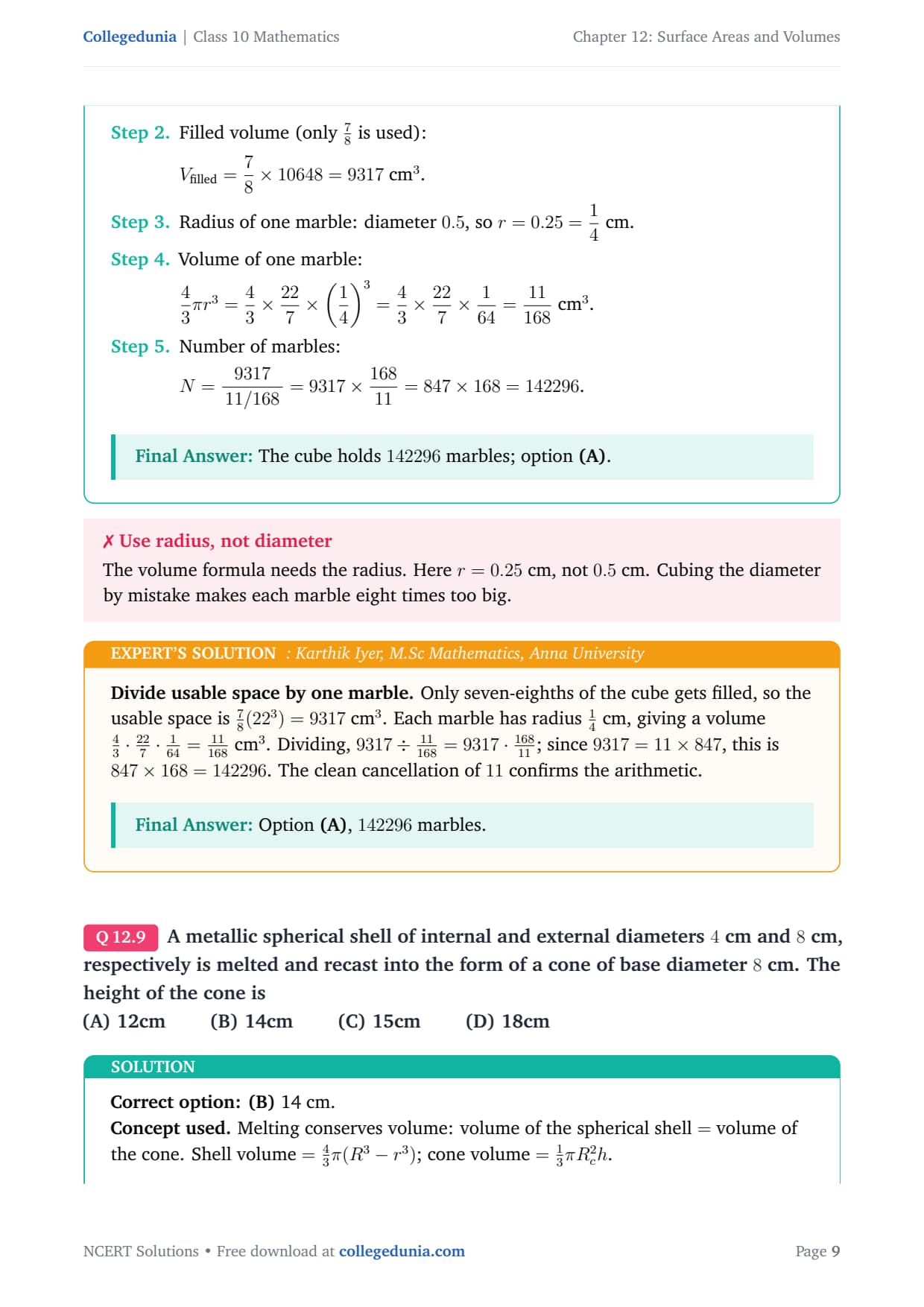
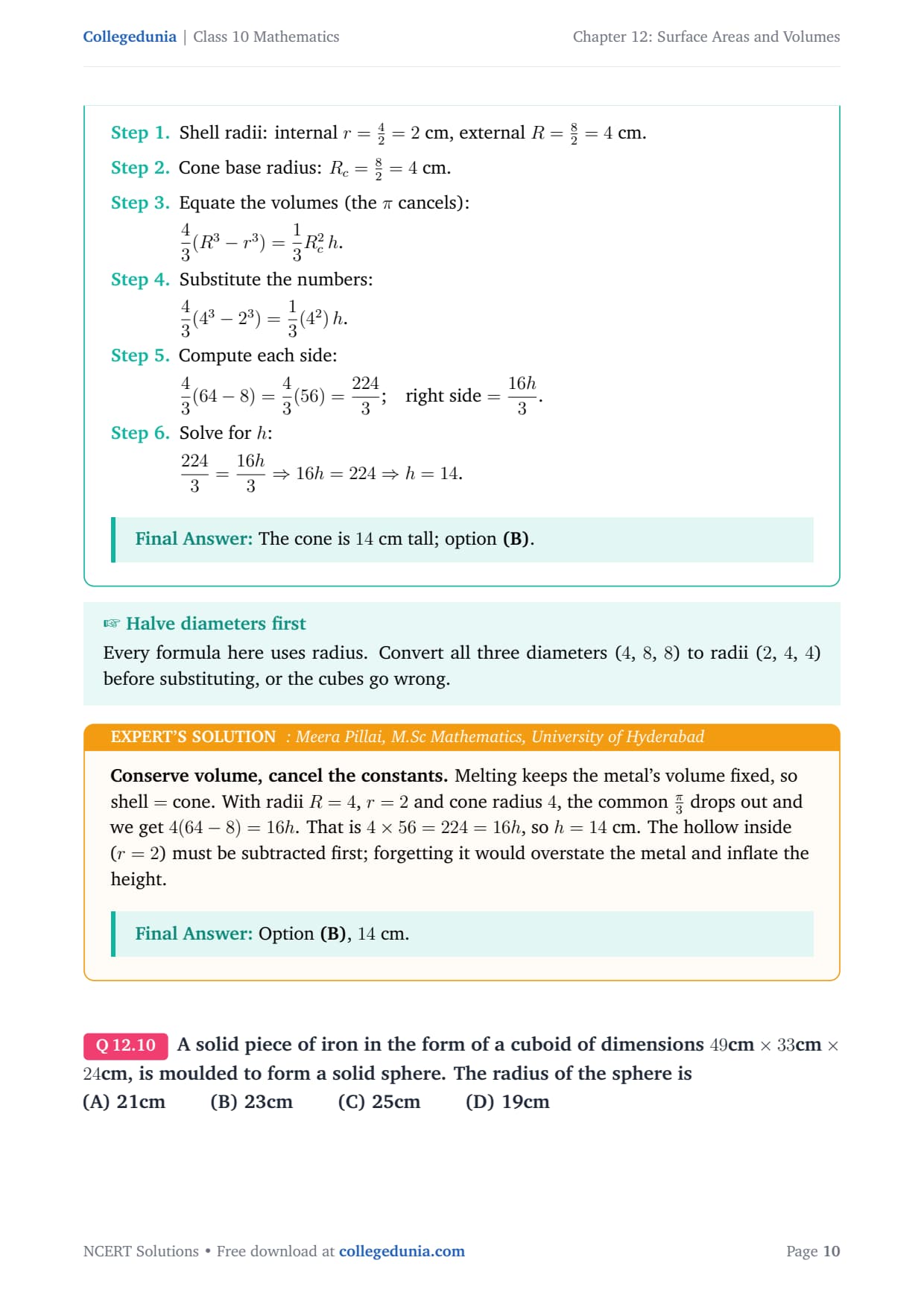
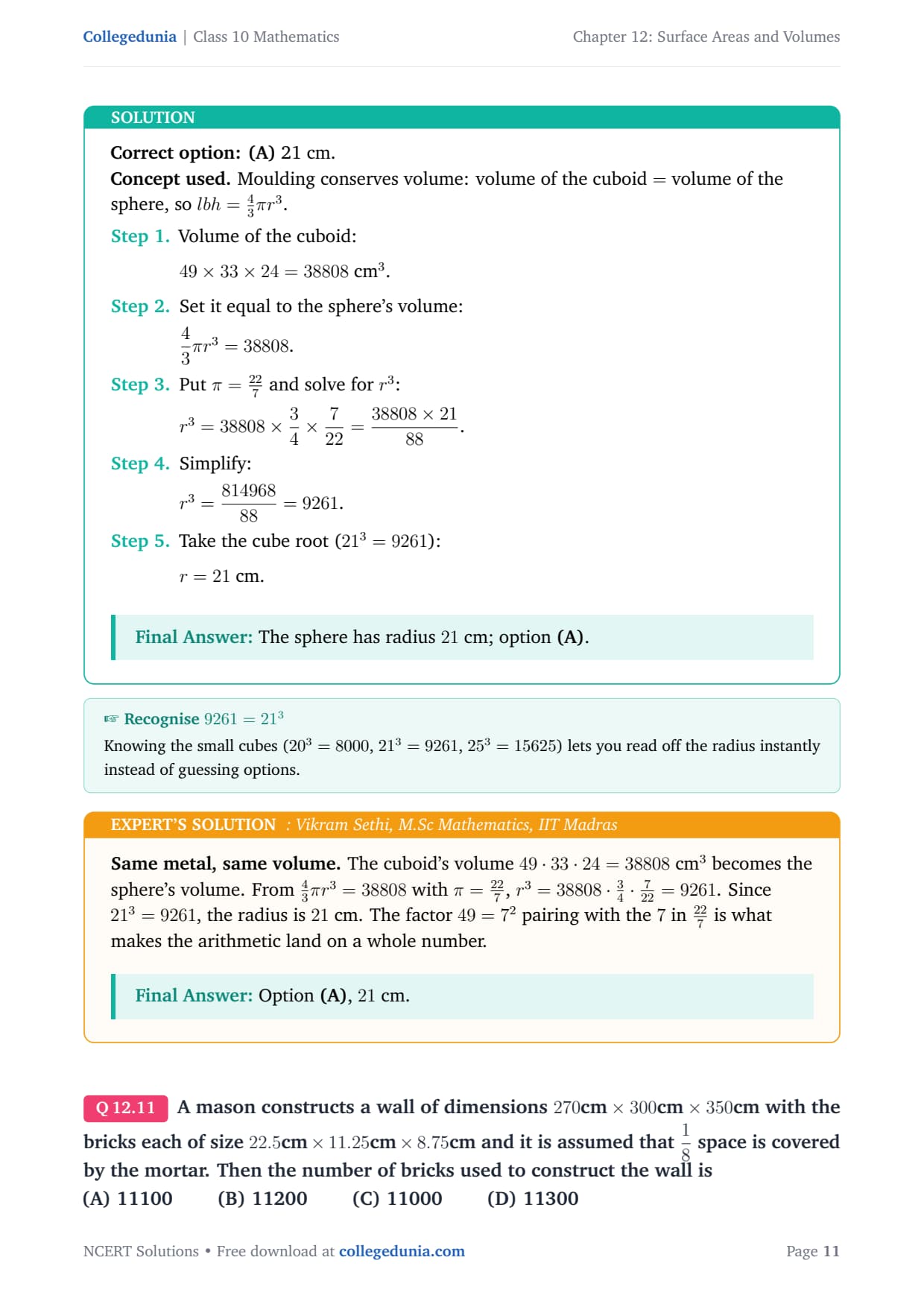
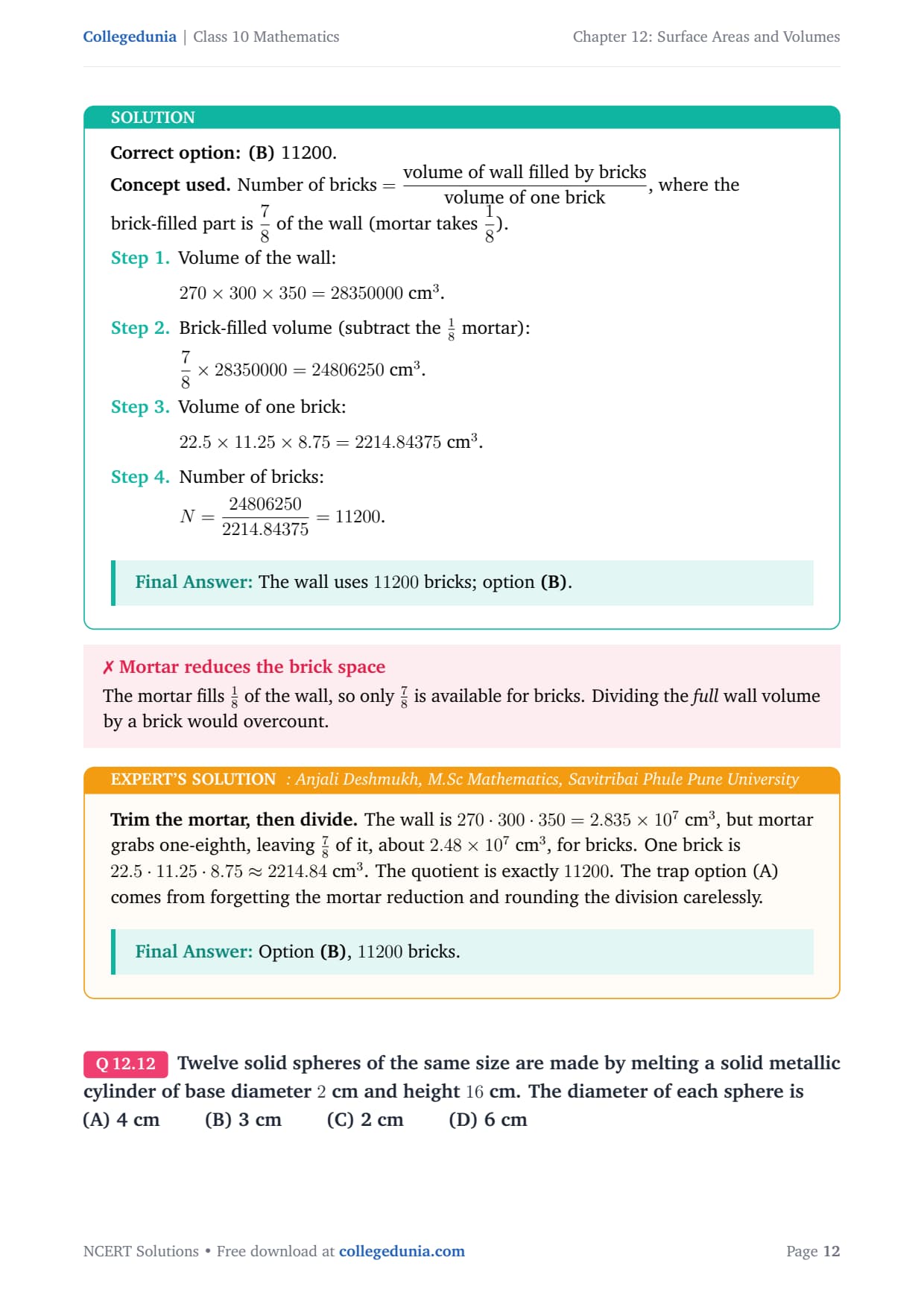
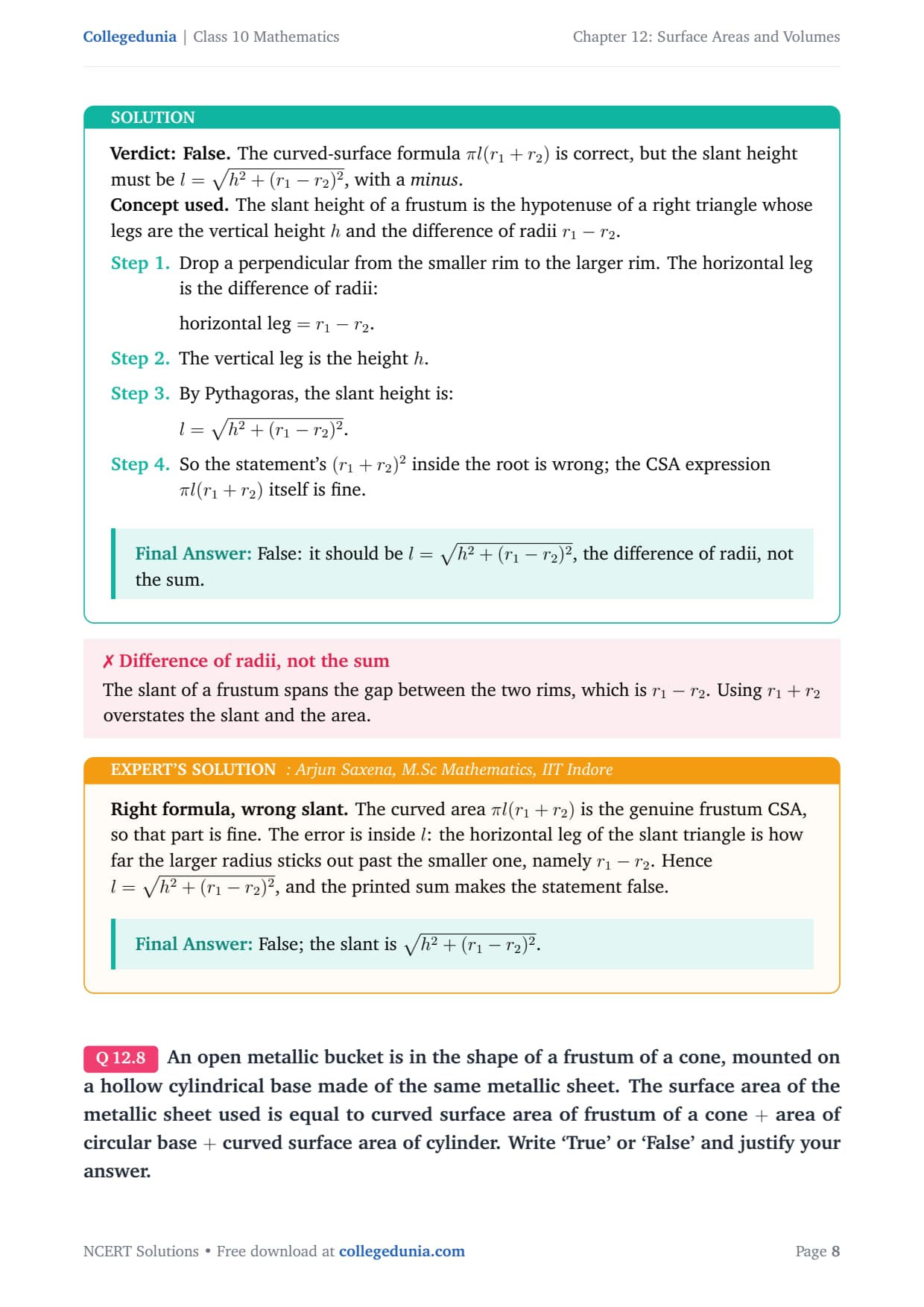
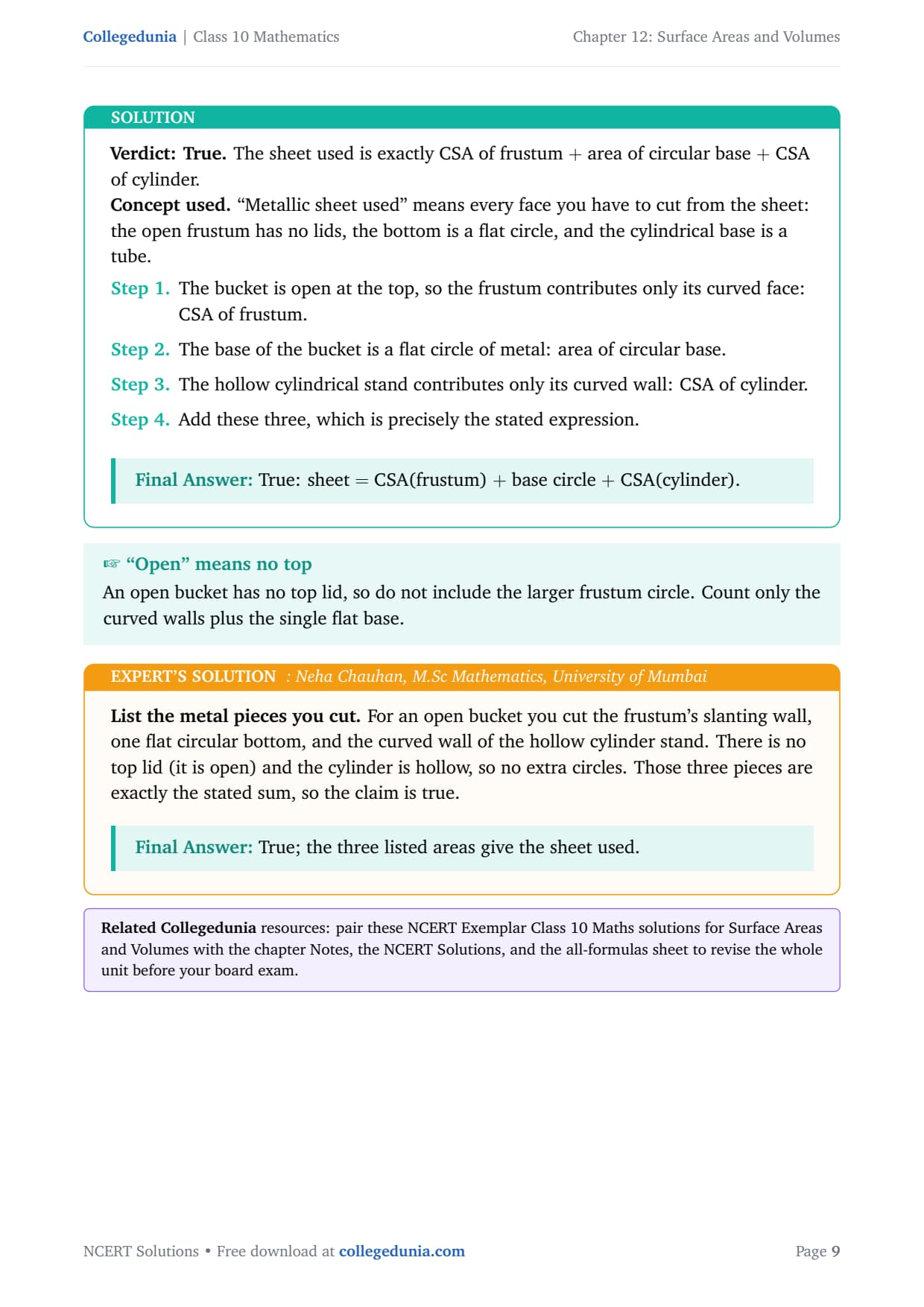
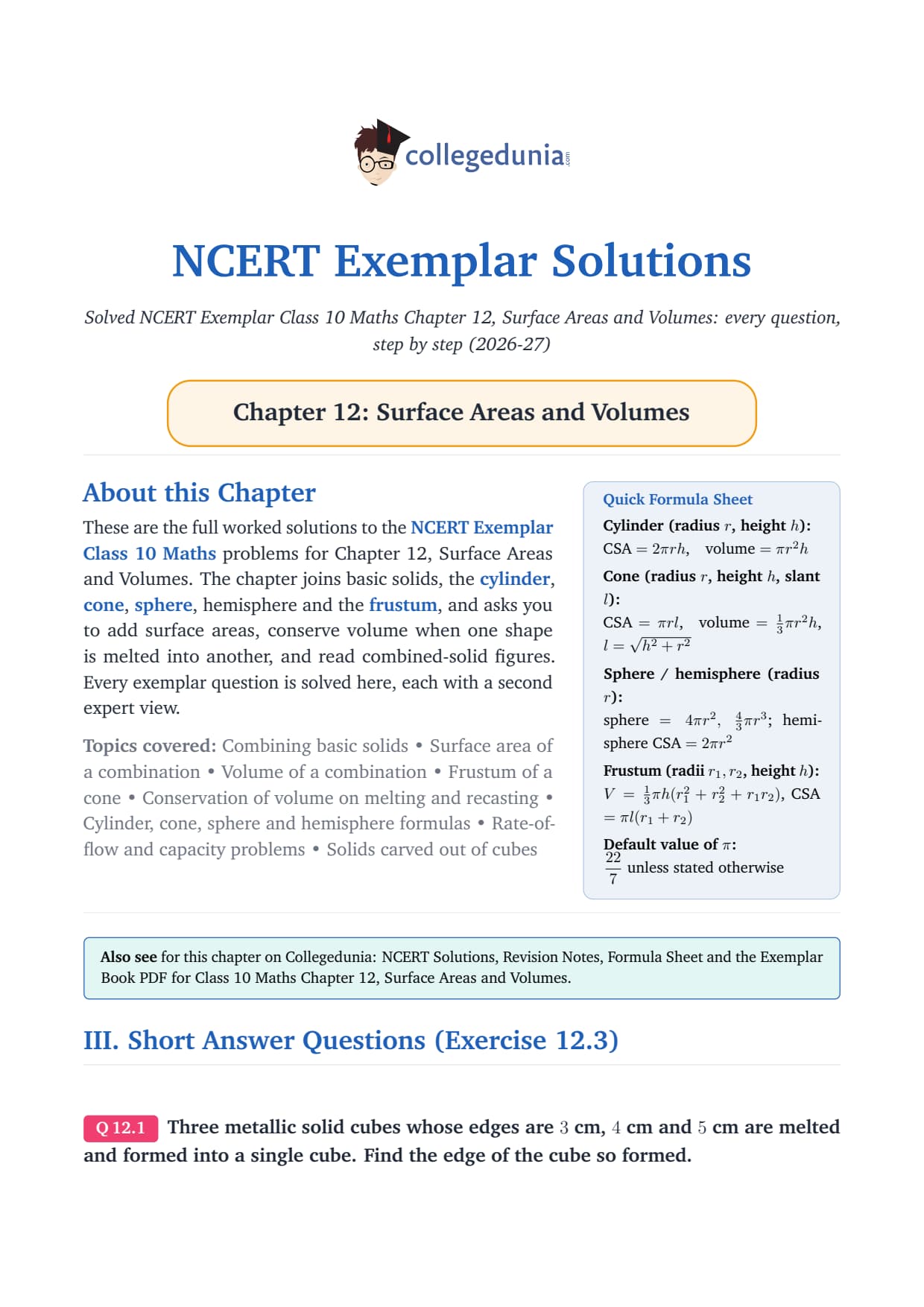
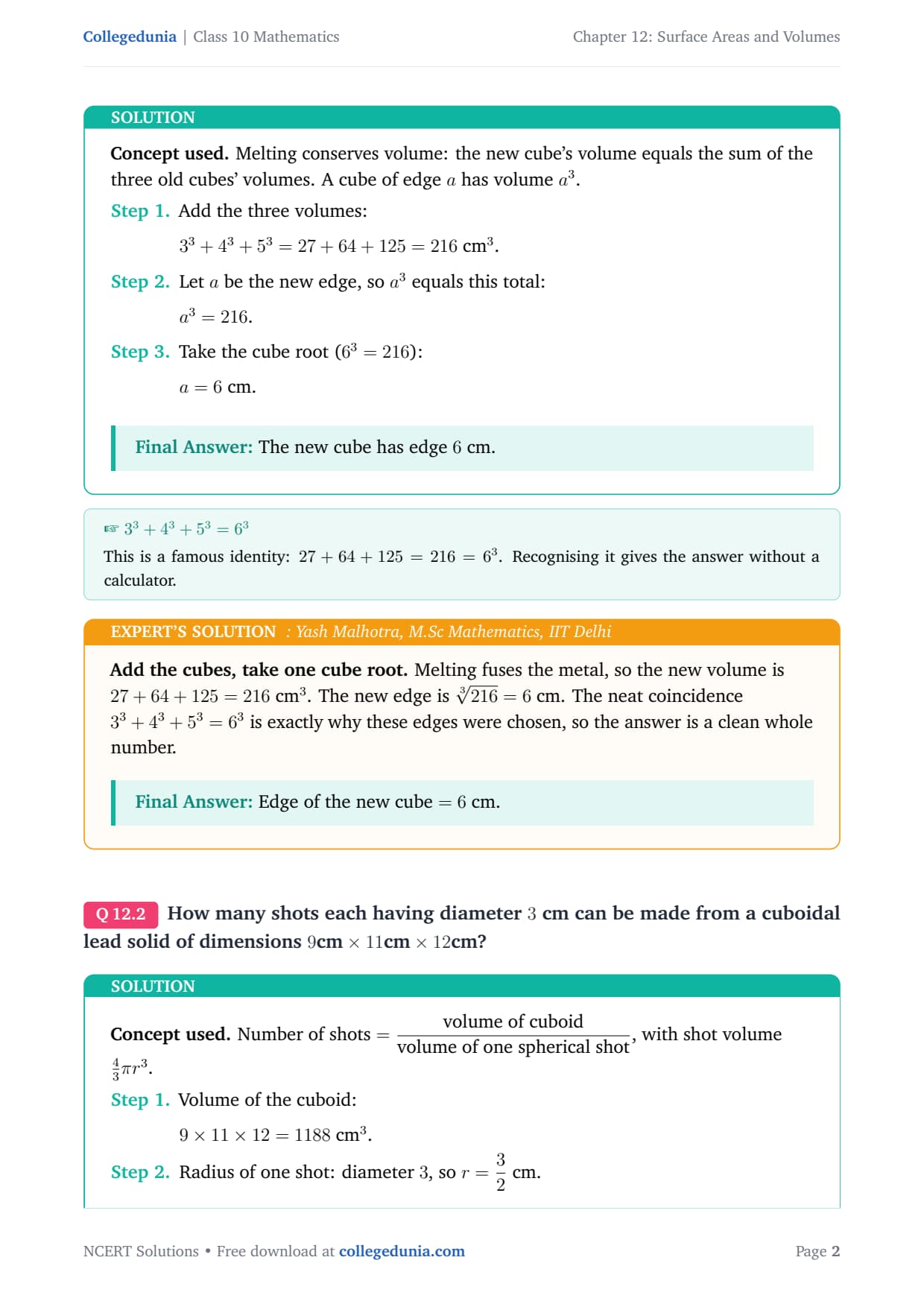
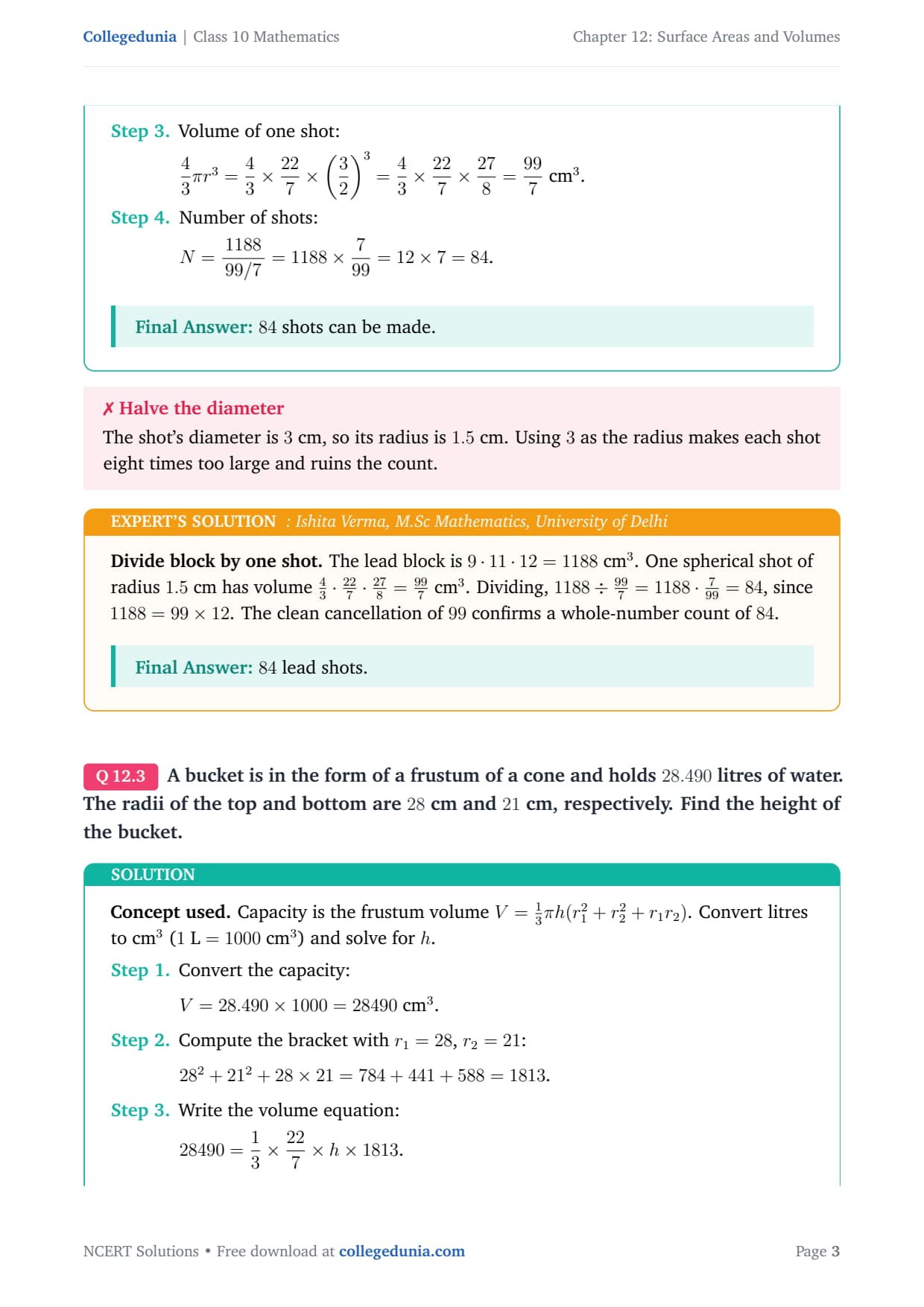
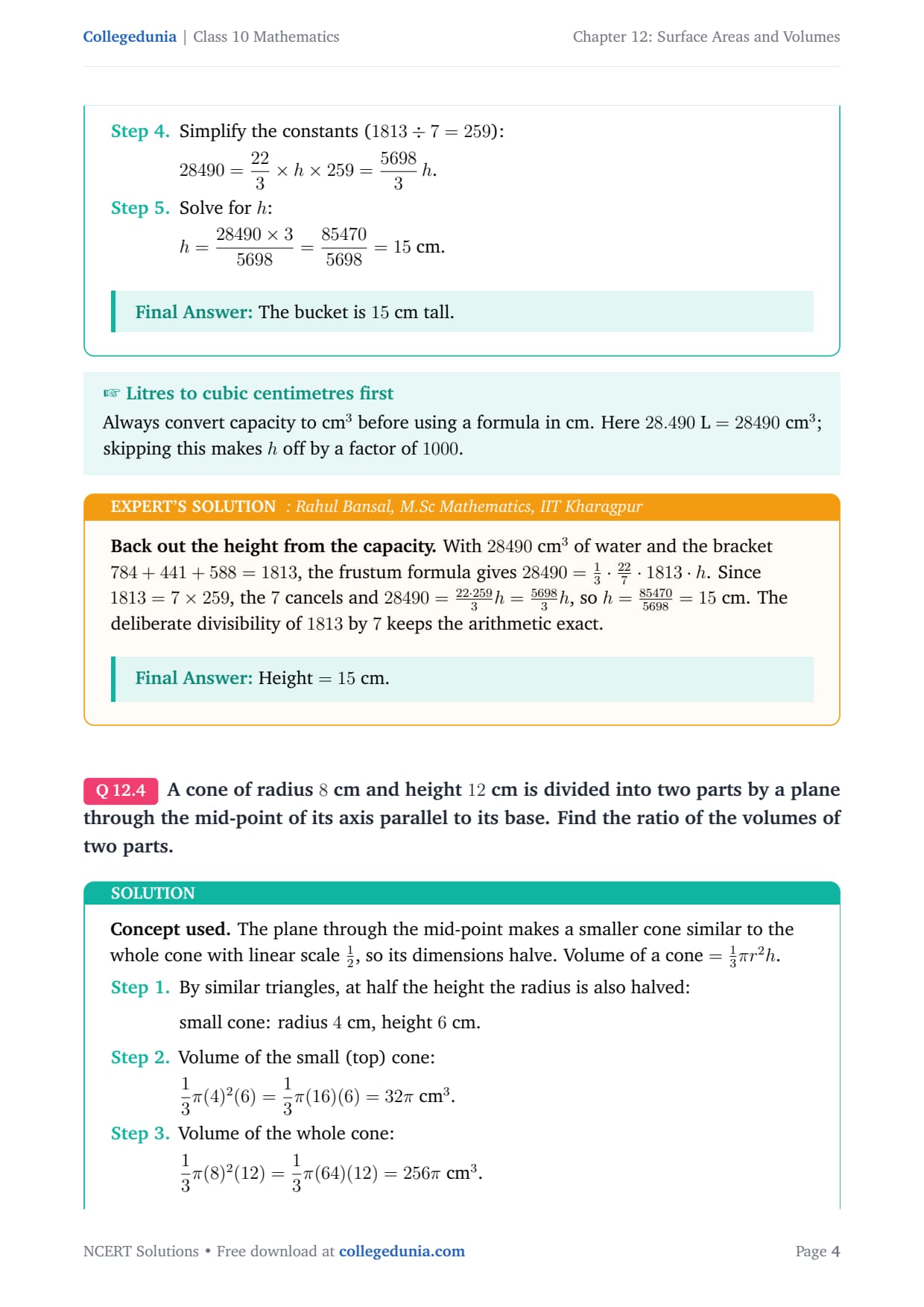
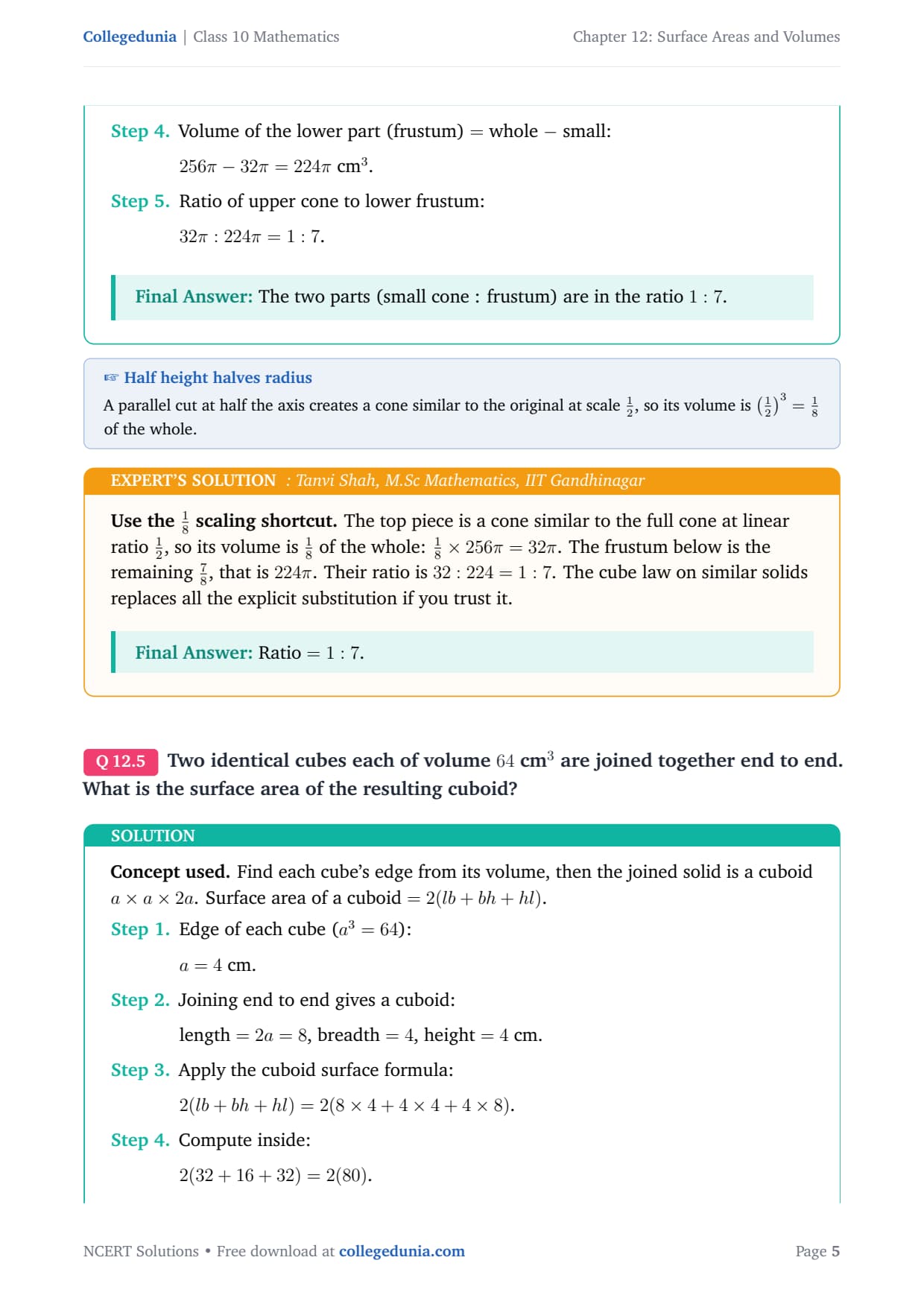
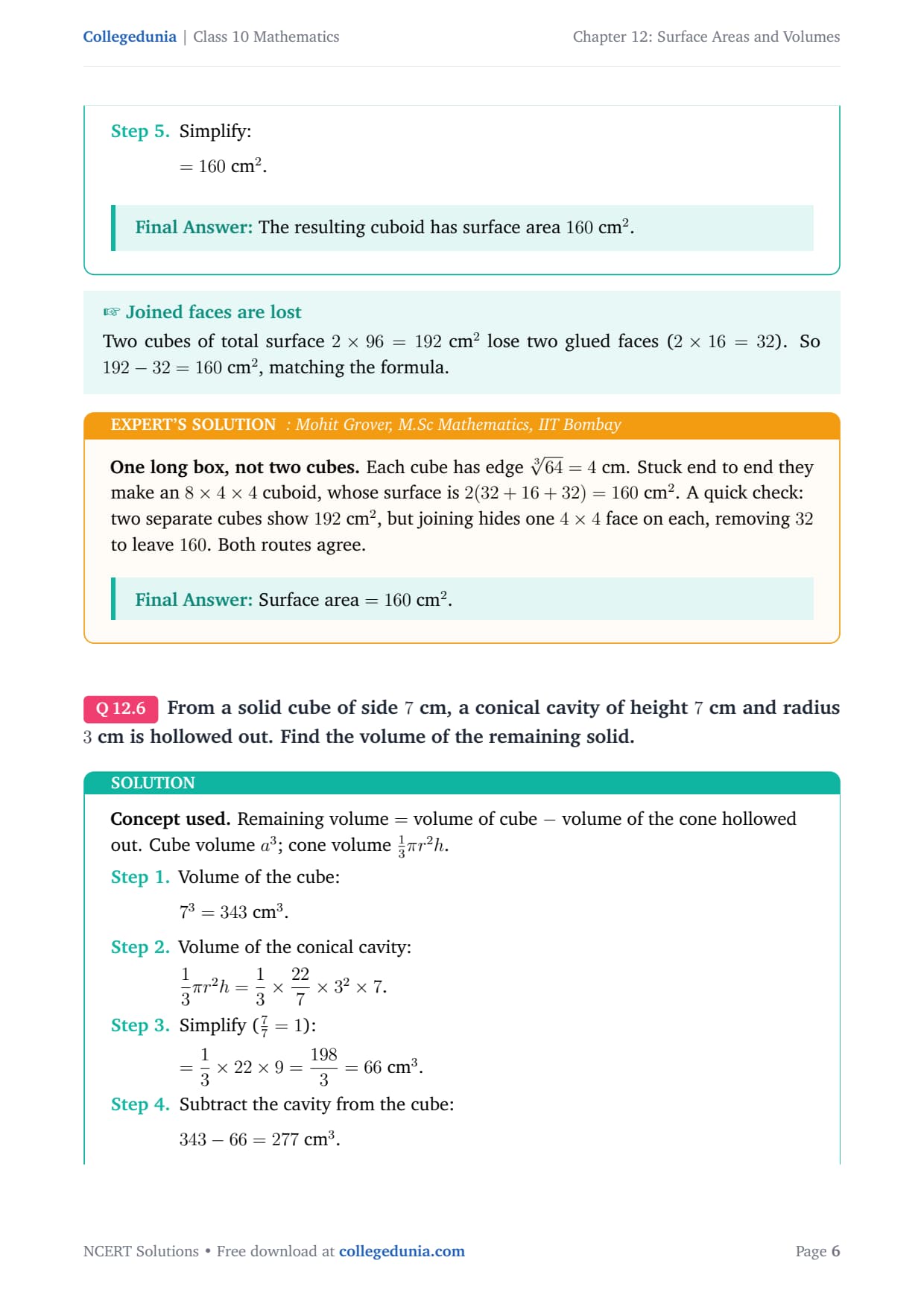
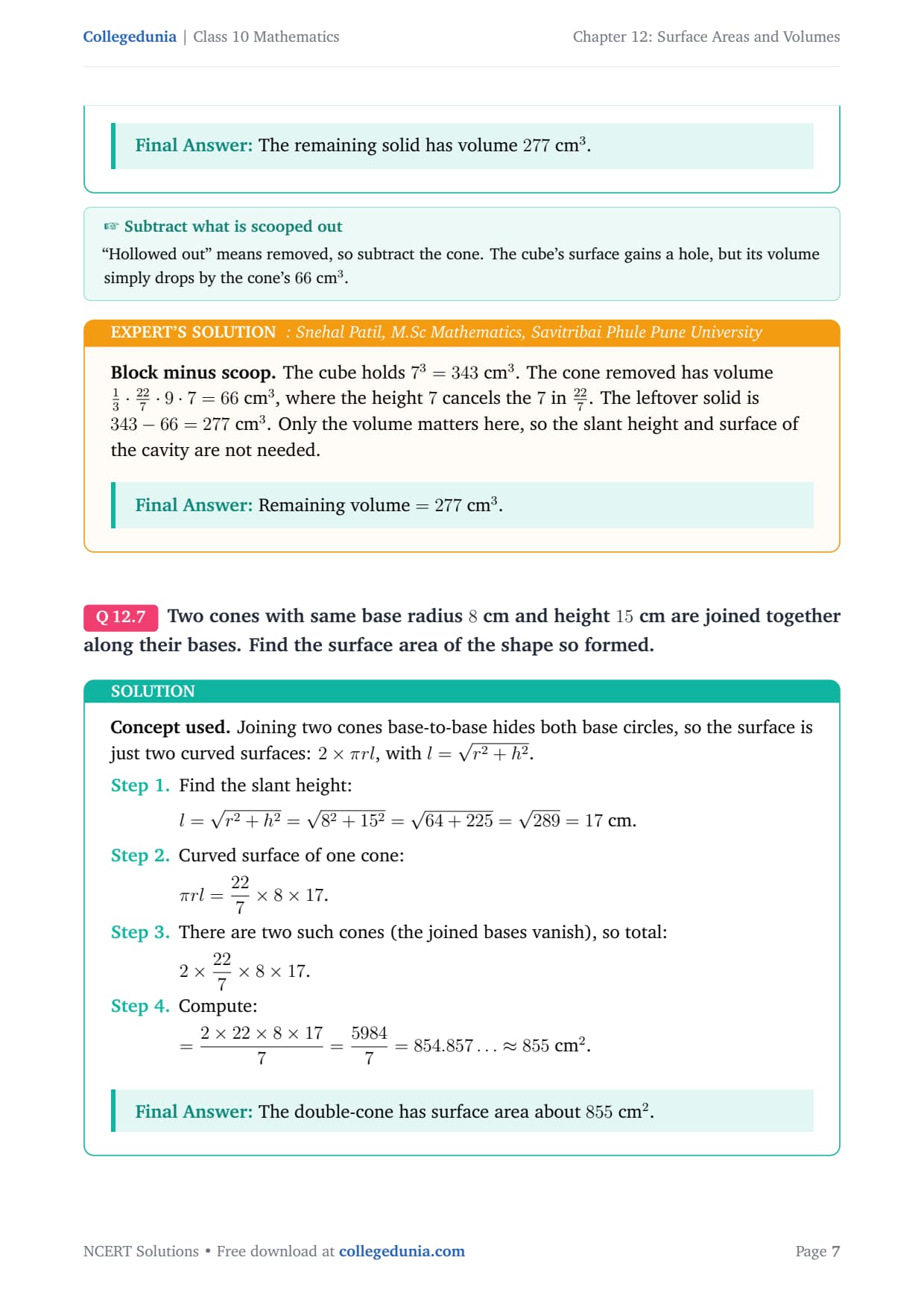
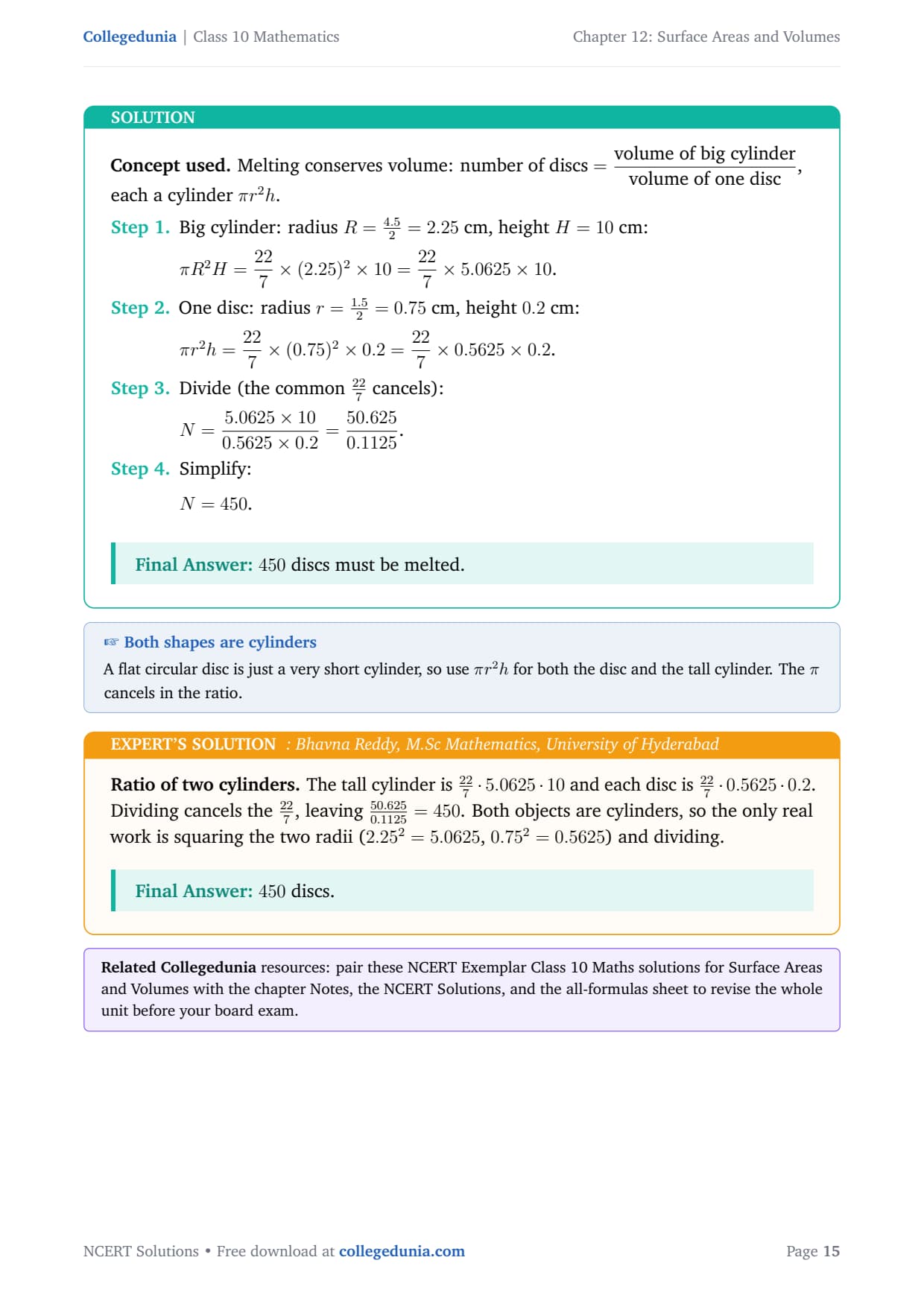
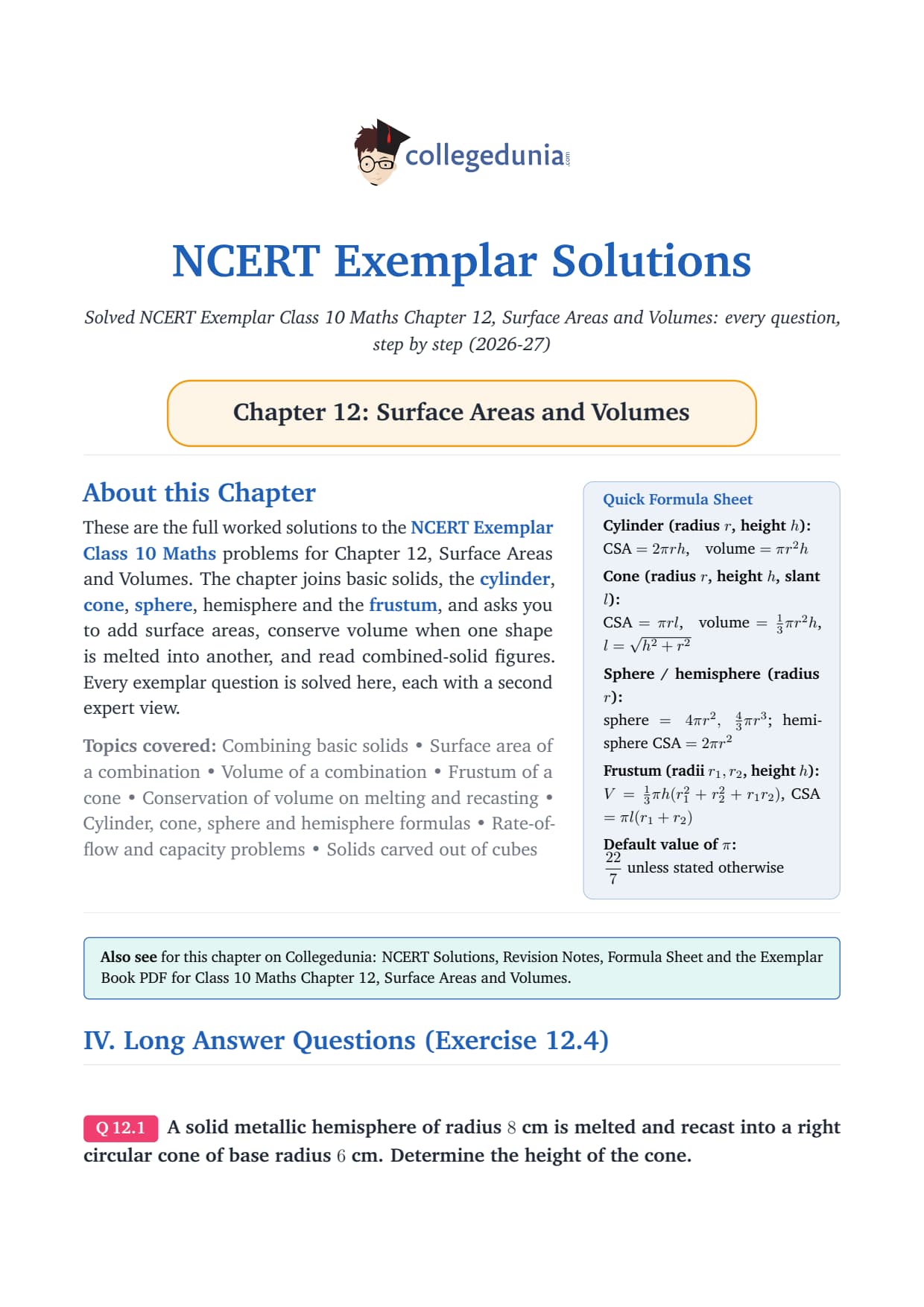
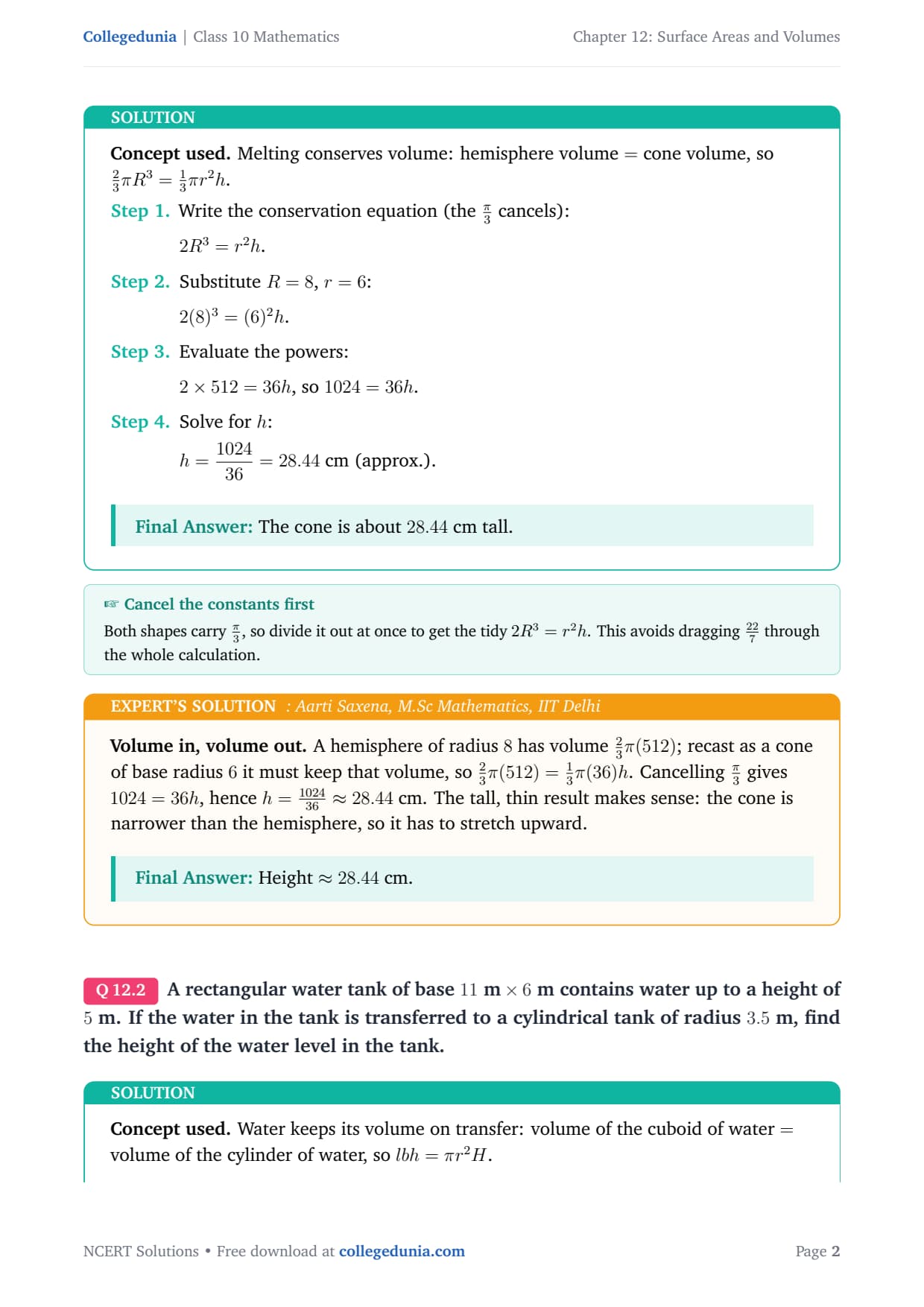
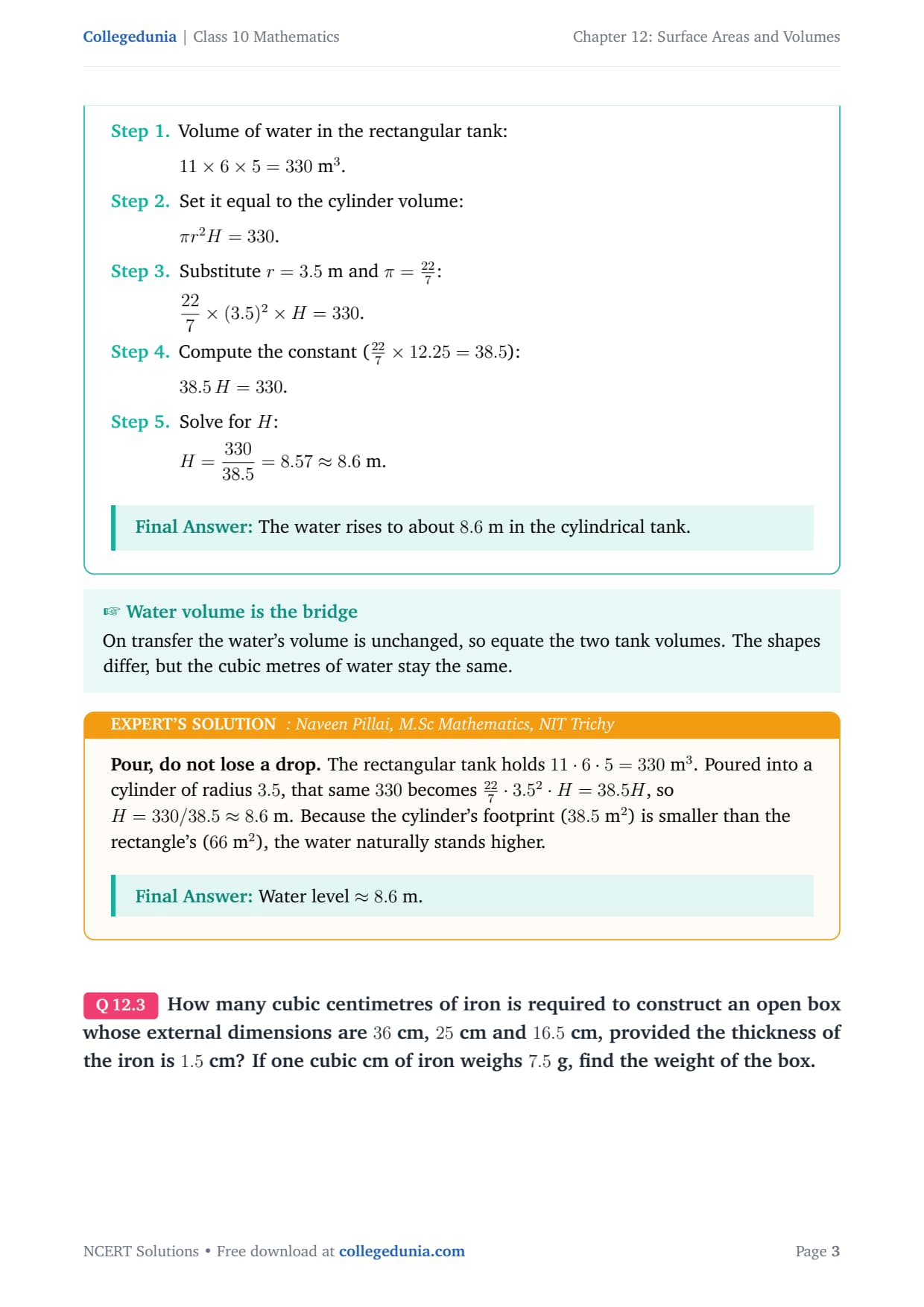
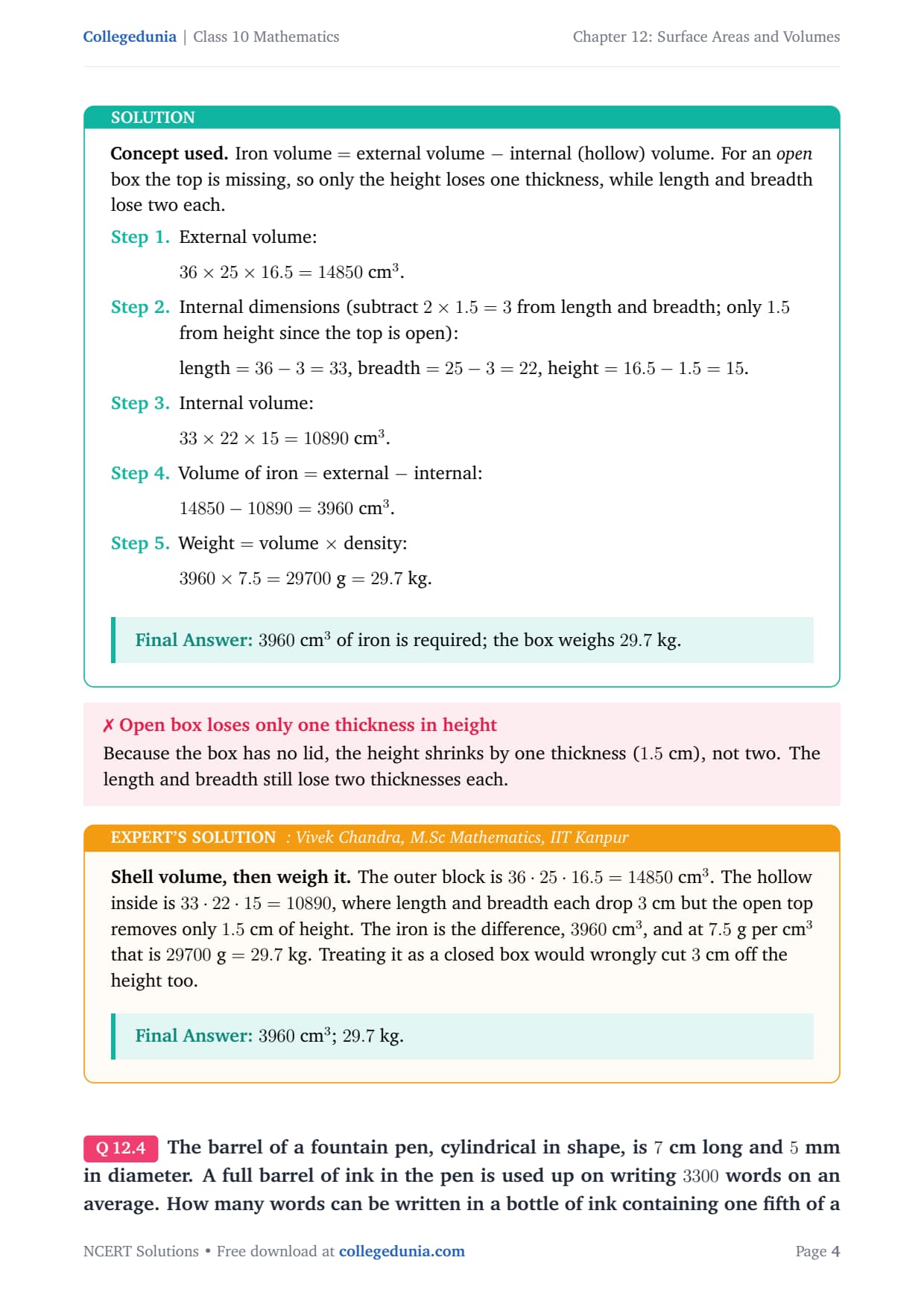
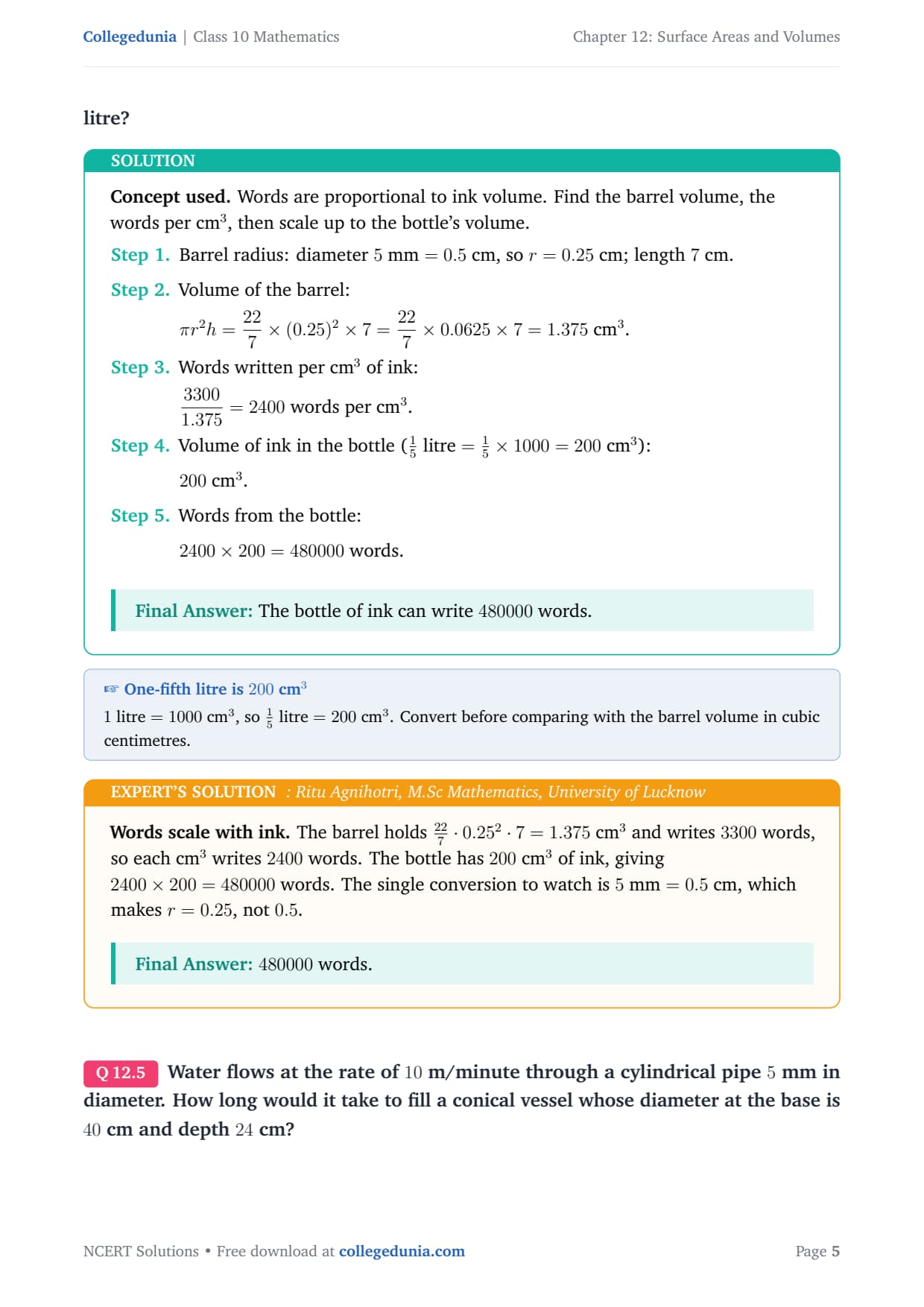
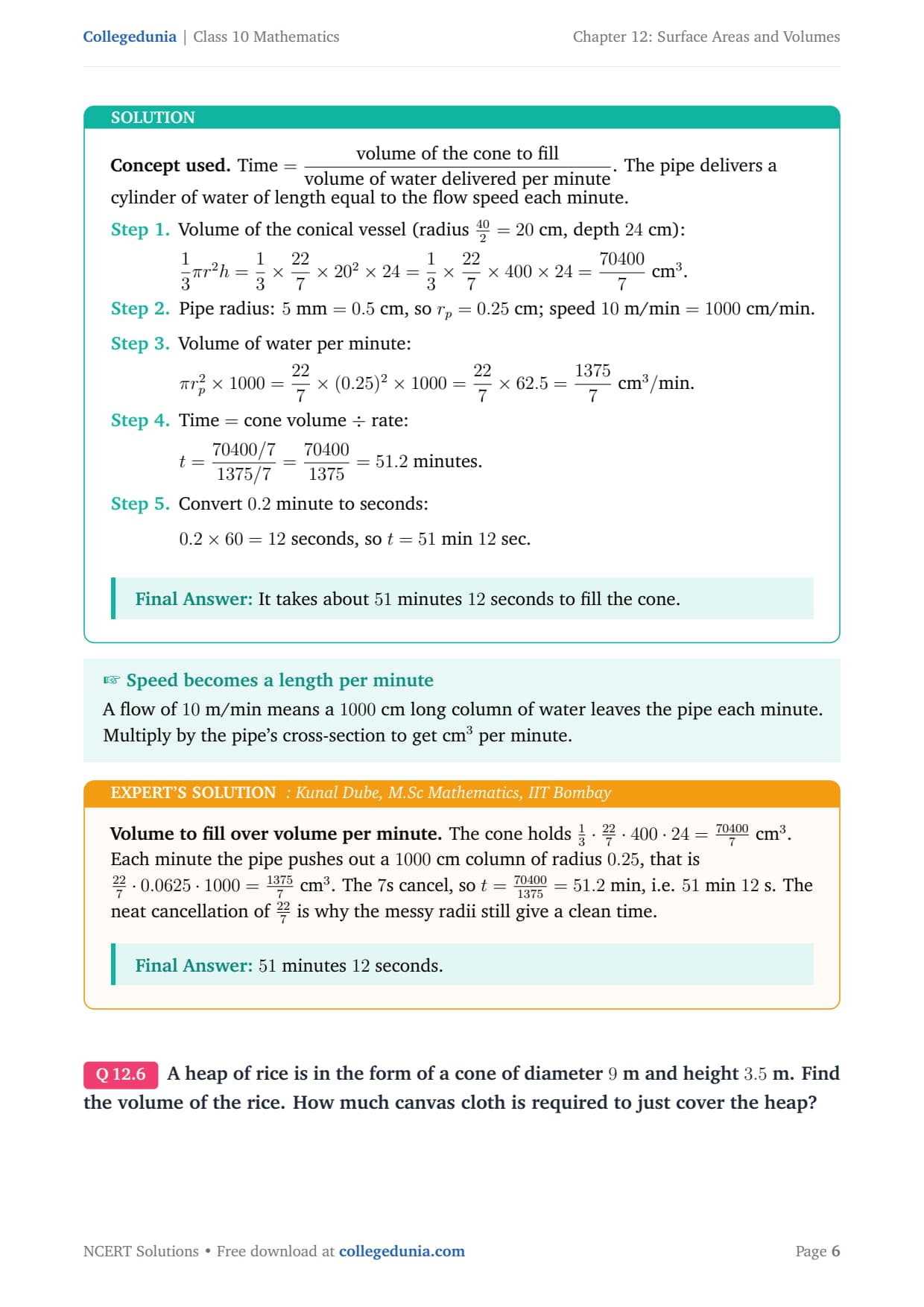
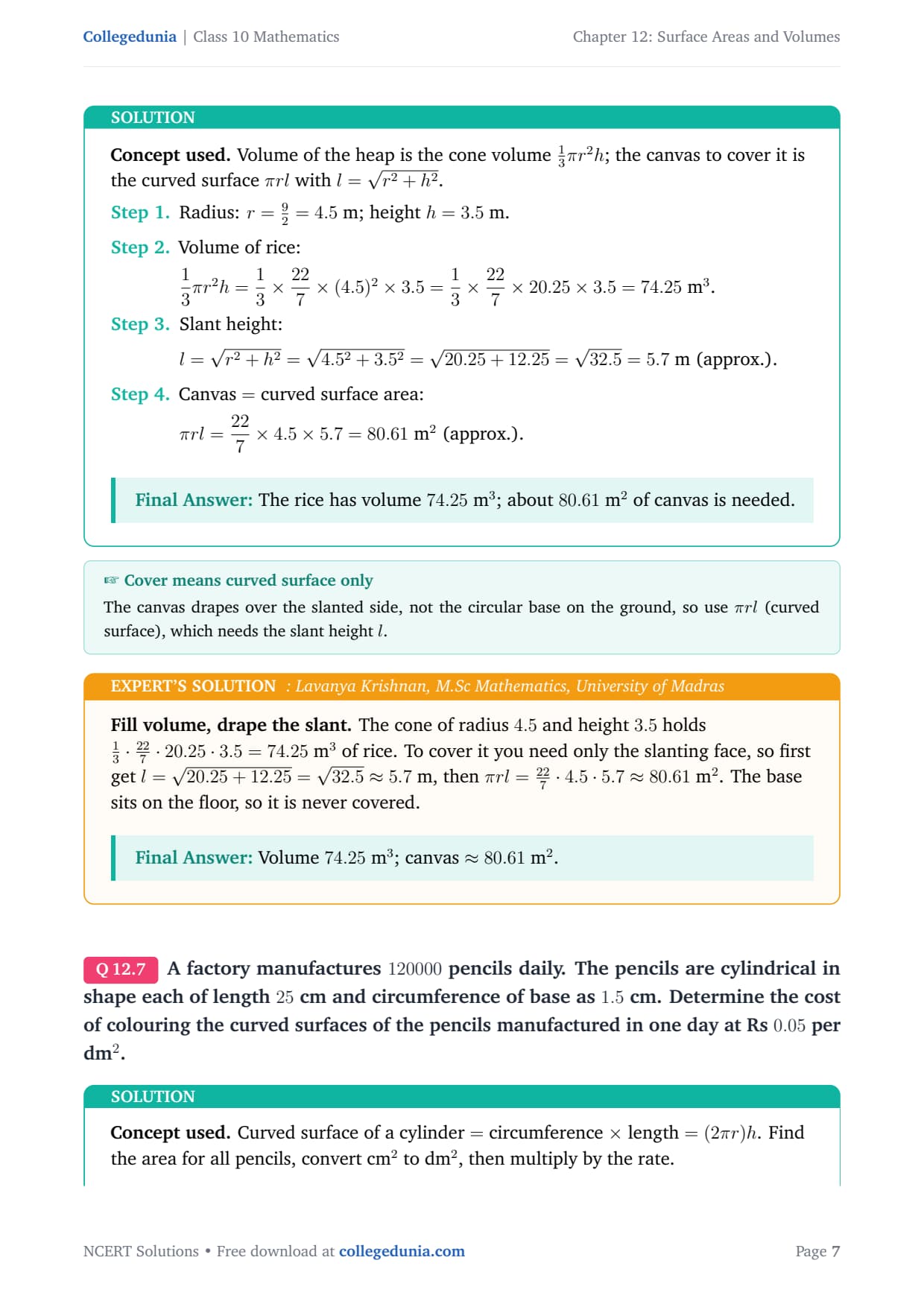
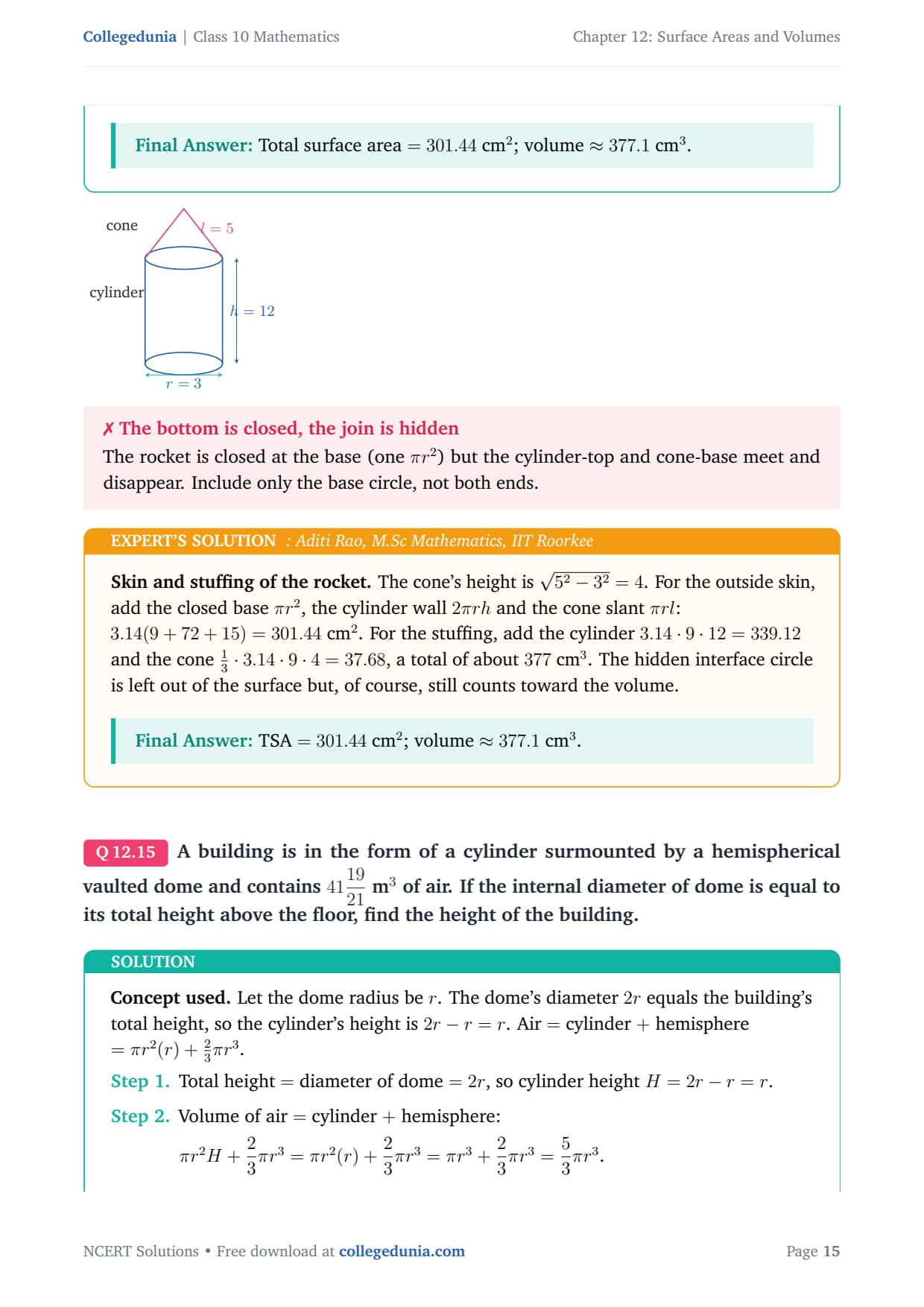
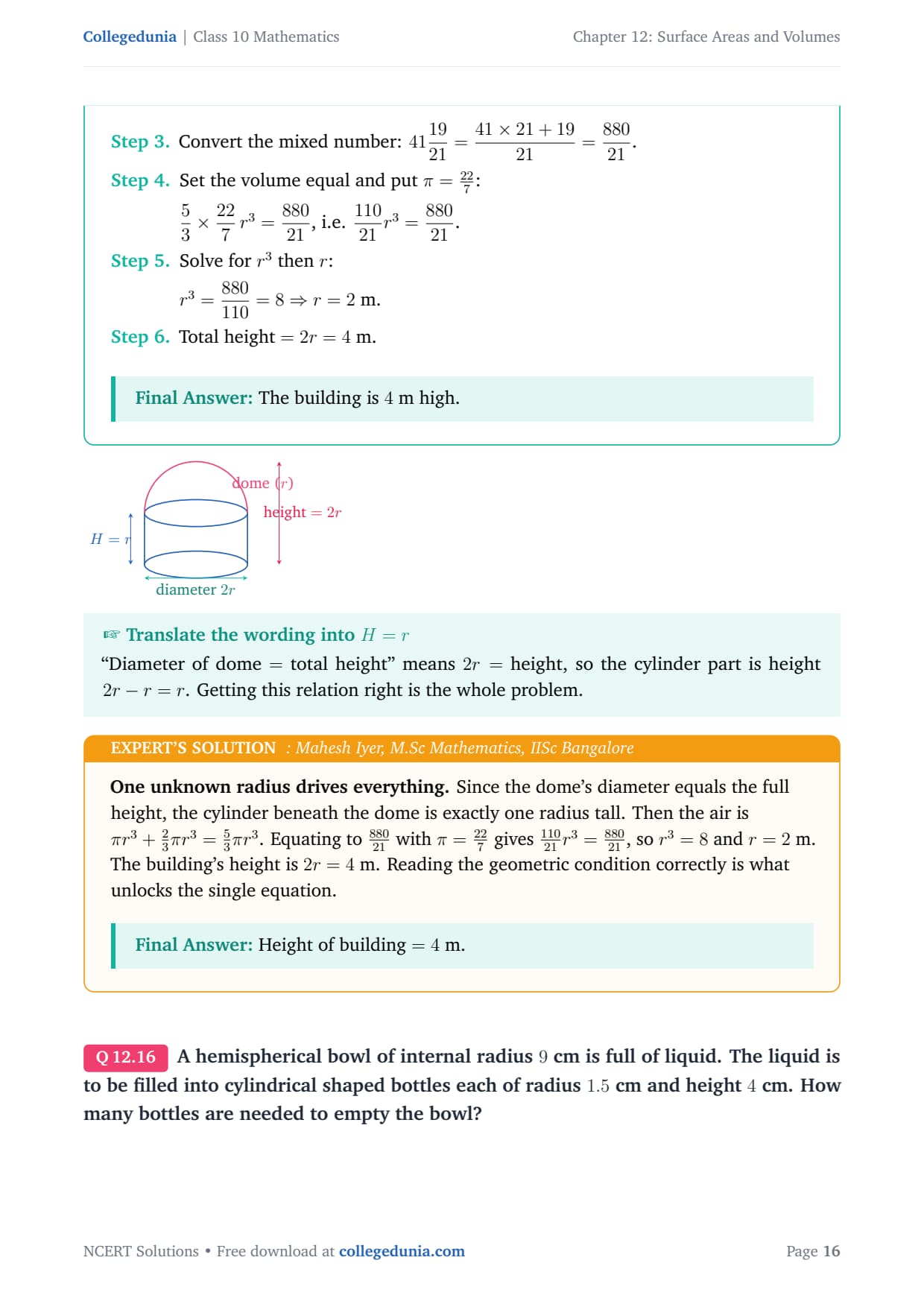
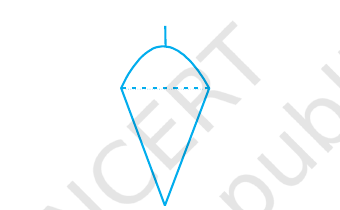
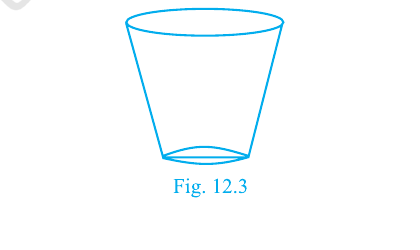

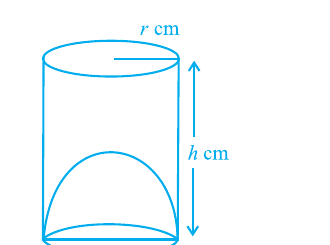
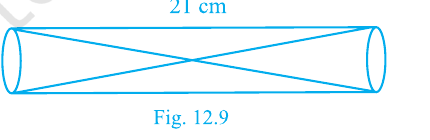
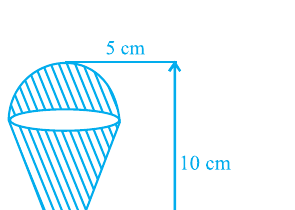



Comments