Class 10 Maths Chapter 11 Areas Related to Circles Exercise 11.2 has 14 Short Answer Questions with Reasoning (true or false type) from the NCERT Exemplar book, set to the 2026-27 CBSE syllabus. Each question asks you to judge a statement and explain why it is true or false.
14 true-or-false reasoning questions (Q11 to Q24) with full step-by-step Collegedunia solutions and an Expert view.
Ideas tested: inscribed and circumscribed circles and squares, sector and segment areas, wheel revolutions, and arc-length comparisons.
Board relevance: this exercise builds the reasoning you need for short and long questions worth 4 to 5 marks.
Each Exercise 11.2 solution here is written by subject experts from the 2026-27 NCERT Exemplar book and checked against recent CBSE board paper patterns.
Solved by Collegedunia
All 14 questions of Exercise 11.2 are solved below, each with the concept, step-by-step working, and an Expert view.
What Areas Related to Circles Exercise 11.2 Covers
Exercise 11.2 is the Short Answer with Reasoning section of the NCERT Exemplar for Chapter 11. Its 14 questions (Q11 to Q24) each ask you to decide if a statement is true or false and give the reason.
Q11 and Q21 use the largest circle inscribed in a square or rectangle, where you decide if the given side is the radius or the diameter.
Q12 and Q13 flip it: a square around or inside a circle, testing the side-vs-diagonal link.
Q14 is a trap: is a segment always smaller than its sector? It depends on whether it is the minor or major segment.
Q15 and Q16 test the wheel-revolution formula, telling π d apart from 2π d for one turn.
Q17 compares the numbers for area and circumference; they cross over at radius = 2.
Q18 to Q20 work on arc length and sector area across circles of different radii.
Q22, Q23 and Q24 close with equal-circumference, equal-area, and inscribed-square problems.
The level is moderate to high. Most lost marks come from using a formula on the wrong measurement: taking the side as the radius when it is the diameter, or forgetting that sector area is 12ℓr.
Key Formulas for Areas Related to Circles
Every question in Exercise 11.2 tests one or more of these core results. Review them before the solutions.
Formula / Concept
Expression
Where used in Exercise 11.2
Area of a circle
π r2
Q11, Q17, Q21, Q22, Q23
Circumference of a circle
2π r = π d
Q15, Q16, Q17, Q18, Q22, Q23
Area of a sector (angle θ)
θ360π r2
Q14, Q18, Q19, Q20
Arc length (angle θ)
θ360 × 2π r
Q18, Q19, Q20
Sector area in terms of arc length
12ℓr
Q19, Q20
Area of inscribed square (diagonal = d)
d22
Q13, Q24
Perimeter of circumscribing square (circle radius a)
8a
Q12
Use π = 227 unless the question specifies otherwise. Carry the ratio symbolically and substitute at the last step to avoid arithmetic errors.
True or False Reasoning Guide
Common Mistakes in Areas Related to Circles Exercise 11.2
In Exercise 11.2, each false statement holds exactly one realistic error. Knowing the trap first is the fastest way to keep marks here.
Question
Common Mistake
The Fix
Q11
Treating side a as the radius of the inscribed circle
Side = diameter, so radius = a/2; area = πa2/4
Q13
Saying outer square is 4 times the inner square
Outer area = 2 × inner area, not 4 times; the area ratio is d2 : d2/2 = 2:1
Q14
Applying the minor-segment rule to all segments
Minor segment < sector, but major segment > sector; the answer depends on which segment
Q15
Writing one revolution = 2π d instead of π d
Circumference = 2π r = π d; writing 2π d uses d where r belongs
Q17
Thinking area always exceeds circumference numerically
Only true for r > 2; for r < 2 the circumference is the larger number
Q21
Using breadth b as the radius of the largest inscribed circle
Breadth = diameter, so radius = b/2; area = π b2/4
Q24
Reading diameter p as the side of the inscribed square
p is the diagonal; area = p2/2, not p2
Formula Quick Reference for Areas Related to Circles
All 14 Exercise 11.2 Solutions with Step-by-Step Answers
II. Short Answer Questions with Reasoning (Exercise 11.2)
Q 11.1
Is the area of the circle inscribed in a square of side a cm, π a2 cm2? Give reasons for your answer.
Verdict: False. The area is π a24 cm2, not π a2 cm2.
Concept used. A circle inscribed in a square touches all four sides,
so its diameter equals the side of the square.
The inscribed circle just fits between two opposite sides, so:
[] diameter =a cm.
Find the radius:
[] r=a2 cm.
Apply area =π r2:
[] area =π(a2)2=π a24 cm2.
False: the radius is a2, so the area is
π a24 cm2, one quarter of the claimed value.
SK
Sanjana Kapoor
M.Sc Mathematics, Jamia Millia Islamia
Verified Expert
Halve the side before squaring.
Squeezed inside: since the circle is squeezed inside the
square, its diameter is the side a and its radius is a2.
The 14 factor: squaring that radius brings in a factor
of 14, so the true area is π a24.
The error: the claim is off by a factor of 4, which is
exactly what using the side as the radius produces.
False; the correct area is π a24 cm2.
Q 11.2
Will it be true to say that the perimeter of a square circumscribing a circle of radius a cm is 8a cm? Give reasons for your answer.
Verdict: True. The perimeter is indeed 8a cm.
Concept used. A square that circumscribes a circle has the circle
touching all four sides, so the side of the square equals the circle's
diameter.
The circle touches both pairs of opposite sides, so the side equals
the diameter:
[] side =2a cm.
Perimeter of a square =4× side:
[] perimeter =4× 2a.
Simplify:
[] perimeter =8a cm.
True: side =2a cm, so the perimeter is 8a cm.
DN
Devendra Naik
M.Sc Mathematics, NIT Surathkal
Verified Expert
Side equals the diameter here.
Touching condition: because the circle of radius a fits
exactly between opposite sides of the square, each side is the
diameter 2a.
The perimeter: four such sides give 8a, so the statement is
correct.
Mirror of Q11: there the square was inside and the side
became the diameter, and the two ideas are mirror images of the same
touching condition.
True; perimeter =8a cm.
Q 11.3
In the figure, a square is inscribed in a circle of diameter d and another square is circumscribing the circle. Is the area of the outer square four times the area of the inner square? Give reasons for your answer.
Verdict: False. The outer square is only twice the inner
square, not four times.
Concept used. For the inner (inscribed) square the diagonal equals
d; for the outer (circumscribing) square the side equals d. Compare the
two areas.
Inner square: its diagonal is the diameter d, so its area
=12d2 (using area =12× diagonal2).
Outer square: its side is the diameter d, so its area =d2.
Form the ratio of outer to inner:
[] d212d2=2.
So the outer square is 2 times the inner square, not 4 times.
False: the outer square's area is 2 times the inner square's area,
because the side of the outer square equals the diagonal of the inner square.
RM
Ritika Malhotra
M.Sc Mathematics, Panjab University
Verified Expert
Doubling the area needs a 2 scale, not 2.
Side ratio: the outer square's side is d while the inner
square's side is d2, so the sides are in the ratio
2, not 2.
Areas square it: areas scale as the square of lengths, so the
true area ratio is (2)2=2, which is why the outer square is
only twice the inner one.
Why not four: the ``four times'' guess would need the sides
in ratio 2, and that happens only if the outer side were the inner
side doubled rather than the inner diagonal.
False; the outer square is twice, not four times, the inner square.
Q 11.4
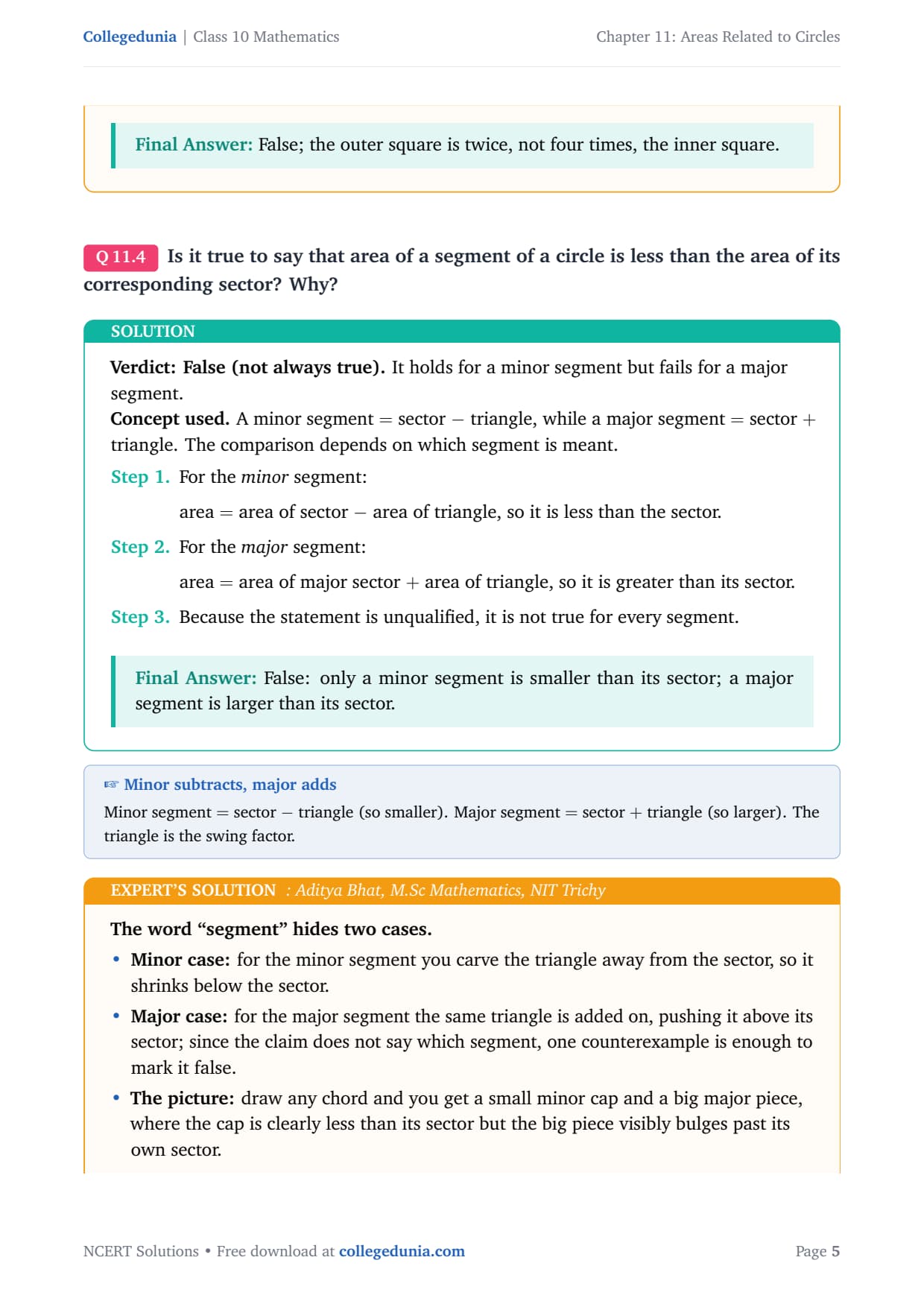
Is it true to say that area of a segment of a circle is less than the area of its corresponding sector? Why?
Verdict: False (not always true). It holds for a minor segment but
fails for a major segment.
Concept used. A minor segment = sector - triangle, while a major
segment = sector + triangle. The comparison depends on which segment is
meant.
For the minor segment:
[] area = area of sector - area of triangle, so it is less than the
sector.
For the major segment:
[] area = area of major sector + area of triangle, so it is greater
than its sector.
Because the statement is unqualified, it is not true for every
segment.
False: only a minor segment is smaller than its sector; a major
segment is larger than its sector.
AB
Aditya Bhat
M.Sc Mathematics, NIT Trichy
Verified Expert
The word ``segment'' hides two cases.
Minor case: for the minor segment you carve the triangle away
from the sector, so it shrinks below the sector.
Major case: for the major segment the same triangle is added
on, pushing it above its sector; since the claim does not say which
segment, one counterexample is enough to mark it false.
The picture: draw any chord and you get a small minor cap and
a big major piece, where the cap is clearly less than its sector but
the big piece visibly bulges past its own sector.
False; the claim only holds for the minor segment.
Q 11.5
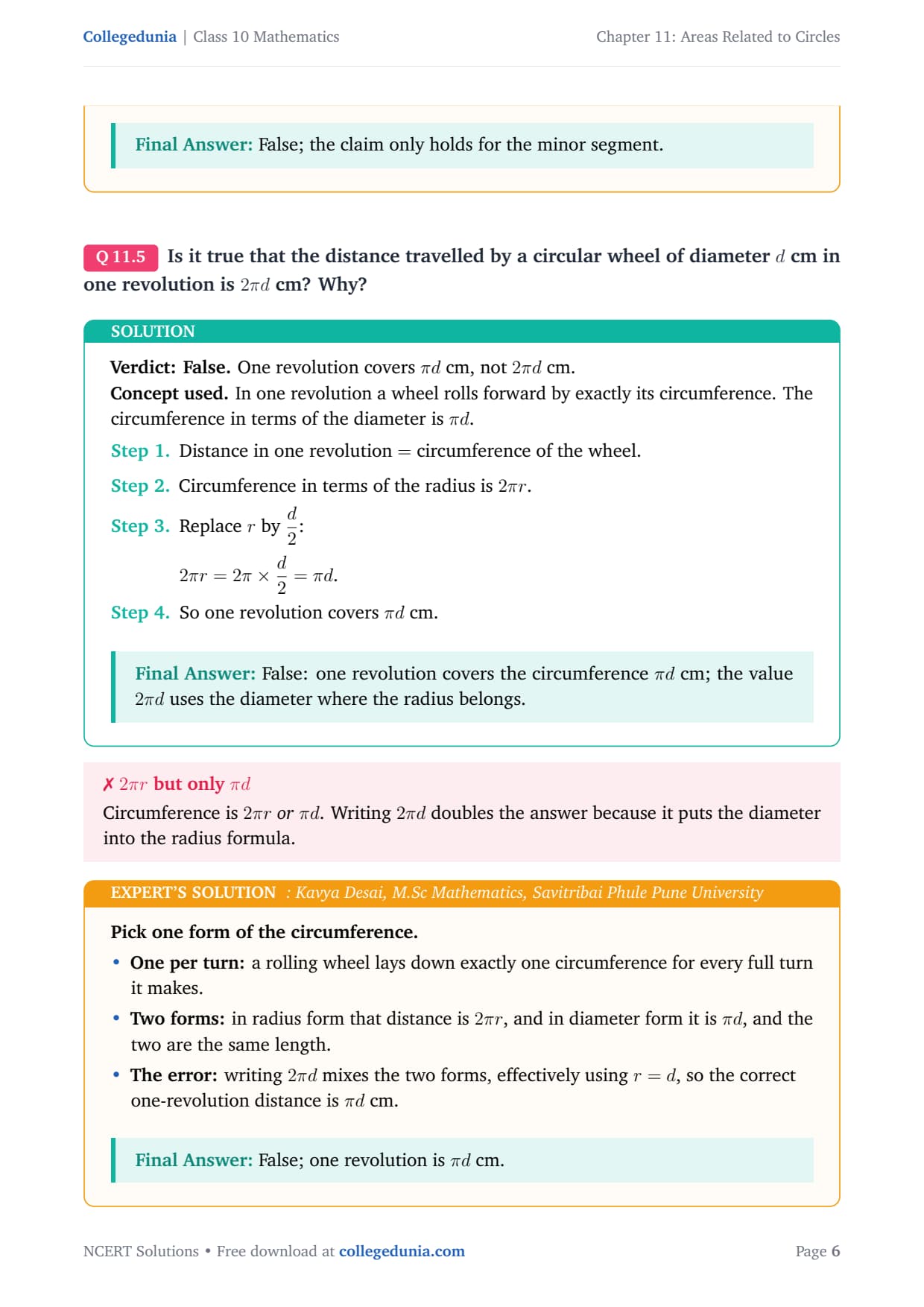
Is it true that the distance travelled by a circular wheel of diameter d cm in one revolution is 2π d cm? Why?
Verdict: False. One revolution covers π d cm, not 2π d cm.
Concept used. In one revolution a wheel rolls forward by exactly its
circumference. The circumference in terms of the diameter is π d.
Distance in one revolution = circumference of the wheel.
Circumference in terms of the radius is 2π r.
Replace r by d2:
[] 2π r=2π×d2=π d.
So one revolution covers π d cm.
False: one revolution covers the circumference π d cm; the value
2π d uses the diameter where the radius belongs.
KD
Kavya Desai
M.Sc Mathematics, Savitribai Phule Pune University
Verified Expert
Pick one form of the circumference.
One per turn: a rolling wheel lays down exactly one
circumference for every full turn it makes.
Two forms: in radius form that distance is 2π r, and in
diameter form it is π d, and the two are the same length.
The error: writing 2π d mixes the two forms, effectively
using r=d, so the correct one-revolution distance is π d cm.
False; one revolution is π d cm.
Q 11.6
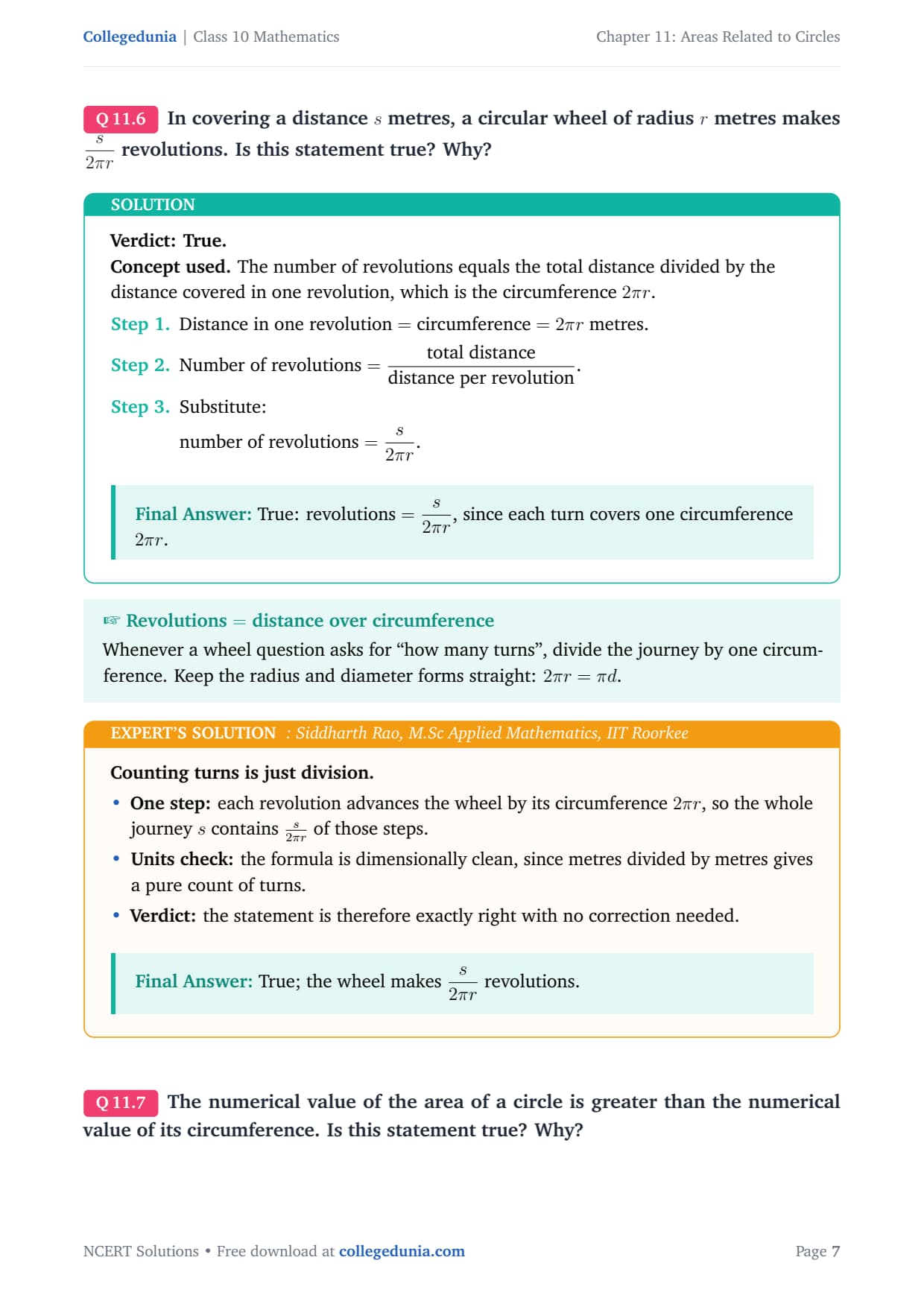
In covering a distance s metres, a circular wheel of radius r metres makes s2π r revolutions. Is this statement true? Why?
Verdict: True.
Concept used. The number of revolutions equals the total distance
divided by the distance covered in one revolution, which is the circumference
2π r.
Distance in one revolution = circumference =2π r metres.
Number of revolutions =total distancedistance per revolution.
Substitute:
[] number of revolutions =s2π r.
True: revolutions =s2π r, since each turn covers one
circumference 2π r.
SR
Siddharth Rao
M.Sc Applied Mathematics, IIT Roorkee
Verified Expert
Counting turns is just division.
One step: each revolution advances the wheel by its
circumference 2π r, so the whole journey s contains
s2π r of those steps.
Units check: the formula is dimensionally clean, since metres
divided by metres gives a pure count of turns.
Verdict: the statement is therefore exactly right with no
correction needed.
True; the wheel makes s2π r revolutions.
Q 11.7
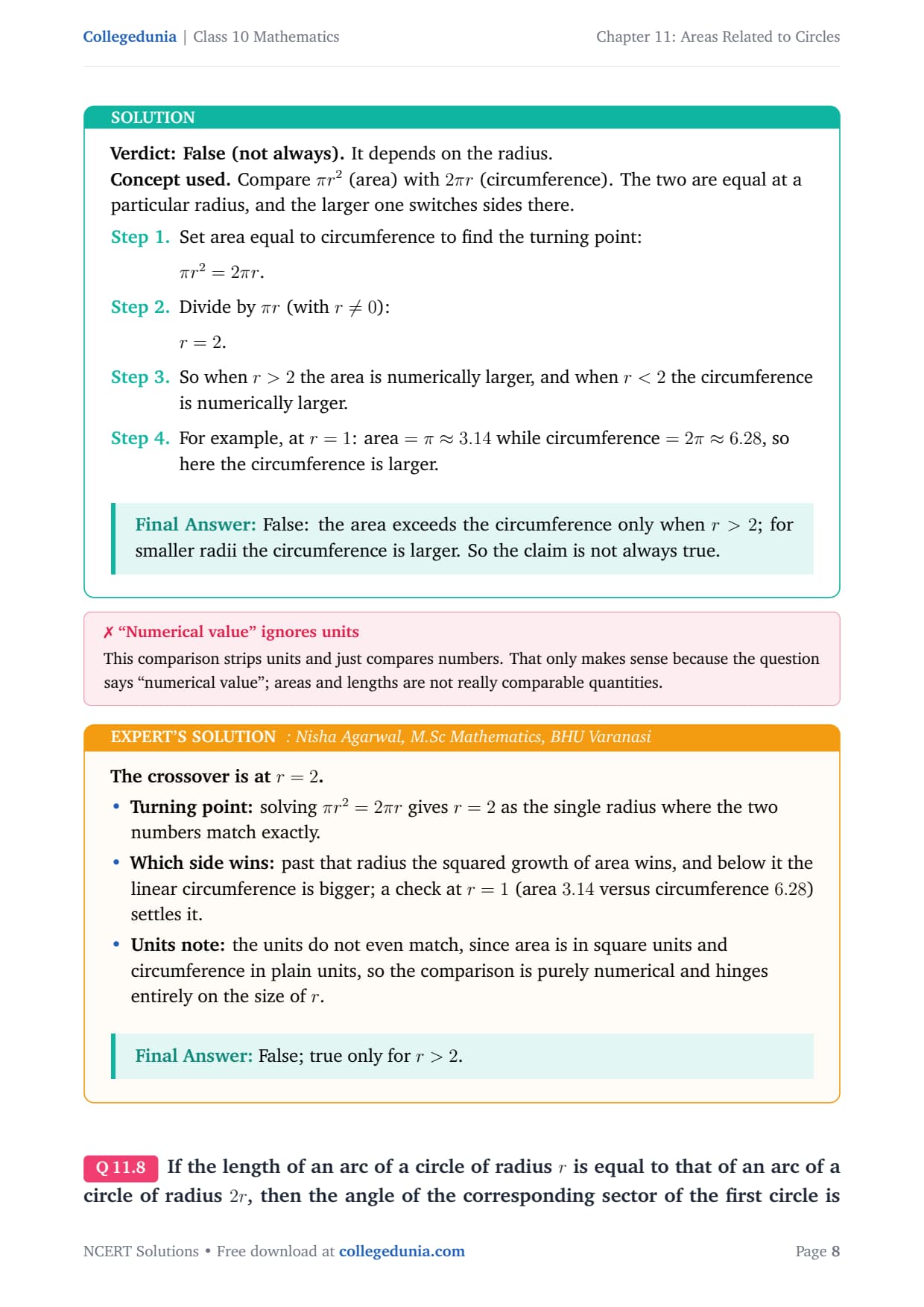
The numerical value of the area of a circle is greater than the numerical value of its circumference. Is this statement true? Why?
Verdict: False (not always). It depends on the radius.
Concept used. Compare π r2 (area) with 2π r (circumference).
The two are equal at a particular radius, and the larger one switches sides
there.
Set area equal to circumference to find the turning point:
[] π r2=2π r.
Divide by π r (with r≠ 0):
[] r=2.
So when r>2 the area is numerically larger, and when r<2 the
circumference is numerically larger.
For example, at r=1: area =π≈ 3.14 while circumference
=2π≈ 6.28, so here the circumference is larger.
False: the area exceeds the circumference only when r>2; for
smaller radii the circumference is larger. So the claim is not always true.
NA
Nisha Agarwal
M.Sc Mathematics, BHU Varanasi
Verified Expert
The crossover is at r=2.
Turning point: solving π r2=2π r gives r=2 as the
single radius where the two numbers match exactly.
Which side wins: past that radius the squared growth of area
wins, and below it the linear circumference is bigger; a check at
r=1 (area 3.14 versus circumference 6.28) settles it.
Units note: the units do not even match, since area is in
square units and circumference in plain units, so the comparison is
purely numerical and hinges entirely on the size of r.
False; true only for r>2.
Q 11.8
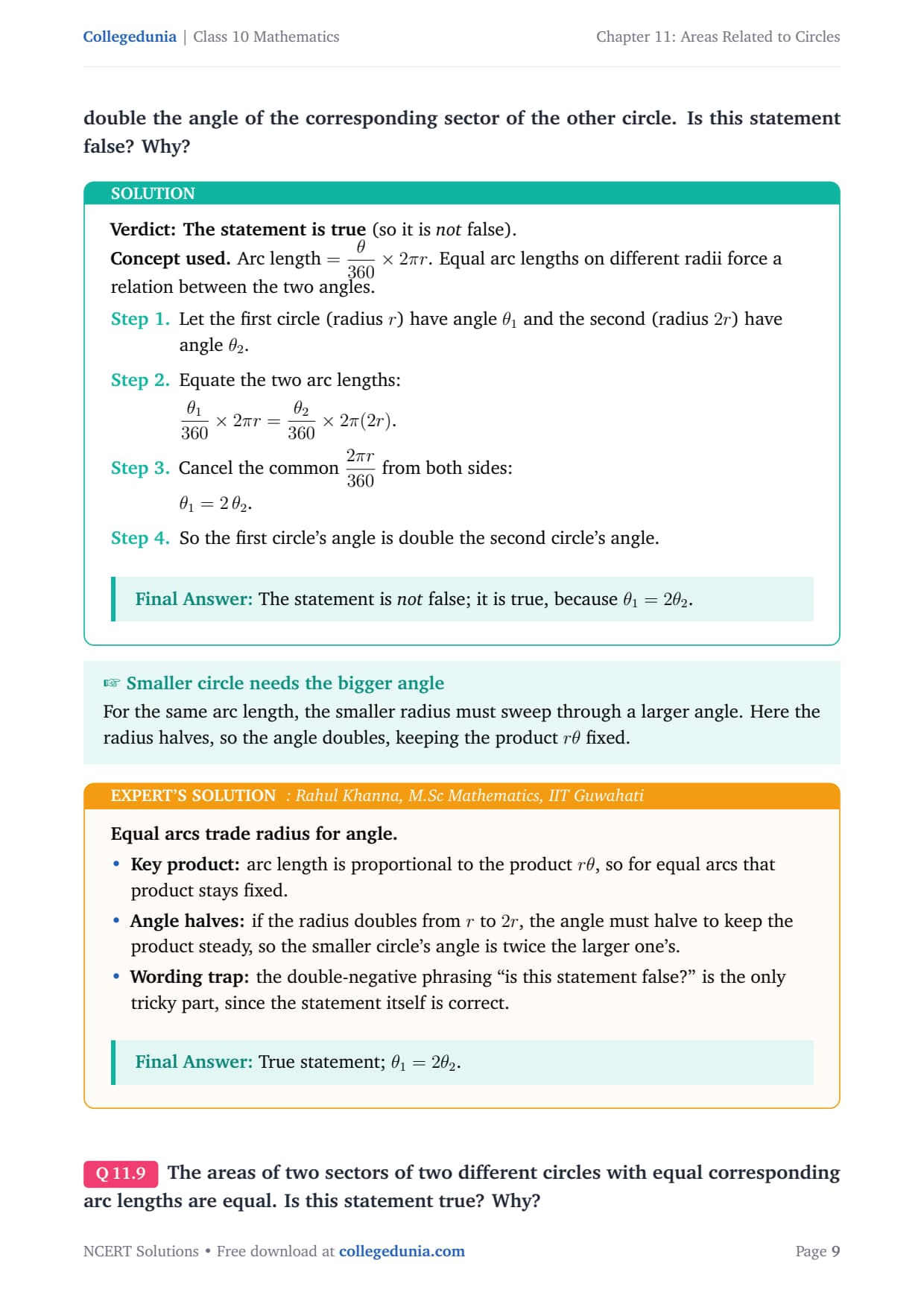
If the length of an arc of a circle of radius r is equal to that of an arc of a circle of radius 2r, then the angle of the corresponding sector of the first circle is double the angle of the corresponding sector of the other circle. Is this statement false? Why?
Verdict: The statement is true (so it is not false).
Concept used. Arc length =θ360× 2π r. Equal arc
lengths on different radii force a relation between the two angles.
Let the first circle (radius r) have angle 1 and the second
(radius 2r) have angle 2.
Equate the two arc lengths:
[] 1360× 2π r=2360× 2π(2r).
Cancel the common 2π r360 from both sides:
[] 1=2 2.
So the first circle's angle is double the second circle's angle.
The statement is not false; it is true, because
1=22.
RK
Rahul Khanna
M.Sc Mathematics, IIT Guwahati
Verified Expert
Equal arcs trade radius for angle.
Key product: arc length is proportional to the product
rθ, so for equal arcs that product stays fixed.
Angle halves: if the radius doubles from r to 2r, the
angle must halve to keep the product steady, so the smaller circle's
angle is twice the larger one's.
Wording trap: the double-negative phrasing ``is this
statement false?'' is the only tricky part, since the statement itself
is correct.
True statement; 1=22.
Q 11.9
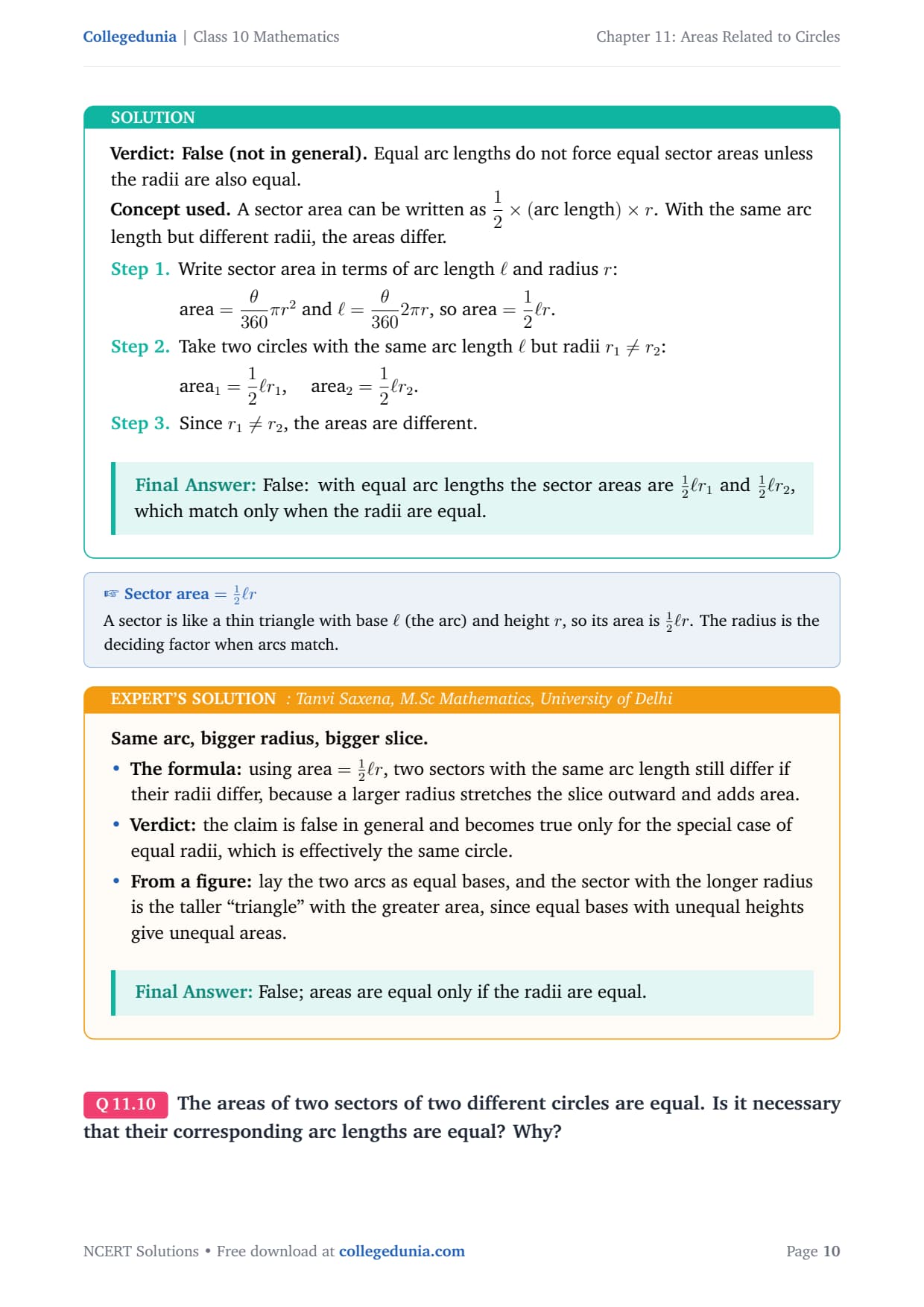
The areas of two sectors of two different circles with equal corresponding arc lengths are equal. Is this statement true? Why?
Verdict: False (not in general). Equal arc lengths do not force equal
sector areas unless the radii are also equal.
Concept used. A sector area can be written as
12×(arc length)× r. With the same arc length but
different radii, the areas differ.
Write sector area in terms of arc length and radius r:
[] area =θ360π r2 and =θ3602π r,
so area =12r.
Take two circles with the same arc length but radii r1≠ r2:
[] area1=12r1, area2=12r2.
Since r1≠ r2, the areas are different.
False: with equal arc lengths the sector areas are
12r1 and 12r2, which match only when the radii are
equal.
TS
Tanvi Saxena
M.Sc Mathematics, University of Delhi
Verified Expert
Same arc, bigger radius, bigger slice.
The formula: using area =12r, two sectors with the
same arc length still differ if their radii differ, because a larger
radius stretches the slice outward and adds area.
Verdict: the claim is false in general and becomes true only
for the special case of equal radii, which is effectively the same
circle.
From a figure: lay the two arcs as equal bases, and the
sector with the longer radius is the taller ``triangle'' with the
greater area, since equal bases with unequal heights give unequal
areas.
False; areas are equal only if the radii are equal.
Q 11.10
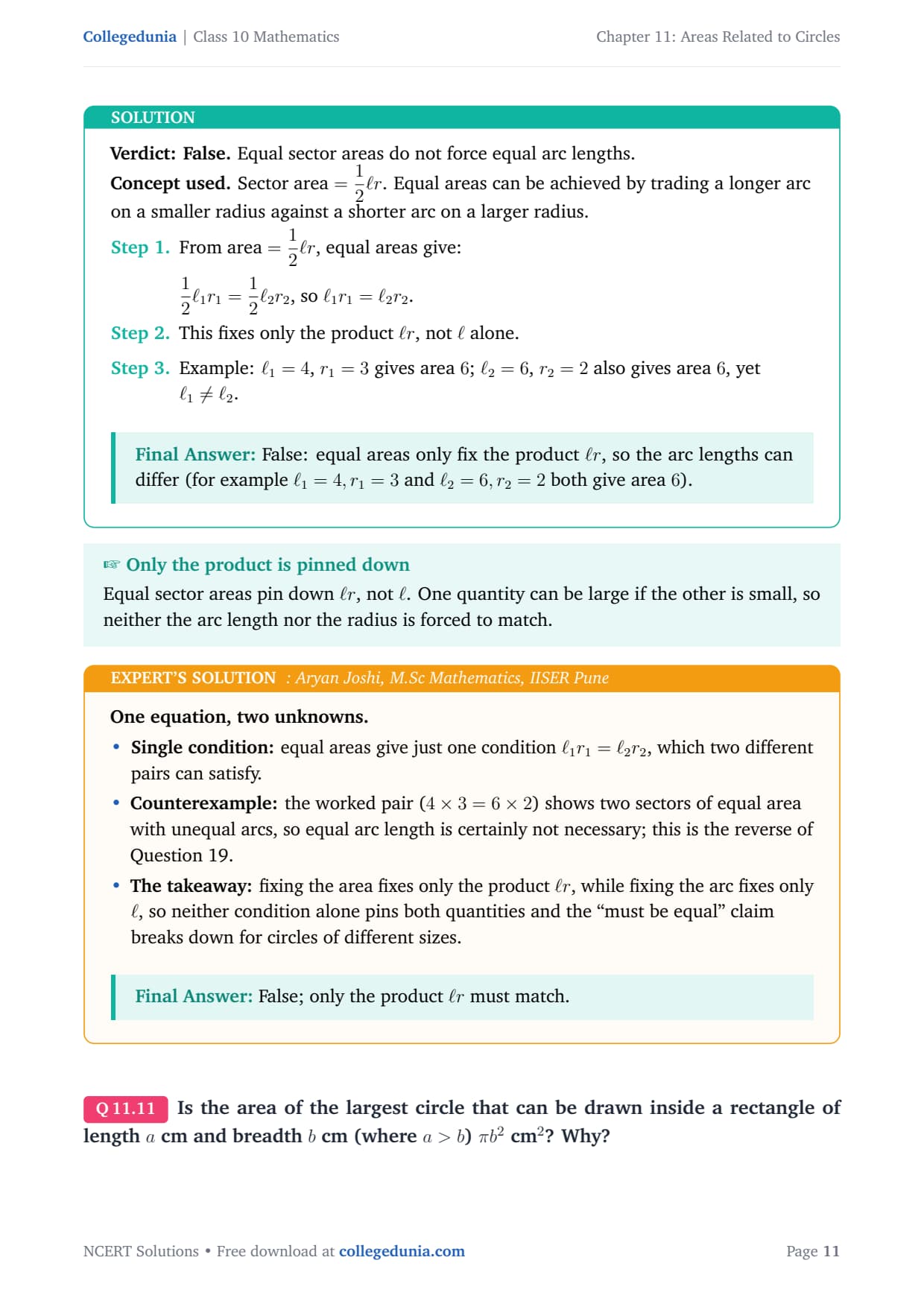
The areas of two sectors of two different circles are equal. Is it necessary that their corresponding arc lengths are equal? Why?
Verdict: False. Equal sector areas do not force equal arc lengths.
Concept used. Sector area =12r. Equal areas can be
achieved by trading a longer arc on a smaller radius against a shorter arc on a
larger radius.
From area =12r, equal areas give:
[] 121 r1=122 r2, so
1 r1=2 r2.
This fixes only the product r, not alone.
Example: 1=4, r1=3 gives area 6; 2=6, r2=2 also
gives area 6, yet 1≠2.
False: equal areas only fix the product r, so the arc lengths
can differ (for example 1=4,r1=3 and 2=6,r2=2 both give area
6).
AJ
Aryan Joshi
M.Sc Mathematics, IISER Pune
Verified Expert
One equation, two unknowns.
Single condition: equal areas give just one condition
1 r1=2 r2, which two different pairs can satisfy.
Counterexample: the worked pair (4× 3=6× 2) shows
two sectors of equal area with unequal arcs, so equal arc length is
certainly not necessary; this is the reverse of Question 19.
The takeaway: fixing the area fixes only the product
r, while fixing the arc fixes only , so neither condition
alone pins both quantities and the ``must be equal'' claim breaks down
for circles of different sizes.
False; only the product r must match.
Q 11.11
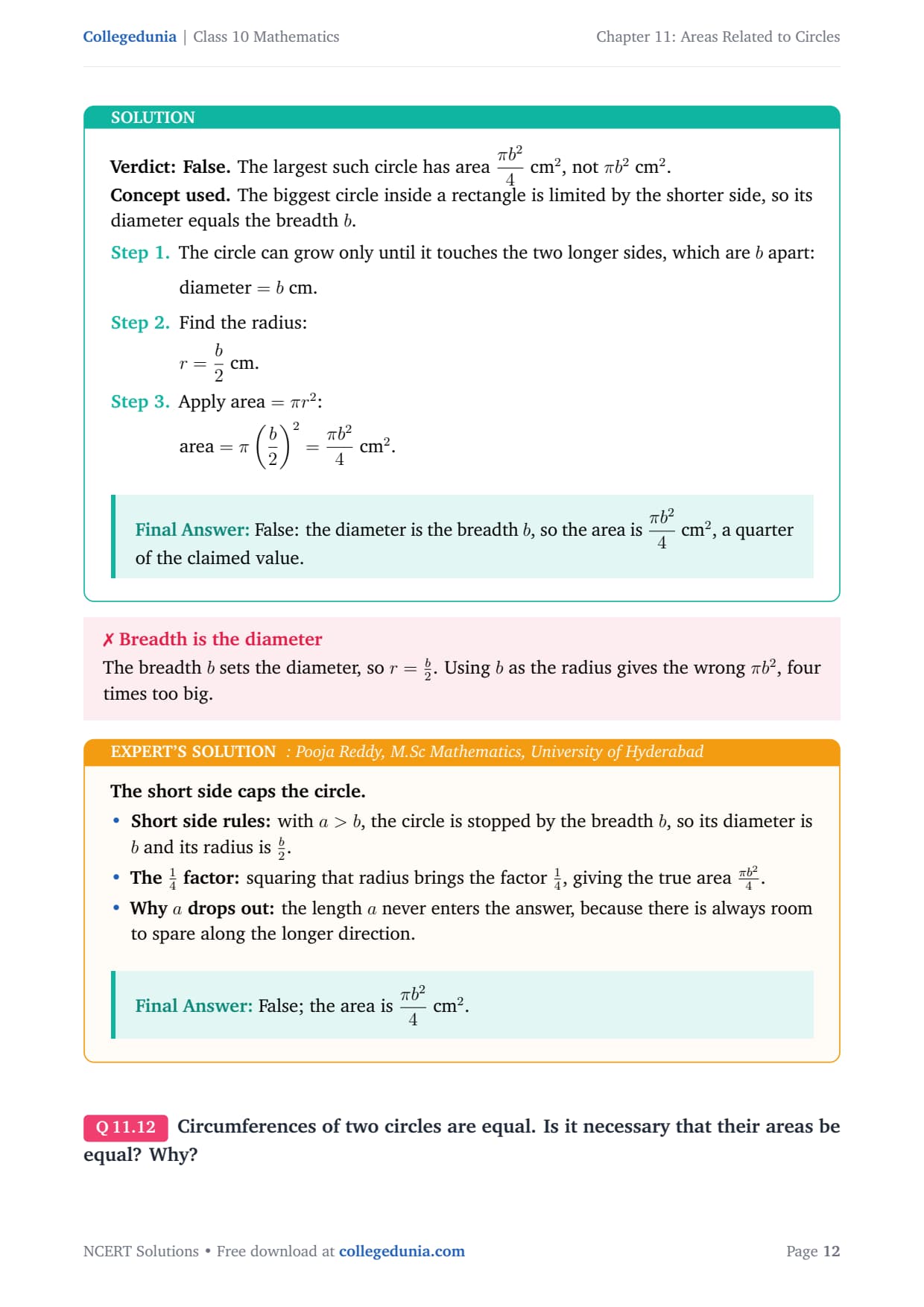
Is the area of the largest circle that can be drawn inside a rectangle of length a cm and breadth b cm (where a>b) π b2 cm2? Why?
Verdict: False. The largest such circle has area
π b24 cm2, not π b2 cm2.
Concept used. The biggest circle inside a rectangle is limited by the
shorter side, so its diameter equals the breadth b.
The circle can grow only until it touches the two longer sides, which
are b apart:
[] diameter =b cm.
Find the radius:
[] r=b2 cm.
Apply area =π r2:
[] area =π(b2)2=π b24 cm2.
False: the diameter is the breadth b, so the area is
π b24 cm2, a quarter of the claimed value.
PR
Pooja Reddy
M.Sc Mathematics, University of Hyderabad
Verified Expert
The short side caps the circle.
Short side rules: with a>b, the circle is stopped by the
breadth b, so its diameter is b and its radius is b2.
The 14 factor: squaring that radius brings the factor
14, giving the true area π b24.
Why a drops out: the length a never enters the answer,
because there is always room to spare along the longer direction.
False; the area is π b24 cm2.
Q 11.12
Circumferences of two circles are equal. Is it necessary that their areas be equal? Why?
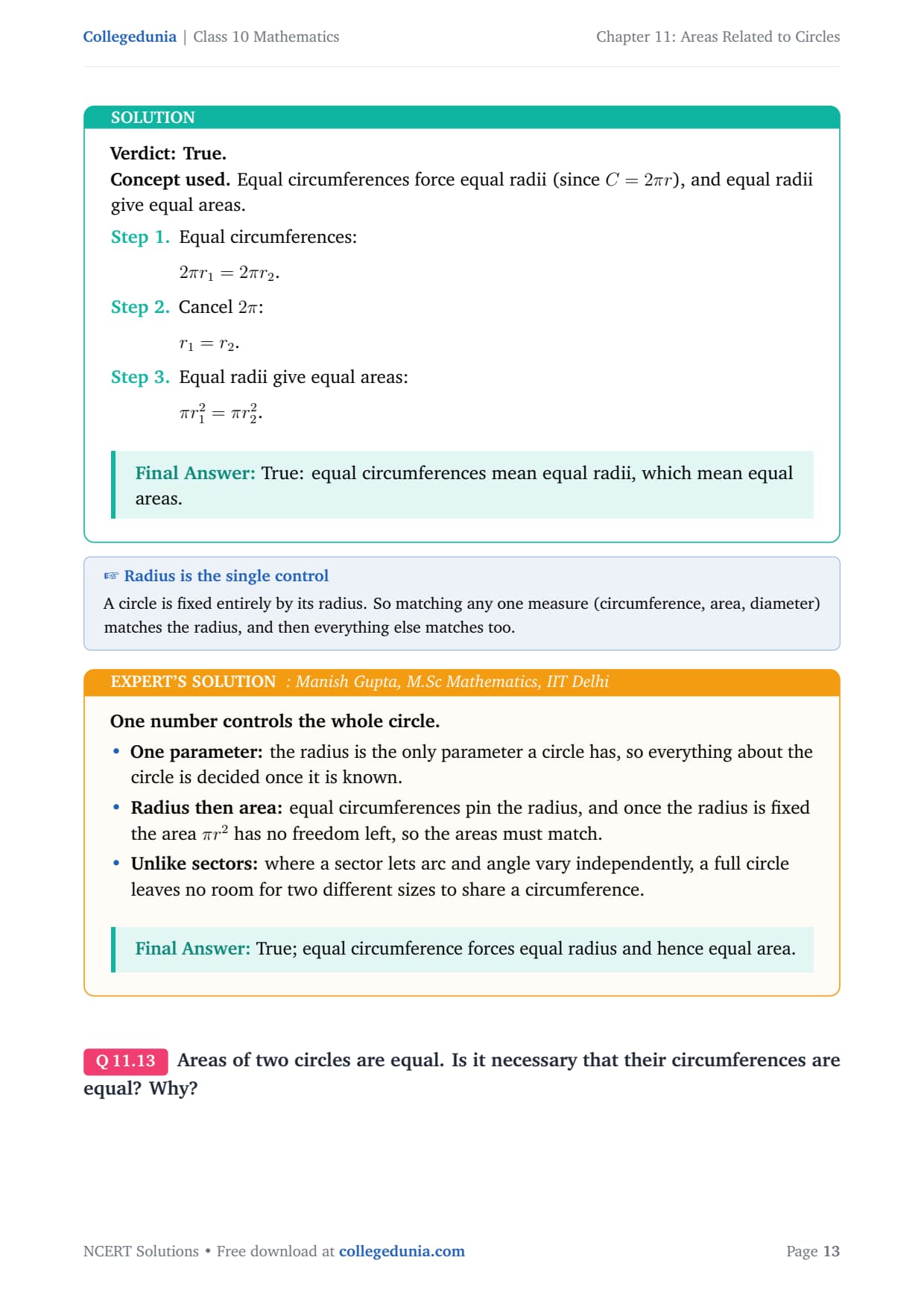
Verdict: True.
Concept used. Equal circumferences force equal radii (since
C=2π r), and equal radii give equal areas.
Equal circumferences:
[] 2π r1=2π r2.
Cancel 2π:
[] r1=r2.
Equal radii give equal areas:
[] π r12=π r22.
True: equal circumferences mean equal radii, which mean equal areas.
MG
Manish Gupta
M.Sc Mathematics, IIT Delhi
Verified Expert
One number controls the whole circle.
One parameter: the radius is the only parameter a circle has,
so everything about the circle is decided once it is known.
Radius then area: equal circumferences pin the radius, and
once the radius is fixed the area π r2 has no freedom left, so the
areas must match.
Unlike sectors: where a sector lets arc and angle vary
independently, a full circle leaves no room for two different sizes to
share a circumference.
True; equal circumference forces equal radius and hence equal area.
Q 11.13
Areas of two circles are equal. Is it necessary that their circumferences are equal? Why?
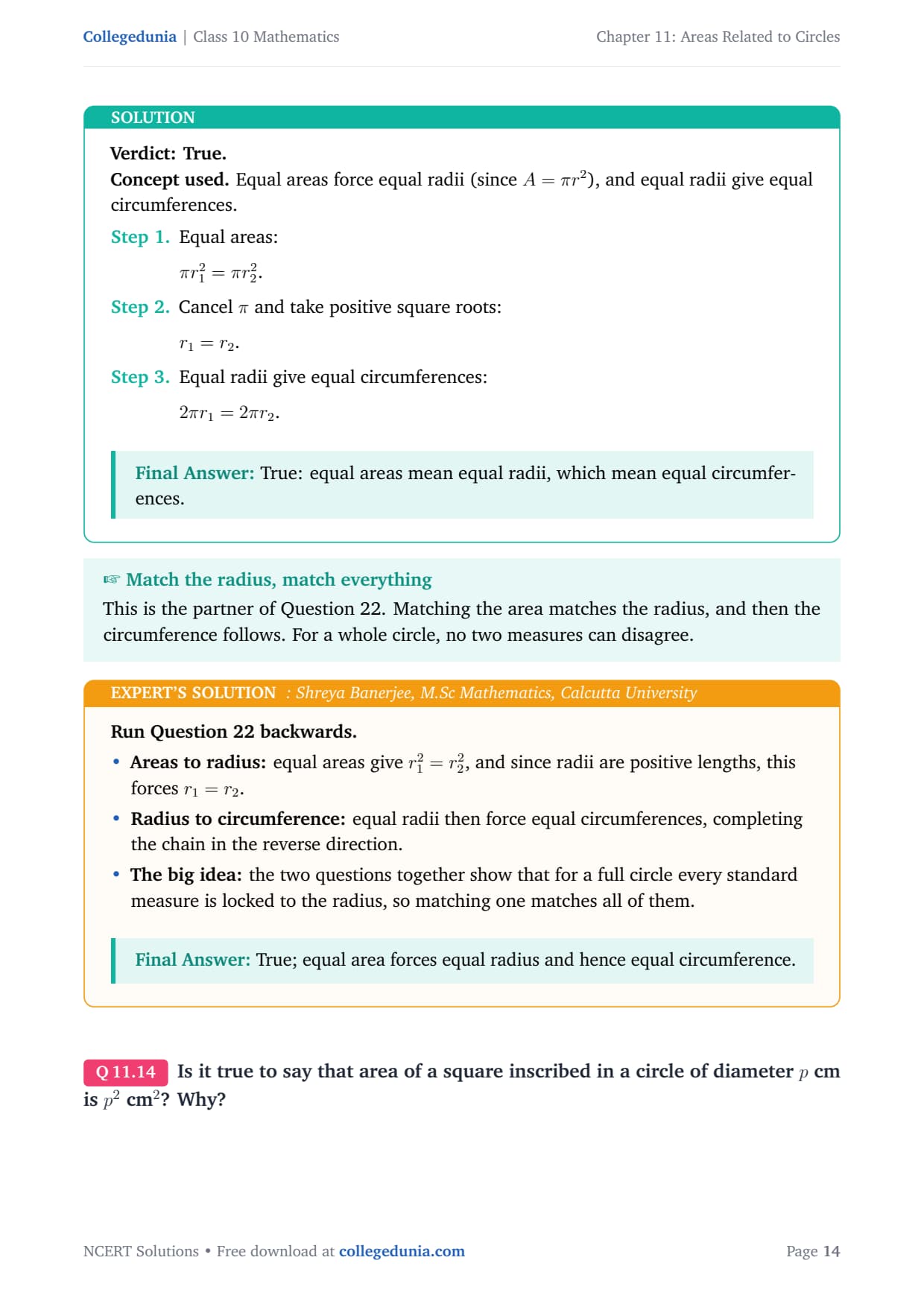
Verdict: True.
Concept used. Equal areas force equal radii (since A=π r2), and
equal radii give equal circumferences.
Equal areas:
[] π r12=π r22.
Cancel π and take positive square roots:
[] r1=r2.
Equal radii give equal circumferences:
[] 2π r1=2π r2.
True: equal areas mean equal radii, which mean equal circumferences.
SB
Shreya Banerjee
M.Sc Mathematics, Calcutta University
Verified Expert
Run Question 22 backwards.
Areas to radius: equal areas give r12=r22, and since
radii are positive lengths, this forces r1=r2.
Radius to circumference: equal radii then force equal
circumferences, completing the chain in the reverse direction.
The big idea: the two questions together show that for a full
circle every standard measure is locked to the radius, so matching one
matches all of them.
True; equal area forces equal radius and hence equal circumference.
Q 11.14
Is it true to say that area of a square inscribed in a circle of diameter p cm is p2 cm2? Why?
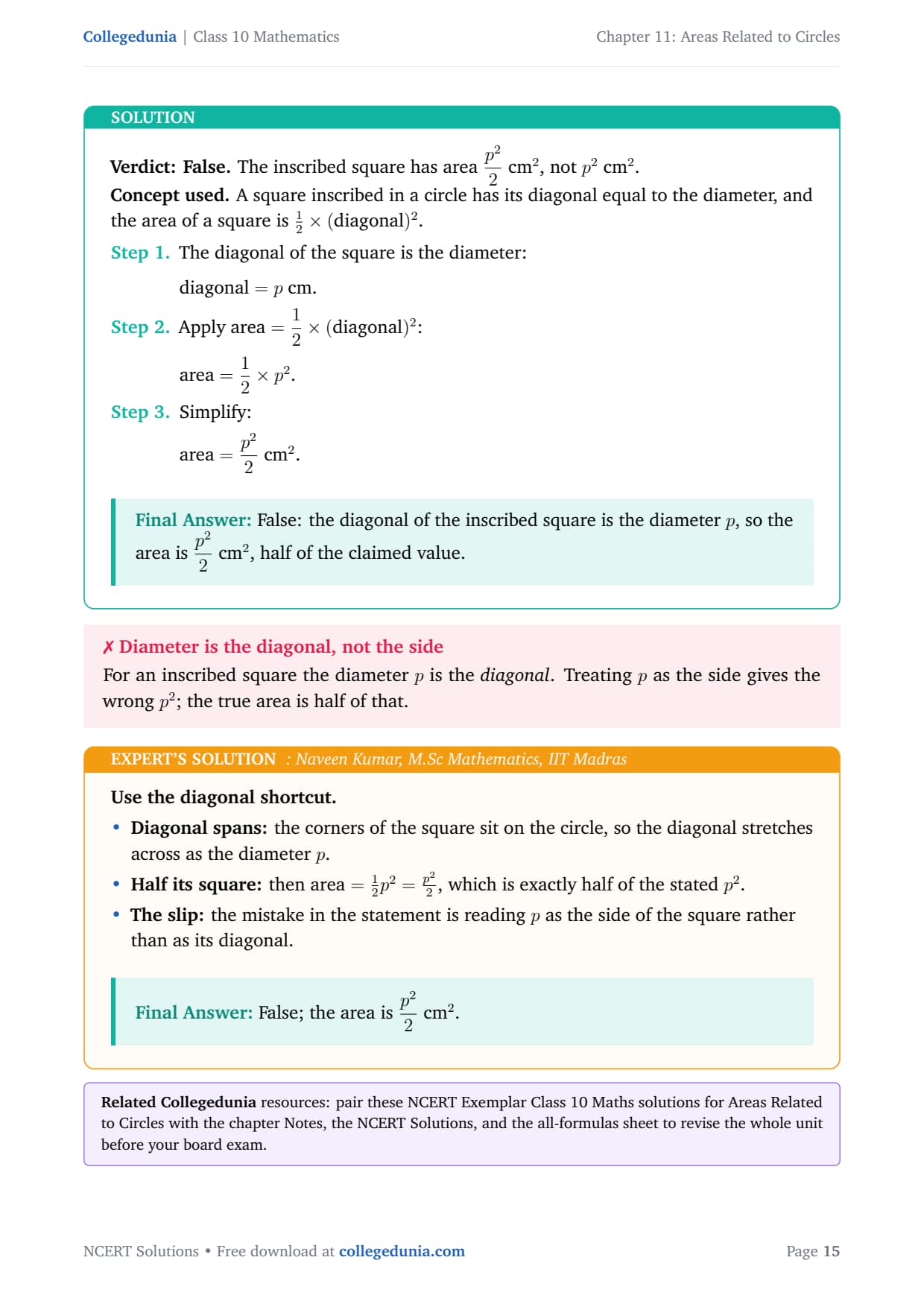
Verdict: False. The inscribed square has area
p22 cm2, not p2 cm2.
Concept used. A square inscribed in a circle has its diagonal equal to
the diameter, and the area of a square is 12×(diagonal)2.
The diagonal of the square is the diameter:
[] diagonal =p cm.
Apply area =12×(diagonal)2:
[] area =12× p2.
Simplify:
[] area =p22 cm2.
False: the diagonal of the inscribed square is the diameter p, so
the area is p22 cm2, half of the claimed value.
NK
Naveen Kumar
M.Sc Mathematics, IIT Madras
Verified Expert
Use the diagonal shortcut.
Diagonal spans: the corners of the square sit on the circle,
so the diagonal stretches across as the diameter p.
Half its square: then area =12 p2=p22, which
is exactly half of the stated p2.
The slip: the mistake in the statement is reading p as the
side of the square rather than as its diagonal.
False; the area is p22 cm2.
All Exercises in Chapter 11 Exemplar
Chapter 11 Areas Related to Circles has four Exemplar exercises. Open any one below.
FAQs on NCERT Exemplar Class 10 Maths Chapter 11 Exercise 11.2
Ques. What type of questions are in Exercise 11.2 of NCERT Exemplar Class 10 Maths Chapter 11?
Ans. Exercise 11.2 has 14 Short Answer Questions with Reasoning (Q11 to Q24). Each question states a result about circles, sectors, segments, or inscribed/circumscribed shapes and asks students to decide if it is true or false, with a full explanation. This is also called the True or False section of the Exemplar for Chapter 11 Areas Related to Circles.
Ques. Why is the area of the inscribed circle in a square of side a equal to πa²/4 and not πa²?
Ans. When a circle is inscribed in a square of side a, the circle just fits between opposite sides, so its diameter equals the side a, not its radius. The radius is a/2. Applying area = π r2 gives π(a/2)2 = πa2/4. The claim πa2 uses a as the radius instead of the diameter, giving an answer 4 times too large.
Ques. Why is the outer square only twice the inner square in Q13, not four times?
Ans. In Q13, the outer (circumscribing) square has side = diameter d, so its area = d2. The inner (inscribed) square has diagonal = diameter d, so its area = d2/2. The ratio is d2 : d2/2 = 2:1. Four times would require the sides to be in ratio 2, but they are actually in ratio √2, which squares to give the area ratio of 2.
Ques. How do I decide if a segment is smaller or larger than its sector (Q14)?
Ans. For a minor segment: area = sector area - triangle area, so the segment is always smaller than its sector. For a major segment: area = major sector area + triangle area, so the segment is always larger than its sector. Since the question does not specify which segment, the statement that a segment is always less than its sector is false - it only holds for the minor segment.
Ques. What is the correct distance covered by a wheel of diameter d in one revolution (Q15)?
Ans. In one revolution, a wheel covers a distance equal to its circumference. Circumference = 2π r = π d. So the correct answer is π d cm. The value 2π d is wrong because it substitutes the diameter into the radius position in the formula 2π r, doubling the result.







Comments