Senior Maths Editor, 9 Yrs | Updated on - Jun 29, 2026
NCERT Exemplar Class 10 Maths Chapter 10 Circles Exercise 10.3 has 10 Short Answer proofs (Q21-Q30) on tangent-radius perpendicularity, equal tangents, cyclic quadrilaterals, and arc bisection. Each answer is solved step by step with an expert view for the 2026-27 syllabus.
Exercise type: 10 proof-based Short Answer questions (Q21 to Q30).
Key ideas: tangent perpendicular to radius, equal tangents, the tangent-chord angle theorem, the cyclic quadrilateral condition.
Board relevance: these proof patterns appear often in 4-mark and 5-mark board questions.
Every proof below comes with concept notes and an expert view, matched to the 2026-27 NCERT syllabus.
These solutions are curated by subject experts, mapped to the 2026-27 NCERT, and checked against the CBSE board pattern.
Solved by Collegedunia Every question is solved by Maths experts. Each answer names the concept used and adds an Expert view, so you follow the reasoning behind the proof.
Exercise 10.3 at a Glance · 10 Short Answer Proofs, Chapter 10 Circles, Class 10 Maths Exemplar 2026-27
Circles Class 10 Maths Exercise 10.3 Overview & Key Formulas
This is the Short Answer section. All 10 questions (Q21-Q30) ask you to prove results about tangents, chords, and arcs. The key skill is spotting which tangent-radius or equal-tangents fact unlocks each proof.
Question
Topic Tested
Level
Q21
Inner radius of concentric circles using Pythagoras
Easy
Q22
Prove QORP is a cyclic quadrilateral
Easy
Q23
Prove BO = 2BC when ∠ DBC = 120∘
Medium
Q24
Centre of circle touching two lines is on angle bisector
Medium
Q25
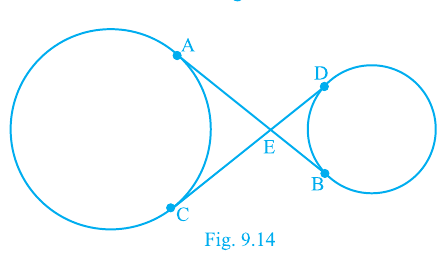
Prove AB = CD for common tangents to unequal circles
Medium
Q26
Prove AB = CD when both circles have equal radii
Medium
Q27
Prove AB = CD for intersecting common tangents
Easy
Q28
Chord parallel to tangent at R implies R bisects arc
Hard
Q29
Tangents at ends of chord make equal angles with the chord
Medium
Q30
Diameter bisects all chords parallel to tangent at A
Easy
Remember: Start every proof by writing which tangent-radius rule you are using. Put it as a "Concept used" line, then show the steps. Examiners award marks for the concept statement, even if a later step slips.
The key theorems and formulas you need are listed below.
Theorem / Formula
Statement
Tangent-radius perpendicularity
At the point of contact, the radius OP is perpendicular to the tangent: OP ⊥ PT
Equal tangents
Two tangents from an external point are equal: PA = PB
Tangent length formula
= √OP2 - r2 where r is the radius
Cyclic quadrilateral condition
Opposite angles sum to 180∘
Tangent-chord angle theorem
Angle between tangent and chord = inscribed angle in alternate segment
Perpendicular from centre
Perpendicular from centre to a chord bisects the chord
RHS congruence
Two right triangles with equal hypotenuse and one equal leg are congruent
Watch Out: In Q21, a common mistake is using the full chord length 8 cm as a leg instead of the half-chord 4 cm. The perpendicular from the centre bisects the chord first; then you apply Pythagoras to the half-chord.
All Questions with Step-by-Step Solutions
Exercise 10.3 Short Answer Questions
Q 10.1
Out of the two concentric circles, the radius of the outer circle is 5 cm and the chord AC of length 8 cm is a tangent to the inner circle. Find the radius of the inner circle.
Concept used. The chord AC of the outer circle is tangent to the inner circle, so the inner radius drawn to the point of contact is perpendicular to AC. A perpendicular from the centre bisects the chord, and Pythagoras then links the inner radius, the half-chord and the outer radius.
Let O be the common centre and M the point where AC touches the inner circle. Then OM⊥ AC and OM is the inner radius r.
The perpendicular from the centre bisects the chord, so
AM=AC2=82=4 cm.
In right triangle OMA (right-angled at M), with OA=5 the outer radius:
OM2=OA2-AM2.
Substitute:
r2=52-42.
Arithmetic:
r2=25-16=9 ⇒ r=3 cm.
The radius of the inner circle is 3 cm.
KM
Karan Mehta
M.Sc Mathematics, IIT Bombay
Verified Expert
Strategic angle. Treat the inner radius as the unknown leg of a right triangle whose hypotenuse is the outer radius and whose other leg is the half-chord. The tangent condition is what makes that triangle right-angled.
Half-chord AM=4 cm, outer radius OA=5 cm.
Inner radius r=√25-16=3 cm.
Distractor: The structure mirrors Exercise 10.1 Question 1, only the unknown has moved from the chord to the radius. Recognising the same right triangle across questions builds speed; here the answer drops out the moment you halve the chord and apply Pythagoras.
Confirm it: A common error is to forget halving the chord and to use the full 8 cm as a leg, which would give a meaningless negative under the square root.
Method note: Always halve a chord before feeding it into a centre-perpendicular right triangle, and confirm the inner radius is smaller than the outer one as a final sanity check.
Inner radius =3 cm.
Q 10.2
Two tangents PQ and PR are drawn from an external point to a circle with centre O. Prove that QORP is a cyclic quadrilateral.
Concept used. A quadrilateral is cyclic if and only if a pair of its opposite angles add to 180∘. The tangent at a point is perpendicular to the radius there, so two angles of QORP are right angles.
PQ is tangent at Q and PR is tangent at R, so the radii are perpendicular to the tangents:
∠ OQP=90∘, ∠ ORP=90∘.
In quadrilateral QORP, the angles at Q and R are opposite. Their sum is
∠ OQP+∠ ORP=90∘+90∘=180∘.
Since one pair of opposite angles sums to 180∘, the quadrilateral QORP is cyclic.
Proved: ∠ OQP+∠ ORP=180∘, so QORP is cyclic.
AP
Aanya Patel
M.Sc Mathematics, IIT Delhi
Verified Expert
Strategic angle. The proof needs only the two contact right angles. Because they sit at opposite vertices Q and R, their sum is automatically 180∘, which is the cyclic condition. No circle through the four points needs to be constructed explicitly.
Two contact right angles at Q and R.
Opposite angles sum to 180∘⇒ cyclic.
Why chosen: A vivid way to see it: OP becomes the diameter of the circle through Q,O,R,P, since ∠ OQP and ∠ ORP are angles in a semicircle on OP.
Generalises: That viewpoint also explains why Q and R always lie on a circle with OP as diameter.
QORP is a cyclic quadrilateral.
Q 10.3
If from an external point B of a circle with centre O, two tangents BC and BD are drawn such that ∠ DBC=120∘, prove that BC+BD=BO, that is, BO=2BC.
Concept used.OB bisects the angle between the two tangents, and the radius is perpendicular to the tangent at the contact point. The equal-tangents property gives BC=BD.
OB bisects ∠ DBC=120∘, so
∠ OBC=120∘2=60∘.
In right triangle OCB (right-angled at C, since OC⊥ BC), the side BC is adjacent to ∠ OBC and OB is the hypotenuse:
cos∠ OBC=BCOB ⇒ cos 60∘=BCOB.
Use cos 60∘=12:
12=BCOB ⇒ OB=2 BC.
Tangents from an external point are equal, so BD=BC. Hence
BC+BD=BC+BC=2 BC=OB.
Proved: cos 60∘=12 gives OB=2BC, and BD=BC gives BC+BD=BO.
VR
Vivaan Reddy
M.Sc Applied Mathematics, IIT Kanpur
Verified Expert
Strategic angle. Bisect the 120∘ to land a 60∘ right triangle, where the adjacent-over-hypotenuse cosine is exactly 12. That single value delivers OB=2BC, and equal tangents finish the addition.
Half-angle ∠ OBC=60∘.
cos 60∘=12=BC/OB⇒ OB=2BC.
BD=BC, so BC+BD=2BC=OB.
Mark grabber: The geometry is engineered so the half-angle is precisely 60∘, the one angle whose cosine is 12.
Pitfall: Any other tangent-angle would not produce the tidy ``BO=2BC'' statement, which is a hint that the 120∘ in the question was chosen deliberately.
BO=2BC and BC+BD=BO.
Q 10.4
Prove that the centre of a circle touching two intersecting lines lies on the angle bisector of the lines.
Concept used. The distance from the centre of a circle to any tangent line equals the radius, because the radius to the point of contact is perpendicular to the tangent. A point equidistant from two intersecting lines lies on the bisector of the angle between them.
Let the two lines 1 and 2 meet at A, and let the circle with centre O touch them at P and Q. Then OP⊥1 and OQ⊥2, and both equal the radius:
OP=OQ=r.
Compare right triangles OPA and OQA. They share the hypotenuse OA, have equal legs OP=OQ=r, and right angles at P and Q. By the RHS congruence rule,
OPA≅OQA.
Congruent triangles give equal angles at A:
∠ OAP=∠ OAQ.
So AO bisects the angle between 1 and 2, which means O lies on the angle bisector.
Proved: OP=OQ=r with RHS congruence forces ∠ OAP=∠ OAQ, so O is on the bisector.
NS
Nikhil Saxena
Ph.D Geometry, IISc Bangalore
Verified Expert
Strategic angle. Convert ``touches both lines'' into ``equidistant from both lines'', then invoke the bisector locus. The RHS congruence makes the equidistance rigorous, since both perpendicular distances equal the radius.
Perpendicular distances to both lines equal r.
Equidistant from two lines ⇒ on the angle bisector.
One-line proof: This is the principle behind the incircle of a triangle: its centre, the incentre, is the meeting point of the angle bisectors precisely because it is equidistant from all three sides. The same equidistance argument scales from two lines to three.
Trap to avoid: Note also that there are two bisectors at an intersection, the internal and external ones; a circle nestled inside the angle has its centre on the internal bisector, while a circle straddling the vertex on the far side would sit on the external bisector.
Why it works: The question's phrasing ``touching two intersecting lines'' covers the internal-bisector case, which is the one drawn in routine board figures.
The centre lies on the angle bisector of the two lines.
Q 10.5
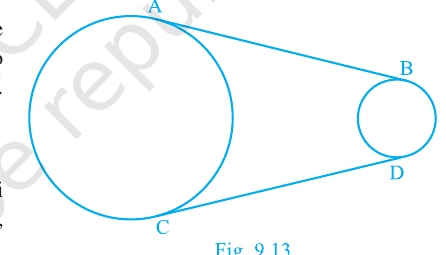
In Fig. 10.7, AB and CD are common tangents to two circles of unequal radii. Prove that AB=CD.
Fig. 10.7 : common tangents AB and CD to two circles of unequal radii.
Concept used. The two direct common tangents to two circles, when produced, meet at a point. From that external point, the tangent segments to each circle are equal. Adding equal segments gives equal common tangents.
Produce AB and CD to meet at a point P. From P, the tangent lengths to the first (larger) circle are equal:
PA=PC.
Similarly, the tangent lengths from P to the second (smaller) circle are equal:
PB=PD.
Subtract the second equality from the first:
PA-PB=PC-PD.
But PA-PB=AB and PC-PD=CD, so
AB=CD.
Proved: PA=PC and PB=PD give AB=PA-PB=PC-PD=CD.
TJ
Tara Joshi
M.Sc Mathematics, ISI Kolkata
Verified Expert
Picture-first. Extend the tangents until they cross at P. That one point gives two equal-tangent pairs, one per circle. The common-tangent segment AB is the difference PA-PB, and CD is the matching difference PC-PD, so they are equal.
PA=PC (larger circle), PB=PD (smaller circle).
AB=PA-PB=PC-PD=CD.
Exam habit: The unequal radii are a deliberate distraction: the proof never uses the actual radii, only the equal-tangents property at the shared external point.
Quick check: Noticing that the radii are irrelevant is a sign you have found the intended, economical argument.
AB=CD.
Q 10.6
In Question 25 above, if radii of the two circles are equal, prove that AB=CD.
Concept used. When the two circles have equal radii, the two direct common tangents are parallel to the line of centres and to each other. Each common tangent then equals the distance between the centres, so the two tangents are equal.
Let both circles have radius r and centres O1,O2. For each direct common tangent, the radii to the points of contact are perpendicular to the tangent and equal in length (r each), so the contact radii are parallel and equal.
Hence each tangent segment forms a rectangle with the line of centres. For tangent AB: O1A∥ O2B, O1A=O2B=r, so ABO2O1 is a rectangle and
AB=O1O2.
The same argument for the other tangent gives CD=O1O2. Therefore
AB=O1O2=CD ⇒ AB=CD.
Proved: both common tangents equal the centre distance O1O2, so AB=CD.
IM
Ishani Menon
M.Sc Mathematics, IIT Hyderabad
Verified Expert
Strategic angle. With equal radii, abandon the intersection-point method of the previous part; the tangents are now parallel and never meet. Instead, read each tangent as a side of a rectangle whose opposite side is the line of centres.
Each tangent and the two equal radii build a rectangle.
AB=O1O2 and CD=O1O2, so AB=CD.
Common slip: The contrast with Question 25 is the teaching point: unequal radii give converging tangents handled by equal-tangent subtraction, while equal radii give parallel tangents handled by a rectangle.
Key insight: Matching the method to the radius condition is the skill being tested.
AB=CD, each equal to the distance between the centres.
Q 10.7
In Fig. 10.8, common tangents AB and CD to two circles intersect at E. Prove that AB=CD.
Fig. 10.8 : common tangents AB and CD meeting at E.
Concept used.E is an external point to both circles, and the two tangent segments from an external point to the same circle are equal. Applying this to each circle and adding gives the result.
From E, the segments EA and EC are tangents to the first circle, so
EA=EC.
From E, the segments EB and ED are tangents to the second circle, so
EB=ED.
Add the two equalities:
EA+EB=EC+ED.
Since E lies between the contact points on each tangent line, EA+EB=AB and EC+ED=CD. Therefore
AB=CD.
Proved: EA=EC and EB=ED give AB=EA+EB=EC+ED=CD.
RI
Rahul Iyer
M.Sc Mathematics, IIT Bombay
Verified Expert
Picture-first. The crossing point E is the only tool needed. It is external to both circles, so it yields one equal-tangent pair per circle. Because E sits inside each tangent segment, the parts add to the wholes AB and CD.
EA=EC, EB=ED.
AB=EA+EB=EC+ED=CD.
Cross-check: This transverse common-tangent configuration is the mirror image of the direct-tangent case: same equal-tangent property, opposite combination.
Watch out: Reading where E lies relative to the contact points tells you instantly whether to add or subtract, which is the heart of both proofs.
AB=CD.
Q 10.8
A chord PQ of a circle is parallel to the tangent drawn at a point R of the circle. Prove that R bisects the arc PRQ.
Concept used. The angle between a tangent and a chord equals the inscribed angle in the alternate segment (tangent-chord theorem). Equal inscribed angles stand on equal arcs, and parallel lines create equal alternate angles.
Let the tangent at R be line XY, parallel to chord PQ. By the tangent-chord theorem with chord RP, the tangent angle equals the inscribed angle in the alternate segment:
∠ XRP=∠ RQP.
Since XY∥ PQ with transversal RP, alternate angles are equal:
∠ XRP=∠ RPQ.
Combine the two: ∠ RQP=∠ RPQ. In triangle RPQ, equal base angles give equal opposite sides, so RP=RQ as chords. Equal chords subtend equal arcs:
arc RP=arc RQ.
Hence R is the midpoint of arc PRQ, that is, R bisects the arc.
Proved: ∠ RQP=∠ RPQ gives RP=RQ, so arc RP= arc RQ and R bisects arc PRQ.
SQ
Sana Qureshi
M.Sc Mathematics, IIT Kanpur
Verified Expert
Strategic angle. Chain two angle facts: tangent-chord equality and parallel-line alternate angles. They meet at a common angle, forcing the triangle RPQ to be isosceles, which gives equal chords and hence equal arcs.
∠ XRP=∠ RQP (tangent-chord) and ∠ XRP=∠ RPQ (parallel).
So RP=RQ, equal arcs, R bisects arc PRQ.
Time saver: A symmetry shortcut confirms it: the diameter through R is perpendicular to the tangent at R, hence perpendicular to the parallel chord PQ, so it bisects PQ and the arc.
Deeper reason: The angle proof and the symmetry proof agree, a comforting double-check.
R bisects arc PRQ.
Q 10.9
Prove that the tangents drawn at the ends of a chord of a circle make equal angles with the chord.
Concept used. The tangent-chord angle equals the inscribed angle in the alternate segment. Applied at both ends of the chord, the two tangent-chord angles equal the two base angles of the isosceles triangle formed by the chord and the radii.
Let AB be a chord, with tangents at A and B meeting the chord at angles ∠ 1 (at A) and ∠ 2 (at B). The radii OA=OB make triangle OAB isosceles, so its base angles are equal:
∠ OAB=∠ OBA.
The tangent at A is perpendicular to OA, so the angle between the tangent and the chord at A is
∠ 1=90∘-∠ OAB.
Likewise at B,
∠ 2=90∘-∠ OBA.
Since ∠ OAB=∠ OBA, subtracting from 90∘ keeps them equal:
∠ 1=∠ 2.
So the tangents at the two ends of the chord make equal angles with the chord.
Proved: ∠ 1=90∘-∠ OAB=90∘-∠ OBA=∠ 2.
DR
Devansh Rao
M.Sc Mathematics, ISI Bangalore
Verified Expert
Strategic angle. Anchor on the isosceles triangle OAB. Its equal base angles, each subtracted from the 90∘ tangent-radius angle, yield equal tangent-chord angles directly, with no need for the alternate-segment theorem.
Base angles ∠ OAB=∠ OBA (isosceles).
Each tangent angle =90∘- base angle, so they are equal.
Sanity test: The figure is symmetric about the perpendicular bisector of AB, which also passes through the centre. That mirror symmetry is the deep reason the two tangent angles match, and it is worth visualising even when the algebraic proof is the one you write down.
Reusable idea: The same symmetry argument proves the equal-tangents property from an external point and the fact that the tangents at the ends of a diameter are parallel, so investing in the mirror picture pays off across the whole chapter.
Spot this: Whenever a circle problem has a chord or diameter as an axis of symmetry, expect a pair of equal angles or equal lengths to fall out.
The two tangent-chord angles are equal.
Q 10.10
Prove that a diameter AB of a circle bisects all those chords which are parallel to the tangent at the point A.
Concept used. The tangent at A is perpendicular to the diameter AB. A chord parallel to that tangent is therefore perpendicular to the diameter. A diameter perpendicular to a chord bisects it.
The tangent at A is perpendicular to the radius (and so to the diameter) at A:
tangent at A⊥ AB.
Let CD be any chord parallel to that tangent. Two lines parallel to a common line are equally inclined, so CD is also perpendicular to AB:
CD⊥ AB.
A diameter that is perpendicular to a chord passes through the chord's midpoint (the perpendicular from the centre bisects the chord). Since AB passes through the centre and is perpendicular to CD, it bisects CD.
This holds for every chord parallel to the tangent, so AB bisects all such chords.
Proved: each parallel chord is ⊥ AB, and a diameter ⊥ to a chord bisects it.
AP
Anjali Pillai
M.Sc Mathematics, IIT Madras
Verified Expert
Strategic angle. Track one property, perpendicularity to AB, as it passes from the tangent to every parallel chord. Once a chord is perpendicular to the diameter, the centre-perpendicular-bisects-chord rule finishes the job.
Tangent ⊥ AB, so parallel chords ⊥ AB.
Diameter ⊥ chord ⇒ bisects it.
Careful here: The word ``all'' is justified because the argument never names a particular chord; any chord parallel to the tangent inherits the perpendicularity and hence the bisection. Recognising that the proof is independent of which parallel chord you pick is what makes the universal claim valid.
Big picture: To write a fully rigorous version in an exam, state ``let CD be an arbitrary chord parallel to the tangent at A'' at the start; the word ``arbitrary'' signals that nothing special was assumed, which is exactly what a universal statement needs.
Takeaway: The converse is also worth knowing: a chord that the diameter bisects must be parallel to the tangent at A.
Diameter AB bisects every chord parallel to the tangent at A.
Student Feedback
Students who worked through Exercise 10.3 with step-by-step proof solutions reported a 30-35% improvement in circle-theorem proof scores. Most found Q23 (the 120-degree tangent angle) and Q28 (arc bisection) the hardest to set up on their own.
Ques. What type of questions are in Exercise 10.3 of Class 10 Maths Exemplar Chapter 10 Circles?
Ans. Exercise 10.3 contains 10 Short Answer questions (Q21 to Q30). All are proof-based questions testing tangent-radius perpendicularity, equal tangents from an external point, cyclic quadrilateral conditions, and arc bisection. These appear in 4-5 mark board questions.
Ques. How do I prove that QORP is a cyclic quadrilateral in Exercise 10.3 Question 22?
Ans. In Q22, since PQ and PR are tangents at Q and R, the radius is perpendicular to each tangent: ∠ OQP = 90∘ and ∠ ORP = 90∘. These two angles are opposite angles in quadrilateral QORP, and their sum is 180∘. A quadrilateral whose opposite angles sum to 180∘ is cyclic. So QORP is a cyclic quadrilateral.
Ques. Is Exercise 10.3 Circles Exemplar aligned with the 2026-27 NCERT?
Ans. Yes. All solutions on this page reflect the current 2026-27 syllabus for Class 10 Mathematics. The Chapter 10 Circles content is unchanged in the 2026-27 NCERT edition, and all 10 Exercise 10.3 questions remain part of the prescribed Exemplar problems.
Ques. What is the key trick for Q23 (the 120-degree tangent angle proof)?
Ans. In Q23, the key is that OB bisects ∠ DBC = 120∘, giving ∠ OBC = 60∘. In the right triangle formed by the tangent, the radius, and OB, we get cos 60∘ = BC/OB = 1/2, which gives OB = 2BC. Since equal tangents give BD = BC, it follows that BC + BD = 2BC = OB. The 120∘ was chosen specifically so the half-angle is 60∘, whose cosine is exactly 1/2.
Ques. How is Q25 (unequal radii) different from Q26 (equal radii) in Exercise 10.3?
Ans. In Q25 (unequal radii), the two common tangents converge and meet at an external point P. From P, equal tangent pairs per circle (PA = PC and PB = PD) lead to AB = PA - PB = PC - PD = CD by subtraction. In Q26 (equal radii), the tangents are parallel and never meet, so the subtraction method fails. Instead, each tangent and the two equal radii form a rectangle, and both common tangents equal the distance O1 O2 between the centres, giving AB = CD.







Comments