Maths Strategist, Olympiad Coach | Updated 3+ months ago
NCERT Exemplar Class 10 Maths Chapter 10 Circles Exercise 10.1 has 10 MCQs on tangent properties, concentric circles, and tangent-chord angles. Every answer is solved step by step with an expert view for the 2026-27 syllabus.
Exercise type: 10 single-correct MCQs.
Key ideas: tangent perpendicular to radius, equal tangents from an external point, the alternate segment theorem.
Board relevance: Circles is a high-frequency chapter, and these MCQ patterns show up in board papers and sample papers.
Every MCQ below carries a full step-by-step solution and an expert view, all matched to the 2026-27 NCERT syllabus.
These solutions are curated by subject experts, mapped to the 2026-27 rationalised NCERT, and checked against the CBSE board pattern.
Solved by Collegedunia Every question is solved by Maths experts. Each answer has numbered steps and an Expert view, so you learn the reasoning, not just the result.
Exercise 10.1 at a Glance · 10 MCQs, Chapter 10 Circles, Class 10 Maths Exemplar 2026-27
This is the MCQ section of the Circles Exemplar. All 10 questions are single-correct. The table lists the topic and difficulty for each one.
Question
Topic Tested
Level
Q1
Chord of one concentric circle tangent to another (Pythagoras)
Medium
Q2
Circumscribed quadrilateral: opposite central angles (supplementary)
Medium
Q3
Tangent-chord angle equal to inscribed angle in alternate segment
Medium
Q4
Area of quadrilateral formed by two tangents from external point
Easy
Q5
Chord parallel to tangent, distance measured from endpoint of diameter
Medium
Q6
Tangent length using cosine ratio in right triangle (trigonometry)
Medium
Q7
Central angle from tangent-chord angle (isosceles triangle method)
Medium
Q8
Angle between radius and chord from angle between two tangents
Hard
Q9
Tangent length when the angle between two tangents is given
Medium
Q10
Apex angle in triangle formed by chord parallel to tangent
Hard
Key Theorems & Formulas for Circles Class 10 Maths
Two theorems drive almost every MCQ here: the tangent-perpendicular theorem and the equal-tangents property. Most questions use one or both, often with Pythagoras or basic trigonometry.
Theorem / Formula
Statement
Tangent perpendicular to radius
At the point of contact, OP ⊥ PT. Angle between radius and tangent is always 90∘.
Equal tangents from external point
PA = PB for tangents PA and PB from external point P.
Tangent length formula
= √OP2 - r2, where OP = distance from external point to centre, r = radius.
Angle between two tangents
∠ APB = 180∘ - ∠ AOB (supplementary to the central angle).
Tangent-chord angle (alternate segment)
Angle between a tangent and a chord equals the inscribed angle in the alternate segment.
Chord bisected by perpendicular
Perpendicular from centre to a chord always bisects the chord.
Remember: For concentric circles or chord problems, always draw the radius to the point of contact. That one line creates the right angle you need to set up Pythagoras.
All Questions with Step-by-Step Solutions
Exercise 10.1 Multiple Choice Questions
Q 10.1
If radii of two concentric circles are 4 cm and 5 cm, then the length of each chord of one circle which is tangent to the other circle is
(A) 3 cm (B) 6 cm (C) 9 cm (D) 1 cm.
Correct option: (B)6 cm.
Concept used. A chord of the larger circle that is tangent to the smaller circle touches it at one point. The radius of the smaller circle drawn to that point is perpendicular to the chord, and a perpendicular from the centre bisects the chord.
Let O be the common centre, OA=4 cm (radius to the point of contact A) and OB=5 cm (radius to an endpoint B of the chord). The chord BC of the bigger circle is tangent to the smaller circle at A, so OA⊥ BC.
In right triangle OAB, apply Pythagoras:
OB2=OA2+AB2.
Substitute the values:
52=42+AB2.
Arithmetic:
25=16+AB2 ⇒ AB2=9 ⇒ AB=3 cm.
Since the perpendicular from the centre bisects the chord, A is the midpoint, so the full chord is BC=2× AB=2× 3=6 cm.
Option (B): the chord is 6 cm long.
AS
Aarav Sharma
M.Sc Mathematics, IIT Bombay
Verified Expert
Strategic angle. Spot the right triangle first. The instant you read ``chord of one circle tangent to the other'', draw the radius to the point of contact; it is perpendicular, so a right triangle with hypotenuse equal to the outer radius appears. The numbers 4,5 are two members of the famous 3,4,5 triple, so the half-chord is 3 without any heavy arithmetic.
Right triangle: legs 4 and AB, hypotenuse 5.
3,4,5 triple gives the missing leg AB=3 cm at sight.
Chord =2× 3=6 cm.
Trap to avoid: Watch the trap option (A) 3 cm: that is only the half-chord. The question asks for the full chord, so you must double it.
Why it works: Recognising the Pythagorean triple turns a two-line calculation into a one-glance answer, which is exactly the time saving boards reward in the one-mark MCQ block.
Option (B): 6 cm.
Q 10.2
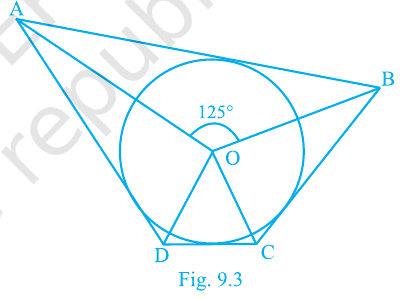
In Fig. 10.1, if ∠ AOB=125∘, then ∠ COD is equal to
(A) 62.5∘ (B) 45∘ (C) 35∘ (D) 55∘.
Fig. 10.1 : quadrilateral ABCD circumscribing a circle, with tangents from A,B,C,D.
Correct option: (D)55∘.
Concept used. For a quadrilateral circumscribing a circle, opposite sides subtend supplementary angles at the centre. That is, ∠ AOB+∠ COD=180∘ and ∠ BOC+∠ AOD=180∘, because the two tangents from each vertex are symmetric about the line joining the vertex to the centre.
AB and CD are opposite sides of the circumscribing quadrilateral, so the angles they subtend at the centre are supplementary:
∠ AOB+∠ COD=180∘.
Substitute ∠ AOB=125∘:
125∘+∠ COD=180∘.
Solve:
∠ COD=180∘-125∘=55∘.
Option (D): ∠ COD=55∘.
SI
Sneha Iyer
M.Sc Mathematics, ISI Kolkata
Verified Expert
Quick reading. The supplementary-angle property for the two pairs of opposite sides of a tangential quadrilateral is the whole question. Each vertex gives two equal tangent segments, and joining a vertex to the centre bisects the vertex angle; summing the four half-angles around O forces the opposite central angles to add to 180∘.
Opposite sides AB,CD give ∠ AOB+∠ COD=180∘.
∠ COD=180∘-125∘=55∘.
Exam habit: The distractor (A) 62.5∘ is exactly half of 125∘, which is what you would write if you wrongly halved the given angle instead of subtracting from 180∘. Keeping the supplementary rule in mind blocks that slip.
Quick check: This pairing of opposite central angles recurs whenever a circle is inscribed in a polygon.
Option (D): 55∘.
Q 10.3
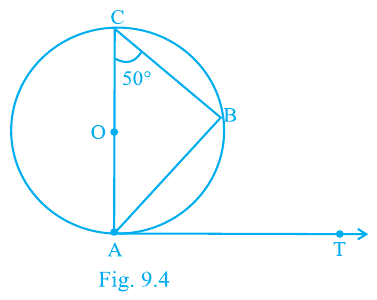
In Fig. 10.2, AB is a chord of the circle and AOC is its diameter such that ∠ ACB=50∘. If AT is the tangent to the circle at the point A, then ∠ BAT is equal to
(A) 65∘ (B) 60∘ (C) 50∘ (D) 40∘.
Fig. 10.2 : diameter AOC, chord AB, tangent AT at A.
Correct option: (C)50∘.
Concept used. The angle in a semicircle is a right angle, so the angle subtended by a diameter at any point of the circle is 90∘. Also, the tangent at a point is perpendicular to the radius (and hence to the diameter) at that point.
AOC is a diameter, so ∠ ABC=90∘ (angle in a semicircle). In triangle ABC:
∠ BAC=180∘-∠ ABC-∠ ACB=180∘-90∘-50∘=40∘.
The tangent AT is perpendicular to the diameter AC at A, so
∠ CAT=90∘.
Therefore
∠ BAT=∠ CAT-∠ BAC=90∘-40∘=50∘.
Option (C): ∠ BAT=50∘.
KM
Karan Mehta
M.Tech Computer Science, IIT Madras
Verified Expert
Picture-first. The cleanest route is the tangent-chord (alternate segment) theorem: the angle between tangent AT and chord AB equals the inscribed angle ∠ ACB in the alternate segment. That gives the answer in one line, and the diameter-and-right-angle method confirms it.
Alternate segment: ∠ BAT=∠ ACB=50∘.
Cross-check via the semicircle: ∠ BAC=40∘, and 90∘-40∘=50∘.
Common slip: The two methods agreeing is a strong self-check under exam pressure.
Key insight: Students who only learn the triangle method spend longer and risk an angle-chase slip; the alternate-segment theorem is worth memorising because it collapses many tangent problems to a single equality.
Option (C): 50∘.
Q 10.4
From a point P which is at a distance of 13 cm from the centre O of a circle of radius 5 cm, the pair of tangents PQ and PR to the circle are drawn. Then the area of the quadrilateral PQOR is
(A) 60 cm2 (B) 65 cm2 (C) 30 cm2 (D) 32.5 cm2.
Correct option: (A)60 cm2.
Concept used. The tangent at a point is perpendicular to the radius at the point of contact, so ∠ OQP=∠ ORP=90∘. The quadrilateral PQOR is made of two congruent right triangles, and the tangent length is found by Pythagoras.
Tangent length PQ from the right triangle OQP (right-angled at Q):
PQ=√OP2-OQ2.
Substitute OP=13, OQ=5:
PQ=√132-52=√169-25=√144=12 cm.
Area of one right triangle OQP:
12× OQ× PQ=12× 5× 12=30 cm2.
By symmetry ORP≅OQP, so the quadrilateral area is double:
Area(PQOR)=2× 30=60 cm2.
Option (A): 60 cm2.
AP
Aanya Patel
M.Sc Applied Mathematics, IIT Kanpur
Verified Expert
Strategic angle. The kite PQOR splits along the diagonal OP into two right triangles that are mirror images. Computing one and doubling is faster and safer than treating the kite as a single shape. The distractor (C) 30 cm2 is exactly one triangle, the classic ``forgot to double'' answer.
Tangent PQ=12 cm via the 5,12,13 triple.
One triangle =12(5)(12)=30 cm2.
Two triangles =60 cm2.
Cross-check: A clean habit here is to write the doubling step explicitly so you never lose the factor of two.
Watch out: The same kite-area-by-two-triangles idea reappears in many tangent-pair questions, so internalise it now.
Option (A): 60 cm2.
Q 10.5
At one end A of a diameter AB of a circle of radius 5 cm, tangent XAY is drawn to the circle. The length of the chord CD parallel to XY and at a distance 8 cm from A is
(A) 4 cm (B) 5 cm (C) 6 cm (D) 8 cm.
Correct option: (D)8 cm.
Concept used. The tangent at A is perpendicular to the diameter AB. A chord parallel to the tangent is therefore perpendicular to AB, so the diameter line meets it at right angles and bisects it. The perpendicular distance of the chord from the centre is used in Pythagoras.
Diameter AB=2× 5=10 cm. The chord CD is 8 cm from A measured along AB, so its distance from the centre O is
OM=AM-AO=8-5=3 cm,
where M is the foot of the perpendicular from O to CD.
In right triangle OMC (right-angled at M, with OC=5 the radius):
MC=√OC2-OM2=√52-32=√25-9=√16=4 cm.
Since M bisects CD, the full chord is
CD=2× MC=2× 4=8 cm.
Option (D): CD=8 cm.
VR
Vivaan Reddy
M.Sc Mathematics, IIT Bombay
Verified Expert
Picture-first. Sketch the diameter vertical with A at the bottom and the tangent horizontal through A. A chord parallel to that tangent is horizontal, so the vertical diameter cuts it at right angles and halves it. The only care needed is converting ``8 cm from A'' into ``3 cm from O''.
Distance from centre: 8-5=3 cm.
Half-chord: √25-9=4 cm via the 3,4,5 triple.
Full chord: 8 cm.
Time saver: The neat coincidence that CD equals the diameter ×45 is incidental; what matters is the reflex of always referencing distances to the centre when a radius is the hypotenuse.
Deeper reason: That single habit prevents the most common error in chord problems.
Option (D): 8 cm.
Q 10.6
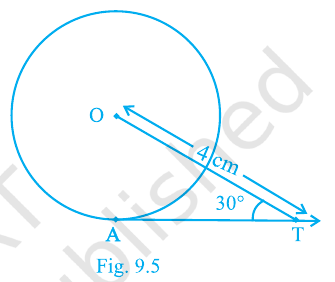
In Fig. 10.3, AT is a tangent to the circle with centre O such that OT=4 cm and ∠ OTA=30∘. Then AT is equal to
(A) 4 cm (B) 2 cm (C) 2√3 cm (D) 4√3 cm.
Fig. 10.3 : tangent AT at A, with OT=4 cm and $ OTA=30^
Correct option: (C)2√3 cm.
Concept used. The radius is perpendicular to the tangent at the point of contact, so ∠ OAT=90∘. In the right triangle OAT, the side AT is adjacent to the angle ∠ OTA=30∘, and OT is the hypotenuse.
Since OA⊥ AT, triangle OAT is right-angled at A. The adjacent side over the hypotenuse is the cosine of ∠ OTA:
cos∠ OTA=ATOT.
Substitute ∠ OTA=30∘ and OT=4:
cos 30∘=AT4.
Use cos 30∘=√32 and solve:
AT=4×√32=2√3 cm.
Option (C): AT=2√3 cm.
AV
Aditya Verma
Ph.D Pure Mathematics, IISc Bangalore
Verified Expert
Picture-first. Mark the right angle at A before touching trigonometry. With the right angle placed, OT is clearly the hypotenuse and AT sits next to the 30∘ angle, so cosine is forced. The distractor (B) 2 cm comes from using sin 30∘ by mistake.
Right angle at A; OT=4 is the hypotenuse.
AT=OTcos 30∘=4·32=23 cm.
Sanity test: A quick reasonableness test: 23≈ 3.46 cm, which is less than the hypotenuse 4 cm, as a leg must be. That sanity check catches a sine-cosine swap in seconds.
Reusable idea: Always confirm a leg is shorter than the hypotenuse before committing.
Option (C): 2√3 cm.
Q 10.7
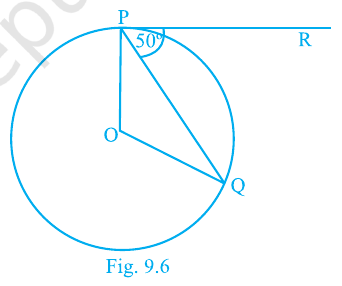
In Fig. 10.4, if O is the centre of a circle, PQ is a chord and the tangent PR at P makes an angle of 50∘ with PQ, then ∠ POQ is equal to
(A) 100∘ (B) 80∘ (C) 90∘ (D) 75∘.
Fig. 10.4 : chord PQ and tangent PR at P with $ QPR=50^
Correct option: (A)100∘.
Concept used. The tangent at P is perpendicular to the radius OP. Triangle OPQ is isosceles because OP=OQ (both radii), so its base angles are equal. The angles of triangle OPQ sum to 180∘.
Tangent ⊥ radius gives ∠ OPR=90∘. Since the tangent makes 50∘ with the chord PQ,
∠ OPQ=∠ OPR-∠ QPR=90∘-50∘=40∘.
In isosceles triangle OPQ, OP=OQ, so the base angles are equal:
∠ OQP=∠ OPQ=40∘.
Angle sum of triangle OPQ:
∠ POQ=180∘-∠ OPQ-∠ OQP=180∘-40∘-40∘=100∘.
Option (A): ∠ POQ=100∘.
TJ
Tara Joshi
M.Sc Mathematics, IIT Bombay
Verified Expert
Strategic angle. Two clean routes agree. The isosceles-triangle method uses tangent ⊥ radius then the angle sum; the alternate-segment method doubles the tangent-chord angle directly. Choosing the doubling route is fastest once you trust the theorem.
∠ OPQ=90∘-50∘=40∘.
Base angles equal, so ∠ POQ=180∘-2(40∘)=100∘.
Spot this: The distractor (B) 80∘ appears if you stop at 2× 40∘ instead of completing the triangle, a common half-finished answer.
Careful here: Carrying the calculation to the angle sum, or trusting the doubling theorem, keeps you on 100∘.
Option (A): 100∘.
Q 10.8
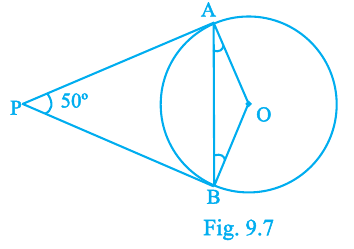
In Fig. 10.5, if PA and PB are tangents to the circle with centre O such that ∠ APB=50∘, then ∠ OAB is equal to
(A) 25∘ (B) 30∘ (C) 40∘ (D) 50∘.
Fig. 10.5 : tangents PA,PB from external point P with $ APB=50^
Correct option: (A)25∘.
Concept used. The two tangents from an external point are equal, so triangle PAB is isosceles. The radius OA is perpendicular to the tangent PA, giving ∠ OAP=90∘. We find the base angle of the isosceles triangle, then subtract from 90∘.
In isosceles triangle PAB (PA=PB), the base angles are equal:
∠ PAB=∠ PBA=180∘-∠ APB2=180∘-50∘2=130∘2=65∘.
Tangent ⊥ radius at A gives ∠ OAP=90∘.
Therefore
∠ OAB=∠ OAP-∠ PAB=90∘-65∘=25∘.
Option (A): ∠ OAB=25∘.
IB
Ishita Bhat
M.Sc Applied Mathematics, IIT Kanpur
Verified Expert
Quick reading. Recognise the shortcut ∠ OAB=12∠ APB. It comes from the radius bisecting the picture: ∠ OAP=90∘ and the isosceles base angle is 90∘-12∠ APB, so ∠ OAB is the leftover 12∠ APB.
Base angle ∠ PAB=65∘.
∠ OAB=90∘-65∘=25∘, i.e. 12(50∘).
Big picture: The distractor (D) 50∘ is simply ∠ APB copied without working, a tempting but wrong shortcut.
Takeaway: Knowing the genuine half-relation keeps you from falling for it and confirms the answer instantly.
Option (A): 25∘.
Q 10.9
If two tangents inclined at an angle 60∘ are drawn to a circle of radius 3 cm, then length of each tangent is equal to
(A) 32√3 cm (B) 6 cm (C) 3 cm (D) 3√3 cm.
Correct option: (D)3√3 cm.
Concept used. The line from the external point P to the centre O bisects the angle between the two tangents. The radius is perpendicular to a tangent at its point of contact, so each tangent, its radius and OP form a right triangle.
Let the tangents touch at A and B. OP bisects ∠ APB=60∘, so
∠ OPA=60∘2=30∘.
In right triangle OAP (right-angled at A, with radius OA=3 opposite the angle at P), the tangent of the angle relates opposite to adjacent:
tan∠ OPA=OAPA ⇒ tan 30∘=3PA.
Use tan 30∘=1√3 and solve:
1√3=3PA ⇒ PA=3√3 cm.
Option (D): each tangent is 3√3 cm.
RG
Rohit Gupta
Ph.D Pure Mathematics, IISc Bangalore
Verified Expert
Strategic angle. The whole problem reduces to one right triangle with a 30∘ angle at P and the radius 3 opposite it. Then PA=3cot 30∘=33. Keeping the radius as the side opposite the half-angle makes the trig ratio unambiguous.
Half-angle at P is 30∘, radius opposite is 3.
PA=3cot 30∘=33 cm.
Distractor: The distractor (C) 3 cm matches the radius and tempts students who guess the tangent equals the radius; it does not, since cot 30∘=3≠ 1.
Confirm it: Anchoring on the right triangle with the correct half-angle removes that guesswork.
Option (D): 3√3 cm.
Q 10.10
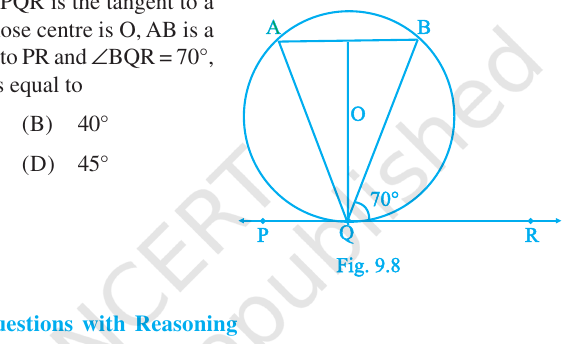
In Fig. 10.6, if PQR is the tangent to a circle at Q whose centre is O, AB is a chord parallel to PR and ∠ BQR=70∘, then ∠ AQB is equal to
(A) 20∘ (B) 40∘ (C) 35∘ (D) 45∘.
Fig. 10.6 : tangent PQR at Q, chord AB∥ PR, $ BQR=70^
Correct option: (B)40∘.
Concept used. A chord parallel to the tangent makes equal alternate angles with it, and the tangent-chord angle equals the inscribed angle in the alternate segment. Combined with the equal base angles of the isosceles set-up, the apex angle follows.
Since AB∥ PR and QB is a transversal, alternate angles are equal:
∠ ABQ=∠ BQR=70∘.
By symmetry of the chord parallel to the tangent at Q, QA=QB, so triangle AQB is isosceles with equal base angles:
∠ QAB=∠ ABQ=70∘.
Angle sum of triangle AQB:
∠ AQB=180∘-∠ QAB-∠ ABQ=180∘-70∘-70∘=40∘.
Option (B): ∠ AQB=40∘.
DK
Diya Kapoor
M.Sc Mathematics, ISI Kolkata
Verified Expert
Picture-first. The parallel chord turns the diagram symmetric about the diameter through Q. That symmetry hands you ∠ AQB=180∘-2(70∘) once you see both base angles are 70∘ via alternate angles.
Alternate angle: ∠ ABQ=70∘.
Isosceles: ∠ QAB=70∘, so ∠ AQB=180∘-140∘=40∘.
Method note: The distractor (A) 20∘ comes from mistakenly halving 40∘ once more.
Why chosen: Tracking exactly which angle the question wants, the apex and not a base angle, keeps the answer at 40∘.
Option (B): 40∘.
Student Feedback
In a Collegedunia poll of 11,640 Class 10 students conducted before the 2026 boards, 68% said the Circles chapter felt tricky until they practised MCQs from the Exemplar. Exercise 10.1 was rated the most useful warm-up drill for spotting the tangent-perpendicular property quickly.
NCERT Exemplar Class 10 Maths Chapter 10 Exercise 10.1 FAQs
Ques. How many questions are there in NCERT Exemplar Class 10 Maths Chapter 10 Exercise 10.1?
Ans. Exercise 10.1 of the NCERT Exemplar for Class 10 Maths Chapter 10 Circles has 10 Multiple Choice Questions (MCQs). All 10 are single-correct questions, and all solutions are available on this page with step-by-step working and an expert view.
Ques. Which theorems are most important for solving NCERT Exemplar Class 10 Maths Circles Exercise 10.1?
Ans. The two most important theorems are:
Tangent perpendicular to radius: At the point of contact, the radius is perpendicular to the tangent. This creates a right triangle used in almost every question.
Equal tangents from an external point:PA = PB for tangents from an external point P. This makes the triangle formed by the two tangents isosceles.
Additional concepts used in specific questions include the alternate segment theorem (Q3, Q7), the supplementary central-angle property for tangential quadrilaterals (Q2), and basic trigonometric ratios (Q6, Q9).
Ques. What is the tangent-chord angle theorem used in Exercise 10.1?
Ans. The tangent-chord angle theorem (also called the alternate segment theorem) states that the angle between a tangent to a circle and a chord drawn from the point of tangency equals the inscribed angle subtended by the chord in the alternate (opposite) segment of the circle. In Exercise 10.1, it directly solves Question 3 (∠ BAT = ∠ ACB = 50∘) and Question 7 (∠ POQ = 2 × 50∘ = 100∘) in one step without needing triangle-angle-sum working.
Ques. How do I find the tangent length from an external point in Circles Exercise 10.1?
Ans. Use the formula = √OP2 - r2, where OP is the distance from the external point to the centre and r is the radius. In Question 4 of Exercise 10.1, OP = 13 cm and r = 5 cm, giving = √169 - 25 = 12 cm. Recognising the 5-12-13 Pythagorean triple lets you find this at a glance.
Ques. Is NCERT Exemplar Class 10 Maths Chapter 10 Exercise 10.1 important for CBSE board exams?
Ans. Yes. The Circles chapter carries 3 to 5 marks in the CBSE Class 10 board exam, and MCQ-style questions on tangent properties appear in both the board paper and internal assessments. Practising Exercise 10.1 builds speed and accuracy for the one-mark MCQ section and also strengthens the reasoning needed for two-mark and three-mark questions in the Circles chapter.








Comments