




The Class 12 Physics NCERT Book PDF (2026-27 edition) is the official NCERT textbook, split chapter-wise as free PDFs. Each file is the same scan that NCERT puts on its own portal.
Class 12 Physics NCERT Book PDF Download

Every chapter of the 2026-27 Class 12 Physics NCERT is listed below. Each row links the chapter PDF and its study material. NCERT prints the book in two volumes: Part 1 covers Chapters 1 to 8, and Part 2 covers Chapters 9 to 14. The chapter-wise PDFs below let you grab only what you need.
We mirror it here so it downloads faster. You also get the Hindi-medium edition and the answer keys to the back exercises.
- Chapters covered: 14 chapters across 8 CBSE units, exactly as the rationalised 2024-25 NCERT print carried into 2026-27
- Format: chapter-wise official NCERT PDFs (Part 1 and Part 2 together cover all 14 chapters); a single combined volume is also linked
- Languages: English and Hindi-medium editions of every chapter
- Use case: the main reference whenever the Notes or Solutions point to a figure, worked example, or NCERT page number
Every chapter PDF here is the official NCERT 2026-27 edition. We take it straight from NCERT and mirror it with no changes. The back exercises and worked examples stay in the original page order.
Why Download the Class 12 Physics NCERT Book PDF from Collegedunia?
NCERT hosts the same PDFs on its own portal. But the Collegedunia mirror fixes three problems most students hit. Downloads slow down during result-week traffic. There is no quick way to find one chapter from the contents page. And there is no link to notes or solutions.
- Fast chapter-wise downloads: each chapter is a separate 2 to 6 MB file. It opens on phone or laptop without the 200 MB full-book download.
- Direct chapter index: the table above jumps straight to the chapter. You skip the nested menu on ncert.nic.in.
- Hindi-medium files too: each chapter comes in both English and Hindi (Bhautiki), matching what students see in school.
- Linked to the Notes and Solutions: every chapter PDF pairs with the matching Collegedunia notes and step-by-step solutions. The textbook and the explanation sit one click apart.
- Mobile-friendly viewer: open the PDF right in the browser, with no download. Handy for a quick check while clearing a doubt.
- Updated to 2026-27: the version here matches the current trimmed edition. Older 2023 or earlier prints are not hosted, since they hold content the syllabus dropped.
What 19,210 students told us about their Class 12 Physics NCERT Book usage
Source: Magnet Brains on YouTube
Class 12 Physics NCERT Book: Part 1 vs Part 2 Split
NCERT prints Class 12 Physics as two volumes. Knowing which part holds which chapter helps if you buy the printed book instead of the PDFs.
| Volume | Chapters | Roughly what it covers | Approx page count |
|---|---|---|---|
| Part 1 (Bhautiki Bhag 1 in Hindi) | Ch 1 to Ch 8 | Electrostatics, Current Electricity, Magnetism, Electromagnetic Induction, Alternating Current, Electromagnetic Waves | ~280 pages |
| Part 2 (Bhautiki Bhag 2 in Hindi) | Ch 9 to Ch 14 | Ray Optics, Wave Optics, Dual Nature, Atoms, Nuclei, Semiconductor Electronics | ~230 pages |
The chapter PDFs above let you skip the part-split and grab any chapter on its own. If you read on a phone, use the chapter-wise files. The full Part 1 or Part 2 PDF is better for printing a whole volume into a revision booklet.
Class 12 Physics Topic Map (Aligned to the NCERT Book Chapters)
Here is how the 14 chapters group into the 8 CBSE units. This unit-to-chapter map sets how many questions each unit gets on the board paper.
| Unit | NCERT Book chapters | What the textbook chapter covers |
|---|---|---|
| I. Electrostatics | Ch 1, Ch 2 (Part 1) | Coulomb's law, electric field, dipoles, Gauss's law and its applications, electric potential, capacitors and dielectrics. |
| II. Current Electricity | Ch 3 (Part 1) | Drift velocity, Ohm's law, resistivity, Kirchhoff's rules, Wheatstone bridge, potentiometer. |
| III. Magnetism | Ch 4, Ch 5 (Part 1) | Biot-Savart law, force on a moving charge, moving-coil galvanometer, magnetic materials, earth's magnetism. |
| IV. EMI and AC | Ch 6, Ch 7 (Part 1) | Faraday and Lenz laws, self and mutual inductance, AC circuits, LCR resonance, transformer. |
| V. Electromagnetic Waves | Ch 8 (Part 1) | Displacement current, EM wave properties, the EM spectrum. |
| VI. Optics | Ch 9, Ch 10 (Part 2) | Mirrors, lenses, optical instruments, Huygens principle, interference, diffraction, polarisation. |
| VII. Dual Nature of Radiation and Matter | Ch 11 (Part 2) | Photoelectric effect, Einstein's equation, de Broglie matter waves. |
| VIII. Atoms and Nuclei | Ch 12, Ch 13 (Part 2) | Bohr model, hydrogen spectral series, radioactivity, nuclear fission and fusion. |
| IX. Electronic Devices | Ch 14 (Part 2) | p-n junction, diodes, rectifiers. |
NCERT Class 12 Physics Deleted Syllabus 2026-27
NCERT has trimmed the 2026-27 Class 12 Physics syllabus to cut the study load for CBSE Boards, JEE and NEET. The seven topics below are officially out of the 2026-27 question paper, so skip them while revising.
| Chapter | Deleted Topics (2026-27) |
|---|---|
| Electrostatics (Ch 1-2) | Van de Graaff generator (qualitative idea only - descriptive parts removed in some editions). |
| Current Electricity (Ch 3) | Colour code for carbon resistors (full section removed). |
| Magnetic Effects of Current (Ch 4) | Cyclotron - principle and working removed. |
| Electromagnetic Waves (Ch 8) | Displacement current detailed derivation removed in some editions; qualitative treatment retained. |
| Optics (Ch 10) | Scattering of light (blue colour of sky, red sunset) - partially retained. |
| Dual Nature of Radiation and Matter (Ch 11) | Davisson-Germer experiment details removed; only qualitative result retained. |
| Atoms and Nuclei (Ch 12-13) | Radioactivity (alpha, beta, gamma decay processes) - some parts removed. |
The chapter resources in the All Chapters index above already mark every deleted line inline, so you don't waste revision hours on dropped topics.
NCERT BOOK PDF · CLASS 12 PHYSICS
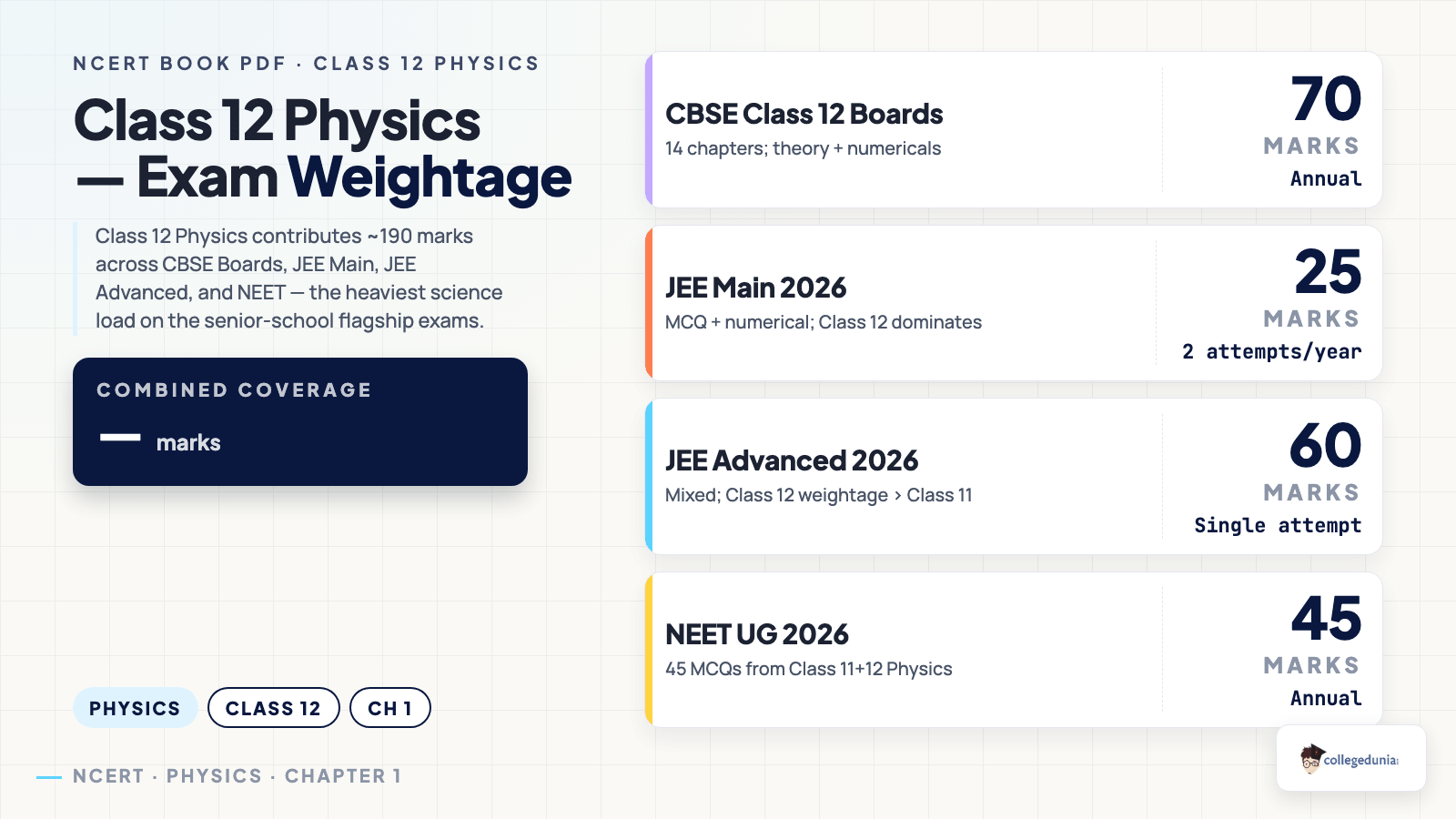
Class 12 Physics - Exam Weightage Across CBSE, JEE and NEET
Class 12 Physics contributes roughly 200 marks combined across CBSE Boards, JEE Main, JEE Advanced and NEET UG, the heaviest science load on the senior-school flagship exams.
NCERT Book PDF File Sizes and Page Counts
Use this if you have little phone storage or slow internet. The figures below come from the official 2026-27 NCERT release.
| Chapter | Title | NCERT pages | PDF size |
|---|---|---|---|
| Ch 1 | Electric Charges and Fields | ~36 | ~2.2 MB |
| Ch 2 | Electrostatic Potential and Capacitance | ~36 | ~2.4 MB |
| Ch 3 | Current Electricity | ~38 | ~2.6 MB |
| Ch 4 | Moving Charges and Magnetism | ~34 | ~2.5 MB |
| Ch 5 | Magnetism and Matter | ~22 | ~1.8 MB |
| Ch 6 | Electromagnetic Induction | ~26 | ~2.0 MB |
| Ch 7 | Alternating Current | ~26 | ~2.1 MB |
| Ch 8 | Electromagnetic Waves | ~18 | ~1.6 MB |
| Ch 9 | Ray Optics and Optical Instruments | ~52 | ~3.4 MB |
| Ch 10 | Wave Optics | ~30 | ~2.3 MB |
| Ch 11 | Dual Nature of Radiation and Matter | ~22 | ~1.9 MB |
| Ch 12 | Atoms | ~22 | ~1.7 MB |
| Ch 13 | Nuclei | ~24 | ~1.9 MB |
| Ch 14 | Semiconductor Electronics | ~24 | ~1.9 MB |
The full Class 12 Physics NCERT Book PDF (Part 1 and Part 2 together) is about 510 pages and 30 MB. Use chapter-wise downloads unless you are printing the full textbook.
What's Changed in the 2026-27 Class 12 Physics NCERT Book
The 2026-27 NCERT Class 12 Physics book has the same structure as the trimmed 2024-25 edition. Here are the main changes carried forward from the earlier print:
- Communication Systems (the old Chapter 15) is removed: it is not in the 2026-27 print. If you use an older edition, skip Chapter 15 fully.
- Semiconductor Electronics (Ch 14) is trimmed: transistor amplifier circuits, oscillators, and logic-gate truth tables are out of scope. Only p-n junction diode characteristics and rectifier circuits stay.
- Magnetism (Ch 5) is shorter: the magnetic dipole moment of a revolving electron is now just a definition with the gyromagnetic ratio result. The full angular-momentum derivation is gone.
- Van de Graaff generator (Ch 2): kept only as a labelled diagram with a 2-line working principle, not as a worked numerical.
- Cyclotron (Ch 4): retained in full as a board-paper-frequency derivation.
- Polarisation by reflection (Ch 10): Brewster's law and its derivation are back in scope after a short removal in earlier editions.
If you have last year's print at home, the chapter-wise PDFs above let you check which sections moved in or out.
How the NCERT Book PDF Pairs with the Other Class 12 Physics Resources
The NCERT Book PDF is the source. Every other Class 12 Physics resource on Collegedunia is built on the chapter numbering and worked examples in this book.
- Class 12 Physics Notes: concept revision drawn from the NCERT chapter, with derivation walkthroughs that match the book's notation.
- Class 12 Physics NCERT Solutions: every back-exercise question worked out, in the order printed in the NCERT chapter.
- Class 12 Physics Formula Sheet: every equation in the NCERT chapter pulled into a compact one-page sheet per chapter.
- Class 12 Physics Exemplar Book PDF: the separate NCERT Exemplar Problems book, with harder problems than the back exercise. Pair it with the Class 12 Physics Exemplar Solutions for worked answers.
- Class 12 Physics Handwritten Notes: notebook-style, scanned-look concept revision of the same NCERT chapters.
How to Use the Class 12 Physics NCERT Book PDF in Revision
The NCERT Book is your reference text, not your daily revision tool. Open the PDF in these moments:
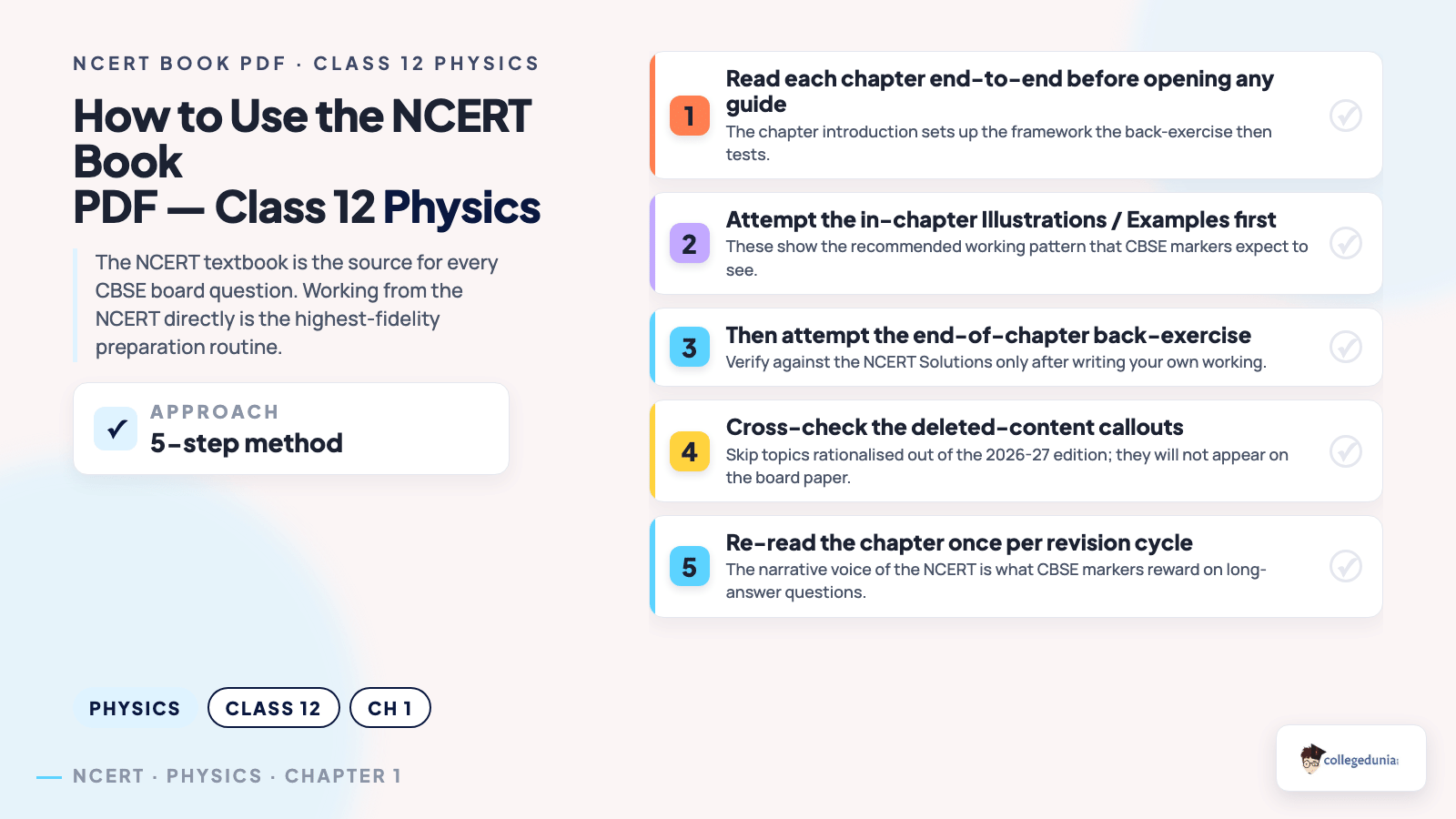
5-STEP METHOD · CBSE TOPPER ROUTINE
How to Use the NCERT Book PDF - Class 12 Physics
- 1Read the chapter first. Open the NCERT Book PDF or chapter Notes. The resource assumes you already know the concepts.
- 2Try each question on your own. Write the working in a notebook before you open the answer. Just reading does not build exam speed.
- 3Compare your working to the resource. Mark every step where your method differed. Those are the spots that lose marks on the board paper.
- 4Flag questions taking over 7 minutes. These go on the re-attempt list for the final-week revision pass.
- 5Read the example boxes first, prose second. The worked examples carry the testable patterns. They are the closest thing to a CBSE marking scheme inside the textbook.
- When the Notes or Solutions point to a figure number: open the chapter PDF and scroll to the figure instead of reading a word description. Optics and Magnetism chapters have figures that are hard to describe in words. The original NCERT caption often adds a clarification that the Notes paraphrase loses.
- When you doubt a worked example: each NCERT chapter has 8 to 14 worked examples in the text. Open the Book PDF to check the Notes match the source. This helps when a Solution skips a step that the original example shows in full.
- Before you try Exemplar problems: read the NCERT chapter once, end to end. Exemplar problems assume you know the textbook. Many wrong MCQ options are built around ideas the NCERT chapter mentions in passing but the Notes may cut.
- For Points to Ponder and chapter summaries: the last page of each NCERT chapter has a Points to Ponder list and a summary that students often miss. Both are good 5-minute revision blocks before unit tests. Several CBSE 2-mark short-answer questions in the last five years came almost word for word from the Points to Ponder list.
- For NCERT-only exercises like the "Additional Exercises" block: Chapters 1, 2, 3, 9, and 14 have extra exercises after the main back exercise. These are not in any coaching workbook. They are exactly the board-pattern numericals CBSE has reused in recent years.
- Quick check during JEE Main and NEET practice: when a competitive-exam question feels new, the NCERT chapter PDF is the fastest way to see if the concept is in scope or if the coaching module went past the syllabus.
Student Feedback: What 19,210 Class 12 Physics Students Told Us
What 19,210 students told us about their Class 12 Physics NCERT Book usage
- 88% of students downloaded chapter-wise NCERT Book PDFs at least once in the 2025-26 year, mostly for offline phone reading.
- Most-downloaded chapter: Chapter 9 Ray Optics PDF, opened an average of 2.8 times per student, ahead of Chapter 6 Electromagnetic Induction at 2.1 times.
- 63% of students liked chapter-wise downloads over the full-volume PDF, since the chapter file opens faster in a phone browser.
- Hindi-medium downloads made up 34% of all NCERT Book PDF downloads from Hindi-belt states, matching the board language most of them use.
Also Check: Related Class 12 Physics Resources
- Also Check: CBSE Class 12 Physics chapter notes hub on Collegedunia Exams
- Also Check: CBSE Class 12 exam pattern, dates, and full-subject hub
- Also Check: CBSE Class 12 Syllabus 2026-27
- Also Check: JEE Main 2026 exam information
- Also Check: JEE Main 2026 Syllabus
- Also Check: NEET 2026 exam information
- Also Check: NEET 2026 Syllabus
Class 12 Physics NCERT Book PDF FAQs
Ques. Where can I download the Class 12 Physics NCERT Book PDF?
Ans. Every chapter-wise Class 12 Physics NCERT Book PDF is downloadable directly from the index above, from Chapter 1 Electric Charges and Fields through Chapter 14 Semiconductor Electronics. The combined Part 1 plus Part 2 volume is also linked. Both Normal and HD resolutions are free.
Ques. Is this NCERT Book PDF the 2026-27 edition?
Ans. Yes. The chapter PDFs match the official NCERT 2026-27 print, the same version on ncert.nic.in. Where NCERT cut content from the older 2023 print (Communication Systems removed, Semiconductor Electronics trimmed), the PDFs here show those edits.
Ques. How many chapters are in the Class 12 Physics NCERT Book?
Ans. 14 chapters across 8 CBSE units. NCERT publishes them in two physical volumes: Part 1 (Chapters 1 to 8, covering Electrostatics through Electromagnetic Waves) and Part 2 (Chapters 9 to 14, covering Optics through Semiconductor Electronics). The Topic Map table above lists every chapter under its unit.
Ques. Is the Hindi-medium Class 12 Physics NCERT Book PDF available?
Ans. Yes. Every chapter ships with a Hindi-medium PDF (Bhautiki Bhag 1 for Chapters 1 to 8 and Bhautiki Bhag 2 for Chapters 9 to 14) alongside the English version. The Hindi edition matches the printed textbook distributed to Hindi-medium CBSE schools.
Ques. How is the NCERT Book PDF different from the Notes and Solutions?
Ans. The NCERT Book PDF is the source textbook itself, the original NCERT print. The Class 12 Physics Notes shrink its concepts into an 18 to 26 page revision per chapter, with derivation walkthroughs. The Class 12 Physics NCERT Solutions work every back-exercise question end to end. Open the Book PDF when the Notes or Solutions point to a figure or worked example you want to see in full.
Ques. What is the file size of the full Class 12 Physics NCERT Book PDF?
Ans. The combined Part 1 plus Part 2 PDF is roughly 30 MB and 510 pages. Individual chapter PDFs range from 1.6 MB (Chapter 8 Electromagnetic Waves at 18 pages) up to 3.4 MB (Chapter 9 Ray Optics at 52 pages). The chapter-wise downloads listed above are recommended for phone reading.
Ques. Which chapter was removed from the Class 12 Physics NCERT Book in 2026-27?
Ans. Communication Systems (the old Chapter 15) is no longer part of the 2026-27 syllabus and is not included in this NCERT Book PDF index. Students using older editions should skip Chapter 15 entirely.
Ques. Is the NCERT Book enough on its own to crack the Class 12 Physics board paper?
Ans. For a 70 to 80 mark score, yes. The NCERT chapter text, worked examples, and back exercises together cover everything on the CBSE board paper. For 90 plus, add the Exemplar problems and one previous-year-paper round. Toppers said NCERT-only study gets you to the upper 70s. The last 10 to 15 marks need Exemplar-level practice.
Ques. What does Class 12 Physics cover?
Ans. Class 12 Physics has 14 chapters. They cover electrostatics, current electricity, magnetism, electromagnetic induction and alternating current, electromagnetic waves, ray and wave optics, modern physics (photoelectric effect, atoms, nuclei), and semiconductor electronics. The course is the base for the CBSE Class 12 boards and the Physics sections of JEE Main, JEE Advanced, and NEET.
Ques. Why use the Collegedunia NCERT Book PDF mirror instead of ncert.nic.in?
Ans. The PDFs are the same, since Collegedunia mirrors the official files. The gains are practical. Downloads are faster during busy weeks like result time. You get direct chapter links instead of a nested menu. And each chapter links to the matching Notes and Solutions.
Ques. Is the NCERT Book PDF useful for JEE Main and NEET preparation?
Ans. Yes. NCERT is the base text for both JEE Main and NEET Physics. The chapter coverage and worked examples in the NCERT Book match the JEE Main and NEET syllabus closely. Coaching institutes keep telling students to read the NCERT chapter deeply before starting any coaching module.



Comments